
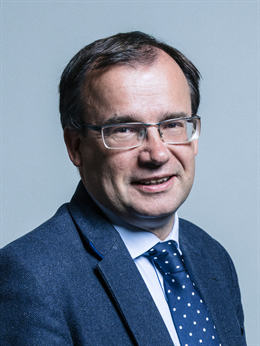
The speech made by Gareth Thomas, the Labour MP for Harrow West, in the House of Commons on 13 May 2026.
I should say at the outset how much I welcome the opening remarks of my right hon. Friend the Prime Minister about antisemitism. Kenton United Synagogue and Golders Green sit very close to my constituency. The attacks were shocking and appalling; I welcome the Government’s determination to crack down on online hatred and antisemitism, and I take this opportunity to commend the courage and skill of the police officers who responded.
One of the many important points that my hon. Friend the Member for Bradford West (Naz Shah) made in her excellent and humorous speech was the need for those of all faiths—and indeed those of no faith—to stand together against hatred. That point will resonate particularly in a constituency such as mine. My hon. Friend gave a brilliant speech. She is an inspiration, and I suspect I am not the only Member to feel that it is an honour to be in the same party as her.
My hon. Friend the Member for Harlow (Chris Vince), who is without doubt a rising star in our ranks, made me jealous with his marathon-running skills. If hon. Members will forgive me, I will not dwell on his love letter to Harlow, but I will dwell a little bit on our shared commitment to co-operation. Together with other members of the Co-operative parliamentary party, I hope we will see progress on delivering solutions to the need for capital so that more co-operatives can expand in our country over the time covered by this King’s Speech.
The biggest challenge facing our country remains how to put more money in people’s pockets and drive up living standards at a time of ever-increasing global tensions. It is worth remembering what the Leader of the Opposition is clearly trying to forget: after 14 years of austerity, and after the Conservatives and their friends in Reform led us out of the world’s biggest market, doing huge economic damage, our public services are still in need of sustained investment. In that regard, I share my constituents’ impatience for change.
I welcome the determination in the Gracious Speech to continue to reform the leasehold system, for example to make service charges more transparent, fairer and easier to challenge. I welcome the plans to abolish NHS England, to fund more investment in expanding GP services and to bring down waiting lists and waiting times in hospitals such as Northwick Park, which serves my constituents.
I welcome, too, the overdue crackdown on late payments by big firms to small businesses.
There are two long-term changes that I believe are key to delivering sustained higher living standards, particularly for my constituents. The first will be to secure far better access to Europe’s single market; the second will be to secure far better access to finance for small businesses and the financially vulnerable. On Europe, I particularly welcome the European partnership Bill in this Gracious Speech as the next step towards a closer relationship with Europe. With the US increasingly unreliable as an ally and with the economic damage from Brexit ever clearer, Britain needs to prioritise negotiating a dramatically better trade, defence and security deal with the EU. The imminent deal lowering barriers to trade in food will reduce red tape and lower business costs. The decision to rejoin Erasmus and the coming deal on youth mobility are positive, too.
A referendum in my lifetime on whether to rejoin the EU feels inevitable, and if it happens, I will be very tempted to campaign to rejoin. We are, though, a long way from such a moment. The priority, with the next UK-EU summit coming up, should be to reach agreement for a full renegotiation of the trade and co-operation agreement and to secure greater access to the single market, which would be far more beneficial than mere customs union membership. The recently concluded EU-Swiss trade deal offers a helpful pointer, with much more integration into the single market for more sectors of Switzerland’s similarly service-based economy. Further security and defence co-operation, increased business mobility, mutual recognition agreements to remove duplicate product testing and certification to make it easier for businesses to sell British goods in European markets would make a significant difference for businesses here, for our economy and ultimately for living standards.
Dave Doogan
I am listening intently to the hon. Gentleman’s anticipation of a brighter future, with a closer relationship with the EU. He even goes so far as to say that he looks forward to another referendum on whether to rejoin the European Union. Does he agree that when we are sold an outcome in a false prospectus on a referendum, it is probably no big deal to have a rerun of that referendum so that we can make an informed decision about our constitutional future?
Gareth Thomas
The one thing I would agree with the hon. Gentleman on is that we need a closer relationship. It is this Government who have sought to rebuild relations with Europe, and they are doing so increasingly effectively. On the need to open up opportunities for more co-operation with Europe, I recognise that we will have to pay to access the single market more easily, but given the damage to our economy, the higher costs and the extra bureaucracy that the poorly negotiated Brexit deal brought in its wake, we should be willing to negotiate that hard bargain.
The second long-term issue that we should focus on as necessary to deliver sustained higher living standards is banking. Millions of people and thousands of small businesses are locked out of affordable credit and forced into high-cost or illegal lending. Money is being taken from the pockets of the poorest, and economic growth is being stifled. This is an entrenched but fixable market failure, which I hope the coming enhancing financial services Bill may begin to address.
Research published in January by the National Institute of Economic and Social Research, funded by the Treasury and the Department for Business and Trade, made the striking conclusion that if Britain had a network of mutual banks that had stronger direct relationships with their small business owners, growth would be higher by between 1% and more than 2% over its first five years, rising to between 1.7% and 3.5% over the long term. It noted, too, that investment would be almost 2% to 3.5% higher in the first five years, rising to between 2% and almost 4.5% higher in the long run. The research—it is academic research—looks at the impact of mutual banks in France, state-run German regional banks and community development finance institutions in the US, and considers how much more lending would happen if the UK had a somewhat less centralised banking model than we have now.
Many suggestions for how to deliver growth are currently doing the rounds, but the scale of the impact of more investment in mutual or community banks, as this serious research suggests, raises the obvious question of what more we could achieve in this area during this Parliament by expanding the reach and scale of mutual banks, building more direct and personal relationships with more small and medium-sized businesses, offering more affordable credit options for personal customers, and creating a greater willingness to back hard-headed community ownership initiatives that help to restore pride in the places where we live.
Fair banking legislation—similar to that in the US—would help. Proactive efforts to help credit unions expand through employers, particularly those in the public sector, offering payroll deduction options would help too. The biggest banks should actively help support the expansion of community banks; one or two do, but they need sustained private capital investment. Barclays, Santander and HSBC invest in community development finance institutions or community banks in the US, but they do not here in the UK. That should change.
Let me turn to the international situation. I welcome the Government’s continuing support for Ukraine, the decision to stay out of the illegal conflict with Iran and the strong support for NATO. The situation in Gaza remains profoundly disturbing. Every child under five in Gaza is considered undernourished by UNICEF and other aid agencies. Almost every school has been destroyed or severely damaged, and 96% of households lack adequate access to water. Over 1 million children are facing a catastrophic humanitarian crisis, which I suggest demands fresh and sustained UK engagement. I strongly supported the Government’s decision last year to recognise the state of Palestine to protect the viability of a two-state solution and create a path towards a lasting peace for the Israeli and Palestinian people. Distant as that prospect may seem, in my view it remains the only path to a sustainable peace for the Palestinians and Israelis alike. The UN documented more than 1,800 settler attacks last year in the west bank—the highest on record and clearly part of a sustained campaign to reduce the possibility of a viable Palestinian state. Action to clamp down on goods coming into the UK from illegal settlements and to further sanction violent settlers is needed.
Lastly, 80 years since the founding meeting took place just across from where this House meets, a renewed commitment to the United Nations has never been more necessary. For all its failings—and there have been many—it remains our best route for addressing conflicts, for tackling global health threats, for promoting the rights of all, for delivering humanitarian aid and for championing the interests of the world’s most vulnerable. With our coming G20 and G7 presidencies, we are in a unique position to support the current UN Secretary-General as he seeks to rethink and reaffirm the UN’s role for the world we are in now. I hope that we will support him in those efforts.