
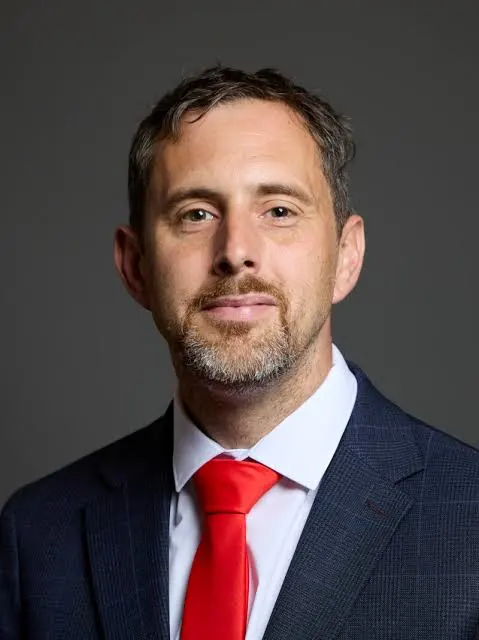
The speech made by Chris Vince, the Labour MP for Harlow, in the House of Commons on 13 May 2026.
It is an absolute honour to second this Humble Address. First, I thank my hon. Friend the Member for Bradford West (Naz Shah) for her incredibly powerful speech and echo her words about the importance of communities coming together to tackle the divisive politics that we have seen so often. I thank her for those comments.
May I also echo her comments about the House staff and the incredible job that they do to support all of us? Following my recent London marathon run, two of the Doorkeepers suggested that the only reason Sabastian Sawe did it in less than two hours was to get away from me talking about Harlow. As a big fan of curries, I look forward to having the opportunity to sample one in Bradford in the future, although I cannot speak for all my fellow Essex MPs.
Speaking to this motion is a unique opportunity. I have checked the records, and I am the first MP for Harlow to have had the opportunity to do so—mind you, Harlow has only been a constituency since the 1970s, and I am not counting Winston Churchill, who represented what is now Harlow when it still came under Epping. It may be the first time that a Harlow MP has delivered this speech, but I believe that this opportunity has come at the right time. When I reflect on the hurdles ahead, a lot can be learned by looking at Harlow’s past and Harlow’s future.
My seconding the Humble Address came about when I received a phone call from the Chief Whip on the train home. Like my hon. Friend the Member for Bradford West—and most Members across the House, I am sure—my first thought was, “What have I done wrong?” I thought that perhaps, as some Members across the House did, he had misheard me when I said “horned” during a speech; I did not much fancy explaining to him on a train full of my constituents that I had said “horned” and not another word that sounds like “horned”. Thankfully, that was not the case.
The Chief Whip told me there were certain traditions around the King’s Speech—that the seconder’s speech should be humorous and was an opportunity to mention the Member’s constituency as often as possible. This did sound like a good gig to me, to be fair. I cannot necessarily promise humour—although I will give it a good go—but I can certainly promise that I will mention Harlow as often as possible. Those listening at home may wish to count the number of times I do so. I believe the current count is seven. [Interruption.] Is it eight? What did I do for a living?
Harlow is never a dull place to represent. Members across the House will know that Harlow once again bucked the national trend when it came to last week’s local election results. We are getting quite good at that, even if it might not have been in quite the way I would have liked. However, it shows the ambition of the people of Harlow to see their town improve and grow—something that can only happen with this Government’s continued investment. Hint, hint!
The Chief Whip also told me that it was tradition to have an established MP propose the Loyal Address and for a “bright young thing” to second it. I have to say that I am not particularly bright and I am not particularly young—[Hon. Members: “Ah!”] But I am definitely a thing, so I can claim one third of that description.
I think the Chief Whip asked me to give this speech because he was aware that, on the last day of term, I failed to achieve my 400th contribution to Hansard. I thank everybody for being here so that I can now do so. In this parliamentary term I look forward to making 400 further contributions, with multiple references to Harlow, my mother’s sterling career at HMRC, and the fact that I may have previously been a maths teacher. [Hon. Members: “More!”] There is more; don’t worry.
I think we all recognise, as His Majesty does, that this King’s Speech comes at an increasingly dangerous and volatile time that, like hon. Friends and other hon. Members, I have spent a great deal of time thinking about. During this turmoil, I have taken the time to reflect on what it means to be British—those British values. What is our country about? What is the real Britain? We mention Britishness more and more, but it can mean any number of things to any number of people.
When I think about what it means to be British, I think about my recent experience running the London marathon. To be clear, I am not referring to when the right hon. Member for Basildon and Billericay (Mr Holden), with his Union flag shorts on, overtook me on mile 17, just as I hit the metaphorical wall. I have looked it up and he is two years younger than me, so I have an excuse.
During my marathon run—or perhaps in my case I should say my marathon limp—along the streets of London, I saw neither hate nor division. I saw unity. I saw people coming together to cheer on perfect strangers in their shared endeavour. I saw Gordon Ramsay randomly heckle me to carry on. I even got support from a Man United supporter. I saw everyone—man or woman, black or white, gay or straight—all lining the 26.2-mile course. And by the way, that 0.2 miles at the end is only made possible by those supporters. That is the Britain I know. That is the Britain that I love.
That sense of supporting one another, and of coming together as a community in hardship and celebration, is alive and well in Harlow. In fact, it was baked into the very foundation of Harlow when it was first conceived as part of the new town revolution under the first majority Labour Government in 1945.
Harlow remains a strong community today. When I think of Britishness, I think of Rainbow Services, which supports projects across Harlow by getting young people to build infrastructure for their community; I think of Streets2Homes, the homelessness charity I worked at that supports the most vulnerable in our society; and I think about the Michael Roberts charitable foundation, which runs the local food bank.
As I mentioned, Harlow is a post-war new town designed by Sir Frederick Gibberd to be a place of neighbourhoods and communities. It was built as a solution to the problem of overcrowding in London. Harlow sought to alleviate that pressure, while keeping communities tightly knit together. We can still see remnants of that today, with people from Walthamstow moving to The Stow in Harlow, which gives people a fresh start in life with all the comforts of their community. To this day, Harlow is one community built by lots of smaller and close communities—communities like Potter Street, Bush Fair, Church Langley and Little Parndon.
As Harlow grew into its new town, so too did its pioneering spirit. Just two weeks ago, I was lucky enough to recognise one of those pioneers by unveiling a blue plaque in memory of Harlow-raised scientist Dr George Hockham, one of the key brains behind the invention of the fibre-optic cable. Fibre-optic cable, created in Harlow, revolutionised modern communication not just in Britain, but across the world. For me, George Hockham and many others like him from Harlow can be an inspiration for Harlow’s next generation—a generation who deserve a Government on their side. I also think of inspirations like Professor Hannah Fry and Paralympian Anne Strike. These inspirations are a reminder of what it means to be British, to achieve so much and to have such a proud community behind you.
Harlow has a history to be proud of and a future to be excited about. As a former teacher—I do not know whether I have mentioned that fact—I am filled with pride when I visit schools across Harlow and see the incredible young people learning there. That is why I am proud that education is at the heart of this Government’s offer in the King’s Speech, building on the work done in the previous parliamentary Session.
Looking to this Session, the Government will tackle the broken special educational needs and disabilities system, giving every young person with SEND the support they need and supporting parents, not leaving them to battle a broken system. This issue cuts across this House. I am sure every hon. Member can recall a constituent coming to them broken, with nowhere to turn, at their wits’ end with a SEND system that benefits no one; I certainly can.
I also welcome the Government’s commitment to review the national curriculum to make it broader, recognising the importance of citizenship and financial education and the dangers of online harm. What our younger generation learn is so important. If I could achieve one thing, when I look back on my time serving Harlow, I want it to be achieving for the young people in Harlow the aspiration that they deserve. Every young person now sitting in a classroom in Harlow—primary or secondary—should have the opportunity to aspire to achieve whatever they want to do. That is what I want for Harlow.
Some might say the fact that I am standing in this Chamber, giving this speech, means that anyone can achieve anything if they are resilient enough. Let me tell you, Mr Speaker, I can roll with the punches, and believe me, my journey to these Green Benches did not happen without me getting knocked down along the way. I say now, directly to the young people of Harlow: Do not give up on your dreams. Do not let someone tell you that you can’t do it. If you really want something and you are willing to work hard for it, you can achieve it. I am proof of that, and I know that in this Government, you have a Prime Minister dedicated to giving that opportunity to others—because he is even more proof of it than I am.
I would be remiss of me not to take this opportunity to mention a personal focus of mine in this place: supporting young carers and young adult carers. I call on the Government once again to ensure that support for those particularly incredible young people is a golden thread running through everything that they do.
Of course, Harlow is about more than just its young people, and my community has not been immune to the pressures of the cost of living crisis. I welcome the work already done—the freezing of rail fares and prescription charges, the lifting of the two-child benefit cap and the raising of the minimum wage—but most of all I am pleased that this Government, in this King’s Speech, recognise that there is more to do to support families in Harlow.
When we talk about cost of living pressures, it is easy to get lost in the numbers— as a mathematician at heart, that is even easier for me. But to bring the issue home, when I think of the reality facing hard-working and proud families in Harlow, I think of my friend Jamie, who works six days a week to pay the bills, put food on the table for his two-year-old son and provide for his family. At the end of the month, he has very little, if anything. He cannot enjoy himself. He cannot treat his family. This parliamentary Session must be defined by being the one where we see living standards improve for everyone in our society, not just for the privileged few. That is what will be in my mind’s eye when I cast my votes in this place.
I am sure my hon. Friend the Member for Oldham West, Chadderton and Royton (Jim McMahon) is waiting anxiously for me to point out that I stand here in this place as not just a Labour MP, but a Labour and Co-operative MP. I am proud of the Co-operative party and the work it has been doing alongside the Government to empower local communities, like mine in Harlow, through community ownership. I hope this next Session will bring even more co-operative opportunities for people in Harlow.
Of course, like those of many hon. Members in this place, my constituency name does not encompass the full nature of my area. The Harlow constituency does not end at the town boundary; I also represent incredible villages with incredible histories. I represent Roydon, a village that first appeared in the Domesday Book. Bordering Roydon are Lower Nazeing and Dobbs Weir, which are home to the Lea Valley growers—some of the biggest vegetable producers in the country. I also represent Sheering, one of whose most notable residents is Rod Stewart. For the first time, Harlow also includes Hatfield Heath and Hatfield Broad Oak—I know that the Leader of the Opposition will vaguely remember those places—which are incredible communities with a strong sense of what it means to look after your neighbour; I have got a “Neighbours” reference in there for the Secretary of State for Culture, Media and Sport! Ironically, one of my predecessors, Bill Rammell, moved out of Harlow to one of the villages, but Harlow was not keen on this so it expanded its boundaries to include him back in the constituency, and we welcome him.
Part of the fun of representing such a diverse community, with its healthy share of rural and urban, is the mix I get to experience as its MP. I can visit local businesses in the morning, talk to a group of students in the afternoon, and then round up the day with a community event. I have attended my fair share of community events, although I am not convinced it was a great idea to run the Matching village 10K a week after the London marathon. I did not see the right hon. Member for Basildon and Billericay there—just saying! Perhaps he had already finished. [Laughter.] On the point about running, when I took part in the London marathon, I received the card from my parliamentary team wishing me luck, with one member of my team commenting: “You’ve run in enough elections, so a marathon should be easy.”
That brings me to my conclusion and to the line that I want to end with, which is from one of my own former teachers. Did I mention I was a teacher? Mr Feeley used to teach me science, although I am not really sure that we learned a lot of science in his lessons. However, I think this line perfectly sums up this Government. We should always remember: “it’s a marathon and not a sprint.” I would respectfully remind Members of that.