Tag: Speeches

  • Theresa May – 2018 Speech on Science

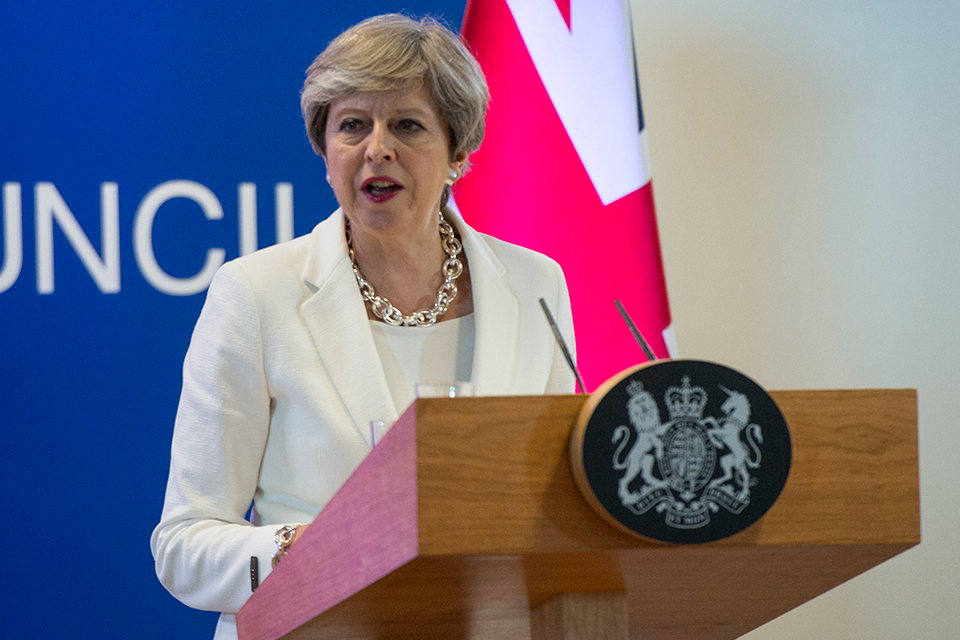
    Below is the text of the speech made by Theresa May, the Prime Minister, at Jodrell Bank on 21 May 2018.

    Introduction

    Jodrell Bank was established in 1945, in a Britain rebuilding in the aftermath of the Second World War.

    Motors from the gun turrets of battleships were built into the machinery used to rotate the dish of the awesome Lovell Telescope behind me.

    The first scientists to use it were continuing research into radar which had begun in wartime, with the purpose of defeating our enemies, but which they continued in peacetime, to extend human knowledge.

    Memories were fresh of the destruction that had been wreaked through what Winston Churchill called ‘the lights of perverted science’.

    But stronger than the doubts about technological change was a faith in the potential of scientific inquiry to overcome the great challenges of their time – want, disease, ignorance and squalor – and to light the path to a better future. They were men and women who stood at the threshold of a new age.

    Their grand-parents lit their homes with oil lamps and travelled by horse and cart, but they would live to see jet travel and space flight.

    Jodrell Bank is an icon of the United Kingdom’s tradition of scientific achievement and is today at the cutting edge of twenty-first century discovery.

    And as I look towards the future, that spirit of scientific inquiry, and its power to shape a better tomorrow, is at the heart of my vision.

    Because the world today stands at the threshold of a new technological age as exciting as any in our past.

    Great changes in how we live, how we work, how businesses trade will reshape our economy and transform our society in the years ahead.

    This technological revolution presents huge opportunities for countries with the means to seize them.

    And Britain is in pole position to do just that. We are ranked first in the world for research into the defining technologies of the next decade, from genomics and synthetic biology, to robotics and satellites.

    With 1 per cent of the world’s population, we are home to 12 of the top 100 universities.

    And London is Europe’s leading tech start-up cluster, attracting more venture capital investment than any other city.

    But this success is not automatic. We are at the forefront of scientific invention because we embrace change and use regulation not to stifle but to stimulate an environment for creativity.

    We have great universities because we have strengthened historic institutions and nurtured new intellectual powerhouses with public investment.

    Britain’s businesses can take on the world because they have access to a skilled workforce and modern infrastructure.

    Key to our success has been the combination of individual ingenuity and ambition with government action to invest in the future.

    British scientific achievement

    UK global leadership in science and innovation is one of this country’s greatest assets.

    For centuries Britain has been a cradle of scientific achievement.

    William Harvey’s discovery that blood circulates around the body provided the basis for modern physiology and lead directly to every great medical advance of the last 400 years.

    Isaac Newton’s establishment of the laws of motion, optics and gravitation defined the parameters of physics and laid the foundations on which modern science rests.

    Michael Faraday’s discovery of electromagnetic induction unlocked the potential of electricity to light up the world and power the modern age. Every day, we benefit from the work of generations of British scientists and engineers. Every time we use a computer or go online, we benefit from the genius of Alan Turing and the foresight of Sir Tim Berners-Lee.

    Every journey in an airliner is powered by the turbo-jet technology pioneered by Frank Whittle.

    Every day my life and the lives of millions of people around the world are made infinitely better because of the ground-breaking work on the structure of insulin by Dorothy Hodgkin.

    Each of these scientists and inventors has an inspiring story of human achievement borne of hours of patient labour from which we all reap the rewards.

    Contemporary British science is just as inspiring. Developing gene therapies to treat – and even cure – diseases that until now have been beyond us.

    Creating new materials like graphene that open-up opportunities across industry and medicine – from lighter display screens to synthetic bone tissue.

    Producing CT and MRI scanners to provide new ways of seeing inside the body to diagnose disease and target treatments.

    Scientific research is a noble pursuit and a public good – whether or not it leads directly to a commercial application.

    But when a discovery does have the potential to create or transform an industrial sector, time and again British entrepreneurs have been the first to capitalise on it.

    In the eighteenth century, Stoke-on-Trent became the ceramics capital of the world after Josiah Wedgewood industrialised the manufacture of pottery.

    In the nineteenth century, George Stephenson made Newcastle the first city anywhere to export railway locomotives.

    In the twentieth century, Arthur Pilkington made St Helen’s the global centre of innovation in glassmaking.

    The great towns and cities of Britain grew up as global centres of innovative production.

    However, the nature of innovation and progress is that new technology inevitably replaces old.

    And in the twenty-first century, some parts of the country that once thrived because of innovation and technology have seen the jobs and opportunities of the past fall away.

    But in others we have seen Britain’s capacity for invention and reinvention create twenty-first century success stories:

    Cardiff has gone from exporting coal to pioneering in semiconductors.

    Dundee from jute to computer gaming.

    Hull from whaling to wind-turbines.

    Our challenge as a nation, and my determination as Prime Minister, is not just to lead the world in the 4th industrial revolution – but to ensure that every part of our country powers that success.

    That is what our modern Industrial Strategy is all about.

    Investing in science and research to keep us at the forefront of new technologies and the benefits they bring.

    Nurturing the talent of tomorrow – through more outstanding schools, world-leading universities and the technical skills that will drive our economy.

    And transforming the places where people live and work – the places where ideas and inspiration are born – by backing businesses and building infrastructure not just in London and the South East but across every part of our country.

    Science at heart of a modern Industrial Strategy

    Government has always had a crucial role in supporting scientific research and the technological advancements that flow from it…

    …from the founding of the learned societies under royal patronage in the seventeenth century to the expansion of state-funded research in universities through the twentieth century.

    In the last few years, government support has helped create new landmark institutions, like the Francis Crick Institute – Europe’s biomedical research facility – and the Aerospace Technology Institute in Bedford – leading on research and technology in the aerospace sector.

    And in the Industrial Strategy, we have made a commitment to take our support for UK science and technology to another level.

    £7 billion in new public funding for science, research and innovation: the largest increase for 40 years.

    But to truly succeed we will go even further.

    As a government, we have set the goal of research and development investment reaching 2.4 per cent of GDP by 2027 – more than ever before.

    That could translate to an additional £80 billion investment in the ideas of the future over the next decade.

    But even that figure fails to capture the scale of the possibility this will create.

    Because science and technology have a dynamic relationship.

    The scientific breakthroughs of today will lead to technological advances which themselves open the door to further scientific discovery, the likes of which are beyond our imagination.

    And it won’t just be public funding – our R&D target covers the combined power of government and business alike.

    That is what the Industrial Strategy is all about – not just the state spending money but using smart public investment to harness private funding.

    Not government running enterprise, but a strategic state using its power and influence to create the right conditions to allow us to thrive in the long term.

    A strategic approach means ensuring we have an education system that gives young people the skills they need to contribute to the economy of the future.

    That means more free schools and academies providing great school places, a curriculum that sets the highest standards, and proper support for our teachers to deliver it…

    It means more rigorous science GCSEs preparing young people better for further study and work, and more young people going on to do sciences at A-level.

    And to attract talented science graduates into the teaching profession, we are offering tax-free bursaries worth up to £26,000 in priority subjects.

    And it means going even further in the future.

    Transforming technical education with new high-quality T-levels that are every bit as good as A-levels.

    New Institutes of Technology to provide higher-level education and training.

    And a national re-training scheme to help workers of all ages adapt their skills to the jobs of tomorrow.

    This is action from a strategic state to drive policy changes that will benefit our economy, our society and the individuals we serve.

    And it’s not just in education.

    A strategic approach means…

    …renewing and extending our infrastructure with faster trains, bigger stations, better road connections…

    …delivering next generation mobile and broadband connections, with faster speeds and better coverage…

    …ensuring we have the right regulation, modern employment standards, effective corporate governance rules.

    It means government doing what only it can do: fixing the essential foundations of our economy.

    That allows researchers, innovators and businesses to do what only they can do: generate and develop the great ideas, products and services that create jobs and produce growth.

    And if we do this – if we get the essentials of our economy right – we can focus our talents and ambition on seizing the opportunities of the future.

    Grand challenges

    We cannot predict the future or guess what technological or scientific breakthroughs might lie just around the corner.

    But we can observe the long-term trends that are shaping change in our world today and which will drive and demand innovation in the years ahead.

    We know that artificial intelligence and the big data revolution is transforming business models and employment practices across all sectors of the economy – especially in services, which are so important to our country.

    We can see that a rising global population and ever-increasing urbanisation, combined with new transport technologies, are driving profound changes in how we move people and goods around our cities and countries.

    We know that our society here in the UK, and in other developed countries around the world, is getting older – creating new demands and opportunities.

    And the international determination to address climate change and deliver clean growth in the future is one of the facts of our time – and one of the greatest industrial opportunities of all time.

    The modern Industrial Strategy identifies these four Grand Challenges as the areas of enormous potential for the UK economy.

    By channelling our efforts into meeting them – building on our strengths in science, innovation, and commerce – we can develop technologies to export around the world, we can grow whole new industries that bring good jobs across the UK, and we can achieve tangible social improvements for everyone in our society.

    Four missions

    From John Harrison’s development of the marine chronometer, to the sequencing of the human genome and treatments to tackle the AIDS crisis…

    …we have seen throughout our history that setting ambitious and clearly-defined missions motivates human endeavour.

    There is huge potential in a missions-based approach to drive faster solutions – and it is an approach being pioneered here in the UK, by University College London’s Commission on Mission-Oriented Industrial Strategy.

    So today I am setting the first four missions of our Industrial Strategy – one in each Grand Challenge.

    If they are to be meaningful, they must be ambitious and stretching.

    That means that our success in them cannot be guaranteed.

    But I believe that by setting a high ambition, we can achieve more than we otherwise would.

    So these are the missions I am setting today.

    AI and data

    First, as part of the AI and Data Grand Challenge, the United Kingdom will use data, artificial intelligence and innovation to transform the prevention, early diagnosis and treatment of diseases like cancer, diabetes, heart disease and dementia by 2030.

    Late diagnosis of otherwise treatable illnesses is one of the biggest causes of avoidable deaths.

    And the development of smart technologies to analyse great quantities of data quickly and with a higher degree of accuracy than is possible by human beings opens up a whole new field of medical research and gives us a new weapon in our armoury in the fight against disease.

    In cancer, our ambition is that within 15 years we will be able to diagnose at a much earlier stage the lung, bowel, prostate or ovarian cancer of at least 50,000 more people a year.

    Combined with the great treatment and care provided by our NHS, that will mean every year 22,000 fewer people will die within five years of their diagnosis compared to today.

    We will work with industry and the medical research community to announce specific ambitions in a range of other disease areas over the coming weeks and months.

    Achieving this mission will not only save thousands of lives.

    It will incubate a whole new industry around AI-in-healthcare, creating high-skilled science jobs across the country, drawing on existing centres of excellence in places like Edinburgh, Oxford and Leeds – and helping to grow new ones.

    Healthy ageing

    Second, through our healthy ageing grand challenge, we will ensure that people can enjoy five extra healthy, independent years of life by 2035, whilst narrowing the gap between the experience of the richest and poorest.

    We are living longer lives because of medical advances, better drugs, healthier lifestyles, and safer workplaces.

    It is a sign of our success, of our progress as a society, and is to be celebrated.

    But as we extend the years of our life, we should also work harder to increase quality of life in our later years.

    That should not just be the preserve of the wealthy – everyone, of every background and income level, has the right to enjoy a happy and active retirement.

    We can do that by supporting more people to stay happy, healthy and independent in their own homes for longer, instead of going into hospital.

    It will take a collective effort to achieve this.

    Employers can help, by meeting the needs of people who have caring responsibilities and by doing more to support older people to contribute in the workplace – and enjoy the emotional and physical benefits of having a job if they want one.

    Businesses can contribute, and benefit, by supplying the needs of a growing market.

    Innovative and well-designed products and services – from housing adaptations that make our homes safer for older people to live in, to smart technologies that help people continue to enjoy life if they have a health condition.

    These innovations can also be exported to a rapidly growing market around the world.

    And we can all play our part – by making healthier lifestyle choices ourselves, and by supporting our friends and neighbours as they get older.

    We can build a stronger society, where more people can contribute their talents for longer and fewer people face loneliness and isolation.

    Future of mobility

    Third, in the future of mobility grand challenge, we have a mission to put the UK at the forefront of the design and manufacturing of zero emission vehicles and for all new cars and vans to be effectively zero emission by 2040.

    Technology is revolutionising how we power vehicles, how they are driven, how we navigate and how we access information about public transport.

    Britain led the world into the railway age. We pioneered jet air travel.

    By putting the UK at the forefront of the twenty-first century transport revolution, we can ensure our automotive sector – one of our greatest success stories – continues to thrive and create good jobs across the country.

    We can make our towns and cities cleaner, safer and more productive places to live and work.

    We can set a global standard for managing technological change to maximise economic and environmental benefits.

    We will work with industry to achieve this ambition, and share the benefits this opportunity presents.

    Clean growth

    And fourth, in the clean growth grand challenge, we will use new technologies and modern construction practices to at least halve the energy usage of new buildings by 2030.

    Heating and powering buildings accounts for 40 per cent of our total energy usage.

    By making our buildings more energy efficient and embracing smart technologies, we can slash household energy bills, reduce demand for energy, and meet our targets for carbon reduction.

    By halving the energy use of new buildings – both commercial and residential – we could reduce the energy bills for their occupants by as much as 50 per cent.

    And we will aim to halve the costs of reaching the same standard in existing buildings too.

    Meeting this challenge will drive innovation and higher standards in the construction sector, helping it to meet our ambitious homebuilding targets and providing more jobs and opportunity to millions of workers across the country.

    It will be a catalyst for new technologies and more productive methods, which can be exported to a large and growing global market for clean technologies.

    These four missions are just the beginning – and in setting further missions across the four grand challenge areas, we will work closely with businesses and sectors.

    In each one of these four missions, scientific and technological innovations have the potential to create jobs, drive economic growth across the country and deliver tangible improvements for everyone in our country.

    This represents a level of ambition every bit as high as that which created Jodrell Bank and rebuilt Britain in 1945.

    We live in a different world today. Our economy is more globalised. Our strengths are in services, as well as in manufacturing. Our population is older.

    And the Industrial Strategy sets its sights on our future, not our past.

    As we look towards that new future for the UK outside of the European Union, the UK’s ingenuity and creativity will be what drives our progress as a nation.

    Science and Brexit

    William Wordsworth described the statue of Sir Isaac Newton that stands in the chapel of Trinity College, Cambridge as being ‘the marble index of a mind forever voyaging through strange seas of thought, alone.’

    That romantic image belies the truth that the essence of scientific progress is not private contemplation, but collaboration.

    Nothing is achieved in isolation and it is only through co-operation that advances are made. Every great British scientist could only reach new frontiers of invention because they built on the work of others, exchanged ideas with their contemporaries and participated in an international community of discovery.

    William Harvey learned medicine at the University of Padua.

    The first secretary of the Royal Society, Henry Oldenburg, was an immigrant from Germany.

    The discovery of DNA in Cambridge was the work of an Englishman, Francis Crick; an American, James Watson; a born New Zealander, Maurice Wilkins; and a descendent of Jewish immigrants from Poland, Rosalind Franklin.

    Indeed Newton himself put it best when he wrote that, ‘if I have seen further it is by standing on the shoulders of giants’.

    Science is an international enterprise and discoveries know no borders.

    The United Kingdom today is at the centre of a web of international collaboration.

    Our immigration system supports this, with no cap on the number of the students who can come to our universities, and thousands coming every year, learning from some of the finest academics and contributing to the success of some of the best universities in the world.

    Indeed, since 2010 the number of overseas students coming to study at UK universities has increased by almost a quarter.

    The UK will always be open to the brightest and the best researchers to come and make their valued contribution.

    And today over half of the UK’s resident researcher population were born overseas.

    When we leave the European Union, I will ensure that does not change.

    Indeed the Britain we build together in the decades ahead must be one in which scientific collaboration and the free exchange of ideas is increased and extended, both between the UK and the European Union and with partners around the world.

    I know how deeply British scientists value their collaboration with colleagues in other countries through EU-organised programmes.

    And the contribution which UK science makes to those programmes is immense.

    I have already said that I want the UK to have a deep science partnership with the European Union, because this is in the interests of scientists and industry right across Europe.

    And today I want to spell out that commitment even more clearly.

    The United Kingdom would like the option to fully associate ourselves with the excellence-based European science and innovation programmes – including the successor to Horizon 2020 and Euratom R&T.

    It is in the mutual interest of the UK and the EU that we should do so.

    Of course such an association would involve an appropriate UK financial contribution, which we would willingly make.

    In return, we would look to maintain a suitable level of influence in line with that contribution and the benefits we bring.

    The UK is ready to discuss these details with the Commission as soon as possible.

    Conclusion

    What I have set out today – unprecedented investment into science and research; four missions to drive businesses, academia, and government to meet the Grand Challenges of our time; and a clear commitment to extend our international collaboration after Brexit – build a positive vision for our country’s future.

    An open and innovative economy.

    The best place to start and grow a high-tech business.

    An outward-looking country, open to talent and ideas from around the world. A global centre for scientific discovery and creativity, where progress is driven by an optimism about the possibilities technological change can bring.

    There is no escaping the complexity of the challenge, but there should be no mistaking the scale of the opportunity before us either.

    The world is about to change – and is indeed already changing – at a remarkable pace.

    Technologies with the potential to transform our society will come of age in the years ahead.

    This is an exciting time to be alive – and rich in possibility for the curious, the inventive and the determined: the children in schools today studying STEM subjects in record numbers thanks to our education reforms.

    The undergraduates from an ever more diverse set of backgrounds now embarking on higher studies.

    The aspiring engineers and skilled workers who will benefit from our reforms to technical education over the coming years.

    The young researchers from around the world, starting their careers working in British laboratories.

    All have the chance to be part of one of the most exciting periods of discovery the world has ever known.

    Amongst their number will be names to be inscribed alongside the greatest figures of the past on the honour roll of scientific achievement.

    And together, we can continue a tradition of innovation that will extend our horizons and transform our lives.

  • Michael Gove – 2018 Speech on Plant Health

    Below is the text of the speech made by Michael Gove, the Secretary of State for Environment, Food and Rural Affairs, RHS Chelsea Flower Show on 21 May 2018.

    Thank you for those incredibly kind words and thank you also for the chance to come to Chelsea. Like all of you here I’m captivated by what’s been achieved by the designers, growers and everyone who has been brought together to create something truly magical for a limited period of time and something that we can all share.

    It’s a very special moment in the light of the nation Chelsea Flower Show. It’s a very special organisation the RHS and can I begin by expressing the thanks that I feel all of us to Sir Nicholas, the RHS and to everyone who has made this Chelsea possible. Can we show our gratitude please.

    This has been something of a Chelsea weekend for me. I spent Saturday at Wembley with my son watching Chelsea Football Club who afloat the FA cup. I can see that many of you were there. But it’s a somewhat different crowd who are here this afternoon. But what we are also celebrating is excellence in another field.

    But of course, both the Chelsea Flower Show and the FA cup were significant events this weekend. But there’s another event even more significant, if you forgive me this weekend, that was of course, the wonderful wedding of the Duke and Duchess of Sussex. And like many of you, I was held wrapped by the sermon delivered by Michael Curry. I thought that perhaps after hearing that sermon I should rewrite my speech.

    I shall begin thus, there’s a power in flowers, flower power can change the world. And indeed, there is a power in flowers, and flowers can change our world because its flowers that provide us with food and drink. It’s flowers that clean up the mess that mankind makes and ensures that climate change can be dealt with by coping with the CO2 that we emit.

    It’s flowers increasingly that are providing the treatments that will heal the sick. It’s flowers that ensure our Earth remains in balance. And in that sense, those who invest and those who care for, those who husband and nurture flowers, those who work in horticulture are those who are contributing so powerfully to keeping our Earth in balance and ensuring that future generations have a chance to flourish. So Chelsea as well as being an amazing celebration of creative, aesthetic power and of commercial flavour.

    It’s also a celebration of those who do the most fundamental work of all, the work of nurturing this planet, the only one that we have, so it can survive and flourish in the future. But of course, that work as Nicholas reminded us is threatened and challenged by the impact of globalisation and climate change.

    Now of course, globalisation and trade brings many benefits, it’s the single most powerful force for rescuing us from poverty and of course, the whole history of the RHS, the history of Chelsea is a history of taking different parts of the globe and celebrating fusion and growth.

    But even as our history is one of trade and interchanging, even as globalisation brings benefits. We know that the unique mixture of global trade flows on the scale that we have at the moment, and climate change occurring at the pace it is at the moment creates new threats and new dangers to the UK’s environment and particularly to plant life here. Whether it’s Oak Processionary Moth or Xlyella, it is the case that changing weather and also the flow of international trade brings to our shores, bugs, parasites and threats which now have a chance to flourish, multiple and cause devastation as never before.

    And that requires vigilance and above all, it requires a partnership between Government and the industry in order to ensure that we can continue to enjoy the benefits of trade. But we also provide protection for that which we grow here. And in particular, I want to thank Nicola Spence and all those who within the Defra family do so much in order to ensure that we have appropriate protection for that what we grow here. And the particular threat of Xlyella as Sir Nicholas pointed out has acted as a wakeup call, a particular goad to ensure that we do everything necessary in order to provide protection for our plants and our environment.

    And the plant health service carries out targeted inspections of plant and wood imports at ports and airports every day of the year in order to ensure that we can be protected. For the past five years, the UK and the work of the plant health service has ensure this have made around 900 interceptions of harmful organisms from Non-EU countries. That’s more than any other EU member state, that’s around 40% of the EU total, and it’s that energetic work which has ensured that our nurses can continue to flourish and we can continue to protect that what we grow here. And only last week, our plant inspectors outed the thousand pest to the UK plant health register. It’s an invaluable tool which reflects the outstanding work in making sure that we screen new pests and new diseases, and ensure that growing here can continue successfully. And of course, we continue to monitor these threats and we continually seek to ensure that we have the arrangements in place and expertise at hand in order to be able to deal with threats like Xlyella and others.

    Now of course, as well as the action that’s been taken which already exists within the Defra family. There’s more activity that we are launching today which you may have heard about. Today we are launching the Action Oak initiative and this particular initiative is intended to ensure that we, Defra, the RHS and others can bring together world-leading research in order to ensure that the oak, one of our most iconic species, can be protected from the predators and pests that increasingly pose a threat to this amazing example of the glory in the garden that is England. And of course that work, the Action Oak initiative, is simply one of a number of areas of collaboration which Defra seeks to lead with people in this room and with industry beyond it.

    And Sir Nicholas has already spoken about the new senior cross-industry alliance which meets for the first time on Wednesday and it will bring together the nurseries, retailers, tree suppliers, landscapers, foresters and of course our Chief Plant Officer Nicola. To ensure that all of the usual rivalries that exist in the commercial world are put aside so we can have one joint endeavour in order to provide the highest levels of biosecurity, in order to provide them with the reassurance they need. And in particular, we should note that here at Chelsea decisions have already been taken without waiting for Government in order to ensure that the appropriate protections are in place.

    And that’s the case the RHS here has banned from its show. Nine of the overseas growing species that are already known to be a Xlyella risk, including rosemary and oleander. And of course where the RHS have led, other nurseries are leading, Barcham is a specialist tree grower has again displayed outstanding leadership in the way it grows its own stock and makes sure it never imports any plants from immediate release. I believe that it’s through working together with the best in the industry and making sure that we use the expertise that we have that to provide that higher level of biosecurity which Nicholas has asked for and is so important.

    Because since we published our biosecurity strategy in 2014, I believe that we in this country have built a stronger reputation for setting the highest standards of biosecurity for plants and trees. Our approach is based on science combined with grassroots visualise and with the inspections which our expert team are responsible for. But we all agree in this room that there is no room for complacency and I do believe that there are opportunities as we leave the European Union to tighten our security further.

    In the ten years’ time, I wanted to be able to say that our oaks are thriving, that pests have been kept at bay, and I want my children and grandchildren to be able to come to Chelsea to marvel at the diversity of what is on show here. To pleasure and joy in the nature world around them, and to know that the power that there is in flowers is their preserved and enhanced for generations yet to come.

    Thank you all very much.

  • Theresa May – 2018 Speech at High Performing Teachers’ Reception

    Below is the text of the speech made by Theresa May, the Prime Minister, in Downing Street, London, on 21 May 2018.

    Good evening everyone and welcome to Downing Street.

    We have teachers here from across the country, including from a school in Wimbledon Park where I used to be a governor!

    One of the many wonderful things about living here and working here at No 10 is that I can draw inspiration from the countless great figures who have passed through these rooms over many years.

    I was asked earlier what it feels like to feel the history of this place when you are sitting in the Cabinet Room – so many great decisions have been made here, and it has seen so many great people.

    But few can claim to have shaped and influenced as many lives as the incredible people here this evening.

    You educate. You inspire. You unlock the potential of young minds, turn their aspirations into reality, you nurture the innovators, leaders and entrepreneurs of tomorrow.

    I was making a speech earlier today about science and the importance of nurturing innovation and creativity among our young people for the future. So teachers do a remarkable job, and you represent the best of the best. Indeed, we have among us Andria Zafirakou, who I am delighted to welcome back to Downing Street today, who has been named as the world’s best, the first ever British winner of the Global Teacher Prize.

    But amazing though it is, we are not here today just to celebrate Andria’s achievement. We are here to celebrate all of you, and all of your colleagues ups and down the country who do such vital work day-in, day-out.

    You are completely committed to giving every child the education that is right for them.

    And Damian and I are absolutely committed to helping you make that happen. You can see that from what we have achieved so far and what we are doing next.

    Compared with 2010, nearly two million more children are being taught in schools that are good or outstanding. We have raised teacher numbers to record levels. We are looking at ways of reducing your workload by stripping out unnecessary bureaucracy. We are working with the profession on a new strategy to drive recruitment and boost retention.

    And we are doing all of this because this is a government that supports and values teachers. Because we know that the success of every young person, in whatever they go on to do in life, is shaped by the education they receive at school.

    I was just asked about what education means to me. I said what I say to young people is education is the key to unlock the door to your future, and it is so important.

    Although I have to say on my first day at school I did not perhaps view it in quite the same way. Because on my very first day at primary school, the headmistress had to literally carry me, kicking and screaming, into the classroom.

    I think at the time she said “look what a silly girl we have here”.

    Fortunately, it did not take long for me to realise and appreciate both the power of education and the impact that good teachers have on so many young lives.

    That’s something that stayed with me in my time as a councillor, when I was chairman of the education authority in Merton. It stayed with me as a new MP, when the very first speech I gave was about education, and in my first frontbench job, was as shadow schools minister and then as shadow education secretary.

    And it is something that drives me today as Prime Minister.

    When I stood on the steps outside this house almost two years ago, I talked about my desire to tackle the burning injustices facing our country today.

    And education is the key to doing so, and that means teachers like you are the key to making Britain the great meritocracy it can and should be.

    The generations of famous figures who have graced this room throughout history owe their successes to the teachers who inspired and educated them. Teachers just like you.

    So I want to thank you, and thank all teachers, for everything you have already done to nurture the next generation.

    And let me say, once again, how much I look forward to working with you so that every child in every corner of this country has the best possible start in life.

  • Penny Mordaunt – 2018 Statement on Sexual Exploitation in the Aid Sector

    Below is the text of the statement made by Penny Mordaunt, the Secretary of State for International Development, in the House of Commons on 17 May 2018.

    Following the written ministerial statement of 20 March, Official Report, column 11WS, ​I am updating the House on what the Department for International Development (DFID) is doing to protect recipients of UK aid and those working in the sector from harm—safeguarding for short—with our focus on preventing and responding to sexual exploitation, abuse and harassment.

    Ensuring DFID’s programmes meet the highest standards

    Around 60% of DFID’s funding is delivered through multilateral organisations. On 21 April I co-hosted with the Dutch Minister for Foreign Trade and Development Co-operation a roundtable with senior representatives of international financial institutions—I am placing the list of names in an annex to this document in the Libraries of both Houses—and discussed how we can pool best practice and resources to tackle this issue across the sector. All 10 institutions signed a joint statement reaffirming their commitment to preventing sexual harassment, abuse and exploitation, both within their own institutions and their operations, many of which are funded by DFID. I will be pressing for them to translate this commitment into further concrete actions in 2018.

    From my recent meetings in Washington it is clear that multilateral organisations are taking this issue extremely seriously and looking to learn from previous cases and improve their systems and processes. For example, the World Bank has strengthened its staff rules covering sexual misconduct and abuse and is rolling out staff training and a wider review of its human resources policies with respect to sexual harassment and exploitation.

    The UN Secretary-General has made clear his zero tolerance approach to both sexual exploitation and abuse and sexual harassment. In the past two weeks I have discussed safeguarding with the heads of the United Nations Development Programme and the United Nations High Commission for Refugees. At the UN system chief executives board meeting in London earlier in May, Secretary-General António Guterres led a special session with the heads of 31 UN agencies, funds and programmes on addressing sexual harassment within the UN system. This included a new 24-hour helpline for staff to report harassment and access support, so fast-tracking complaints. I am pressing for agreement to a consistent UN-wide approach on reporting, investigation and outreach, and support when cases of sexual exploitation, abuse or harassment occur.

    I am also pressing all organisations that DFID funds to learn from best and worst practice. Last month Save the Children UK withdrew from bidding for new UK Government funding while it looks to learn lessons and the Charity Commission carries out a statutory inquiry into its handling of internal cases.

    Following my letter to DFID partners seeking assurances on their safeguarding policies and procedures, I have now received responses from our top suppliers, multilateral partners, development capital partners and research partners. This is a total of 283 organisations. I will publish a high-level summary of the returns on gov.uk later this month updating the information published on 20 March on the 179 charities directly receiving UK aid. I am including the link to that document in an annex to this document in the Libraries of both Houses.

    Following the 5 March summit organised by DFID and the Charity Commission, DFID has convened four NGO working groups and an external experts group to ​develop concrete ideas. I met representatives of the working groups and the experts this week to discuss which of their initial proposals could make the biggest difference. The work is focusing on:

    accountability to beneficiaries and survivors—prioritising those who have suffered and survived exploitation, abuse and violence, and designing systems of accountability and transparency that have beneficiaries at their centre;

    how the aid sector can demonstrate a step change in shifting organisational culture to tackle power imbalances and gender inequality;

    ensuring that safeguards are integrated throughout the employment cycle, including work on the proposal for a global register/passport; and

    providing full accountability through rigorous reporting and complaints mechanisms, and ensuring that concerns are heard and acted on.

    Ensuring all UK aid meets the highest standards

    On 28 March I chaired a meeting of UK Government Departments that spend official development assistance (ODA). I updated Ministers on DFID’s work including the new safeguarding due diligence standards which I announced in March. Following a successful pilot, the new process will be rolled out to other programmes later this month. DFID will write to all other UK ODA spending departments with the details should they wish to adopt the same approach.

    This month senior DFID officials have held further meetings with opposite numbers from the Foreign and Commonwealth Office, the Cabinet Office and the Charity Commission to discuss how we can raise our own performances on safeguarding and that of others in the aid sector.

    I am in contact with the Ministry of Defence about pre-deployment training for peacekeeping operations, and DFID’s HR director has been working with colleagues across Whitehall to drive up internal HR standards.

    Working with other donors to drive up standards

    The Department is working closely with Canada as G7 presidency and at a meeting of G7 Development Ministers at the end of May I have been asked to lead a discussion on sexual exploitation, abuse and harassment.

    DFID is now chairing monthly meetings of a group of 15 donors—I am placing the list of names in the Libraries of both Houses—to seek collective action including in our key implementing partners.

    DFID is also working with the Development Assistance Committee (DAC) of the Organisation of Economic Co-operation and Development (OECD) to explore how to measure donors’ performance on sexual exploitation, abuse and harassment as part regular peer reviews. I plan to write to all DAC donors, observers and other major donors updating them on our work and seeking their suggestions.

    The UK is leading the change needed on this issue. We have made good progress since March and I will use every opportunity possible in the coming weeks and months to push for much more. I will host an international conference in London on 18 October.

  • Greg Clark – 2018 Statement on Energy Policy

    Below is the text of the statement made by Greg Clark, the Secretary of State for Business, Energy and Industrial Strategy, in the House of Commons on 17 May 2018.

    The Secretary of State for Housing, Communities and Local Government, my right hon. Friend the Member for Old Bexley and Sidcup (James Brokenshire) and I wish to reiterate the Government’s view that there are potentially substantial benefits from the safe and sustainable exploration and development of our onshore shale gas resources and to set out in this statement to Parliament the actions we are taking to support our position. This joint statement should be considered in planning decisions and plan making in England.

    The UK must have safe, secure and affordable supplies of energy with carbon emissions levels that are consistent with the carbon budgets defined in our Climate Change Act and our international obligations. We believe that gas has a key part to play in meeting these objectives both currently and in the future. In part as a result of the UK’s diverse range of energy sources, which include natural gas, we have had competitively priced energy since 1990 while reducing carbon emissions across the economy by 49%—a leading performance among developed nations. Gas still makes up around a third of our current energy usage and every scenario proposed by the Committee on Climate Change setting out how the UK could meet its legally binding 2050 emissions reduction target includes demand for natural gas. As set out in the clean growth strategy, innovations in technologies such as carbon capture usage and storage (CCUS) have the potential to decarbonise this energy supply still further and prolong its role in our energy mix.

    However, despite the welcome improvements in efficiency and innovation from companies operating in the North sea, the ongoing decline in our offshore gas production has meant that the UK has gone from being a net exporter of gas in 2003 to importing over half (53%) of gas supplies in 2017 and estimates suggest we could be importing 72% of our gas by 2030. Our current import mix, via pipelines from Norway and continental Europe and LNG terminals that can source gas from around the world, provides us with stable and secure supplies. However, we believe that it is right to utilise our domestic gas resources to the maximum extent and exploring further the potential for onshore gas production from shale rock formations in the UK, where it is economically efficient, and where environment impacts are robustly regulated.

    We also believe that further development of onshore gas resources has the potential to deliver substantial economic benefits to the UK economy and for local communities where supplies are located by creating thousands of new jobs directly in extraction, local support services, and the rest of the supply chain. A potential new shale gas exploration and production sector in the shale basins of England could provide a new economic driver. We also see an opportunity to ​work with industry on innovation to create a “UK Model”—the world’s most environmentally robust onshore shale gas sector—and to explore export opportunities from this model, a core theme of our modern industrial strategy.

    But to achieve these benefits, we need to work with responsible companies prepared to invest in this industry as they proceed with the exploration process, to test the size and value of the potential reserves and to ensure that our planning and regulatory systems work appropriately while assisting local councils in making informed and appropriate planning decisions. So we are setting out a series of actions, including those committed to in the Government’s 2017 manifesto to support the development of shale gas extraction.

    Planning

    The UK has world-class regulation to ensure that shale exploration can happen safely, respecting local communities and safeguarding the environment. The development of the shale gas industry so far has already led to millions of pounds being invested in the UK, supporting businesses and the supply chain, and creating British jobs. We have recently seen four planning approvals for exploratory shale development. The Government remain fully committed to making planning decisions faster and fairer for all those affected by new development, and to ensure that local communities are fully involved in planning decisions that affect them. These are long-standing principles. No one benefits from the uncertainty caused by delay which is why, in September 2015, Government set out a range of measures to help ensure every planning application or appeal was dealt with as quickly as possible.

    However, recent decisions on shale exploration planning applications remain disappointingly slow against a statutory time frame of 16 weeks where an environmental impact assessment is required. So we are announcing a range of measures to facilitate timely decisions. These measures only apply in England.

    Planning policy and guidance

    This statement is a material consideration in plan making and decision taking, alongside relevant policies of the existing national planning policy framework (2012), in particular those on mineral planning, including conventional and unconventional hydrocarbons.

    Shale gas development is of national importance. The Government expect mineral planning authorities to give great weight to the benefits of mineral extraction, including to the economy. This includes shale gas exploration and extraction. Mineral plans should reflect that minerals resources can only be worked where they are found, and applications must be assessed on a site by site basis and having regard to their context. Plans should not set restrictions or thresholds across their plan area that limit shale development without proper justification. We expect mineral planning authorities to recognise the fact that Parliament has set out in statute the relevant definitions of hydrocarbon, natural gas and associated hydraulic fracturing. In addition, these matters are described in planning practice guidance, which plans must have due regard to. Consistent with this planning practice guidance, policies should avoid undue sterilisation of mineral resources, including shale gas.​
    The Government have consulted on a draft revised national planning policy framework (NPPF). The consultation closed on 10 May 2018. In due course the revised national planning policy framework will sit alongside the written ministerial statement.

    We intend to publish revised planning practice guidance on shale development once the revised national planning policy framework has been launched ensuring clarity on issues such as cumulative impact, local plan making and confirmation that planners can rely on the advice of regulatory experts.

    Planning decision making

    To support a decision-making regime that meets the future needs of the sector we will progress our manifesto commitments by:

    Holding an early-stage consultation, in summer 2018, on the principle of whether non-hydraulic fracturing shale exploration development should be treated as permitted development, and in particular on the circumstances in which this might be appropriate.

    Consulting, in summer 2018, on the criteria required to trigger the inclusion of shale production projects into the nationally significant infrastructure projects regime.

    Further, we will strengthen community engagement by consulting in due course on the potential to make pre-application consultation a statutory requirement.

    Support for those involved in decision making

    We are aware that the shale applications and the planning process can be complex for local authorities. Building capacity and capability within local authorities to deal with shale development is a vital step towards speeding up decision making. We will help achieve this by announcing today:

    The launch of a new £1.6 million shale support fund over the next two years to build capacity and capability in local authorities dealing with shale applications.

    The creation of a new planning brokerage service for shale applications to provide guidance to developers and local authorities on the planning process to help facilitate timely decision making. The service would focus exclusively on the planning process and will have no role in the consideration or determination of planning applications. The service will not comment on the merits of a case and will also have no role in the appeals process.

    In addition, the Government recognise that early engagement with local authorities, including capitalising on formal pre-application discussions, is critical in building confidence in decision making and securing support for development proposals and set realistic timeframes for decisions. We expect this to be formalised by a planning performance agreement providing certainty for all parties. And we then expect all parties—including decision makers in local authorities—to stick to the timetable.

    Opportunities for redress

    While we are confident that the measures announced in this written ministerial statement will speed up decision making on shale applications, we cannot be complacent. Therefore:

    We will continue to treat appeals against any refusal of planning permission for exploring and developing shale gas, or against any non-determination as a priority for urgent determination by the planning inspectorate, making additional resources available where necessary.

    Under the written ministerial statement in 2015 the criteria for recovering planning appeals were amended to include proposals for exploring and developing shale gas. This was applied for a two-year period subject to further review. ​The Secretary of State for Housing, Communities and Local Government has conducted a review and remains committed to scrutinising appeals for these proposals. We are therefore announcing that the criteria for considering the recovery of planning appeals are continued for a further two years. The new criterion is added to the recovery policy of 30 June 2008, Official Report, column 43WS.

    The Secretary of State for Housing, Communities and Local Government will actively consider calling in shale applications particularly where statutory deadlines have been exceeded. Each case will be considered on its facts in line with his policy. Priority timeframes for urgent determination will be given to any called-in applications.

    The Government continue to commit to identifying underperforming local planning authorities that repeatedly fail to determine oil and gas applications within statutory timeframes. When any future applications are made to underperforming authorities, the Secretary of State will consider whether he should determine the application instead.

    Shale Regulator

    The UK regulatory regime for shale gas is considered among the most robust and stringent in the world. However, we acknowledge that it is also complex, with three regulators, the Environment Agency, the Health and Safety Executive and the Oil and Gas Authority, all with responsibilities for regulation. It is not always transparent to both the public and industry who is responsible for what. Therefore, the Government are setting up a shale environmental regulator which will bring the regulators together to act as one coherent single face for the public, mineral planning authorities and industry. We intend to establish the regulator from the summer.

    We anticipate that the plans for the shale environmental regulator and future consultations will only apply in England.

    Community Benefits

    We strongly believe that communities hosting shale gas developments should share in the financial returns they generate. The Government welcome the shale gas companies’ commitment to make set payments to these communities, which could be worth up to £10 million for a typical site. Actions to support local communities are an important complement to the planning actions set out above. With that in mind, we want to go further, and we will work with industry to see how we can improve this offer.

    In addition to this offer we also announced in the autumn statement 2016 that the shale wealth fund will provide additional resources to local communities, over and above industry schemes and other sources of Government funding. Local communities will benefit first and determine how the money is spent in their area.

  • Claire Perry – 2018 Speech on Gas

    Below is the text of the article written by Claire Perry, the Minister of State for Energy and Clean Growth, on 18 May 2018.

    Developing our North Sea oil and gas has been a Great British success story.

    Since the first wells started producing in the 1960s we have created a secure domestic energy supply, created thousands of high quality jobs, delivered billions to the economy and driven the growth of a huge engineering sector that we have exported to the world.

    Even with the amazing improvements in North Sea production, volumes are declining and we are now importing almost half of our gas supplies.

    Although we are in no way reliant on Russian gas despite what the Russians would have you believe.

    Because gas is so important for our economy we know that we will need it for decades to come.

    It also fits with our world-beating climate goals as it generates less CO2 than oil and coal.

    That is why every estimate of our 2050 emissions reductions targets from the independent Climate Change Committee includes gas in our energy mix and why it is right to continue to look for gas that can be safely extracted from the potentially huge reserves hundreds of metres beneath our feet.

    And there are other benefits too.

    Shale gas extraction could provide a big clean growth boost for local communities as part of our modern Industrial Strategy – bringing thousands of high quality jobs, local investment and financial benefits to many parts of the country.

    And our world-leading environmental regulations mean we could create even more investment and export opportunities from innovations like recycling waste water.

    There are those who argue strongly against shale gas, using the most colourful and scaremongering language they can find and intimidating local communities and decision makers with lots of protesters from out of town.

    In my experience, most of these arguments are made by people who actually just don’t want us to use gas at all – now or ever.

    While we should all be hugely proud of our huge progress on renewables that delivers almost 30 percent of our electricity needs, we cannot meet our energy and heat needs now, or for many years to come, at a price we can afford, without using the gas that geography has gifted us.

    That is why we committed to support the development of onshore British shale gas and to deliver a clean safe and affordable energy supply for the country.

    It is why I have set out these changes to the planning and regulation regime to make sure there is support available for all involved in this process.

  • Tom Watson – 2018 Speech on Gaming Machines

    Below is the text of the speech made by Tom Watson, the Labour MP for West Bromwich East, in the House of Commons on 17 May 2018.

    Good morning to you, Mr Speaker. I am grateful to the Minister for advance sight of her statement, and I refer hon. Members to my entry in the register.

    At the outset, let me warmly congratulate the Minister on her decision today. I am not going to be mealy-mouthed about it: we are absolutely delighted that the Government have decided to deliver a Labour party manifesto pledge. Today, we have had this on FOBTs and yesterday we had the railways taken back into public ownership—it is just a shame we could not make it three with the Leveson inquiry earlier in the week. I genuinely believe this is a great moment; it is the right decision and I applaud the Minister for making it. Having been in government, I know how tricky it is to reach a consensus on these complex regulatory issues, and she deserves recognition from those in all parts of the House for getting this through. We should also recognise that this is a victory for the many people in this House who have led this campaign, particularly my friend, colleague and fellow deputy leader, my hon. Friend the Member for Swansea East (Carolyn Harris), who has fought tirelessly for this, alongside other Members, including the right hon. Member for Chingford and Woodford Green (Mr Duncan Smith), whom I also regard as a friend.

    During this process, we have seen how some parts of the gambling industry have stood in defiance of Ministers, civil servants, parliamentarians, clinicians and other professionals, and have sought to delay at every turn common-sense decisions that would have given comfort to those who have been afflicted by these machines. ​There is a lesson in this: if the UK is to retain its reputation for innovative, light-touch regulation and responsible gambling, the wider industry needs to start taking its responsibilities and obligations to players seriously. Any Government, whatever their political hue, will be deeply concerned about the situation we find ourselves in: we have 430,000 gambling addicts; 2 million vulnerable players at risk of developing an addiction; and 25,000 young people who gamble every week. It is incumbent on the industry now to show the Government and Parliament its progress on how it shoulders these responsibilities and uses its £13.8 billion a year yield to deal with harms created by gambling. Across the industry we have global leaders in innovative online gambling products who are seeking solutions to these issues through investment and technology. However, too many household name companies have belligerently denied the facts in front of their noses, so our message today is clear: clean up your act or a future Labour Government will do it for you.

    In that spirt of unity and cross-party co-operation, I would like to make a few suggestions to the Minister, if I may—[Interruption.] I say that genuinely; there is no need to laugh. We understand there are concerns about revenue reduction, and the Minister has suggested she will increase remote gaming duty to cover this. Would it not be more appropriate to close the loophole that allows British online gambling companies based in Gibraltar to avoid paying tax? Secondly, the Government have chosen not to implement a statutory levy for research, education and treatment at this point, but there was a significant call for that, including from some gambling industry leaders. So will she think again on it, in order to guarantee that resources are available for treatment? Thirdly, we all want addicts to access the most appropriate treatment, so will the Government please start to collect proper data in that area? I have asked a number of questions to Ministers about how many addicts are receiving treatment on the NHS and how much treatment costs the NHS, but we have been told time and time again that the Departments do not hold or collect that data. I am sure we all agree that if we are to understand and better treat this problem, we need better data.

    Fourthly, some of the largest companies affected by this decision have argued for restrictions on betting advertising for football in particular. Given that that is also the No. 1 concerned expressed by parents, it seems to me that the Government have been hasty in ignoring it.

    Finally, our view is that the 2005 Act is no longer fit for purpose. We need a new gambling Act that is fit for the digital age. How draconian that new Act might be is dependent on how the industry chooses to engage with Parliament. We call on the innovative and responsible new leaders of the gambling industry to show us that they take their obligations seriously, and to work with us to alleviate problem gambling.

    In conclusion, cutting the maximum stake on FOBTs is a big step in the right direction, but it is just one part of the puzzle. In praising Ministers, I urge the Government to use the new spirit of consensus to introduce a new gambling Act, fit for the purposes of the digital age.

  • Tracey Crouch – 2018 Speech on Gaming Machines

    Below is the text of the speech made by Tracey Crouch, the Parliamentary Under Secretary of State for Sport and Civil Society, in the House of Commons on 17 May 2018.

    With permission, I will make a statement on the gambling review and the publication of our response to the consultation on proposals for changes to gaming machines and on social responsibility requirements across the gambling industry.

    In October 2016, the Government announced a review of gaming machines and social responsibility measures to ensure that we have the right balance between a sector that can grow and contribute to the economy and one that is socially responsible and doing all it should to protect consumers and communities from harm. Underlying that objective was a deep focus on reducing gambling-related harm, protecting the vulnerable and ensuring that those experiencing problems are getting the help they need. Following a call for evidence, we set out a package of measures in a consultation that was published in October last year. The package included social responsibility measures to minimise the risk of gambling-related harm, covering gambling advertising, online gambling, gaming machines and research, education and treatment.

    The consultation ran from 31 October 2017 to 23 January 2018. We received over 7,000 survey responses from a wide range of interested parties and more than 240 submissions of supplementary information and evidence from the public, industry, local authorities, parliamentarians, academics, charities and faith groups. We welcome the responses to the consultation and, in preparing our conclusions, we have reflected on the evidence, concerns and issues that have been raised. We considered the responses alongside advice that we have received from the Gambling Commission and the Responsible Gambling Strategy Board, and we have set out measures on gaming machines, as well as action across online, advertising, research, education and treatment and, more widely, the public health agenda in regard to gambling.

    Before I set out the detail of the package of measures, let me say that we acknowledge that millions of people enjoy gambling responsibly and that we are committed to supporting a healthy gambling industry that generates employment and investment. However, over the course of the review I have met many people who have experienced gambling addiction and those who support them, including relatives of those who have sadly lost their loved-ones to suicide as a result of the impact of gambling. In addition, I have visited the incredible treatment services that are there to support addicts. We are clear that gambling can involve a serious risk of harm to individual players, as well as to their families and to the communities they live in, and we must ensure they are protected.

    The Government are satisfied with the overall framework of gambling regulation but, as part of our action to build a fairer society and a stronger economy, we believe that when new evidence comes to light, we need to act to target any gambling products or activities that cause concern. It is important to acknowledge that, although gambling-related harm is about more than one product or gambling activity, there is a clear case for the Government to make targeted interventions to tackle the riskiest products, with the objective of reducing harm.​

    One product in particular, B2 gaming machines or fixed odds betting terminals—FOBTs—generated enormous interest throughout the review process. At consultation, we set out the evidence for why we believe targeted intervention is required on B2 gaming machines, and we set out the options for stake reduction. Although overall problem gambling rates have remained unchanged since the Gambling Act 2005, it is clear that consistently high rates of problem gambling remain among players of these machines. Despite action by industry and the regulator, a high proportion of those seeking treatment for gambling addiction identify the machines as their main form of gambling.

    According to the latest available data, across Great Britain 11.5% of players of gaming machines in bookmakers are found to be problem gamblers, and a further 32% are considered at risk of harm. In England, 13.6% of players of FOBTs are problem gamblers—the highest rate for any gambling activity. We are concerned that such factors are further amplified by the relationship between the location of B2 gaming machines and areas of high deprivation, with players tending to live in areas with greater levels of income deprivation than the population average. We also know that those who are unemployed are more likely to most often stake £100 than any other socioeconomic group.

    Following our analysis of all the evidence and advice we received, we have come to the conclusion that only by reducing the maximum stake from £100 to £2 will we substantially impact on harm to the player and to wider communities. A £2 maximum stake will reduce the ability to suffer high session losses, our best proxy for harm, while also targeting the greatest proportion of problem gamblers. It will mitigate risk for the most vulnerable players, for whom even moderate losses might be harmful. In particular, we note from gaming machine data that, of the 170,000 sessions on B2 roulette machines that ended with losses to the player of over £1,000, none involved average stakes of £2 or below, but losses of that scale still persist at stakes of £5 and £10.

    The response to our consultation has been overwhelmingly in support of a significant reduction in B2 stakes. The majority of respondents to the consultation submitted opinions in favour of a £2 limit, indicating strong public approval for this step. I am grateful for the cross-party work on this issue, and I pay particular tribute to the hon. Member for Swansea East (Carolyn Harris) and my right hon. Friend the Member for Chingford and Woodford Green (Mr Duncan Smith), the latter having been a very strong supporter of change when he was in government.

    Elsewhere in the industry, we are, for the time being, maintaining the status quo across all other gaming machine stakes, prizes and allocations. We have, however, agreed to an uplift for stakes and prizes on prize gaming, which we consider to be sufficiently low risk.

    We are aware that the factors that influence the extent of harm to a given player are wider than any one product, and include factors around the player, the product and the environment. The response therefore also sets out action on: increasing player protection measures on other gaming machines on the high street; increasing protections around online gambling, including stronger age verification rules and proposals to require ​operators to set limits on a consumer’s spending until affordability checks have been conducted; doing more on research, education and treatment of problem gambling, including a review by Public Health England of the evidence relating to the public health harms of gambling; enhancing protections around gambling advertising, including a major multimillion pound advertising campaign led by GambleAware on responsible gambling, to be launched later this year; and filling the gaps in evidence on advertising and harm, with substantial new research commissioned by GambleAware on the effects of gambling advertising and marketing on children, young people and vulnerable groups.

    Looking ahead, we will also be considering the issue of 16-year-olds playing national lottery products as part of the next licence competition for the national lottery. We aim to gather evidence on this issue with sufficient time to consider it fully ahead of the next licence competition. Changes to the B2 stake will be effected through regulations in Parliament. The move will need parliamentary approval and, in recognition of the potential impact of this change for betting shops, we will also engage with the gambling industry to ensure it is given sufficient time for implementation.

    In conclusion, we want a healthy gambling industry that contributes to the economy, but also one that does all it can to protect players and their families, as well as the wider communities, from harm. We will work with the industry on the impact of these changes and are confident that this innovative sector will step up and help achieve the necessary balance. I commend this statement to the House.

  • Adam Afriyie – 2018 Speech on Lakeside Energy

    Below is the text of the speech made by Adam Afriyie, the Conservative MP for Windsor, in the House of Commons on 17 May 2018.

    We have just witnessed a wonderful debate on International Day against Homophobia, Transphobia and Biphobia that showed both passion and insight into the modern world. I am equally passionate about that subject, but this evening I wish to talk about the Lakeside Energy from Waste plant in my constituency. I am grateful for the opportunity to address the House on this important issue.

    Lakeside Energy from Waste is not just a local energy provider in Windsor; it is an establishment of local, regional and national significance. I have concerns about the plant’s viability and longevity if the third runway should go ahead at Heathrow, or even if it is threatened that the third runway should go ahead at Heathrow, and I will explain why.

    The Lakeside Energy from Waste facility is situated on the proposed site of the third runway at Heathrow. The plant is the largest facility of its kind in England and has been in operation for just six years. The cost of relocation is estimated at between £500 million and £700 million and, from what I can see, with all the potential delays and all the other issues surrounding it, the cost could well run to as much as £1 billion. Those are large sums of money.

    The site is of local significance because of the number of people it employs—around 300, plus others—so it provides local jobs. Regionally, it deals with 450,000 tonnes of waste each year, which is more than the non-recyclable waste produced in a year by the people of Birmingham and Manchester combined. It is a major national plant.

    Some 90,000 tonnes of waste come from west London, 45,000 tonnes of waste come from south London and 30,000 tonnes of waste come from Surrey. Lakeside’s impact is one of national significance because it deals with 40% of the country’s hazardous waste, much of it medical waste. Seventeen NHS trusts, 500 GP surgeries and other medical establishments rely on Lakeside Energy from Waste.

    The plant also provides electricity to the grid, powering up to 50,000 homes in the area, and of course Slough Borough Council enjoys the fruits of its labours in providing services to Lakeside Energy from Waste. I will not name the exact figure for commercial reasons, but a very large sum of money is taken in business rates by Slough Borough Council.

    The hon. Member for Slough (Mr Dhesi) was keen to be here for this debate, and he wants me to say that it is clear to him that the jobs and the economic and environmental benefits of Lakeside Energy from Waste are incredibly important to Slough Borough Council and the local area. He points out that 4% of UK waste is processed through the plant. Like me, he is concerned that there will be a detriment to the local area unless there is a clear and orderly plan, with clear responsibilities, for a replacement plant if the third runway goes ahead. My right hon. Friend the Member for Putney (Justine Greening), who spoke so passionately in the previous debate, has been consistent and clear in asking the ​Government about who is responsible for ensuring the continuity of service if the third runway goes ahead and if the deadline for replacing the plant is missed.

    My first concern is that, if the facility is demolished and not replaced—if there is a gap in service—the effects locally, regionally and nationally will be enormously harmful due to the inability to process the levels of waste that it is contracted to process. The second problem lies in the timeline for Heathrow’s decisions about the third runway, because a replacement plant must be in place before the current plant is decommissioned to avoid a break in operations. Relocating the plant will take a minimum of five years, including one year alone for planning permission, three years for construction and another year for decommissioning the current plant. We can see how tight the timeline is, and the consequences will be enormous for waste processing if there is any gap in operations.

    All that makes Heathrow’s target of having a new runway operational by 2023 pretty much unachievable as things stand, and that assumes there will be no objections to people having an incinerator and a waste processing plant located near their homes. As Members of Parliament, we know that there is always an enormous number of objections from local residents whenever a new operation of this nature is promised. As far as I can see, no sites for new incinerator and waste processing plant have been identified, so it is hardly surprising that I am concerned that a site may not be available.

    The delays and uncertainty are undermining the fantastic business that Lakeside Energy from Waste represents. How will it be possible for people to sign long-term contracts with the plant if there is uncertainty about its future? I am sure that that is having enormous consequences for its operations. Given that the relocation costs are perhaps likely to be in the region of £1 billion—the current estimate is £500 million to £700 million, but it could run towards £1 billion—that is an enormous amount in the context of the overall cost of developing a third runway.

    Where is the money coming from? Airline charges are currently £22.53 per passenger, and rather than Heathrow Airport Ltd conjuring up the money to relocate the plant, passengers will bear the risk of the debt repayments on any secured loans and of ensuring a return on shareholder equity. Having the customers pay the enormous costs of something that does not necessarily benefit them directly does not seem like a good way to proceed with a national project of this nature. If Heathrow Airport Ltd raises the landing fee per passenger, it will probably have to go up to around £30 or £31, making Heathrow the most expensive airport in the world at which to land. If we are looking to become a more competitive nation, particularly as we head towards Brexit, it does not seem a good idea to proceed with a project that causes enormous challenges for waste recycling and processing and creates a white elephant when it comes to the price.

    When considering the plant’s relocation, Heathrow’s financial viability is also called into question. As I said, the cost of relocation looks like it will be about 5% of the cost of the entire project. Looking at the gearing ratio of assets against borrowing, Heathrow is in a parlous position, so I worry that it will not be able to afford to proceed in the first place. We have become ​incredibly concerned because Thames Water’s gearing ratio is 81%, and it has been told that it must be reduced.

    In 2012, the Civil Aviation Authority said that the National Air Traffic Services gearing ratio should be restricted to just 65%, yet Heathrow’s gearing ratio is already at 87%, before it has even begun the third runway project. If it goes ahead, Heathrow’s gearing ratio will end up somewhere around 91%. This is very worrying. Were I an investor, I would be worried, but as a Government I would be even more worried. As a user of the services of Lakeside Energy from Waste, I would be exceptionally worried that this would create enormous troubles for me, with a lack of continuity in waste processing.

    Overall, my main concern is that there could well be a lack of continuity of service for waste disposal. I am also concerned that Heathrow’s viability in coming up with the money to finance the relocation of the operation, particularly without a site having already been identified, is in question.

    I have two core questions for the Minister; he will have heard them before, but I want to reiterate them. First, will the Government confirm that they unconditionally accept the Transport Committee’s recommendation that

    “a condition of approval”—

    for the third runway—

    “be specified in an updated”

    national policy statement

    “that provides the Lakeside Energy from Waste plant with equivalent recognition as the Immigration Removal Centres and that the replacement of its facilities be accounted for”

    in the development consent order process?

    Secondly, is there a way in which the Government can guarantee that there will be no break in service? If they maintain that

    “the planning and costs of moving the Energy from Waste Plant would be a matter for the airport to take forward with the owners of the site”,

    I fear that that responsibility may well be placed on a private limited company, when we are talking about a waste processing plant that is an asset of national significance. Although I hope this will not be the case, let us say that it turns out that Heathrow Airport Ltd is responsible for relocating the plant; who then is going to pay for the necessary local infrastructure—the roads and perhaps even some rail—for the heavy goods vehicles that will need access to the plant?

    In summary, I have huge concerns. It is no great secret that I think the third runway is a bit of a mistake. I hope the decision will be changed at some point. In the meantime, I simply emphasise this: if we are going to have one more runway, would it not be far simpler, greener, less costly and, more importantly, quicker to proceed with the runway at Gatwick, which would not encounter these problems? Even the Government’s updated figures show that Gatwick gives a better net present value than Heathrow. A third runway at Heathrow would affect 2.2 million people more than they are affected today, and perhaps 300,000 people would begin to experience significant noise.

    The Government have an opportunity to change their mind. When it comes to Lakeside Energy from Waste operations in Colnbrook, I urge the Government and the Minister to think carefully about continuity ​and who is responsible for this national asset, which provides such good services to the NHS, local authorities and others.

  • David Lidington – 2018 Speech to CBI Scotland

    Below is the text of the speech made by David Lidington, the Chancellor of the Duchy of Lancaster, to CBI Scotland on 11 May 2018.

    Thank you Paul for that kind introduction – and thank you everyone for that very generous welcome.

    Before I start, and on behalf of everyone here, can I pay tribute to Paul, your tenure with the CBI, and for everything you have done on behalf of the thousands of businesses across the UK.

    Leading this organisation through two general elections and a referendum on our membership of the European Union would be a tall ask for anyone, but you have kept the CBI at the forefront of our national debate – and it is fair to say you have kept the UK Government permanently on our toes.

    And so for that I thank you, and wish you all the success in the future.

    It is a pleasure to be with you today, and to have the great privilege of addressing CBI Scotland. And it is also a pleasure to be back here in Edinburgh.

    Whenever I visit this great city, I am constantly reminded of the weight of history that is all around us.

    Edinburgh isn’t simply a thriving, modern capital within our United Kingdom.

    It is the cradle of so much that our country, and indeed Europe, can celebrate in terms of philosophy, literature, architecture, poetry and political thought.

    It is the birthplace of the Scottish Enlightenment, a period in our history when pragmatism, reason and freedom of thought rose to the fore.

    And so it is the proud home of many of our finest intellectual figures, such as Adam Smith, whose statue stands proudly just a few streets away from here, and whose legacy continues to remind us of that virtue of choice that is so integral to our economic way of life and wellbeing.

    That is what I want to touch on very briefly with you this lunchtime: the importance of making choices – not just in the economic sense, but in the political sphere too.

    The choice to leave the EU

    Because politics is ultimately about having preferences and making choices.

    Left or right; conservative or socialist; liberal or protectionist; Unionist or Nationalist; I guess Hearts or Hibs; even Celtic or Rangers – it is the virtue of having different choices which makes democracy something we must always cherish and respect.

    I am sure there are many of you here who voted to Remain in the European Union nearly two years ago. As many of you will know, I also fought hard for such an outcome.

    But on June 23rd 2016, the British people made a clear choice to leave the European Union and forge a new and different path for ourselves in the world.

    Now it is incumbent all of us, both individuals and governments, not just to accept that choice as democrats – and not merely to understand why the British people made that choice – but to minimise the risks and seize the opportunities that this choice presents.

    Now there will be those here in this room who, for perfectly understandable reasons, have concerns about the challenges we face – and want nothing more than certainty and clarity as negotiations proceed.

    But you should be in no doubt of the resolve of the UK Government to respond to those concerns and deliver a Brexit that prioritises certainty and clarity for businesses and consumers in all four parts of our union.

    Update on negotiations

    And as negotiations proceed, that is precisely what we are doing.

    We have already agreed a fair deal on citizens’ rights, ensuring that EU citizens in the UK and UK nationals can get on with their lives broadly as they are now.

    We’ve agreed a good financial settlement for British taxpayers, made in the spirit of our future partnership with the EU.

    We’ve agreed a Joint Declaration with the EU that makes clear our mutual determination to preserve the Common Travel Area, avoid a hard border between Northern Ireland and the Republic of Ireland, and uphold the totality of relationships embodied in the Belfast Agreement, both East-West and North-South.

    And we’ve reached agreement with the EU on an implementation period, providing that certainty and clarity for people and businesses so they will only see one change when we enter into a new relationship with the EU in the future.

    So while these are real achievements we have made in the interests of businesses and individuals across our country, we must now look to build our future economic partnership with the European Union.

    In her speech at Mansion House in March this year, the Prime Minister set out her aim for a deep and comprehensive partnership in which:

    trade between the UK and the EU would be as frictionless as possible

    UK regulatory standards remain at least as high as the EU’s

    and in which there is no hard border on the island of Ireland

    She also made clear that one important objective in building that partnership would be to seek a new customs arrangement with the European Union.

    At Lancaster House in 2017, the Prime Minister said that we will be leaving the EU’s customs union, its Common Commercial Policy, and the Common External Tariff.

    But she also said that we do want to have a customs agreement with the EU. As she said, we have an open mind on how: it is not the means that matter, but the ends.

    And that is why last year, we set out two potential options for what this new customs arrangement might be.

    Option one was a customs partnership between the UK and the EU, in which the UK would mirror the EU’s requirements for imports from the rest of the world, applying the same tariffs and the same rules of origin as the EU for those goods arriving in the UK and intended for the EU.

    The other option was a highly streamlined customs arrangement, in which we would jointly agree to implement a range of measures to minimise frictions to trade.

    This would include waivers for goods moving between the UK and the EU, “trusted trader” schemes, specific exemptions for small businesses, and online systems – such as for customs declarations to be made far from the border, as is already the case with VAT declarations when VAT regimes between the Republic of Ireland and Northern Ireland are different.

    But whatever option we are discussing, our objectives remain the same:

    for trade at the UK-EU border to be as frictionless as possible

    with no hard border between Northern Ireland and Ireland

    and for us to conduct our own trade policy and sign free trade agreements that will benefit businesses and consumers here in Scotland, as well as those in England, Wales, and Northern Ireland too

    And I am pleased to say that, despite what you may have read, this work is now nearing completion.

    So as negotiations continue, these are choices that will have the best interests of Scottish businesses and consumers at their heart, and the need to provide clarity and certainty as soon as possible for you all.

    Importance of the UK common market

    Because this is a long road that has many different twists and turns, as we together journey out of the European Union.

    But as negotiations continue on that future deep and special partnership we all want to see, we must not forget the need for certainty and clarity here at home as well.

    It is why the UK has a responsibility, through our modern industrial strategy, to improve living standards, spread prosperity and promote growth around all parts of our country, and ensure we are match fit for the next wave of technological change that is fast approaching.

    For example, our Industrial Strategy Challenge Fund is providing £795 million for potential innovators, and we are working to ensure as many Scottish bidders as possible are successful.

    And we are investing in new City Deals – which have been committed to or agreed for all seven of Scotland’s cities – as well as a Borderlands Growth Deal to help secure prosperity in southern Scotland. We have also opened formal negotiations for the Ayrshire Growth Deal.

    But it is also why the UK has a deep-seated responsibility to maintain the integrity of our union.

    When I spoke in North Wales earlier this year about the value of our union, I emphasised the importance the UK Government places on preserving the common market of the United Kingdom – what many of you may refer to as the “internal market” or the “UK single market” that comprises Scotland, England, Wales and Northern Ireland.

    I also emphasised why it is so crucial that our businesses and consumers face no new internal barriers to conducting their business on the day of our exit in March next year.

    For it is only by maintaining the coherence of that common market – and keeping barriers to trade within it to an absolute minimum – that businesses and consumers in all parts of our union can continue to benefit.

    Preserving that common market is exactly what the EU Withdrawal Bill, currently making its way through Parliament, will do.

    It will make sure that, as we carry out the delicate process of transferring European Union law back onto the UK statute book, we do so as smoothly as possible…

    The current regulatory and legal framework will remain in place, but on a UK rather than an EU legal footing.

    If and when we wish to move away in future from the current rules, we can do so in a considered and deliberate fashion, taking account of consultation with business.

    So it will make sure that when we leave the European Union in March next year, we do so in a way that avoids a damaging cliff-edge for businesses, firms; factories, industries and consumers alike – so that businesses have certainty from day one of our exit.

    And on devolution, the Bill will make sure that, as this process is carried out, we retain the ability to keep common and temporary UK frameworks where necessary, while we work on the long term solution – such as one set of package labelling and hygiene rules, instead of four different ones.

    The Bill respects the devolution settlement – but stops short of giving any part of the UK a veto over that temporary mechanism.

    This has always been a red line for us.

    For if one part of the UK has a veto over the ability to establish a common framework across the rest of the UK, it could be used to undermine this common market we all, everyone in this room, prospers from.

    And the message we have from business is that the UK common market is vital to their growth and prosperity.

    For Scottish businesses trade four times as much with the rest of the UK as they do with the EU.

    And as businessmen and women you want to be sure that your factories in Paisley and farms in Perthshire will be able to continue selling their goods freely to customers in Preston and Swansea and Londonderry.

    And not only will the temporary preservation of common frameworks guarantee certainty for businesses trading within the United Kingdom – it will mean that, with a clear set of commonly-recognised standards, we can agree those new trade deals with the global growth markets of tomorrow as well.

    Indeed, when I visited China just last month, I saw first-hand how hard our network of embassies around the world work to promote both UK and Scottish exports, such as the finest Scotch Whisky, of which 61 per cent of exports go to countries outside the EU.

    I even had the pleasure of seeing the First Minister during my visit to China, who was also using the network of UK embassies to promote Scottish goods overseas.

    And just this morning I was visiting Diageo here in Edinburgh hearing about the breadth of ambition the industry has to reach new and emerging markets and build on the strength of the internationally renowned quality of Scottish food and drink.

    And during my last visit to Scotland in January, I also visited a Marine Harvest factory in Rosyth, specialising in salmon sales and learned that not only do they sell to every part of the UK, but export the fish heads to China and the skins to Thailand, where they are made into crisps.

    That is why having a successful domestic market and competitive global markets are complementary to one another, and why the UK Government is committed to delivering directly for Scottish businesses and consumers.

    Put simply, respecting and preserving the United Kingdom common market is to uphold one of the fundamental expressions of the constitutional integrity that underpins our existence as a union.

    But put even more simply, any attempt to undermine that common market would represent a self-inflicted blow to the thousands of firms who owe their prosperity to its success.

    Clause 11 negotiations

    Now I am well aware from the conversations I have had with Scottish and Welsh businesses that what they care about is what all this means for business – and whether it provides the certainty they need.

    That is why all of us – Westminster, Cardiff and Holyrood – have worked hard to identify only those absolutely essential areas where we agree that UK-wide frameworks are needed.

    And of course it is worth underlining that we already have UK-wide frameworks in all these areas right now.

    Our approach as we leave the EU however, is to see the vast majority of powers returning from Brussels bypass Westminster entirely.

    Indeed, we have moved a considerable distance in the spirit of compromise and collaboration so as to ensure we reach a deal with the Scottish and Welsh Governments that not merely respects the devolution settlements and improves upon them, but also upholds the Sewel Convention and provides the certainty that businesses require.

    That is why I was pleased that the Welsh Government, in this spirit of pragmatism, recently agreed to our approach, and to recommend the Welsh Assembly give legislative consent to the Withdrawal Bill.

    As the Welsh CBI, the Federation of Small Business in Wales, and the Farmers Union of Wales have all made clear, this deal is very good not only for the Welsh economy and its people, but for the whole of the UK too.

    And as the First Minister for Wales himself said this week: “the nature of an agreement is that you come to ground that you believe to be common ground”.

    I am glad that thanks to the joint work of the three governments there is now far more common ground between all.

    The door is still open

    But it is also why it is disappointing that the Scottish Government still does not feel able to sign up to our proposals and deliver that certainty for businesses.

    Of course, it is now for the Scottish Parliament to decide what view it wants to take on the compromise we have reached, and that we have now agreed with the Welsh Government.

    So that is why I say to the Scottish Government – and to the Scottish Parliament – the door is still open.

    At a stroke, they can join the Welsh Government – who have also put so much into getting us to this stage – and recommend to the Parliament here in Holyrood that we should end any lingering question of legal uncertainty for businesses in all parts of the UK.

    Indeed, just a couple of weeks ago, the Food and Drink Federation Scotland, Scottish Bakers, and the Scottish Retail Consortium all emphasised the importance of the UK common market.

    How it benefits Scotland’s businesses enormously by lowering costs and increasing efficiency and how it also benefits Scotland’s consumers by providing more choice and keeping prices down.

    And as the Scottish Government themselves have agreed, it makes sense for there to be frameworks applying across the UK in some areas.

    But no matter what the Scottish Government decides, I want to reiterate that the UK Government is committed to acting in accordance with the Intergovernmental Agreement that – even now at this late stage – is open to the Scottish Government to sign up to.

    Scottish businesses can see this in black and white: our Intergovernmental Agreement is public for all to see.

    You can have that certainty and clarity that we will work to agree the approach needed to protect our vital common market, and that we will respect – in full – the devolution settlements as we do so.

    Conclusion

    So as we all face choices, the Scottish Government also faces a choice.

    But I am confident that, if we work together, we can and will forge a path that fully respects the democratic choice the United Kingdom made two years ago while maximising clarity and certainty wherever we can for our families and businesses not just here in Scotland, but across our whole country.

    For our union is strongest when each of its constituent parts is strong and working together.

    As I have said before, the unity that exists between our four nations gives us a scale of ambition that none of us could possess alone.

    But this ambition can only be realised if we do work together, and make those choices that are truly in the national interest.

    For together, we are a union that is greater than the sum of its parts.

    A country that can remain a strong, global leader.

    A United Kingdom at home.

    And an active, force for good in the world.

    Thank you very much.