Tag: Theresa May

  • Theresa May – 2017 Speech to DrugFam Reception

    Below is the text of the speech made by Theresa May, the Prime Minister, to the DrugFam Reception in Downing Street on 27 November 2017.

    Good afternoon everybody and it’s a great pleasure to welcome you all here to Downing Street today. And, as you have heard, we are all here to recognise and celebrate the work that DrugFam has done over the last 11 years – years of real achievement and I’ve not only seen the charity grow over those years but also the impact the charity has made. But, I think we can say that the past year has been exceptional even for DrugFam.

    This year:

    – you have received the Queen Award for Voluntary Service – the highest honour a charity can receive
    – you held a major service of celebration and hope at Westminster Abbey – which I am very sorry I was not able to attend,
    – and of course Elizabeth received her MBE from Her Majesty the Queen – an honour which was richly deserved

    As you’ve just heard, I have known Elizabeth for well over a decade and she is, of course, a constituent of mine. I remember coming to your home, Elizabeth, and hearing you tell the story of Simon and Nicholas and, sadly, the loss of Nicholas. I think I had tears in my eyes as well as you, as you were telling that story. I’ve heard Elizabeth speak at events subsequently and I’ve seen the impact it has on people, when they hear that story, that tragic story, that brings home to people so clearly the impact that drugs can have not just on the individuals but on their whole family as well. What you’ve built here following the loss of Nick is something of huge value, improving the day to day life of others.

    I was proud to serve as a patron of DrugFam before I was appointed Home Secretary. The work you do makes a huge difference. You ensure that families, friends and partners affected by a loved one’s addiction get the support they need.

    Because when families have to face addiction, they really do need that support. And I think that was one of the elements is that, often for families, it is very difficult to know where to turn, to know what to do for the best. Sometimes, through love, families take steps that they think are the right ones but sadly sometimes are not. And it is for those feelings of helplessness, of shame, of isolation and fear that DrugFam exists today to show people there is someone to help, there is someone there to turn to.

    And what has really enabled DrugFam to do that has been the dedication and commitment of all its volunteers, and I am delighted that so many of you are here tonight. Without your generosity and the gift of time which you give to DugFam nothing it has achieved would have been possible.

    So I want to say a huge thank you to all of the staff, trustees, volunteers, patrons, ambassadors, donors, friends and supporters of DrugFam for everything you do. Including Sarah Cooper and her team, who I just met, who fundraise and deliver the fantastic Summer Ball on an annual basis.

    DrugFam volunteers gave over 7,000 hours of their time last year – manning the helpline, volunteering in support groups, and helping with fundraising and governance.

    But what is particularly striking is that half of the volunteers have previously accessed DrugFam support themselves – so DrugFam was there for you, and now you are there for other people. You are doing wonderful work and it is hugely appreciated.

    We know that we face a huge challenge as a country in overcoming addiction. The Government’s Drugs Strategy seeks to protect the most vulnerable, and I’m pleased to say the Home Office minister Victoria Atkins is here at the reception tonight, and to help those with drug dependency to recover and turn their lives around. But no one knows better than the people in this room just how difficult that can be.

    There are no quick solutions or easy answers. And for those affected by the addiction of a loved one, the impact can be immense and can last a lifetime. That’s why DrugFam’s work is so essential – providing long-term support and advice at every stage.

    So, Elizabeth, you can be justifiably proud of what you established all those years ago. From your personal tragedy has come a strong charity that is doing so much good in helping the lives of others. But thank you to all those that have joined Elizabeth along the way, some of you who through your own personal tragedy have come to give DrugFam the support it needs to be able to help others. You have achieved a tremendous amount in these last eleven years – and there is so much to celebrate and I am very pleased we have been able to invite you here today to do just that. With the support of everyone here in this room, and many who are not, I am sure that you will go on to achieve even more and help even more people in the future. Thank you.

  • Theresa May – 2017 Statement on Robert Mugabe’s Resignation

    Below is the text of the statement issued by Theresa May, the Prime Minister, on 21 November 2017.

    The resignation of Robert Mugabe provides Zimbabwe with an opportunity to forge a new path free of the oppression that characterised his rule. In recent days we have seen the desire of the Zimbabwean people for free and fair elections and the opportunity to rebuild the country’s economy under a legitimate government.

    As Zimbabwe’s oldest friend we will do all we can to support this, working with our international and regional partners to help the country achieve the brighter future it so deserves.

  • Theresa May – 2004 Press Release on Family Needs

    Below is the text of a press release issued by Theresa May, the then Shadow Secretary of State for the Family, on 24 August 2004.

    Labour’s plans to improve access arrangements for children whose parents split up will prove to be a big disappointment, Theresa May has warned.

    The Shadow Secretary for the Family accused Government ministers of “papering over the cracks” rather than addressing the real problems at the heart of Britain’s family justice system.

    In a Green Paper being published by the Department for Constitutional Affairs, Labour is seeking to encourage separated parents to embark on a mediation process to find agreement on access and control over their children, rather than going to court. However, the Government has rejected the idea that parents should be guaranteed 50-50 access to their children, claiming that offspring cannot be divided up “like property” after a marriage founders.

    Commenting on the proposals, Mrs May described the package as “a huge disappointment for families up and down the country”, and declared: “Rather than address the real problems at the heart of our family justice system, this Government would rather attempt to paper over the cracks. This is just another false dawn for all those many heartbroken parents and grandparents trapped for years in the courts and denied contact with their children.”

    Highlighting the absence of a presumption in favour of equal rights for parents to have an influence on the upbringing of their children, Mrs May said: “This has meant that parents with residence have found it far easier to obstruct the other parent’s access to their children and their ability to have a say in how those children are brought up. Government must redress that imbalance.”

    She added: “The Government has failed to grasp the real problem at the heart of the current system. What parents want is proper quality parenting time with their children, not the availability of more contact centres and warm words about ‘parenting plans’. Children need to have contact with their mothers and fathers if at all possible. The best parent is both parents. We need to ensure that children grow up with mother and father, and where ever possible Grandparents playing a full and active role in their upbringing.”

  • Theresa May – 2017 Speech to Tech Sector

    Below is the text of the speech made by Theresa May, the Prime Minister, in Downing Street in London on 15 November 2017.

    Thank you very much for coming here and it’s a great pleasure to welcome you all to No 10 Downing Street this evening to celebrate the tech sector – and the huge contribution you make to our economy, our society and our country.

    You are creating and developing the new technologies which are changing the world and improving lives and what you achieve is truly remarkable and inspiring.

    Just some raw numbers speak for themselves: £6.8 billion of inward investment last year alone, and £4.6 billion raised in funding outside London.

    In Britain, we have a long history of achievement in technology – and our country has been the home of the great innovators in this field.

    Charles Babbage – who designed the first general purpose computer in the 1830s.

    Ada Lovelace – whose portrait hangs in this very room, and whose ground-breaking work on algorithms made her the world’s first computer programmer.

    And of course, Alan Turing, the visionary mathematician who contributed so much to the development of artificial intelligence.

    What defines the tech sector today – your energy, your dynamism and your creativity – are in the finest traditions of those illustrious figures of the past.

    Your continuing success will be essential to our country’s success in the future.

    The people gathered in this room amply demonstrate the tremendous achievement and potential to be found in the tech sector today, right across the country.

    We have with us successful businesses from Belfast and Bristol, Cardiff and Cambridge, Manchester and Leeds. And next year, when Liverpool hosts the UK’s third International Business Festival, firms from across the UK will showcase their innovations to the world.

    The great city of Liverpool, which has always been a gateway for global trade and which today is integral to our vision of a thriving Northern Powerhouse, will play host to hundreds of delegations from right around the globe. I am delighted that Max Steinburg who I met earlier and Ian McCarthy have joined us today.

    There is so much to be proud of – and so much success to celebrate.

    Here today we have Oxbotica, who are developing systems to power the autonomous vehicles of the future and change the way we travel.

    We have Babylon, who are working with the NHS to deliver 21st century digital healthcare and help people live healthier lives.

    And we have Raspberry Pi, who are helping thousands of children learn to code and develop the skills to succeed in the economy of the future.

    But as we celebrate this success, we cannot take anything for granted. I know that Government has an important role to play in supporting you. And our industrial strategy is based on the belief that our economy does best when government and industry work together as partners.

    And that’s why we committed in our election manifesto to developing a Digital Charter – with a vision to make Britain the very best place in the world to start and run a digital business.

    I’m pleased that we have colleagues here tonight from across Government – Greg Clark who is responsible for the Industrial Strategy at BEIS, Liz Truss from the Treasury, Karen Bradley and Matthew Hancock from our department for Digital, Culture, Media and Sport and others – who share my determination to make that vision a reality.

    We’re already investing in infrastructure and skills, with £1 billion of investment in next-generation broadband and mobile networks, new digital apprenticeship standards, and new technical education qualifications in digital. And the announcements we’ve made today build on that: more visas for the best and brightest, more investment to support digital clusters outside London, and a new approach to getting innovative technology into the public sector.

    But this is just the start.

    The economy fit for the future which we will build as we leave the European Union, and forge a new role for ourselves in the world, must be one which leads the world in innovation and emerging technologies. We have all the ingredients of success: immense human talent, world-leading universities, and a thriving ecosystem of start-ups.

    We have serious, experienced investors. We have regulators who understand how to work with innovative companies. And the world’s largest technology companies are putting their faith in Britain: investing here, experimenting here, opening new offices, hiring more staff.

    So, we are going from strength to strength. Let’s build on that success together in the years ahead. Let’s work as partners – businesses, educators, innovators and government – to do all we can to make Britain the best place in the world to start and grow a digital business.

    Let’s make sure that when people look back on this time of great innovation and change, they see in Britain a country which seized the opportunities that were within in its grasp.

    A country which, inspired by its illustrious past, resolved to achieve even greater things in the future.

    We all have our part to play – let’s work together to achieve it.

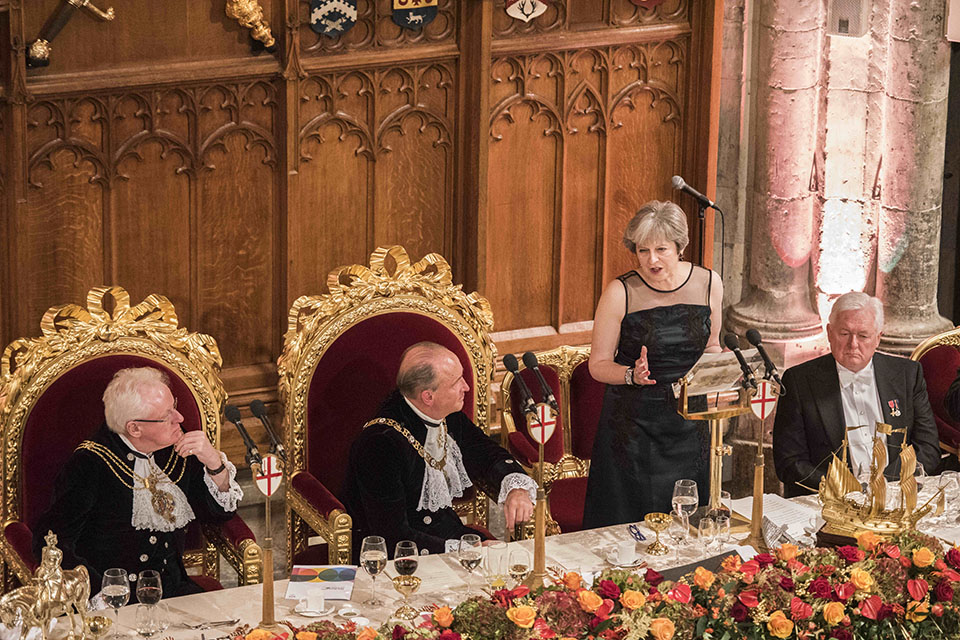
  • Theresa May – 2017 Speech at Lord Mayor’s Banquet

    Below is the text of the speech made by Theresa May, the Prime Minister, at the Lord Mayor’s Banquet on 13 November 2017.

    My Lord Mayor, My Late Lord Mayor, Your Grace, My Lord Chancellor, Your Excellencies, My Lords, Aldermen, Sheriffs, Chief Commoner, ladies and gentlemen.

    As we meet here tonight, we are approaching a defining moment in the history of our nation and our place in the world.

    It is a period of great change and it will, of course, have its challenges.

    There will be ups and downs along the way. But I believe we should embrace this period with confidence and optimism.

    Not grounded in some article of faith, but with a clear understanding of our strengths as a nation.

    We are the fifth biggest economy in the world, the fifth largest exporter in the world and the top destination for inward investment in Europe. We have the second largest defence budget in NATO.

    We are one of the only countries to deliver our promise to spend 0.7% of Gross National Income on international development. We have the extraordinary reach of our global brands from the Premier League to the BBC World Service; the thought leadership of our outstanding universities, the global finance of this great City of London – and the best of British business in demand the world over.

    And perhaps above all we have that defining British spirit – and the fundamental values of fairness, justice and human rights – to use our influence in the world for good.

    And these same capabilities and values that we bring to the task of leaving the European Union, we will also bring to the wider challenges facing the world today.

    For we meet here at a moment when the international order as we know it – the rules based system that the United Kingdom helped to pioneer in the aftermath of the Second World War – is in danger of being eroded.

    A moment when some states are actively destabilising the world order to their own ends, claiming that the rules and standards we have built, and the values on which they rest, no longer apply.

    When regional instability is driving cross-border threats such as Islamist extremism and fuelling conflicts to which many ask whether the rules based order has an answer.

    A moment when the failure to translate the success of global trade into growth that benefits everyone is weakening support for the free markets and open economies that have driven global prosperity for generations.

    And when the rules of the game for this century are increasingly being shaped by emerging economies and powerhouses in the East.

    So as we reach out into the world and write this new chapter in our national history, the task of a global Britain is clear.

    To defend the rules based international order against irresponsible states that seek to erode it.

    To support our partners in regions of instability in repelling the threats they face and to back their vision for societies and economies that will prosper in the future and play a positive role in the world.

    To harness for a new generation the dynamism of open economies to deliver fair and equitable growth. And in doing so to build a new consensus in support of free markets and fair societies that may be the greatest long-term defence against division, tension and conflict.

    These are the issues I want to address tonight: how government and business working together can secure the future prosperity and security of our nation – and play our part in doing so for the world at large.

    Defending the global system

    Our starting point must be to strengthen the commitment, purpose and unity of those allies and partners with whom we have built this order.

    Central to this must be the enduring strength of our transatlantic partnership and our relationships with our European allies.

    The role of the United States in shaping the global order is as vital now as it has ever been.

    Of course we will not always agree on each and every course of action. But underpinning this relationship is an alliance of values and interests between our peoples which has been a force for good in the world for generations – and must continue to be so.

    The same is true of our relations with our European partners as we leave the EU. For we remain a European nation – our history marked by shared experience, our societies shaped by common values, our economies interdependent, and our security indivisible.

    As I said in my speech in Florence, the UK will remain unconditionally committed to maintaining Europe’s security.

    And the comprehensive new economic partnership we seek will underpin our shared commitment to open economies and free societies in the face of those who seek to undermine them.

    Chief among those today, of course, is Russia.

    In a recent speech President Putin said that while the interests of states do not always coincide, strategic gains cannot be made at the expense of others. When a state fails to observe universal rules of conduct and pursues its interests at any cost, it will provoke resistance and disputes will become unpredictable and dangerous.

    I say to President Putin, I agree. But it is Russia’s actions which threaten the international order on which we all depend.

    I want to be clear about the scale and nature of these actions.

    Russia’s illegal annexation of Crimea was the first time since the Second World War that one sovereign nation has forcibly taken territory from another in Europe. Since then, Russia has fomented conflict in the Donbas, repeatedly violated the national airspace of several European countries, and mounted a sustained campaign of cyber espionage and disruption. This has included meddling in elections, and hacking the Danish Ministry of Defence and the Bundestag, among many others.

    It is seeking to weaponise information. Deploying its state-run media organisations to plant fake stories and photo-shopped images in an attempt to sow discord in the West and undermine our institutions.

    So I have a very simple message for Russia.

    We know what you are doing. And you will not succeed. Because you underestimate the resilience of our democracies, the enduring attraction of free and open societies, and the commitment of Western nations to the alliances that bind us.

    The UK will do what is necessary to protect ourselves, and work with our allies to do likewise.

    That is why we are driving reform of NATO so this vital alliance is better able to deter and counter hostile Russian activity. It is why we have stepped up our military and economic support to Ukraine.

    It is why we are strengthening our cyber security and looking at how we tighten our financial regimes to ensure the profits of corruption cannot flow from Russia into the UK.

    So we will take the necessary actions to counter Russian activity. But this is not where we want to be – and not the relationship with Russia we want.

    We do not want to return to the Cold War, or to be in a state of perpetual confrontation.

    So whilst we must beware, we also want to engage – which is why in the coming months the Foreign Secretary will be visiting Moscow.

    For there is another way.

    Many of us here looked at a post-Soviet Russia with hope.

    Because we know that a strong and prosperous Russia which plays by the rules would be in the interests of the United Kingdom, Europe and the world.

    As a Permanent Member of the UN Security Council, Russia has the reach and the responsibility to play a vital role in promoting international stability.

    Russia can, and I hope one day will, choose this different path.

    But for as long as Russia does not, we will act together to protect our interests and the international order on which they depend.

    Addressing regional instability

    But the international order on which we depend faces other threats, including the challenge of regions where it is the absence of strong states that allows instability and conflict to threaten the global order.

    And nowhere is this clearer than in the Middle East.

    We see the spillover effects of this instability in the challenge of mass migration and humanitarian crises in countries like Yemen.

    And we see it most starkly of all with the threat from Daesh and Islamist terrorism.

    Britain is at the forefront of international efforts in the fight against this terrorism – from the battlefields in Syria and Iraq to tackling the ideologues who fuel the hatred of Islamist extremism. And we will defeat it.

    But the conflicts we see in the Middle East are rooted in a complex mix of economics, demographics, history and sectarian tension.

    In the past we have sought to remake countries or even entire regions at great cost to their people and ultimately to our own willingness to intervene when necessary.

    Of course we must never be paralysed by the myth that armed intervention is doomed to fail. And the UK is not and will not be afraid to deploy its hard power where necessary.

    Indeed this is happening around the world as I speak. From our world leading covert agencies to over a thousand troops deployed in Iraq and Afghanistan, to our Royal Air Force operating in the skies over Syria and Iraq, and our Royal Navy patrolling the waters of the Gulf.

    But as we look to the future it is the strength and stability of our partners that will define the trajectory of the region.

    So if we are to achieve enduring stability in the Middle East, we must make an offer which supports both the long-term security and prosperity of our key partners, and encourages them to be champions of the global order.

    As we are doing in countries from Saudi Arabia to Jordan, we will provide support to help them defend and protect their borders and their cities from external aggression – from terrorists to Iranian-backed proxies.

    We will step up our efforts – together with our European and American allies – to help them not just contain, but solve conflicts in the region. From seeking political solutions in Yemen and Libya, to bolstering a united Iraq and working towards a two-state solution in the Middle East Peace Process.

    As part of this, while we will stand firm in our support for the Iran nuclear deal, we are also determined to counter destabilising Iranian actions in the region and their ballistic missile proliferation, working with the US, France and Germany in particular.

    And drawing on the full capability of government and private sector, we make a long-term commitment to work with our partners as they seek to reform their own economies: from Jordan as it deals with the challenge of refugees from Syria, and which I will be visiting again later this month, to countries across the Gulf undertaking social and economic transformation. For these reforms can present far-reaching opportunities for the people of the region and the wider world.

    As part of these efforts, we will champion steps towards greater rights and openness – insistent on the direction of travel, working with our partners in the region and recognising that each country must find its own path.

    And this credible and coherent offer of support and partnership is a matter of urgency. As we see with the events of the last few weeks, from Lebanon to the GCC dispute, our partners see the threats they face as immediate and are straining for the means to tackle them.

    So it is in all of our interests to get this right: to bring long-term, long-sought stability to the Middle East, ensure these growing economies can play their full role in the global system, and reinforce a rules-based international order.

    Ensuring free markets work for everyone

    And at the same time as dealing with threats to the global order from state and regional instability, we must also step up to the challenge of ensuring that free markets and open economies deliver fair and equitable growth for all.

    As I argued at this Banquet last year, free market economies have delivered unprecedented levels of wealth and opportunity. But they are losing popular support because they are leaving far too many people behind.

    The answer cannot be to turn our backs on the free market economy which – with the right rules and behaviours – is the greatest agent of collective human progress ever created.

    For it is when countries make the transition from closed, restricted, centrally-planned economies to open, free market policies that we see life expectancy rise and infant mortality fall, incomes rise and poverty fall, access to education rise and illiteracy fall.

    Indeed it is open, free market economies which are the only sustainable means of increasing the living standards of everyone in a country.

    So our challenge is to ensure that is exactly what they do.

    That is why, here in Britain, we are building a modern industrial strategy that will help to bring the benefits of our trade to every part of our country.

    It is why we will act as a voice for free trade at the WTO. And also continue our efforts – including as I set out this year at the G20 – to reform the international trading system to ensure that trade is not just free but fair: fair between countries and fair for the poorest countries.

    But as we all know global economic growth is increasingly being driven by emerging economies and powerhouses in the East.

    And Africa’s population growth means its significance will also only increase in the decades ahead.

    So the West cannot write the rules of this century on its own. It is our partnership with the countries of Asia and Africa in particular that will define the course the world takes.

    That is why I have asked the new International Development Secretary to build on the work of her predecessor by making one of her first priorities a review of how the whole of government, together with the private sector, can best support African aspirations for trade and growth.

    It is why we will use our relationships with the Commonwealth, and the Summit here next year, to work with partners in Africa, Asia and beyond in building consensus and taking practical steps towards a global economy that works for everyone.

    And it is why I am also clear that we will continue to increase our investment in Asia.

    I am committed to maintaining the Golden Era of our relationship with China – not just as a vital trading partner but also as a fellow permanent member of the Security Council whose decisions together with ours will shape the world around us.

    And I am committed to deepening our partnerships with countries across Asia, where I believe that Britain’s global offer can have a hugely beneficial impact in ensuring that the region’s potential is fully realised.

    That includes tackling the problems in the region today – such as North Korea, where we have played a leading role in securing sanctions in response to the regime’s outrageous proliferation of nuclear weapons.

    And it includes continuing to step up our efforts to respond to the desperate plight of Rohingyas – brought home to us again on our TV screens so graphically today, with heart-breaking images of young children emaciated and pleading for help.

    This is a major humanitarian crisis which looks like ethnic cleansing. And it is something for which the Burmese authorities – and especially the military – must take full responsibility.

    The UK is already the largest donor in response to this crisis. And we will continue to play a leading role in bringing the international community together – working through the UN and with regional partners to do everything possible to stop this appalling and inhuman destruction of the Rohingya people.

    And beyond the immediate challenges of today, we must also invest now in longer-term security partnerships in Asia, such as those which I have launched with Japan and India over the last year; and which we will look to develop further with countries across the region.

    Role of business

    Lord Mayor, as we look to the future, one of the biggest assets of a global Britain will be our soft power – and crucially that includes British business.

    Where open markets thrive and the rule of law holds sway, British companies prosper. And they take in their DNA a way of doing business that brings not only commercial but wider benefits – of good governance, respect for the law, corporate and social responsibility.

    So as a Global Britain makes its offer to the world, we are also offering the certainty and the confidence of the high standards you set, the framework of rules you follow, the values you live by and the ethos and culture you create.

    You are the bearers of a certain idea of economic order upon which the last century of growth has been based – as I believe the next will be based.

    So you have a vital role to play: to honour the great tradition of your livery companies by meeting that profound responsibility not just to do business – but to advance the values, rules and standards on which good business and global security and prosperity depend.

    To champion the deepest trade links and open markets in Europe – and support a new economic partnership with the EU that will be in all of our interests to ensure Western strength.

    To seek out and secure new markets from the Gulf to East Asia, driving growth and productivity at home, embodying British dynamism and expertise aboard, and giving proof to our firmly held faith in open markets and fair competition as the best route to lasting stability, security and prosperity.

    And I am confident that you can do this.

    For while our partners around the world want our support as a global power, they want something else too.

    They want what you bring. They want expertise. They want reliable partners for the long-term. They want the legal services, the accountancy services and the finance in which this great City of London leads the world.

    Because your engagement and your investments are the ultimate kitemark of confidence – a signal to the world that a country is a credible partner and open for business.

    Conclusion

    So Lord Mayor, these are challenging times. But I am confident that a global Britain has the ability and, indeed, the responsibility to rise to the moment.

    To work together to secure the best possible Brexit deal; a deal that is not just good for Britain and good for the EU – but also strengthens the liberal values we hold dear.

    And to work together to adapt and defend the rules based order on which our security and prosperity depends.

    For this is fundamental to our success, to that of our partners and that of the world.

    So let us step up to the task. And let us do so together – with the confidence and conviction of a truly global Britain.
  • Theresa May – 2017 Speech at Balfour Centenary Dinner

    Below is the text of the speech made by Theresa May, the Prime Minister, at the Balfour Centenary Dinner held on 2 November 2017.

    Lord Rothschild, Prime Minister Netanyahu, Chief Rabbi, distinguished guests, Lords, Ladies and Gentlemen, I am so pleased to be here with you tonight – and to be with you Lord Balfour on this special evening – as we mark the centenary of the letter written by your great-Uncle: which I believe to be one of the most significant letters in history.

    A letter which gave birth to a most extraordinary country.

    And a letter which finally opened the door to helping make a Jewish homeland a reality.

    It was a letter that is all the more remarkable when you consider its length, its context and its sensitivity.

    First, it was exceptionally concise – just 67 words and one single sentence.

    In my experience such brevity is not typically a feature of letters from the Foreign Office!

    Second, we should consider the context in which this letter was written.

    Let us cast our minds back to the time of 1917. In an era of competing imperial powers and with Britain still embroiled in the midst of the First World War, the idea of establishing a homeland for the Jewish people would have seemed a distant dream for many; and been fiercely opposed by others.

    Yet it was at this very moment that Lord Balfour had the vision and the leadership to make this profound statement about restoring a persecuted people to a safe and secure homeland.

    Third, this was a letter that remains very sensitive for many people today – but it was not ignorant of those sensitivities.

    Indeed, Balfour wrote explicitly that: “nothing shall be done which may prejudice the civil and religious rights of existing non-Jewish communities in Palestine, or the rights and political status enjoyed by Jews in any other country.”

    So when some people suggest we should apologise for this letter, I say absolutely not.

    We are proud of our pioneering role in the creation of the State of Israel.

    We are proud to stand here today together with Prime Minister Netanyahu and declare our support for Israel. And we are proud of the relationship we have built with Israel.

    And as we mark one hundred years since Balfour, we look forward to taking that relationship even further.

    As Prime Minister Netanyahu and I discussed in Downing Street earlier today, we want to deepen our links in areas where Israel is leading the world – in areas like agriculture, health, science, technology and innovation.

    Israel is the true start-up nation and we are proud to be your partner.

    We also remain absolutely committed to Israel’s security.

    For it is only when you witness Israel’s vulnerability that you truly understand the constant danger Israelis face – as I saw on my visit in 2014, when the bodies of the murdered teenagers Naftali Frenkel, Gilad Shaer and Eyal Yifrah were discovered.

    So I am clear that we will always support Israel’s right to defend itself.

    And in a world where Britain and Israel increasingly face the same shared challenges and threats, I am just as clear that our security services will continue to deepen their already excellent co-operation to keep all our people safe.

    So I believe we should gather here tonight with a great deal of pride in all that we have achieved – and all that Israel stands for as a symbol of openness, as a thriving democracy; and a beacon to the world in upholding the rights of women and members of the LGBT community.

    But marking this centenary is not just about what has been achieved.

    We must recognise how difficult at times this journey has been – from the Jews forced out of their homes in Arab countries in 1948 to the suffering of Palestinians affected and dislodged by Israel’s birth – both completely contrary to the intention of Balfour to safeguard all of these communities.

    And we must, I believe, seize this opportunity to renew our resolve on what is still to be achieved.

    For sadly, Balfour remains unfinished business – as his fundamental vision of peaceful co-existence has not yet been fulfilled.

    And I believe it demands of us today a renewed resolve to support a lasting peace that is in the interests of both Israelis and Palestinians – and in the interests of us all.

    So I am delighted to see US Secretary of Commerce Wilbur Ross here with us this evening and, Wilbur, you can be assured of the full-hearted support of the United Kingdom for the efforts that the Trump administration is making to bring the parties together to reach that peace deal.

    A peace deal that must be based on a two-state solution, with a safe and secure Israel alongside a viable and sovereign Palestinian State.

    And let us be honest with each other: there will need to be compromises from each side if we are to have a realistic chance of achieving this goal – including an end to the building of new settlements and an end to Palestinian incitement too.

    But as we work together towards Balfour’s vision of a peaceful co-existence we must be equally clear that there can never be any excuses for boycotts, divestment or sanctions: they are unacceptable and this government will have no truck with those who subscribe to them.

    Neither can there ever be any excuse for anti-Semitism in any form. Just as there is no excuse for hatred against Muslims, Christians, or anyone based on the peaceful religions they choose to follow, the place of their birth, or the colour of their skin.

    And yes, this means recognising that there is today a new and pernicious form of anti-Semitism which uses criticism of the actions of the Israeli government as a despicable justification for questioning the very right of Israel to exist.

    This is abhorrent and we will not stand for it.

    That is why the United Kingdom has been at the forefront of an international effort to create a new definition of anti-Semitism which explicitly calls out this inexcusable attempt to justify hatred.

    So let me be clear. Criticising the actions of Israel is never – and can never be – an excuse for questioning Israel’s right to exist, any more than criticising the actions of Britain could be an excuse for questioning our right to exist.

    And criticising the government of Israel is never – and can never be – an excuse for hatred against the Jewish people – any more than criticising the British government would be an excuse for hatred against the British people.

    Put simply, there can be no excuses for any kind of hatred towards the Jewish people.

    There never has been – and there never will be.

    And let me say this too. We will never forget where that hatred and prejudice can lead.

    That is why it is right that the United Kingdom will have a permanent and fitting National Memorial to the Holocaust standing next to Parliament together with a learning centre that will teach the lessons of the Holocaust for society today and act as a voice against hatred in the modern world.

    And I am delighted that just last week, the cross-party United Kingdom Holocaust Memorial Foundation announced that Sir David Adjaye, Ron Arad and the landscape architects Gustafson Porter and Bowman have won the international design competition for the memorial and learning centre with their evocative concept design for this new national landmark at the heart of our democracy.

    In saying all of this I do not underestimate the scale of the challenges we face together.

    The challenge of fighting hatred in all its forms.

    The challenge of bringing people together.

    The challenge of fulfilling Balfour’s vision of peaceful co-existence.

    But neither do I underestimate the scale of the prize that is at stake.

    I saw a glimpse of that prize just last Saturday when I attended a charity concert with the West-Eastern Divan Orchestra on London’s South Bank – an orchestra that brings together young Israeli and Palestinian musicians as well as those from several other Arab countries to promote co-existence and intercultural dialogue.

    They were performing together raising money for the Jacqueline du Pre Tribute Fund which helps fund MS research.

    And through their shared love of music they escaped the divides of their history to come together for a united cause.

    In their actions, and in many others like it, the spirit of Balfour lives on.

    So let us tonight be inspired by that spirit.

    Let us recognise the contribution of Balfour in fulfilling what was once little more than a two-thousand year old dream for a persecuted people.

    Let us take inspiration from the vision he showed as we work together for that future where Arabs and Jews can live in peaceful co-existence.

    And as we look to that future, let us mark with pride what has been achieved with the creation of the State of Israel and – in Balfour’s own words – “a national home for the Jewish people.”

  • Theresa May – 2017 Speech at Emergency Services Reception

    Below is the text of the speech made by Theresa May, the Prime Minister, at a Downing Street reception held on 23 October 2017.

    Good evening everybody and it is a great pleasure to welcome you all to Downing Street today.

    I host a number of these receptions, and when I host events here it is normally to celebrate an anniversary or to recognise the success of a good cause.

    And of course today is different. Because the events that have brought us together are some of the most tragic our country has had to face in recent times.

    Four dreadful acts of terrorism and a catastrophic fire, which all occurred over a 3 month period this year; they united, I think, the whole country in both shock and in grief.

    Just to recap, on 22 March, the Westminster Bridge attack killed 5 innocent people, including PC Keith Palmer, and injured 49.

    On that day, Metropolitan Police officers responded immediately to neutralise the terrorist and the London Fire Brigade rescued a person from the River Thames.

    On 22 May, in the attack at the Manchester Arena, 22 people were killed and at least 250 were injured.

    Officers from the British Transport Police and Greater Manchester Police and the North West Ambulance Service were on the scene within minutes, entering the arena without hesitation to help survivors.

    On 3 June, on London Bridge and at Borough Market, eight people were killed and nearly 50 were injured. Armed police arrived and shot the attackers dead within just 8 minutes of being called.

    Officers from the British Transport Police, the Metropolitan Police and the City of London Police worked together at the scene administering first aid and comforting the injured, evacuating the area, and gathering evidence.

    On 14 June, at the Lancaster West Estate in Kensington, the devastating Grenfell Tower fire killed whole families – adults and children – and made hundreds of people homeless.

    The first fire crews were on site in less than 6 minutes. Over 200 firefighters and officers attended, working in extremely difficult conditions to bring the fire under control and rescue scores of people.

    Officers from the Metropolitan Police secured the scene, while the London Ambulance Service treated the victims.

    And then in the early hours of 19 June, a man was killed and ten people were injured in a cowardly attack outside Finsbury Park mosque.

    The alleged attacker was detained by members of the public until police officers, including an armed officer, arrived at the scene, again within just a few minutes.

    Firefighters and the Ambulance Service supported the police and treated casualties.

    What linked all these terrible events was not simply the loss of life and the suffering inflicted, but also the inspiring responses of the people in this room today – our emergency services.

    You see the worst of us, but represent the best of us.

    You are the ones who run towards devastation, while others run as fast as they can the other way.

    And every day you go to work knowing you could be called on to face things which most of us would never want to confront.

    On each of those five days this year, and again at times like the Parson’s Green bombing, that’s exactly what you had to do.

    To bear witness to horrific and heart-breaking scenes.

    To do your jobs, in the most difficult of circumstances, with professionalism and courage.

    And to risk your own lives to protect others and to serve your country.

    And then, when your shift was over, to go back home to your families, to try to put what you’ve experienced into perspective, and to get on with your lives.

    I have to say I know from my experience, and also as Home Secretary, one of the most inspiring things when I meet members of the emergency services, both in general, but particularly those who have been responding to incidents like this, is the way everybody says they ‘were just doing their job’. But as I say that is a job that most people wouldn’t want to do and it is a job that matters and is so important to all of us.

    And I know that doing that and then returning to, if you like, normality, with your families and life generally can be enormously difficult.

    And you will of course be supported and sustained by the camaraderie and mutual support of your colleagues. By the love and affection of your families and friends.

    And by your own sense of duty and public service.

    But the country you have served has a responsibility to support you and your families too and the government takes that responsibility seriously.

    We have a responsibility to ensure that you have access to the right occupational health services, with proper mental health support.

    And we announced over the summer that we are making available a further £1.5 million to support the delivery of Mind’s Blue Light Programme, which provides mental health support for all emergency service staff and volunteers.

    And we are also supporting Chris Bryant’s private members’ Bill, which will double the maximum sentence for common assault from six months to a year if committed against an emergency worker while they are on duty. Now it is my privilege to host you here today; to be able to invite you here to Downing Street. And I want to thank you, on behalf of the whole county, for your bravery, for your professionalism and for your dedication.

    At all times, you command the respect and admiration of the British people.

    And you represent the values and qualities which we all look up to.

    You are truly an example to us all.

    Thank you for being here today, thank you for everything that you did in relation to these incidents, and for some of you are continuing to do in relation to these incidents.

    Thank you for what you do every day when you go to work.

    Thank you for being here and enjoy the rest of the evening.

  • Theresa May – 2017 Commons Statement on the European Council

    Below is the text of the speech made by Theresa May, the Prime Minister, in the House of Commons on 23 October 2017.

    With permission, Mr Speaker, I would like to make a Statement on last week’s European Council.

    Long after we have left the European Union, the UK will continue to be a strong and committed partner, standing alongside our neighbours and working together to advance our shared values and interests.

    This Council provided a further opportunity to demonstrate that ongoing commitment, through discussions that included migration, the digital single market, North Korea and Iran.

    And it made important progress in moving towards the new, deep and special partnership with the European Union that we want to see.

    Migration

    First on migration, the UK is playing its full part.

    The Royal Navy has intercepted 172 smuggling boats and saved over 12,000 lives since Operation Sophia began.

    While our National Crime Agency is working with Libyan law enforcement, enhancing their capability to tackle the people smuggling and trafficking networks.

    At the Council we welcomed the reduction in migrant crossings and the renewed momentum behind the Libyan political process.

    But we must also continue to address the root causes driving people across the Sahara and the Mediterranean.

    So the UK is also continuing to invest for the long term in education, jobs and services both in countries of origin and transit.

    Digital single market

    On the digital single market, it is right to keep up the pressure on completing its implementation by the end of 2018.

    This will bring new opportunities to British businesses and consumers, contributing to growth and jobs.

    At this Council, I also argued that the free flow of data is key to unlocking the potential of Europe’s digital trade and we secured conclusions which recognised this.

    As the Government set out in a paper over the summer, such arrangements will be an important part of the future relationship between the UK and the EU.

    North Korea and Iran

    On North Korea, we welcomed the EU sanctions adopted last week and reaffirmed our clear condemnation of North Korea’s aggressive and illegal missile and nuclear tests.

    We urged all states, including China, to play their part in changing the course Pyongyang is taking.

    And on Iran, the Council built on the joint statement made by Chancellor Merkel, President Macron and myself last week, reiterating its firm commitment to the nuclear deal.

    This was the culmination of 13 years of diplomacy and a major step towards ensuring that Iran’s nuclear programme is not diverted for military purposes. That is vitally important for our shared security.

    Exit from the EU

    Mr Speaker, turning to our negotiations to leave the European Union, I shared the vision I had set out in Florence for a creative and pragmatic approach to a new, deep and special partnership between the United Kingdom and the European Union.

    A partnership based on the fundamental beliefs we share – in democracy and the rule of law, but also in free trade, rigorous and fair competition, strong consumer rights, and high regulatory standards.

    Both sides have approached these talks with professionalism and a constructive spirit – and we should recognise what has been achieved to date.

    Citizens’ rights

    On citizens’ rights, both sides share the same objective of safeguarding the rights of EU nationals living in the UK and UK nationals living in the EU.

    This has been my first priority from the very beginning of the negotiations – and it remains so.

    The negotiations are complicated and deeply technical but in the end they are about people – and I am determined that we will put people first.

    EU citizens make an extraordinary contribution to our national life, enriching the economic, social and cultural fabric of our country – and we want them to stay.

    I know that EU Member States also value the UK nationals living in their communities and I want them to have their rights protected too.

    We are united on the key principles, and while there are a small number of issues that remain outstanding, we are in touching distance of a deal.

    This agreement will provide certainty about residence, healthcare, pensions and other benefits.

    It will mean that EU citizens who have paid into the UK system – and UK nationals who have paid into the system of an EU27 country – can benefit from what they have put in.

    It will enable families who have built their lives together to stay together.

    And it will provide guarantees that the rights of those UK nationals currently living in the EU, and EU citizens currently living in the UK, will not diverge over time.

    We will also ensure that the implementation of the agreement we reach does not create complicated and bureaucratic hurdles.

    So we are developing a streamlined digital process for those applying for settled status in the UK in the future.

    This will cost no more than a UK passport. People applying will not have to account for every trip they have taken in and out of the UK and they will no longer have to demonstrate Comprehensive Sickness Insurance.

    And there will be a simple process for any EU citizen who holds permanent residence under the old scheme to swap their current status for UK settled status.

    To support this, we are setting up a User Group that will include representatives of EU citizens in the UK as well as digital, technical and legal experts.

    And we will do everything possible to work closely with EU Member States to ensure their processes are equally streamlined for British nationals living in their countries.

    Northern Ireland

    We have also made significant progress on Northern Ireland, where it is absolutely imperative that joint work on the peace process is not affected in any way.

    The Belfast agreement must be at the heart of our approach and we have clearly agreed that the unique circumstances across the whole of the island of Ireland will require specific solutions.

    There will not be any physical infrastructure at the border and we have also developed joint principles to ensure the continuation of the Common Travel Area.

    These principles will fully preserve the rights of UK and Irish nationals to live, work and study across these islands – and protect the associated rights to public services and social security.

    No UK or Irish national will need to apply for settled status anywhere in the Common Travel Area at any stage in order to protect their entitlements.

    And to provide legal certainty, the joint principles we have developed recognise that the Withdrawal Agreement should formally acknowledge that the UK and Ireland will continue to be able to uphold and develop these bi-lateral arrangements.

    Moving forwards

    Mr Speaker, this Council provided an opportunity to assess and reflect on how to make further progress in the negotiations.

    My speech in Florence made two important steps which have added a new impetus.

    First, I gave two firm commitments on the financial settlement: that the UK will honour commitments we have made during the period of our membership and that none of our EU partners should fear they will need to pay more or receive less over the remainder of the current budget plan as a result of our decision to leave.

    As the House would expect, we are going through our potential commitments line by line and that detailed work continues.

    And second, I proposed a time-limited implementation period based on current terms, which is in the interest of both the UK and the EU.

    At this Council the 27 Member States responded by agreeing to start their preparations for moving negotiations onto trade and the future relationship we want to see.

    The Council conclusions call for work to continue with a view to – and I quote – “consolidating the convergence achieved and pursuing negotiations in order to be able to move to the second phase of the negotiations as soon as possible.”

    And President Tusk, in his press conference ,was clear that the EU’s internal work “will take account of proposals” presented in the Florence speech.

    And indeed that this agreement to start preparatory discussions would not be possible without the new momentum given by that speech.

    Conclusion

    So Mr Speaker, I am ambitious and positive about Britain’s future and these negotiations.

    If we are going to take a step forward together it must be on the basis of joint effort and endeavour between the UK and the EU.

    But I believe that by approaching these negotiations in a constructive way – in a spirit of friendship and co-operation – we can and will deliver the best possible outcome that works for all our people.

    As Chancellor Merkel said: “We haven’t reached a final agreement, but it’s going to happen.”

    Mr Speaker, Chancellor Merkel is right.

    We are going to leave the European Union in March 2019, delivering on the democratic will of the British people.

    But while we must and will prepare for every eventuality, I am confident that we will do so in a smooth and orderly way and that we will be able to negotiate a new, deep and special partnership between a sovereign United Kingdom and our friends in the European Union.

    That is my mission.

    That is this Government’s mission.

    And I commend this Statement to the House.

  • Theresa May – 2017 Press Statement on European Council

    Below is the text of the statement made by Theresa May, the Prime Minister, on 20 October 2017.

    The United Kingdom will take its seat at the European Council table for another year and a half, and we have important work to achieve together in this time.

    But cooperation with our European friends will not stop in March 2019.

    The UK will stand alongside the EU, as a strong and committed partner, working to promote our shared interests and values.

    Nowhere is this more important than in our approach to the global challenges we face.

    Whether security and defence, migration or foreign policy issues – we face common opportunities and risks, and we must continue to address them together.

    As I’ve said before, the UK is unconditionally committed to the security and defence of Europe. We share the vision of a strong, secure and successful EU, with global reach and influence. An EU capable of countering shared threats to our continent, working alongside a confident, outward-looking UK.

    Yesterday we discussed a range of subjects including migration, the digital economy and some of the most pressing foreign policy issues, such as North Korea and Iran.

    We stand united in our clear condemnation of North Korea’s aggressive and illegal missile and nuclear tests and urge all states, including China, to play their part in changing the course Pyongyang is taking.

    On Iran, we have reiterated our firm commitment to the nuclear deal, which we believe is vitally important for our shared security.

    Exit from the EU

    And last night at dinner, I spoke to my fellow leaders about my vision for a new, deep and special partnership between the UK and the European Union after Brexit.

    A partnership based on the same set of fundamental beliefs – in not just democracy and rule of law, but also free trade, rigorous and fair competition, strong consumer rights, and high regulatory standards.

    I am ambitious and positive for Britain’s future and for these negotiations. But I know we still have some way to go.

    Both sides have approached these talks with professionalism and a constructive spirit. We should recognise what has been achieved to date.

    The UK and the EU share the same objective of safeguarding the rights of EU nationals living in the UK and UK nationals living in the EU.

    EU citizens have made a huge contribution to our country and let me be clear that – whatever happens – we want them and their families to stay.

    While there are a small number of issues that remain outstanding on citizens’ rights, I am confident that we are in touching distance of a deal.

    On Northern Ireland, we have agreed that the Belfast agreement must be at the heart of our approach and that Northern Ireland’s unique circumstances demand specific solutions. It is vital that joint work on the peace process is not affected in any way – it is too important for that.

    Both sides agree that there cannot be any physical infrastructure at the border and that the Common travel area must continue.

    We have both committed to delivering a flexible and imaginative approach on this vital issue.

    This Council is an important moment. It is a point at which to assess and reflect on how to make further progress.

    My speech in Florence made two important steps, which have added a new impetus to the negotiations. I gave a firm commitment on the financial settlement and I proposed a time-limited implementation period based on current terms, which is in the interest of both the UK and the EU.

    Both sides agree that subsequent rounds have been conducted in a new spirit. My fellow leaders have been discussing that this morning and I believe that it is in the interests of the UK that the EU 27 continues to take a united approach.

    But if we are going to take a step forward together it must be on the basis of joint effort and endeavour.

    We must work together to get to an outcome that we can stand behind and that works for all our people.

  • Theresa May – 2017 Open Letter to EU Citizens in the UK

    Below is the text of the open letter issued by Theresa May, the Prime Minister, to EU citizens living in the UK.

    As I travel to Brussels today, I know that many people will be looking to us – the leaders of the 28 nations in the European Union – to demonstrate we are putting people first.

    I have been clear throughout this process that citizens’ rights are my first priority. And I know my fellow leaders have the same objective: to safeguard the rights of EU nationals living in the UK and UK nationals living in the EU. I want to give reassurance that this issue remains a priority, that we are united on the key principles, and that the focus over the weeks to come will be delivering an agreement that works for people here in the UK, and people in the EU.

    When we started this process, some accused us of treating EU nationals as bargaining chips. Nothing could have been further from the truth. EU citizens who have made their lives in the UK have made a huge contribution to our country. And we want them and their families to stay. I couldn’t be clearer: EU citizens living lawfully in the UK today will be able to stay.

    But this agreement will not only provide certainty about residence, but also healthcare, pensions and other benefits. It will mean that EU citizens who have paid into the UK system – and UK nationals into the system of an EU27 country – can benefit from what they’ve put in. It will enable families who have built their lives together in the EU and UK to stay together. And it will provide guarantees that the rights of those UK nationals currently living in the EU, and EU citizens currently living in the UK, will not diverge over time.

    What that leaves us with is a small number of important points to finalise. That is to be expected at this point in negotiations. We are in touching distance of agreement. I know both sides will consider each other’s proposals for finalising the agreement with an open mind. And with flexibility and creativity on both sides, I am confident that we can conclude discussions on citizens’ rights in the coming weeks.

    I know there is real anxiety about how the agreement will be implemented. People are concerned that the process will be complicated and bureaucratic, and will put up hurdles that are difficult to overcome. I want to provide reassurance here too.

    We are developing a streamlined digital process for those applying for settled status in the UK in the future. This process will be designed with users in mind, and we will engage with them every step of the way. We will keep the cost as low as possible – no more than the cost of a UK passport. The criteria applied will be simple, transparent and strictly in accordance with the Withdrawal Agreement. People applying will not have to account for every trip they have taken in and out of the UK and will no longer have to demonstrate Comprehensive Sickness Insurance as they currently have to under EU rules. And importantly, for any EU citizen who holds Permanent Residence under the old scheme, there will be a simple process put in place to swap their current status for UK settled status.

    To keep development of the system on track, the government is also setting up a User Group that will include representatives of EU citizens in the UK, and digital, technical and legal experts. This group will meet regularly, ensuring the process is transparent and responds properly to users’ needs. And we recognise that British nationals living in the EU27 will be similarly concerned about potential changes to processes after the UK leaves the EU. We have repeatedly flagged these issues during the negotiations. And we are keen to work closely with EU member states to ensure their processes are equally streamlined.

    We want people to stay and we want families to stay together. We hugely value the contributions that EU nationals make to the economic, social and cultural fabric of the UK. And I know that member states value equally UK nationals living in their communities. I hope that these reassurances, alongside those made by both the UK and the European Commission last week, will provide further helpful certainty to the four million people who were understandably anxious about what Brexit would mean for their futures.