
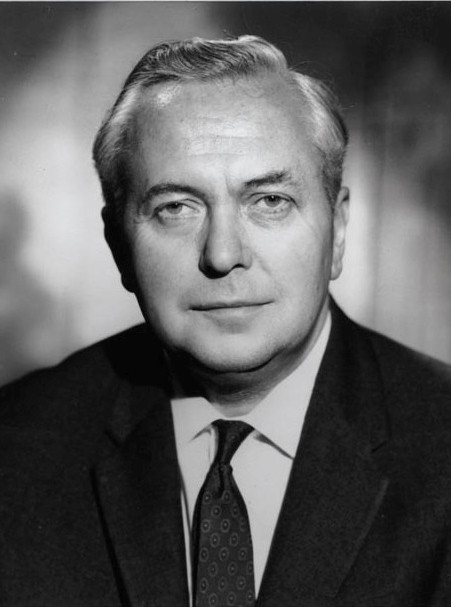
The letter sent by Harold Wilson, the then Prime Minister, to cabinet colleagues on 20 December 1966.
We have to take a decision by the end of the year on whether or not we should continue with the P.1127. In discussion in the Defence and Oversea Policy Committee there was a division of view and, although preponderant opinion was in favour of continuation, the decision is one which the Cabinet will wish to take.
I attach a note by officials setting out the considerations on either side.
H.W.
10, Downing Street, S.W.1.
20th December, 1966
SECRET
P1127
Note by Officials
Introduction
The P1127 is an aircraft intended to provide close support for our ground forces. It is a major advance in this field through the exploitation of its unique ability to operate from very short rough strips in the forward area (short take off and landing capability or STOL) and to operate from small landing sites in the vertical take off and landing (VTOL) mode with a bomb or rocket load. At the time of the Defence Review it was hoped that the VTOL performance, which is limited in range and load, could be appreciably improved through incorporating plenum chamber burning, but further studies have established that this is not the answer and the most likely alternative would be costly in both development and production. There are, however, indications that engine thrust increases can be achieved in the normal course of development which will lead to worthwhile improvements in aircraft performance.
There is no aircraft which can replace the special V/STOL characteristics of the P1127, but it is possible — admittedly with some detriment to the operational efficiency of our forces — to provide close support for the Army by means of different combinations of the Spey-Phantom and of the Anglo-French Jaguar. The latter course would be cheaper, but would involve additional expenditure in foreign currency and would have industrial implications for the future of the United Kingdom aircraft industry. The question is the degree of priority to be accorded to the gain in operational efficiency.
Defence Requirements
The Defence Review made provision for the purchase of 110 P1127 aircraft (93 solos and 17 duals). In considering the Review in February (CC(66) 9th Conclusions) the Cabinet agreed that the P1127 was important for United Kingdom industrial reasons and that at that stage we should plan on the assumption that it would be developed. The Cabinet, however, reserved the right to take a different decision should technical developments or the escalation of costs make it desirable to do so. Following their discussion, the Defence and Oversea Policy Committee agreed in March (OPD(66) 15th Meeting, Item 1) that an order should be placed for 60 aircraft, with an option for a further 40, and that the issue should be further considered in the autumn in the light of feasibility studies, the cost of production and the prospect of export orders.
The present position is that the programme is going well, the first two aircraft are flying and development should be completed within the estimate of last March. Our commitments to the end of December in respect of both research and development and production will total about £45 million, which is over one-third of the estimated cost of the development and production of the first 60 aircraft (£120 million to £125 million) and 13 per cent of the total ten year programme cost of £336 million. In addition, we have spent, including contributions from the United States and German Governments to the Kestrel programme and payments on the cancelled P1154, a further £70 million on the technology of vectored thrust.
The further defence studies might call also for a review of the number of P1127 (or alternative aircraft) which will be required. These studies will not be completed until July, 1967 and, theoretically, the decision on the future of the P1127 should be taken then in the light of the cost and implications of the alternative courses. By then, however, a further £26 million will have been committed on the P1127 and effectively deferment now would be equivalent to a decision to continue with the aircraft. The choice on whether to continue or cancel the P1127 is therefore open to us only until the end of the year.
The argument for cancellation
The argument for cancelling the P1127 is its cost and its low defence priority. Pressure on the Defence Budget has increased. There is still the problem of attaining the Defence Review target of £2,000 million at 1964 prices in 1969-70: and further defence studies are being undertaken to consider the possibility of substantial additional savings by 1970-71. To provide the total 110 P1127 aircraft which would be necessary for the defence commitments envisaged in the Defence Review would cost £130 million more over a ten-year period than a likely alternative. Such an alternative, although cheaper in budgetary terms, could, however, involve expenditure of £40 million in dollars, plus perhaps a further £25 million for the foreign currency element of the additional Anglo-French Jaguars. (Until the further defence studies are completed it is uncertain whether this requirement for a number of P1127, or alternative aircraft, can be reduced: it is therefore impossible to calculate with any precision the additional budgetary cost of the P1127 and the cost in foreign exchange of the alternative.)
Although the P1127 is desirable on grounds of operational efficiency the priority to be accorded to it on defence grounds alone is not such as to justify its continuation in view of the pressure on the Defence Budget. The incidence of expenditure on the P1127 would moreover give rise to awkward budgetary problems in 1969-70 and 1970-71 and although alternatives to it, giving us a similar capability, could also do this, there would be greater room for manoeuvre. If the continuation of the P1127 is approved, then the Defence Budget will be higher than the total to which it could otherwise be reduced in consequence of the Defence Review and the further defence studies.
The argument for continuation
The argument for continuing with the P1127, apart from the gain in operational efficiency and the saving in foreign currency, is that it is the only advanced military aircraft at present under development in the United Kingdom and the only major national aircraft project this Government has initiated. Its adoption as a part replacement for the Hunter was intended to mitigate the cancellation of the TSR 2, P1154 and HS 681. If it were to be cancelled now the effect on the aircraft industry could be disastrous, particularly in the context of the uncertainty of the future of the Anglo-French variable geometry (VG) aircraft. Although the balance of probability is that the French will agree to the continuation of the latter, this is not certain, and if they withdrew we should then have to consider whether or not to continue with the development of a somewhat simpler form of this aircraft in the United Kingdom alone. This uncertainty is relevant to the future of the United Kingdom industry.
Although the main work for a design team in the immediate future would be on a VG aircraft and not on the P1127, the loss of confidence from the abandonment of the P1127 alone would be such that it is doubtful if men of the right industrial, scientific and technological standing could be retained in the industry. In particular, this is the major project in the programme for Hawker Siddeley. It is around this firm, and its management, that the Government’s proposals for reorganising the airframe industry are built. If this project were now cancelled, Hawker Siddeley’s willingness to remain in the industry could evaporate: in that event any prospect of an effective United Kingdom aircraft industry on the basis of the Government’s proposals would disappear.
Furthermore, the development of the VTOL and STOL capability is the only part of aircraft technology in which at present the United Kingdom is in advance of the rest of the world. To abandon the P1127 would be permanently to throw away that lead, with wider consequences for our technological capacity.
Export Prospects
The export prospects of the aircraft are necessarily uncertain until it is clear whether or not the Government intend to go ahead with production, since we cannot expect to sell military aircraft unless the RAF order them. However, a number of countries have shown interest. The most promising prospects so far appear to be Israel, India and Finland. In general, the Head of Defence Sales considers the export prospects are good but of course there can be no certainty of them.
Numbers to be ordered
If a decision were taken in favour of the continuation of the programme there would then be a choice between ordering now 60 single and ten dual aircraft (essential for training purposes) at a programme cost of £242 million while keeping an option open for a further purchase, the cost of which cannot be quantified until the end of the defence studies, or ordering now the full number of 110 (including 17 duals) at a programme cost of £336 million. The advantage of the former course is that it would leave options open if the defence studies showed either a requirement for fewer than 110, or that alternative cheaper aircraft should be provided for the full remaining requirement. The advantage of ordering the full 110 now is that if this number is required it would be marginally cheaper and that it would give greater industrial certainty and enhance exports prospects.
The Choice
The choice lies between:
(1) cancelling the P1127 and
(2) continuing the programme, in which case the choice is between:
(a) ordering 70 aircraft now and keeping the option open on the remainder until mid-1967; and
(b) ordering the full 110 now.