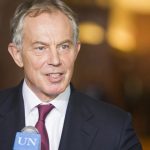
The press conference between Tony Blair and George W Bush at RAF Halton on 19 July 2001.
PRIME MINISTER BLAIR:
Good evening, everyone. First of all, can I say how delighted I am to have President Bush here — not just here in Britain, but also here staying with us, and Laura, tonight at Chequers. And we’re looking very much forward to hosting them. And I think it is yet another example of the strength of the relationship between our two countries. It is a very strong relationship, a very special one.
And I know in the discussions we’ve had we’ve ranged over many issues. Obviously, we started with the discussion of the upcoming G-7/G-8 Summit where we agreed how important it is that we get across the strong message to people, the summit is important because it allows us to discuss issues of real importance to people. I have no doubt that we’ll be with people there who will be making their protest, but I hope they do so peacefully, because some of the things we’re discussing at this summit in terms of global trade, in terms of the developing world, are things that are of huge importance not just to the most prosperous countries of the world, but also to some of the poorest countries of the world.
We touched then on many other issues in the course of our discussion, including, obviously, missile defense, the issue of climate change, and a good discussion on Macedonia, Northern Ireland, the Middle East process, and of course, the state of the world economy.
And I’m sure you want to ask some questions about those things. But, once again, can I say, George, how much I welcome you and Laura here, how delighted we are to see you. And I know and hope very much this will be a good evening for you, and set you up in the right frame of mind for the summit ahead. (Laughter.)
PRESIDENT BUSH:
Thank you. At Camp David, Tony told me that Chequers was a beautiful place, and he was telling the truth. And we’re glad — Laura and I are glad to be here. I appreciate so very much your hospitality and your friendship. America and Great Britain have got a special relationship. We both have pledged to keep the relationship as special as possible, and I’m convinced it will continue to be.
I, too, look forward to going to Genoa. You know, I am — I can’t wait to make the case, along with Tony Blair, about the need for the world trade in freedom. And for those who want to shut down trade, I say this to them as clearly as I can: You’re hurting poor countries. For those who kind of use this opportunity to say the world should become isolationist, they’re condemning those who are poor to poverty. And we don’t accept it. We don’t accept it.
We’ve got a lot in common between our countries, most of which are values. We value freedom. We value political dialogue. We value freedom of religion — freedom of the press, for that matter. But we also value the fact that we’re responsible nations, and that we realize there are some who are less fortunate than the great land Tony is the leader of, and our great land, as well.
So at the summit, we’ll be talking about how best to help the continent of Africa deal with HIV/AIDS, how best to make sure our aid and loans work well, and how best to encourage the habits of freedom, starting with good education.
So I’m looking forward to it, and I want to thank you for having Laura and me here. It’s a great joy to be in your beautiful country.
PRIME MINISTER BLAIR:
Right. We’ll take some questions. We’ll bring you a mike, I think.
QUESTION:
Could I ask you both about what you’ve been saying to each other about Northern Ireland, and particularly in view of the President’s comments, whether you feel it’s still possible that the package that Britain and Ireland are going to produce can be even-handed in the continued absence of the commissioning?President reviews the guard
during his visit to Buckingham Palace July 19, 2001. White House photo
by Paul Morse.
And can I also ask you, Prime Minister Blair, about your thoughts on Jeffrey Archer, the former Deputy Chairman of the Tory Party and Conservative MP, starting a four-year sentence tonight for perjury and perverting the course of justice?
PRIME MINISTER BLAIR:
I’m afraid, Adam, on the second part, I’ve really got nothing to say on that.
In respect to the first part, the package that we put to the parties will be balanced because it will deal with all the outstanding issues. It will deal with the issues of the stability of the institutions, how we get a normalized situation — we’ve reduced troop movements and the numbers of troops in Northern Ireland dramatically, but we want to do more — how we make sure, too, that we get a police service that all parts of the community in Northern Ireland can support.
And then also there is the issue of the decommissioning, the putting beyond use of paramilitary weapons. And obviously there’s got to be action on all those fronts. And so we hope very much the people will respond positively. Because, as I often say to people, you only have to look at the situation in the Middle East to realize what happens when negotiation breaks down, when parties move apart from each other, and how quickly a situation that looked optimistic can become unstable and dangerous.
And this — this Good Friday agreement, this peace process is the only hope for people in Northern Ireland. And the package has been put forward by ourselves and the Irish government together. And I hope people respond positively and realize that the future of generations of people in Northern Ireland depend on that positive response.
PRESIDENT BUSH:
We did spend a fair amount of time talking about Northern Ireland. I’ve reiterated to the Prime Minister that I stood ready to help in any way — a simple phone call away; if there’s anything I can do to help bring peace to the region, I will do so. And make no mistake about it, people shouldn’t have any doubt as to where my government stands. We stand strongly, side-by-side, with Britain when it comes to decommissioning in Northern Ireland.
RON:
Q A question for each of you, please. Mr. Prime Minister, does Saturday’s successful test of a antimissile system in the U.S. affect your opinion at all of President Bush’s plans to deploy a missile shield and scrap the ABM Treaty?
And to you, Mr. President, as we speak, environmentalist ministers are meeting in Germany, trying to find a way to salvage the Kyoto global warming treaty. If the rest of the world proceeds without you, doesn’t it isolate your policies and your country?
PRESIDENT BUSH:
Ron’s very good about taking one question and converting it to two. (Laughter.)
PRIME MINISTER BLAIR:
Well, first of all, on the subject of missile defense, obviously, we await a specific proposal from the U.S. administration. But I want to say this and say it clearly, that I think President Bush is right to raise the issue of the proliferation of weapons of mass destruction and say that that needs new and imaginative solutions, because it’s a huge threat facing the whole of the world.
Secondly, I think that that has got to, as I said at Camp David, has got to encompass defensive systems and offensive systems. And I think it’s again sensible and right that we sit down and work our way through that.
And the third thing is that we welcome very much the approach that President Bush and the administration have taken to consulting allies, and also making it clear that they wish to have a dialogue and a partnership with Russia about this issue.
And I think that in combination those things are bringing about a situation in which we can have a sensible and rational debate about an issue that is of fundamental importance facing the world. So I hope that in that spirit, you know, we will carry forward the dialogue that we have achieved so far.
PRESIDENT BUSH:
Let me comment on that, and then I’ll comment on your other question. The thing I appreciate about the Prime Minister is that he’s willing to think anew as we head into the future. It’s hard for any country to commit to vague notions. But there are some leaders who just out of hand reject any willingness to think differently about security. And Prime Minister Blair is not that way. He’s been very forthcoming. He’s had great questions. He’s been more than willing to listen to the philosophy behind moving beyond a treaty that has codified a relationship that no longer exists.
ABM Treaty codified a relationship between enemies. Russia is not our enemy. And as we head into the 21st century, we must think about new ways to keep the peace. And the Prime Minister has been very positive. You know, some people just reject new thought out of hand. And that’s certainly not the case. And as time develops, I will stay in touch — as our plans develop, I’ll stay in touch with Tony as to what’s going on. He’s been a great person with whom to consult on this issue.
The United States is concerned about the emission of CO2. We share the goal of reduction of greenhouse gases. We will be, and are in the process — we’ll be presenting a strategy that may have different means than Kyoto of achieving the same goal. And we’re in the process of developing the strategy.
People shouldn’t, just because I gave an honest assessment of Kyoto’s chances in the United States Senate and what it would mean to our economy, should not think that we don’t share the same goal. We do. We want to reduce greenhouse gases. Ours is a large economy, generating — we used to generate more wealth than we are today, and as a result, we do contribute greenhouse gases to the atmosphere. And so we’re concerned about it.
But first things first, as far as I’m concerned. Our strategy must make sure working people in America aren’t thrown out of work. My job is to represent my country. And I’m going to do so in a way that keeps in mind the ability for people to find work and for our nation to be prosperous. And I believe economic growth and sound environmental policy can go hand in hand.
Mr. Prime Minister, as I assured you, I will come to you with a strategy that conforms to the goals of Kyoto and one that is — that I hope people understand makes sense for our country.
QUESTION:
Mr. President, given the very strong relationship which you say exists between yourself and Tony Blair, between Britain and the United States, are you endangering that special, unique, close relationship because Mr. Blair wants to be a bridge between Europe and the United States, and yet, you don’t seem to be offering very much to help narrow the gulf which seems to be opening up between Europe and the United States on key issues?
PRESIDENT BUSH:
I will let Tony Blair speak to how he feels my relationship with Europe — I’m not going to — you’ll say my answer is not very objective, but, frankly, after my last trip here, I think the European leaders got to know me and realize that our country will be engaged with Europe in all aspects.
In the Balkans, I made it clear, we came in together and we’re going to leave together. When it comes to trade, I made it clear that we’re a strong trading partner, and we’ve got to work hard to reduce barriers that prevent us from trading freely. When it comes to defenses within NATO, we’re more than willing to do our commitment.
And I appreciate Tony’s friendship. I think people will find out that I’m plenty capable of conducting foreign policy for the United States in a way that reflects positively on my nation. And I’m glad to be back in Europe. I look forward to a frank discussion in Genoa. And I’m confident that we’ll find areas to work together on. When we disagree, we’ll do so in a respectful way.
PRIME MINISTER BLAIR:
Well, I would just like to add a word on that, if I could, James. First of all, I think that the way the President came to Europe and to Gothenburg and made his presentation impressed everybody who was there. I thought it was a highly successful visit.
And, of course, there may be differences of the minute, for example, over Kyoto — though, again, I think it is helpful that the United States is saying, look, this is not what we can agree to, but nonetheless, we agree with the aim, we agree with the objectives, and there are proposals that we will make as to how we can get there. Now, you know, we’ve had a very strong position in favor of Kyoto. That is our position, obviously. But the fact is that dialogue there is extremely important.
But, you know, on a whole range of issues, Europe and America and Britain and America stand together. We’re doing so in the Balkans. We’re doing so trying to sort out the problems of Macedonia. We’re doing so on the issue of world trade. We’re going to do so again on issues like Africa and global health and debt. And where we’re trying to go to the G-7/G-8, and present to the world an agenda for better and more free trade, for help for the poorest nations of the world, for stability in the world economy, which is of dramatic importance not just to our countries, not just to Europe and America, but to the whole of the world.
This is a passionate belief I have that I held in theory when I was an opposition leader, and has strengthened in practice over the last few years that I’ve been Prime Minister. And that is not merely, is the relationship between Britain and America key — and we are and always will be key allies — but when Europe and America stand together, and when they approach problems in a sensible and serious way and realize that what unites them is infinitely more important than what divides them, then the world is a better, more stable, more prosperous place. When we fall out and diverge, and when people try and put obstacles in the way of that partnership, then the only people rejoicing are the bad guys.
That is my basic view after these years. And just to make one other point. Since this administration has come to power, on the issue of trade, in particular, we have seen big steps forward in the relationship between Europe and America. These are the important things, as well. There’s a whole range of issues that I was dealing with a couple of years ago which were tough issues here that we’ve got resolved. So I think it’s against that background that we make these judgments.
QUESTION:
Mr. President, will you be urging your G-7 partners to do more to bring major economies out of the doldrums? And will you heed the call of U.S. business and labor groups who urge you to discuss negative effects of the strong U.S. dollar in Genoa?
And, Prime Minister Blair, I’d like your views also on whether Europe is doing all it can to stimulate the global economy.
PRESIDENT BUSH:
Well, one of the things I’ll do, Randy, is to share with my colleagues the successes we’ve had at cutting taxes, as well as holding the line on spending. Let me say this — successes we’ve had so far in holding the line on spending. The President is given a veto for a reason, Mr. Prime Minister, and that’s to hold the line on spending. As well as to assure them that our Fed is going to continue to watch our economy very carefully.
The Federal Reserve is independent from our government, but nevertheless, Mr. Greenspan is sending signals that he’s concerned about the state of our economy. In other words, we’re doing everything we can to, within our own borders, to deal with an economic slowdown. As for the dollar, the market needs to determine the price of the dollar.
There’s all kinds of folks in our country insisting the dollar be this way or the dollar be that way. The best way to determine the price of the dollar is to let the market determine that price. And that’s my message to business, labor, anybody else who wants our government to intercede in the market.
PRIME MINISTER BLAIR:
Well, just shortly on the question of the European economy, obviously, we want to see the European economy strengthen. I think the — quite apart from the impact of the world economy, particularly the U.S. economy, on Europe is the whole issue of economic reform in Europe.
We now — one of the big changes in the direction of European economic policy over the past couple of years has been that every year now — and next year it will be in Barcelona in March — we hold an annual summit specifically on the issue of economic reform, in order that Europe should be not a fortress Europe, but should be a Europe that is open, competitive, not just within Europe, with the rest of the world.
Now, I think we’ve still got a lot of structural change to get through in Europe. And certainly we will be raising this obviously in the G-7/G-8, but within the European Union, as well. It’s important that we make big steps forward on that reform agenda, since whatever the state of the world economy, some of the rigidities we still have within our own economies have to be eliminated.
QUESTION
Prime Minister, could you tell us whether you support President Bush’s wish to set aside or get rid of the ABM Treaty? And for President Bush, could you tell us whether it is likely that you’ll want to upgrade U.S. radar stations in the north of England for your missile defenses?
PRIME MINISTER BLAIR:
Well, in respect to the first part, as I said a moment or two ago, we welcome very much the approach the U.S. administration has taken, which is to say, look, the world has moved on; let us look at what is the right framework for today, and let us do that in close consultation and dialogue with Russia, since it’s a treaty between these two countries. And I think that is the right approach to take.
PRESIDENT BUSH:
I’m absolutely convinced we need to move beyond the ABM Treaty, and will continue my dialogue with President Putin in a couple days time. It is important for him to know, once again, to hear me say once again, Russia is not the enemy of the United States. There is no need for us to live under a treaty that codified a period of time in which the world was divided into armed camps. It’s time to work together to address the new security threats that we all face.
And those threats just aren’t missiles, or weapons of mass destruction in the hands of untrustworthy countries. Cyberterrorism is a threat, and we need to work on that together. There are all kinds of threats that freedom-loving people will face in the near future. And I look forward to discussing all those threats with President Putin, as I have with Tony Blair.
It’s premature to determine how best to track missiles under a new strategic framework. So, to answer your question about upgrading radars in Britain or in America or anywhere else, it is too early to determine. The problem we face under the current system is that it’s impossible to do enough research and development to determine what will work. Therein lies part of the dilemma for the Prime Minister. He said, what do you want me to support? What are you proposing? And what I’m first proposing to Mr. Putin is that we move beyond the treaty so that we can figure out what does work.
And I want to remind you all that he was the leader early on who said that the new threats of the 21st century will require theater-based systems that will be able to intercept missiles on launch. Mr. Putin said that. Of course, that’s what I was saying in the course of the campaign, which led me to believe that there was some common ground. And that’s the common ground on which we’re exploring moving beyond the ABM Treaty. And I look forward to reporting back how the conversations go here pretty soon to my friend Tony Blair.
JOHN ROBERTS
Q I have a three-part question for you, Mr. President, and a one-part question for you, Prime Minister Blair.
PRESIDENT BUSH:
Wait a minute, that’s four questions.
Q Well, no, it’s essentially one question
PRESIDENT BUSH:
Okay, good.
Q — in three parts. (Laughter.) I’m wondering, sir, how it is that’s it’s taking you so long to make a decision on whether or not to continue embryonic stem cell research. What is the basis of the this compromise that we’ve heard about? And now that Senator Frist has joined Senator Hatch and former Reaganites in supporting a continuation of funding for embryonic stem cell research, do you believe you now have enough political cover on the right to make a decision in the affirmative?
And, Prime Minister Blair, as some U.S. laboratories, in anticipation of a negative decision, have started the process to move to Great Britain, I’d like to know your position on embryonic stem cell research in the context of the global advancement of science.
PRESIDENT BUSH:
I’ll start.
PRIME MINISTER BLAIR:
You’re welcome. (Laughter.)
PRESIDENT BUSH:
John, this is a very serious issue that has got a lot of ramifications to it, and I’m going to take my time because I want to hear all sides. I want to fully understand the opportunities and to fully think through the dilemmas.
And so I will make an announcement in due course, when I’m ready. And it doesn’t matter who is on what side, as far as I’m concerned. This is a decision I’ll make. And somehow to imply that this is a political decision is — I guess either doesn’t understand how I — somebody doesn’t understand how I think, or doesn’t understand the full consequence of the issue. This is way beyond politics.
This is an issue that speaks to morality and science, and the juxtaposition of the both. And the American people deserve a President who will listen to people and to make a serious, thoughtful judgment on this complex issue. And that’s precisely how I’m going to handle it.
PRIME MINISTER BLAIR:
If you’ll forgive me, John, I’m not going to get into any of the debates that are happening in your country. We have made our decision here, as you know and as your question implied. The only thing I would say to you about this issue is that it is an extraordinarily difficult and sensitive question for people. And I think, certainly, the best way of resolving it is for people on whatever side of the argument they are to realize that the people on the opposite side aren’t necessarily badly intentioned or badly motivated. They’re just in an immensely difficult situation, taking a different perspective.
I think if people approach the question with that type of goodwill even towards people with whom they profoundly disagree, then I think the answers are, if not easier to find, then they’re easier to explain. But, as I say, we took opposition here, but your decision is for the President and people in the United States.
PRESIDENT BUSH:
I was wondering if anybody has got an extra Pepsodent? (Laughter.) Get it?
PRIME MINISTER BLAIR:
Okay. Thanks a lot.