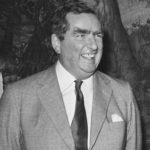
The speech made by Harold Lever, the then Shadow Secretary of State for Trade, in the House of Commons on 18 January 1972.
This is a grim hour for the mining community and, by the same token, for the people of the country, as I shall seek to show.
It is some time since I have concentrated my mind on the affairs of the miners. Before the last Government ended I had the great privilege of being in charge of the National Coal Board and of mining affairs.
In the past my hon. Friend the Member for Ebbw Vale (Mr. Michael Foot) has been in charge of these matters for the Opposition. I wish that at this hour of crisis I could reproduce one fraction of the zeal and passion of my hon. Friend and the concern he showed for the miners in the period during which he had charge of this portfolio for the Opposition. In a sense, he has swapped his portfolio with me and he is now the Opposition’s leading spokesman on Europe. Whatever differences of view I may have with my hon. Friend on any other subjects, I certainly hope to convey to the House the concern which throughout the period of our opposition has been expressed by my hon. Friend on behalf of our party for the miners of this country.
It may be relevant to refer to my own experience with the miners. I have known them intimately over a period of years as a lawyer, but I met them more particularly in connection with my work at the Ministry of Technology. It might be thought from much that has been said that the miners are men who make exorbitant demands upon the community, that they are less socially responsible and socially conscious than the rest of the community. That has not been my experience. I do not want to sentimentalise, but my experience is that these men, who have been mistreated so badly by the people of this country and the arrangements of this country over so long a period, are among the most loyal to their craft and to their country that we possess.
I met not exorbitance of demand but moderation, decency and reason. I met men at the modesty and reasonableness of whose demands I marvelled. I marvelled at their co-operation, at their loyalty to the grim taskmaster which their industry is, and the love and affection they have for that work and that industry and their loyalty to their comrades in the industry, a matter with which I will deal later.
So the first question I must ask is, why have we a strike on our hands? For nearly half a century there has been no such general strike of the miners. Why today, in our more affluent society, have the miners been brought to a pitch of feeling where there is a general strike backed emotionally, whatever the ballot says, by every single man at the pits, in Scotland, Wales, Cumberland and the like?
Mr. Skinner
And their wives.
Mr. Lever
I do not approach the question in a censorious or arrogant spirit. In no country has anyone found a golden key to unlock the doors of the problem of determining wages and wage differentials between one trade and another. Therefore, no one has the right to speak with arrogance and overconfidence about particular settlements or ethical principles in determining either the total of money wage rates or the relative wages between one trade and another. Therefore, I certainly do not approach the question with a desire to make destructive criticism of the Government.
But I must say at the outset that, having followed very closely what has taken place, I am amazed that the Minister should make the speech he did. He failed even for a moment to direct his mind to the central questions that should be troubling it and his conscience: why have we this strike on our hands; why have nearly 300,000 of the most patient, hardworking, hazard-risking men in our industrial society reached a point where they are prepared to jeopardise their future prospects of employment and submit themselves to immediate poverty and conflict to establish what they believe to be their rights? That question does not even appear to have crossed the mind of the right hon. Gentleman or his colleagues who have been handling the matter.
Why is it that patient, hardworking men of the calibre of the miners, to whom the right hon. Gentleman paid such generous tribute in opening, when he talked of their years of co-operation, of reasonableness, of loyalty to their craft, are now feeling a sense of outrage? The right hon. Gentleman has not even begun to attempt to understand this. Why is it that the men are prepared only with difficulty to obey their union’s order to attend to safety in the pits because of the strike which has been brought about?
Mr. F. A. Burden (Gillingham)
Everyone in the country regrets that the miners were 16th in the wages league table, but we are surprised that Labour hon. Members, who are now exclaiming so bitterly that nothing has been done by the present Government, when the miners are being brought up at least to sixth place, should have been so silent during their period of office, never saying a word about the matter then.
Mr. Lever
I like to be generous about interventions. However, they are no substitute for catching the eye of the Chair and treating the House to oratory, valuable or less valuable according to judgement.
I want to ask the right hon. Gentleman—
Mr. Burden
Answer.
Mr. Lever
I will deal with all these questions in my own order if the hon. Gentleman will contain himself.
I now want to ask the right hon. Gentleman and the Secretary of State for Employment, who is to reply, why they think that the strike has been brought about. Has there been a sudden sea change in the character and quality of our mining population which, after nearly half a century including the past 25 years of patient co-operation, leads them to feel outraged at their situation and to feel that they have no alternative but to take strike action to secure some justice? The fact that we have no rules which can tell us exactly how we should seek to determine wages in any particular situation does not entitle us to retreat into rigidity and inflexibility.
On the contrary, as we seek to evolve better ways of dealing with our problem of wages and the like, we must show the maximum respect to the well-tried principles of fair play, decency and candour while we seek in one way and another to improve the general bargaining situation and its consequences for our country. I shall not enter into controversy about what direction that will take. In the meantime, rigidity, inflexibility, coldness, rules of thumb evolved in the secrecy of Government Departments, are not the way in which to handle work-people with a grievance. Real and serious efforts to meet them man to man to examine their grievances and find out what may reasonably be done to deal with them are the order of the day.
I shall try in the time at my disposal to deal with the major policy questions that were involved and seek to show that on every count the Government failed to apply ordinary candour, common sense and fair play in their treatment of the miners. I was rather shocked by the right hon. Gentleman. More than once in his speech he sought to trot out the weary argument about a 15 per cent. increase in coal prices if the miners’ demands had been granted in full. I shall not speak in detail about what should be granted, but the right hon. Gentleman knows perfectly well, in spite of the synthetic indignation he mustered about the 15 per cent. increase, that no union entering into a bargaining situation states its original demand as being equivalent to what it finally accepts.
What we are discussing is not whether the full demands of the miners should have been met but whether the Government and the Coal Board have made reasonable attempts to meet the miners’ legitimate grievances, whether the offer they have made is adequate to the situation, whether the manner in which they have approached and treated the work-people has been calculated to lead to peaceful co-operation with the workers, or whether it has been a manner cold, dictatorial, inflammatory and provocative. I shall seek to show that all those adjectives are justified. I am very reluctant to use them.
There are three major points of policy to which I want to refer and to which the strike situation relates: first, the Government’s relations with nationalised industries and public services; second, regional policy; third, the general economic strategy for dealing with the country’s economic needs, which includes the questions of inflation, wages and unemployment. As to the Government’s position in relation to public service industries, I must say first that I acknowledge that in any matters affecting public servants directly in the public service or in nationally-owned industries, the Government have a special responsibility to use their influence in a way which they believe is conducive to the overall economic advantage of the country. I do not believe that the Government can say, should say or do say, “This is a matter for the National Coal Board. If it feels like offering more, it can do so. If it does not, that is too bad.” That is humbug, and it is very important that that kind of humbug should not be allowed to poison relations between the N.C.B. and the men or between any nationalised industry and its employees by failure of candour. The Government should come out into the open and state quite openly and perfectly reputably that they have an interest in the wage negotiations, and that it is the determining interest in the present circumstances as to what the settlement shall be. But with that interest goes a responsibility not only for candour but a responsibility to do what is constructive and is likely to lead to an agreement if one is possible.
How do we reconcile that with the way in which the negotiations have been conducted? The Government have not attempted to influence negotiations from a sense of responsibility and a helpful and constructive attitude. They have attempted nothing less than a diktat on the Coal Board and the miners as to the limits of any advance that can be made in the miners’ wages. That is the fact. Everybody knows that it is the fact. Everybody knows that the ceiling on the advance offered to the miners by the Board has been fixed by the Government, and the fact that the Government discreetly say nothing about it is because they fail to observe the rule of candour.
The Government then become responsible for meeting the leaders. They are responsible for bringing about settlements in private industry where their good offices make it possible. But what about the coal strike? I have never listened to such dishonest pretence belatedly come to as the pretence that the request to Joe Gormley to meet the officials of the Department of Employment was the delicate and timid beginnings of the wish of the Secretary of State for Employment to be allowed to intervene in the dispute. That bogus and belated pretence for what was in fact an act of deliberate official discourtesy, of deliberately disclaiming the Minister’s intention to intervene, is particularly difficult to swallow.
What in fact happened was that on the eve of the strike officials of the Department telephoned Mr. Gormley and asked him, “Would you come across and see us?” He replied, “Of course, I should like to see the Minister, but why should I come across to see you? What do you want?” They said, “We want to be filled in on some of the facts of the dispute.” We must stretch romanticism to an extreme degree if we are to believe that the officials of the Department really have to leave it to the eve of a strike before they want to be filled in. What they wanted to do was to sound out the officials of the mineworkers’ union without taking the moral commitment which the Minister should have taken, and undertaking to preside over negotiations with a constructive purpose. I hope that the Secretary of State does not repeat that balderdash tonight, seriously telling us that the miners are at fault for there not being a meeting with him because his own timid first approach to them received the brush-off. I take it that the right hon. Gentleman is in command of plain English. He has often shown himself to be. If he wanted to talk to the miners’ leaders and get them round a table with a view to constructive talks, why in heaven’s name did he not just telephone himself and ask Mr. Gormley to come?
The Secretary of State for Employment (Mr. Robert Carr)
The right hon. Gentleman must be aware that in interventions by the Department under various Ministers of both parties in the past it has been very common for talks in a dispute to start with officials and lead on to other things. Is the right hon. Gentleman not also aware that it is common procedure in these matters to start by inviting the parties to come together on neutral territory to give the full background? Is he not aware that only a few weeks previously those tactics led to the settlement of the Coventry tool room dispute?
Mr. Lever
I take it that the right hon. Gentleman listened to the speech of his right hon. Friend who, in answer to a complaint that the Minister had not called the men round the table to talk about their problems with him, claimed that this official approach was quite obviously the beginning of the Minister calling them together. When the right hon. Gentleman saw that the offer of the officials was not regarded in the extraordinary way in which he appears to have expected, why did he not remedy this by a simple application of his voice to the telephone to call the men together? Why has he not done so now? It is part of the dictatorial, insensitive attitude of the Government throughout the dispute.
As I have said, none of us has the right to be dogmatic or arrogant about how wage disputes should be settled, but the rule-of-thumb, dictatorial arrogance of the Government in this dispute comes particularly ill from a Government which before it was elected made great play of the high unemployment figures and the high cost of living increases not being adequately compensated for by wages. We heard a lot about that before the Government came to office. As my hon. Friend the Member for Ebbw Vale reminded me a few weeks ago, Disraeli once said—he must have had a Conservative Government in mind—that one should not compare too closely the hours of courtship with the years of possession. The Government now have a very different attitude, and have failed to attempt to influence in a constructive way, even in the style of the conduct of the negotiations, this grim dispute.
Mr. Loughlin rose—
Mr. Lever
I applaud my hon. Friend’s attempts to intervene in the speech of the Minister, which I found very understandable, but I hope he will allow me to make my points.
Another example of the Government’s attitude in these negotiations, provocative and negative, is that the right hon. Gentlemen cited with apparent approval one of the greatest blunders I can recall in industrial relations, that on the eve of this grim strike, the Coal Board told the miners that the offer it had made to them would necessarily not be open if they persisted in their strike. That is like saying, “You take our diktat or, if you fight, you will not get what we have acknowledged is a minimum fair deal”. Analysed, this is a simple call to the miners for unconditional surrender. I never thought it was a particularly valuable strategy when applied to our Nazi enemies whom we were fighting in 1939, but when it is applied to the mining community of our country it is worse than bad strategy; it is a deeply dishonourable act as a reward to people who, as the Minister has admitted, have co-operated through the grim years of the contraction of the industry to seek to keep its viability.
Apart from the superficial acknowledgement traditional to the miners and their union, the Minister has said not a word to show that the Government recognise that miners have a special and individual case. All work people have a special and individual case, but no such individual case has been considered by the right hon. Gentleman. I must weary him a little by telling him what he appears not to recognise. He has not taken any steps, so far as I can discover from any words he has spoken this afternoon or from anything which the Government have said, even to begin to understand the feelings of the miners and the case they feel they have.
As everybody acknowledges, the miners do hard, dangerous and unhealthy work. There was a substantial correction in the post-war status of the miners which led to the miners being at the top of the league instead of in the miserable position they had been in before the war. This was not an inappropriate correction brought about by accident in post-war circumstances; it was a long overdue act of justice by society to correct the abominable treatment the mining community had endured for a long period.
In my dealings with miners I have been struck not only by their straight-forwardness and courage but by their entire good temper and lack of bitterness about past history which so often bedevils relations in other trades. The miners appear to be able to forget the mis-treatment to which they were subjected in the years before the war, and that is to their credit. But if we forget it, it will be much to our dishonour, and the Government appear totally to have forgotten the long record of the miners both before and after the war. Their status has gone. Their average wages have declined in relation to other people’s. Over the last four years, even on averages, there has been a loss of real wages to the miners. Over a few months, if the offer had been accepted, their wages might have kept up with the recent changes in prices, but over four years the miners have not only watched a relative decline in their status but an actual decline in their real standards of life.
The averages are not very instructive. I shall leave it to my hon. Friend the Member for Chesterfield (Mr. Varley) who knows far more about this than I do, to deal with the details when he winds up the debate for the Opposition. Many men are taking home disgracefully low wages by any standards for skilled or unskilled men. The average is inflated. Some miners in certain circumstances are performing superhuman feats of overtime to earn high wages, and this distorts the picture of what the average man is getting. Those who earn overtime in the pits, earn it hard. Many of them work 12 hours a day underground to receive wages which are quite commonplace in industries outside the pits for full overtime. But that is not the lot of the average man.
What is worse is that this decline which the miners have witnessed and about which they feel keenly arises in part because their union, rightly, in the long-term interests of the miners and the industry, sought to co-operate with the Government and the Coal Board in dealing with the problems that beset a declining industry. They have simplified the wage structure. The bonuses, piecework rates and all the complexities which, for example, bedevil the motor industry, have been eliminated in the mining industry thanks to the miners and their union. When the motor workers are asked to do this they refuse because they say that at the end of the day by one means or another, if they make this sacrifice to logic and industrial advantage, they will be cheated. The miners have suffered as a result of their co-operation and not gained by it. So the right hon. Gentleman and the Coal Board are putting a premium on non-co-operation in simplifying wage structures.
The miners’ union and the men have agreed to the shuffling of jobs whereby skilled men take on unskilled jobs at low wages so as to find a niche for themselves in this declining industry. The miners and the union have co-operated with the Coal Board in the agonising problems of redundancy that have arisen in these last few years when the number employed has shrunk to little more than one-third of the strength a relatively few years ago.
I am appalled that yet again today we hear that the miners will injure their prospects, and that they should be warned about competitive fuels—nuclear power, oil and the like—as if this were the miners’ problem from which the Government dissociate themselves. I do not claim any special virtues as a Minister, but I should be ashamed, at the maximum moment of friction with the miners, whatever difference we had, if ever by one word or hint I did not identify with their grim anxieties, not only about what they have had to suffer in the past but about the difficulties they are likely to have to meet in the future.
The Government say, “You will injure yourselves”, as if it were the concern of the miners alone and not of the Government. I did not hear this from the Minister when he spoke and I should like to hear the Government say, with humility, that, whatever differences divide them and the miners in this dispute, they share and identify with the anxieties and difficulties of the miners in the declining industry situation with which they are faced. This warning must not be used as a leverage to support a Government diktat.
The Government have wholly ignored the regional aspects of the problem. Seventy per cent. of the miners work in depressed regions or regions of high unemployment. What asinine behaviour it is to go searching around these areas of high unemployment to find some emergency means of giving more employment while, on the other hand, exercising self-righteous pedantry in keeping down the buying power of the miners to a point where it leads to a disruptive strike with the consequences which the right hon. Gentleman has pointed out.
This is a prescription, if we are to believe him, for more unemployment in this region of high unemployment. Having refused the miners a modest and flexible response to their demands for wage increases on the ground that this would threaten the economy, the Government would rather have a strike which will add in the long run to unemployment in areas of high unemployment. If ever there was an area where there should be some flexibility and response to wage demands it is an area of high unemployment, because by making that response the buying power of the wage earners in that area would be increased. I am not saying that this justifies an unlimited increase, but it certainly justifies a far more flexible approach than the Government have shown. This should have been kept in mind, but we have not heard a word from the Minister or from the Government about the regional aspects of this problem.
Another matter on which the Minister might at least have treated us to his views is the financial structure of the Coal Board, which was saddled at the outset with the cost of taking over the mines. I will not reflect on the 1945 Labour Government by suggesting that we unknowingly overpaid for the mines, but we can say that a very handsome payment was made for the neglected collieries of those days. If I may put on a private entrepreneurial hat for the moment, it is not a payment which I would have thought reasonable to pay. The Coal Board and the miners have been saddled with the burden. I say “the miners” because every time the miners want a wage increase they are referred to the balance sheet and told that there is interest to be paid on that huge debt before anyone can think of paying more wages.
Mr. Richard Kelley (Don Valley)
Would my right hon. Friend not agree that if the Coal Board was allowed to fix prices according to ordinary commercial criteria it would be in a different position today, approaching this terrible calamity? It would then be able to measure the demands of its employees against the price it might be able to charge for its products in the commercial market.
Mr. Lever
My hon. Friend has a good point, but the point that I am seeking to make is that instead of being allowed to pursue commercial criteria the Board has been saddled with this debt which is unrealistic, particularly in a declining industry. The debt is already too high in relation to the assets, but in the nature of a declining industry those assets have been vanishing and so the miners are servicing a debt on machines which are no longer in use, covering pits which have been long closed down. In 1965 my right hon. Friend the Member for Cardiff, South-East (Mr. Callaghan) wrote off a substantial sum, but that is nearly seven years ago.
I want to know why we cannot write off a great deal more of the debt in view of all the closures that have taken place since then. This is where I complain of the Minister’s attitude. He ought to be aware, and to show awareness, of these things. The charge per ton by way of interest is higher today than it was before my right hon. Friend wrote off the debt. In terms of the burden on the miners and the industry the weight of debt is greater on the contracted industry of 1972 than before. Since the right hon. Gentleman does not want to push up prices but wants to do justice by the miners, why cannot he perform this elementary act of financial justice that would automatically have been provided for in the accounts of any private firm, and write off a substantial part of the debt interests?
That interest amounts to about the same amount in total as the total offer made by the Board. If the Government make a serious incursion into this debt they will find themselves with some millions available which would provide the facilities to make a flexible response to the miners without adding a penny to the price of coal.
This coal strike must be seen as part of general policy which cannot be acceptable to us. It is a policy of selective pressure on the public sector while, if there is any pressure at all on the private sector, it is applied in a very different way. We cannot say to the public sector as the Minister sought to say today, “You must make a sacrifice in your legitimate claims because we are trying to protect prices and the public.” We cannot say that to miners and public servants if we are not attempting some control over other people’s wages. The Government remind me of an old music-hall song in a rather obvious way, which used to go something like this:
“When I’m not near the girl I love, I love the girl I’m near.”
I do not say that the Government love the public industries—I acquit them of that charge—but when they cannot control the wage rises they would most like to control they control the wages of those where they are a monopoly employer, where they are backed by an unlimited public purse.
This is not good enough. We cannot expect one-sided sacrifices by public servants and State industries when they are not being protected. We will end up with a situation where there is an undeclared incomes policy diktat in the public sector and a million unemployed in the private sector. For us this is not an acceptable policy.
Mr. R. Carr
I wonder what the right hon. Gentleman would advocate as an incomes policy.
Mr. Lever
The right hon. Gentleman has chosen his moment of interrogation well. I can hardly expect the House to allow me to enlarge on what is, as I admitted, a very difficult question. Sometimes it is possible to express a certain humility as to how we may achieve what is right and comprehensive but that does not mean that one forfeits one’s right, when one sees plainly wrong things being done, to denounce such things. Whatever a right incomes policy may he, and I have every sympathy with this or any other Government in thinking out and groping for one, if it is done with a little humility and compassion I welcome it.
One thing is quite clear and it is that what I have described as a diktat in the public sector—the risk of grim strikes, poverty and the ruin of one of our great industries with consequential damage to the people of the country—is not a policy for incomes. Nor is it a substitute for neglect in the private sector to claim proudly that that sector now has a million unemployed threatening it. It is no good saying, “If we cannot dictate to them when we are not a monopoly employer we can at least provide an overhang of a million unemployed.”
What is to be done? Are we really to go on with the attitude shown by the Minister today, of pious sermonising, or are the Government at long last going to get them round a table and start talking flexibly and intelligently with the miners in a real effort to understand why they feel as they do, why they are incensed and why they are prepared to suffer as they are likely to suffer, have already started suffering—they and their families? Do the Government believe that these men are their fellow citizens, in line with the panegyric with which the Minister began his speech? If they do, then the only honourable thing they can do is to get them round a table.
I want to warn the right hon. Gentleman that the alternative is a fight to a finish and it is one which no one will relish when it starts. There are two possibilities in theory. One is that we would achieve a dishonourable victory with a trail of bitterness, and beat the miners back to work, as happened in 1926. The other is that we will achieve a ruinous defeat because the miners are not the kind of people the Government seem to believe them to be. These are among the most loyal and determined men we have. These are the yeomen of England, Scotland and Wales. These are the men who rarely turn against their fellow men. I once said in this House when I had the honour and privilege of being a Minister dealing with their affairs that the thing that struck me most about the miners was their open-facedness. They had the faces of men who have spent long years wrestling in comradeship against the grim hazards of nature, not wriggling foxily, determined to outwit their fellow men. These are not men who by nature are aggressive or eager to injure their fellow men.
Their record proves to the contrary. If they feel their cause to be righteous, if they feel they are being subjected to a humiliating diktat by a Government which has totally failed to understand their grievances, they will fight and fight until not only they suffer but our whole country suffers. I do not believe the people of the country are prepared to stand idly by and watch an attempted re-enactment of the terrible experiences of 1926.
It is my privilege on behalf of my party to pledge that we will not stand idly by and that we stand solidly behind the miners in their sense of grievance and intend, as we believe the whole of the trade union movement intends, to support them in their efforts to secure justice. In doing so we we will be giving expression to the deepest wishes of the great majority of forward-looking people in this country irrespective of party.