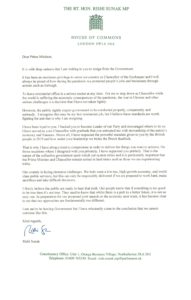
The letter of resignation from Rishi Sunak, the Chancellor of the Exchequer, sent to Boris Johnson, the Prime Minister, on 5 July 2022.


The letter of resignation from Rishi Sunak, the Chancellor of the Exchequer, sent to Boris Johnson, the Prime Minister, on 5 July 2022.


The comments made by Caoimhe Archibald, Sinn Fein’s Spokesperson on the Economy, on 18 June 2022.
For months the cost of living has been on a steep upward trajectory, inflation is now predicted to hit 11% over the next couple of months and this is impacting on workers, families and businesses.”Boris Johnson and his government need to listen to workers and act now.
While the Tory government did announce some measures in recent weeks, further action is urgently needed, particularly in relation to rising petrol and diesel costs.
Petrol and diesel prices are heading towards £2.00 per litre and many people are calculating the cost of every journey and only making the ones they can’t avoid.
The British government should act immediately to cut duty on fuel further and also slash VAT on fuel and energy.
Workers and families are struggling as their pay packets don’t go as far now as they previously would have, and we need to empower workers to uphold their rights to decent pay and conditions.
We need the DUP to join immediately with other parties to form an Executive so we can tackle the cost of living crisis and get money into the pockets of workers and families.

The speech made by Rachel Reeves, the Shadow Chancellor of the Exchequer, to the Times CEO Summit in London on 16 June 2022.
Thank you Dominic, and thanks to the Times for hosting us today.
Since being appointed Shadow Chancellor I have had the privilege to visit inspiring British businesses.
From Castleton Mills, once a key part of West Yorkshire’s textiles industry – now reimagined as a creative, collaborative space housing freelancers and start-ups.
To world-recognised names like Rolls Royce in Derby – leading pioneering research to develop carbon-neutral aviation.
And Oxford Nanopore, one of our leading technology and life science firms.
Britain has huge economic strengths. Our leading universities, our language, our geography, our excellence in sectors from financial services to life sciences to cultural industries.
But questions of wealth creation have become too marginal to our politics.
After starting my career as an economist at the Bank of England, I spent several years at HBOS in Halifax.
I know what business can bring. Not just in prosperity and work which pays well – but in pride and identity.
After a decade in which people have seen their incomes stagnate and their public services cut to the bone, I don’t only see the task of building a more just society as a moral responsibility – though it is that – but also as the route to a dynamic economy with wealth creation at its core.
Through which opportunity is widely shared, and through which we can break out of our cycle of low growth, low productivity and underinvestment.
Labour is pro-worker and pro-business in the knowledge that the success of both is crucial to our country’s economic success.
A new partnership between government and business will be the foundation of everything the next Labour government will hope to achieve.
This a challenging moment.
The politics of stagflation and energy security have come to the fore for the first time in half a century.
But this present crisis is just the latest chapter in a longer economic story. Between 1997 and 2010, the UK economy grew at an average of 2.1 percent a year, but since then, growth has averaged just 1.5 percent a year.
And now the OECD forecasts that the UK will have zero growth next year – putting us behind every G20 economy bar Russia.
I don’t accept that economic decline is an inevitability.
But we do face a succession of challenges if we are to return to strong growth and shared prosperity.
Our success will rely on the leadership of both government and business.
I know businesses increasingly recognise their wider role in strengthening our economy and society.
But there is an onus on government to rethink too.
It is no longer enough – if it ever was – for government to simply get out of the way.
In America, the Biden administration is taking a more active role in tackling structural economic weaknesses. US Treasury Secretary Janet Yellen calls this approach ‘modern supply side economics.’
For the next Labour government, such an approach will mean government applying itself more concertedly to driving up the productive potential of our economy. By boosting labour supply through providing workers with the skills, healthcare, and childcare they need to flourish. By using its power of procurement to support businesses here in Britain. And as a strategic partner of business.
Let me talk more about that final point – strategic partnership.
I want to see UK companies thrive, to see great ideas come to fruition and for the UK to be a great place in which to invest.
But I don’t believe all that happens in a vacuum.
The state has to be active in fostering the conditions for our country to prosper, whether that is in sponsoring world leading research, getting the regulatory environment right, or in helping bridge the gap between a fantastic concept and the reality of its commercial production.
The last Labour Government developed an active industrial strategy on these lines – and for all my differences with the the Cameron and May governments, their efforts to continue this work were welcome.
But now these efforts have been abandoned – and the industrial strategy scrapped.
And for no clear reason, other than an ideological objection.
Ideology won’t help great British companies, but good partnership will.
That’s why Labour will bring local, regional and national leaders together with businesses, workers and universities to support the growth of high-tech, competitive industries of the future. And to map out a better way forward for the high-employment, low-productivity sectors on which we all rely – what I call the everyday economy.
But an approach to strategic partnership can’t stop there.
I agree with the director of the CBI, Tony Danker, that what is required to break us out of our cycle of underinvestment and low productivity is ‘catalytic public investment’.
Labour’s climate investment pledge would provide just that, and crowd in private sector investment – to create new markets and bolster existing ones.
And a modern supply side approach cannot and must not ignore the task of making Brexit work for British businesses and consumers.
So we must address the flaws in the Brexit deal hitting our food and drinks manufacturers, creative industries, professional services and more – through repairing and strengthening our supply chains, and building on the UK-EU trade deal to cut red tape for exporters.
We need to adopt an approach that seeks to solve problems in a practical way for UK companies, and aims to build trust – rather than continually retreating to the issue of Brexit as a domestic political wedge.
Any competitive market economy must offer opportunities for new, innovative and agile businesses to flourish.
Innovation is a great British strength. It’s in our DNA.
We have immense resources in the creativity and drive of our entrepreneurs, and the innovative capacity of our universities.
Fast-growing firms already contribute £1 trillion to our economy and employ 3.2 million people.
But something I have heard repeatedly is a real worry about the stubborn obstacles preventing many of them from scaling up, and the small number of start-ups listing in the UK.
Labour’s mission is to build an institutional ecosystem enabling the market access, finance, and skills that new and growing businesses need.
So today I am launching a review, led by a panel of entrepreneurs and experts including the economist and former Treasury Minister Lord Jim O’Neill, and tasked with charting a course to ensure Britain is the best place to start and to grow a business.
The review will be given a remit to ask the difficult questions and present solutions – about the incentives for growing businesses here compared with other countries, about access to capital – especially patient capital, about the skills, structures and incentives presented to our universities to spin out new businesses, and about how we extend opportunities to a more diverse range of entrepreneurs.
I consider it a key task for the next Labour government – a central part of a modern supply side approach – to provide answers to those questions, and to unleash the next generation of innovators and wealth creators.
The method I have outlined today is a modern supply-side approach, with government as a provider economic security, enabler of a highly-skilled workforce, and a strategic partner to business.
The object is a stronger society – underpinned by a thriving market economy in which opportunity is shared widely.
But to realise this, we need a different kind of leadership. Upholding strong institutions, practising transparent decision-making, and showing respect for business.
Keir Starmer’s Labour Party – proudly pro-worker and proudly pro-business – will offer that leadership.
Thank you.

The comments made by Rachel Reeves, the Shadow Chancellor of the Exchequer, on 12 June 2022.
People are scared about the future and lack the confidence to spend.
While the Chancellor’s cost of living package and u-turn on the windfall tax are welcome, we need more than just sticking plasters. People want more than just sticking plasters. They want to know that the government has got control of the economy and a grip of this crisis.
Over the past 12 years the Conservatives have demolished the foundations of our economy.
With me as Chancellor, Labour will build a stronger, more secure economy. We will get the cost of living crisis under control and make Britain more resilient, laying the foundations we need for a thriving, dynamic economy.

The speech made by Pat McFadden, the Labour MP for Wolverhampton South East, in the House of Commons on 13 June 2022.
I am grateful to the Minister for his response. GDP down 0.3% in April. A fall of 0.1% in March. Services down 0.3%. Production down 0.6%. Construction down 0.4%. Inflation at 9%. Tax promises broken. The trade deficit at £24 billion. The pound falling against the dollar. The director general of the CBI saying business leaders are “in despair”. The OECD forecasting that, next year, the UK will have the lowest growth of any G20 economy, with the sole exception of—Russia.
That is what the Government are presiding over. Britain is going backwards under the Conservatives. Our businesses, universities and people are all great, but they do not have the partner they need in this Government. The chaos is affecting more and more areas of life: passports, driving licences, GP appointments, A&E waiting times, airports and delays in court trials. Time after time what we used to take for granted is now another feature of Boris Johnson’s backlog Britain.
Those on the Government Benches had a chance to change direction last week. They had a chance to install new leadership that might have given us some hope of a greater sense of grip on all this. But what did they do? They decided that the best person to turn the economy round, to sort out the chaos and the backlogs, and to bring the qualities of focus, attention to detail and sustained delivery to these matters was the current Prime Minister. That was the judgment they made.
The question for the Minister today is simple: after making that judgment—I do not know what he did, but that was the collective judgment—and choosing to continue with the leadership that brought us here, what will the Government do now to turn matters around, and why on earth should anyone believe that the result will be different from what went before?

The statement made by John Glen, the Economic Secretary to the Treasury, in the House of Commons on 13 June 2022.
Like other advanced economies, the UK is affected by global economic challenges, including the unprovoked Russian invasion of Ukraine. As the Chancellor said a few weeks ago,
“A perfect storm of global supply shocks is rolling through our economy simultaneously.”
At the same time, the impact from the wind-down of the national covid testing scheme is dragging on UK GDP data. Overall, the figures for April, published by the Office for National Statistics this morning, show that output fell by 0.3% on the month, with the services sector falling by 0.2%, and production and construction declining by 0.6% and 0.4% respectively. As the ONS notes, the fall in GDP on the month is driven by the impact of the wind-down of the NHS covid testing programme. Testing volumes fell by 70% from March to April, which, alongside the impact from vaccines, detracted 0.5 percentage points from GDP growth in April. Looking through the impact of falling tests, we see that the rest of the economy actually grew by 0.1%. Importantly, GDP is still 0.9% above pre-pandemic levels, and support provided over the past two years has put the UK economy in a good position to deal with any economic headwinds, with record numbers of employees on payrolls and a strong economic recovery from the pandemic.
As the Chancellor has also said:
“The next few months will be tough. But where we can act, we will.”
The Government are taking significant action to support households this year, having announced an additional £15 billion of further support for households just over a fortnight ago, on top of the £22 billion announced at the spring statement. In the longer term, the Chancellor has set out his vision for a lower tax, higher growth, higher productivity economy based on the three pillars of capital, people and ideas. The plan for growth and the tax plan represent an ambitious strategy for boosting growth and productivity in the years ahead. The Government’s priority going forward is to put those into effect, including through significant investment in infrastructure, skills and innovation.
We will of course keep the data under close review, and that includes monitoring the economic impact of Russia’s illegal invasion of Ukraine, but our focus will continue to be on the best solution for all: a growing economy that supports high-wage, high-skilled jobs.

The speech made by Michael Heseltine, the then Secretary of State for Trade and Industry, in the House of Commons on 22 March 1993.
The Budget sets in place one more step in our strategy for industry. When coupled with the autumn statement, it must be seen as a comprehensive response to our industrial needs. First, it provides a sound economic background against which our companies can more effectively enhance their competitiveness. Secondly, it backs our drive on the export markets. Thirdly, it addreses a range of specific measures that industry has raised with us. Fourthly, it recognises the vital role that small and medium-sized firms play in economic vitality.
No Government have done more to create a favourable climate for enterprise and wealth creation. Interest rates have been cut by 9 per cent. As a consequence, industry’s costs have been reduced by £11 billion a year. The Government’s privatisation programme is perhaps one of the most radical changes in the United Kingdom’s economic and industrial structure since 1945.
In 1978–79, the nationalised industries received subsidies of some £2.2 billion in today’s prices. In contrast, in 1990–91, the privatised companies paid £3 billion to the Exchequer. The privatised industries are achieving striking improvements in productivity. British Airways has increased its productivity by more than 20 per cent. The number of customers per employee in respect of British Gas has increased by about 19 per cent. Productivity at British Steel, which is now considered to be one of the world’s most efficient steel producers, has increased dramatically. It now takes only 4.8 man hours to produce a tonne of liquid steel, compared with 13.2 man hours in 1979–80.
Those improvements in productivity have been passed on to consumers as lower prices and rising standards of service. Since privatisation, gas prices have fallen by 18 per cent. for domestic customers and by 40 per cent. for large industrial customers. Those industries are, in many cases, now acting as flagships for Britain in overseas markets.
During the Prime Minister’s visit to India last month, British Gas signed an agreement with the Gas Authority of India enabling both companies to take gas from offshore Bombay and send it through a new distribution network to more than 60,000 offices, factories and homes.
In Argentina, British Gas has won a $300 million contract to replace the Buenos Aires distribution system. The company is working as far afield as Indonesia and Kazakhstan. It is developing the Uisker oil field in Tunisia and converting the German town of Spremberg to natural gas.
Since privatisation, Rolls-Royce——
Mr. David Winnick (Walsall, North)
The Secretary of State has mentioned gas and electricity and there is much confusion in people’s minds outside this place. Will the Government fully compensate pensioners, and particularly those on very low incomes, in respect of the imposition of VAT? Is it not necessary for the Government to be quite clear, before the vote at 10 pm, precisely what is to be done, bearing in mind the tremendous hardship and misery that so many people on low incomes already face when they pay their heating bills during the winter months?
Mr. Heseltine
Of course that is important and that is why the Chancellor of the Exchequer made the position clear in his Budget statement and why my right hon. Friend the Prime Minister built on what the Chancellor had said when he addressed the House last Thursday. I will return to that subject when I reach that part of my speech.
As I was saying, since Rolls-Royce was privatised in 1987, its share of the world civil engine market has risen from 10 per cent. to no less than 22 per cent. Its aero-engine order book has more than doubled and currently stands at £6.7 billion. More than 70 per cent. of its output is exported. Its industrial and marine activities are also world wide. It recently won power supply contracts worth £67 million in India and the subsidiary, NEI Parsons, secured a £100 million contract for turbines in Singapore.
Ten years ago, British cars were hardly seen on the streets of Tokyo. In 1991, Rover exported 10,000 vehicles to Japan. The company produced 395,000 vehicles in 1991, of which about 40 per cent. went overseas, the bulk to other members of the single market.
As I said in the House last week, British Telecom is now one of the world’s foremost telecommunications companies. Last year, it won a £350 million contract to install a network for the New South Wales Government.
Our water companies are making formidable strides in overseas markets. Thames Water is expected to sign a contract for £450 million for a water supply scheme in Izmit in Turkey to build, operate for 15 years and then transfer the scheme to the Turkish Government.
Mr. Andrew Mackinlay (Thurrock)
What about the unemployed in Dock road, Tilbury? What about real people?
Mr. Heseltine
I heard the hon. Gentleman say, “What about real people?” Does the hon. Gentleman believe that real people do not work for those real companies? What sort of real people does the hon. Gentleman have in mind if people who export for Britain and design and manufacture for Britain are not considered by the Labour party to be real people? I suppose that, in the language of the Labour party, the real people are those who disrupt industrial relations, try to undermine Britain and talk the nation down: the real people of the left; yesterday’s real people.
Mr. Dennis Skinner (Bolsover)
Will the right hon. Gentleman give way?
Mr. Heseltine
Here is one of them. One of yesterday’s real people stands before us.
Mr. Skinner
As a matter of fact, I am making inquiries about today’s real people. The Secretary of State knows as well as I do that the mining industry could do with participating in the exports to which he referred. After a 15 to 20 per cent. reduction in the value of the pound, we could be exporting coal and today’s real miners could be taking part in that.
Will the Secretary of State tell us today that the 20 million tonnes of coal imported into Britain will be massively reduced and that he will launch an export drive for coal? If we are exporting all those things to all those parts of the world, why has there been a announcement today of an increase in the balance of payments monthly deficit of £1.3 billion?
Mr. Heseltine
I can help the hon. Gentleman. Yes, we can export coal the day that we produce it at a price which the export market will absorb. If the hon. Gentleman had put his mind years ago to advising his constituents about the productivity gains that we are beginning to see in the mining industry, we might not have these imports of foreign coal. The price that we have paid for the views expressed by the hon. Member for Bolsover (Mr. Skinner) and his right hon. and hon. Friends and their failure to bring home the realities of a competitive marketplace to the miners of this country is now being visited on those very people.
Thames Water, as I said, expects to sign a contract for £450 million. Anglian Water has won a stake in a winning consortium for a Buenos Aires water privatisation project. North West Water, in conjunction with an Australian engineering firm, has signed a contract for 100 million Australian dollars to improve water quality in Melbourne.
That is a remarkable transformation. Not only are those privatised companies no longer loss making, in tax terms, but they are paying large sums of money to the Exchequer. They are now winning for Britain in a way in which, for the past 30 or 40 years, we denied them the opportunity even to try to.
I am not sure whether the hon. Member for Dunfermline, East (Mr. Brown) is in his place at the moment.
Mr. Rhodri Morgan (Cardiff, West)
I am grateful to the right hon. Gentleman for giving way before he goes off on one of those manic, last deckchair attendant on the Titanic performances. Does he not realise that the reason why the water companies are able to make flash investments in places such as Turkey and New South Wales has nothing to do with the technology which they have to offer? It has everything to do with the guaranteed and ludicrously high prices which they are allowed to charge by the over-generous terms on which they were privatised by the Government in 1989. As a result of having that guaranteed income, the companies can spend overseas the capital which they have accumulated from the ordinary water and sewerage users in the United Kingdom. It is capital which we, the taxpayers, have provided. It is nothing to do with the skills of the companies.
Mr. Heseltine
Here we have the revisited Labour party. This is the Labour party which does not want to see real people involved in making real products. We now have a new concept: if a privatised British company goes out and wins in the marketplace of the world, somehow it is doing so because it is taking on loss-making contracts. That is what the hon. Member for Cardiff, West (Mr. Morgan) said. British companies are not winning on their merits. They are winning contracts because, somehow or other, they are being artificially supported in the domestic marketplace.
What sort of message does the hon. Gentleman think that he is sending to countries that are considering taking British tenders? The message has come from the British Labour party that it is a giant fix—that these are not competitive tenders but have all been sorted out on the back of the domestic market by the British Government.
I hope that all those people out there who are selling for Britain are listening to this debate and to the support that they are getting from the Labour party in the House. Labour Members of the revitalised Labour party say that they are backing Britain. They are backing Britain everywhere except when it comes to winning contracts in the overseas marketplace. If the hon. Member for Dunfermline, East (Mr. Brown) were here today——
Mr. George Foulkes (Carrick, Cumnock and Doon Valley)
Get on with it!
Mr. Heseltine
The hon. Gentleman should not worry: I shall get on with it. The hon. Member for Dunfermline, East said: The central questions are how we invest in people for the future, how we invest in industry and how we invest in the social and economic fabric of our country to ensure that we will have not only rising production in industry but rising standards of living.”—[Official Report, 17 March 1993; Vol. 221, c. 296.] That was the great sort of interrogation to which the Chancellor and the Chief Secretary were subjected by the hon. Gentleman.
What is happening to improve the living standards? What are the facts? As a result of the changes which I have been talking about, real spending on the national health service in England has increased by 60 per cent. since 1979. There are 19,000 more doctors and dentists and almost 38,000 more nurses and midwives, and 45 per cent. more acute in-patients and day cases are treated each year.
Dame Elaine Kellett-Bowman (Lancaster)
Real doctors, real nurses, real patients.
Mr. Heseltine
My hon. Friend is right: this is another example of real people doing real things because a Tory Government have made it possible.
The investment programme in the privatised water industry is heading for an additional £30 billion by the end of the century. There has been record public expenditure on roads and the urban programme has been transformed. The essence of the matter is that, while Labour Members continue to talk about these problems, the Tory Government continue to do something about them. There has been much comment about the Chancellor’s commitment to extend VAT to fuel bills. That applies with a rate of 8 per cent. in the year starting 1994 and moves to the full rate in April 1995. The Chancellor made his position clear in his Budget speech. On Thursday, the Prime Minister told the House that there would be extra help for less well-off pensioners and other people on low incomes. They will get the extra help from next April before the higher fuel bills come in. That help will be additional to the future increases in pensions and other benefits which will take place automatically. Cold weather payments will also be adjusted to reflect increases in fuel costs.
I was intrigued to read in The Observer that the Chancellor and I were engaged in a furious row on the subject. Apparently, I was furious that I had not been consulted. Perhaps I may say a word about the matter. I was consulted in an orderly way. I made no protest, for the simplest of all reasons—I shared the Chancellor’s judgment that it was necessary to raise taxes in the Budget.
Of course any tax increases are likely to be difficult, but, frankly, I am not prepared to cop out of the difficult tax decisions on the most contemptible of arguments—that I agree with what the Chancellor is doing in principle, but I disagree with some specific examples of the difficult decisions which he must take. That is the sort of stuff of which Opposition arguments are made. That is the sort of argument which the Labour party relishes. Indeed, it is the sort of argument which keeps Labour Members pinned to the Opposition Benches.
Why did not The Observer take the trouble to check the facts about this great row between me and the Chancellor? It cannot be because it did not know exactly how to get hold of me. That cannot be the case, because I received a telephone call from The Observer on Saturday wanting to take my photograph. The House will be delighted that I turned down that extremely generous offer. If the picture editor of The Observer knows how to find me, is it too much to think that the serried ranks of industrial and political correspondents somehow cannot manage the same trick—or were they frightened that, if they put to me the straight question, they would get the truth and the truth would deny them any sort of headline at all?
I can see that this will be the revisiting of the inglorious past of the hon. Member for Livingston (Mr. Cook). This afternoon he will be in his element. If ever there was a story tailor-made for the hon. Gentleman, this is that story. There are millions of pensioners to frighten and spectres of ill-health and hardship to conjure up. The hon. Gentleman knows the arguments backwards, because, over the years, he has invented most of the arguments backwards. He is the seasoned practitioner on whom all those people out there will wish to make a judgment.
In The Times of 14 December 1987, the hon. Gentleman described the Government’s intentions as to leave the NHS as a ghetto service for those who are too poor to afford anything better”. In The Times of 1 February 1989, he said of GP budget holders: For the first time, GPs will have an incentive to turn away patients with a high price tag, the elderly, the disabled and the chronically sick. In The Independent of 5 October 1990, he spoke of an NHS in which pensioners queue up for their operations in an end-of-season sale”. What happened? All the trusts are still in the public sector, and 1 million more patients are being treated than when the hon. Gentleman was making his statements.. The hon. Gentleman is a man with a record. He has been through it all before. He should be judged by how true it all turned out to be.
I took a little time off last Wednesday to listen to the hon. Member for Dunfermline, East, and I am glad to welcome him to our deliberations today. Some of us had the privilege to watch him. He was at his most ferocious. Psychologically, the red flag was up—I see that it is round his neck today. Red blood was flowing all over the carpets as he ended his speech with these fighting words: There is no one left for this Government to betray; they have no credibility in this country. The electorate will never trust them again. If Britain is to have a new start, it will need a new Government—and that will be a Labour Government.”—[Official Report, 17 March 1993; Vol. 221, c. 298.] Trust a Labour Government! In September 1964, the Leader of the Opposition, Mr. Wilson, said: Over the period of a Parliament I believe that we can carry out our programme without any general increase in taxation. When that Government left office, they were collecting £2 for every £1 collected when their promise was made. In the same election campaign, the late George Brown—[Interruption.] Oh yes. Opposition Members may laugh now. I know that it is a long time ago, but it is a long time since we had a Labour Government. The reason why it is a long time is because the Labour party said these preposterous things and was found out.
The late George Brown said: For new mortgages we have something in mind of the order of 3 per cent. By the time that Government left office, mortgage rates were 8.5 per cent. By the late 1960s we had the then Prime Minister, Lord Wilson, proclaiming on 17 April 1969: The Industrial Relations Bill is an essential Bill, essential to full employment and essential too for the Government’s continuation in office. On 18 June 1969, the Bill was withdrawn from the legislative programme.
For those who are interested in the flights of fancy of the hon. Member for Dunfermline, East about trusting a Labour Government, what about all the bravura claim in October 1964: Labour will abolish poverty in Britain”? Six years later, the Child Poverty Action Group had sadly to conclude: in many ways the plight of poor families is now worse than when the Labour Government took office. Worse it was, worse and always it will be. Trusting the Labour party is not a matter of investing in risk. It is a matter of investing in certainty. All out. All up. All over.
The hon. Member for Bolsover asked a question about coal. I recognise, as will the House, that there has been much speculation in recent days about the coal contracts. Some progress has been made in respect of the base contracts. Work has continued now through several weekends. I hope that I am about to be able to report on the position. I hope that I may be able to do that in the not-too-distant future. However, as I have said many times, I have no powers to make people sign contracts. In the meantime, I have agreed that British Coal can extend the redundancy terms until the end of December this year.
Increases in productivity are often accompanied by falls in employment. We have had to face that problem in the coal industry over many years. But we are familiar with the general trend throughout manufacturing industry. Indeed, manufacturing employment peaked as far back as 1966. That phenomenon is not confined to the United Kingdom. Some decline in employment in manufacturing is evident in most industrial countries.
Increased competition and continuing technical progress mean that many firms will reduce employment to stay competitive. That does not mean that those firms are in difficulties. Far from it. The vehicle industry in the United Kingdom is producing 300,000 more vehicles a year than 10 years ago, but it employs 100,000 fewer people. The paper, printing and publishing industries increased their output by more than a quarter between 1980 and 1991, but employment fell by 12 per cent.
In many industries, successful firms are cutting jobs as they invest for the future to stay ahead of the competition. New firms and new businesses were the key to employment growth in the 1980s and they are undoubtedly the area of the economy to which we must look for new jobs in the future. We have been more successful in job creation than other European Community countries. The work force in employment grew by almost 1.5 million over the last economic cycle, between 1979 and 1990, so it is of critical importance that we recognise that every degree of support that we can give to new companies is most relevant to creating new jobs and new opportunities in our economy.
The next matter of dramatic importance in what we seek to achieve and must achieve is support for our export companies. Our companies know that there is no such thing as a secure market. Overseas firms face the same pressure to win as we do. We are pushing forward with fresh initiatives to help exporters.
Last November the Minister for Trade announced an export strategy to maximise our strengths and minimise our weaknesses. I have invited British companies to second to my Department 100 men and women to help us in the promotion of our exports. I am extremely gratified by the response that I am achieving. I believe that we shall have 100 such people by the summer of this year. That will give us experts with first-hand knowledge of overseas markets who will aim to identify and promote opportunities to help our companies to fulfil their potential.
Mr. John Townend (Bridlington)
I am sure that my right hon. Friend agrees that our exporters are doing a fantastic job, but is not the United Kingdom’s problem the fact that we import too much? Do we not have a cultural problem? A large part of the British buying public still believes that it is smarter or better to buy foreign, even when British goods are competitive and of the right quality.
I give my right hon. Friend an example from my constituency. I represent more pigs than people. We produce the finest pigmeat in the world. British charter bacon is of top quality and is internationally competitive. Yet 50 per cent. of the bacon bought by housewives is from Holland or Denmark. Is not that a national disgrace?
Mr. Heseltine
I understand my hon. Friend’s anxiety. That is why I was delighted to notice the seminar which my right hon. Friends the Prime Minister and the Minister of Agriculture, Fisheries and Food, with leaders in both the retail and producing sectors of the food industry, held recently to address some of those difficult issues. As my hon. Friend says, that part of our economy is particularly important because it represents one of the largest deficits in our balance of trade.
The Budget of my right hon. Friend the Chancellor of the Exchequer will help business build on the achievements of the 1980s. It will promote the economic recovery by providing concrete benefits for business and a stable framework for business decisions. His Budget has successfully combined three aims, at least two of which were widely said to be incompatible before he rose last Tuesday and showed how it could be done. His Budget has avoided damaging the inevitably fragile early stages of recovery; it has achieved a substantial improvement in the public finances into the medium term; and it has done all this while keeping inflation within clearly defined limits. All three aims, and especially the continued control of inflation, are of vital importance to business.
We now hear less than we did two or three years ago about short-termism as a feature of our industrial and commercial life. To a large extent, this is because we have got inflation down, yet I do not doubt for one moment that deep-seated short-term attitudes are prevalent in our affairs; or that this is one important strand in understanding why we as a nation have performed less well than many of our competitors.
Such attitudes have led us to invest less than we might in technology and advanced means of production. They have encouraged growth in companies by acquisition and financial engineering, rather than through organic development and building on products and markets. They have led us to place far too great an emphasis on comparisons of near-term financial results in judging our companies, instead of considering the strength of management and its underlying strategy.
Those attitudes are all of a piece. They reflect much that is cultural, and they can be changed only slowly. But they have one great mechanism of reinforcement—inflation. Inflation is an evil which narrows the focus of attention into the short term. Inflation must be kept low in the years to come if our performance is to be improved. The Budget measures will reduce burdens on business by £1 billion in the year ahead. They will assist small and medium enterprises to do what they do best—create the wealth on which the rest of the country depends.
Ms Liz Lynne (Rochdale)
On that specific point, can the President of the Board of Trade say why the Chancellor did not introduce a statutory requirement to pay interest on late payment of debt? That would have helped small businesses considerably.
Mr. Heseltine
We have no doctrinal view on that measure, but there are many doubts about whether it would have the effect that the hon. Lady suggests. We have discussed the matter. My noble Friend Lady Denton has exercised significant influence on late payment of debts. There has been a substantial improvement in the rate of payment. Not the least reason for that is that the Government have paid their bills in a timely way and encouraged large companies to do the same. My noble Friend has made it clear that she will take up specific cases if they are drawn to her attention.
Mr. Robert Sheldon (Ashton-under-Lyne)
I wish it were true that Government Departments had been settling their bills promptly. The Public Accounts Committee took evidence from the Property Services Agency, which was only paying when it received payment, and I shall shortly be criticising that strongly.
Mr. Heseltine
I fully acknowledge the high position of responsibility that the right hon. Gentleman has in our affairs. If he has examples that my Department should explore, I assure him that we shall do so, as that is an important matter. We have tried to do what we can to speed up payments, but we are aware that a statutory process might not improve matters in the way that people think, and have therefore hesitated to move in that direction.
For the second year running, no business will face a real increase in its rates bill. The package of value added tax measures introduced by the Chancellor will also be welcomed by every small firm. Finance for small businesses—a subject of great concern—will also be given a boost by the changes in premiums and loan size limits, under the small firms loan guarantee scheme. I have no doubt that my right hon. Friend the Chancellor has thrown a challenge to the banks. The Government have taken an initiative and it is now up to the banks to judge business plans and to make their loans in a way that will help businesses to grow.
The changes to capital gains tax will encourage reinvestment by not penalising those who use their profits to start another business.
I have referred to the need to help exporters. We are making available an additional £1.3 billion of cover for key markets. Together with the changes in the autumn statement that will mean that annual cover for United Kingdom exporters in priority markets will have increased by more than 75 per cent. in just four years. Premium rates have also been cut and are now more than 25 per cent. lower than in 1991–92. Those reductions will bring the average level of premiums charged in the United Kingdom down to around the average charged by the United Kingdom’s competitors.
The Chancellor announced a special scheme in the Budget to help persuade foreign-owned companies to choose the United Kingdom as a location for international headquarters companies. The present advance corporation tax rules are an obstacle to their doing so. The new rules, which will be implemented next year, will remove that obstacle, which should attract new business to the United Kingdom, and bolster London’s role as Europe’s premier financial centre.
I know that oil companies have always recognised the responsiveness and stability that our North sea tax regime offers. However, the petroleum revenue tax regime was introduced in 1975, with the last substantial amendment in 1983. In keeping the tax system under review, it was important to keep in mind the fact that the North sea was maturing as an oil province—new fields tend to be smaller, and older fields are gradually declining. The Chancellor has now reduced petroleum revenue tax from 75 to 50 per cent. for existing fields from 1 July 1993, and abolished the tax for future fields given development consent on or after 16 March. The Chancellor’s proposals move the North sea from a high-tax to a low-tax regime.
Conditions for recovery are in place. The United Kingdom has the lowest inflation rate for 25 years; the lowest interest rates since 1977; and the lowest base rates in the European Community. Interest rates have fallen by nine percentage points since autumn 1990, knocking £11 billion a year off industry’s costs.
We have a fiercely competitive exchange rate; a set of Budget measures to boost confidence and stimulate growth; and confidence is rising. The Confederation of British Industry, the chambers of commerce and the Institute of Directors show rising confidence in their surveys. Retail sales are at record levels; car sales are up sharply; manufacturing investment in the fourth quarter of 1992 was up by 5.5 per cent. on the start of the year; the increase in average earnings is the lowest for 25 years and we expect a further decline in the coming months.
Rapid productivity growth means that United Kingdom manufacturing unit wage costs are lower than those in Germany or Japan, on recent OECD estimates, and they have fallen during the past 12 months. However, further pay restraint is vital to maximise the competitive advantages of sterling depreciation. This month’s fall in unemployment is welcome, but too much should not be read into one month’s figures, as the fall might not be immediately sustained and it may be some time before the underlying trend takes a downward turn. Unemployment is likely to be one of the last indicators to respond to any recovery in the economy.
Exports and productivity are at record levels and Britain is moving ahead. British business now has clear advantages in competing in the rest of the world.
Mr. Anthony Steen (South Hams)
While I agree with all that my right hon. Friend is saying, does he agree that the rules and regulations affecting small firms prevent them from competing with other countries on that famous level playing field? Something needs to be done to reduce the number of rules and regulations affecting small firms. Can he tell the House what the deregulation unit is doing about future and existing regulations, which are preventing the recovery that small firms so badly need?
Mr. Heseltine
As my hon. Friend knows, we have started to review proposed regulations and those already on the statute book and are applying the review to domestic and European Community regulations. We have been fortunate in securing the services of Lord Sainsbury and those of various other chairmen and significant figures from the private sector, who have helped us to establish seven task forces, to consider the 7,000 existing regulations, which obviously create the climate in which industry has to operate. I shall report to the House as progress takes place.
Mr. Peter Hain (Neath) rose——
Mr. Heseltine
I shall not give way.
I assure the House that in all those ways the Government will play their full part to help the private sector in difficult circumstances.
As I told the House in a recent debate, we live in a competitive world. As we export such a high proportion of our output, it is impossible to believe that we can operate as an island economy. We are broadly comparable with many economies in the world. During the past year industrial production has fallen by 2 per cent. in Italy, by 2.5 per cent. in France, by 6.5 per cent. in Germany and by 7 per cent. in Japan, but in this country industrial production has risen in that period.
Japanese gross domestic product fell by 0.75 per cent. in the second half of 1992, output fell in France and Italy and there were three successive quarters of decline in Germany. Since 1981—the trough of the last recession—United Kingdom manufacturing output has risen by more than a fifth, manufacturing investment is up by nearly two fifths and manufacturing productivity by two thirds. Our export volumes are at an all-time high and by the end of 1990 there were about 400,000 more businesses operating in this country than in 1979.
The underlying strength of our manufacturing base can also be seen from our ability to attract inward investment. In 1991, we attracted one third of all inward investment into the European Community.
So, as we have said many times, despite the severity and length of the recession, Britain is in a strong position to take advantage of prevailing domestic and world economic circumstances. That can be done only by making this country’s economy competitive, which can be achieved only by the relentless grind on costs and the pursuit of improved quality.
The Opposition are incapable of understanding those arguments, and view the British economy as an island apart from international pressures and the international marketplace. They keep peddling their view of an industrial strategy, which is simple and based on clear but irrelevant ideas: higher taxes to finance higher public expenditure; bigger training budgets; pushing up education standards; helping workers with statutory rights; and embracing the social chapter. They have pursued all those ideas in France, where their income taxes are higher and their education system renowned. They have extensive public ownership and have turned the social chapter into a Domesday book. What has happened under one of Europe’s most substantial socialist Governments? The people living under it are sick to death of what is happening.
The French election result, if replicated in this country, would take a scythe to the parliamentary Labour party. It would be down to a rump of about 10 people; the impregnable Labour strongholds might be all that would be left if we had a Labour socialist Government. What would that Government look like? Perhaps the hon. Member for Merthyr Tydfil and Rhymney (Mr. Rowlands) would be Foreign Secretary; the hon. Member for Rhondda (Mr. Rogers) would be Chancellor of the Exchequer; the hon. Member for Liverpool, Riverside (Mr. Parry) would be Home Secretary; and presumably there would be an early return to the Front Bench for the right hon. Member for Islwyn (Mr. Kinnock) as Secretary of State for Wales. We could count on the fact that the hon. Member for Bolsover would be there clambering on to any convenient barricade, searching for a starring role in “Les Miserables”. What a brilliant piece of casting that would be, but it would be casting in the world of make-believe. The Budget contains real policies for the real world; I commend it to the House.

The speech made by Michael Heseltine, the Secretary of State of Environment, on 19 February 1992.
I beg to move, To leave out from “House” to the end of the Question and to add instead thereof: congratulates Her Majesty’s Government on its success in winning the battle against inflation and in bringing interest rates down; welcomes the recent reduction in the balance of payments deficit and the fact that exports are at record levels; notes that the United Kingdom has some of the most competitive tax rates in the world, including the lowest level of corporation tax in either the G7 or the European Community and that Government spending on training has increased by two and a half times over and above the rate of inflation since 1979; recognises that the foundations for economic recovery are now firmly laid; and rejects totally the policies of the Opposition, which would lead to soaring inflation, greater public sector borrowing, higher taxation, increased unemployment, rising interest rates, declining investment and a spiralling cycle of higher wages and prices which would destroy any prospect of recovery and plunge Britain into perpetual recession.”. You, Mr. Deputy Speaker, will of course identify the speech of the right hon. and learned Member for Edinburgh, Monklands—[Interruption.]
Mr. John Smith
Monklands, East.
Mr. Heseltine
—the right hon. and learned Member for Monklands, East (Mr. Smith). You, Mr. Deputy Speaker, will know that the main thrust of the right hon. and learned Gentleman’s argument was to suggest that the recession in this country was the responsibility of the Government, and of the Government alone.
Nobody questions the nature of the recession with which we have to grapple. It has never been disputed by my colleagues or by myself. It is interesting that in this morning’s newspapers the effect on the German economy is so adequately described—to indicate as clearly as possible the effect of recession on that economy.
I fear that this morning’s newspapers reveal another casualty of the recession. Labour’s campaign, as The Guardian reveals, has quite failed to convince the British people that the British Government are to blame. Only 9 per cent. of the British people believe that the recession here is the fault of the British Government.
If the right hon. and learned Member for Monklands, East has scanned this morning’s newspapers, what he will have found interesting is not the uncritical columns of the Daily Mail or the Daily Express, but what he might have found in the uncritical columns of The Guardian. The Labour party, dismayed by the right hon. and learned Gentleman’s failure to pin the blame on the Tory Government, is looking for a scapegoat.
I read with some surprise that, despite the onslaught from the Labour party, its members have already lost faith in the man at the front end of the attack. No Conservative Member would say such things, but I understand that the right hon. and learned Gentleman’s colleagues, loyal to a man, are concerned that he is not radical enough on the economy”. I gather that it is felt—dare I say it—that he is ” less clever than he thinks and less busy than he should be”. There is even a suspicion growing—only on the Labour side, of course—that he has left Labour boxed in”, and that his policies are deflationary and offer little comfort for the unemployed or for debt-laden firms”. [AN HON. MEMBER:”Is that The Guardian?”] Yes, that was The Guardian. The tumbrils are rolling. This evening’s Evening Standard carries the headline: Labour’s knives out for Smith”. The debate began as a vote of confidence in the Government’s economic policies; it has rapidly become a vote of confidence in the shadow Chancellor. I find no difficulty in agreeing with some of the anxieties that flow from the whispers on the Labour Benches, although I totally reject the implication that what is needed is not less but more of them.
Nothing more reveals the willingness of the Labour party to misread the harsh nature of present events than the accusation by the Leader of the Opposition in the House two weeks ago that the Government are “inventing recessions abroad”. The report of the Bundesbank—the right hon. and learned Member for Monklands, East will not feel that I am undermining his position in saying that I trust the Bundesbank’s views on the German economy rather than his—is that the main reason for three successive quarters of negative growth in Germany is the international recession which is reflected in particularly low investment activity”. Perhaps the right hon. and learned Gentleman should think again. Inventing recessions? How does he explain unemployment in Germany of 3 million? Did we invent the fact that in the past three months, industrial production fell by more in the United States, in Japan and in Germany than it did in the United Kingdom? Did we invent the fact that there are economic problems across the world, from Stockholm to Sydney? Did we invent the comment on Japan by Russell Jones of Phillips and Drew? He said: There’s no doubt in my mind that the manufacturing sector is in recession”.
Mr. Nigel Griffiths (Edinburgh, South)
The right hon. Gentleman talks about inventions. Let us bring him to the facts. Do he and the Government take responsibility for the tens of thousands of people who have lost their houses? Does he take any responsibility for or feel any guilt about the 2.5 million people who have lost their jobs? Let him deal with the facts for which he is responsible.
Mr. Heseltine
We shall come to the policies that will affect those who have lost their jobs. The hon. Gentleman will welcome as much as I do the fact that houses are now beginning to sell and that the starts are 2 per cent. up.
The issue that we must recognise is that there is one particular reason why the world economy is especially difficult for this country. Britain’s economy is one of the world’s most dependent on exports. The right hon. and learned Member for Monklands, East knows that Scotland alone exports more manufactured goods per head of population than do Germany, America or Japan. He knows that Britain exports a greater proportion of our gross national product than Japan does. If there is difficulty in the world economy, our economy will suffer disproportionately as a consequence. If all our principal overseas markets are sluggish, we cannot avoid the consequences at home.
The question that must concern us is the nature of the policies that we need to fight our way out of the present international difficulties. In stark contrast to the right hon. and learned Gentleman, let me set out the policies that are essential for us to fight our way out of our present position.
Mr. Tony Benn (Chesterfield)
When there are so many unmet needs in Britain and so many unemployed people who could meet those needs, why cannot the two be put together to create prosperity for the 1990s?
Mr. Heseltine
The reason is that, unlike the right hon. Gentleman’s right hon. and hon. Friends, we are not prepared to direct labour, as all the most ineffective economies in the world have tried to do at some stage.
The question with which we must concern ourselves concerns the essential policies which we believe we must follow to fight our way out of our present circumstances. The first essential ingredient is that we must pursue the drive for competitiveness in every aspect of the domestic economy. That is critical in the battle to contain public expenditure, to reduce inflation, to keep interest rates under control, to attract inward investment, to stimulate new enterprise and to keep our tax rates competitive. Those economic policies are essential to our policies, as are those for improving education and training, and for the safeguarding of the environment.
The right hon. and learned Member for Monklands, East said that we were doing nothing. All that reveals is that he does not understand what must be done. During the past 16 months, interest rates have been cut eight times and inflation has fallen from 10.9 per cent. to 4.1 per cent. The contradiction in everything that the right hon. and learned Gentlemen says is displayed no more eloquently than in the words of the man who is something of a hero figure to the right hon. and learned Gentleman—Jacques Delors. He said that Britain is fast becoming a paradise for foreign investment. That is why, in spite of the world downturn, we have seen in recent months Toyota’s announcement of further investment in Derbyshire bringing 3,000 more jobs, Nissan’s additional £150 million in Sunderland and other inward investment projects from Kimberley Clarke on Humberside to Toshiba in Plymouth.
The objectives are clear. The question that we must debate today is how we are to achieve those objectives. To be fair to the right hon. and learned Gentleman, I do not think that he would have too much difficulty in accepting many of the priorities that I have listed. Nobody should be especially surprised about that. He is one of the few Labour Members who has served in a Government with a basic rate of 35p in the pound, a top rate of 98p in the pound, inflation running out of control at 27 per cent. and more days lost in strikes in just one month in the winter of discontent than were lost in the whole of last year. I understand that he is not leaping up and down to restore the record of a Government among whom he was prepared to serve without complaint.
The right hon. and learned Gentleman’s problem is that most of his right hon. and hon. Friends are positively enthusiastic to restore, piece by piece, the regime that Labour left behind in 1979. What is at issue this afternoon is not the debate across—[interruption.]
Mr. Deputy Speaker
Order. I very much hope that the hon. Member for Vale of Glamorgan (Mr. Smith) will show a little more restraint.
Mr. Heseltine
What is at stake this afternoon is not the debate across the Floor of the House; it is in reality the debate within the Labour party and, even worse, the debate within the shadow Cabinet. On the one hand, we have the much vaunted prudence of the shadow Chancellor and on the other, the irresponsible extravagance of his shadow Cabinet colleagues.
I hear wherever I go that the right hon. and learned Gentleman has become a star attraction in the City. Lunch after lunch, dinner after dinner, the assurances flow. The prawns are consumed and there are soft shells, soft words and soft lights. Not a discordant crumb falls on to the thick pile. “All will be well,” is the message that the right hon. and learned Gentleman conveys. “The shadow Cabinet? Don’t you worry,” is the message. “I’ve stitched them up.” The words are no sooner uttered than up pops the hon. Member for Oldham, West (Mr. Meacher), the shadow Secretary of State for Social Security, who said: If you took a poll on Labour’s public expenditure commitments in the City, you would find it almost 100 per cent. against”. Think of the tragedy, Mr. Deputy Speaker. All those prawn cocktails for nothing. Never have so many crustaceans died in vain. With all the authority that I can command as Secretary of State for the Environment, let me say to the right hon. and learned Member for Monklands, East, “Save the prawns.”
Mr. John Smith
I forgive the Secretary of State for not knowing that Monklands is not in Edinburgh. It was very revealing about Conservative attitudes to Scotland. [Interruption.] I hear the right hon. Gentleman asking his hon. Friend where it is. It is in Lanarkshire. However, I ought not to badger the right hon. Gentleman about his lack of knowledge of his country. While we are of divisions within parties, does the Secretary of State hold to the view expressed in his article in November 1989 in The Times that Britain should sign the social charter?
Mr. Heseltine
The right hon. and learned Gentleman knows full well that the matter was then negotiated brilliantly by my right hon. Friend the Prime Minister [Interruption.] The Labour party has been duped on the social charter. Labour Members all know that the Germans want to export their high costs, that the French cannot resist the social charter because they have a socialist Government, and that other countries will not take any notice of it. The Labour party has been duped into signing up to that extravagant impost on our industrial economy.
I have to recognise that there is another lacuna in the dilemma that we on this side of the House face. Up to now I have discussed the unlikely hypothesis of the right hon. and learned Member for Monklands, East being the Chancellor of the Exchequer should a Labour Government emerge. I assumed that we should enjoy the bespectacled geniality of the right hon. and learned Gentleman. But there is even dispute about that. The hon. Member for Livingston (Mr. Cook) tells us: Once we have a Scottish Parliament handling Scottish home rule affairs in Scotland, it is not possible for me to act as Minister of Health administering health in England and Wales. At a stroke, the shadow Health Secretary—a Scot—is gone. By the same standards, the shadow Chancellor—a Scot—is gone; the shadow Trade and Industry Secretary 364—another Scot—is gone. All Scots, all gone. Never have I heard so convincingly and eloquently made the case for devolution.
Let us assume that the right hon. and learned Member for Monklands, East survived the scenario sketched by the hon. Member for Livingston. The right hon. and learned Gentleman may think that he has trouble now, but in those circumstances his trouble would hardly have begun. Not a day passes when his protestations of economic constraint are not shot to pieces by his colleagues. As each Labour spokesman promises a new priority, urgent action, immediate initiative—
Mr. George Foulkes (Carrick, Cumnock and Doon Valley)
Will the Secretary of State give way?
Mr. Tam Dalyell (Linlithgow)
Will the Secretary of State give way?
Mr. Heseltine
No.
Each Labour spokesman has his own variant of a crash programme. That is exactly what it would be—the biggest crash programme in British economic history.
Let us look at the heart of the matter. Only two weeks ago, Labour’s housing spokesman, the hon. Member for Hammersmith (Mr. Soley) tried to cook the books by redefining public borrowing. He promised—his phrase was eloquent—a phased release of up to £8 billion of capital receipts, without, of course, increasing the public sector borrowing requirement. Consternation in the Opposition camp. Urgent telephone calls. But they were all abroad somewhere out there across the continent. Dramatic disruption of the grand tour. Then, before we knew where we were, the climbdown.
Mr. Clive Soley (Hammersmith)
Will the Secretary of State give way?
Mr. Heseltine
No. I am not giving way. In order that the hon. Gentleman does not get the quotation wrong, it might be helpful to provide the House with the quotation from The Times of 6 February this year in which he continued his saga of this phased release. He said: There is no plan to revise the PSBR. I was wrong. I withdraw it. This is not really about the phased release of capital receipts. We have witnessed the phased release of the Opposition spokesman on housing. The whole House will wish to join me in saying, “Good luck, good fortune and goodbye.”
Mr. Soley
I have the advantage over the Secretary of State of having the script available to me with the exact words. What I said, as the hon. Member for Ealing, Acton (Sir George Young) will tell him, was that there should be a phased release of capital receipts and that that would have an impact on the PSBR. That is precisely what I said. The interesting thing, as the hon. Member for Acton will agree, is that he went on to say that the Government were also keeping that very option under review.
Mr. Heseltine
The Times now joins the list, along with the Daily Mail, the Daily Express and The Guardian, of unprincipled misrepresentation of Labour’s policies.
Mr. George Howarth (Knowsley, North)
On a point of order, Madam Deputy Speaker. A few moments ago, the Secretary of State wilfully and deliberately misquoted comments attributed to my hon. Friend the Member for Hammersmith (Mr. Soley) who, with the benefit of his script, has corrected him. Should not the Secretary of State apologise to my hon. Friend?
Madam Deputy Speaker (Miss Betty Boothroyd)
I fear that that is a point of frustration, rather than a point of order. [Interruption.] Order. These are matters for debate, not for points of order.
Mr. Heseltine
Without taking issue with you, Madam Deputy Speaker, it is not frustrating me, it is frustrating them. All that I want to know is, if the transatlantic or trans-European phone calls produced a result, how much did they add to public expenditure as a consequence? Opposition Members cannot have it both ways.
Mr. Soley
I am willing to give the Secretary of State a copy of the script. I have the exact words, as taken down at the time. I am happy to give them to him either in half an hour or later. If I give them to him, will he give an apology to the House?
Mr. Heseltine
I am just old-fashioned: I believe what I read in The Times. I, the House and the country want to know what deal the hon. Gentleman did with the right hon. and learned member for Monklands, East. How much public expenditure was slid under the carpet which they thought that no one would see?
Mr. George Howarth
Apologise.
Mr. Heseltine
I had not intended to raise the matter, but as I hear the hon. Member for Knowsley, South (Mr. Howarth) interrupting from a sedentary position, I tell him to go back to Knowsley and look at Cantrill farm, as it once was. It was one of the great housing slums of Europe. It took a Tory Government to rescue it.
Mr. Howarth rose—
Mr. Heseltine
I will not give way.
Mr. Robert N. Wareing (Liverpool, West Derby)
On a point of order, Madam Deputy Speaker. Is it not one of the conventions of the House—[Interruption.]—there are such things—that when a Member names another Member as part of a speech, he is willing to give way when requested to do so?
Madam Deputy Speaker
It is certainly up to the hon. Member who has the Floor whether he gives way, but I am afraid that many of the common courtesies which we used to extend to each other in the House were forgotten a long time ago.
Mr. Heseltine rose—
Mr. George Howarth
At least because of you, Madam Deputy Speaker, the Secretary of State has learnt some courtesy. He mentioned Stockbridge village. Will he confirm that the Stockbridge Village Trust has been technically bankrupt for the past three years and that, without the guarantees which have been provided by the Labour council in Knowsley, it would have been in the hands of the receiver?
Mr. Heseltine
The Labour council of Knowsley begged me to rescue that estate. The hon. Member should never forget that the Abbey National and Barclays bank made it all possible.
If I may leave the junior spokesman for the environment, I should like to come to the hon. Member for Dagenham (Mr. Gould)—no slouch he, when it comes to egging up the public expenditure ante. Within the past few months, by his team alone we have been asked to support: local authority bids for an extra £2 billion a year; the full release of all those capital receipts; the unfettered discretion of local authorities to clobber the business rate payer.
That is just part of the hon. Gentleman’s programme. Then there is the problem of renationalising the water industry. In the past few weeks—this is why there has been so much muttering on the Labour Back Benches—we have heard about the £1 billion so-called recovery package, about the £800 million that Labour wants to spend on training and the £50 million that it wants to spend on the national health service by cancelling private health insurance.
But hold on: not to he outdone, the hon. Member for Dagenham says that renationalising the water industry is a “priority” for Labour. What will all that cost—about £4 billion, just to get control of it. That will cost about four times the size of Labour’s recovery package; five times the amount that it proposes to spend on training; and 80 times what it deems to be essential for the national health service. All for one purpose—to buy off the hard left of the Labour party. The consequence would be a return to the regime when Labour cut water investment. That was Labour’s contribution to the environmental enhancement of that vital industry.
Before the day is out, the hon. Member for Dagenham will be back on his feet, defending the higher tax rate plans of the Labour party, which overnight would do more to destroy the housing market than any other single thing one could do.
Mr. Bryan Gould (Dagenham)
I know that the Secretary of State can hardly wait for me to get to my feet. When I do so, I shall attack the Government’s record on the recession—something which the right hon. Gentleman has so far notably failed to defend.
Mr. Heseltine
My colleagues and I tremble on our feet. I promise the hon. Gentleman that we shall all be here waiting for the great hour when the hon. Member for Dagenham flattens us. I confess that I had intended to go out to dinner tonight, but I shall not do so now.
I do not want to be unfair to the hon. Member for Dagenham. Why should he respect the shadow Chancellor’s edict, when the leader of the Labour party designs policies over Luigi’s pasta, late at night—economics bolognaise?
Several Hon. Members rose—
Madam Deputy Speaker
Order. The Secretary of State has made it abundantly clear to me that he is not giving way.
Mr. Heseltine
I do not want to pretend that the Leader of the Opposition isolates himself from advice, to act alone. He does not act alone—he does it with the aid and assistance of some of Britain’s leading economists, even if they are heavily disguised as journalists from the Galleries of the parliamentary Lobby.
There was the leader of the Labour party—wrestling with the twin complexities of national insurance on the one hand, and how to carve up the shadow Chancellor on the other. Picture the scene. The Leader of the Opposition, fighting to prevent long strings of spaghetti from slipping through the prongs of his fork, while the minutiae of national insurance were slipping through the caverns of his mind.
Mr. Foulkes
On a point of order, Madam Deputy Speaker.
Mr. D. N. Campbell-Savours (Workington)
On a point of order, Madam Deputy Speaker.
Mr. Heseltine rose—
Madam Deputy Speaker
Order. There are points of order.
Mr. Foulkes
In my constituency, the level of unemployment is more than 20 per cent. Is it therefore in order for the Secretary of State to give us nothing other than a music hall turn?
Madam Deputy Speaker
The hon. Gentleman knows that that is not a point of order for the chair.
Mr. Heseltine
So, there we were, it was the politics of Bedlam—fork-twisting, head-spinning, mind-boggling—the right hon. Member for Islywn (Mr. Kinnock) firmly in charge. He would have been better employed wrestling with the damaging consequences of his tax policies on the national economy.
The right hon. and learned Member for Monklands, East is not that far apart from his leader on putting up tax rates. In a recent interview, David Frost put it to him that The Economist had pointed out that, under his proposals, Britain would have the highest tax rates for middle managers anywhere in the world. Quick as a flash, the right hon. and learned Member for Monklands, East said, “Ah.”—[HON. MEMBERS: “Ah!”]—I paused because it is so awful that I had to check it before I read it. He said, by way of excuse, “Ah, what they took was not all the countries in the world; what they took were the G7 industrial countries.”
So, there it is, on the record, staring us in the face. Put the right hon. and learned Member for Monklands, East in the Treasury and, as long as he can find some clapped-out, down-at-heel, fly-blown socialist economy with higher tax rates than we have in this country, he will be content to point his lawyer’s finger and say that someone, somewhere is suffering more than we are.
The Opposition have the effrontery to come to the House and talk of job creation. They talk of better education. They did so when they were in government. They called for a great debate, which consisted of agonising over the collapse of education standards that the worst excesses of Labour’s social engineering had delivered.
Twelve years ago, only one in eight of our young people went through higher education. Today, that figure is one in four and it is heading for one in three. The Government are investing £2.8 billion in training, enterprise and vocational education—that is two and a half times as much in real terms as was invested in the final year of the last Labour Government. In addition, the private sector is spending £20 billion on training its employees; exports are at an all time high; inflation is at 4.1 per cent., below the average of the European Community and that of the G7 countries. Interest rates are down by 4.5 per cent. in just over a year. We have some of the most competitive tax rates in the world and the lowest level of corporation tax in either the G7 countries or the European Community. All the Labour party can do is talk about taxing the rich, as though that will help the economy.
The Labour party does not understand that there is a whole generation of young people out there—the skilled, the talented and the enterprising—who need to believe that there is a future for them here, in Britain, where energy and initiative will be rewarded.
We want to see young teachers seek the initiative to assume responsibilities as head teachers. We want young engineers to believe that it is worth their while to be promoted to production managers. We want young doctors to stay and practice in Britain and aim for the privilege and reward of running our hospitals. We want young scientists to relish the opportunities to explore tomorrow’s frontiers in our laboratories and research establishments.
Mr. Giles Radice (Durham, North)
On a point of order, Madam Deputy Speaker. Is it in order for someone who is making a speech to the House to speak only to those on his Benches? Is this a leadership bid?
Mr. Heseltine
Why should I not speak to my own Benches? We are the governing party and we will stay that way because the Labour party is out of date, out of touch and out of office. We will keep them there.

The speech made by Michael Heseltine, the then Conservative MP for Henley, in the House of Commons on 6 March 1990.
The right hon. Member for Swansea, West (Mr. Williams) has done us all a service. His speech was thoughtful and comprehensive, embracing a coherent strategy on how to attempt to run an economy. To paraphrase what he said, there was the once-and-for-all bonanza of North sea oil and “we”—I assume he meant the Government of which he hopes to be a member—will be able to use that money for a once-and-for-all investment process for the greater benefit of the British people. That shows the difference between the Opposition and the Government. The weakness in the Opposition’s case is that they have no idea how to use the money, which they would have confiscated through high taxes from the people who had extracted the oil from the North sea.
It is precisely because Governments the world over do not have the sophisticated mechanisms for investing money for profit that the system described by the right hon. Gentleman does not work. Socialism fails because it misuses resources in its hand. It is the marketplace that finds the probable investments, and that is what the Labour Government, had they been in power, would have denied—the proper effective disposition of resources.
The seriousness of the right hon. Gentleman’s speech, with the conclusions of which I wholly disagree, was in stark contrast with what I think he described as the “knockabout rubbish” of the speech of the hon. Member for Dunfermline, East (Mr. Brown)—which was funny. By any standards in the House, it was extraordinarily funny, and the better the jokes, the more apparent it became that he had absolutely no policy contributions to make. If this country wants to be run on the basis of inspired humour and the odd wit of Opposition Members, it has today seen what lies over the edge of the abyss.
The hon. Member for Dunfermline, East was quite specific about what he wanted to do. He wanted to introduce a Budget for investment to bring down interest rates. We were led to understand that that commitment was at the top of his list of priorities. He did not tell us what the Budget would contain to bring down interest rates. Bringing down interest rates would mean cutting the level of demand in the economy. As my right hon. Friend the Chancellor eloquently put it, “If it ain’t hurting, it ain’t working.” The hon. Member for Dunfermline, East did not say where he would impose the pain necessary to get a grip on inflation.
The hon. Gentleman then moved on to the second broad sweep of policy. I wholly agree with many of the sentiments he expressed, but then, all hon. Members would broadly agree with them. He argued for more education, training and research and development. He would be the first to say that those are essentially long-term policies. It is no use thinking that, if we say that we are going to put £1 billion into education, the kids will be in the factories within 24 hours, changing the nature of the performance of British industry. It is a long-term policy. With research and development, we must start with a gleam in the eye, work through to the application and then the product emerges.
Mr. Gordon Brown indicated assent.
Mr. Heseltine
The hon. Gentleman is generous enough to agree with me.
With training, we have to start the process, find people to do the training and set up the facilities, and, in five to 10 years, we will probably get a greater output of trained people. The hon. Gentleman and I are at one on that, but there is a lacuna in his argument. If, when he and his party were in power, they were doing all the training, education and investing in research and development, why did the economy fall apart when they left power? We should have been the beneficiaries and inheritors of that great legacy, but they had done none of those things.
The third, and by no means the worst, item of the hon. Gentleman’s agenda for change is regional policy. If I understood him correctly, the implications of his speech were that the northern parts of our economy work less effectively than the southern parts, and a little bit of subsidy here from central Government to stimulate a little bit of job creation there, will change things in a way that all Governments since the war have failed to do. However, there is a small problem for the hon. Gentleman——
Mr. Allen
The right hon. Gentleman tried it when he was Secretary of State.
Mr. Heseltine
No. The hon. Gentleman says that we tried it. The Labour Government did something quite different. In their regional policy, they spent a few hundred million pounds from the centre to the regions while they took billions of pounds from the regions in the south-east in one form of subsidy or another to the City of London and the pension funds.
What do the Opposition think they achieved with the capital gains tax that destroyed the family businesses of the north? What do they think they achieved when they subsidised pension funds to take the money out of the wealth-creating companies to institutionalise them in the City of London? What did they think they achieved when they gave the publicly quoted companies of the south of England the privilege of taking over the businesses in the midlands and the north with tax incentives? Where did the power go from? From the north. Where did the power go to? To the south. When the communications explosion of the 1980s took place, where did it take place? Where the head offices were. Where were they? Down here. Why? Because they had been driven out of all parts of peripheral Britain by the Labour party. That is what has happened.
The fourth argument of the hon. Member for Dunfermline, East—his cri de coeur to my right hon. Friend the Secretary of State for Trade and Industry—was, “Give me this one hope.” The hon. Gentleman’s message was, “Let there be no more restructuring of British industry.” I have heard that before. That was the essence of nationalisation—remove the industry from the initial owners, subsidise it, protect it, prevent it from being changed, do not let it diversify, ossify the economies around the country’s periphery, and then expect those economies to compete.
That is what the hon. Member and his party achieved. When the market winds blew, the subsidised, nationalised industries were the first to shed the horrendous number of jobs which, if they had been changed and diversified when the economy was prosperous and growing, would have resulted in much less pain and much more benefit. It took the Conservative party to face up to that, and it is because the Opposition have learnt nothing that they must remain what the hon. Gentleman made them today—an eloquent, uproarious joke, fit for opposition but not for government. [HON. MEMBERS: “What about Jaguar?”] Hon. Members know it has already been sold to the Americans.
I wish to speak about the central issue to which my right hon. Friend the Secretary of State for Trade and Industry referred—the battle against inflation. Conservative Members understand that that is the battle we must win. I am grateful that the Chancellor is here today. He and my right hon. Friend the Secretary of State should seriously consider the first act of nationalisation in the post-war world—the nationalisation of the Bank of England. The Government have achieved wonders by working back through the corridors of history and privatising most of the major nationalised industries. It is curious that we did not concentrate on the first act of nationalisation, that of the Bank of England. We all know that it cannot be privatised, but there is every conceivable reason why we should seek to distance the Bank of England from its current relationship with the Government.
I say that for two reasons. First, the battle for inflation is an institutional and a psychological battle. It is of critical importance that the people, the politicians and the wage negotiators of a country know what is the overriding priority of a nation, and that has to be the battle against inflation. If, as with the German, American and Swiss banks, the central bank is distanced from the Government, everybody knows that the only way in which politicians can change the influences on the value of money is by direct and open direction through a bank that is likely to resist it. That is a huge sanction. There would be no diminution in the sovereignty of the House, because it would be easier for the House to detect the process that was at work, and the power built into the central governor’s position would have a major stabilising impact in the direction that I have described.
Secondly, whatever one might consider to be the likely effects of German unification, we are moving, driven by treaty, towards the completion of the single European market. One of the major benefits of that market is not just the removal of the structural inhibitions between the 12 countries: it is the enhanced confidence that can come from the investment profile of a much larger and more stable home market, a market that enables Britain, within a partnership of Europe, to stand on all fours with the United States or Japan. One method of achieving that is to obtain a degree of monetary stability in the wider market place.
The debate is increasingly becoming one of sovereignty, and there are no ways in which, in logic and in the ultimate, that issue can be avoided. But in the first stages towards a more co-ordinated market, the European monetary system and the disciplines of the exchange rate mechanism, no unacceptable loss of sovereignty is involved in moving into such a mechanism. But one would preserve that sense of national independence if we saw it happening coincidentally with the establishment of a central independent bank in Britain.
We should suggest to our European partners that they should all establish independent central banks on the same model as the Bundesbank, operating to the disciplines of the Bundesbank. Let us have no illusions about that: the disciplines of the Bundesbank are precisely those to which we are all committed. It is precisely because it has been so successful, and the deutschmark so powerful, that all of us recognise that either it will make it on its own, dominating the European economic marketplace, or there will be some arrangement within which we conduct a dialogue; in other words, we have access to the top table.
A way in which that could be achieved without loss of national sovereignty would be if an independent team of hankers, operating to the same disciplines as the Bundesbank, were established in the national capitals, acting coherently as a council of central bankers.
It would be perfectly possible for any country to opt out of the exchange rate mechanism or not to attend the meeting of the council of central bankers if it wanted to. But if one did not attend, it would become apparent that one was worried about the disciplines themselves and, in leaving the central mechanism, one would lose the underpinning of the exchange rate mechanism itself, so there would be a price to be paid. But if the central management of a national economy is such as to justify such a removal from the mechanism, one will pay that price in any case, so the important point is to establish disciplines which bind us into the highest standards, which are those of Europe, the deutschmark and the Bundesbank.
It is apparent from what we have heard in the House today that the alternative policies of a putative Government are those of yesterday, with no understanding of the changes that are coming. But for Britain the 1990s will be more traumatic and the change more far-reaching than is yet perceived. We shall deal with the rationalisation of industry and commerce on a scale that is relevant to the competitive challenge of the modern world only if we get inflation under control and if we have disciplines that are equal to the best in Europe. That is something that only the Conservative party understands and has the will to achieve.

The speech made by Kirsty Blackman, the SNP MP for Aberdeen North, in the House of Commons on 26 May 2022.
It is quite amusing to hear the Chancellor talk about this announcement being timely. I mean, it is timely: it just happens to have happened in the week of the Sue Gray report. It just happens that that report came out yesterday and the Chancellor has suddenly realised today that people are really struggling. He has suddenly realised that he needs to announce something.
At the spring statement, when the Chancellor announced the energy loan, he stood up and said, “Look at these amazing things that I am announcing.” He genuinely seemed to believe at that time that that was the best this Government could do. Now, he has changed his mind. He has listened to the calls of the Opposition and of the people up and down these islands who are struggling, in many cases more than they have ever struggled before.
I do not understand why the Chancellor has announced only a £15 billion package. He has £28 billion of fiscal headroom in public sector net debt and £32 billion of fiscal headroom in balancing the current budget—those are the Office for Budget Responsibility’s figures from March—yet he is refusing to spend that money now in the timely and targeted way that is needed for people now.
I am glad that the Chancellor announced money for the poorest households and that it has been targeted in that way, but it is not enough. What he has announced fails to uprate benefits; fails to account for the fact that the energy price cap that is coming in October will still be in place next year; and fails to ensure that benefits keep pace with inflation.
I have to laugh at the Chancellor’s comments about inflation. Brexit has increased food prices by 6%. Brexit has done that. People who are struggling to meet the most basic costs—the majority of their costs are for energy and food—have been hit incredibly hard by Brexit. The poorest 10% of households are seeing a massive inflationary increase in comparison to the richest 10% of households, because of the percentage of their budget that is spent on energy and food. The Chancellor needs to uplift benefits as well as making payments.
It was pretty cheeky of the Chancellor to choose to include the £150 council tax payment in all the figures he read out. That went only to people who live in homes in bands A to D. It certainly did not go to all pensioners and certainly cannot be included in the money that is going to all pensioners. It cannot be included in the money that is going to all universal credit claimants, and it cannot be included in the money that is going to all disabled people. It cannot be included in the cost of this support package because it is absolutely not universal. On that point, the payment that we made in Scotland went to a higher percentage of households than the payment made in England.
This package does not go far enough. We are going to see an energy price increase of more than £1,000 for all households because of the increase in the energy price cap, yet the Chancellor is providing only £300 extra for pensioners. That will not even touch that £1,000 increase. He is only including these things. The uplift should have been 9%, to match inflation, and there should have been a further £25 uplift to universal credit and a further £25 uplift to legacy benefits. Lastly, he has failed in the uplift for disabled people, who face the very highest cost because of the increase in energy costs and in the cost of, for example, their diets.
I am glad that the Chancellor has put in place the windfall tax. I am very disappointed that it covers only oil and gas companies. It should have gone much wider. We have been calling for this since 2020, with Kate Forbes and Ben Macpherson. [Interruption.] The Labour party failed to support our amendment on this last week, so Labour Members are a bit cheeky as well in suggesting that we have not moved on this.
I would like the Chancellor to go further, to make a difference and to actually care about the poorest people in our society.