
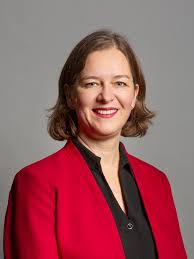
The speech made by Fleur Anderson, the Labour MP for Putney, in the House of Commons on 13 May 2026.
It is a privilege to speak in this debate on the Loyal Address in reply to the King’s Speech. I thank my hon. Friends the Members for Bradford West (Naz Shah) and for Harlow (Chris Vince) for their proposing speeches and congratulate them.
It is an honour to be the MP for Putney, Southfields, Roehampton and Wandsworth Town, and I would like to take this opportunity to thank all the people who have stopped me—on the street, at events or when I go to schools—to thank me for the work I do for our community. That is not often the image of MPs, which is usually about being constantly harassed and abused, but, honestly, the people of Putney are wonderful and I am so grateful for their support for my work. We do not always agree on everything, but they are very supportive of my work as an MP, and I thank them for that.
In a short time, His Majesty’s Government have delivered real change that matters to people in Putney, Southfields, Roehampton and Wandsworth Town, who tell me what the Government are doing to make a difference to their lives. We have raised the minimum wage and strengthened workers’ rights, including day one sick pay, protecting renters’ rights and stopping the unfair section 21 evictions. In the last few months leading up to section 21 evictions being stopped, it has been horrific to see that, while the good landlords remain good, the rogue landlords have taken the opportunity to evict people. That just shows why we needed to make that change, and how good it is to rebalance the equation in favour of renters. We have also brought the railways back into public ownership, starting with our own South Western Railway, and I am so proud that we have lifted 450,000 children out of poverty by abolishing the two-child benefit cap.
I welcome the ambitious package of legislation announced today. The 37 Bills include those on health, education and security. There is a clean water Bill to tackle pollution and hold water companies to account. There is a Bill to speed up remediation for those living with unsafe cladding, which is still affecting so many people on developments in Putney. There is long-term investment in social housing, and support for victims of domestic abuse to stay in their own home. There is reform of the leasehold system by accelerating the transition to commonhold, including stronger transparency measures alongside tighter regulation of managing agents. This issue plagues so many people in Putney, who have been looking forward to the commonhold and leasehold transformation coming down the line. It will make such a difference to people who do not get enough information on their bills, do not know what they are being asked to pay for and see their bills go up time and again. We are giving them the security of tenure that they have not had up to now. There is also the scaling up of clean energy through the energy independence Bill.
The Northern Ireland legacy Bill will build a fairer Northern Ireland, with justice for the families who have waited for too long.
Jim Shannon
I commend the hon. Lady for her very positive speech. Unfortunately, however, we do not see in the legacy Bill the emphasis that we wish on victims. Does she agree that, if we are going to have a legacy Bill, it must address the issues of victims? It must also address the issue of the Republic of Ireland, which has more say in the process than we have here.
Fleur Anderson
I absolutely respect the work that the hon. Member does in his constituency and across Northern Ireland to bring about reconciliation, but I would say that the Bill does put victims at its heart. The victims have been spoken to constantly to create the Bill and rework it, since the Tories’ Bill did not work, and to put the justice they want at its heart. Across the Chamber, we should make sure that the Bill does deliver what he advocates, because it should deliver justice and the answers for which families have been waiting for so long.
I must say that I am disappointed there was no mention of the renovation of Hammersmith bridge in the King’s Speech. I live in hope that one day the King will sit on the Throne and talk about the renovation of Hammersmith bridge. We are one step further, because there is a timetable for applying to the structures fund, and I am very hopeful that funding will be announced soon—this year—for that renovation, so that the bridge can reopen for the six bus routes and all the vehicles now prevented from going across it, which impacts us so much in Putney.
However, I was most keen to see the focus on closer alignment with the European Union, and I will focus my speech on that, as well as on protecting children online and international security. Brexit has imposed a deep and enduring cost on our economy and living standards. It is the elephant in the room when we talk about the economy, and the context for the very difficult financial position we are in as a country. Because of Brexit, GDP per person is 6% to 8% lower, business investment is about 18% lower, and employment and productivity are down 3% to 4%. The hon. Member for Clacton (Nigel Farage) will talk about everything he did, except the consequences of the single policy that he has delivered. He sold the country false promises, and we are seeing the consequences today, but he is not the only one that bears the cost.
Madam Deputy Speaker (Caroline Nokes)
Order. The hon. Lady might like to consider withdrawing the comment “false promises”, because I think she is suggesting falsehoods from the hon. Member for Clacton (Nigel Farage).
Fleur Anderson
I certainly will withdraw that. Thank you very much, Madam Deputy Speaker.
The cost is being borne by families who cannot magic away the detrimental economic consequences of Brexit with a £5 million gift. The damage that the hon. Member for Clacton has inflicted has compounded, year after year. The Brexit effect has built up and up through uncertainty, higher trade barriers, and businesses being forced to divert time and resources away from growth, innovation and job creation.
As a member of the Foreign Affairs Committee, I recommend that all Members read our report on the EU reset. The most important lesson the Committee drew is that a reset cannot simply be a collection of lots of initiatives; it must be guided by a clear strategic vision. We need a whole-of-government strategy that defines what we want the relationship with the EU to look like in five, 10 and 15 years’ time, and aligns our economic, security and diplomatic priorities accordingly. I therefore welcome the announcement of the European partnership Bill in the Gracious Address. I welcome the priority that is being given to a better working relationship with the EU. This will benefit the whole country through better security, increased economic growth and more investment for businesses. This is how we tackle the cost of living crisis.
On economic co-operation, we must reduce the real-world frictions holding back British businesses. A veterinary sanitary and phytosanitary agreement will cut border checks and bring down costs. Mutual recognition of professional qualifications will unlock services and trade, and where alignment supports jobs and growth, we should pursue it.
On security and defence, in a more dangerous world, the UK’s security and that of Europe are indivisible. We should seek to return to frameworks such as Security Action for Europe, which increased military readiness and defence scale-up. We should strengthen co-operation on defence capability, industrial resilience and strategic planning. The choice is not between sovereignty and co-operation; it is between influence and absence.
On people-to-people links, the return to Erasmus+ must be built upon with a youth mobility scheme. We should reverse the cutback in school visits, and ensure better access for touring musicians, creatives and researchers. This parliamentary Session will include action on social media and its impact on under-16s. Across Putney, parents raise with me again and again the harmful impact of social media. I recently had consultations in schools in my constituency—in Hotham primary school, Putney high school and Ashcroft technology academy—in which I talked to young people about the impact. I talked about the addictive design, harmful content and sheer amount of time young people are spending online—wasted time that they feel disappointed about.
I am really pleased that the Government are already taking action; there are consultations, pilots and proposals for restrictions right now. I agree that we must now go further, and with greater clarity. Other countries are already acting on this issue. The debate here has progressed very fast in the last year, and action now, it is agreed by everyone, is essential. The time has come to set a clear principle that childhood should not be shaped by predatory algorithms designed to maximise engagement at any cost. I support raising the age of social media use to 16, alongside robust and enforceable age verification. This is not about being anti-technology; it is about being pro-childhood. The campaign on this issue in Australia is called 36 Months. It said it so well: raising the age for social media use by 36 months, from the age of 12 to 16, gives young people 36 months to get to know themselves before the world gets to know them.
Internationally, I welcome our stance on Ukraine and Iran, and urge the Government to go further in opposing the illegal settlements on the west bank, which undermine peace in the region, and to take more action to boycott illegal settlement goods. In Sudan, 25 million people need assistance, yet the funding gap means that food, medicine and water, sanitation and hygiene services are being rationed.
Next week’s development conference at the beginning of this new parliamentary term is a test of whether the changes are more than rhetoric and will be backed up by action. If we reverse the cuts, put money behind frontline health and water systems, and back local leadership, instead of bypassing it with top-down contracts, we can effect real change. There is a false dichotomy between spending on aid and development, and on defence and security. Spending on aid is frontline defence and security spending, just delivered differently. Funding global health, WASH and conflict prevention cuts off the instability that terrorists and armed groups thrive on. Aid preserves a political space for diplomacy and stops conflict, the need to evacuate citizens, and the need to deploy troops.
This is a King’s Speech for talent. Britain’s got talent and Putney’s got talent. This King’s Speech shows that this Government back the talent of Putney’s young people. My constituents in Putney voted for Labour at the general election for action—action to change their lives for the better; action from a Government in touch with the issues that really matter to them; and action that takes a long-term view of the changes that are needed. This King’s Speech is a programme that delivers on that, and I look forward to working with the Government on continuing to achieve the ambitious programme for change that we promised.