
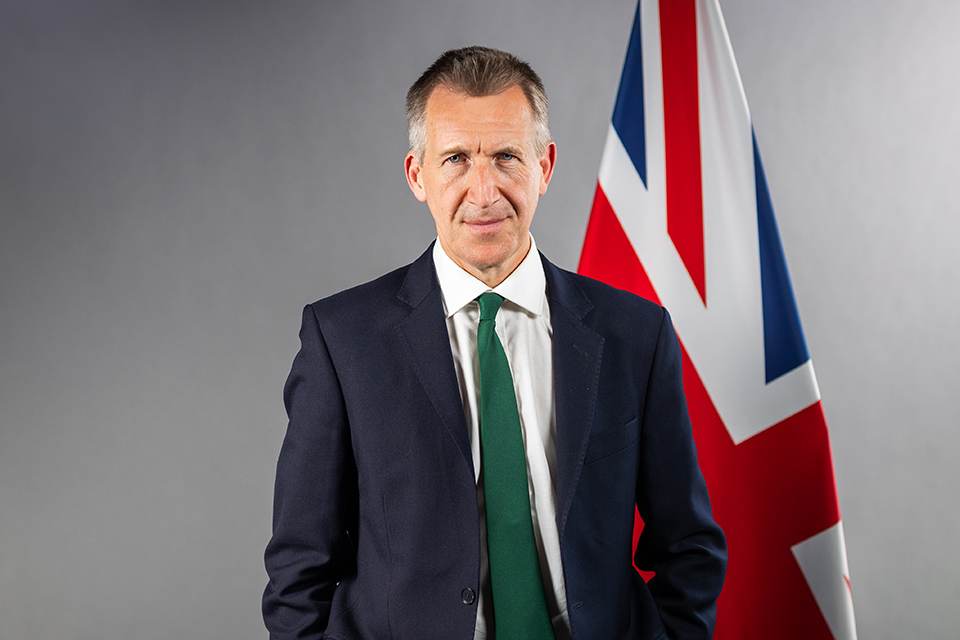
The statement made by Dan Jarvis, the Minister for Security, in the House of Commons on 6 May 2025.
With permission, Mr Speaker, I will make a statement on the series of national security-related arrests that took place on Saturday 3 May. Protecting our national security is the first duty of Government, and it is a testament to our world-leading law enforcement and intelligence services that, through their tireless commitment, so many plots against the UK have been thwarted. I pay tribute to them again today for the work that they have done not just this weekend, but in recent weeks and months, on these important operations.
The two operations that took place across multiple locations this weekend were significant and complex. They were some of the largest counter-state threats and counter-terrorism actions that we have seen in recent times, and I am sure the whole House will want to join me in thanking the police, the security services and other partner agencies across the country, who showed their professionalism and expertise in carrying out these operations to keep our country safe.
Right hon. and hon. Members will understand that these are complex investigations. The police and the security services need time and space to be able to pursue their investigations, and our first priority must be to protect the integrity of that work so that we do not cut across those investigations and operations at a crucial time. However, these are serious matters, and the House will rightly want to remain informed. I will therefore outline as much detail as I am able, and I hope that right hon. and hon. Members will understand that there is a strict limit to what I can say at this stage, given that investigations are now ongoing.
I will first outline the facts around the events on Saturday 3 May. Throughout the day, counter-terrorism police undertook a series of arrests relating to two separate investigations. In total, eight men were arrested by the Metropolitan police’s Counter Terrorism Command. Five men were arrested on suspicion of preparation of a terrorist act, contrary to section 5 of the Terrorism Act 2006, as part of a proactive investigation in the areas of west London, Swindon, Rochdale, Stockport and Manchester. All five men are Iranian nationals. While four of the individuals remain in police custody, the fifth has now been bailed with strict conditions.
As part of the investigation, police officers carried out searches at a number of addresses in the Greater Manchester, London and Swindon areas. Investigations continue, with searches and activity still under way at multiple addresses across the country. The investigation relates to a suspected plot to target specific premises. Police officers have been in contact with the affected site’s representatives to make them aware and provide relevant security advice and support. However, the police have also been clear that for reasons of operational security and public safety, they are not—and I am not—able to provide further information on the target at this time, and I urge Members not to speculate about the site.
In a separate police investigation, two men were arrested at two different addresses in north-west London, and one man was arrested at an address in west London. All three were arrested under the National Security Act 2023. These three men are also Iranian nationals, and remain in police custody. I can confirm to the House that these are the first Iranian nationals arrested under the National Security Act.
The operations to execute these eight arrests under both counter-terror and counter-state threat powers—in different parts of the country, and in the space of 24 hours—were intensive. They involved a range of different organisations, including different police forces, counter-terror police, the National Crime Agency, and our security and intelligence services. These operations were co-ordinated through the world-leading Counter Terrorism Operations Centre, which brings together and co-ordinates the UK’s agencies, alongside the agencies of our Five Eyes partners, to detect and tackle national security threats. I welcome the work of the previous Government to establish CTOC in 2021, and this Government have continued to support it and invest in it since taking office.
The significant point about both counter-terrorism and counter-state threats powers is that they allow the police to intervene early to prevent and disrupt threats, not just respond after events have taken place. This is crucial for public safety, but it also makes the investigations more complex, and that is why the police need the time and space to pursue them now, so we will not be providing a running commentary on the work that they are doing. However, what now follows is an incredibly complex set of investigations, involving hundreds more officers carrying out forensic searches, collecting vital evidence across different sites across the country and securing witness statements, backed up by the continued efforts of our security and intelligence agencies. This is careful, painstaking work.
At this stage in the operations and investigations, it would not be appropriate for me to speculate on or comment further on the details of these two cases and the motivations behind any of the threats that were posed. However, the House will be aware that these operations come against a backdrop of complex, interconnected threats to the UK, where state threats and counter-terrorism as well as serious and organised crime are intertwined together.
For 20 years, the greatest focus of our national security work was on terrorism—primarily from Islamist terrorism, with additional threats from Northern Ireland-related terrorism and other areas—and those threats have not gone away. Fifteen terrorist attacks have taken place since 2017, and there have been 43 late-stage disruptions of terrorism plots, but alongside that we have seen a serious, growing and complex challenge from state threats. Last year, Sir Ken McCallum, the director general of MI5, said that MI5 state threat investigations had increased by 48% in the previous 12 months. He added that, since January 2022, the police and MI5 had responded to 20 Iran-backed plots presenting potentially lethal threats.
In March, I told Parliament that the UK is facing a growing and evolving threat from malign activity carried out by a number of states. My statement in March outlined the Government’s response to the unacceptable threat that we face from the Iranian state, and the steps we are taking to ensure that our intelligence and law enforcement agencies have the tools they need to disrupt and degrade Iran’s malign activity on UK soil. We have delivered on the commitments made. I announced that the whole of the Iranian state, including the Islamic Revolutionary Guard Corps and the Ministry of Intelligence and Security, would be placed on the enhanced tier of the foreign influence registration scheme. I laid the regulations to make this happen in the House on 1 April and committed to bring the scheme into force on 1 July. I trust that all Members will vote in favour when those regulations are debated shortly.
Let me be clear: anyone in the UK who works for the Iranian state must declare it or they will be committing a serious criminal offence. We will also go after the criminal networks and enablers that Iran uses to carry out its work. Last month, the Government sanctioned the Foxtrot network—a network involved in violence against Jewish and Israeli targets in Europe on behalf of the Iranian regime. Training and guidance on state threats activity is now being offered by Counter Terrorism Policing to all 45 territorial police forces across the UK.
The independent reviewer of terrorism and state threats legislation, Jonathan Hall KC, was asked by the Home Secretary to review the parts of our counter-terrorism framework that could be applied to modern-day state threats such as those from Iran. The Home Secretary specifically asked the reviewer to look at a state threats proscription tool, so we are not held back by limitations in applying counter-terrorism legislation to state threats. Jonathan Hall has now completed his review and will publish it shortly, and the Government will not hesitate to take action in response to Mr Hall’s advice.
As we continue to support the police and the security services in their investigations, I can also tell the House that the Home Secretary has instigated a series of security assessments that are being done or refreshed in the light of the cases this weekend and the further information surrounding them, which will ensure that the Government can respond robustly and comprehensively to any wider national security issues raised by these cases.
Working alongside our international allies to counter state threats is central to our success. The Foreign Office is engaging with our closest allies to outline the disruptive action that has taken place and will be considering potential future response options as the investigation progresses. The Home Secretary remains in close contact with my right hon. Friend the Foreign Secretary, who is committed to doing everything necessary to protect the country from these threats and to bring to bear all the diplomatic tools at our disposal.
The Home Secretary and Ministers will provide an update on the national security position when we are able to do so, following both these operations and investigations and the wider security assessments that are under way. The Government will not hesitate to act robustly to respond to these plots at the appropriate time, but first, we must allow the investigations to continue. Our police, security and intelligence agencies are the best in the world and stand ready at all times to take action to keep our country safe. I am sure they will have the support of the whole House as they continue this vital work. I commend this statement to the House.