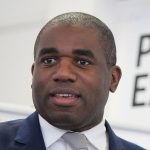
The speech made by David Lammy, the Shadow Foreign Secretary, on 22 November 2022.
It is a great honour to give this lecture at Christian Aid.
An organisation that fights injustice, supports victims of humanitarian emergencies, and defends human rights.
The Christian faith that my mother taught me has always been, and will always be, central to my values.
And I’ll tell you why. It’s because in the example of Jesus we learn of a man willing to challenge power.
Not simply saying ‘this is sad’ but ‘this is wrong’.
Someone who sought to end cruelties and injustices because he saw in every single one of us one of his Father’s children.
I believe it was in this spirit that in 1952, a group of Labour MPs, led by future Labour Prime Minister Harold Wilson, published a pamphlet called the ‘War on Want’.
It set out a challenge not only for the UK, but for the whole of the Global North and our allies.
“Transcending all our immediate problems,” the War on Want group said a year before, “the gap between the rich and the poor of the earth is the supreme challenge of the next 50 years.”
Let me say that again. The gap between the rich and poor of the earth is the supreme challenge.
Because here too were individuals recognising that gaps – in wealth, in dignity, in power – offend us on a moral level just as much as suffering touches us on an emotional one.
And that is what I want to talk to you about tonight.
About how we can have a new development approach, fit for the 2020s, that addresses questions of power and inequality, just as vigorously as the last Labour government sought to tackle the very worst forms of poverty we then faced.
It would be wrong to fail to recognise the progress the world has made since Harold Wilson was launching his war on want.
In 1950, nearly two-thirds of the world were living in extreme poverty.
Today that figure is estimated at around 9%.
Hundreds of millions have been lifted out of the most dire poverty.
Smallpox was eradicated.
Infant and youth mortality has vastly reduced.
Vaccinations rates for preventable diseases have soared.
Extraordinary progress has been made.
And yet few look upon the world with optimism at present.
Today, we face enormous challenges – old and new, immediate and long term.
The world today is facing acute humanitarian crises.
Not only stubborn poverty and pervasive inequality, but famine, conflict, climate change, refugee and migration flows and global health insecurity.
Earlier this year I was sitting in a classroom in district 17 on the north-west outskirts of Kabul with a group of women helping children displaced by war.
One told me she was considering selling a kidney so she could put food on the table for her family.
Another explained she was having suicidal thoughts.
A third asked me: “Two or three generations have suffered. Will another generation suffer? Should we have hope or is it just hopeless?”
In Afghanistan alone, more than 18 million people are facing potentially life-threatening food insecurity.
But this is just one pocket of desperation in a world that is becoming increasingly insecure.
Drought is gripping the Horn of Africa.
Up to 26 million people will face food shortages in Kenya, Ethiopia and Somalia over the next six months.
In Lebanon, real terms food inflation has spiked to 72 per cent.
According to the World Food Programme, 345 million are facing acute food insecurity in 82 countries.
A new global coalition – Hungry for Action – of which many of you in this room are a part, has been formed to campaign against this outrage, standing in a long tradition from the anti-apartheid struggle to Jubilee 2000 and Make Poverty History.
But while this new effort shares its heritage with those great campaigns of the past, it is also new because , for the first time, it brings the worlds of development and domestic poverty together, something I know Christian Aid has been keen to do for some time.
Because it cannot be right to say to my constituents in Tottenham that their pain, in this terrible cost of living crisis we are facing, somehow matters less than that of our brothers and sisters overseas.
That the sleepless nights of a worried mother who knows there is nothing to give her children for breakfast matter if they are spent in Hargeisa but not in Haringey.
The answer to those who say ‘charity begins at home’ cannot be ‘you don’t know how lucky you are’.
No. It must be ‘we stand together, because no child should be hungry anywhere at any time, when we live in a world of plenty and a century of promise.
Charity might begin at home, but it shouldn’t end there.
So this idea that we must stand together as people experiencing inequality wherever we are in the world is one of many ways that the world has changed since Labour came into power 25 years ago in 1997.
It is not the only thing that is different.
On the one hand Covid, the Global Financial Crisis, the global energy crisis, the climate emergency show that the world is more interdependent than ever – with our fates more closely intertwined.
On the other hand our world now is more divided.
More aggressive, more transactional, more short-termist, more dangerous.
In 1997, the UK economy was almost double the size of China’s.
Today, China’s economy is roughly six times the size of the UK.
Where economic gravity has shifted, international institutions have been put under strain.
The UN remains vital, but Russia’s veto on the Security Council limits its power.
Populists and autocrats are blocking the path to progress, pursuing narrow nationalist interests and fanning the flames of division.
Our problems require collective solutions, but collective action seems harder than ever.
As we neglect the multilateral institutions that have been at the heart of so much progress, China is intent on reshaping and in some cases replacing them creating their own institutions through which to make investments and deliver aid.
Western development assistance is just one part of shifting financial flows.
ODA from donor countries – totalling $180bn last year – is dwarfed by remittances which were $773bn last year, more than four times bigger.
And funding and debt from authoritarian states are reshaping the development map.
These funds come without the restraints and expectations of development assistance, but with other strings attached.
It is no coincidence which countries in the Global South have abstained at UN votes instead of condemning Putin’s illegal invasion.
The role of the IMF is now rivalled by Chinese investment, which is now the largest official bilateral creditor in more than half of the world’s 73 poorest countries.
Visit the capitals of the developing world and it is glaringly obvious the sheer scale of investment and construction from China.
We are still working out how to compete in this current reality while remaining committed to our values, but we do not have time to waste.
In the decade ahead, these trends reshaping the world will only intensify.
The most significant of all is the climate emergency – the greatest challenge the world faces.
The UN warned recently that the world is on course for a catastrophic 2.8C of warming, in part because the promises made at COP26 a year ago have not been fulfilled.
This would deliver devastating consequences for our natural world and dangerous, destabilising effects for all countries.
It would usher in an era of cascading risks as the uncontrolled effects of global heating result in more frequent extreme heat, sea level rises, drought and famine.
This will end up hitting us in the UK too. We are seeing its effects already with floods and heatwaves becoming the norm not the exception.
Global heating will hurt us all.
But the truth is that developing countries and people living in poverty are the most exposed to the worst consequences of the climate emergency.
I have just returned from COP27 in Egypt, where the issue of loss and damage was front and centre.
The agreement to create a new fund is an important step forward in recognising the consequences of the climate crisis for the world’s most climate-vulnerable countries.
This is a matter of solidarity, and the reality that those most likely to be affected by climate change are the least able to afford to adapt to it.
The UK government already supports poorer countries to cut emissions, and to adapt to climate change.
Loss and damage is about coping with the disastrous effects.
But on the necessary actions to keep global warming to 1.5 degrees yet again we hear the unmistakable sound of the can being kicked down the road – and as a result it is now at grave risk.
Too many countries were clearly resistant to what is required, including on fossil fuels.
And the government’s leadership has been weak, with the Prime Minister having to be embarrassed into even showing up.
We need a government that can step up – delivering cheap, home-grown zero-carbon power at home so we have the credibility to pressure other countries to fulfil their obligations and play their part.
Given what is at stake, it is easy to be pessimistic.
But I still believe that multilateralism – incremental and imperfect as it may be – remains our best hope to face our common challenges.
The rise of geopolitical competition just makes it harder.
And we need to work much harder to show that multilateralism works in the interests of the whole world, not just its most prosperous nations.
Development and diplomacy are our best tools in the fight against poverty, conflict, and climate change.
But instead of straining to make multilateralism work I am afraid our government has sometimes seemed intent on breaking our relationships and trashing our reputation.
12 years of Conservative government has left Britain disengaged, forgetting that sharing vaccines and investing in global health makes our citizens less likely to experience deadly pandemics.
Forgetting that tackling climate change will stop sea levels rising and submerging British towns.
Forgetting that reducing key drivers of the refugee crisis – poverty and conflict – will make a more secure world for everyone.
Under this government the Conservatives have knocked down the pillars upon which Britain’s development leadership was built.
First, they retreated from Britain’s commitments – cutting our development target from 0.7 to 0.5, and stripped billions from vital aid programmes in the process.
They lost credibility by failing to meet promises on climate and covid.
Then, they undermined delivery, overseeing a bungled merger between DFID and the Foreign Office – deprioritising development, sapping morale and pushing out expertise.
Now, they are projected to spend £3 billion of the development budget here, in the UK, to cover the costs of incoming refugees.
Meaning billions in foreign aid never leave Britain.
Their retrograde strategy for development, takes a transactional approach to aid which risks repeating the worst mistakes of the past.
The improvement in the UK’s credibility on aid after the horrors of the Pergau Dam was not a matter of chance, but of choice.
The choice to untie aid and focus it on the goal of poverty eradication.
The Conservatives’ approach to trade is today a shameful shambles, as none other than George Eustice has recently found the courage, after office, to concede.
It reflects not so much a mindset of “Global Britain” but “Little England”.
The Tories fail to understand that neglecting the challenges of climate, conflict, famine and global health makes all of us less safe, and will work against Britain’s national interests in the long term.
This shift towards making aid transactional is not only damaging our reputation for development, it reduces our diplomatic influence.
When we had a clear moral purpose, focused on helping those most in need, there was far less suspicion about our own agenda.
The time for post imperial delusions is over, it’s time for a new and more effective approach.
And this brings me back to where I started, with the idea that we shouldn’t have any sort of hidden agenda, but a public and radical one.
Our ambition should be nothing less than redistributing power to people – particularly women and girls – at the sharpest end of inequality at home, and around the world.
For Britain’s development to get back on track, we need a Labour government.
You only need to look at history to know that we are the party that can be trusted as a force for good.
What has today become known as international development arose originally from a plan to extract even more profit from the colonies.
After World War One, Britain experienced large-scale unemployment.
UK politicians reasoned that if British colonies were given loans for capital projects that required British imports, unemployment at home would reduce.
The 1924 Trade Facilities Act did just this.
By 1929, the colonial Development fund was established for 10 years of up to £1 million per year.
The fund was predominantly targeted at the West Indies and Africa, and it was presented as in Parliament as in the interests of Britain rather than the colonies themselves.
It was not until the 1950s that Britain’s thinking towards international development began to mature.
This happened for two reasons.
First, Britain’s empire was rapidly collapsing.
Second, there was growing international recognition that richer countries would need to assist poorer countries on their journey to economic and social progress.
The US, which at the time provided two-thirds of resources to developing nations, demanded fairer burden sharing.
And the issue moved up the agenda of the UN.
But it was not until the Labour government of 1964 that a Ministry of Overseas Development was created.
Harold Wilson, who had helped write the ‘war on want’ pamphlet, finally got his wish.
In 1997, Labour created the department for international development, which became renowned around the world.
More important than the structural model of delivery was the seismic shift in ambition that Labour brought to development policy.
Under the leadership of Tony Blair and Gordon Brown we set our sights on an eventual target of 0.7%.
It was one of the greatest successes of our last period in office.
Through international aid, Labour helped lift 3 million people out of poverty each year.
1.5 million people got improved water and sanitation services.
3 million more people got access to drugs for HIV and AIDs.
We helped 40 million extra children go to school.
And we made huge progress on eradicating polio.
At Gleneagles in 2005, Labour led an international campaign to cancel 100 per cent of multilateral debts for the world’s poorest countries while securing an extra billion dollars of aid.
In September 2008, the UK played a key role in the Millennium Conference making progress on malaria, food, education and health.
And we supported an Environmental Transformation Fund, anticipating the urgent action needed to tackle climate change.
One of Labour’s lasting achievements had been to forge a new political consensus around development that it was in Britain’s interests, that it should be rigorous and transparent, focused on effectiveness and value for money, and that it was something that Britain should truly be proud of.
To their credit, David Cameron and George Osborne sustained that commitment, keeping Britain on the path to 0.7% that Labour had set it on.
And while there is much that I disagree with them on, this was an important area of broad cross-party consensus.
Under the numerous Tory prime ministers since then… Boris Johnson, Liz Truss and Rishi Sunak that consensus has broken down.
At the time when – as I described earlier – humanitarian need is soaring not falling, and the challenges of famine, conflict and climate threaten our security.
Labour made Britain a world leader in development before and we can do it again.
In a world of global challenges, and political divides, we need both the long-term transformational agenda of development, and the political nous of good diplomacy.
Both will be essential as we continue that hard work towards the ambitions of the Sustainable Development Goals and beyond.
We must be able to lead by example – not break our word or commitments.
That goes for the treaties we sign with our closest partners in Europe or the promises we made to deliver climate finance to the developing world.
It means not reducing our focus on development while asking others to do more.
It means not preaching to others about Net Zero without a credible plan to get there ourselves.
It means rediscovering the core principles that should guide us: our commitment to human rights, democracy and the rule of law.
But our approach to development must also evolve with the world we are living in.
We must be realistic about the role and contribution of Western donors.
Development finance and policy are vital but they are not the only – or indeed the main driver – of global economic development.
Overstating our own influence downplays the other profound forces at work and undermines the agency of developing countries themselves.
Instead, we must be focused on where we can really make a difference.
We must adapt to a world where lower and middle income countries across Africa and Asia have greater economic weight, and greater political influence.
Our approach should be grounded in a deeper understanding of our own history, and the way people in many countries in the Global South view the historical role of the UK.
It must be sensitive to the criticisms of aid as patronising or paternalistic, and build instead modern relations of equals, two-way partnerships based on respect and mutual trust.
I think of the example of the development sector’s understandable pre-occupation with the fair distribution of vaccines around the world.
It is of course an injustice that millions of Europeans were vaccinated many times over while much of the world waited for a first dose.
All because a few wealthy nations stockpiled more vaccines than they could ever use.
This cannot happen again.
But our goal must be even bigger: for intellectual property and manufacturing capacity to be shared around the world so that countries are producing their own vaccines, not waiting for our leftovers.
That’s what I mean when I talk about power. The old slogan was ‘justice not charity’.
I want us to go further and think not about justice bestowed but power claimed.
The power for people to chart their own futures.
Development policy must be rooted in the aspiration for lives of dignity and opportunity across the world.
I’m sure that everyone in Britain shares this aspiration, and we must show them that being a good partner to low-income countries is not only a great British tradition but an opportunity for our growth and prosperity too.
Our development agenda must respond to the vast need for financial investment across the developing world, from a range of sources.
Development should support the role of effective public services in the developing world to help support capable, accountable governance.
We must work alongside our trade union movement and partners overseas to strengthen workers’ rights and fair labour practices.
I am convinced that we can do more to share the experience of Britain’s most beloved institution at home – the NHS – to support the goal of universal health coverage abroad.
And it must address the twin drivers of climate change and conflict – championing the green energy transition, climate finance, and supporting peace building and conflict prevention.
Let me explain some of the ways Labour would set about doing this.
First, we will become one of the world’s leading conveners.
Our new foreign and security policy pact with the EU will enable a constructive working forum with our European partners.
We will use our deep relationship with the United States to strengthen collaboration on development.
We will use our membership of the UN Security Council, the G7 and the G20 to move development further up the international agenda.
And the Commonwealth provides a unique opportunity to partner with the Global South.
As my great colleague Ed Miliband has outlined, we will build a clean power alliance of developed and developing nations committed to renewable energy.
If we prioritise development in all of these fora, Britain can become one of the world’s best connected and trusted leaders on aid.
And Labour will be strategic in its approach to forming new partnerships with African nations.
There is far more the UK can do to support aspirations in the most climate-vulnerable continent, but also the continent with the greatest potential for increased development and prosperity over the coming century.
Second, we will use the power of example to extend the UK’s soft power.
From our leadership on development to the brilliance of the BBC World Service and British Council, our credibility abroad starts from the strength of our support at home for these vital instruments of UK soft power
Not by exchanging aid for trade. That would do the opposite.
But by offering the best of Britain as partners in their own development.
We need to offer an alternative to Chinese physical infrastructure – and link it to British innovation in education, governance and healthcare to support their own development.
Third, yes, we will get Britain back on track to meet its commitment to the UN’s 0.7% development target, as soon as possible as the fiscal situation allows.
Let me address today why even at a time of real economic hardship and fiscal constraint, I believe it is unequivocally in the UK’s national interest to restore the UK’s leadership in international development.
For me, the answer is deep and deeply personal, the roots of my politics are nourished by the belief in the equal worth of every human being.
A world this unequal and divided offends that fundamental belief.
It demands a response based on solidarity, not simply sympathy.
It demands a response based on justice, not charity.
It demands a response based on dignity, not dependence.
And it demands a response that recognises that in the UK we have a real national interest in a world that is more equal, more sustainable and more stable.
So, for me, the case for UK leadership in international development combines a moral and a strategic dimension.
It is not only the morally right approach. It is also the strategically smart approach.
It’s about who we are, and the world we want to leave to our children and grandchildren.
And we will target this development assistance for the most impact.
Prioritising early, smart and innovative development interventions.
Getting people into decent employment using locally driven information.
Restoring the role of our trade unions in supporting development policy and programmes, through their partnerships with sister labour organisations across the world.
And using private sector finance where interests align.
For example, the International Rescue Committee’s partnership with Google in Nigeria which uses satellite imagery to trigger cash payments to communities in advance of extreme weather events.
We will set up a new taskforce to coordinate private sector support for development finance in line with the government’s priorities.
Fourth, learning the lessons of the government’s bungled merger we will create a new model for international development to meet the challenges of the 21st century.
Labour has always maintained that development and diplomacy are related but distinct, and our new model will have the independence needed to reflect those important differences and empowers both to meet the challenges of the 21st century.
We are working at the moment on what are the best structures of delivery to restore transparency, value for money and focus to the UK’s international development.
We are consciously and purposely looking outwards not inwards, and forward not back in undertaking this work.
We are looking at best practice in the sector internationally and looking at what are the challenges of the coming decades.
In this task, development organisations like Christian Aid have a crucial role and we want your help.
As we continue this work, we want to hear your fresh thinking on how we met the development challenges of tomorrow.
Just as in the past, it will fall to an incoming Labour Government to once again move the UK’s development efforts back into a position of international leadership so we’re determined to do the work, look at the evidence and reach the correct outcome.
Fifth, we remain committed to a feminist development policy.
Away from the world’s gaze, millions of school age girls across Africa face forced marriage, with all the dangers and humiliations it wreaks on a child’s life.
But we’ve seen the shameful deletion of references to protecting women and girls’ reproductive rights in the Government’s statement on freedom of religion or belief and gender equality.
As we approach the 16 Days of Activism against Gender Based Violence, Labour reaffirms its commitment to the UN Sustainable Development Goals of reaching gender equality.
And sixth, we will recognise the inextricable link between tackling the climate crisis and global development for all.
A Labour government will campaign for climate action to become a fourth pillar of the UN, and push for a new international law of ecocide to criminalise the wilful and widespread destruction of the environment.
And as our excellent Shadow Cabinet Minister for Development, Preet Gill, set out at conference, Labour will legislate to make sure that Britain’s aid budget makes climate action a priority.
The world today is increasingly insecure.
Too many people live under authoritarian regimes, denied the dignity of democracy.
I know many of us will have been praying for and thinking of the women of Iran in particular in recent days.
Too many are still in poverty, while the gap between them and the super rich grows.
Covid and Climate Change show how disease and disaster know no borders.
International rules, multilateral institutions and political leadership are needed more than ever.
Throughout our history, Britain has played a leading role in establishing this system.
Helping to create institutions like the UN and NATO.
But today our leaders in government are jeopardising it.
Acting outside of the rule of law for domestic, short-term reasons.
Undermining the system that keeps our people safe in a lame effort to protect their own jobs.
The Conservatives have focussed more on protecting themselves than protecting others.
Britain can be better than this.
Britain must be better than this.
It is time to repair our relationships with our allies around the world.
Revitalise our nation’s soft power, influence and impact with a renewed strategy for modernising international development.
Restore the influence of multilateral institutions like the UN.
Once again reach the target of 0.7% because it is the national interest for Britain to be a force for good.
Only by playing our role in fixing the problems around the world will we be able to provide security and prosperity at home.
In a dark age of authoritarians and populism Labour will shine a light for democracy, the multilateral system and human progress once again.