Tag: Speeches

  • Philip Hollobone – 2022 Speech on Ofsted School Inspections

    Philip Hollobone – 2022 Speech on Ofsted School Inspections

    The speech made by Philip Hollobone, the Conservative MP for Kettering, in Westminster Hall, the House of Commons on 6 December 2022.

    I beg to move,

    That this House has considered Ofsted school inspections.

    It is a delight to see you in the Chair, Ms Harris. I thank Mr Speaker for giving me the honour of holding this debate, and I welcome the Minister to his place. I am delighted that we are joined in the Public Gallery by the headteacher of Bishop Stopford School, Jill Silverthorne, and the deputy head, Damien Keane, who recognise the importance of the issues I wish to raise. I am grateful to them for travelling to London today.

    May I start by praising the Minister, who is one of the Ministers I hold in the highest regard? He has a distinguished record in education. He was shadow schools Minister from 2005 to 2010. He was a Minister in the Department for Education from 2010 to 2012. He had his second coming from 2014 to 2021 and his third coming on 26 October this year. That is 15 years of Front-Bench experience in opposition and in government. We are very lucky to have him as schools Minister. He cares about the subject and I am grateful to him for being here today and for his genuine involvement in this issue.

    I wish to raise the recent Ofsted inspection of Bishop Stopford School in Kettering, which resulted in a downgrade from “outstanding” to “requires improvement.” May I declare my interest, as one of my children attends Bishop Stopford School? However, I raise the matter not because of my child, but because I think a genuine injustice has been done with this inspection.

    Bishop Stopford is a non-selective secondary school and sixth form with academy status in Kettering. Located in the Headlands, the school has 1,500 pupils. At the heart of all it does is a Christian ethos, and its core values are faith, responsibility, compassion, truth and justice. That provides stability for pupils in an ever-changing world. In the light of that ethos, the school’s aim is quite simple:

    “to provide the highest quality education for every student.”

    The Minister has seen the school’s pupils in action. The school’s brass band performed at the Music for Youth Proms in London, in November. Students were outstanding in the performance in every respect—behaviour, attitude, performance, kindness to each other and helping staff. They did the school proud in every way possible and were tremendous ambassadors for the school. Yet Ofsted’s view is that personal development at the school “requires improvement”.

    The Ofsted inspection was done on 28 and 29 June 2022. The overall recommendation was “requires improvement”. Quality of education was “good”. Sixth form provision was “good”. Behaviour and attitudes, personal development, and leadership and management were graded “requires improvement”. I am very concerned about the way in which the inspection was carried out. From the information I have received, I believe not only that the correct procedures were not followed, but that the inspection team deliberately set out to engineer a downgrade in the school’s Ofsted rating from “outstanding” to “requires improvement”. That is the equivalent of one of the highest scoring teams in the premier league being relegated straight to the conference.

    I support rigorous Ofsted inspections of schools, which raise school standards. Until now, I have had every confidence in Ofsted’s abilities to inspect schools in line with proper process and to challenge them where improvements can be made, but I have to tell the Minister that it is my strong view that this Ofsted inspection has gone wrong. It should be quashed, and a fresh inspection undertaken with different inspectors. I know that this is a serious request, and I do not make it lightly.

    The evidence I have heard from the headteacher, the deputy head and pupils at the school is compelling. I believe that the inspection team sent in by Ofsted went rogue. In effect, Ofsted has sent in an educational inspection hit squad with a pre-arranged agenda to downgrade this faith-based school, whatever it found on its visit. In interviews with pupils, the inspection team disparaged the school’s Christian ethos. One year 7 boy was asked, “Do you think this is a white, middle-class school?” A year 10 girl was asked, “Do you feel uncomfortable about walking upstairs when wearing a skirt?” I ask the Minister, are these questions appropriate for an Ofsted inspection?

    Furthermore, the new downgraded rating for the school was leaked by Ofsted to the local community in breach of Ofsted’s own procedures.

    Jim Shannon (Strangford) (DUP)

    I commend the hon. Gentleman for his initiative and assiduousness on behalf of the school. I am shocked at the allegations that he has made, and I see the problems there among those of a certain faith group. Does he feel, as I do, that this inspection has increased anxieties and stress among the teachers, parents and others involved? He has asked for the whole thing to be done again, and that is probably the best thing to do, because what has happened is clearly wrong.

    Mr Hollobone

    I am grateful for that intervention. The hon. Gentleman is a Christian gentleman. He understands the importance of a Christian ethos in schools, but it seems that some Ofsted inspectors do not share those values. In this case, it seems that they have deliberately set out to downgrade the school, and the hon. Gentleman is right that that is having a devastating impact on the teachers, pupils and parents, who feel that the inspection has gone wrong and that they have all been treated extremely unfairly. It appears that, unable to criticise the school’s educational achievements, inspectors have pursued an agenda against a top-performing school with a Christian ethos by engineering criticisms of the behaviour and attitudes, personal development, and leadership and management criteria.

    I thought that this matter was so serious that it should be brought to the immediate attention of the Department for Education, so I wrote to the Minister’s predecessor on 11 October. I am afraid that I do not think that Ofsted can be relied on to judge its own homework. The deficiencies in the inspection of this school are extremely serious. In effect, no one is inspecting the inspectors, and they can basically do what they like.

    On the same day, I wrote to Ofsted chief inspector Amanda Spielman, yet all I received was a one-page letter from the assistant regional director of the east midlands on 20 October saying that they noted my concerns but that nothing else would be done and that they would just go along with the complaints process in which the school was engaged. I do not regard that as satisfactory, when a Member of Parliament has raised genuine concerns.

    Let us look at the quality of education at the school. On the Department’s latest unvalidated educational attainment data, Bishop Stopford School ranks 106th out of all 6,761 secondary schools in the country and is in the top 1.5%. Let us look at the key headline measures of educational attainment. On the EBacc scores, in the data comparing Bishop Stopford School with schools that Ofsted has rated “outstanding” since September 2021, the school is the highest performing non-selective school. Some 94% of the school’s students entered for the EBacc, which is massive. In Northamptonshire, the second highest school is at 79%. The national average is 39%, and the Government’s ambition is 75%.

    On progress 8 scores, which show how much progress pupils at this school made between the end of key stage 2 and the end of key stage 4, out of 3,721 selective and non-selective schools with a progress 8, the school is No. 115, which is in the top 3%. On the attainment 8 scores, which are based on how well pupils have performed in up to eight qualifications, there are 3,768 non-selective schools, and Bishop Stopford School is 110th, which is in the top 3%. On the basic five GCSEs, including English and maths, Bishop Stopford School is at 70%. Of the 126 schools ranked as “requiring improvement”, Bishop Stopford School is fourth, with the range 0% to 96%. Of the 52 schools rated “outstanding”, the school is 27th, with a range of 45% to 100%, and it is fifth for the non-selective mixed schools in this category.

    In terms of the number of pupils who stayed in education or went into employment after finishing key stage 4, of all the selective and non-selective schools previously rated as “outstanding”, Bishop Stopford School is ranked 16th in the whole country. Of non-selective mixed-sex schools, it is fourth in the whole country, with 98% staying in education or going into employment. Ofsted partially recognises this educational record:

    “Most pupils enjoy attending Bishop Stopford School and value the teaching that they receive. The school is ‘unapologetically academic’ and leaders have high expectations of what pupils should achieve.”

    Yet Ofsted only gave the school a “good” rating in this area.

    The mantra about making a judgment about the quality of education is explicitly stated as depending on the three Is: intent, implementation and impact. In essence, this assesses whether a school is clear about what it wishes to achieve with its curriculum, how well that intent is implemented and what its impact is. The only way this can be easily measured is through the empirical data: results, destinations and attendance. The impact of the school’s curriculum is, once again, abundantly clear in this validated data.

    If the school is enabling its young people to be so successful and to progress to high-quality destinations, there has to be a disconnect somewhere. If the school is performing so poorly, as the report suggests, how could it possibly generate outcomes that can only be described as excellent, even among the schools Ofsted has judged to be “outstanding”?

    The school has followed the Ofsted complaints process, and it got a reply dated 9 November from the senior regional inspector. The school complained about the judgment on quality of education. Ofsted said that a common area that needs to be improved is using assessment to adapt teaching so that identified gaps are addressed. It said:

    “modern foreign languages and the mathematics curriculum are not as securely embedded as other curriculum areas”,

    and the complaint was not upheld.

    The school complained about the judgment on behaviour and attitudes. Ofsted acknowledged that

    “behaviour was calm and orderly around the school.”

    In its report, it said that the school deals with low-level disruption when it occurs, yet in the inspection on the day the Ofsted inspectors said that there was no low-level disruption. The inspection team had a particular concern about bullying and the use of derogatory language. In this case, the grade descriptor that needed to be considered was:

    “Leaders, staff and pupils create a positive environment in which bullying is not tolerated.”

    The inspection team said that that criterion was not fully met, and the complaint was not upheld. Parents are in disbelief that the inspection team could come to that conclusion.

    The school complained about the Ofsted judgment on personal development. Ofsted said:

    “inspectors considered how the Christian ethos and wider curriculum supported pupils’ personal development”,

    yet the inspection team raised the Christian ethos only twice, both times negatively.

    Scott Benton (Blackpool South) (Con)

    My hon. Friend is making a powerful speech. Surely the aim of the equality, diversity and inclusion statement should be to ensure schools are abiding by the necessary equality regulation in legislation. I am concerned that, in some cases, Ofsted appears to take it beyond its original intention by judging schools against its own ideas about what life in modern Britain should be. Does my hon. Friend share those concerns?

    Mr Hollobone

    I am grateful to my hon. Friend for raising those concerns. I do share them, as do pupils at the school. I had the privilege of speaking to some of the pupils who engaged with the inspectors. They were expecting the inspectors to ask about the curriculum and their academic studies, but they were probed particularly about the Christian ethos. One pupil, very maturely, responded: “It is not so much about Christianity as about Christian values.” That was a very mature and sensible response.

    Kim Leadbeater (Batley and Spen) (Lab)

    The hon. Gentleman is making a really powerful and interesting speech, and I thank him for securing this debate. Does he agree that it would be more sensible if Ofsted inspections were not so narrowly focused on academic achievement? Although that is important, and the school clearly has a fantastic academic record, Ofsted should have a more holistic approach and look at things such as how schools work extremely hard to build social and emotional resilience in children and young people and to create a happy and healthy learning environment, which gives pupils the skills and values they need to be well-rounded citizens?

    Mr Hollobone

    I am most grateful to the hon. Lady for making that very sensible point. That is right. The school clearly has a Christian ethos. I am not saying that all the pupils and parents are Christians, but this is about Christian values and the key themes I mentioned at the beginning, which we surely all share: responsibility, compassion, truth and justice. Yet it seems that this inspection team regards those values as inappropriate for a school because they are Christian. The parents and I find that outrageous.

    The pupil said that when they responded to the inspector’s question, “The inspector shut my comment down. He made me feel silly, embarrassed and a bit stupid.” Pupils described the interaction with inspectors as “intense”, “uncomfortable”, “tense” and “awkward”. Those are the pupils themselves telling me about their experiences with the inspectors. Something is not right here, and I want the Minister to take that on board.

    The school complained about the judgment on sixth form provision. Ofsted said:

    “Inspectors spoke to groups of students. They raised the point that they were well prepared for university, but other routes were not as well covered. While I agree that there is no statutory requirement for work experience, it was clear from the evidence that preparation for the wider world of work was not as secure as other areas of students’ wider development.”

    That was Ofsted’s comment. However, 98% of pupils go on to education or go straight into employment. Nevertheless, this aspect of the complaint was not upheld. The school also complained about the overall inspection report, the overall judgment, and the inspection process, but all those complaints were not upheld. All the points that the school made to Ofsted were dismissed.

    The breach of confidentiality point has not been addressed by Ofsted in any satisfactory way. Ofsted said to the school:

    “It was explained that unless you were able to provide any further evidence, we would be unable to look into this any further.”

    Yet the headteacher gave Ofsted the names of two local schools that had heard of the downgrade before the report was published. A serious breach of confidentiality has not been investigated properly and has effectively been dismissed.

    On the comments about

    “a white middle class school”

    and

    “walking upstairs when wearing a skirt”,

    Ofsted said:

    “There is no record in the evidence of the exact line of questioning from the team inspector that you referred to. Having spoken to the team inspector, they cannot recall asking the two questions that are cited.”

    I have to say to the Minister that I spoke with the pupils involved and they confirmed what was said, so clearly something is not right here.

    The headteacher wrote a measured letter to parents to reassure them on the back of the publication of the report, stressing the school’s outstanding academic performance. He said that

    “student performance last summer was outstanding”,

    and that that was based on the Department for Education’s own statistics. He went on to say:

    “GCSE results place us in the top 3% of schools nationally. A Level performance data is still provisional, but with 43% of grades awarded at A and A*”.

    On behaviour and attitudes, the headteacher rightly said:

    “External visitors to our school almost without exception comment on the impressive behaviour and engagement of our students. On the inspection days themselves, students’ behaviour was exemplary, and the five members of the inspection team unanimously agreed that they saw no low-level disruption during the inspection.”

    That is not what the report said. He went on to say, rightly:

    “Unfortunately, this detail has not been included in the report, but we will be sharing with students that we were immensely proud of the way they conducted themselves and upheld our core values in the inspection—and continue to do so.”

    I have to say to the Minister that since the report was published 500 parents have been in touch with the school to offer their support and basically they say that they do not believe what Ofsted is saying and do not respect the downgrade to “requires improvement”. However, I think there is a wider agenda going on here, because although I believe that Bishop Stopford has been picked on, recent information has come out that more than four fifths of “outstanding” schools inspected last year have lost their top grade after the exemption from inspection was removed. Also, the chief inspector herself said that the outcomes from the first full year of inspection since it was scrapped:

    “show that removing a school from scrutiny does not make it better.”

    A fifth of schools, including Bishop Stopford, dropped at least two grades.

    The Minister will know that schools rated “outstanding” were exempt from reinspection between 2012 and 2020. The exemption was lifted in 2020 after Ofsted warned that over a thousand schools had not been inspected in at least 10 years. Ofsted itself has said that 308 of the 370 previously exempt schools had a graded inspection that resulted in a downgrade, which is 83%: 62% became “good”; 17% fell to “requires improvement”, including Bishop Stopford; and 4% fell from “outstanding” to “inadequate”. This is a power grab from Ofsted, saying to the Government, “You must let us inspect all schools all the time.” I am not sure that is appropriate, given the level of distress it can cause to excellent schools such as Bishop Stopford when an inspection goes wrong.

    On behalf of the school, parents and local residents in Kettering, I ask the Minister to quash the report and send in a fresh inspection team. Let us have a proper inquiry into the leaking of the downgrade. If quashing is not possible within the Minister’s powers, can we have a reinspection of the school at the earliest opportunity? I would not want that grade hanging over the school for potentially the next 30 months. At the very least, can we have a meeting between the Minister himself, the chief inspector, the headteacher and myself as the local parliamentary representative, so that local concerns that the inspection went wrong can be relayed in the clearest possible terms to Ofsted?


  • Huw Merriman – 2022 Speech on Southeastern Railway Timetable Changes

    Huw Merriman – 2022 Speech on Southeastern Railway Timetable Changes

    The speech made by Huw Merriman, the Minister of State at the Department for Transport, in Westminster Hall, the House of Commons, on 6 December 2022.

    It is a pleasure to serve under your chairship, Ms Harris. I thank the hon. Member for Eltham (Clive Efford) for securing this important debate on Southeastern’s rail timetable changes, and I thank all right hon. and hon. Members who have spoken. I have always been a south-eastern MP. Over the past seven years, I have shared debates with many Members or their predecessors in Westminster Hall, the main Chamber and, indeed, meetings on Southeastern. I declare that as an interest, but I have always enjoyed working with south-eastern MPs.

    I will do my best to cover the rationale for these changes and to explain the positives and negatives. I will explain the positive changes, although sadly there are no Members present from the constituencies where those changes will take place. I will certainly talk more about the consultation—or lack of one, as Members have pointed out. I will write to all Members who have contributed, so if I have not answered their points directly, I will ensure that we do so via correspondence.

    I have met many Members, including my right hon. Friend the Member for Bexleyheath and Crayford (Sir David Evennett), and they have made their points with force. I appreciate what they said because I empathise with colleagues and their constituents who believe that the changes will negatively impact them. With any timetable change, some will feel that they are losing out. There is ultimately no way of making changes that will please everyone who uses the railway, but the changes are necessary, and I hope to highlight some of the reasons behind it.

    The changes are driven by our current financial and travel habit situation. Travel habits have changed and there is a need to make our railways more financially sustainable, as well as improving their reliability. That has been the starting point. Within that framework, the team has worked hard to ensure that we will build a more resilient and reliable timetable through the process; again, I will talk more about that. The benefits of resilience and reliability will be there for all who use Southeastern, and we must look at the network as a whole. We must acknowledge that the pandemic has caused changes in travel habits, with many people who can adopting a hybrid approach, working from home some days of the week and/or travelling at different times of the day to avoid peak times. The new timetable needs to reflect that.

    The changes in travel habits, alongside the successful introduction of Elizabeth line services, mean that all-day weekday demand on Southeastern services is around 70% of pre-covid levels. That figure drops to between 50% and 65% during peak periods. Demand simply does not warrant 2019 levels of service provision. The Government have earmarked £16 billion of funding for rail services since the start of the pandemic. That is taxpayers’ money and is clearly unsustainable in the long term, so the Department has asked all operators, not just Southeastern, to develop timetables that are appropriate to customer demand and that deliver good value for the taxpayer while prioritising the punctual services that customers rightly demand.

    Clive Efford

    Will the Minister give way?

    Huw Merriman

    Can I go on a little further? I will touch on the three key reasons why Southeastern has changed its timetable and then I will give way. The first reason is efficiency and the post-covid rail situation. The timetable reduces train mileage to better match capacity to demand and changes the underlying structure to improve efficiency. At a time of unprecedented pressure on Government finances, this will save significant taxpayer subsidy and is essential to enable Southeastern to meet its spending review budgets. Southeastern is taking the opportunity to remove first-class seats from its mainline services, freeing up almost 4 million extra seats for all each year. That creates capacity without adding cost.

    The second reason is punctuality and reliability, which are the No. 1 drivers of customer satisfaction as measured by Transport Focus. Today’s timetable includes many crossing moves at key junctions that have a damaging impact on performance. Furthermore, at times of service disruption, the current timetable leads to the spread of delays to other routes and makes it much harder to recover the service. By deconflicting key junctions and changing the base structure, the new timetable is estimated to deliver a 12% reduction in cancellations and a 3% improvement in on-time station stops across the whole Southeastern network services. That is 300,000 more on-time station stops ever year. I want to make clear that reducing the number of London terminals directly served on some routes, which have been touched on today, will dramatically reduce the number of trains having to make complicated crossing moves at Lewisham, a notorious bottleneck. That will significantly improve performance for everyone using Southeastern.

    I will turn to the third part of the rationale, which is flexibility. The change provides a simpler, cleaner, basic structure from which services can be altered far more easily and efficiently. Should demand patterns change in the way that we all want them to, services can more easily be scaled up—or down, if that is not the case—subject to available funding, of course.

    Clive Efford

    The Minister gave figures for the reduction in demand. According to the ORR report I have in front of me, the peak of 183.2 million passenger journeys was in 2018-19. That is back up to 97.8 million, which is well over 50%. That is not the 65% reduction that I think he quoted. It is similar with the passenger kilometres, which are at 2,543 million, which is way over 50% of where we were at the highest point. What is happening is that rail services are recovering after covid, as we would expect. It is too early to make these decisions.

    Huw Merriman

    I am happy to send our statistic base to the hon. Gentleman and others who have contributed to the debate, so that we can agree on our starting point. The ORR report also demonstrates that passenger contributions through the fare box were more than £12 billion during pre-covid time, and we have got back to only £6 billion. That in itself demonstrates that we do not have the same patronage across our services. He will know that commuting has been the worst hit, because commuters can work differently. I am confident that my evidence base will stack up for this, but I will exchange it with him and other to ensure that is the case. I am about to come to consultation, but I will take an intervention.

    Matthew Pennycook

    I want to probe the Minister a little further on levels of demand. Southeastern approached the Department for the derogation on 22 June, so were using demand data from that time. Will the Minister give us a sense of what the Department thinks is the permanent level of demand reduction? Or does he accept that passenger numbers are steadily recovering, which may require the timetable to shift again very quickly?

    Huw Merriman

    Again, we will come back to that. The point I would bring back is that during the peak times we have largely been talking about, the 70% of pre-covid level figure drops to 50% to 65% during those peak periods. We are arguing about different parts of the service at different times. That is why I want to write, to explain exactly where my base is. Members can write back and say that they have a different base.

    There have been a lot of points about transparency. I hope that right hon. and hon. Members who have met me know that I have an absolute desire to ensure that all the facts that I have are all the facts that right hon. and hon. Members will have—[Interruption.] I will take one more intervention; why not?

    Sir David Evennett

    I totally agree that the Minister has been helpful and transparent. We are very grateful for the meetings that we have had. My concern is that if there is no train service on the Bexleyheath line to Charing Cross at weekends, the passenger numbers will fall. Therefore, it is a flawed argument. I hear what has been said about the peak period, but I am also concerned about the weekends. We have already heard about the disadvantage for certain members of our communities who will not go up to London. It could be that Southeastern loses a lot more passengers and revenue at the weekends.

    Huw Merriman

    My right hon. Friend makes a good point. This is the challenging balance for Government and train operators. The cloth has to be cut accordingly. If I look at my Southeastern service, I am now down to an hourly service, without the benefit of going up to Cannon Street but having to change at London Bridge, in the same way that Members are about to experience with their constituents.

    I recognise the danger that, in order to grow the railway, it is necessary to demonstrate a positive experience. We do not want to get to a situation where the railway service looks like the bus service. At the same time, there has been time taken post pandemic to assess how passenger numbers have been performing and they have not performed with the level of uptick that we need to give us an indication that people will not change their work habits—they are not going to return to the office five days a week. That is why difficult decisions have had to be made, but my right hon. Friend makes a very good point and it will be taken into account.

    On consultation, there has been a need to recast the Southeastern timetable for many years. The last recast was over a decade ago, when Southeastern’s highspeed services were introduced. Even before the pandemic, the timetable no longer matched demands and had inherent efficiency and structural performance issues. As has been pointed out, Southeastern has changed its timetable 15 times since March 2020. Coming out of the pandemic, the industry has had to continue to work at pace to provide rail timetables that meet the new travel patterns and carefully balance cost, capacity and performance.

    Operators have had to move at speed to address changes in demand and deliver cost-efficient timetables. That means that traditional public consultation has not always been possible. It takes many months to design and consult on a timetable, and it would have been challenging for Southeastern to conduct a meaningful consultation without time to change the timetable based on the feedback it received. That ultimately means money spent on running an inefficient timetable for longer, costing the taxpayer money. Ministers at the time thought that this was unacceptable, and, as a result, agreed to allow operators to implement demand-led timetables through 2020 without consulting formally.

    Going forward, fiscal pressures may mean that other relatively short-notice timetable changes need to happen. However, there are lessons to be learnt from this timetable change on engagement and information sharing with stakeholders, even if timescales are compressed. I say to all right hon. and hon. Members present that I will ensure that if changes need to be made there will be transparency and engagement with Members of Parliament and other stakeholders at the earliest opportunity. It may not be possible to do a full 16-week consultation, but I will ensure that the starting point is with Members in this place. That is what I would expect, and I give them that assurance.

    While I am giving assurances, I was also asked by my hon. Friend the Member for Old Bexley and Sidcup (Mr French) for an assurance that there are no plans in place to close Albany Park station: there are no plans in place to close Albany Park station.

    Vicky Foxcroft

    There has been quite a lot of talk about Lewisham station, which is in my constituency. I can assure the Minister that Lewisham station is absolutely rammed at times, and there have been humungous safety concerns around it and the rerouting of passengers. We have had many new developments going up in the area. In the spirit of the Minister wanting to do consultations, would he like to come and meet me and Lewisham station’s user group—who are very expert in the rail network and Lewisham station—to hear their views on what might happen as we proceed?

    Huw Merriman

    I have always enjoyed spending time with the hon. Member—if that does not damage her electoral chances—so I would be very happy to meet her and the user group. I will put out another offer at the end of my speech.

    Since the publication of the timetable in September there has been a mixed reaction from stakeholders. Many are pleased by the delivery of long-held ambitions on their routes, but others, such as those on the Bexleyheath and Sidcup line, are concerned about the loss of direct services to either Cannon Street or Charing Cross stations at off-peak times. All passengers affected by losing direct services can change at London Bridge to access high-frequency services to either station at no extra cost, and without having to use the tube. I see the hon. Member for Eltham shaking his head—that is a change I do on a regular basis, and I know what it takes. I will explain why it is not the poor experience that some may think it to be.

    London Bridge is a modern station that has been designed for high volumes of interchanging passengers. I understand that some Members have concerns about changing there, but I can assure them that, as someone who does the change often, the station is well designed for that purpose. We believe it is one of the best in the country. The station is well lit, is sheltered and has full CCTV coverage. Southeastern has completed an equalities impact assessment and has made further improvements, which include the increased provision of dedicated mobile assistance staff, on-site lift engineers to ensure that all platforms remain accessible and on-site paramedics for any emergencies.

    I turn to some of the benefits that Members who are not here might receive from the timetable change.

    Janet Daby

    In conversation, many of my residents raised concerns about their daughters working up town quite late. The parents and the young women like the reassurance that they can get on the train at one end and be taken straight to their destination at the other, rather than having to change at London Bridge—no matter how lovely that station may be.

    Huw Merriman

    That experience involves getting off the platform, taking the lift—while staying within the station, not going all the way through the station—and then going back up the lift to another platform that can be seen directly. It is a change that I see many do daily. I recognise that it is not ideal, and we would rather that it did not occur, but it is a safe, well-designed and modern station environment. I hope that that reassurance can be given to those who may be concerned.

    Let me turn to the benefits. As with any timetable change, there are trade-offs. Inevitably, those who feel that they are losing out are making their voices heard. However, as well as the improved performance, which we believe will benefit everyone, the changes deliver a wide range of other benefits. In the metro area, passengers will benefit from the reintroduction of peak Beckenham Junction to Blackfriars services, and all metro services on the Herne Hill line will be extended to Orpington, which will benefit Bickley and Petts Wood. Bexleyheath line customers will enjoy an uplift to four trains per hour on a Sunday from the current two per hour. Passengers on that line will also have off-peak connections to London overground via New Cross for the first time.

    The Sidcup line will receive a new peak service to Blackfriars via Denmark Hill, and Swanley will gain an all-day fast service via London Bridge. Woolwich line passengers will benefit from the new Elizabeth line offering 10 trains per hour from Abbey Wood at peak times, and eight for the rest of the day, as well as extra services on the DLR from both Woolwich and Greenwich. On the main line, the December 2022 timetable will deliver the long-awaited service from Maidstone East to the City of London in under an hour. Tunbridge Wells and Hastings services will see journey time improvements in the morning peak, and there will be new peak services between Cannon Street and Tonbridge. Finally, local services in Kent will see a service doubling of one to two trains per hour between Strood and Paddock Wood, which will improve connectivity on that corridor.

    To conclude, I appreciate the concerns raised by some Members. We should bear in mind that the timetable changes will undoubtedly be affected by the planned industrial action. When we can evaluate, we will. There will be transparency. We will reflect and act accordingly. As part of that process, I can perhaps visit more services and stations. I have already given one offer, across the Chamber, to the hon. Member for Lewisham, Deptford (Vicky Foxcroft). Perhaps I can also offer to visit my hon. Friend the Member for Old Bexley and Sidcup and my right hon. Friend the Member for Bexleyheath and Crayford. I am keen to find out how the changes are bedding in. I ask all right hon. and hon. Members to allow the changes to bed in and see whether they work.

  • Janet Daby – 2022 Speech on Southeastern Railway Timetable Changes

    Janet Daby – 2022 Speech on Southeastern Railway Timetable Changes

    The speech made by Janet Daby, the Labour MP for Lewisham East, in Westminster Hall, the House of Commons, on 6 December 2022.

    It is a pleasure to serve with you in the Chair, Ms Harris. I am grateful to my hon. Friend the Member for Eltham (Clive Efford) for securing such an essential and necessary debate. I share many of the concerns that have been expressed by other Members and hon. Friends.

    The changes will be implemented in just five days’ time. They have been very controversial, to say the least. South London has always been seen as the poor relation to north London in terms of transport connectivity. In Lewisham East, we do not have the Elizabeth line, the docklands light railway, the Jubilee line and so on. We rely on rail services to travel. They are essential. The changes reduce connectivity in areas south of the River Thames. That means that for users of Blackheath station the number of direct trains to Charing Cross is dramatically reduced. In fact, there will be no direct trains to Charing Cross during off-peak times.

    The new timetable clearly creates problems, not solutions, for many of my constituents. I will share with the Chamber two significant quotes from constituents. One said:

    “Changing at London Bridge will be difficult for me as a registered blind person with severe arthritis. I avoid changing trains as a rule. The changes will make any trips to Charing Cross or Waterloo significantly harder and more time-consuming for me. I will probably stop going into London unless I have to”.

    Another constituent said:

    “My elderly neighbours rely on the service to Charing Cross for entertainment and for connecting trains to Kings Cross. They have told me that the change at London Bridge is so stressful that they will probably stop taking the train altogether. They are aged 91 and 85 years old and the escalators and lifts at the New London Bridge present too much of an obstacle for them.”

    Southeastern really needs to ask whether it is trying to deter people from using the train service, or is it trying to encourage people to use it. It seems that the former is being achieved. My concerns about the timetables include the impact on the safety of young girls, women and vulnerable people, as they have to make an extra change at London Bridge late at night. I am concerned about commuters’ ability to get to work on time and about the timetable making it harder for Londoners to use public transport during the climate crisis, as already mentioned by my hon. Friend the Member for Lewisham, Deptford (Vicky Foxcroft).

    Blackheath councillors and I started a petition as soon as we heard about the proposed changes and cuts to the trains, to call for the reversal of the timetable. It was signed by hundreds of local people. Last week, the petition was handed in at Southeastern headquarters. What has angered many residents is the fact that local people have not had the chance to be consulted on the changes. It is outrageous that the Government have allowed Southeastern to implement the changes without a consultation, which is entirely unacceptable.

    My Blackheath constituents have written to me endlessly on this matter. They need to be heard. That is why I did a survey asking for their views on the timetable. Of the 1,151 households who responded, 98% said that Southeastern should not go ahead with the timetable. Some 96% said that the timetable changes will make their journeys more difficult. When asked what concerned them most about the timetable changes, the top three answers were: the safety of vulnerable people, including young women and those with disabilities, travelling back from central London; the fact that the timetable would make them change their commuting journey; and increased crowding on trains for those using Blackheath station. Lastly, when we asked whether Southeastern should have consulted on the changes, 96% of respondents agreed. I also agree, and I encourage the Government to ask Southeastern to press the pause button on the plans. Will the Minister tell us that all future significant train cuts to services will be met with transparency and consultation?

  • Vicky Foxcroft – 2022 Speech on Southeastern Railway Timetable Changes

    Vicky Foxcroft – 2022 Speech on Southeastern Railway Timetable Changes

    The speech made by Vicky Foxcroft, the Labour MP for Lewisham Deptford, in Westminster Hall, the House of Commons, on 6 December 2022.

    It is an absolute pleasure to serve under your chairpersonship for the first time, Ms Harris. I congratulate my hon. Friend the Member for Eltham (Clive Efford) on securing this important debate and on his speech. He has made many key points with which I wholeheartedly agree.

    Like many colleagues, I have worked closely with local transport users during my time as an MP, and I am here today to share the concerns of constituents who have contacted me following the publication of the amended timetable. As we have heard from many Members, it is fair to say that there has been widespread anger with the Department for Transport for allowing Southeastern to press ahead with the changes without consulting its passengers.

    Although I can appreciate the removal of the requirement during the pandemic so that operators could bring in changes more quickly, most Members would agree that we are now at a point at which passenger numbers have restabilised. In response to a written question from my hon. Friend the Member for Sheffield, Heeley (Louise Haigh), the Department stated:

    “There will be less than 1% fewer typical weekday passenger services across the…network compared to the current timetable.”

    Well, I can tell the Chamber that users of St Johns station in my constituency are expecting to lose 19 services per day thanks to the rerouting of the Hayes line’s trains to Charing Cross.

    I have received representations from two very active local organisations: St John’s Society and Brookmill Road Conservation Area Society, as well as from individual constituents. St Johns has had its services reduced in recent years, and the walk to nearby stations—New Cross and Lewisham—is long and uphill for many, causing difficulties for disabled people and those with young children.

    Lewisham in particular suffers, as has been mentioned by many colleagues, with overcrowding at peak times and a woefully inaccessible station. The situation will only get worse as further large residential developments are completed in Lewisham, as Members have referenced in relation to their own constituencies. When the remaining peak-time trains reach St Johns—the next stop on the line—they might be too full for passengers to be able to join them. There are environmental considerations, too, if people are forced to use their car when previously they would have opted to travel by train.

    Similarly, users at Blackheath station in the constituency of my hon. Friend the Member for Lewisham East (Janet Daby), just over the border from my constituency, have been hit with the news that there will be no direct services to London Charing Cross during off-peak hours, and many peak trains will also be cut.

    I will conclude my comments. While the overall number of services might not be significantly reduced, that 1% figure in no way reflects the impact that the changes will have on individual stations and communities.

  • Michael Gove – 2022 Statement on New Coalmine at Whitehaven in Cumbria

    Michael Gove – 2022 Statement on New Coalmine at Whitehaven in Cumbria

    The statement made by Michael Gove, the Secretary of State for Levelling Up, Housing and Communities, in the House of Commons on 8 December 2022.

    With permission, Mr Speaker, I would like to make a statement following the decision I made yesterday to grant planning permission for a new metallurgical coalmine at Whitehaven in Cumbria.

    I think it is important to stress at the beginning of my statement that I am speaking with regard to a planning decision that I have taken in my capacity as Secretary of State in what is a quasi-judicial process. Members of the House will be aware that the decision may, of course, be subject to a legal challenge, so I urge all Members of the House who are interested in the decision to read the decision letter, which was published yesterday, alongside the detailed report of the independent planning inspector who oversaw the public inquiry into the proposals. Any mature and considered response needs to take account of both my decision letter and the planning inspector’s full report.

    I would like to refer in my statement to some of the arguments that the planning inspector has entertained and some of the arguments that he has made in the course of his report, but nothing that I say at the Dispatch Box should be taken in any way as a substitute for full engagement with the inspector’s report.

    It is important to note that it is rare that any planning decision is an open-and-shut matter. There are almost always competing elements for and against any planning scheme—particularly a substantial one of this kind, which can raise serious and passionate debate—but the open and transparent public inquiry system allows all those issues to be fully explored. It also allows all parties to put their case before an independent inspector.

    The decision that I issued yesterday was in line directly with the recommendation of the inspector, who heard all the evidence for and against the scheme and was able to test that evidence through the participation of interested parties. This was a comprehensive and thorough process, lasting over a month and hearing from over 40 different witnesses. It is summarised in a report of over 350 pages, which, again, I urge all hon. Members to read.

    I think it important to restate—as I think is well understood—that the proposal granted permission yesterday for the production of coking coal for use in steel production is not an energy proposal. Our net zero strategy makes it clear that coal has no part to play in future power generation, which is why we will be phasing it out of our electricity supply by 2024. Coal’s share of our electricity supply has already declined significantly in recent years. It was almost 40% of our energy supply in 2012, and less than 2% in 2020.

    I took account of the facts in reviewing the planning application, as did the inspector, taking into particular account the Department for Business, Energy and Industrial Strategy industrial decarbonisation strategy of March 2021, which explicitly does not rule out the use of coking coal in an integrated steel-making process, and makes it clear that, together with carbon capture and storage, that can be part of a net zero-compliant option.

    It is important to note, as the inspector makes plain on page 239 of the report, that it is clear all the scenarios and forecasts for the future use of coking coal which were put before the inquiry demonstrated a continued demand for coking coal for a number of decades to come. It is also important to state that the European Commission, as the inspector noted, recognised the indispensable role of coking coal during the steel industry’s transition to climate neutrality.

    It is also important to note, as the inspector did on page 238, that the UK is currently almost wholly dependent on imports of coking coal to meet its steel manufacturing demand. In 2017, 98.8% of the more than 3 million tonnes of coking coal used in UK steel plants was imported. The main exporters of coking coal at the moment are Australia, the USA and, of course, Russia. European metallurgical coal demand is forecast to remain between 50 and 55 million tonnes per annum for the next 28 years, and in the UK demand is forecast to remain at the current level of 1.5 million tonnes per annum.

    The coking coal that will be extracted from the mine in Whitehaven is of a particular quality. Coking coal is usually a blended product of soft and hard high volatile coals and low volatile coals. The coal from the proposed mine would have a low ash content of below 5%, compared with between 7% and 8% for US coal and 10 % for Australian coal. It would also have a low phosphorus content, lower than that of Australian coal, and a high fluidity. It is also important to note that, while the sulphur content of this coal has been referred to, and it is relatively high, the evidence before the inspector suggests that the coal handling and processing plant will produce coal with an average sulphur content of 1.4 %, and the applicant has stated its acceptance of the planning condition to ensure the product leaving the mine meets this level.

    It is also important to note that the applicant is making it clear that this will be the only net zero metallurgical coking coalmine in the world. It is vitally important that all of us recognise—as the inspector does on page 255—that the proposed development would to some extent support the transition to a low-carbon future specifically as a consequence of the provision of a currently needed resource from a mine that aspires to be net zero. I think it is also important that we recognise that, in any change of land use, there will always be a potential impact on biodiversity and on the local environment as well. Again, it is important to note that, on page 278 of his report, the inspector makes it clear that this mine would not cause any unacceptable impacts on ecology or result in a net loss of biodiversity. The inspector also makes it clear in paragraph 22.9 that the proposed development itself would have an overall neutral effect on climate change, and as such there would be no material conflict with Government policies for meeting the challenge of climate change.

    Taking account of all these environmental considerations, we should also bear in mind the impact on employment and on the economy, locally and nationally. As the inspectorate notes on page 279, the mine will directly create 532 jobs, which will make a substantial contribution to local employment opportunities because they will be skilled and well-paid jobs. The employment, and indirect employment, that would follow will result in a significant contribution to the local and regional economy, with increased spending in local shops, facilities and services. In addition, the exportation of some of the coal to European markets will make a significant contribution to the UK balance of payments. It is therefore the case that granting the application is compliant with planning policy, and the social and economic benefits should be afforded substantial weight.

    The inspector’s report makes a strong case, in a balanced way, for the granting of permission. After reading the inspector’s report in full, I am satisfied, in my role as Secretary of State, that it is the right thing to do to grant this planning application.

  • Lindsay Hoyle – 2022 Statement Following Breach of Ministerial Code by Michael Gove

    Lindsay Hoyle – 2022 Statement Following Breach of Ministerial Code by Michael Gove

    The second statement (first statement) made by Lindsay Hoyle, the Speaker of the House of Commons, in the House on 8 December 2022.

    I will suspend the House until 11.30, when we will have business questions. That will enable us to try to get a transcript of what has been said in the statement, so that all Members, whatever their opinions, can ask informed questions, as they would wish to. That is how we will play it: we will have business questions at 11.30, then we will come back to the statement. I am sorry about this; this is not the way to do good government.

  • Lindsay Hoyle – 2022 Statement on Michael Gove Breaking the Ministerial Code

    Lindsay Hoyle – 2022 Statement on Michael Gove Breaking the Ministerial Code

    The statement made by Lindsay Hoyle, the Speaker of the House of Commons, in the House on 8 December 2022.

    Order. The statement I received was the thinnest ever, but the Minister has gone long. Between that and what the Opposition and I have been provided with, there is something missing, which is not in accordance with the ministerial code. We do not work like that. The shadow Secretary of State has not been able to read what has just been said. I am going to suspend the House in order to try to find out what is in the statement.

  • Louie French – 2022 Speech on Southeastern Railway Timetable Changes

    Louie French – 2022 Speech on Southeastern Railway Timetable Changes

    The speech made by Louie French, the Conservative MP for Old Bexley and Sidcup, in Westminster Hall, the House of Commons, on 6 December 2022.

    Thank you for chairing, Ms Harris, and I thank the hon. Member for Eltham (Clive Efford) for securing this important debate. Although we often differ in our views, when it comes to Southeastern trains we share frustrations over the timetable changes that will come into force next week. On my first anniversary of being sworn into Parliament, local residents will not be surprised to see me standing up and fighting against Southeastern for them again today.

    The issue of no consultation has been mentioned by several colleagues. The new Minister is already aware of how frustrated MPs and members of the public are over not being informed of the timetable changes by Southeastern until it was too late. In recent weeks, people in Bexley have experienced two transport shocks. First, Southeastern pushed through these changes under the guise that they are demand based, when they clearly go much further. Secondly, the Mayor of London ignored the wishes of the clear majority of Londoners who rejected his outrageous ULEZ—ultra low emission zone—tax raid on drivers in outer London. We have had no consultation on the trains, and a sham consultation by the Mayor. That helps explain my anger and that of local residents across Bexley.

    The Minister and many Members here will be aware that, since Southeastern’s announcement in late September, I have been running a constituent survey on the timetable changes. The thousands of responses to the survey highlight that the most impactful changes are the reduction in Albany Park station services in my constituency, the loss of off-peak Charing Cross services on the Bexleyheath line—we have heard about that from colleagues already—and the loss of the loop service on the Sidcup line, which I will talk about in turn.

    I echo the comments of my right hon. Friend the Member for Bexleyheath and Crayford (Sir David Evennett) on the loss of off-peak Charing Cross services and the impact on passengers travelling to the west end for leisure and work. As someone who commuted to the City for more than a decade from the likes of Welling and Sidcup train stations, I can confirm that Cannon Street services at those times are of minimal benefit to local residents and will force thousands of passengers to change trains at London Bridge. That is of particular concern, given the impact on the more vulnerable residents in our communities and the general increase in travel times that they will experience. I hope that the Minister will at least explain what support Southeastern is putting in place in the short term to help passengers forced to change at London Bridge station.

    The extent of the changes in the new timetable are arguably best reflected by the drastic, near 50% reduction in Albany Park services. Peak services have been reduced from seven trains per hour to four, and off-peak services from four trains per hour to two. That reduction has not only led to concerns about overcrowding and long waits in the event of cancellation, but resulted in the loss of direct services to Lewisham station, which is used by commuters from Albany Park to the DLR and Canary Wharf. I visited that station during my campaign against the timetable changes and I saw at first hand how busy it is, particularly during peak times on Tuesday to Thursday. I remain concerned that that is not fully accounted for in the passenger numbers.

    I raised those concerns with the Minister and at our latest meeting with Southeastern, with my right hon. Friend the Member for Bexleyheath and Crayford. I am grateful for Southeastern’s commitment to look at the live train-loading data for that station daily, and for the fact that it has since visited Albany Park station to reassess passenger numbers. I again request, through the Minister, that it provides the latest peak-time passenger numbers and capacity for the station, especially for Tuesday to Thursday. Furthermore, I would be grateful if the Minister can use his position to ask Southeastern again why there has been such a significant reduction in trains stopping at Albany Park station. Will he seek assurance about the future of the station, which is frequently used by commuters in a residential area with few alternative transport connections? There have been some silly rumours floating around locally that the station is closing. I hope the Minister will put them to bed by confirming that there are no plans to close it.

    At all meetings, I have expressed my considerable disappointment at the loss of the loop service on the Sidcup line, which is used by many constituents, including to connect to the Elizabeth line and for Charlton Athletic fixtures. It is also used by children and parents travelling to school. Again, I am concerned about the data that Southeastern used to inform that decision. The time period used to capture passenger numbers does not incorporate the increase in passengers on the service since the Elizabeth line was opened. It would be a shame for residents to lose that connecting service, especially given the four-year delay and the billions it has cost taxpayers and businesses in our area. I again urge Southeastern to provide more services to Abbey Wood on the Sidcup line, especially off peak and at weekends.

    As Members have said, Southeastern has consistently stated that the timetable changes have been demand-led, and that their purpose is to reduce crossovers in Lewisham, thereby improving reliability and reducing delays. I fundamentally disagree with that reasoning, especially given the consistent increase in passenger numbers since the pandemic and the £250 million investment in junction works at Lewisham over the past couple of years. Those engineering works, which have often required full and partial line closures, have been to improve track, signalling and capacity at Lewisham to meet demand “for decades ahead”. I am frustrated that my constituents have been negatively affected by regular disruption caused by union strikes and the works, which includes a planned nine-day full closure of the Bexleyheath line later this month, only a couple of weeks after the timetable changes.

    My constituents have tolerated that major disruption to their journeys over the past couple of years on the basis that the works are

    “to meet the demands of the railway today.”

    That is a real kick in the teeth, because they are now losing a substantial number of services and the choice of termini to reduce crossovers at Lewisham—the very issue the works were said to address. I hope the Minister will address that issue, because that could be a massive waste of taxpayers’ money. It should be a good thing for the area, not a bad thing.

    I emphasise again my disappointment and outrage at the lack of consultation for such drastic changes, which will have a detrimental impact on my constituents and their ability to travel for work, school and leisure. Given that Bexley does not benefit from direct access to the underground, rail services are the principal means of transport into and out of London, as well as for travelling to other areas in the south-east. It is therefore vital that the frequency and links to a range of central London stations are preserved. I continue to call for urgent concessions and reversals to many of the changes, particularly ahead of the new timetable in May.

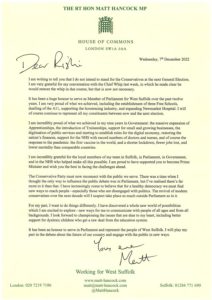
  • Matt Hancock – 2022 Letter to the Prime Minister Confirming Not Standing for Re-Election

    Matt Hancock – 2022 Letter to the Prime Minister Confirming Not Standing for Re-Election

    The letter sent by Matt Hancock, the Conservative MP for West Suffolk, to Rishi Sunak, the Prime Minister, on 7 December 2022.

  • Matthew Pennycook – 2022 Speech on Southeastern Railway Timetable Changes

    Matthew Pennycook – 2022 Speech on Southeastern Railway Timetable Changes

    The speech made by Matthew Pennycook, the Labour MP for Greenwich and Woolwich, in Westminster Hall, the House of Commons on 6 December 2022.

    It is an absolute pleasure to serve with you in the Chair, Ms Harris, and I congratulate my hon. Friend the Member for Eltham (Clive Efford) on securing this important debate and on the powerful case he made in opening it.

    The deeper that I have dug into Southeastern’s stated rationale for its planned December timetable changes, the more convinced I have become that it simply does not add up. No one denies that we have seen a reduction in passenger numbers on Southeastern services post pandemic. However, given the difficulties inherent in determining levels of permanent demand reduction, not least given the fact that passenger numbers across the country continue to recover steadily, it beggars belief, quite honestly, that levels of demand as they were six months ago are being used to justify the kind of radical and disruptive change entailed by the timetable that is due to come into force next week.

    It is worth bearing in mind that Southeastern introduced a reduced timetable on the Greenwich line in November 2020, but it was forced to restore the full peak hour service in January of this year because of overcrowding. Yet we are now told that similar service reductions are essential and that despite there being 302 fewer weekday services and 426 fewer weekend services across the network, as well as extremely large gaps between services during peak periods, there will be more than enough space to meet demand.

    In the face of significant public anger, Southeastern has offered all manner of additional reasons why these planned timetable changes must be made. We are told by Southeastern representatives that the current timetable has:

    “several disbenefits which will only get worse as customers return to the railway.”

    That statement not only contains an implicit admission that demand is expected to continue to rise, but the company has also failed to make clear what those disbenefits are.

    We are also told that the timetable is needed to deal with:

    “the notorious bottleneck at Lewisham”.

    However, as several colleagues have already mentioned, once again no specific information about delays caused by conflicting movements at or outside Lewisham station has been presented.

    We are also told that Southeastern is an aberration for having metro trains that serve multiple London termini, yet Southern runs services into both Victoria and London Bridge, and Great Northern runs services into King’s Cross and Moorgate, both doing so without issue. We are told that the new timetable was based on feedback from customers and stakeholders, yet there was no engagement campaign with rail user groups and community groups prior to the cackhanded announcement of these changes in late September. Indeed, there has been none since.

    It is hard to escape the conclusion, particularly given that the new timetable closely reflects proposals made prior to the pandemic as part of the 2017 Southeastern franchise tendering exercise, that what we are witnessing is the implementation of plans drawn up long before anyone had heard of coronavirus, under the pretext of post-pandemic changes in travel patterns and ultimately being driven by a desire to cut costs.

    That would certainly explain why Southeastern sought to evade proper scrutiny about these planned changes by seeking and securing from the Department for Transport a formal derogation against the requirement to undertake a consultation exercise in respect of them.

    Responding to that charge, Southeastern has argued that it takes many months to design and consult on a timetable change, and the pace of events meant that it was unable to do so. Yet other train operating companies that are minded to make timetable changes, including South Western Railway and London North Eastern Railway, managed to undertake detailed consultations with their customers despite facing the same pressures.

    Despite the concerns raised by colleagues from across south-east London over several months, it is clear that the Government and the operator will plough ahead and introduce the new timetable on Sunday 11 December. That is deeply regrettable, because of the inconvenience that will be caused to all those passengers who will henceforth be forced to take multiple services to reach their intended destinations, but also because, as my hon. Friend the Member for Eltham mentioned, of the risk of severe overcrowding.

    The Minister owes it to concerned Southeastern passengers to make clear precisely what will happen if demand does exceed service capacity, as I fear it will, so I would be grateful to him if he could address the following questions. Given that departmental responses to written questions suggest that data on overcrowding on the rail network has been discontinued, how will pressure on Southeastern services be monitored in the weeks and months ahead? Assuming that it is monitored in some open and accessible form, what extent of overcrowding will trigger an internal review of the new timetable’s efficacy?

    How serious will matters have to become for services that are to be cut this weekend to be restored, and how quickly can any revisions be made? Indeed, can the Minister confirm that specific revisions to the planned timetable can be made, given that it is premised on significant alterations to termini on various lines? Finally, will the Minister today rule out issuing Southeastern with a further formal derogation and provide a commitment that there will be extensive public consultation ahead of any further timetable changes carried out next year?

    It is not enough for the Minister to argue, as he did in response to a question from my hon. Friend the Member for Eltham at Transport oral questions, that we should all

    “just wait and see how matters progress”.—[Official Report, 24 November 2022; Vol. 723, c. 437.]

    Concerned passengers in my constituency and many others rightly expect answers from the Government as the operator of last resort, and, most importantly, an indication that Ministers will move quickly to amend this new timetable if it proves as damaging as we all fear.