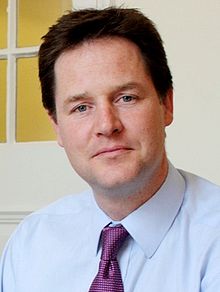
Tag: Nick Clegg

  • Nick Clegg – 2013 Speech on Modern Families

    nickclegg

    Below is the text of the speech made by Nick Clegg, the then Deputy Prime Minister, on 2 September 2013.

    Every weekday morning, across the UK, there’s an army of mums, dads, grandparents and carers cajoling young children to “Hurry up and get ready for their day!”

    Many of these families are feeling the squeeze. They’re doing what they can to juggle their busy lives. And, now more than ever, one of the biggest things that could help them out is better access to more affordable high-quality childcare. That’s why I’ve made childcare one of my main priorities in government. And whenever money has become available I’ve pushed hard for it to be invested in this area.

    Last month, the government launched its consultation on our newest offer that will help more of Britain’s working families. This means that from 2015, if your family doesn’t receive support through tax credits or Universal Credit, but both parents are working, or you’re a lone working parent, the government will provide 20% of your childcare costs up to a cost of £6,000, per child, per year. That’s the equivalent of up to £1,200 per child, per year.

    And from 2016, if you’re a lone parent or couple in work, who pays income tax and relies on Universal Credit to make childcare affordable, or even possible, we’re investing an extra £200 million to increase the contribution we give to your childcare costs from 70% to 85%. This could help out around 200,000 families.

    Of course, there has been controversy about which families are eligible for these offers. But that doesn’t detract from the fact that this is a substantial package of support that will help ease the pressure for millions of families across the country.

    And today I want to talk about what we’re doing, step by step, in the coalition government to help every British family balance the demands of their lives with children.

    One of the first decisions our government took was to increase the hours of funded early education available for every family with a 3 and 4 year old from 12.5 to 15 hours a week.

    And today I’m pleased to mark our next step on this path to affordable, accessible childcare; launching the government’s latest free childcare offer for 2 year olds.

    From today, if you’re a parent on a low income with a 2 year old in the family your child will qualify for 15 hours a week of free early years’ education.

    Any childcare and early learning provider – that’s nursery, preschool or childminder – rated outstanding or good by Ofsted can provide places. These funded places are focused on helping the families that need them most. That’s around 130,000 2 year olds – 1 in every 5.

    We are investing over £500 million this year. And have distributed £100 million to local authorities to create new places to ensure those children eligible right now can benefit from these funded places from today.

    The households, which qualify are those that meet the same eligibility requirements as for free school meals. If that’s you, or you think it might be, your local authority is there to help you. They will confirm if you’re eligible and can help you take up a place for your child.

    And we’ve also made this support available to 2 year olds, who are looked after by their local authorities. So that they too can benefit from the great start this valuable early learning support provides.

    And from this time next year, we want to extend that helping hand even further.

    Our investment will increase to £760 million to help another 130,000 children, whose families are on the next rung of the income ladder.

    In total, that will mean extra places for around 40% of families with 2 year olds. And today, I am pleased to confirm that this will be working families, who earn under £16,190 a year and rely on working tax credits. The 40% most feeling the squeeze.

    This support will also be there to help children, who have been adopted, are in care, or have a disability or special educational needs.

    And I want to thank all of those local authorities and early year’s education providers working hard across England, to ensure that the children who qualify right now can access their place from day one.

    I’m delighted at the response we’ve had so far from nurseries and child-minders in preparing these extra places and promoting this offer to parents.

    These people are amongst those you rely on the most when your children are young. And the coalition government has been working with providers to reduce paperwork, improve quality and increase routes into this sector. So that when you drop your child off at nursery, preschool, or their child-minder you know they’ll get the best early learning, care and support possible throughout their day.

    I know that some of you will be thinking…why not give this free support to every 2 year old? Why not help every family? And it is certainly my long-term ambition to extend free support to all 2 year olds. But the fact is that at a time of limited resources you’ve got to start somewhere. And for me, it’s better for us to start with those children, who can benefit most from high-quality early year’s education, but who too often miss out.

    All the evidence shows that if you take 2 young children – hanging up their coats next to each other on the first day of school – the poorer child will already be behind their better-off classmate. And if we don’t step in to help these children, that gap just keeps getting bigger. We’re talking about a child’s journey through life already being mapped out for them before they’ve even set foot in a classroom.

    Well-off children are more likely to become well-off adults. Poorer children are more likely to stay poor. And not only do these children suffer. The whole class suffers, as teachers have to focus more of their efforts on children frustrated and left behind through no fault of their own.

    As a Liberal, I believe that every British family, whatever its structure, background and circumstances, should be able to get on in life. And that the role of government should be to support, not control, our families. To make their choices possible, not to dictate their choices.

    It’s not for us to tell you whether you should stay at home or not. You have to decide what’s best for your family. And the modern British family comes in all shapes and sizes. But it is government’s responsibility to help those families feeling the squeeze; those who find it hard to meet their childcare costs.

    That’s why in government, we’re doing everything we can to reform, simplify and modernise those parts of the system that are making it harder for your families to realise their ambitions.

    From day one in government, we’ve worked with the belief that if modern families no longer fit the system, then it’s the outdated system that needs to change. That’s why from next year, we’re extending the right to request flexible working to every employee. So that the vital back up team of grandparents, family members and friends who would love to do more to help you out now can. And from 2015, if you’re a new parent you’ll also have greater freedom and flexibility to use and share leave during the maternity leave period in a way that works for you.

    Now, of course, this doesn’t mean that we can put off the tough decisions we need to take to get the massive deficit we inherited under control. But what you can be sure of is that the choices we make will be rooted in evidence and focusing investment where it can help your families most.

    The crucial question every parent asks when weighing up whether to work, or take on extra hours is: how much of my earnings will I keep after costs like tax, childcare, travel and so on? That’s why we’re designing the system to ensure that families get to keep more of what they earn and that work pays.

    It’s why we’ve committed to raise the personal allowance on income tax. So that basic rate taxpayers will get to keep all of the first £10,000 they earn. We’ve already taken over 2 million people out of paying income tax altogether. And by the time these changes are complete, they will be worth around £700 a year for 20 million basic rate taxpayers.

    We believe this is a better way to help your family. To put this money back in your pocket for you to spend on what you know can help your family best, rather than have the government decide that for you.

    And alongside our additional childcare investment in Universal Credit, I’ve also fought hard to ensure that the system no longer penalises those parents who want to go back to work, but can only work less than 16 hours. Securing £200 million of investment that will benefit an extra 100,000 low-income families.

    Previously, these parents knew that if they worked less than 16 hours a week, they would lose their existing benefits from day one, but not qualify for any additional support through the tax-credit system. This left them in the ridiculous position of knowing that their families would be worse off despite them working the hours they could. Now they know that the work they do will always pay.

    Within government, it will always be one of my biggest priorities to ensure that when both you and your children set out to achieve your ambitions, the choices available to you are greater, the sums add up a little easier and that, at every step of this road, our government is working hard to build a stronger economy and fairer society in Britain. A Britain fit for modern families.

  • Nick Clegg – 2013 Q&A on Syria

    nickclegg

    Below is the text of the speech made by Nick Clegg, the then Deputy Prime Minister, on 27 August 2013.

    Question

    Why are we now considering military action?

    Deputy Prime Minister

    I think many people who’ve been watching this horrific bloodshed unfold in Syria over the last couple of years will ask themselves why it is that the international community, why is France, America, Britain, considering a serious response to what has happened in Syria. The answer is that the murder of innocent men, women and children through the use of chemical weapons is a repugnant crime and a flagrant abuse of international law. And if we stand idly by we set a very dangerous precedent indeed, where brutal dictators and brutal rulers will feel they can get away with using chemical weapons on a larger and larger scale in the future. These are weapons that were used on a large scale in the First World War and banned back in the 1920s. So what we’re considering is a serious response to that.

    What we are not considering is regime change, trying to topple the Assad regime, trying to settle the civil war in Syria one way or another. That needs to be settled through a political process. We are not considering an open-ended military intervention with boots on the ground like we saw in Iraq. What is being considered are measures which are legal, which are proportionate and which are specific to discouraging and sending out a clear signal that use of chemical weapons in this day and age is simply intolerable.

    Question

    How confident are you that it will be legal?

    Deputy Prime Minister

    Well, any steps we will take will have to be legal. This government, this Coalition Government, of course is not going to act outside the remit of international law. But let’s remember that the use of chemical weapons is a flagrant abuse of international law. These weapons were first banned by international conventions back in the 1920s after their widespread use in the First World War, a hundred years ago, and what we want to ensure, as an international community, is that we don’t go back to a world in which people think they can use these heinous weapons with impunity.

    This is about taking proportionate, legal and carefully circumscribed steps to ensure that everybody understands, the world round, that we will not stand idly by when chemical weapons are used in complete breach of international law.

  • Nick Clegg – 2013 Speech to CBI Scotland

    nickclegg

    Below is the text of the speech made by Nick Clegg, the Deputy Prime Minister, to CBI Scotland in Glasgow, Scotland on 5 September 2013.

    After the toughest global economic conditions in living memory, the UK economy is starting to turn a corner. And the signs of recovery are encouraging.

    Growth has doubled in the last quarter. Across the UK, more people are in work than ever before. And at a time when unemployment is rising across the EU, private sector employment in Scotland has grown by 146,000 in the last three years.

    Our focus on fiscal discipline is also helping to keep interest rates low for UK businesses and families. We’ve reduced the deficit by a third as a percentage of GDP over the last three years. And we’re borrowing £49 billion less this year than the previous government.

    Of course, none of this is easy. There are still major economic challenges to be overcome. Many families are feeling the squeeze. Some businesses still struggle to get the credit they need. And, as a country, we are working hard to repair and rebuild our economy.

    That means doing what we can to unwind the toxic legacy of the last government’s economic model. Broken from the start, it didn’t do enough to support balanced growth across the UK. It was lop-sided: over-reliant on one specific part of the financial services industry to drive an unsustainable boom that left us vulnerable when the crisis hit.

    None of that can be fixed overnight. But bit by bit, we are clearing up the mess we inherited. Our critics said it couldn’t be done. That the two parties of the coalition wouldn’t be able to set politics aside and put our economy and nation first. But we are proving them wrong.

    And so are you. Because ultimately it is your enterprise and your hard work, as UK and Scottish businesses, that is making the difference. And tonight I want to focus on our work together, government and business.

    And the essential role that Scotland – as one of the UK’s biggest economic success stories – plays in realising our vision for a stronger economy and fairer society across the UK.

    Because I believe that the best route we have to achieving a sustainable recovery lies in strengthening that partnership between us.

    For me, it’s a partnership that strikes that old-fashioned liberal balance between a government that gets out of the way of businesses to enable and empower them to do what they do best: create jobs and drive growth.

    And a government that steps in, when needed, to set the rules of the game essential to ensure a sustainable and competitive economy; backed up with access to finance, modern infrastructure and a skilled workforce.

    That’s why we’re making the UK’s business environment one of the most competitive in the world: cutting corporation tax to one of the lowest rates in the G20; reducing the National Insurance bill for companies; protecting the flexibility of our jobs market and getting rid of unnecessary red tape.

    And that combination of measures has helped make the UK the most attractive location for overseas investment in Europe, with over 10% of the UK’s 2012 FDI, foreign direct investment, projects coming to Scotland.

    At every step of the way, in the coalition, we’re fighting hard to create jobs, boost growth and make a genuine difference to people’s lives across the UK.

    That’s why we’ve committed to raise the personal allowance on income tax. So that basic rate tax payers will get to keep all of the first £10, 000 they earn. We’ve already taken over 2 million people out of paying income tax altogether. And by the time these changes are complete, they will be worth around £700 a year for over 20 million basic rate taxpayers.

    We’ve also extended our Funding for Lending Scheme to provide more help to SMEs. And the latest figures show that under this scheme lending to businesses and homebuyers has increased. And ahead of the official launch of our new £1 billion UK Business Bank, we are already accepting proposals for the project’s first investment round.

    We’re also protecting and boosting investments essential to our long-term growth. Setting out, for the first time, a long-term Infrastructure Strategy for 21st century Britain, with a major boost to capital spend here in Scotland.

    This is supporting a £100 million roll-out of superfast broadband to communities across Scotland; a £50 million contribution to safeguard and improve the cross-border sleeper service for Scotland; and an investment in faster, more modern electric trains on the East Coast Main Line. That’s in addition to our committed investment in a national High Speed Rail Network.

    HS2 is central to our 21st century ambition to build a stronger economy in the UK. We know that our competitors have been investing in better roads and railways for decades. But the last time we built a new main rail line north of London was more than 100 years ago.

    Rail travel has doubled in the last 20 years. With important routes like the West Coast Main Line hit by serious capacity issues. HS2 will help us catch up and compete, more than doubling the number of seats between London and Birmingham and helping to slash journey times to Scotland. This is an economic growth story.

    Completing HS2 will help us to tackle the north-south divide that’s scarred our country for too long. Giving 8 of our biggest cities, across the North and Midlands, the modern rail links they deserve, as well as generating over £60 billion of benefits for the UK.

    The Core Cities Group estimates this investment will create around 400,000 new jobs, 70% of which will be based outside of London. And in Scotland, we calculate it will boost the economy by around £3 billion.

    And here I just want to respond to those who have criticised this project in recent weeks. That includes the ex-ministers who green-lighted this idea in the first place.

    It’s a pattern, we see happening time and time again in this country. When a deal has been signed, the temptation to undermine it from the comfort of opposition can be too much for some politicians to resist. This clouds the debate and chips away at the consensus.

    But the alternatives they suggest – such as upgrading existing lines – aren’t viable answers. For example, the extra capacity created through the £9 billion upgrade of the West Coast Mainline has already been filled.

    We’ve tested our business case rigorously. And we’re clear on what needs to be done to deliver this project on time and to budget. That is how Britain builds the infrastructure it needs. And that’s how we compete, as a 21st century economy, with a modern transport system that works to make us stronger.

    In energy, our £3.8 billion UK Green Investment Bank, headquartered here in Scotland, is helping to boost private sector investment in green energy projects.

    And I’m pleased to say that we can raise a glass to the bank’s first project here in Scotland: with over half a million pounds committed to a new bio mass boiler at Tomatin Distillery, near Inverness.

    But that’s just the start. And with our strengthened support for renewables through the single British energy market, we are helping to create thousands of new jobs in Scotland.

    And here in Glasgow, at Strathclyde University, we’re funding 2 new catapult centres to drive research, innovation and business development in our Offshore Renewables and High-Value Manufacturing sectors.

    These are investments that will help rebuild the UK’s economy because the UK succeeds when Scotland succeeds. And a stronger UK economy ensures a stronger Scotland.

    And it’s precisely because of that shared prosperity that I don’t want to see a barrier thrown up between Scotland and the rest of the UK.

    Right now, membership of the UK’s Single Market gives UK businesses unrestricted access to over 60 million consumers. As set out in our business and microeconomic analysis paper, in 2011, that was worth around £45.5 billion in trade for Scotland (excluding oil and gas), that’s double the amount Scottish businesses sell to the rest of the world. And the demand for Scottish goods and services from England, Wales and Northern Ireland contributes almost 30% of Scottish GDP. In turn the rest of the UK exports almost £50 billion worth of goods and services to Scotland.

    Now I’m not saying that all of this trade will be lost, if Scotland votes Yes in 2014. I’m not here to create an artificial argument. But our latest research shows that the long-term effect of a new border between our two countries – with all of the new rules, regulations and systems it will require – will reduce Scotland’s GDP by 4%, equivalent to £5 billion in 2012, over the next 30 years.

    The UK’s strong monetary and fiscal framework also provides investors and businesses in Scotland with the confidence, certainty and support they need to grow. This includes strong national institutions like the Bank of England. And as a strong part of the UK, Scotland also makes its global voice heard with a seat at the table at the G8, the G20, NATO and UN Security Council.

    This also means that Scotland through the UK’s membership can play a powerful part within the wider union of EU, shaping legislation, negotiating budgets and driving the future of EU single market.

    This time next year, the people of Scotland will be gearing up for one of the most important collective decisions you will ever take together.

    Those, who say Scotland could not be an independent state are wrong. Scotland could be an independent state, but my view is that Scotland’s future is best served in the UK, as part of our family of nations. And just because you can do something does not mean you should do something.

    In the 21st century when countries around the world, within the European Union, in Latin America, South East Asia and beyond are reaching out to cooperate, I believe that it would serve no-one well if the nations of the UK family were to loosen the ties that bind us together.

    But separating our family of nations – through the creation of a new international border – would inevitably, mean a drifting apart. So that the strength that we draw from 300 years of economic integration; the solidarity of our common values that built the welfare state and the NHS; and the security we share from standing together past and present – all of that will be lost.

    I will campaign proudly for Scotland to remain in the UK. Not out of some nostalgia-driven attachment to the past. But out of a clear-sighted look to our future.

    Just two days ago the Chancellor was in Aberdeen to publish the latest in our series of Scotland Analysis papers, which set out objective expert analysis on the realities of Scotland becoming an independent state. Everything points the same way: our nations are better together than we are apart.

    We have a great deal of confidence in our argument and that the facts speak for themselves. Already the answers put forward so far by the nationalists about what an independent future for Scotland might look like keep changing. In particular, what the economic realities of separation will mean for your business.

    You drive the Scottish economy. You create the jobs and the wealth that makes Scotland a great place to live and work. And I urge businesses across Scotland to remain a voice of reason in this debate, relentless in securing honest answers about the choice Scotland has to make.

    But if Scotland votes No next year, this won’t be the end of the story. A vote against leaving the UK family is a positive vote to remain within it – and to be part of Scotland’s evolving position within it.

    We can’t let this debate be set up as a false choice between separation, on the one hand, and a status quo set in tablets of stone, on the other. Because the more pragmatic reality is – and which business accepts – is that nations must adapt and evolve.

    Gladstone, Grimond, Steel, Kennedy and Campbell – these are just some of the giants of my party who, down the years, have set the Scottish debate alight. And made a genuine, lasting difference.

    And within the coalition government, we have a strong track record on this. Through last year’s Scotland Act 2012, we took substantial steps to improve Scotland’s devolution settlement.

    And I want to thank Michael Moore and his team, for their work with business to ensure this new settlement will be one that serves the interests of Scottish business and Scotland’s communities.

    The Act amounts to the biggest transfer of financial powers – including major tax and borrowing powers – from London to Edinburgh in 300 years. That work has been a priority for me in government, because, as a Liberal, I will always argue that our country is at its strongest and has its best shot at success when we share the power within it more fairly between our government and our people.

    And the Campbell Home Rule Commission defined a truly modern settlement for a modern Scotland to be achieved through a major transfer of financial and constitutional power from Westminster to Holyrood: with Holyrood raising the majority of the money it spends. So Scotland can determine its own destiny on the domestic agenda.

    Fiscal responsibility is critical to a modern, mature parliament; one that has to balance the budget not just spend the money. This also means much more autonomy and power for local councils and communities across Scotland, and across the UK.

    This is a proposition that the Scottish government seems reluctant to accept. For example, it says it will consider powers for the Isles of Scotland to become independent in the future – yet they seem to be centralising power more and more.

    My proposition protects the United Kingdom single market, one of the most important things for business. A single currency; a single regulatory system; a single, open, free market.

    With Home Rule we truly get the best of both worlds. Local power and authority right alongside global clout, social equity and economic strength.

    Many others are joining the debate. I welcome this. It is in the best Scottish political tradition to have a broad, inclusive conversation about the best form of government for Scotland. It worked to deliver devolution and it can work to improve devolution. And I urge you to join it too.

    I believe that the structures of government, and the policies of government, should serve all of the people – that they should serve the people of Scotland.

    A thriving business sector creates opportunity and diversity as well, of course, as the revenue on which our public services depend. So the future of devolution in Scotland must evolve in a way that enables your success too.

    This train is leaving the station – debate is under way. So now is the time for you to express your views, to shape that debate, to influence and shape a modern and successful Scotland within a strong United Kingdom.

    In conclusion, the responsibility that rests on the shoulders of the people who live in Scotland today is considerable. One year from now, you will decide whether Scotland remains part of the UK or not.

    You won’t just be making that decision for now, for yourselves. But for ever – that’s because there is no turning back. The future of the 300 year union is your call on 18 September next year.

    What I believe, and what the evidence shows is that, the best future for Scotland is to be part of a strong United Kingdom.

    That is how we build a stronger economy and secure a fairer society in a UK where every corner of our country prospers, and where every individual – English, Scottish, Welsh and Northern Irish – can succeed.

  • Nick Clegg – 2012 Speech at Mansion House

    nickclegg

    Below is the text of the speech made by Nick Clegg, the then Deputy Prime Minister, at the Mansion House in London on 16 January 2012.

    Another week, another speech about the evils of capitalism. Let me start by asking: who here is in favour of irresponsible capitalism? Because you won’t find many people arguing for more recklessness, more short-termism or greater rewards at the top. On the contrary – the growing consensus is that we need the opposite: a more sustainable economy; a more balanced economy, where rewards are proportionate and relate to real success.

    That consensus, emerging among the political parties, has attracted a little cynicism.

    I can understand that. It is, after all, bonus season in our banks. But there is a more generous interpretation of the shifting political mood. One that says: perhaps the penny has finally dropped.

    As this debate moves forward, we need to be clear about what we mean. Because, whether you call it a new economy, an ethical economy, moral markets, responsible capitalism, there is a big difference between having strong views on bonus culture or excessive top pay and wanting real change in the practices and principles that guide corporate life. A bit of wrist slapping or moralising at the worst offenders will not be enough. This should not be a war of words but a real contest of ideas about how to reform our economy.

    So this morning I want to offer a liberal diagnosis of what’s wrong; and then a liberal remedy.

    First, diagnosis. Why is our capitalism in crisis? I will argue that this is, at root, a crisis of power.

    That we now have an economy driven by immensely powerful vested interests. Interests that politicians have abjectly failed to stand up to.

    The remedy, put most simply, is a redistribution of power. Last month I set out my vision for an Open Society and I talked about the need to disperse political power to create strong citizens. Today I want to talk about dispersing economic power to that same end.

    Before I say any more, I want to make one thing clear: Capitalism may be today’s political punchbag, but let’s take a long view: it’s one of history’s great success stories. No other human innovation has driven progress – and raised living standards – so consistently. Markets catalyse ideas, invention and experimentation. When they work well, they are meritocratic and liberating.
    And they generate the wealth to support the most vulnerable and needy in society.

    Liberals believe strongly in the virtues of the market. But only if it is a market for the many, not a market for the few. Our economy is in danger of becoming the latter, monopolised by a minority, serving narrow and sectional interests.

    I am not here to take a cheap shot at big business – this would hardly be the right crowd.

    Big British firms are the backbone of our economy: our employers, our wealth generators, leaders in our society. And I am grateful to many of our major firms, particularly, for the commitment they are showing to greater corporate and social responsibility.

    Just last week over 100 large companies signed up to the Coalition’s Business Compact, opening their doors to young people from all backgrounds in order to improve social mobility. I’m delighted to see some of them represented here today.

    And I know many people in this room will agree: our economy is now seriously out of whack. It simply cannot be right that, right now, because of the crash and the recession, millions of ordinary people are struggling to get by. Yet relatively little has changed for those at the top.

    It cannot be right that for most people, on average, wages are falling by around 3% a year, yet executive pay is rising – on average by 13%. Over the last 25 years, top chief exec pay has shot up by 1200%.

    That is a gross imbalance, with wealth and influence hoarded among the few. It’s socially destabilising. Morally, it cannot be justified. And it’s bad for the economy too.

    Our problem is what Jesse Norman has called crony capitalism. It’s easy to throw rhetorical rocks at directors, bankers and businesses. But, if we are honest, this is as much a failure of politicians and regulators, the authorities too often cowed by corporate power. Whether that is political parties of all stripes in hock to vested interests or regulators struggling to stop supermarkets from putting the squeeze on small suppliers, whether it’s politicians kow-towing to media barons, the problem is endemic.

    There’s nothing new about it. Kings have always bestowed privileges on their favourite merchants. Corporations will naturally seek a dominant market position. It’s one of the reasons liberals from John Bright to the present day have been such fierce advocates of free trade. The agricultural landlords of the 19th century and early 20th century were happy for working people to pay more for their food because of protective tariffs. What Lloyd George in 1906 memorably called ‘stomach taxes’. So long as their own profits were protected.

    This has always been capitalism’s greatest danger: a tendency for the rule makers and the money makers to get too close. And we saw the consequences of that closeness play out in the most dramatic fashion right here, in the City, just three years ago. It was a political failure; a regulatory failure; and a market failure too.

    Political failure, because Whitehall became so dependent on City revenues. That politicians would not see the problems that were brewing. Instead, they hoped the goose would keep laying golden eggs.

    Regulatory failure, because the Financial Services Authority failed spectacularly in its duties. Regulators are meant to guard vigilantly against industry excesses. But they turned soft – either captured by or intimidated by those they were supposed to keep in check. And, just like the politicians, just like the industry, the FSA ignored the alarm bells ringing. And market failure, as short-termism and recklessness eventually consumed our banks, taking the whole economy to the edge of a cliff.

    Politicians in the pockets of vested interests, regulators asleep at the wheel, an unrestrained economic elite. The primary symptoms of crony capitalism.

    For liberals – from Gladstone to Grimond – the role of the state has always been to break up unaccountable, opaque concentrations of power, to protect the national interest from those vested interests. That is why, as well as the moves the Coalition Government is making to bring greater transparency to government contracting and lobbying, we need real reform of party funding to reduce the influence of those interests in politics. We need tougher border controls between the political class and the corporate world, and we need a better distribution of power within our economy.

    That’s why, for example we want new rules to stop an executive serving in one company from sitting on the pay board at another, so that directors’ salaries are no longer, effectively, decided by their mates. And we see an extremely important role for the state in redistributing wealth through income tax. In fact, one of the Coalition’s most significant reforms is our changes to income tax. Making it more progressive – so that lower earners keep more of what they earn.

    But liberals also recognise that narrowing wage inequality is not solely a task for the state. We also need to put much more power in the hands of other stakeholders in the economy – shareholders and employees – when it comes to setting top pay. Trusting not the unfettered market, nor the interventionist state, but trusting people.

    That is the core of a more responsible capitalism: power in the hands of people. Strong economic citizens able to keep vested interests in check. So let me say a word on the Coalition’s approach to empowering two groups in particular: shareholders and employees.

    First, shareholders. Part of the challenge is getting more of them to behave like business owners rather than absentee landlords. If they are unhappy, we don’t want them just to sell up and move on, we want them to throw their weight around so that the company improves: but we need to make sure they have the right tools at their disposal and they know how to use them.

    The Coalition has said we will introduce binding shareholder votes to curb executive pay as part of a package of measures to moderate boardroom behaviour. Vince Cable will set out that package next week but I can tell you today that we are going to overhaul the way shareholders – and others – can access information.

    Often, the reason investors are passive is because they can’t see the reasons to act. Take annual and pay reports. Shareholders should be able to use them as a kind of report card so they can see how well their money is being spent. But, you’ve read them, many – not all, but many – are impenetrable texts: obscuring rather than illuminating. Hundreds and hundreds of pages of facts, figures, charts and graphs. Plenty of information but nowhere – nowhere – a simple, clear single figure showing who gets paid what; Or a simple summary of where the money goes – how much is spent on directors, how much on dividends, or re-invested into the business.

    That information is absolutely essential for any investor trying to calculate value for money. Some companies do much better on making it transparent and easy to understand, but not enough. And where companies bury it – that is deeply cynical.

    So the Coalition will force companies to open up their books, so that investors don’t need an accountancy degree to decipher them. We are looking at a range of ways of increasing transparency, but here are two very simple changes:

    One: shareholders will only need to look at one number, not a dozen, to see how generously top executives are being paid, and they will need a clear policy in place for departing CEOs so that, if they deviate from that policy, and if a hefty payment is made for failure, that decision is up in lights.

    Two: the way money is spent will need to be crystal clear. So if a company is spending too much on boardroom pay compared to the amount being reinvested in the business, they will have to explain why: show investors where their money is going. That’s how to unlock shareholder power.

    But it’s not just shareholder power that matters. Ultimately investors seek profits, just like executives expect high pay. Some enlightened shareholders might see the benefits of a well-rewarded workforce, but the people best placed to look after the interests of staff are staff. And that is what, so far, has been missing from this debate: ordinary people.

    In an open society, a liberal society, people don’t just hold more power in politics, but in the economy too. And, over time, empowering workers can have a hugely transformative effect over corporate culture. People want to work in companies which are dynamic, but they also value stability. They want firms that secure big profits, but not at any cost. They believe that effort and achievement should be rewarded above all else.

    Aren’t those precisely the values everyone is now clamouring for businesses to hold?

    There are, of course, a range of ways employees can be given a louder voice.

    More rights, for example: like the new right to request flexible working and more flexible parental leave – to name just two.

    But today I want to focus specifically on employee ownership, a touchstone of liberal economic thought for a century and a half.

    John Stuart Mill hoped that employee-owned firms could end what he called the ‘standing feud between capital and labour’, and liberals have been championing it ever since. Because we don’t believe our problem is too much capitalism: we think it’s that too few people have capital. We need more individuals to have a real stake in their firms.

    More of a John Lewis economy, if you like.

    And, what many people don’t realise about employee ownership is that it is a hugely underused tool in unlocking growth.

    I don’t value employee ownership because I believe it is somehow “nicer” – a more pleasant alternative to the rest of the corporate world. Those are lazy stereotypes. Firms that have engaged employees, who own a chunk of their company, are just as dynamic, just as savvy, as their competitors. In fact, they often perform better: lower absenteeism, less staff turnover, lower production costs. In general, higher productivity and higher wages. They weathered the economic downturn better than other companies.

    Is employee ownership a panacea? No. Does it guarantee a company will thrive? Of course not. But the evidence and success stories cannot be ignored, and we have to tap this well if we are serious about growth. The 80s was the decade of share ownership. I want this to be the decade of employee share ownership.

    Now that’s a big ambition, I know. And it won’t happen overnight. But it won’t happen at all without Government taking a lead, so I am kickstarting a drive in Government to get employee ownership into the bloodstream of the British economy.

    We’re already doing this in the public sector, though the work of the Mutuals Taskforce, under Julian le Grand, and work being led by Francis Maude. And, of course, the radical reform of the Royal Mail – on that, I’d like to pay special tribute to Ed Davey. Governments have been grappling with the future of the Royal Mail for decades. Under Ed’s stewardship it will finally be transformed into an organisation in which staff have a meaningful stake. And now I’ve asked Ed to turn his hand to employee ownership in the private sector too.

    Working with professional bodies and businesses, the Coalition is going to find out where the barriers are, so that we can knock them down. Do staff and business owners know enough about employee ownership? Are the accountants and lawyers who advise them taught enough about it? Is there red tape we can cut? Does the tax system treat these firms fairly? Do we need an off-the-peg model so that more ordinary people take this up?

    We’ll appoint an independent adviser – an expert in the field – to help us find the answers and solutions to these kinds of questions, which will be brought together at a Summit I will chair in the summer.

    Crucial to all of this, of course, will be encouraging take up. One option, to give you an idea, could be giving employees a new, universal “Right to Request” shares.

    Imagine: an automatic opportunity for every employee to seek to enter into a share scheme, enjoying the tax benefits that come with it, taking what for many people might seem out of their reach, and turning it into a routine decision. Clearly the details of that kind of policy need to be properly thought through. We need to establish which companies would and wouldn’t benefit – it might not be feasible for microbusiness, for example.

    But we need to start by thinking big: not asking ‘why?’, but asking ‘why not?’ Looking across the board – tax, regulation, simplicity, awareness – to help more of these companies flourish, in order to put more employees at the helm.

    And that brings me to the thought I want to end on today: economic power in more hands.

    As the debate on a more responsible capitalism moves forward, Liberals will remain set on that goal:

    An end to crony capitalism, where vested interests trump the national interest. A better balance of power, in the economy – and between politics and business. That is the route to a safer, more stable, more prosperous economic future. This is how we will spread wealth and share rewards.

    A more responsible capitalism. A more liberal capitalism.

    Thank you.

  • Nick Clegg – 2012 Speech on Working Families

    nickclegg

    Below is the text of the speech made by Nick Clegg, the then Deputy Prime Minister, at the Institute for Government in London on 26 January 2012.

    Yesterday’s GDP figures remind us that the road to the UK’s economic recovery will be long. And progress will be uneven. Those GDP figures remind us that we cannot simply ride out these troubles, waiting for the good times to roll around again. Nor can we return to business as usual. The financial crash and the recession that followed were unprecedented, and they were global. But the UK’s weakness in the face of those events was a damning indictment of the way our economy had been run. An economy that became closed, elitist, driven by vested interests, where we prized recklessness and short-term gains and undervalued stability and hard work.

    So picking ourselves up for good means fundamental reform. Hitting the reset button to ensure that, not only does prosperity return, but this time it’s properly shared and really lasts. The first part of that is clearly deficit reduction. Filling the black hole; wiping the slate clean; preventing years of higher interest rates and fewer jobs; ensuring that the next generation does not pay for this generation’s mistakes; creating the sound public finances – the macroeconomic stability – that we know is a prerequisite for lasting growth.

    But, beyond that, we must also rebalance our economy: ending our overreliance on financial services and the South East; shifting from consumption to investment; from debt-driven bubbles to sustainable growth. And there is another element of rebalancing – rebalancing our tax and benefits system. Because both need to be rebuilt with work at their heart, restoring some sense to the assistance and rewards the state provides.

    We cannot pin all our hopes on the traders or the bankers. It will be the millions of hardworking Britons who deliver the nation from these difficult times. So we must now make the most of all of our human capital. And we must help struggling families stand on their own two feet. That means a benefits system that gets more people into work and a tax system that ensures work pays. Today I want to say a word on each.

    First, benefits. I have always believed in a welfare system that helps those in need, those who cannot work must be protected and those who have jobs must be confident that, should they lose them there is a safety net in place. That is precisely why, in the Autumn Statement last year. The Coalition committed to the full uprating for pensions and out-of-work benefits from April – 5.2%, in line with inflation. Not everyone agreed that “the unemployed” should receive the full uplift, certainly not in the current climate. And, if you believed everything you read, you would think that these benefits are, essentially, unlimited handouts for the ‘idle poor’. But that just shows what is so often wrong with this debate.

    For one thing, for decades now benefits have been uprated in line with prices, while earnings have generally increased at a faster rate. So the value of benefits such as Jobseekers Allowance have actually shrunk over the years, compared with the incomes of those in work. But, even more importantly, abuse of the benefits system by a minority has obscured the needs of a deserving majority. The older people who have contributed to our society for their whole lives, those who cannot work due to disability or serious illness. And – the group most often forgotten – working people who have been laid off, through no fault of their own and, most often, for short periods of time. Yes, sometimes the system is exploited – and that cannot be accepted. But the majority of people who claim JSA are off benefits within three months, people who pay their taxes, support their families, but are temporarily down on their luck. So we need a benefits system that helps those who can work into work.

    And it is that simple principle that drives the Coalition’s welfare reforms. From the Universal Credit, to the benefits cap, to the Work Programme and the Youth Contract. While the economy was booming we saw four and a half million people stuck on out-of-work benefits, the number of young and unemployed hardly changed.

    There are now 2.6 million people on incapacity benefits, 900,000 of them have been parked there for 10 years or more. And where children grow up in homes where no one works, they are twice as likely to experience long spells of unemployment themselves. It isn’t right; the country can’t afford it, the Coalition is determined to see it change.

    Nearly 70 years ago, when William Beveridge designed the welfare state, he imagined a system that would give people protection from cradle to grave. Not one that would act as a crutch every day in between. The state must offer security in hard times. But it should not, he warned, ‘stifle incentive, opportunity, responsibility’. In the words of another great liberal, John Stuart Mill, ‘assistance should be a tonic – not a sedative’. I couldn’t agree more. And it is those same values, that same belief in the potential of ordinary men and women to flourish, that needs to be instilled in our tax system too.

    My philosophy on tax is simple: the system should reward effort, enterprise and innovation and bear down on those things which are bad for our society. That sounds like a proposition with which most people would agree, but attitudes to tax are a good proxy for our deepest political instincts. And the three major political traditions in the UK – conservatism, socialism and liberalism – have very distinct approaches.

    For those on the philosophical right, taxes are necessary. But there is an understandable fear that tax-done-badly can threaten entrepreneurialism and business, strengthening the hand of an intrusive state. That wariness means the right can be less inclined to promote tax as a way of redistributing wealth and opportunity, putting less of an emphasis on using the tax system to tackle inequality, for example, between those who earn their income and those who are asset rich.

    For the traditional left, on the other hand, taxes are the principal means of redistribution. Socialists will support a penal rate of tax on the highest earners simply because it makes them poorer. For them, tax is a badge of socialist success: the more, the better. They would rather draw money in through the state and then hand it back to people, rather than letting them keep more of their earnings in the first place.

    The liberal approach, put most simply, is based on a profound commitment to the value of paid work. Citizens are empowered when they can keep the fruits of their own labour. As Gladstone said, it is better for money to ‘fructify in the pockets’ of the people who earn it, rather than in the Treasury. And fiscal liberalism supports taxes on unearned wealth, precisely to lighten taxes on the wages of the hardworking.

    Those principles could not be more important today. Because, in developed economies around the world, in every country now seeking to get back on the right path. Where money is scarce, where, every day, families are tightening their belts, the biggest question we face is this: how is that burden shared?

    That’s why, this week, we heard President Obama devote his State of the Union Address to greater fairness in the American tax system. It’s why tales of tax avoidance are filling our newspapers everyday. And every politician now has a simple choice: do you support a tax system that rewards the hard-working many? Or do you back taxes that favour the wealthy few?

    I know which side of the line I stand on: the UK’s tax system cannot go on like this. With those at the top claiming the reliefs, enjoying the allowances, hiring other people to find the loopholes, while everyone else pays through the nose.

    So the Coalition is calling time on our unfair and out-of-whack tax system. We’ve put up Capital Gains Tax, ending the scandal of a hedge fund manager paying less on their shares than their cleaner paid on their wages. We’ve reduced tax breaks on pension funds for the very rich. We’ve clamped down on avoidance and taken steps to raise an extra £7bn through closing the tax gap.

    And my priority in Government is freeing the lowest-paid from income tax altogether and cutting income tax for millions of ordinary workers. Over recent weeks you will have heard a great deal about fairness at the top, through Vince Cables’ reforms to curb excessive executive pay. You will have heard a great deal about fairness at the bottom, through reform of our welfare system to ensure benefits are fair and reasonable and to get more claimants into work. This is about fairness in the middle, more money in the pockets of the people who need it.

    Whether you call them the ‘squeezed middle’, ‘hard-working families’, or, as I have, ‘alarm clock Britain’, cutting income tax is one of the most direct tools we have to ease the burden on low and middle earners – the people whose incomes are too high to qualify for welfare benefits but too low to provide any real financial security; the group whose plight the Resolution Foundation has done so much to highlight; the working mum whose bills keep rising but whose wages do not; the father kept awake in the dead of the night, worried tomorrow the company will be laying people off; the young couple who used to look forward to the holiday they would book or the car they would buy but who now know that if the boiler breaks or the washing machine packs up, the money just isn’t there.

    Go back 50 years or so and many more working people were exempt from income tax thanks to a more generous tax-free threshold. But over the last few decades, wage rises have outpaced the increase in the allowance sucking more and more people into the income tax net. And, while in the early 70s, the Personal Allowance was worth around 28% of average earnings, by 2010 that had dropped to around 20%.

    I am extremely proud that the Coalition is on track to raise the personal allowance to £10,000 for ordinary taxpayers over the course of this Parliament. We’ll make sure that anyone earning £10,000 or less will pay no income tax at all and, for those on middle incomes, the first £10,000 they earn will be tax free.

    For millions of basic rate taxpayers – ordinary, hardworking people – that means paying £700 less in income tax each year – around £60 a month. In the 2010 Budget we increased the tax allowance from £6,475 to £7,475. This year we have already announced a planned rise of an additional £630, meaning that a total of 1.1 million more people will no longer pay income tax at all.

    But today I want to make clear that I want the Coalition to go further and faster in delivering the full £10,000. Because, bluntly, the pressure on family finances is reaching boiling point. Compared to those at the top, these families have seen their earnings in decline for a decade and that’s got worse since 2008 with lower real wages and fewer hours at work.

    Ongoing consolidation in the UK public finances has meant necessary increases in taxation, reductions in spending, restrictions on public sector pay, and higher contributions on pensions. Last year brought much higher world inflation – some food prices have doubled, some energy prices have gone up by 50%. And, yes, we are now seeing some moderation in inflation. But, in just three years, real household disposable incomes have fallen by some 5 per cent – one of the biggest squeezes since the 1950s, since the records began.

    These families cannot be made to wait. Household budgets are approaching a state of emergency and the Government needs a rapid response.

    Delivering the £10,000 personal allowance more quickly will need to be fully funded. We cannot just cut taxes by raising borrowing – that is just extra taxation deferred. And it would undermine our success in restoring stability and credibility to the public finances. So we need to find the money – and that will not be easy, of course.

    But to those who say: we cannot afford to do this, I say we cannot afford not to do this. And it is because of the pressure our economy is under that there is now an urgent need to give families more help; an urgent need to rebalance our tax system so it rewards work and encourages ordinary people to drive growth. And that means those who are better off paying their fair share.

    In its recent excellent report ‘Divided We Stand’ the OECD noted how the incomes of the richest 1 per cent have soared away from everyone else over the last 20 years and showed that these people could be making a bigger tax contribution. They also made clear that the right way to do this is not to increase marginal tax rates on work any further. This would simply drive many of the rich away to other countries or encourage them to use tax avoidance mechanisms more aggressively. Instead, they suggest, governments need to look at tackling industrial-scale tax avoidance as well as at the allowances and reliefs which favour those on very high incomes.

    That is how we can raise the average taxes paid by the very rich without any further rise in marginal rates. To that end the Coalition set up the Aaronson Review to look at a General Anti-Avoidance Rule on tax so that the tax industry cannot spend all its time creating ever more contrived schemes undermining the principles and intentions of the system.

    There are a range of other, specific areas where we need to be tough too, not least stamp duty avoidance, particularly on higher end property sales and the transferring of assets and income abroad to avoid UK tax.

    We need to look at what more can be done to “green” the tax system. Not just because we care about the planet we leave our children, although that would be reason enough, but because, when the decision is between taxing pollution or taxing hard-graft, the right impulse is obvious.

    And, there is another big part of the tax system where I believe we need to be much more ambitious: serious, unearned wealth. The eyewateringly lucrative assets so often hoarded at the top. We still live in a society where, for so many people how much you earn can never compete with how much others own. Our tax system entrenches that divide and we need to be bold enough to shift the burden right up to the top.

    I know the Mansion Tax is controversial but who honestly believes it is right that an oligarch pays just double the Council Tax of an average homeowner even if their house is worth one hundred times as much? And who seriously thinks we would kill aspiration through a levy on the 0.1% of the population who own £2 million pound homes? The Mansion Tax is right, it makes sense and I will continue to make the case for it. I’m going to stick to my guns.

    So, to finish as I began: we are living in tough times. And many families are feeling the pinch. We need more of those who can work to be in work, and real rewards and incentives for those who are.

    It is often said that to govern is to choose and, in particular, to choose whose side you are on. That is especially true when there is no money around. My choice is clear: I want to help the hard-pressed and the hardworking. If that means asking more from those at the top – so be it.

    We are committed to eliminating the deficit and eliminate it we will. But I am determined that we do so in a way that is fair, that rebalances our economy that gives the right people their dues.
    People want economic competence, but they want compassion too.

    It is my job to make sure this Government delivers both.

    Thank you.

  • Nick Clegg – 2012 Speech on House of Lords Reform

    nickclegg

    Below is the text of the speech made by Nick Clegg, the former Deputy Prime Minister, in the House of Commons on 9 July 2012.

    Mr Speaker, no one doubts the commitment and public service of many members of the House of Lords.

    But dedicated individuals cannot compensate for flawed institutions, and this Bill is about fixing a flawed institution.

    So let me begin by setting out why our upper chamber is in need of these reforms.

    The three simple reasons why I hope members will give it their full support.

    First: because we – all of us here – believe in democracy.

    We believe that the people who make the laws should be chosen by the people subject to those laws.

    That principle was established in Britain after centuries of struggle, and it’s a principle we still send our servicemen and women halfway across the world to defend.

    Yet, right now, we are one of only two countries in the world – the other being Lesotho – with an upper parliamentary chamber which is totally unelected, and instead selects its members by birthright and patronage.

    It’s an institution that then offers those members a job for life.

    An institution that serves the whole of the UK yet draws around half its members from London and the South East.

    An institution in which there are eight times as many people over 90 as there are under 40.

    An institution which has no democratic mandate – none whatsoever – but which exercises real power.

    The House of Lords initiates bills. It shapes legislation. As governments of all persuasions know, it can block government proposals too.

    So these reforms seek to create a democratic House of Lords – matching power with legitimacy.

    Under our proposals 80% of members would be chosen at the ballot box, with elections taking place every five years, the remaining 20% appointed by an independent statutory commission.

    There would be no more jobs for life.

    We’re proposing single, non-renewable limited terms of around fifteen years, and our reforms would guarantee representation for every region in the UK.

    At the heart of this Bill is the vision of a House of Lords which is more modern, more representative, and more legitimate. A chamber fit for the 21st Century.

    The second reason is that these reforms will lead to better laws. This Bill isn’t just about who legislates, it’s about how we legislate.

    Right now, in our political system, power is still overly concentrated in the executive – governments, quite simply, can be too powerful.

    Many members have seen, in their political lifetimes, landslide administrations able to railroad whichever bills they like through the Commons.

    And we’ve all heard our colleagues complain about different governments trying to ram bills through the other place, when they should have been trying to win the argument in both Houses.

    Despite its assertiveness, too often governments believe they can disregard the Lords. This Bill, by creating a more legitimate House of Lords gives it more authority to hold governments to account – a greater check on executive power.

    That doesn’t mean emboldening the Lords to the point that it threatens the Commons – and I’ll come on to those concerns shortly – but it does mean bolstering its role as a chamber which scrutinises government.

    It means forcing governments to treat an elected upper chamber with greater respect.

    The aim of this Bill, to quote the Right Honourable member for Charnwood, is to create a second chamber: “more independent of the executive, more able to exercise independent judgement”.

    That will not only mean better laws, but also fewer laws, restricting, again in the words of my Right Honourable friend, “the torrent of half-baked legislation” governments are capable of.

    The third reason to support the Bill is simple practicality.

    The House of Lords cannot continue on its current path. We need to reform the Lords to keep it functioning, and we need to do it soon.

    Right now we have an upper chamber that is ever-expanding.

    That’s one of the main consequences of the unfinished 1999 reforms.

    Very simply: after a general election, new governments will always seek to reflect the balance of the vote in the Lords, but it is impossible to get rid of members – the only way to leave is to die.

    So new administrations inevitably have to make more appointments to get the right balance.

    The current membership is 816. That will soon be over 1000. Clearly the status quo is unsustainable.

    The House of Lords is already too big and it will continue to grow bigger still unless we do something about it.

    So this Bill reverses that trend. It gradually reduces the membership, and caps it at 450, plus 12 Bishops.

    Some people have said the numbers could be dealt with much more easily:

    That you can slim the other place by disqualifying convicted criminals or allowing members to resign.

    The first solution would bring the total down by a handful, potentially. The second perhaps by none.

    Others have said: yes, cap the House at an appropriate limit, but make it fully appointed.

    But how could we possibly justify dramatic reform of the Lords that didn’t introduce a democratic element?

    That would be unthinkable.

    It would be in direct contravention of each of the three main party’s manifestos, flying in the face of our collective promise to renew our politics.

    The only way to get to grips with the numbers is fundamental democratic reform. That is what this Bill does.

    So democracy, better laws, the urgent and practical need for reform. The three reasons why members of this House should give this Bill their blessing and wish it a swift passage into law.

    Mr Speaker, before I address some of the concerns around the Government’s proposals, I would just like to make the point that, while the Bill has been introduced by the Government, in many ways it’s not just the Government’s bill.

    These reforms build on the work of our predecessors on all sides of this House.

    As with all of the best examples of British constitutional reform, the proposals look to the future but are respectful of the past.

    Veterans of these debates will know that the Coalition parties cannot claim full credit for the reforms presented here.

    Go back to the White Paper produced by the Right Honourable Member for Blackburn in 2008; the late Robin Cook’s ‘Breaking the Deadlock’; the House of Lords Act in 1999; Lord Wakeham’s Royal Commission; and everything that went before over the last 100 years.

    And it’s clear the reforms have a long bloodline that includes all of our parties and political traditions.

    Indeed in 1910, when Government proposals to limit the power of the House of Lords were introduced, it was Churchill who said:

    “I would like to see a Second Chamber which would be fair to all parties.

    And which would be properly subordinated to the House of Commons …

    And harmoniously connected with the people.”

    He ended by saying:

    “The time for words is past, the time for action has arrived.”

    I couldn’t agree more.

    In 2007 the Commons voted overwhelmingly for a mostly elected second chamber.

    Each of the main parties stood on a platform of Lords reform at the last election and, since coming into Government, my Honourable Friend the Minister for Political and Constitutional Reform and I have looked for every way to take this forward by consensus.

    We convened a cross-party committee, which I chaired.

    We then published a white paper and draft bill for pre-legislative scrutiny.

    A Joint Committee of both Houses spent nine months considering that White Paper and draft bill – and I remain extremely grateful for their forensic and detailed analysis.

    We accepted over half the Committees recommendations and reshaped the Bill around their advice.

    So this Bill is the sincere result of a long and shared endeavour.

    Its history belongs to us all:

    To Liberals, Conservatives, to Labour and to all other parties in this House, as well as to the great political reformers and pragmatists of the past.

    Of course, that doesn’t mean every member of this House agrees with every clause. There is no perfect blueprint for a modernised second chamber.

    Even within each of the main parties differing visions of reform can be found, and this Bill reflects a number of compromises that have been made to accommodate differences across this House.

    And, I want to say to members of this House who have specific worries about particular aspects of this Bill: that’s precisely what further scrutiny of the proposals, in both Houses, will be about.

    Of the concerns that remain – they fall into two camps.

    The myths, which I will now seek to dispel, and the fears, which I hope to address.

    Taking the myths in turn:

    I have heard the accusation that the reforms will be too quick, too abrupt,

    that the Bill amounts to some frantic act of constitutional violence.

    The truth?

    These reforms would be implemented over around 15 years.

    New members would be appointed or elected in three tranches, over three elections.

    The political parties and groups would have maximum discretion over how to reduce their existing numbers.

    I have heard that the modernised Lords will cost the earth.

    The truth?

    Taken as a whole, and once completed, the Government’s reforms of Parliament will be broadly cost neutral.

    The additional costs attached to running a reformed House of Lords – which, incidentally, are much more modest than some of the estimates doing the rounds – will be offset by the saving from reducing the number of MPs.

    Once all this is implemented, the real terms cost of running Parliament is expected to be roughly the same as it is now.

    The only additional cost will be conducting the elections themselves.

    Next, I’ve heard Lords reform presented as some kind of Liberal Democrat crusade.

    The truth?

    All the main parties stood on a platform of Lords reform at the last election – and in elections before that too.

    Indeed, it was in the Conservative Party’s manifesto in 2010, 2005 and in 2001, and the Labour Party has long campaigned against privilege and patronage in the other place.

    Going back – as the Right Honourable Member for Neath has highlighted – all the way to Keir Hardie’s 1911 manifesto.

    The final myth:

    I’ve heard that the House of Commons should not be concerning itself with Lords reform at a time of economic difficulty.

    Then let’s get on with it. Proper scrutiny, yes. Years of foot-dragging, no.

    I don’t remember this complaint being made when we legislated to create elected police commissioners, or when we were debating local government finance, or legal aid reform.

    And it’s odd to suggest that Parliament cannot do more than one thing at a time. But I certainly agree that jobs and growth are the priority.

    So let’s not tie ourselves up in knots on Lords reform. We don’t need to – all the parties are signed up to it.

    Vote for the Bill and the programme motion so we can scrutinise the Bill properly, while still allowing ourselves to make progress on other Government priorities.

    So much for the myths.

    Now let me address some of the fears about the Bill, many of which I believe have been expressed in good faith.

    Broadly, there is a worry that we risk upsetting a delicate constitutional balance, creating a second chamber that is too assertive and so a threat to this place.

    I’m not surprised by that – it’s part of a normal and familiar pattern.

    Every time the other place has been reformed, questions over the primacy of the Commons have arisen, with predictions ranging from disaster to apocalypse.

    In 1999 some said that new Life Peers wouldn’t accept traditional conventions, and so would start blocking manifesto bills, where Governments legislate on their election promises, resulting in endless gridlock over government priorities.

    As with all these things, the prediction was completely wrong. The reformed House accepted that the conventions should continue.

    It adjusted to its new status without overreaching its role as a junior partner – as it will again.

    So, while questions of primacy are important and must be clearly answered, we should remember that these fears are the routine reflexes of Lords reform.

    And this Bill will not turn the other place into some kind of monster. It relates to size and composition only, and does not contain any new powers for the other place.

    Ultimately the primacy of the Commons will remain grounded in our conventions and absolutely guaranteed by our laws.

    To ensure a rock solid legal backstop the Parliament Acts will remain, and we have reaffirmed the Acts on the face of the Bill to make that point crystal clear.

    The Government will still be based in the Commons.

    The appointed element of the new chamber means it could never claim greater electoral legitimacy.

    And the Commons will of course continue to have sole responsibility for Money Bills.

    A separate but related fear is that opening up the Lords to election will politicise it, creating a chamber of career politicians likely to rival MPs and robbing the Lords of its wisdom and expertise.

    Let’s be clear on the current situation.

    The other place contains some extremely eminent individuals, who bring a wealth of knowledge and experience to Parliament.

    But it is hardly entirely dispassionate – an institution somehow untouched by party politics:

    More than 70% received their peerage from party leaders.

    That’s over two thirds of members taking a party whip – and very few rebel.

    Members of the House of Lords are more likely to have come from this place than from any other profession – 189 are ex-MPs.

    In a reformed House members will see themselves and their role very differently to us here.

    Not least because of their longer term and the means by which they are elected.

    This Bill attempts to make space in parliament for a different kind of politician.

    A different character of parliamentarian.

    The Government not only accepted the recommendation by the Joint Committee that appointed members should be able to combine membership with a role outside the House, but we have extended that principle to elected members.

    Because the Lords should be a place for people who are public spirited, who have political and ideological affiliations, who want to serve this country, but who also want to continue to lead a life outside politics, who want or need to work, who have neither the desire or inclination to be an MP.

    And they won’t be allowed to leave the Lords and immediately seek election in the Commons, encouraging them to see their time in the House of Lords as their one real chance to make their mark.

    The combination of elections by proportional representation, single terms and a specific duty on the Appointments Commission to consider diversity could encourage more women, more members from BME communities, and more people with disabilities to serve.

    And, crucially, the list system will mean that the new membership will properly represent all parts of the UK.

    Right now nearly half of the members of the House of Lords are drawn from London and the South East.

    Yet only 5% come from the North West. 2.6% from the North East.

    Our proposals will correct those imbalances.

    Proportionately, the West Midlands will see its representation more than double. For the East Midlands it will treble.

    This Bill has sown into it the chance to create a richer, more diverse house, drawn from many more walks of life.

    Mr Speaker, I would like to conclude my speech as I began.

    There are three reasons to vote in favour of the Bill and its orderly passage.

    Because we believe in democracy, for the sake of better laws, because reform cannot be ducked.

    I welcome the reasoned and expert questions, arguments, concerns I know many members will raise.

    I also know there will be those who are not interested in rational discussion.

    Those who will oppose Lords reform in whatever form, at whatever time, no matter what commitments their parties have made.

    This project has always been dogged by those who fear change.

    What encourages me is that it has also been kept alive by those who champion democracy.

    The reformers and modernisers who believe, simply, that power belongs in the hands of the people.

    We, here, have a chance to finish their work. This has been a hundred year long project. Let us now get it done.

    I commend the Bill to the House.

  • Nick Clegg – 2012 Speech at the Global Business Summit on Energy

    nickclegg

    Below is the text of the speech made by Nick Clegg, the then Deputy Prime Minister, at the Global Business Summit on Energy held on 6 August 2012.

    It’s a pleasure to welcome you all to today’s Global Business Summit on Energy. One of a series of events, all timed to coincide with the Olympic Games, the biggest international business conference we have ever held.

    Our aim today is to look at what more we can do together, to advance clean, smart energy generation, boosting our shared prosperity, as well as building a more resilient economy, better able to withstand future shocks.

    The UK is already the sixth largest market in low carbon and environmental goods and services.

    We lead the world in offshore wind – our total installed capacity is as much as the rest of the world put together.

    With enviable natural resources, we’re one of the biggest players in marine and tidal energy too.

    We offer political stability, legal certainty, the English language.

    This is one of the best places in the world to do business – that’s according to the World Bank;

    With the best regulatory environment in Europe – that’s according to a recent poll of European utility investors;

    As well as some of the world’s best universities and research facilities;

    Indeed we produce more Nobel Prize Winners than any other country bar the US.

    We are creating the most competitive corporate tax regime in the G7.

    Add to that the fact the world’s biggest single market is on our doorstep, despite Europe’s continuing difficulties it’s still home to 500 million consumers, and you have the ideal location to invest your money and grow your businesses: A global powerhouse in the industries you represent.

    Despite pressures on other parts of the economy, since the 2008 financial crisis our low carbon sector has grown year on year with growth averaging 4.4%. But we want to do more; we want to seize every opportunity. Last year the sector was worth around £3.3 trillion worldwide and the race for green global investment is hotting up. The biggest, savviest economies are crowding in – China, Germany, Korea, Brazil. So the UK is upping our game exploiting our competitive edge making the most of our internationally respected brand in order to stay ahead.

    Ed will set out some of detail on how the government is seeking to do that, so I will limit my remarks to our central message to you today. The one thing we want to impress on you above all else: This coalition government is unreservedly committed to helping our low carbon sector thrive – no ifs; no buts. And we want to support the shift by traditional industry to cleaner sources of energy – while of course recognising the pressures they face. When we say that we want green growth, that is not flimsy, political rhetoric: It is a very real aim, driven by very real economic needs.

    I think it’s important to put that up in lights. The coalition is sometimes presented, in the press, as if it is riddled with debate and division with regard to greening the economy. That isn’t the case. Yes, there will be internal discussions and debates on the balance and sequencing of different policies – that’s the nature of any government – and energy policies will evolve over time as costs come down. That’s why, for example, we could recently reduce the subsidy for onshore wind. But the entire government is working within the parameters of the carbon budget, which sets the pace for decarbonising our economy. And there is no one in government who wants to depart from that.

    We all want an economy rebalanced across industries and regions. We all want to build on our highest growth sectors to create more jobs.

    So our challenge is giving you as much certainty as possible – we know that’s what you crave; we know it keeps your costs down. Indeed, it’s the issue raised with me most often by the people in this room. No-one expects an entirely risk-free investment environment, but your companies are embarking on major projects, breaking new ground, building infrastructure intended to last a lifetime, relying on low carbon technologies that involve significant upfront costs. And so, understandably, you place a big premium on predictability. We hear that loud and clear. And there are three overarching ways that we are seeking to provide it.

    First – and this applies to all business: We have made macroeconomic stability an absolute priority, because it is an absolute prerequisite for confidence and growth. It is easy to forget that, at the time of the financial crash, the UK had a deficit bigger than Greece. By taking the difficult decisions we pulled our economy back from the brink. We have kept the markets at bay, remaining masters of our own destiny. Interest rates have remained historically low. A quarter of our deficit has now been paid off.

    Yes, the road to recovery is long and testing, but make no mistake: if we have to sacrifice short-term political popularity for lasting economic health – so be it. We promised to safeguard economic stability in the national interest. That is what we will continue to do.

    Second: consistency from government. So no surprises; no rabbits out of hats. We set out what we’re going to do – then we do it. It sounds obvious, but you all know governments don’t always behave like that.

    Clearly our emissions and renewable targets provide an overall policy framework. And look, for example, at how we take decisions on things like our renewable obligations banding. We review it every 4 years, like clockwork. So, every 4 years, we consult with industry on the subsidy levels, we listen to the evidence you provide, and then we set the bands. And because everyone gets a sense of what’s coming, companies can plan and prepare.

    That’s why, since announcing the new levels just a few weeks ago, we’ve already seen signs of progress on around £3.5 billion worth of investments. Today, for example, shovels will hit the ground in Tees Valley, where Air Products is building a renewable energy plant that will power 55,000 homes and create 700 construction jobs.

    It’s true that sometimes we have to take a bit of time to get the detail right – especially on major items like Electricity Market Reform. But our aim is always predictable processes; transparent and inclusive policy-making; decisions that are based on evidence above all else. And, please, let us know how we can do more of that.

    Finally: ambition. A willingness to be bold, because we seek nothing less than a clean, green, low carbon economy and the scale of that task demands imagination.

    In order to meet this challenge we need to think big.

    That’s why the UK’s fourth carbon budget constitutes the boldest emissions reduction target set, in law, by any government, anywhere in the world.

    And we have been at the forefront of attempts to secure a more ambitious target across the EU.

    We are creating the world’s first Green Investment Bank: A national bank devoted to leveraging billions of pounds for green infrastructure. The government’s UK Green Investments team has already begun making investments. And I can announce they have just sealed a contract to provide £100 million for investment in small-scale, non-domestic energy efficiency projects.

    The Green Deal will start later this year. And which will transform home energy consumption. Creating a whole new market in UK home insulation and energy efficiency.

    We’re beginning the biggest shake up of the electricity market in 3 decades. In order to level the playing field between low carbon and conventional energy.

    We’ve just announced the largest investment in rail since the Victorian era.

    We’re providing one of the best offers in the world for Carbon Capture and Storage, including our new £1 billion competition.
    We’re the first country where listed companies will include emissions data in their annual reports. Something I pressed our international partners to adopt at the Rio Sustainability Summit in June.

    We’ve dramatically overhauled our planning regulations, slimming over 1,300 pages of planning policy down to 49, easing the path for good, sustainable developments.

    Big ticket reforms. World firsts. Policy that looks decades ahead.

    So, stability. Consistency. Ambition. The building blocks of our shared prosperity. I hope today reminds you of the value this government places on your businesses and your ambitions.

    Together we find ourselves at the vanguard of one of the most dynamic, most innovative, most important industries of our time. An industry that will help us build a more stable, more sustainable, more prosperous world. That’s a vision we can all get behind. This is a journey we are on together. And on that note, let me hand over to Ed.

  • Nick Clegg – 2012 Speech at UKTI Manufacturing Conference

    nickclegg

    Below is the text of the speech made by Nick Clegg, the then Deputy Prime Minister, at the UKTI Manufacturing Conference held on 10 August 2012.

    Nick thank you very much and thank you all very, very much for being here this morning for this excellent event.

    I was at the Olympic Park yesterday like a lucky number of others watching Nicola Adams win the first gold medal, medal ever for a woman boxer in this new Olympic phenomenon female boxing. And it was such an uplifting celebration of talent and grit and determination and such a wonderful response to all the cynics and naysayers that Nick referred to and travelling here this morning I thought to myself that in many respects that celebration of success and that rejection of cynicism and pessimism is exactly what we should dwell on here this morning when we consider the strengths and potential in Great Britain for our advanced manufacturing and engineering sectors.

    Because for far, far too long we’ve laboured under the wrong narrative which has undervalued our successes in this area and undervalued our future potential as well. For far too long there has been almost a sort of hidden, unspoken assumption that inventing, designing and manufacturing, exporting things is part of the sort of past legacy of our manufacturing heritage, but that the future is all about services, that going in to boring subjects like engineering and science is the wrong thing, that what you should do is always aspire to go in to the whizz bang service industries – accountancy, lawyer, the City, City – and so on.

    And that is a dramatic misreading of our national strengths as a national economy and I really just want to in a very few minutes make three basic points, highlight our strengths as a global power for manufacturing and engineering. Secondly emphasise how determined we are as a Coalition Government to do more to expand on those strengths and thirdly to underline the importance I attach and we attach to inspire just as young people have been inspired by the Olympics, to inspire the next generation to dream of being the, the new Brunels and Stephensons of the future.

    So firstly our, our strengths. It is just worth repeating how important so many of you are in the fabric of our British economy, some of the most successful companies in the world operate – Airbus, (indistinct) Jaguar and Land Rover – all of whom are very, very welcome sponsors of this event and Nissan, Siemens, BAE and so many other dynamic businesses represented here. We have the second largest aerospace industry in the world.

    Despite the very disappointing trade statistics that were published overnight last night, we nonetheless saw that in the early months of this year the United Kingdom has, was exporting more cars than we import for the first time since 1976. A quarter of all Ford engines are made here, eight out of twelve Formula One teams are based here for good reason, because of access to skilled engineers and cutting edge technology.

    It is a sector advanced, advanced manufacturing, responsible for almost three quarters of business research and development in this country and in so much of that research and development we lead the world in neuroscience, computer science, ecology, energy, material science and so on. And we pride ourselves that we also have strengths, natural strengths, (indistinct) that we are right at the heart of the world’s largest borderless single market right on our doorstep in the European Union, all of those strengths are strengths which we must celebrate because they are very, very phenomenal strengths indeed.

    We need however as I said secondly to do more to build on those strengths and I won’t, because it’ll consume too much time and I know that Vince Cable and others will go in to this in greater detail later, enumerate all the measures that the Government has taken, but whether it is the new technology innovation centres, that try and emulate some of the world’s best examples of clustering academic excellence with advanced manufacturing research; whether it’s our very ambitious plans in infrastructure (indistinct) long term productivity of the economy so heavily depend; whether it’s the commitment to a high speed train spine up and down the length of the country, whether it’s the new guarantee scheme that we have recently announced using the strength of the Government’s balance sheet to mobilise private sector infrastructure and investment infrastructure; whether it’s the Green Investment Bank, the first of its kind, (indistinct) using three billion pounds worth of public money to leverage in several times that private sector money in our new renewable energy infrastructures.

    Those are all examples of commitment to infrastructure which is so necessary to your work, whether it’s rebalancing the sectorally unbalanced pattern of British, the British economy over, which has built up over the last two or three decades where so much growth is concentrated in the City of London, the South East and not enough is concentrated in what has become regions elsewhere in the country, in the North of the country in particular who’ve become over reliant on public sector subsidy. We’re using instruments like the Regional Growth Fund, two and a half billion pounds worth of direct finance from the Government to companies and particularly to manufacturers elsewhere outside the South East of the country who are committed to diversifying their businesses, creating jobs and creating greater private sector dynamism in other parts of the country.

    Those are just some of the examples of what we are doing. We’ve already launched, already implementing in the last two and a half years to build on those successes. But as I said at the outset, the final point I’m going to make to you before taking questions and comments from you is the importance of the, and the Olympics, the slogan is inspire a generation. I think we together, everybody in this room, the politicians and you in industry, we need to work together to inspire a generation so that unlike, I’m forty five, when I was at school I wasn’t the greatest at science and maths, but nonetheless no one suggested to me or to my friends at school at the time that maybe we wanted to dream of being engineers, of being, going in to industry, going in to manufacturing. This was, this was the early Eighties and it was all about making a fast buck in the City of London or going in to the glamorous industries of advertising or the media. There was no positive image visually given to our youngsters of an alternative career path. That has to change and thankfully it is changing.

    I’ve got three little sons. I want my sons to dream of doing what their grandfather and their great grandfather did who were in different capacities, scientists and industrialists and, and manufacturers. And we’re committed to do that, whether it is, notwithstanding all the difficult cuts we’ve had to introduce in public spending, protecting public spending on science, whether it’s the reforms that we are introducing in order to ensure and guarantee that our universities remain amongst the very best universities in the world; whether it’s the expansion of apprenticeships on a scale that has not been seen in this country in the post war period, we’re delivering a quarter of a million more apprenticeships during this Parliament than was planned by the previous administration; whether it’s the creation of twenty four new university technical colleges which specialise in subjects like advanced manufacturing, engineering and health technologies; whether it’s the new Queen Elizabeth Prize for Engineering which was launched, which is an international prize with a million pounds from us in order to celebrate and highlight the best achievements in engineering; whether it’s the network of around twenty eight thousand volunteers we’ve had from academia and industry who are going in to schools to get children enthused about a career in science and technology.

    All of those things and more are the kind of things we need to do together to make sure that we don’t regard our manufacturing excellence as something which only belongs to the past and present, but it’s also absolutely crucial to a thriving and prosperous future for the United Kingdom in the years to come as well. Thank you very much for listening to me.

  • Nick Clegg – 2014 Speech at BIS Manufacturing Summit

    nickclegg

    Below is the text of the speech made by Nick Clegg, the Deputy Prime Minister, to the BIS Manufacturing Summit in Liverpool on 19th June 2014.

    Growing optimism

    For the first time, I think, since these summits began, there’s a real sense of optimism emerging – albeit cautiously – about the future of British manufacturing.

    Our economy is growing again – with Britain forecast to grow faster than any other G7 economy this year.

    We have more people in work than ever before – with your businesses adding around 10,000 new manufacturing jobs to our economy every month.

    Orders are increasing. Exports are rising. Output is up.

    And, to take just one example, Britain now has the most productive car sector in Europe. We’re exporting more vehicles than ever before – with a new vehicle rolling off our production lines every 20 seconds. By 2017, UK industry predicts that Britain will be producing 2 million cars a year, beating our all-time peak of 1.92 million in 1972.

    That’s no accident. It’s down to your hard work, your expertise and the close partnership you’ve built with our government – especially Vince and his team – to help Britain get back on its feet.

    Why manufacturing matters

    Yet, of course, whatever these results, there’s always going to be an economist or statistician ready to point to a pie-chart and question the ongoing importance of British manufacturing. Some talk about global shifts in demand, the rise of lower-cost competitors and say that manufacturing is only around 10% of our economy.

    In truth, its impact is so much more. I only need to look at Sheffield, the city where I’m an MP, to see how much your success still matters. In fact, travel anywhere in the UK and ask people about the place they come from and they’ll talk with pride about the industries and products that put their communities on the map.

    To name just a few – in Sheffield it’s steel. In Sunderland, Birmingham and across the North West it’s cars. In the Highlands, it’s whisky. In County Antrim, it’s buses. In Broughton, it’s planes. And hopefully in years to come, here on the Wirral, it will be building renewable technologies.

    Your industries create a whole network of businesses that keep our local communities’ economies alive.

    Take the good news that Jaguar Land Rover will be investing a further £200 million in their Halewood plant, near Speke. This investment will bring production of the new Discovery vehicle to Halewood in 2015, creating 250 jobs. And will increase Halewood’s workforce to 4,750 – trebling it since 2010.

    Currently, this plant is producing a new Range Rover Evoque and Land Rover Freelander at the rate of one vehicle every 82 seconds. Over 80% of everything they build at Halewood is exported to markets including Brazil, India, China, the US and Hong Kong.

    Yet this is only part of the story, with countless local businesses supporting the plant across its supply chain. Companies like GETRAG, which produces transmissions for these vehicles and recently received investment from the Regional Growth Fund to expand its Merseyside plant.

    Beyond that, we also have the hundreds of service companies that contribute. Whether it’s the accountants or legal services used by Head Office, the building services teams that maintain JLR’s factories and offices, the sales teams that market their cars around the UK or the local pubs, cafes and shops that serve their employees after a hard day at work. The reality is your companies are creating jobs, driving growth and boosting productivity in manufacturing and services.

    And, as a sector, you delivered around £140 billion in GVA (gross value added) last year alone. You produce over half our exports in goods; invest more than anyone else in UK business R&D; and employ millions of highly-skilled people.

    With figures like that you’d never get a French politician talking down their manufacturing industry. And the UK’s manufacturing base is growing faster than France’s right now!

    Our commitment to you

    That’s why, when we joined this coalition government, we were committed to sitting down with you to set out what Britain’s long-term industrial strategy should be.

    It’s a conversation that had been long overdue: tackling the big issues that impact your companies – skills, access to finance, procurement, innovation and technology – and identifying the levers government could pull to help you grow.

    And we’re delivering on our promises – with globally competitive taxes, less red tape and more generous capital allowances.

    We’re establishing the British Business Bank to help make finance markets work better for small firms. And we have set up the Green Investment Bank – which is leveraging extra private sector investment for major green projects. This includes the partial conversion of the Drax Coal Power Station to biomass fuels – which when completed will provide around 10% of the UK’s 2020 renewable electricity target.

    We’ve created our Catapult Centres – a national network of cutting-edge business research facilities, dedicated to commercialising the latest processes, materials and technologies.

    Earlier this month, Vince and I opened a new Rolls-Royce facility in Washington, Tyne and Wear, which uses innovations developed at our Advanced Manufacturing Research Centre in Sheffield: to radically cut the time and energy it takes to produce essential engine components.

    And Vince’s announcement today of a new £7 million grant to support research into cutting-edge aerospace technologies at Sheffield’s AMRC will help secure the UK’s global lead in this sector also.

    More widely, we’ve expanded our apprenticeships programme, with 1.7 million new apprentices since 2010.

    And, wherever possible, we’re giving power back to local councils, colleges and businesses like yours – through our Local Enterprise Partnerships, our Regional Growth Fund, as well as City Deals and the billions of pounds worth of Growth Deals we’re now negotiating. Together, this is helping to boost local skills and kick-start local infrastructure projects like the development of new transport systems and roads to support your business.

    I’ve also established a new Local Growth Committee – which brings together ministers from across government to speed up the critical decisions needed in Whitehall to get projects in your local area moving.

    Planning for the future

    But despite all the progress the job’s not done.

    And I know that, as the economy improves, many of you are questioning just how committed Whitehall will be to sticking to this strategy in the long-term.

    You work in industries where it can take you years to develop your next big idea: whether it’s 3 to 5 years to develop a new car, 10 years to produce a new drug and up to 15 years to design and build a new aircraft.

    These long timescales do not sit easily with the minute-by-minute demands and 5-year election cycles of the political world. And, over and over again, in Britain, we’ve seen politics not business drive the focus and scope of our country’s industrial policy.

    And it’s staggering to see that, in the 10 years of the last government, the importance of our manufacturing base to Britain’s economy was left to decline 3 times faster than it did under Margaret Thatcher – shrinking from 20% as a proportion of our economy to a little over 10%.

    Compare this to France, Germany and Asia where, for decades, your competitors have benefited from governments committed to preserving their countries’ industrial strengths, whatever the global challenges.

    Taking the politics out of industrial policy

    In my view, it’s time we had that same kind of certainty and stability here in Britain. The way I see it is like this: if this 5 year parliament was about rescuing the British economy, the next will be about renewing our economy. If this parliament was about reviving our economy, the next must be about finishing the job of rebalancing our economy.

    It is about ensuring that we’re never again reliant on just one sector, just one region or over rely on simply boosting public sector jobs to shore up growth across our country. And, to make that happen, we need British governments – now and in the future – to act in a more strategic and less short-term way.

    To put it bluntly – we need to take the politics out of Britain’s industrial policy. The country needs us to establish a cross party consensus – strong enough to last in this parliament and beyond – which isn’t about picking winners, on the one hand, or leaving it all up to the market, on the other. But, instead, builds on the work of individuals from across parties – such as the Conservative’s Lord Heseltine, Labour’s Lord Mandelson and Vince in the Liberal Democrats – to lay the best possible foundations for the future.

    I know as much as anyone about trading blows in the Westminster bear pit. And I’m not going to pretend that’s going to end anytime soon. Yet, as we’ve seen in the last 4 years, there are times when – in the national interest – we need to put the political point scoring aside.

    And whether it’s tackling the deficit, securing long term pension reform, creating the Office of Budget Responsibility or delivering the biggest programme of economic decentralisation in a generation – we are committed to pushing through the big, ambitious reforms Britain needs to make its economy stronger and prospects brighter, working with others across party lines where needed.

    We’re committed to governing for the long-term – guaranteeing a government that is ready, on the one hand, to get out of the way of your businesses, so you can generate jobs and growth.

    And that, on the other, is equipped to step in – where needed – to tackle market failures and create the best possible conditions for securing your success.

    So, today, I want to set out 3 possible policy areas where, I believe, we could achieve the long-term, cross-party agreement we need. It starts with government’s industrial strategy.

    Supply chain strategy

    Over the past 4 years, working in collaboration with you, this government has been able to set out a long-term plan to boost Britain’s competitiveness and secure jobs.

    The importance of this work shouldn’t be underestimated. For example, Richard Parry Jones – co-chair of the Automotive Council – has talked about the critical role that our industrial strategy is playing in securing that sector’s recent success.

    Businesses have confidence in our industrial strategy, because they have helped to develop it and they’re helping us deliver the strategy. And this powerful partnership gives us the chance to rectify some of those mistakes of the past – notably, by strengthening Britain’s supply chains.

    Every time a UK manufacturer has moved overseas in the past 40 years, we’ve seen the local companies that support them disappear too. Company by company, this has led to a hollowing out of the UK’s domestic supply chain – meaning that over half of the materials and components used in British manufacturing are now sourced from overseas.

    But, if we move now, I believe that trend can be reversed. As you know, the Fukushima earthquake 3 years ago heavily impacted global supply chains – forcing factory closures in Japan and months of production delays across the world. That’s led to companies like Nissan taking a serious look at basing more of their supply chains here in the UK to mitigate problems like this in the future.

    I believe a new UK Supply Chain Strategy – developed in collaboration with your core UK suppliers – would help us identify how we can turn that intention into long-term investment. These supply industries are huge, important sectors in their own right – our steel makers, petrochemical companies, glass producers and so on – all of which employ thousands of people and generate millions for our economy.

    Leading business organisations, including the CBI, believe that real potential exists for the UK’s share of global supply chains to be much higher. And, to help make that achievable, I believe this new strategy should focus on answering 3 central questions:

    What exactly are the big issues your sectors face in basing more of your supply chain in the UK?

    What are the common barriers to investment and growth in the UK’s supply chain sectors – such as access to finance, regulation and research etc?

    How can we tackle these issues to make the most of opportunities like major government-supported infrastructure projects?

    Take our offshore wind industry – which is so important to this region’s future. By 2020, it’s estimated that there will be around £40 billion worth of renewable electricity projects in the UK. Yet only around 20% of the components needed to build our offshore wind farms are currently being sourced in the UK. Think of the opportunities for local jobs and growth, if – together – we could increase that figure. Siemens are already paving the way, with their £160 million planned investment in UK turbine manufacturing.

    The other major weakness of the past which needs addressing will be familiar to you – skills. We’re already doing a lot of work to increase the number and quality of apprenticeships available, by giving you greater input into these qualifications, and also to make it easier for you to recruit and train the young people you need for the future.

    And, recently, Vince announced his plans for a new network of National Colleges – centres of excellence dedicated to giving people the high-level technical skills required to work on huge projects like the development of High-Speed 2.

    We’re now consulting with you on the priority projects and skills gaps that you think these colleges should address. For instance, boosting the skills and training needed in the offshore wind industry will give people highly transferable skills which they can use not just in one sector but across our economy as a whole.

    These kinds of skills are highly transferable, giving people a greater shot not just at employment in one sector but also across our economy. And this could be another critical opportunity for businesses like yours to help develop Britain’s future workforce.

    Regional Growth Fund

    Finally, with public finances likely to remain tight in the next Parliament, we also need to look at where government can best focus its money to continue that rewiring of Britain’s economy.

    Gradually, we’re repairing the economic mess of the previous government – but it can’t be fixed overnight. Between 1998 and 2008, cities like Birmingham and Nottingham actually saw their private sector workforces shrink even in the boom years. This has left behind a profound imbalance in our regional economies – increasing their reliance on public sector employers for jobs.

    That’s why we established the Regional Growth Fund (RGF) to help kick-start private sector investment and jobs in areas like this. And, over the past 4 years, government has committed to invest £2.9 billion in over 400 projects focused on increasing business competitiveness across our regions. This includes companies in Merseyside like Glen Dimplex Appliances, where I visited recently, a manufacturer of cookers and ovens, which secured £3 million in RGF funding to expand their operations – creating 300 new jobs.

    And I’m pleased to announce that Round 6 of the RGF opens today, with over £200 million available. We’re encouraging bids directly from companies that require grants of more than £1 million, as well as from organisations like Chambers of Commerce, universities and others to help support SMEs who require funding of less than a million. So, if that’s you, please apply.

    Of course, there are some who complain that our RGF money isn’t getting spent fast enough. They’re comparing it to the days when the last government would just hand over money to the Regional Development Agencies (RDAs) to spend as they saw fit. But we’ve changed that – we’ve put the businesses that secure this funding in the driving seat. They decide when this money is spent in line with the growth plans for their companies.

    And this is proving a powerful stimulus for business investment in those regions that need it. In total, for every £1 invested through the RGF, we’ve leveraged over £5 in extra private investment: creating and safeguarding over half a million jobs across the UK. This compares to the RDAs which only leveraged 65p for every £1 they spent.

    But, we’ve still got a way to go to clear up the damage done to our long-term competitiveness. That’s why I believe there’s such a strong case for extending the RGF beyond this parliament to 2020.

    Conclusion

    So, in conclusion, together, we’re building a better future for British manufacturing.

    We’re delivering results, but we mustn’t stop now.

    Together, we’ve got to ensure that the hard work of the last 4 years continues to pay off.

    And this is my commitment to you – that I will do everything I can to build a long term political consensus focused on helping your sectors thrive, your companies grow and securing a stronger economy for Britain’s future. Thank you.

  • Nick Clegg – 2014 Speech on International Development

    nickclegg

    Below is the text of the speech made by Nick Clegg, the Deputy Prime Minister, on international development, made in Shoreditch, London on 28th May 2014.

    Development myths

    Stand on any British high street with a collecting tin and you’ll quickly lose count of all of the people willing to put their hand in their pocket for a good cause.

    When disaster strikes – the Pakistan floods, the humanitarian crisis in Syria – the British people are always among the first in the world to give what they can. And yet if you stopped those same people to ask them how much our government gives in foreign aid every year, you’d probably get a more distorted response.

    How much we give

    The myths about Britain’s development commitments, peddled vigorously by aid sceptics, are sadly now rooted in many people’s imaginations. On average, the British public believe that around 20% of all the money the UK government spends in a year goes on foreign aid. In reality, we spend 0.7% of our nation’s income. That in itself is an historic achievement: we are now the first of the world’s wealthiest countries to meet this long-held promise.

    It is still a lot of money. But, to put it into some kind of perspective, it’s less than what we spend on takeaways every year.

    Where UK aid goes

    Then there are the claims that the bulk of this money is effectively stolen – lining the pockets of corrupt officials overseas. Again, not true. The UK government has some of the toughest procedures possible in place to ensure the money gets to the right people.

    Under this coalition, we assess UK development programmes every year to check their value for money. And every 2 years, we review our work with international partners like the World Bank. We check that our money is going to the right place. And when it isn’t, we shut programmes down. We also ask the Independent Commission for Aid Impact to take a tough look at DFID’s work, so Parliament – through the Commons International Development Committee – can ensure it meets the highest standards.

    And the public is now able to go online and check the purpose, scope and details of all DFID’s programmes via the Dev Tracker website. Here they can see exactly what DFID spends their money on, even the funds we invest via NGOs like Save the Children and CAFOD. And – despite what the sceptics say – it’s simply not the case that people’s taxes are frittered away, wasted on irrelevant projects or problems we cannot solve.

    Britain does a huge amount of good with this money; alleviating human suffering in some of the most dangerous and deprived parts of the world. When disasters strike like Super Typhoon Haiyan, we are always amongst the first on the scene and the most generous.

    We work with communities where people have virtually nothing and help them protect their children from diseases, their families from starvation and women and girls from violence and rape. We are working to end wars. We are helping millions of boys and girls to go to school so they can one day play their part in giving their nations a better future. We are helping to protect the planet from climate change – the greatest challenge of our time.

    The right thing to do; the smart thing to do

    And the things we do with this money are also clearly in Britain’s own interests too: making our people safer and more prosperous.

    When Pakistan can’t prevent young men getting radicalised and trained by militants within its borders, that can lead to terrorist attacks on our streets. When Somalia can’t tackle the problem of piracy, it disrupts the trade routes of UK businesses. When droughts destroy the crops of farmers in the developing world, global food prices spike and it hits the pockets of families here at home. And when countries like Brazil and others can’t put a stop to deforestation, it increases the chances of us and everyone else being hit by floods and extreme weather.

    So when the coalition said that we would not sacrifice aid spending as we dealt with the deficit to fix our economy; that we would not balance the books on the backs of the world’s poorest; that we would meet our commitments to spending 0.7% of our nation’s wealth on development come what may; we did so not only because it is the right thing for Britain to do, but also because it was the smart thing for Britain to do.

    Who we are

    So let the aid sceptics continue to campaign against these efforts. Their cynicism is, I believe, out of step with our national interest and with the compassion we feel as a country towards those who are suffering elsewhere. They might want to sneer at the generosity of the British people. I will be even more staunch in standing up for the UK’s development programmes.

    The help we provide is the hallmark of a Britain that is open, compassionate and engaged in the world – an expression of who we are. It must be defended with renewed energy and vigour against the forces of insularity and xenophobia which are now on the march.

    As of last year, we are spending 0.7%, and that is a huge achievement.

    The debate that matters now

    And beyond this issue of how much we spend, there’s arguably the more important question of what we spend the money on?

    In fact, for me, this is the debate that matters most. Not if we spend 0.7% on this, but where that money should go.

    The world is changing. It can no longer be carved up along the same old dividing lines: rich vs poor; north vs south; developed vs developing. Power has shifted with dizzying speed from west to east and from north to south. And the paradox is that some of the world’s fastest growing countries are now the most impoverished, the most unstable. In fact, 75% of the world’s poorest people now live in these so-called Middle Income Countries.

    These are the millions that still have to live on less than £1 a day – far less than the cost of our daily cup of coffee. And this reality – that most of these people now live in countries growing faster than our own – leads to legitimate questions about whether we should still be helping them.

    Nigeria

    Nigeria is a good case in point. Right now, everyone is agreed that the world should help bring back the school girls kidnapped by Boko Haram. Yet that hasn’t stopped some aid sceptics commenting that, once the girls are found, the UK – as a major development donor to Nigeria and the only country working on development projects in the north of the country – should just get out. They point to Nigeria’s rising GDP, its vast oil reserves, investment in satellite technology and the fact it’s now Africa’s richest country as proof that it should sort out its own problems.

    Yet beyond these economic statistics, there’s a more complex human reality. A lack of governance, a lack of investment and a lack of capacity means that Nigeria isn’t making as much of its natural resources as it could. And, every day, a rising population, growing poverty and the increasing threat of crime and violence means that Nigeria is simply running to catch up. 1 in 10 of the world’s poor now live in Nigeria. 1 in 6 of the world’s children not in school are in Nigeria. The situation is particularly bleak in the north, where living conditions are as tough as in any warzone. Targeted attacks by Boko Haram on vaccination centres threaten a polio epidemic across the region. And just last week, the country was hit by a wave of bombing attacks.

    What Nigeria shows us is that you can’t judge a country’s progress by its economic statistics alone. Every one of these countries experiencing rapid growth, and undergoing huge change, is on a journey, taking them from poverty to prosperity.

    The UK’s development programmes are designed to help them complete that journey. Everything DFID does is to ensure that, in the end, they don’t need us anymore – that they can be independent of outside help. Of course, countries like Nigeria are ultimately responsible for providing for their own people. But everything in our history tells us that, if we walk away from a country too early – midway through that journey – things just get worse.

    A tailored approach to development in a more complex world

    That’s why I don’t believe it is right that we just arbitrarily cut off our help when a country hits a certain GDP target. We need to look at this on a country by country basis: delivering a more tailored approach to development in a more complex world. That means we need to know exactly where these countries are located along that long journey. And, for me, this is a job for the whole global community, working with the World Bank, OECD and others.

    Organisations like the Bill and Melinda Gates Foundation are also critical to this work. For example, in 2011, working with the Gates Foundation, we were able to leverage extra funds that will enable GAVI to vaccinate nearly 250 million children, saving around 4 million lives by 2015.

    Working with other organisations allows us to take a collective view on the form of aid and assistance most appropriate to a country’s development, for instance when to move from conventional aid to providing more of what’s known as technical assistance to a country.

    That means ensuring they have strong political, economic and social institutions and practices to support their continued growth. More accountable, effective and transparent parliaments and public sector organisations; a free press; the rule of law; better education and human rights protections – these are the best tools people have to guarantee power is spread from governments and elites right out across society.

    So right now, for example, teams of UK tax experts – set up by Danny Alexander – are working in countries like Afghanistan and Tanzania: using HMRC expertise to train government officials to collect the taxes due from businesses and wealthy individuals within their borders.

    3 years ago, I launched our £355 million Girls Education Challenge, which is working to help a million girls in the toughest circumstances across the world, by 2016, improve their lives by getting into school. And Lynne Featherstone is looking at how we can do the same to help children with disabilities around the world who are excluded from school.

    While Ed Davey at the Department of Energy and Climate Change is leading on work – through the International Climate Fund and other programmes – to help millions of people in developing countries prevent and adapt to the growing risks of climate change.

    And in all of this, of course, we need to be clear to these countries that, as we help them, we expect them to respect the rights of their own people. That’s why the human rights’ protections set out in our partnership agreements with them are so important. They should know that the help we give depends on them doing what is right and fair for all their citizens.

    Female genital mutilation (FGM)

    And that includes protecting those who are most at risk. That’s why we’ve fought so hard for strong action from the UK government, and others, on female genital mutilation or cutting. This is one of the most extreme manifestations of gender-based violence there is, but for most of its 4,000 year history no-one even talked about it.

    Now, finally, thanks to the committed work of campaigners like Nimko Ali and Leyla Hussain and my Lib Dem colleague Lynne Featherstone that taboo is finally being broken. This practice is being brought out of the shadows.

    It’s already illegal here in the UK and in many countries around the world. Yet, despite this, millions of girls around the world are still at risk of FGM – a staggering 3 million girls in Africa alone.

    Right now, the first thing many of them know about this threat is when one day, terrified, they’re physically held down and harmed. And what follows is a lifetime of excruciating pain and trauma, serious health issues and, more often than not, dangerous complications in childbirth.

    But, together, working across nations and creeds, I really believe we can end FGM within a generation. I believe we can protect and empower these girls. And I want to pay tribute here to Lynne for her tireless work – from Burkina Faso to Kenya, around the United Kingdom and inside government – to increase the public’s understanding of this unnecessary, harmful practice and promote the voices of FGM survivors worldwide.

    Last year, Lynne announced a £35 million DFID programme to end FGM worldwide within a generation. And, building on this work, this summer, the UK is holding a major international summit to take our campaign around the world and also address the problem of child and forced marriage too.

    But it’s no good doing great things abroad, if we don’t also take a long hard look at what’s happening here as well. This isn’t just some mysterious ritual that only happens in far-off places. Shockingly, each year, more than 20,000 British girls are at risk of FGM too. Just imagine, that’s roughly the equivalent of all the pupils in 20 UK secondary schools.

    There are already some brilliant young activists like Fahma Mohamed talking about these issues to young people, to parents and to communities and governments across the world and they deserve our unswerving support.

    Working with partners

    Like many of you in this room, they’re blazing a trail; they’re telling us what needs to be done. And I want them to know that we will act. Many of them are using the power of the internet – publishing blogs, producing videos and organising Twitter campaigns – to get their message out there. And, again and again, activists are showing us how much more we can achieve by harnessing these technologies.

    This is why our work with organisations like the Omidyar Network is so important. Over the last 2 years, together, with the Network’s support, we’ve been able to kick start tech-projects that can empower people across the globe. This includes:

    – tech-solutions to help citizens in Uganda and Kenya highlight government corruption and fight for redress

    – women and young people in Liberia reporting sexual abuse and influencing future legislation to protect them

    – new mothers in Nigeria giving feedback on the care they’ve received to improve services

    Giving these people a voice and a chance of a better life where they didn’t have one before.

    And, finally, this reinforces how much more we can achieve together – we can’t do any of this in isolation. By working with other countries, NGOs, foundations, businesses and multilateral institutions like the EU, we can extend our reach to the remotest villages, the toughest terrain and the people who are hardest to reach.

    Take just a handful of projects represented here today – in Uganda, we’re providing clean water and better sanitation with Water Aid. We’re helping fight for women’s rights in Afghanistan with Amnesty. In East Africa, we’re helping to improve children’s health with UNICEF and so on.

    And, as part of the European Union, the world’s largest development assistance donor, the UK’s voice is louder and influence stronger in countries where human rights violations and environmental abuse are taking place.

    This is why I’m so committed to multilateralism – because it’s plainly in our own national interest. Moving forward, I’m keen that the EU develops closer partnerships with other organisations like the African Union and new emerging leaders in development like Brazil.

    Conclusion

    So, in conclusion, In the last 2 decades, we’ve seen the greatest progress in human history to lift people out of poverty. But the job’s not done. And no matter what the aid sceptics say there really is no ‘them and us’ – climate change, terrorism, better health and the need for growth and jobs matter to all of us. Rich or poor, north or south, developed or developing, we all simply want a better future and a chance to get on.

    For me, nothing perhaps exemplifies that more than the story of 2 young girls I met – 1 in a school in Tower Hamlets and 1 in a school in Addis Adaba. When I asked each of these girls what they wanted to be when they grew up, despite all of the differences and distances between them, both answered, “I want to be Prime Minister one day” (They didn’t say Deputy PM).

    These young girls, and millions like them, deserve the chance to achieve their dreams.

    That’s the reality that makes you do the work you do. It’s the ambition that drives Britain’s commitment to development.

    And it’s why I will always fight for the same things abroad as we do at home: stronger economies and fairer societies for all.