Tag: James Cartlidge

  • James Cartlidge – 2022 Letter of Resignation as Courts Minister

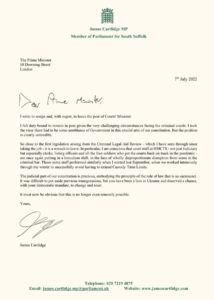
    James Cartlidge – 2022 Letter of Resignation as Courts Minister

    The letter of resignation sent by James Cartlidge, the Courts Minister, on 7 July 2022.

  • James Cartlidge – 2022 Statement on Criminal Legal Aid

    James Cartlidge – 2022 Statement on Criminal Legal Aid

    The statement made by James Cartlidge, the Parliamentary Under-Secretary of State for Justice, in the House of Commons on 30 June 2022.

    In December the Independent Review of Criminal Legal Aid made clear the need for fee reform. Among a number of recommendations, the review called for an immediate pay increase of £135 million across the various criminal legal aid fee schemes. In response to these recommendations, in March, we consulted on proposals that would mark the most significant reform to criminal legal aid in more than a decade—and would include an additional investment of £135 million.

    Our reforms are twofold. First, addressing the immediate fee increase as called for by the representative bodies, and second, focusing on longer term systemic change. We took this approach precisely because we recognise the urgent need for fee reform, and so we can act swiftly and decisively in the interests of our criminal legal profession. We have been working hard to analyse the responses of all stakeholders, so all our decisions are rooted in evidence. We will be publishing our formal response in due course, but I can confirm that we will be implementing a fee increase of 15% across the majority of fee schemes.

    As set out in the consultation, there are a small number of schemes we are not uplifting at this stage. This includes the uplift to payment related to pages of prosecution evidence which the review found to encourage “perverse incentives”. We will be looking at how to address this as part of our longer term reforms and have set aside £20 million for those reforms initially. As well as reform to fee schemes we are considering wider issues, such as the potential roll-out of the successful “opt out” pilot for children, currently taking place at Brixton and Wembley police stations.

    We want to make sure practitioners get paid properly for all the work they do. So, in addition to increasing fees, we are extending the scope of payment for pre-charge engagement work to cover work done ahead of an agreement, or where an agreement is not reached, in appropriate cases, in line with the Attorney General’s disclosure guidelines. We also intend to abolish fixed fees where individuals elect to have their case heard at the Crown court, and go on to plead guilty. We will lay a statutory instrument by 21 July, which will bring these changes into effect on 30 September this year. Considering the parliamentary process and operational changes required to do this, this is the quickest we are able to deliver this uplift. Solicitors and barristers will start to receive increased fees this year and our modelling suggests that over two thirds of the additional funding will have entered the system within the first year.

    Our response to the longer term proposals, including details on the longer term funding and structural graduated fees schemes reform, will be published in the autumn, driven by the evidence in our consultation. Of course, we want to continue engaging with key stakeholders, including the Bar Council and Law Society as we develop our final policies. We are also considering the role of an advisory board as recommended by the review and plan to work closely with the Law Society and the Bar Council to design it with the intention of ensuring legal aid keeps pace with a modern justice system. Further details on the board including a terms of reference will be published in the autumn. If implemented, our longer term changes are good news for the criminal legal profession, helping us to build a sustainable sector that is fit for the future. Most importantly, they are good news for victims and everyone relying on the criminal justice system.

  • James Cartlidge – 2022 Comments on Court Decisions Made Available On-line

    James Cartlidge – 2022 Comments on Court Decisions Made Available On-line

    The comments made by James Cartlidge, the Justice Minister, on 19 April 2022.

    As we continue to build a justice system that works for all, the National Archive’s new service is a vital step towards better transparency. It will ensure court judgments are easily accessible to anyone who needs them.

    Our first official Government record of judgments is a modern one-stop-shop that will benefit everyone, from lawyers and judges to academics, journalists and members of the public.

  • James Cartlidge – 2022 Statement on Personal Injury Reforms

    James Cartlidge – 2022 Statement on Personal Injury Reforms

    The statement made by James Cartlidge, the Parliamentary Under-Secretary of State for Justice, in the House of Commons on 22 March 2022.

    My hon. Friend the Parliamentary Under-Secretary of State for Justice (Lord Wolfson of Tredegar) has made the following statement:

    I announce today the publication of Part 2 of the Government’s response to the ‘Reforming the soft tissue injury (‘whiplash’) claims process’ consultation paper on www.gov.uk.

    In November 2016, the Government published a consultation that set out proposed measures to tackle the number and cost of road traffic accident related personal injury claims. This consultation covered both legislative proposals for tackling the number and cost of whiplash claims, and a ‘Call for Evidence’ on several related issues.

    The Government response was split into two parts, with Part 1 covering the primary and secondary legislative measures which made up the Whiplash Reform Programme, and Part 2 covering the ‘Call for Evidence’. Part 1 of the response was published in February 2017, but a decision was taken to defer work on Part 2 to enable focus on developing and implementing the significant whiplash reform measures.

    Now that the whiplash reforms have been successfully implemented, it is appropriate to revisit the issue of publishing the deferred Part 2 Government response. The newly published response includes a summary of stakeholder views and specific analysis of the responses received on issues relating to credit hire, rehabilitation, early notification of claims, recovery of disbursements, Insurance Fraud Taskforce actions, and consideration of a Barème scheme. It also details the next steps to be taken in relation to these topics.

    In considering the responses received, we have acknowledged that these were views provided in 2016, and that in some areas, developments in the sector have altered the position considered in the ‘Call for Evidence’. We will continue to monitor several of the areas identified and remain open to working with specific stakeholder groups to develop and implement industry-led solutions to issues in areas such as rehabilitation and credit hire.

    The consultation response paper can be found here:

    https://www.gov.uk/government/consultations/reforming-the-soft-tissue-injury-whiplash-claims-process.

  • James Cartlidge – 2022 Statement on Nightingale Courts

    James Cartlidge – 2022 Statement on Nightingale Courts

    The statement made by James Cartlidge, the Parliamentary Under-Secretary of State for Justice, in the House of Commons on 3 March 2022.

    I am today setting out an update on the use of Nightingale court venues.

    Since the start of the pandemic, the priority of the Government, working closely with the judiciary and others, has been to ensure the justice system continues to perform its vital role while keeping court and tribunal users safe, in line with public health guidelines.

    Hotels, former courts and conference centres were rapidly transformed into courtrooms, known as Nightingale courts, during the pandemic to provide more space when social distancing was in place. These venues have provided our court estate with vital additional capacity as part of our continued efforts to recover from the impact of covid-19.

    Combined with other measures—such as removing the cap on court sitting days, the use of remote hearings, and increasing magistrates’ sentencing powers—we are beginning to see the levels of outstanding cases in our courts falling. The latest figures show that in December 2021 the Crown court backlog was under 59,000. This is a fall of over 2,000 cases since its peak in June 2021. Meanwhile, in the magistrates courts, the outstanding criminal caseload has dropped by almost 70,000 cases since its peak in July 2021.

    The relaxation of covid-19 restrictions means that courtroom capacity has returned to pre-pandemic levels. But continuing to use some of our Nightingale courts will now help drive court recovery further, tackling the backlog and ultimately helping to secure speedier justice for victims.

    So today this Government have confirmed arrangements to extend 13 Nightingale courts from March 2022. This equates to 30 extra courtrooms, mainly dealing with criminal work, but also some civil and family cases.

    The following Nightingale courts have been extended:

    Prospero House, London

    Barbican, London

    Croydon Jurys Inn, London

    Mercure Hotel, Maidstone

    Former court, Chichester

    Former county court, Telford

    Park Hall Hotel, Wolverhampton

    Maple House, Birmingham

    Former Magistrates court, Fleetwood

    Cloth Hall court, Leeds

    Civic Centre, Swansea

    Former Magistrates court, Cirencester.

    The decision to extend these Nightingale courts was based on operational need and venue availability, ensuring that these extra facilities are in the right place to meet demand and make best use of taxpayers’ money.

    Nightingale courts at Middlesbrough, Manchester, Liverpool, Bolton, Chester, Peterborough, Warwick, Winchester, Nottingham and 102 Petty France in London will end as planned at the end of March 2022. Use of the venue at Monument will end in early April, with HM Courts and Tribunals Service seeking a replacement venue.

    The sites which are closing as planned are not needed because HMCTS has reopened existing hearing rooms as social distancing measures have eased. We now have sufficient rooms in these areas for all the available Crown court judges. We are continuing to deliver a high volume of judicial recruitment, with a recruitment programme of a further 1,100 judges in 2022-23 planned in addition to around 1,000 recruited during this financial year.

    The extensions to Nightingale courts are part of our wider approach to increase capacity in line with local demand, building on measures taken over the last two years in response to the challenges of the pandemic, including:

    Legislating to double the sentencing powers available to magistrates from six months to a year to free up an estimated 2,000 extra days of Crown court sitting time each year;

    Investing a quarter of a billion pounds to support recovery in the courts in the last financial year, plus over £50 million for victims and support services;

    Ensuring there is no limit on the number of sitting days in the Crown court this year;

    Opening three rooms at Hendon Magistrates court that are currently being used for Crown court work, with a fourth due to open by the end of March 2022, providing custodial facilities for defendants on remand;

    Opening two “super courtrooms” in Manchester and Loughborough, which can accommodate multi-handed trials, and added portacabins at 14 locations to facilitate jury trials; and

    Arranging a temporary venue to hear a large trial in Walsall over the next 13 months, avoiding major disruption in the nearby Crown court.

    These plans, alongside the decisive action already taken by this Government to date, makes it clear that we remain totally committed to reducing delays in our courts, and pulling every lever available to us to deliver justice for all those who need it.

  • James Cartlidge – 2022 Speech on the European Court of Human Rights

    James Cartlidge – 2022 Speech on the European Court of Human Rights

    The speech made by James Cartlidge, the Parliamentary Under-Secretary of State for Justice, in the House of Commons on 19 January 2022.

    As ever, Madam Deputy Speaker, it is a pleasure to see you in the Chair for the Adjournment debate, especially as you served on the Parliamentary Assembly of the Council of Europe as recently as 2017, as my hon. Friend the Member for Henley (John Howell) observed.

    I congratulate my hon. Friend on securing this important debate and on the quality and detail of his speech. I value his insight into the problems that face the Strasbourg Court given his twin roles as chair of the UK delegation to the Parliamentary Assembly of the Council of Europe and vice-president of the Assembly. I commend his work in both roles: he and the rest of the delegation do a fantastic job representing our Parliament in Strasbourg.

    My hon. Friend is widely recognised at the Assembly as a champion of democracy and transparency, the latter of which is particularly central to the debate. To highlight just one of his achievements in Strasbourg, he co-authored two important reports that pointed out issues affecting the rule of law and democracy in Turkey. The reports led to the Assembly’s adopting two resolutions, the most recent of which was adopted in April last year and called on Turkish authorities to take steps to address the issues that my hon. Friend had raised, including the need to refrain from incriminating, prosecuting and arresting peaceful demonstrators, students and LGBT people.

    I mentioned transparency; in June last year, my hon. Friend supported the motion introduced by one of his co-delegates, my hon. Friend the Member for Bridgwater and West Somerset (Mr Liddell-Grainger), that called on the Assembly to set up a transparency register to address concerns about the influence of some NGOs in the Assembly’s decision-making processes. I heard the similar concerns that my hon. Friend expressed in respect of the Strasbourg Court and will in a moment touch on the issue of the selection and election of judges to the Court, which made up much of the substance of his speech.

    The Council of Europe, and the European Court of Human Rights in particular, has played a leading role in the protection and promotion of human rights across our continent. The Court now has jurisdiction in respect of no fewer than 47 countries and is widely recognised as one of the most successful regional human rights courts in the world.

    The UK, of course, has a long-standing tradition of ensuring that rights and liberties are protected both at home and abroad and, as my hon. Friend knows, was instrumental in the drafting of the European convention on human rights and in the setting up of the Council of Europe, the primary statue of which is still known as the treaty of London.

    As we have previously assured the House, the Government are wholeheartedly committed to remaining party to the ECHR and will ensure that our obligations under it—including those relative to the execution of judgments of the Strasbourg Court against the UK—continue to be met. It has long been a UK objective to strengthen the Strasbourg Court and the convention system, both to improve the efficiency of the European Court of Human Rights in the light of its continued backlog of pending applications and to ensure that it can focus on the most important cases before it, underpinned by the principle of subsidiarity to which my hon. Friend referred in detail.

    It is true that the Court, having become a victim of its own success, continues to face significant challenges, with its case load having grown exponentially in the past 20 years. As a way to address this, in 2010 ECHR state parties adopted the Interlaken declaration, a 10-year programme of work known as the Interlaken process that set out to reduce the Court’s backlog of cases and allow for all cases, especially those that concern serious violations of human rights, to be adjudicated within a reasonable time. That was followed in 2012 by the Brighton declaration, which was adopted under the UK’s chairmanship of the Council of Europe’s Committee of Ministers.

    As my hon. Friend will recognise, the UK has been at the forefront of efforts to reform the Strasbourg Court following the Interlaken declaration, and the Brighton declaration went further than Interlaken in a number of respects. Notably, it called for the stronger application of the principle of subsidiarity and the doctrine of the margin of appreciation. Those calls were, of course, aimed to address the Court’s growing case load, but they also served as a reminder of the paramount role of national courts in the enforcement of human rights.

    One of the major achievements of the Brighton declaration was protocol No. 15 to the convention, which came into force in August 2021. Not only does protocol No. 15 add the principle of subsidiarity and the margin of appreciation to the preamble of the convention, but it will improve the efficiency of the Strasbourg Court by shortening the time limit for applications, ensuring that all applications have been duly considered by domestic courts and ensuring an appropriate upper age limit for judges, so that they can serve for the full term of their tenure and provide continuity to the Court. We also welcomed the adoption in 2018 of the Copenhagen declaration, which carried forward some of the initiatives begun in Brighton.

    Although it can be said that the Interlaken process has been partly successful—the number of applications pending before the court in January 2021 was 62,000, which is down from a record high of just over 150,000 applications in 2011—the Court’s caseload is still stubbornly high and some other issues remain. Although state parties agreed in November 2020 that no comprehensive reform of the convention was needed, there was a recognition that further efforts should be pursued, and I very much agree with that assessment.

    My hon. Friend has already alluded to a specific area that is worth highlighting: the selection and election of judges to the Strasbourg Court. In my view, it is crucial that judges in Strasbourg are of the highest calibre possible and independent from any political influence, as we aim to have in our system in the UK. As my hon. Friend has already mentioned, judges are elected by the Parliamentary Assembly of the Council of Europe, as stipulated by article 22 of the convention. As part of that, the advisory panel set up in 2010 gives a non-binding opinion on whether countries’ candidates for judges, provided as a shortlist, meet the necessary criteria set out in paragraph 1 of article 21 of the convention.

    I am aware that the panel is one way in which the Council of Europe has tried to improve the standard of judges elected to the Strasbourg Court in recent years, with the aim of increasing confidence in its judgments. However, consideration must be given to whether the process undertaken by the advisory panel is sufficiently robust to ensure that all candidates meet the requisite suitability criteria. I particularly note the concern raised by my hon. Friend about the calibre of some candidates put forward and their affiliations, be they political activists or academics who have limited experience in the practical application of the law. I would therefore welcome the Parliamentary Assembly’s exploring ways in which to share best practice with state parties to assist in that regard.

    John Howell

    Is my hon. Friend aware that Russia recently put forward three Russian candidates to be judges? They were considered so inadequate that even the committee responsible for them sent them home without seeing them.

    James Cartlidge

    My hon. Friend makes an excellent point. Russia has already had quite a lot of mentions in the debate. I am sure that will continue on matters affecting the ECHR, but as I said, we need to look at the issue of judges, which was such an important part of his speech.

    I am particularly pleased that, at our Government’s request, state parties have agreed to ask the Steering Committee for Human Rights to take a further look at the effectiveness of the system for the selection and election of judges at the Strasbourg Court. The report will also look into the need for additional safeguards to preserve their independence and impartiality, and it may well explore some of the areas of concern raised by my hon. Friend. I know the committee will undertake other important work concerning reforms of the Strasbourg Court, including a review of the first effects for protocol No. 15 to the ECHR.

    Although the focus of the debate has quite rightly been on reform at Strasbourg level, it is worth noting that our proposed reforms of the Human Rights Act 1998 should help to address the systematic reliance on Strasbourg jurisprudence by our domestic courts. Among other measures, we are consulting on options for reform of section 2 of the Human Rights Act that will emphasise the primacy of domestic precedent. These options will set out a broad range of case law, including, but not limited to, Strasbourg jurisprudence that UK courts may consider.

    As the title of the debate is “European Court of Human Rights: Reform”, let me sum up by reiterating the UK’s commitment to its obligations under the European convention on human rights and that we will continue to abide by the Court’s judgments. We will continue to work with our Council of Europe partners to pursue ongoing reform of the Court, both to improve the Court’s efficiency in the light of its large backlog of pending applications and to ensure that it can focus on the most important cases before it, underpinned by the principle of subsidiarity.

    I thank my hon. Friend for securing this important debate. He put his case eloquently and in great detail, and I pay tribute to him again for his work. Thank you, Madam Deputy Speaker, for allowing me to respond for the Government.

  • James Cartlidge – 2021 Speech on Digital Image Abuse

    James Cartlidge – 2021 Speech on Digital Image Abuse

    The speech made by James Cartlidge, the Parliamentary Under-Secretary of State for Justice, in the House of Commons on 2 December 2021.

    I congratulate my right hon. Friend the Member for Basingstoke (Mrs Miller) on bringing forward this incredibly important subject for debate. I know that she has long championed the victims of online abuse, and I would like to thank her for her efforts, which have contributed greatly to the Government’s thinking in this sensitive area and indeed to the reform of the criminal law itself. I shall try to summarise how I feel on hearing her speech and the contribution she has made by saying that she has an enduring passion for protecting society, especially women and girls, from the dark side of digital. I think that is the best way to describe what is so powerful about the way she speaks on this subject.

    Turning to the specifics, deepfake is a term used broadly to describe software or processes used to splice or superimpose existing images on to source photographs or videos. My right hon. Friend has explained that this technology is now being used to create fake pornography, often without the agreement or knowledge of the victim. The images, though in themselves fake, can appear realistic, and their sharing can understandably cause deep distress. She rightly used the word “grotesque” to describe this practice, and she spoke movingly about the real-world impact that it has. She referred to the cases of constituents, and let me express my sympathy for every one of them. This must be harrowing and distressing for them, and we need to tackle it and stamp it out.

    I should like to begin by assuring the House that the existing criminal law is fully equipped to deal with instances where the manipulated images depict children, who of course are the most vulnerable. These pseudo-images can cause real-life harm, as I said. They can be created from real images where a child was abused, and viewing the images creates a demand for those pictures, which leads to further abuse. I realise that my right hon. Friend did not primarily talk about children, but because of the issue of vulnerability, I think I should put this on record.

    The Protection of Children Act 1978 criminalises the making, taking, sharing and distribution of indecent photographs and indecent pseudo-photographs of children. A pseudo-photograph is an image, whether made by computer graphics or otherwise, that appears to be a photograph. This offence carries a robust maximum 10-year prison sentence. Similarly, section 160 of the Criminal Justice Act 1988 captures the mere possession of such images, and that offence is subject to a five-year prison sentence. Section 62 of the Coroners and Justice Act 2009 created a new offence of possession of a prohibited image of a child, punishable by up to three years’ imprisonment. In addition, it created a new criminal offence to make illegal the possession of non-photographic visual depictions of child sexual abuse, including cartoons and computer-generated images of child abuse, with a three-year maximum prison sentence.

    Although it is right that there are specific and robust provisions in relation to faked indecent images of children, I share my right hon. Friend’s concern at the distress that the non-consensual creation and sharing of deepfake images can cause to adult victims. I assure the House that a person who shares such images of adults may—I stress may—in some circumstances be committing an existing offence. A person who shares deepfake images of adults may in some circumstances be committing an existing offence. For example, against a background of domestic abuse, the posting or sharing of faked images could be captured under section 76 of the Serious Crime Act 2015. That offence was created specifically to target controlling or coercive behaviour in an intimate or family relationship, including when the victim is an ex-partner. We are aware that deepfake images are being used for such disturbing and cruel purposes.

    In addition, section 1 of the Malicious Communications Act 1988 prohibits the sending of an electronic communication that is indecent, grossly offensive or false, or that the sender believes to be false, if the purpose, or one of the purposes, of the sender is to cause distress or anxiety to the recipient. Furthermore, section 127 of the Communications Act 2003 makes it an offence to send or cause to be sent through a

    “a public electronic communications network a message or other matter that is grossly offensive or of an indecent, obscene or menacing character”.

    The same section also provides that it is an offence to send or cause to be sent a false message

    “for the purpose of causing annoyance, inconvenience or needless anxiety to another”.

    Such behaviour may also amount to harassment, which is also already an offence.

    There has been a successful conviction in which a person was found guilty of harassment after uploading images of a colleague, fully clothed, alongside images on a porn site of women of a similar shape and build as the colleague. Additionally, those who encourage others to commit an existing communications offence may be charged with encouraging an offence under the Serious Crime Act 2007.

    I stress, though, that the Government recognise the concerns, set out so eloquently and clearly by my right hon. Friend, about the existing communications offences. The Law Commission considered the specific offences I have set out as part of its “Modernising the Communications Offences” review, to understand whether they needed to be reformed to better tackle abusive and harmful behaviours online. The Commission has now published its final report and recommendations for reform, and my right hon. Friend the Secretary of State for Digital, Culture, Media and Sport has indicated that she is minded to adopt the harm-based offence, the false-communications offence and the threatening-communications offence.

    Alongside the use of existing and established criminal sanctions, there is a major role for the websites that host the images. It is encouraging that sites such as Pornhub, Twitter, Reddit and several others have all announced bans on deepfake images. Such images already violate community standards on major social media platforms such as Facebook. Some sites are already beginning to turn to artificial intelligence to police the images, rather than rely on users reporting them—an example of the determination to find effective and new ways to restrict the practice. For example, Facebook uses machine learning and AI to detect near-nude images or videos shared without permission on its platforms. Bumble, a dating app, has its own “Private Detector” safety feature, which automatically blurs a nude image shared in a chat. These are important steps to protect user safety and ensure that the images are tackled head on.

    I hope that my right hon. Friend is satisfied that the law can, in most scenarios, deal with this behaviour, and that non-criminal interventions are developing all the time, but it is of course crucial that the criminal law keeps pace with new technologies as they emerge. We continue to keep these issues under review and when we see a problem with the criminal law, we act.

    This Government have a strong record when it comes to protecting the public from the abuse of private, intimate imagery. For example, much as a result of my right hon. Friend’s assiduous campaigning, as she said earlier, in 2015 we created the so-called revenge porn offence at section 33 of the Criminal Justice and Courts Act 2015, and only recently, during the passage of the Domestic Abuse Act 2021, we listened to the voices of victims of image abuse and supported provisions to extend that offence to capture those who threaten to disclose private sexual images with an intent to cause distress. That change has now been implemented and I am sure that my right hon. Friend, having fought so hard for the creation of the original offence, welcomes that significant extension of the protection of victims from image-based abuse. In addition, after listening to the victims of upskirting and the excellent campaign for change headed by Ms Gina Martin, we created new criminal offences in the Voyeurism (Offences) Act 2019 specifically to address that intrusive and distressing behaviour. Offenders now face up to two years behind bars, and the most serious among them will be subject to sex offender notification requirements. We do listen and we do respond.

    Mrs Miller

    My hon. Friend has clearly gone through the shopping list of laws that can be used to try to guard against the misuse of intimate images, but in having a shopping list we have created a lot of gaps, too. For instance, upskirting may be unlawful but down-blousing is not. It is very difficult when we have law that is so prescriptive. Does he have sympathy with the need to have something more encompassing so that we can capture all forms of intimate image abuse and not have to play whack-a-mole by outlawing the latest devious way in which people try to abuse women and girls online?

    James Cartlidge

    My right hon. Friend makes an excellent point, and once again she highlights her incredible expertise on these matters. She will be aware that the way Parliament often works is that individual campaigns generate momentum and become specific offences—I would not use the phrase “ad hoc,” which is almost demeaning to those campaigns, which are incredibly important and powerful. That is the reality of how this place makes law at times, but she is right that we need to consider the broader picture. I know where her focus is, and I will be coming to the Law Commission, which will feed into that point.

    My colleagues in the Department for Digital, Culture, Media and Sport are busy preparing the online safety Bill, which will include provisions to tackle illegal and legal-but-harmful content, including criminal deepfake pornography, sexual harassment and abuse that does not cross a legal threshold. Under the Bill all companies will need to take action against illegal content and ensure that children are protected from inappropriate material. Major platforms will also need to address legal-but-harmful content for adults, which will likely include online abuse. Ofcom will have a suite of enforcement powers to deal with non-compliance, including fines of up to £18 million or 10% of qualifying annual turnover.

    The Joint Committee that is scrutinising the Bill is due to report before recess—by 10 December. We will table the Bill as soon as possible, subject to the parliamentary timetable, but we must not rest. I assure the House that we do not take concerns in this sensitive area lightly.

    It was with those concerns in mind that the Government asked the Law Commission to review the law on the taking, making and sharing of intimate images without consent, to identify whether there are any gaps in the scope of protection already offered to victims. Importantly, the review has considered the law on manipulated images such as those created by deepfake technology and the protection that the existing law affords.

    On 27 February 2021 the Law Commission published the consultation paper on its review, and the consultation ended on 27 May and put forward a number of proposals for public discussion. I understand the Law Commission is due to publish its final recommendations by spring 2022.

    Although I welcome this opportunity to discuss the nature of developing technology and the production and sharing of explicit manipulated images and other offences, this is a complex area and it is right and proper that we should take time to consider the law carefully before deciding whether to add further to the raft of existing legislation that already addresses these issues. It is important, therefore, to allow the Law Commission to finish its work and to consider in detail and with care any recommendations it produces. The Government await the Law Commission’s findings with interest and will consider them carefully.

    I believe my right hon. Friend has previously met the Law Commission but, if it would be of interest, I would be more than happy to arrange for her to do so again, based on its latest position.

    Mrs Miller

    I am slightly taking advantage of the fact that we have a little more time this evening. The Minister will know that the Law Commission has made its recommendations, which have gone out for consultation. That consultation finished a month or two ago, so it is not that the Law Commission will finish its deliberations in the spring; it has already finished its deliberations. Those recommendations, subject to any input from the consultation, should be available shortly. I still do not understand why he is not able to bring these recommendations forward at the same time as the online safety Bill.

    James Cartlidge

    My right hon. Friend makes a good point. I wish to clarify this, as a lot of Law Commission reviews are taking place over time. There are two in this regard. The one I believe she is referring to is the one I mentioned earlier, which is the Department for Digital, Culture, Media and Sport one. I believe that has reported and that the Department is now considering it, and it concerns malicious communications and other offences to which I referred earlier. The review on taking, making and sharing is ongoing and will report in spring next year. The point I was making to her was that if she wanted to contribute to that and meet the Law Commission—

    Mrs Miller indicated assent.

    James Cartlidge

    My officials have noted her positive nodding of the head, and so I would be more than happy to set that meeting up, because she has great expertise. I can assure her that her concerns, and the views and issues raised by this House, will be taken fully into account when the Government consider those findings and the issue of whether reform to the criminal law is necessary.

  • James Cartlidge – 2021 Speech on Employment Rights

    James Cartlidge – 2021 Speech on Employment Rights

    The speech made by James Cartlidge, the Conservative MP for South Suffolk, in the House of Commons on 25 January 2021.

    May I begin by associating myself with the remarks of the Opposition spokesman, the hon. Member for Middlesbrough (Andy McDonald), about those workers who continue to go to their physical workplace during the pandemic? We should all pay tribute to them and share that noble sentiment. I also congratulate my right hon. Friend the Secretary of State on his promotion to the Cabinet—it is well deserved. I know he will champion business in these challenging times and, in particular, the principles and practice of free enterprise.

    We may not be moving the amendment, but I am particularly proud that it contains two words that we did not hear at all from the Opposition: job creation. Let us be clear: no matter what anyone says, there is broad consensus now across the House and the country about keeping the fundamental employment rights we have. Employers are familiar with them, employees understand them and the country generally supports them. However, it would be quite extraordinary, facing the economic pressures that we do, if a Conservative Government did not look at what supply-side reform, including deregulation and cutting red tape, could be brought forward so that we can strengthen our recovery as we eventually come out of lockdown, and there are two key reasons why they should do that.

    The first is obviously the strength of the challenge. I am very proud that, as the Secretary of State said, we had the lowest unemployment since I was born in 1974 before we went into the pandemic. However, covid and the action that we have had to take have created inevitable economic pressure, and the impact on jobs will be seismic. In that context, the Government should use every lever at their disposal to strengthen the recovery as we move out of lockdown. That must include looking at what areas can be deregulated, while keeping fundamental employment rights in place.

    The second reason is that we have to understand one of the most important assets of our economy. One of the key strengths of UK plc is that we have a flexible labour market. The World Economic Forum and others have recognised that. It is a key factor in why huge multinationals like to invest in the UK, and inward investment will be a crucial part of our recovery. It would therefore be deeply unwise if we were now to send a message to the rest of the world that we were going to unwind our flexible labour market.

    This is about the message we send. If we had a four-day week—it seems that the Labour party is still considering that—there are many who would support it, but the message that that would send is that we were not going to be pro-business or to drive a strong recovery. Instead, the message we should send is that we will look at every single action we can take across Government, in every Department, to prioritise jobs, jobs, jobs and to achieve the two outcomes we must achieve above all else: reducing the risk of long-term scarring from covid to the economy and, most important of all, maximising those two great words—job creation.