Professor Susan Hopkins, Chief Medical Adviser at the UK Health Security Agency (UKHSA), said:
It’s important to minimise the spread of infection in schools and other education and childcare settings as much as possible. If your child is unwell and has a fever, they should stay home from school or nursery until they feel better and the fever has resolved.
Helping children to learn about the importance of good hand hygiene is also key, so practice regular handwashing at home with soap and warm water. Catching coughs and sneezes in tissues then binning them is another simple way to help stop illness from spreading.
Adults should also try to stay home when unwell and if you do have to go out, wear a face covering. When unwell don’t visit healthcare settings or visit vulnerable people unless urgent.
Remember that flu vaccination is still available for all eligible groups and is the best protection against the virus. We have seen good uptake in older age groups but vaccination among young children remains low. Flu can be very unpleasant and in some cases can lead to more serious illness. Getting your child vaccinated protects them and others they come into contact with, and it’s still not too late.
The press release issued by the Department for Transport on 2 January 2023.
millions are being encouraged to walk and cycle more this year to get fit and save money, with an additional £32.9 million of government funding to accelerate walking and cycling schemes across the country
with many people looking to improve their health or reduce their carbon footprint this month, the government is helping councils improve how they design and create active travel schemes by training staff
innovations could see better designed school safety zones to encourage active travel, improved walking and cycling infrastructure on local high streets as well as new cycle and wheelchair paths
Millions of families, commuters and school children are being encouraged to take up healthy habits this year. Local councils will benefit from skills training and a boost to green jobs thanks to a £32.9 million scheme launched today (2 January 2023) which will enable them to develop thousands of well thought-through local walking and cycling schemes, co-created by the communities that will use them.
As people across the country are looking to kickstart the year with healthy resolutions, the government expects to see millions shake up the way they travel.
The investment will help local councils in England design, develop and consult on high-quality active travel schemes that work for residents and consider the local road network. These could include new school safety zones to encourage active travel, improved walking and cycling infrastructure on local high streets as well as new cycle and wheelchair paths.
The measures aim to get more people of all groups walking and cycling and help to address the barriers that exist. Surveys show the number one issue putting women off cycling is how safe they feel on the roads with 79% of women supporting more protected cycle lanes being built. Safety will therefore be the major focus for the new designs and routes.
This funding will support local authorities to maximise active travel investment by enhancing their technical skills. Local councils will be investing in resources dedicated to co-creating schemes communities want. Activities being funded include network planning, public engagement exercises and bespoke training for councillors and staff. The fund could see hundreds of new green jobs created across England.
Making active travel part of everyday journeys can improve health, cut costs and protect the environment. Cycling UK has estimated that if people cycled short journeys, they would save an average of £126 per year in fuel costs alone and would burn hundreds of extra calories each week.
Active Travel Minister Jesse Norman said:
Leaving the car and walking and cycling instead is an easy way to get fit, save money and reduce your carbon footprint.
Better designed schemes, which take into account the views of local people will help deliver improvements that have widespread local support.
Skills training and local community engagement will help local authorities to make active travel an attractive choice for getting around.
Developing teams that lead active travel programmes will create more cost-effective and well-targeted projects. Local authorities will learn how to enhance their engagement with residents, businesses and other road users to ensure schemes are delivered with local support.
National Active Travel Commissioner, Chris Boardman, said:
If we want to enable hundreds of thousands more people to walk, wheel and cycle for everyday trips then we need to deliver high-quality schemes that make it feel easy, fun and safe.
Of course, ensuring the right technical skills are in place at a local level is vital but so is engagement. Survey after survey has shown strong community support for making space for active travel but it’s vital that people get strong input into helping to decide what is the right solution for their area.
The funding will also be used to engage under-represented groups and enable more children to walk, wheel and cycle to school. Community engagement programmes will give individuals the confidence to walk and cycle safely through cycle training, school walking groups and bike rental schemes.
Xavier Brice, Chief Executive Officer of Sustrans, the charity that makes it easier for people to walk, wheel and cycle, said:
Sustrans is pleased to see this investment in training and community engagement which will ultimately lead to high-quality infrastructure developments across England that help people choose to use their cars less.
This funding is crucial in ensuring that travelling actively is a safe and accessible option for all, particularly as we work towards the government’s goal of 50% of all journeys in towns and cities being walked or cycled by 2030.
We’re looking forward to seeing ambitious plans being brought to life and continuing our work to support our local authorities in doing so.
People will benefit from better access to jobs and education through initiatives such as outreach to schools and employment centres.
The ‘capability fund’ will support local councils across the country to train and retain local engineers and planners, creating a skilled active travel workforce able to collaborate effectively with local communities and conduct high-quality engagement and consultation sessions.
As well as enabling local councils to hire and retain skilled professionals, this multi-million-pound investment will deliver specialised training, driving up skills and ensuring consistent, high-quality schemes are set up across England to give people truly attractive active travel choices.
The press release issued by the Department for Business, Energy and Industrial Strategy on 2 January 2023.
UK government moves to fulfil G7 commitment to diversify uranium and nuclear fuel production capacity away from Russia
Energy Minister announces £75 million Nuclear Fuel Fund to provide greater options for UK nuclear operators to use UK-produced fuel
investment to support development and commercialisation of home-grown nuclear fuel production and advanced fuel technologies
Nuclear fuel production in the UK is set to be bolstered by up to £75 million in UK government funding in a bid to support development of alternatives to Russian fuel supply and strengthen UK energy security, the Energy and Climate Minister Graham Stuart has announced today (2 January).
This will encourage investment in new and robust fuel production capabilities in the UK, backing the government’s ambition to secure up to 24GW of nuclear power by 2050.
G7 leaders agreed in June to begin concerted action to reduce reliance on civil nuclear and related goods from Russia, including working to diversify their supplies of uranium and nuclear fuel production capability. Russia currently owns around 20% of global uranium conversion capacity and 40% of enrichment capacity.
The UK’s £75 million Nuclear Fuel Fund will strengthen energy security by encouraging investment into the development and commercialisation of domestic nuclear fuel production including advanced fuel technologies.
This includes the development of new conversion capacity in the UK for both freshly mined and reprocessed uranium. These will help power existing as well as future advanced nuclear reactors – and support international diversification from Russian fuel supply.
Minister of State for Energy and Climate Graham Stuart, said:
Record high global gas prices, caused by Putin’s illegal invasion of Ukraine, have highlighted the need for more home-grown renewable energy, but also UK generated nuclear power – building more plants, and developing domestic fuel capability.
This investment package will strengthen the UK’s energy security, by ensuring access to a safe and secure supply of UK produced fuel to power the UK nuclear fleet of today and tomorrow – squeezing out Russian influence, while creating more UK jobs and export opportunities.
Up to £13 million of the fund has already been awarded in Preston, which has strategic importance to fabricating fuel for the current UK advanced gas cooled reactor fleet. The funding will help the company develop primary conversion capability for both reprocessed uranium and freshly mined uranium.
The support will provide for significant investment at the Springfields site in Lancashire, safeguarding hundreds of highly skilled jobs in the North West.
Uranium conversion is an important stage in the nuclear fuel cycle. The funding will create expert nuclear fuel capability to convert recycled uranium in the UK that is not currently available outside Russia. As well as bolstering UK energy security, ministers hope it will also deliver export opportunities for the sector and position the UK as a key international supplier of nuclear fuel and fuel cycle services.
The government aims for the remaining £50 million fund, which opens for bids today, to stimulate a diverse and resilient nuclear fuel market, supporting specialist skills, levelling up opportunities through new job creation across the country and opening up new export opportunities.
It will support projects establishing new domestic fuel capabilities, which could include fuel supply options for Light Water Reactors, including future Small Modular Reactors, that could support much of our current nuclear energy needs. It will also look to support projects producing new fuel types which will be needed to supply Advanced Modular Reactors, likely to be in operation from the 2030s, such as High Assay Low Enriched Uranium.
Chief Executive of the Nuclear Industry Association Tom Greatrex, said:
Having the sovereign capability to manufacture next generation nuclear fuels for advanced reactors of the future is vital for energy security and net zero.
It will also open up export opportunities for the UK, helping us reclaim our place as world leaders in the fuels sector.
The news comes just over a month after ministers announced the further revitalisation of the UK nuclear industry, by confirming the first state backing of a nuclear project in over 30 years, with an historic £700 million stake in Sizewell C in Suffolk. The power station will produce enough electricity to power the equivalent of 6 million homes for over 50 years. The nuclear acceleration requires pushing ahead to deliver new reactors, including advanced modular reactors, which will need new fuel streams.
The press release issued by the Department of Health and Social Care on 2 January 2023.
People encouraged to make the new year a healthy one by downloading the app and enjoying the health benefits of running
Free app downloaded 6.5million times since it launched in 2016 and is an alternative for people unable to afford gym or sports membership
More than six million runs were completed using the Couch to 5k app across the UK in 2022, helping people to get fit for free.
The app – a free running plan for beginners provided by the Office for Health Improvement and Disparities (OHID) in partnership with the BBC – helped people to complete 6.46 million runs between 1 January and 29 December 2022.
More people were active over Christmas in 2022 than in 2021 with 8,600 people using the app to run on Christmas Day and Boxing Day in 2022, up from 8,000 (7.5%) in 2021.
As we move into the new year, people are being encouraged to download the app and join the hundreds of thousands of people who got last year off to a healthy start. 937,724 runs were completed in January 2022, with 12,500 people using the app to run on New Year’s Day itself.
Regular running has been shown to reduce the risk of long-term illnesses, such as heart disease, type 2 diabetes and stroke, as well as helping to maintain a healthier weight and improve your mood.
A recent YouGov poll found that 10 per cent of adults in Great Britain have either cancelled or are considering cancelling a gym or other sports or exercise membership due to the rising cost of living, with the Couch to 5k app a great alternative for people struggling to pay for gym or sports memberships.
Public Health Minister Neil O’Brien said:
“The start of a new year is a great time to make healthy lifestyle changes and the free NHS Couch to 5K app is a brilliant way to get fit and healthy for free, as people look to exercise for less due to the rising cost of living.
“Keeping fit can have a positive impact on our health, preventing risks of developing serious illness such as heart disease and diabetes – helping to reduce pressure on the NHS.
“I hope people will be inspired by the progress of hundreds of thousands of others and will give the app a try – it costs nothing and could be the best resolution you make this year.”
860,000 people used the app to do at least one run between 1 January and 29 December 2022. Designed for people who have done little or no running, the app provides guided commentary from a celebrity coach of their choosing and helps users to easily track their progress by doing three runs per week.
Runners are spurred on by one of many celebrity coaches including Reece Parkinson, Yasmin Evans, Jo Whiley, Denise Lewis, Sanjeev Kohli and Sarah Millican, as well as Mum Laura – the original programme trainer – who returned to the app by popular demand.
As each running challenge is completed, users receive celebration videos and summaries of their progress. ‘Discover’ and ‘Support’ sections help people to overcome setbacks with helpful articles and videos. Buddy Runs are also available where users can invite others on the app to run together – either in person or virtually.
Deputy Chief Medical Officer and joint lead for OHID Dr Jeanelle de Gruchy said:
“It’s brilliant to see so many people have kept active through using the NHS Couch to 5K app in 2022 and I hope the trend continues into 2023.
“With over 6 million runs completed this year, every run represents someone taking a small step towards improving their health, getting a bit of me-time and progressing to that 5-kilometre goal. If you do one thing this New Year, get moving and download the Couch to 5K app.
OHID (formerly Public Health England) teamed up with BBC to create the Couch to 5K mobile app in 2016, and since then they have been working together to help more people access the app.
Director of Sport at the BBC Barbara Slater said:
“Since our partnership began, the Couch to 5k app has helped millions of people across the UK to get fitter and more active. We’re proud it’s helping people to take positive steps to improve their health.”
The app has been downloaded 6.5 million times since it launched in May 2016, with 2.36 million downloads during the height of the pandemic (March 2020 to July 2021) by people seeking to get more active during lockdown.
The press release issued by Extinction Rebellion on 1 January 2023.
When XR burst onto the scene four years ago, few could have imagined the seismic shift it would bring about in the climate movement, the climate conversation, and the world at large.
But despite the blaring alarm on the climate and ecological emergency ringing loud and clear, very little has changed. Emissions continue to rise and our planet is dying at an accelerated rate.
The root causes? A financial system prioritising profits over life, a media failing to inform the public and hold power to account, and a reckless government entrenched in corruption and suppressing the right to protest injustice.
As we ring in the new year, we make a controversial resolution to temporarily shift away from public disruption as a primary tactic. We recognise and celebrate the power of disruption to raise the alarm and believe that constantly evolving tactics is a necessary approach. What’s needed now most is to disrupt the abuse of power and imbalance, to bring about a transition to a fair society that works together to end the fossil fuel era. Our politicians, addicted to greed and bloated on profits won’t do it without pressure.
We must be radical in our response to this crisis and determined in our efforts to address the climate and ecological emergency, even if it means taking a different approach than before. In a time when speaking out and taking action are criminalised, building collective power, strengthening in number and thriving through bridge-building is a radical act.
XR is committed to including everyone in this work and leaving no one behind, because everyone has a role to play. This year, we prioritise attendance over arrest and relationships over roadblocks, as we stand together and become impossible to ignore.
The conditions for change in the UK have never been more favourable – it’s time to seize the moment. The confluence of multiple crises presents us with a unique opportunity to mobilise and move beyond traditional divides. No one can do this alone, and it’s the responsibility of all of us, not just one group. It may be uncomfortable or difficult, but the strength of all social, environmental, and justice movements lies in working together. As our rights are stripped away and those speaking out and most at risk are silenced, we must find common ground and unite to survive.
It’s no secret that those in power are hoarding wealth and power at the expense of ordinary people, while ignoring the consequences of their greed. Emissions continue to rise, but they couldn’t care less. But people do care, and changes to democracy that free and empower the voices of the people through Citizens Assemblies could balance the tables and bring about the positive societal tipping point we all need.
Choose Your Future – 21st April and beyond – The Big One – Houses of Parliament – 100,000 people.
The press release issued by 10 Downing Street on 1 January 2023.
The King has been pleased to approve the following appointments:
Viscount Younger of Leckie as a Parliamentary under Secretary of State at the Department for Work and Pensions (previously a Lord in Waiting (Lords Whip));
Lord Evans of Rainow as a Lord in Waiting (Lords Whip).
This follows the departure from government of Baroness Stedman–Scott OBE DL.
The press release issued by the Foreign Office on 1 January 2023.
The Foreign, Commonwealth & Development Office has issued a statement after North Korea launched a ballistic missile. A spokesperson said:
“North Korea has once again violated UN Security Council Resolutions by launching a short-range ballistic missile on 1 January.
The UK, alongside our international partners, continues to call on North Korea to return to dialogue and prioritise the well-being of its people instead of the unlawful pursuit of nuclear and ballistic missile programmes.”
The interview with Emma Corlett, the Deputy Leader of the Labour Group on Norfolk County Council, on 1 January 2023.
(i) Are the Labour group on Norfolk County Council opposing the project primarily on the cost or environmental grounds?
Our initial opposition and manifesto position was on environmental grounds and in favour of investing in public transport infrastructure. Over the past eighteen months concerns about the rocketing cost have given an additional dimension to our steadfast opposition to the proposed road.
(ii) Is the suggested need for the road simply a legacy of an inadequate public transport system in the county?
In part, but also a failure of a vision by the council as strategic transport authority that genuinely addresses the climate crisis, tackles social inequality (see car ownership stats below for 2011 census – 2021 not yet available but we anticipate being worse due to austerity of past twelve years). It is also ideologically driven in that the ruling Tory administration have a very outdated view of “growth” and are not focussed on sustainable and inclusive growth. They love leaving a “legacy” and like 1970s style legacy infrastructure projects such as this road.
Households with no car (2011 census)
Norwich 33%
Great Yarmouth 28%
King’s Lynn & West Norfolk 17%
North Norfolk 17%
Broadland 12%
South Norfolk 12%
(iii) Do you agree with the council’s suggestion that the road is essential for economic growth or do you feel that there are alternatives?
No, we do not agree the road is essential for economic growth. There are greater priorities in the County that would bring sustainable growth such as in integrated and affordable public transport system to get people around the county not just for work and education but for leisure and social life. People will spend money in the local economy if they can access it easily and cheaply. It would also boost sustainable tourism. Our vision for ‘growth’ is based on the principles of the Green New Deal (eg, Pettifor’s Case for A Green New Deal – the Ecologist – Ann Pettifor) rather than the outdated vision of growth that we are being presented with. Norfolk is well placed to develop the renewable energy sector. We face a social care crisis and investment in the social care skills and workforce would pay dividends with the challenge of a rapidly aging population.
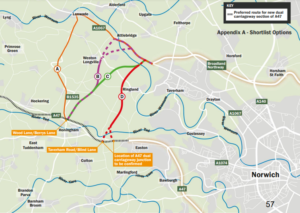
The planned road from Broadland Northway roundabout (Norfolk County Council)
This is the first in our ‘issue of the week’ series which are designed to collect information and resources together about specific matters of political debate. Although we are publishing a number of documents every week for each new issue, we will also continually add new resources to these pages to make them as comprehensive as possible. We also hope that students will find the topics useful as a starting point for research on matters of political interest.
For this week’s ‘issue’, we’re looking at how politicians can balance economic growth whilst also protecting the environment, especially on matters of infrastructure projects. One of these current debates is in Norfolk, East Anglia, with the planned Norwich Western Link. We have interviews with Martin Wilby, a Conservative councillor and the Cabinet Member for Highways, Infrastructure and Transport at Norfolk County Council, and also the campaign group established to oppose the road, Stop the Wensum Link. Listed below, we also have additional interviews we have conducted, as well as collecting together past statement and policy positions from charities, pressure groups and individuals.
The council are supporting the road (the route of which is visible in the council’s own video above) as they argue that it completes the ring of roads (the Southern Bypass which opened in 1992 and the Norwich Northern Distributor Route – which is formally known as the Broadland Northway – which opened in April 2018) around Norwich and will improve transport links in the county. Although Norfolk County Council are the main movers of the project, it is also supported by the majority of other councils in Norfolk, although Norwich City Council oppose the road as it promoted car dependency in the area. The road construction is supported by numerous organisations including Norfolk Fire Service and also the Norfolk and Norwich University Hospital who believe on balance that it would be beneficial because of reduced ambulance conveyancing times, as well as Norfolk Chambers of Commerce who say it will meet “our growth ambitions”. Norfolk Constabulary stated that they supported the road as “it would be useful to have the Western Link Road completed which would save officers time when they are on an emergency call rather than go partially around the route and then have to traverse through the city roads”.
However, the reason this section of road was not constructed along with the Broadland Northway was explained by the council stating in their executive summary in 2008:
“[The public consultation led to] strong environmental concerns being expressed about the impact of a new road across the River Wensum Special Area of Conservation (SAC) to which the County Council responded by carrying out further assessment beyond a Stage 2 level to ascertain whether the impact on the SAC could be mitigated. The conclusion was that it could not be demonstrated that the new road would not affect the integrity of the SAC. Alongside this, traffic modelling indicated that a road starting at the A1067 in the west rather than the A47 gave significant benefits and delivered most of the objectives of the NDR scheme and these were key factors in the decision to choose the preferred route as now proposed.”
These environmental concerns are based around the land which would need to be crossed which is the rare chalk stream habitat of the Wensum Valley. The council’s proposals include a bridge across the River Wensum itself, but opponents question whether this would significantly damage not just the natural environment, but also be damaging visually and cause noise issues during both the construction of the road and then from traffic using it. Stop the Wensum Link point to the environmental mitigation measures on the Norwich Broadland Northway and say that these “had failed” with the council’s own inspection report showing issues.
The council are arguing that after reviewing transport usage that this section should now be built. After some initial research and site investigations, there were four suggested routes for the new road which went to a wider consultation and review, with the council preferring route C. Although this consultation is now closed, details of all of the routes are still visible at https://nwloptions.commonplace.is/. The council have organised a number of events explaining the need for the road and they also published the results of the 2018 public consultation exercise.
The council argue that there are economic benefits to the road, stating that the environmental issues can be mitigated. Others argue that the environmental impact is too damaging and the CPRE produced a report with evidence that road projects simply generate more traffic. The Government believe that new infrastructure is necessary for the economy, with the Western Link road being listed in the Government’s September 2022 Growth Plan. Other pressure groups, such as the Campaign for Better Transport, have argued that sustainable transport can reduce the need for new roads and have published a research paper entitled Roads and the Environment. The new road is opposed by environmental groups including Norfolk Wildlife Trust, Friends of the Earth, the Woodland Trust, Norfolk Rivers Trust and the Norfolk & Norwich Naturalists’ Society.
Opponents of the scheme also argue that roads are only necessary because there are a lack of alternative public transport options, with some suggesting that despite environmental concerns the Government is too ready to provide financing for new road projects. The council have also had to amend their preferred route slightly due to the presence of bats in the area, which are a protected species. There is also the challenge of providing access to the road for pedestrians and cyclists, with Norwich Cycling Campaign stating their opposition to the current proposals as they don’t include cycle lanes which the group says is necessary to keep cyclists safe. Other public transport organisations such as First Eastern Counties Buses said that they supported the road because they believed that it would “reduce congestion” in the area. A representative from KonectBus also stated that they supported the Western Link, but wanted the road “to be built as close to the Longwater junction as possible” in their public consultation submission.
Part of the land that would be crossed by the road (copyright UKPOL)
The current cost of the 3.9 mile long road is estimated to be around £251 million, an increase on the previous estimate of £198 million, although opponents of the project have suggested that the final total might be closer to £300 million. The project requires the financial backing of the Department for Transport, who would provide 85% of the total funding. The Government is also committed to continuing a road building programme, but have stated that they are focused on the Strategic Road Network being net zero. However, there is still a significant cost to the council and Stop the Wensum Link note on their web-site:
“Norfolk County Council already have a deficit of £39M, forcing them to hike council tax 3% this year. With construction costs spiralling, high inflation and stagnating wages, throwing more money at building this road makes no sense. Increasing costs and an already debt laden council threatens vital services and risks further tax rises.”
Although the Government’s growth plan of September 2022 mentioned the road, this was under Liz Truss’s brief premiership and no guarantees have been given to the council on whether funding will still be made available. Liz Truss had been in support of the road before becoming Prime Minister and as she was a Norfolk MP, it had seemed very likely that her government would have backed the plans. With Rishi Sunak now Prime Minister, a final decision on the funding is expected to be made in 2023 with the Government needing to balance the economic argument alongside a growing demand for action to be taken to protect the environment and there is also the backdrop of potential national spending cuts being needed to balance the books.
If the funding is made available, the current timetable for the road construction is:
Mid-2022 – Pre-planning application public consultation
Spring 2023 – Submit planning application
Late 2023 – Public inquiry (if required)
Mid-2024 – Full Business Case submitted to the Department for Transport
Late 2024 – Start of construction
Late 2026 – Norwich Western Link open for use
This road is an example of the challenges which local Government have in trying to balance economic growth and the environment. It also shows the cost of embarking on these projects and the substantial amount of work that has to take place to get them to a stage where funding can be secured. For those opposing schemes such as this, there are financial challenges as councils have funding to help them make a business case for a new road, whereas campaigning organisations often have to fund raise to secure their monies. They also often have to be creative in how they can get publicity for their work, with the Stop the Wensum Link group holding numerous events and having a strong social media presence.
Whether or not the road is built, this is likely to be an important case that is watched by other councils and governmental bodies to see how the environmental impact is dealt with. It also shows how much work local councillors have to put in to these projects, often facing opposition to their plans and needing to constantly respond to that. But, on the flip side, it also shows how much work and energy that volunteer campaigners put in towards monitoring projects and putting together arguments to help protect the environment. These are complex arguments and why it is perhaps important for individuals to become engaged in politics to fight for their beliefs to ensure that the best decisions are made.
For readers, we have listed a wide variety of resources below which may help those who are undecided on whether they support this road project and ones like it. We will continue to add to this list and continue to secure more interviews as the project continues.
![PRESS RELEASE : Back to school advice issued amid high levels of flu, COVID-19 and scarlet fever [January 2023]](https://www.ukpol.co.uk/wp-content/uploads/2022/08/ukhealthsecurity-150x125.png)
![PRESS RELEASE : £32.9 million to create a national network of walking and cycling experts [January 2023]](https://www.ukpol.co.uk/wp-content/uploads/2022/08/transport-150x124.png)
![PRESS RELEASE : Ministers bolster UK nuclear fuel capacity to squeeze out Russian influence [January 2023]](https://www.ukpol.co.uk/wp-content/uploads/2022/08/businessenergy-150x150.png)
![PRESS RELEASE : Millions of runs completed using NHS Couch to 5k app [January 2023]](https://www.ukpol.co.uk/wp-content/uploads/2020/01/healthsocialcare-150x140.png)
![PRESS RELEASE : Extinction Rebellion Quit Tactics of Public Disruption [January 2023]](https://www.ukpol.co.uk/wp-content/uploads/2023/01/extinctionrebellion.png)
![PRESS RELEASE : Ministerial Appointments Including Viscount Younger of Leckie [January 2023]](https://www.ukpol.co.uk/wp-content/uploads/2022/08/downingstreet-150x122.png)
![PRESS RELEASE : Foreign Office Statement on North Korea missile launch [January 2023]](https://www.ukpol.co.uk/wp-content/uploads/2020/01/fco-150x150.png)
![PRESS RELEASE : The key benefits of the Norwich Western Link [January 2023]](https://www.ukpol.co.uk/wp-content/uploads/2022/10/norfolkcountycouncil.png)