Tag: 2002

  • Michael Howard – 2002 Speech at British Chambers of Commerce

    michaelhoward2

    Below is the text of the speech made by Michael Howard, the then Shadow Chancellor of the Exchequer, to the British Chambers of Commerce conference on 23rd April 2002.

    Introduction 

    I am very grateful for your invitation to address you today. You timed this Conference well, to come so soon after the Budget – the date of which you obviously knew before everyone else. I am already getting ready to clear my diary for the time of next year’s Conference.

    But this timing has enabled the Conference to concentrate on the main themes of the Budget.

    Today I want to focus on what the Budget showed about this Government’s approach to enterprise, and on the approach the Conservative Party is taking to economic policy.

    Conservative Approach to Economic Policy

    We believe that business should be freed to do what it does best: win orders and create jobs.

    Governments should set in place the conditions which enable it to do so. In part those conditions involve stability. And that means that, in areas of policy where there is room for consensus between the parties, this should be welcomed.

    Sometimes it comes as a surprise to hear a politician say that. It shouldn’t. Politicians should not seek to differ from each other for the sake of difference, criticise for the sake of criticism and adopt different policies in order to be seen to be adopting different policies.

    That is just common sense. Business works in an environment which is uncertain enough as it is. Elected representatives should act as forces for stability, not for further instability. Governments come and go. The last thing you want to see is each new administration arriving with its own ideas and plans, determined to uproot everything that has gone before, and completely oblivious to the lessons learnt by its predecessor.

    So in recent weeks I have pointed to important areas where there is consensus between the parties. One such area is monetary policy – the framework which has been established for setting interest rates and controlling inflation. To the extent that both main parties now recognise the evil of inflation for what it is, and both support the same policy framework for dealing with it, this is a very welcome development.

    Of course the one – rather large – fly in this ointment is the single currency. I do not intend to say any more about this issue today than this: it is perhaps the supreme irony that at the very moment when we reach inter-party consensus on the framework for monetary policy the Conservative Party is the only Party in favour of maintaining that framework. Joining the single currency would mean giving up a successful system in which interest rates are set in Britain on the basis of what is best for Britain for one in which the European Central Bank does its best to set a single rate for the whole of the Eurozone. It’s difficult enough for the Bank of England to get it right for us. It would be virtually impossible for the ECB to achieve this.

    But that argument is for another day. As things stand, we have consensus on monetary policy.

    On fiscal policy, however – the Government’s framework for taxing and spending – the room for consensus is not quite so great.

    I believe that the two fiscal rules which the Government has established have an important role to play in guiding fiscal policy. But I have called for the rules to be buttressed by greater scrutiny and accountability; for a greater focus on the outcome of spending – rather than just the amount which is spent; and for the Government to live up to the principles which it has itself set out for fiscal policy – namely transparency, stability, responsibility, fairness and efficiency.

    It is my belief that the endless series of changes introduced into the tax system in the last few years have taken it far from these worthy principles.

    One of the most serious criticisms that can be levelled against the Chancellor is the increasing complexity of the tax system. The Institute of Chartered Accountants, for example, has said that the tax system has ‘spun out of democratic control’ because of complexity, the number of anomalies and the ‘culture of never-ending change.’

    When even tax accountants criticise the complexity of the tax system, something is going seriously wrong.

    And it is often employers who have to bear the brunt of such complexity and never-ending change. In the case of the Government’s various tax credits, for example, it has often been employers who have faced the task of administering them. And as my colleague David Willetts points out, in terms of credits for families alone, within the space of four years, from 1999 to 2003, the Government will have: abolished Family Credit; introduced the Working Families’ Tax Credit; introduced the Disabled Person’s Tax Credit; introduced a Childcare Tax Credit; introduced an Employment Credit; abolished the Married Couple’s Allowance; introduced the Children’s Tax Credit; introduced a baby tax credit; abolished the Working Families’ Tax Credit; abolished the Disabled Person’s Tax Credit; abolished the Children’s Tax Credit; abolished the baby tax credit; introduced a Child Tax Credit; abolished the Employment Credit; introduced a Working Tax Credit.

    So, since October 1999, the Government will have introduced five new tax credits for families, scrapped four of them and then introduced two new ones which come into force in April 2003. That averages out as a new tax credit for families every six months.

    A Government which is truly committed to creating the conditions for enterprise to flourish would put an end to such destabilising change.

    Budget and Enterprise

    I am afraid, however, that last week’s Budget cast serious doubt over whether we have such a Government at present.

    I find it difficult to recall any previous Budget which aroused such a degree of hostility from the business community in this country.

    I think there are several reasons for that.

    First, the business tax rises we saw in that Budget were in direct contradiction to repeated ministerial statements on the issue.

    Second, the timing of the rises is appalling. They come at a time when manufacturers are struggling to emerge from recession. And, as the BCC pointed out in its Budget submission, at a time when OECD figures show that business taxation is already higher here than in some of our key competitors. In fact recent figures show that, of our top five trade partners, only France has a larger burden of business taxation. The Chambers estimate that business taxation has risen by £29 billion over the last 5 years.

    And third, there is the sheer scale of the increases. They dwarf those other measures in the Budget for which businesses have been calling and which they have welcomed – such as the assistance with research and development.

    In fact, quite apart from and in addition to the £4 billion increase in NICs, the Institute for Fiscal Studies has estimated the net cost to business of the Budget at £1.1 billion, even after the positive measures for business have been taken into account.

    The consequences for enterprise and employment will be very serious.

    The rise in NICs for employers is a direct tax on jobs. The Government has now created an additional incentive for firms to hire as few staff as possible – and for larger firms to shift employment abroad. As a succession of business organisations have pointed out, it directly contradicts everything ministers have said about the importance of job creation and full employment.

    It is of no use to business if the Chancellor spends most of his Budget speech talking about enterprise – a word he mentioned a dozen times – when the remainder is spent outlining measures which will do more to stifle enterprise and job creation than virtually anything else he has done.

    And it is not as though these tax increases are likely to lead to the improvement in public services we all want to see, for the reasons Iain gave when he addressed you yesterday.

    Furthermore, the Government has now admitted that public sector employers will themselves have to pay an additional £1.2 billion as a result of the NIC rise. This just goes to show the sheer absurdity of the Government’s position. First they refuse to change and reform the public services, so we will not see the improvements that we all want. Next they increase employee contribution rates for many of the very public sector workers that we are relying on to try to improve these services. Finally they hit the services themselves with a £1.2 billion tax bill, in the name of raising more resources for those very same services.

    Red Tape and Regulation

    If those tax increases are of concern to business, the final issue I want to address this morning is, I think, of just as much concern.

    Just before the Budget, the London Chamber of Commerce asked a particularly interesting question as part of its regular survey of business. It asked whether the Government had kept its promise, made in 1997, to cut unnecessary red tape.

    97 per cent of businesses surveyed said it had not.

    I referred earlier to consensus. I think it is fair to conclude that a consensus exists amongst business on this issue. And I doubt somehow that this consensus is confined to business in London.

    Indeed, after looking at the Red Tape Audit which the BCC published last month, I know it’s not.

    It is not hard to see why. The latest figures from the House of Commons Library show that 4,642 regulations of all types were introduced in 2001. Not only is that a record. It is an increase of nearly 50 per cent on the number introduced in 1997.

    I defy anyone to defend that number, to claim that introducing 4,642 regulations in one year is justified. Even if a bureaucrat can find a valid reason for each additional piece of regulation, the presumption should be against it. For the cumulative total – however innocuous each one of the 4,642 regulations is – can have a devastating effect on business.

    In fact the Chambers estimate that complying with all the different demands placed on business from regulation has cost business £15.6 billion since 1997. Other estimates have put the figure even higher.

    This, too, is having a direct impact on job creation. To quote one BCC member from Bristol: `Instead of getting myself bogged down with regulations I just don’t employ staff’.

    And to quote the BCC itself, in last year’s submission to the Chancellor: ‘The bottom line is that the sheer quantity of red tape on business is damaging our economy, stifling enterprise, job creation and economic growth’.

    Conservatives too were less responsive to these concerns, and less effective in deregulating, than we should have been. But what became clear to us then is that the desire to over-regulate seems to be embedded in the bricks and mortar of Whitehall. It is clear that only a serious and systematic approach to tackling it stands any chance of keeping it at bay. At least towards the end of our time in office, I believe we were taking this approach.

    It hasn’t been taken since then.

    The BCC is to be applauded for its efforts to encourage the Government to tackle the problem – through your Red Tape Audit, Burdens Barometer, and Think Tank on regulation. I wish you every success in doing so.

    Conclusion

    I hope I have indicated some of the issues which are at the forefront of our minds as we establish our approach to economic policy at this early stage in the Parliament.

    In contrast there has been a worrying trend in Government policy. Ministers seem to display a distinct lack of understanding of how the enterprise economy works, and the effect their actions will have on business and those who work and invest in it. They should not think on taxation that they can treat the private sector as a giant milch cow, from which they can extract, painlessly, endless amounts of revenue without it affecting investment, employment or pay levels. They should not think on red tape that they can impose new initiatives or schemes or regulations without it affecting the ability of business to expand or in some cases even to stay afloat. And they should not think, as in the case of Railtrack, that they can ride roughshod over the interests of investors without it affecting their willingness to invest in government projects in future.

    Any government must understand the importance of the daily decisions taken by thousands of businesses and millions of citizens.

    Politicians should not divert the attention of business from the vital task I mentioned earlier: winning orders and creating jobs.

    As everyone here will recognise, the pace of change has never been faster than it is today. The prizes go to those who respond quickly and flexibly.

    So politicians should engender a climate of economic stability, and should not seek to introduce change for changes sake.

    They should keep the burdens of taxation and red tape to a minimum.

    Instead of being in the way, they should often get out of the way.

    Crucially, which firm wins the order and creates the jobs is decided at the margin. It is at the margin that the extra tax or new regulation can determine whether a company takes on an extra worker or lays one off – and, ultimately, whether that company succeeds or fails.

    That is a lesson which politicians forget all too easily. But it is a lesson which the Conservative Party is determined to remember.

    And if we are ever in danger of forgetting it, I know that the British Chambers of Commerce will keep us up to the mark. I welcome that, and I wish you and your members well. Both you and we have work to do.

  • Michael Howard – 2002 Speech at Conservative Spring Forum

    michaelhoward2

    Below is the text of the speech made by Michael Howard, the then Shadow Chancellor of the Exchequer, at the Conservative Spring Forum on 24th March 2002.

    Before I begin may I just say a few words about Lady Thatcher. The Chairman paid tribute to her yesterday and I don’t want to repeat what he said. We are all devastated by Friday’s news. I was privileged to serve in Margaret Thatcher’s cabinet. I want to say one thing about her great record as Prime Minister. Her reforms were not introduced to protect the privileged.

    The sale of council houses brought home ownership within the reach of people who had only dreamed of it before. The reform of the trade unions helped free every worker from the tyranny of un-elected union bosses.

    With these, and with so many more of the changes she made the result, to borrow a phrase, was to benefit the many, not the few. It is very important that that is not forgotten.

    Lady Thatcher is not with us today but may I say how delighted I am to see all of you here. Throughout this conference we have been talking about how to make people’s lives better. I am not sure that I am setting a very good example by asking you all to come and hear me make a speech on a Sunday morning! But after last night’s escapade we both have an excuse if you fall asleep.

    But our public services are of vital importance, whether we talk about them on a Sunday or indeed any other day of the week.

    And let’s remember those public service workers who are at work this morning and every Sunday morning – in our hospitals, policing our streets, coming to deal with fires or reports of fires in the early hours and doing all the other things we ask them to do on our behalf.

    Their role is crucial to my role as Shadow Chancellor.

    Much of the time, I am expected to talk about the economy. And by definition, a great deal of economic debate seems somewhat abstract and remote from the real world.

    But we all know and understand one essential truth. The economy lies at the very heart of the success of our public services. And vice versa. A strong economy delivers the resources necessary to deliver good public services. But at the same time, weak public services can do serious damage to the economy.

    Hospital waiting lists mean your colleagues are off work much longer than they should be.

    Thousands are made late for work every day by delayed trains.

    Poor schools mean that many school leavers can’t get work because they lack basic skills.

    Of course deteriorating public services affect the economy – because they affect all of us, those who work in them and those who use them and those who rely on others who use them.

    The public services are the beating heart of Britain, and we must improve them.

    Labour’s Broken Promises

    When Iain became leader, and asked me to be his Shadow Chancellor, we both agreed that we would not indulge in opposition for opposition’s sake. We would give credit to the Government where it was due. Indeed only a few days ago I congratulated Gordon Brown on making the Bank of England independent.

    But I can’t find it in my heart to congratulate the Government on the state of the public services in Britain today. I would like to. The country would be better off if I could. And after all, Labour put the public services at the heart of their 1997 election campaign.

    And what an opportunity they had – a huge majority, a strong economy, an appetite for reform. And let’s face it, at that time, the trust of the nation. It was a golden opportunity and they blew it.

    Look back at the promises they made. Things can only get better they said. Twenty-four hours to save the NHS, they said. Well, they have had almost 43,000 hours to save the NHS, and it is still on the waiting list!

    Every year they make these promises, and every year they break them. Can you believe a Government that had its Year of Delivery in 1999? Or a Government that entered its 2001 election campaign promising to put Schools and Hospitals First? What on earth were they doing in the previous four years?

    Now we are told that taxes will have to go up in next month’s Budget to pay for the NHS. But why should we be surprised? Every year Labour has promised better public services in return for higher taxes. But every year they just deliver the higher taxes – forty five of them to date. From industry to individuals, from petrol to pensions.

    You name it, they’ve taxed it.

    This Labour Government is now taking nearly £100 billion more from the taxpayer every year than we took in 1997 – £35 every week for every man, woman and child in this country.

    And the services just get worse.

    I don’t need to spell it out.

    We all know that since Labour renationalised the railways, train delays are up by a third.

    We all know that teachers are leaving in droves. Thousands of trained teachers have quit even before they have started teaching.

    We all know that Labour haven’t met their 1997 pledge to reduce waiting lists. As it happens some of my constituents are luckier than most, they can go to France to get the operations they need. But what a reflection on the state of the NHS that people have to be sent abroad for treatment they want and should receive at home in this country.

    The Need for Reform

    None of this is the fault of the people who teach in our schools, work in our hospitals and try to keep our streets safe, the people to whom I paid tribute five minutes ago.

    Part of the blame lies with the Government’s sheer incompetence – for example the £3 billion allocated to key public services last year which simply wasn’t spent.

    But the biggest problem is that instead of working in a system that helps them work effectively, they work in a system that stops them working effectively.

    And if, even after Labour’s record of failure, anyone still thinks that more taxpayers’ money alone is the answer, they should just look at Scotland. There, spending on the NHS per head of the population is more than a fifth higher than it is in England. And total spending on health in Scotland is already higher – much higher – than the target the Government has set for the UK as a whole.

    And the result? In Scotland, waiting times are rising. In fact in the last three years, the average wait for an outpatient appointment has increased by 10 days. And a third more people die of heart disease and 40 per cent more people die of lung disease than in England.

    That is not the sort of record I want to see – in Scotland, in England, or anywhere.

    There must be a better way. And it’s up to us to provide it.

    Lessons from Abroad

    Last week Gordon Brown said there were no lessons to be learned from abroad. There’s nothing, he said, that other countries can teach us about healthcare.

    Try saying that to people like my 83-year old constituent who was told he’d have to wait 83 weeks for an appointment with a neurologist. Try saying that to the 250,000 people who have had to pay for their operations out of their own pockets because they can’t get them on the NHS.

    How can he say that when we know they do things better elsewhere?

    Gordon Brown has a closed mind. You remember what Henry Ford said about the Model T – you can have any colour you want so long as it’s black. Well, the Chancellor is the Henry Ford of the health service. You can have any policy you want so long as it’s Brown’s!

    There is one promise we can make now to the British people. We will approach these questions with an open mind.

    Where there are lessons to be learned we shall learn them.

    Where there are improvements which can be made we shall make them.

    If there is an alternative that is better we shall pursue it.

    We shall do all we can to provide this country with world class healthcare, world class transport, world class education, and world class standards of law and order. Nothing else will do.

    Challenges to Conservatives

    That means two things.

    First, we must be prepared to reform. Labour promised reform. In fact Gordon Brown said last year: `There will not be one penny more until we get changes to let us make reforms and carry out the modernisation the health service needs’. But he hasn’t delivered reform and we haven’t seen the modernisation.

    We shall deliver them both through more local management, through more choice, through greater diversity of provision.

    And the second lesson is even more important: for Conservatives, reforming and improving our public services must be our priority.

    Now, I know that many people in this country have struggled to pay the extra taxes which Labour have imposed since 1997. And I have always believed that low tax economies are more successful economies.

    But there are times when priorities must lie elsewhere.

    Today, Madame Chairman, is such a time. Our public services have now reached the point of crisis. At a time when the Government has failed patients, passengers and parents alike, reforming and improving these services must be our overriding priority.

    Of course that does not stop us being critical of further tax rises. Taxes have already risen. But without reform, the money is not delivering the improvements in services we all want to see. Labour’s tax rises just aren’t working. More of the same won’t work any better.

    The Conservative approach is different. We will decide what needs to be done to improve the public services, what reforms are needed, what resources these require, and how this should best be financed.

    Then – and only then – will we decide our approach to spending on our public services. So don’t believe any claims from Tony Blair about so-called Tory plans. Our plans are still being worked on. Until they have been announced whatever Tony Blair says about them should not be entered in Hansard. It should be entered for the Booker prize for fiction.

    Conclusion

    Madam Chairman. This Government has been in power for almost five years. Does anyone believe things have got better? And does anyone doubt the reasons why?

    Spin doctors won’t move sick relatives up the waiting list. Focus groups won’t make the trains run on time. Soundbites won’t give people’s children a decent education. When it comes to people’s needs today, New Labour simply have nothing to offer.

    Conservatives must offer something different.

    Of course, we are not pretending that is going to be easy.

    We must examine our priorities.

    We must change the way we go about things.

    We must challenge our thinking.

    But if we have the courage to propose real, practical ways to make our public services better, the prizes will be great.

    We will be able to achieve what Labour promised to achieve. What Labour were elected to achieve. And what Labour have failed to achieve:

    – Health care that is truly the envy of the world.

    – Transport systems that are truly world class.

    – Schools that truly extend opportunity wider than ever before.

    – Safety for the people of our country in their homes and on their streets.

    We must show how we will make people’s lives better. On that we should be judged. And on that we must – and we shall – deliver.

  • Charles Kennedy – 2002 Speech to the TUC

    charleskennedy

    Below is the text of a speech made by the then Leader of the Liberal Democrats, Charles Kennedy, to the 2002 TUC annual conference.

    It gives me great pleasure to be the first leader of the Liberal Democrats to be invited to address Congress, although it’s by no means the first time that I’ve been in attendance.

    This is, of course, a day of commemoration. I have my own indelible memory of visiting Ground Zero not long after September 11th. I had the privilege of meeting the members of the emergency services who had been there that day, risked their lives and seen so many of their colleagues and others forfeit theirs. It was a day which saw unimaginable horror but also unimaginable courage which will never be forgotten.

    Two years ago, John Monks became the first TUC General Secretary to address a Liberal Democrat annual conference. So this speech, if you like, is a return match. A significant proportion of trades union members now regularly vote Liberal Democrat. So good, constructive dialogue is important and I’m grateful to the TUC for keeping us well briefed on issues of mutual concern.

    The fruits of our cooperation have been seen at Westminster. We’ve continued our long campaign alongside the nurses’ unions against the disgracefully low pay which has led so many people to leave that vital profession.

    We’ve supported the teachers in their attempts to reduce the bureaucracy which has demoralized their profession so much.

    In industry, we backed the demands which were successfully made by a number of unions for more flexible working. That’s especially important to women.

    And we’ve also campaigned alongside you for Britain to adopt the European directive on Information and Consultation. Personally I thought it was a scandal that, when Vauxhall decided to shut a plant down, the first the workforce heard about it was on the radio.

    We’re strongly in favour too of tougher action on health and safety.

    And we share your anxieties about company pensions. Some employers have arbitrarily curtailed pension entitlements in an outrageous way. Liberal Democrats believe that members of pension schemes should have much clearer rights and much better legal protection.

    Such attention to detail is extremely important. But so is the big picture. There’s an emerging consensus between us – from Europe to environmental responsibility, from employee rights to worker participation, from public services to the welfare state.

    I’m a lifelong believer in trade unionism. When I was given a job as a shelf-stacker as a teenager, I immediately joined the shop-workers union USDAW. And from my first days as an MP – facing the onslaught of Thatcherism – I was convinced that strong trades unions were healthy for society.

    And that strength derived from being accountable to and representative of their individual members. And such strength gave greater legitimacy to the vital role of modern, progressive trades unionism in the national agenda of democratic governance .

    In those days we were way behind too much of continental Europe in this respect.

    So I was delighted when Jacques Delors as Commission President addressed this Congress. That was a real turning-point. Remember how infuriated Mrs. Thatcher was? Satisfaction enough in itself for many of us.

    But there was also great long-term benefit to all the progressive forces across the British body politic. It began to help shift the rhetoric – and the real agenda followed on.

    There’s a pleasing sense of historical continuity here. The earliest trades union members were Liberals; Liberals in government pioneered the state pension; it was a Liberal, Beveridge, drawing on the work of the trade unions, who went on to lay down the intellectual foundations of the welfare state, enacted by the Attlee government.

    Our party is strongly attached to the ideal of freedom. But that doesn’t mean simply leaving everything to the market.

    As Beveridge said himself: ‘Liberty means more than freedom from the arbitrary power of Governments. It means freedom from economic servitude to Want and Squalor and other social evils.’

    We Liberal Democrats believe in dialogue. We believe in cooperation with both sides of industry and between both sides of industry. And we believe in the language of cooperation. We reject the language of confrontation.

    Of course we’re not going to agree automatically with everything you say.

    But we’ll listen. You won’t catch Liberal Democrats describing trade unionists as wreckers.

    And I believe that the momentum of public opinion is swinging towards both of us –

    Liberal Democrats and trade unionists alike.

    When John addressed our conference two years ago he spoke tellingly about different approaches to capitalism. He rejected – and we do too – what he called ‘the deregulated wild-west devil take the hindmost style of the US.’

    Two years on and the American model is looking distinctly shop-soiled and tarnished.

    Slowly, but surely, the more socially-orientated European approach is coming to be appreciated. Not least when it involves a degree of social and environmental responsibility.

    Consider these words:-

    ‘In business, the warts on the face of capitalism – every Enron story, every bit of creative accounting, every shoddy or overpriced product, every little exploitation of an employee or a supplier, every unjustified increase in executive remuneration, every bit of damage to the environment – each one of these has a cumulative, corrosive effect.

    ‘A company that simply dances to the fickle tunes of the financial markets does itself no good – nor the wider interests of business, nor the cause of capitalism.’

    Karl Marx? Arthur Scargill? Tony Benn?

    No, in fact I’m quoting from this year’s personal valedictory address by the retiring President of the CBI, Sir Iain Vallance. Incidentally, Sir Iain has subsequently

    joined the Liberal Democrats.

    It seems that Sir Edward Heath’s ‘unacceptable face of capitalism’ is still with us.

    But it’s not mission impossible to transform its appearance.

    Of course we believe in markets. Nobody’s talking about a return to old fashioned state run bureaucracies. But the European approach to markets is preferable to the American model in almost every way. It treats workers decently. It protects their rights. It delivers quality public services. It’s better at long-term planning. And it makes for a stronger and more stable economy.

    It would be better still for Britain to join the euro – at the right exchange rate. We look to the Government to give a lead.

    But I’m not convinced that Ministers sufficiently grasp the broader merits of Europe.

    Take the public services. Britain has fallen woefully behind our European partners when it comes to the standard of our hospitals, schools and transport system.

    We Liberal Democrats – like you in the TUC – called for the Government to put in the investment needed much earlier and faster than they have.

    But now at last they’ve done what we asked them to do. So it’s become a question of how the money’s best spent.

    I don’t say that everything should be done through the public sector. I have no ideological hang-ups between public and private. What I do say is that there shouldn’t be an automatic American-style assumption that the private sector is always better.

    So let’s retain all our collective, critical faculties over the next few years over the funding and the delivery of the public services.

    I welcome the extra investment the Government has belatedly promised for public services.

    But I am concerned about the fairness and transparency by which the sums involved are being raised. I fear that Gordon Brown’s extra billions for the NHS will be squandered unless we reform the tax system to make sure the taxpayer gets value for money. That’s why I shall strongly support a proposal to be put to our party conference later this month to take health funding out of general taxation.

    Our proposal is to turn National Insurance into National Health Insurance. That would give people a cast-iron guarantee that the money raised for health is actually spent on the NHS – not sucked into the Treasury.

    Earmarking National Insurance – perhaps to be renamed the NHS Contribution – can easily be achieved because it raises almost exactly the amount of money that needs to be spent on the NHS. What’s more, it’s set to rise above inflation in years to come. This way, we’ll guarantee extra funding for health in the long-term, regardless of the Chancellor’s short-term calculations at budget time.

    Far too many decisions over public services are taken behind closed doors by the man – and, all too often, it still remains the man – in Whitehall. So the second part of our reform plan for health – and indeed for education too – is for a major shift in power away from Whitehall to each locality in Britain.

    I want to see far more decisions taken far closer to the patients, the passengers and the pupils. Far more power for locally and regionally elected politicians who understand best the needs of their areas. And far more say too for the dedicated staff at all levels in health and education.

    That way the extra resources stand a far better chance of getting through to the front line rather than being swallowed-up by bureaucrats in quango-land. The Liberal Democrats and the TUC are never going to be in each other’s pockets. From our financial point of view, chance would be a fine thing!

    But just as we have to build a party that’s in no-one else’s pocket, largely by digging into our own, so the progressive forces in our society can only stand to mutual benefit by a principled process of cooperation.

    Thank you for your invitation today. I hope that this contribution assists towards that highly desirable social and political aspiration.

  • Lord Falconer – 2002 Speech to the Local Government Association

    charliefalconer

    Below is the text of the speech made by Lord Falconer to the Local Government Association on 22nd January 2002.

    Thank you for that kind introduction.

    I welcome today’s opportunity to explain how the Planning Green Paper represents a genuine opportunity for local government.

    We are keen to engage in dialogue with you on the Planning Green Paper.

    I believe that the proposals in the Planning Green Paper will empower you to deliver a more effective and efficient planning system.

    These two themes – empowerment and delivery – are crucial to achieving a planning system that is faster and fairer and more effective.

    They are crucial to creating a planning system with community interests at its heart, but with barriers to economic development removed.

    In order to achieve this kind of fundamental change, we need to empower local authorities to bring clarity, certainty, and a sense of strategic direction to planning.

    The first way to do this is to simplify the planning system.

    At the moment, and you will all know this better than I, there are too many plans. The hierarchy of plans is complex, often overlapping and often contradictory.

    Structure plans, local plans and unitary development plans are too often incomplete or unresponsive to local needs and aspirations.

    That is why structure plans, local plans and unitary development plans will be replaced by the single, new local development framework.

    I know that a number of you in the Counties have expressed concerns about our proposals to abolish Structure Plans.

    Let me make clear that there is no hidden agenda to abolish counties.

    My concern is simply and solely with the inherent inefficiencies and barriers created by an over-bureaucratic system. There are simply too many tiers of planning and one has to go.

    Increasingly Structure Plans fail to add value. Strategic issues are best settled at the regional level.

    More detailed planning, on the other hand, is best undertaken at a local level where the local community can most effectively be involved.

    We therefore propose that in County areas there should be the same, more straightforward, two tier system of regional and district planning as already exists for the 40% of the population that lives in unitary areas.

    The Green Paper envisages that county planners will still retain minerals and waste responsibilities.

    And there may be a role for them in continuing to support regional and, where appropriate, sub-regional planning as well as local development planning.

    I have specifically asked in the Green Paper about what the county role should be and I invite your comments on this.

    In addition to tackling the number of layers, we also need to simplify the relationship between the three levels of the system – national, regional and local.

    The local development framework will be updated regularly to ensure it fits in with regional and national policy, which turn needs to be clearer, more focussed, and more accessible.

    We are starting on the process of recasting guidance and will introduce a series of planning policy statements that will gradually replace the current PPGs.

    Our intention is to be much more rigorous about separating out policy – things planning must deliver – from guidance about how to do it.

    So, simplification and accessibility is the first principle.

    The second way in which we can empower local authorities is to involve fully the people who use and are affected by planning decisions.

    This includes both the business and local residential communities.

    At the moment, the planning system disenfranchises rather than engages. Excludes rather than embraces.

    The very people most affected by planning decisions often don’t understand how and why decisions are taken. Planning is seen as at best obscure and at worst a fundamental threat to quality of life.

    What we are enduring is the bitter fruit of an adversarial system.

    I want to create a new system whereby there can be real participation by the community – participation not consultation – especially in detailed planning for action areas.

    There are already many example of planners taking community involvement seriously and engaging people in planning the future of their communities.

    But there is tremendous scope for local authorities to use more modern and interesting ways to contact residents about planning issues, such as through the internet, or local radio, local TV – all means of reaching people and engaging them. Redcar and Cleveland, for example, has already used virtual reality to demonstrate choices for local development.

    Under our new approach, local communities will be involved in the preparation of action plans for their neighbourhoods. They will help shape the vision, the objectives and the strategy.

    With regard to development control, we will encourage pre-application discussions between developers and communities.

    And we have proposed that, in the case of major developments, the effectiveness of community involvement could be a material consideration to be taken into account in determining a planning application.

    Our vision is that local authorities will be empowered to provide a simpler system in which more people are able, and want, to get involved.

    Simplicity and community involvement by necessity go together.

    But this will mean little unless we focus on outcomes and the planning system delivers real improvements on the ground.

    The first main issue of delivery is to create more sustainable communities.

    We want our towns and cities to be attractive places in which people actively choose to live and work. We want to turn around the poverty which blights so many urban and rural areas. We want to safeguard our countryside and environment from inappropriate development and make the most efficient and appropriate use of land.

    Planning must be a bridge to economic development not a barrier. The Green Paper puts these principles into practice.

    For example, some types of business the need for planning consent will be completely removed. Our new business planning zones will allow high tech companies to bring forward high quality development, within defined parameters.

    We have also published a consultation document on compulsory purchase which we hope will help remove a further barrier to regeneration.

    The second aspect to delivery of outcomes is to ensure that planning connects with other local government functions.

    In particular, local authorities must seize the opportunity of aligning their Community Strategies, regeneration or conservation strategies with their planning framework.

    I very much hope that you will see planning as a valuable and powerful tool to making the aspirations set out in Community Strategies turn into action on the ground.

    And the third aspect of delivery is to create a better quality of service to applicants.

    The current target that 80 per cent of applications should be processed in eight weeks means that more complex – usually business – applications sometimes find themselves at the bottom of the pile as councils strain to meet the 80 per cent target.

    It cannot be right, for example, that plans for the multi-million pound transformation of a city centre should take their place in a queue behind applications for domestic conservatories and dormer windows.

    Our new targets – for example, sixty per cent of all major commercial applications in 13 weeks – seem longer. In fact, we believe they will speed up the system and will reinforce a sense of strategic direction in development control.

    And lastly, delivery cannot pause for a break. We need to continue the momentum of change in order to deliver the improvements which are urgently needed.

    Some of you may by now have seen an open letter that I sent to Cllr Keith House.

    In that I have made the point that it is not acceptable for local authorities to down tools as far as updating current plans is concerned and to wait for the new regime to be introduced.

    We have – obviously – to maintain a working planning system and seek to improve its delivery while we seek the legislative opportunity to change the system.

    But I think we can take a constructive approach that takes full advantage of an interim position.

    For example, there is no current provision that prevents an area based approach to the updating and review of plans.

    There is already scope for supplementary planning guidance to be produced for action areas or areas of conservation.

    There is already scope for counties to plan jointly with other authorities if they feel that cross-boundary working on sub-regional issues would be useful.

    The Planning Green Paper outlines how we can move ahead to a fairer, faster and more transparent planning system, but local government can seize the opportunity to embrace change now.

    The consultation period on this green paper ends in March so it’s vital you have your say before then.

    In the meantime, I look forward to local government playing a key role in a reinvigorated planning system.

    Good planning can make a major difference to the success of our economy, our communities and our environment. This country needs a faster, fairer and more foreseeable planning system and with your help we intend to deliver.

  • Alistair Darling – 2002 Speech on the Railways

    alistairdarling

    Below is the text of the speech made by Alistair Darling on 2nd July 2002 at the Railway Forum.

    Introduction

    ‘Getting on with it’ is the title of this conference and that is exactly what I want to talk about today. It’s what your customers expect from you. And bluntly it’s what the public tell us too.

    I’ve been impressed at how much enthusiasm there is to work together. And importantly an enthusiasm to get on with it. That’s in all our interests. Industry. Government. And most crucially the passengers.

    Today is not for analysing how we got where we are. Rather we need to focus on how progress is made from now on. Towards a better and safer railway.

    To allow plenty of time for questions, I shall be brief. In following weeks and months I’ll set out in more detail how I believe we should take things forward from here. And at the same time, I’ll address important wider issues such as the critical balance between road and rail and how we get that right.

    You asked me to set out my first thoughts in relation to the railway. Today I’ve got three things I want to say:

    First, we must to build from where we are

    Second, you need to work together, and we with you.

    And third, the industry must look at things through the eyes of its customers, the travelling public.

    Focus on delivering existing strategy

    I’m clear the first priority must be to deliver existing objectives. So let’s concentrate on making improvements where they are needed most. We need to convert the very substantial funding going into transport through the 10 Year Plan into visible results and improvements year on year.

    The day I got this job I said I would take a good look at all the Department’s work. That’s what you would expect. But I also said that I had no intention of tearing up the 10-Year Plan and starting from scratch again.

    Just as economic stability is essential for businesses to plan investment with confidence. So we need stable transport policies.

    Of course we’ll improve on the plan. It will undoubtedly need further development. And we’ll do it. But the immediate need is to get on and see visible progress as quickly as possible.

    The railways have been through a difficult time. The legacy of years of under investment are very apparent.

    And all this alongside the public rightly demanding better standards means there is a lot to be done. And the public is rightly impatient for change.

    Now there are successes. In my first few weeks I have been struck by what is being achieved:

    4000 new carriages on order or delivered

    A substantial increase in freight and passenger numbers over the last 5 years

    And construction of the first new major railway for over 100 years ( the Channel Tunnel Rail Link) now on time and on budget

    We need to build on these. A clear programme delivering improvements across the whole network.

    Last week’s announcement which will lead to the setting up of Network Rail was crucial to get the network on to a sound footing. And I’m grateful for the welcome most of you gave it. It marks a new spirit of co-operation, working together.

    Work together

    Which brings me to my second point. ‘Getting on with it’ means working together. The fragmentation and lack of common purpose that characterised the railway system in the past few years has been damaging and destructive to the interests of both the industry and the travelling public.

    As many of you recognise, the industry needs to work together. In the same direction with a shared objective. Sorting out the small problems as well as the bigger ones. And you’ll have our support.

    And the Department will always be open to new ideas and approaches. Not just from industry but user groups and the wider public. If there’s a case for change or a new approach, let’s discuss it. But always remembering the key thing is to get on with the job in hand.

    Progress is being made. I am encouraged the industry is now working together far more closely than in the past. In particular, I welcome the good relations between the Rail Regulator and the Strategic Rail Authority, Railtrack and the operating companies.

    With the setting up of Network Rail, there’s been some comment about what this means for the relationship between Government and the industry. Of course it’s Government’s job to put the right structures in place and secure the funding we need. But let’s be clear about this: it’s your job to manage and to deliver.

    The Strategic Rail Authority has already brought coherence to long-term planning. As well as a clear commitment to getting results. The new management is making a real difference

    Network Rail will operate in the public interest. But it needs to driven by sound commercial decision-making. It must have a firm control over its costs, its assets and its contractors.

    Through the 10 Year Plan, we are providing the funding to put right decades of under-investment. But we will not write blank cheques. You’ve got to show results.

    The Train Operating Companies need to bring in the flair and efficiency they promised. And they can point to some successes – new rolling stock for example. But there are still problems to be overcome. Operating Companies account for half the network’s delays.

    For the railways to work, everyone has to work together. I want to say a word about contractors and subcontrators in that context. This is a big issue. A problem we know needs to be sorted out.

    Now there always have been subcontractors in the industry. That’s not the problem. Rather the problem is that in too many cases not enough attention is being paid to making sure subcontractors do what they are supposed to do.

    And what is imperative for safety also makes good sense commercially.

    So what’s needed urgently is end to end accountability. And it isn’t enough to put in place processes – ticking boxes to show the process has been followed. Checks are needed to see they’ve actually done what they are supposed to do. Safety is of paramount importance.

    We’ll play our part. I am going to publish proposals for a new independent Rail Accident Investigation Branch later this month. Setting up for the first time in the railway’s history, an independent railway investigator whose sole focus is to establish the causes of accidents and to learn lessons.

    Look outwards and improve

    This brings me to my third and final point. The industry needs to look out at the railways through the eyes of its customers – both passengers and freight.

    Customers are concerned about results. They want to see trains running on time. They are concerned about safety. And they want to travel in comfort. This is not rocket science. And it’s within our grasp. We just need to do it.

    But there’s more to it than that. People should use the railway because they want to. Not because they have to. As an industry you should set high standards for yourselves. We need more innovation. We need to give the customer proper choice. Reflecting the way they want to travel. Easy to book tickets which are easily changed.

    The railways have been about for a long time. But the industry needs the vigour and imagination of a new industry.

    We can learn from the way newer industries have responded to the demands of their customers. You face different problems. So your solutions will be different. But be creative. Show some flair.

    Stand in your customers’ shoes. Ask yourselves what matters to them. Services should centre around the customer. Not shoe-horn customers into operational convenience. Or because it’s always been done that way.

    We must set our sights on a railway network that is consistently reliable and accessible to its passengers. It will take time. We’re making up for years of under investment. The approach is changing. There is the beginning of a new culture of co-operation which should deliver year by year improvement. Putting it bluntly, there’s a lot more to be done.

    Conclusion

    That’s all I want to say today. There will be more in months to come. But I said I would give you my first thoughts. We build on what’s been achieved. And work together. And we put ourselves in the passengers’ shoes . If we do that I believe we can make a real difference to the railways in this country.

  • Gordon Brown – 2002 Speech to the TGWU Conference

    gordonbrown

    Below is the text of the speech made by Gordon Brown, the then Chancellor of the Exchequer, to the TGWU Conference on 28th March 2002.

    Introduction

    It is a pleasure to be in Yorkshire today to address this conference on manufacturing and to praise the TGWU for their role in organising this event highlighting the importance of manufacturing for us.

    The importance you attach to jobs, good jobs, lasting jobs and highly skilled jobs that pay, is right at the heart of our full employment agenda for this region and for this country.

    And building what I call “modern manufacturing strength” plays a vital part.

    Manufacturing has been, and remains, critical to the success of the British economy – employing 4 million people and accounting for 20 per cent of our national income.

    Let no one think that manufacturing is a sector of the past, to be praised for its historic role but somehow not relevant to the future: the issue for manufacturing — as a hugely important source of innovation in our economy, accounting for 60 per cent of our exports and vital to our regions — is to build modern manufacturing strength.

    Here in Yorkshire and Humberside manufacturing accounts for 375,000 jobs – and generates over one pound in every four of the region’s annual wealth.

    This morning I met one of Yorkshire’s most successful women entrepreneurs in high tech manufacturing…beating competitors in Britain and soon, I hope, abroad. Her business in Wakefield, which I visited today, is responsible for pioneering a new and innovative windows system which opens by touch – helping the disabled and elderly.

    But we know the challenges we face.

    Take last year.

    The fastest growing and most dynamic sector of manufacturing – electronics and engineering – saw a 29 per cent decline in the output of computers, a 45 per cent cut in the output of semi conductors and a 54 per cent fall in the production of telephony equipment.

    And we recognise the problems the weak euro has caused manufacturers exporting to the euro area.

    But let us remember that there are many success stories in Britain’s manufacturing industry:

    – last year manufacturing output in chemicals, food, drink and tobacco did not fall but rose;

    – and on average productivity growth in manufacturing has outstripped productivity growth in the rest of the economy;

    – even after the world slowdown in ICT demand and production last year, output of computers in the UK was still over four times higher than ten years ago;

    – since 1970, output of the ‘high-tech’ electrical and optical equipment industries has more than trebled and output of chemicals has increased almost 140 per cent.

    And there are many successful manufacturing businesses in Britain – world beating firms from aerospace and pharmaceuticals to motor vehicles and general engineering:

    – our high tech expertise in steel engineering is exported to 170 countries around the world. Engineers at Sheffield Forgemasters have built and exported 280 tonnes of castings to the US, china and the Middle East;

    – we are home to two of the most productive car plants in Europe attracting foreign investment of over £400 million in the last two years, creating and safeguarding thousands of jobs;

    – and our pharmaceutical industry contributes 2.5 billion pounds to GDP and 60,000 jobs in Britain.

    High skilled, high tech manufacturing is what Britain does best.  We are world leaders in electronics design, photonics, mobile network and broadcast technologies.

    Yes, manufacturing is facing new challenges, but I can assure you that, as a government, we will help people, be on their side to cope with change.

    I know that what manufacturers and manufacturing workers fear most is a return to the old boom and bust – they saw what happened in the eighties and early nineties when boom and bust cost Britain 3 million manufacturing jobs.

    So stability is the essential pre-condition.

    That is why since 1997 we have rejected short-termist free for alls – the take-what-you-can irresponsibility – and have put faith in our values of economic responsibility, building from solid foundations and looking to the long term.

    With Bank of England independence, tough decisions on inflation, new fiscal rules, and hard public spending controls, we today in our country have economic stability not boom and bust, the lowest inflation in Europe, and long term interest rates – essential for businesses planning to borrow and invest – lower than for thirty five years.

    So while many have claimed Britain was worst placed of any to withstand the global slowdown, the OECD and IMF have both shown that Britain last year had the highest growth of any of the G7 countries.

    So nothing we do will put at risk the fundamental stability on which manufacturing depends.

    There will be no return to the short-term lurches in policy that would put long-term stability at risk.

    No relaxing our fiscal disciplines as some would like.

    And there will be no change but consistency in our European policy – in principle in favour of the euro, in practice the five tests that have to be met.

    The challenge

    The challenge now for Britain – for manufacturing and across the economy – and for the Budget – is both to maintain our hard won stability and to accelerate the productivity improvements that will increase output, jobs and wealth.

    That is why there will be no let-up in the drive that management and unions are all engaged in – with more competition not less, more innovation not less, more investment not less, and more not less small business development – to make Britain the most enterprising, productive and therefore prosperous economy over the next decade.

    And our European policy is also designed to help manufacturing – opening up markets for British companies through economic reform.

    We know that recovery in world trade will help manufacturing, but because modern manufacturing is about creating new ideas, new science and new technologies, developing new processes and new products, the vital factor in the future success of modern manufacturing will be our ability to harness technological change and develop a knowledge driven economy.

    So I propose to go further to tackle four key drivers of productivity in manufacturing, and in the economy generally:

    – innovation;

    – investment;

    – skills; and

    – measures to help small business.

    Innovation

    80 per cent of research and development activity in the UK is done by manufacturers.

    To encourage modern manufacturing strength we will help British business and particularly manufacturers to invest in technologies of the future.  This week I announced a boost to innovation with a new research and development tax credit for large firms, following the introduction of the R&D tax credit for small firms – matching the best in the world.

    To develop research partnerships between universities and business the Department of Trade and Industry is establishing university innovation centres.

    Investment

    Manufacturing contributes 15 per cent of business investment in the UK, but to generate greater growth and productivity we must boost investment further.

    To encourage new investment by small business we have made capital allowances a permanent feature of the tax system – with 40 per cent capital allowances for investment in plant and machinery and, to encourage small and medium sized enterprises to move to the newest it systems, offering 100 per cent first year allowances for ICT expenditure.

    Getting the venture capital funds for expansion can sometimes be difficult too.

    So to encourage investment in the regions we are for the first time forming in every region of the country locally based venture capital funds.

    The Yorkshire fund will be £25 million and we expect it to be operational and investing in local businesses in the next couple of months.

    Skills

    Skills are vital, not only because they are key to future levels of productivity and pay but also to our strength and security.

    To encourage the new skills of the future we are backing modern apprenticeships.

    In 1997 there were 75,000 modern apprenticeships, now there are 220,000 and by 2004 there will be over 320,000, with the aim that over a quarter of young people between 16 and 21 will take part in the scheme.

    Many of these apprenticeships are in the manufacturing sector, with 15 per cent of advanced apprenticeships in engineering.

    Because a third of the existing workforce lacks basic or level 2 qualifications and because the old voluntaristic approach has not worked, we have been investigating the joint CBI and TUC proposals for a tax credit for in-work training. And we will, from September, pilot a new approach combining direct financial support for business – especially small business  – with time off for training, under which employees, employers and government each accept their responsibilities.  Following consultation, the location and details of these pilots will be announced in the Budget.

    We have also agreed with the CBI and TUC that we will encourage diffusion of best practice throughout industry. We have committed an additional £20 million to fund best practice initiatives and are establishing regional centres of manufacturing excellence in every region of our country.

    The first stage of British regional policy – from the 1930s – was designed to support hard up areas with emergency measures.

    The second stage – from the 1960s –  sought to encourage inward investment with new incentives.

    Now we are moving to the third stage of modern regional policy – creating Regional Development Agencies where the emphasis is not just on encouraging inward investment but also on innovation and investment and building indigenous strength with freedom and flexibility for local people to make decisions based on local needs.

    Small business

    As over 95 per cent of manufacturing businesses are small, I want to create a competitive environment in which businesses can start up and grow.

    Small businesses account for 55 per cent of all jobs – over 10 million jobs in all – and 45 per cent of the economy’s output, in total a trillion pounds of economic activity.

    And small firms of today are the big firms of the future.

    So I want a Britain where you can work your way up from unemployment to employment to self employment, from micro business to growing business.  A Britain where we break down the old barriers to opportunity, and where everyone has the chance to move ahead.

    I want a Britain where people know what matters is not where you come from but what you do, not what you were born to but what you aspire to.

    I want people with ideas and dynamism to know that if they start or grow a firm and make a profit they can not only reward themselves and their families but reinvest year on year to build a strong business.

    Indeed in all areas of the country we must make it possible for people from all social backgrounds to transfer their ideas and hopes into the reality of small firm start ups and growing businesses.

    And I want people in disadvantaged communities to see that the enterprise culture too often restricted to the elite is open to them – not least in high unemployment communities where prosperity for too long has passed people by.

    We recognise not just the dynamism that small firms inject into our economy but also that starting a business or becoming self employed is increasingly an attractive option for graduates, women, the over 50s and those seeking new work and new challenges.

    And so government has a special responsibility to remove the barriers that hold small firms back and create a level playing field in which small firms have an equal opportunity to succeed and grow.

    Yet for fifty years British small business creation has been half that of the US and in our high unemployment communities one sixth of that of the more prosperous areas.

    We need to do more to remove the barriers which hurt small business at each stage in their business development – and thus create the ladder of opportunity for businesses to move forward.

    We need to cut the costs of starting a business, remove the barriers to hiring, training, investing, exporting and issuing equity.

    Because the economy is stable and interest rates and inflation are low, there have never been better conditions in which to start a business.

    And because there should be equality of opportunity for small business to enter new markets and to grow we supported the competition commission’s proposals to open up competition to make small business banking cheaper and until this happens  each small business should either see their bank charges abolished or have interest paid on their current accounts of at least 2.5 per cent less than the Bank of England base rate.

    Through the tax system we are creating a more favourable environment for businesses to start and grow.

    In 1997 we cut the small business tax rate from 23p to 21p. And then in 1998 we cut it again to 20p and introduced a lower rate 10p band especially for start up and growing businesses.

    As I stated in the Pre-Budget Report I propose for business assets held for one year or more to cut capital gains tax to 20 per cent

    And I propose to go even further for business assets held for more than two years, cutting capital gains tax to 10 per cent.

    When we came to government all transactions were subject to a 40p rate.

    Now three quarters of taxpayers with business assets will pay only a 10p rate, giving Britain overall a capital gains tax regime more favourable to enterprise than that of the united states.

    At present each company with turnover above £54,000 has to account for VAT on each individual purchase and sale.

    But because I want to cut red tape for small businesses, from next month a new flat rate and simplified scheme for payment of VAT will cut form filling for 500,000 businesses with turnovers of up to £100,000 – saving a typical small business up to £1,000 a year.  In the Budget I will consider extending this relief to more small firms and removing automatic VAT fines for companies in this category.

    We will conclude our consultation on the Carter Report by making it easier and cheaper to do electronic filing of returns.

    And we plan to do more for women entrepreneurs, not least with more help for starting up child care businesses.

    Although we have many more businesses than in 1997, entrepreneurial activity in this country is still lower than the US.

    Even more importantly, entrepreneurial activity in Britain varies markedly between areas.

    In the wealthier areas of Britain, such as the South East, start-up rates – measured by VAT registrations – are as high as 45 per 10,000 people.

    In Britain as a whole the rate is 39 per 10,000.

    But in high unemployment areas like Yorkshire and Humberside start-up rates are as low as 30 per 10,000 people – 25 per cent below the national average – and in some towns between 21 and 27 per 10,000.

    If all regions produced new businesses at the same rate as the South East, around 50,000 more small businesses would be registered a year.

    So we have decided to do more to create a more favourable environment with new and special incentives in our high unemployment areas.

    In the Pre-Budget Report I implemented the first stage of stamp duty relief in 2000 of our high unemployment areas – the abolition of stamp duty on all home and business property transactions up to £150,000. I intend to significantly increase or abolish this limit altogether for commercial transactions in this area.

    Our ambition is to transform these high unemployment areas into 2000 enterprise neighbourhoods – and so they will also benefit from the initiatives this Government is putting in place as we champion small business:

    – cutting the cost of investing with grant finance to stimulate entrepreneurial projects in the community through the Phoenix Fund;

    – helping with premises and business support through the £75 million business incubation fund;

    – advice worth up to £2,000 for start up through the small business service;

    – providing equity investment for high growth firms through the £40 million community development venture fund;

    – reduced VAT for residential conversions and capital allowances for creating flats over shops to regenerate our high streets.

    And because new investment, new businesses and new jobs – not subsidies or giros – are the key to regenerating our high unemployment communities, the new community investment tax credit will cut the cost of capital and match every £100 million of private investment in the inner cities with £25 million of additional public investment – and we are publishing today the legislation for consultation.

    I want to construct a ladder of opportunity, removing the barriers that prevent many from moving up the ladder rung to rung at every stage of growth: from employment or unemployment to self employment, from self employment to employing the first members of staff, and from small business to large business.

    Too often for people and places that prosperity has passed by the enterprise culture is weak.

    The enterprise culture will only be truly a British enterprise culture if no town, no community however depressed is left behind and if we extend its opportunities and benefits to the poorest areas of Britain where we need not more giro cheques being sent but more businesses being created.

    Genuine equality of opportunity means that no matter your background or area, no matter your wealth, you should have the chance if you have talent and initiative to turn your ideas into a successful business – making Britain a more dynamic vibrant job creating wealth creating economy.

    And to recognise the achievements of entrepreneurs working in our most disadvantaged areas I propose to present later this year a “Rising Star Award” as part of the Inner City 100 Campaign for the fastest growing new business created in our highest unemployment areas.

    Conclusion

    At each point we will be on the side of business, competition and wealth creation.

    Our aim the most entrepreneurial economy, as we pursue our programmes for enterprise and fairness.

    So the Budget in April will be a Budget for enterprise as well as for our public services.

    And in each area modernisation will be the theme and the demand: modernisation of the environment supporting enterprise to achieve higher productivity and modernisation of the way we run public services to achieve better value for money.

    So, as a Government, we must, and we will, press ahead with reforms to encourage new investment and higher productivity and promote enterprise.

    And will continue to do more to recognise the vital contribution of modern manufacturing to exports, innovation, and our great regions.

    But this calls for a modern dynamic partnership between government, trade unions, business and employees.

    And the fruits of working together will be not just for some but for all – in every sector – in every region.

    The test of national success judged not as the successes of a few, but how successes can be shared by the whole country.

    Releasing our enduring values, the same yesterday, today and tomorrow – an opportunity and prosperity that enriches not just a few but everyone, and makes us a stronger, fairer, Britain.

    This is our vision. It is our task.

    Working together, this can be our achievement.

  • Gordon Brown – 2002 Speech at the United Nations General Assembly Special Session on Children

    gordonbrown

    Below is the text of the speech made by the then Chancellor of the Exchequer, Gordon Brown, to the United Nations General Assembly on Children. The speech was made in New York on 10th May 2002.

    Financing A World Fit For Children

    We are here in New York this week…

    – under the leadership of the United Nations and UNICEF;

    – inspired by the calls to action from Nelson Mandela, Graca Machel and Kofi Annan;

    – forming a new global partnership for children that spans the reach of global geography and the entire breadth of the economic spectrum – from the Pacific Islands to the Caribbean Basin, from Central America to Central Africa.

    We have come here to stand up for the 113 million children – two-thirds of them girls – who are not going to school today because they have no schools to go to;

    To speak out on behalf of the 150 million children who are malnourished, and for the 30,000 children facing death each day from diseases we could prevent;

    And to fight for the cause of the 600 million children in developing countries who are living in the most disfiguring, grinding poverty imaginable – their lives in its stranglehold, their potential wasted, their hopes crushed by a world that condemns almost half its children to failure even before their life’s journey has begun.

    It is this vicious circle of poverty, deprivation and hopelessness that shames us, calls us here, and challenges us to act.

    And by our collective action, starting here this week in New York, that stranglehold of despair can, and must, be broken.

    We have gathered here together – governments, non-governmental organisations, parents – because of:

    – our shared concern for all these children who live on the knife’s edge of bare existence;

    – our shared responsibility to end the senseless tragedy of young lives lost to disease and deprivation;

    – our shared belief: that just as each and every child has a right to realise their potential we have a duty to help make it happen;

    – and most of all, we are here because of our shared conviction that what can be achieved together by unity of purpose is far greater than what we can ever achieve acting on our own, and that is it our duty, from New York onwards, to form a partnership for children so wide, so powerful and so determined that no obstacle should be allowed to impede its path of progress.

    We are united by our commitment to the Millennium Development Goals — that by 2015 we must halve the proportion of people – many of them children – who are living in poverty and suffering from hunger, cut child mortality by two thirds and ensure that every girl and every boy in every part of the world can enjoy basic education.

    The Zedillo Report estimates that if we are to succeed in achieving these goals, an extra $50 billion will be required each year until 2015.

    To raise investment by $50 billion a year would require unprecedented action.  But I believe it is not beyond us.

    Together, pledges from the United States and the European Union – and I am pleased that Glenys Kinnock is here today from the European Parliament – made at the UN Financing for Development Conference at Monterrey will, from 2006, raise $12 billion a year more for education, health and anti-poverty programmes.

    $12 billion more a year is an historic advance – a reversal in the 20 year decline in aid levels.

    But because we know that we must act now to ensure a better world for our children, we must do more.

    The question we must ask is:

    When we have in our hands the means to enable every child to be fed, the sophisticated medical know-how to cure many of their diseases, the means to abolish their poverty, when we well know the liberating power of education…and when the resources required to achieve all these ends are not beyond our means but within our means…how can we fail to act?

    For we have the power and obligation, never given to any other generation at any other time in human history, to banish ignorance and poverty from the earth.

    Today, as this Special Session issues our call to action – a call that we hope will be heard and heeded by all governments, and resonate far beyond these walls and these borders – I want to propose what is a new deal for the global economy, that is also a new deal for the world’s children:  that in return for developing countries pursuing corruption-free policies for stability and for creating a favourable environment for investment, developed countries should be prepared to open up trade to developing countries for everything but arms and to increase vitally needed funds to achieve the agreed Millennium Development Goals.

    And so I suggest a new development compact grounded in new rights and new responsibilities – where no country genuinely committed to good governance, poverty reduction and economic development, should be denied the chance to achieve the 2015 goals through lack of resources.

    There are four areas in which action is now urgent:

    First, hunger is a fact of life for too many children.  And in some countries it is tragically getting worse not better. Even when there is adequate food available, poverty often prevents poor people from feeding their children.

    So the British Government proposes today that not only do we recognise the importance of the trade round for long-term food security – opening up agriculture in all our countries to fair competition – but that we also take short term immediate action – as Clare Short our International Development Secretary is doing – to help those countries currently affected by food shortages, including Malawi, Zimbabwe and Zambia.

    Second, because we have been far too slow in advancing our education goals – because as things stand 88 countries will not achieve primary education for all by 2015 and indeed because instead of raising educational aid as a share of national income the world has been, disgracefully, cutting it – our Government’s proposal today is that the richest countries back the new World Bank initiative with the funds it now needs to fast track our commitment to meeting the goal of primary education for all by 2015.

    And that, out of the G8 summit in Canada, rhetoric on education is matched by resources — not just for Africa but for every developing country pursuing pro-stability, pro-investment policies who should not be prevented from achieving their education goals by debt or lack of resources and who should not have to charge for education but should be able to offer schooling free of charge.

    Third, half the child deaths are from four avoidable diseases – acute respiratory tract infection, diarrhoea, malaria and measles – a loss of millions of children’s lives unnecessarily each year.  So building on the Global Health Fund for drugs and treatments in HIV/AIDS, malaria and TB, the British Government proposes today that just as we fast track investments in education for countries who have a plan, so too for health we should fast track support for helping to build universal and equitable health care systems.

    Fourth, because we must build a virtuous circle of debt relief, poverty reduction and sustainable development for the long term, our Government also proposes today that we step up our commitment to making the HIPC initiative a success, by driving forward with HIPC implementation and pledging to ensure its full financing.  Our estimate is that a further $1 billion contribution will be needed from richer countries.

    And I propose we do far more than that.  Recognising the cost of meeting the Millennium Development Goals at $50 billion a year, we ask Europe and America to maximise their development spending by examining as a matter of urgency the means by which the $12 billion a year boost to aid can be made to go much further and its benefits maximised.

    Friends, here with us today are not just the memories of the children who lost out when we have failed in the past, but the hopes and expectations, the dreams and yearnings of millions of young people who may doubt us, but who in large measure have to depend on our decisions to make a difference in their future and their fate.

    Their voices must be heard and our response must be clear.

    Hunger

    The first area where action is imperative is in the battle to eradicate hunger that not only causes the deaths of so many children but also stunts the development of so many others.

    Just as the international community is working together to win the war against terrorism, so we must redouble our efforts and work together to win the peace.  It is indeed a terrible indictment of our civilisation that in spite of economic growth, technological advance and food surpluses in so many countries, over 800 million people in the world – mainly women and children – still go hungry every day. And nearly half of children in developing countries under 5 years old suffer from malnutrition, with all the consequences for the quality of their physical and educational development.

    Together we have signed up to the goal of reducing by half the proportion of hungry people in the world by 2015. But progress towards this target has been far too slow and in many areas – Bangladesh, Afghanistan, Nepal and parts of Sub-Saharan Africa – the situation is getting worse.

    Britain is ready to respond to likely food shortages in Southern Africa as the year progresses.  We must coordinate our response internationally – with all countries, including those in the surrounding region, playing their part. The affected countries themselves must take urgent action to root out corruption and ensure that available food gets to the people who really need it.

    But food aid is expensive and not a sustainable solution.  So we must do what is immediate and urgent to help those who are hungry, but also develop credible strategies for food security.

    And we must recognise that, in the longer term, the liberalisation of trade by all countries – rich and poor – is critical to the elimination of hunger.

    All developed countries should follow the EU in offering free access to all but military products from the least developed countries.  And as a matter of urgency we must drive forward the agreement made at Doha to open up trade in agriculture.

    We must fulfill our commitment to make substantial improvements in market access; reduce domestic support that distorts trade; and negotiate reductions in all forms of export subsidies with a view to phasing them out.  Subsidies to agriculture run at $1 billion dollars a day – six times development assistance – and the UK is committed to push for significant reform of the EU’s Common Agriculture Policy to allow developing countries to take full advantage of domestic and international market opportunities.

    But we must not rush developing countries to reduce their tariffs without recognising the effect it could have on both government revenues and on the livelihoods of people working on the land.

    We need a sequenced approach which ensures that appropriate measures are in place to protect vulnerable countries from an overly rapid transition to a system of liberalised trade. Hence the IMF and World Bank commitment to undertake Poverty and Social Impact Assessments of our reforms.  And at the spring meetings in Washington we asked to see a more systematic approach to these assessments and for the IMF and World Bank to report back on progress in the autumn.

    Trade liberalisation must also be coupled with pro-stability, anti–corruption policies in the developing countries themselves – policies designed to boost agricultural production, encourage economic diversification, tackle poverty and promote sustainable development, thereby reducing the risk of hunger and food crises for the poor.

    Education

    Our second priority area is education.

    Children are 40 per cent of the population but 100 per cent of our future.   And we know that a child can develop his or her potential only if there is educational opportunity.

    For many children from poor households, primary education is the one chance they will have to acquire basic literacy, numeracy and the essential life skills to enhance their changes of a sustainable livelihood.

    I think of the five year olds for whom schooling can give opportunities they would never otherwise have both in learning and in life – a chance that will transform their own lives immediately…and lift the life of their nations for the next half century and beyond.

    Education is the very best anti-poverty strategy, the best economic development programme.  There is simply no better means to empower the powerless, and to put their future directly in their hands.

    But progress since the World Education Forum in Dakar two years ago has been unacceptably slow.  Almost half of all African children and one quarter of those in South and West Asia still do not go to school and the recent World Bank report set out the need for urgent action — with a total of 88 countries in danger of missing the goal of primary education for all by 2015, 34 of these are in Sub-Saharan Africa.

    The current level of international support for education is inadequate with less than 5 per cent of total Overseas Development Aid going to basic education.

    And it is estimated that to finance universal primary education in 47 countries – just over half of those failing to progress – will require a minimum of $2.5 billion more per year from donor countries, on top of substantially increased domestic efforts.

    This World Bank initiative marks a major breakthrough – the first focused financing framework to ensure that no country genuinely committed to economic development, poverty reduction and good governance is denied the chance to achieve universal primary education through lack of resources.

    It is a new deal for developing countries who must play their part by drawing up their own education plans, undertaking the necessary reforms, channeling resources to education through their Poverty Reduction Strategies, abolishing user fees and ensuring that children don’t just start school but actually finish their education.

    And in return, the international community must increase substantially its financial contribution for education in the poorest countries, focusing on those nations with very low rates of primary school completion where there is an assurance that the additional resources will have the maximum impact.

    We welcome the recent announcement by the Netherlands that they are investing $120 million in strengthening the effort to reach education for all.  Germany and Canada have also pledged their support. And, under the leadership of Clare Short, Britain will play its part, building on the £650 million we have already committed to achieving universal primary education since 1997.  The problems in Africa are of particular concern and the joint initiatives between African leaders and the G8 under the New Partnership for Africa’s Development will be crucial.

    Our purpose, Nelson Mandela has said, “is to get specific commitments…and specific results”.  And so, in advance of the G8 summit in Canada next month, I urge all developed countries to pledge their support for the World Bank initiative so we can move forward in the certainty that funds will be provided as, country-by-country, detailed plans are developed.

    Too often, the world has set goals like the Millennium Development Goals and failed to meet them.

    Too often, we have set targets, reset them, and recalibrated them again so that our ambitions, in the end, only measure our lack of achievement.

    This time, it can be – and must be – different. This time, we must together commit ourselves to a specific course of action, and then each of us as partners must be prepared to make the radical changes required so we can see education truly become the birthright of every child.

    Health

    We must also move forward with as much speed and purpose on the issue of health.

    We well know the human and economic cost of infectious disease in developing countries. In South Africa, Botswana and Zimbabwe, half of all 15?year olds are expected to die of AIDs; and diseases like malaria and tuberculosis kill millions of children a year.

    These are dread diseases, but perhaps the greatest tragedy of all is that we know they – and the loss of so many young lives – are preventable:

    – as many as half of all malaria deaths could be prevented if people had access to diagnosis and drugs that cost no more than 12 cents;

    – a quarter of all child deaths could be prevented if children slept beneath $4 bed?nets – in Africa, only one per cent of children do; and

    – improving and expanding immunisation could save a further two million lives each year.

    Where these strategies have been implemented, they have brought results.  The latest UN figures show that however limited their resources, poor countries that make treatment and prevention a priority can stem the spread of HIV and AIDS as Uganda, Thailand and Senegal have, and cut TB deaths by 50 per cent, as China, India and Peru have.

    So there is more that developing countries can do to reduce disease and despair, particularly amongst their children; yet there is a natural limit imposed by their ailing economies.  The countries that most urgently need to devote more resources to health care are the countries that spend the least on health care.  Health spending in the least developed countries is $13 per person – a fraction of the $2000 a head we spend on health care in developed countries.

    That is why – under Kofi Annan’s leadership and with, I am pleased to say, Clare Short’s International Development Department playing an important advisory role – we have set up the Global Health Fund which has so far raised $1.9 billion for bulk purchase of medicines by developing countries.  And why the UK has created new tax incentives to accelerate the research – both in Britain and elsewhere – on diseases like AIDS, TB and malaria.

    This must be matched by a commitment from pharmaceutical companies to create new drugs and vaccines in ways that truly help the poor and sick and again I call on them to step up to their responsibility, to recognise the scale of the challenge we face and to respond on an equal scale.

    But if the Millennium Development Goals are to be met, action on health must be at the very core of the priorities, budgets and Poverty Reduction Strategies of developing countries themselves.

    So just as the World Bank has set out an action plan for education, we call on them to work with the World Health Organisation to develop a plan for health — to identify the financing gaps and set out the action now needed to ensure that no country committed to improving the health of its people, particularly its children, is prevented from doing so because of a lack of funds.

    Debt Relief and Financing for Development

    If we are to achieve our goals of improved education and better health, we must build a virtuous circle of debt relief, poverty reduction and sustainable development.

    As we have seen with Uganda – where pupil teacher ratios as a result of debt relief will fall from 100-to-1 to 50-to-1 and every child at school will have a roof above their head – faster and deeper debt relief, accompanied by aid focused on poverty reduction, will be the essential foundation for meeting the 2015 targets.

    The HIPC process is lifting the burden of unpayable debt from 26 of the most highly indebted countries, canceling $62 billion in debt from countries that have clearly demonstrated their commitment to poverty reduction.

    But what drives us forward are not the achievements we can point to – important as they are – but the gains still to be made.  If all countries eligible – including countries in conflict – became part of HIPC, $100 billion of debt could be cancelled.

    Indeed our challenge is not to relax our efforts but to redouble them to ensure that debt relief provides a sustainable exit from the burden of unpayable debt, to find ways to assist those countries torn by conflict who for that reason have been unable to benefit from debt relief, and to protect the benefits of debt relief for vulnerable countries who are suffering from the effects of the global slowdown and fall in commodity prices.

    That is why we welcome the decision made at the IMF and World Bank spring meetings to undertake a review of the HIPC initiative to ensure it achieves its aim of delivering debt sustainability and urge the G8 – under the leadership of the Canadians – to drive this forward.

    There are three issues on which we need to make progress:

    First, we must be much more cautious about the forecasts we use to calculate debt sustainability between Decision Point and Completion Point.  Optimistic assumptions about future growth and exports often do not reflect the reality many countries face – and unnecessarily restrict the amount of debt relief we can provide in the interim stage before countries finally exit HIPC.

    Second, where countries have had to contend with external shocks – such as sharp falls in the price of key export commodities – we must form a broad consensus on the need for topping up at Completion Point to ensure a lasting exit from unsustainable debt.  And we must develop more realistic and generous rules for its provision — including agreement that the calculation of topping up should exclude voluntary bilateral provision of additional 100 per cent relief.

    Third, we must do more to ensure that all creditor countries – including non-Paris Club members – deliver debt relief to our poorest nations.  And take action to identify commercial creditors who refuse to provide debt relief.

    In order to ensure that we can make a swift start to these reforms – and in particular to ensure that more realistic and generous debt relief can start to be provided now to secure a robust exit from unsustainable debt – we estimate that a further $1 billion contribution will be needed from richer countries.

    Finally, we must do more to support HIPC and other low-income countries who face legal challenges from creditors – both commercial and official – who are unwilling to give debt relief.

    We particularly condemn the perversity where Vulture Funds purchase debt at a reduced price and make a profit from suing the debtor country to recover the full amount owed – a morally outrageous outcome. The international community should consider giving technical assistance to any HIPC country being sued by a Vulture Fund and provide them with expert financial advice on debt restructuring to prevent future legal claims.

    Whenever a country has to defend a legal case it has to divert considerable time, attention and resources away from focusing on poverty reduction, health and education and we must do everything we can to stop this shameful practice.

    But debt relief alone will not be enough and we must look at other innovative ways, building on the $12 billion already pledged, to reach the $50 billion needed to meet the Millennium Development Goals.

    The $12 billion could be spent more effectively by disassociating aid from the award of contracts and better collaboration among donors – pooling of budgets, monitoring their use to achieve economies of scale and better targeting of aid – to maximise its efficiency in diminishing poverty.  Overall, better allocation, co-ordination and untying by bilateral donors and international institutions could make aid 50 per cent more effective.

    And developing countries themselves have a responsibility to show that the funds they receive are properly and effectively used.  They must end corruption, meet their obligations to pursue stability, create the conditions for new investment and ensure that resources go to fighting poverty.

    In recent months, many proposals have been made for new and innovative ways to meet the funding gap – Tobin tax, Arms tax, Special Drawing Rights.  And it is right that we examine the practicalities of these proposals.

    One possibility is to leverage up the new resources promised by Europe and the United States through an International Development Trust Fund.  If national governments offered a guarantee – either though callable reserves or appropriate collateral as security – then additional aid contributions could be levered up in the years to 2015 to meet the $50 billion target, so ensuring that the $12 billion already committed in additional aid money goes further and its benefits maximised to the advantage of all.

    Conclusion

    Before us are threats we must face and defeat – from terrorism, to exploitation, to the easy temptations of indifference.

    But before us there is also an unprecedented possibility of progress.

    Every time we lift one child above the squalor of the slums…

    Every time we rescue one teenage soldier pressed into combat or one young girl pushed into prostitution or forced labour…

    Every time we cure one mother afflicted by disease, and give her and her children a chance in life…

    We are making a difference.

    But if we can lift not just one child, but millions of children, and then all children, out of poverty and hopelessness, we will have achieved a momentous victory for the cause of social justice on a global scale and the values that shape our common humanity.

    At this Special Session, in this momentous time in history which has seen the best and the worst of human kind, it is up to all of us in every nation – the greatest and the most powerless, the most prosperous and the poorest – to pledge together that in the face of so much pain and poverty, and with the possibility of so much progress, we will not pass to the other side.

    So as the UK Government we make this declaration: that we will substantially increase our development aid, raise its share of our national income, untie all our aid and, beyond that, will be ready to reshape our policies, adjust our expenditures and refashion our priorities so that the actions of each of us make possible the attainment of the goals set by all of us

    But let us remember that we advance only if we advance as one – and each country must play their part, accept their responsibilities and go further than they have been prepared to go in the past.

    I believe that whether we help the world’s children should be the true litmus test of globalisation.

    Managed badly, globalisation could leave millions of children in the developing world marginalised but managed wisely, globalisation can, and will, lift millions out of poverty and become the high road to a just and inclusive global society.

    And if globalisation is to be considered a success, the real test is that the world’s children must become its beneficiaries not its victims.

    So here in New York, we must see what the world – firm of heart and united in spirit – can do and will do.  Not as disconnected acts of charity, but as wave upon wave of caring, collective endeavour and compassion in action flowing from this moment, and this year, to 2015 and well beyond.

    At every moment our thoughts are on – and our inspiration drawn from – the needs of children anywhere and everywhere that poverty and injustice exist who today lose their chance in life when their lives have barely begun.

    And summoned to act by the calls of the dispossessed for justice, we must achieve our goal – the goal of decent minded people everywhere in the world – that no country, no person, and no child is left behind.

    Let it be said of us as was said of a great American leader:

    “we did not fear the weather and did not trim our sail but instead challenged the wind itself to improve its direction and to cause it to blow more softly and kindly over the world and its people”.
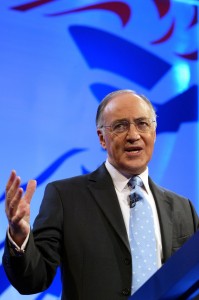

  • Tony Blair – 2002 Science Matters Speech

    tonyblair

    Below is the text of a speech made by the then Prime Minister, Tony Blair, on 23rd May 2002 to the Royal Society.

    When 12 men founded the Royal Society in 1660, it was possible for an educated person to encompass all of scientific knowledge. In fact, that was probably true for more than half of this body’s existence. It was only in 1847 that the Royal Society decided to restrict its membership to working scientists.

    But in the last century, and in particular in the last 50 years, such has been the pace of scientific advance that even the best scientists cannot keep up with discoveries at frontiers outside their own field. More science is being done, it’s more global and it’s faster to impact on our lives.

    Given the great advances of recent years, it would be easy for non-scientists to think that the great scientific problems have been solved, that today’s work is filling in minor gaps. But we stand on the verge of further leaps forward in scientific endeavour and discovery.

    Now I know there are scientists here who can explain with far more insight than I the challenges and wonders that are emerging. But there are three main reasons why I want to address the potential of this new age of discovery.

    First, science is vital to our country’s continued future prosperity.

    Second, science is posing hard questions of moral judgement and of practical concern, which, if addressed in the wrong way, can lead to prejudice against science, which I believe would be profoundly damaging.

    Third, as a result, the benefits of science will only be exploited through a renewed compact between science and society, based on a proper understanding of what science is trying to achieve.

    The idea of making this speech has been in my mind for some time. The final prompt for it came, curiously enough, when I was in Bangalore in January. I met a group of academics, who were also in business in the biotech field. They said to me bluntly: Europe has gone soft on science; we are going to leapfrog you and you will miss out. They regarded the debate on GM here and elsewhere in Europe as utterly astonishing. They saw us as completely overrun by protestors and pressure groups who used emotion to drive out reason. And they didn’t think we had the political will to stand up for proper science.

    I believe that if we don’t get a better understanding of science and its role, they may be proved right.

    Let us start with the hardest thing of all to achieve in politics: a sense of balance. Already some of the pre-speech criticism suggests that by supporting science, we want the world run by Dr Strangelove, with all morality eclipsed by a cold, heartless test-tube ideology with scientists as its leaders.

    Science is just knowledge. And knowledge can be used by evil people for evil ends. Science doesn’t replace moral judgement. It just extends the context of knowledge within which moral judgements are made. It allows us to do more, but it doesn’t tell us whether doing more is right or wrong.

    Science is also fallible. Theories change. Knowledge expands and can contradict earlier thinking.

    All of this is true, but none of it should stop science trying to tell us the facts. Yet in every generation, there are those who feel that the facts may lead us astray, may tempt us to do wrong. And in one way, they are right. There is a greater capacity to do wrong with scientific advances because we have greater technological capability – for example, nuclear weapons.

    But the answer is not to disinvent nuclear fusion. The answer is that with scientific advance, we need greater moral fibre; better judgement; and stronger analysis of how to use knowledge for good not ill.

    The balance is that better moral judgement goes hand-in-hand with better science.

    But first why is science important to our economic and social future?

    Current state of science

    There are many issues of gravity in our world, of danger, of difficulty. But I think scientific discovery is one of the most exciting developments happening in the world today.

    The biosciences are, rightly, drawing much admiring attention at the present time. But huge advances continue to be made in the physical sciences and the interdisciplinary areas between them. Indeed, increasingly, physical and life sciences are inderdependent.

    The current work in nanoscience – manipulating and building devices atom by atom – is startling in its potential. From this we now see emerging nanotechnology, the ultimate in miniaturisation. Programmable and controllable microscale robots will allow doctors to execute curative and reconstructive procedures in the human body at the cellular and molecular level. Visionaries in this field talks about machines the size of a cell that might, for example, identify and destroy all the cancerous cells in a body. Nanomachines might target bacteria and other parasites, dealing with tuberculosis, malaria and antibiotic-resistant bacteria.

    I saw a demonstration last week of some of the pioneering work being done in Cambridge in light-emitting polymers. Imagine a thin, flexible sheet of plastic coated with flexible semiconductors. This kind of disruptive technology may create whole new industries and products we can’t begin to imagine. And it’s revealing that this sort of work requires the collaboration of physicists, chemists, material scientists and engineers.

    Meanwhile, climate change presents one of the greatest challenges. Science alone can’t solve the problem. But I’m encouraged by the work in Britain on improved solar panels, better fuel cell technology, and more efficient means of tapping tidal and wave energy. Note for example that our tidal rip – if harnessed – could provide ten times our current energy needs.

    Meanwhile, hydrogen technologies offer the potential of zero-pollution transport. The vision of the scientists and engineers developing this technology is of clean and safe cities, without the air quality and health impacts of conventional vehicles.

    What is particularly impressive is the way that scientists are now undaunted by important complex phenomena. Pulling together the massive power available from modern computers, the engineering capability to design and build enormously complex automated instruments to collect new data, with the weight of scientific understanding developed over the centuries, the frontiers of science have moved into a detailed understanding of complex phenomena ranging from the genome to our global climate. Predictive climate modelling covers the period to the end of this century and beyond, with our own Hadley Centre playing the leading role internationally.

    The emerging field of e-science should transform this kind of work. It’s significant that the UK is the first country to develop a national e-science Grid, which intends to make access to computing power, scientific data repositories and experimental facilities as easy as the Web makes access to information.

    One of the pilot e-science projects is to develop a digital mammographic archive, together with an intelligent medical decision support system for breast cancer diagnosis and treatment. An individual hospital will not have supercomputing facilties, but through the Grid it could buy the time it needs. So the surgeon in the operating room will be able to pull up a high-resolution mammogram to identify exactly where the tumour can be found.

    We already enjoy many of the fruits of biomedical science. In Shakespeare’s day, life expectancy in Britain was only 30 years. Even by the 1880s, for the malnourished working class, it was still under 40. Today, life expectancy at birth is nearly 80 years, and we can expect many of us to live healthily into our eighties and nineties and even hundreds. The availability of this extraordinary progress is largely a direct result of advances in the life sciences and improved diets.

    As we move into what Sir Paul Nurse calls the post-genomic world, we can anticipate that healthcare will undergo enormous change. Some diseases can be directly linked to the presence or absence of particular genes or gene sequences. The new field of pharmacogenomics will vastly increase the efficiency of medication. Drugs will be tailored to an individual’s genetic make-up.

    Beyond that, we can now see a future where the doctor will swab a few cells from inside your cheek, put them into a DNA-sequencing machine and a computer will spit out a complete reading of your unique genetic makeup – all 30,000 or so genes that make you who you are. From that, doctors could pinpoint flawed genes and gene products and predict what diseases you are likely to develop years in advance of any symptoms – and how to help you avoid them.

    As scientific understanding develops, we may even be able to change the fate of individual cells – which could mean breakthroughs against diseases like Alzheimer’s, diabetes, Parkinson’s and cancer.

    We have a unique resource in this regard in the National Health Service. There are crucial issues of privacy of genetic information that we need to deal with. But our national, public system will enable us to gather the comprehensive data necessary to predict the likelihood of various diseases – and then make choices to help prevent them.

    Everything I’ve mentioned is already work in progress in laboratories in Britain and elsewhere. But what is most exciting is that science creates possibilities that were not imagined previously. After all, only ten years ago researchers in elementary particle physics were determined to find a way in which they could share information more effectively. Out of this seemingly simple aim, Tim Berners-Lee invented the World Wide Web.

    This is the best recent example of the hidden power of science. We use these devices and don’t even think about them being creations of science. In the case of the Web, particle physicists created a great equalising, democratic force.

    Britain’s special position

    So: what can all this mean for Britain’s future well-being and prosperity?

    We are fortunate to have a long science tradition, perhaps best represented by the history of this very institution. Newton, a former president of the Royal Society, and Darwin are acknowledged as two of the epochal scientists of human civilisation, and are probably – with Shakespeare – Britain’s greatest contributors to human civilisation. I would also cite Faraday, Thomson, Dirac, Crick, Perutz, Nurse and many others. As Bob May has said, “creative imagination at and beyond the frontiers simply is something we are good at”.

    By any measure, our record is outstanding. With 1% of the world’s population, we fund 4.5% of the world’s science, produce 8% of the scientific papers and receive 9% of the citations.

    The strength and creativity of our science base is a key national asset as we move into the 21st century. Britain has produced 44 Nobel laureates in the last 50 years, more than any country except the US. But this statistic does conceal a problem we must acknowledge. Only eight of those laureates are in the last 20 years. We have relied for too long on tradition and sentiment to aid our scientists. We need strong funding and strong public support, not just the warm glow of our traditions.

    I don’t want our next Nobel laureate to echo the tale of Tim Hunt, who – in the moment of his Nobel triumph last year – told the story of how he and his colleagues had to scrape together money to buy a telephone for their lab.

    When the Government came to power science was suffering from a lengthy and disastrous period of underfunding and neglect. Scientists were increasingly going abroad to do their research; our laboratories were in an appalling condition and the inept political handling of the BSE crisis meant that there was a growing distrust of science and scientists.

    The Government has taken major steps to improve the funding of science. In the 1998 comprehensive spending review we increased the science budget by 15%, the largest increase of any area of Government expenditure. And in the 2000 Spending Review we took further steps, so that today the science budget is increasing by 7% a year in real terms.

    As part of this increase, in a highly valuable partnership with the Wellcome Trust, we have invested £75bn for the renewal of science research infrastructure in the last 2 spending reviews.

    And it isn’t just the sums of money that are important. The Research Assessment Exercise and the thousands of hard working scientists who have responded to these incentives have fostered excellence and driven up the quality of research in universities. But we realise the need to do more still to promote world class excellence and this will be a priority for us in the period ahead.

    As a result, we are seeing an improvement in the quality of our laboratories, and instead of seeing a continuing “brain drain” we may be seeing the beginning of a “brain gain”. Sir Gareth Roberts’ report for 2001 estimated a net inflow of 5000 scientists and engineers to the UK. But there is a long way to go.

    Also, science is a thoroughly globalised endeavour, one in which Britain can and must play a key role.

    A considerable amount of scientific effort today occurs on a pan-European scale. There’s the research at CERN, the fusion work at Culham and the experiments organised through the European Space Agency.

    It is typical in today’s research to have British scientists working with other European, American and Asian colleagues on a common problem. In radio astronomy, for example, UK scientists at Jodrell Bank collaborate in a network of antennae spreading across Europe, China, Australia and the US. This is truly an example of global science, with free access to the facilities and to the science.

    Science is both internationally competitive and internationally collaborative. If we are to remain an innovative, forward-looking nation, we need to retain the capacity to do this work, both on our own and in collaboration with scientists in other nations.

    High technology industries

    Government and business support for scientific research is not enough on its own. We also need to make sure that scientific innovation gets translated into applied uses in business.

    We are already leaders in science-based industries including pharmaceuticals, aerospace, biotechnology and opto-electronics. But there are many more that could benefit from our world-class science and technology.

    So we are establishing strong links between universities and business through specific schemes – such as University Challenge, Link, the Faraday Partnerships and the Higher Education Innovation Fund.

    But more general initiatives too are helping lead to a major cultural change in higher education. A recent survey showed that in 1999-2000, 199 companies were spun off from our universities, compared with 70 a year on average in the previous five years. In relation to the amount of research we do, this was a better record than even the United States. The number of patents filed was also sharply up. And the percentage of university research funded by industry was higher than in the US.

    Cambridge Science parks and the surrounding area now house about 1,400 high-tech companies, and some of the top companies are worth over 1 billion Euro. Science parks and incubator laboratories for start-up companies have now sprung up around many of our universities.

    We have also just introduced a new tax credit for research and development: a boost to innovation, affecting expenditure by 1,500 large companies in the UK.

    Biotechnology is at the forefront of these developments. The biotech industry’s market in Europe alone is expected to be worth $100 billion by 2005. The number of people employed in biotech and associated companies could be as high as three million, as we catch up with the US industry – currently eight times the size of Europe’s.

    And Britain leads Europe: three-quarters of the biotechnology drugs in late-stage clinical trials in Europe are produced by British companies. With our excellent science base, our sophisticated capital markets and venture capital industry, the large number of skilled scientists and managers in our pharmaceuticals sector, and the investment in research by the Research Councils, Wellcome Trust and others, Britain is well placed to keep and extend its lead.

    What’s more, the other disruptive technologies that I have already mentioned – nanotechnology and plastics electronics – have the potential to penetrate global markets in the same way.

    The ideas recently put forward for a Nanotech fabrication plant and for investment by a public/private partnership in “proof of concept” work to demonstrate the potential of new scientific discoveries, are well worth examining.

    Science and Government

    So Britain can benefit enormously from scientific advance.

    But precisely because the advances are so immense, people worry. And, of course, many of these worries are entirely serious. In GM crops, I can find no serious evidence of health risks. But there are genuine and real concerns over biodiversity and gene transfer. Human cloning raises legitimate moral questions. Advances in arms technology makes the world less safe. Humanity has, for the first time, the capacity for vast prosperity or to destroy itself completely.

    People have an understandable concern about the pace of change, about the new and the unknown. They are concerned that technology dehumanises society. They are concerned by their belief that scientists contradict each other, or can be unreliable. And about what they see as the inability of Government to regulate science properly.

    In some cases, these concerns descend into a fear, which is amplified by parts of the media.

    Some of these concerns are not new. You don’t need to go back to Galileo for examples. Lightning conductors, invented by Benjamin Franklin, were initially torn down, even from churches, because it was believed they thwarted God’s will. There were riots in the streets when the smallpox vaccine was introduced. Smallpox has now been eliminated. In the early days of heart transplants they were attacked as unnatural or dehumanising, but in surveys today heart transplants are seen as one of the most beneficial results of modern science.

    Sometimes science is wrongly blamed for the faults of others. Take BSE. Science in this case correctly identified a new problem. The American Scientist Stanley Prusiner won the Nobel Prize for discovering prions, and establishing the link between BSE and CJD. Bad science didn’t cause the spread of BSE; it was bad agriculture and poor government.

    The response of the government must be to encourage openness, transparency and honesty. The Food Standards Agency, which operates in an area of particular public concern and sensitivity, holds meetings in public and publishes minutes on the Web. The Human Genetics Commission and the Agriculture and Environment Biotechnology Commission are other examples where we are spearheading this approach and the Chief Scientific Adviser has established an independent voice in Government as an important part of this process.

    And there are lessons to be learnt from the way that we handled the embryonic stem cell debate. Firstly, we established the scientific facts very carefully, with the authoritative report by the Chief Medical Officer in August 2000.

    There was then a lengthy discussion which gave time for all groups, including the medical charities, to make their views known, and this led to a very balanced debate in Parliament, resulting in carefully framed legislation. As a result we have an intelligent, stable regulatory regime for this crucial field.

    Nowhere in the world has what one might call a community of stem cell experts yet – the science is too new. But Britain starts with a strong reputation in developmental biology and a number of institutes with worldwide reputations. I want to make the UK the best place in the world for this research, so in time our scientists, together with those we are attracting from overseas, can develop new therapies to tackle brain and spinal cord repair, Alzheimer’s disease and other degenerative diseases, such as Parkinson’s.

    It is also critically important that the Government are given the best possible advice on science, engineering and technology through Government departments. We are currently looking at ways of improving Government science.

    The recent appointment of Professor Howard Dalton, a Fellow of this Society and a much respected microbiologist, as Chief Scientific Adviser to the Secretary of State for DEFRA, is an example of this in action. Drawing on the successes of the Research Assessment Exercise in the University sector, we are looking at introducing a programme of external benchmarking and review of the way Government departments use science.

    The revised Government Foresight Programme has just been launched by the Chief Scientific Advisor with two examples of scientific horizon scanning. A Foresight project on cognitive neuroscience will bring together experts in IT and in brain research to seek out new technological opportunities for exploitation.

    And a project on flood and coastal defences will examine increasing threats to our country over the next 50 to 100 years arising from predicted changes in climate. Here the predictive capability of the science will be evaluated alongside science and engineering possibilities of mitigating against the worst effects. Environmentalism is strongest when allied to hard science and empirical testing.

    Science and Society

    But this isn’t just about Government and science. Its crucially about society. We need better, stronger, clearer ways of science and people communicating. The dangers are in ignorance of each others point of view; the solution is understanding them.

    The fundamental distinction is between a process where science tells us the facts and we make a judgement; and a process where a priori judgements effectively constrain scientific research. We have the right to judge but we also have a right to know. A priori judgement branded Darwin a heretic; science proved his tremendous insight. So let us know the facts; then make the judgement as to how we use or act on them.

    None of this, incidentally, should diminish the precautionary principle. Responsible science and responsible policymaking operate on the precautionary principle. But that principle should make us proceed with care on the basis of fact; not fail to proceed at all on the basis of prejudice.

    There is only a small band of people, I believe, who genuinely want to stifle informed debate. But a small group can, as has happened in our country, destroy experimental crops before we can determine their environmental impact. I don’t know what that research would have concluded. Neither do the protestors. But I want to reach my judgements after I have the facts and not before.

    Of course there must be constraints that we properly place on scientists, through health and safety regulations, through legislation controlling animal experimentation, and, most recently, through the ban on human reproductive cloning. There are strong ethical reasons why we have one of the world’s strictest, most regulated regimes for animal experimentation. The Government is also at the forefront of pan-European efforts to ensure that there is no unnecessary duplication of animal experimentation. But if we had stopped all animal experiments in recent years we would not have developed a meningitis vaccine or combined drug therapy for HIV infection.

    We’re faced with a current example, where Cambridge University intends to build a new centre for neurological research. Part of this would involve using primates to test potential cures for diseases like Alzheimer’s and Parkinson’s. But there is a chance the centre will not be built because of concerns about public safety dangers and unlawful protests. We cannot have vital work stifled simply because it is controversial.

    We need, therefore, a robust, engaging dialogue with the public. We need to re-establish trust and confidence in the way that science can demonstrate new opportunities, and offer new solutions.

    This task will be aided if we can embed a more mature attitude towards science in our society. I absolutely reject notions of two cultures. There is a deep human need to understand, and science has revealed so much of our extraordinary world. Science is a central part, not a separate part, of our common culture, together with art, history, the social sciences and the humanities.

    Conclusion

    All of this adds up to a clear challenge for Britain over the next 10 years.

    We need to ensure our bright young people share our excitement about the potential of science and the role they can play. We particularly need to reverse the decline in maths, physics and engineering, and make science a career to aspire to, for girls as well as boys.

    We have recently reversed an eight-year decline in teacher training applications for science subjects, partly through ‘golden hellos’ for science and technology teachers. But we are not complacent – recruiting and retaining more science teachers remains a key priority.

    We’ve also concentrated on establishing a network of specialist schools that share their best practice with other schools in the locality: of the 1000 we expect by this September, around 500 will be in scientific disciplines, of which about 25 will be specialist science colleges. We have proposed a new National Centre of Excellence in Science Teaching. We have created a network of Science and Engineering Ambassadors to support science teachers. And we have provided millions to refurbish school labs and modernise the learning infrastructure.

    We have also ensured that science remains a core subject until 16. From September 2002 there will be a new applied science GCSE to offer pupils a new route into science as a career. Science is also at the heart of our programme to develop the potential of the very brightest pupils through the Academy for Gifted and Talented pupils at Warwick University, which will open next year.

    We also need to deepen school specialisation in science, in particular by seeking new forms of collaboration involving colleges and Higher Education institutions. I would like to see many more universities sharing their facilities and teaching expertise with secondary schools, as well as linking up with the private sector to maximise our national scientific capability.

    We should not ignore our strengths in science education. The recent, highly respected OECD PISA study ranked British 15-year olds fourth internationally for science literacy, well ahead of most of our competitors.

    However, I am concerned about the findings of the Roberts report on skills shortages in the sciences and engineering. We will be looking very carefully at his recommendations as part of the Spending Review 2002.

    I want to make sure the UK is one of the best places in the world to do science. For that we need our people, equipment and infrastructure to be properly funded. And we should continue to promote British science abroad.

    We need to continue our improvements in Government handling of science, where public trust is particularly low. All departments need strong systems for managing research and handling advice. Scientific information and advice to Government should be freely available and accessible. Open and informed public debate on key scientific issues will be an integral part of our approach.

    We need to go further in our drive for successful knowledge transfer. Our goal is prosperity for all through successful business using excellent science.

    We need to ensure that Government, scientists and the public are fully engaged together in establishing the central role of science in building the world we want.

    If we can succeed in producing a confident relationship between scientists and the public, the promise is that Britain can be as much of a powerhouse of innovation – and its spin-offs – in the 21st century as we were in the 19th and early 20th century. The benefits in industry, jobs of quality, healthcare, education, and the environment can transform our future. Of course, we must exercise the care and judgement to make scientific discovery a liberating, civilising force not a leap into the unknown.

    But let the debate be one between open minds, not a retreat into a culture of unreason. I want to prove those entrepreneurs in Bangalore wrong. I want Britain and Europe to be at the forefront of scientific advance. But its no exaggeration to say that in some areas we’re at a crossroads. We could choose a path of timidity in the face of the unknown.

    Or we could choose to be a nation at ease with radical knowledge, not fearful of the future, a culture that values a pragmatic, evidence-based approach to new opportunities. The choice is clear. We should make it confidently.

  • Tony Blair – 2002 Statement Following Death of the Queen Mother

    tonyblair

    Below is the text of a statement made by the then Prime Minister, Tony Blair, following the death of the Queen Mother. The statement was released on 30th March 2002.

    During her long and extraordinary life, her grace, her sense of duty and her remarkable zest for life made her loved and admired by people of all ages and backgrounds, revered within our borders and far beyond.   She was part of the fabric of our nation and we were all immensely proud of her.

    Along with her husband, King George VI, she was also a symbol of our country’s decency and courage.

    Her bravery, when she refused point blank to leave London and her husband’s side during the Blitz epitomised both her own indomitable spirit and the spirit of the nation in its darkest hours. Later as Queen Mother, she was a unifying figure for Britain, loved by all, sharing in its joys and troubles.

    But respect for her went far beyond Britain.  Throughout the Commonwealth and the world she was greeted with instant affection and acclaim. Above all, she was motivated by the most powerful sense of duty and service, enhanced by her profound religious conviction.

    She believed that the Royal Family’s role and duty was to serve the British nation and she carried out that duty with total and selfless devotion.

    Our thoughts are with The Queen, and particularly so after the sad loss of Princess Margaret, and with all the Royal Family, with whom Britain mourns, united in grief at our loss and giving thanks for a life of extraordinary service to our country.

  • Tony Blair – 2002 Speech at the LSE

    tonyblair

    Below is the text of the speech made by the then Prime Minister, Tony Blair, on the future of New Labour. The speech was made at the LSE on 12th March 2002.

    Just under a decade ago a gathering like this would have been a wake; raking over the ashes of Labour’s fourth election defeat, with everyone asking, can we ever win? Is the left in Britain doomed? Is this the end of progressive politics?

    Today the contrast is almost taken for granted. Labour has won an historic second term. As if we had been in power for decades. The Right is seen as divided and incapable.

    We are emerging from a long period in which Tory values held sway; elitism; selfish individualism; the belief that there is no such thing as society and its international equivalent, insularity and isolationism, which led Britain to turn its back on Europe and the world.

    I passionately, profoundly, reject these values. I reject elitism because I believe that our country will only ever fulfil its true potential when all of our people fulfil their potential. And there is such a thing as society. As communities and as an international community, we do best when we work in co-operation with others.

    Our values – our belief in equality, in progress, our belief in the power of community to be a force for good, at home and abroad – these are the values that hold strong now.

    But as Mario Cuomo once said: “you campaign in poetry: you govern in prose”. There is a danger in the day to day business of Government – keeping the economy on track, getting the details of health and education improvements sorted out, dealing with the innumerable practical obstacles – large and small – strewn across the path of progress – that we lose sight of the destination. The destination to me is clear: to build a Britain that is a modern, tolerant, outward-looking nation where power, wealth and opportunity are in the hands of the many not the few. Our basic analysis is that people are held back from fulfilling their true potential – by economic failure, poor education, poverty, prejudice, discrimination, class, inadequate access to top quality services. Our job is to liberate that potential; to remove those barriers. To make aspiration and achievement not the ambition of a privileged few but of all; where the limit to that achievement is merit, not birth, class, race or gender.

    Britain under the Conservatives was a long way from that lofty ideal. And because we had failed to modernise ourselves, for a long time Labour lacked the credibility to be able to win power, or even had we won power, to deliver it.

    Now two election victories later, people are asking: can we carry it through? Is there a core of beliefs that will sustain us? Will we be submerged by the slings and arrows of an outrageous opposition, furious we are in power at all, never mind in power for a full second term for the first time in our history.

    The answer is to take stock. Lift our eyes from the immediate and hold high again the ideal we are striving for. And then return to work with renewed energy and determination.

    And, of course, patience: change takes time. Yet consider: an economy that is stable, has weathered the downturn better than many, with the best economic record in Europe and the lowest unemployment in the Western world; the first clear signs of public service improvement, certainly in education and increasingly in health; the first concerted attack on social exclusion any Government has undertaken with increased participation rates at work, one million children out of poverty, Sure Start and other programmes giving deprived children at least a fighting chance; overall crime down and police numbers the highest ever; and Britain’s position and influence in the world incomparably higher than 5 years ago. In all sorts of small ways – from banning handguns, to the equal age of consent, to the trebling of women MPs and the first black Ministers and Muslim MPs – the country has a different feel to the harshness of the Thatcher years.

    But yes, naturally, a huge amount remains to do. Too many people still wait an unacceptably long time in the NHS. The transport system is nowhere near what the world’s 4th largest economy needs. Street crime and social disintegration in parts of the inner city are a menace we must tackle quickly. There are still many people who could work but don’t. Still too much ignorance, too much wasted potential, too much inequality.

    We accept these challenges remain. And the forward programme of the Government is designed to meet them; still driven by that same ideal, of a modern, fairer Britain, where opportunity is open to all.

    What we have to do is to explain the journey we are undertaking by reference to that ideal, blow away the fog that is designed to cloud the sight of it and work ever harder to translate it into reality.

    Today I call on those who share our beliefs to join us in the battles that lie ahead.

    Join us in the battle to extend prosperity and full employment to all parts of the country based on a platform of economic stability.

    Join us in the battle for the investment and reform necessary to build strong public services and encourage greater opportunity and equality.

    Join us in the battle to tackle crime, anti-social behaviour and poverty to build a society based on rights and responsibilities

    Join us in the battle against the sceptics and phobes to get Britain back once again at the top table of Europe.

    This is the progressive project for a second term, the next steps for the New Labour project, an ambitious programme for the Labour Party as it enters its second century.

    First phase of new Labour: becoming a modern centre left party.

    But to chart New Labour’s next steps we have to understand our first steps.

    The collapse of the Labour Party and its electoral base, most painfully dramatised by the 1992 defeat, was only the most obvious sign of a broader shift in politics and society. Labour stuttered when confronted by the new world that emerged in the 1970s and 1980s: a more diverse, more fractured society; new industries and new attitudes to work and consumption; and an international order that was both more integrated and yet more unpredictable.

    In 1956, Anthony Crosland had set out a new path in his “Future of Socialism”. He urged socialists to acknowledge the successes of post-war capitalism and to understand the consumer society and why it was advancing so fast including in Labour’s heartlands.

    But in the 70s Labour seemed to forget Crosland’s revisionist message.

    New Labour was in part a response to what had gone wrong. We strove to modernise social democracy, to become a party that brought together wealth creation as well as wealth distribution; enterprise as well as fairness.

    So New Labour put levelling up, the aspirations of the majority, at the centre of its appeal.

    And we changed our constitution to bring it up to date with the modern world.

    New Labour’s second phase: laying the foundations

    The first phase of New Labour was becoming a modern social democratic party fit for government. The second phase was to use our 1997 victory to put in place the foundations that would allow us to change the country in a way that lasts.

    Labour governments of the past had tried to make progress without firm foundations, firm economic foundations in particular. Getting the foundations right is not time wasted. It is not the boring housework of Government. It is the structure within which we live.

    That is why we transformed the framework for economic management.

    – It matters whether prices in the supermarket are the same from one week to the next. It matters that today inflation is at its lowest level for 30 years.

    – It matters whether interest rates let you pay the mortgage or threaten to lose you your home, and today, it matters that the average family is paying £1800 less on their mortgage compared to the early Nineties.

    On welfare reform getting the first term foundations right meant tackling unemployment. The New Deal has helped halve unemployment which is now at its lowest for forty years. We introduced the Working Families Tax Credit and the Minimum Wage to make work pay.

    On public services, let us be in no doubt what we inherited:

    – Crime had doubled

    – Waiting lists had risen by 400,000

    – Hospital beds cut by 60,000

    – Nearly half of all 11-year-olds were failing to reach the basic levels expected for their age in maths and English.

    – Infant class sizes were far too high

    – Police numbers falling

    – Child poverty tripled

    – Investment in rail and the tube stalled

    – the railways subject to a botched privatisation, which had fragmented them completely.

    In each area in the first term we laid the foundations for investment and reform.

    – A strategy for improving numeracy and literacy in primary schools, with record primary school tests results.

    – A ten year plan for the NHS including the first ever independent inspection, league tables, the creation of primary care trusts now coming to fruition to transform local services, more doctors and 31,000 more nurses since 1997.

    – Crime and Disorder Partnerships in every Community. Police numbers rising. Our youth justice system overhauled. Burglary fell by 34% and car crime by 24%. The Auld Report on the criminal justice system was commissioned.

    – A 10 year Transport Plan to treble public sector investment in rail and tube.

    – devolution and House of Lords reform, a peace process begun in Northern Ireland.

    We also set the foundations of a new foreign policy. Before the Amsterdam Summit in 1997 Britain was totally isolated, treated with something between exasperation and contempt. Today as we approach the summit at Barcelona, Britain has a highly influential position. We have a strong constructive relationship with our partners and we have led the way over Kosovo and more recently Afghanistan, and on debt and aid.

    New Labour’s third phase: Driving through reform

    Now is the third phase of New Labour. It is about driving forward reforms, building lasting change – and a better society – on the foundations so carefully laid.

    – on the basis of economic stability a sustained improvement in productivity and enterprise, measures that will form a key part of next month’s Budget.

    Overhauling the Criminal Justice System to support victims and witnesses and bring the most persistent offenders to justice; a thorough programme of police reform; and a reform of the asylum system.

    – welfare reform that cuts even further the numbers of working age on benefit plus the integrated children’s credit, and the new pensions credit; and the merger of the employment and benefit service, a huge cultural change in Britain’s welfare system.

    – completing House of Lords reform, bedding down devolution and making the peace process in Northern Ireland durable for the long term.

    – Britain taking its rightful and leading place at the centre of Europe.

    – implementing the plan for Africa, continuing to lead on aid and development and the Kyoto protocol on climate change as the basis for sustainable development in the world.

    Alongside this, our core mission: to improve our public services.

    In each service, there is a comprehensive, detailed plan for change and reform, broadly supported within the public services themselves.

    Underlying the plans are the four principles of reform set out in our pamphlet last week: national standards, devolution, flexible staff, more choice – all aimed at redesigning high-quality public services around the consumer.

    But without investment, reform will get you very little further – as the Tories found in the Eighties. There is no point designing new structures for the health service if you don’t tackle the fundamental problem of inadequate capacity – and fashion your reforms around the significant increase in capacity essential to build a modern, consumer-focused service. It is the same with schools and transport, and across our public services.

    Under this Labour government there will be no blank cheques – but nor will we expect public services to run on empty.

    So in next month’s Budget and the spending review in the summer, the country is faced with a fundamental choice. Either we continue investing. Or we cut back.

    We aim to continue investing.

    There is no question of putting money into some bottomless pit. Each pound spent will be accounted for.

    But we can see already where the existing money has gone. The extra money on infant class sizes reduced them. The money spent on literacy and numeracy, together with the teachers’ dedication, delivered the results.

    The schools with new buildings: tell them the money’s wasted.

    The new surgical centres, the extra cancer and heart operations, the extra critical care beds, the extra nurses in wards: tell the patients using these facilities the money is all wasted.

    Money is not enough. But money used to lever in change is what will work.

    So these are our second term ambitions and broadly I believe the country supports them. But that is not enough.

    Values that unite us

    There is a clear road-map to our destination. But sometimes it can seem as if it were a mere technocratic exercise, well or less well managed, but with no overriding moral purpose to it.

    What is vital now is to explain the “why” of the programme, to describe it not simply point by point but principle by principle. The reason for the changes we are making is not for their own sake but because they are the means to the fairer society, where aspirations and opportunity are open to all, which we believe in. The programme is not driven by administration but by values.

    It means quality public services because they are social justice made real.

    It means an economy with a new job if your old one goes.

    It means stable mortgage rates.

    It means giving the children of someone who did not go to university the hope they can go. Enough of this nonsense that more than half the population don’t have the brains to get there. When I was a student, 7% of school-leavers went to university. Today it’s 33% and rising. Yet we heard the same arguments back then. Are those extra 27% undeserving?

    Opportunity means a young woman with a nursing diploma who is able to work her way up to become a consultant nurse or Director of Nursing or hospital Chief Executive.

    It means a first rate vocational education system so people can get new and better skills.

    It means children in deprived areas getting first-class schools, their parents helped, their environment improved.

    It means your health care shouldn’t depend on the size of your wallet.

    It means your security shouldn’t depend on the neighbourhood you can afford to live in.

    It means that decent hard-working people who play by the rules don’t see others who refuse to, gain by it.

    That is the other part.

    We believe in responsibility going with the opportunity. That is the reason for measures to curb anti-social behaviour; to ensure if people have the ability to work, they don’t remain dependent on benefit; that employers treat their employees fairly; that we don’t allow poverty pay; that increasingly the polluter should pay for polluting the environment.

    It is why we are making a priority of discipline in the classroom. Because without learning discipline and respect, children will not only fail to learn at school but leave school unfit to be decent citizens.

    So it’s about the two together – opportunity and responsibility. And its about using our collective power, in our local communities, in society, and through Government, to enable people to help themselves.

    At the root of it all is a simple belief in fairness. It isn’t fair that people are held back or live in poverty. We want to change it. Amidst all the day to day pressures, that is our ideal. That is what we hold aloft. Sure, it’s hard to see it from time to time. But it’s there and it will see us through.

    My final point is this. It’s important to understand why people can sometimes find the ideals obscured. It’s not just that Governments get embroiled in events and controversies, though they do, and whilst they dominate the news, the people think: what are they concentrating on this for, when, of course, it’s the opposite of what we’re trying to do.

    It is also that for some, even in our own ranks, the idea of New Labour remains controversial or unclear. Even now, a large part of the political discourse in Britain assumes that the “true” Labour Party is one that puts trade unions before business; is indifferent to financial discipline; addicted to tax and spend; weak on issues of crime; irresponsible over state benefits for the unemployed or socially excluded; backs the producer interest in public services; and, give or take the odd exception, weak in defence and foreign policy. Since this Government is plainly none of those things, ergo: we are not real Labour and are “unprincipled”.

    This, of course suits immensely the right-wing in politics. They love the “true” Labour Party. These positions made it unelectable. But it also suits some on the left. They see the Labour Party as a pressure group. We campaign against those with the power. We fight for these positions, rejoice in our “principles”, are given the odd crumb from the governing table and avoid the harsh realities of taking any hard decisions.

    After 18 years of Conservative government we changed all this. I am not so naïve as to deny some changed to win. Banging your head on a brick wall, hurts. At some point, if you want to stop hurting, you devise the brilliant solution of ceasing to bang your head on the wall.

    But changing those positions to win, was never the right reason for changing them; nor can it sustain us over the long term. The right reason for change was a principled one. Those positions, hallowed by the Party over many years, were a tangled and mistaken view of the Party’s true raison d’etre and values; positions that were the product of the circumstances of our birth, of 20th century politics and ideology and of the post-war settlement.

    The values of the Labour Party are the values of progressive politics throughout the ages. The same values as those of the great Liberal reformers of the 19th Century and early 20th Century, as well as those of the Labour heroes of 1945: the belief in social justice, opportunity for all, liberty; the belief that the individual does best in a strong community and society of others.

    The essence of New Labour is to strip away all the outdated dogma and doctrine, the “hallowed positions” and return to those first principles, to those values. Then we ask: if these are our values, what is their proper translation into practice for today’s world? And that is the question each generation of Labour members should ask, and answer in a different way.

    New Labour answered it in this way: that if we want strong economic growth to increase the prosperity of ordinary families, we need low inflation and low interest rates and that requires financial discipline. If we want enterprise to flourish in the post industrial economy, to give our people jobs, we need to support and work with business; and levels of tax that don’t discourage the entrepreneur.

    If we want to protect the poor and vulnerable against attack and crime, we have to make sure that the criminal is brought to justice. If we want to stop the working age poor being poor, we need to help them to work, not give them more benefit, which would never provide them with a decent enough income. If we want to rebuild our public services, we need to make them work for the consumer of those services, because they are the very people dependent on them for opportunity and help.

    If we want to shape the world around us, outside Britain, we must have the alliances and where necessary, the armed forces, to allow us to do so.

    And, yes, we are financially disciplined, but one of the ways we got there was by cutting massively the bills of unemployment through the New Deal. Yes we work with business, but we also introduced the minimum wage. Yes we are reforming our public services, but we are also the only major country in the world today increasing health and education spending as a percentage of national income. Yes we are tough on crime but have also lifted one million children out of poverty, cut pensioner poverty and have huge inner-city regeneration programmes underway.

    Yes, we are prepared to take military action where necessary, but are also leading the way on debt relief, and international development, especially in Africa.

    Hence the confusion I talked of earlier. We don’t fit the mould. Good. We never intended to.

    Why don’t we just conform? Because we shouldn’t. The modern Labour Party is here to stay because it is based on values and principle; and is the right way forward for us and the country.

    So we should have confidence, hold firm to our course and above all, hold true to the basis of New Labour. We are changing the basis of British politics. Progressive values are in the ascendant because, in the end, they are also the values of the British people and only needed to be applied in a modern way, to be popular.

    Look how our opponents are coming on to our agenda.

    What a reversal in these last 10 years to see the Tories now falling over themselves to agree with our economic policy hoping some of our economic competence rubs off on them, travelling around Europe to look at public services but dodging the real test of whether they support our extra investment. As someone said success in politics is not changing your own party; it is changing the opposition.

    The Lib Dems don’t know whether to oppose us on reform, for opportunism sake because they know change can be unpopular; or scuttle to our right as a pale imitation of the Tories calling for tax cuts.

    The centre of gravity of British politics is moving in our direction. A new post Thatcherite progressive consensus is being born and it is one we should be proud of.

    A consensus that a dynamic economy and a fairer society where we realise the potential of all go together; a consensus that our public services have been under-invested in for two decades and now need sustained investment, but that investment will only work if coupled with reform.

    Understanding this and not being frightened by it is a vital part of us retaining our ability to change Britain.

    So help us get there. We need your energy, your ideas, your commitment. We can’t do it alone. The dialogue and partnership we offer you is an indispensable part of our being successful.

    Remember ten years ago: we were on our knees, out of office and out of hope. Now look forward ten years and imagine what could be possible. A society that is fairer, more tolerant of people’s differences, with prosperity shared, quality public services more social mobility and less poverty. And imagine too what we could achieve pulling together if we show our determination, stick to the values we believe are right, stick to our plans and see them through.

    A Britain that is modern, fair and strong.