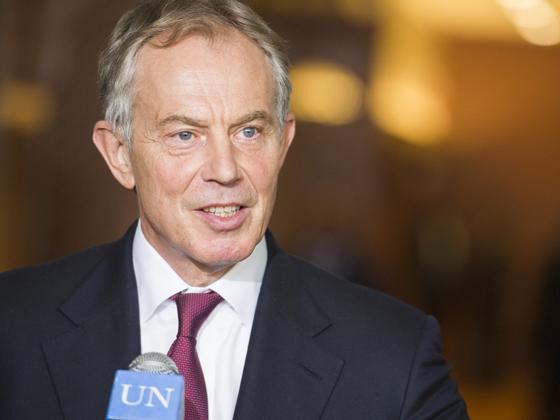
The speech made by Tony Blair, the then Prime Minister, on 26 April 2004.
Immigration and politics do not make easy bedfellows. They never have. We need few reminders of what can happen when the politics of immigration gets out of hand.
Let us also be very clear. Those who warned of disaster back in the 1960s and 1970s if migration was not stopped, who said Britain would never accept a multi-racial society, have been proved comprehensively wrong.
On the other hand, there is no doubt that on the doorstep, in local communities, immigration has suddenly become very high on the agenda. Why?
It is not, incidentally, an exclusively British issue.
This is a worldwide phenomenon. Immigration has dominated elections in countries like Denmark, Austria and Netherlands in recent years. Le Pen rose to prominence in France. In Australia and New Zealand, it has been a central question, sharply dividing the main parties.
Migration flows across the world, with increased opportunities to travel and globalisation, drives the issue.
And beneath the surface, we all know as politicians, certainly on the centre left, what we fear: that concern slips into prejudice, and becomes racism. But we cannot simply dismiss any concern about immigration as racism.
In part, what has put immigration back up the agenda – with public concern at its highest since the 1970s – is that there are real, not imagined abuses of the system that lead to a sense of genuine unfairness.
There were real problems with asylum; some immigration procedures have clearly been at fault; some rules, introduced for entirely legitimate reasons, have been subject to systematic and often criminal fraud. Many of these systems simply need bringing up to date.
Then there are high profile examples of the absurd – not many in number but very damaging in terms of impact – like radical clerics coming here to preach religious hate; people staying here to peddle support for terrorism.
The combination of all these things – with the reporting of them not exactly calculated to douse the flames of concern – lead to a crunch point. That is where we are now.
The vast bulk of the British people are not racist. It is in their nature to be moderate. But they expect Government to respond to their worries. They can accept migration that is controlled and selective. They accept and welcome migrants who play by the rules. But they will not accept abuse or absurdity and why should they?
So now is the time to make the argument for controlled migration simultaneous with tackling the abuses we can identify; and then, longer term, put in place a system that gives us the best guarantee of future integrity in our migration policy.
That is why we have begun a top to bottom analysis of the immigration system, how it operates, how it can be improved, how it can agree migration where it is in our country’s interests and prevent it where it isn’t. One thing already is clear: the overwhelming majority migrate in and often out of Britain fairly and in accordance with the rules. But there are areas of abuse and we can and should deal with them.
We are putting in place a strategy – globally, nationally and locally – to ensure migration works for Britain today and in the future.
We will neither be Fortress Britain, nor will we be an open house. Where necessary, we will tighten the immigration system. Where there are abuses we will deal with them, so that public support for the controlled migration that benefits Britain is maintained.
Our strategy has a number of interlocking elements:
(1) A recognition of the benefits that controlled migration brings not just to the economy but to delivering the public and private services on which we rely.
(2) Being clear that all those who come here to work and study must be able to support themselves. There can be no access to state support or housing for the economically inactive.
(3) We will continue to tackle abuses in the asylum system, including through the legislation currently before Parliament which will establish a single tier of appeal and clamp down on asylum seekers who deliberately destroy their documents and lie about their identity.
(4) Action on illegal immigration through the introduction of ID cards and millions invested in strengthening our border controls in ports and airports across the world: and heightened enforcement in the UK too.
(5) Celebrating the major achievements of migrants in this country and the success of our uniquely British model of diversity. But alongside that an explicit expectation that rights must be balanced by responsibilities. That there are clear obligations that go alongside British residency and ultimately citizenship – to reject extremism and intolerance and make a positive contribution to UK society.
(6) An acknowledgement that there is no longer a neat separation between the domestic and the international. In a world of global interdependence our policies on migration cannot be isolated from our policies on international development or EU enlargement.
Facts
But I want to start today with some facts – for too often the debate about immigration is characterised by a vacuum of reliable information which can all too easily be filled by myth. To give just one example a recent MORI poll found that people estimated the proportion of ethnic minorities in Britain as 23% when the real figure is a third of that at 8%.
So fact one; the movement of people and labour into and out of the UK is, and always has been, absolutely essential to our economy.
Visitors from outside the European Union spent £6.8bn in the UK in 2002 and those from within the European Union billions more. Overseas students spend over £3bn on fees and goods and services a year on top of that.
Indeed according to the Treasury, our economic growth rate would be almost 0.5% lower for the next two years if net migration ceased. Lower growth means less individual and family prosperity, and less revenue to spend on public services.
And the economic contribution of visitors and migrants is nothing new. At crucial points over the past century and beyond we have relied on migrants to supply essential capital to our economy and plug the labour gaps when no others could be found.
When the Bank of England was founded, for example, in 1694 – 10 per cent of its initial capital was put up by 123 French Huguenot merchants who had already transformed Britain’s textile and paper industries.
In the mid 19th century, more than 900,000 Irish immigrants settled in England – and became a mainstay of our armed forces – 30% by 1830.
157,000 Poles came to Britain immediately after the second world war, soon followed by the Italians – all filling essential gaps in a labour market – in our mines and steel mills and brick works.
And they were followed in the 1950s and 1960s by workers from the West Indies and South Asia who found jobs in electrical engineering, food and drink plants, car manufacturing, paper and rubber mills and plastic works, fuelling the post-war economic boom that backed up MacMillan’s claim that “we’d never had it so good”.
And then since the late eighties and nineties it is IT and finance professionals from the U.S., India, the EU and elsewhere who have driven London’s growth as the financial centre of the world in a highly competitive global market for financial services.
As CBI Director Digby Jones says in today’s FT “using controlled migration to help reduce skill gaps and stimulate economic growth in geographical areas that might otherwise have problems is nothing more than common sense”.
And never forget those migrants from the Commonwealth and Eastern Europe who gave more than just their labour.
138,000 Indian soldiers served the British Army on the Western Front in the first world war. Thousands of Polish airmen flew alongside the RAF during World War Two. And it was Polish mathematicians who helped break the enigma code.
So each decade brings its own particular needs, its own skills gap and our immigration system too must keep respond to these gaps in a targeted and controlled way.
Which brings me to my second fact. This country is already highly selective about who is allowed in to the UK to work, study or settle. Almost 220,000 people were refused entry clearance by our posts abroad in 2002 – more than treble the number in 1992. Thousands more were turned back at airports by airlines working with IND’s network of liaison officers.
Those wishing to work or study in the UK or to marry a UK national must show that they are able to support themselves without access to state funds. And they must satisfy our overseas embassies that they will leave the UK at the end of their stay.
Employers wishing to employ a worker from outside the EU must demonstrate that they have advertised that position in the UK and failed to attract a suitably qualified British applicant before they are given a work permit.
The number of low-skilled workers that are allowed into the country from outside the EU remains small compared to other countries and is controlled by strict quotas – all of which we will now cut significantly following the expansion of the EU.
My third fact is that in international terms the UK is not a particularly high migration country. Even today. We have lower levels of foreign-born nationals as a proportion of our total population than France, Germany or the US.
And the same applies to our work force. Only 8% of our work force is foreign born compared to 15% in the US and almost 25% in Australia.
Indeed, trends in net migration to the UK over the past two or three years have been in line with those of our European neighbours like Germany, Sweden and the Netherlands and significantly less than for Spain, Ireland, Australia or the US – where migration increased by 50% in the 1990s.
So those who say migration is out of control or that the UK is taking more people than other countries are simply wrong. As are those who suggest that we exert no control over who comes here.
Those who do come here make a huge contribution, particularly to our public services. So, fact four: far from always or even mainly being a burden on our health or education systems – migrant workers are often the very people delivering those services.
Take the nursing staff from the West Indies recruited by then health minister, Enoch Powell in the 1960s. By 1968, there were almost 19,000 trainee nurses and midwives born overseas – 35% of whom were from the West Indies and 15% from Ireland. Now, a quarter of all health professionals are overseas born.
Or consider the 11,000 overseas teachers now working in schools in England. Or the 23% of staff in our HE institutions are non-UK nationals – that’s 33,530 out of 143,150.
Our public services would be close to collapse without their contribution.
And there is an important fifth fact. Migration is not all one way. Britain is a nation of outward migration as well as inward migration. Over the past two centuries millions of Britons have left the UK to seek work in America, Canada, Australia and further afield.
There are for example 200,000 UK passport holders living in New Zealand alone and UK applicants account for almost a quarter of employment visas issued each year by the New Zealand government. The UK remains the largest source country for skilled migrants to Australia.
UK nationals form the third most important group of immigrant workers to Canada – behind only the USA and Mexico in 2002 and hundreds of thousands of people from the UK live and work in mainland Europe.
Many of these workers will return to the UK. Others will stay on and marry local residents. Between them they will send back millions of pounds in remittances – contributing not just to the economic prosperity of their host country – but to the UK too.
So these are the facts. Population mobility and migration has been crucial to our economic success, migration levels in the UK are in line with comparable countries, we are already selective about who comes into Britain and many that do are essential to our public services.
But precisely because stopping migration altogether would be disastrous for our country and economy, it is all the more vital to ensure the system is not abused. There are real concerns; they are not figments of racist imagination; and they have to be tackled precisely in order to sustain a balanced and sensible argument about migration.
Asylum
Nowhere has that challenge been greater than in relation to asylum.
We have a long heritage of welcoming those who are genuinely in need of our protection and this must continue.
In 2002, I was proud to recommend for a Knighthood the remarkable Nicholas Winton, who saved nearly 700 Jewish children from Nazi-occupied Czechoslovakia. We offered these children refuge in the UK. There are now around 5000 ‘Winton children’ – descendents of the original refugees – living in the UK.
The East African Asians who fled Uganda in the 1970s have contributed immeasurably to British society and in just 30 years have become one of the most economically successful migrant groups this country has ever seen.
In both these cases, the evidence of persecution was all too clear, the case for asylum overwhelming.
But since the early 1990s, the nature and volume of asylum claims to the UK has changed radically.
It became increasingly apparent that our asylum system was being widely abused. The UN Convention on Refugees, first introduced in 1951, at a time when the cold war and lack of cheap air travel made long-range migration far more difficult than it has become today, has started to show its age.
Significant numbers of economic migrants have been arriving in the UK, destroying their documentation and then trying to claim asylum – often by pretending to be from a different country to that from which they have actually come.
Some have invented stories of persecution, bought ready made off so-called immigration advisers.
By doing so they were undermining the integrity of our asylum system and making life far harder for the genuine refugees who really needed our help. So while application numbers increased, the numbers actually granted asylum remained a relatively small proportion – just 6% in 2003.
Difficult though it has been with some of our supporters, we had to tackle this abuse.
So, we have changed asylum procedures and laws so that, for example, those trying to claim asylum from countries which are manifestly safe, like Slovakia, Bulgaria or Jamaica, can now only appeal against a refusal once they have left the UK. We have introduced stricter border controls, operating in France, soon to be extended along the coast of Europe.
We have tightened the rules on benefits so that they only go to those who claim asylum as soon as possible after arriving in the UK, and introduced much tougher controls on legal aid so that it is restricted to legitimate advisers – to weed out the cowboys who were preying on vulnerable migrants.
Already these measures have had a massive effect.
Over the last 18 months, asylum applications have fallen by more than a half, from almost 9,000 in October 2002 to 3500 in December 2003 – the lowest since 1998. Asylum intake in 2003 fell four times as fast in the UK as in the rest of Europe.
The backlog of asylum cases awaiting initial decision is at its lowest level for a decade – half what it was in 1997. Eighty per cent of asylum applicants now get an initial decision within 2 months – compared to an average of 20 months at the beginning of 1997.
Our new legislation on asylum will tighten up further still, overhauling the appeals system which allowed unfounded applicants to play the system for months on end, and clamping down on those who destroy their documents and create an new and fraudulent identity in order to claim asylum. And we have asked the NAO to audit the figures in order to confirm that the fall in asylum is genuine.
Immigration abuse
But once we sort out the asylum system, we must also continue to root out abuse of our broader immigration system.
Though it remains the exception rather than the rule, there are very real examples of abuse in particular countries or with particular schemes, which the public, quite rightly expects us to deal with.
So our strategy against illegal immigration aims to strengthen our borders and prevent abuse by those who enter the UK legitimately but then attempt to stay on illegally
Our borders are now more secure than they have ever been.
100% of freight is now searched for clandestines as it passes through Calais. And a new agreement with the French allows us to screen passengers before they leave France – resulting in 9,827 people being turned back at Calais last year.
We have established a new network of airline liaison officers, who work with airlines to turn back inadequately documented or suspect passengers – in 2003 33, 551 people were prevented from travelling to the UK.
We’ve stepped up enforcement to tackle illegal working – and doubled frontline enforcement staff in the past 2 years.
And we are changing our internal laws and safeguards too.
We are putting in place tighter rules to restrict migrants’ access to benefits and social housing. Migrants will not be able to access social housing unless they are here legally and are working.
No-one will be able to come to the UK from anywhere in the enlarged EU simply to claim benefits or housing. There will be no support for the economically inactive.
And let me be clear: the same goes for migrants from elsewhere in the world. Whether they come to work in our hospitals or in our banks, they must be self-sufficient.
In particular, they will not be able to access local authority housing unless they are here legally and working.
And we are tightening up certain migration channels which we suspect may have been abused in the past. So by the end of the year students from overseas will only be given permission to come here to study if they choose institutions on an accredited list. And we are consulting on a requirement for colleges to notify the Home Office if any student fails to attend the course they have come to the UK to study.
To prevent bogus marriages, we will create a new requirement that third country nationals have to apply to certain, designated registry offices before they can marry in the UK. And we are looking at whether Registrars need greater powers to refuse to marry those people they believe are trying to use false marriages to abuse the migration system.
All of this will be kept under close review through the stocktakes I am holding, which are looking at a number of other areas as well: abuse of temporary employment routes; how we can improve enforcement and removal of illegals; the rules in relation to immigration appeal rights and settlement in the UK; the collection of good and up to date data; and the ability to switch between immigration categories.
But perhaps the most important significant new measure on the horizon is the ID card.
Yesterday, David Blunkett published the detailed draft legislation which will pave the way for the phased introduction, from 2008 of a national identity card – first on a voluntary basis as people renew their passports and driving licenses, then once key conditions have been met, and after Parliamentary approval, on a compulsory basis.
For the first time, employers and those regulating access to public services will have a secure, fraud-proof way of testing whether a potential worker or service user is legally in the UK and eligible to work or access services.
As population flows into and out of the UK and across the EU grow the case for such a card grows ever more irresistible. As the barriers to the free movement of people and goods go down across Europe – bringing huge benefits for individuals and business – it becomes more important than ever that each of us is able, unambiguously to prove that we are who we say we are.
Accession / Eastern Europe
The move from a Europe of 15 countries to a Europe of 25 with a population bigger than that of the North American Free Trade Area is to be warmly welcomed not feared. Already, 100,000 British jobs are linked, directly and indirectly, to the export of goods and services to the new member states.
As the world around us changes, so too must our immigration strategies and framework.
When Spain joined the EU there were scare stories about economic migrants. Now, because of the way Spain has thrived in the EU, 300,000 UK citizens live there.
As we approach 1 May, there are similar scare stories about the movement of workers from Eastern Europe.
As ever, it is essential that we get behind the myths and misinformation and really look at the facts.
From 1 May, people from the ten accession countries will be able to travel freely and to take up self-employment opportunities in every member country of the EU – not just the UK. No country will be able to turn back residents of Poland or Lithuania or any other accession country at their border. In this we are no different from any of our European neighbours.
In practice, thousands of workers from Eastern Europe – around 100,000 of them – are already living, working and studying perfectly legally in Britain.
The UK unemployment rate is half that of France and Germany and is dramatically different than at the time of the Iberian enlargement in 1986 when unemployment was 2 million higher than it is today.
There are half a million vacancies in our job market and our strong and growing economy needs migration to fill these vacancies.
Some of these jobs are highly skilled, some are unskilled jobs which people living here are not prepared to do. Some are permanent posts, others seasonal work.
Given the facts we faced a clear choice: use the opportunities of accession to help fill those gaps with legal migrants able to pay taxes and pay their way, or deny ourselves that chance, hold our economy back and in all likelihood see a significant increase in illegal working and the black economy as Eastern European visitors attempt to get round arbitrary restrictions.
We chose the former.
To take account of the new shape of the EU we will significantly reduce the quotas of non EU low-skilled migrants coming in to fill labour shortages in the agriculture, hospitality and food-processing industries – to take into account the impact of EU free movement of workers from May 1.
A diverse Britain
Those coming to the UK from the new member states will find a nation much more diverse than the societies they have left behind.
London, for example, where over a quarter of the population is foreign born has become perhaps the most diverse city in the world, with over 300 languages spoken.
Another example is Oldham – where David Blunkett and Trevor Philips are this afternoon talking to local groups about the opportunities and challenges of today’s diverse communities.
Britain as a whole is immeasurably richer – and not just economically – for the contribution that migrants have made to our society.
Our literature, our music, our national sporting teams – all bear the indelible impact of centuries of migration.
British race relations has in general been a quiet success story. We’ve avoided ghettos and Jim Crow laws or anguished debates about religious dress codes.
Successful migrant populations have moved onwards and outwards over the generations. From the East End to Golders Green; from Southall out to leafy Hertfordshire. Harrow and Croydon are now as racially mixed as Lambeth or Southwark.
But there is still some way to go and progress is patchy.
Whilst the workforce of our immigration and probation services for example matches the ethnic breakdown of the population as a whole, that’s still a long way from being true for the police service or our judiciary.
And whilst children from Indian or Chinese backgrounds out perform their white peers at school- those from Pakistani homes still lag behind.
In tackling under achievement and exclusion we need an approach which understands the specific challenges facing particular communities and which works with those communities to develop solutions – with the voluntary sector playing an invaluable role.
Rights and responsibilities
So: the UK will continue to welcome migrants who come and contribute the skills we need to for a successful economy.
But migration is a two-way deal: there are responsibilities as well as rights.
British residency and eventually citizenship carries with it obligations as well as opportunities.
The obligation to respect our laws, for example, and to reject extremism and intolerance. There can be no place for those who incite hatred against the very values this country stands for. And we will take firm action against those who abuse the privilege of British citizenship to do so.
The obligation to pay taxes and pay your way. To look after your children and other dependents.
The obligation to learn something about the country and culture and language that you are now part of – whilst recognising that there never was and never can be a single homogeneous definition of what it means to be British.
There are responsibilities too on government. To protect you from exploitation and harassment, for example. To stamp out prejudice and discrimination. To provide healthcare and other essential services when you are legally here and paying your way.
Getting the balance between rights and responsibilities isn’t always easy – for individuals or for government.
This government has had to take difficult choices:
The first new race relations legislation in 25 years – but some tough new laws to prevent abuse or our asylum and immigration systems too.
Interdependent world
I have commented many times before of the increasing links between domestic and international policy, and this is no exception. We can and should take all the measures necessary to control immigration in the UK. But we need to examine the linkages with our international policy which has a crucial role to play.
First on peace and security. Wars and internal instability still ravage too many nations and place huge burdens on neighbouring countries, dwarfing asylum applications to the UK. There are, for example, 450,000 refugees in Tanzania alone.
The UK is supporting the efforts of African countries, and particularly South Africa and the Africa Union in bringing peace to the region, from Burundi to the DRC.
And we are fully engaged with the UNHCR in its work with refugee populations, including through the new resettlement gateways where we take small numbers of refugees direct to the UK from conflict zones.
Secondly, we should recognise the increasingly important role of remittances. More than £50 billion globally flows every year from migrant workers in developed countries back to their families and friends in developing countries.
In terms of international financial flows, this is second only to foreign direct investment, and about double the value of official aid flows. Millions of families worldwide are dependent on these transfers for everyday needs such as food or their children’s education.
Remittances are however, no substitute for official aid and for developing the partnerships with developing country governments that will enable them to deliver services to the poor. The UK has increased aid to the poorest countries dramatically, with aid to Africa reaching £1 billion in 2005.
Lastly it is important that all countries take account of their migration policies on the poorest countries. Many countries have real problems staffing their public services, especially in Southern Africa where death from HIV/AIDS can be the most significant cause of attrition. The UK has already adopted an International Recruitment Code of Practice to ensure that when our hospitals recruit for nurses we do not deplete the health services of other countries.
Conclusion
So over the coming months, we will do two things at once: make the argument for controlled migration as good and beneficial for Britain; act to root out the abuses that disfigure the debate and bring the system into disrepute.
This should not become a party-political issue. That would do real damage to national cohesion. It is above all an issue to deal with, not exploit. But all people of good sense and moderation can agree the way forward. These are challenging and fast moving times, but there is no reason to abandon our values or lose our confidence. We all have responsibilities: Government to put in place the policies and rules that make migration work for Britain; migrant communities to recognise the obligations that come with the privilege of living and working in Britain; the media in giving as much attention to the benefits of migration and successes of diversity as to the dangers and fears; local authorities and community groups in working for integration and cohesion on the ground. And ordinary decent British people – including generations of migrants themselves – to keep faith in our traditions of tolerance and our historic record of becoming stronger and richer as a result of migration and diversity.
![PRESS RELEASE : Keir Starmer call with President of the European Commission Ursula von der Leyen [December 2025]](https://www.ukpol.co.uk/wp-content/uploads/2025/10/downingstreet.png)

![PRESS RELEASE : This resolution mandates a strong package of measures to degrade Al-Shabaab – UK Explanation of Vote at the UN Security Council [December 2025]](https://www.ukpol.co.uk/wp-content/uploads/2025/09/newfco.png)