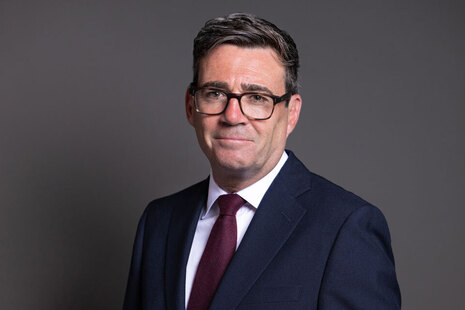
The speech made by Andy Burnham, the Prime Minister, in Manchester on 9 October 2026.
It’s good to be back on home turf and I’m sorry for the shock that Manchester-based members of the audience are feeling at seeing me in person in a tie.
So, I’m going to start by saying something that I used to say every week between the years of 2007 and 2010, when I was in his cabinet. Gordon is right. In every cabinet meeting. Very loyal. A very proud member, I might say. But life has taught me that he so often is.
And I think many people will know that, David Sainsbury and others, we all know that. I’m pleased actually that I’ve got a member of my cabinet here today, the Business Secretary, who is part of that Greater Manchester team that is increasingly making its presence felt on the national stage and the AI Minister Kanishka Narayan. We’re really pleased to be here with you all.
Gordon is right. Britain can be the world’s leading innovation nation. We are an innovation nation. But I today set the national goal to be the world’s leading innovation nation.
The good news is I think we’re already close. We’ve got multiple strengths and assets that Gordon’s mentioned, but this is a moment to challenge ourselves to go further. It’s what the country needs. I said this last week in Liverpool. We need to draw a line on a decade of too much drift, face forward, get a real sense of direction, purpose, hope in our hearts, knowing where we’re going. That’s what the country needs. It’s what I’m trying to bring, and I hope it’s beginning to be felt in all of the regions and nations of the UK. I think we can go further and I want to say a few things today about how.
The first thing though is just to question what is it to be an innovation nation and particularly to become the world’s leading. I would say this, it would mean having a globally significant cluster in every region and nation, every single one. And within those clusters, a globally significant company in every region and nation on the scale that Gordon was just describing. And from that, having opportunity, investment, growth and good jobs, fairly distributed across all parts of the UK as part of a new intentional national drive to re-industrialise the UK in the 21st century as an innovation-led, research-driven economy.
Re-industrialisation, that is a serious part of this mission and re-industrialisation that is felt by all people in all places. We can do it and we can be the nation in the next 10 years that as Gordon says, does find the cure for cancer or does make the breakthrough on dementia or indeed on nuclear fusion.
To anyone who says we can’t be that I say we did it before, so why not?
As Gordon said, this is the city where Ernest Rutherford in 1917, over a 100 years ago, first split the atom. So why can’t we be the place that makes nuclear fusion a commercial possibility. After all, the Dalton Nuclear Institute is literally a stone’s throw from where we are now, and it is world leading.
Innovation is a tradition in Britain. It is part of us. Ada Lovelace imagined what a computer could be in the 19th century, and this was before one even existed. And then Alan Turing laid down the blueprint for the world’s first programmable computer. And then he moved here to Manchester when that very machine was built here in 1948.
Tim Berners-Lee, as Gordon said, then put the world on the web. And more, if you think about life sciences, the millions of lives saved by Alexander Fleming and Edward Jenner, the electric motor, the jet engines and the telephone, all of these things, British inventions, Britain, a nation of inventors then and now.
The important thing is just to be clear about the assets that we have right now because they are to be found in every single region and every single nation of the UK.
An expanding creative sector in the Liverpool city region. It is unbelievable how many things you will watch tonight on Netflix or whatever that are filmed in the city of Liverpool. It really is an amazing UK strength.
Then if you look to South Yorkshire, the outstanding advanced manufacturing research centre that is doing so much to lift productivity in South Yorkshire.
One of the continent’s largest fintech sectors in Edinburgh, Europe’s gaming capital in Dundee, a global hub for photonics in Glasgow, clean energy in Newcastle, space research in Leicester, the future home of the UK’s biggest electric vehicle battery plant in Somerset, a global automotive engineering research and testing centre in Warwickshire, the frontier of quantum research in Oxford, 100 billion chip design company headquartered in Cambridge, a leading cyber cluster in Belfast, thousands of jobs in compound semiconductors in South Wales. You can tell I’ve become Prime Minister because I’ve not mentioned Greater Manchester once in this list, but I will now, Greater Manchester. The biggest UK AI cluster by headcount outside of London and the South East.
And then look at what is happening in London. There are so many strengths. The creative industries, obviously, but research, fintech, AI, our capital city is at the top of its game and can go further. So it’s proof isn’t it? We’ve got world-class strength in every region and as Gordon said every region needs now to punch its full weight and make its presence felt on the world stage as a home of innovation.
All of those clusters are underpinned by world-class universities, many represented in this room today and we thank you for what you are doing to drive the innovation economy in the UK. It isn’t said enough, I will say it today, without you we just couldn’t have done it.
I know as the Mayor of Greater Manchester, I’m obviously looking to Vice Chancellor of Manchester University when I say this but I know there are others in the room. We could not have done what we did here in the last 10 or more years without having the universities right with us, and I mean right with us, developing the thinking, the ambition for what we could be, and I know that applies elsewhere as well.
The university assets we have in this country are perhaps our strongest base when it comes to being a world leader in innovation. As Gordon said, 16 in the top 100, all of them conducting world leading research and spinning out a stream of startups.
We mentioned those London-based scientific institutions, but very shortly, the UK Biobank, a true global resource, will soon complete its move to the Manchester Science Park here. Life sciences in this part of the world about to take a major step forward, bringing cutting edge robotics and leading research into cancer dementia and heart disease to the fore.
Behind all of it, the government is investing over 80 billion in research and innovation in this spending review.
So, we’ve got the assets, we’ve got the talent, we’ve got the ideas and the ambition, but here’s the crux of it. Here is where we’re falling short. We are not making the most of them yet. And this is our collective challenge, everybody. This is what we must fix, and this is what today is about.
Being an innovation nation is thinking more about what we are all doing in our different places. It’s when you combine it all together that we’ve become more than the sum of our parts in innovation and this is what the next decade has to be about.
We can all see the world in the way that it’s changing and some of the challenges that it’s presenting to us. I’ve certainly felt that in my first two months as Prime Minister. They are huge challenges.
In Germany yesterday talking to Chancellor Mertz, we have to face them with our partners as well and our partners in Europe. We won’t rise to these challenges if we don’t think like that, networking as people ever are. It is the way we make Britain and the people of this great country safer, healthier and more resilient in the 21st century that is going to test us in so many ways.
We can’t do it any other way, and we need to think like that and set out a clear plan and a shared purpose and path for where we go next together and I hope that comes from today.
For me it does always begin with place as Gordon said. If we want to unlock the potential of people in all places, we do need to give more power for them to do more for themselves. And I have set up Number 10 North for precisely that purpose, to take power out of Whitehall and rewire an over-centralised country and create the optimum conditions for innovation on the ground in all parts of the UK.
And it’s great today to have the Cabinet Secretary, Antonia Romeo with us, and also Caroline Simpson, former Chief Executive of the Greater Manchester Combined Authority here today, Caroline leading the team at Number 10 North, both of them recognising that more power in the hands of people in our places is what will make the difference. That is when you see the fusion of public, private, academic sectors around place-based strengths.
That is how it happens. I saw it happen here, I know it can happen elsewhere, but when you have a Cabinet Secretary committed to civil service report, leading that change, evolving power, working with Number 10 North. This is when it gets exciting, everybody. And this is what I want, what has happened here and the powers that we have here available to all parts of the UK. And that is what we are going to deliver.
Because the key thing is when you have that, you have the ability to change the game and set new ambitions, you have the chance to improve the liveability of places. And that’s what we have tried to do here.
And I know Steve, my colleague in Liverpool, who’s doing exactly the same, as are the other mayors. You can then attract talent to live in these great cities that perhaps wouldn’t have come here before. That is a really important part. of it. And that is what has been happening here and elsewhere in the last decade.
So, when you are able to take more control over your destiny, and this place first in England to do it, what then happens is the crucial thing. You can set a new ambition. And that’s what we did, working with our colleagues in the private sector, Chris has been a huge driving force, as you all know here, and others who helped come together with us, our business leaders, in the city region with our vice-chancellors, then with the politicians, set a joint ambition and that’s what we did.
And the thing we’ve got to be honest about is when we had a country that was largely run from Whitehall, it didn’t have ambitions for its big city regions like this. It wouldn’t be able to articulate them if they’d been asked to say what was the ambition for the leaders, what was the ambition for Birmingham, it just didn’t have one. But when you give people power, they then will say that ambition and they will back their places and then those places start to move.
It’s like what Gordon said about putting a man on the moon. If you create a situation where people have the power to set a mission, it’s unbelievable and then people start to feel part of it and start to come towards it. And that is the joy of my life to see that happen here when I was the Mayor of Redmond and it’s still happening now under Bev Craig.
And that’s what I want everybody to be able to do, all parts of the country, to set new ambitions for themselves. And you can see the results when it happens.
For the first time, having set our ambition, we then worked with Theresa May’s government, actually, and I’m really pleased to see Greg Clarke in the audience today, because Greg led here a very important process which was the local industrial strategy process and that still underpins modern Greater Manchester and actually allowed us to develop our thinking around five clusters because that is where we got to.
We obviously had the original creative media cluster at Media City, Life Sciences on the Oxford Road and the UK Biobank that is as I said going to go up several levels.
Digital, cyber and AI across the city centre, our third cluster. And we have the emerging advanced materials and manufacturing cluster at Atom Valley, in the North East of Greater Manchester and Clean Energy at Carrington, five clusters and that came from that work and we thank you Greg for that.
All built from the bottom up and this is the important point that everyone in Whitehall needs to understand and I think they’re getting the message now. It comes from the bottom up, that’s how growth is, it has to come that way. And it’s when you combine the different things together that then you weave it into something that becomes powerful and compelling.
Business, academia, local government working in lockstep with high ambition. That’s what we want everywhere. And I want personally to see everywhere taking a step forward in that direction very shortly.
I want all areas to have a good growth fund, on the model that has been established here. A single investment pot drawn from public sources which can then attract private capital and decisions can be made quickly and made jointly and we will say more at the budget about how that will be achieved.
As part of that commitment I want to announce three specific measures today.
First, we will devolve local innovation partnerships funds to established mayors from 2028. Now this is significant. I’m going to explain this because this is the first step towards devolving dedicated innovation funding to local leaders. So, a very significant announcement.
Second, we will build on our existing industrial strategy at a national level by identifying the clusters around the UK with the potential to become truly world leading and with UKRI, commit one billion pounds over the next four years to back these clusters and these places.
So that is working with UK Research and Innovation to take a more place-based approach to innovation is something the mayors have long called for and it’s about to happen.
And thirdly, picking up on what Gordon was saying, I want to see more collaboration between clusters in a way Britain has never managed before.
Lou Caldwell chaired the business board here in Greater Manchester and she pioneered the partnership between Greater Manchester and Cambridge which has really already started to open new thinking and we’re really proud that that has really taken root.
You know Cambridge, home of incredible health research. When you connect that health research to a city region nearer 3 million people with a digital care record, you immediately see how the potential for clinical trials is totally transformed.
And on the back of that we’ve seen Liverpool and Oxford sign a new partnership. Imperial and Warwick, doing the same. We want to see more of it, a more collaborative UK. If you think of that Edinburgh FinTech sector or gaming in Dundee, partnering them with counterparts in England, Wales and Northern Ireland. That’s the way I think the UK will start to punch above its weight and that’s what we’ve got to do, partnering complementary clusters around the UK.
So that’s the third element of this. If we do these things in this way, Number 10 North will lay the foundations for the innovation nation.
But given the fierceness of competition globally, the Chancellor and I know we need to do more to back British investors, British inventors, entrepreneurs, and businesses.
Our people will always be our most important asset. I believe everyone should have the opportunity to go as far as their talents will take them.
It does need to start in schools, and we will reshape the education system so that it is innovation ready, 21st century ready and that does mean basing it on parity between academic and technical so that there is a path for everybody into the innovation economy.
It can’t be about supercharging a part of the economy and everybody else feeling shut out. We need to give paths to everybody into the emerging innovation economy.
And from there we need to provide quality pathways towards work experience working with our employers, work placements, apprenticeships, solving Britain’s skills deficit in a re-industrialised economy.
What we also recognise is of the 100 fastest growing companies in the UK last year, more than half were founded by people who came to Britain.
And let me just say for a moment, we thank them for coming here. We welcome them here. We need the brightest and the best from across the world, researchers, academics, entrepreneurs to keep choosing here. And it’s why we will have an international outlook in everything that we do, building closer ties with Europe and making sure that we have that outlook in everything that we do, not too much of the division that we’ve seen in the last decade.
This is time to network here and around the world and that is what we will do.
I also know we need our innovators to be able to move freely between companies and start their own without constraint.
I believe some businesses have gone too far in their use of restrictive practices such as non-compete clauses.
A few I know shared by many in this room and across the sector. Non-compete clauses stop workers from joining a rival organisation or indeed setting up one of their own after they have left their role and I think that’s a drag on innovation and prevents the best really being energised and bringing that dynamism to the economy.
So, we are looking at changing this. They are often held back and unpaid during the time they have to sit out on the sidelines, and it does, as I say, stunt innovation and traps workers.
So, I can confirm today we will legislate to make sure that non-compete clauses will no longer be a barrier to hiring for our most promising startups and scaling firms.
Call it, if you like, the Bosman ruling for the innovation sector, but I think it’s much needed and long overdue.
And we will ensure, by the way, that workers in the foundational economy, the everyday economy, are not prevented from moving jobs too.
We will also bring forward options to address the wider use of restrictive practices. Everyone needs talent to succeed. Everyone needs investment to grow. We are in Britain very good at financing companies early on. The problem is that when our companies are ready to scale, the money too often comes from abroad or not at all. And before long, that company will head to where that investment came.
We have, I believe, been too relaxed as a country about this arrangement. How many innovations, how many inventions can you think of that began here and then were scaled up somewhere else around the world?
This is part of our national story, which we should not be proud, and we should commit to change today.
Over the last two years the government has sought to increase domestic investment in UK assets through the creation of a national wealth fund and reforms made to the local government pension scheme, but we will go further and ensure more UK pension capital is invested specifically in British-based, high-growth companies.
With talent and capital, you also need somewhere to sell. We are the fifth largest economy in the world, yet alone our market is simply not big enough for one of our startups to grow into a global giant. And this is why our trade deals with the US, India, and others matter, why closer relations with the European Union matter.
You all heard me talk before about the power of public procurement to re-industrialise Britain, and this applies just as much to our shipyards and steelworks as it does to our start-ups, and we will make British public procurement work harder.
We will work with our trade unions too, represented in this audience today with Jay McKenna from the TUC.
We will make sure that we get good jobs by using social value procurement too.
We’ve got a great example of that on the River Mersey with Camel Laird or the former Camel Laird site and what has been happening there.
I want to see so much more of that across the UK. British public procurement driving re-industrialisation but also giving good secure jobs to people in all places. And that will be a very big theme.
So, this is how we use our resources better to support British business and retain sovereign manufacturing capability and technology. A government on your side not in the way. That’s what we want to be.
I know it’s not always felt like that. Our Regulatory Innovation Office is changing it. New sandboxing powers will allow us to suspend rules temporarily, giving innovators the space to test out ideas more freely.
It means you can develop new technology more quickly and bring new medicines for instance to patients faster.
We cannot speak about innovation today without mentioning AI.
Of course, it is a foundational technology that would underpin all of the sectoral strengths of the United Kingdom, and we need to have a mentality of building out the AI sector everywhere to support a research driven innovation led economy everywhere.
As you know Britain takes the presidency of the G20 next year and I have promised to demonstrate our renewed confidence as a country by putting AI top of the G20 agenda.
We do need to take an AI for good approach first and foremost because it can unlock everything that we’re talking about today, but at the same time be clear-sighted about the risks it may pose.
And just as Gordon did in the aftermath of the financial crisis in 2008, convening the world around a set of principles and standards to safeguard the global economy, so Britain will do it again, using the high level of trust that we have from many countries to develop a global set, a global code of standards and principles to support an AI for good approach, but at the same time making sure that we guard against any risks it may pose.
This could be a major moment as the G20 comes to Manchester for the Leaders’ Summit next year, a huge opportunity for investment and I hope you will work with me to unlock it right around the country.
Even if we get all of this right, it is still a fact that business and those who build companies want to see a reward. And those who back them expect to see a return.
If the UK wants to build global companies, we need to be globally competitive. To do that, we cannot have Britain’s startups simply sell up.
So, one of our biggest challenges is breaking through our own ceiling.
Too often our best ideas are developed and scaled overseas, as I said, with it the jobs, technology and investment that goes with them.
So, I know there is more to do to fix that, specifically on tax, to encourage people to stay and scale.
And if we do that, we know the UK can become home to trillion-pound companies in the future, as Gordon was saying, who employ thousands of people, pay taxes and invest in local communities.
Obviously, we will be able to develop that thinking as we go forward from here.
So, I want to finish by where Gordon ended his remarks in that concept of an idea galvanizing everybody and then bringing progress forward.
When we were speaking about this event, we talked about how an innovation nation comes to life around some of those big missions that we might set ourselves. But what is it that we’re ultimately reaching for here?
I mentioned jobs and apprenticeships and investment opportunities and obviously people having higher living standards, growth productivity, all of those things are important.
But the main thing, and let’s not today forget this, it’s about human progress at the end of the day. That’s what innovation can most bring, in the 21st century, making sure that everywhere we can see and feel human progress. And I think there’s areas where we need to go further. And I want to learn from something I did when I was here as Mayor.
I was advised when I came in 10 years ago that we could within a decade end all youth transmissions of HIV in the Greater Manchester, I should say in a generation.
It was part of the Fast Track Cities initiative, a call to arms to improve screening, education, testing, and get life-saving antivirals to the most vulnerable in our city and region. I’ll be honest, I felt sceptical about it all the time. I was worried about making a commitment that we could end new transmissions of HIV in greater amounts within a generation.
I look back at it, and I castigate myself for the caution because the progress has been incredible.
When you do put out a challenge and you ask people to pull together. It’s amazing actually what happens and the progress that we’ve achieved on it means we’ve achieved our fast-track HIV goals as a sitting region.
And I learned from that and then start to think well how do then we apply that thinking more nationally.
So, what we need to do is draw from our past and start to set new goals for the future.
I think we are a global leader in life sciences, and we should be proud of that status. We all remember what happened during the pandemic. Britain was at the forefront of the development of the vaccine.
We have successfully added years to life in so many ways, but I look at a challenge that is particularly personal to me right now.
We have nearly a million people living with dementia in Britain and I cannot stand before you today and say that we know enough about it because honestly, we don’t.
When people get a diagnosis, what are they told? But even before a diagnosis, do we all know enough individually about what we might do now to change our lifestyle to reduce the risk of dementia in later life. I don’t think we do, do we?
This is the issue, I would say, or one of the issues in the 21stcentury, but we’re still in a position where we are not facing it fully.
Cancer has made a huge drive in terms of what we know and what we can do, and we need to see the same now around dementia.
Cancer was the 20th century focus and look what’s been achieved and we need to keep that going. But we need to convene people in the same way because I do know three things from personal experience.
First, I know of its cruelty as a disease and what it does not just to the person but the people around that person. It’s devastating, absolutely devastating and I know many of you know that too.
I also know, secondly, that we don’t know enough about it. As I said before, it’s quite shocking actually when you are in that experience and you start to try and find out more. I know amazing work being done by the Alzheimer’s Society and Alzheimer’s Research UK, but still, we don’t know enough about it, nowhere near enough.
But thirdly, and more positively, there is extraordinary work underway to find out more and to stop it.
The Dame Barbara Windsor Dementia Goals programme was set up by a previous Conservative government. Part of that programme includes the Barbara Alliance, a brilliant organisation which carries out some remarkable work in the search for new dementia treatments by increasing the number of participants in clinical trials.
Today I’m very pleased to announce 33 million pounds of government investment to support those life changing efforts. And with thanks to additional industry funding, it means a total of 48 million will now go to speed up the development of dementia treatments.
I can also confirm today that the Health Data Research Service, a 600 million investment by this government and the Wellcome Trust, will select dementia as one of their first priorities.
And this is a move that I hope will make the UK the leading nation in dementia research. I want Britain to be the country that makes the breakthrough and delivers the cure for dementia the world has been waiting for.
And I say it knowing we can do it. Absolutely confident that we can. When this country pulls together, there is nothing that we can do. We are unbeatable.
I mentioned the vaccine, the Oxford vaccine, but also there are so many other things that we can point to for Britain to take pride in and then from that start believing in ourselves again.
We have everything we need to succeed. We’ve got the finest minds working at the most prestigious universities, the most innovative companies and clusters producing some of the most advanced technologies.
We are doing so much right, but we can do so much more. We have good opportunities now in all of our nations and regions to deliver something that I’ve set as a mission as Prime Minister, good growth in every postcode.
Let’s really focus on that and bring innovation to all parts of the UK as well. We can grow our companies into global giants. We can extend the chain of human achievement. We can be the world’s innovation nation.
Thank you very much.


![PRESS RELEASE : Migrants exploiting human rights laws targeted in fresh reforms [October 2026]](https://www.ukpol.co.uk/wp-content/uploads/2025/09/homeoffice.webp)




![PRESS RELEASE : Prime Minister call with President Volodymyr Zelenskyy of Ukraine [October 2026]](https://www.ukpol.co.uk/wp-content/uploads/2025/10/downingstreet.png)