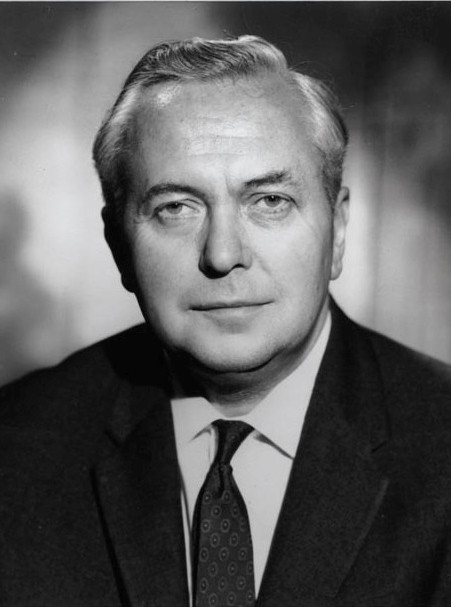
Below is the text of the speech made by Harold Wilson, the then Labour MP for Huyton, in the House of Commons on 7 November 1978.
I associate myself with what my right hon. Friend the Foreign Secretary and the right hon. Member for Cambridgeshire (Mr. Pym) said about the retirement of John Davies. We shall remember his unfailing courtesy and his diligence in whatever task he was given. Some of us, of course, remember him in his FBI—and later CBI —capacity, I am glad to have the opportunity today to comment on all that has been said and written before and since the publication of the Bingham report on Rhodesian oil sanctions. I was abroad when it was published. When I returned to London, I said then that I would reserve all public comment until this debate since, as I was Prime Minister during part of the relevant time covered by Bingham, I was answerable then to the House and therefore the statement is due to this House.
At the same time, I called for a full public inquiry involving or invoking whatever powers were needed, which must mean the right to call for the appearance of persons and the production of papers, including all relevant Government documents, Cabinet minutes, Cabinet committee minutes—all papers submitted to the Cabinet and its committees and all interdepartmental exchanges. I have called also for all the relevant papers to be laid as soon as possible before the House itself and to be published. Before I sit down I shall say why I think that that is necessary.
Even since that time a month ago when I made that statement, still further facts have emerged which keep putting the controversy into a yet different light. A fortnight ago, The Sunday Times carried a story asserting that one of the two British oil companies was still supplying oil to Rhodesia, on a transfer arrangement with Mobil, Caltex and others, right up to a date four days before the Bingham report was published. What that means, of course, is that not one but three Prime Ministers in office from 1968–69 to 1978 were unaware of this disreputable traffic. Whether it was disreputable and illegal must be a matter for the Director of Public Prosecutions and the courts. But over this period there have been three Prime Ministers, five successive Foreign Secretaries and nine Energy Ministers— counting my right hon. Friend the present Secretary of State for Energy as two because he held the position both in 1969 and from June 1975.
I am perfectly certain that none of those Ministers—none of the holders of those posts in successive Governments—knew of any of these events. Indeed, I should mention that you yourself, Mr. Speaker, received an honourable mention in the Bingham report, particularly for putting inconvenient questions to Shell at one of the meetings when, I think, you were Minister of State. There is in a letter reference to both my noble Friend Lord Thomson and to the then Minister of State, whose name at that time was George Thomas and, I understand, still is.
The situation regarding knowledge of these facts has not changed from that time right up certainly to 1976. In 1976 the Government sent a report to the United Nations sanctions committee, and this is what it said:
“The competent United Kingdom authorities have studied the report most carefully, and have discussed its contents with the British oil companies mentioned. These authorities are satisfied that the report contains no evidence of sanctions breaking by any British companies or individuals and have accepted the assurances given by Shell and BP that neither they nor any company in which they have an interest have engaged either directly or with others in supplying crude oil or oil products to Rhodesia.”
I emphasise that the report said:
“neither they nor … with others. This is the same position”
—the report continued—
“established as in 1968 when Her Majesty’s Government investigated similar charges at the highest level with the same companies.”
That was 2nd September 1976. The Government made it plain that in 1976 it did not regard the position as having changed since 1968 and that no more about the illegal or disreputable traffic was known in 1976 than in 1968.
In my own case the first time I received any information—I shall give details to the House in a moment—indicating this traffic now exposed in Bingham was last April, seven months ago. In a speech at Oxford I criticised on that occasion Mr. Andrew Young’s attack on my right hon. Friends the Prime Minister and the Foreign Secretary the previous day, when Mr. Young accused my right hon. Friends on the Treasury Bench of wanting to get rid of the responsibility for Rhodesia. On the following day, 2nd April, I was asked to appear on BBC radio to discuss Mr. Andrew Young’s position.
I was asked in the course of that interview about sanctions. I repeated what I had always been told and what I had made public, namely, that in my view the breach of sanctions was due to President de Gaulle, who appeared to connive at oil shipments through Mozambique, crossing the border into South Africa, and then, some miles further into South Africa, forking right into Rhodesia. It was a tortuous route, now described in detail in the Bingham report, with place-names and maps. That was what we understood to be the position and it was what I told the House and said publicly.
Indeed, I had been asked by the Cabinet, as the House knows, to raise this matter of French behaviour with President de Gaulle on my visit to Versailles in June 1967. Our conversation on that occasion and what President de Gaulle said has been reported and is public knowledge.
My reference to this matter in the BBC programme led to my receiving a somewhat intemperate letter from Mr. Rowland, of Lonrho, which he has recently published. He said that I must have known about the action of BP and Shell, and he enclosed a number of documents of his own purporting to substantiate his allegations about them. I replied to him that I knew no more than what I said on a number of occasions, including the BBC broadcast, but that since his documents seemed to relate to his legal action against the oil companies concerned, I could not comment.
At this point it is appropriate to quote the Bingham report. At the beginning—
Mr. Robin Maxwell-Hyslop (Tiverton) rose
Sir H. Wilson
I am sure that I shall deal with the hon. Gentleman’s point later.
Mr. Maxwell-Hyslop
Could not the right hon. Gentleman send his dirty linen to a laundry—
Sir H. Wilson rose—
Mr. Maxwell-Hyslop
—so that the House can get on with the debate? Will he not—
Mr. Speaker
Order. Once the right hon. Member who is addressing the House gets back to his feet, the hon. Gentleman must he aware that those who are intervening must resume their seats.
Mr. Maxwell-Hyslop rose—
Hon. Members
Sit down.
Mr. Maxwell-Hyslop rose—
Mr. Speaker
Order. I thought that the hon. Gentleman’s intervention was Over.
Mr. Maxwell-Hyslop rose—
Mr. Speaker
I know that the House wants to give a good hearing to the right hon. Member for Huyton (Sir H. Wilson), who has an important statement to make to the House.
Mr. Maxwell-Hyslop
Ex-Prime Ministers are not absolved from the normal rules of the House. The right hon. Gentleman gave way to me. [HON.MEMBERS: “Sit down.”] I have the same rights as any other hon. Member of this House in debate. The point I wish to make—[HON. MEMBERS: “No.”]
Mr. Speaker
Order. May I explain the position? I thought that the hon. Member for Tiverton (Mr. Maxwell-Hyslop), who knows procedure very well indeed, knew that if the person who is being called to speak rises to his feet again he must be allowed to continue, otherwise it will be possible for an hon. Member with an intervention to speak for 20 minutes. The right hon. Gentleman had got back on his feet. Sir Harold Wilson.
Mr. Maxwell-Hyslop
On a point of order, Mr. Speaker. It is not in accordance with the rules of order of this House that when a Member gives way to another he can then terminate a short intervention by rising again. [HON. MEMBERS: “It is.”) It is not. I put the question to the right hon. Gentleman—
Mr. Speaker
Order. The hon. Gentleman is on one of those rare occasions when he is not correct. [HON. MEMBERS: “Quite right.”] Order. I wish the House would leave this to me. The hon. Gentleman, on reflection, must realise that the House wants the right hon. Gentleman to continue.
Mr. Maxwell-Hyslop
Further to that point of order, Mr. Speaker. I willingly and gratefully give way to your ruling.
Hon. Members
Oh.
Mr. Speaker
Order. I wish that some of those who laugh would give way as quickly.
Sir H. Wilson
There are some important matters to discuss, and I am sorry that I gave way and caused that long delay.
At this point it is appropriate to quote the Bingham report. At the beginning of what he calls “Factual conclusions” on page 212, chapter 14, paragraph 3(b), Mr. Bingham says:
“In making this summary we would emphasise … that the summary is of facts now known”.
The word “now” was underlined by Mr. Bingham. He goes on:
“many of the facts now summarised were not contemporaneously known to one or other or both of the Groups ”
—that is BP and Shell—
“in London; some were not known until the relevant documents were assembled from many sources for presentation to us”
—that is, the Bingham pair. He continues:
“some came to light in the course of the investigation. It would be wrong to assume that all the events now summarised were known to the Groups in London at the time the events were taking place.”
That is certainly true. Bingham’s examination of 40 witnesses, mainly South Africa-based—especially Mr. Walker— has unearthed many facts. Some, I am sure, were not known to Shell and to BP headquarters. All the more so, they were not known to Her Majesty’s Government until Bingham was published.
The Sunday Times report of 22nd October this year, referring to the supplies continuing until September this year until four days before Bingham was published, was first denied by BP within the day. The report was then confirmed by BP the following day. If BP did not know that, Her Majesty’s Government had an even smaller chance of knowing. Yet this was going on all the time until September this year. The same is true of fact after fact catalogued by Bingham—some but not all of which the London headquarters of the major oil companies did know, but they were facts, which we, the Government, did not know.
In August, while I was on holiday, I read press reports seemingly anticipating what the Bingham report would say. They were mainly leaks of Lonrho’s submissions to Bingham. Therefore, in September I availed myself of a former Minister’s right to look at all relevant documents, as well as Cabinet documents and papers, as well as two other documents sent from the Foreign and Commonwealth Office to No. 10. One of these was the letter from Lord Thomson of Monifieth. He said in a Granada Television programme that he had apprised me of the fact that British oil was getting through to Rhodesia. In fact, his letter said that British, French and American oil was getting through to Rhodesia.
The second of the documents which I especially asked to see, and almost know by heart now, was the minute of the meeting chaired by my noble Friend on 6th February 1969, now published in Bingham, annex II pages 268 to 271. I shall address myself first to those two documents because most of the discussion was centred on them. My study of the documents at No. 10 confirmed that the letter of 15th March 1968, to which he had referred, was sent to me and that I had seen it. I had ticked it in the usual way. Now let me refer to its contents. The letter was from Lord Thomson’s secretary to mine. It was in reply to a memorandum from my office which had asked for an investigation into President Kaunda’s allegations of British breaches of oil sanctions.
The reply began by outlining the action taken by the Commonwealth Office to secure a rebuttal of the suggestion that the British major oil companies were breaking the sanctions. It stated that it had been decided to use a Question tabled by my noble Friend Lord Brockway in another place that was answered by Lord Brown, then of the Board of Trade. The letter recorded the Minister’s answer of 5th March 1968, which read:
“The investigations done into the activities of British oil companies leave Her Majesty’s Government satisfied that the British oil compaines themselves are not supplying oil to Rhodesia.”—[Official Report, House of Lords, 5th March 1968; Vol. 289, c. 1220.]
That was an arranged answer that will be found in Hansard of another place.
Hon. Members will have noticed the word that I accentuated—namely, “themselves”. I inquired into that. That was a reference to “unreliable purveyors” as we knew them in those days, secondary dealers in Lourenco Marques who were suspected by our people of not being above passing on their supplies to South Africa. Some of them were suspected by our people of not being above sending on to Rhodesia by one of a number of routes the oil that they had bought. The oil majors and the British Government were all at one in warning British companies in Mozambique to be vigilant in checking the bona fides of those whom they supplied. The letter went on to refer to assurances of Mr. McFadzean of Shell and Mr. Fraser of BP on careless sales to those who were really spivs.
The letter included another much publicised phrase that justified my noble Friend’s answer to a question put to him on the Granada programme. The passage in the letter reads:
“although we are satisfied that British oil companies have at no time been directly involved in the supply of oil to Rhodesia through Mozambique, we now know that a good deal of the oil which is getting to Rhodesia has been corning from refined products delivered to Lourenco Marques by the French, British and US oil companies. In other words, the oil which is getting through to Rhodesia, does not all come from Sonarep or CFP”.
My check on that point was again answered in terms of the spivs, the unreliable secondary dealers, whom the Government and the oil companies agreed should be investigated and dealt with by denying supplies case by case.
The conclusion drawn at almost every Cabinet and Cabinet committee every time we met throughout the period, and for a long time afterwards, as the House was told on many occasions, was that French, Portuguese and some American companies were the real culprits. At every stage that was recognised, and at almost every ministerial meeting renewed demands were made for bilateral approaches to be made to France, Portugal and the United States and reference made to the need for a comprehensive United Nations resolution binding on all these suppliers.
I have referred to my meeting with General de Gaulle. In the event—much later—we had the United Nations resolution. The countries that I have named ignored it or got round it.
I have set out the Government’s aim during that period. I do not know what more we could have done. I take up a point, with which I totally agree, that was made by my right hon. Friend the Foreign Secretary. We knew that we could not have a major military confrontation with South Africa. It would have been necessary to impose a blockade on South Africa. The Beira patrol took five frigates. A study of a possible Lourenco Marques patrol suggested that a further 17 would be needed. Any question of blockading South Africa would have been utterly unreal. Even if it had been possible, what would it have meant? Would it have meant cutting off all oil supplies to South Africa? If we had “rationed” South Africa, Rhodesia could still have been supplied. The oil consumption of South Africa was far greater than Rhodesia’s needs.
At the beginning of the Bingham report it is made clear that South Africa needed 5 million tons a year while Rhodesia needed only 400,000 tons. Rhodesia’s consumption was 8 per cent. of South Africa’s. In an old phrase, the South Africans could have put aside the supplies needed for Rhodesia in their eye corner and seen no worse. The hope, forlorn as it proved, was to try to get a United Nations resolution and South African compliance.
My right hon. Friend the Foreign Secretary has mentioned the arms embargo on South Africa. That was something we were able to deal with and we did. We had made an announcement before the General Election of 1964 that we would immediately impose an arms embargo. That was done the morning after the Government were formed—indeed, before the Cabinet had ever met. I gave an order that all shipments of arms to South Africa must stop. I heard to my surprise on the Sunday that arms were being unloaded from some ships at Southampton. Opposition Members may or may not have agreed with our policy, but they will recall that in 1974—some shipments of arms to South Africa had taken place while Labour was out of office—we announced to the House a short time after taking office that we had stopped the aircraft shipments and the shipments of other arms to South Africa.
I turn to the second important document to which I referred—namely, the Foreign Office note of the meeting held between my right hon. and noble Friend Lord Thomson, Foreign Office officials and the chairmen of Shell and BP. My right hon. and noble Friend took that meeting, but by that time he had no direct responsibility for Rhodesia and sanctions. The Commonwealth Office had been merged with the Foreign Office. In 1968 he had, as Minister without Portfolio, maintained a sort of residual responsibility for Southern African affairs. By 1969 he had entirely different duties as Minister without Portfolio. Later as Chancellor of the Duchy of Lancaster he had a number of entirely different duties—for example, the co-ordination of Government action on the Redcliffe-Maud report on local government reform to a growing, later full-time, preoccupation with renewed plans for seeking entry to the EEC. Nevertheless, at that time my right hon. Friend the then Foreign Secretary was away and my right hon. and noble Friend was asked to chair the meeting with the oil majors.
The only Minister present with direct responsibility for African affairs was Maurice Foley. The House will remember that he had a great knowledge of Africa. As we can see in the note now published, his only contribution was on an entirely separate point that had nothing to do with the so-called laundering—namely, the rationing of South Africa.
The text of the note of the meeting is published in the Bingham report. The report makes clear its circulation. A copy was sent to No. 10. It was not circulated to the Cabinet either by the Foreign Office or by No. 10. I have checked on that on a number of occasions in recent weeks.
I have seen the copy that came over. It was not marked to me. There is no record of my seeing it. Nor is there any record of it having been seen by Sir Michael Palliser, as he now is. That may sound bizarre, but hundreds of documents, telegrams, despatches, notes of meetings, reports and assessments from the Foreign Office come in every week from the Foreign Office. This particular document—I note that the Prime Minister agrees with me—was not marked urgent or highlighted in any way. It was not marked in any way.
A copy was also marked—I must tell the hon. Member for Staffordshire, South-West (Mr. Cormack) that this is not a laughing matter—to the private secretary to the Cabinet secretary, Lord Trend. Again it was not marked for special attention by him. If Lord Trend had thought that it contained anything of the sort that the Bingham report has imported into it, I am sure that he would have come steaming in right away to insist that it go to the Cabinet. It was the document that set out the minutes of the meeting that I have mentioned, the Shell-BP-Total deal.
The text of the meeting suggests that there was little realisation of the import of the disclosure. Partly in the light of material only later available, the Bingham report clearly regards it as important. If we had had the same material available, we would have regarded it as important. There is also published in the Bingham report a report of the oil companies of the same meeting. No one took the view that it was important at the time. They did not even open a file on it.
My right hon. Friend the then Foreign Secretary saw me shortly after the document had been circulated. He saw me not about Total but about the Soames affair, which was greatly engaging the interest of the Foreign Office at the time. My analysis is that Michael Palliser was similarly preoccupied. He had been appointed to the post of Minister at the Embassy at Paris. He was being briefed and was, indeed, regularly visiting Paris at that time. He was also heavily engaged in preparation for my visit with him to Nigeria and Addis Ababa at the height of the Nigerian war. There is no reflection on him whatsoever for failing to realise what nine and a half years afterwards is now recognised in that particular document.
It is tempting to ask: what would have happened if someone—a Foreign Office Minister or official—had realised the document’s importance? I know what would have happened. The Foreign Secretary, my right hon Friend the Member for Fulham (Mr. Stewart), would have dropped everything and come round to see me, perhaps stopping for a moment to telephone me to say that he was on his way. He would have put it as the first item on his weekly general report to Cabinet on foreign affairs. My right hon. Friends who were members of Cabinet know that this would have been reported there. But it was not in fact reported to the Cabinet or to any relevant Cabinet committee or any other. I ask the House to consider what would have happened if our attention had been drawn to its implications.
The Bingham report, nearly 10 years later, has been sent to the Director of Public Prosecutions. Obviously, I cannot comment further on this.
Sir Bernard Braine (Essex, South-East)
Will the right hon. Gentleman give way?
Sir H. Wilson
I am sorry, but I have given way once too often. [HON. MEMBERS: “Oh.”] I shall certainly give way to the hon. Gentleman. I always used to do so on similar subjects. However, I should like to develop this point before I give way.
The then Attorney-General, now my noble Friend the Lord Chancellor, would in these circumstances have been no less vigorous in taking action, if the meaning of the minute had been realised, than the Director of Public Prosecutions. I do not think that my noble Friend the present Lord Chancellor would object to my saying—and there are former colleagues present tonight who will confirm it —that no member of the Administration was more hawkish on Rhodesia than my noble Friend when he was Attorney-General. He had been intimately involved long before UDI. He had been with me to Salisbury in our October 1965 mission, hoping to head off UDI. He was with me on HMS “Tiger” and on HMS “Fearless”. He was, if anything, critical of any willingness to do any kind of a deal with Mr. Ian Smith on those occasions, as indeed, equally, was my noble Friend Lord Thomson. Both of them were very critical of apparent easy ways out. So his duty as Attorney-General would have been clear if the significance of the Total deal had been recognised.
Therefore, unless one suspects a conspiracy of the then Foreign Secretary, my noble Friend the Lord Chancellor, a wide circle of foreign officials and the Cabinet Secretary to deceive both the Cabinet and Parliament, it is certainly the case that the future conduct of every ministerial meeting involving Rhodesia would have been entirely different, and we would have been taking up these questions many years ago.
Sir Bernard Braine
The right hon. Gentleman is taking us through a catalogue of events as he remembers them. Will he take his mind back to the date when he saw President de Gaulle? Am I not right in saying that precisely 12 days before that Foreign Office officials had met French Foreign Office officials in Paris in order to discuss alleged breaches by British oil companies of sanctions? Is the right hon. Gentleman telling the House that he was not told of that at the time, that he and his senior civil servants were totally unaware that sanctions were being broken? I think that the right hon. Gentleman owes the House an explanation in view of the statement that he has been making, which would suggest that neither he nor his senior officials, at any time, knew anything about what was going on, and that is very hard to believe.
Sir H. Wilson
No, Sir. There were two cases in those years, and certainly at that time, in which allegations were being made about Britain. Indeed, the meeting to which I have referred concerned allegations from the Portuguese. The Portuguese themselves were spreading allegations that Britain was breaking sanctions at that time. [HON. MEMBERS: “Oh.”] It is all in Bingham. They were making allegations and our officials discussed with the French the allegations that were made against us. That was when we were trying to get the French to agree, before I met de Gaulle, that they would stop breaking sanctions. That is as I recall it. Certainly there was a meeting just before I went for that purpose.
Mr. Roderick MacFarquhar (Belper)
Accepting my right hon. Friend’s statement, of course, that there was no vast conspiracy of the type that he indicated at the end of his last set of remarks, may I ask whether he would not at least accept that there must somewhere have been a grotesque error of judgment and that it is impossible to see, in his catalogue of all the people who could not have been guilty of that grotesque error of judgment, where it lay?
Sir H. Wilson
Before I sit down I intend to say where I think criticism may be applied. [HON. MEMBERS: “Oh.”] Certainly. But the very point raised by my hon. Friends is my reason for pressing so strongly for a full and independent inquiry. Let the inquiry see all the papers and all the facts and let the inquiry say, independently—not those who were involved in this matter or those who were not involved, or those who put questions about it now—who, if anyone, was guilty of this evasion.
As I have said, I have been through the record of every Cabinet and Cabinet committee meeting during those three years. These are the ones that I have suggested ought to go to an inquiry, and not only to an inquiry but to the House. I do not know whether the assent of one Prime Minister is enough to get the papers for his period. As far as I am concerned, if it is necessary to have my consent, I am agreeable, if the rules and conventions permit. I am sure that they do.
I will say this much: at the Cabinet meeting of 7th March, one month after the famous meeting in February chaired by my noble Friend, we discussed sanctions. No reference was made to the 6th February meeting. At none of the meetings held that year—I cannot go into details, though I have read all the minutes and all the papers—was any reference made to that particular meeting of 6th February. At a sub-committee in April, I asked for a full report on sanctions to be submitted by the Foreign and Commonwealth Secretary, and we got a full report, on nearly 30 pages, both by my right hon. Friend and by a committee of all the officials of all the Departments concerned. There was no reference there to the Total deal, CFP, nor was there any reference whatsoever to the meeting on 6th February.
Mr. Alexander W. Lyon
Will my right hon. Friend give way?
Sir H. Wilson
No, I am sorry. I have given way too often. I might give way when I have finished developing my point.
In addition to the Cabinet and associated minutes and documents, I asked No. 10—the people there are always ready to do this—to make available every letter, every minute, every comment, notes of telephone calls, the lot, during this relevant period—four bulky files, in all about 8 in. or 9 in. thick. I have been through them. They cover inquiries mainly by myself or by my right hon. Friend the Foreign Secretary on drought in Rhodesia, registration of trade marks, successive drafts of speeches for my noble Friend Lord Caradon, a scheme of mandatory certificates of origin in reducing exports from Rhodesia, queries about Orders in Council, queries about reports from Lisbon about a questionable sugar deal, demands to chase up reports from Greece, Norway, Italy and West Germany, two more about dubious shipments of ferrochrome and maize, questions about certain European countries and Japan concerning CKD cars, and where the Dutch were getting their tobacco from.
I cite all this. I think that Opposition Members felt that this was work that should not have been being done. I am just making it clear that so much work was going on and I was so much involved in this myself that it is inconceivable that any of us could have known about or colluded with the story about a total breakdown of sanctions on this important question of oil.
As I say, some hon. Members might feel that I should have been concerned with weightier matters, but that was what was inevitable. As I say, it is inconceivable that it could have been involved at the time if we had known anything about an oil swap with France, Total or anyone else.
I have mentioned these as well as the whole history that I have unfolded, and even the documents that I have quoted, because I believe that I have the right to ask the House to conclude that it would have been inconceivable for my Cabinet colleagues, myself, the Attorney-General or the officials to have connived at any action brought to our notice constituting a body blow to our sanctions policy.
There was therefore, as far as the Government as a whole and individual Ministers were concerned, no awareness that the meeting of the oil company chairman with Lord Thomson had created a new situation. With the advantage of hindsight and what Bingham has revealed, this collusive agreement had shown the situation very clearly in terms of BP and Shell’s relationship with Total. Had we known then what Bingham has reported, it would have been taken much more seriously. It would have been the duty of myself or the Foreign Secretary, or the duty of us both, to report to Ministers collectively. We would have to have initiated a fresh look at the whole situation and involved the whole Cabinet. The Attorney-General would have had to look at the situation and the Director of Public Prosecutions would almost certainly have been involved—nearly a decade earlier than he has been involved. All the heart-searching of Cabinet and Cabinet committee meetings in 1969 would have had to take account of this situation. Instead, the whole emphasis was placed on trying to secure South African, as well as French and Portuguese, adherence to United Nations policy.
Mr. Alexander W. Lyon
The whole implication of what my right hon. Friend is saying is that our colleague Lord Thomson did not disclose to him what we know, through the Bingham report of the meetings, was disclosed to the noble Lord. Is my right hon. Friend really saying that that would happen between the Commonwealth Secretary and the Prime Minister on an issue of this importance? How does my right hon. Friend meet the denial of Lord Thomson that he failed to disclose to the Cabinet what took place at the meetings?
Sir H. Wilson
Let me say first that Lord Thomson was not Commonwealth Secretary at the time. He was working on other things entirely. He might not have known whether there had been any developments. I certainly do not believe that when my noble Friend heard what was said he realised the implications. It is easy to he wise and critical 10 years after, but it is clear and the Commonwealth Office official—and I am not resting on officials here—interpreted it to him in terms which suggested that there was no necessity to get worried about it.
We knew that, because of South Africa, oil was getting through to Rhodesia. Even if we had realised the extent and implications of the BP, Shell and Total agreement, apart from action with BP-Shell, I do not think that we would have gone to the United Nations and asked for oil sanctions to be ended.
There have been recent press comments suggesting that, with this problem, we should have ended oil sanctions, but, with or without the knowledge that we now have, we would have been right in seeking, as we were all the time, a United Nations ban—even though the countries I have mentioned proceeded to disregard it. There was no question of dropping the other sanctions which were, to a high degree, effective. In answer to a Question in the House, I said that, as a result of sanctions, Rhodesia’s gross product had fallen very considerably and I gave the figures. All the criticisms from Conservative Members were that we were doing too much damage to Rhodesia. There was never any suggestion that we had been slack in what we were doing.
Though there was no change in the situation after the time the Conservative Party became the Government, despite the United Nations decision, even though, as we now know, the Total-British arrangement was still working throughout the early 1970s, I am sure that the incoming Conservative Government were no more aware than we were of the implications. I do not believe that they were told. The right hon. Member for Sidcup (Mr. Heath) will no doubt say whether this was so or not. My strong impression is that no one thought of telling him or Lord Home any more than they had during the period when we were in office. Lord Home was very active in relation to Rhodesia. He visited the country and made proposals for a settlement which were put to a test of the opinion of the people of Rhodesia. Clearly the Conservative Government knew as little and as much as the outgoing Government. Their ignorance of what was going on and their inability to stop the flow of oil to Rhodesia was the same as ours.
I should like to rebut some views expressed in press comments about the conventional practice relating to the briefing of an incoming Administration. The suggestion has been made, apparently with authority, that an incoming Government are not told of anything that occurred under the previous Administration unless it has been made public. It is true that an incoming Government are not told of internal discussions round the Cabinet table during the outgoing
Administration, but anything that bears on relations with external bodies, whether overseas Governments or, say, industrial corporations in this country, must be explained, whether those relationships have been publicly explained in detail or not. For example, if we had been involved in discussions with the United States or the EEC, and they had not been announced, it would have been the duty of officials to tell the incoming Government how far that process had gone, though to do so with discretion, of course. Equally, the incoming Government in 1974 had to be told about the degree of commitment made by the previous Government in respect of Rolls-Royce engines. Were there to be a change of Government in a foreseeable period, the incoming Administration have to be told about the commitments entered into by the National Enterprise Board or Government Departments in relation to help for industry. I believe that the alleged constitutional bar is a fiction.
I remind the House that in my statement on 6th September I expressed my strong support for an independent, high-level inquiry. Should the House, at the end of this debate, still have doubts or reservations, I would repeat my view in favour of such an inquiry and, as the Prime Minister responsible for the Cabinet and Cabinet committee meetings during part 1 and part 3 of the various phases of this period, I express the hope that all the internal papers of the Government during that period—I cannot speak for others—including the minutes and associated documents should be made available to the inquiry and to the House.
This is only fair, not just to the three Prime Ministers who have been involved during this period, but to my right hon. Friend the Member for Fulham and his successors and, as is underlined by a careful study of the Bingham report, to my right hon. Friends who were Ministers or Secretaries of State for Energy, including my right hon. Friend who was Secretary of State for Northern Ireland until November 1969 and my right hon. Friend the present Secretary of State for Energy who took over the old Ministry of Fuel and Power in November 1969 and has got it again now. Was he told? I would judge that he was not. Only the internal papers of the Ministry, which I have not seen, can tell us.
Ever since I prepared these notes last week, new evidence has come to light. Hon. Members will be able to form their own view on how far Foreign Office officials withheld information from Ministers. I would judge very little, though at the famous February meeting, Lord Thomson’s conclusion followed advice. I believe that there is no complaint against Foreign Office officials about informing Ministers and doing so quickly, but if we are to believe what was published in the press this weekend, officials of the Energy Ministry were in much closer contact with the oil companies—that is to say, with the London headquarters of the major companies, not with the pro-consuls of the oil companies in South Africa.
A book on the Bingham report was published yesterday. It has been written by a solicitor. I have not read it and few other hon. Members will have had time to read it, but The Sunday Times published an extract two days ago. In February 1968, Mr. Francis of Shell did not tell the Ministry. The Bingham report confirms this but points out that while the Shell note was explicit about the Total deal, the note of the meeting sent to the Foreign Office was not. The report goes on to say that in May 1968 much more detail was given to a Ministry official. The report in The Sunday Times said:
“although the view was taken that neither the groups nor H.M. Government would wish to be too much involved with the details”.
That is a quotation from what the oil companies said. The Sunday Times said that, according to the book by Mr. Andrew Phillips,
“by this time it was too late for Ministers to undo the swap”.
I believe that that would have been for Ministers to decide, but the accusation here is that information about the swap was given and that it was not until many months afterwards that we were told about it, even if one accepts that Lord Thomson meeting as being full information. It is alleged that it was known in the Ministry nearly a year before.
What is even more suspicious—and this is something which, even if there had been no case before, makes the case for an inquiry now—is the suggestion in Sunday’s article that BP and Shell were giving assurances to Rhodesia before UDI and therefore resolving Smith’s doubts about going ahead. This is the accusation in a serious book, published after a lot of study and based on the Bingham report.
Still worse, there are suggestions that there had been discussions between British oil companies and Total for a swap even at that time, before UDI. There have been all the stories about the letters which were missing. Bingham could not find them. There were the letters that were not written because it was thought that it would not be safe, and there were the letters that were destroyed.
These matters really do provide the need for an inquiry, but perhaps most of all the need for an inquiry if there is any suggestion at all that Ian Smith—who was considering whether to go for UDI or not, and was being pushed this way and that—was helped to be persuaded into UDI by oil companies saying that they would look after him in regard to sanctions and “There is no need to worry, old chap”, and so on. These are the allegations, and there is certainly a case for their investigation.
Some of my hon. Friends are deeply concerned about the power of multinational companies. I have not shared, and I do not share, their anxiety about many of them, and never have. But the Bingham report, and now the facts published this week, if verified, might suggest that their case has been not overstated but understated, certainly in respect of Shell, arrogantly asserting power with scant regard for responsibility. There were the BP revelations of only a fortnight ago, showing that, even while the Bingham report was being duplicated, the company was still engaged in sordid swaps with a group of international oil corporations, Caltex, Mobil and the rest.
Mr. Russell Kerr (Feltham and Heston)
It is in the nature of the beast.
Sir H. Wilson
It may be a laughing matter to Conservative Members, but they wanted this debate, as I wanted it. They have to be told these facts, whether they like them or not. Certainly, as I pointed out, while I do not go along with some of my hon. Friends in what they say about the multinationals, I have always felt—
Mr. Dennis Skinner (Bolsover)
My right hon. Friend ought to now.
Sir H. Wilson
My hon. Friend is having so many successes, he might be put in charge of this one day.
Mr. Skinner
If anyone has learned a lesson over this, my right hon. Friend has.
Sir H. Wilson
I absolutely accept this. But, concerning the multinational oil companies, it is a fact that successive Governments have had difficulties with them on the home front. For example, I remember a Minister of Fuel and Power who was flatly refused any statistics from the oil companies, although he could get statistics from all his other clients. I remember very well indeed that senior Treasury officials have told me that they could not get the information necessary from the oil companies. I believe, therefore, that if the latest book to which I have referred is true, we are up against a much more serious problem than any of us thought when this debate was decided upon some weeks ago.
Mr. Stephen Hastings (Mid-Bedfordshire)
I do not wish to be discourteous to the right hon. Gentleman. I recognise that he is making an important statement of a kind. Nevertheless most of us, I think, are here to discuss the tragedy of Rhodesia, which may seem to a good many of us to be even more important. You have appealed to all of us, Mr. Speaker, for brevity. I wonder if you would prevail on the right hon. Gentleman to move a little more rapidly towards his denouement or conclusion, or whatever it is.
Sir H. Wilson
The hon. Member for Mid-Bedfordshire (Mr. Hastings), if he was here earlier, will remember that we wasted 10 minutes as a result of an intervention of one of his hon. Friends on what, if this were not the House of Commons, I would call a piece of pure tomfoolery.
Dr. Jeremy Bray (Motherwell and Wishaw)
My right hon. Friend will recall that I was Parliamentary Secretary to the Ministry of Power in 1966–67. He will also be aware that I do not owe him any particular political debt. Will my right hon. Friend accept that if I catch Mr. Speaker’s eye I shall seek substantially to support and to elaborate some of the points that my right hon. Friend has made concerning the Ministry of Fuel and Power?
Sir H. Wilson
I am grateful to my hon. Friend. I will just say this about the Ministry at that time. Looking back on it—it is a bit ludicrous, and we are all to blame for this—I recall that to police what was being done by these powerful corporations, as we now know, we had only a very small group. That was in addition to doing all the other oil work of the Ministry. There were three under-secretaries and five assistant secretaries, one of whom took up employment in BP in 1970. That is what we should look at.
Suppose that we had had the reports to which reference has been made. Suppose that we had known—this is hypothetical—what could we have done? We would have informed the Attorney-General. Perhaps there would have been a cease and desist order under the sanctions power. This might have led to the oil companies withdrawing from South Africa, or the Government might have pressed them to do so. But Rhodesia would still have got the oil. South Africa would have seen to that. We should have had to come to Parliament for all the powers needed in that situation. Parliament would have had to comment on the cease and desist order.
I believe that if all that had happened. Rhodesia would still have got the oil, because oil is a viscous fluid, and nowhere is it more viscous than in South Africa.
We have learned a lot about that viscosity in South Africa. It would have flowed to Rhodesia, but the Government strategy would still have had to be what it was, in those circumstances, namely, to get a mandatory United Nations order binding on South Africa, France and Portugal. We did get action in the end by the United Nations, and it was defied by all three of those nations. But that is hypothetical, because Ministers were not told.
Although that was the case all those years ago, there is one institution, the House of Commons, which cannot be denied a full disclosure, and which has the right and the duty to see all these facts—and, by the tabling of the information that I have asked for, the media and the British people also have the right to know. That is why I press for an inquiry, whether by Privy Councillors who are Members of this House or by Privy Councillors who are Members of another place, provided that they have had no connection with these problems during this period. That is why I press for such an inquiry, however it may be done. I also press for all the papers to be laid, not just for the members of the inquiry but for this House and those we represent.