Blog

  • Sarah Champion – 2022 Speech on a Strategy for International Development

    Sarah Champion – 2022 Speech on a Strategy for International Development

    The speech made by Sarah Champion, the Chair of the International Development Committee, in the House of Commons on 6 July 2022.

    Thank you, Madam Deputy Speaker. It is always a pleasure to serve under your guidance. I also wish to thank the Backbench Business Committee for granting this debate on the spending of the Foreign, Commonwealth and Development Office on the strategy for international development.

    A year ago, I stood in this Chamber to open an estimates day debate on the FCDO’s main estimate. At that point, the Department had recently changed the format of its spending plans, which made scrutiny incredibly difficult. I wish to take this opportunity to thank FCDO officials who have worked with House of Commons staff over the past year to restore and improve the quality of information available in the estimate, allowing my Committee and Members to fulfil their crucial role in holding the Government to account for how they spend their aid.

    Much has changed since I made that speech last year, but one in 10 people around the world are still living in extreme poverty. That simply cannot be right. Today, I wish to reflect on the enormous potential that lies within the poorest communities in the world and on how the UK Government’s aid spending should seek to develop that potential, transforming lives and creating a fairer, more inclusive world for all.

    In the past few weeks, we have finally seen the Government release their new international development strategy. Combined with this main estimate, the approach signals a new era in how the UK spends its development funding, but I am simply not convinced that this approach will help the very poorest people in the world. It is clear that the Government’s priorities are increasingly about trade, security and creating British jobs, but the legally mandated objective of UK aid spending is to reduce poverty. That must remain front and centre.

    The Government’s plans described a more hard-nosed, investment-driven approach to UK official development assistance. Capital investment expenditure—spending that is used, for example, on infrastructure projects—has increased by 49% compared with the last financial year, but relative day-to-day spending, from which traditional aid programmes would typically be funded, has increased by only 8.5%.

    Investment partnerships are becoming a more dominant feature of UK aid. British International Investment will receive a further £200 million in capital from the FCDO, and the amount of funding channelled through BII is set to increase dramatically over the next two years. Economic and investment-led development certainly has a place in any coherent development strategy, but it tends to benefit those who are engaged, or are able to engage, with the formal labour market. I am not convinced that this approach will help the poorest and most marginalised groups around the world. I am just not convinced that it will help them to achieve their potential or create long-lasting development in their communities.

    Putting all of the UK’s development eggs in the economic basket will mean that swathes of people are left behind: disabled people, minorities, and women and girls. How does the FCDO’s approach help them to reach their potential and enrich their communities? I have no doubt that UK investments can fund and support some truly transformative projects. However, we need to get the basics right first, otherwise how will those projects succeed?

    Investing in new roads does not help a girl who cannot access clean water. A new telecoms network is not much use to a boy who cannot get vital vaccines. We need basic support in place first, before those investments can succeed. Get the foundations right, and then development will flourish. Under DFID, it was clear how UK aid was working towards the attainment of the UN sustainable development goals—the map to lifting people out of poverty and keeping them out of it—but this strategy barely refers to the SDGs.

    It is hard to know whether we are on the right path to development without the map that the SDGs provide. With the integration of development and wider foreign policy objectives, helping the poor increasingly seems to be seen as a by-product of British foreign policy, rather than an end in itself. In fact, this Government strategy has no qualms about UK aid being “overtly geopolitical”. The strategy seeks to actively draw lower income countries away from the influence of authoritarian regimes, and to promote freedom and democracy around the world.

    However, what about the communities living in countries that are not a pressing priority for achieving a foreign policy aim, or whose Governments do not share UK objectives? Are we leaving those communities behind? What happens to their potential? In my Committee’s work, we have heard that different types of development problems require different approaches. Sometimes spending through bilateral programmes is effective, and sometimes putting funds through multilaterals—such as Gavi, the Vaccine Alliance, or the World Food Programme—is more effective. We need to use the right tools for the job.

    The UK is stepping back from its commitment to multilateral co-operation and placing more emphasis on bilateral spending. The Foreign Secretary told my Committee that, in 2022-23, £3.7 billion of UK aid funding will be spent through multilaterals. By 2024-25, it will be £2.4 billion—a 35% reduction in just two years. The UK’s contribution to major multilateral institutions means that we generate goodwill and we also have a huge influence over the way global institutions spend tens of billions of dollars each year.

    Our multilateral investments are also a lever in investments from elsewhere, meaning that they have a multiplier effect, but the UK will be reducing its contribution to the World Bank by an astonishing 54%. If the UK is looking to increase its influence on the global stage, it seems counter-intuitive to step away from that leadership role.

    Liam Byrne (Birmingham, Hodge Hill) (Lab)

    I am grateful to the Chair of the Select Committee, who is making a brilliant speech. Does she agree that it is in Britain’s interests to use multilateral institutions, rather than to simply donate bilaterally, because that multiplies the impact that we can have?

    Sarah Champion

    My right hon. Friend is absolutely correct. At a time of such international uncertainty, a policy of giving away influence and friendships that have taken decades, if not centuries, to build up seems a very strange way to further the interests of this country, let alone the poorest in the world.

    Gareth Thomas (Harrow West) (Lab/Co-op)

    My hon. Friend is making a very good speech, and I strongly agree with her point about multilateralism. May I take her back to a debate she initiated in Westminster Hall on the plight of the Palestinians and the role of the United Nations Relief and Works Agency—a crucial part of the multilateral system that does so much to support Palestinians in the worst conditions in Gaza, the west bank and elsewhere in the middle east? I am sure my hon. Friend agrees that it would be good to hear from the Minister how the UNRWA pledging conference went—the Minister was good enough to reference the conference in her response to the debate last week—as well as what Britain’s contribution was and why no Minister from the UK attended.

    Sarah Champion

    I second everything my hon. Friend has said. We have a number of significant pledges that are coming up or being processed—I am thinking, for example, of the Global Fund to Fight AIDS, Tuberculosis and Malaria. It would be so short-sighted to step away from investments that we have been making for so long, when we are at a real crisis point on many issues, whether that is solving the problem of malaria or HIV or just maintaining what we have already built up. So I completely support what my hon. Friend has said.

    The Government are blunting a key tool in the development toolbox by not continuing their support of multilaterals. Let us remember that they have chosen to cap the aid budget at 0.5% of gross national income. We face an unprecedented set of crises around the world—the war in Ukraine, hunger in the horn of Africa and the devastating impacts of climate change—so we must spend every penny of the budget in the most effective way possible. Sadly, I am not convinced that the direction we are taking with this spending allows us to do that.

    There is enormous potential in the poorest communities around the world, and UK aid can empower people to help themselves, creating long-term, sustainable economies, but we need to help lift people out of poverty first and make those transformations permanent.

  • David Lammy – 2022 Speech on the NATO Accession of Sweden and Finland

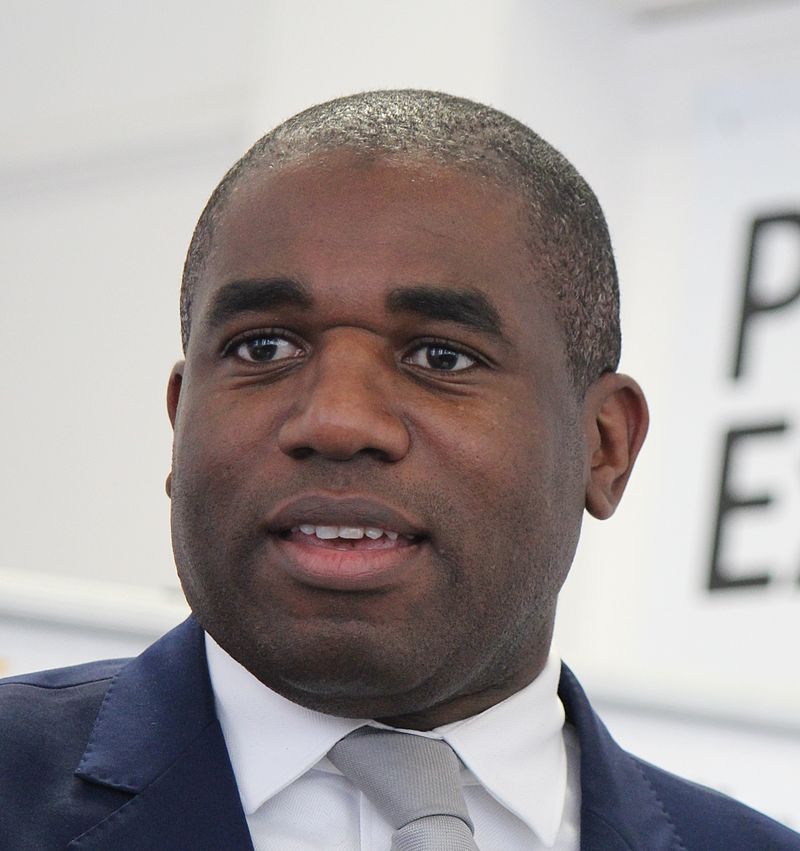
    David Lammy – 2022 Speech on the NATO Accession of Sweden and Finland

    The speech made by David Lammy, the Shadow Foreign Secretary, in the House of Commons on 6 July 2022.

    I thank the Minister for advance sight of her statement. The accession of Finland and Sweden to NATO is an historic decision that is wholeheartedly welcomed by the Labour party. Finland and Sweden will be valuable members of this alliance of democracies that share the values of freedom and the rule of law and that seek peace through collective security.

    Russia’s brutal invasion of Ukraine is a turning point for Europe. As we strengthen UK and European security, it is more important than ever to do so alongside our allies. The great post-war Labour Government was instrumental in the creation of NATO and the signing of the North Atlantic treaty in 1949. Seven decades later, the alliance remains the cornerstone of our defence, and Labour’s commitment to NATO is unshakeable.

    I have visited both Finland and Sweden in recent months to discuss the consequences of Russia’s attack on Ukraine. I have seen the careful, considered and democratic approach that the Governments of both countries have taken to this new security context. They saw the need to think anew and to reassess the assumptions of the past. I pay tribute to the Swedish and Finnish Foreign Ministers, Ann Linde and Pekka Haavisto, for their roles in stewarding this process. It is a remarkable illustration of the dangers that Putin poses that Sweden and Finland have reversed their long-held policies of non-alignment. But is it also a demonstration of the way that Russia’s attack on Ukraine has had the opposite effect from what was intended—strengthening rather than weakening NATO, unifying rather than dividing the alliance. As the recent Madrid summit demonstrated, NATO is responding resolutely to the threat Russia poses and adapting to the challenges of the future.

    I do note, though, that although Finland and Sweden and many other NATO allies, including Germany, have reassessed their defence planning in this new context, the UK has not. Labour, in government, did exactly that after the 9/11 attacks, introducing the longest sustained real-terms increase in spending for two decades. We believe that the Government should reboot defence plans and halt cuts to the Army, as we have been arguing for months. We also believe that it is important to deepen our security co-operation with our European allies and the EU, as a complement to NATO’s role as the bedrock of Euro-Atlantic security.

    Turning to the mechanism of ratification, in normal circumstances we would rightly expect the House to have appropriate time to consider and consent to the ratification of an international treaty of this importance. But these are not normal circumstances, and there are clear risks to both countries from a drawn-out accession process, so we recognise the need for the Government to act with haste in these exceptional circumstances.

    I thank the Foreign Secretary for keeping me up to date on that particular matter, and for the Government’s decision to come to update the House today. It provides an opportunity for the whole House to send a united message of support to our new allies and I hope it will encourage other NATO partners to move swiftly in the ratification process too. Putin has sought division, but has only strengthened Europeans’ unity and NATO’s resolve. We stand together in defence of democracy and the rule of law.

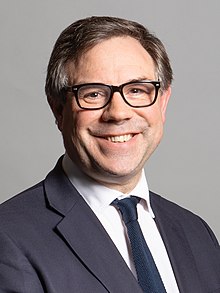
  • Jeremy Quin – 2022 Speech at the RUSI Conference

    Jeremy Quin – 2022 Speech at the RUSI Conference

    The speech made by Jeremy Quin, the Defence Procurement Minister, on 7 July 2022.

    Some of you may have wondered whether this event would proceed this morning. Thank you for keeping the faith and being here.

    All of us in Defence have a profound sense of the weight of responsibility in undertaking the tasks with which we are charged even in the most difficult of circumstances.

    From a personal perspective I think the Prime Minister has shown enormous leadership on Ukraine which will be a lasting legacy and he has proved a good friend for defence. I wholly understand why he is now stepping down, it is the right decision, and I wish him well.

    Now to Defence. We meet in historic times and I am delighted that the process of Nato ratification of Finnish and Swedish accession is underway with Canada the first to complete the process so far.

    I have visited Finland on several occasions as Defence Minister especially in the run up to their HX competition.

    I confess to being delighted yet bemused by being engaged in earnest debate on the differential performance of F35, Grippen and Eurofighter not just by the Finnish Government but by a Helsinki taxi driver and a wide array of Finnish citizens.

    It transpired that a considerable number of the men and women on the Helsinki omnibus knew all about the munitions carriage and stealth in modern combat air, such is their personal focus on their nation’s defence – and for good reason.

    While debate of this nature in the United Kingdom is rather more muted, I learned early on in my role that a Defence Procurement Minister can rely on strong and informed debate via the medium of Twitter.

    There is often complete agreement on Twitter than an issue must be aired if a less uniform view on how it should be concluded.

    Underpinning all such debates, RUSI has remained supreme in offering detailed and considered views on defence. I have often said that our defence industry is a strategic national asset. Without comparing the two in terms of scale I have no doubt I can say the same of RUSI.

    It has been a constant through a great deal of change. Including changes in Defence Procurement Ministers. In the two calendar years prior to my appointment in February 2020 no fewer than 5 Defence Procurement Ministers held office.

    No wonder in the introductory call with my German counterpart he warmly welcomed me and I quote “to the plushest ejector seat in UK Defence.”

    I feel today, two and half years in, the same excitement and determination I did on day one. It is an extraordinary role it is a privilege to serve – and above all to have the opportunity to work with truly excellent and committed colleagues in and out of uniform.

    Unlike my Commons Defence Ministerial colleagues who have all served their country on the front line of combat operations and done so with distinction, the nearest I have got to action was serving in the treasury during the financial crisis and the whips office during Brexit.

    However, we are all at our strongest working in teams and I indebted to the huge support of the Defence Secretary who is doing an outstanding job and all my ministerial colleagues.

    My 25 years of experience in business before entering parliament means I often start a debate on procurement from a different perspective but we invariably come to the same conclusion –

    We recognise Core skills.

    Fundamental focus on the tasks we need to meet.

    Ruthless prioritisation within budget.

    Working with suppliers through partnership.

    Creating and retaining the Skills base we need to deliver.

    One learns early on that Defence Procurement isn’t easy.

    We are delivering “Some of the most technically complicated, risky and costly procurements in Government.”

    Not my words but those of the NAO.

    Whilst our national debates are not as active as those on the Helsinki omnibus, defence procurement can occasionally hit the news and, if I may share a secret with you, that’s not hugely when projects are going well.

    From some of the commentary, one could be forgiven for believing that every defence procurement is late and every project is over budget.

    In point of fact nearly three quarters of DE&S projects have already delivered or are expected to hit their original P50 cost estimate. In a world dominated by covid and supply chain hold-ups, over half of DE&S projects have been or are expected to be on their P50 estimated delivery time – and this audience is wise to the fact that by definition not all projects will come in within a P50 estimate.

    In addition, since 2016 we have made £5.9 billion of independently assured efficiencies on our Equipment plan – genuine improvements with the same output being delivered for lower cost.

    The DPAG which was established through the Spending Round, has met regularly since has recognised a changed MOD with greater clarity and transparency – determined to recognise and fix issues, not hide them.

    However, and especially on delivery the overall position is of course not where we want it to be, there is room for huge improvement and I am determined that the reforms we are driving will deliver just that – but this is a solid base from which to drive performance.

    The reasons why we must get better are legion, but the pressing current is all too obvious.

    Since 1989 our belief in what the collapse of the Berlin Wall presaged has dictated the size of not just our forces but has driven changes to the structure, capability and even the expectations that we place upon our entire Defence sector.

    As the Secretary of State has said, the way we’ve been doing defence for the last three decades is no longer adequate for the threats we are facing today.

    We thankfully got ahead of the game in recognising the changed world when the Prime Minister took the strong decision to invest an extra £24 billion in Defence in 2020.

    And we are even more thankful that last Thursday the Prime Minister went one step further by making clear that the critical capabilities we are pursuing in defence from FCAS to AUKUS mean that we will reach 2.5% of GDP by the end of the decade.

    We need to ensure that not only will the equipment procured be deployed effectively by all our armed forces, including as vividly set out by the new CGS through “Operation Mobilise”. We need to ensure we deliver that equipment on time on budget and to the very best of our ability.

    All of which brings me right back to procurement.

    Given the scale of the task ahead an eye-catching route would be to seize the opportunity for a “review”.

    I dare say this would immediately get plaudits and Defence would be praised for recognising historic issues and seeking external insight as to how we meet fresh challenges.

    Except I don’t think that’s getting after the issues at all. I fear that’s hiding from them. After all we’ve been round this buoy before, many times actually, we’ve had 13 reviews in one form or other of defence procurement in the last 30 years.

    We know what happens. We have seen it in public and private sector alike. The self-absorption of the process. The inertia while its conducted. Good people getting frustrated. The less good eagerly awaiting a game of musical chairs when the distracting music finally stops.

    In all the analysis I have seen, of international comparators, or different structural options here in the UK the one point that has stood out is that there is no nirvana.

    Every model set up to deliver equipment, equipment which has never previously been created before but which may be needed in service for decades and which will depends on multiple untested linkages, will be vulnerable to the challenge of delivering those projects.

    There is no single bullet. In the same way that our uniformed colleagues succeed by constant work, upskilling, agility and attention to detail we need to do the same.

    We know what the challenges are.

    We know what we need to do to overcome them.

    It’s often the small things that derail big projects. When the Apollo 13 mission was aborted the problem turned out to be something as small as damaged electrical wire insulation.

    Sometimes you don’t need to overhaul the whole system. You just need to fix the wiring.

    And our approach to procurement requires a remorseless focus on getting the basics right.

    First making the structure of what we do as clear and simple as possible, junking unnecessary bureaucracy and injecting flexibility and agility into our processes. We are doing just this through the Procurement Bill which is wending its way through the Lords now and is a cast iron exemplar of our commitment to ongoing sensible reform.

    Secondly take skills. If our people are going to be working on the most sophisticated projects around, we are going need to make sure they are better trained, more experienced and have more time to dedicate to the task.

    So that’s what we’ve been doing.

    Our Senior Responsible Officers for all our major projects are now required to complete the Infrastructure and Projects Authority’s Major Projects Leadership Academy.

    Around 40% of major projects currently meet or exceed the 50% SRO time commitment, up from 23% previously and we are determined that this upward trajectory must continue.

    We are encouraging commands to consider rank-ranged posts to enable SROs to be promoted within a project and also to align military SRO postings with key project milestones.

    We are determined to create a broader bench of SROs, civilian and military, growing experience over time so that we have people able to better deliver for us in the years ahead.

    And we’re investing in skills more broadly.

    All of the most senior DE&S finance and accounting staff now have professional Chartered Accounting qualifications.

    While more than 80% of our commercial staff are qualified with the Chartered Institute of Purchasing and Supply (CIPS) or are studying for their qualifications, and we also have a finance graduate development programme and a finance apprentice scheme.

    Meanwhile, to streamline our approvals processes we are developing new approaches and tools to support proportionate, risk-based, assurance activity. This ensures our effort is focused in the highest risk areas, so we can continue to take robust, evidence-based investment decisions.

    Programmes such as the Vehicle Storage and Support Programme have used these new approaches to save time and drive pace in delivery.

    Reducing time on bureaucracy saves time and money and I know that the more we are seen to deliver the greater will be the trust in defence in the Cabinet Office and Treasury and the more we can in turn reduce timelines external to the Department.

    But the hardest things to fix in any organisation are not the practical problems but the cultural ones.

    These are issues which span both defence and the industry –

    I have spoken on occasion at Staff College courses and one of the things with which I have been struck is how these brilliant and committed officers have been imbued with a sense throughout their service career that you don’t go to Higher Command with a problem, you go with a solution. Don’t second guess, find a solution and deliver.

    We all get that on operations but procurement works to different rules.

    When you are ordering state of the art weaponry which has never previously been manufactured the one thing you can guarantee is that there will be problems.

    Raising concerns, seeking external advice, ensuring issues are addressed not hidden. That is what we require from our procurement teams.

    One example of where, faced by externally created issues, we let ourselves down comes through in the Ajax Health and Safety Report. And we know that Ajax is not unique.

    So, we need to learn these lessons… We need to be open… We need to be honest with each other… We need to share.

    On Ajax we have commissioned a further review by Clive Sheldon QC and I have no doubt we have valuable lessons to implement.

    So, we can tighten up our own act to be better customers but it takes two to make a partnership work.

    This is one of the core emphases of DSIS which the thoughts of RUSI over many years have been incorporated in the work we did in taking DSIS forward.

    Not only do we have DSIS but many sub-sector reports from AI to the Land Industrial Strategy that have followed.

    Underpinned as they all are by the Equipment Plan (which I will remind you for the first time in years according to the NAO is not unaffordable!) and by the Defence Capability Framework which was published yesterday setting out our plans for military capability development.

    Defence has never been more transparent in setting out how we believe we can address emerging threats nor more open about seeking the engagement of industry and academia in meeting them.

    Through the Defence Command Paper we have deleted programmes we can’t afford and we are focusing on the projects we need to deliver and we know we can finance.

    We are investing in capabilities that will be delivered, at pace with certainty that spiral upgrades will follow– maintaining skills, maintaining R&D and maintaining joint working long after FOC. Front Line Commands need to know that they will not only get good kit into service but that perfection can be delivered overtime rather than overburdening the camel at the start of its journey with far too many straws.

    Industry needs to deliver on the open architectures and room for development that we all know are vital to enabling spiral development and accessing a wider eco-system of providers.

    We are doing our bit on investment in R&D, the long decline over 30 years has already been checked and reversed. This is surely as leading an indicator as there can be about our seriousness to deliver – £6.6 billion of ringfenced funding to drive forward the game-changing ideas of the future.

    And we know the game has evolved. 50 years ago, if my predecessors had a challenge they could bring five companies into the office and discuss who’d be best at bashing bits of metal together to make a better bit of metal.

    But these days the answers to our future needs could just as easily be found in a university lab, or any number of brilliant SMEs.

    We know we need to harvest wider ingenuity than ever before and we have seen that it works.

    Working in partnership through our new Regional Defence Clusters across the UK, at the brandnew Defence Battlelab, at the newly created Newcastle AI Hub among other defence centres of excellence to produce the goods.

    In the last five years our Defence and Security Accelerator (DASA) has provided over £180 million worth of funding for more than 1,000 projects, 58% of which were awarded to SMEs.

    Our Defence Technology Exploitation Programme will help support these SMEs to work with Primes to deliver their brilliant thinking to the front line.

    As I set out in the SME Action Plan earlier this year we have already increased SMEs shares of our procurement spend from 16 to 23 per cent and there is further to go.

    One of the joys of working with SMEs is their sheer agility

    Technology is evolving quickly and we need to be able to mobilise quickly to harness these new ideas and get them into the hands of the users. We do this in response to urgent requirements as a matter of course.

    Over the last 120 days I have seen one SME taking the early concept of some serious military equipment through contract to mass production and delivery. I have seen dozens of others produce brilliant ideas for our Ukraine Innovation challenge which we are going through right now.

    Evidence from Ukraine is that low value capabilities adapted quickly from the commercial market can have an asymmetric and significant effect on the battlefield.

    In these situations, we have shown that we can change our procurement and certification risk appetite and adapt to the circumstances.

    We need this approach to become more mainstream in procurement and free up our acquisition professionals to think outside the box and incentivised to deliver.

    There are not many positive stories written about defence acquisition – you all know that in this room – and this has driven a risk averse culture through the organisation – nobody enjoys being constitutionally quite properly put through the ringer at select committee.

    But the fact is that if we are to get ahead, then we need to take measured risk and accept that not everything will be always be delivered to plan.

    In the new world we have to take risks and be willing to move on when projects hit the buffers.

    I enjoy having meetings when SROs tell me that all is well.

    I enormously respect SROs who come to me in candour to explain the problems their work has exposed – whether that means projects are rated RED or Amber and we know what we must to do turn them around.

    Or ultimately when we know it’s time to pull the plug, fail fast and reinvest.

    Problems will happen it’s how we respond to those problems that matters.

    And to have the right kit we need to take risks and we need industry to deliver.

    Let’s be clear back in 1937, to use General Patrick’s comparator, there was no doubt why we needed a strong on-shore Defence industry.

    And once again the need for the West in general and the UK in particular to be able to churn out quality kit to meet our needs is very stark.

    It is very clear to the British people that we need armed forces to deter our adversaries and that we need them to be supplied reliably, swiftly and effectively.

    But there is more than that in the equation and that points to the national security that is delivered through national prosperity.

    I am so pleased that the JEDHub Annual Economic Report has set out clearly the distinct and vital role that is played by defence in our wider economy. This is just the base from which I am confident we will see rapid growth in the years ahead.

    JEDHub revealed a growing sector, delivering greater productivity than wider manufacturing, growing investment in skills and R&D. A sector enmeshed in exports with nearly 40 per cent of surveyed jobs supported by international business. A sector which distributes jobs and prosperity right across our Union.

    A sector which we are ensuring through the application of social value in our tenders is delivering not just critical capability but more widely for our country.

    Our national agenda for levelling up and strengthening our Union is vital and every part of our country will benefit as we invest in our own defence and help secure the overseas orders and partnerships, supported where appropriate with G2G packages, UKEF funding and critically a joined up approach across Government which pulls in support from our brilliant armed forces.

    Not only is the UK rightly perceived as producing battle winning kit we are a country with whom the world, including many who had previously looked to our adversaries’ inventory, wishes to do businesses.

    I am proud that traditional strengths in combat air is being matched by a renaissance in naval shipbuilding and other areas of UK capability as we regain momentum in a growing world market.

    I want to finish by reiterating a fundamental point.

    Our on-shore defence industry is a national asset it bestows wider benefits on our economy and critical capabilities to our armed forces. It can deliver exports and defence diplomacy and engagement. It helps keep us safe.

    We need them to continue to lift their sights and take risk.

    Our demand signal, bolstered by export opportunity, is the clearest signal one could imagine of the opportunity ahead.

    We look forward to seeing the fruits of industry’s investment in skills, capacity, R&D and export campaigns and in return we will be supporting them through clarity of purpose, investment in defence science and technology and the full gamut of support to access UK and international markets.

    We will continue in defence procurement to work with industry tirelessly to deliver the multiple improvements which together will guarantee more agile and reliable programmes on which we can all rely.

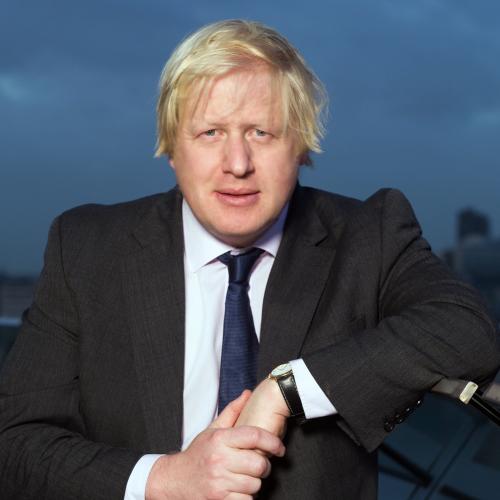
  • Boris Johnson – 2022 Resignation Statement

    Boris Johnson – 2022 Resignation Statement

    The statement made by Boris Johnson, the outgoing Prime Minister, in Downing Street, London, on 7 July 2022.

    Good afternoon everybody,

    It is now clearly the will of the parliamentary conservative party that there should be a new leader of that party

    and therefore a new Prime Minister

    and I have agreed with Sir Graham Brady

    the chairman of our backbench MPs

    that the process of choosing that new leader should begin now

    and the timetable will be announced next week

    and I have today appointed a cabinet to serve – as I will – until a new leader is in place

    so I want to say to the millions of people who voted for us in 2019 – many of them voting Conservative for the first time

    thank you for that incredible mandate

    the biggest Conservative majority since 1987

    the biggest share of the vote since 1979

    and the reason I have fought so hard for the last few days to continue to deliver that mandate in person

    was not just because I wanted to do so

    but because I felt it was my job, my duty, my obligation to you to continue to do what we promised in 2019

    and of course I am immensely proud of the achievements of this government

    from getting Brexit done and settling our relations with the continent after half a century

    reclaiming the power for this country to make its own laws in parliament

    getting us all through the pandemic

    delivering the fastest vaccine rollout in Europe

    the fastest exit from lockdown

    and in the last few months leading the west in standing up to Putin’s aggression in Ukraine

    and let me say now to the people of Ukraine that I know that we in the UK will continue to back your fight for freedom for as long as it takes

    and at the same time in this country we have at the same time been pushing forward a vast programme of investment in infrastructure, skills and technology

    the biggest for a century

    because if I have one insight into human beings

    it is that genius and talent and enthusiasm and imagination are evenly distributed throughout the population

    but opportunity is not

    and that is why we need to keep levelling up

    keep unleashing the potential of every part of the United Kingdom

    and if we can do that in this country, we will be the most prosperous in Europe

    and in the last few days I have tried to persuade my colleagues that it would be eccentric to change governments

    when we are delivering so much

    and when we have such a vast mandate and when we are actually only a handful of points behind in the polls

    even in mid term after quite a few months of pretty unrelenting sledging

    and when the economic scene is so difficult domestically and internationally

    and I regret not to have been successful in those arguments

    and of course it is painful not to be able to see through so many ideas and projects myself

    but as we’ve seen at Westminster, the herd is powerful and when the herd moves, it moves and

    and my friends in politics no one is remotely indispensable

    And our brilliant and Darwinian system will produce another leader equally committed to taking this country forward through tough times

    not just helping families to get through it but changing and improving our systems, cutting burdens on businesses and families

    and – yes – cutting taxes

    because that is the way to generate the growth and the income we need to pay for great public services

    and to that new leader I say, whoever he or she may be, I will give you as much support as I can

    and to you the British people I know that there will be many who are relieved

    but perhaps quite a few who will be disappointed and I want you to know how sad I am to give up the best job in the world but them’s the breaks.

    I want to thank Carrie and our children, to all the members of my family who have had to put up with so much for so long

    I want to thank the peerless British civil service for all the help and support that you have given

    our police, our emergency services and of course our NHS who at a critical moment helped to extend my own period in office

    as well as our armed services and our agencies that are so admired around the world and

    I want to thank the wonderful staff here at Number Ten and of course at chequers and our fantastic protection force detectives – the one group, by the way, who never leak

    and above all I want to thank you the British public for the immense privilege you have given me

    and I want you to know that from now until the new Prime Minister is in place, your interests will be served and the government of the country will be carried on

    Being Prime Minister is an education in itself

    I have travelled to every part of the United Kingdom and in addition to the beauty of our natural world

    I have found so many people possessed of such boundless British originality and so willing to tackle old problems in new ways that I know that even if things can sometimes seem dark now, our future together is golden.

    Thank you all very much.

  • Dominic Cummings – 2022 Comments on Boris Johnson’s Departure

    Dominic Cummings – 2022 Comments on Boris Johnson’s Departure

    The comments made by Dominic Cummings on Twitter on 7 July 2022.

    I know that guy & I’m telling you -he doesn’t think it’s over, he’s thinking ‘there’s a war, weird shit happens in a war, play for time play for time, I can still get out of this, I got a mandate, members love me, get to September…’

    If MPs leave him in situ there’ll be CARNAGE

  • Liz Truss – 2022 Comments Backing Boris Johnson’s Resignation

    Liz Truss – 2022 Comments Backing Boris Johnson’s Resignation

    The comments made by Liz Truss, the Foreign Secretary, on 7 July 2022.

    The PM has made the right decision.

    The Government under Boris’s leadership had many achievements – delivering Brexit, vaccines and backing Ukraine.

    We need calmness and unity now and to keep governing while a new leader is found.

  • Keir Starmer – 2022 Statement on the Resignation of Boris Johnson

    Keir Starmer – 2022 Statement on the Resignation of Boris Johnson

    The statement made by Keir Starmer, the Leader of the Opposition, on 7 July 2022.

    It is good news for our country that Boris Johnson has resigned as Prime Minister.

    But it should have happened long ago. He was always unfit for office. He has been responsible for lies, scandal and fraud on an industrial scale. And all those complicit should be utterly ashamed.

    The Tory Party have inflicted chaos upon the country during the worst cost of living crisis in decades and they cannot now pretend they are the ones to sort it out.

    They have been in power for over 12 years.

    The damage they have done is profound. 12 years of economic stagnation, 12 years of declining public services, 12 years of empty promises.

    Enough is enough.

    We don’t need to change the Tory at the top – we need a proper change of Government.

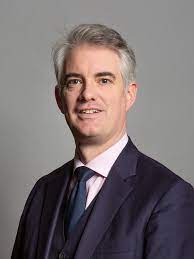
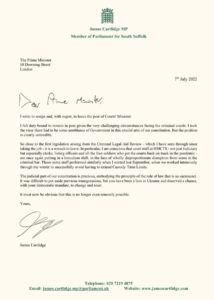
  • James Cartlidge – 2022 Letter of Resignation as Courts Minister

    James Cartlidge – 2022 Letter of Resignation as Courts Minister

    The letter of resignation sent by James Cartlidge, the Courts Minister, on 7 July 2022.

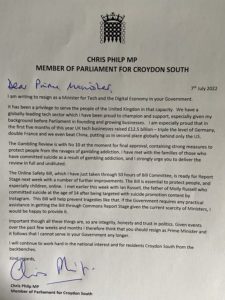
  • Chris Philp – 2022 Letter of Resignation as Technology and Digital Economy Minister

    Chris Philp – 2022 Letter of Resignation as Technology and Digital Economy Minister

    The letter of resignation sent by Chris Philp, the Minister for Technology and the Digital Economy, on 7 July 2022.

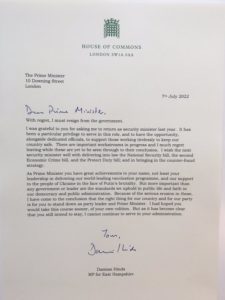
  • Damian Hinds – 2022 Letter of Resignation as Security Minister

    Damian Hinds – 2022 Letter of Resignation as Security Minister

    The letter of resignation sent by Damian Hinds, the Security Minister, on 7 July 2022.