Blog

  • John Finucane – 2022 Comments on Restoring the Northern Ireland Executive

    John Finucane – 2022 Comments on Restoring the Northern Ireland Executive

    The comments made by John Finucane, the Sinn Fein MP for Belfast North, on 14 September 2022.

    With inflation still running at almost ten percent living costs remain far too high for ordinary people to cope with.

    Workers, families and small businesses are struggling to pay their bills in this cost-of-living emergency. They need help now.

    They need an Executive up and running so parties can work together to put money in people’s pockets and make people’s lives better.

    One party should not continue to block the formation of an Executive because they don’t like the outcome of the election. It’s anti-democratic and a cruel dereliction of duty.

    The DUP need to join with the rest of us, work with the rest of us, and help to deliver for people in an Executive as we face into a difficult winter.

  • Caoimhe Archibald – 2022 Comments on Reports Government Removing Bankers Bonuses Cap

    Caoimhe Archibald – 2022 Comments on Reports Government Removing Bankers Bonuses Cap

    The comments made by Caoimhe Archibald, the Sinn Fein MLA for East Londonderry, on 15 September 2022.

    Reports that the Tories are seeking to remove the cap on banker bonuses demonstrates once again that they are detached from the reality of the cost-of-living emergency facing ordinary people.

    Recent months have seen Tory ministers lambasting workers and introducing laws to undermine workers’ rights and the right to strike, while making bizarre claims that modest pay rises will deal with soaring costs and inflation.

    However, the same caution does not exist when it comes to top bankers, whose salaries are already through the roof.

    Ordinary workers and families are already facing the impossible choice between heating their homes and putting food on the table this winter.

    The British government needs to focus on real support for workers, families and businesses who are most impacted by rising costs and they need to cut people’s bills by slashing the eye-watering profits of energy giants through a Windfall Tax.

    We need an Executive formed immediately so we can work together to tackle the cost-of-living emergency and put money into people’s pockets now. The DUP should end the boycott.

  • PRESS RELEASE : New figures show the importance of the English Baccalaureate [July 2011]

    PRESS RELEASE : New figures show the importance of the English Baccalaureate [July 2011]

    The press release issued by the Department for Education on 7 July 2011.

    Commenting on today’s publication of statistics showing outcomes for 19-year-olds in England in 2010, Schools Minister Nick Gibb said:

    These statistics underline the importance of studying the core academic subjects that make up the English Baccalaureate – young people who achieve good grades in these subjects are more likely to go on to higher education and less likely to be NEET.

    Publishing information on EBacc attainment will increase the opportunities for all young people – especially those in disadvantaged areas – to study these vital subjects.

    Today’s statistics show that:

    Of those who achieved the EBacc:

    • 80% were in full-time education at age 19 – 81% of them were in higher education
    • 3% were NEET at age 19

    Of those who achieved five GCSE passes at A* to C or equivalent including English and maths:

    • 67% were in full-time education at age 19 – 67% of them were in higher education
    • 5% were NEET at age 19

    Of those who achieved five GCSE passes at A* to C or equivalent not including English and maths:

    • 61% were in full-time education at age 19 – 60% of them were in higher education
    • 6% were NEET at age 19
  • John Hayes – 2011 Speech to the Association for Careers Education and Guidance Annual Conference

    John Hayes – 2011 Speech to the Association for Careers Education and Guidance Annual Conference

    The speech made by John Hayes, the then Education Minister, in Thame, Oxfordshire on 7 July 2011.

    Introduction

    Good morning everyone and thank you for inviting me.

    I’m glad to be here for many reasons. Not the least of them is the fact that I think careers education and guidance in schools has had a rough deal for longer than most of us would care to remember. And I want to assure you in person of my commitment to playing my part in putting that right.

    The esteem, or lack of it, in which careers teachers have sometimes been held is in inverse proportion to their influence over young people’s lives and prospects. Many teachers have viewed being handed the careers brief as drawing the short straw in the curriculum lottery.

    But you know better. And so do I.

    Importance of guidance

    It was that most down-to-earth of Dominicans, St Thomas Aquinas. who once said that it is “better to illuminate than merely to shine”.

    Eight hundred years on, the work of your Association continues to demonstrate how right he was. Indeed, there can be few roles more important than that of helping to set young people’s feet on the right path as they set out in life and of helping them to understand where the choices they are making could lead.

    As any good teacher can confirm, offering guidance implies far more than just conveying information. It also implies illumination.

    Plans for reform

    So I want to begin by saying something about the Government’s plans for reform in this area.

    Our aim is not, as some have mischievously claimed, to diminish or deprofessionalise careers education and guidance, but the very opposite.

    Our approach to careers provision in schools is based on two very clear principles.

    First, we believe that schools should have the freedom and flexibility to take decisions in the best interests of their pupils.

    That means focussing schools on securing access to advice on the full range of academic and vocational options but giving them freedom to determine how best to do this. That includes recognising that legal constraint is not necessarily the most effective way of ensuring pupils receive careers education and other wider support they may require.

    Second, we believe that young people will benefit from high quality external sources of guidance – free from any vested organisational interests – to complement any in-house arrangements. Schools must be able to commission any specialist support that they need from a strong and diverse market in careers guidance.

    Cultural change

    I recognise that this move away from central Government control will be a significant cultural change and, in at least one sense, a step into the unknown for some schools.

    But at the same time, I’m confident that empowering schools and setting them free from bureaucratic oversight is the right way forward. Independent schools have been using a wide range of services and advice for many years and now we want all schools to enjoy that same freedom of choice.

    Of course, schools must be accountable for the quality of what they achieve. So we should expect them to answer for outcomes, not inputs such as the use of a particular service or a specific approach to providing careers guidance.

    The increasing amounts of information that are becoming available not just about different careers, but also about the comparative benefits of different higher education courses and of the comparative merits of choosing an academic route or a vocational option like an Apprenticeship post-18, are making the guidance young people get in schools more vital than perhaps ever before.

    That is why I regard the development of reliable destination measures as increasingly crucial – and not just in schools, but in further and higher education, too.

    If used properly, they will provide clear and comparable information on the success of schools in helping their pupils to progress to university, into further education or into employment.

    Role of the careers sector

    I want the careers sector to be at the forefront of showcasing the benefits of careers guidance. And I want to say here and now how grateful I am for the work already under way to strengthen the evidence base and bring together the very best examples of interventions that have a positive impact on young people.

    I want to go further and ensure that we do all we can to celebrate the very best in high-quality careers education and guidance and the good work that many schools are doing to support the young people in their care.

    I recently announced my intention to establish a network of school leaders to develop and share the most effective practice in securing careers guidance for pupils.

    I hope that your Association will play a prominent role in identifying and sharing those inspirational examples that will demonstrate the value and benefit of careers provision.

    But as well as individual examples of excellence, we will need to gauge how the system as a whole is responding to the changes.

    Review of careers guidance

    That is why we have promised to commission a thematic review of careers guidance by Ofsted. This will help us to establish a baseline for future policy development and to understand whether there are areas that are not delivering the key outcomes of achievement and progress for young people. If the review uncovers problems then I will not hesitate to consider what could change for the better and what further support might be necessary.

    I know that working your way through this difficult transitional period is a challenge. But I see a real opportunity to reach a point where the careers profession is restored to the position it deserves.

    Next steps

    By adopting a relentless focus on quality, on outcomes and on promoting the benefits of independent, impartial guidance we can build a careers profession that is stronger and better equipped to face the future.

    An important element of this new world of opportunity will be the opening up of the market for careers guidance. And whether your position is one of a careers professional, or a school-based practitioner involved in the day-to-day management or delivery of careers education and guidance, I would urge you all to think carefully about the opportunities that will open up through this new way of doing things, and how you can best take advantage of that.

    Of course, significant progress has already been made in the development of the careers sector as one that can stand comparison with other respected professions.

    For example, the main professional bodies for careers are working for the first time as a unified force for professionalism. The Careers Profession Alliance is committed to developing a register of careers professionals, and wishes to achieve chartered status for careers professionals over the next three years.

    The Alliance is working with the professional bodies to establish common professional standards, so that everyone signs up to the same code of ethics as well as to the same standards of practice. Those common standards need to be supported by continuing professional development, and organisations in the National Careers Service will be required to support their staff in meeting these standards. The Alliance will support this process by putting a range of new resources including resources online, for careers advisers to use as an integral part of their professional development.

    Moreover, a new National Careers Service will lead the way on quality and standards. Young people will be able to access the National Careers Service through its online and telephone channels.

    Schools can, of course, commission organisations that are part of the National Careers Service to provide independent, impartial careers guidance. The Service will not be funded to provide that support but I have outlined the steps we are taking to strongly persuade schools of the merits of investing in professionally delivered face-to-face guidance.

    This approach reflects the fact that the needs of young people and adults are different. It would be strange to give teachers clear responsibilities for the careers guidance of their pupils and then provide a public service that attempted to replicate part of that function. So the Service itself will not be centrally funded to provide services direct to schools.

    Conclusion

    My colleagues and I are clear that there are few tasks in our education and skills system that are more important than helping young people to understand as early as possible the full implications of the choices they are asked to make.

    We know that enlightenment is a prerequisite of empowerment. But, even so, we do not pretend to have all the answers. So I would like to close by encouraging you to take advantage of three forthcoming opportunities to feed you views and experiences into the reform process.

    First, we will be hosting a careers guidance transition summit, jointly with the Local Government Association on 15 July. I am delighted that ACEG will be represented alongside a range of school and local authority representatives. This will provide an opportunity to focus on issues of transition from the current arrangements. We are keen to facilitate the exchange of good practice between local authorities and will share effective delivery models – examples such as those in Swindon and Northamptonshire where authorities are already using the greater freedom afforded by the Early Intervention Grant to develop integrated, efficient support for young people. Following the event we will set out key milestones for the transition period up to September 2012, to support local authorities’ transition planning. You may wish to refer to the Local Government Association’s Communities of Practice website where a detailed summit agenda and attendee list will be available from tomorrow and where we will place outputs shortly after the event.

    Second, we have begun initial conversations with stakeholders on the question of extending the duty to secure independent careers guidance down to school year 8 and to young people up to the age of 18 studying in schools and further education settings. I am delighted to confirm that a full public consultation on this issue will take place in the autumn and I very much hope you will take part.

    Third and finally, it is important to me to hear your immediate reactions to the progress that has been made to date and the immediate challenges we face. So I look forward to your questions.

    Thank you.

  • Pola Uddin – 2022 Tribute to HM Queen Elizabeth II (Baroness Uddin)

    Pola Uddin – 2022 Tribute to HM Queen Elizabeth II (Baroness Uddin)

    The tribute made by Pola Uddin, Baroness Uddin, in the House of Lords on 9 September 2022.

    My Lords, Inna Lillahi wa inna ilayhi raji’un: to God we belong, and unto God we shall be returned. As a Muslim, these are the first sentiments that we utter on hearing news of deaths. So it was that I learned of Her Majesty’s death and shared the same words with my friends and family.

    I stand in deepest sorrow and share all the condolences to His Majesty King Charles III and Her Majesty’s beloved family—our sincerest sorrow and deepest sympathy. Being respectful of all the eloquent contributions before me, I speak as her Peer, a woman, a mother and grandmother, in expressing my deepest gratitude for her lifelong service to our nation and the Commonwealth—indeed, the longest serving woman leader of any nation. Her presence will have inspired umpteen generations of younger women and emerging leaders in their communities and countries. We cannot overestimate the impact on the young of Her Majesty’s encounter, with natural ease, with Paddington Bear, or of her bus ride on a Peppa Pig bus booked to Buckingham Palace. I can share with noble Lords the endearment with which Her Majesty is held by the generation of my seven year-old granddaughter, Imaan, who wants to meet Her Majesty the Queen on the next red bus ride.

    On a very personal note, I had the honour of receiving Her Majesty the Queen for the first time as deputy leader of Tower Hamlets Council during her visit to a London hospital. I had just given birth and left a breastfed baby behind. The royal visit was a little delayed and, as I got a call, I stepped out of this huge building with a heavy wooden door and shielded myself behind the entrance. As I was there for a few minutes, the door was flung open, exposing me with a little telephone to my ear. I was petrified. Her Majesty opened the door and said, “Who are you?”. I curtsied and said, “Your Majesty, I am the deputy leader of the council, here to welcome you, to receive you, and I am really sorry. I had to step out because I have a screaming baby and a distressed husband.” She asked me how many children I had: was this the first? I said, “No, Your Majesty, this is my fifth.” She said, “For God’s sake, tell him to get a bottle and feed him.” Remarkably, a few years later, in the Royal Gallery, when I was introduced as the first Muslim woman appointed by her to this House, she asked me if we had met before. I dared to explain where I had met her and she asked where the babies were. I said, “Unfortunately, still with the same man.”

    The smile that I saw everywhere yesterday on television was exactly the smile that was so endearing and so loving. It was almost as though you knew her, although those moments were so little, so unimportant, in the greater scheme of things.

    I am thankful for this opportunity to express my humblest gratitude for Her Majesty’s life of service and dedication to all her people. As a mother, I feel confident that Her Majesty’s teaching and indelible wisdom will be imprinted in the footprints of His Majesty King Charles III: duty to our whole country as defender of all people, of all faiths. Long may he reign, and may Almighty God bless our Queen, eternal guardian of peace beside her beloved rock.

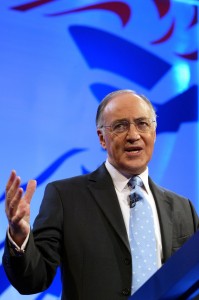
  • Michael Howard – 2022 Tribute to HM Queen Elizabeth II (Baron Howard of Lympne)

    Michael Howard – 2022 Tribute to HM Queen Elizabeth II (Baron Howard of Lympne)

    The tribute made by Michael Howard, Baron Howard of Lympne, in the House of Lords on 9 September 2011.

    My Lords, at this stage in your Lordships’ proceedings, it is not easy to say very much that is new. However, I want to echo in particular the words of the right reverend Prelate who led our prayers and the noble and learned Lord, Lord Judge, in suggesting that our mourning for the longest-reigning monarch in our history should be infused with a spirit of gratitude. For it is we, the people of the United Kingdom and the Commonwealth, who are the beneficiaries of that sense of duty, devotion to service and dedication to the well-being of her subjects about which so many have spoken. She applied those principles in practice in a way that provided inspiration and leadership without ever trespassing for a second into the realm of party politics. In the words of my noble friend Lord Forsyth, she never put a foot wrong.

    Much is said these days about soft power: the way in which a country can influence events without necessarily relying on military or even economic clout. It is impossible to exaggerate the extent to which Her Majesty influenced across the world a positive perception of the United Kingdom. She was soft power personified.

    Much has been said about the way she put people at ease, and I had the privilege, with my wife, of spending a night at Windsor Castle when I was leader of the Opposition. I was amazed to find in the library the trouble that had been taken to assemble a collection of objects which related to my constituency, Folkestone and Hythe—objects I had known nothing at all about and which were quite remarkable.

    Perhaps the most telling example of the way she could put people at ease occurred when a friend of mine who had been subject to much trauma was invited to lunch at the palace, sat next to the Queen and, in the middle of the lunch, froze. The Queen sent for the corgis and, together, they fed the corgis, and my friend unfroze and was able to continue the conversation.

    Much has been said about the way Her Majesty was regarded with such enormous respect and admiration far beyond our shores. I finish with one reminiscence. I was in a Caribbean country when a new governor-general had just been appointed, and the local newspaper published an article giving advice to the new governor-general. It said: “You will have many difficult decisions to make, and we suggest that when you are confronted with those decisions, you ask yourself one question: what would Her Majesty do?”

    My Lords, we have lost a great monarch, a great friend and, as she described herself, a servant—our country’s greatest and most faithful servant.

  • PRESS RELEASE : School lunches – Sarah Teather welcomes rise in take-up [July 2011]

    PRESS RELEASE : School lunches – Sarah Teather welcomes rise in take-up [July 2011]

    The press release issued by the Department for Education on 7 July 2011.

    New figures, published today by the School Food Trust and Local Authority Caterers Association show that an average of 44.1% of children in primary schools and 37.6% of pupils in secondary school opted for school meals in the 2010 to 2011 academic year, up from 41.4% and 35.8% respectively in the previous year.

    It means that:

    • around 173,000 more children had healthy school meals last year, compared with around 100,000 extra children in 2009 to 2010
    • more than three million children now eat a school meal every day
    • the equivalent of almost 590 million healthy school lunches were served up last year
    • the number of children taking both paid-for and free school meals in the 2010 to 2011 academic year increased
    • figures in primary schools have now notched up a rise of almost 5 percentage points over just 3 years

    Children’s Minister Sarah Teather said:

    Healthy eating has a direct impact on behaviour, concentration and ability to learn in schools so these are hugely encouraging figures – the fastest year-on-year rise in take up since junk food was banned and tough nutritional standards were introduced.

    It’s a tribute to caterers’ hard work that tens of thousands of parents and children are voting with their feet by opting to eat lunch at schools, particularly the most deprived.

    It is vital that we help schools, children and parents develop healthier attitudes to nutritious food from a young age. We continue to support the School Food Trust and to help set it up as a permanent independent, not-for-profit social enterprise to carry on its outstanding work driving up the quality of school meals.

    Further information

    The 2010 to 2011 take up figures are published today by the School Food Trust and Local Authority Caterers Association in its annual survey.

    The Government announced last year that the School Food Trust was to become an independent, not-for-profit community interest company – although it will still be funded by the government for specific projects. Education Secretary Michael Gove has written to the Trust setting out its remit for 2011 to 2012 while it makes the transition

  • PRESS RELEASE : New statistics highlight ‘shameful’ education for children in alternative provision [July 2011]

    PRESS RELEASE : New statistics highlight ‘shameful’ education for children in alternative provision [July 2011]

    The press release issued by the Department for Education on 1 July 2011.

    Experimental statistics published for the first time show how only 1.4 per cent of children in Alternative Provision in 2009/10 achieved five or more GCSEs at grade A*-C, or equivalent, including English and mathematics GCSEs or iGCSEs. This compares with 53.4 per cent in all schools in England.

    Commenting on the statistics, Schools Minister Nick Gibb said:

    Children in alternative provision are among the most vulnerable in education. Following Ofsted’s recent report, these new statistics confirm that many pupils in alterative provision are not receiving the education they need. Of course children excluded from mainstream schools have had a disrupted education, but an alternative education system for those children that results in only 1.4% achieving five good GCSEs including English and Maths is shameful. It is vital the provision they receive addresses pupils’ problems and is of high quality.

    As set out in our White Paper, we want to increase the autonomy, accountability and diversity of alternative provision to help drive up standards. For the first time, we have invited applications for alternative provision Free Schools, so that we can provide more high quality provision for vulnerable young people. It is encouraging to see that 34 groups have put forward proposals.

    We are also legislating to allow good and outstanding Pupil Referral Units to benefit from the freedoms that Academies enjoy, and allowing others to benefit from similar freedoms as community schools, including control of their own budgets. Through a new pilot starting later this year, schools in the trial will get the power and responsibility to secure high quality alternative provision for excluded pupils.

  • PRESS RELEASE : Schools Minister congratulates winners of first ever Stonewall Education Equality Index [July 2011]

    PRESS RELEASE : Schools Minister congratulates winners of first ever Stonewall Education Equality Index [July 2011]

    The press release issued by the Department for Education on 1 July 2011.

    Schools Minister Nick Gibb today presented Cambridgeshire County Council with an award after coming top of Stonewall’s 2011 Education Equality Index. The winner was revealed by celebrity stylist Gok Wan at Stonewall’s Education for All Conference in London.

    Nick Gibb MP said:

    I would like to congratulate Cambridgeshire County Council – the winner’s of Stonewall’s Education Equality Index 2011. They have shown how bullying, and in particular homophobic bullying, can be tackled effectively. Successful schools have clear policies – developed with pupils and parents – that result in pupils understanding what is expected of them.

    Tackling poor behaviour and bullying are top priorities for the Coalition Government. We are supporting schools to take a zero tolerance approach to all forms of bullying. We need to send the message that homophobic bullying, of any kind and of any child, is completely unacceptable. No child should have to suffer fear, victimisation or disruption as a result of bullying, either on or off school premises. Homophobic language should become as unacceptable as racial slurs.

  • Michael Gove – 2011 Statement on Industrial Action in Schools

    Michael Gove – 2011 Statement on Industrial Action in Schools

    The statement made by Michael Gove, the then Secretary of State for Education, in the House of Commons on 30 June 2011.

    On Tuesday I gave a statement to the House on this Government’s response to the planned industrial action by two of the teaching unions. In that response I outlined the action I had taken and I also provided data on likely closures based on early estimates from local authorities and Academies.

    We now have a fuller picture, updated this morning, based on data from all 152 local authorities and all 707 Academies.

    Our data show that 5,679 local authority schools were closed, 4,999 were partially open and 5,860 were fully open, while the situation with a further 4,320 has not been reported to us or the local authority did not know.

    The figures also show that of the 707 academies and City Technology Colleges, 201 were closed, 235 were partially open and 271 fully open.

    This means that 27% of all Local Authority schools were closed, 24% were partially open and 28% were open. Data were unavailable for the remaining 21%. 28% of Academies were closed, 33% were partially open, and 38% were open.

    I know that many teachers are concerned about the changes that have been proposed to their pensions. But I believe that we must resolve these differences through discussions and that the action today, while discussions are still going on, was disappointing and unnecessary. I am grateful to headteachers and governors who have worked hard to keep schools open. And I am particularly grateful to all those school staff who – while they may also have concerns about pensions – have decided to go into work today to minimise the impact on pupils and their parents. However I am also disappointed that there has been disruption to the lives of so many parents across the country. The Government remains committed to discussing pension reforms with all the teacher unions openly, honestly and constructively.