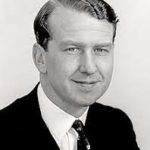
The speech made by Peter Walker, the then Conservative MP for Worcester, in the House of Commons on 6 November 1967.
I beg to move, at the end of the Question, to add: but humbly regret that the Gracious Speech contains proposals to nationalise further large sections of the transport industry instead of concentrating on practical measures to improve conditions for the travelling public and for industry. I am sure the House regrets that this debate is taking place under the shadow of a major railway disaster. I assure the House that any criticisms of the management or policies of British Railways are in no way connected with the railway’s safety record, which has been outstanding over the years, or the diligence with which our railwaymen apply themselves to seeing that railway travel is safe and secure.
Last week’s by-election results are perhaps a reflection on the fact that the Government’s performance contrasts vividly with their plans. If the plans which have been published week by week, and month by month, had been fulfilled, or even started to be fulfilled, the Government’s popularity would be very much higher, but instead we have had a long series of plans contrasting vividly with performance, and this is particularly true of transport.
An examination of the various forms of transport shows that in every sphere Government policies are hindering progress. In aviation one finds that B.E.A.’s future is in jeopardy as a result of the constant delay and indecision of the Government on replacing the present B.E.A. fleet. If one considers future developments in aviation, internal air services, the development of freight air services, and the indecision, and probably wrong decision, on matters such as Stansted, one sees aviation once again being affected by the Government. It is remarkable that this industry, which could perhaps best be quoted as an industry of the future, is completely and utterly without investment grants as a result of the Government’s policies.
When one considers shipping, and ports and docks, one sees that only last week the Confederation of British Industry and the British Shippers’ Council gave their verdict on the Government’s policy. Their verdict is summarised in a statement issued last Wednesday or Thursday: To face the industry with an administrative revolution when it is already grappling with great changes would surely reduce operating efficiency, retard evolution, increase costs, and thus, by raising the price of exports, damage the economy. No case has been made for fundamental change now or in the future. The Minister’s proposals establish no reasoned case for a further change of ownership or control. On the railways, we see a fast increasing deficit, obviously completely out of the Minister’s control. Indeed, it was the Minister herself who said in reply to a Question on 25th January of this year, at col. 1471 that the railway deficit this year would be £130 million, but we were told in a debate in another place that the figure was now likely to be £150 million. Labour relations on the railways have never been worse than they are at the moment, and the position of top management is in complete chaos.
One of the most fundamental needs is an improvement in the road building programme, but we see the Minister complacently going up and down the country boasting that at the moment expenditure on road building is higher than it has ever been in our history. This is a boast which every Minister of Transport has been able to make every year since 1950, but the real test of the Minister’s performance—and that of the Government—is to see how the right hon. Lady has carried out the road building programme which she inherited.
The programme was laid down in great detail in July 1964. It proposed Government expenditure of £1,200 million on road building in the years 1965 to 1970. The party opposite said that it was an electioneering offer, and something to entice the voters. Indeed, the right hon. Member for Vauxhall (Mr. Strauss), who at that time was the shadow Minister of Transport, stated categorically in the Press and in speeches that the programme announced by the Tories for the period 1965–70 was too little and too late.
Let us examine what has happened to the programme which the present Government described as too little and too late. We can establish the exact figures because my right hon. Friend the Member for Barnet (Mr. Maudling) published a White Paper setting out the Government’s investment programme for 1967–68. He said that in that year at 1963 prices, £470 million would be spent by the Government and local authorities on roads in this country. Adjusted to 1963 prices, it would be necessary to spend £53 million this year to fulfil the promise which hon. Gentlemen opposite described as too little and too late. This year the Government and local authorities will spend £450 million on the roads, so this year alone they will spend £81 million less than that set out in a programme which they described as too little and too late.
The Government have stated categorically that in the period 1965–70—this information was given in reply to a Question—they will spend £1,100 million. This is £100 million less than the sum laid down in the programme which they described as too little and too late, and during this period the motorist has had an extremely bad deal. Comparing this year’s figures with those for 1964–65, one sees that this year the Government will spend £70 million more on roads, but from the owners of motor cars they will get an extra £350 million in increased petrol tax, in increased Purchase Tax, and in increased motor vehicle licences. Thus, for every £1 extra which they are spending on reads they are taking an extra £5 from the motorist. This is the Government’s record for the motorist and the roads.
The Government’s record on the railways, in aviation, in shipping, and in the road programme is bad, and what do they offer for the future? They have put forward a programme—which received enthusiastic support at the Labour Party conference as a good Socialist one for tackling transport problems—substantially to increase the nationalisation of public transport.
First, I turn to the proposals for passenger transport authorities. These proposals have no friends. Local authorities do not like them; industry does not like them, and the bus industry in particular does not like them. Everybody is opposed to them. The Minister says that this is not nationalisation, and describes me as illiterate for speaking of it as such. She claims that it is local ownership and not nationalisation. The only real ownership which will be given locally is the ownership of losses.
How can the Minister claim that these P.T.A.s will have local control? Let us consider some of the features of the proposal. These authorities will be very much in the hands of the Minister of Transport. First, the Minister will designate the boundaries of the P.T.A.s, and she has specifically stated that not only will she designate them but will allow no form of public inquiry into them, and there will be no appeal from her decisions. So much for local control of the boundaries.
Secondly, local control will consist of immediately confiscating the assets of all municipal bus companies—a very odd and peculiar way of giving local control—and doing away with local bus companies.
Thirdly, there will be considerable investment control in the hands of the Minister. Grants will depend on her being satisfied with the way P.T.A.s are run. Then, the Minister will have nominees on the boards of the P.T.A.s. Her first suggestion was that one-third of the representatives should be appointed by the Ministry of Transport and that the chairmen should also be so appointed. We are pleased to know that as a result of considerable criticism and pressure she has reduced her demands for representation, and the chairmen will now be appointed by the P.T.A.s. But let us remember that even if, for example, her representatives consisted only of 20 per cent. of the Board, this would be 20 per cent. more than the representation on the boards which are now running local government transport. Also, if, in a public transport authority area, 60 per cent. of the authorities were Tory-controlled and 40 per cent. Labour-controlled, with the Minister’s nominees and the Labour-controlled representatives the Minister’s nominees would have a majority on the P.T.A. Under the P.T.A.s, many major boroughs will have no appeal on the question of fares or timetables.
There is much evidence that there is no great advantage in size, in respect of bus operations; indeed, the public will vouch for the fact that the bigger the size the less efficient is the bus company, the more inferior its labour relations, and the less direct contact it has with the public.
It is becoming more and more clear that all the local authorities in the major conurbations and elsewhere are becoming bitterly opposed to this project. The Minister will say that this is due to briefing and interference on the part of the Conservative Central Office and the leaders of Tory councils, but she should remember that last May the people of this country overwhelmingly voted Tories to their local councils, and they did not vote for them to give back into public ownership private and municipal bus companies.
But not only Tory councils are opposed to this scheme. One of the Minister’s civil servants—a person who is particularly responsible for P.T.A.s.; a Mr. Locke—spoke to municipal operators, and if he reported accurately to the Minister he will have told her that local authorities are passionately opposed to her proposals. At the M.P.T.A. conference five Labour chairmen of local authority transport committees spoke in the debate upon the P.T.A. proposals. Every one was opposed to those proposals. Perhaps their objections were most appropriately put by Councillor Williams, chairman at St. Helens, who said: It would be a voice in the wilderness. I am second to none as a supporter of the Labour party, but this is not one of the things they ought to be doing. Another opinion—and I am sure the Minister will appreciate this, as she represents a Lancashire division—was expressed by Alderman Walsh, vice-chairman at Bolton, who said that the whole programme could only be called a load of codswallop. It is understandable that local authorities should be strongly opposed to P.T.As. First, the ratepayers will have to bear the service charges necessary to compensate for the taking over of privately owned bus companies. Secondly, they will lose their municipal assets. Thirdly, they will have to make a contribution to the deficit of passenger railway services in their areas. Fourthly, fares will increase as a result of the levelling up of wages and conditions of all those employed in bus companies which are taken into P.T.As.
One of the proposals which will be greeted with great alarm is a clear undertaking that P.T.As. will have control over coaches and coach excursions going out of their areas. Many people travel by coach because of the cheap fares. To travel from Birmingham to London costs 34s. by coach, but £3 6s. by second-class railway fare. We can understand this Minister, for what she will describe as good transport planning, deciding that it is wrong to take this traffic from the railways and therefore placing considerable restrictions on coach services.
Alternatives to this programme are quite clear. They are immediately to repeal some of the policies which the Government have pursued, which are directly opposed to the efficient running of our bus companies. It was this Government who took away investment allowances for buses and coaches, immediately resulting in increased fares. It is this Government who made bus companies create an interest-free overdraft for the Government, in the form of S.E.T., and it is this Government who are dragging their feet on trade union reform, which would help to bring single manning and do away with some of the overmanning which exists today.
It is a remarkable thing that if there was one proposal which should have waited for the report of a Royal Commission it was the P.T.A. proposal, which should have waited for the report of the Royal Commission on Local Government. But the Government were determined to hasten through these proposals before the published. What a different attitude to their attitude on trade union reform. The creation of passenger transport authorities will result in considerable increases in road fares and a great loss of freedom of choice in terms of transport for the individual, and we shall oppose this proposal.
The post-war history of the railways is that from the early 1950s, as people began to own more and more motor cars, and passengers turned from the railways to the roads, and as a great modernisation programme was required to change from steam to diesel electric, the railways ran into increasing deficits. It was then that a Conservative Government appointed Lord Beeching and a major reorganisation started to take place. The success of this was reflected in the last two years of Tory Government, when the railway deficit was reduced by £37 million. In the first three years of Labour Government it will have increased by over £30 million.
Today we have had published a White Paper. I say that it has been published today but, like all Government documents, it was really published many weeks previously in the Press. It is remarkable that every major proposal in the White Paper appeared in The Times of 26th June. That newspaper’s transport correspondent described the proposals of the Joint Steering Group under the chairmanship of the Parliamentary Secretary. He described its conclusions in respect of subsidies for services of social importance; he described the recapitalisation of the railways and the writing off of a great deal of capital. He described in detail the proposals for reorganisation of the main board and the doing away with regional boards, and he went on to describe the special subsidies for bridges, level crossings and railway police.
If that same correspondent wanted to summarise the Minister’s White Paper he could not do better than repeat his article of 26th June. This is a terrible reflection upon Her Majesty’s Government.
One political correspondent suggests today that the right hon. Lady should become the next Foreign Secretary. On Press leaks, she puts Lord Chalfont completely in the shade, because every major proposal from the Ministry since she has been Minister has been leaked, in one way or another, beforehand. If these proposals were not leaked by the Ministry itself, the Ministry should have done something to give this House the White Paper, the details of which appeared in the Press in June, some time before November, a few hours before this debate. Instead, with the normal sense of priorities of this Government, the Press came first and Parliament came afterwards.
The White Paper carries the report and recommendations of a very distinguished firm of accountants, Cooper Brothers, who have done a great deal of work, and of the steering group which contained a number of distinguished men from industry and the British Railways Board, and a distinguished professor of finance, under the chairmanship of the Parliamentary Secretary. The whole House will want to examine carefully its proposals, and we obviously have not had time to study some of the background facts and statistics; some of the figures, of course, are not available in the White Paper. But there are some questions which I should like to ask the Minister.
First of all, she states in the White Paper, in rather strange wording; that, after consultation with British. Railways, the Government have decided to adopt the proposals. Do British Railways agree with the proposals? I know that they had representatives on the Steering Group, but it has been said that the Chairman and many of the Board disagree with the proposals. We should like to know whether this is true or whether it was purely consultation, without the Board fully supporting the proposals.
One of the things which will dramatically affect British Railways is the Minister’s proposals for a National Freight Authority. This Steering Group contains the advice of one of the best firms of accountants in the world, with men of considerable ability who have looked in depth into the management and financial problems of British Railways. I therefore challenge the right hon. Lady to ask this same Steering Group, with all its knowledge, whether or not it is in favour of the creation of the National Freight Authority. If it is, that will give great support to her case. If it is not, it will show that her proposals are thoroughly irresponsible and against the future interests of British Railways. If the right hon. Lady declines that challenge to put that question fairly and straightly to the Steering Group, the country will realise why?
The real problem for the railways is not the proposals in the Report, interesting though they are and correct as many probably are. It is easy to study and decide what should be done, but the test is implementing that study. Everything that has so far happened has given us absolutely no confidence in the Minister’s ability to bring this Report into being, because the essence is the attraction of top and good management. The railways today have labour relations problems, and a rising deficit, yet, for more than a week, 350,000 men employed by British Railways— an industry losing £150 million a year—have known that their chairman has been under notice to quit, but have had no idea who his replacement is to be. That is an appalling situation for any major industry.
Also, almost every national newspaper reported that, in the middle of the most crucial negotiations with the unions, in which a major strike was a possibility, the chairman of British Railways was called out to be hold by the Minister that she was going to offer him another job. What a way to handle top management. If this did not happen, the Minister should immediately have issued a statement saying that it did not, instead of leaving this situation for a week.
Everyone knows that the chairman has been offered another job but does not know his replacement. The vice-chairman has said that he will join a shipping company and has given notice to quit. Did the Minister tell Mr. Shirley that she would like him to go, after which he found another job, or did the reverse happen? As the Minister has constantly praised Mr. Shirley in the country for the wonderful way in which he has organised freight liner trains, why can she not provide him with the terms and conditions under which he could stay? Either he was important and successful, in which case it was her duty to see that he was kept or enticed to stay, or else he has been inefficient for some time, in which case she has been wrong to praise him all over the country. As well as the chairman and vice-chairman, Mr. Fiennes, one of the most creative thinkers of all the general managers of British Railways, has been sacked and has left the service.
This is the position of top management in British Railways after the Minister has been in charge for a couple of years. She says in the White Paper that the real need is for stability of British Railways. What a lot of stability there is at present—an army without a general, a major industry not knowing exactly what will happen in terms of top management.
Who will be attracted to take on the jobs of top management? What is this Minister’s record in this respect? Just look at the treatment of top management. First of all, the road construction units were created so that the county surveyors, who had been vocal critics of all Governments, would no longer have that same say. Then, Sir Alexander Samuels was removed from his position as road traffic adviser to the Minister because, as we knew, he was having a number of disagreements with her. Then, Sir Alfred Owen had views on the 70 m.p.h. speed limit and was removed from his position as chairman of the National Road Safety Advisory Council and replaced by the Parliamentary Secretary, Lord Rochdale, who was Chairman of the National Ports Council, opposed nationalisation and was in favour of developing Portbury, so he was given another job and replaced by someone from one of the nationalised boards. This is a complete record of any person who disagrees with the Minister being removed to another job.
Who will take on the job of Chairman of British Railways, with this sort of background—[HON. MEMBERS: “George will.”]—when the Minister has already stated that the track will remain at 11,000 miles, no matter what the commercial considerations? The new chairman will immediately inherit that fixed position. She has also said that she will take away from British Railways its most expanding element, the freightliner trains, and give it to the National Freight Authority. So the new Chairman will be told. “You will have to keep the track as it is and I am taking away the best potential for the future, but, apart from that, you have every freedom and may get on with the job.” This is an impossible position for top management.
Any top management coming into British Railways while the present Minister remains will, of course, remember her words at the Labour Party conference. When pressed to set up various organisations, she said: No, friends, when it comes to transport planning, I have got to be the overall authority. The real trouble is that any person working under this Minister knows that he will always be subject to considerable political interference.
The other proposal which will be in the Government’s Bill, the National Freight Authority itself, also has no friends and no supporters in industry. No one in the railways supports it, either. There has been no pronouncement from the Railways Board or from the railway unions saying that it wants such an authority. Sir Donald Stokes, who would not be quoted as an enemy of the present Government, has made his position clear. He said: If we are going to have restrictions for Socialist doctrinaire reasons, it is absolutely crazy. He went on: … if they are going to restrict road transport, it is still worse, because in Great Britain we need above all a competitive transport system. This is the biggest machine tool of industry. Sir Donald Stokes has clearly stated his view, and so has the C.B.I.
The proposal for a national freight authority is a proposal to allow the nationalised industries to take over a large section of the road haulage industry without compensation. Seventy thousand vehicles will be subject to new tribunals. How many bureaucrats will be employed on those tribunals? What sort of people will decide, and what criteria will those people use?
The Minister has stated that licences will be taken away or refused only if it can be shown that the railways are faster, less expensive and more reliable. Those are the three criteria. Will all three have to apply or will it be a matter of balance? Who will judge the speed of British Rail? Will British Rail have to prepare a time-table? A lot of tribunals would not take much note of that. Who will decide whether the reliability will be better or worse? Is this to be based on promises? Who is to decide on cost in its relationship with time?
We on this side of the House have made our position quite clear. We believe that the best people to decide how best to send their goods are the customers themselves, and not some bureaucratic tribunal trying to decide for them. The position is that £150 million worth of assets belonging to private road hauliers are in jeopardy without any form of compensation.
Let us just look at the handicap which the Government have put on those in the road haulage industry before they start: three increase in fuel tax, graduated pension contributions up, National Insurance contributions up, Selective Employment Tax, postage and telephone costs up, industrial training 1.6 per cent. up, road vehicles licences increased by 50 per cent. and investment allowances on road haulage vehicles completely taken away by this Government. The Minister has said that the N.F.A. would give the road haulage industry a good run for its money, and so I should think, with the handicap put on the road haulage industry before ever it starts.
In every sphere of transport the performance is bad, and instead of the Government offering remedies for these performances they are embarking on a programme of public ownership of all our ports and docks, considerable ownership of the bus industry, interferences in the ancillary services such as taxis and coaches, and a considerable extension of the public section of long distance road haulage. We on this side believe that this will make no contribution to efficiency. It is yet another attack on free enterprise by a Government that by now should realise that they are doing great harm to the country by their constant attacks on free enterprise, and that they will bring about a considerable worsening, and not an improvement, of the nation’s transport system.