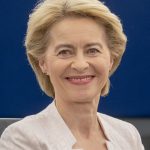
The speech made by Ursula von der Leyen, the President of the European Commission, on 10 October 2022.
My dear Kaja, dear Prime Minister Kallas,
Prime Minister Ngirente,
Excellencies,
Ladies and Gentlemen,
I am very glad to join you here today in Tallinn at the Digital Summit. Here in Estonia, the keyword of this conference – ‘connectivity’ – has a very special sound. You have next door a country that is trying to use our interconnections as a weapon against us. Because Russia is not only waging war on Ukraine. Russia is waging war on our energy, on our democracies and on our values. Estonia – like many of the Baltic States – has been warning Europe for years about the dangers of our dependency on Russian fossil fuels. You were right, and Europe should have followed your example earlier. Ever since you broke free from Soviet rule, you have been working very hard to get rid of Russian fossil fuels and to disconnect from the Russian grid. You have invested heavily in renewable energy, in LNG terminals, in new interconnectors with the rest of Europe. And on top, you have become global leaders in cybersecurity and in the digital field.
Today, you are standing strong before a hostile neighbour. So from a small country like yours, comes a great example for our entire European Union. This must be a lesson for all of us, especially as the war in Ukraine has now entered a new phase. Faced with the brave Ukrainian resistance, the Kremlin has once again escalated its aggression to a new level. Putin has launched Russia’s first mobilisation since World War II. He has used sham referenda in an illegal attempt to change international borders by force. All of this, while redoubling his efforts to destabilise global energy security. But this will only strengthen our resolve to support Ukraine for as long as it takes. But this new phase of the war also calls for renewed action on our energy independence, on our infrastructure, and on building new partnerships with the rest of the world. In short, it calls for a new investment into trusted connectivity.
Today, I would like to focus on three issues in particular. The first one is: We need to protect our critical infrastructure. The second topic is: We need to keep replacing unsustainable dependency with more balanced cooperation. And the third topic is: We need to continue to build trust in global connectivity.
Let me begin with the physical infrastructure that underpins connectivity. The acts of sabotage against the Nord Stream pipelines have shown how vulnerable our critical infrastructure is. Pipelines and underwater cables connect European citizens and the companies across the world. They are the lifelines of financial markets and global trade. And they are essential for services such as modern healthcare, for example, or energy. Submarine fibre-optic cables carry 99% of global internet traffic. And now, for the very first time in modern European history, this infrastructure has become a target. So the task ahead of us is clear: We need to better protect our lifelines of the world economy.
We have carved out five different strands of actions. Let me briefly reflect on them with you here. First of all, of course, we must be better prepared. The good news is that we have brand-new European legislation, which will strengthen the resilience of critical EU entities. With this new legislation that was done under the French Presidency, what we have to do now is implement it, put it on the ground, that it is really working and developing a track record. Second, we need to stress test our infrastructure. We need to identify the weak points and prepare our reaction to sudden disruptions. We all know how important stress tests are to make sure that everyone knows what to do in case of emergency. We will work with the Member States to do these stress tests in the field of energy and other high-risk sectors, such as offshore digital and electricity infrastructure, for example. The third point is: We will increase our capacity on the European level to respond through our Civil Protection Mechanism, if needed. With this, we can support Member States in case of disruption of critical infrastructure with very practical things – like fuel supplies, generators, shelter capacity. All these things have to be in place. And then, we will make best use of our satellite surveillance capacity to detect potential threats. We have this capacity, we should use it much more to really know what is going on in the different areas of our critical infrastructure. And last but not least, we will strengthen cooperation, of course, with NATO on this subject and partners, like for example our American friends. Critical infrastructure is the new frontier of warfare. And Europe will be prepared.
In the same spirit, we have to step up our support to our Ukrainian friends. Time and again – you have watched and you have been witnessing this in the last months – Russia has been trying to take down Ukraine’s IT systems. Therefore, the European Union has mobilised financial support for emergency cybersecurity to Ukraine. We have helped move government servers to safe locations. And this direct assistance is multiplied by Member States. Many thanks also to our host, Estonia, you have done a great job on that one. I know you have done a great job on that one because you understand very well, by bitter experience, that in the struggle between democracy and autocracy, the digital sphere is not a sideshow, but it is the front line. This is the critical infrastructure and the question of how we can better prepare to protect the physical infrastructure.
Let me move on to the second point which is that we have to replace unsustainable dependencies, which we do have, with balanced cooperation that we want with trusted partners. For that, we have to double down on our positive engagement with the rest of the world and continue to act in a spirit of openness, of cooperation, and of trust – that is the motto of this Summit. Just last year, just to give you some examples, we inaugurated the EllaLink transatlantic cable, connecting Europe with Latin America – revolutionary. And we are now deploying a new fibre-optic cable under the Black Sea. It will diversify internet access across Central Asia and reduce dependency on terrestrial cables that go through Russia. This project is one of the typical projects of Global Gateway – we have heard already a lot about it. Global Gateway, as you know, is our big investment project of EUR 300 billion for investments abroad in trusted connectivity. And I am very glad to see here the Prime Minister of Rwanda. We have, for example, a typical Global Gateway project that is building up vaccination manufacturing capacity. With the experience of the pandemic, we have decided to say: ‘Listen, there needs to be manufacturing capacity of mRNA vaccines in Africa, not only for COVID-19 but potentially to later fight malaria, tuberculosis and other deadly diseases.’ And here we have done what is typical for Global Gateway: come with public money but also come with our legal framework, for example for pharmaceuticals, that has to be in place; attract private capital; have a partner on the ground that is working with us to make sure that the project develops. That is one of the typical projects we have and we need more infrastructure like this in our neighbourhood managed and funded through Global Gateway. We also need this kind of infrastructure to connect Ukraine, to connect Moldova, Georgia and the Western Balkans more tightly to our Union. And we can do it. We have the experience. We have shown this. Let me give you a typical example: It was about two weeks after Russia’s invasion that we successfully connected the European electrical grid with the Ukrainian electrical grid. They decoupled from Russia. That was a move, I was told before the war, that was planned for 2024 – so two years ahead of us. We were able to manage that and to do that in two weeks. These are exactly the projects that have to be done through Global Gateway. Here, we needed to really join forces, of course to invest massively, but we did within two weeks what was planned for two years. So now Ukraine is an important new exporter of electricity to the European Union that creates a revenue stream for Ukraine. And our Union can rely on electricity from Ukraine to help tackle the energy crisis. And in case of need, we can provide them with electricity.
This is just one example in the broad attempt to get rid of Russian energy supplies. We have been working hard over the last seven months, since Russia invaded Ukraine – and we have been working with success to get rid of our dependency on Russian fossil fuels. We have completely cut off the supply of Russian coal. And if I can give you two figures concerning Russian gas: Last year, of all the gas imported to the European Union, 40% was Russian gas. In seven months, we have been able to decrease that dependency down to only 7.5% of Russian gas in the overall supply of European gas from abroad. Again, crucial was here to have the right infrastructure in place. And the good news is that Europe is making more progress by the day. The speed is accelerating because the pressure is high, and that is good. Just some days ago, we inaugurated a new gas interconnector between Bulgaria and Greece. It brings gas from Azerbaijan, and from Mediterranean LNG terminals, not only via Greece to Bulgaria but also to Romania, Serbia and North Macedonia. These examples, these interconnections are game changers for Europe’s energy supply and energy security. This means access to trusted and reliable sources of energy everywhere in our Union. And it means freedom from Russian dependency and freedom from Russian blackmail.
Dear Kaja, you were so right when you were reminding us of the real price tag that is attached to dependency on Russia. You have been describing it in your introductory remarks. We need to keep this firmly in mind as we transition to renewable sources of energy. Because, yes, it comes with an investment but it is worth it. Because if you look at the dependency, and the price tag that is coming with the dependency, it is much more needed to get rid of this dependency, invest in renewables and find your independence. Every kilowatt-hour of electricity or energy that we receive from solar or wind is not only good for our climate – it is also good for our climate and it is necessary – but it is good for our independence and our security of supply. If we invest more and more into renewables in the future, we have to be, also from the very start, vigilant and we have to be strategic. Because renewables – we want to produce them – often depend on scarce raw materials. And that is another topic that I want to raise here. You all know the magnets for wind turbines, the cells for solar panels, they all need rare minerals or rare raw materials, and you know the examples. By 2030, Europe’s demand for those rare earth metals will increase fivefold – five times what we use today, and today it is already a scarce resource. The first and foremost good news behind this fivefold increase is that it shows that our European Green Deal is moving fast. That is good news. The not so good news is that one country dominates the market: That is China. So we have to avoid falling into the same dependency on China – as we were with oil and gas from Russia. And we have to start now. That is why we are working on a European Critical Raw Materials Act. It will help to diversify our supply chains towards trusted partners – the motto of this Summit: ‘trusted connectivity’. And this will be another crucial domain for Global Gateway. Global Gateway will mobilise the public and private investment that is needed on the ground. Investments in projects abroad that connect us.
But we also have to do our own homework. And let me switch to topics we sometimes do not look at enough. Let me take the topic of semiconductors, for example, which is a good example of our overarching theme of new forms of cooperation. As you all now, semiconductors are in every digital device, from cars to phones to medical equipment. Without chips – no modern economy. This is clear. Let me give an example, how crucial these semiconductors are in the daily life. We have sanctions: The export of semiconductors to Russia. We have banned all export of semiconductors. The impact of these sanctions is now very real and tangible on the ground in Russia. The Russian military for example cannibalises by now refrigerators and washing machines to take out the semiconductors, trying to get the semiconductors for their military hardware.
Semiconductors are crucial. But not only for others, they are also crucial for us. Therefore, our aim is to increase our global market share to 20% by 2030. And we have all we need to achieve this. What are we doing? We have world-class research and testing facilities. This is attractive for investors – but not enough to create the necessary ecosystem. Thus, with our European Chips Act we have mobilised billions of investment for development, for mass production of next-generation chips. We have just approved, for example, the first state aid decision, giving the go-ahead to a EUR-730-million investment by a Franco-Italian company to build a new facility in Sicily. It will produce, for the very first time in Europe, large-scale silicon carbide wafers – the base of all semiconductors. And in the coming months, a trusted American company is set to break ground with its new chips plant in Germany – a EUR 17 billion investment. That is what trusted connectivity looks like in reality.
That brings me to my third and final point: It is about trusted connectivity. Who defines the rules of the game? High-tech is great – but what is the purpose you use it for? Who is setting the standards? Who is setting the standards that will govern and protect our societies? Is it the market? Is it the government like in China? Or is it the human-centric approach that is our European approach? Think of the individual and his or her rights. Take the GDPR, as you know, born in Europe, it might not be perfect – but for the very first time the rules of the game have been defined. And now they are setting data protection and they are setting standards, from here not only in Europe, but also in Silicon Valley for example. They are the benchmark for data protection in Silicon Valley. Or take our Digital Markets and Digital Services Act. Here again, Europe is on the vanguard, bringing the rules of the analogue world into the digital world. For the very first time, there are clear rules on how to deal with topics like hate speech, disinformation, terrorist content online. We are doing the same for product cybersecurity, with a regulation proposed next month.
Now, setting standards for Europe is good. But it is our engagement with our trusted partners that makes European standards finally global standards. This is one of the reasons for example why our work with the United States, and recently also with India, through our Trade and Technology Councils, is so important – set the standards with your friends. In addition, we have teamed up with the G7’s Partnership for Global Infrastructure – you were describing it, Kaja. With our combined package of USD 600 billion, we are leveraging not just our investments, that is important, but also our standard-setting power. Thus, step by step, we are re-anchoring the values- and rules-based order on firmer ground in a modern economy. Working with friends, working with partners through trusted connectivity. The Roman statesman, Cicero, famously said: ‘The shifts of fortune test the reliability of friends.’ I am glad to be amongst friends. For we cannot always control what history has in store for us. But we can shape our fortunes, we can influence it – by standing tall for our values, and by standing united with our trusted partners and our friends.
Thank you very much.