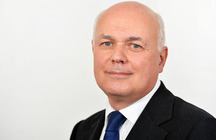
Below is the text of the speech made by Alan Johnson, the former Home Secretary, in the House of Commons on 2 December 2015.
It is a pleasure to follow the hon. Member for Basildon and Billericay (Mr Baron). During my time in Parliament, it has become a convention that this House authorises military action, whereas previously it was for a Prime Minister to do so under the guise of royal prerogative. Sometimes they would involve the House of Commons; most often they did not. This new convention places a responsibility on Members of Parliament to weigh up the arguments and vote according to their conscience, rather than a parliamentary Whip.
I am not sure if other parties are whipped on this vote or not, but I am pretty sure that nobody in any part of this House would seek to justify their vote tonight by pleading that although they disagreed or agreed with the proposition, the Whip forced them to vote the way they did. On votes such as this, the Whip is irrelevant, except to Front Benchers, perhaps. Although I am grateful to the shadow Cabinet for the free vote my party has been afforded, I do not think it will make the slightest difference to the way we make our decision.
I intend to vote for the motion this evening for one basic reason: I believe that ISIL/Daesh poses a real and present danger to British citizens, and that its dedicated external operations unit is based not in Iraq, where the RAF is already fully engaged, but in Syria. This external operations unit is already responsible for killing 30 British holidaymakers on a beach in Sousse, and a British rock fan who perished along with 129 others in the Paris atrocity a few weeks ago.
It is true that this unit could have moved out of Raqqa, but that is not what the intelligence services believe. The fact is that just as al-Qaeda needed the safe haven it created for itself in Afghanistan to plan 9/11 and other atrocities, so ISIL/Daesh needs its self-declared caliphate to finance, train, organise and recruit to its wicked cause. Yes, there may be cells elsewhere, but there is little doubt that the nerve centre is in Raqqa. Just over 14 months ago, this House sanctioned military action in Iraq against ISIL/Daesh by 524 votes to 43. Nobody expected that action to bring about a swift end to the threat from ISIL; indeed, the Prime Minister, responding to an intervention, said that
“this mission will take not just months, but years”—[Official Report, 26 September 2014; Vol. 585, c. 1257.]
Many right hon. and hon. Members felt at that time that it was illogical to allow the effectiveness of our action to be diminished by a border that ISIL/Daesh did not recognise. We were inhibited by the absence of a specific UN resolution, so there was some justification for this House confining its response to one part of ISIL-held territory in September 2014. There can surely be no such justification in December 2015—no such justification after Paris, given the request for help from our nearest continental neighbour and close ally in response to the murderous attack that took place on 13 November; and no such justification after UN Security Council resolution 2249.
Paragraph 5 of the resolution, which was unanimously agreed,
“Calls upon Member States that have the capacity to do so to take all necessary measures…to eradicate the safe haven they”—
ISIL-Daesh—
“have established over significant parts of Iraq and Syria”.
George Kerevan:
I put to the right hon. Gentleman the point that I would have put to the right hon. Member for Derby South (Margaret Beckett): a similar call from France was met by Germany, which sent reconnaissance aircraft but refused to bomb.
Alan Johnson:
Germany is constrained by its history. The point I am making is that we in this Parliament, having authorised military action by the RAF in Iraq, can no longer justify not responding to recent events by extending our operations to Syria. If we ignore the part of resolution 2249 that I have just read out, we will be left supporting only the pieties contained in the other paragraphs; we will unequivocally condemn, express deepest sympathy, and reaffirm that those responsible must be held to account. In other words, this country will be expressing indignation while doing nothing to implement the action unanimously agreed in a motion that we, in our role as chair of the Security Council, helped formulate.
Furthermore, there is no argument against our involvement in attacking ISIL/Daesh in Syria that cannot be made against our action in Iraq, where we have helped to prevent ISIL’s expansion and to reclaim 30% of the territory it occupied. As the Prime Minister set out in his response to the Foreign Affairs Committee, that means that RAF Tornadoes, with the special pods that are so sophisticated that they gather 60% of the coalition’s tactical reconnaissance information in Iraq, can be used to similar effect in Syria, so long as another country then comes in to complete the strike. That is a ridiculous situation for this country to be in.
Mr David Anderson (Blaydon) (Lab):
Is not the different between Iraq and Syria the fact that we have on the ground in Iraq a long-established ally, the Kurdish peshmerga, who want to work with us? We do not have that in Syria; we have there what the Prime Minister is now describing as a patchwork.
Alan Johnson:
My hon. Friend, as always, makes an important point. I have just re-read the Hansard report of our debate in September 2014, and this point was not raised by anyone. The question of what comes next, which is a very important consideration—concerns have been expressed on both sides of the House—must not stop us responding to what happened in Paris and to the UN resolution’s request for all countries with the capability to act now. The resolution did not say to delay; it said to act now.
I do not think that anybody in this House believes that defeating the motion tonight will somehow remove us from the line of fire—that ISIL/Daesh and its allies will consider us no longer a legitimate target for its barbaric activities. The 102 people murdered in Ankara were attending a peace rally. The seven plots foiled by our security services so far this year were all planned before this motion was even conceived. Our decision tonight will not alter ISIL/Daesh’s contempt for this country and our way of life by one iota, but it could affect its ability to plan and execute attacks. If our decision does not destroy ISIL/Daesh’s capability in Syria, it will force its external operations unit to move and, in so doing, make it more exposed and less effective.
The motion presents a package of measures that will be taken forward by the international community to bring about the transformation in Syria that we all want to see, and it promised regular updates on that aspect. Furthermore, I believe that the motion meets the criteria that many Members will have set for endorsing military action now that the convention applies: is it a just cause? Is the proposed action a last resort? Is it proportionate? Does it have a reasonable prospect of success? Does it have broad regional support? Does it have a clear legal base? I think that it meets all those criteria.
I find this decision as difficult to make as anyone. Frankly, I wish I had the self-righteous certitude of the finger-jabbing representatives of our new and kinder type of politics, who will no doubt soon be contacting those of us who support the motion tonight. I believe that ISIL/Daesh must be confronted and destroyed if we are properly to defend our country and our way of life, and I believe that this motion provides the best way to achieve that objective.
Below is the text of the speech made by Margaret Beckett, the former Foreign Secretary, in the House of Commons on 2 December 2015.
This debate centres on national security and the safety of our constituents. There will be differences of view within and between every party in this House. In good faith and conscience, Members will reach different conclusions. Anyone who approaches today’s debate without the gravest doubts, reservations and anxieties simply has not been paying attention. We are sent here by our constituents to exercise our best judgment—each our own best judgment. This is a debate of contradictions.
The terms of today’s motion, echoing the UN resolution are stern, almost apocalyptic, about the threat, which is described as
“an unprecedented threat to international peace and security”.
As my right hon. Friend the Member for Manchester, Gorton (Sir Gerald Kaufman) said, the proposal before us amounts to only a relatively minor extension of the action that we are already undertaking. We have been asked to agree to act in both Iraq and Syria, precisely because that is what Daesh does, and its headquarters are in Syria. We have been asked to make a further contribution to an existing international effort to contain Daesh from extending the mayhem and bloodshed that accompany its every move even more widely across the middle east.
Serious questions have been raised, and I respect those who raise them. There is unease about ground forces. There is proper concern about the strategy and endgame, about the aftermath, and about rebuilding. Some say simply that innocent people are more likely to be killed. Military action creates casualties, however much we try to minimise them. Should we, on those grounds, abandon action in Iraq, although we undertake it at the request of the Iraqi Government, and it seems to have made a difference? Should we take no further action against Daesh, which is killing innocent people, and striving to kill more, every day of the week, or should we simply leave that to others? Would we make ourselves a bigger target for a Daesh attack? We are a target; we will remain a target. There is no need to wonder about it—Daesh has told us so, and continues to tell us so with every day that passes. We may as well take it not just at its word but, indeed, at its deeds. It has sought out our fellow countrymen and women to kill, including aid workers and other innocents. Whatever we decide today there is no doubt that it will do so again, nor is the consequence of inaction simply Daesh controlling more territory and land. We have seen what happens when it takes control. The treatment, for example, of groups such as the Yazidis, in all its horror, should surely make us unwilling to contemplate any further extension of Daesh-controlled territory. Inaction too leads to death and destruction.
Quite separately, there are those, not opposed in principle to action, who doubt the efficacy of what is proposed: coalition action which rests almost wholly on bombing, they say, will have little effect. Well, tell that to the Kosovans, and do not forget that if there had not been any bombing in Kosovo perhaps 1 million Albanian Muslim refugees would be seeking refuge in Europe. Tell that to the Kurds in Kobane who, if memory serves, pleaded for international air support, without which they felt they would lose control to Daesh. Tell them in Sierra Leone that military action should always be avoided because there would be casualties. Their state and their peace were almost destroyed. It was British military action that brought them back from the brink.
Of course, that military action took place in conjunction with political and diplomatic activity, and I share the view that it is vital that such activity is substantially strengthened. I was heartened by what the Prime Minister told us today. Our conference called for a United Nations resolution before further action, and we now have a unanimous Security Council resolution. Moreover, that resolution calls on member states in explicit and unmistakeable terms to combat the Daesh threat “by all means” and
“to eradicate the safe haven they have established”
in Iraq and Syria.
Although it speaks of the need to pursue the peace process, the UN resolution calls on member states to act now. Moreover, our French allies have explicitly asked us for such support. I invite the House to consider how we would feel, and what we would say, if what took place in Paris had happened in London and if we explicitly asked France for support and France refused.
George Kerevan:
Will the right hon. Lady give way?
Margaret Beckett (Derby South) (Lab):
I am sorry, no.
These are genuinely extremely difficult as well as extremely serious decisions, but it is the urgings of the United Nations and of the socialist Government in France that, for me, have been the tipping point in my decision to support military action.
Below is the text of the speech made by Sir Gerald Kaufman in the House of Commons on 2 December 2015.
There is of course absolutely no doubt that Daesh/IS is a vile, loathsome, murderous organisation, and the attack in Paris—the murder of 130 innocent people—could just as well have been in London. The choice of Paris was a retaliation against French activity in its region, but that does not justify our taking action unless it were appropriate, relevant and, above all, successful. These people claim to call themselves Islamic, and the Prime Minister talked about reclaiming Islam from them—they do not own Islam. Hundreds of millions of Muslims throughout the world are appalled by their murders, their beheadings, their kidnappings—all the abominable things they do. But our loathing of IS and our wish to get rid of it, to defeat it, to stop it is not the issue here today. The issue here is: what action could be taken to stop IS and get rid of it? I have to say that I do not see such an action.
The Prime Minister spoke about getting a transitional Government in Syria and about the situation in Syria. I have been to Syria many times. I did so with some distaste as shadow Foreign Secretary, as I met leading officials in the Syrian Administration—I knew they were murderers. They murder their own people. They murdered 10,000 people in Hama alone. I would be delighted to see them got rid of, but they are not going to go. There is talk about negotiations in Vienna, but the assumption that somehow or other they are going to result in getting rid of Assad and the Administration is a delusion. Putin, one of the most detestable leaders of any state in the world, will make sure that because they are his allies and they suit him, action against them is not going to be successful.
What is the issue today? It is not about changing the regime in Syria, which would make me very happy indeed. It is not about getting rid of Daesh, which would also make me very happy indeed. It is about what practical action can result in some way in damaging Daesh, stopping its atrocities, stopping the flood of people who are fleeing from it and stopping the people who are flocking to it, including, sadly, a small number of people from this country. If what the Government were proposing today would in any way not simply or totally get rid of Daesh but weaken it significantly so that it would not go on behaving in this abominable fashion, I would not have any difficulty in voting for this motion. But there is absolutely no evidence of any kind that bombing Daesh—bombing Raqqa—will result in an upsurge of other people in the region to get rid of Daesh. It might cause some damage, but it will not undermine them. What it will undoubtedly do, despite the Prime Minister’s assurance, which I am sure he gave in good faith, is kill innocent civilians. I am not going to be a party to killing innocent civilians for what will simply be a gesture.
I am not interested in gesture politics and I am not interested in gesture military activity; I am interested in effective military activity, and if that is brought before this House, I vote for it. When the previous Conservative Government came to us asking for our support to get rid of Saddam Hussein from Kuwait, I, as shadow Foreign Secretary, formulated the policy that led Labour Members of Parliament into the Lobby to vote for that. I am not interested in gestures; I am interested in effective activity. This Government’s motion and the activity that will follow, including military action from the air, will not change the situation on the ground. I am not interested in making a show. I am not interested in Members of this House putting their hands up for something that in their own hearts they know will not work, and for that reason I shall vote against the Government motion this evening.
Below is the text of the speech made by Liam Fox, the former Secretary of State for Defence, in the House of Commons on 2 December 2015.
It is very important that the whole House is clear about what this debate is not about. It is not about provoking a new confrontation with Daesh, given that it has already confronted peace, decency and humanity. We have seen what it is capable of—beheadings, crucifixions, mass rape; we have seen the refugee crisis it has provoked in the middle east, with its terrible human cost; and we have seen its willingness to export jihad whenever it can. It is also not about bombing Syria per se, as is being portrayed outside; it is the extension of a military campaign we are already pursuing in Iraq, across what is, in effect, a non-existent border in the sand. I am afraid that the Leader of the Opposition’s unwillingness to answer the question from my hon. Friend the Member for Enfield, Southgate (Mr Burrowes) will give the clear impression that he is not just against the extension of the bombing campaign into Syrian territory, but against bombing Daesh at all, which is a very serious position to hold.
To understand the nature of the threat we face and why it requires a military response, we need to understand the mindset of the jihadists themselves. First, they take an extreme and distorted religious position; then they dehumanise their opponents by calling them infidels, heretics and apostates—let us remember that the majority of those they have killed were Muslims, not those of other religions; then they tell themselves it is God’s work and therefore they accept no man-made restraint—no laws, no borders; and then they deploy extreme violence in the prosecution of their self-appointed mission. We have seen that violence on the sands of Tunisia, and we heard it in the screams of the Jordanian pilot who was burned alive in a cage.
We must be under no illusions about the nature of the threat we face. Daesh is not like the armed political terrorists we have seen in the past; it poses a fundamentally different threat. It is a group that seeks not accommodation but domination. We need to understand that before determining our response.
Daniel Kawczynski (Shrewsbury and Atcham) (Con):
My right hon. Friend will know of concerns that Daesh fighters are leaving Syria for Libya in greater numbers. Does he believe that when we are tackling Daesh in Syria, we will have to confront it in Libya at some stage as well?
Dr Fox:
My hon. Friend is absolutely right. As I said, we have not chosen this confrontation; Daesh has chosen to confront us—and the free world, and decency and humanity. It is a prerequisite for stability and peace in the future that we deal with the threat wherever it manifests itself.
There are two elements to the motion: the military and the political. On the military question of whether British bombing, as part of an allied action in Syria, will be a game changer, I say, no, it will not, but it will make a significant and serious contribution to the alliance. The Prime Minister is absolutely correct that some of our weaponry enables us to minimise the number of civilian casualties, and that has a double importance: it is important in itself from a humanitarian point of view, as well as in not handing a propaganda weapon to our opponents in the region. Britain can contribute: we did it successfully in Libya, by minimising the number of civilian casualties, which is not an unimportant contribution to make.
We must be rational and cautious about the wider implications. No war or conflict is ever won from the air alone, and the Prime Minister was right to point out that this is only a part of the wider response. If we degrade Daesh’s command and control, territory will need to be taken and held, so ultimately we will need an international coalition on the ground if this is to be successful in the long term. There may be as many Syrian fighters as the Joint Intelligence Committee has set out, and they may be co-ordinating with the international coalition, or be capable of doing so, but we must also recognise the need for a wider ability to take and hold territory. To those who oppose the motion, I say this: the longer we wait to act, the fewer our allies’ numbers and the less their capabilities are likely to be, as part of a wider coalition. If we do not have stability and security on the ground in Syria, there is no chance of peace, whatever happens in Vienna.
On the political side, our allies think it is absurd for Britain to be part of a military campaign against Daesh in Iraq but not in Syria. It is a patently militarily absurd position, and we have a chance to correct it today. But we must not contract out the security of the United Kingdom to our allies. It is a national embarrassment that we are asking our allies to do what we believe is necessary to tackle a fundamental threat to the security of the United Kingdom, and this House of Commons should not stand for it. Finally on that point, when we do not act, it makes it much more difficult for us diplomatically to persuade other countries to continue their airstrikes, and the peeling off of the United Arab Emirates, then Jordan and then Saudi Arabia from the coalition attacking Daesh is of great significance. We have a chance to reverse that if we take a solid position today.
This motion and the action it proposes will not in itself defeat Daesh, but it will help, and alongside the Vienna process it may help to bring peace in the long term to the Syrian people. Without the defeat of Daesh, there will be no peace. We have not chosen this conflict, but we cannot ignore it; to do nothing is a policy position which will have its own consequences. If we do act, that does not mean we will not see a terrorist atrocity in this country, but if we do not tackle Daesh at source over there, there will be an increasing risk that we have to face the consequences over here. That would be an abdication of the primary responsibility of this House of Commons, which is the protection and defence of the British people. That is what this debate is all about.
Below is the text of the speech made by Iain Duncan Smith, the then Leader of the Conservative Party, to business executives in London on 3rd March 2003.
Let me begin by thanking you for his invitation to me to address you this evening.
It was clear to me, within five minutes of arriving here, that foremost in all of our minds is the question of the war. When will it come? How will it go? Where will it end? And just to be clear, I am talking about Iraq!
On that subject, I left on Friday for the Gulf, returning just this morning. I went out there to see for myself our state of readiness, and to lend our own encouragement to the brave young British servicemen and women who have taken up their positions in the desert, awaiting their orders.
Iraq was not intended to be the main subject of my address tonight. However, the war, and related security issues, are a critical factor in the general apprehension that presently grips the business community, the country, and indeed economies – and polities – around the world.
And we have now reached a critical point.
So it is important that I make my position perfectly clear.
Saddam Hussein is a tyrant who tortures and murders his own people and poses a threat to the safety and stability of the Middle East.
Of that, I have absolutely no doubt.
And there are few people in Iraq or among its neighbours who will mourn his passing. I know there is widespread concern about the dangers of war, and where they may lead.
But I believe it will be far more dangerous if we do not act now; if we fail to deal resolutely and unhesitatingly with Saddam, once and for all.
If we don’t deal with him now, our soldiers will only have to go back – in two, or five, or ten years time – just as it is today, after 12 long years of Saddam’s cat-and-mouse game with the UN.
Saddam still holds the power to come clean; to disarm; to pull back from the brink of war, which, as any soldier will always tell you, must always be the last resort.
But he must be left in no doubt that if he does not disarm, after years of terrorism and evasion, after years of unanswered questions – from hidden weapons to missing Kuwaiti prisoners of war – then he will face the consequences.
The reality of the world didn’t change on September 11th. We had already seen the signs – the new threats had already made themselves clear. What happened on September 11th is that our understanding of the world caught up with that reality.
So this is now a crucial test. There are things at stake here — and not just for Britain and the United States — that go well beyond the outcome of this crisis. There is the credibility of the United Nations and the Security Council as instruments of international security.
There is the future of the Transatlantic relationship – which, given the importance of France and Germany in Europe and their appalling behaviour over the issuing of defence missiles to Turkey – can be said to be at its lowest ebb in 40 years. And there is a burgeoning threat to civilised, democratic values and their preservation and advancement around the world.
This is now our chance to send a very clear message to Saddam and beyond. It is, I repeat, a crucial test. We must be resolute in our determination to disarm Saddam by whatever means prove necessary, or fail it.
I want to turn, now, to our domestic concerns.
Our country faces great challenges at home – challenges which represent real threats to our day-to-day lives, and to our future.
The sooner we can return our attention to these challenges, the better it will be for all of us.
Now you will all be able to guess what I think of this Labour Government. I think this Government is hell bent on a massive programme of tax and spending, regardless of the results.
I think it is obsessed with centralised control – with targets and micro-management. I think it is wasteful – careless with your money. I think this Government is just like Labour Government have been and always will be. There is a continuity of behaviour that no amount of spin can hide.
As a politician I always have to take a moment to get the rhetoric off my chest. But I’m sure you are here for some more thorough analysis.
And in that regard, I want to make two assertions tonight –
The first is this: –
That the Labour Government has gambled its entire economic strategy on an assumption that it can continue to take more and more tax – currently £109 billion more – and that businesses and people can continue to afford it. Moreover, that if it continues to spend more and more money on the public services, they will continue to improve. They have failed and we are now paying the price.
But whereas they believe you should now be paying the price for their failure through higher taxes…
We in the Conservative Party believe – and I think the general public is coming to believe – that Labour should pay the price at the next election — by being thrown out.
My second assertion is that there is a critical connection between the state of Britain’s public services – services which Labour, despite its promises, has utterly failed to improve — and our ability to compete on the global economic playing field.
As a nation, we are now less competitive and less productive than we were in 1997. Britain must regain the competitive ground it has lost over the past six years – but it can only do so under a Conservative government committed to the reform and improvement of the public services.
So, my first assertion… Labour has gambled on a tax and spend policy, and failed. What does that mean?
Well, for that we can turn to the record.
Labour came to power saying: ‘We’ve no plans to increase tax’. Since 1997 they’ve raised the national tax bill from £270 billion to £380 billion. Next year, it will rise to £405 billion – a 50 per cent cash terms increase since 1997.
What that means is that in the past five and a half years the price per household for Government services has gone up from £11,000 to £16,500 a year.
Does it feel like we have had a 50 per cent improvement in those services?
This April’s tax increase comes in the form of National Insurance contributions – another £4 billion a year from employers, and £4 billion a year on top of that from employees.
It’s a straightforward tax on jobs and pay. Gordon Brown may have talked about an increase on National Insurance of just one penny, but the total effect is equivalent to raising the basic rate of income tax by 3p.
In 1997, the Labour manifesto said: ‘The level of public spending is no longer the best measure of the effectiveness of government action.’ And: ‘New Labour will be wise spenders, not big spenders.’
In 2002, the Chancellor committed the government to – in his own words – ‘vast increases’ in spending over the next few years.
So from this April, as the extra jobs tax kicks in, the Labour Government will break though the 50 MPH barrier.
It will be spending more than £50 million pounds an hour – that’s almost 50% faster than the rate of spending in 1997 before they came to power.
On the health service alone, spending will have risen 70% in real terms by the time of the next election.
They have pumped money into the health service in a desperate attempt to show they care, that they are doing something, never mind about the results.
This in spite of a promise by Gordon Brown not 15 months ago that “there will not be one penny more [spent on the Health Service] until we get [the] changes [that] let us make reforms and carry out the modernisation the health service needs”.
They hit pensions funds while the market was at its peak and when only so-called ‘fat cats’ would complain. And because pension funds were apparently in surplus, Gordon Brown had the gall to call it a reform.
But it wasn’t a reform, it was a tax, plain and simple. Not only that, but the markets have since gone into reverse with the FTSE falling much further and faster than the Dow Jones.
Private pensions have halved since those heady days – but Mr Brown’s still raking off his £5 billion quid. This tax has had two further knock-ons.
First, companies contributing to pension funds have to replace that £5 billion, reducing their profits, and knocking about £80 billion off share values.
Second, removing the dividend tax credit has reduced the relative attractiveness of UK equities compared to bonds and overseas equities.
Unintended as these consequences may have been, they are the product of an arrogant attitude to policy making. And they have made the prospect of retirement a source of fear and anxiety for millions of hard-working people.
This pensions debacle speaks precisely to the reasons which underlie the larger failure of Labour’s tax policies.
For a start — they assumed the great bull market of the late 1990s would run and run and run.
They assumed that as the economy continued to grow, and incomes continued to grow, that they would be able to take more and more money out of British enterprise in tax, and no-one would notice.
And so they took decisions – to tax, to regulate, to spend — whose consequences they thought would be covered up, or softened up, by a growing economy.
They assumed that instead of putting in the hard work, and making the hard choices, to reform and improve our public services, they could exercise the soft option — making pledges, announcing targets, introducing schemes, undertaking initiatives.
They assumed that glittering promises and finely-spun excuses would make an effective substitute for hard results.
This has been a fatal misjudgement; policy-making at its most arrogant and most injudicious.
Policy-making, my friends, that has proved wholly unsustainable: Because we know that you cannot spend more and more money – and note that I say spend money and not invest it, – you cannot spend far faster than you are earning, while delivering less and less return on that spending, and not expect to be caught out when the market turns against you.
And now the market has turned. The gamble has failed. A flawed policy, founded in the most basic error, has run aground. The damage is done.
And there is much more damage to come – for businesses, for taxpayers, and for our public services.
Because, at precisely the moment when the economy has just grown at its slowest rate for a decade, and businesses and consumers alike are gripped by uncertainty, the Government – instead of consolidating; reassuring; being a rock of stability – is planning to do precisely the opposite. It is about to embark on a tax and spend experiment of such unprecedented scale that the Health Secretary himself – whose department will most benefit – is known to have grave concerns that the money will be wasted.
And there is every likelihood that this will indeed happen. Good money will be thrown after bad. Because Labour has balked at the hard job of introducing into the public services the efficiencies needed to ensure that they can use the new money to best effect.
You, as businessmen and women, as leaders of British enterprise, will have seen too many disquieting parallels.
Companies which assumed the old and unforgiving rules of economics had somehow been suspended.
Executives who pursued disastrous strategies.
Who re-engineered corporate finances to breaking point – Then when it all snapped, destroyed the wealth of millions of stockholders, and were disgraced and dismissed.
I think it’s time we understood this Labour Government in the same way.
They had so much going for them – a golden economic legacy, the vast goodwill of so many in business and among the electorate, two landslide election victories, a massive majority in the Commons.
They have squandered it all.
They have failed to deliver.
They have destroyed wealth, not created it.
Indeed, ironically, it is their very policies that have helped create the malaise that is now catching them out.
At the earliest opportunity, they should be dismissed.
Let me turn now, to my second assertion – that there is a critical connection between the state of Britain’s public services – services which Labour, despite their promises, have utterly failed to improve — and our ability to compete on the global economic playing field.
Let me explain my view of how that connection is made.
In 1997, Britain voted for a change.
It is not my job to tell Britain that it was wrong to make that choice. It is my job to understand why Britain made that choice.
We could understand the lure, for many voters, of more money for schools and hospitals and more support for patients, parents and the lowest earners.
But something deeper was going on. Across the board, people were coming to recognise that being able to compete had to be about more that just economic efficiency.
To compete meant being a country where people wanted to live, where people were optimistic, where businesses would choose to locate their operations.
A place that would attract and retain the best talent and the most investment. A place with something extra to offer.
To compete meant being a nation with a well educated, highly qualified workforce that didn’t waste weeks every year, off sick, or stuck in traffic jams.
People had come to understand that the poor quality of our public services was holding us back.
Britain needed better public services, a better quality of life.
For years, we had worked hard to improve our standard of living.
18 years of Conservative Government had yielded a wonderful legacy – we had taken the sick man of Europe and turned it into a wealthy, enterprising and confident nation.
But there was work still to do.
In 1997, the debate was shifting from standard of living to quality of life.
Tony Blair took advantage of this and, on the promise of delivering a better quality of life while not threatening our standard of living, he carried the country on a tidal wave of support.
His use of pledges and slogans was brilliant, and helped him to capture the imagination. But all this did was mask his party’s true colours.
So unfortunately, we’re now no further on than we were six years ago. In fact, we’ve fallen further behind.
Britain is a country where people are afraid to fall ill; where their children are not guaranteed a decent education; where our infrastructure – from the transport system to our local communities – is falling apart.
Over a million people are still on hospital waiting lists, waiting for treatment in a health service that now has more administrators than it has beds.
If you need an operation in France, the maximum wait is four weeks. If you need one in Britain, the average wait is 4.3 months.
In Accident and Emergency, NHS patients have to wait hours – first just to be seen, then to be admitted. In Germany, all patients are seen within minutes of arrival.
And all this despite a dramatic increase in resources. Over the last two years, health spending has gone up by 22 per cent. And what did it deliver? A paltry 1.6 per cent increase in hospital treatments, and a half-percent decline in hospital admissions.
Our education system is leaving more and more children behind.
One quarter of 11 years olds leave primary schools unable to read, write and count properly.
30,000 young people leave school each year without a single GCSE. The gap between inner city school and the rest is getting wider.
The failure of our schools to deliver for all is no good for business and no good for society.
As for crime, despite all of Labour’s pledges, it keeps getting worse. Gun crime soaring, robbery way up, domestic burglary up, drug offences up.
A crime is now committed every five second in England and Wales.
So Labour’s policies have had little impact – the challenge to improve British people’s quality of life remains.
But meanwhile, what other competitive advantages we did have are being eroded.
The burden on business is up, and our competitiveness and productivity growth down.
The CBI believes Labour’s new regulations alone have added £15 billion to the cost of doing business in Britain.
And since 1997
– we’ve lost over half a million jobs in manufacturing,
– we’ve seen the number of days lost to strikes increased sixfold
– and we’ve fallen from 9th to 16th place in the World Competitiveness rankings.
Over the last year, business investment has fallen at its sharpest rate for more than three decades.
As a global competitor, we have lost a lot of ground.
With taxes up, we’re a more expensive place to do business.
With regulation up, we’re no longer an easy place to do business.
With our public services in decay, we’re no longer a magnet for the world’s top talents and skills.
Instead, we have a government that has so completely lost control of its own policies on asylum that Britain has become the destination for a flood of economic migrants – more than 100,000 last year alone, who put further pressure on our straining services and finances.
These are the issues to which a Conservative government will give priority.
What does this mean for business?
First, we are, by nature, a party of lower tax.
It flows from our belief in smaller government, greater individual liberty, and greater personal responsibility.
It flows from our belief that governments should measure success not by how much they spend of your money, but how well – and how carefully – they spend it.
And our belief – also — that low-tax economies are more efficient, and more competitive, than high-tax economies.
Second, a Conservative Government will not be trying to second-guess everything you do. We will not be over-interfering in the way you run your businesses.
And unlike the Labour Government, we mean what we say when we say that we’ll cut red tape, and we’ll ask for your advice on how to do it.
Thirdly, on public services we are committed to a strategy of reform, widening choice, and rooting out waste.
Up and down the country, Conservative councils are putting this approach into practice and using people’s money more carefully.
What sets us so completely apart from Labour is that we understand how important it is to have a holistic approach. Without strong businesses, you cannot have a strong economy.
Without a strong economy you cannot have strong public services. Without strong public services, you cannot have strong businesses. And without all these things you can’t have a strong country. This, I hope, is in our future.
But there is still today to contend with. Indeed, we have two to three years of this Government still to run.
The Chancellor has already badly miscalculated.
His tax and spend gamble has failed. It is clear that more money alone is not the answer to better healthcare. Or to improving any other public service for that matter.
But on the way to finding this out, Mr Brown and Mr Blair have damaged us. Undermined our competitiveness and left us all poorer.
The Chancellor’s policy is running into heavy weather. Already holed below the waterline, he now risks steering the country onto the rocks.
It is not too late to change course. Indeed he has a month left to scrap his new tax on pay and jobs. He still has time to admit that his failed policies are damaging the economy – and to recognise that our public services need real reform.
But what concerns me now, and you may share this concern, is that he will not change course in time, and that before someone else gets the chance we will already have run aground.
Below is the text of the speech made by Iain Duncan Smith, the then Leader of the Opposition, at the launch of the Conservative Consultation Document on Health on 5th June 2003.
The Labour Government is dangerously divided.
And it’s got its priorities hopelessly wrong.
That’s as plain today as it will ever be.
We are not be going to spend today talking about the euro.
We are going to talk about things that are already damaging the British people’s quality of life…
Day in, day out…
The public services on which they depend — and which are now failing them badly under Labour.
But the Government are most certainly talking about the euro today.
And they’ll still be talking about it tomorrow.
And for a long time after that.
Even as – we – speak, Mr Blair and Mr Brown are lining up their coalitions, on either side of the Cabinet table, ready for a battle over the euro — in which the losers will be the British people.
While the Government are busy talking about something people don’t want — the euro — we will be talking about something they do want – better healthcare.
This distracted and divided Government should be focusing on the things that really matter to the British people.
The British people want better public services.
Public services that work – and work well.
We’ve already begun.
For the past two years, we have been conducting the most wide-ranging policy review for a generation.
A policy review focused on making the public services better.
We have travelled – at home and abroad – learning from whatever works best for people.
So last month, we promised to scrap Labour’s university tuition fees – their tax on learning.
Today, Liam Fox and I are launching fresh, exciting proposals designed to give British people the better healthcare they need and deserve.
Today begins a full consultation with patients and professionals on something that will make a real difference to people’s lives.
The ‘patient’s passport’ is our plan to give people real choice over the health treatment they receive.
This will be a fair deal for patients.
A fair deal for everyone on healthcare.
Our proposals will mean…
Fairer healthcare, with no-one left behind, as we expand choice to everyone, not just those who can afford it.
Fairer healthcare, with no-one held back, as we recognise the contributions of those who pay for their own treatment.
Last year, a staggering number of people – 300,000 – paid for their own treatment.
Most of them were pensioners — desperate people, who had suffered for too long.
Under our proposals for a Patient’s Passport, everyone in the NHS will be able to get treatment at the hospital of their choice, free of charge.
And people who choose to go outside the NHS for their treatment will be helped, not penalised.
Our proposals would also mean…
Better healthcare for everyone, with choice driving innovation and excellence.
And more healthcare, as we expand the capacity of the health system in Britain.
Our proposals would mean nothing less than a revolution in healthcare.
We will preserve all the founding ideals of the NHS.
Healthcare, according to your need not your ability to pay, and free at the point of delivery.
But, for the first time in its history, the NHS would become a truly national health service — embracing our belief that healthcare is first and foremost about the patient.
Compared to that, everything else is surely secondary.
Our plans for a patients’ passport, combined with our plans to shift power from politicians to doctors, nurses and hospitals, will deliver a fair deal for everyone on healthcare.
We care enough to find out what people really want, and we are open-minded enough to find out what really works.
That’s why last month we promised to scrap Labour’s university tuition fees, abolishing their tax on learning.
That’s why today we are proposing to give every patient in Britain a Patient’s Passport, making real choice available to all, not just those who can afford it.
We have the courage and vision to commit Britain to a better course.
Today, we are taking forward our fight, on behalf of the British people…
For better public services — and a fair deal for everyone.
A fair deal for people who find themselves paying higher and higher taxes, but not getting the improved public services they need.
We will give them those better public services
…public services where no-one is held back…
…and no-one is left behind.
A fair deal for people who deserve better healthcare.
A fair deal for people who deserve a better education.
A fair deal for people who have been made to wait and suffer too long.
Below is the text of the speech made by Iain Duncan Smith, the then Leader of the Conservative Party, to businessmen in the North East on 20th February 2003.
Thank you for inviting me here today.
It’s a great pleasure to be here in Newcastle — and a privilege to be among you.
This opportunity to see what you do at Rite-Vent has been very valuable.
So let me say thank you, first, to the Directors and the workforce for making me so welcome and for taking the time to show me around.
And let me also take this opportunity while I’m here in Newcastle to say congratulations to Sir Bobby Robson and his team for the excellent result on Tuesday.
I wish them well as they progress in the Champions League and – as a keen Tottenham fan myself – I hope we’ll be joining them there next season.
Football is of course one of the things for which Newcastle is best known.
A tradition of manufacturing and industry is another.
But these are tough times for British manufacturing – and it’s companies like Rite-Vent which — in spite of the higher taxes and over-regulation Labour has imposed – are holding the line.
Last year manufacturing output in Britain fell by 4% — the sharpest drop year-on-year for a decade…
Manufacturing investment has suffered its sharpest drop for 20 years.
And the number of jobs in manufacturing has being falling every month for the past 4 and a half years.
In fact, under Labour we’ve been losing 303 manufacturing jobs every day.
Last Friday, the Chancellor said the economic boom had not come about by accident.
Britain’s manufacturers would say it hasn’t come about at all.
This gap between rhetoric and reality is the trademark of New Labour.
So what has happened under the New Labour government should come as no surprise –
New Labour was built on rhetoric.
And now we have the gap.
Labour promised innovation – and instead they stifled it.
They promised to support business – and instead they turned their backs on it.
They promised more choice – and instead they restricted it.
They promised to improve our public services – and instead they have led those services into spectacular failure in every important sector –
– our schools and universities,
– our hospitals and surgeries,
– our railways, our roads and our airports.
– 30,000 children leave school with no GCSEs.
– 60,000 care home places gone.
– longer commuting times than anyone else in Europe.
All the work they did in opposition to convince people to give them a chance…
All the good-will they were given in their first four years in power…
All the benefits of a strong economic inheritance…
Are gone…
Squandered.
Instead, we have had six years of waste and incompetence.
Take the New Deal for example:
Supposedly one of this Government’s crowning achievements, but now we see it as an expensive failure. Thousands of young people have to go through it 3 times before they find a job. Many of those who have jobs would have found them anyway.
And all this at a cost of £11,000 for every person on the scheme.
Or consider this Government’s approach to pensions:
They forced companies to take on stakeholder pensions – but the Insurers Association says that 90% of them have no members.
Worst of all, Gordon Brown imposed the ultimate stealth tax – a £5 billion a year tax raid on pension funds, which he foolishly sought to justify by pointing to the buoyancy of the stock market which he inherited from the Conservatives.
We all know what has happened to the Footsie after six years of Labour government. It has halved. But the Chancellor’s tax grab has made the prospect of retirement a source of fear and anxiety for millions of hard-working people.
Incompetence on this scale is extremely damaging.
New Labour promised to be different. They pretended to be Conservative even.
But you can’t be Conservative when your instincts are wrong.
I believe we are witnessing the slow death of New Labour.
This may be good news for those who were always suspicious of it – those on the Labour left who were prepared to keep quiet so long as they were in Government.
But it is bad news for the people of Britain who will be made to endure the pain.
Because as Labour reverts to type things are not going to get any better.
The Government is committed, now, to —
in the Chancellor’s own words –
‘vast increases’ in spending over the next few years.
From this April, the Labour Government will be spending £50 million an hour – that’s almost 50% faster than the rate of spending in 1996-97 before they came to power.
By the time of the next election, spending on the Health Service alone will have risen by 70% in real terms.
But if the record of this Government is anything to go by, then that profligacy will do little good for the lives of ordinary people.
But I’ll tell you where it does harm – and that’s when Government takes more and more money from the people, then spends it badly, and wastefully.
And boy, has Labour been on the take!
Since 1997 they’ve raised the national tax bill from £270 billion to £380 billion.
That’s £36 a week more for every man, woman and child in the United Kingdom . . .
Business alone has paid £47 billion in extra taxes . . .
And if all this spending had led to results then some may say it was worth it.
The problem is, it didn’t.
We didn’t get the results.
We’ve got little to show for the money we spent.
Take the health service.
A 22% increase in spending in the past two years alone . . .
For just a 1.6% increase in hospital activity.
So where’s the money going?
Well, for the first time ever, the NHS has more administrators than it has beds.
What a magnificent achievement.
They told us they’d create jobs – and they have.
The trouble is – you’re paying their wages.
Now — because they’ve failed to keep their promises — taxes are going up again.
So this April they’re putting up National Insurance contributions.
They’re taking another £4 billion a year from employers – which, for a company like Rite-Vent, means an added cost of around £10,000 a year.
And for a typical Rite-Vent employee it means another £100 a year.
This is nothing short of a tax on jobs – plain and simple. Overall, it’s the equivalent of an effective 3p increase on the basic rate of tax.
And what do Labour say this new tax increase is for?
To fund their new spending on the Health Service,
This in spite of a promise by Gordon Brown not 15 months ago that
“there will not be one penny more [spent on the Health Service] until we get [the] changes [that] let us make reforms and carry out the modernisation the health service needs”.
And have we got any of those changes yet?
Not if we’re to believe the Health Secretary.
Mr. Milburn told health professionals behind closed doors this week that he fears these additional taxes will be wasted.
So now we have it.
The reforms aren’t in place.
The Health Secretary thinks the new money won’t make much difference.
And the new money is simply going to go the way the same way as before – to waste.
Well, if that’s the case – and we have absolutely no doubt that it is – Indeed the government is now admitting privately what we have been saying in Parliament and on public platforms up and down the country for many, many months! –
If that’s the case . . .
Then the Government must think again, before more damage is done and scrap this jobs tax now before this spending goes the same way as the last.
I say again – we are witnessing the death of New Labour. . .
And the resurrection of Old Labour . . .
The whole, hopeless cycle of tax-and-spend-and-fail.
We have to break that cycle.
And we have to make up a lot of lost ground.
The stock market has touched a seven-year low.
For many people, retirement is receding further and further into the distance.
And those already in retirement are struggling.
Looking ahead —
The latest Mori poll of Business Confidence says 87% of you think economic conditions will be the same or worse.
The consumer boom is petering out as house prices appear to be stagnating
And consumers are confronting a very large debt hangover.
If we are to have any chance of making up that lost ground, then Britain needs businesses like yours to thrive. . . and thrive. . . and thrive!
And it starts by saying – enough is enough.
I’ve been travelling around the country every week for the past few months – and that’s what people say to me . . . enough is enough!
Enough tax.
Enough spend.
Enough failure.
Enough spin.
And enough time to deliver the results they promised.
And in consequence, enough is enough of this Labour government.
It’s time for a change.
It’s time to think differently — and do things differently.
And that will be our approach as a Conservative government.
Keith Joseph said something I have never forgotten —
“There are limits to the good governments can do, but there are no limits to the harm they can do.”
What he was doing was expressing, essentially, why we are, by nature, a party of lower tax.
It flows from our belief in smaller government, greater individual liberty, and greater personal responsibility.
It flows from our belief that governments should measure success not by how much they spend of your money, but how well – and how carefully – they spend it.
And our belief – also — that low-tax economies are more efficient, and more competitive, than high-tax economies.
A Conservative Government will not be trying to second-guess everything you do.
A Conservative Government won’t be over-interfering in the way you run your businesses.
And unlike the Labour Government, we mean what we say when we say we’ll cut red tape.
Most importantly, because we are determined to spend your money more carefully, we will take a different approach to the public services.
Last year, when I spoke of my belief in low taxes, Labour and the Liberal Democrats accused me of wanting to destroy public services.
They refused to admit that a lower tax regime means a healthier economy.
They could not grasp that it is possible to have both lower taxes and better public services.
They baulked at the fundamentally simple and sound proposition that by changing the way we run and deliver those services, we can cut waste and improve delivery.
And now, in desperation, Tony Blair ha resorted to the Labour lie that we would cut front-line services by 20 per cent. I call it a lie because it is fundamentally untrue. We are committed to our core strategy of public service reform, widening choice, rooting out waste and keeping taxes low.
What sets us so completely apart from Labour is that we understand how important it is to have a holistic approach.
Without strong businesses, you cannot have a strong economy.
Without a strong economy you cannot have strong public services.
Without strong public services, you cannot have strong businesses.
And without all these things you can’t have a strong country.
My friends, we are still some way out from an election.
Between now and that time, I and my party intend to fight this Government’s dangerous and damaging anti-business policies.
And when the election comes,
I believe you will fight for a Government that knows the real meaning of support for business, and why that is so important to Britain.
Below is the text of the speech made by the then Leader of the Opposition, Iain Duncan Smith, to the Welsh Conservative Conference on 24th May 2002.
I have spent much of the last three months looking first hand at the symptoms of political failure.
I have seen evidence of drug abuse – lying alongside evidence of children playing.
I have seen poverty – not just a lack of money, but of hope and ambition.
I have seen the evidence of crime – graffiti on walls of abandoned houses where people have lost respect for their own community.
The failure of politics is evident here in Wales.
We must be a Party that speaks for vulnerable people as well as for the rest of society.
And we are becoming that Party again.
Here in Wales you’re leading the way.
You have shown how the interfering policies of the Labour and Liberal Democrat parties are letting these people down.
If Labour have achieved anything through their devolution settlement, it is to expose the myth that they are on the side of people in Wales.
For they are now in government in Wales, propped up by their Liberal Democrat allies.
The Liberals claim to be the real opposition to Labour in Westminster. They stood on their manifesto here in Wales.
Yet at the very first sniff of power they have rolled over. Their cynicism takes your breath away.
So where before Labour and the Liberals blamed all Wales’ problems on the Conservatives, they now have to take responsibility themselves.
The Labour Party has to explain why hospital waiting lists in Wales are spiralling out of control.
Labour politicians have to explain why one hospital in South Wales has the longest waiting lists in the developed world.
When parents and children look at their crumbling school buildings and ask why they are being educated in such appalling conditions, they will remember that Labour told them it would all be better after devolution.
Of course, it is not.
Because Labour in Cardiff have the same instincts as their colleagues in London.
Rhodri Morgan may not call himself ‘New’ Labour, but beneath the surface the same instincts and prejudices remain.
Centralised control, rather than devolution to the front-line.
Stifling innovation, rather than encouraging initiative.
Outdated dogma, instead of new ways of thinking.
For the past five years Labour has spent its time centralising our public services with targets and ten-year plans. It has drowned individual initiative in directives and dogma.
British People deserve better than this. Wales deserves better than this.
Yet Labour plough on regardless. When something doesn’t work they throw more money at it. They are the ultimate proponents of ‘one-more-heave’ politics. They believe everything is basically fine, as long as we push a little bit harder everything will fall into place.
Wales spends more as a nation on health than Holland does, but waiting lists are longer now than they were in 1997. In Holland they get the right to treatment 4 weeks after seeing their GP.
This approach is delivering neither fairness nor efficiency.
In this new century, we are still trying to run our public services in the same way we did after the Second World War.
The result is disastrous – and vulnerable people suffer the most.
When the health service fails, it is the vulnerable who suffer. It is the elderly person who cannot be discharged from their hospital bed because there is no care home for her to go to. It is the small child left waiting hours in A&E. It is the person who has to spend their life savings on a heart by-pass operation in South Africa.
When the transport system doesn’t work, vulnerable people can’t get to work or seek out training opportunities. Pensioners can’t access health care or even do something as simple as their shopping.
When schools are struggling to find enough teachers, it is children who suffer the most.
After five years of undermining the authority of teachers in the classroom and the ability of heads run their own schools, is it any wonder that so many people are turning their backs on the profession?
These are all problems politics is supposed to help solve. Instead, Labour’s politics is making them worse.
Conservative solutions
So it falls to Conservatives to provide the solutions where Labour have failed.
And our solutions are based on a simple message – Trust People.
Trust people to choose what’s best in education.
Trust people to know what’s best for their community.
Trust people to run their own lives.
It is a concept that’s alien to our opponents.
It’s not just Labour. Liberal Democrats don’t even trust people enough to tell them the truth.
At one press conference in London during the General Election last year. Charles Kennedy said that, because of their involvement in the National Assembly: ‘Rather than just promising what we would do if we were elected, we can show you what we have done where we are in power’.
And what have they achieved?
Hospital waiting lists – up.
Teacher shortages – up.
Manufacturing job losses – up.
And what about Plaid Cymru?
Well, what about them?
They are increasingly becoming an irrelevance. Their only concern seems to be whether their former leader should stand for the Assembly again.
Frankly, I think that says more about them than anything else. While everyone else is discussing the future, they’re debating the past – or whether Merthyr should host the Olympics.
People in Wales cannot look to them for solutions to today’s problems.
So it falls to us. Wales has always been our priority. That is why I recreated the position of Shadow Secretary of State for Wales and that is why I asked Nigel Evans to join me in the Shadow Cabinet to lead the charge.
That is why I asked Nick Bourne to come to Shadow Cabinet and show us how his leadership in the assembly is proving so efficient.
And that is why I asked Jonathan Evans to come to Shadow Cabinet to show how he is battling for us in Europe.
Three big hitters – three big targets – Labour, Liberal Democrats and Plaid Cymru – I almost feel sorry for our opponents.
Next year’s Assembly elections will be a referendum on Labour’s record.
But they will also be a judgement of how much we’ve changed as a Party.
It is not enough for us to wait for Labour to lose the trust of the people. We have to ensure that people trust us again. We have to be a credible alternative. Thanks to Nick Bourne and his team, we are providing that alternative.
If it had not been for Conservatives in the National Assembly the decision to spend millions of pounds on an unnecessary new building would have gone largely unopposed.
The self-indulgent waste of time and money on new logos and titles would have gone unnoticed.
Most important of all, the Administration’s decision to spend vast amounts of money while utterly failing to improve public services in Wales would go unchallenged.
Without us, there would be no opposition at all in the Assembly. And that’s why I want to see many more Conservatives elected to serve in Cardiff Bay next year.
The Assembly elections must be the springboard for our fight back to win back Welsh seats in Parliament.
Because I am an unashamed Unionist.
I am a proud Scotsman by birth, but I was educated in Wales. Anglesey, just up the road from here, was my home for some of my formative years.
I went on to serve in Northern Ireland and now I represent a seat from an English constituency. So I know that the things which unite the constituent parts of the United Kingdom vastly outweigh the things that divide them.
And I know we need to win again in Wales.
We are already attracting support from a wider cross-section of society than ever before.
You need look no further than here in Conwy.
Your candidate for next year’s elections here is Guto Bebb.
He is the former Chairman of Plaid Cymru’s Caernarfon constituency. He even ran Dafydd Wigley’s election campaigns. But he said the Party’s lacklustre performance in the National Assembly, and its internal divisions, led him to join the Welsh Conservatives.
He is an excellent candidate, and I look forward to seeing him serving under the Conservative banner in the National Assembly.
And they’re not just coming over to us from Plaid Cymru.
Last November we welcomed Dan Munford into the Conservative fold.
Dan used to be a Liberal Democrat. He worked for them as a researcher, he even stood as their candidate for Parliament, but he came to conclude that the Party was ‘neither liberal nor democratic’.
He is an excellent addition to our team.
And just last month we welcomed back a former Conservative supporter. Heather Douglas was a Liberal Democrat councillor in Cardiff, but she has recognised that the Conservatives are the only principled opposition party in Wales.
We are glad to have her back.
The choice that these people and other like them have made to join the Conservative Party is proof that we are changing.
But as we change we will remain true to our principles. We do not have to ditch all that we believe, like Labour, to win the trust of the people again.
We want to help people be more independent of the State; we want to reduce the power of the State over people; to increase the choices available to citizens; to provide greater security for our fellow citizens; and we want to remove obstacles to enterprise, both at home and abroad.
Conservatives believe in a government that devolves power and responsibility to local communities.
A community can consist of many things – families, local schools, charities and places of worship, but it cannot consist of government taskforces and committees, run by politicians from Whitehall or even Cardiff.
This morning I visited a day centre for people with learning disabilities right here in Llandudno. It helps people cope with everyday tasks, it gives them an opportunity to take part in sport and offers the chance for them to work.
It isn’t run by Central Government or by the Assembly, but by local volunteers: people from the community supporting the community, helping vulnerable people who are too often left behind.
It is in such places that problems are confronted and overcome.
Across Wales, there are voluntary groups working in local communities to improve things like housing, childcare and the environment. There are 250,000 voluntary organisations in Wales, and hundreds of thousands of volunteers.
They are the glue that binds our society together.
Government cannot solve every social challenge but government can support these institutions and the values that energise them.
That’s why our manifesto for next year’s Assembly elections will contain practical ideas to support these groups – families, charities, social entrepreneurs.
And it will contain measures that will deliver real change in our public services.
I’m not talking about Labour’s tinkering reforms – a lot of spin and disruption, ending up with more of the same.
Labour want to replace 5 health bodies with up to 37 new organisations.
This is madness.
We want to replace 5 Health Authorities with one all-Wales health commissioning organisation.
That way we can keep politicians out of the day-to-day running of the NHS and let doctors and nurses get on with what everybody wants them to do: treating patients.
On education, we want to see more money going directly to the schools, rather than being siphoned off by politicians and bureaucrats.
On crime, we don’t just want to see more police. More police filling in more forms helps no one.
When I met Mayor Giuliani recently, he told me how he’d cut crime in New York by 60% in the past nine years.
It wasn’t by concentrating on the Mr Bigs. It was by putting more police where they belong out on our streets.
That’s what we need to work towards in this country.
These are the policies that will turn public services into services that the public want.
And people want the Welsh economy to be competitive again.
Nothing marks out the true instincts of the Labour-Liberal Administration more than its hostility to business, in this they take their lead from Westminster.
What is the £4bn tax on employers’ National Insurance if it isn’t a tax on jobs and wealth creation?
What is the extra £214 than an average worker will pay a year in tax on their income, if it isn’t an increase in income tax?
These measures say a great deal about what the Government really thinks about enterprise and working families.
And the recent speculation about the Euro says a great deal about their priorities for the country.
The Prime Minister has been dropping hints at a referendum on the single currency next year.
At a time when everyone is concerned about the state of their schools and hospitals, when we feel threatened by the rise in violent crime, he should be focusing on these issues instead of playing games.
If the Prime Minister wants Britain to adopt the single currency, he should say so, name a date and let the people to decide.
When he does, we will campaign vigorously for a ‘no’ vote.
Then get back to the urgent task of making this country fit for the century we are living in.
Helping the vulnerable means supporting communities and in Wales there is one community which has been particularly hard hit by Labour’s policies – the countryside.
Agriculture is central to the Welsh economy and to the Welsh way of life, but it is in a state of crisis.
Foot and Mouth, Bovine TB and the restrictions on the movement of livestock, Welsh farmers have received one slap in the face after another.
Labour’s refusal to sanction a full public inquiry into the foot and mouth is nothing short of a scandal.
And no-one should ever forget that the Liberal Democrats in Cardiff voted against our calls for a public inquiry. Shame on them.
Nor should anyone forget that it was Jonathan Evans, the leader of our MEPs in Strasbourg, who led the calls for a public inquiry there.
He stands up for the interests of Wales in Europe, not for the interests of Europe in Wales.
Of course the countryside is not simply about farming.
People in rural areas rely on local schools. Too many of them are in a poor condition in Wales and too many suffer from a lack of teachers.
Rural people need access to family doctors and hospitals. But they need to be able to get to them. High fuel costs continue to hit hardest in rural areas.
So does the decline in the postal service. Which is why I promise you this: whatever else happens, our commitment to universal postal delivery remains total.
These are the problems that Welsh politicians should be tackling. The Assembly would be held in higher esteem if it faced up to these issues rather than talking about banning hunting.
Welsh Conservatives face the same challenges as Conservatives everywhere.
We need to re-engage with people. That means talking about the things they want to talk about.
It means changing not who we are but the way we have been seen for far too long.
Here in Wales that process has already begun.
We are addressing people’s concerns. We are developing policies to tackle the problems they face.
Next year we have the chance to put those policies to the test.
I know that in Wales we have a team who can rise to the challenge ahead.
The tide will turn, but when it does we have to be ready.
Ready to give the people the public services they deserve.
Ready to give local communities the support they need.
Ready to make life better for all the people in Wales.
The below speech was made by the then Leader of the Conservative Party, Iain Duncan Smith, on the 21st November 2002. The speech was made as the Nicholas Ridley Memorial Lecture and held at the Portman Hotel, Portman Square, London.
There are three popular prejudices about modern politicians.
The first is that they have no interests outside politics.
The second is that they are all spin and no substance.
And the third is that they are desperate to please whoever they happen to be talking to at the time.
Well, none of these were true of Nick Ridley. It is a real privilege to give this lecture in his honour tonight.
It would be an understatement to say that Nick liked to speak his mind.
He was that rare creature in Conservative politics of the 1980’s, a dry who was a patrician dry.
He was once emerged from a debate when he was a Foreign Office Minister, having been needled by a Labour MP, and muttered under his breath: “He was my fag at Eton, I wish I had beaten him more.”
The object of his wrath was – Tam Dalyell.
Nick was a younger son, and knew he was never going to have a large and comfortable inheritance.
Instead, he was going to have to make his own way in the world.
Perhaps this is why he seemed to see himself as an outsider.
He genuinely saw himself as fighting for the little man, struggling on a modest income, who couldn’t afford high taxes. He loathed political correctness.
And Nick, of course, was gloriously and triumphantly politically incorrect.
This is what he wrote in his memoirs, “My Style of Government” –
“The French glory in making their lives as enjoyable as possible: I sometimes wonder whether the lobbies in Britain don’t glory in trying to make other people’s lives as unenjoyable as possible.
“We are told we must eat less fat, less cholesterol, fewer calories and all the rest of it. Growing numbers of people want to ban this, that or the other blood sport.
I hardly dare mention smoking; smokers, of which I am one, are treated like outcasts.”
Gordon Brown said that when Nick was a Minister his idea of the perfect office was an empty in-tray, an empty out-tray…and a full ashtray.
But Nick’s eccentricities were based on a practical judgement of what would worked and what wouldn’t.
There was a time when he was in Brussels to attend a meeting of the Council of Ministers.
The night before, he and his team of officials had a briefing meeting in his hotel room over supper, but the room was overheated.
The air conditioning was out of control and the windows were sealed, much to Nick’s fury.
So after the team of officials had left, he removed all his clothes before starting to work on his briefing papers.
At that point the waiter arrived to remove the remains of supper to find the British Minister naked at his desk, just like a scene from Monty Python.
Nick’s quirkiness and angularity, his originality and outspokenness, reflected the character of a man who had lots of interests outside politics – more than I can possibly do justice to.
Engineer, architect, writer and cook, Nick helped create one of the finest water gardens in England in his own house with his own hands, and was a distinguished painter of watercolours – one of the most gifted artists in the Commons since Winston Churchill.
He also designed the gates that now stand at the end of Downing Street a few feet away from the Cenotaph.
Apparently, there had been a bureaucratic muddle about the construction of the gates. Nick was present during a Cabinet discussion about how to resolve it.
“If my grandfather could design the Cenotaph,” he said. “I can surely design the gates.”
And he did there and then. It took him twenty seconds.
The breadth of Nick’s interests helps to explain what for me was the most important aspect of his public life.
The last century was shaped partly by those who believed that politics is the be-all and end-all of human existence.
By Lenin, Hitler, Stalin, and Mao-Tse-Tung.
By the ideologies of fascism, communism, and socialism.
Who dreamed, as T.S.Eliot once wrote, “of systems so perfect that no-one will need to be good”.
These ideologies had their differences.
But they had one belief in common.
That government could bring about the satisfaction of all human desires.
As this century begins, those over-arching systems have collapsed into a heap of rubble.
Taking with them the lives of millions of innocents.
The belief that government can make people’s lives perfect, was anathema to Nick.
Like Sir Keith Joseph, his great contemporary, he believed that there were limits to the good which government can do, but almost no limits to the harm.
And like Sir Keith again, he played an irreplaceable part in the Conservative revolution during the opposition years of the 1970s, which prepared the way for the Thatcher governments of the 1980s.
This group, Conservative Way Forward, was founded to keep the spirit of that revolution alive, and drive it into the future.
And it can truly be said that Nick Ridley always looked for the conservative way forward.
Now, once again, we are in opposition.
Again, we seek to serve the British people in government.
However, times have changed.
During the 1980s, people were menaced by double-digit inflation, trade union power and the Cold War. Their overriding concern was their standard of living.
But today, people are confronted by the declining quality of our public services. They face queues for treatment in hospitals or for places in good schools. They have to cope with trains that don’t arrive on time and roads that are clogged by traffic. Even their pensions are in peril.
They are alarmed by the rise in violent crime, anti-social behaviour, disorder and incivility. In short, their overriding concern is their quality of life.
Times may have changed, but our beliefs should not.
They are just as relevant today as they were in the 1970s and 80s.
The Conservative Party needs to take the Conservative Way Forward which inspired Nick Ridley and won us 18 uninterrupted years in office. Once again we must ignite a Conservative revolution in opposition.
And it is very clear what that revolution needs to overthrow today.
It is New Labour’s ever-growing centralised control of government, civil society and people’s lives.
Because it is centralisation which grows those queues for hospital treatment and places in good schools.
Centralisation which allows anti-social behaviour to rampage unchecked.
And centralisation which is damaging our quality of life in Britain.
It’s not just that we need less government.
We need more responsibility exercised at a local level.
I don’t just mean by that giving back more powers to local government.
I mean enabling people to take power themselves.
It’s what I call community government.
Tonight I will tell you how a Conservative Government, drawing on the concepts which inspired Nick Ridley, would help to make this idea a reality.
But first, let’s look at how the problem has grown.
There is a cycle in modern political life.
The media identifies a problem.
People demand that the problem must be solved.
They call upon central government to solve it.
So central Government forces more laws and rules and regulations through Parliament, often without proper scrutiny.
Those laws leave central Government with more power to intervene and interfere.
Because politicians at the centre feel they must keep control.
But the problem remains unsolved.
Indeed, it often gets worse.
People get frustrated with government and fed up with politicians.
Which leads to more media calls for action…
…and the cycle begins once again.
Here’s an example from the Queen’s speech.
There are media reports of bed-blocking in hospitals.
Local authorities haven’t enough places in care homes for those who are being discharged.
People demand that bed-blocking must end.
So New Labour proposes in the Queen’s Speech to fine local authorities wherever there is bed-blocking.
Of course, local authorities didn’t cause the bed-blocking.
The cause was this Labour Government.
By burdening care homes with new rafts of rules and regulations and red tape.
These rules and regulations have helped to close 60,000 care home places since New Labour came to power.
Places which would otherwise have been available to patients leaving hospital.
And which now aren’t available – hence the bed-blocking.
It is a perfect of example of central government first causing a problem and then punishing someone else for it.
And, in doing so, making the problem worse.
Because, you see, if local government is fined because beds are blocked, the consequence will be cuts in services or higher council taxes or both.
Causing people to be even more fed up and frustrated.
This is consistent with what New Labour is doing everywhere.
Five years of New Labour have seen five years of greater government power – an ever-extending web of centralization and control.
When it comes to decentralisation, their slogans are “constrained discretion” and “the new localism”.
They promise the roar of a lion – but deliver the squeak of a mouse.
Our teachers, doctors, nurses and police are being steadily buried beneath a blizzard of targets, directives, indicators, circulars, contracts, inspections, performance agreements and best practice demands.
For example, central government sets waiting times for hospital appointments.
And targets for a 50 per cent pass rate at A-C grades in GCSE exams.
But in setting artificial targets, New Labour distorts good practice.
And demoralizes doctors, teachers, nurses, and police officers at the same time.
In hospitals, urgent operations are put off so that routine operations can go ahead – because New Labour’s targets must be met.
In schools, fewer students in inner city schools gain any GCSEs at all – because New Labour’s targets must be met.
Although New Labour are incapable of meeting their own targets themselves.
New Labour has failed or is on course to fail nearly 40 percent of targets it set in 1998.
And it has failed or is on course to fail 75 percent of targets it set in 2000.
More departmental target performance figures are supposed to be released later this month. We expect more slippage, more watered down targets, more failures.This is the Labour Government’s classic combination:
More spending and more centralisation without any real reform is failing.
Productivity in the public services is actually falling.
In the Health Service, for every extra pound spent, we are only getting 60 pence worth of extra services.
But this deluge of directives is not just swamping our public services.
It is also burying what is left of local government.
Because in local government, the link between taxation and representation has been broken.
Just as, with the public services, the link between what you pay and what you get has been broken.
Central government funds 80 per cent of what local government spends.
It judges local councils against 140 specific performance indicators.
Insists they must agree up to 66 plans.
And monitors them through four different inspection regimes.
So byzantine are the financial affairs of local government that a typical local authority would need to increase council tax by two-thirds to raise local spending by 10 per cent.
And now New Labour plans to bind the hands of councils with Comprehensive Performance Assessments.
To instruct them how to spend money by using more specific grants and fewer block grants.
And impose more of John Prescott’s decisions on them through Public Service Agreements.
But this torrent of targets doesn’t just threaten public services and local government.
It threatens to bury civil society too.
Because greater centralised control by government isn’t just bad for our public services.
It isn’t just bad for local government.
And it isn’t just bad for individuals.
It’s bad for civil society as well.
There is a space between the individual and government.
Here in Britain, Jonathan Sacks, the Chief Rabbi, has referred to it as the “public square”.
In that public square live families, charities, clubs, colleges, voluntary groups and the faith communities. They are Britain’s free institutions.
I believe it is no coincidence that as government grows ever-bigger, the free institutions seem to shrink ever-smaller.
As central government does more, our free institutions do less.
And as our free institutions do less, our social capital declines.
Social capital is the connections between people: the self-knowledge, abilities and good habits we develop by working with others.
The local Church-run drugs counseling project and the Council meals-on-wheels service,
the Red Cross and the mothers-and-toddlers group,
the Rotary dinner and the school parenting class,
the local hunt and the debt advice centre,
the women’s self-defence class and the Sunday morning football league – all these are generators of social capital.
These generators, and others like them, encourage the work ethic, self-discipline, teamwork, helping others, and build opportunity and achievement.
If social capital declines, civil society declines with it.
And when civil society declines, people feel not more free, but less.
If there’s no order in the public square, you can’t be free in it.
In America, the academic Robert Puttnam has chronicled the decline of social capital there in his book “Bowling Alone”.
The same phenomenon is happening here.
In the 1970s, the centralised state was crowding out private capital.
In the early years of this century, it is crowding out social capital.
And this process is endangering democracy.
Let me be clear what I mean by that.
Democracy has many aspects.
Voting in elections is perhaps the most obvious.
As it happens, we’re not doing so well at that.
At the last general election, turnout fell to its lowest since the First World War.
And voters turned increasingly to single-issue candidates.
In Wyre Forest, they voted for an independent – a respected local doctor who campaigned to save Kidderminster Hospital.
Of course, he can’t save the hospital now he’s elected.
That’s centralisation for you.
In Hartlepool, during the recent Mayoral election there, they voted for a monkey.
Perhaps they were making a point about their local MP.
He was parachuted into Hartlepool from far-away London.
Again, that’s centralisation for you.
Political evolution in Hartlepool seems to work from man to monkey.
Indeed, Peter Mandelson is like a New Labour Washing Machine: he is the master of the Spin Cycle.
This is how the cycle works:
The media story,
The public protest,
The panic, spin and interference from central government,
The botched legislation,
The consequent frustration
…and the problem growing all over again.
There are many reasons why turnout in elections is falling.
With the defeat of old-fashioned socialism, the clash between the main parties lacks the drama of the Cold War years.
Rightly or wrongly, people feel that the combats in the Commons and the arcane procedures of Parliament are all too often meaningless.
They sense that there is a political vacuum in modern Britain.
That vacuum is being filled by a new governing class.
An elite of appointees accountable not to the people, but to central Government.
New peers, top judges, chief police officers, the people who run health authorities and oversee exam boards; who plan roads and railways or power stations; who design our welfare systems or administer health and safety.
In short, the quangocracy – an ugly word for an ugly thing.
But democracy is about more than just voting.
It’s also about participation in our public life and in civil society.
In building up our social capital.
And it’s no coincidence that voter turnout and public participation are falling together.
New Labour believe that the public services and local government are accountable to central government.
Well this is a meagre view of accountability.
We believe that the public services and local government should be accountable far more widely and diversely
To consumers.
To customers.
And to local communities.
In fact to civil society itself.
And in doing so, we are moving with the tide.
At the last election, people were willing to give the old model of centralised control one last try.
But now people’s attitudes are changing as the information age gathers pace.
They no longer trust national government to deliver.
Indeed, they no longer trust the central media to deliver.
The information they trust is the information they find for themselves.
They are better informed about the mixed blessings of public sector delivery.
And their expectations are higher.
And they recognize that in many instances they can make better provision for themselves by paying for extra services individually, such as healthcare, or paying for them communally, such as home and estate security.
Furthermore, they are no longer prepared to put up with the frustration caused by top-down systems of service delivery.
We are living in the information age.
But our public services seem rooted in the industrial age.
Just as the Soviet Union lost its power to real nations when the Berlin Wall came down. In the same way, central government is losing its power to real communities.
I have seen this for myself while travelling Britain to find out what is happening outside Westminster.
When I first went to Easterhouse, one of the poorest parts of Glasgow, I talked to local people there.
And they told me about a different kind of visit.
The great and the good gathered at a local primary school to solve the problems of Easterhouse.
They analysed.
They conjectured.
They debated.
They discussed.
And afterwards, like colonial administrators sent out to govern some far-flung part of the Empire,
they prowled the streets of Easterhouse,
peered at the local inhabitants,
met up to compare notes…
…and then went home.
Without having spoken to anyone who actually lived there.
But the people of Easterhouse are working together to build up social capital and civil society.
In Gallowgate, elsewhere in the city, local people have come together to offer support and help to the families of heroin and crack cocaine addicts.
In Barry Comprehensive in South Wales, an inspirational head teacher, David Swallow, has revitalised the school by providing vocational courses to children from disadvantaged backgrounds.
I have seen all these projects and many others at work.
And there are thousands of others like them all over Britain.
They are the very opposite of New Labour’s plans for Regional Assemblies.
Which will destroy our historic counties and create a new layer of government,
employ fresh armies of bureaucrats and create new reams of red tape,
and impose a new tier of politicians on local people and place new burdens on business.
Regional government will do nothing to bring about community government.
The people of Carlisle will not feel closer to power for being bossed around by Manchester.
And the last thing the people of Cornwall want is to be controlled by Bristol.
Regional government has one objective only.
Not devolving power down.
But grabbing power up.
Regional Assemblies and community government just don’t mix.
And I am determined to find a new Conservative Way Forward for community government in Modern Britain.
We have already begun a process of policy renewal as sweeping and extensive as that of the 1970s.
We have published a detailed critique of Labour failure in a series of pamphlets about the public services.
And recently at party conference we announced 25 new policies.
Tonight, I want to announce the next stage of our programme to restore community government.
We will further be examining ways in which this is done both here and abroad –
First of all, in the delivery of public services.
In healthcare, we will be closely examining the system used in other countries.
In Sweden, for example, patients have the right to choose hospitals, doctors and treatments.
In education, we will be doing the same.
In Holland, for example, parents have the right not just to choose schools for their children, but also to have new schools set up.
Our second aim is to strengthen society itself.
In crime prevention, we will learn from examples of community institutions which have played a major part in taking young people off the conveyor belt to crime.
In welfare reform, we will learn from the ways in which Kent County Council has begun to reduce welfare dependency by intervening early and strengthening civil society through social independence projects.
The third area we will look at is how we can revive the powers of local government.
In other countries, local government is financed in a more open and transparent way.
In Australia an independent grants commission allocates money free from central government interference.
Elsewhere, local government is allowed to borrow money or issue bonds.
In the United States, as elsewhere, both the financing and the powers of local government are different from Britain.
In America, judges, police chiefs and others are often held accountable by election.
We will want to examine how this system works and why it works.
So I am announcing today that we have set up a task force on community government which will cut across departmental boundaries.
It will be chaired by David Davis, and those Shadow Cabinet members who cover the Treasury, Home Office, Health, Education and Local Government and the Regions will also serve on it.
The task force will find the best way for the next Conservative Administration to roll back the boundaries of New Labour centralised control and roll forward the new age of community government.
In the 1970s, when Nick Ridley was pioneering the Conservative revolution, there was a sense that the tide of ideas was flowing in our direction.
It is flowing the same way today.
Away from top-down politics.
Away from the quangocrats.
Away from the control freaks in Downing Street and the Treasury.
Away from New Labour’s ever-growing centralised control of government, civil society and people’s lives.
We have always believed in our country and in the people of Britain.
A generation ago, pioneers like Nick Ridley used that conviction to transform the economic prospects of millions.
He had the courage to defy the prevailing consensus and the vision to point to a better way.
Armed with this same conviction, we must now show the same courage and capture that same sense of radicalism as we seek enrich our society, improve our public services and renew our democracy.
We can do no greater honour to Nick Ridley’s memory. We can perform no greater service to our country.
Below is the text of the speech made in December 2002 by the then Leader of the Conservative Party, Iain Duncan Smith, to the Confederation of British Industry.
A lot has happened over the past year since I spoke at your National Conference, but very little has happened to change my view of the way this Government is running our economy. Indeed, my views have only been reinforced.
Last year, I warned that Labour’s approach to the public services would not deliver the improvements we all want to see, and I said that their failure to deliver real reform would end up costing you money and eventually undermine our economic stability.
This is the message I have been giving the Government ever since I took over as Leader of my Party.
Well, they are still not listening.
The Chancellor has enjoyed the benefit of the doubt from media commentators who rarely referred to him without the words ‘iron’ or ‘prudent’ appearing in the same sentence.
The story coming out of Number 11 was one of stability and optimism.
Small wonder. When the current Government came to office in May 1997, this country had low inflation, falling unemployment that was less than in France, Germany, Italy or Spain, the lowest business taxation among our major competitors, and a third of all EU inward investment.
Until then it was so easy for him to sneer at anyone who dared to doubt him.
Only last Monday, when the Chancellor addressed the CBI, he was all-to-ready to dismiss your concerns about the incessant creep of regulation. But last Wednesday was a significant day in the history of this Government. Last Wednesday the cracks began to show.
The Iron Chancellor has got metal fatigue.
‘I do not accept that Britain is a worse place to do business than it was five years ago’, he said. ‘That would be defeatist and wrong’.
But now we know this: Just because Gordon Brown does not accept something doesn’t mean it’s not true.
In his pre-budget report, the Chancellor refused to accept that the downgrading of the growth forecasts was his fault.
He blamed it on the world economy; he blamed it on the threat of terrorism; he blamed it on everyone else.
But the fact is that the Chancellor simply got it wrong.
Forecasts for world trade and world growth have changed little since the time of the Budget. Independent forecasters told him that his estimates were too high, but he just didn’t listen.
Everybody else knew, but the Chancellor did not.
So in just 7 months he has had to nearly double the amount of UK borrowing in the coming year to safeguard the public spending increases he has promised.
And, of course, he would have far less flexibility to respond to the changing economic conditions if the UK were part of the Eurozone, because joining the Euro means giving away the ability to control our own economy.
Now I know some of you will disagree with me here, but I believe it is simply not in our long-term economic interests to enter the Euro.
However there is one thing that I think we can all agree on, that the briefing and counter-briefing between the Prime Minister, the Chancellor and their acolytes can only damage British business.
The flaws now appearing in the Government’s economic management and their failure to reform public services has sparked a bitter feud in Downing Street.
But we will all suffer if the Prime Minister and his Chancellor now indulge in the blame game.
You need certainty and stability, not spin and mutual recrimination.
If the Government wants us to join the Euro, it should make the case and get on and hold a referendum. If it does not, it should shut up and let businesses plan accordingly.
With our policy you get that, with the Government’s current policy you don’t.
The Chancellor has been able to increase borrowing by £20 billion over two years, thereby attempting to ensure he can meet the spending commitments he has set himself.
This is the way New Labour judges success. It’s about what you put in not what you get out.
So they are committed to huge increases in public sector spending over the next few years, spending which presumes a buoyant economy and a thriving business sector.
But as the CBI has shown have shown, their approach to business is threatening to undermine their approach to public services.
Over the last five years, despite what Gordon Brown thinks, Britain has become a less attractive place for business to invest.
I know that. Your members know that. Everybody knows except the Chancellor.
The burden of regulation – and the gold-plating of regulations by the British Government – will do significant damage to the performance of British businesses.
I know that. Your members know that. Everybody knows except the Chancellor.
Because the reality is that he simply doesn’t understand how business works.
Business and enterprise create jobs and generate wealth. Jobs and wealth raise living standards, encouraging a strong economy.
And a strong economy is the foundation stone of strong public services.
So you might expect a Government that says it’s committed to improving public services to be equally committed to supporting business.
But instead, this Government’s anti-business policies are striking at the very heart of our enterprise economy and threatening to undermine our public services.
They have created a vicious cycle: the Government’s approach to business contradicts its approach to public services.
And its approach to public services perpetuates its destructive approach to business.
Ultimately, the success or failure of this Government lies in the hands of the Chancellor – the man who even his own colleague calls the ‘money god’.
Well, he is a false idol.
Five years ago, he said: ‘We will not impose burdensome regulations on business, because we understand that successful business must keep costs down’.
Yet you have shown that Labour have added £47 billion of extra taxes onto business since 1997. In total, you estimate that business is paying up to £15 billion a year including tax and red-tape.
Two weeks ago, I attended a dinner at the Institute of Directors. One of their surveys shows that as many as 93% of businesses believe that the burden of red tape relating to employment law has got heavier in the past five years.
Last year, Labour passed the Regulatory Reform Act, promising more than 250 regulations would be cut. But more than a year later only six Regulatory Reform Orders have actually been passed
According to the Financial Times, Government Officials say that these orders are simply too bureaucratic to draw up.
Now, the Government wants to introduce yet more regulations through costly and bureaucratic regional assemblies throughout England. They say these will help economic regional development, but there is absolutely no basis for this claim. Indeed, the evidence suggests the opposite.
And if we wanted still more proof that this Government doesn’t understand the needs of business, let us consider the decision to increase National Insurance contributions from next year.
This means an extra £4 billion a year in higher employers’ contributions for a start. Then, of course, businesses could come under pressure to pay even more as employees seek to win back some of their extra contributions through higher pay claims.
Did Labour tell you about this before the last election?
I was struck when you said that France is the only one of our top five trading partners to have a larger burden of business taxation than we do.
In the 80s and 90s,a lot of hard work transformed a failing economy into one of the best places in the world to do business,
All that work is now being thrown away.
That transformation took place because we had a Government which understood and worked with business, not against it.
But now we have a Government that thinks it knows how to run business better than you do.
A Government that has presided over half a million manufacturing job losses over the last five years.
A Government under which business investment has suffered its sharpest fall for three decades.
And a Government under which the UK has recorded a trade deficit every month since January 1998.
Last month Patricia Hewitt blamed the quality of British management for the growing productivity gap.
Notice it is not the fault of the DTI or the Treasury or the fact that this Government has introduced one new regulation every 26 minutes of every working day. Apparently it’s all your fault.
And they must take responsibility for the problems in the wider economy too.
They must take responsibility for the massive expansion of means testing in the tax and benefits system, which has imposed yet more administrative costs on business.
The entire tax credit system is so confused that millions who are entitled to them cannot even be bothered to take them up.
The government must take responsibility for distorting incentives to work.
Because of the way tax credits work, two and a half million people on low incomes now face effective marginal tax rates of 40% or more and nearly two million face a marginal rate of 60% .
And this Government must take responsibility for reducing incentives to save.
Last week, I challenged the Chancellor to apologise for the damage he has caused to the pensions industry with his £5 billion a year raid on pension funds, a measure that will have cost £40 billion by the time of the next Election.
I told him that 300,000 stakeholder pension schemes – 90% of them – have no members.
I told him that the proportion of recently-retired pensioners taking an income from an occupational pension has fallen to just 59%.
But the Chancellor refused to apologise and refused to accept responsibility.
Once again, the Chancellor thinks he knows best.
And this is also his approach to the public services.
That is why he sets targets and imposes restrictions on professional people. Public Service Agreements were supposed to deliver value for money and ensure that the money going in to public services was met with improved outputs.
But in reality, they have simply led to a culture of deceit, where professionals are forced to manipulate figures to meet centrally decided targets.
Huge pressure is brought to bear on doctors, nurses and teachers by bureaucrats who have boxes to tick.
The government has allowed political objectives to take priority over public service.
Hospital trolleys have their wheels removed so that they can be called beds.
Hospital corridors have partitions erected so that they can be called wards.
Examining boards manipulate A-level results to meet the latest Government objective.
And if after all this the target is still missed, the Government simply changes the target.
In fact, the Government has missed 40% of the targets it set itself in 1998 and 75% of the targets it set two years ago.
All this, despite the huge amounts of money going into public services.
This Government is very good at spending people’s money but not very good at producing the results people want to see.
They’ve spent more on the police – but street crime actually rose by more than 30% last year.
They’ve spent more on education – but 200,000 seven year-olds still can’t master the basics of reading and 1 in 4 eleven year-olds can’t deal with even basic maths.
They’ve spent more on the health service – but while activity has scarcely increased the number of administrators has.
All this suggests that productivity in our public services is deteriorating rather than improving.
And yet the Chancellor’s promise of more money for the public services has raised expectations and sparked a new round of public sector wage claims.
The Government has promised that it will be uncompromising, that higher wages have to be earned through modernisation and reform.
But how are these productivity gains to be measured?
By whom are they to be measured and over what period of time?
And what will happen to the wage increases in future years if the productivity gains fail to materialise?
For all of the tough talking coming out of No. 10 and No. 11, no-one is providing the answers to these questions.
Instead, yesterday morning we had stories emanating from Downing Street that future fire disputes would be made illegal. This morning the Minister responsible for the Fire Service both denied any plans for a strike ban and said he was ‘keeping all options under review’.
At a time when lives are at stake, the public has a right to demand clarity and consistency from its political leaders; instead it is being fed a daily diet of spin and political posturing.
We simply cannot allow this current dispute to drag on for weeks or even months. I welcome the fact that the FBU has suspended its next strike and is seeking talks with its employers at ACAS.
The firemen should not go back on strike. No more lives should be put at risk from industrial action.
The Prime Minister already has the power under the Trades Union laws passed by the previous Conservative government to seek an injunction against the FBU.
How ironic that the Government talked over the weekend about new powers to ban strikes, while their new Criminal Justice Bill is about to scrap powers they already have. And he also has Emergency Powers to keep the public services running.
So he does have the tool at his disposal to bring the current dispute to a swift end. He should use them.
At the beginning of the 21st century it is simply unacceptable for people in this country to be left without adequate fire cover.
It is equally unacceptable to have a model of public service delivery that has scarcely changed since the end of the Second World War.
And why does this affect you?
Not only because business suffers when employees can’t read or write properly;
Not only because business suffers when employees spend long periods on sick leave waiting for treatment;
And not only because business suffers when employees spend hours stuck on congested roads or waiting for trains which never come.
This Government’s failure to improve public services affects you because, as they fail, Labour’s only answer is to plough more and more money in – and that ultimately means more taxes.
Labour are investing in failure and you and I are funding that investment.
But there is an alternative.
It’s not the scare tactics that the Government likes to deploy; it’s not simply a choice between spending more money or cutting that money.
The choice is this:
Between spending more and more on old, unreformed public services.
Or delivering the reforms which are the only way to achieve real improvements.
Between a Labour Government that believes taxing more, spending more and reforming nothing.
Or a Conservative Party that believes in lower taxation and less regulation as the best way to a dynamic economy and thriving public services.
We have already begun to set out how we intend to go about this task, by taking politicians out of the day-to-day running of schools and the health service and by cutting the bureaucracy Police Officers face everyday.
So our direction on public services is clear.
But it’s also a choice between a party which thinks that Governments make the best managers and one which says managers make the best managers.
I am pleased that, following on from our successful regulation summit in September, Tim Yeo and his team will be inviting respected figures from the business community to join a new Conservative Regulation Commission.
This will examine both specific regulations and the general burden of regulations and provide a systemic approach to reducing them.
I hope you will agree to play your part in this to find a way through the jungle of red-tape this Government has created.
So – the Conservative approach will be very different.
We have to break the cycle of failure this Government has created.
We have to support business.
Because we recognise that business is the very heart of a successful enterprise economy; an economy we need to create if we are ever to deliver our objective of delivering world-class public services.