Category: Southern England

  • Natalie Bennett – 2021 Comments on the Environment and Norwich Western Link [Baroness Bennett of Manor Castle]

    Natalie Bennett – 2021 Comments on the Environment and Norwich Western Link [Baroness Bennett of Manor Castle]

    The comments made by Natalie Bennett, Baroness Bennett of Manor Castle, in the House of Lords on 15 September 2021.

    My Lords, I have to question the description given by the noble Lord, Lord Hylton, of HS2 as affecting a

    “small area of ancient woodland”,

    given that the Woodland Trust says that 108 areas of ancient woodland are at risk of “loss or damage”. However, it will probably please your Lordships’ House to know that I will not restart the HS2 debate at this moment.

    I will focus on Amendment 100, to which we in the Green Party would have attached one of our names, had there been space. We are talking about something very ancient and precious, and we can make comparisons with cathedrals and indeed with your Lordships’ House. I was on the site of what is supposed to be the Norwich western link, standing at the base of an oak tree that was a sapling when Queen Elizabeth I was on the throne. An ancient woodland containing trees like that is comparable to your Lordships’ House or a cathedral. Think about the protections we offer to those and all the money we are thinking about putting in to preserving this building; we are in a different place on that.

    We often think of ancient woodland as being out in the countryside somewhere. I want to be a little parochial and point out that Sheffield has 80 ancient woodlands within its boundary. I want to think and talk about the benefits to human health and well-being of having these ancient woodlands—indeed, London has some of them, and, when I lived here, I used to walk in them as well. They have enormous human health benefits that we have to take account of.

    Returning to the subject of walking through ancient woodland in Sheffield or the threatened woodland in Norwich, we are talking about not just trees here but crucial, utterly irreplaceable habitats for bats and insects. These woodlands would have a chance truly to flourish without air pollution and other factors. Lichens and mosses—crucial, complex organisms that are absolutely foundational to rich, healthy ecosystems—depend on those ancient trees to thrive and indeed survive. So I commend both these amendments to your Lordships’ House, and I encourage the noble Baroness to press Amendment 100 in particular to a vote.

  • Jerome Mayhew – 2022 Comments on the Norwich Western Link

    Jerome Mayhew – 2022 Comments on the Norwich Western Link

    The comments made by Jerome Mayhew, the Conservative MP for Broadland, in the House of Commons on 18 January 2022.

    Jerome Mayhew

    I disagree with the hon. Member for Norwich South (Clive Lewis) about the western link road. We have created, essentially, an orbital route around Norwich, but rather like the situation with the M25 and the Thames, we have decided not to build the bridge. It is very damaging to connectivity, particularly for the north-east of the county getting access to the physical markets in the rest of the country—

    Clive Lewis

    The hon. Gentleman talks about a bridge over the Thames, but this is a massive road bulldozed through an ecologically sensitive area. There were options to go over the most ecologically sensitive parts, but they were a bit more expensive and were rejected. I think that point needs to be made.

    Jerome Mayhew

    I am grateful for the hon. Gentleman’s intervention. It is also a bridge over the River Wensum, as he knows. A consultation was undertaken and, taking that into account, the best route was reached. It deals with a huge amount of rat-running and links north Norfolk to the rest of the country.

  • Chloe Smith – 2019 Statement on the Norwich Western Link

    Chloe Smith – 2019 Statement on the Norwich Western Link

    The statement made by Chloe Smith, the Conservative MP for Norwich North, on 21 February 2019.

    Ensuring that Norwich has the transport infrastructure it needs is one of my key priorities for the local area. It was really useful to meet with colleagues from Norfolk County Council recently to hear about the need for the Western Link and to have an update on council’s plans for our roads network.

    The Western Link is a proposed section of road that links the newly built Northern Distributor Road and the A47. Norfolk County Council is considering different options on the precise location of the Western Link Road.

    Encouraging people to have their say in how our County makes decisions is also something I think is really important, which is why I actively encouraged Norwich North residents to take part in the County Council’s consultation to have their say on the options available.

    Now the consultation period has concluded, Norfolk County Council will consider the responses it has received from the public and affected stakeholders, before publishing the consultation findings.

    I have personally been a big supporter of the Northern Distributor Road and the Western Link to create a complete northern link from the west of Norwich to the business park to the east. This complete link will allow traffic to flow better around the north of Norwich; this will allow businesses to benefit from quicker transportation times, which means more investment and more jobs, and it will help people simply to get about more easily in their everyday lives.

    I was proud to lead the lobbying by Norfolk MPs to secure the extra funding to make the NDR a reality and am proud to support plans to build the final quarter of the road, the ‘Western Link’.

    Earlier this month, I wrote to the Secretary of State for Transport, together with other Norfolk MPs in relation to transport priorities for the East and urged him to prioritise three areas:

    1.       The full dualling of the A47, including the Acle Straight, after completing the current committed works, and consideration of the Western Link between the A47 and the Norwich Northern Distributor Road

    2.       The feasibility study and associated actions to improve the Ely North rail junction – to unlock half hourly train services to King’s Lynn and Norwich from Cambridge.

    3.       The promises already made by this Government to make infrastructure improvements to the Great Eastern Mainline so that the new rolling stock will enable ‘Norwich in Ninety’ across the whole timetable rather than the short form promoted in this franchise

     I will continue to support Norfolk County Council in taking forward their plans for the Western Link Road and will be writing on their behalf to the Department for Transport seeking an update on the funding decision for the Transforming Cities project.

  • Clive Lewis – 2022 Statement on the Norwich Western Link

    Clive Lewis – 2022 Statement on the Norwich Western Link

    The statement made by Clive Lewis, the Labour MP for Norwich South, on 18 May 2022.

    Bulldozers could soon be tearing through a pristine area of natural beauty and biodiversity to make way for the Western Link. This fossil fuel infrastructure and ecological destruction is not what Norwich needs.

    The river Wensum and the rich ecology in the Wensum Valley is part of our shared environment, a natural corridor for wildlife, and a beautiful area in its own right that should be preserved so we can all continue to access and enjoy it.

    This is why I support the campaign to stop the Western Link road being built.

  • Emma Corlett – 2023 Interview on the Norwich Western Link

    Emma Corlett – 2023 Interview on the Norwich Western Link

    The interview with Emma Corlett, the Deputy Leader of the Labour Group on Norfolk County Council, on 1 January 2023.


    (i) Are the Labour group on Norfolk County Council opposing the project primarily on the cost or environmental grounds?

    Our initial opposition and manifesto position was on environmental grounds and in favour of investing in public transport infrastructure. Over the past eighteen months concerns about the rocketing cost have given an additional dimension to our steadfast opposition to the proposed road.

    (ii) Is the suggested need for the road simply a legacy of an inadequate public transport system in the county?

    In part, but also a failure of a vision by the council as strategic transport authority that genuinely addresses the climate crisis, tackles social inequality (see car ownership stats below for 2011 census – 2021 not yet available but we anticipate being worse due to austerity of past twelve years). It is also ideologically driven in that the ruling Tory administration have a very outdated view of “growth” and are not focussed on sustainable and inclusive growth. They love leaving a “legacy” and like 1970s style legacy infrastructure projects such as this road.

    Households with no car (2011 census)

    Norwich 33%

    Great Yarmouth 28%

    King’s Lynn & West Norfolk 17%

    North Norfolk 17%

    Broadland 12%

    South Norfolk 12%

    (iii) Do you agree with the council’s suggestion that the road is essential for economic growth or do you feel that there are alternatives?

    No, we do not agree the road is essential for economic growth. There are greater priorities in the County that would bring sustainable growth such as in integrated and affordable public transport system to get people around the county not just for work and education but for leisure and social life. People will spend money in the local economy if they can access it easily and cheaply. It would also boost sustainable tourism. Our vision for ‘growth’ is based on the principles of the Green New Deal (eg, Pettifor’s Case for A Green New Deal – the Ecologist – Ann Pettifor) rather than the outdated vision of growth that we are being presented with. Norfolk is well placed to develop the renewable energy sector. We face a social care crisis and investment in the social care skills and workforce would pay dividends with the challenge of a rapidly aging population.


  • ISSUE OF THE WEEK 1 : Balancing Economic Growth with Protecting the Environment – the Norwich Western Link Road

    ISSUE OF THE WEEK 1 : Balancing Economic Growth with Protecting the Environment – the Norwich Western Link Road

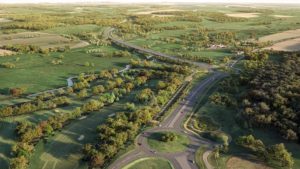
    The planned road from Broadland Northway roundabout (Norfolk County Council)

    This is the first in our ‘issue of the week’ series which are designed to collect information and resources together about specific matters of political debate. Although we are publishing a number of documents every week for each new issue, we will also continually add new resources to these pages to make them as comprehensive as possible. We also hope that students will find the topics useful as a starting point for research on matters of political interest.

    For this week’s ‘issue’, we’re looking at how politicians can balance economic growth whilst also protecting the environment, especially on matters of infrastructure projects. One of these current debates is in Norfolk, East Anglia, with the planned Norwich Western Link. We have interviews with Martin Wilby, a Conservative councillor and the Cabinet Member for Highways, Infrastructure and Transport at Norfolk County Council, and also the campaign group established to oppose the road, Stop the Wensum Link. Listed below, we also have additional interviews we have conducted, as well as collecting together past statement and policy positions from charities, pressure groups and individuals.

    The council are supporting the road (the route of which is visible in the council’s own video above) as they argue that it completes the ring of roads (the Southern Bypass which opened in 1992 and the Norwich Northern Distributor Route – which is formally known as the Broadland Northway – which opened in April 2018) around Norwich and will improve transport links in the county. Although Norfolk County Council are the main movers of the project, it is also supported by the majority of other councils in Norfolk, although Norwich City Council oppose the road as it promoted car dependency in the area. The road construction is supported by numerous organisations including Norfolk Fire Service and also the Norfolk and Norwich University Hospital who believe on balance that it would be beneficial because of reduced ambulance conveyancing times, as well as Norfolk Chambers of Commerce who say it will meet “our growth ambitions”. Norfolk Constabulary stated that they supported the road as “it would be useful to have the Western Link Road completed which would save officers time when they are on an emergency call rather than go partially around the route and then have to traverse through the city roads”.

    However, the reason this section of road was not constructed along with the Broadland Northway was explained by the council stating in their executive summary in 2008:

    “[The public consultation led to] strong environmental concerns being expressed about the impact of a new road across the River Wensum Special Area of Conservation (SAC) to which the County Council responded by carrying out further assessment beyond a Stage 2 level to ascertain whether the impact on the SAC could be mitigated. The conclusion was that it could not be demonstrated that the new road would not affect the integrity of the SAC. Alongside this, traffic modelling indicated that a road starting at the A1067 in the west rather than the A47 gave significant benefits and delivered most of the objectives of the NDR scheme and these were key factors in the decision to choose the preferred route as now proposed.”

    These environmental concerns are based around the land which would need to be crossed which is the rare chalk stream habitat of the Wensum Valley. The council’s proposals include a bridge across the River Wensum itself, but opponents question whether this would significantly damage not just the natural environment, but also be damaging visually and cause noise issues during both the construction of the road and then from traffic using it. Stop the Wensum Link point to the environmental mitigation measures on the Norwich Broadland Northway and say that these “had failed” with the council’s own inspection report showing issues.

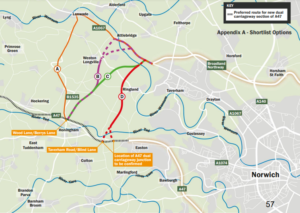
    The council are arguing that after reviewing transport usage that this section should now be built. After some initial research and site investigations, there were four suggested routes for the new road which went to a wider consultation and review, with the council preferring route C. Although this consultation is now closed, details of all of the routes are still visible at https://nwloptions.commonplace.is/. The council have organised a number of events explaining the need for the road and they also published the results of the 2018 public consultation exercise.

    The council argue that there are economic benefits to the road, stating that the environmental issues can be mitigated. Others argue that the environmental impact is too damaging and the CPRE produced a report with evidence that road projects simply generate more traffic. The Government believe that new infrastructure is necessary for the economy, with the Western Link road being listed in the Government’s September 2022 Growth Plan. Other pressure groups, such as the Campaign for Better Transport, have argued that sustainable transport can reduce the need for new roads and have published a research paper entitled Roads and the Environment. The new road is opposed by environmental groups including Norfolk Wildlife Trust, Friends of the Earth, the Woodland Trust, Norfolk Rivers Trust and the Norfolk & Norwich Naturalists’ Society.

    Opponents of the scheme also argue that roads are only necessary because there are a lack of alternative public transport options, with some suggesting that despite environmental concerns the Government is too ready to provide financing for new road projects. The council have also had to amend their preferred route slightly due to the presence of bats in the area, which are a protected species. There is also the challenge of providing access to the road for pedestrians and cyclists, with Norwich Cycling Campaign stating their opposition to the current proposals as they don’t include cycle lanes which the group says is necessary to keep cyclists safe. Other public transport organisations such as First Eastern Counties Buses said that they supported the road because they believed that it would “reduce congestion” in the area. A representative from KonectBus also stated that they supported the Western Link, but wanted the road “to be built as close to the Longwater junction as possible” in their public consultation submission.

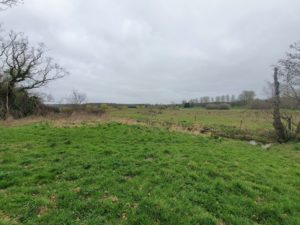
    Part of the land that would be crossed by the road (copyright UKPOL)

    The current cost of the 3.9 mile long road is estimated to be around £251 million, an increase on the previous estimate of £198 million, although opponents of the project have suggested that the final total might be closer to £300 million. The project requires the financial backing of the Department for Transport, who would provide 85% of the total funding. The Government is also committed to continuing a road building programme, but have stated that they are focused on the Strategic Road Network being net zero. However, there is still a significant cost to the council and Stop the Wensum Link note on their web-site:

    “Norfolk County Council already have a deficit of £39M, forcing them to hike council tax 3% this year. With construction costs spiralling, high inflation and stagnating wages, throwing more money at building this road makes no sense. Increasing costs and an already debt laden council threatens vital services and risks further tax rises.”

    Although the Government’s growth plan of September 2022 mentioned the road, this was under Liz Truss’s brief premiership and no guarantees have been given to the council on whether funding will still be made available. Liz Truss had been in support of the road before becoming Prime Minister and as she was a Norfolk MP, it had seemed very likely that her government would have backed the plans. With Rishi Sunak now Prime Minister, a final decision on the funding is expected to be made in 2023 with the Government needing to balance the economic argument alongside a growing demand for action to be taken to protect the environment and there is also the backdrop of potential national spending cuts being needed to balance the books.

    If the funding is made available, the current timetable for the road construction is:

    Mid-2022 – Pre-planning application public consultation
    Spring 2023 – Submit planning application
    Late 2023 – Public inquiry (if required)
    Mid-2024 – Full Business Case submitted to the Department for Transport
    Late 2024 – Start of construction
    Late 2026 – Norwich Western Link open for use

    This road is an example of the challenges which local Government have in trying to balance economic growth and the environment. It also shows the cost of embarking on these projects and the substantial amount of work that has to take place to get them to a stage where funding can be secured. For those opposing schemes such as this, there are financial challenges as councils have funding to help them make a business case for a new road, whereas campaigning organisations often have to fund raise to secure their monies. They also often have to be creative in how they can get publicity for their work, with the Stop the Wensum Link group holding numerous events and having a strong social media presence.

    Whether or not the road is built, this is likely to be an important case that is watched by other councils and governmental bodies to see how the environmental impact is dealt with. It also shows how much work local councillors have to put in to these projects, often facing opposition to their plans and needing to constantly respond to that. But, on the flip side, it also shows how much work and energy that volunteer campaigners put in towards monitoring projects and putting together arguments to help protect the environment. These are complex arguments and why it is perhaps important for individuals to become engaged in politics to fight for their beliefs to ensure that the best decisions are made.

    For readers, we have listed a wide variety of resources below which may help those who are undecided on whether they support this road project and ones like it. We will continue to add to this list and continue to secure more interviews as the project continues.


    KEY INTERVIEWS

    Martin Wilby

    Stop the Wensum Link

    INTERVIEWS, RESOURCES AND COMMENTS

    Emma Corlett, Deputy Leader Labour Group of Norfolk County Council

    Ben Price, Leader of Green Party Group of Norfolk Council Council

    Chloe Smith, Conservative MP for Norwich North

    Chloe Smith – 2019 Letter to Norfolk County Council on Norwich Western Link

    Clive Lewis, Labour MP for Norwich South

    George Freeman, Conservative MP for Mid Norfolk

    Jerome Mayhew, Conservative MP for Broadland

    Natalie Bennett, Baroness Bennett of Manor Castle (former Leader of the Green Party)

    Nova Fairbank, Norfolk Chambers of Commerce

    Norfolk County Council – Key Benefits of the Road

    Norfolk County Council – 2016 Technical Report for the Road

    Norfolk County Council – 2021 Outline Business Case for the Road

    Norfolk County Council – 2022 Addendum to Business Case

    10 Myths About the Western Link – Stop the Wensum Link

    CPRE Letter to Norfolk County Council Opposing Road

    Report to Breckland District Council’s Cabinet

    Bat Conservation Trust’s Position Statement

    First Eastern Counties Buses Letter of Support for the Project


    PRESS RELEASES

    [The county council also have their own extensive timeline of documents at https://www.norfolk.gov.uk/roads-and-transport/major-projects-and-improvement-plans/norwich/norwich-western-link/timeline]

    Amended route options approved as Norwich Western Link shortlist – 09/11/2018 [Norfolk County Council]

    Road Link Across Wensum Valley Would Cause Irreversible Harm – 15/01/2019 [Norwich Green Party]

    Western Link for NDR options are unacceptable, says NWT – 11/01/2019 [Norfolk Wildlife Trust]

    Grave concerns as Norwich Western Link route approved – 16/07/2019 [Norfolk Wildlife Trust]

    Preferred route for Norwich Western Link agreed by councillors – 25/07/2019 [Norfolk County Council]

    Cabinet asked to agree council’s approach to appoint Norwich Western Link contractor – 24/01/2020 [Norfolk County Council]

    NDR Western Link – Net Gain is not enough – 03/02/2020 [Norfolk Wildlife Trust]

    NWT reaction to conditional support for Western Link road – 18/05/2020 [Norfolk Wildlife Trust]

    NDR Western Link – Norfolk Wildlife Trust will object – 02/09/2020 [Norfolk Wildlife Trust]

    Western Link threatens probable largest barbastelle bat colony in UK – 01/12/2020 [Norfolk Wildlife Trust]

    Norwich Western Link contractor announced – 25/06/2021 [Norfolk County Council]

    Ferrovial Construction Awarded Norwich Western Link Project – 25/06/2021 [Ferrovial Construction]

    The Wensum Link – What About Cycling? -22 August 2021 [Norwich Cycling Campaign]

    Maternity colony for rare bats continues to be under threat from proposed road route – 06/12/2021 [Norfolk Wildlife Trust]

    National Highways announce new environmental sustainability division as it targets net zero – 07/01/2022 [National Highways]

    Campaigners from Norfolk, Suffolk and Essex have signed a joint statement calling for greener priorities in Transport East’s 30-year plan -31/01/2022 [Stop the Wensum Link]

    Western Link’s design refined following bat surveys – 25/02/2022 [Norfolk County Council]

    Norwich Western Link remains catastrophic for wildlife despite route changes – 04/07/2022 [Norfolk Wildlife Trust]

    The Western Link: What would happen to our wildlife? – 08/08/2022 [Norfolk Wildlife Trust]

    Our Open Letter, in objection to the Norwich Western Link – 17/08/2022 [Norfolk Wildlife Trust]

    Western link still represents value for money, despite cost increase – 24/06/2022 [Norfolk County Council]


    EXTERNAL LINKS

    Stop the Wensum Link

    Norfolk County Council – Western Link Road

    Norfolk Wildlife Trust – Western Link Road

    Wensum Woodlanders

    Buglife – Western Link Road

    Norwich Western Link – Campaign Web-Site Opposing the Road

    Big Issue Article – Wales has stopped building new roads. Will other countries go down the same route?

    Imperial College Business School Report – Are new roads worth the money?

    Guardian News Article – Norfolk road report rewritten to remove warning of risk to bats

    The wood and the road: my battle to save an irreplaceable ecosystem

    Andrew Boswell’s Crowd Justice Campaign to Stop Road Building

    Greenpeace – Building New Roads Creates More Traffic

  • Stop the Wensum Link Group – 2023 Interview on the Norwich Western Link

    Stop the Wensum Link Group – 2023 Interview on the Norwich Western Link

    The interview with Stop the Wensum Link Group published on 1 January 2023.


    (i) The county council has modelled numerous routes for the Norwich Western Link (NWL). Do any of them have your support, or is there any new road development or improvement that you would support?

    We would support single-carriageway improvements to B1535 and its junctions with A1067 and A47, in conjunction with other non-new-road initiatives e.g public transport and restriction of traffic through villagesMost of such a road improvement was proposed and agreed amongst local villages in 2008, but a much lower-cost scheme was put in place instead. 

    (ii) The NWL has the support of numerous public bodies, including emergency services, the majority of councils and many business groups. Are they mistaken in that support?

    Unfortunately, they are.  

    We have never seen an analysis by any emergency service to show how many emergency journeys would be shortened by the building of the proposed road, and by how many minutes. We suspect the difference is negligible; after all, the blue light allows high speed on existing roads.  Ambulance response times currently are much more affected by the availability of vehicles than how fast a route is.

    Councils and business groups always see new roads as reducing travel times, making industry and commerce more efficient.  This is probably true to a certain extent, but its effect is exaggerated.  The Norwich Distributor Road, for instance, predicted commercial gain, but this has not yet been assessed; the ‘one year after’ report declined to do an analysis, and promised to do one after 5 years (2023). We need to see and evaluate that report before giving credence to the idea that an NWL would improve commerce. 

    Any improvement in commerce has to be weighed against the major harm such a road would do, and its escalating financial cost. 

    (iii) The Norwich Northern Distributor Road (or Broadland Northway) was finished in 2018 and nearly completed a circle around Norwich with the exception of the proposed NWL. Isn’t there an inevitable number of car journeys which would be more efficiently completed along one joined-up road rather than having to cut through villages? Do you feel that evidence has been produced by the council to quantify that number of journeys?   

    Certainly, many car journeys may be more efficiently completed on the proposed new road, depending on exactly is meant by ‘efficiently’.  Much better fuel and emissions efficiency would be achieved by encouraging travellers to use a good public transport system, instead of their cars. 

    Council predictions show much of the 15,000 journeys per day across the valley would transfer to the NWL. We believe this is hugely exaggerated, and that many journeys will still be pressed through villages and suburbs. Especially closer to Norwich where the time saving of driving out to the NWL will be negligible at best. Council traffic counts have shown how many vehicles travel through the villages, but not their origins and destinations. So NCC do not have full information to base their decision on. Such information could inform the creation of the most efficient bus routes. 

    (iv) The county council has said that there would be no public transport along the route of the road as there would be limited demand. Do you consider that this excludes those who can’t afford a car?

    Yes, clearly it does.  Those members of society are excluded now, as there is no public transport across the valley.  We cannot agree that there would be limited demand for good, well-planned  joined up, frequent and affordable public transport.  Figures show a minimum of 15,000 journeys each way (mostly cars) within the valley sector. A proportion of these could be shifted to public transport. But this needs to be a comprehensive system, not a couple of infrequent bus routes. This could be instated at low capital cost without building the proposed new road.

    (v) The county council claims that the majority of the public support the construction of the road. Is this a legacy of a failure of public transport policy in Norfolk over recent decades?

    That is certainly a major component.  Public transport throughout the country is poor, not only in Norfolk, despite government statements of the need for ‘modal shift’.  This has led the public to lose trust in public transport outside the very big cities.  Norfolk, in particular, has reneged on its promise to introduce ‘bus rapid transit’ services, which was an agreed action when the NDR was approved. Cost, reliability, frequency, speed, and lack of useful routes has meant that much of the public prefer to rely on their own transport, with resulting increasing congestion and harm to the environment.  The attitude of Norfolk CC has been that ‘this is a car county’. Many people do love their cars, but if public transport were good, more people would not need to meet the costs of running one. 

    (vi) The cost of the road is estimated to be over £250 million with the majority paid for by national Government (if agreement is reached), but much to be funded by Norfolk County Council (perhaps around £50 million). Would it better for the county to use that money to fund the public transport network? Do you have any view on how the money could be spent instead?

    Most certainly.  With regard to the NWL area, subsidised bus routes could be introduced from, say, Dereham to the Airport area, Aylsham to Wymondham, Fakenham through Hellesdon and Costessey to the Hospital; a consolidation of bus routes on the A47.  These are just a few examples.  Bus routes need to be informed by detailed origin and destination analysis, with continual review when in operation.  We have noted much support for the improvement of bus services when have raised this at events. It is worth bearing in mind that the result of the most recent general questionnaire on transport in Norfolk (before the NDR was built, in 2005) the MOST popular policy was ‘improve public transport’. Yet NCC then made building the NDR their top priority. 

    (vii) You have raised concerns about numerous aspects of the environmental damage, including removing ancient woodland, destroying the habitat of bats and impacting on the River Wensum. How much of this can the council mitigate if the road is constructed?

    Very little.  No mitigating measures can compensate for the loss of an ancient woodland, or an important hedge. They take centuries to develop, and the wildlife cannot wait for newly panted saplings to grow into old trees. Unfortunately, many councillors and others seem to think that all wildlife can learn to live anywhere, and will easily move and adapt to change, as do wood pigeons, blackbirds and rats. This is not the case. If we carry on disturbing their habitats, the more specialist animals will not survive, and we risk ending up with an environment with reduced variety.  

    No doubt care can be taken in construction of the viaduct to reduce possible contamination of the river (which is an SAC), but this depends on maintenance of filters.  With the death of so many trees on the NDR, NCC have shown themselves incapable of handling such necessary maintenance.  

    (viii) Would you consider this sort of project as being something that might have been acceptable twenty years ago, before there was more prominence placed on environmental issues?

    For those of us who care deeply about the protection of the natural world, its landscapes, and about the well-being of us all, whether living in town or country, these projects have never been acceptable.  The M25 was built around 40 years ago, with huge destruction and at huge cost, and now it is regularly congested and there are calls for its expansion.  Building large roads cures nothing long-term; we are a finite country (and planet), and we need to be enacting policies which let us live well without destroying our own habitat.

  • Martin Wilby – 2023 Interview on the Norwich Western Link

    Martin Wilby – 2023 Interview on the Norwich Western Link

    The interview with Martin Wilby published on 1 January 2023.


    ROUTE QUESTIONS

    (i) The county council undertook work on several routes early on during this process, coded Option A, Option B (East and West), Option C and Option D (East and East). The preferred route is Option C, but would it be too late in the process for the council to switch to, for example, Option A? Would it rather switch than lose the project entirely? Some campaigners have suggested that the improvement of existing roads would be possible, is that still an option?

    The proposed route for the Norwich Western Link was selected as the best overall solution for the road having considered a number of factors, such as transport benefits, environmental effects, value for money and impacts on local communities. 

    We wanted, and continue to want, to strike the right balance in providing infrastructure that provides great benefits to residents, businesses and visitors in Norfolk which effectively tackles the transport issues that exist to the west of Norwich but also limits impacts on the local area. 

    The process we need to follow for a major infrastructure project of this kind means there is still some way to go before we can be certain that the project will be delivered; reaching milestones such as receiving a funding commitment from central government and receiving planning approval will be crucial. We are focused on achieving these milestones and we have no plans to change the route. If that position were to change in the future, we would need to consider the reasons for that change in any decision-making on how to proceed.

    (ii) When the preparatory work was done by the council to choose a preferred route, there was preference given to Option C because of the limited presence of bats compared to other routes. It has transpired that there are bats on this route and amendments have been needed. Would this have impacted on the council’s decision earlier on if this information had been known? Is it normal for mistakes of this sort to be made on projects of this scale and funding?

    As referred to above, the proposed route for the Norwich Western Link was chosen based on a number of factors, which included information gathered about the presence of bats in the area to the west of Norwich. It is not therefore true to say that decision-making about the route selection was based, or would ever be based, on one element but rather by taking all the relevant elements into account.

    Before the decision on the preferred route was reached, a great deal of work had been carried out. Objectives for the project were established with input from local communities and a long list of options was developed. These were reduced to a shortlist of options based on how effective the options were at meeting the project objectives, and a public consultation on this shortlist was conducted as well as other assessment work including a range of surveys in the area. Bat surveys were among the surveys conducted before the preferred route was agreed.

    Surveys over a number of years had identified the presence of bats in the area to the west of Norwich, including around the proposed route for the Norwich Western Link, and mitigation measures including green bridges and planting were developed to take account of this. Our 2021 surveys identified a roost used by a maternity colony of barbastelle bats in an area of woodland close to part of the route. We therefore needed to develop our design to minimise our impact on these woodlands.

    It is entirely normal on an infrastructure project for further surveys to be carried out at the point at which a single, preferred route has been agreed and for the design of the route to be developed as further detail is known. And continuing to develop the design of the road and its associated measures in response to evidence until the planning application is submitted is a normal and expected part of the process. 

    (iii) The route has the support of most councils in the county, business groups and also the emergency services. Do you believe that some opponents of the new road have underestimated how much support the project has in many areas?

    There is strong support for the project, not least from those people who are living in communities to the west of Norwich which are badly affected by traffic congestion on unsuitable local roads and in residential areas. And with planned growth in and around Norwich, existing traffic congestion to the west of Norwich is expected to significantly worsen without the Norwich Western Link. I don’t know if anyone has underestimated the support that exists for the project, I can’t think of anything that would lead me to think that.

    ENVIRONMENTAL QUESTIONS

    (iv) Assuming that the council’s preferred route receives approval and funding, is it confident that it has done all that it can to minimise the negative environmental impact? Are there things that the council would like to do, but can’t justify the cost of doing?

    Cost and value for money are of course important considerations across all aspects of this project, as they should be when national and local public investment is involved. But there are also other important considerations and these include our environmental responsibilities on a project like this.

    We’re continuing to take an evidence-based approach to the project and to receive expert advice and follow relevant guidance. If we receive planning approval this means we would have satisfied the planning authority and environmental statutory bodies that our proposals are acceptable to them, which is of course a crucial aim.


    TRANSPORTATION QUESTIONS

    (v) The council has suggested that the road has significant public support. Is this a failure of the wider public transportation policy over recent decades, both within and without the control of Norfolk County Council? Is a new road primarily necessary as there are poor public transportation options, particularly when crossing Norfolk rather than on arterial routes?

    There are a number of reasons why people might support the creation of the Norwich Western Link: businesses may welcome more efficient journeys for the transportation of goods, enabling them to increase productivity and profitability; local residents may be looking forward to quieter, safer local roads and better air quality close to their homes; and emergency services and the people who rely on them are likely to be relieved that many journeys to the west of Norwich will be shortened, including for ambulances to and from the Norfolk and Norwich University Hospital.

    It’s also important to remember that public transport requires good infrastructure just like any other mode of travel. Bus operators need to be able to run quick, reliable services to attract and retain passengers and make routes commercially viable, and getting stuck in queuing and slow moving traffic significantly hinders this.

    We want to support people to shift their journeys from using a car to more sustainable forms of transport, such as walking, cycling and public transport where appropriate. This will generally be more achievable over relatively short distances and in and between larger centres of population, or where there is a concentration of public amenities or employment. 

    We have been investing in improvements to facilities for public transport users and walkers and cyclists for several years now, particularly in our towns and larger villages and in and around Norwich through our multi-million Transport for Norwich project (www.norfolk.gov.uk/tfn). We have, among other things, improved pedestrian and cycle access to railway stations in Norwich and Great Yarmouth, there have been upgrades to bus facilities in Norwich, Thetford, North Walsham and Cringleford, and we’ve created an off-road pedestrian and cycle path linking Norwich to the fast-growing populations in Hethersett and Wymondham, and extended our very popular Beryl bike/e-bike/e-scooter hire scheme from Norwich into those areas.

    So my view is that there isn’t a ‘one size fits all’ approach to transport and we need to continue to invest in a wide range of transport infrastructure in Norfolk to support all kinds of journeys.

    (vi) The council has suggested that it is unlikely that there will be public transport provided along the route of the road itself. Does this further exclude those who can’t afford cars, don’t want cars or are trying to avoid acquiring a car? Does more road building make it harder to ever increase public transport usage?

    As stated above, reducing congestion on the existing road network as well as creating a more resilient road network that is able to cope with planned growth will bring benefits to all road users, including bus companies and passengers. So making sure we have good infrastructure is important to everyone who travels in Norfolk.

    I would also add that the possibility of a new bus service being established to connect communities to the west of Norwich directly to employment hubs and services, such as the Norfolk and Norwich University Hospital, once the Norwich Western Link is in place is being discussed with bus operators. By taking traffic off the existing road network, the Norwich Western Link would make such a service more viable. 

    We are also planning to support people to walk and cycle more by improving the Public Rights of Way network in the vicinity of the Norwich Western Link route as well as putting in measures to make walking and cycling more attractive across a wider area.

    (vii) Is the council comfortable with the level of money that has already gone into the project? What are the latest figures for the total cost of the project?

    The latest cost of the project is £251 million as set out in the July 2022 Cabinet report, of which we anticipate 85% would be funded by central government.

    Cost is of course an important factor when managing a project of this nature but so is value for money, and the Norwich Western Link is considered ‘high’ value for money according to Department for Transport criteria. Providing and improving infrastructure is an investment in the future of an area that will provide benefits for many years to come and enable it to grow successfully. So this is how I see the Norwich Western Link – an investment in Norfolk’s future.

    (viii) The council is relying on the support of national Government financing to fund the majority of the project. Is a problem the council faces that it is easier to get funding for road projects in Norfolk than perhaps subsidised bus routes or new light rail/rail routes?

    I wouldn’t say funding for road projects is easier but rather there are different processes, partners and mechanisms involved with the different types of projects and services you mention. 

    Infrastructure improvements to the council’s highway network – whether that’s projects aimed at supporting all road users or more specific interventions like creating bus lanes or cycle paths – are by and large funded by a one-off investment that we will deliver, and the infrastructure will then be added to the network for which we are responsible. Our £32 million Transforming Cities Fund project in Norwich is wholly funded by the Department for Transport and is currently delivering a range of improvements aimed at investing in clean and shared transport, creating a healthy environment, increasing social mobility and boosting productivity through enhanced access to employment and learning.

    Network Rail are responsible for the country’s rail network, so while we can make the case for investment, any new or improved rail infrastructure in Norfolk would generally be delivered and owned by them. That said, we are currently working to develop a proposal for a new rail station at Broadland Business Park to the east of Norwich, which would be on an existing rail line adjacent to the business park.

    Subsidised bus routes are a recurring rather than a one-off cost to a council, so this is funded by revenue rather than capital spending. We do subsidise some bus services in Norfolk and we’ve recently secured £50 million of funding – £31 million of capital funding and £19 million of revenue funding – from the Department for Transport for our Bus Service Improvement Plan, which will deliver measures to support and expand bus services across the county over the next three years.

    QUESTIONS ABOUT POLITICS AND BEING A COUNCILLOR

    (i) Projects such as road building are controversial because of the balance of ensuring the local economy thrives whilst limiting the damage to the environment. As a councillor and portfolio holder, have you found the debate on the road’s construction generally positive and engaged? Or can being a councillor sometimes feel a little thankless?

    The vast majority of the people I encounter in my role as a county councillor and cabinet member are very polite, friendly and respectful and I get a lot of satisfaction from holding a position which gives me the opportunity to help Norfolk and its residents. People will always have different views about how this should be achieved and of course it isn’t possible to please everyone, but I’ll just keep trying to do the best job I can.

    (ii) Would you like councils to have more power and influence over public transport to help deliver an integrated transport policy?

    The county council certainly supports the principle of devolving powers to local government so that local decision makers have more control over how money is spent in their area, as the recent County Deal announcement has demonstrated. I think we at the county council, the Department for Transport, public transport companies and other partners are all committed to making sure we have good public transport services that are viable options for many journeys people want and need to make.

    (iii) Is standing for election in local politics something that you would recommend those interested in the environment to get involved with?

    I think the most important quality in any elected representative is the desire to represent a community and an aptitude for public service. For me, it’s less about what I’m interested in and more about what the people I’m representing want and need. That’s obviously not always easy and, as I said above, it’s impossible to please everyone when people have different and sometimes competing priorities, and – being realistic – there’s a finite amount of time and money. But I’ll keep trying my best and that’s all I can do.

  • John Redwood – 2022 Speech on BBC Local Radio

    John Redwood – 2022 Speech on BBC Local Radio

    The speech made by John Redwood, the Conservative MP for Wokingham, in the House of Commons on 8 December 2022.

    I entirely agree with that passionate defence of localism by the hon. Member for York Central (Rachael Maskell). Local must mean local and we do not want people in the BBC in London imposing on us their views on how our local radio should be conducted and how big our locality should be. I see behind the centralised planning at the BBC a distorted version of what our constitution should look like within the United Kingdom, and a wish to impose that—against the clear majority wishes of people, whenever they have been asked about these subjects in referendums and elections.

    It is not just that the BBC wishes to create phony regional groupings instead of truly local radio, but that it has a very distorted view of devolution. The BBC seems to be an enthusiast for devolution to Northern Ireland, Scotland and Wales, but it does not even know England exists. It always wants lopsided devolution. One of the four important constituent parts of the United Kingdom is scarcely ever mentioned; it is never suggested it should have any powers or right to self-government and there is no engagement with English issues on BBC radio in the way that there is a clear engagement with Scottish, Welsh or Northern Ireland issues. That causes enormous resentment.

    In my own case, local radio is organised at the county level, at Radio Berkshire. That makes sense, because it is an area that we can recognise and there is some loyalty to our royal and ancient county. Many people now do not know that it had its borders artificially compressed in a local government reorganisation some 50 years ago, under a Conservative Government that I think made some mistakes, but the county retains an enormous amount of goodwill and residual loyalty, and people are very happy for our local radio to be organised at that scale. If people had real choice, however, I think Wokingham would rather have a different radio from Reading, and I think we would probably rather have a different radio from Windsor, because we have a different set of issues. But we accept that there have to be some compromises because talented people need to be appointed and paid wages, and that cannot be done to a sensible budget at very local levels.

    I urge the BBC to look in the mirror and understand why, in many respects, it is getting so out of touch with its audiences. It has a very narrow range of views and issues that it will allow people to discuss, and it has a particularly warped perspective on how we feel about our areas and what our loyalties belong to. I am allowed to express views from time to time on BBC Radio Berkshire. It does not put me through the ordeal of a pre-interview to find out whether my views are acceptable and fit its caricature of a Conservative in the way that nearly always happens if national radio is thinking of interviewing me. Then, I always have the double interview, and I quite often fail the first interview test because my views are clearly too interesting or unacceptable, or do not fit the caricature that the radio wishes to put into its particular drama, so people are spared my voice on radio and I have more free time, which is perhaps a wonderful outcome from those events.

    I do not find that my local radio quite plots the drama as strongly as national BBC radio and television. I am very grateful for that because I think that good, independent broadcasting of the kind that the BBC says it believes in should allow people of decent views—not extremists who want to break the law, or racists—to conduct civilised conversations and debates through the medium of the BBC. But all too often, that is truncated or impossible because of the way in which the editors operate and their pre-conceived set of views, about which they wish to create some kind of drama.

    Colleagues have made extremely good points, which I will emphasise, about the treatment of staff and the way these kinds of proposals are planned. If the BBC wishes to run truly local services, it must listen to us—the local people and the local people’s representatives—and treat its staff well, and be aware that they have given good service in the past and should be taken on a journey of change that makes sense for them as well as for the BBC. This all looks rather top-down, abrupt and unpleasant. Successful organisations understand that their own journeys, evolving as institutions, are best conducted if, at the same time, they allow good journeys for the staff who give them loyal service. That does not seem to be happening in this case.

    I will spare you a bit of time, Madam Deputy Speaker—I have made the main points that I wished to make. The BBC needs to be more open to a wider range of views. If it wants to be local, it has to ask us what local means.