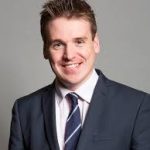
Below is the text of the speech made by Tom Hunt, the Conservative MP for Ipswich, in the House of Commons on 7 July 2020.
I thank the Minister for being here to respond to this much-needed debate. It is needed because on 14 July, the Ipswich and East Suffolk and North East Essex clinical commissioning groups will make a decision on plans to remove elective orthopaedic surgery from Ipswich Hospital and transfer it down the A12 to a new centre in Colchester, away from the people who rely on it. If the plans were to go ahead, they would represent a downgrade to Ipswich Hospital and make it the only hospital in the east of England that I am aware of not to offer a full complement of orthopaedic services. Despite that, the CCGs’ papers for the 14 July meeting will recommend that the plans be approved.
In many ways, it is disappointing that this debate is needed in the first place. Public opposition to the plans is overwhelming. I will come to the important reasons why later, but first I want to make the House aware of the scale of the opposition to the plans. An online petition to protect orthopaedic services at Ipswich Hospital established by the Orwell Ahead campaign group currently has more than 8,700 signatures, despite having been up for only a few days. I have already shared the petition with the Minister, but I want him to be aware of how many more people have added their names to it since we last spoke.
As well as the number of signatures, I am sure that the Minister and others who have studied the petition will not have failed to notice that it refers to a joint quote from me and the Labour leader of Ipswich Borough Council, Councillor David Ellesmere. Anyone who follows day-to-day politics in Ipswich will know that Councillor Ellesmere and I do not always see eye to eye, but on this issue we are united as the principal national and local representatives of our town. The quote in the petition comes from one of two joint letters about these proposals that we have sent to the chief officer of the Ipswich and East Suffolk clinical commissioning group. Combined, those letters, which detail our cross-party opposition to the plans, stretch to more than nine pages. However, that is by no means the extent of the opposition that has been expressed.
The 12-week consultation on the plans, which ran between February and April, found that almost two thirds of respondents were opposed to the new centre in Colchester. That is despite the fact that the consultation took on board the views of people in Colchester as well as people in Ipswich. Had the consultation taken place just in Ipswich, that number undoubtedly would have been far higher.
Over the last few weeks, that has been reflected in my inbox. I have received hundreds of letters, emails and other messages from constituents about this issue and not one has expressed support for the plans. They include not only former patients who have told me they would not be walking today were it not for the first-rate orthopaedic care currently provided at Ipswich Hospital, but hospital workers, and elderly and vulnerable people who are worried about the prospect of having to travel to Colchester in future.
When the chief executive of the hospitals trust asked me to pass on the correspondence that I have received from constituents so he could address their concerns, I did. I sent over a dossier that was 20 pages long, yet this still only represented a fraction of the correspondence that I have received. It also excluded many people who have contacted me from further afield in Suffolk, who are among the 390,000 people who depend upon the services provided by Ipswich Hospital. Many of them share my constituents’ concerns, and some patients to the north of Ipswich face even longer and more difficult trips to Colchester than patients in Ipswich.
It is clear now that the only way for the concerns of my constituents and others to be addressed is for these plans to be reviewed. Of course, my overwhelming preference is for new plans to be drawn up and for the approximately £44 million that is currently earmarked for a new centre to be invested in both Ipswich and Colchester hospitals. I know that many of the people from across the political spectrum who signed the petition and who have written to me are also tuning into BBC Parliament this evening and are watching what is said here very closely.
I think it is only right to use this opportunity to refute the claim made jointly by the chief executive of the hospitals trust and the chief officer of the clinical commissioning group that the public’s petition is causing unnecessary concern and fear. Leaving aside the substance of those remarks for one second, I point out that this is not the first time that the chief executive of the hospitals trust and the chief officer of the CCG have written a joint letter or made closely aligned statements. Given that the chief officer of the CCG will be at the heart of the decision-making process on this issue, it is questionable why he is already so firmly in line with the trust on its plans. This adds to the widely shared sense that, for all intents and purposes, this decision has already been made, and that the decision-making process has been compromised. I hope that Ministers will consider that very carefully when looking at this issue and at how these plans are being pushed through against the wishes of my constituents.
I think it is clear to almost everyone, except senior NHS management locally, that it is not the public petition that is causing concerns, but the plans themselves. It is the local NHS management who have failed to make the case for these proposals. They are the ones who have failed to take the public with them on this journey. Unfortunately, these latest remarks by the chief executive and the chief officer are just more evidence of that same senior management failing to listen to the public. However, the public’s concerns deserve to be heard and that is why I will set them out very clearly now.
The removal of elective orthopaedic surgery would mean that patients in Ipswich have to travel further for their surgery. There must not be an assumption that everyone will have loved ones who can take them to Colchester and back or that they will be able to take public transport, especially after just having had a hip or knee replacement. Constituents have also told me that it would be harder for them to visit their loved ones who have undergone surgery in Colchester to give them crucial comfort and support.
Robbie Moore (Keighley) (Con)
I feel for my hon. Friend’s constituents who potentially have to make that extra journey. In my constituency, I am very fortunate that the Airedale General Hospital provides orthopaedic surgery to constituents on a local basis. Does he agree that the right thing to do is to provide that local service so that his constituents in Ipswich can benefit?
Tom Hunt
I agree with my hon. Friend. There is a national challenge when it comes to tackling waiting lists for hip and knee replacements. There is not one hospital across the country that does not have to meet that challenge, but in meeting that challenge, we need to keep services as local as possible for the people who depend on them. That is what I am arguing for this evening.
So far, neither the hospital trust nor the CCG has presented sufficient detail about how vulnerable patients will be supported in making the journey to Colchester, and the reassurances we have received about joint working and engagement with the public just do not cut it. There is major concern among my constituents about the plans, and it is no surprise that people do not support them while this crucial element is not in place.
Secondly, Ipswich Hospital is currently ranked in the top 10% in the country for both hip and knee replacements, and I would like to thank all the surgeons and staff who work in the orthopaedic services. There are real concerns that the fine quality of care currently available to patients in Ipswich will be diminished when combined with the practice in Colchester. Many of my constituents are currently going through an anxious wait for hip and knee replacements during covid-19, but the knowledge that they will receive first-class surgery at their town’s local hospital provides a great deal of reassurance. Under these plans, however, the surgery would certainly not be at their local hospital, and there are fears that the standard of care could be lower too.
James Cartlidge (South Suffolk) (Con)
I am grateful to my hon. Friend and neighbour for giving way. It was great to campaign with him in the election; I knew that he would be a doughty fighter for his constituents, and he is showing that tonight. Does he agree that, however we configure services, the priority must be the people he is talking about who are waiting for elective surgery that has been cancelled or shifted back many months because of covid, and we need to focus on bearing down on that backlog?
Tom Hunt
I thank my hon. Friend. As I said to my hon. Friend the Member for Keighley (Robbie Moore), I am not blind to the fact that covid-19 is putting huge pressure on the NHS and hospitals up and down the country, including Ipswich Hospital, where the frontline staff have gone above and beyond to serve my constituents. We need to deal with these waiting times, but we need to do so in a way that keeps services closer to people. That is very important.
Under the current proposals, most of the surgeons in Ipswich Hospital’s orthopaedic team would split their time between Ipswich Hospital and the new centre in Colchester. In many cases, this would mean that the surgeon who operates on a patient in Colchester one day will not be there to make crucial check-ups on their patient in recovery over the following days. Only the operating surgeon is best placed to see how their patient is responding to the surgery that they carried out. These personal check-ups are also an important source of confidence for patients. This important aspect of high-quality care would largely be lost under the current plans. Questions have also been left unanswered about the impact of the plans on the highly rated emergency orthopaedic practice, which would remain at Ipswich Hospital, with doctors and resources diverted elsewhere.
This all feeds into a third main concern, which is about the wider effect of these plans on the reputation and standing of Ipswich Hospital. Addenbrooke’s Hospital, Peterborough City Hospital, Hinchingbrooke Hospital, Norfolk and Norwich University Hospital, Queen Elizabeth Hospital, Princess Alexandra Hospital, Colchester Hospital, West Suffolk Hospital and James Paget University Hospital are all general hospitals in the east of England that provide elective orthopaedic surgery. Under the current plans, Ipswich Hospital would become the only hospital of its size in the eastern region not to provide a full complement of orthopaedic services. In fact, James Paget University Hospital in Yarmouth serves a population under half the size of Ipswich Hospital.
The question is, why should Ipswich Hospital be stripped of its first-class elective orthopaedic surgery and placed in such an unusual position? More and more people in Ipswich are beginning to answer that question by looking at whether the merger of Ipswich and Colchester Hospitals has been beneficial to Ipswich Hospital and whether the promises that were made about both hospitals improving together have been kept.
In fact, there are significant doubts that the hospitals trust fully explored the options that would allow both Ipswich and Colchester Hospitals to improve their orthopaedic care together, without one hospital losing core services. My understanding is that a full assessment was not made of repurposing space at Ipswich Hospital, to open up room for two additional operating theatres, and the borough council’s two alternative proposals to the Colchester centre were essentially dismissed out of hand.
The hospitals trust has insisted, the whole way through, that the Colchester centre is the only way to create enough capacity to cut waiting times and cancellations to planned surgery. I have spoken to the hon. Member for Strangford (Jim Shannon) about what we have to do on that across the country.
I ask what justifies these sweeping plans, for many, including within the hospital itself, have doubts that the plans are even justified on their own terms. The proponents of the plans have highlighted that five new operating theatres for hip and knee replacements would be added, and that these would simply replace five existing operating theatres currently in use at Ipswich and Colchester. Cutting waiting times and delays is undoubtedly an important aim, and I am sure, as I said, that there is no hospital in the country where the pressure on waiting lists for hip and knee replacements has not increased due to covid-19. As I mentioned, these plans would largely replicate existing services, at great financial expense and at the unquantifiable cost of moving them further from where people live. It is therefore disappointing that some in north Essex—some of my colleagues in north Essex—cannot see how important it is that both Ipswich and Colchester improve together side by side.
The last major concern I want to mention is that key voices within Ipswich Hospital have been muffled on this issue. The chief executive of the hospitals trust has claimed that the plans are clinically led and that only three out of 27 consultants are opposed to them, but it is my belief that the cards have been stacked in favour of this position. I understand that the 27 consultants he refers to include spinal surgeons as well as surgeons in Colchester. He has also assumed that surgeons who have not directly expressed their opposition to the plans must be in favour of them. Following the private conversations I have had with senior representatives at the hospital who have approached me, I understand that nine out of 12 surgeons at Ipswich Hospital who deliver non-spinal elective and emergency orthopaedic care do not support the proposals, but, understandably, many of them do not want to put their career at risk by speaking out publicly. However, two surgeons did speak out publicly during one of the consultation events, which turned out to be the only one where the audio recording of a public meeting was not uploaded online. It was eventually put online only when the surgeons themselves pointed this out.
To summarise, the plans are incredibly unpopular in Ipswich. The concerns for patients within Ipswich Hospital’s core service are real, and the decision-making process seems to be nothing more than a rubber-stamping exercise to push through the plans against the wishes of my constituents. When I stood for election and won the great honour of being elected as the Member of Parliament for Ipswich, I said to my constituents that I would fight for them with everything that I have. I love my constituency and I love my constituents, and I know how important the hospital is for them.
That is why it is really important for us to be here today. We do need to deal with the waiting lists, and we do need to make sure that people do not wait in pain for hip and knee replacements, but we need to do so in a way that keeps services closer to people. The merger needs to be about Ipswich and Colchester hospitals thriving together side by side, and I will work with my colleagues across the region to make sure that that is the case. At this late stage, I ask the Minister to look into the matter, reflect upon it, and meet me to discuss my concerns before the decision on 14 July.