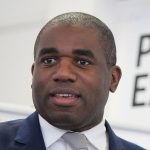
The speech made by David Lammy, the Shadow Foreign Secretary, at Chatham House in London on 24 January 2023.
Thank you, Chatham House, for hosting me here today.
This institution is an encapsulation of Britain in the world — at its best.
A trusted force for good.
Universally respected.
Globally networked and influential.
But we meet at a time when Britain feels lost and disconnected in a world that is more divided than at any time since the fall of the Berlin Wall.
Three major trends are shaping the foreign policy landscape the next Labour government plans to inherit.
The first is that we are in a new age of geopolitical competition.
We see it in the bloody war on our continent.
We see it in a world economy splitting into blocs.
As global competition between the United States and China shapes our century.
And regional powers make the contest multipolar.
From the vast collective bloc of the EU to more assertive middle powers in the Middle East throwing their weight around.
The second major trend is weaponised interdependence.
The ties that bind us together are now also driving fragmentation – trade, industry, energy, migration, the internet.
And new technologies from Artificial Intelligence, to Automation, Quantum and Biotech risk being used as tools of authoritarian power.
Less a new order.
More a new polarised disorder.
Third is the trend I will focus on most today.
There has been a blurring of the distinction between foreign and domestic policy.
As President Biden has said, “there’s no longer a bright line” between the two.
In a world this interdependent foreign policy has become domestic policy.
And domestic policy has become foreign policy.
We can see this in every village, town and city across the UK.
Most of you know me as the MP for Tottenham in North London.
But it is less known that I spent much of my childhood in Peterborough studying at a state boarding school.
It is easy to see the impact of global trends in Tottenham.
But the impact of the world on Peterborough has been just as transformative.
I went back a couple of years ago to have lunch with Clive and Cathy, the parents of my school best friend.
Over tea in their bungalow, they told me how at home they felt in Peterborough when they were young.
Now, they feel powerless as their grandchildren struggle to find decent jobs.
The industrial workplaces of the past not yet replaced by the green jobs of the future.
They feel like their community has been eroded.
As neighbouring families moved out.
And they tell me they feel too insecure on their street to walk home at night.
As the tentacles of international criminal gangs have reached into their neighbourhood.
This is not just down to domestic policy failures in policing, housing and education.
But a failure of the Conservative government to grasp the impacts of foreign policy, globalisation and economic change on all our communities.
Leaving not only families, but us as a nation feeling lost — and disconnected.
Principles
To help communities like Peterborough, Labour’s foreign policy must adapt.
And meet these three tectonic shifts fragmenting the world with three unifying principles.
The first is that British foreign policy must seek to take back control.
The Conservatives were right about that.
But they were fundamentally wrong to think it means going it alone.
In the modern world, we maximise our influence by reconnecting Britain with our allies and partners.
The second is that our foreign policy must put pragmatism over ideology.
Making decisions based on what will advance the British public’s security and prosperity.
Not the ideological purity of the ERG.
And the third is that our foreign policy choices must be made for the many, not the few.
Putting the consumer, before the fossil fuel company.
The small business owner, before the hedge fund manager.
The NHS patient, before the tax exile.
The test that lies behind each of these principles is simple.
Will our choices help hard-working families in a more dangerous world where the borders between foreign and domestic policy are breaking down?
Redefining the FCDO’s mission
The lack of purpose in Britain’s foreign policy stems from both bad choices and institutional dysfunction.
We have left the EU but not yet found a new, settled and confident place in Europe.
Our country’s reputation for the rule of law has been badly damaged.
Our leadership in development has been squandered.
The foundations of our defences have been weakened.
Our soft power has been corroded and our climate leadership forsaken.
It is, I am afraid to say, a dismal record.
I take no pleasure from saying that.
We all have a stake in the success of our country.
And a future Labour government will inherit the consequences of these choices.
It will fall to us to rebuild the foundations of our influence in the world.
My vision is of a “Britain Reconnected”.
Secure at home and strong abroad.
A confident country, outside of the EU but a leader in Europe once again.
A reliable partner, a dependable ally and a good neighbour.
NATO’s leading European power.
A development superpower once more.
At the vanguard of climate action.
Driving forward the industries of the future for Britain.
A diplomatic entrepreneur.
And a country that keeps its word.
In government, we will announce a new mission statement for the Foreign, Commonwealth and Development Office designed around five clear goals.
One – a Britain Reconnected to defend the UK’s Security, with strong armed forces and resilience against 21st century threats.
Two – a Britain Reconnected to champion the UK’s Prosperity, and lead the industries of the future.
Three – a Britain Reconnected for Climate Action, turning our response into an engine of growth.
Four – a Britain Reconnected for International Development, helping to promote the UK’s security, health and jobs in the process
Five – and a Britain Reconnected for Diplomacy, to re-establish the UK as a trusted, reliable and influential partner while protecting Britons abroad.
Security
Let me start with security.
Whether you get your news from TV, or from scrolling through social media the public understand that we face a more insecure world than at any time since the heights of the Cold War.
I visited Kyiv a couple of weeks before the invasion, to show our solidarity in the face of Russia’s imperialist threats.
From the beginning of this crisis through to the recent decision to send Challenger tanks, the government has had Labour’s total support in providing Ukraine with the military, economic, diplomatic and humanitarian assistance it needs to defend itself.
Britain is united on this.
Whoever is in government, the UK will stand with Ukraine.
For the long-haul.
It was a Labour Foreign Secretary who was the driving force behind the creation of NATO 70 years ago.
Today, as then, Labour’s commitment to NATO is unshakeable.
That is why I visited Stockholm and Helsinki last year to show our support for their NATO ambitions.
Our commitment to Britain’s independent nuclear deterrent is unambiguous.
And we know the value in deepening our alliances beyond Europe too, be that with Australia through AUKUS or new defence cooperation with Japan.
But it is in Europe – the first priority for our own security – where a Labour government would forge a new security approach.
At present, our influence in Europe has waned.
I felt this, recently, in Kosovo.
Where I met with the Prime Minister, the President and the small group of British troops at the K-FOR base.
From the Kremlin’s influence, to migration and organised crime — many of the forces threatening Kosovo are those threatening Britain too.
But despite all the goodwill I felt towards Britain, from back when a Labour government led Europe in decisive action to stop ethnic cleansing — the Tories have left Britain on the sidelines.
Locked out of a diplomatic process centred on the EU.
There’s no doubt our heft could help.
But to do that we must cement our traditional friendships.
New initiatives like the European Political Community have real potential but they illustrate the way we have left others to do the running and take the lead.
Europeans are more than just trading partners.
We share security and fate in this changing world.
In Kyiv, in Kosovo and with terrorism — right here at home.
We need a Britain Reconnected for security.
That’s why we will pursue a new UK-EU security pact to complement our unshakeable commitment to NATO.
We will seek to institutionalise new cooperation across foreign policy through regular EU/UK summits and structured dialogue, both at the political and official level.
And as my excellent colleague and friend, the Shadow Defence Secretary John Healey has said, we could negotiate new mechanisms for cooperation on hybrid threats between EU and UK defence industries.
These specific areas of cooperation are a matter for negotiation.
But from sanctions to energy security, and space capabilities and new technology, we can see how developing deeper connections with Europeans can make Britons stronger and safer.
We need to think about security in a holistic way.
Tanks, planes and ships matter as much as they ever have – but they are just the tip of the security iceberg.
Today, conflicts are also waged by controlling energy prices.
By using critical technologies or resources as bargaining chips.
By cyberattacks and misinformation.
By detaining foreign nationals.
Threats are often in the grey zone.
The Russian state murdering people on UK soil with a chemical weapon.
Influencing operations against our democracy targeting Parliamentarians.
These threats need a coordinated response.
That is why today I am announcing that Labour will create a new joint FCDO-Home Office State Threats Cell.
Working in partnership with the intelligence and security agencies to assess state threats, disrupt hostile actors, improve resilience in both government and the private sector, and coordinate with international partners.
Labour will rebuild the foundations of our defence, lead in NATO, build new ties with Europe and strengthen Britain’s resilience
Prosperity
Next, I want to talk about prosperity.
Because growing up poor in Tottenham in Thatcher’s Britain, I know the pain of living through a cost-of-living crisis.
Every week I meet constituents still suffering from a lack of opportunity.
And the indignity of choosing between eating and heating.
Keir Starmer’s Green Prosperity Plan will reindustrialise the UK, supporting the creation of over 200,000 jobs over the next decade.
But we are not alone in wanting to accelerate into green industries.
China, the US, and the European Union taking steps to become green superpowers.
China already has the largest market share in every stage of solar panel manufacturing.
And the US has passed the landmark Inflation Reduction Act.
I welcome efforts by other countries to accelerate along the path to net zero.
But if we do not use our power smartly, we risk falling behind.
That is why our £28 billion Green Prosperity Plan will help our many strengths such as our position as a world leader in wind power and our renewable research base to build political, scientific and commercial alliances to grow prosperity in the UK.
And we will make Britain’s prosperity more resilient.
Successive crises – from the pandemic to war in Ukraine – have demonstrated the vulnerability of international supply chains.
As the transition from fossil fuels accelerates, dramatic industrial shifts are creating new demand for technology critical materials like cobalt and lithium.
But where is the new diplomatic drive to reflect this shifting resourcing economy?
We need to move rapidly to reduce our exposure to volatility and our vulnerability to geo-economic pressure.
But Britain is falling woefully behind.
US CHIPS legislation will provide $52bn in subsidies for US chip manufacturers.
The EU CHIPs Act will provide €43bn.
But the UK has put aside just £700,000 to commission a research project.
And it still has not published its promised semiconductor strategy.
Labour will publish one within our first Parliamentary session.
Unconstrained globalisation has played a part in the turbulence we have seen in recent years.
You can see this in Peterborough today.
However, we must not let this deter us from the opportunities that globalisation can bring.
That’s what I want for Peterborough tomorrow.
Labour will drive up trade across the UK and harness the power of our Green Prosperity Plan to fuel exports and growth.
We will build global alliances and partnerships, strike deals that deliver jobs and opportunity at home, while promoting prosperity and fairness around the world.
Good jobs, strong growth, and real opportunities.
A framework business can trust.
But we will also ensure that global corporations pay their fair share.
It is why Labour has led calls for a windfall tax on oil and gas profits.
It is why we will bear down on tax havens and press other countries to put the global minimum corporate tax rate into domestic law.
Any serious discussion about increasing prosperity in Britain must include the 15 trillion elephant in the room.
The European market just across our shores.
It has been a central principle of British strategy for centuries that we should never find ourselves isolated in our own continent.
But that is exactly what this Government has done.
It is time to put an end to what the Economist has called the ‘magical thinking’ of the Conservative Party.
And that means, yes, recognising the damage the government’s bad Brexit deal has done to our economy.
Investment down. Growth, sluggish or non-existent.
45% of businesses say they are having difficulties trading with the EU.
The number exporting to Europe has fallen by a third.
In the middle of a cost-of-living crisis, this is a scandal.
And the Labour Party is not afraid to say it.
Reconnecting Britain to Europe, while remaining outside of the EU, will be a top priority of the next Labour Foreign Office.
Keir Starmer has been clear.
With Labour, Britain will not rejoin the EU, the Single Market or the customs union.
But within our red lines, there is real progress we can make to increase trade with our neighbours and deliver prosperity at home.
We will aim to fix the Tories bad Brexit deal to increase trade with Europe.
Including by:
- Fixing the Northern Ireland protocol.
- Reducing friction on food, agricultural, medical and veterinary goods.
- Strengthening mutual recognition of professional standards and qualifications to unlock trade in services.
- Unblocking participation in the Horizon scheme to unleash research and development.
- Using the 2025 TCA review to reduce barriers to trade.
- And improving links between our students and universities.
From Paris to Berlin and Dublin to Warsaw, we will rebuild bilateral relationships with key European partners.
A modern Britain in a changing world must invest in partnerships beyond our traditional allies in Europe, North America and the Commonwealth.
We will develop a new initiative to build dynamic partnerships with African nations, recognising that by 2050 one in four people will be from the continent.
A Labour government will build on the government’s new commitment to the Indo-Pacific.
China’s rising economic and political power is the most significant change in global affairs in the last three decades.
And by 2050 Asia will comprise more than half of the global economy.
So this is not about ‘tilting’ one way or the other.
It is an essential response of the shifting centre of gravity in world affairs.
Maintaining serious, long-term strategic approaches to this vital region.
Climate
And we need a Britain Reconnected for climate action.
The UN warned recently that the world is on course for a catastrophic 2.8 degrees of warming.
This would deliver an era of cascading risks as extreme heat, sea level rises, drought and famine become more frequent.
It’s easy to dismiss the climate crisis as a problem for other parts of the world.
But try to tell that to the courageous mother of Ella Kissi-Debrah.
A nine-year-old girl from South East London, who was killed, in part, by the unlawful levels of air pollution near her home.
Climate action is deeply intertwined with protecting Britain’s prosperity and security.
Decarbonisation is now a vital national security imperative.
The faster we can transition to clean power, the quicker we can undermine Putin’s war effort.
Every solar panel is a shield to Putin’s aggression.
Every windfarm a defence against dependency.
And in developing our homegrown energy systems we can build the green jobs and transformational industries of the future.
Climate action is not just the ethical choice.
It’s the economic choice.
The pro-business choice.
The choice for growth.
The choice for jobs.
The choice for security.
And the choice for communities like Peterborough.
I am proud that the next Labour government’s foreign policy agenda will be centred on the climate emergency.
Labour will push for climate action to become a fourth pillar at the UN.
We will argue for the creation of a new law of ecocide to prosecute the widespread and intentional destruction of the planet.
And, as my friend and great colleague Ed Miliband has outlined, we will build a clean power alliance, an ‘Inverse OPEC’ of developed and developing nations committed to 100% clean power by 2030.
Development
Before Christmas, in a speech to Christian Aid, I outlined in detail how a Labour government will modernise development.
I told a story about how I became the first UK politician to go to the country since the government’s disastrous withdrawal.
I was sitting in a classroom in district 17 on the north-west outskirts of Kabul with a group of women helping children displaced by war.
A woman told me she was considering selling a kidney so she could put food on the table for her family.
I’ve never felt more conviction in my belief that development is vital in the modern world.
Tackling poverty and climate change, improving health and education around the world is not only the moral choice.
It is the strategic choice, and in our common interest.
A way to make the British public safer and reduce the drivers of conflict and migration.
Our development policy must still aim at reducing global poverty.
It should be proudly feminist, prioritising women and girls.
With climate action and solidarity at the aid budget’s heart.
But it must also have a new focus on partnership, mutual respect and shared interests.
Take the example of the fair distribution of vaccines around the world.
While Europeans were vaccinated many times over, much of the world waited for a first dose.
This cannot happen again.
But our goal must be bigger: for intellectual property and manufacturing capacity to be shared around the world so that countries are producing their own vaccines, not waiting for our leftovers.
Diplomacy
As well as being proudly British and European, if I become Foreign Secretary I will not hide my trans-Atlanticism.
The relationships I formed as the first Black Briton to study at Harvard Law school have matured into deep bonds with many who work in Washington DC.
Back in 1997, when I was buried in legal textbooks, New Labour was just coming into office.
There was deep excitement in the US about the UK.
We were seen as a dynamic and forward-looking country.
Most of all we were trusted as a reliable ally, which would uphold the rule of law and defend the international system.
It pains me to say that when I visit the US these days, the chaos of the UK government is not seen as a joke, it is seen as a problem.
What leaders in Washington think of the UK may seem distant for the public.
But it matters to us all.
It matters as we work with the US administration to maintain steadfast support for Ukraine and European security and tackle climate change.
And it matters if we want a trade deal to benefit Britain’s economy.
The final priority of the new Labour foreign policy must be diplomacy.
Healing the rifts with the US that the Protocol fiasco has opened.
Restoring our bond with Europe to counter shared challenges.
Building on partnerships with a rising India and rapidly growing African nations.
And the Commonwealth provides a unique framework to partner with the Global South.
Visit the capitals of the developing world and it is glaringly obvious who is the key external driver of investment and construction: China.
China’s rise is indisputably the greatest change in the global system in my lifetime.
But China’s growth has been matched by greater repression at home and more assertive behaviour abroad – in Hong Kong and Xinjiang, Taiwan and the South China Sea.
Meanwhile it has singled out allies – like Australia and Lithuania – for hostile treatment.
And undermined the economic level playing field.
The government is divided and inconsistent on China.
Flip-flopping between tough talk and muddled actions.
Labour will be strong, clear eyed, consistent.
Beginning with a complete audit of the UK-China relationship.
Based on a strategy of three Cs.
Challenge, compete and, where we can, cooperate.
Strong on national security. Standing firm on human rights.
But engaging where it is in our interests to do so – on climate change, on trade and on global health.
As a lawyer, and with a boss who is a lawyer, the rule of law will be at the heart of our approach to foreign policy.
Britain’s record of respect for the rule of law has become tarnished.
Through the Overseas Operations Bill, the Internal Markets Bill, the Protocol Bill.
And two prime ministers fined for breaking the law.
This record damages our moral authority and political credibility.
It shows us as unreliable, making future agreements harder to reach.
It serves the interests of those who want to weaken the rule of law.
It is unbefitting of this great country.
The rule of law is not a Labour or Conservative value.
It is no exaggeration to say it is one of the great contributions our country has made to the world.
No party owns it. No government should squander it.
Britain should be a country that keeps its word.
And let me tell you, with Keir Starmer KC as Prime Minister, it will be.
International rules and multilateral institutions are needed more than ever.
But these have come under growing strain.
The UN Security Council hamstrung by the veto during perhaps the most blatant violation of the UN Charter since its creation.
The WTO dispute settlement not functioning just as global trade becomes more contested.
The World Bank failing in the face of the climate emergency.
The WHO in need of reform before we face future pandemics.
As we neglect multilateral institutions, China is intent on reshaping and in some cases replacing them.
But I still believe that multilateralism – incremental and imperfect as it may be – remains vital.
A Labour government will declare an open-ended campaign to reform the UN Security Council in the wake of Russia’s invasion of Ukraine.
Meanwhile at the G20, Labour will push to make this crucial body for our multipolar world more effective.
But while we hope to re-energise these institutions, we need to be prepared to operate beyond them.
Labour would invest in AUKUS. Support our deepening security partnership with Japan.
We would build new networks and revive those we have allowed to drift, like the E3 with France and Germany.
To deliver this international effort, we need a strong Foreign, Commonwealth and Development Office.
Yet this government have overseen the unmanaged decline of this Great Office of State.
And left the FCDO without the economic and industrial expertise to help navigate the challenges Britain faces.
Contrast this with France, where the French Foreign Ministry is growing its budget, hiring more diplomats and moving towards the 0.7% aid target, not away from it.
We need an FCDO ready for the challenges of the future.
And energised by a clear sense of purpose, to focus the efforts of our brilliant diplomats, development professionals and intelligence agencies.
This is where I want to end.
I want to show you what Labour’s new approach looks like in a single policy: the fight against kleptocracy.
I know this is an issue where Chatham House has led the charge.
But the past year has laid bare a decade of chronic inaction against dirty money from Russia and other authoritarian states that has infiltrated this city.
Money laundering has seen London homes become the bitcoins of kleptocrats, pricing out our frontline workers from their home.
Corruption, bribery, and even financing of terrorist organisations.
Here in the UK.
This is not just a job for the police.
This is foreign policy.
I felt this when I visited in Ukraine almost exactly one year ago, just before Putin’s tanks rolled in, as I sat with anti-corruption campaigners angry that Putin’s oligarchs could launder their dirty money in Mayfair.
They want Britain to act.
I see this in Brussels, where EU and UK officials have already been working together to coordinate sanctions policy. But are hamstrung by the Tories’ bad deal in how far they can cooperate.
They want a Britain to work with.
I hear this in Washington, where today my friends Senator Sheldon Whitehouse and Senator Jeanne Shaheen are calling for the United States, Britain and the European Union to join forces to create a new Transatlantic Anti-Corruption Council to coordinate the fight.
Labour will answer their call — not whistle the other way.
We will reconnect Britain.
But the work will start at home.
Conclusion
We passionately believe in Britain.
But feel the frustration of its disconnection everywhere.
We can restore Britain’s influence and realise our potential.
We have so much to build on.
World-leading universities.
Scientists are at the cutting edge of future technologies.
Vibrant cultural industries that shape the global conversation.
And home to some of the most dynamic service sectors in the world.
But we cannot build on these strengths by going it alone.
Under Labour Britain will be:
Internationalist.
Confident.
And facing the future.
A Britain Reconnected, for security and prosperity at home.
Thank you.