![The Book of A History of Parliamentary Elections and Electioneering in the Old Days by Joseph Grego [Full Book – Published in 1886]](https://www.ukpol.co.uk/wp-content/uploads/2020/04/ukpol-150x150.jpg)
The Book of A History of Parliamentary Elections and Electioneering in the Old Days by Joseph Grego, published in 1886. This book was made available by Project Gutenberg. An HTML5 version is available on their website at https://www.gutenberg.org/cache/epub/52156/pg52156-images.html.
The Project Gutenberg eBook, A History of Parliamentary Elections and
Electioneering in the Old Days, by Joseph Grego
This eBook is for the use of anyone anywhere in the United States and most
other parts of the world at no cost and with almost no restrictions
whatsoever. You may copy it, give it away or re-use it under the terms of
the Project Gutenberg License included with this eBook or online at
www.gutenberg.org. If you are not located in the United States, you'll have
to check the laws of the country where you are located before using this ebook.
Title: A History of Parliamentary Elections and Electioneering in the Old Days
Showing the State of Political Parties and Party Warfare at the Hustings and in the House of Commons from the Stuarts to Queen Victoria
Author: Joseph Grego
Release Date: May 24, 2016 [eBook #52156]
Language: English
Character set encoding: UTF-8
***START OF THE PROJECT GUTENBERG EBOOK A HISTORY OF PARLIAMENTARY
ELECTIONS AND ELECTIONEERING IN THE OLD DAYS***
E-text prepared by MWS, Wayne Hammond, and the Online Distributed
Proofreading Team (http://www.pgdp.net) from page images generously made
available by Internet Archive/American Libraries
(https://archive.org/details/americana)
Note: Project Gutenberg also has an HTML version of this
file which includes the original illustrations.
See 52156-h.htm or 52156-h.zip:
(http://www.gutenberg.org/files/52156/52156-h/52156-h.htm)
or
(http://www.gutenberg.org/files/52156/52156-h.zip)
Images of the original pages are available through
Internet Archive/American Libraries. See
https://archive.org/details/historyofparliam00greg
Transcriber’s note:
Text enclosed by underscores is in italics (_italics_).
Text enclosed by equal signs is in bold face (=bold=).
A carat character is used to denote superscription. A
single character following the carat is superscripted
(example: y^e). Multiple superscripted characters are
enclosed by curly brackets (example: hon^{ble}).
A HISTORY OF PARLIAMENTARY ELECTIONS
AND ELECTIONEERING IN THE OLD DAYS
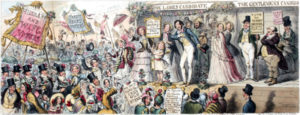
[Illustration: “THE RIGHTS of WOMEN” or the EFFECTS of FEMALE
ENFRANCHISEMENT]
A HISTORY OF PARLIAMENTARY ELECTIONS
AND ELECTIONEERING IN THE OLD DAYS
Showing the State of Political Parties and Party
Warfare at the Hustings and in the House of
Commons from the Stuarts to Queen Victoria
[Illustration: CANDIDATES ADDRESSING THEIR CONSTITUENTS.]
Illustrated from the Original Political Squibs, Lampoons
Pictorial Satires, and Popular Caricatures of the Time
by
JOSEPH GREGO
Author of “James Gillray, the Caricaturist: His Life, Works, and Times”
“Rowlandson, the Caricaturist: His Life, Times, and Works,” etc.
London
Chatto and Windus, Piccadilly
1886
[The right of translation is reserved]
“I think the Tories love to buy
‘Your Lordships’ and ‘Your Graces,’
By loathing common honesty,
And lauding commonplaces....
I think the Whigs are wicked Knaves
(And very like the Tories)
Who doubt that Britain rules the waves,
_And ask the price of glories_.”
W. M. PRAED (1826).
“A friend to freedom and freeholders--yet
No less a friend to government--he held
That he exactly the just medium hit
’Twixt place and patriotism; albeit compell’d,
Such was his sovereign’s pleasure (though unfit,
He added modestly, when rebels rail’d),
To hold some sinecures he wish’d abolish’d,
But that with them all law would be demolish’d.”
LORD BYRON.
PREFACE.
Apart from political parties, we are all concerned in that important
national birthright, the due representation of the people. It will be
conceded that the most important element of Parliaments--specially
chosen to embody the collective wisdom of the nation--is the legitimate
method of their constitution. Given the unrestricted rights of
election, a representative House of Commons is the happy result;
the opposite follows a tampering with the franchise, and debauched
constituencies. The effects of bribery, intimidation, undue influence,
coercion on the part of the Crown or its responsible advisers, an
extensive system of personal patronage, boroughmongering, close or
pocket boroughs, and all those contraband devices of old to hamper
the popular choice of representatives, have inevitably produced a
legislature more or less corrupt, as history has registered. Bad as
were the workings of the electoral system anterior to the advent
of parliamentary reform, it speaks volumes for the manly nature of
British electors and their representatives that Parliaments thus basely
constituted were, on the whole, fairly honest, nor unmindful altogether
of those liberties of the subject they were by supposition elected to
maintain; and when symptoms of corruption in the Commons became patent,
the degeneracy was not long countenanced, the national spirit being
sufficiently vigorous to crush the threatened evils, and bring about a
healthier state of things.
The comprehensive subject of parliamentary elections is rich in
interest and entertainment; the history of the rise, progress, and
development of the complex art of electioneering recommends itself to
the attention of all who have an interest in the features inseparable
from that constitution which has been lauded as a model for other
nations to imitate. The strong national characteristics surrounding, in
bygone days, the various stages of parliamentary election--peculiarly a
British institution, in which, of all people, our countrymen were most
at home--are now, by an improved elective procedure, relegated to the
limbo of the past, while the records of electioneering exist but as
traditions in the present.
With the modifying influence of progress, and a more advanced
civilisation, the time may come when the narrative of the robustious
scenes of canvassing, polling, chairing, and election-feasting, with
their attendant incidents of all-prevailing bribery, turbulence, and
intrigue, may be regarded with incredulity as fictions of an impossible
age.
It has been endeavoured to give the salient features of the most
remarkable election contests, from the time when seats began to
be sought after until comparatively recent days. The “Spendthrift
Elections,” remarkable in the annals of parliamentary and party
warfare, are set down, with a selection from the literature, squibs,
ballads, and broadsides to which they gave rise. The illustrations
are selected from the pictorial satires produced contemporaneously
upon the most famous electoral struggles. The materials, both literary
and graphic, are abundant, but scattered; it is hoped that both
entertainment and enlightenment may be afforded to a tolerant public by
the writer’s efforts to bring these resources within the compass of a
volume.
CONTENTS.
CHAPTER I.
PAGE
The assembling of parliaments--Synopsis of parliamentary
history--Orders for the attendance of members--Qualifications
for the franchise: burgesses, burgage-tenures, scot and lot,
pot-wallopers, faggot-votes, splitting--Disqualifications:
alms, charity, “faggots,” “occasionality”--Election of knights
of the shire, and burgesses--Outlines of an election in the
Middle Ages--Queen Elizabeth and her faithful Commons--An
early instance of buying a seat in the Commons--Returns
vested in the municipal corporations; “Money makes the
mayor to go”--Privileges of parliament--“Knights girt with
a sword”--Inferior standing of the citizens and burgesses
sent to Parliament--Reluctance of early constituencies to
sending representatives to parliament--Paid members--Members
chosen and nominated by the “great families”--The Earl of
Essex nominating his partisans and servants--Exemption
from sending representatives to the Commons esteemed
a privilege--The growth of legislative and electoral
independence--The beginning of “contested elections”--Coercion
at elections--Lords-lieutenant calling out the train-bands for
purposes of intimidation--Early violence--_Nugæ Antiquæ_; the
election of a Harrington for Bath, 1658-9; the present of a
horse to paid members--The method of election for counties,
cities, and boroughs--Relations of representatives with their
constituents--The “wages” of members of parliament--“Extracts
from the Proceedings of Lynn Regis”--An account rendered to the
burgesses--The civil wars--Peers returned for the Commons in
the Long Parliament after the abolition of the House of Lords. 1
CHAPTER II.
Influence of administration under Charles I.--Ballad on
the Commonwealth--House of Commons: “A General Sale of
Rebellious Household Stuff”--The Parliament under the
Restoration--Pepys and Prynne on the choosing of “knights
of the shire”--Burgesses sent up at the discretion of the
sheriffs--The king’s writ--Evils attending the cessation of
wages to parliamentary representatives--Andrew Marvell’s ballad
on a venal House of Commons--The parliament waiting on the
king--Charles II. and his Commons--“Royal Resolutions,” and
disrespect for the Commons--The Earl of Rochester on Charles
II.’s parliament--Interference in elections--Independence
of legislators _versus_ paid members--The Peers as “born
legislators and councillors”--“The Pensioner Parliament”
coincident with the remission of salaries to members of the
Commons--“An Historical Poem,” by Andrew Marvell--Andrew
Marvell as a paid member; his kindly relations with his Hull
constituents--Writ for recovering arrears of parliamentary
wages--Uncertainty of calling another parliament--The
Duke of Buckingham’s intrigues with the Roundheads; his
“Litany”--Degradation of parliament--Parody of the king’s
speech--Relations of Charles II. and his Commons--Summary
of Charles II.’s parliaments--Petitioners, addressers, and
Abhorrers--The right of petitioning the throne--The Convention
Parliament--The Long Cavalier Parliament--The Pensioner
Parliament and the statute against corruption--“The Chequer
Inn”--“The Parliament House to be let”--The Habeas Corpus
Parliament--The country preparing for Charles II.’s fourth
parliament--Election ballads: “The Poll,”--Origin of the
factions of Whigs and Tories--Whig and Tory ballads--“A
Tory in a Whig’s Coat”--“A Litany from Geneva,” in answer
to “A Litany from St. Omer”--The Oxford Parliament of eight
days--“The Statesman’s Almanack”--A group of parliamentary
election ballads, 1679-80--Ballad on the Essex petitions--The
Earl of Shaftesbury’s “Protestant Association”--“A Hymn
exalting the Mobile to Loyalty”--The Buckingham ballad--Bribery
by Sir Richard “Timber” Temple--The Wiltshire ballad--“Old
Sarum”--Petitions against prerogative--The royal pretensions to
absolute monarchy--The “Tantivies,” or upholders of absolute
kingly rights over Church and State--“Plain Dealing; or, a
Dialogue between Humphrey and Roger, as they were returning
home from choosing Knights of the Shire to sit in Parliament,
1681;” “Hercules Rideing”--“A Speech without-doors, made
by a Plebeian to his Noble Friends”--Philippe de Comines
on the British Constitution--On freedom of speech--A true
Commonwealth--The excited state of parties at the summoning
of the Oxford Parliament, 1681--Ballads on the Oxford
Parliament--The impeachment of Fitz-Harris, and the proposal of
the opposition to exclude the Duke of York from the “Protestant
succession”--Squabble on privilege between the Peers and
Commons--The Oxford Parliament dismissed, after eight days, on
this pretence--“The Ghost of the Late Parliament to the New
One to meet at Oxford”--“On Parliament removing from London to
Oxford”--“On his Majesty’s dissolving the late Parliament at
Oxford”--A “Weeked” Parliament. 22
CHAPTER III.
Electioneering on the accession of James II.--A parliament
summoned by James II.--The municipal charters restored in
the nature of bribes--Lord Bath, “the Prince Elector,” and
his progress in the west--Electioneering strategies--How Sir
Edward Evelyn was unjustly cozened out of his election--The
constitution of James II.’s Parliament--Inferior persons “of no
account whatever” chosen to sit in the Commons--The question
of supplies, the royal revenue, and prerogative--Assembling
of James II.’s parliament--The corrupt returns boldly
denounced--Violence at the elections--The abdication of
James II., and the “Convention Parliament”--Accession of
the Prince of Orange--Ballad “On the Calling of a Free
Parliament, Jan. 15, 1678-9”--Ballads on William III.’s
Parliament: “The Whigs’ Address to his Majesty,” 1689; “The
Patriots,” 1700--An election under William III., for the
City of London--“The Election, a Poem,” 1701; the electors,
the Guildhall, the candidates; Court-schemers _versus_
patriotic representatives; and “the liberties of the people”
_versus_ the “surrendered Charters”--Electioneering under
Queen Anne--The High Church party--“The University Ballad;
or, the Church’s Advice to her Two Daughters, Oxford and
Cambridge,” 1705--Whigs and “Tackers”--The Nonconformity
Bill--Mother Church promises to “wipe the Whigs’ nose”--The
“case of Ashby and White,” and the dispute thereon between the
Lords and Commons--Breaches of privilege--“Jacks,” “Tacks,”
and the “Occasional Conformity Bill”--Ballad: “The Old Tack
and the New,” 1712--The Act against bribery--Past-masters
of the art of electioneering--Thomas, Marquis of Wharton;
his election feats, and genius for canvassing-Election,
1705--“Dyer’s Letters”--Reception of a High Church “Tantivy”
candidate--Discomfiture of the “Sneakers”--Lord Woodstock’s
electioneering ruse at Southampton, 1705--“For the Queen and
Church, Packington”--Dean Swift on election disturbances
in Queen Anne’s reign--Sir Richard Steele’s mishap when a
candidate for election--Steele’s parliamentary career--“The
Englishman” and “The Crisis”--Sarah, Duchess of Marlborough, an
accomplished hand at electioneering--Her _ruse_ against Lord
Grimston--“Love in a Hollow Tree”--Dr. Johnson on scandals
revived at election-time--Failure of the High Church party
to bring in the Chevalier--The accession of George I., and
the Tory discomfiture--“The Whigs’ answer to the Tories”--The
Jacobite and Hanoverian factions--Ballads upon “Nancy,” “the
Chevalier,” and George of Hanover, 1716--The disaffected and
their hatred to Sir Robert Walpole--Ballad: “King James’s
Declaration”--The abortive Jacobite rising in 1715--Ballad:
“The Right and True History of Perkin”--The end of Perkin’s
attempt. 56
CHAPTER IV.
Sir Robert Walpole “chaired” on his election for Castle
Rising, 1701--“Robin’s Progress”--Walpole in Parliament--His
offices--Impeached by the Commons for corruption on the death
of George, Prince of Denmark--Returned for King’s Lynn--Firmly
established in power on the accession of George I.--“A
Tory Bill of Costs for an Election in the West, 1715”--The
Septennial Act, 1716--The elections of 1721--Walpole’s
“universal salve”--“The Election carried by Bribery and the
Devil,” 1721--Municipal corruption--Ballad: “Here’s a Minion
sent down to a Corporate Town”--The elections of 1727--“Ready
Money, the Prevailing Candidate; or, the Humours of an
Election,” 1727--“No bribery, but pockets are free”--Ballad:
“The Laws against Bribery Provision may make”--“The Kentish
Election, 1734”--“The Country Interest” _versus_ “the
Protestant Interest”--Vane and Dering _versus_ Middlesex
and Oxenden--Vane’s treat to his electors--Walpole paraded
in effigy--Hogarth’s design on the election of 1734: Sir
Robert Fagg--“The Humours of a Country Election,” 1734--The
first suggestion for Hogarth’s series of four election
prints--Plays, operas, and poems on elections--The oath
imposed upon electors--“A New-year’s Gift to the Electors of
Great Britain,” 1741--“The flood of corruption”--Walpole, as
“The Devil upon Two Sticks,” carried through the “Slough of
Despond,” 1741--“A Satire on Election Proceedings,” dedicated
to “Mayors and Corporations in general,” 1741--Walpole’s
lease of power threatened--Satirical version of Walpole’s
“Coat of Arms”--The Westminster election of 1741--Wager and
Sundon _versus_ Vernon and Edwin--A patriotic “Address to the
Independent and Worthy Electors” of Westminster, 1741--Royal
canvassers--“Scene at the Westminster Election,” 1741--Lord
Sundon calls in the grenadiers to close the poll--The
Westminster Petition, 1741--A new election--Wager and Sundon
unseated; Edwin and Percival returned--Admiral Vernon and
Porto Bello--“The Funeral of Independency,” 1741--“The Triumph
of Justice,” 1741--Walpole defeated--“The Banner of Liberty
displayed,” 1741--A ministerial mortification--Ballads upon
the Westminster election of 1741--“The Independent Westminster
Electors’ Toast”--“The Downfall of Sundon and Wager”--“The
Independent Westminster Choice”--“The True English-Boys’
Song to Vernon’s Glory”--Triumph of the “Country party” or
“Patriots”--“The Body of Independent Electors of Westminster”
constituted into a society--Their anniversary dinners--A
dinner-ticket, 1744--The Stuart rising of 1745--Lord
Lovat’s trial--Meeting of “The Independent Electors of the
City and Liberty of Westminster” at Vintners’ Hall, March,
1747--Jacobite toasts--“The Spy detected:” ejectment of a
ministerial spy from Vintners’ Hall--The state of parties
at the Westminster election, 1747--Earl Gower and his son,
Lord Trentham--Falling-off of the Independent party--Trentham
and Warren _versus_ Clarges and Dyke--“The Two-Shilling
Butcher,” 1747--The Duke of Cumberland and the Prince of Wales
as rival canvassers--The Duke of Bedford’s support of Lord
Trentham--“The Jaco-Independo-Rebello-Plaido”--“The Humours of
the Westminster Election; or, the Scald Miserable Independent
Electors in the Suds,” 1747--Jacobite vagaries--“Great
Britain’s Union; or, the Litchfield Races,” 1747--The
Jacobite rebellion--Political animosities carried on to the
race-course--Alternate Whig and Tory race meetings--The Duke
of Bedford horsewhipped at the Litchfield races on Whittington
Heath--Ballad on the _fracas_: “The Lords’ Lamentation; or,
the Whittington Defeat,” 1747--Trentham _versus_ Vandeput,
1749--The _fracas_ at the Haymarket Theatre--Frenchified Lord
Trentham’s deadly attack on his own electors--Gallic valour
and the Admiralty Board--Ballad: “Peg Trim Tram in the Suds;
or, No French Strollers,” 1749--“Britannia Disturbed, or an
Invasion by French Vagrants, addressed to the Worthy Electors
of the City of Westminster,” 1749--Violence and bribery--“Aux
Electeurs très dignes de Westminster”--The Duke of Bedford’s
oppression and injustice to his tenants--Hogarth’s print of “A
Country Inn-yard at the Time of an Election,” 1747--The Hon.
John Child--“No Old Baby.” 78
CHAPTER V.
The Pelham Administration--Corruption rife--“The Duke of
Newcastle as the Complete Vermin-Catcher of Great Britain;
or, the Old Trap new baited,” 1754--Ministerial bribes
and baits--Boroughmongering--“Dissection of a Dead Member
(of Parliament)”--A mass of corruption--Henry Pelham’s
measures--The Jews’ Naturalization Bill, 1753--Death of
Pelham--“His Arrival at his Country Retirement and Reception,”
1754--Pelham’s reception across the Styx--The elections of
1754--Humours of canvassing--The election for the City of
London: “The Liveryman’s Levee,” 1754--“The City Up and Down;
or, the Candidates Pois’d,” 1754--City candidates: Sir John
Barnard, Slingsby Bethell, William Beckford, Sir Richard Glyn,
Sir Robert Ladbroke, Sir Crispe Gascoyne, and Sir William
Calvert--Sir Sampson Gideon, the loan contractor, and “The
Jews’ Naturalization Bill”--“A Stir in the City; or, Some
Folks at Guildhall,” 1754--Ballad on the City election at the
Guildhall--“The Parliamentary Race; or, the City Jockies,”
1754--Ballad on “The Parliamentary Race for the City”--The
London and Oxfordshire elections--“All the World in a Hurry;
or, the Road from London to Oxford,” 1754--Ballad on “The
London Election”--The Oxford Election; Candidates: Wenham and
Dashwood _versus_ Turner and Parker--Ballad on the Oxford
election--The four election pictures by William Hogarth
having reference to the county election for Oxfordshire,
1754--“The Election Entertainment”--Humours of an election
feast--“The low habits of venal wretches”--“The New Interest”
_versus_ “The Old Interest”--Election party cries in 1754:
“Give us our eleven days”--Ballad on alteration in the
style--Party animosities--“Act against Bribery”--“Kirton’s
Best”--“Canvassing for Votes,” 1754--“Punch, Candidate for
Guzzledown”--“The Royal Oak” _versus_ “The Crown,” otherwise
“The Excise Office”--“The Polling Booth,” Oxfordshire,
1754--Ballad on the humours of polling--“Chairing the Members,”
1754--Burlesque on Bubb Dodington--The dangers of chairing--A
ministerial dinner, 1754--Hogarth’s sketches of “Bubb
Dodington and the Earl of Winchilsea”--Murderous incidents
of the Oxfordshire election--Wrecking houses--Parliamentary
interest _versus_ place--Hawking “marketable ware”--Diary
of Bubb Dodington (Lord Melcombe Regis)--Overtures from
the Pelhams--Bubb’s “parliamentary interest”--A prime
minister--“Bubbling” a boroughmonger--The intriguer
over-matched--The Bridgwater Election, 1754--Details of an
election contest in 1754, from Dodington’s diary--The Duke of
Newcastle, an arch-negotiator--Bubb and his “parliamentary
interest” bought for nothing--The vitiating effects of bribery
and corruption on a representative legislature--“Burning
a Prime Minister in Effigy,” 1756--Denunciations against
venal ministers and the vital injuries they inflict on the
constitution. 125
CHAPTER VI.
John Wilkes, the _pseudo_ “Champion of Liberty”--W.
Hogarth as a partisan--His attack on Wilkes and Churchill,
the _North Briton_, 45--Hogarth’s unfortunate political
satires--“The Times,” Plate I., 1762--Lord Bute as Hogarth’s
patron--“The Epistle to Hogarth,” by Churchill--“The
Times,” Plate II., withheld from publication; given to
the public in 1790--The demagogue tried in court at
Westminster--Hogarth’s print of “John Wilkes, a patriot”--The
_North Briton_, No. 45--Severe animadversions on Hogarth by
Wilkes and Churchill--The “Bruiser,” Charles Churchill, by
Hogarth--His reprisal--Hogarth, Wilkes, and Churchill: “A
Bear Leader”--Wilkes’s illegal imprisonment on “a general
warrant”--Wilkes in the Tower--“A Safe Place,” 1763--“Daniel
cast into the Den of Lions; or, True Blue will never stain,”
1763--Wilkes set at liberty--His appearance in parliament,
and duel--Wilkes absconds to Paris--Is outlawed for contempt
of court--Returns from Paris, and contests the City of London
at the general election, 1768--The City candidates--The
nomination--The poll--Wilkes at the bottom of the poll--The
adulation of the mob--Wilkes’s letter to the king--His
submission to the Treasury--Wilkes a candidate for the
county of Middlesex--“The Return of Liberty,” and “Liberty
revived”--The Brentford election--Violent conduct of the
“Wilkes and Liberty” mob--Candidates for Middlesex--“No.
45 N.B.”--Wilkes returned for Middlesex--Dr. Franklin on
“Wilkes and the Brentford election”--“John Wilkes elected
Knight of the Shire for Middlesex, March 28, 1768, by the
Free Voice of the People”--More of the “Wilkes and Liberty”
riots--The mob in London--Universal turbulence--The attack on
the Mansion House--“The Laird of the Boot”--“The Rape of the
Petticoat”--Lord Bute and the Princess of Wales--The _Oxford
Magazine_ on the valour of the Lord Mayor--The view taken by
the _Political Register_--Ballad on Lord Mayor Harley’s seizure
of the “Boot and Petticoat”--Surrender of Wilkes--Released
by the rabble--His second surrender--“The Scot’s Triumph; or,
a Peep behind the Curtain”--Wilkes a prisoner in the King’s
Bench--The Wilkes riots in St. George’s Fields--Southwark in
a state of siege--The military under arms--Wilkes’s address
from the King’s Bench Prison, “To the Gentlemen, Clergy, and
Freeholders of the County of Middlesex”--The mob demonstration
outside the King’s Bench on the opening of parliament--The
Riot Act read--The massacre of St. George’s Fields--The case
of William Allen, deliberately assassinated--“The Scotch
Victory; murder of Allen by a Grenadier.--St. George’s Fields,
1768”--The ministerial approval of the butcheries by the
soldiers--Justice Gillam--The circumstances of the riot--The
soldiers tried--The murderer shielded from justice; his escape,
and subsequent pension--Horne Tooke as a witness--He brings
the guilty to justice--The defence by the Government--“The
Operation,” 1768--“Murder screened and rewarded” 157
CHAPTER VII.
Death of Cooke, Tory member for Middlesex, 1768--A fresh
election--Serjeant Glynn, Wilkes’s advocate, a Radical
candidate for the vacant seat; opposed by Sir W. Beauchamp
Proctor--Proctor’s mob of hired ruffians--“The Hustings
at Brentford, Middlesex Election”, 1768--Prize-fighters
employed to terrorize the electors--Dastardly attack
on the hustings--Glynn’s “Letter to the Freeholders of
Middlesex”--Proctor’s repudiation of the charge of “hiring
banditti”--Horne Tooke’s “Philippic” to Proctor--The true
facts of the case--The circumstantial account given in the
_Oxford Magazine_--The rioters beaten off--Electioneering
manœuvres: summoning electors as jurymen--The bruisers
recognized--Broughton engaged as generalissimo of the
forces--An expensive contest--Glynn’s letter of acknowledgment
to his constituents--The “Parson of Brentford”--Poetical
tributes to Horne Tooke--Results of the injuries inflicted
by the hired ruffians: Death of Clarke--“The Present State
of Surgery; or, Modern Practice,” 1769--Trial of Clarke’s
murderers--The bruisers defended by the ministers--Found
guilty, and sentenced to transportation, but receive a royal
pardon and pensions for life--Partial conduct and verdict of
the College of Surgeons--“A Consultation of Surgeons”--The
petitions and remonstrances addressed to the Throne--Colonel
Luttrell sent to parliament, though not duly elected, to
represent Middlesex in place of Wilkes--An unconstitutional
vote of the Commons: “296 votes preferred to 1143”--Lord
Bacon on the lawful power of Parliaments--The Crown and its
advisers, and the odium attaching to their unconstitutional
proceedings--Servile addresses--The loyal address from the
“Essex Calves”--“The Essex Procession from Chelmsford to St.
James’s Market for the Good of the Common-Veal,” 1769--Charles
Dingley, “the projector”--The bogus city address--“The
Addressers”--The _fracas_ at the King’s Arms, Cornhill--A
battle-royal--“The Battle of Cornhill,” 1769--Administrative
bribes of preference “Lottery Tickets”--“The Inchanted
Castle; or, King’s Arms in an Uproar,” 1769--Walpole’s
account of the procession--“The Principal Merchants and
Traders assembled at the Merchant Seamen’s Office to sign
y^e Address”--“Epistle to the _North Briton_,” 1769--The
“Abhorrers” of Charles II.’s reign revived--The Administration
arraigned with their crimes--Address of the Quakers to James
II.--“The conduct of ninety-nine in a hundred of the people
of England ‘Abhorred’”--The loyal address forwarded to St.
James’s Palace--“The Battle of Temple Bar,”--The addressers
routed--“Sequel to the Battle of Temple Bar: Presentation of
the Loyal Address at St. James’s Palace,” 1769--The fight
at Palace Yard--“The Hearse,” and Lord Mountmorres--The
lost Address recovered--Account of the procession from the
_Political Register_--The _Town and Country Magazine_--A royal
proclamation against the rioters: _Gazette Extraordinary_--“The
Gotham Addressers: or, a Peep at the Hearse”--“A Dialogue
between the Two Heads on Temple Bar,” 1769 178
CHAPTER VIII.
More petitions and remonstrances to the king--Petition
of the Livery of London--The king’s advisers denounced
by the citizens--An arraignment of ministerial crimes
and misdemeanours--Undue prerogative and its abuses--The
alienation of our colonies, and the consequent loss of
America--The king’s contemptuous reception of the city
petition--Disrespect shown to the corporation at the Court
of St. James’s--Threatening attitude of the military--An
unscrupulous and tyrannical ministry--A poetical petition--The
king visits the city petition with “severe censure”--A more
stringent remonstrance prepared--The violated “right of
election”--An unrepresentative parliament--“The true spirit
of parliaments”--“The constitution depraved”--The Coronation
Oath violated--The king’s answer, condemning the former
petition, and the city remonstrance--“Nero fiddled while
Rome was burning”--Further popular agitations--Horne Tooke’s
“Address to the Freeholders of the county of Middlesex”--“The
Middlesex Address, Remonstrance and Petition”--“Constitutional
liberties attacked in the most vital part”--“A self-elected
and irresponsible Parliament”--The petitions from Middlesex
and Kent received at St. James’s in silence--The Westminster
remonstrance--Corrupt administration of the House of
Commons--The king prayed to dissolve a parliament no longer
representing the people--The right of petitioning impeached
by the Commons--The king replies that “he will lay the
remonstrance before parliament”--“Making a man judge in his
own trial”--The undignified reception of the Westminster
remonstrance--Parliamentary counter-petitions at the
bidding of corrupt ministers--The city vote of thanks to
Lord Chatham, for his patriotic “zeal for the rights of the
people”--The king’s answer considered at a general assembly
of the citizens--Alderman Wilkes on the violation of the
rights of election and of the constitution--The recorder
characterises the remonstrance as a libel--The conduct of
ministers in the case of Colonel Luttrell’s election--A fuller
remonstrance from the city--The results of the Revolution of
1788 contravened--The king’s answer--Beckford requests leave
to reply--His dignified speech to the king--The king remains
silent--“Nero did _not_ fiddle while Rome was burning”--The
courtiers abashed--The king prorogues parliament with an
address approving of the conduct of both Houses--The citizens
eventually triumph in “the cause of Liberty and of the
Constitution”--Lord Chatham’s eulogium pronounced upon the
“patriotic spirit of the metropolis”--Beckford and Chatham,
the champions of popular rights--The national importance of
their conduct at this crisis of our history--Civic honours
paid to Beckford--His speech to the king inscribed on the
monument erected to his memory in the Guildhall--The corrupt
ministers cowed--An uncontested election for Westminster,
1770--Sir Robert Bernard’s nomination--His election, without
expense or disorder--Speeches of Sir J. Hussey Delaval and
Earl Mountmorres on the late conduct of the Government--The
advantages of leaving the people to the legitimate exercise of
their liberties, uninfluenced by the administrative interest,
corruption, and undue influence, the usual features at an
election. 207
CHAPTER IX.
“The Spendthrift Election,” Northampton, 1768--Expensive
contests, the defeated men appearing in the
_Gazette_--Colchester; Hampshire--Three noble patrons
adversaries at Northampton: the Earls of Halifax,
Northampton, and Spencer--Open-house at ancestral seats--The
“perdition of Horton”--The petition and scrutiny on the
Northampton election--The event referred to chance--Cost
of the contest--The results of the reckless expenditure
upon the fortunes of the patrons--Sir Francis Delaval at
Andover, 1768--His attorney’s bill: item, “to being Thrown
out of window, £500”--Reckoning without the host--An
hospitable entertainment--Returning thanks--The Mayor
_versus_ the Colonel--“Sir Jeffery Dunstan’s Address to
the Electors of Garratt,” 1774: a parody upon election
manifestoes-“Lord Shiner’s Appeal to the Electors of
Garratt”--Bribery at elections, and “controverted election
petitions”--Various methods of acquiring “Parliamentary
interest”--Boroughs cultivated for the market, like
other saleable commodities--Patronage--Buying up
burgage-tenures--Recognized prices of votes--The Ilchester
tariff--“Dispensers of seats”--Lord Chesterfield’s experience
of borough-jobbing--The seven electors of Old Sarum--Typical
sinks of corruption--Boroughbridge, Yorkshire--“The last
of the Boroughbridges”--A solitary franchise-holder; one
man returning two representatives--The bribery scrutiny,
Hindon, 1774--203 bribed electors out of a constituency of
210--Wholesale corruption--Bribing candidates committed to the
King’s Bench--A fine of “a thousand marks”--Boroughmongering
at Milborne Port--Lord North’s agent--A wholesale purchase
of “bailiwicks”--Supineness of the Commons and ministerial
influence--Corrupt bargains ignored by the House--Illegal
interference of peers and lords of parliament in elections;
Westminster election, 1774--“Money, meat, drink, entertainment
or provision”--The partiality of persons in power manifested
at “election bribery commissions”--The “king’s menial servants
disqualified”--“Direct solicitation of the peers”--Worcester,
1774, wholesale swearing-in of electors as special
constables--Convenient formula for defeating evidence of
bribery before the House--High-Sheriffs returning themselves,
Abingdon, 1774--The instance of Sir Edward Coke--“The sheriff
in no respect the returning officer for boroughs”--The
election made void by the sheriff returning himself--Morpeth,
1774--An election determined by main force--The candidate
forcibly returning “himself and friend”--A “bribing” candidate
preferred to a “main-force” candidate--Petersfield, Hants--The
Shaftesbury “Punch,”--Pantomimic method of distributing
bribes--The mysterious “Glenbucket”--Sudbury, 1780--A wager on
the result of a controverted petition--A mayor insisting upon
carrying on an election all night--The Shaftesbury “Punch”
outdone by the Shoreham “Christian Society”--A well-organized
scheme for “burgessing business”--The “Society” a “heap of
bribery”--Stafford, 1780; The price paid by R. B. Sheridan
for his seat--Tom Sheridan a candidate for Stafford, on his
father’s retirement, 1806--The successful candidate for
Stafford presented with a new hat at the hustings, by a
subscription of his constituents--“A Mob-Reformer,” 1780--The
first entry into public life of William Pitt--“The spirit of
the country in 1780”--Pitt seated for Appleby, one of Sir James
Lowther’s pocket-boroughs--Pitt’s early political friends:
the Duke of Rutland and Lord Euston--Pitt’s letter to his
mother, Lady Chatham, on his coming election--No necessity to
visit constituencies--Choice of seats offered to the young
premier, 1784--Nominated for the City of London--Invited
to stand for Bath, represented by his late father Earl
Chatham--Pitt returned for the University of Cambridge,
1784, which he represented till his death--The dissolution
delayed by the theft of the Great Seal from the Chancellor’s
residence, 1784--Pitt’s letter to Wilberforce on the coming
elections--Pitt “a hardened electioneerer”--The war carried
into the great Whig strongholds--The subscription to forward
Wilberforce’s return for Yorkshire--Earl Stanhope on “Fox’s
Martyrs”--Fox’s courage under adversity--Wilkes returned as the
ministerial representative for Middlesex--Wilkes’s “address
to the electors”--“The Back-stairs Scoured”--“The boldest
of bilks”--“Reconciliation of the Two Kings of Brentford,”
1784--“The New Coalition,” 1784--Charles James Fox’s first
entry into public life--Returned for Midhurst, 1769--His first
speech on the Wilkes case--Wilkes at a levée: he denounces to
the king his friend Glynn as a “Wilkite”--Canvass of Pitt’s
friends--The poet Cowper’s description of Pitt’s cousin, the
Hon. W. W. Grenville, seeking for suffrages--The amenities of
canvassing in the old days: saluting the ladies and maids--A
most loving, kissing, kind-hearted gentleman--W. W. Grenville
and John Aubrey returned for Buckinghamshire, 1784 226
CHAPTER X.
The Great Westminster election of 1784--Wilkes’s famous
election contest for Middlesex dwarfed by comparison-State
of political excitement--Relations of parties in the
Commons--Fox’s India Bill--“Carlo Khan”--Downfall of the
Coalition Ministry--Pitt made premier by the will of the
king--“Back-stair influence,” and Court intrigues--“The
royal finger”--Hostility of the East India Company against
Fox--An administration called to power with a working
minority--Defeated on division--Vote of want of confidence--The
House dissolved--The great election campaign--“The storm
conjured up”--The popular aversion to the late Coalition
Ministers shown at the hustings--“The royal prerogative exerted
against the palladium of the people”--Horace Walpole on the
situation--The Whig losses all over England--Fox’s contest for
Westminster--A forty days’ poll--The metropolis in a state of
ebullition--Party cries--The streets a scene of combat--The
rival mobs--The Guards--Hood’s sailors; their violent
partisanship and reckless attacks--The “honest mob”--Fox’s
narrow escape--The Irish chairmen beat the sailor-mob--A
series of pitched battles--Partial behaviour of the special
constables--Their interference and violence--Flood of ballads
and political squibs--Rowlandson’s caricatures on the
contest--The odium revived against the late Coalition Ministry;
turned to political account by the Court party--“The Coalition
Wedding: the Fox and the Badger quarter their Arms”--“Britannia
aroused; or, the Coalition Monsters destroyed”--Pitt’s election
manœuvres; his bidding for the favour of the citizens--Pitt
presented with the freedom of the city--“Master Billy’s
Procession to Grocers’ Hall”--The king threatens to retire
to Hanover in the event of a defeat--Ministerial wiles--Bids
of place and pension--Extensive “ratting”--“The Apostate
Jack Robinson, the Political Rat-catcher. N.B. Rats taken
alive!”--“The Rival Candidates: Fox, Hood, and Wray”--Rival
canvassers--“Honest Sam House, the Patriotic publican”--The
hustings, Covent Garden--The “prerogative standard”--“Major
Cartwright, the Drum-Major of Sedition”--“The Hanoverian
Horse and the British Lion”--“Fox, the Incurable”--Fair
canvassers--The ladies of the Whig aristocracy a bevy of
beauty; the Duchess of Devonshire, the Countess of Duncannon,
the Duchess of Portland, Lady Carlisle, etc.--“The Devonshire,
or Most Approved Manner of securing Votes”--“A Kiss for a
Vote”--Tory lady canvassers: Lady Salisbury, the Hon. Mrs.
Hobart--“Madame Blubber, the Ærostatic Dilly”--Walpole’s
account of the canvassing--Fox’s favour with the fair--The
Duchess of Devonshire’s exertions on behalf of the Whig
chief--Earl Stanhope on “Fox’s Martyrs”--His account of
the contested election--Pitt’s letters on the Westminster
election, to Wilberforce, and James Grenville--Pitt’s account
of the country elections--His anxiety about Westminster--Earl
Stanhope’s summary of the Westminster election--Ballads on
the contest--“The Duchess Acquitted; or, the True Cause of
the Majority on the Westminster Election”--Tory libels on the
Duchess of Devonshire--“The Wit’s Last Stake; or, the Cobbling
Voters and Abject Canvassers”--“The Poll”--Animadversions
against Sir Cecil Wray--“Lords of the Bedchamber”--“The
Westminster Watchman”--A flood of _jeux d’esprit_--“On undue
influence”--“A concise Description of Covent Garden at the
Westminster election”--“Stanzas in Season”--The Prince of Wales
a zealous partisan of Fox--“Lady Beauchamp, Lady Carlisle, and
Lady Derby at the Hustings”--Poetical tributes--The Duchess
of Devonshire saves the Whig cause at Westminster--“On the
Duchess of Devonshire and Lady Duncannon canvassing for
Fox”--“On a certain Duchess”--Horace Walpole’s nieces, the
Ladies Waldegrave, “the three Sister Graces,” canvassing
for Fox--“Epigram on the Duchess of Devonshire”--“Impromptu
on her Grace of Devon”--“Ode to the Duchess”--“The Paradox
of the Times”--A new Song, “Fox and Freedom”--The downfall
of Wray--“The Case is Altered”--Bringing in outlying
voters--“Procession to the Hustings after a Successful
Canvass”--“Every Man has his Hobby-Horse”--Fox carried into the
House by the duchess--_Exit_ Sir Cecil Wray!--“For the Benefit
of the Champion--a Catch.” “No Renegado!” Wray defeated--“The
Westminster Deserter drumm’d out of the Regiment”--Apotheosis
of the fair champion--“Liberty and Fame introducing Female
Patriotism (the Duchess of Devonshire) to Britannia”--The
close of the poll--Wray demands a scrutiny--Partial and
illegal conduct of the high bailiff as returning-officer--Fox
triumphant--The ovation--The chairing procession--Two days
of festivities--The reception at Devonshire House--The
Prince of Wales’s rejoicings--The fête at Carlton
Palace--Rival interests--Mrs. Crewe’s rout--The tedious and
prolonged progress of the scrutiny--Fox for Kirkwall--“The
Departure”--Fox recovers damages against the high bailiff
for illegality in refusing to make a return--The affair only
settled a year later--“Defeat of the High and Mighty Balissimo
Corbettino and his Famed Cecilian Forces, on the Plains of
St. Martin,” 1785--Corbett ordered by the court to make his
return--Cast in damages--Fox’s final majority 257
CHAPTER XI.
Another Westminster election, 1788--Lord Hood appointed
to the Admiralty Board, 1788--A fresh contest--Lord John
Townshend, a candidate in the Whig interest--Defeat of Lord
Hood--Two Whig members for Westminster--Mob violence, the
Guards, Hood’s sailors--Ministerial support--“Election Troops
bringing their Accounts to the Pay-table” (Treasury Gate),
1788, by J. Gillray--“An Independent Elector”--Helston,
Cornwall, 1790--Lady canvassers--A violent “eccentric”--“Proof
of the Refined Feelings of an Amiable Character, lately a
Candidate for a Certain Ancient City,” by J. Gillray--“The
‘Marplot’ of his Own Party”--Abuses of patronage--Traditions
of boroughmongering--Accumulations of seats and parliamentary
interests--Cartwright’s tables of pocket boroughs--Pitt’s early
patron, Sir James Lowther--“The tyrant of the North”--“Pacific
Entrance of Earl Wolf (Lord Lonsdale) into Blackhaven,”
1792--Great distress prevalent throughout the country, in
1795; its effect on political agitation--Political clubs
clamour for parliamentary reform--The king and his advisers
in disfavour--Revolutionary societies and the “Seditions
Bill”--Gillray’s caricatures--“Meetings of Political Citizens
at Copenhagen House,” 1795--Whig agitation against the
threatened incursions on the “liberty of the subject”--“The
Majesty of the People”--“A Hackney Meeting,” 1796--A threatened
constitutional struggle averted by a dissolution of parliament,
1796--Pitt’s tactics--“The Dissolution; or, the State Alchymist
producing an Ætherial Representation,” 1796--Mr. Hull’s
costly electioneering experience at Maidstone, 1796--Horne
Tooke unsuccessful at Westminster, 1790 and 1796--Fox and
the favour of the mobocracy--“The Hustings, Covent Garden,”
1796--Electioneering squibs--The _Anti-Jacobin_ and the
member for Southwark--Canning’s lines on George Tierney,
“The Friend of Humanity and the Knife-grinder,” 1797--Grey’s
reform measure first moved in 1797--Defeat of the Whigs,
and their temporary abstention from the debates--Increased
political agitation out of doors--Great reform meetings--Medal
commemorative of the gathering at Warwick--“Loyal Medal,” a
parody of the “Greathead” patriotic medal--The secession of
“the party”--Horne Tooke as a political agitator--The Brentford
Parson’s pamphlets--Horne Tooke a political portrait painter,
and the _Anti-Jacobin_--“Two Pair of Portraits, dedicated to
the Unbiased Electors of Great Britain,” 1798--Meeting on the
twentieth anniversary of Fox’s membership for Westminster--The
Whig chief’s speech to his constituents--“The Worn-out Patriot;
or, the Last Dying-Speech of the Westminster Representative
at the Shakespeare Tavern,” 1800--Horne Tooke seated for “Old
Sarum”--The opposition to his membership led by Temple--Lord
Camelford’s nominees--“Political Amusements for Young
Gentlemen; or, the Brentford Shuttlecock,” 1801--“Horne Tooke
as the ‘Shuttlecock’”--Unexpected honours thrust upon Captain
Barlow at Coventry, 1802--Middlesex Election for 1804--The
Brentford Hustings--“A Long Pull, a Strong Pull, and a Pull
All Together;” Sir Francis Burdett drawn to the poll--“The
Governor in his Glory,” 1804--The Westminster election,
1806--The Radical Reformers--“Triumphal Procession of Little
Paull”--“The Highflying Candidate mounting from a Blanket,”
1806--The coalition between Hood and Sheridan--Paull tossed
at the hustings--Burdett for Middlesex--“Posting to the
Election; or, a Scene on the Road to Brentford,” 1806--William
Cobbett “A Radical Drummer,” 1806--“Coalition Candidates,”
Hood and Sheridan--Sheridan disconcerted--“View of the
Hustings in Covent Garden, Westminster Election,” 1806--“Who
suffers?”--The general election, 1807--A split in the Radical
camp--Differences between Burdett and Paull--“Patriots deciding
a Point of Honour; or, the Exact representation of the
Celebrated Rencontre which took place at Coombe Wood, between
Little Paull the Tailor and Sir Francis Goose,” 1807--“The Poll
of the Westminster Election,” 1807--“the Republican Goose at
the Top, etc.”--Horne Tooke and Sir Francis Burdett--“The Head
of the Poll; or, the Wimbledon Showman,” 1807--“The Chelmsford
Petition; Patriots addressing the Essex Calves” 289
CHAPTER XII.
The “royal” Duke of Norfolk an enthusiastic
“electioneerer”--Wilberforce’s electioneering experiences--His
contest for Hull--The price of freemen--The great fight for
Yorkshire, 1807--“The Austerlitz of Electioneering”--The
candidates, Wilberforce, Lord Milton and Lascelles--The
Fitzwilliam and Harewood interests--Three hundred thousand
pounds expended--The voluntary subscription to defray the
expenses of Wilberforce’s candidature--The poll--The county
in a state of ferment--Election wiles; false rumours;
“Bruisers”--All the conveyances bespoke--Wilberforce’s
victory--His motives for the contest--“Groans of the
Talents”--Personation--Female canvassers under false
colours--Travelling expenses of electors--Carrying cargoes
of freeholders by water--Kidnapping--The caricaturists on
elections--Customary episodes of a Westminster election,
delineated by Rowlandson and Pugin--George Cruikshank as
an election caricaturist--The “Speaker’s Warrant” for
committing Burdett to the Tower, 1810--“The Little Man in
the Big Wig,” 1810--“The Election Hunter,” 1812--“Saddle
White Surrey for Cheapside”--Southwark election, 1812--“The
Borough Candidates”--“An Election Ball,” 1813--The Westminster
election, 1818--“The Freedom of Election: or, Hunt-ing
for Popularity and Plumpers for Maxwell,” 1818--“Hunt, a
Radical Reformer”--“A Political Squib on the Westminster
Election,” 1819--“Patriot Allegory, Anarchical Fable, and
Licentious Parody”--Major Cartwright, an unsuccessful
candidate--Cartwright’s Petition to the House of Commons
on the needful reform of a corrupt representative
system, 1820--Statistics of borough-mongering--“Sinks
of corruption”--“353 members corruptly imposed on the
Commons”--The coming elections of 1820--John Cam Hobhouse--His
imprisonment--“Little Hob in the Well”--“A Trifling
Mistake--corrected,” 1820--Radicals--“The Root of the King’s
Evil; Lay the Axe to it,” 1820--The Riot Act--“The Law’s Delay.
Showing the advantage and comfort of waiting the specified time
after reading the Riot Act to a Radical Mob; or, a British
Magistrate in the Discharge of his Duties, and the People
of England in the Discharge of Theirs,” 1820--“The Election
Day”--Dissolution of Parliament, 1820--“Coriolanus addressing
the Plebs,” 1820--“Freedom and Purity of Election! Showing the
Necessity of Reform in the Close Boroughs,” 1820--“Radical
Quacks giving a new Constitution to John Bull,” 1820--Burdett
and Hobhouse as Radical Reformers 324
CHAPTER XIII.
The last parliament of George IV.’s reign--The country
clamorous for retrenchment--The Tory _régime_ growing
irksome--The king’s illness, 1830--John Doyle’s caricatures
upon public events (HB’s “political sketches”)--“Present
State of Public Feeling Partially Illustrated,”
1830--Death of the king--“The Mourning Journal: Alas! Poor
Yorick!”--“The Magic Mirror; or, a Peep into Futurity”--The
Princess Victoria--Accession of William IV.--Whig
prospects reviving--Brougham, “A Gheber worshipping the
Rising Sun”--Wellington, a “Detected Trespasser”--Party
intrigues--“Anticipation; or, Queen Sarah’s Visit to
Bushy”--The old campaigner--“_Un_-Holy Alliance; or, an
Ominous Conjunction”--The general election, 1830--“Election
Squibs and Crackers for 1830. Before and After the
Election”--Caricaturists, as politicians, usually above party
prejudices--W. Cobbett returned for Oldham--“Peter Porcupine”
an M.P.--“A Characteristic Dialogue”--Changes of seats--“The
Noodle Bazaar”--Heads for Cabinets--John Bull and the
_Times_--“The man that is easily led by the nose”--“Resignation
and Fortitude; or, the Gold Stick”--“The Rival Candidates;”
Boai and Grant--Wellington’s leadership threatened: “The
Unsuccessful Appeal”--The popular will--Attacks upon the
Wellington and Peel Ministry--Results of the general election
unfavourable to the Cabinet--“A Masked Battery”--“A Cabinet
Picture”--“Guy Fawkes; or, the Anniversary of the Popish
Plot”--Defeat foreshadowed--“False Alarm; or, Much Ado
about Nothing”--The Eastern Question fatal to Wellington’s
Ministry--“Scene from the Suppressed Tragedy entitled the
Turco-Greek Conspiracy”--“His Honour the Beadle (William IV.)
driving the Wagabonds out of the Parish”--The adoption of
liberal progress--Preliminary skirmishing--“The Coquet”--The
ministry thrown out--“Examples of the Laconic Style”--“A
very Prophetical and Pathetical Allegory,” 1831--Reform on
the road--“Leap-Frog down Constitution Hill,” 1831--Another
appeal to the country--“Anticipated Radical Meeting”--The
dissolution--“Great Reform” Specialists; John Bull and his
constitutional deformity--“Hoo-Loo-Choo, _alias_ John Bull,
and the Doctors”--“May-Day”--“Leap-Frog on a Level; or,
Going Headlong to the Devil”--The Reformers having it all
their own way--A swinging pace--Political squibs on the
elections of 1831--The great battle of Lord Grey’s Reform
Bill--“The New Chevy Chase,” a poetical version of the reform
struggle--“Votaries at the Altar of Discord”--“Peerless
Eloquence”--Slaughter of the Innocents--“Niobe
Family”--Extinction of pocket boroughs--Reform at a breakneck
pace--“John Gilpin”--William IV. carried away by the old
Grey--“The Handwriting on the Wall: ‘Reform Bill!’”--A warning
to reformers--Grey and “Brissot’s Ghost”--“Macbeth” and “The
Tricoloured Witches”--Grey, Durham, and Brougham--Althorp and
Russell--A tub to a whale--“A Tale of a Tub, and the Moral
of the Tail”--Renovations at the King’s Head: “Varnishing--A
Sign (of the Times)”--“The Rival Mount-o’-_Bankes_; or, the
Dorsetshire Juggler”--Root-and-branch reform--“LINEal Descent
of the Crown,” a hint from Hogarth’s works, 1832--Hobhouse in
office--“The Cast-off Cloak”--Radicalism over-warm--“Mazeppa”
(William IV.): “Again he urges on his wild career”--“Ministers
in their Cups” 343
CHAPTER XIV.
John Doyle, a Tory Caricaturist--The Tories out in the
cold--“The Waits,” 1833--Grey and the king--“Sindbad the
Sailor and the Old Man of the Sea,” 1833--Parliamentary
reform not carried far enough--Burdett, Hume, and O’Connell:
“Three Great Pillars of Government; or, a Walk from White
Conduit House to St. Stephen’s,” 1834--“Time running away
with the Reform Bill”--General election, 1834-5--Party
competition--“The Opposition ’Busses”--“Original Design
for the King’s Arms, to be placed over the New Speaker’s
Chair,” supporters, Burdett and Cobbett--“Inconveniences that
might have arisen from the Ballot”--Bribery and violence
discounted--General election of 1835--Broadside squibs on the
Windsor election--Tory view of the decline of the British
constitution, “A New Instance of the Mute--ability of Human
Affairs,” 1837--Appeal to the Constituencies in 1837--“Going
to the Fair with It: a cant phrase for doing anything in an
extravagant way”--Contortions of statesmen to keep in place:
“Ins and Outs”--“Fancy Ball: Jim Crow Dance and Chorus,”
1837--Conversion of Sir Francis Burdett from Radicalism to
Toryism--“A Fine Old English Gentleman, one of Olden Time,”
1837--A bye-election for Westminster--Burdett opposed by
Leader--“Following the Leader”--“May-Day in 1837”--Whig
gambols--Sir Francis Burdett invites the verdict of his
Westminster constituents upon his change of front--Thackeray’s
pictorial squib on the event--“The Guide”--“The Rivals; or,
Old Tory Glory and Young Liberal Glory,” 1837--Sir Francis
Burdett re-elected--His valedictory speech at the Westminster
hustings, 1837--His quarrel with Daniel O’Connell, the
Liberator--Defeat of Leader--“The Dog and the Shadow”--“Race
for the Westminster Stakes between an Old Thoro’bred and a
Young Cock-tail; weight for age. The old ’un winning in a
canter,” May, 1837--“Taking up a Fare: All the World’s a
Stage”--Burdett’s attack on Democracy--“The Last and Highest
Point at which the unheard-of Courage of Don Quixote ever did,
or could arrive, with the Happy Conclusion”--“An Old Song to
a New Tune”--“The Raddies”--Fate of Leader--“A Dead-horse:
a sorry subject; what was once a Leader in the Bridgwater
Coach”--“The Three Tailors of Tooley Street. We, the People
of England”--“Reorganizing the (Spanish) Legion”--Burdett
for North Wilts--“Grinding Young”--Lord Durham--“The Newest
Universal Medicine”--“The Rejected of Kilmarnock”--Joseph Hume
defeated at Middlesex--“Figurative Representation of the Late
Catastrophe!”--Dan O’Connell providing the rejected candidates
with seats--“Great Western General Booking Office”--Hume for
Kilkenny--“Shooting Rubbish”--The interval before parliament
reassembled--“Retzsch’s Extraordinary Design of Satan Playing
at Chess with Man for his Soul,” 1837--Party tactics--“A Game
at Chess (again): the Queen in Danger”--“High Life below
Stairs (inverted), as lately performed at Windsor by her
Majesty’s servants”--“Election Day: a Poetical Sketch from
Nature”--The hustings--The chairing--John Sterling’s poem,
“The Election,” 1841--A New Election at Aleborough--Rival
Houses--The Candidates--The attorneys--A corrupt bargain--The
canvassing--Indirect bribing--The Bribery Act set at
naught--Female voters, a fanciful prospect by George
Cruikshank--“Rights of Women; or, a View of the Hustings with
Female Suffrage,” 1835--Memorable electioneering experiences:
Two eminent writers as candidates for seats in parliament,
1857--Incidents in the canvassing of James Hannay--W. M.
Thackeray’s contest at Oxford--Summary of bribery at elections:
Bribery Acts 374
LIST OF ILLUSTRATIONS.
SEPARATE PLATES.
PAGE
THE RIGHTS OF WOMEN; OR, A VIEW OF THE HUSTINGS WITH
FEMALE SUFFRAGE. 1835 _Frontispiece_
READY MONEY, THE PREVAILING CANDIDATE; OR, THE HUMOURS
OF AN ELECTION 84
THE HUMOURS OF A COUNTRY ELECTION. 1734 90
TO THE INDEPENDENT ELECTORS OF WESTMINSTER. VERNON AND
EDWIN. 1741 97
MEETING OF THE ASSOCIATION OF INDEPENDENT ELECTORS OF
WESTMINSTER: THE SPY DETECTED. MARCH, 1747 109
THE HUMOURS OF THE WESTMINSTER ELECTION; OR, THE SCALD
MISERABLE INDEPENDENT ELECTORS IN THE SUDS. 1747 113
GREAT BRITAIN’S UNION; OR, THE LITCHFIELD RACES. 1747 114
BRITANNIA DISTURBED BY FRENCH VAGRANTS. LORD TRENTHAM FOR
WESTMINSTER. 1749 121
ALL THE WORLD IN A HURRY; OR, THE ROAD FROM LONDON TO
OXFORD. 1754 134
THE OXFORDSHIRE ELECTION--THE POLLING BOOTH. 1754 145
“WILKES AND LIBERTY” RIOTS. THE SCOTCH VICTORY. MURDER OF
ALLEN BY A GRENADIER. MASSACRE OF ST. GEORGE’S FIELDS. 1768 174
THE HUSTINGS AT BRENTFORD, MIDDLESEX ELECTION, 1768. SERJEANT
GLYNN AND SIR W. BEAUCHAMP PROCTOR 178
SEQUEL TO THE BATTLE OF TEMPLE BAR--PRESENTATION OF THE LOYAL
ADDRESS AT ST. JAMES’S PALACE. 1769 201
MASTER BILLY’S PROCESSION TO GROCERS’ HALL--PARLIAMENTARY
ELECTIONS--PITT PRESENTED WITH THE FREEDOM OF THE CITY. 1784 264
THE APOSTATE JACK ROBINSON, THE POLITICAL RAT-CATCHER. 1784 265
THE RIVAL CANDIDATES--GREAT WESTMINSTER ELECTION. 1784 266
THE HANOVERIAN HORSE AND THE BRITISH LION. MARCH, 1784 268
THE WIT’S LAST STAKE; OR, THE COBBLING VOTER AND ABJECT
CANVASSERS 275
LORDS OF THE BEDCHAMBER 276
THE WESTMINSTER WATCHMAN 277
THE CASE IS ALTERED 281
THE PROCESSION TO THE HUSTINGS AFTER A SUCCESSFUL CANVASS 282
THE WESTMINSTER DESERTER DRUMMED OUT OF THE REGIMENT. DEFEAT
OF SIR CECIL WRAY. HUSTINGS, COVENT GARDEN, WESTMINSTER
ELECTION. 1784 284
LIBERTY AND FAME INTRODUCING FEMALE PATRIOTISM (DUCHESS OF
DEVONSHIRE) TO BRITANNIA. 1784 285
DEFEAT OF THE HIGH AND MIGHTY BALISSIMO CORBETTINO AND HIS
FAMED CECILIAN FORCES, ON THE PLAINS OF ST. MARTIN, ON
THURSDAY, THE 3RD DAY OF FEBRUARY, 1785, BY THE CHAMPION
OF THE PEOPLE AND HIS CHOSEN BAND 287
PROOF OF THE REFINED FEELINGS OF AN AMIABLE CHARACTER, LATELY
A CANDIDATE FOR A CERTAIN ANCIENT CITY 293
PACIFIC ENTRANCE OF EARL WOLF (LORD LONSDALE) INTO BLACKHAVEN.
1792 296
MEETING OF PATRIOTIC CITIZENS AT COPENHAGEN HOUSE, 1795.
SPEAKERS: THELWALL, GALE JONES, HODSON, AND JOHN BINNS 298
THE DISSOLUTION; OR, THE ALCHYMIST PRODUCING AN ÆTHERIAL
REPRESENTATION. WILLIAM PITT DISSOLVING THE HOUSE OF COMMONS.
1796 300
TWO PAIR OF PORTRAITS. PRESENTED TO ALL THE UNBIASED ELECTORS
OF GREAT BRITAIN. 1798 305
MIDDLESEX ELECTION, 1804. A LONG PULL--A STRONG PULL--AND A
PULL ALL TOGETHER 312
POSTING TO THE ELECTION; OR, A SCENE ON THE ROAD TO BRENTFORD.
1806 315
THE LAW’S DELAY. READING THE RIOT ACT. 1820 334
CORIOLANUS ADDRESSING THE PLEBS. 1820 338
ELECTION SQUIBS AND CRACKERS FOR 1830 346
HIS HONOUR THE BEADLE (WILLIAM IV.) DRIVING THE WAGABONDS OUT
OF THE PARISH. NOV. 28, 1830 354
LEAP-FROG DOWN CONSTITUTION HILL. APRIL 13, 1831 356
HOO-LOO-CHOO, _alias_ JOHN BULL, AND THE DOCTORS. MAY 2, 1831 357
LEAP-FROG ON A LEVEL; OR, GOING HEADLONG TO THE DEVIL. MAY
6, 1831 358
JOHN GILPIN. MAY 13, 1831 366
“THE HANDWRITING ON THE WALL.” MAY 26, 1831 367
VARNISHING--A SIGN (OF “THE TIMES”). JUNE 1, 1831 370
THE RIVAL MOUNT-O’-_Bankes_; OR, THE DORSETSHIRE JUGGLER. MAY
25, 1831 371
MAZEPPA--“AGAIN HE URGES ON HIS WILD CAREER.” AUG. 7, 1832 372
THREE GREAT PILLARS OF GOVERNMENT; OR, A WALK FROM WHITE
CONDUIT HOUSE TO ST. STEPHEN’S. JULY 23, 1834 376
INCONVENIENCES THAT MIGHT HAVE ARISEN FROM THE BALLOT 378
SMALLER ILLUSTRATIONS.
CANDIDATES ADDRESSING THEIR CONSTITUENTS _Title page_
WALPOLE CHAIRED. 1701 79
THE PREVAILING CANDIDATE; OR, THE ELECTION CARRIED BY BRIBERY
AND THE D----L 82
KENTISH ELECTION. 1734 86
THE DEVIL ON TWO STICKS. 1741 92
WESTMINSTER--THE TWO-SHILLING BUTCHER. 1747 111
THE ELECTION AT OXFORD--CANVASSING FOR VOTES. 1754 144
THE OXFORDSHIRE ELECTION--CHAIRING THE MEMBERS. 1754 147
GEORGE BUBB DODINGTON (LORD MELCOMBE REGIS) AND THE EARL OF
WINCHILSEA. 1753 149
BURNING A PRIME MINISTER IN EFFIGY. 1756 155
JOHN WILKES, A PATRIOT 159
A BEAR-LEADER. HOGARTH, CHURCHILL, AND WILKES 160
A SAFE PLACE. WILKES IN THE TOWER, 1763 162
THE NEW COALITION--THE RECONCILIATION OF “THE TWO KINGS OF
BRENTFORD.” 1784 254
A MOB-REFORMER. 1780 256
THE COALITION WEDDING--THE FOX (C. J. FOX) AND THE BADGER
(LORD NORTH) QUARTER THEIR ARMS ON JOHN BULL 263
BRITANNIA AROUSED, OR THE COALITION MONSTERS DESTROYED 264
HONEST SAM HOUSE, THE PATRIOTIC PUBLICAN, CANVASSER FOR FOX 266
MAJOR CARTWRIGHT, THE DRUM-MAJOR OF SEDITION 267
THE DEVONSHIRE, OR MOST APPROVED MANNER OF SECURING VOTES. 1784 270
EVERY MAN HAS HIS HOBBY HORSE--FOX AND THE DUCHESS OF DEVONSHIRE 282
FOR THE BENEFIT OF THE CHAMPION--A CATCH. DEFEAT OF THE
MINISTERIAL CANDIDATE, SIR CECIL WRAY, WESTMINSTER
ELECTION. 1784 283
ELECTION TROOPS BRINGING THEIR ACCOUNTS TO THE PAY-TABLE,
WESTMINSTER. 1788 290
AN INDEPENDENT ELECTOR 291
AT HACKNEY MEETING--FOX, BYNG, AND MAINWARING 299
THE HUSTINGS--COVENT GARDEN. 1796 301
THE FRIEND OF HUMANITY AND THE KNIFE-GRINDER 302
LOYAL MEDAL. 1797 305
THE WORN-OUT PATRIOT, OR THE LAST DYING SPEECH OF THE
WESTMINSTER REPRESENTATIVE, ON THE ANNIVERSARY MEETING,
HELD AT THE SHAKESPEARE TAVERN, OCTOBER 10, 1800 308
POLITICAL AMUSEMENTS FOR YOUNG GENTLEMEN, OR THE BRENTFORD
SHUTTLECOCK BETWEEN OLD SARUM AND THE TEMPLE OF ST.
STEPHEN’S. 1801 310
THE OLD BRENTFORD SHUTTLECOCK--JOHN HORNE TOOKE RETURNED
FOR OLD SARUM. 1801 310
BRITANNIA FLOGGED BY PITT--THE GOVERNOR IN ALL HIS GLORY. 1804 313
THE HIGHFLYING CANDIDATE, LITTLE PAULL GOOSE, MOUNTING FROM
A BLANKET--_Vide_ HUMOURS OF WESTMINSTER ELECTION. 1806 315
COALITION CANDIDATES--SHERIDAN AND SIR SAMUEL HOOD. 1806 316
A RADICAL DRUMMER. 1806. W. COBBETT 317
VIEW OF THE HUSTINGS IN COVENT GARDEN--WESTMINSTER ELECTION.
1806 318
PATRIOTS DECIDING A POINT OF HONOUR; THE DUEL AT WIMBLEDON,
BETWEEN SIR FRANCIS BURDETT AND JAMES PAULL. WESTMINSTER
ELECTION. 1807 320
THE POLL OF THE WESTMINSTER ELECTION, 1807. ELECTION CANDIDATES;
OR, THE REPUBLICAN GOOSE AT THE TOP OF THE POLL. ON
THE POLL: BURDETT, COCHRANE, ELLIOTT, SHERIDAN, PAULL;
BELOW ARE TEMPLE, GREY, GRANVILLE, PETTY, ETC. 321
THE HEAD OF THE POLL; OR, THE WIMBLEDON SHOWMAN AND HIS
PUPPET. 1807. TOOKE AND BURDETT 322
THE CHELMSFORD PETITION: PATRIOTS ADDRESSING THE ESSEX CALVES 323
THE FREEDOM OF ELECTION; OR, HUNT-ING FOR POPULARITY, AND
PLUMPERS FOR MAXWELL. 1818 332
HUNT, A RADICAL REFORMER 334
THE GHEBER WORSHIPPING THE RISING SUN. JULY 6, 1830 345
WILLIAM COBBETT--“PETER PORCUPINE” 348
SINDBAD THE SAILOR AND THE OLD MAN OF THE SEA. JUNE 8, 1883 375
DESIGN FOR THE KING’S ARMS, TO BE PLACED OVER THE SPEAKER’S
CHAIR. FEB. 17, 1835 377
A HISTORY OF PARLIAMENTARY ELECTIONS IN THE OLD DAYS.
CHAPTER I.
CONCERNING EARLY PARLIAMENTS AND ELECTIONS OF KNIGHTS AND BURGESSES.
The subject of elections being so indissolubly bound up with that of
parliamentary assemblages and dissolutions, it will not be out of place
to glance at the progress of that institution. John was the first
king recorded to summon his barons by writ; this was directed to the
Bishop of Salisbury. In 1234 a representative parliament of two knights
from every shire was convened to grant an aid; later on (1286) came
the parliament of Merton; and in 1258 was inaugurated the assembly
of knights and burgesses, designated the _mad_ parliament. The first
assembly of the Commons as “a confirmed representation” (Dugdale) was
in 1265, when the earliest writ extant was issued; while, according
to many historians, the first regular parliament met in 1294 (22 Edw.
1), when borough representation is said to have commenced. From a
deliberative assembly, it became in 1308 a legislative power, without
whose assent no law could be legally constituted; and in 1311, annual
parliaments were ordered. The next progressive step was the election
of a Speaker by the Commons; the first was Peter de la Mare, 1377. A
parliament of _one_ day (September 29, 1399), when Richard II. was
deposed, is certainly an incident in the history of this institution;
the Commons now began to assert its control over pecuniary grants.
In 1404 was held at Coventry the “Parliamentum Indoctum” from which
lawyers were excluded (and that must have offered a marked contrast
to parliaments in our generation). In 1407 the Lords and Commons
assembled to transact business in the Sovereign’s absence. Reforms
were clearly then deemed expedient: in 1413 members were obliged to
reside at the places they represented,--this enactment has occasioned
expense and inconvenience in obeying “the letter,” but appears to
have otherwise been easily defeated as regards “the spirit;”[1] in
1430 the Commons adopted the forty-shillings qualification for county
members. A parliament was held at Coventry in 1459; this was called
the _Diabolicum_. The statutes were first printed in 1483; in 1542
the privilege of exemption from arrest was secured to members; and in
1549 the eldest sons of Peers were admitted to sit in the Commons.
With James I. commenced those collisions between the Crown and the
representatives of the people which marked the Stuart rule. The Commons
resisted those fine old blackmail robberies known during preceding
reigns as “benevolences,” under which plea forced contributions were
levied by the Crown, especially during Elizabeth’s reign. James I.
pushed these abuses too far, in his greed for money.
The parliament of 1614 refused to grant supplies until grievances
were redressed; James dismissed them, and imprisoned several members.
This short session was known as the “Addled Parliament.” The “Long
Parliament” assembled in 1640, and the House of Peers was abolished by
it in 1649; and later on, a Peer sat in the Commons. This parliament,
proving intractable, was dissolved by Cromwell in 1653. Under Charles
II., with the restoration of monarchy, the Peers temporal resumed
their functions, and in 1661 the Lords spiritual were allowed to
resume their seats, and the Act for triennial parliaments was unwisely
set aside by the Commons. The relations between the Crown and the
Commons were again becoming strained in 1667, when an Act excluding
Roman Catholics from sitting in either House was forced through the
legislature. From this point the narrative of electioneering incidents
may commence, the more appropriately since it was at this time there
arose the institution of the familiar party distinctions of Whig and
Tory.
The orders for the attendance of members and the Speaker were somewhat
curious; for instance, among the orders in parliament regulating
procedure, the following are noteworthy:--
Feb. 14, 1606.--The House to assemble at eight o’clock, and
enter into the great business at nine.
May 13, 1614.--The House to meet at seven o’clock in the
morning, and begin to read bills at ten.
Feb. 15, 1620.--The Speaker not to move his hat until the third
_congée_.
Nov. 12, 1640.--Those who go out of the House in a confused
manner before the Speaker to forfeit 10_s._
May 1, 1641.--All the members that come after eight to pay
1_s._, and those that do not come the whole day to pay 5_s._
April 19, 1642.--Those who do not come to prayers to pay 1_s._
Feb. 14, 1643.--Such members as come after nine o’clock to pay
1_s._ to the poor.
March 21, 1647.--The Speaker to leave the chair at twelve
o’clock.
May 31, 1659.--The Speaker to take the chair constantly every
morning by eight o’clock.
April 8, 1670.--The back door in the Speaker’s chamber to be
nailed up during the session.
March 23, 1693.--No member to take tobacco into the gallery, or
to the table, sitting at committees.
Feb. 11, 1695.--No news-letter writer to presume to meddle with
the debates, or disperse any in their papers.
Orders touching motions for leave into the country:--
Feb. 13, 1620.--No member shall go out of town without open
motion and licence in the House.
March 28, 1664.--The penalty of £10 to be paid by every knight,
and £5 by every citizen, etc., who shall make default in
attending.
Nov. 6, 1666.--To be sent for in custody of the serjeant.
Dec. 18, 1666.--Such members of the House as depart into
the country without leave, be sent for in custody of the
serjeant-at-arms.
Feb. 13, 1667.--That every defaulter in attendance, whose
excuse shall not be allowed this day, be fined the sum of £40,
and sent for in custody, and committed to the Tower till the
fine be paid.
That every member as shall desert the service of the House
for the space of three days together (not having had leave
granted him by the House, nor offering such sufficient excuse
to the House as shall be allowed), shall have the like fine
of £40 imposed on them, and shall be sent for in custody, and
committed to the Tower; and that the fines be paid into the
hands of the serjeant-at-arms, to be disposed of as the House
shall direct.
April 6, 1668.--To pay a fine of £10.
A few words of explanation regarding technicalities will be found
in place, since the qualifications of voters have a distinctive
language of their own, used to indicate their various degrees of
electoral privilege. The terms, “burgage tenures,” “scot and lot,”
“pot-wallopers,” “splitting,” “faggot votes,” etc., occur constantly,
and it may be desirable to indicate in advance the meanings attached to
these enigmatical expressions.
Burgage tenures consist of one undivided and indivisible tenement,
neither created, nor capable of creation, within time of memory, which
has immemorially given a right of voting; or an entire indivisible
tenement, holden of the superior lord of a borough, by an immemorial
certain rent, distinctly reserved, and to which the right of voting is
incident.
Another qualification determined the right of voting “to be in such
persons as are seized in fee, in possession, or reversion, of any
messuage, tenement, or corporal hereditament within the borough, and in
such persons as are tenants for life or lives, and, for want of such
freeholds, in tenants for years determinable upon any life or lives,
paying scot and lot, and in them and in no other.”
Potwallers--those who, as lodgers, boil the pot. Pot-wallopers, or
Pot-boilers.
The word Burgess extends to inhabitants within the borough.
The right of election being generally vested “in inhabitants paying
scot and lot, and not receiving alms or any charity,” these terms
require explanation. What it is to pay scot and lot, or to _pay scot_
and _bear lot_ is nowhere exactly defined. According to Stockdale’s
“Parliamentary Guide,” compiled in 1784, it is probable that, from
signifying some special municipal or parochial tax or duty, they
came in time to be used in a popular sense, to comprehend generally
the burdens and obligations to which the inhabitants of a borough or
parish were liable as such. What seems the proper interpretation is,
that by inhabitants “paying scot and lot,” those persons are meant
whose circumstances are sufficiently independent to enable them to
contribute in general to such taxes and burdens as they are liable to
as inhabitants of the place. In Scotland, when a person petitions to be
admitted a burgess of a royal borough, he engages he will _scot_ and
_lot_, i.e. _watch_ and _ward_; and by statute (2 Geo. 1, c. 18, s. 9)
it is ascertained that in the election of representatives for the city
of London, the legislature understood _scot_ and _lot_ to be as here
explained.
As to the disqualifications, _alms_ means parochial collections or
parish relief; and _charity_ signifies sums arising from the revenue of
certain specific sums which have been established or bequeathed for the
purpose of assisting the poor. There are further nice distinctions in
the latter; for on election petitions persons receiving certain defined
charities were qualified to vote, while other charities disqualify
for the identical return. The burgage tenement decision which defines
the nature of this qualification as set down, arose on a controverted
election in 1775 for Downeton or Downton, a borough in Wilts, the
right of voting being admitted by both sides to be “in persons having
a freehold interest in burgage tenements, holden by a certain rent,
fealty, and suit of court, of the Bishop of Winchester, who is lord of
the borough, and paying reliefs on descent and fines on alienation.”
Thomas Duncombe and Thomas Drummer were the sitting members; and the
counsel for the petitioners, Sir Philip Hales and John Cooper, objected
to some twenty votes recorded for the candidates elected. “It was
proved that the conveyances to some were made in 1768, _i.e._ the last
general election, but that the deeds had remained since that time in
the hands of Mr. Duncombe, who is proprietor of nearly two-thirds of
the burgage tenements in Downton; so that the occupiers had continued
to pay their rents to him, and expected to do so when they became due
again, considering him as their landlord, and being unacquainted with
the grants made by him to the voters; and that there were no entries
on the court rolls of 1768 of those conveyances, nor of the payment
of the alienation fines. The conveyances to others appeared to have
been _printed_ at the expense of Mr. Duncombe, and executed after the
writ and precept had been issued, some of them being brought _wet_ to
the poll. The grantees did not know where the lands contained in them
lay, and one man at the poll produced a grant for which he claimed a
vote, which, on examination, appeared to be made to another person.”
The practice of making such conveyances about the time of an election
had long prevailed in the borough; the votes so manufactured were known
by the name of _faggots_; and the petitioners contended such votes,
although pertaining to obsolete “burgage” immunities, were “colourable,
fraudulent, and void,” both by the common law of parliament, and the
statute of William III. aimed at abuses, and commonly called the
_Splitting_ Act. Besides the general objection of “occasionally,” a
proportion of the votes for the sitting members was impeached for
reasons drawn from the nature of burgage tenements, as set forth in the
definition of these terms. Whence it was decided that Mr. Duncombe had
done his spiriting so clumsily that neither he nor his colleague could
be considered duly elected as burgesses to serve in the parliament in
question, and the petitioners ought to be returned in their places.
In 1826 the Earl of Radnor was patron of this same borough of Downton,
Sir T. B. Pechall and the Hon. Bouverie being its representatives, and
the votes being vested in the persons having a freehold interest in
burgage tenures and held of the Bishop of Winchester; the number of
voters is not given--possibly J. J. Stockdale (election agent), who
compiled the “Election Manual,” was unable to discover any.
It seems that, while they were permitted to exist, those qualifications
which surrounded burgage tenures were founded on shadowy premises; for
instance, Horsham (Sussex) was summoned to send burgesses to parliament
from the 28th of Edward I. According to Bohun, the Duke of Norfolk, as
lord thereof, held the entire election in his own hands, the bailiffs,
chosen by the duke’s steward in the court-leet held at Michaelmas,
having been the principal officers which returned members to serve
in parliament; while as to the constituents and their suffrages, the
qualifications for these add a fresh and startling paragraph to the
subject:--
“The house or land that pays twelve pence a year to the Duke,
is called a whole burgership; but these tenancies have been
splitted into such small parts, that he who has only so much
land, or part of a house, as pays two pence a year, is now by
custom entitled to vote for members to serve in parliament; but
it is the tenant of the freehold, though not resident in the
place, or occupier of the house, or land, that has the right to
vote.”
The outlines of an election, when the state of “villainage,”
approximating to feudal serfdom, was the condition of the labouring
classes, have been sketched by Sir Francis Palgrave. From the pages of
his “Truths and Fictions of the Middle Ages” we obtain a vivid picture
of the manner of the quest for representatives to serve the king in
parliament, as it might have presented itself to the faithful lieges in
the fourteenth century, at the three annual seasons for summoning the
chamber.
The sheriff, Sir Roger de Swigville, mounted on a noble steed worthy
of so stout a knight, rides up to the county court, the scene of the
elections of the period, where is gathered a goodly assemblage of
mounted gentry; the sheriff’s javelin-men about him, his silken and
broidered banner waving in the breeze; and forthwith is displayed the
sacred scrap of parchment, the “king’s writ,” informing the estates
of the realm in the learned Latin tongue, that a parliament is to be
holden at Westminster, Winchester, York, or elsewhere. The baronage and
freeholders are bidden to choose a worthy and discreet knight of the
shire for the county, to aid the king with his advice,--duly providing
for his expenses during the term while parliament may sit, and for his
charges going and returning; but first taking due care to ascertain
if the great baron of the county--De Clare or De Bohun--has not
already signified, through his steward or attorney, whom he would have
chosen. The name of Sir Fulke de Braose is mentioned--yonder handsome
“chivaler” who, hawk on wrist, is watching the proceedings; but that
gay knight preferreth the excitements of war or sport, and at the Words
“election” and “parliament,” he hastily withdraws from the crowd, and
spurreth off as fast as his good horse may carry him. The “Chiltern
Hundreds” was a sanctuary where knights, anxious to avoid the honour of
being sent to the senate, frequently sought refuge.
It was Elizabeth who took a practical course with her faithful Commons,
and in businesslike fashion admonished them not to waste their time
in long and vain discourses, but to apply themselves at once to their
function--that of voting supplies, and, on occasions, of granting
“benevolences,” that is, forced loans to the Crown.
According to some writers, the earliest recorded instance of corruption
in electioneering matters occurred under date 1571, but the incident
hardly comes under the description of bribery. In the “Parliamentary
History” (i. 765), it is stated from the journals of 1571, that one
Thomas Long was returned for the borough of Westbury, Wilts, who,
“being found to be a very simple man, and not fit to serve in that
place, was questioned how he came to be elected.” It seems that extreme
simplicity was so unusual in the House that its presence was easily
detected; in any case, Thomas Long acted up to his reputation, and
replied with a frankness not commonly exhibited in the admissions made
before election committees and their perquisitions: “The poor man
immediately confessed to the House that he gave to Anthony Garland,
mayor of the said town of Westbury, and one Watts of the same, £4 for
his place in parliament.” This was certainly a modest consideration for
a seat, when it is considered that famous electioneering tacticians,
like the Duke of Wharton, in a later generation, exhausted ample
fortunes in the traffic of constituencies. Moreover, this simple
purchaser of a place in parliament, though he forfeited his bargain,
did not lose his money; “an order was made that the said Garland and
Watts should repay unto the said Thos. Long the £4 they had of him.”
Although the actual briber escaped scot-free, the inquiry terminated
with the infliction of a severe penalty on those who had been convicted
of venality, “a fine of £20 being assessed for the queen’s use on the
said corporation and inhabitants of Westbury for their scandalous
attempt.” This precept was not without its use, and in the future
history of this species of corruption it will be found that mayors
and corporations--in whose influence once rested that “merchantable
property,” the right of selecting representatives--grew more
experienced in iniquitous ways, and exacted the highest tariff for the
saleable commodity they offered, besides making choice of more cunning
purchasers, and, moreover, generally managed to get not only the best
of the bargain, but contrived to avoid being forced to disgorge their
ill-gotten gains; the proverb still remains, a relic of the days in
which it had its origin, “Money makes the mayor to go.”
The privilege of parliament which protected the persons of members was
already sought after in Elizabeth’s days for its incidental advantages;
thus, John Smith, whose name is mentioned in the “Parliamentary
History,” presented himself to be elected for Camelford, for the
purpose of defrauding his creditors--a _ruse_ which was allowed to
succeed by a tolerant chamber,--privilege, however, and the continuance
of his seat were voted by 112 to 107.
Mr. Norton, in 1571, speaks of “the imperfection of choice, too often
seen, by sending of unfit men;” and he notices as one cause, “the
choice made by boroughs, for the most part of strangers.”
Interference in elections by the territorial lords, or by the Church,
was resented about this time:--
“A penalty of £40 proposed upon every borough that should elect
at the nomination of a nobleman, one great disorder, that
many young men, not experienced, for learning sake were often
chosen. Proposed that none under thirty years of age should be
returned.”
From the “Parliamentary History” we secure the account of a disputed
return for Buckinghamshire in the year 1603, set down by the sheriff as
returning officer:--
“About eight o’clock he came to Brickhill; was there told
by Sir George Throckmorton and others that the first voice
would be given for Sir Francis Goodwin; he answered ‘he hoped
it would not be so,’ and ‘desired every gentleman to deal
with his freeholders.’ After eight went to the election....
After the writ was read, he first intimated the points of the
proclamation, then jointly proposed Sir John Fortescue and
Sir F. Goodwin. The freeholders cried, first, ‘A Goodwin, a
Goodwin!’ Every Justice of the Peace on the bench said, ‘A
Fortescue, a Fortescue!’”
Election proceedings began early in those days, and parliamentary hours
were equally matinal. From the pamphlets, tracts, and broadsides of the
Stuart era it may be noted that the Speaker took his place in the House
at eight o’clock in the morning.
“The knights girt with swords by their sides,” as returned for the
shires of the counties, were important personages, the influential
families retaining this prerogative in their houses for generations;
the names of the great county families may be traced, according to
their respective localities, for more than a century in uninterrupted
succession as the county members, as may be observed in the compendious
lists of the knights, citizens, and burgesses of parliaments summoned
in the seventeenth and eighteenth centuries. Chaucer relates of his
Frankleyn--
“Ful ofte tyme he was a knight of the schire.”
It was, as Hannay has expressed it, the great gentry who seem to have
accepted the girding of the sword, in something like turns, as both
a dignity and a duty. “From such men the House of Commons took that
high, that _gentle_ tone, which has often been so justly boasted of
by its great men, and which it is to be hoped it will retain, through
whatever changes are destined for it.” The dignity of representation
in the earlier stages of parliamentary history does not appear to have
extended beyond the knights of the shires; those of this select order
might, if they had the ambition, contest among themselves, but it is
difficult to imagine electoral contests among the representatives of
a less exalted class--the citizens and burgesses, whose election was
at first very much at the discretion of the sheriffs. When the real
parliamentary strength lay in the baronage, the worthies who came up
from the cities and boroughs to advise about taxation were not much
regarded originally, and seem to have conducted themselves, during
their brief visits to the Commons House, with a docility of demeanour,
supposed to be in keeping with their native obscurity; as, for the
most part, they were but nominees or placemen of Peers and Lords of
parliament, of ecclesiastical hierarchs, of officers of State, or put
forward by lords of manors, influential families, and dispensers of
preferment of one kind or another, a retiring and deferential line of
conduct was due from these mere parliamentary “pawns” to their patrons.
This state of subjection appears foreign to the independence by
presumption associated with the character of a member of parliament,
and might be taken as belonging only to a feudal epoch; but with rare
intervals of self-assertion on the part of the people, such as happened
during the civil wars--when the equipoise of society was unsettled
for a space--it must be admitted that at least a considerable portion
of the Commons under the boroughmongering and patronage-monopolizing
days, which reached to 1831, was not far removed from the condition
of semi-vassalage as described, until the revision and extension of
the representative system assimilated the constitution of the Commons
in earnest to what by a plausible fiction it was “on trust” for
generations assumed to be.
It is shown that in the early days of the representative system the
high obligation of sending members to parliament was regarded as a
burden instead of a privilege by many boroughs, and that exemption
from this duty was a boon for which sacrifices were cheerfully made;
moreover it was a “right” which constituencies managed to leave in
abeyance, intermitting in many instances for a century or more. By
the same rule, electoral bodies were relieved to get rid of their
responsibilities, before the days of sordid trafficking, and while
venal boroughmongering was still an undeveloped branch of gain: it
was at first accepted by the cities and boroughs as a kindly service
on the part of a great man to choose the citizens and burgesses
for parliament; “influence” was not considered “undue” when it was
exercised in dictating the choice of what by a traditional figment were
considered the popular representatives. Thus, in Elizabeth’s reign,
quite as a matter of course, Devereux, Earl of Essex, was busying
himself in providing such nominees as he thought fitting for various
places, as appears from the following letter, addressed to Richard
Bagot, of Staffordshire, and printed with the “Memorials of the Bagot
family,” 1592:--
“After my very hartie commendacions. I have written several
letters to Lichfield, Stafford, Tamworth, and Newcastle for
the _Nomination_ and _Election_ of certain Burgesses for
the Parliament to be held very shortlie; having named unto
them, for Lichfield, Sir John Wingfield and Mr. Broughton.
For Stafford, my kinsman Henry Bourgcher, and my _servant_
Edward Reynolds. For Tamworth, my _servant_ Thomas Smith. For
Newcastle, Dr. James. Whom because I do greatlie desire to
be preferred to the said places, I do earnestlie pray your
furtherance by the credit which you have in those towns.”
The mere dealing in “parliamentary interest” was still undeveloped
as regarded its monetary aspect, but party strengthened its ranks by
nominating candidates, first, because it was the “will and pleasure”
of those who held the influence; secondly, when the possessor of
several boroughs began to realize he could utilize his seats in many
ways, electioneering science took a new departure, and boroughs and
“burgage tenures” began to be cultivated for the market like any other
trafficable commodity.
“Formerly,” says Waller, “the neighbourhood desired the member
to sit, and there was an end; but now it is a kind of empire.
Some hundred years ago, some boroughs sent not; they could get
none to serve; but now it is a fashion, and a fine thing they
are revived.”
The ancient system was shaken in the early Stuart days: under Charles
I. we find ministers still writing of those “seats which were safe,”
and where, such as in the “Cinque Ports,” patronage could secure the
election of placemen; but opposition was ripe in the land, and when the
stand was to be made against the Crown “in many places the elections
were managed with much popular heat and tumult.” The strength of the
Church was matched against dissent--“that incredible heresy;” then
began Puritan corporations which exhibited a “factious activity” in the
boroughs, and thus raised to white heat the indignation of territorial
magnates; thence did lords of the manor bestir themselves for the
assertion of traditional privileges, by easy degenerations swollen
into prescriptive rights and oppressive tyrannies. Hence attempted
coercions; “certain lord-lieutenants of the counties were accused of
making an improper use of the Train-bands,” the beginning of the
system of electioneering intimidation. Thus we are informed that, in
the year 1639:--
“In many places the elections were managed with much popular
heat and tumult by the countenance of those English nobility
and gentry of the Scottish faction. At the County election for
Essex, for instance, the Earl of Warwick made good use of his
lord-lieutenancy, in sending letters out to the captains of
the Train-bands, who having power to charge the people with
arms, durst not offend, which brought many to his side. Those
ministers who gave their voices for my Lord of Warwick, as Mr.
Marshal and others, preached often out of their own parishes
before the election. Our corporation of Essex, consisting most
of Puritans, and having had their voices in electing their
own burgesses, and then to come to elect knights, is more
than the greatest lord of England hath in their boroughs;
the multiplicity of the people are mean-conditioned, and
most factious, and few subsidy-men; and therefore in no way
concerned in the election.
“A man having but forty shillings a year freehold hath as great
a voice in the election as any; and yet this man is never a
subsidy-man, and, therefore, no way concerned in the election
for his own particular; and when the statute was made two
centuries earlier (in 1430) forty shillings, it was then twenty
pound in value now. And it were a great quiet to the state if
it were reduced to that; and then gentlemen would be looked
upon, and it would save the ministers a great deal of pains, in
preaching from their own churches.”
About 1640, although absolute intimidation was not common, it at least
was resorted to in the case of one candidate, who suffered therefrom,
and evidently entered a subsequent protest. In Nalson’s papers it is
recorded:--“A paper sent to the Secretary of State by Mr. Nevil, of
Cressing Temple, the unsuccessful candidate, whose life was threatened.
‘It was said among the people that if Nevil had the day they would
tear the gentleman to pieces.’” Walpole, otherwise unscrupulous in
his resort to corruption of various kinds, appears to have avoided
downright violence; it was reserved for the Pelhams and the Duke of
Grafton to bring armed force to the hustings by way of intimidating
opposition--an unsatisfactory state of affairs which reached its most
unconstitutional proportions under the administration of William
Pitt, when those Court candidates selected from the two services
received the support of both army and navy; when the guards and
sailors surrounded the hustings, and menaced such as were prepared to
record votes for candidates other than their employers. Much might be
written of the struggles in which envenomed adversaries were led into
personal encounters; and rival factions, as between the Cavaliers and
Roundheads, went to great lengths in their hostilities: but when the
excitement cooled down, the honour of sitting for a borough did not, as
a rule, excite fierce competition, at least, anterior to the Revolution
which dismissed the Stuarts; members were proposed and accepted in a
half-hearted way, and the burgesses sent to Parliament seemed little
ambitious of the honour.
The method in which a member was selected in the middle of the
seventeenth century for the city of Bath, even then a place of
importance,[2] which a short while after became a celebrated centre for
election contests and ministerial and party intrigues, may be studied
with all its simple minutiæ among the “Nugæ Antiquæ,” (vol. ii.)
prepared from the family papers of the Harringtons, landed proprietors
in the locality, who, from father to son, had represented the citizens
in successive sessions:--
“_To our much honoured and worthie Friend, J. Harrington, Esq.,
at his house at Kelston, near Bathe._
”WORTHIE SIR,
“Out of the long experience we have had of your approved worth
and sincerity, our Cittie of Bathe have determined and settled
their resolutions to elect you for Burgess of the House of
Commons in this present Parliament, for our said Cittie, and do
hope you will accept the trouble thereof: which if you do, our
desire is you will not fail to be with us at Bathe on Monday
next, the eighth of this instant, by eight of the morning at
the furthest, for then we proceed to our election. And of your
determination we entreat you to certifie us by a word or two in
writing, and send it by the bearer to
“Your assured loving friends,
”JOHN BIGG, _the Mayor_.
”WILLIAM CHAPMAN.
“Bathe.”
There is some obscurity as to the dates; according to Willis, John
Harrington sat for Bath 1658-9.
The progress of these negotiations is set down in the diary of the
worthy gentleman selected to serve:--
“A NOTE OF MY BATHE BUSINESS ABOUT THE PARLIAMENT.
“Dec. 26.--Went to Bathe and dined with the Mayor and Citizens;
conferred about my election to serve in parliament, as my
father was helpless and ill able to go any more; went to
the George Inn at night, met the Bailiffs, and desired to
be dismissed from serving; drank strong bear and metheglin;
expended about iiij_s._; went home late, but could not get
excused, as they entertained a good opinion of my father.
“Dec. 28.--Went to Bathe; met Sir John Horner; we were chosen
by the Citizens to serve for the city. The Mayor and Citizens
conferred about Parliament business. _The Mayor promised Sir
John Horner and myself a horse apiece when we went to London to
the Parliament_, which we accepted of....
“Thursday, Dec. 31.--Went to Bathe; Mr. Ashe preached [this was
before the members, probably in state at the Abbey]. Dined at
the George Inn with the Mayor and 4 citizens; spent vj_s._ in
wine.
“Laid out in victuals at the George Inn xj_s._ 4_d._
“Laid out in drinking vij_s._ ii_d._
“Laid out in tobacco and drinking vessels iiij_s._ 4_d._
“Jan. 1.--My father gave me £4 to bear out my expenses at
Bathe.”
The members were salaried at this time, being allowed from two
shillings to three shillings and fourpence, and in exceptional cases
five shillings, per day during the sessions of the Commons, although in
many instances no more than two shillings was the recognized fee;[3]
these wages were generally raised by the town, and paid in a lump sum
at the close of the sessions.
The writ directs two knights to be chosen out of every county, two
citizens out of every city, and two burgesses out of every borough.
The counties were well known, and had long been ascertained; but the
sheriffs had it left to their discretion as to the cities and boroughs.
They were the _dominicæ civitates_ and _burgi regis_, viz. such as had
charters from the king and paid a fee-farm rent in lieu of the customs
and other advantages and royalties that belonged to the Crown; but
these not being named in the writ, the sheriffs took great liberties,
either by summoning such as had no right, or omitting others, who ought
to have been summoned: this arose from the nature of the institution.
“The representation of the nation in parliament was then a
burden to the people, the elected being paid by their electors;
nor doth it appear that the representatives at that time had
any advantage more than their wages. Cities and boroughs were,
therefore, not fond of returning representatives to Parliament,
and it was reckoned a privilege to be exempted, and to obtain
which there are more instances than one of petitions having
been presented. Sheriffs would frequently act in a very partial
and arbitrary manner, and out of pique return many _poor
boroughs_, who were not able _to pay their representatives_,
and omit others who were able, _in order to show favour towards
them_.”
This became a veritable grievance, and, in 5 Rich. 2, a law was made
to hinder these arbitrary proceedings, and several boroughs were, by
charter from the Crown, exempted from what they would have esteemed a
hardship and burden upon them.
Colchester returned members to Parliament 23 Edward 1; as endorsed
upon the writs in 7 Edward 4, only five burgesses, named in the
return, chose for that Parliament. At that time, service was thought a
burden, and exemption was allowed by way of reward for loyal services
rendered; thus Richard II., in consideration of the burgesses of
Colchester rebuilding and fortifying the walls of their town against
the king’s enemies, granted them an exemption for the space of five
years.
Beyond the very modest wages allowed by constituencies to their
representatives during their sojourns in London at the three sessions
of parliament, it was generally held a matter of courtesy to present
the two representatives with a horse apiece to help them on their way;
and expenses by the road, at the allowances stipulated, were added in
with the fixed pay of so much per day for the duration of parliament,
which sum was generally allowed to accumulate, and redeemed at the
close of the session, when the members came back to report themselves
to their constituents and give an account of their stewardship.
In respect of Middlesex, which has been represented in parliament from
the first general summons of the knights of the shire in the reign of
King Edward I., a reservation was made. The city of Westminster, where
parliament was usually held, being within this county, the knights had
only their fees for attendance, and no allowance for coming and going,
as in other counties. “In the second year of King Henry V. (1414),
the Bishop of London complained that his tenants of Fulham were taxed
towards the expenses of the knights of the shire for this county, upon
which a writ was issued for discharging the said tenants, in case it
should appear they had not been formerly taxed.”
The sums paid to members were in all cases very moderate; but these
allowances appear to have varied even for the same place. The
interesting “Extracts from the Proceedings of Lynn Regis, 1430 to
1731,” as printed in _Archæologia_ (vol. xxiv.), supply evidence of the
dealings of that corporation with their parliamentary representatives,
as set down in the “Hall Books.” The parliamentary warrant was read
in the mother-tongue, and sealed after the election of burgesses to
serve in the Commons. The manner of election by a committee on the
jury principle seems to have prevailed; thus, in 1433, the king’s
writ was publicly read for electing members of parliament. “And for
electing them the Mayor called two of the twenty-four (the court of
Livery) and two of the common council, which four chose two more of
the twenty-four, and two of the common council, and they chose four
others, who all unanimously chose John Waterden and Thomas Spicer, to
be Burgesses in Parliament.”
The year previous, the burgesses went to parliament in May, and
returned in July, when, as was customary, a report was submitted
before the mayor as to the manner in which the corporation had been
represented, and how far its interests had been promoted by the
members; when accounts were compared and a settlement was agreed upon
for wages due, to be raised by a special rate, thus:--
“July 23. John Waterden reported the transactions of
Parliament, at which time was granted by the Corporation half
a fifteenth, to be paid in at two several payments; viz. at
Martinmas next, and at Martinmas then next following. That ye
Parliament held from ye 12th day of May to Thursday next before
ye feast of St. Margaret, on which day ye Parliament ended,
and so ye Parliament held for 70 days. And so there is owing
to them, for their appearance for 73 days, 6_s._ and 8_d._
for each day, of which they received before their journey or
passage one hundred shillings, and there remains £19 6_s._
8_d._”
From this entry it seems evident that these members received 3_s._
4_d._ each. Ten years later, January 10, 1442, two burgesses were
chosen, but, for some unexplained cause, the fees were lowered.
“And it was ye same day ordered, by ye assent of ye whole
congregation, that ye Burgesses chosen for Parliament shall be
allowed each of them two shillings a day and no more.”
At the same time, various instructions were given touching renewal and
confirmation of the Charter; and the burgesses on their return to Lynn--
“did well and discreetly declare those things which were
substantially done and acted for ye Mayor in ye Parliament.”
“April 18, 1442. The Burgesses of ye last Parliament
ingeniously and seriously related several transactions of ye
said Parliament.”
As a qualification to serve, it was, as a rule, deemed essential that
the member should be “an individual either bearing office or being
resident in the borough,” and persons residing elsewhere were held
inadmissible; thus:--
“Feb. 1664. Two letters, one from Sir Robert Hitchin, Kt.,
ye other from Sir Henry Spelman, Kt., desiring to be elected
Burgesses for ye next Parliament; forasmuch as ye Statute of ye
1st of Henry 5 (1413) doth appoint that Burgesses should be men
residing and free in ye Borough at ye time of their election,
it is agreed to answer their letter that ye corporation is
minded to chuse according to ye Statute.”
In March, the mayor and recorder were straightway elected burgesses
for the next parliament, and enacted under “June 20. The mayor to
have ten shillings per day for serving in parliament.” This specially
high allowance was possibly due to the extra state which the mayor of
a corporation like King’s Lynn would be expected to support in the
metropolis, to impress the citizens with the consequence and honour of
the borough. The fee speedily dwindled again, and, in 1642, when the
kingdom was in a state of ebullition, during the Long Parliament, a
general prescript appears to have been instituted as to the fees due to
members, and the possible difficulties of collecting them. It is thus
noted:--
“Oct. 15. An order from ye House of Commons to ye Mayor,
Aldermen, and Common Council, to require them to pay to Mr.
Toll and Mr. Percivall, their Burgesses in Parliament, the same
allowance as formerly per day, being 5_s._”
“1643, Jan. 3. In answer to ye above order to ye House of
Commons to acquaint them that heretofore no Parliamentary wages
have been paid before ye Parliament ended, nor then out of
ye town stock, but by ye freemen and inhabitants, saving of
late of mere bounty ye Burgesses were diversely rewarded by ye
representative body. Also ye impossibility of performing ye
said order, there being no town stock, ye revenues not being
sufficient to defray ye necessary charges in common; besides,
extraordinary expenses unavoidably fall upon us daily for ye
safety of this town and ye kingdom.”
The Rump Parliament, 1649, had abolished the House of Peers, but some
of the Upper Chamber became burgesses to parliament, and this secured
admission to the Commons. Lynn Regis came forward hospitably on this
emergency, and the head of the proud house of Salisbury had reason to
feel grateful for the privilege of being sent to parliament at a time
when the order of Peers was abolished through the spontaneous suffrages
of the people.
“Jan. 16, 1649. Ordered that a letter be written to ye Right
Honble. ye Earl of Salsbury, by ye Mayor from this house, to
give him knowledge that this house have granted him ye freedom
of this Burgh, and that the _comonalty_ of this Burgh hath
elected him a Burgess of ye Parliament of England.”
This honour, which had rarity to recommend it, elicited a graceful and
earnest letter from the new member.
“THE EARLE OF SALSBURY’S LETTER.
”GENTLEMEN,
“As ye precedent you have made in choosing me to be your
Burgess is unusual (I believe), if not ye first among you,
so do it lay ye greater obligation upon me, neither is that
favour a little heightened by my being so much of a stranger
to you as indeed I am; and as you have here an open and free
acknowledgment from me of your kind and good affections in so
unanimous an election of me to serve you in Parliament, as your
letter doth express, so cannot they merit or you expect more
thanks than I do really return unto you for them. You have been
pleased cheerfully (as you say) to confer your freedom upon me.
I shall ever be zealous in maintaining yours, and, as I am not
ignorant of the great trust you have placed in me, so shall you
never be deceived in it; for ye addresses you are to make me
(as your occasion shall require) they shall not be so many as
cheerfully received, and whatsoever may concern the public good
or yours, shall ever be pursued with all faithfulness by him
that is
“Your very loving friend,
“SALSBURY.”
CHAPTER II.
PARLIAMENTARY LIFE UNDER THE STUARTS; PAID MEMBERS.
The days of the Long Parliament were fruitful in frank out-of-door
expressions of opinion under the rule of Charles I. and the
Commonwealth; but, although political feelings were embittered, it does
not appear that the franchise was exposed to any undue influence worth
recording. A certain amount of governmental favour was reckoned of use
in isolated instances; this patronage was considered safe to return
nominees for such places as the Cinque Ports. But few election squibs,
pure and simple, can be discovered before the Restoration. Ballads
are less rare; these for the most part deal with the broader party
relations, and are confined within discreet limitations, for “privilege
of parliament” was rigorously enforced under Cromwell. On the
disappearance of the Commonwealth, the spirits of the Cavalier wits and
rhymsters revived, with all the more liveliness for their long-enforced
repression. As an animated and characteristic example of the ballads
produced at the close of the stern conventicle _régime_, we include
the _jeux d’esprit_ written upon the moribund parliament, when it was
no longer formidable,--dissolution having, for the time being, shorn
its far-reaching and vengeful claws, while a changed head of the State
had rendered its return to a lease of power extremely problematical.
It is fair to say that, for the most part, the disappearance of this
straight-laced and tyrannical House of Commons was hailed as a national
relief: the theory of flying “to ills we know not of” had yet to be
realized with the gradual development of the Merry Monarch’s selfish
and ruinous system, the most iniquitous ever tolerated.
“A GENERAL SALE OF REBELLIOUS HOUSEHOLD STUFF.
“Rebellion hath broken up House,
And hath left some old Lumber to sell;
Come hither and take your choice--
I’ll promise to use you well.
Will you buy th’ old Speaker’s chair,
Which was warm and easy to sit in,
And oftentimes hath been made clean,
When as it was fouler than fitting?
Will you buy any Bacon-flitches
They’re the fattest that ever were spent;
They’re the sides of th’ old Committees
Fed up with th’ Long Parliament.
Here’s a pair of bellows and tongs,
And for a small matter I’ll sell ’em;
They’re made of the Presbyters’ lungs
To blow up the Coals of Rebellion.
Here’s the besom of Reformation,
Which should have made clean the floor;
But it swept the wealth out of the nation,
And left us dirt good store.
Here’s a roll of States tobacco
If any good fellow will take it;
It’s neither _Virginia_ nor _Spanish_,
But I’ll tell you how they do make it;
’Tis _Covenant_ mixt with _Engagement_,
With an _Abjuration Oath_;
And many of them that did take it,
Complain it is foul in th’ mouth.
A Lantern here is to be bought,
The like was scarce ever begotten,
For many a plot ’t has found out,
Before they ever were thought on.
Will you buy the _Rump’s_ great saddle
Which once did carry the nation?
And here’s the Bit and the Bridle,
And Curb of Dissimulation.
Here’s the Breeches of the _Rump_
With a fair dissembling cloak,
And a _Presbyterian_ Jump
With an _Independent_ Smock.
Here’s Oliver’s Brewing vessels,
And here’s his Dray and slings;
Here’s Hewson’s awl and his bristles,
With divers other odd things.
And what doth the price belong
To all these matters before ye?
I’ll sell them all for an old song,
And so I do end my story.”
From the pages of Pepys we are reminded that members of parliament were
paid for their services up to Charles II.’s reign.
It might be expected that the secretary’s “Diary” would contain some
pertinent observation upon elections; he has set down a good deal
upon parliamentary matters that is curious and enlightening, but the
diary ceases in May, 1669, and the more remarkable election contests
commenced later.
Samuel Pepys was evidently as indifferent as were the courtiers of his
day to the relatively vital importance of the Commons to the State.
While accompanying the reforming member William Prynne, who had accused
Sir G. Carteret of selling places,[4] from Whitehall to the Temple,
the diarist in return for the hospitality of his coach, endeavoured
to obtain some information by the way as to the manner of holding
parliaments, and whether the number of knights and burgesses were
always the same. To which Prynne replied--
“that the latter were not; but that, for aught he can find,
they were sent up at the discretion, at first of the Sheriffs,
to whom the writs were sent to send up generally the Burgesses
and citizens of their county, and he do find that heretofore
the Parliament-men, being paid by the country, several boroughs
have complained of the Sheriffs putting them to the charge of
sending up Burgesses.”
This conversation was in January, 1668; in March, Pepys describes his
dining with certain counsel retained by creditors of the navy, the
secretary having been to Cursitor Street to arrange assignments on the
Exchequer to the tune of £1,250,000 in favour of these creditors. The
counsel were pleased to flatter Mr. Secretary upon a recent performance
of his in the Parliament House, and, finding himself with four learned
lawyers, Pepys, with his dinner, enjoyed what he calls “a great deal of
good discourse about parliament”--
“their number being uncertain, and always at the will of the
king to increase, as he saw reason to erect a new borough.
But all concluded the bane of the Parliament hath been the
leaving off the old custom of the places allowing wages to
those that served them in Parliament, by which they chose men
that understood their business and would attend it, and they
could expect an account from, which now they cannot, and so the
Parliament is become a company of men unable to give account
for the interest of the place they serve for.”
Andrew Marvell, member for Hull, who had enjoyed much experience of men
and measures, found fit subject for satire among the corrupt comrades
who now surrounded him in parliament.
“_C._ That traitors to th’ Country in a brib’d House of Commons
Should give away millions at every summons.
_W._ Yet some of those givers such beggarly villains
As not to be trusted for twice twenty shillings.
_C._ No wonder that beggars should still be for giving,
Who, out of what’s given, do get a good living.
_W._ Four Knights and a knave, who were burgesses made,
For selling their consciences were liberally paid.
_C._ How base are the souls of such low-priced sinners,
Who vote with the country for Drink and for Dinners.
_W._ ’Tis they that brought on us this scandalous yoke,
Of excising our cups, and taxing our smoke.
_C._ But thanks to the Harlots who made the King dogg’d,
For giving no more the Rogues are prorogued.”
(ANDREW MARVELL, 1674: _A Dialogue between Two Horses_.)
From his “good discourse on parliament,” Mr. Secretary Pepys, by a
happy coincidence, straightway betook himself to that palace, where
he had the privilege of being well received, and in which, under the
Stuarts, more curious scenes were witnessed than falls to the lot of
even the average of princely abodes:--
“Thence to Whitehall, where the Parliament was to wait on the
King, and they did: and he did think fit to tell them that they
might expect to be adjourned at Whitsuntide, and that they
might make haste to raise their money: but this, I fear, will
displease them, who did expect to sit as long as they pleased.”
A truly regal reception, and a most unceremonious mode of dismissing
the “chosen of the people.” The wits of the day thus tersely summed up
the situation of affairs:--
“I’ll have a long parliament always to friend,
And furnish my treasure as fast as I spend,
And if they will not, they shall have an end.”
(A. MARVELL: _Royal Resolutions_.)
Perhaps the most felicitous sallies were due to the pen of that gifted
reprobate, the Earl of Rochester, at times the _alter ego_ of the Merry
Monarch, but who finally, after enjoying boundless favour by diverting
the king at his own royal expense as often as at that of his subjects,
pointed a shaft with too galling a barb, and flitted away from a Court
whose vileness he both exposed and shared in equally liberal measure:--
“A parliament of knaves and sots,
Members by name you must not mention,
He keeps in pay, and buys their votes;
Here with a place, there with a pension.
When to give money he can’t cologue ’um,
He doth with scorn prorogue, prorogue ’um.
But they long since, by too much giving,
Undid, betray’d, and sold the nation;
Making their memberships a living
Better than e’er was sequestration.
God give thee, Charles, a resolution
To damn the knaves by Dissolution.”
Later, Pepys is in conference with the king and the Duke of York
(April, 1668) upon no less a subject than “about the Quakers not
swearing, and how they do swear in the business of a late election of a
Knight of the Shire of Hertfordshire in behalf of one they have a mind
to have,” which diverts the monarch mightily.
We have seen how the juris-consultists who lived contemporaneously
with the system of “paid members” considered the impartiality of
representatives was protected from outside influences by the receipt
of a small independence; later on we find that, owing to a dispute
between the two Chambers, the impression was arrived at by the Peers
that no salaried judges can be deemed impartial, and that hereditary
legislators are the only reliable tribunals whence unimpeachable
justice could be secured.
On a question of privilege between the Lords and Commons (May, 1668),
when the latter took upon themselves to remedy an error of the Upper
Chamber, Lord Anglesey informed the Commons that the Lords were
“_Judices nati et Conciliarii nati_, but all other Judges among us
are under salary, and the Commons themselves served for wages; and
therefore the Lords, in reason, were the freer Judges.”
The circumstance of receiving a salary does not appear to have
compromised the independence of members, but to the contrary, as
they were thus enabled to keep their honesty the purer, by resisting
the venal attacks of the Court. The integrity of members seems
to have suffered when their fees were no longer recognized. The
“Pensioner Parliament” came into existence precisely at the epoch when
representatives remitted “their wages;” a significant circumstance,
but indicative of the times; when selfishness usurped the place of
patriotism, members sacrificed the modest retainers designed to keep
them honest, that they might be the less fettered to bargain in their
own interests.
“The senate, which should head-strong Princes stay,
Let’s loose the reins, and gives the Realm away;
With lavish hands they constant tributes give,
And annual stipends for their guilt receive.”
(ANDREW MARVELL: _An Historical Poem_.)
The proverbial incorruptibility of Andrew Marvell is a case in point.
This example of a true patriot is erroneously said to have been the
last member who received wages from his constituents. He died in 1678,
M.P. for Hull.[5] Others, his contemporaries, maintained the right,
and suffered their arrears to accumulate, as a cheap resource at the
next election. Marvell more than once, in his correspondence, speaks of
members threatening to sue their boroughs for pay.[6] Lord Braybrooke,
in his notes to Pepys’s “Diary,” refers to a case, noticed by Lord
Campbell in his “Life of Lord Nottingham,” where the M.P. for Harwich,
in 1681, petitioned the Lord Chancellor, as that borough had failed
“to pay him his wages.” A writ was issued “De expensis Burgensium
levandis.” Lord Campbell adds, “For this point of the People’s Charter
[payment of wages] no new law is required.”[7]
Pepys’s later allusions concern the constantly threatened dissolutions;
in November, 1668, he records, “The great discourse now is that the
Parliament shall be dissolved and another called, which shall give the
King the Dean and Chapter’s lands, and that will put him out of debt,”
concluding with a hint that the subtle and “brisk” Duke of Buckingham,
at that time the actual ruler of the kingdom, “does knowingly meet
daily with Wildman and other Commonwealth-men,” the while deceiving
Charles into the belief that his intrigues were of a more tender nature.
At Whitehall, the same month, Pepys acquires some fresh and rather
significant information upon the subject of the Commons; it is imparted
to him that--
“it was not yet resolved whether the Parliament should ever
meet more or no, the three great rulers of things now standing
thus:--The Duke of Buckingham[8] is absolutely against their
meeting, as moved thereto by his people that he advises with,
the people of the late times, who do never expect to have
anything done by this Parliament for their religion, and who
do propose that, by the sale of the Church lands, they shall
be able to put the King out of debt: my Lord Keeper is utterly
against putting away this and choosing another Parliament,
lest they prove worse than this, and will make all the King’s
friends, and the King himself, in a desperate condition:
my Lord Arlington [being under suspicion, owing to his
mismanagement of money in Ireland] knows not which is best for
him, being to seek whether this or the next will use him worse.
It was told me that he believes that it is intended to call
this Parliament, and try them for a sum of money; and, if they
do not like it, then to send them going, and call another, who
will, at the ruin of the Church perhaps, please the King with
what he will have for a time.”
These passages need no comment, the accepted ideas upon representative
government under the House of Stuart were such as to fill
constitutional minds with amazement. This view is endorsed by a popular
ballad of the day:--
“Would you our sov’reign disabuse,
And make his parliament of use,
Not to be chang’d like dirty shoes?
This is the time.”
The inconsistency of the king’s behaviour, and the triviality of his
mind--when applied to matters of business, and especially that of
parliament--is happily held up to ridicule by one of his contemporary
wits, who has thus parodied the expected speech from the throne:--
“HIS MAJESTY’S MOST GRACIOUS SPEECH TO BOTH HOUSES OF PARLIAMENT.
”MY LORDS AND GENTLEMEN,
“I told you at our last meeting the Winter was the fittest time
for business; and truly I thought so, till my Lord Treasurer
assured me the Spring was the best season for salads and
subsidies: I hope, therefore, that April will not prove so
unnatural a month as not to afford some kind showers on my
parched Exchequer, which gapes for want of them. Some of you
perhaps will think it dangerous to make me too rich; but I do
not fear it, for I promise you faithfully whatever you give me
I will always want; and altho’ in other things my word may be
thought a slender authority, yet in that you may rely upon me,
I will never break it.
“My Lords and Gentlemen, I can bear my straits with patience;
but my Lord Treasurer does protest to me, that the Revenue,
as it now stands, will not serve him and me too; one of us
must pinch for it if you do not help me. I must speak freely
to you, I am under circumstances, for, besides my Harlots on
service, my reformado Concubines lie heavy upon me. I have a
passable good estate, I confess; but, Gads-fish, I have a great
charge upon’t. Here’s my Lord Treasurer can tell, that all the
money design’d for the next summer’s guards must of necessity
be apply’d to the next year’s cradles and swaddling clothes.
What shall we do for ships then? I hint this only to you, it
being your business, not mine. I know by experience I can live
without ships; I liv’d ten years abroad without, and never had
my health better in my life; but how you will be without I
leave to yourselves to judge, and therefore hint this only by
the by; I don’t insist upon it. There’s another thing I must
press more earnestly, and that is this. It seems a good part of
my revenue will expire in two or three years, except you will
be pleased to continue it. I have to say for’t, Pray why did
you give me so much as you have done, unless you resolve to
give on as fast as I call for it? The nation hates you already
for giving so much, and I will hate you too if you do not give
me more; so that if you stick not to me, you must not have
a friend in England. On the other hand, if you will give me
the revenue I desire, I shall be able to do those things for
your Religion and Liberty that I have had long in my thoughts,
but cannot effect them without a little more money to carry
me through. Therefore look to’t, and take Notice that if you
do not make me rich enough to undo you, it shall lie at your
doors, for my part I wash my hands on’t. But that I may gain
your good opinion the best way is to acquaint you what I have
done to deserve it out of my royal care for your religion and
your property. For the first, my proclamation is a true picture
of my mind: he that cannot, as in a glass, see my zeal for the
Church of England, does not deserve any farther satisfaction,
for I declare him wilful, abominable, and not good. Some may
perhaps be startled, and cry--how comes this sudden change?
To which I answer I am a changeling, and that’s sufficient,
I think. But to convince men farther that I mean what I say,
there are these arguments. _First_, I tell you so, and you
know I never break my word. _Secondly_, my Lord Treasurer says
so, and he never told a lie in his life. _Thirdly_, my Lord
Lauderdale will undertake it for me, and I should be loth by
any act of mine he should forfeit the credit he has with you.
* * * * *
“I must now acquaint you, that by my Lord Treasurer’s Advice,
I have made a considerable retrenchment upon my expenses in
Candles and Charcoal, and do not intend to stop there, but
will, with your help, look into the late embezzlements of my
dripping-pans and kitchen stuff; of which, by the way, upon my
conscience, neither my Lord Treasurer nor my Lord Lauderdale
are guilty. I tell you my opinion, but if you should find them
dabbling in that business, I tell you plainly I leave ’em to
you; for I would have the world know I am not a man to be
cheated.
“My Lords and Gentlemen, I desire you to believe me as you
have found me; and I do solemnly promise you, that whatsoever
you give me shall be specially manag’d with the same conduct,
trust, sincerity, and prudence, that I have ever practised
since my happy Restoration.”
The commencement of party warfare as now recognized in parliamentary
life may be dated from the Stuarts, and to account for the designations
of Whig and Tory it is necessary to glance back at the parliamentary
troubles of Charles II., 1679-1680, when that monarch, acting under the
encouragement of Louis XIV., was inclined to make a misguided attempt
to govern without a legislative chamber. In 1679 the monarch refused
a Speaker to his Commons, finding that functionary obnoxious; and
between this date and 1681 parliament was prorogued seven times: in
fact--as a summary of Charles II.’s parliaments discloses--the discords
of the previous reign were revived; the “town and country party”
petitioned zealously for the reassembling of parliament, while the
Court party counter-petitioned “to declare their _abhorrence_ of the
late tumultuary petitioning.” Those who were urging on the struggle for
popular representation and freedom were designated _Petitioners_, the
king’s “friends” were voted “betrayers of the liberties of the people,
and abettors of arbitrary power,” and expressively stigmatized as
_Abhorrers_;[9] from these two parties, which were ready to exterminate
one another, arose the nicknames of Whigs and Tories, as is explained
in Tindal’s “Rapin.”[10]
The “Abhorrers,” who were the mainstay of Charles’s utterly
unconstitutional procedure, although as courtiers they hoped for their
reward from the king, did not get much tolerance from the Commons:
when the parliament at last reassembled, several members were expelled
from the House on this pretence alone, and they consigned to the Tower
that Sir Francis Withers who had been knighted for procuring and
presenting the loyal address from the city of Westminster; the majority
at the same time recording, as a gage of battle to their opponents,
the resolution (October, 1680), “That it is the undoubted right of
the subject to petition for the calling of a parliament, and that to
traduce such petitions as tumultuous and seditious is to contribute to
the design of altering the constitution.” The Tories at that time and
long after maintained the doctrines of “divine hereditary indefeasible
right, lineal succession, passive obedience, prerogative, etc.”
That a determined attitude was felt to be fitting is exhibited in the
protests of the House, printed for circulation, like the following:--
“Wednesday, October 27, 1680.
“Two Unanimous votes of this present Honourable and Worthy
Parliament concerning the subjects’ rights in Petitioning.
“_Resolved, Nemine Contradicente_,--
That it is and ever hath been the undoubted Right of the
subjects of England to petition the King for calling and
sitting of parliaments, and redressing of Grievances.
“_Resolved, Nemine Contradicente_,--
That to traduce such Petitioning is a violation of duty, and
to represent it to his Majesty as Traitorous and seditious, is
to betray the Liberty of the Subjects, and contributes to the
design of subverting the ancient, legal Constitution of this
Kingdom, and the Introducing Arbitrary Power.
“_Ordered_--That a Committee be appointed to enquire of all
those Persons as have offended against these Rights of the
subject.
“London: Printed for Francis Smith, Bookseller, at the Elephant
and Castle, near the Royal Exchange in Cornhill.”
Francis Smith was the publisher--
“who suffered a Chargeable Imprisonment in the Gaol of Newgate,
in December last, for printing and promoting Petitions for the
Sitting of this present Parliament.”
He is referred to with acrimony in the ballads by Tantivy and courtier
bards, among the “pestiferous crew of republican scribes.”
Charles’s first parliament was, amid the confusion of the time (the
revolution subverted and royalty restored), barely constituted; it
lasted from April 25, 1660, to December 29th, and, being assembled
without the king’s writ, was, with customary royal ingratitude
for “past favours,” considered by Charles as the _Convention_
Parliament.[11] The long _Cavalier Parliament_, some portion of
which, like the king, was in the pay of Louis XIV., is stigmatized
to posterity as the “Pensionary” Parliament; it met May 8, 1661,
and lasted until January 24, 1679; the members were doubly corrupt,
accepting money-bribes or lucrative offices from the Court, or being,
according to Barillon’s clear declarations, in the pay of France and
Holland, as regarded the patriotic members, who fiercely denounced the
venality of the Court. In 1675 the oath against bribery was opportunely
inaugurated, providing against corruption either from the Crown or
from any ambassador or foreign minister. The Pensionary Parliament,
which began its career by servile loyalty, and was merciless against
Republicans, towards its close opposing the unreasonable extension of
prerogative became factious and insubordinate, arrogating to itself the
control of legal procedure, and, according to the opinions of extreme
Royalists, generally proving itself a “scourge.”
The popular view of this venal legislature is given in the following
version:--
“A PENSIONER PARLIAMENT:
ANSWER TO THE BALLAD CALLED ‘THE CHEQUER INN.’
“I.
“Curse on such representatives!
They sell us all, our bairns and wives,
(Quoth Dick with indignation);
They are but engines to raise tax,
And the whole business of their acts
Is to undo the nation.
“II.
“Just like our rotten pump at home,
We pour in water when ’twon’t come,
And that way get more out,
So when mine host does money lack,
He money gives among the pack,
And then it runs full spout.
“III.
“By wise Volk, I have oft been told,
Parliaments grow nought as they grow old,
We groan’d under the Rump,
But sure this is a heavier curse,
That sucks and drains thus ev’ry purse,
By this old Whitehall pump.”
Another warning note is struck in the following ballad, aimed at the
reprobated Pensionary Parliament:--
“THE PARLIAMENT HOUSE TO BE LET.
“1678.
“Here’s a House to be let,
For Charles Stuart swore
By Portsmouth’s honour
He would shut up the door.
“Enquire at the Lodgings
Next door to the pope,
At Duke Lauderdale’s head
With a cravat of Rope,
“And there you will hear
How next he will let it,
If you pay the old price
You may certainly get it.
“He holds it in-tail
From his Father, who fast
Did keep it long shut,
But paid for’t at last.”
Charles II.’s third, or _Habeas Corpus_ Parliament, showed a
determination to exceed its predecessor in opposing the Court, and
seemed ambitious of imitating that of 1640, the reminiscences of which
were still of a portentous character, and filled with dread as regarded
the survivors of those uncompromising times:--
“The _Habeas Corpus_ act is past,
And so far we are safe;
He can’t imprison us so fast,
But straight we have relief;
He can’t deny us aught we ask,
In so much need he stands;
And before that we do money give,
We’ll tie up both his hands.”
Charles very naturally found this parliament beyond his control, so
it was prorogued May 27, 1679, to the 14th of August, but dissolved
on the 10th of July. The whole country was in commotion during August
and September in electioneering contests, preparing for the fourth
parliament. It is to be regretted that electioneering broadsides have,
as a rule, been allowed to perish; they would prove a mine of curious
information.
The following is a pertinent allusion to the eventualities of the
“poll:”--
“But most men did think
He had not so much chink,
Nor could pay for the poll of the County,
And therefore did fear
It would cost them too dear
Should they accept of his Bounty.”
(_The Worcestershire Ballad._)
The opprobrious terms of Whigs and Tories were freely exchanged. Here
is a Whig’s view of the “king’s men:”--
“As Rascals changing rags for scarlet coats,
Cudgell’d before, set up to cut Whig throats.”
The wit lay rather with the Cavaliers, though it must be confessed
their opponents had the best of the argument when reasoning on facts.
The definition of the nickname _Tory_, as it originally arose, is given
in “A New Ballad” (Narcissus Luttrell’s Collection):--
“The word _Tory’s_ of Irish Extraction,
’Tis a Legacy that they have left here,
They came here in their brogues,
And have acted like Rogues,
In endeavouring to learn us to Swear.”
By way of answer, the Tories exulted in their loyalty:--
“Let Tories guard the King,
Let Whigs on halters swing.”
The Court party denounced--
“Visions, Seditions,
And railing Petitions.”
The designs of the various factions were thus summed up:--
“Sir Tom would hang the _Tory_,
And let the _Whig_ go free:
Sir Bob would have a Commonwealth
And cry down Monarchy.”
The Tories retaliated upon their antagonists with interest, though they
feared the zealots not a little, as the following ballad illustrates:--
“What! Still _ye Whigs_ uneasie!
Will nothing cool your brain,
Unless Great _Charles_, to please ye,
Will let _ye_ drive his Wain?
That _Peer-less_ House of Commons,
So zealous for the Lord,
Meant (piously) with some on’s
To flesh the Godly sword.”
(_A Tory in a Whig’s Coat._)
One of the most popular “counter-blasts” to the Whig pretensions is
embodied in the following parody, which enjoyed considerable favour,
though not equal to Andrew Marvell’s diatribes “on the other side:”--
“A LITANY FROM GENEVA,
IN ANSWER TO A LITANY FROM ST. OMER.
“From the force and the fire of th’ Insolent Rabble
That would hurl the Government into a Babel,
And from the nice fare of the Mouse-starver’s table,
_Libera nos Domine_.
“From a surfeit occasion’d by Protestant feasts
From Sedition for sauce, and Republicks for guests,
With Treason for Grace-cup, or Faction at least,
_Libera nos_.
“From the blind Zeal of all Democratical tools,
From Whigland, and all its Anarchical rules,
Devisèd by knaves and imposèd by fools.
_Libera nos._
“From Parliamentarians, that out of their Love
And care for his Majesty’s safety, would prove
The securest way were his Guards to remove.
_Libera nos._
“From a Protestant Church where a Papist must reign,
From an Oxford Parliament call’d in vain,
Who because Fitz-Harris the plot would make plain,
Was dissolv’d in a fit and sent home again.
_Libera nos._”
The newly elected parliament, the materials of which were equally
unpalatable to the Court party, was summoned to meet in October, 1679,
but, prorogued during the royal pleasure, it did not actually meet
until October 21, 1680. The interval was marked by the presentation of
loyal addresses and petitions for its reassembling. Further prorogued
on the 10th of January, it was dissolved on the 18th, to be followed by
the “Oxford Parliament” of eight days, which was dissolved on March 28,
1681. The nation saw itself on the verge of civil war, and, remembering
what it had suffered--while opposing the encroachments of the Crown
and autocratic exactions--from the opposite extremes of anarchy and
fanaticism, the people were resigned to temporize, and thus Charles was
allowed to rule without a parliament until his death.
The following satire is well-founded, and pertinent to the prevalent
state of affairs:--
“THE STATESMAN’S ALMANACK.
Being an excellent new Ballad, in which the qualities of each
month are considered, whereby it appears that a parliament
cannot meet in any of the old months; with a proposal for
mending the Calendar. Humbly offered to the packers of the next
parliament,”
--which, as it fell out, never reassembled during the reign of the
Merry Monarch. The rhymster, after rehearsing the sufficient reasons
why every month, from January to December, is unfitted, according to
the royal inclinations, for the assembling of a parliament, concludes
with a prayer by way of--
EPILOGUE.
“Ye Gypsies of Rome
That run up and down,
And with miracles the people cozen,
By the help of some saint
Get the month which you want
And make up a baker’s dozen.
“You see the old Year
Won’t help you ’tis clear,
And therefore to save your Honour,
Get a new Sun and Moon,
And the work may be done,
And ’fore _George_ it will never be sooner.”
The political squibs of this time are chiefly written by Cavaliers,
and give a one-sided view, from which, however, much may be gathered.
Though not actually election addresses, they refer to the claims which
the electors of the kingdom found themselves constrained to address to
the throne.
Among the collection of “Bagford Ballads,” so capably edited and
illustrated by J. W. Ebsworth, M.A.,[12] is a group of parliamentary
election ballads, apparently of the date 1679-80, and relating to
Essex, Buckinghamshire, Wiltshire, and the Universities. The Titus
Oates plot; the Duke of York and his threatened exclusion from the
succession; the impeachment by the Commons of a secretary of State, of
Lord Danby, lord-treasurer; with the opposing designs of the Papists
and the rabid Dissenters; and, above all, the petitions and the
counter-petitions, seem the leading topics of these satires: but they
do not contain much enlightenment upon elections, pure and simple.
“The Essex Ballad,” humorously explains the _modus operandi_ of the
“abhorred” petitions.
“In Essex, much renowned for Calves,
And giving verdicts in by halves,
For Oysters, Agues, and for Knaves
Of Faction,
One Peer, and men of worship four,
With gentlemen some half a score,
Did draw in ten Dutch Ells of Bore
To Action.[13]
The Squire, whose name does famous grow
As Marcus Tullius Cicero,
And keeps true time with Sir A. Carew
And Ashley.[14]
As freely gave himself his hand,
As once his voice to rule the Land
By such as should not understand
Too rashly.
The Rout, that erst did roar so loud,
A Mildmay and a Honeywood,[15]
Are of their choice now grown so proud
You’d wonder:
And these State-Tinkers must be sent
To stop the leaks of Government,
Grown crazy now, and almost rent
In sunder.
His Honour first set all his hands,
Each member next in order stands;
The rabble, without ‘ifs and ands,’
Sub-scratch it.
The Cause, not obsolete, though old,
Like Insects lay in winter cold,
And warm Petitions (they were told)
Would hatch it.
Corn bore a price in Cromwell’s days,
Nor did we want a vent for bays;
Nay, even calves were several ways
Advanced.
And then we fear’d not wicked plots,--
The Godly serv’d to cut our throats,
Though agents for the Pope, as Oates
And Prance[16] said.
Those reasons did so much prevail,
That they petition’d tooth and nail,
To have the Sovereign strike sail,
And stand by:
While th’ Parliament had sate some years,
To drive out Pope with Presbyteers,
And try the Babylonish Peers
And Danby.”[17]
The grievances of the petitioning constituencies are farcically
rehearsed, the king is prayed that he will not “quite forget the
Senate,” and the writer goes on to describe the signatories of this
“Anti-Popish Bull.” When all hands had been set to the roll, it was
found that--
“Several yards of fist,
Were wanting to complete the list
_Sans scruple_.
Those scholars that could write, they bribe
To prompt and proxy every side;
And these did personally subscribe
_Centuple_.
But now the time draws on apace,
And member itches for his place,
The knights and gentlemen five brace
Assemble;
And brought the muster-roll to Court
Tho’ Charles did hardly thank ’em for’t;
But made ’em with a sharp retort
To tremble.
Now God preserve our King and Queen
From Pyebald Coats and ribbons green,
Let neither knave nor fool be seen
About ’em.
And those that will not say _Amen_,
Let ’em petition once again,
For every one, the Shire has ten
To rout ’em.”
“Ribbons green,” were the badges of the Protestant Association, at the
head of which was Shaftesbury, “the popular favourite,” or “Sejanus,”
as his enemies designated him. _Vide_ “A Litany from Geneva:”--
“From Saucy Petitions that serve to inflame us,
From all who for th’ Association are famous,
From the _Devil_, the _Doctor_, and the d----d _Ignoramus_,
_Libera nos Domine_.”
The obstinate and infatuated zealots, who would insist on keeping up
the pretence that parliaments were essential to the constitutional
government of the kingdom, were, with the suspected association,
treated to all the witticisms Cavalier balladists could bring to bear
against preposterous attempts to assail the royal prerogative, and
enforce the just balance of the State:--
“’Tis to preserve his Majesty,
That we against him rise,
The righteous cause can never die
That’s manag’d by the wise.
Th’ _Association’s_ a just thing,
And that does seem to say,
Who fights for us, fights for the King,
_The clean contrary way_.”
(“_A Hymn exalting the Mobile to Loyalty._”)
The members representing Buckingham town in the fourth parliament of
Charles II., 1679, were Lord Latimer and Sir Richard Temple.
“Of thirteen men there were but six
Who did not merit hemp well,
The other seven play their tricks
For Latimer and Temple.”
The Buckingham ballad, “The Sale of Esau’s Birthright,” which relates
to these members, is interesting from an electioneering point, as
proving bribery, and as showing there were only thirteen electors of
this limited constituency concerned in this particular return. Six
voted, according to a list at the end of the ballad, “for their king
and country,” and seven for Lord Latimer and Sir _Timber_ Temple (the
Earl of Danby, in another version), “for popery and their Town Hall”
(“Sir R. T. his Timber, Chimney-money and Court,” according to another
version). It seems certain that Sir Richard Temple had offered a
present of timber for the Town Hall--in fact, some years later he is
called “Timber Temple” (“State Poems”)--which was regarded as a bribe;
it also appears that some delay had arisen in its payment.
“Our prating Knight doth owe his call
To Timber, and his Lady;
Though one goes longer with Town-Hall,
Than t’other with her baby.
“The Bailiff[18] is so mad a spark
(Though h’ lives by tanning leather),
That for a load of Temple’s bark,
He’d sacrifice his father.”
The other electors were a barber, two maltsters, a baker, and a farmer;
the peppery ballad castigates the former, and concludes with a groan
against the members returned:--
“Thus Buckingham hath led the way
To popery and sorrow;
Those seven Knaves who make us slaves,
Would sell their God to-morrow.”[19]
“The Wiltshire[20] Ballad,” also belonging to this so-called “group of
election ballads,” professes to be--
“A new Song, composed by an old Cavalier,
Of wonders at Sarum by which doth appear,
That th’ old Devil came again lately there,
To raise a Rebellion
By way of Petition.
“From Salisbury, that low Hous’d Town,
Where steeple is of high renown,
Of late was brought unto the Crown
A Lesson:
’Twas drawn up by three worthy wights,
Members they were, and two were Knights,
Great trencher-men, but no one fights
Mompesson.[21]
Through discontent his Hand did set
First to the scroll without regret,
Then pilgrim-like travel’d to get
Some others,
From house to house, in Town and Close,
Our zealous Preservator goes;
Tells them of dangers and of Foes;
But smothers
The true intent of what they bring,
Who beg’d the House may sit; a thing
Which only can preserve the King,
When nothing
Destroys him more; for should he give
Consent, he’d never that retrieve,
But part with his Prerogative;
A low thing
Make himself by ’t, the rabble get
Into his high Imperial seat
They’d make him Gloriously Great!
We trow it.
They serv’d his Father so before,
These Saints would still increase the store
Of Royal Martyrs, Hum! no more,
We know it.
The herd of zealots long to see
A monarch, but in effigie,
A project which appears to be
Most witty;
And they at helm aspire to sit,
There govern without fear or wit,
King and un-king when they think fit;
That’s pretty.
To see (’twould make a Stoic smile)
_Geneva Jack_[22] thus moil and toil
To Lord it in our British Isle
Again, Sir;
And ‘Pulpit-Cuff’ us till we fight,
Lose our Estates and lives outright;
And when all’s done, he gets all by ’t,
That’s plain, Sir.
But this, I hope, nor make no mars
_Charles_ knows what’s meant by all these jars,
And these domestic paper-wars,
Conceive it;
_Tom_ of Ten Thousand,[23] is come in,
Sure such a hero much will win,
On skulls as thick, as his is _Thin_,
Believe it
The people would have power to call
Parliaments, and dissolve them; all
Regalias possess; what shall
The Saint, Sir,
Not have the power of Peace and War?
Religion steer? Holy we are,
And rich, the King shall we (be ’t far)
Acquaint, Sir?”
The Court party lost no opportunity of abusing their opponents of the
Constitutional and Protestant party; they not only did the Whigs the
favour to hate them cordially, but, as their own satires abundantly
demonstrate, they also dreaded and feared them not a little.
The more sober-sided attacks came from the opponents of overstrained
prerogative and those who upheld the popular rights of representation
against absolute monarchy; witness the following:--
“PLAIN DEALING,
_Or a Second Dialogue between Humphrey and Roger, as they were
returning home from choosing Knights of the Shire to sit in
Parliament_.
(PRINTED FOR T. B.)
_Roger._ Well overtook, neighbour. I see you are not a man
of your word; did you not promise me, when we last met,
that you would vote for our old members, that sat in the
last Parliament, to be Knights of the Shire, to sit in the
parliament at Oxford.
_Humphrey._ I thought to do so, but, by my brown cow, I have
been over-persuaded to the contrary by my Landlord and his
Chaplain, _Mr. Tantivie_, and a pestilent fine man, I think
they said he was a courtier, that lay at my Landlord’s house;
and what with arguments and wine, they drew aside my heart, and
made me vote against my conscience.
_Roger._ ’Twas ill done, neighbour _Numps_, but all their
artifices would not do, we have carried it by some hundreds
for our old members, that stood so bravely for their country.
_Humphrey._ I am glad of it with all my heart, for, to tell you
truly, tho’ my landlord had my voice, the old members had my
heart, and I’ll never do so again.
_Roger._ I hear most of the Counties in England are of the same
mind, and all the Burgess Towns, Cities, and Corporations; but
what arguments could they use to alter thy mind?
_Humphrey._ First, I say, they made me continually drunk, and
then my Landlord asked me so very civilly, and gave me so many
good words, and fine promises what a kind Landlord he would
be, that I forgot all your instructions; and methought he had
invincible arguments to persuade me.
_Roger._ What were they?
_Humphrey._ Nay, I have forgot them; but I thought no
Counsellor-at-Law, nor any Bishop, could have contradicted
them: I now remember one argument that took with me; you know I
was ever for the King, and he told me the King did not love the
old Parliament-men, and therefore I should not vote for them;
but I, being bold, asked him how he knew that.
_Roger._ What said he then?
_Humphrey._ Why he laid me as flat as a flounder, that is, he
fully convinced me, for, said he, if the King had loved them he
would not have dissolved them. I think that was demonstrable.
_Roger._ ’Tis no matter, tho’ the King did not love them, they
lov’d you and your country, and you should so far have loved
yourself, as not to have betrayed your own interest. What said
the Courtier?
_Humphrey._ ‘Faith he said not much to me, but I suppose he had
said enough to my Landlord.
_Roger._ And was this all your Landlord said to you? Had you
nothing to say for yourself? You spoke rationally the last time
we were together.
_Humphrey._ Nay, I was forward enough to speak I’ll assure you;
and I told them I was sure our old members would be for the
rooting up of Popery, and would stand stiffly against Arbitrary
Government.
_Roger._ What said they then?
_Humphrey._ My Landlord laughed at me, and told me I had been
among the _Presbyterian Whigs_, and bid me have a care of
being cheated into Rebellion, by those two words _Popery_ and
_Arbitrary Government_. Then he showed me a printed paper, I
think he called it _The Mistress of Iniquity_, which showed as
plain as the nose on my face, that in ’41 they did as we do
now, and by that means they brought one King to the block, and
so they would now do by our present Sovereign, God bless him.
_Roger._ Alas! alas! and that frighted you, did it?
_Humphrey._ Frighted me, ay marry did it, and I think ’twould
affright any honest man; you know I was always a King’s man,
and I would be taught to join with those, or give my Voice
for such, who, under the notion of crying against Popery and
Arbitrary Government, would pull down the King and the Bishops,
and set up a Commonwealth again.
_Roger._ Well, _Numps_, I believe thee to be an honest man, and
there be many in this land of thy condition, that are not of
any great reach in policies and tricks of State Mountebanks,
and so may be easily persuaded, upon false grounds, to betray
your country, your liberties, your lives, and religion.
_Humphrey._ Nay, that was not all; he then read another printed
paper, with a hard name, I think it was _Hercules Rideing_, or
something of jest and earnest which I laughed heartily at, and
methought there were some things called ‘_Querks_,’ which made
a jingling and noise in my ears, that I thought there was some
spell in it, for it seemed to join with _Mistress Iniquity_, to
make all the Presbyterians traitors, and most of the people of
England mad and factious.
_Roger._ There is as much heed to be given to these pamphlets
as to the jingling of Morrice-bells. They are hired to set the
people together by the ears, and are Papists in masquerade;
things set up to affright the people out of their senses, with
the buy leave of ’41; wise men see through them, honest men are
not affrighted at them, and fools and knaves only are led aside
by them.
_Humphrey._ But don’t we do now as formerly, before the late
wars? don’t we run in just the same steps as they did, who
caused all the late bloody doings, as those pamphlets would
make us believe?
_Roger._ I cannot tell what they mean by roads and highways;
pray Hodge, we are now riding in the High-road to the next
market-town; before the last Assizes, in this very road three
or four Highwaymen rode in it too, and robbed several persons,
and committed many villainous murders, and were at last caught
and hanged for it; now therefore, because we are riding in the
same Highway, must we honest men be accounted thieves, robbers,
and murderers, and all others who travel this road? that’s a
hard case.
_Humphrey._ You say right, neighbour Hodge, tho’ the gallows
stand in the highway, we need not run our Heads against it, nor
do anything to deserve it.
_Roger._ Shall not the people who feel the burden and groan
under the oppression, and, having no other way of redress but
a parliament, desire and petition for one, and cry out against
such illegal and unjust proceedings, but presently they must be
termed by these fellows seditious, factious, and such as would
dethrone the King, and pull down the Bishops? Then all men must
hereafter be afraid to speak, to vote, or to petition against
grievances, lest they should be termed rebels, villains, and
traitors.
* * * * *
_Humphrey._ O neighbour, my heart trembles! what a rogue was I
to vote at random, when our all lies at stake! I did not think
we had put such a trust into the hands of our Parliament-men;
I thought, alas, as many do, that we chose only for form-sake,
and that they were only called to Parliament to give the King
money, and to do what he would have them; and we have paid so
many taxes already, and given so much money, that I wished in
my heart there would be no more parliaments in my days.
_Roger._ You see you were mistaken; ’tis the greatest trust
that can be put into the hands of men, when we send to the
parliament our representatives, for we entrust them with our
religion, lives, liberties, and property, all we have; for they
may preserve them to us, give them from us, and therefore,
neighbour, we ought to be careful in whom we put this great
trust, and not be persuaded by our Landlord or any flattering
Courtier, or ‘_horn-winding Tantivie_’ of them all, to choose
those whom we know not, and are not well assured of, and that
we dare not confide in.”
Equally sound in argument is the following:--
“A SPEECH WITHOUT DOORS MADE BY A PLEBEIAN TO HIS NOBLE FRIENDS.
(PRINTED FOR B. T. 1681.)
Parliaments have been wont to take up some space at the first
Meetings to settle the House, and to determine of unlawful
elections, and in this point they never had greater cause to
be circumspect than at this time: For by an abuse lately crept
in, there is introduced a custom, which, if it be not seen and
prevented, will be a great derogation of the honour, and a
weakening of the power of your House, where the law giveth a
freedom to Corporations to elect Burgesses, and forbiddeth any
indirect course to be taken in their Elections, many of the
Corporations are so base-minded and timorous, that they will
not hazard the indignation of a Lord Lieutenant’s letter, who,
under-hand, sticks not to threaten them, if he hath not the
Election of the Burgesses, and not they themselves.
And commonly those that the Lords recommend are such as desire
it for protection, or are so ignorant of the place they serve
for, as that there being occasion to speak of the Corporation
for which they are chosen, they have asked their neighbours
sitting by, whether it were a sea or a land town?
The next thing that is required is _Liberty of Speech_,
without which Parliaments have little force or power; speech
begets doubts, and resolves them; and doubts in speeches beget
understanding; he that doubts much, asketh often, and learns
much; and he that fears the worst, soonest prevents a mischief.
This privilege of speech is anciently granted by the testimony
of Philip Cominus, a stranger,[24] who prefers our parliaments,
and the freedom of the subject in them, above all other
Assemblies; which Freedom, if it be broken or diminished, is
negligently lost since the days of Cominus.
If Freedom of Speech should be prohibited, when men with
modesty make repetition of the grievances and enormities
of the kingdom; when men shall desire Reformation of the
wrongs and injuries committed, and have no relation of evil
thoughts to his Majesty, but with open heart and zeal, express
their dutiful and reverent respect to him and his service;
I say, if this kind of Liberty of Speech be not allowed in
time of Parliaments, they will extend no farther than to
Quarter-Sessions, and their Meetings and Assemblies will be
unnecessary, for all means of disorder now crept in, and all
remedies and redresses will be quite taken away.
As it is no manners to contest with the King in his Election of
his Councillors and servants (for Kings obey no men, but their
laws), so it were a great negligence, and part of Treason, for
a subject not to be free in speech against the abuses, wrongs,
and offences that may be occasioned by Persons in authority.
What remedy can be expected from a prince to a subject, if the
enormities of the kingdom be concealed from him? or what King
so religious and just in his own nature, that may not hazard
the loss of the hearts of his subjects, without this Liberty
of Speech in Parliament? For such is the misfortune of most
princes, and such is the happiness of subjects where Kings’
affections are settled, and their loves so far transported to
promote servants, as they only trust and credit what they shall
inform.
In this case, what subject dares complain? or what subject
dares contradict the words or actions of such a servant, if it
be not warranted by Freedom of a Parliament, they speaking with
humility? for nothing obtaineth favour with a King, so much as
diligent obedience.
The surest and safest way betwixt the King and his people,
which hath the least scandal of partiality, is, with
indifference, and integrity, and sincerity, to examine the
grievances of the Kingdom, without touching the person of any
man, further than the cause giveth the occasion: for otherwise,
you shall contest with him that hath the prince’s ears open to
hearken to his enchanting tongue, he informs secretly, when you
shall not be admitted to excuses, he will cast your deserved
malice against him, to your contempt against the King; and so
will make the prince the shield of his revenge.
These are the sinister practices of such servants to deceive
their Sovereigns; when our grievances shall be authentically
proved, and made manifest to the world by your pains to examine
and freedom to speak. No prince can be so affectionate to a
servant, or such an enemy to himself, as not to admit of this
indifferent proceeding: if his services be allowable and good,
they will appear with glory; if bad, your labour shall deserve
thanks both of Prince and country.
When justice shall thus shine, people will be animated to serve
their King with integrity; for they are naturally inclined to
imitate their princes in good or bad.
* * * * *
If any man shall pervert this good meaning and motion of yours,
and inform his Majesty, _’Tis a Derogation from his Honour to
yield to his subjects upon Conditions_, his Majesty shall have
good cause to prove such men’s eyes malicious and unthankful,
and thereby to disprove them in all their outer actions; for
what can it lessen the reputation of a Prince whom the subject
only and wholly obeyeth, that a _Parliament_ which his Majesty
doth acknowledge to be his highest Council, should advise him,
and he follow the advice of such a Council? What dishonour
rather were it to be advised and ruled by one Councillor alone,
against whom there is just one exception taken of the whole
Commonwealth?
Marcus Portio saith, that that Commonwealth is everlasting,
where the Prince seeks to get obedience and love, and the
subjects to gain the affection of the Prince; and that Kingdom
is unhappy where their Prince is served out of ends and hope of
reward, and hath no other assurance of them but their service.”
The substitution of Oxford, “the hot-bed of Toryism,” for Westminster
as the place of assembly for what proved Charles II.’s last parliament,
was violently opposed by the members, who naturally resented this royal
manœuvre of cutting off the representatives from the protection of the
citizens. A petition remonstrating against the change was presented by
Essex and sixteen other Peers; this darkly set forth dangers to the
Crown, and reminded the king of the disasters which had always followed
similar departures from the rule of London parliaments. Charles
frowned, but took no heed. The parliament, forced into submission,
attended at Oxford, Shaftesbury and other adherents taking with them
a body-guard of armed retainers, citizens of London, wearing the
Association green ribbons, with the legend, “No Popery: no Slavery!”
“Who was ’t gave out, that a thousand Watermen
Had all conspir’d to Petition, when
The parliament to Oxford were conven’d,
That they might sit at Westminster for them;
But ne’er were heard of more than Smith and Ben?[25]
Who was ’t endeavour’d all that preparations
To guard the City Members in their stations
To Oxford; which look’d far more Arbitrary
Than _Forty-One_, or absolute Old Harry.”
The doctors were dispossessed from their seats to make way for the
legislators:--
“The safety of the King and ’s Royal Throne
Depends on those five hundred Kings alone.”
Parliament met March 21, 1681. Of its short existence of eight days,
three were consumed in formalities, the choice of a Speaker, and
other preliminaries. The course of the action of the members was
predetermined. They were to insist on the banishment and exclusion
of the Duke of York from the succession. The impeachment was to be
proceeded with of Fitz-Harris, who was imprisoned and awaiting trial,
on an information of Everard, for being the author of a treasonable
libel; it was understood, or at least expected, that the Duchess
of Portsmouth and others of the Court would be implicated in his
confession. The Lords voted that he should be proceeded against at
Common Law, by which decision the Commons were craftily involved in a
struggle for privilege and power with the Peers, who were also less
impatient than themselves to carry the Exclusion Bill, the Lower House
resolving that “it is the undoubted right of the Commons in parliament
assembled to impeach before the Lords in parliament any Peer or
Commoner for treason or any other crime or misdemeanour; and that the
refusal of the Lords to proceed in parliament upon such impeachment is
a denial of justice and a violation of the constitution.”[26]
This squabble between the two branches of the legislature exactly
answered the king’s occasions; he made this a pretence for again
dissolving the parliament, thus saving his brother and the Duchess
of Portsmouth from the designs of the Commons. As it was, Charles
coolly dismissed them as impracticable and useless, telling them, “he
perceived there were great heats between the Lords and Commons, and
their beginnings had been such as he could expect no good success of
this parliament, and therefore thought fit to dissolve them.” This was
on the 28th of March. On this point the Rev. J. W. Ebsworth, M.A., who
has edited the “Bagford Ballads,” which illustrate the last years of
the Stuarts, remarks--
“Had they been in London, there can be no doubt they would
have resisted, calling the City to support them, and voted
themselves permanent, to the defiance of the King and a
commencement of civil war. He saw their plan, and conquered
them.”
It was the lesson of “forty-one” to be taught again, as was
prophetically hinted by “the ghost of the late Parliament to the New
One to meet at Oxford.” In reference to the tyranny of the Commons,
as opposed to the absolutism of the Crown, we find a _Loyal Poem_,
entitled--
“THE PARLIAMENT DISSOLVED AT OXFORD.
MARCH 28, 1681.
“Under five hundred kings Three Kingdoms grone:
Go, Finch,[27] Dissolve them, Charles is on the throne,
And by the grace of God, will reign alone.
“The Presbyterians, sick of too much freedom,
Are ripe for Bethle’m, it’s high time to bleed ’em,
The Second Charles does neither fear nor need ’em.
“I’ll have the world know that I can dissipate
Those _Impolitick Mushrooms of our State_,
’Tis easier to _dissolve_ than to _create_.
“They shan’t cramp Justice with their feigned flaws;
For since I govern only by the Laws, (!)
Why they should be exempt, I see no cause.”
The actual “Oxford Poem” in the Bagford Collection is addressed:--
“ON PARLIAMENT REMOVING FROM LONDON TO OXFORD.
“You London lads be merry,
Your Parliament friends have gone
That made us all so sorry
And would not leave us alone.”
“THE WHIGS’ DOWNFALL.
“To perfect which, they made their choice
Of parliaments of late,
Of members that had nought but voice,
And Megrims in their pate.
_Wi Williams_ he the Speaker was,
And is’t not wondrous strange;
The reason’s plain, he told it was,
Because they would not change;
He told you truth, nor think it strange;
He knew well their intent,
They never meant themselves to change,
But change the Government.
For now cry they ‘The King’s so poor,
He dares not with us part;
And therefore we most loyally
Will break his royal heart.’”
For a fine, ancient, divine-right-of-kings effusion commend us to the
following full-flavoured High Tory manifesto:--
“TO MR. E. L. ON HIS MAJESTY’S DISSOLVING THE LATE PARLIAMENT AT
OXFORD.
“An Atheist now must a Monster be,
Of strange gigantic birth
His omnipotence does let all men see,
That our King’s a God on earth.
“_Fiat_, says he, by proclamation,
And the parliament is created:
He repents of his work, the Dissolution
Makes all annihilated.
“We Scholars were expell’d awhile,
To let the Senators in;
But they behav’d themselves as vile,
So we return again:
“And wonder to see our Geometry School
All round about be-seated,
Though there’s no need of an Euclid’s rule
To demonstrate ’em all defeated.
“The Commons their Voting Problems would
In Riddles so involve,
That what the Peers scarce understood,
The King was forc’d to solve.
“The Commons for a good omen chose
An old consulting station:
Being glad to dispossess their foes
O th’ House of Convocation.
“So Statesmen like poor scholars be,
For near the usual place
They stood, we know, for a great Degree,
But the King deny’d their Grace.
“Though sure he must his reason give,
And charge them of some crime:
Or else by course they’ll have reprieve
For this is the _Third time_.
“It was because they did begin,
With insolent behaviour:
And who should expiate their sin
The King himself’s no Saviour.
“Their faults grew to a bulk so high,
As mercy did fore-stall:
So Charter forfeited thereby,
They must like Adam fall.
“It is resolv’d the Duke shall fail
A Sceptre to inherit:
Nor right nor desert shall prevail,
’Tis Popish to plead merit.
“Let the King respect the Duke his brother,
And keep affection still,
As duly to the Church his mother:
In both they’ll cross his will.
“They would Dissenters harmless save,
And penalties repeal;
As if they’d humour thieves, who crave
A liberty to steal.
“Thus he that does a pardon lack
For Treason damn’d to dy.
They’d tempt, poor man, to save his neck,
By adding perjury.[28]
“The Nobles threw th’ Impeachment out[29]
Because, no doubt, they saw
’Twas best to bring his cause about,
But not to th’ _Commons Law_.
“But hence ’twas plaguily suspected,
Nay, ’tis resolv’d by vote,
That th’ Lords are popishly affected,
And stiflers of the plot.
“The Commons’ courage can’t endure
To be affronted thus:
So, for the future to be sure,
They’ll be the Upper House.
“But by such feverish malady,
Their strength so soon was spent
That punning wits no doubt will cry--
_Oh, Weeked Parliament_!”
CHAPTER III.
PARLIAMENTS AND ELECTIONEERING UNDER JAMES II., WILLIAM III., AND QUEEN
ANNE.
With the accession of James II. a fresh era of parliament commences. It
was the first object of the newly proclaimed king to secure a liberal
allowance, settled for life, such as would make him independent of
“his faithful Commons.” His late brother having attempted to govern
without that section of the legislature in which is vested the control
of supplies, was, towards the close of his reign, getting to the end
of his resources, derived from foreign pensions for the most part.
Evelyn records that within a month of Charles’s death a parliament was
summoned, and “great industry used to obtain elections which might
promote the Court interest, most of the Corporations being now, by
their new charters, empowered to make what return they pleased.” These
liberties were, however, restored in the nature of bribes, the new
charters granted by the Court being held as considerations for the
election of such as were reckoned in the interests of that faction.
Evelyn himself discloses this damaging fact: “It was reported that
Lord Bath carried down with him into Cornwall no fewer than fifteen
charters, so that some called him the ‘Prince Elector.’” This was
an “electioneering job” on a gigantic scale, and the new parliament
seems to have been returned on these corrupt principles where it was
possible. On the same authority, we are enlightened concerning another
piece of electioneering strategy, which proves that, as Praed has
wittily told in verse, expediency has ever been proved the ruling
policy on both sides. Under the 8th of April, 1685, the diary records--
“This day my brother of Wotton and Mr. Onslow were candidates
for Surrey against Sir Adam Brown and my cousin Sir Edward
Evelyn, and were circumvented in their election by a trick of
the Sheriff’s,[30] taking advantage of my brother’s party going
out of the small village of Leatherhead to seek shelter and
lodging, the afternoon being tempestuous, proceeding to the
election when they were gone, they expecting the next morning;
whereas before and then they exceeded the other party by many
hundreds, as I am assured. The Duke of Norfolk led Sir Edward
Evelyn’s and Sir Adam Brown’s party. For this Parliament very
mean and slight persons (some of them gentlemen’s servants,
clerks, and persons neither of reputation nor interest) were
set up; but the country would choose my brother whether he
would or no, and he missed it by the trick above-mentioned. Sir
Adam Brown was so deaf that he could not hear one word. Sir
Edward Evelyn[31] was an honest gentleman, much in favour with
his majesty.”
On the 22nd of May, 1685, the new king met his parliament (with his
crown on his head), and the Commons being introduced to the House
of Lords, read his speech, to the effect that he resolved to call a
parliament from the moment of his brother’s decease, as the best means
to settle all the concerns of the nation; that as he would invade no
man’s property, so he would never depart from his own prerogative; and
that as he would take care of _their_ religion and property,--
“so he doubted not of suitable returns of his subjects’ duty
and kindness, especially as to settling his revenues for life,
for the many weighty necessities of government, which he
would not suffer to be precarious; that some might possibly
suggest that it were better to feed and supply him from time to
time only, out of their inclination to frequent parliaments;
but that that would be a very improper method to take with
him, since the best way to engage him to meet oftener would
be always to use him well, and therefore he expected their
compliance speedily, that this session being but short, they
might meet again to satisfaction;”
a speech which, in spite of its palpable duplicity, was received with
acclamation by the House. “So soon as the Commons were returned, and
had put themselves into a Grand Committee, they immediately put the
question, and unanimously voted the revenue to his Majesty for life.”
This ready subserviency is explained, as it transpires, from Evelyn’s
account, that the new members were not all that could be desired:--
“Mr. Seymour made a bold speech against many of the elections;
and would have had those members who (he pretended) were
obnoxious, to withdraw, till they had cleared the matter of
their being legally returned: but no one seconded him. The
truth is, there were many of the new members whose elections
and returns were universally censured, many of them being
persons of no condition, or interest in the nation, or places
for which they served, especially in Devon, Cornwall, Norfolk,
etc., said to have been recommended by the Court, and from the
effect of the new charters changing the electors, as in Lord
Bath’s famous western tour, when that nobleman is said to have
quietly put down the names of all the officers of the Guards
into the charters of the Cornwall boroughs; whence Seymour told
the House in his speech that if this was digested, they might
introduce what religion and laws they pleased, and that though
he never gave heed to the fears and jealousies of the people
before, he was now really apprehensive of Popery.
“By the printed list of members, of 505 there did not appear
to be above 135 who had been in former Parliaments, especially
that lately held at Oxford.”
Under the same date, 1685, Burnet mentions that complaints came up from
all parts of England of the injustice and violence used in elections.
James II. got on no better with his parliaments than his predecessor;
on his abdication at the Revolution, a convention parliament was
assembled, which ratified the late changes, and offered the sovereignty
to William of Orange and Mary his consort. The political squibs upon
this topic are not wanting in point:--
“ON THE CALLING OF A FREE PARLIAMENT.
JANUARY 15, 1668-9.
“A Parliament with one consent
Is all the cry o’ th’ nation,
Which now may be, since Popery
Is growing out of fashion.
The Belgic troops approach to Town,
The Oranges come pouring,
And all the Lords agree as one
To send the papists scouring.”
The Whigs, who had effected the Revolution which placed William III.
on the throne, were now in the enjoyment of place and power, to the
mortification of the discomfited Tories, whose vexation on the aspect
of affairs, which gave them no prospect of a return to office, found
expression in satirical attacks upon their more successful adversaries.
“THE WHIGS’ ADDRESS TO HIS MAJESTY.
“We who were never yet at quiet,
Lovers of Change, Disorder, Riot,
_Old Sticklers_ for a Common-wealth,
(If you believe us) wish you Health,
A long, a safe, a prosperous Reign.
(The wicked _Tories_ think we feign.)
We, who all Monarchy despise,
Hope to find favour in your eyes;
Think you a Protestant so hearty
As not to disoblige our Party,
And humbly beg, at any rate
To be Chief Ministers of State,
Or else your person we shall hate;
For tho’ _Religion_ bears the name,
It’s GOVERNMENT is all our aim.
We’ll be as faithful and as just
As to Your Uncle, Charles the First;
Grant this request, your Cause we’ll own,
And ease the burden of the Crown;
Make it the easiest e’er was worn,
You’ll scarcely know you’ve any on.
But if (Great Sir) we find you slight us,
Ourselves can tell which way to Right us;
And, let you know, by sad disasters,
Tho’ you are Lord, yet we are Masters.
This truth you cannot choose but know,
We prov’d it sixty years ago;
Yet shall you find us now on Trial,
Your faithful subjects, OR WE LIE ALL!”
Disappointment, and a long spell of disfavour at Court, embittered
the Tory wits, and lent a barb to those satirical shafts which they
freely launched at their powerful opponents, the Whigs in office and in
parliament.
“THE PATRIOTS. 1700.
“Your hours are choicely employ’d,
Your Petitions all lie on the Table.
With Funds insufficient
And Taxes deficient,
And Deponents innumerable.
For shame leave this wicked employment,
Reform both your manners and lives;
You were never sent out
To make such a rout,
Go home, and look after your wives.”
A poetic effusion, one of the relics of a parliamentary election in
the reign of William III., was printed in 1701. It is entitled “The
Election, a Poem,” and evidently describes an election for the city of
London; the scene of the incident is the Guildhall, where the electoral
struggle was fought out beneath the shelter of the civic guardians, Gog
and Magog. This production, redolent of the savour of the seventeenth
century, is interesting as displaying the nature of “election squibs”
under an early guise. The poem opens with a brief introduction of the
principal performers, and alludes to the scene of the contest.
“The day was come when all the folks in furs
From sables, ermines, to the skins of curs,
In great Augusta’s Hall each other rub’d
And made it but one common powd’ring tub;
* * * * *
Ne’er was that Hall so throng’d in days of yore,
Ne’er were there seen such numerous crowds before.
From end to end the warm Electors thrust,
And move like ants in heaps of straw and dust.
Each busy mortal does his forces rally,
And from one nook to t’other quarter sally.
So close they prest, with such inhuman twitches;
The _Civit Hogo_ did arise from breeches,
Which thro’ the air increas’d into a breeze
Made e’en the mighty Giants cough and sneeze.
Here a fat spark could scarce his tallow save,
And there a fool was jostled by a knave.
Came to sweat out their venom ’gainst the State,
Old feuds revive, and mischiefs new create.”
The bard describes the “City Godmother,” an obsolete mistress, whose
traditions were with the Tories of the past:--
“She saw the temper of the noisy Hall,
And wept the Churches’ stars that downwards fall.”
In vain does the antique beldame recall the “bad old times” of
fanaticism and oppression (when in a former reign the civic charters
were taken away perforce), and exhort the sympathies of the crowd to
turn from Whiggism and embrace the abuses of the Stuarts:--
“Poor I, the city Sybil of renown,
Am disrespected by the nauseous Town:
Of Innovations daily I complain,
But, like Cassandra, prophesy in vain.”
Next comes the hustings:--
“When on the _Rostra_, as upon a stage,
The Candidates their partizans engage;
You’d think the Hall an Amphitheatre
And these the furious Gladiators were.”
The author first introduces the candidates who were obnoxious to him,
and he certainly roasts them royally, and serves with a right pungent
sauce. Priso, the first candidate to appear before the freeholders, had
degraded himself as a tool of the late Court, and when in possession of
the chair had basely surrendered the liberties of the city corporation.
“First Priso mounts the stage, and shows himself;
The crowd unanimous did hiss the elf,
And vow’d no Representative they’d have,
Who to a Tyrant their old Charter gave.”
Candidate number two, Child, was, it is hinted, in the interests of
the “prince over the water,” whom he was hopeful of converting from
popery.
“Next him an infant comes, a Babe of Grace,
And steps into his abdicated place,
Where from his throne he, lisping out aloud,
In words like these bespoke the noisy crowd.
‘You’re govern’d, sirs, but by uncommon rules,
If you elect such men as are not fools.
In hopes of this, this doubtful stage I enter,
And at much cost on an election venture.
I hope you’ve read the letter which I sent,
Design’d each silly sot to circumvent.
Tho’ I’m a Child,[32] my parts are come to age,
And for my sense the monied men engage:
Both kings and people have esteemed it fit,
That those who have most money have most wit.
Men they are pleas’d with great and manly toys,
But baubles are the true delight of boys.
I hate of Barons the renownèd Tales
And recommend you to the Prince of Wales.
Who in the Senate I will move to come
Into our Church from the curst See of Rome;
Where he shall hector like the Son of Priam,
And be as wise a Protestant as I am.’”
The sentiments put into the mouths of the candidates contain
enlightenment upon city matters, as well as upon prominent citizens,
both under the reign of William III. and his predecessors from the
Restoration. Another candidate is thinly disguised under the nickname
of “the Czar.” He is made to thus candidly address the “medley voting
crowd:”--
“This City fam’d for Aldermen and Mayors,
The best intrusted with the public cares,
In former ages have obtained renown,
Great as the deeds our Ancestors have done.
I, tho’ of mean descent, and void of fame,
My ancestors obscure in birth and name,
By gold ennobl’d, am come here to serve ye
As once I did my master--that’s to starve ye.
E’er I a representative commence,
I’ll make confession here of all my sins;
I _Judas_ first for my just pattern took,
Betray’d my master, and his cause forsook.
This made me rise, as other courtiers do,
T’ attempt high Crimes, and Villainies pursue.
_Jemmy_ a special Banker had in me,
His coin lay safe as in his Treasury:
It was no cheat his money to purloin,
He knew not how, alas, to use his coin.
My breach of promise is so small a fault,
That no wise man can wonder at.
But that you might not of my wit complain,
I’ve been a cheat in every monarch’s reign.
When paper was equivalent to gold,
And paper-skulls their paper-credit sold,
I, by my cunning and my wise designing,
Soon got the modern art of paper-coining.”
The poetaster has nothing but good repute to shower on the late
representatives of the city of London; he bids his Muse--
“Tell to _Augusta’s_ sons, the worth disclose
Of those good patriots whom they lately chose.
In front of these the aged Clito place,
A better man did ne’er the City grace:
Generous and brave, and true in former time,
When Honesty was thought the highest crime.
He in the _Oxford_ Senate bravely stood,
Like some tall tree, the Giant of the Wood,
O’ertopping all in courage and address,
Invaded-Rights and Freedoms to redress;
Brought in a Bill t’ exclude a Popish prince,
The want of which we have lamented since.
And when the Chair he did most justly fill,
And tempted was to serve a Tyrant’s will,
Would not his fellow-citizens disarm,
But boldly did withstand th’ impending storm.
* * * * *
He in the Senate sits unbrib’d, and knows
No cause--but where the common interest goes.
He, unconcern’d, the dangerous path doth tread,
Where Faction shakes its dire envenom’d head.”
Another favourite and patriotic candidate is “Asto,” who--
“early did his country’s cause embrace
And opposed villains even to their face.
The Charter he would not consent to yield,
But did defend it in th’ open field.
Gold never could his interest engage,
The common vice of this polluted age;
Whereby they villains into office vote,
Such as would cut their King’s and country’s throat.”
The other candidates--“friends to their country all,” according to the
bard--are christened “Witho,” “Hethban,” and “Pastor.”
With the death of William III. the Tory prospects revived, and their
attacks became bolder. In alluding to the accident which caused the
king’s end, the party lyrists showed no compassion for “a fallen foe.”
“Let’s ’em mourn on, ’twould lessen much our woe
Had _Sorrel_ stumbled thirteen years ago.”
(B. HIGGONS, 1702: _The Mourners_.)
One of the ballads in the Bagford collection applies to the elections
which took place in Queen Anne’s reign (the first parliament dissolved
April 5, 1705); this High Tantivy effusion of the Tory Alma-Mater is
rather long-winded, and we must be content with a brief extract:--
“THE UNIVERSITY BALLAD; OR THE CHURCH’S ADVICE TO HER TWO DAUGHTERS,
OXFORD AND CAMBRIDGE.
“I have heard, my dear daughters, a story of late,
Told for truth to the Commons, by a Minister of State,
That the ‘Scotch Act’ was extorted; O England’s hard fate!
“If Whigs at this distance so terrible are,
Such men in our bosom may make us all stare,
And extort what they please, if we do not take care.
* * * * *
“If this be the case, pray what can you think?
But that Church and State are now at the brink
Of ruin, destruction, and ready to sink.
“But we have yet a time to save this poor nation,
From fire and sword, and all desolation,
By choosing such members as hate Decollation!
“And hence I take leave, both my daughters to press
To give good examples, you can do no less,
When the Church and the State are in so great distress.
“The eyes of the nation are fix’d upon you,
Every city and borough will observe what you do,
And if you’ll choose good members they’ll do so too.
“Each member that’s chose, serves for th’ whole nation,
For that end you’re intrusted to vote in your station,
Without any respect to friend or relation.
“The question before you is both plain and short--
Who is the best man, Church and State to support,
From designs of the Whigs, and schemes of the Court?
“And in your next choice lay your hand on your heart,
As if upon Oath, for if you do start
From the rule above-mention’d, your conscience will smart.
“A good man is steady, and with safety may
Be trusted with our Rights; he no tricks will play,
He loves Church, and the Queen, and’s the same every day.
“But if a man be bred up a notorious Whig,
Who because he was neglected begins to look big,
And swears for old Friends he cares not a fig:
“O trust not to such in time of great danger;
Who to mother Church is yet but a stranger,
If Dissenter prevail he may vote for to change her.
“And as to the Tackers[33] that have tack’d the right way,
For the Church and the Laws; to such I do say,
I will give them my blessing, and for them I’ll pray.
* * * * *
“You are two great props of the Church and the Crown,
Then be not like buckets, one up, t’other down,
To expose your dear mother all over the Town.
“O no! Pray consider, this is the last squeak,
Then choose we such men, as can both write and speak,
Since all that we have, now lies at the stake.
“And when by your Daughters such patriots are chose,
I may venture to say, that ‘under the Rose,’
You will spoil the new scheme, and wipe the Whig’s nose.”
One of the forty-nine verses of which “The University Ballad” consists
contains an allusion to an important collision between the two Chambers
upon disputed elections, which came about in Queen Anne’s reign:--
“O! how were we blinded with what some do write,
Concerning the story of Ashby and White,
Till Sir H[eneage] laid before us the fallacy, in sight.”
The names first given refer to the disputants, while Sir H---- in all
probability is one of the University’s parliamentary representatives,
Sir Heneage Finch, son of Finch, Lord Keeper and Chancellor. He was
returned in 1678, 1688, 1695, and also in 1701 and 1702. The important
dispute in question, which is not without interest, as it bears
a special reference to election practices which were at one time
prevalent, arose between the Lords and Commons on the occasion of the
Aylesbury returns, and the case came before parliament in 1703-4.
It seems to have been the tactics of those persons whose party held
a majority in the House, to decide all disputed elections so as to
strengthen their own side. “The majority,” meaning the government,
legislated thus partially, conveniently ignoring the energetic protests
against such flagrant injustice--the condonation of direct bribery
and downright perjury, according to the allegations of the minority;
who, it is said, when the turn of the wheel came which raised them
to power, invariably endorsed the policy of their predecessors by
repeating the same evil practices. The investigation brought to light
the illegitimate nature of election returns, proving that it had long
been the habit of constables and similar officials to secure for such
candidates as would pay them sufficiently, their return for parliament
by obtaining a majority of votes for the person who purchased their
connivance: thus, after the seat was, in advance, put up to the highest
bidder, pains were taken to ascertain in whose favour each vote was
likely to be given; those burgesses who were not to be cajoled or
bribed into voting for the candidate adopted by the constables were
prevented from voting otherwise, under various pretexts by which
they were disabled or disfranchised,--an oppression which reduced
representative government to a mere pretence. Yet, although these
glaring illegalities were patent, they had offered such temptations as
to have been condoned successively by either party in power.
At length the evils of this system were forced upon the attention of
the legislature, as certain burgesses of Aylesbury (Bucks) resisted
the authority of the venal officers which had prevailed unchallenged
hitherto, and at length brought a criminal action against William
White and other constables of the borough. One Matthew Ashby had been
permitted to vote at previous elections, but on the recent occasion
was denied the privilege, as his vote happened to be in favour of the
candidate who had not secured the official interest. The trial came
on, and proved a complicated affair. The constables lost the day at
the assizes, being cast in damages. Brought before the Queen’s Bench,
a majority of two judges supported the constables, although the third,
Chief Justice Holt, was opposed to them. The House of Lords reversed
this judgment, confirming the award of the assizes. The Commons grew
indignant with the Peers at threatened encroachments, and voted
that Ashby, in prosecuting his action, had committed “a breach of
privilege”--that delicate offence so swiftly and severely visited
with condemnation. Lastly, the Lords fulminated their censures on the
Commons for crying injustice; at their order the Lord Keeper sent
“a copy of the case and of their resolutions to all the Sheriffs of
England, to be communicated to all the Boroughs in their counties,”
enlightening all concerned upon prevailing malpractices, and serving
as a caution for the future--a proceeding highly provoking to the
Commons, who were powerless to hinder it. They turned their indignant
wrath upon the five burgesses of Aylesbury, who followed suit to Ashby,
against White: when their actions were brought against the borough
constables, as returning officers, for the refusal of their votes, “the
House of Commons, on plea of breach of privilege, committed the five
to Newgate, where they lay imprisoned three months.” By a curious turn
of the tables, when their trial came on at the Queen’s Bench, Chief
Justice Holt declared they ought to be discharged, but, being remanded,
the prisoners were removed into the custody of the serjeant-at-arms,
and the Commons were covered with disgrace by the after-proceedings.
The dilemma was obviated by the queen interfering with a prorogation,
followed by a dissolution on the 5th of April, 1705, which thus
concluded the last session of Queen Anne’s first parliament.
The “loyal Tackers,” who fought so hard to get their own way under the
easy sovereignty of their “gracious Anna,” were occasionally treated to
hard rubs by their opponents, the stedfast Whigs, whose prospects again
brightened at the close of Anne’s reign.
“THE OLD TACK AND THE NEW.
“The Tack[34] of old, was thought as bold
As any Tack could be, Sir;
Nor is the Age yet void of Rage,
As any man may see, Sir.
“The Tack before was THIRTY-FOUR,
Besides an even Hundred;
But now, alas! So low it was,
That people greatly wonder’d.
“If Tacks thus lose, It plainly shows,
The Spirit of the Nation;
That we may find, For Time, behind,
They’ll lose their Reputation.
“Before the JACKS[35] were said to Tack
Our loyal fine Pretences;
But here folks say, The Humour lay
To bring us to our Senses.
“Religious Laws, was then the Cause,
OCCASIONAL CONFORMING;
Did not agree with true Piety,
And set the Church a storming.
“But now ’tis come, they Tack in fine,
After a great Consumption;
And therefore thought to have it brought
In, by way of Resumption.
“Thus Projects, and thus Patriots chang’d,
The House appear’d so civil;
Both Tacks, which cost such Pains were lost,
And thrown out to the Devil.”
In 1695, the legislature passed a severe act against bribery and
treating, the first of a series of similar preventative measures which
have been found requisite from time to time down to our own day.
That this act was needed is proved by the records of the immense sums
expended in corrupting the suffrage. Addison’s patron, Thomas, Marquis
of Wharton, is calculated to have spent eighty thousand pounds of his
own fortune in electioneering. This spirited nobleman, who was one
of the most energetic Whigs, and largely instrumental in bringing
over the Prince of Orange, has been regarded as the greatest adept at
electioneering which England ever saw, and, says Hannay, “may pass
as the patriarch of the art in this country.” It is certain that his
abilities were admirably adapted to the purpose of exercising this
control. It was his policy “to forward the designs of an oligarch by
the attraction of a demagogue,” a branch of higher art, which has had
imitators in this age. He managed to return from twenty to thirty
members, at an expenditure of thousands, backed by a happy persuasive
knack of carrying all before him. Nor did he stop at an occasional duel
by the way. In the general election of 1705 alone, he spent twelve
thousand pounds. But cash, pluck, enterprise, and activity would have
been less conspicuous had they not been supplemented by what has been
called a “born genius for canvassing,” as is proved from the “Memoirs”
which appeared shortly after his death in 1715. Wharton’s biographer
introduces the subject of an electoral contest for the borough of
Wicombe, at the beginning of Anne’s reign. His Whig lordship having
recommended two candidates of his own choice, the staunch Church party,
in a flutter of indignation, put up two High Tory candidates, and money
was freely spent on both sides. A friend of one of the High Church
candidates being desirous of witnessing the progress made by this
canvasser, was invited down to Wicombe to watch the proceedings, and it
was he who imparted the details to the compiler of the “Memoirs.”[36]
The “Tantivy” party arrived to find my Lord Wharton before them,
accompanied by his two _protégées_, going up and down the town securing
votes for the Whig interest. The Tory candidates and a very few
followers marched on one side of the street, Lord Wharton’s candidates
and a great company on the other.
“The gentleman, not being known to my lord or the townsmen,
join’d with his lordship’s men to make discoveries, and was
by when my lord, entering a shoemaker’s shop, asked ‘where
Dick was.’ The good woman said ‘her husband was gone two or
three miles off with some shoes, but his lordship need not
fear him--she would keep him tight.’ ‘I know that,’ says my
lord, ‘but I want to see Dick and drink a glass with him.’ The
wife was very sorry Dick was out of the way. ‘Well,’ says his
lordship, ‘how does all thy children? Molly is a brave girl I
warrant by this time.’ ‘Yes, I thank ye, my lord,’ says the
woman: and his lordship continued--‘Is not Jemmy breeched yet?”
This conversation convinced the witness that his friend’s chances were
hopeless in opposing a great Peer who could display such an intimate
knowledge of the electors and their families. To the said marquis
does Dr. Percy attribute the famous Irish ballad of “Lillibulero,”
which is said to have had effects more powerful than the philippics of
Demosthenes or the orations of Cicero, and certainly contributed not a
little towards the revolution in 1688.
In the days of Queen Anne, the arrival of a popular candidate of the
High Tory type was welcomed in a stately manner by the supporters of
the “Church” cause, as appears from “Dyer’s Letters.”
“May 5th.--From Exon, we have an account of the honourable
reception there of John Snell, Esq., one of the representatives
in the late parliament, an honest, loyal, and brave _Tacker_,
who arrived from London on the 1st inst., having been met
some miles out of town by above 500 horse and some 1000 foot,
composed of the neighbouring gentry, with the clergy, aldermen,
and principal citizens; who conducted him to his own house with
the city music playing before him, the streets echoing with
these acclamations--‘GOD BLESS THE LOYAL TACKERS, AND SEND
THE SNEAKERS MORE HONESTY AND COURAGE.’”
According to the Tories, all who were opposed to the “Tackers” of their
order must be stigmatized to the public as “Sneakers.”
The Whigs were equally unscrupulous in the audacity of their
assertions; the fatally damaging effect of a startling calumny, no
matter how improbable, so that it be bold enough, exploded on an
opponent by way of surprise--a resource much relied upon when matters
looked desperate at these times of unsparing warfare--is illustrated in
the next extract:--
“May 15th.--The Lord Woodstock, son of the Earl of Portland,
has carried it at Southampton against Fred Tilney, Esq., a
loyal and worthy gentleman, which was done by this trick:--that
gentleman happening to pay his reckoning in that town with
about 70 Loudores, which he had received there, _the Whig party
immediately gave out he was a French pensioner, which calumny
answered their purpose_.”
“May 29th.--Since my last, we have had an account of several
elections, which I leave to the Gazette to enumerate: only the
management of some of them is worth notice, particularly for
the county of Worcester, where Sir John Packington and Mr.
Bromley carried it gloriously against Mr. Walsh, who was set
up by the Dissenters. Sir John Packington had a banner carried
before him, whereon was painted _a church falling,_ with
this inscription--‘_For the Queen and Church, Packington._’
It was observable, that while they were marching through the
Foregate-Street, they met the Bishop’s coach, in which was a
_Non-Con. teacher_, going to poll for Capt. Walsh, but the
horses (at the sight of the church, as ’twas believed) turned
tail, overturned and broke the same, and very much bruised
the _Holder-Forth’s_ outward man; and this raised no small
admiration that the Bishop’s horses should be afraid of a
church.”
The commotion which in the days of Queen Anne was manifested in the
public thoroughfares at an electioneering epoch is incidentally
pictured by Dean Swift, in his “Journal to Stella:”--
“Oct. 5, 1710.--This morning Delaval came to see me, and went
to Kneller’s, who was in town. On the way we met the electors
for parliament-men, and the rabble came about our coach,
crying, ‘A Colt! A Stanhope! etc.’ _We were afraid of a dead
cat, or our glasses broken, and so were always of their side._”
Among the lost illustrations of the humours of elections is the ballad,
“full of puns,” which Swift mentions having produced on that said
Westminster election; for any trace of which we have vainly searched
among the political pamphlets and poetical broadsides of the Queen Anne
era.
It is Swift who relates the untoward catastrophe which awaited his
friend, Richard Steele, the improvident “Tatler,” who, having a design
to serve in the last parliament of Queen Anne, resigned his place of
Commissioner of the Stamp Office in June, 1713, and was chosen for the
borough of Stockbridge, in Hampshire, one of the snug constituencies
swept away by the Reform Bill a century or so later. The Dean writes of
Dick’s adventures on this errand:--
“There was nothing there to perplex him but the payment of a
£300 bond, which lessened the sum he carried down, and which
an odd dog of a creditor had intimation of and took this
opportunity to recover.”
Steele’s parliamentary career was brief. He had not been long in the
House before he contrived to get expelled, and gave deadly offence
to the queen, by writing “The Englishman” and “The Crisis” against
the Jacobite Tories. With the advent of his “Protestant hero,” George
I., Steele secured patronage, knighthood, and a seat in the first
parliament, where he sat for the since-notorious Boroughbridge,
Yorkshire.
A deeply designed stroke of electioneering policy is credited to Sarah,
Duchess of Marlborough, who excelled in the subtle tactics invaluable
in these emergencies, which raised her to the level of Wharton in
election fame, while promoting the success of her nominees. Lord
Grimston happened to oppose her grace’s candidates. Now, Lord Grimston,
as is related by Johnson, had written a heavy play, “Love in a Hollow
Tree,” having become ashamed of which bantling, he did his best to
suppress it:--
“The leaden crown devolved on thee,
Great poet of the hollow tree.”
“But the Duchess of Marlborough had kept one, and when he
was against her at an election, she had a new edition of it
printed, and prefixed to it, as a frontispiece, an elephant
dancing on a rope; to show that his Lordship’s writing comedy
was as awkward as an elephant dancing on a rope.”[37]
It was so much a matter of course that everything in a man’s life
should tell against him, if he had the temerity to stand for
parliament, that Johnson, when interrogated by Boswell, “whether
a certain act of folly would injure a friend of theirs for life?”
replied, “It may perhaps, sir, be mentioned at an election,”--the
duchess’s feat probably presenting itself to Johnson’s mind at the time.
Hannay, in his sparkling essay on “Electioneering,” also relates the
following:--“Mamma,” said a young candidate to his parent in deep
confidence, one nomination day, “tell me truly, is there anything
against my birth?”--an ingenious precaution in view of eventualities
which the youth not imprudently employed to prepare himself for the
worst, and that he might not he taken by surprise at the hustings.
The Tories were forced, after their failure to proclaim the Pretender
as successor to Queen Anne, to subscribe their loyalty on the accession
of George I. This they did with a reservation, as hinted by their
opponents, who now held the good things of the administration:--
“Your fathers, like men, who had thoughts of a Heaven,
Took the Oaths in the Sense in which they were given;
But you, like your Brethren the Jesuits, can find
A way to evade all the ties of mankind,
So that nothing but Halters your faction can bind.”
It was not without reasonable suspicions of the Jacobite party that the
ministers of George I. deemed it prudent to keep the Commons they had,
rather than face a fresh election, since a general mistrust was abroad.
From an effusion upon the bell-ringing in 1716, on the anniversary of
Queen Anne’s coronation, it appears this tribute of respect to the
memory of the late sovereign was regarded as a Tory manifesto:--
“’Tis Nancy’s Coronation Day
By whom ye hop’d to bring in play
Young George, the Chevalier.
But Fate, who best disposes things,
And pulls down Queens and sets up Kings,
A better George sent here.”
According to the lyrist, the papists were tired of praying for
Walpole’s abrupt end; but the conclusion exhibits the feeling then
prevailing--and which was justified by after-events,--that the
prolonged sessions of parliament under the new Septennial Act offered
some defence against the schemes of their opponents; in fact, the
tables were turned, and the Whigs of this parliament dreaded the
machinations of the Tories, much as the Abhorrers and courtiers
detested and feared the Whigs under Charles II.
“But now they utter loud complaints,
And curse all male and female saints,
Walpole still lives, their curb;
And four long years, at least, must come,
Ere French pistoles, and friends to Rome,
Our Liberties disturb.”
The Pretender, whose cause looked hopeful at the time of his “dear
sister’s” decease, was treated by the Whig satirists with all the
ridicule their pens could command:--
“A FULL AND AMPLE EXPLANATION OF ONE KING JAMES’S DECLARATION.
“Had my dear Sister still been living,
I might have hop’d for (the Crown) of her giving;
But she, alas, is gone, and all
Her latest servants--I should call
My friends--disgrac’d and out of power,
Nay some committed to the Tower,
_Impeach’d_! Who then but must resent,
To see a British parliament,
With all the power of Arms and Laws,
So zealously oppose my Cause,
Pay Dutch, raise English troops and seamen,
And may, perhaps, bring more from Bremen.
Can my good subjects bear this still,
And thus _be sav’d against their will_?
However, if you’ll still consent,
To damn that thing call’d _Parliament_,
Burn _Magna Charta_, bring confusion
On all things since the Revolution,
Be governed by no other measure,
But our own sovereign will and pleasure,
I’ll pardon all, and what I’ve promis’d, grant ye,
All ‘Oaths of Coronation’ _non obstante_.”
Whatever prospects the Pretender and his good friends the Tories might
have cherished on the accession of George I., were abruptly put to
flight after the abortive rising in 1715; this ill-advised attempt, and
the consequences of its utter failure, are wittily set forth in the
ballad:--
“THE RIGHT AND TRUE HISTORY OF PERKIN.
“Ye _Whigs_, and eke you _Tories_, give ear to what I sing;
For it is about the _Chevalier_, that silly would-be King!
He boasts of his nobility, and when his race began,
Though his _arms_ they are two _trowels_ and his Crest a
_warming-pan_.
When first he came to Scotland, in ‘Our Dear Sister’s’ reign,
He look’d, but did not like the Land, and so went home again.
Soon after, ‘Our Dear Sister’ did make a peace with France,
And then the _Perkinites_ did laugh to see the Devil dance.
And then to please the growling Whigs, who Perkin could not brook,
That slim young man was sent to graze as far as Bar-le-Duc.
But yet when _D’Aumont_ hither came, to tie the League full close,
Young Perkin tarry’d in Lorrain, or came to Som’set House.
The Lords then did Address the Queen to do what she deny’d,
Until Sir _Patrick_ and the _Prigg_ were safe on t’other side.
Then came a proclamation out, to give five thousand pound
To any one who Perkin took upon the English ground.
Soon after _Semper Eadem_[38] this Mortal life departs
Which thing almost broke _Chevalier’s_, and _Bona Fides’s_ hearts.
Then Royal George of Hanover to happy Britain comes,
With joyful noise upon the Thames, of trumpets, and of drums.
The trait’rous Tory Tools then did cringe to seek for grace,
And swore to be most loyal lads, if they were kept in place.
But when the leaders found the King their Treason did espy,
Away with speed they fled to France, the traitor’s sanctuary.
This made the High-priest cry aloud,--the Danger of the Church,
Because those pillars from her slipt, and left her in the lurch.
Then _Bungay_[39] and his gang, harangu’d the senseless mob to win
’em;
And rous’d ’em up to serve the Lord; as tho’ _the De’il was in ’em_.
They ‘listed thieves, and jail birds, and rogues of ev’ry town,
The Ladies chaste of Drury Lane, and _the w---- of Babylon_.
Depending on this pious crew of ‘Non-Resisting’ Saints,
They thought by plund’ring of the Whigs to make up all their wants.
Then to begin the show,--Lord Mar,--that never was upright,
To summon all his Bag-pipe-men, to Scotland took his flight.
He sent his _baillie_ Jockey round to summon all his clans,
With a concert of Bag-pipes--it should been _Warming-pans_!
He told ’em they might all for mighty Honours look,
For he that was before a Lord, was now become a Duke.
They all (he said) should great men be, which was the way to win ’em.
So he got an army of captains all, and scarce a soldier in ’em.
And finding of his numbers great, he sent a brigadier,
To join a band of Fox-Hunters, that were near Lancashire.
These march’d into Preston town, the women for to frighten,
And there they show’d their talent lay, in marching, not in fighting.
They challeng’d Gen’ral Carpenter to run with them a race,
And troth they beat him out and out, he could not keep ’em pace.
But Wills with expeditious march these foot-pads did surround,
And then they look’d like harmless sheep coop’d up within a pound.
Then Forster got a posset, and gave his priest the Tythe,
But posset could not make the priest nor general look blithe.
Then Forster and his perjur’d crew surrender prisoners,
And show’d they were no Whigs, for they did not delight in wars.
Then as they march’d to London, Oh! ’twas a gallant show,
The Whigs bid the music play ‘_Traitors all a-row_.’
About this time the said Lord Mar (depending on his number)
March’d up against the brave Argyle, and thought to bring him under.
But tho’ he had full four to one (which you may say is odds)
Of Highland Loons dress’d dreadfully, with Bonnets, Dirks, and
plads.
Yet bold Argyle, with Britons brave, engag’d him near Dunblane,
And soon with loss made him retire much faster than he came.
Then Mar sent to the Chevalier, to hasten o’er to Scoon,
And said, ‘He should not want a crown, tho’ the Ale-wives pawn’d
their spoon.’
But Mar’s design was plainly, when next they went to fight,
Only to show a _dismal thing_ which would like Death’s-head fright.
At length the _pale-fac’d Hero_ came, and like an Owler lands,
Indeed he had much reason, for the goods were contrabands.
As soon as he arrived, a Scottish ague took him,
And tho’ he swallow’d _Jesuit’s Bark_, Good Lady! how it shook him.
The non-resisting Damsels believ’d the omen bad,
When at first speech the _Baby_ cried, which made his Council mad.
But when he heard Argyle approach’d with army in array,
As Perkin came in like a thief, so again he stole away.
So there’s an end of Perkin, and thus I end my Lays,
With God preserve our Glorious George, and all his royal race!”
CHAPTER IV.
ELECTIONEERING AND PARTY TACTICS UNDER GEORGE I. AND II.
A fair representation of a chairing scene is given as the second of a
series of eight plates which, under the title of “Robin’s Progress,”
satirically delineates the career of Sir Robert Walpole. The newly
elected member is seated, tranquilly enough, in a capacious arm-chair,
raised aloft by his supporters; there are a few “bludgeon-men” among
his followers. Hats are thrown into the air, and a general sense of
satisfaction is shown to prevail. One of the party, evidently a person
of influence, is made to exclaim, “No bribery, no corruption!” A group
of more distrustful persons is pictured in the foreground; an elector
observes, “I wish we mayn’t be deceived,” while his confederate is
declaring, “I smell a rat!” Whatever “undue influence” might have been
hinted on this occasion, Walpole had not at that early date (1701)
developed the arts of corruption and electioneering, then synonymous;
his proficiency in these branches was of later growth. Although not
strictly a contemporaneous picture of the event, the engraving which
represents the chairing of Sir Robert Walpole on his election for
Castle Rising, Norfolk, in 1701, is the earliest of our election
illustrations as regards the date of the incident depicted. Walpole,
in succession to his father, sat for Castle Rising, in the last two
short parliaments which preceded the death of William III., and at once
distinguished himself as an active and able ally of the Whig party,
then holding the power of administration. In 1702, he was chosen member
for King’s Lynn, and represented that borough in several successive
parliaments. After, with the interest of George, Prince of Denmark,
filling the posts of secretary at war, 1708, and treasurer of the
navy, 1709, the Tory advisers of the latter part of Queen Anne’s reign
dismissed Walpole from all his posts. The Commons in 1711 voting him
guilty of a high breach of trust and notorious corruption in his office
as secretary at war, it was resolved to expel him from the House,
and that he should be committed to the Tower. Under this vindictive
persecution, he was, by his party, regarded as a martyr to the cause,
nor does there appear sufficient proof to justify this severity.
Encouraged by Walpole’s energetic tactics, his constituents remained
firm, and he was re-elected by the burgesses of Lynn in 1713-14, and,
though the House declared the return void, yet the electors persisted
in their choice, and Walpole took a decided part against the queen’s
Tory ministry, until “the turn of the wheel,” which raised the Elector
of Hanover on the English throne as Queen Anne’s successor, threw
back the power of administration into the hands of Walpole and the
Whigs, and once more reduced the Tories to vent their mortification in
unscrupulous attacks and misrepresentations, while they were themselves
exerting all their abilities for the subversion of the House of Hanover
and the restoration of the exiled Stuarts. The bitterness of party
warfare was mostly manifested at election times. A burlesque “Bill of
Costs” was printed in the _Flying Post_ (Jan. 27, 1715), “for a late
Tory election in the West,” in which part of the country the Tory
interest was strongest:--
[Illustration: WALPOLE CHAIRED. 1701. (From “Robin’s
Progress.”)
(Dr. Newton’s Collection.)]
£ _s._ _d._
_Imprimis_, for bespeaking and collecting a mob 20 0 0
_Item_, for many suits of knots for their heads 30 0 0
For scores of huzza-men 40 0 0
For roarers of the word “Church” 40 0 0
For a set of “No Roundhead” roarers 40 0 0
For several gallons of Tory punch on church tombstones 30 0 0
For a majority of clubs and brandy-bottles 20 0 0
For bell-ringers, fiddlers, and porters 10 0 0
For a set of coffee-house praters 40 0 0
For extraordinary expense for cloths and lac’d hats on
show days, to dazzle the mob 50 0 0
For Dissenters’ damners 40 0 0
For demolishing two houses 200 0 0
For committing two riots 200 0 0
For secret encouragement to the rioters 40 0 0
For a dozen of perjury men 100 0 0
For packing and carriage paid to Gloucester 50 0 0
For breaking windows 20 0 0
For a gang of alderman-abusers 40 0 0
For a set of notorious lyars 50 0 0
For pot-ale 100 0 0
For law, and charges in the King’s Bench 300 0 0
--------------
£1460 0 0
===============
It will be observed in this “bill” that bribery is not put down as one
of the prominent features of an election at this period; violence was,
as yet, found to be more effective than corruption.
In March, 1721, when the first of the succession of triennial
parliaments dissolved, the country was already in a state of
fermentation at the prospect of the coming contest. Violence was now
utilized in new methods, such as beating off voters of opposition
candidates; while hostile electors were surrounded by mobs hired for
the purpose, and cut off from the polling-booths; and in some cases
voters were carried off forcibly, and locked up until the election was
over.
In country boroughs much agitation was manifested, and in several
places, such as Coventry, formidable riots took place.
The metropolis shared the general excitement. It was on this occasion
that the Westminster contest began to be regarded as of the first
consequence, it being a point of ambition with the rival parties to
return their candidates for this constituency, the results of which
conflict were expected to exercise an influence upon other places.
The election for this city set in uproariously in 1721, and, as the
progress of these electioneering memorials will demonstrate, it
continued the same throughout its history, even when in other places
the elections were tranquil and uneventful.
The Tories did not allow Walpole to triumph without a struggle for the
ascendency, although, by his foresight, and a lavish employment of his
universal salve--gold, he managed to diminish the influence both of his
opponents and of the mobocracy; and in the new House the Government
secured a powerful majority, leaving the Tory organs, towards the close
of the elections, when the results were no longer doubtful, to vent
their spleen in political squibs and caricatures. Thus, on the 31st of
March, the _Post Boy_ announces two satirical prints--one, “Britannia
stript by a Villain, to which is added, the True Phiz of a Late
Member,” which seems to have disappeared completely; and the other,
“The Prevailing Candidate; or the Election carried by Bribery and the
D----l;” which, according to all accounts, is the earliest existing
contemporary caricature upon the subject of electioneering; and is,
moreover, one of the best examples of these productions as published in
the reign of George I.
[Illustration: THE PREVAILING CANDIDATE; OR THE ELECTION CARRIED BY
BRIBERY AND THE D----L. (Dr. Newton’s Collection.)]
The candidate, it is implied, is a Court nominee; the screen is used
to conceal the true movers of the wires, who are at the back of the
canvasser; their reflection is shown in the mirror behind, above
the console-table, on which bags of money are in readiness to be
used for bribery. The wooden shoes symbolize a threatened relapse
to slavery. The screen is to typify the seven years of the last
parliament--the first of the septennial parliaments; the year 1716 is
marked “Septennial Act”--“Part of the Succession Act repealed;”--1720
registers the “South Sea Act,”--“Act to indemnify South Sea Villains;”
and 1721 the “Quarantine Act, _cum multis aliis_;” the other years are
blanks. The accompanying verses explain the meaning intended to be
conveyed by the principal figures. The personage bribed is the mayor of
the place. These functionaries for a long time held the elections in
their power, and were amenable to corrupt treatment; in fact, they were
expected to make the bargain most advantageous for the court of livery
or aldermen, in whom the votes were generally vested. Hence the old
saying, “Money makes the mayor to go.”
“Here’s a minion sent down to a corporate town,
In hopes to be newly elected;
By his prodigal show, you may easily know
To the Court he is truly affected.
“He ’as a knave by the hand, who has power to command
All the votes in the corporation;
Shoves a sum in his pocket, the D----l cries ‘Take it,
’Tis all for the good of the nation!’
“The wife, standing by, looks a little awry
At the candidate’s way of addressing;
But a priest stepping in avers bribery no sin,
Since money’s a family blessing.
“Say the boys, ‘Ye sad rogues, here are French wooden brogues,
To reward your vile treacherous knavery;
For such traitors as you are the rascally crew
That betray the whole kingdom to slavery.’”
The elections of 1727, in spite of the exertions of Bolingbroke and
Pulteney in the _Craftsman_, and the intrigues of the former with the
Duchess of Kendal, mistress of George I., were a disappointment to the
Tories and “patriots,” _i.e._ Jacobites. On the death of George I.
their prospects were even less promising. Queen Caroline, the consort
of George II., was the steadfast friend of Walpole, and although the
Bolingbroke faction paid their court to the mistress of the new king,
as they had done in the last reign to that of his predecessor, they
gained nothing by their motion, as George II. was governed by his wife
in political questions. The hopes placed by the Tories in the elections
were altogether frustrated; in the parliament chosen in 1727 the
ministerial majority was greater than before, and their opponents were
reduced to vent their mortification in strictures against the bribery,
corruption, undue influence, and those secret intrigues in which they
were themselves such adepts.
Of the few caricatures to which this contest gave rise that best known
is entitled “Ready Money the Prevailing Candidate; or the Humours
of an Election;” and even in this the satirical allusions appear to
have a general rather than a specific application. This picture,
like most of the caricatures of the time, is slightly allegorical;
the scene is evidently the outskirts of a town; colossal statues of
“Folly” and “Justice” are shown at either side. As the title implies,
bribery is the motive power of the entire action. In the centre is
a figure with his back to the spectator; the rear of this person’s
coat is covered with pockets, into which those interested in the
work of buying votes are dropping money; the recipient is declaring,
“No bribery, but pockets are free.” Another gentleman, with his hat
raised in the air, is crying, “Sell not your country.” A whole body
of electors behind these plausible individuals are standing ready to
be bought; an agent is canvassing this group for their votes, with a
money-bag to meet their requirements. To the right, a man is kneeling
to secure a heap of pieces, which are lavishly scattered about, while
another person is stooping to press a well-filled bag of money upon
his acceptance as “a small acknowledgment.” One of the candidates,
handsomely attired, and with a feathered hat, is carried on a litter by
four bearers, much like “Chairing a member;” he has bags of money in
both hands, and his progress is marked by a shower of gold “for his
country’s service.” At the door of an inn stands a figure whose head is
supplemented with antlers--“He kissed my wife, he shall have my vote!”
“Folly” is personated by a male effigy, also emptying out money-bags
to his votaries: before his altar a candidate is kneeling amidst his
canvassing tickets; he is exclaiming, “Help me, Folly, or my cause is
lost.” In the foreground is the figure of an ancient philosopher, who
is made to say, “Let not thy right hand know what thy left does;” his
left hand is accommodatingly held behind his back, and this an agent
is filling with pieces. A person dressed like a Covenanter is crying,
“See here, see here!” The emblematical figure of “Justice,” blind, and
with her attributes of sword and scales, has her altar deserted. One
man is admonishing his neighbour to “Regard Justice;” the other, who
has a sack of unlawful treasure on his shoulder, replies, “We fell out:
I lost money by her.” A modishly dressed candidate, hat in hand, is
pressing a bag of money on another individual, who seems to have been
bribed already, but is willing to accept further emoluments--“’Twill
scarce pay, make it twenty more.”
[Illustration: O Cives! Cives! quærenda Pecunia primum est Virtus post
Nummos.
(O citizens, citizens, you must first seek for wealth, for virtue after
money - Horace)
READY MONEY, THE PREVAILING CANDIDATE; OR, THE HUMOURS OF AN
ELECTION. (Dr. Newton’s Collection.)
[_Page 84._]
A copy of verses sets forth the morality of this plate:--
“The Laws against Bribery provision may make,
Yet means will be found both to give and to take;
While charms are in flattery, and power in gold,
Men will be corrupted and Liberty sold.
When a candidate interest is making for votes,
How cringing he seems to the arrantest sots!
‘Dear Sir, how d’ye do? I am joyful to see ye!
How fares your good spouse? and how goes the world wi’ ye?
Can I serve you in anything? Faith, Sir, I’ll do’t
If you’ll be so kind as to give me your vote.
Pray do me the honour an evening to pass
In smoking a pipe and in taking a glass!’
Away to the tavern they quickly retire,
The ploughman’s ‘Hail-fellow-well-met’ with the Squire;
Of his company proud, he ‘huzzas’ and he drinks,
And himself a great man of importance he thinks:
He struts with the gold newly put in his breeches,
And dreams of vast favours and mountains of riches.
But as soon as the day of Election is over,
His woeful mistake he begins to discover;
The Squire is a Member--the rustic who chose him
Is now quite neglected--he no longer knows him.
Then Britons! betray not a sordid vile spirit
Contemn gilded baits, and elect men of merit.”
[Illustration: THE KENTISH ELECTION, 1734.]
A realistic version of the hustings appeared under the title of “The
Kentish Election, 1734.” The locality of the gathering here represented
is probably Maidstone in Kent. A large open space on the outskirts of
the town is the scene of action. The candidates and their numerous
supporters are raised above the multitude, and standing on the
hustings. Round this erection is a great crowd of electors, many of
whom are on horseback.
In the foreground, a mounted clergyman is at the head of a procession
of his flock, all wearing favours in their hats, and professing
themselves supporters of the “Protestant Interest,” _i.e._ Whigs;
two of them carry staves and books; the “gauges” in their hands seem
to indicate that they are gaugers or excisemen, _i.e._ placemen:
it must be noted that the chief grievance against Walpole and his
administration at this time was the attempt to tax tobacco and wines.
The Opposition party-cry is “No Excise,” with the names of “Vane and
Dering,” the successful candidates, in whose honour, with that of the
“Country Interest,” _i.e._ Tories, which they had pledged themselves
to promote, the followers of their party wear sprigs of oak in their
hats--a memorial of the Restoration of the Stuarts. The party-cry
of their antagonists is for “King and Country,” and “Middlesex and
Oxenden.” Sir George Oxenden had voted for the Government and in favour
of the Excise Bill; he sat for Maidstone before the dissolution, April,
1734. The Earl of Middlesex was not a member of the former Parliament.
These gentlemen finally threw up the poll, the victory of their
opponents being assured, May 16, 1734. Of the successful candidates,
Viscount Vane and Sir Edward Dering, the former had voted against the
Excise Bill, and the latter was absent on the division. Something in
the way of influencing suffrages seems to have been done on a large
scale by Viscount Vane. Two hogsheads of French brandy were sent down
to his seat in Kent (according to the _Daily Post_), together with
sixty dozen of knives and forks, in preparation for the entertainment
his lordship offered the freeholders. _The Grub Street Journal_ devotes
some attention to the treats with which the successful candidates
regaled their constituents at an early stage of their canvass, and
these hospitalities were returned in kind.
“At a meeting lately at the _Swan Tavern_ in Cornhill, of about 100
substantial worthy citizens of London, freeholders of the County
of Kent, the Right Hon. the Lord Vane and Sir Edw. Dering, Bart.,
candidates in the Country Interest, were entertained in an elegant
manner by the freeholders,” etc. It is further stated that “these
candidates were met at about two miles from Westerham, in Kent, by 300
freeholders on horseback, and dined at the _George Inn_, where healths
were drunk to the glorious 205”--this being the number of members whose
votes placed the Government in a minority upon the Excise Bill. Nor
was wanting what later statesmen have termed “the fine old English
Institution” of parading the Minister in effigy.
“The populace, to show their zeal on this occasion, dressed
up a figure of a certain Excise gentleman (Sir Robert Walpole
to wit) with blue paper round his shoulders (intended for the
riband of the Garter, always alluded to with spite by the prime
minister’s adversaries), a pipe in his mouth (Tobacco Bill),
and several Florence flasks about his neck (referring to the
proposed duty on wines), then mounted him upon a mule, and led
him round the town in procession.” (_The Grub Street Journal._)
On the same authority (No. 230), under date Wednesday, May 23, 1734, is
announced the sudden demise of the leading candidate: “On Monday, about
five in the afternoon, the Right Hon. the Lord Visc. Vane dropt down
dead of an apoplexy, just as he was taking leave of a gentleman, at his
seat at Fairlawn in Kent” (_Daily Post_).
An early design upon bribery at elections is attributed to Hogarth.
This plate was produced during the canvass in 1734, just twenty years
before the commencement of the famous “Election” series by the same
artist. The print is a small etching, and represents Sir Robert Fagg,
an old baronet, seated on horseback, holding a purse in one hand, and
offering a bribe of money to a young woman who is standing by his
horse’s head; on her arm is a basket of eggs; she is laughing at the
canvasser. Sir Robert Fagg was member for Steyning, Sussex. Concerning
the baronet it is written, in “The Art of Politicks”--
“Leave you of mighty Interest to brag,
And poll two voices like _Sir Robert Fagg_.”
“The Humours of a Country Election,” of which the first version
appeared in 1734, beyond the light it offers upon the subject in
question, is curious and interesting, as Mr. F. G. Stephens is inclined
to suggest[40] that Hogarth may have borrowed the idea of illustrating
the chief incidents of an election from the “Humours” therein
described. The plate is in three divisions, and forms the frontispiece
to the collection of songs published under the title of “the Humours
of a Country Election” in 1734, at which time there was a general
election; it was republished in 1741,[41] under similar circumstances.
The print is sufficiently described by the original advertisement,
inserted at the time of its publication in the _Grub Street Journal_
(No. 233), June 13, 1734. “_This Day is publish’d_ (Price One
Shilling), Neatly printed, and _stitched in blue paper_, ‘The Humours
of a Country Election.’”
“Being mounted in their best array,
Upon a steed, and who but they?
And follow’d by a world of tall lads
That merry ditties, frolics and ballads,
Did ride with many a Good-morrow,
Crying, Hey for our Town, thro’ the Borough.”
(_Hudibras._)
“A motley mixture! in long wigs, in bags,
In silks, in crapes, in Garters, and in rags;
From Drawing-rooms, from Colleges, from Garrets,
On horse, on foot, in Hacks, in gilded Chariots.”
(_Grub Street Journal_, No. 268. Also in the Poems Edition.)
“With a curious frontispiece explanatory of the same in the following
particulars:--
“I. The candidate welcomed into the town by music and electors
on horseback, attended by a mob of men, women, and children. The
candidates saluting the women, and amongst them a poor cobbler’s wife,
to whose child they very courteously offer to stand God-father. II.
The candidates are very complaisant to a country clown, and offering
presents (a bag marked 50_l._) to the wife and children. The candidates
making an entertainment for the electors and their wives, to whom
they show great respect; at the upper end of the table the parson
of the parish sitting, his clerk standing by him. III. The place of
electing and polling, with mob attending. The members elect carried in
procession in chairs, upon men’s shoulders, with music playing before
them; attended by a mob of men, women, and children huzzaing them. To
which is added the character of a Trimmer in verse, &c.”
“A new Year’s Gift (for the year 1741) to the Electors of Great
Britain,” contains the information that “The Oath imposed upon
Electors--the only preservative of public Liberty from the secret and
fatal attacks of Bribery and Corruption,” was as follows:--
“‘I, ---- ----, do swear, I have not received, or had myself,
or any person whatsoever, in Trust for me, or for my Use and
Benefit, directly or indirectly, any sum or sums of money,
Office, Place, or employment, gift, or reward, or any promise,
or security for any money, office, employment, or gift, in
order to give my vote at this Election, and that I have not
been polled before at this Election,
‘So Help me God.’
“Let every man of common sense judge whether an oath so
wisely framed and strictly worded can possibly admit of any
equivocation, to cover the base villainy of taking a bribe
to his country’s ruin; and what shall we think of those men
who dare tempt others to the breach of a duty so sacred!
Ought they not to be stoned, or hooted out of society, as the
destroyers of public Faith, Virtue, Religion, and Liberty?
Do not such agents for the Devil compass his ends most
effectually, by seducing men from the indispensable duties they
owe to God and their country, to themselves and their posterity?
[Illustration: THE HUMOURS OF A COUNTRY ELECTION. 1734.
[_Page 90._]
“Wisely, therefore, hath that good Law annexed the shameful
penalties of the pillory to the breach of that Sacred Oath,
with a large Fine of Five Hundred Pounds; and justly excluded
all base perjurers from the most valuable Rights and Privileges
of _Englishmen_, in the following paragraphs:--
“‘And be it enacted, That whosoever shall be convicted of false
swearing, shall incur and suffer the Pains and Penalties as in
a case of wilful and corrupt Perjury.
“And whosoever shall receive or take any money or other reward,
by way of Gift, Loan, or other device, or agree or contract
for any Money, Gift, Office, or Reward whatsoever, to give his
vote, shall for every such offence forfeit the sum of Five
Hundred Pounds, and be _for ever_ disabled to vote in any
Election of any Member to Parliament, and be for ever disabled
to hold any public office.’
“Will any man, pretending to common honesty, thus basely
forfeit his Birthright, his most glorious privilege as an
Englishman, by a shameful perjury for the Lucre of a Bribe?
Can such a Bribe make him and his posterity happy in the midst
of his country’s ruin, and the just contempt and abhorrence of
all his neighbours? No, surely: but when the small wages of
his iniquity are spent, he must, like the Traitor Judas, hang
himself, or starve to death; because no man can either pity, or
deal with such a perjured abandoned wretch.
“Artful corruptors of the present times may flatter weak minds
with hopes of being admitted to vote without taking the Oath;
but it is a vain delusion; since the Law allows the _Candidates
or any two of the Electors_ to put the Oath to whomsoever they
please; and surely there are at least _Two Honest Men_ in every
Borough of the Kingdom, who will think it their duty to bring
Corruption to the Test of this just and necessary Oath, to the
eternal infamy of all Corruptors, and the Corrupted.”
The oath thus explicitly explained was in sober earnest administered
by the lawyers retained in the respective interests, as illustrated
by Hogarth in his “Polling Booth,” 1754. It is rather alarming to
think of the huge amount of perjury which has followed electioneering.
The general elections of the spring of 1741 were a trying ordeal for
Walpole; all the well-worn clamours were revived, the “Convention” was
once more torn to shreds, and fresh attacks upon the “excise projects”
were turned to bitter political account. Amidst a shower of squibs,
both literary and pictorial, we find the caricature, “Dedicated to the
worthy Electors of Great Britain,” of “The Devil upon Two Sticks,”
in which Walpole, as the “Asmodeus” of the situation, is represented
as being supported upon the shoulders of two of his bought-majority
to ford the “Slough of Despond,” already crossed by some of his
followers, who, though in safety on the bank, bear evident marks of
the dirty ordeal through which they have been compelled to struggle
upon “Robin’s” account. Britannia and her patriotic friends(?) remain
high and dry on the other shore; below the satire appears a pointed
indication of the unpopular Walpolians, as “Members who voted for the
Excise and against the Convention.”
[Illustration: To the worthy Electors of Great Britain. Walpole carried
through the “Slough of Despond.”
THE DEVIL ON TWO STICKS. 1741.]
“A Satire on Election Proceedings” was given to the public in
pictorial guise on the occasion of the appeal to the constituencies
in May, 1741; the specific part of this squib was aimed at Walpole’s
unpopular taxes and similar enactments, and the whole was dedicated
to “Mayors and Corporations in general.” A dying elector--who, from
the evidence of a paper inscribed “£50,” and seen in his pocket, has
sold himself to party--is in the hands of a ministerial candidate and
the personage of Evil; who are, between them, dragging the moribund
and venal voter towards a precipice, “the Brink of Despotism, poverty,
and destruction, inevitable if such courses are continued.” The
candidate or agent is apparently heedless of the precipice at his
feet; he is waving his hat in exultation, and shouting, “A vote,
a vote, a dead vote for us!” The devil, who is the deepest of the
party, is asserting with plausibility, “I’ll have the Majority, I
warrant you!” His pocket contains the measures which had destroyed
Walpole’s popularity and at that time foreshadowed his fall--fancifully
supposed to have had their suggestion in the brain of the arch-fiend
himself: “Standing Army,” “Lotteries,” “Cyder” (tax), “Stamp Act,”
“Bribes,” and “Address.” The demon is expelling “False reports
against the City of London--all wind”--patriotism having at that era
its head-quarters in the corporation; his hoof has trampled upon
the shield of Britannia, crushed down by “Press-warrants,” “Council
of Satan,” and the ministerial policy--“Neglect the seamen till the
moment they are wanted, lest my beloved press-warrants should be
forgot--my friends shall boldly call them lawful.” Walpole, whose
tenure of office notoriously depended on the results of the elections
in progress when this violent squib was launched, is further indicated
in “The Foundation _we_ go upon;” “_we_” being by implication the
prime minister and the devil; the foot of the latter rests upon these
“Ways and means--Public Money, Promises, Titles, Contracts, Pensions,
Preferments, Places--and by threatening to displace,” etc., besides
current coin for corruption. A further instance of Walpole’s disfavour
is embodied in a paper concerning the army: “My Majority shall vote for
a numerous Land Force in time of Peace; to be established with a double
proportion of officers!--the best proof of my influence:”--the source
of that vaunted influence is shown in a bag of money, marked “Sinking
Fund,” from whence pours the stream of corruption--in the shape of
broad pieces--upon which the prime minister placed a reliance he did
not attempt to disguise, but, on the contrary, of which he cynically
boasted.
Beneath is a coat of arms, a favourite figure with the satirists, as
if designed for the sign of a tavern; the bearings are, 1. A fox
running away with a goose. 2. “Checquy,” _i.e._, as in the sign of the
Chequers; the words, “Time-servers Intire;” behind appear a bottle and
two glasses, tobacco-pipes, and bribes. “£100, £50, £40, £2,”--to suit
all appetites; on a riband above the shield is the legend:--“Votes are
sold for Wine and Gold.” The crest of the card would be a suitable
escutcheon for Hogarth’s comprehensive election satires which appeared
in the contest of 1754.
Another coat of arms, also aimed at the credit of the prime minister,
was reissued as appropriate to this season:--“To the glory of the Rt.
Honble. Sir Robert Walpole,” “A great Britt.,” alluding to the motto of
“S(ir) R(obert) W(alpole)’s Arms,” supplies an ironical and explanatory
text:--
“There is another Device at the Base, the _Arch_, in the shape
of a _Coat of Arms_, which is bound round with a _Garter_,
and hath these words inscribed upon it:--_Honi soit qui Mal
y pense_; ‘Evil be to him, that evil thinks.’ What is most
remarkable in this _Coat_ is, that it bears _three axes_ on one
side, and that the crest is a _Man’s Head_, with a strange sort
of _Cap_, which hath a Ducal Coronet at the bottom by way of
Border;”
--thus suggesting that Walpole deserved decapitation, while the ballads
of the day were all for finding a gibbet for “false Bob.” As to the
print itself, it is said:--
“I am glad to hear that it hath already met with the
approbation and encouragement of a _very great Family_; and I
hope shortly to see it displayed in the richest colours upon
Fans, and wrought into _Screens_ and _Hangings_ for the use and
ornament of the Palace of Norfolk;”
--referring to Houghton Hall, the seat of Sir Robert Walpole, a
residence well known to fame.
The popular interest excited by the Westminster contest generally
seemed to make that election the most prominent in every appeal to
the country. On the dissolution of parliament, April 28, 1741, when
the fate of Walpole’s Administration was known to depend upon the
aggregate return of his nominees, the ministers expected to bring in
their friends who had previously sat for Westminster; the first great
opposition to the Government had its rise there, where the Court was
supposed to possess an unbounded influence. In the “Memoirs of Sir
Robert Walpole” the circumstances of the contest are thus summarized:--
“The representatives in the last Parliament were Sir Charles
Wager, First Lord of the Admiralty; and Lord Sundon, a Lord
of the Treasury; and it was supposed they would have been
rechosen, as usual, without opposition. But Lord Sundon was
very unpopular; he had been raised from a low condition to
an Irish Peerage through the interest of his wife, who had
been favourite bed-chamber woman to Queen Catherine, wife
of George II. The other candidate, Sir Charles Wager, was
unexceptionable, both in his public and private character; but
his attachment to the Minister was a sufficient objection.
Some electors of Westminster proposed, very unexpectedly,
Admiral Vernon, then in the height of his popularity, and
Charles Edwin, a private gentleman of considerable fortune.
The opposition, at first despised, became formidable; and Sir
Charles Wager being summoned to convoy the King to Holland,
the management of the election was entrusted to ignorant
vestrymen and violent justices. The majority of the electors
were decidedly in favour of the Ministerial candidate; but Lord
Sundon was imprudently advised to close the poll, to order
a party of Guards to attend, and, while the military power
surrounded the hustings, the High Bailiff returned him and Sir
Charles Wager. This imprudent conduct highly exasperated the
populace, the Guards were insulted, Sundon was attacked, and
narrowly escaped with life. The example of the opposition at
Westminster diffused a general spirit throughout the kingdom,
and violent contests were excited in all quarters. Large
sums of money for supporting the expenses were subscribed by
Pulteney, the Duchess of Marlborough, and the Prince of Wales,
who contracted great debts on this memorable occasion, and
the managers of the opposition employed this money with great
advantage.”
This account, by W. Coxe, epitomizes the situation. George (Bubb)
Dodington was active on this occasion, directing the manœuvres of
the Leicester House faction, on behalf of the heir to the throne, in
opposition to the ministers of his father, the king. Naturally the view
taken by Walpole’s biographer is favourable to that minister, who was
at this time looked upon as the under-hand enemy of his country. He was
accused of favouring Spain and France; and the taking of Porto Bello
by Admiral Vernon, which was not, after all, a brilliant affair, but
chiefly due to the cowardice of its defenders, was regarded as quite as
much of a victory over the prime minister as over England’s foes. These
sentiments characterize the spirit abroad on the Westminster contest of
1741, which gave rise to many songs, broadsides, and pictorial satires
uniformly unfavourable to the minister and his adherents.
The kind of influence or coercion brought to bear is described in an
“Address to the Independent and Worthy Electors,” which was issued by
the “patriotic party,” May 5th:--
“Notwithstanding the extraordinary methods used by some of the
Burgesses of the Westminster Court, the select vestries of
several of the parishes, and the High Constable; who has in his
own name, and by his own power, taken upon him to summon the
inhabitants to give their Poll _against_ Admiral Vernon and Mr.
Edwin; we have been already so successful in our endeavours to
retrieve the _independency_ of this City and Liberty, in the
Election for the next Parliament, that the old members have but
a very inconsiderable majority (if any) of Good Votes against
The Glorious ADMIRAL VERNON,
And CHARLES EDWIN, Esq.,
who stand upon the Country Interest.
Therefore, Gentlemen, now is the time for completing what we
have so successfully begun; since it is certain that almost
the _whole_ of the Interest on the other side is already near
poll’d, and not one-fourth of ours. And considering the great
and perhaps decisive turn that the Election of this City and
Liberty may give to the Elections all over the kingdom, it is
hoped that no man who has a regard for the Liberties of his
Country, and the Independency of Parliament, will lie by or
remain neuter upon this occasion.
Therefore your Votes and Interest in favour of
ADMIRAL VERNON, and
CHARLES EDWIN, Esq.,
who have no other views than the good of their country and the
prosperity of this ancient City and Liberty.”
The contest thus stood: the king, Duke of Cumberland, and the
ministers,--with all their patronage, but overburdened with
unpopularity, especially as regarded certain acts touching the navy,
the standing army, and excise and other new taxes disliked by
most,--supporting candidates looked upon with disfavour, on the one
side; opposed by the Prince of Wales and his active friends of the
“patriotic party,” with a popular naval commander and “a friend of his
country” as candidates, and the voice of the multitude, on the other;
the arena being the hustings at Covent Garden, supposed to be regarded
expectantly by all the constituencies in the country.
[Illustration: TO THE INDEPENDENT ELECTORS OF WESTMINSTER. VERNON AND
EDWIN. 1741.
[_Page 97._]
A pictorial version of the scene of the Westminster Election, 1741,
dedicated “to the brave Admiral Vernon and his worthy colleague,
Charles Edwin, Esq.,” appeared with a copy of verses “To the
Independent and Worthy Electors of this Ancient City of Westminster.”
The candidates are exhibited before the front of Covent Garden Church;
in the pediment is shown a dial, with the motto which at that time
caught the eye of the moving crowd, “So Passes Ye Glory of Ye World.”
Seated at a table in the portico beneath, are the poll clerks, with
the returning officer casting up the votes: one clerk is directing a
list to be set down in the “Poll Book” for “Vernon and Edwin;” while
the representative of the other side says, “Few for my Lord.” Vernon’s
ships, and the benefit of increased commerce in the shape of bales of
merchandise, are shown in the distance; the favoured admiral himself,
with laced cocked hat and a staff in his right hand, is declaring,
“For the Glory of Britain, down with the Spaniards.” In front of the
platform, and next the popular favourite, stands Charles Edwin, who
is declaring his sentiments to be for “My King and my Country.” The
candidates of the opposition are received with enthusiasm: “Vernon
for ever, no dribbers here;” “Edwin at home, Vernon abroad,” is
shouted by the persons to the left of the picture. The results of
the election were undetermined when this engraving appeared, so the
engraver has anticipated the ultimate results of the petition, and
made the ministerial candidates unsuccessful. Sir Charles Wager,
in a dejected state, is exclaiming, “I don’t know where to put up
next.” Lord Sundon, represented as a mere “fribble,” is in conference
with Justice De Veil, who had a large share in the control of the
Westminster election, and being in the Government pay and a powerful
partisan, was, together with the returning officer, on these accounts
the object of popular indignation. Lord Sundon is declaring for “The
Excise and another place:” the duties on “cyder” and fermented liquors
gave extreme offence to the multitude. The magistrate is made to
exclaim, “I, Justice De Veil, say so, and will justify it.” The good
folks on the right are hissing, and crying, “No pensioners!” A female
is pronouncing for the gallant admiral, “Vernon among the women to a
man;” and a voter is denouncing “Spithead Lights,”--in reference to the
reviews and home displays of the Admiralty, represented by Sir Charles
Wager.
Below the design are the lines--
“O, put it to the public voice
To make a free and worthy choice;
Excluding such as would in shame
The Commonwealth. Let whom we name
Have Wisdom, Foresight, Fortitude,
Be more with Faith than Place endu’d,
Whatever great one it offend;
And from the embraced Truth not bend.
These neither practised force, nor forms,
Nor did they leave the helm in storms;
These men were truly Magistrates;
And such they are make happy states.”
Towards the close, the state of the poll stood thus:--
Sir Charles Wager, 3686.
Lord Sundon, 3533.
Admiral Vernon, 3290.
Charles Edwin, 3161.
At this stage of the proceedings, when the independent candidates
claimed to have many votes in reserve, while the ministers had
exhausted every subterfuge and all their resources, Lord Sundon very
injudiciously appealed to an armed intervention, forcibly closed the
poll, and ordered a body of grenadiers to surround the hustings, and
prevent any further voting; while the high bailiff countenanced
these high-handed illegalities, and made his return accordingly. This
proceeding ruined the chances of the Government in this contest of
1741: a petition was presented against the return of Wager and Sundon,
and, although Walpole fought with all his influence, the subject
was made a party question; in the new session, a warm contest arose
in the Commons, which reassembled June 25, 1741, and the return of
the sitting members was decided against by a majority of four, the
numbers told being 220 to 216. The circumstance of “the election
being declared void,” is alluded to in a letter from Horace Walpole
to Sir H. Mann, December 10, 1741: “Mr. Pulteney presented an immense
piece of parchment, which he said he could but just lift; and was the
Westminster Petition, and is to be heard next Tuesday, when we shall
all have our brains knocked out by the mob.” A new election ensued;
Charles Edwin and Lord Perceval were returned without opposition.
Vernon had been chosen for several places, and had already taken his
seat for Ipswich. The admiral was regarded by the populace as a hero of
the first water, whose victories, though for the honour of his country,
were thorns in the side of the Administration, the members of which
were accused of taking bribes from the enemy. The bards compared Vernon
to Cincinnatus:--
“Let Rome no more with ostentation show
Her so long-fam’d dictator from the plough;
Great Britain, rival of the Roman name,
In arts, in elegance, in martial fame,
Can, from the plough, her Cincinnatus fellow,
And show a Vernon storming Porto Bello.”
The admiral is further alluded to in another engraving produced upon
this same election--“The Funeral of Independency,” where the mourning
procession is passing a tavern with the loyal sign of the Crown and
Anchor. Among other episodes is a man on a donkey, who is galloping
“post to Ipswich 10_s._ 6_d._”--in allusion to Vernon’s return for
that place; while another man is apostrophizing the rider, “Thou art as
tedious as the law.”
The sequel of the memorable Westminster election of 1741 is pictured
in “The Triumph of Justice” (Dec. 1741), an engraving of a satirical
character, in which the late events, the triumph of opposition headed
by the Prince of Wales, and the discomfiture of the Administration,
are figured in allegorical guise. Walpole’s earthly career is assumed
to be finished by the defeat in the Commons, who voted by a majority
of four against the election of that minister’s placemen; and he is
hurried to the tomb. A sarcophagus is displayed whereon a Satyr, with
hour-glass and scythe, usurps the post of symbolical Time; on the base
of the monument is inscribed “Hic Jacet;” in front is a medallion of
the statesmen supposed to be departed, with the legend:--“_Padera
Robertas Ord: Perisci--tidis Eques_;” the supporting “weepers” are
the disqualified members,--they bear a band inscribed “Our Hopes are
gone, the Election’s lost.” Sir Charles Wager, as representing the
admiralty, is leaning on a broken anchor. Lord Sundon has beside him a
coin, two keys, a loaf, some mice (one of which is caught in a trap),
in allusion to the treasury “loaves and fishes,” parasites, etc. On
the ground, across the reverse of Walpole’s medallion, which bears the
legend “_Regit dictus Animos_,” are a sceptre and three bludgeons,
“_Boroughs_” and “_Bruisers_,” both used for electioneering purposes,
to which a plate marked “Covent Garden” further alludes.
Above the clouds, and surrounded by an angelic host, is seated the
Prince of Wales, the _deus ex machina_ of Walpole’s defeat; his sceptre
is a bludgeon, and he is pointing to an orator, who is presumably
denouncing “the king’s party,” whose power is broken. Beside the heir
apparent is a female divinity, balancing the scales of justice above
the figure of Edwin. At the prince’s feet is seen “the glorious 220,”
the number of votes recorded by the opposition, disqualifying Wager
and Sundon, and in favour of a new election for Westminster. The
British crown, decorated with palms and laurels, caps the design;
which is inscribed, on a riband beneath, “_To the Independent Electors
of Westminster_.” A further allegorical engraving, appropriately
due to Jo. Mynde, exhibits and commemorates the final stage in this
contest, where the Court was defeated and the opposition scored a
complete triumph; this version, which consists of a design and a
petition, engraved on the same plate, is entitled, “The Banner of
Liberty, displayed in the Petition of the Inhabitants of Westminster,
with the Coat of Arms of the Glorious two hundred and twenty-two who
voted in favour of the Petitioners.” The emblematical design displays
the tutelary guardian of Westminster, a female figure, seated on the
ground in deep dejection; her hand is resting on the armorial shield
of Charles Edwin, which is placed before that of Lord Perceval (Earl
of Egmont); the arms of Westminster are engraved on a stone, and the
shield of Admiral Vernon also appears. The goddess of Liberty has
arrived on the scene, she has summarily put “Slavery” to flight, and
while she is assisting the guardian of the liberties of Westminster to
rise, the muskets of the soldiery are trampled under foot, in allusion
to the bold and impolitic step of ordering grenadiers to close the
poll, resorted to at the previous election by Lord Sundon, to the
damage of his patron Walpole. In the Commons it was suggested to indict
the soldiers who had the temerity to interfere with “the rights of
election.”
“THE INDEPENDENT WESTMINSTER ELECTORS’ TOAST.[42]
IN MEMORY OF THE GLORIOUS TWO HUNDRED AND TWENTY.
_To the Tune of ‘Come, let us prepare,’ etc._
1.
“My _Westminster_ Friends,
Now we’ve gained our Ends,
Here’s a Health, and I’m sure ’twon’t repent ye:
With Gratitude think,
To the Health let us drink
Of the Glorious _Two hundred and Twenty_.
2.
“Come Honestly on,
Give your votes as you’ve done,
When you voted for EDWIN and VERNON;
Like Britons be bold,
Laugh at Power and Gold,
Else slavery comes, and will spare none.
3.
“The army so grand,
For the good of the Land,
That is annually chose our protectors,
A new Trade have got,
And without _Scott or Lot_;
Are now all become our Electors.
4.
“The Justices, too,
Will soon have their due,
As well as that Rogue the _High Bailey_;
Tho’ ye strut and look big,
With your Sword and Tye-wig,
The Parliament soon will to jail wi’ ye.
5.
“Brave _Edwin_ for you
Did all he could do,
As at the last Poll ye remember,
Now all of ye shou’d
To him be as good,
And choose him once more for your member.
6.
“An _honest good_ Lord
To find out, how hard,
At this time, let any man think, Sir!
Yet all do agree
Lord Perceval’s he,
Then EDWIN and PERCEVAL drink, sir.
7.
“Besides his brave spirit,
My Lord has this merit
With us; that Bob hates him to death, Sir,
He has sworn Zounds and Blood
That my Lord never shou’d
Be a member, as long as he’d breath, Sir.
8.
“Then under his nose
These brave men we will choose,
To show we don’t fear, but despise him.
We’ll laugh and we’ll flout
At the rabble at Court,
Who, for what they can get, idolize him.
9.
“The Parliament just
And firm to their trust,
Have giv’n you another Election;
Then your Liberty use,
These honest men choose,
And rely on their steady protection.
10.
“VERNON’S self will rejoice,
When he hears of our choice,
And is told how we’ve routed the Old-ones;
Then join Hand-in-Hand,
To each other firm stand,
For Success always follows the Bold-ones.
11.
“But if any more
Bob shou’d do as before,
Or by Fraud or by Violence cheat you,
In numbers then go
And demolish your foe--
Ye’re Fools if again he defeat you.”
Other verses appear in a version with a woodcut heading of a party of
jolly citizens toping and toasting healths:--
“Your High Constable rout,
Your Vestrymen out,
Ye Burgesses, Stumps, and High Bailey;
Tho’ _Robert_ assist,
We ne’er will desist,
No Power nor Help shall avail ye.
“But Vernon no more
You can serve as before,
He is chosen for several places;
Then choose in his room
A brave man who will come
And use the Court tools to their faces.
“Lord Perceval here
Will shortly declare,
Who fears neither Wager nor Sundon,
But hates all the tribe
Who take pension or bribe,
By which we brave boys are all undone.”
A second ballad bears a strong resemblance to the foregoing; one or two
verses only are selected:--
“THE INDEPENDENT WESTMINSTER CHOICE, OR, PERCEVAL AND EDWIN.
_To the Tune of ‘The Free Masons.’_
“Ye Westminster Boys, unite and rejoice,
Be steady, and make no defection;
For if you stand true, you are not too few
To carry your glorious election.
* * * * *
“Thus, while Vernon shall ride on America’s tide,
And by arms bring the Spanish Dons under;
His friend shall stand here, this noble young Peer,
And rattle old Bob with his thunder.
“You may now firmly hope, your ruin to stop,
When Vernon abroad guards the nation:
And this noblemen true, match’d by none or by few,
Shall expose all Court Tricks and Evasion.
“Thus shall PERCEVAL brave, your Liberties save,
And with EDWIN in Senate defend you:
These men they were giv’n, a present from Heav’n,
Reject not what Heaven does send you.”
Another spirited ballad, on the same theme, and also to the tune of
“_Come, let us prepare_,” appeared as “A New Song,” with a woodcut
heading of a maiden and matron drinking tea at the sign of the Crown
and Orange-Tree. A second version of the same ballad was published as:--
“THE TRUE ENGLISH-BOYS’ SONG TO VERNON’S GLORY.
OCCASIONED BY THE BIRTHDAY OF THAT BRAVE ADMIRAL.
_To be sung round the Bonfires of London and Westminster._
“Ye Westminster Boys, All sing and rejoice,
Your friends in the House will not fail ye,
We’ll the soldiers indict, And set matters right,
In spite of that Rogue the High Bailey.
“Let us raise our Bonfires As high as the spires,
And ring ev’ry Bell in the Steeple;
All the Art we defy, Of the whole Ministry,
To run VERNON down with the people.
“Stand round, and appear, All ye Hearts of Oak here,
And set the proud _Don_ at defiance,
To VERNON let’s drink, who made Spain and France slink,
And BOB, who’s with both in Alliance.
“A true lad won’t flinch, Now we’re at this sad pinch,
But old England, on VERNON rely on,
For this honest Fellow, who took _Porto Bello_,
Shall find BOB a Gibbet to die on.
“Stop not VERNON’S career, Thro’ Folly and Fear,
Lest the _French_, or the _Spaniards_ should beat ye;
Nor let _Don Geraldino_, Busy _Horace_, or _Keen_ O
Bamboozle you with a new Treaty.
“This time then be bold, Be not bought and sold,
Nor let _Monsieur’s_ old Tricks still seduce ye,
Like our Forefathers try, Or to conquer or die,
Ere _France_ to a province reduce ye.
“_Hessian_ Troops are all sham, The Neutrality damn,
The _Convention_, and ev’ry Vagary;
The money they’ve got, All is now gone to pot,
And so is the Queen of Hungary.
“But send Ships and Food, TO VERNON, that’s good,
For unless Heaven feed him with _Manna_,
His designs they’ll defeat, For without men and meat,
How can he e’er take the _Havanna_.
“Besides, let us send, a true militant Friend,
Nor longer be Bob’s, or Spain’s dupe a;
They there would agree,--Both by Land and by Sea,
And soon be the masters of Cuba.”
The managers of what was called the “Country party” consisted of those
who entitled themselves “patriots,” and were active in promoting the
“good cause.” The victory which in 1741 unseated Wager and Sundon,
and moreover inflicted so heavy a blow upon Walpole’s influence that
he lost his corrupt majority, and subsequently retired from the
struggle, was annually commemorated by an association of members of
the constituency which had been the first to assert its independence.
An invitation was issued to the voters to meet together to celebrate
this anniversary; a copperplate, neatly engraved, surmounted by an
allegorical design, and surrounded by an elegant frame or border,
formed the ticket:--
“The Independent Electors of Westminster
Are desired to meet at Vintners’ Hall, Thames Street,
On Friday, the 15 Feb. 1744,
At 3 o’clock, to Dine together, in order to Commemorate their
Success on the 22nd of December, 1741, and further to promote
the same Public Spirit.
GEORGE DODINGTON, Esq. } { LORD GEORGE GRAHAM.
CHARLES EDWIN, Esq. } Stewards { GEORGE GRENVILLE, Esq.
THOMAS GORE, Esq. } { SIR JOHN PHILLIPS, Bart.
Pray Pay the Bearer 5 shil^s.”
The design which heads this dinner-ticket represents Hercules and
Britannia driving away the Harpies presumed to have been preying upon
corruption; the Goddess of Liberty, with the British lion by her side,
is trampling on prostrate venality,--two figures, with bags of money
and a heap of gold, cast down ignominiously.
“The Body of Independent Electors of Westminster” was evidently
constituted into a society, at first exclusively for the furtherance
of patriotic views, but, as the Court party alleged in 1745, to spread
Jacobite sentiments. The excitement evoked by the rising of the
Scottish clans and proclamation of the Young Pretender in 1745 was
still at its height; the gaols were filled with Scotch rebels, and
the famous trial of Lord Lovat, which only commenced on the 9th of
March, was absorbing popular attention to the extinction of everything
but Jacobite plots, both real and feigned. As the patriotic party
had long been in antagonism with the Court, whose ministers had been
defeated through this influence, and the dissolution of Parliament was
impending, those in office neglected no opportunity of bringing the
so-called “friends of the people” into evil repute. On the assumption
that all weapons are lawful in electioneering warfare, much political
capital was manufactured out of the Pretender’s _fiasco_; and the
Scottish Rebellion was seized as an opportunity to stigmatize all
persons of integrity, and those who were declared enemies of the
corrupt Administration then in power, as Jacobites and sympathizers
with the rebels.
“The Independent Electors of the City and Liberty of Westminster” held
their anniversary festival at Vintners’ Hall, on the 19th of March,
1747. The Stewards were the Earl of Lichfield, Earl of Orrery, Viscount
Andover, Sir R. Bamfylde, George Heathcote, and Thomas Carew. On this
occasion the stewards for the ensuing year were chosen; they were Lord
Ward, Lord Windsor, Sir James Dashwood, Sir Charles Tynte, Sir Thomas
Clarges, and George Cooke (who was then canvassing Middlesex). On the
conclusion of the business of the afternoon, and after the festivities,
toasts, as was customary, began to be proposed. _The London Evening
Post_ gives a list of these healths, beginning with “The King;” but,
as an implication of Jacobite proclivities, it is added in another
paper that the royal health was honoured in the recognized Jacobite
fashion--to “Charley over the Water:”--“Each man having a glass
of water on the left hand, and waving the glass of wine over the
water,”--but this accusation was probably a bold electioneering _ruse_.
The succeeding toasts were as follows:--“The Prince;” “The Duke;”
“Prosperity to the independent electors of Westminster;” “Prosperity to
the city of London and the trade thereof;” “Thanks to the Worshipful
Company of Vintners’ for the use of their Hall;” “The Lord Mayor of
London;” “Success to the arms of Great Britain by sea and land;” “To
the annexing _Cape Breton_ to the Crown of _Great Britain_;” “That the
spirit of independency may diffuse itself through the nation;” “That
the enemies of _Great Britain_ may never eat the bread nor drink the
drink thereof;” “That the Naturalization Bill may be kicked out of the
House, and the foreigners out of the kingdom;” “That the darkening our
windows may enlighten our understanding” (tax upon light); “To all
those that dare--be honest;” “The stewards elect;” “The late stewards,
with thanks for the trouble they have taken;” “Our old Friend ----.”
According to the _Gentleman’s Magazine_, “amidst this mirth, one Mr.
Williams, Master of the ‘White Horse’ in Piccadilly, being observed to
make memorandums with a pencil, gave such offence that he was severely
cuffed and kicked out of the company.” It appears that a Jacobite
complexion was given to the rather forcible expression of public
contempt bestowed upon the Ministerial notetaker, who was branded as
“the Spy.” A spirited version of this incident, executed closely in
the manner of Hogarth, if not by that master, to whose portrait of
Lord Lovat it in style approximates (the artist was himself one of the
free electors of Westminster), exhibits the ignominious ejectment of
“the Spy,” whose detection is further indicated by the paper he has
dropped on the ground, marked “List of the persons, etc.” The pictorial
view of an episode to which undue importance was attached, owing to the
excited relation of parties at the time, is accompanied by a quotation
from “Hudibras” appropriate to the subject:--
“Honour in the Breech is lodg’d
As wise philosophers have judged;
Because a kick in that part more
Hurts Honour than deep wounds before.”
[Illustration: MEETING OF THE ASSOCIATION OF INDEPENDENT ELECTORS OF
WESTMINSTER: THE SPY DETECTED. MARCH, 1747.
[_Page 109._]
A few days later a second entry shows that it was seriously entertained
at that emergency to carry the matter farther; in any case--although
they do not seem to have eventually made anything of it--the complaint
was taken up by the Commons, and referred to the managers of Lord
Lovat’s trial, then just concluded. On the 24th of March--
“Complaint being made to the House that John Williams,
keeper of the ‘White Horse Inn’ in Piccadilly, was on
Thursday last, in a public assembly, assaulted and severely
treated, upon a public assertion made by some persons in
that assembly--‘_that_, Fraser, _said by them, to be one of
the principal witnesses against the Lord Lovat, was in his
custody_’ ORDER’D. That a committee be appointed to
enquire into the matter of this complaint, and examine persons
in the most solemn manner; that this committee be the managers
against Lord Lovat.”
The whole matter is obscured by party misrepresentations. One
James Fraser, who was pronounced a Jacobite, was active against
the Ministerial candidates at the Westminster contest of 1749,
where all opponents of the Court were denounced as Jacobites, while
the “patriots,” “country party,” and “independent electors of
Westminster,”--as they indiscriminately christened themselves--retorted
upon Earl Gower, through his son, Lord Trentham, the Ministerial
candidate for that city, the accusation of Jacobite leanings:--“_Ask_
Lord Trentham _who had his foot in the stirrup_ in the year 1715.”
The parliamentary dissolution followed in June, 1747, when the
favourite manœuvre of those in power was to recklessly accuse their
opponents of belonging to the Stuart faction. The odium attaching to
the suspicion of Jacobite tendencies was sufficiently strong to place
the “Independent party” in a smaller minority than at the previous
election, and thus the outbreak in favour of the Pretender served to
recruit the strength of the Court party, which had been jeopardized at
the 1741 election, and had shown signs of declension before the rising
in 1745. The Government candidates for Westminster, Admiral Sir Peter
Warren and Lord Trentham, were again chosen from the Admiralty. Lord
Trentham was the son of that Earl Gower who was for some time the head
of the Opposition, and at this juncture was one of the recent recruits
of the Court party.
“See Gower, who the Court had opposed thick and thin;
Was out, then was in, then was out and now in;
He kiss’d hands, then look’d pensive--as much as to say,
“I can’t judge which is best, to go or to stay.
Derry Down.”
(_Place Book for the Year 1745._)
[Illustration: WESTMINSTER--THE TWO-SHILLING BUTCHER. 1747.]
Lord Trentham’s selection as a lord of the admiralty occurred somewhat
later (1749). The second candidate was Admiral Sir Peter Warren, who,
as usual, was supported by a mob of Jack Tars, or of ruffians dressed
in sailors’ clothes for the occasion, a common party subterfuge at the
Westminster elections. The candidates put forward for the suffrages
of the “Independent Electors,” and who came out of the contest
ingloriously, were, as first announced, Sir Thomas Clarges (one of the
stewards of the association) and Sir John Phillips (who was a steward
in 1744); after a ten-days’ canvass the latter declined to proceed in
his candidature, on the plea of ill health, and Sir Thomas Dyke was put
up in his stead. Early in the contest a well-executed caricature, in
the manner of Boitard or Gravelot, both artists being contemporary with
Hogarth, was offered to the public under the title of “The Two-Shilling
Butcher.” It was at this election that the highest personages
canvassed. The Duke of Cumberland and the Prince of Wales appeared
in support of the rival factions. In the pictorial view of this
situation, Lord Trentham, a dandified person dressed in the extreme
of French taste, is in conference with his “backer” the “Two-Shilling
Butcher,” who has been supposed by Thomas Wright and other authorities
to represent the “Culloden Butcher,” _i.e._ the Duke of Cumberland.
Mr. F. G. Stephens, who has described all the early caricatures in
the Hawkins Collections with the utmost pains and minutiæ, sets down
this personage as Mr. Butcher, the agent to the Duke of Bedford,
whose residence is introduced in the rear. However, the figure in the
present version corresponds with similar representations of the stout
Cumberland Butcher; moreover, an allusion to cattle put into the mouth
of this personage strongly indicates, by analogy with other caricatures
on “horned cattle,” that none other than the duke is meant. The results
of the election were at this time uncertain. The affected lordling,
also satirized as Sir Silkington, is drawling, “Curs me! you’d buy
me, ye Brutes, at 2_s._ p. Head _Bona fide_?” to which the figure
travestied as a butcher, with apron, knife, and steel, is responding,
“My Lord, there being a Fatality in ye Cattle, that there is 3000
above my Cut, tho’ I offered handsome.” The “3000” presumably refers
to the Association of Independent Electors, who, at the previous poll
(1741), registered for the “patriot” candidates (Vernon and Edwin), but
were found wanting in 1747, as the figures at the close of the poll
demonstrated. The Duke of Bedford’s residence is introduced to recall
the circumstance that he and the candidate were close matrimonial
connections, the duke having married the eldest daughter of John,
Earl Gower. In front of this building, with the “bustos” of sphinxes
above the posts of the gateway, is another important personage, who
is bribing rival canvassers with gold openly filched from the pockets
of Britannia, who is highly indignant at the proceeding; she is made
to exclaim, with reason, “Ye Gods, what pickpockets!” The people seen
in the dark transaction of being bribed were defectors from “Phillips
and Clarges,” demoralized by the spell of gold; another voter is
hastening away, denouncing the venality of these persons. One of the
sphinxes is exclaiming--“We can’t decoy them in!” while labels, carried
through the air by pigeons, record “The Independent has it,” and “For
Yorkshire.” On the opposite side is shown the front of St. Paul’s,
Covent Garden, with its dial and the motto “So passes ye glory of ye
world.” Before its portals stand the rival candidates, Sir Thomas
Clarges and Sir Thomas Dyke; they are showing their contempt for mere
“placemen representatives” by trampling upon government bribes: “Places
in Exchequer we tread on,” and “No lucrative Employment.” Near them
are the poll clerks, and the returning officer, with the poll-book
under his charge. Beside the “independent” candidates are shown their
supporters: one of these, bearing in his hand the cap of liberty, is
pressing the latter on the acceptance of the electors, and assuring
them, “Those candidates will serve you!” while a scroll, borne above
the heads of the voters, carries the warning, “No Trentham!”
[Illustration: THE HUMOURS OF THE WESTMINSTER ELECTION; OR, THE SCALD
MISERABLE INDEPENDENT ELECTORS IN THE SUDS. 1747.
[_Page 113._]
Other caricatures appeared on the same subject, which excited, as
usual, the largest share of public interest during the elections
throughout the country. One of these first appeared, in compliment
to the Scottish Rebellion, the latest novelty of the time, as “The
Jaco-Independo-Rebello-Plaido.” In this version the business of the
election is represented to take place before Westminster Hall, as a
further allusion to the Jacobites and Lord Lovat’s trial there. The two
parties and their respective head-quarters, established at taverns,
are represented, and above all hovers the power of Destruction, always
pictured as an important agent of “the other side,” according to the
respective allegations of the contending parties. The Devil, in the
present instance, is made “to take care of his own,” and has a stock of
halters and axes for the rebels. “I have the Fee in my hands,” saith
the Evil One. One side is appropriated to Ministerialists at the sign
of Jolly Bacchus and the (Rabbit) Warren. Two persons are leaning from
the first-floor window, and exhorting those with votes to “Give the
Devil his due”--_i.e._ the Jacobites. The most prominent figure is a
butcher; and no doubt, according to Mr. F. G. Stephens’s suggestion,
the person thus implied is Mr. Butcher, the Duke of Bedford’s agent,
and a less distinguished person than the “Cumberland Duke” pictured in
the “Two-Shilling Butcher.” He is waving a scroll endorsed, “Trentham
and Warren.” The butcher agent is surrounded by partisans; Admiral Sir
Peter Warren’s sailors (a Lascar among them) are asserting “bludgeon
law;” the people are pushing to the Governmental head-quarters, crying
“No independency” and “No Pretender,” as if the terms were synonymous;
a Frenchman may be identified in the crowd; and a person is offering
the butcher a paper, “They squeak.” The head-quarters of the opposite
party is shown as a Jacobite house. The flag displayed is adorned with
the figure of an owl dressed in a full wig and a counsellor’s bands,
and indicates “Morgan’s Ghost,” the Morgan thus favoured having been
a Jacobite barrister who had the misfortune to be implicated in the
abortive rising of 1745 in the interests of the Pretender, which cost
Morgan his life. The adherents rallying round this questionable house,
intended as a reflection upon the Association of Independent Electors
of Westminster, who were stigmatized as friends of the Jacobites,
are dressed for the most part in plaids, and wear Scotch bonnets, to
imply their Jacobite sympathies. This caricature was republished,
with the hustings at Covent Garden substituted for Westminster Hall,
and the Devil very civilly giving place to the figure of an angel,
with the legend “Faithful to King and country.” The title was changed
to “The Humours of the Westminster Election; or, the Scald Miserable
Independent Electors in the Suds,” 1747, with the following lines:--
“Britons brave are true and unconfin’d,
To lash the Coxcombs of the Age design’d;
Fixt to no Party, censure all alike,
And the distinguish’d Villain sure to strike;
Pleas’d we behold the great maintain the Cause,
And Court and Country join the loud applause.”
[Illustration: GREAT BRITAIN’S UNION; OR, THE LITCHFIELD RACES. 1747.
[_Page 114._]
Strong Jacobite imputations are farther conveyed in the pictorial
version of “Great Britain’s Union; or, the Litchfield Races, 1747.”
Both Whig and Tory parties, not content with the legitimate and
recognized contests of the hustings, and their ultimate goal, the
senate, carried their partisan proclivities on to the racecourse, and
ministerial and opposition stakes were alternately put into competition
on the same turf. Thus, at Lichfield were held Tory race weeks,
succeeded by similar gatherings on the part of their opponents. Some
rather extraordinary doings occurred there, the general description
of which is conveyed by the caricature; the two factions by some
means came into collision, and his Grace of Bedford received a sound
hiding with a horsewhip as an acknowledgment of his services to the
House of Hanover and his antagonism to the Patriotic party, denounced
as Jacobites by their Hanoverian rivals; Earl Gower, and his modish
son, Lord Trentham, were also roughly handled. Various freaks of
an extravagant nature were performed, ladies and gentlemen of the
Patriotic faction appearing dressed in Scottish plaids. In the design
this circumstance is specially embodied: a party of enthusiasts,
assembled in a booth on the course, are toasting the Pretender, whose
sun is seen in the distance, falsely depicted as in the ascendant.
A despondent grenadier outside the Jacobite head-quarters, is
grumbling, “We are rode by Germans;” a cradle, a Gallic cock, and a
_fleur-de-lis_ allude to the Chevalier and the French assistance lent
to his pretensions; overhead several hands are seen clasped, with the
suggestive legend, “A-greed.” A Frenchified person, pointing to a
gamecock fighting his own shadow, is denouncing the Duke (of Bedford)
in no measured terms; under his right arm is the whip with which the
duke was castigated, and in the left hand of this valorous bravo is
a paper, “We have courage.” As usual, the Devil is present, and this
time he is flying off with “Information,” possibly to be laid before
his dear friends in office. A sort of zany, seated beneath a flag
marked, “And curse upon denial” (alluding to equivocation on the part
of several), is giving the starting signal. The Scotch plaid-clad
jockey riding for the Chevalier is beating the Hanoverian jockey on the
traditional “White Horse.” This highly fanciful conception, the reverse
of actual experience, is hailed with extravagant delight by the excited
assembly; the occupants of the Grand Stand are described as “Don Juan
and his friends at the place of Desert.” Various ballads and satirical
productions were evoked upon the transaction related.
Lord Trentham, his father, Earl Gower, and their great relative, the
Duke of Bedford, are, with various references to the late election
for Westminster, introduced into several caricatures which followed,
and notably in “Great Britain’s Union; or, Litchfield Races
transposed,” “A Sight of the Banging Bout at Litchfield,” and “An Exact
Representation” of the same occurrence. The circumstances to which
these pictorial satires refer are traceable to the national ferment
succeeding the suppression of the Rebellion, when, as recapitulated,
various eccentricities were committed by those who favoured the
Pretender’s cause; among others, certain Staffordshire sportsmen
made themselves conspicuous. Smollett, in his “History of England,”
describes these vagaries: the Stuart partisans--
“appeared in the Highland taste of variegated drapery, and,
their zeal descending to a very extraordinary exhibition of
practical ridicule, they hunted with hounds clothed in plaid, a
fox dressed in red uniform. Even the females at their assembly
and the gentlemen at the races affected to wear the chequered
stuff by which the prince-pretender and his followers had been
distinguished. Divers noblemen on the course were insulted
as apostates; and one personage of high rank is said to have
undergone a very disagreeable flagellation.”
The sequel of this adventure is related in the _Gentleman’s Magazine_
(1748):--
“Before Mr. Justice Burnett, took place the trial of the
information against Toll (a dancing-master) and others,
for insulting and striking the Duke of Bedford, and other
gentlemen, upon Whittington Heath, at the late Litchfield
horse-races; when it was likewise proposed by the counsel for
the defendants, that the several rioters, to the number of
thirteen, should submit to be found guilty: if the counsel for
the crown would consent to withdraw the information against
several other persons concerned in that riot.”
The circumstances of the _fracas_ are also alluded to in the “Letters
of Junius” (xxii.):--
“Mr. Heston Humphrey, a country attorney, horsewhipped the duke
with equal justice, severity, and perseverance on the course at
Litchfield. Rigby and Lord Trentham were also cudgelled in a
most exemplary manner.”
These incidents gave rise to various ballads as well as caricatures; a
parody on “Chevy Chase” offers the liveliest version of the affair:--
“THE LORDS’ LAMENTATION; OR, THE WHITTINGTON DEFEAT.
“God prosper long our noble King,
Our lives and safeties all,
A woeful Horse race late there did
At Whittington befall.
Great Bedford’s duke, a mighty prince
A solemn vow did make;
His pleasure in fair Staffordshire
Three summer days to take,
At once to grace his father’s race,
And to confound his foes;
But ah! (with grief my muse does speak)
A luckless time he chose.
For some rude clowns who long had felt
The weight of tax and levy,
Explain’d their case unto his Grace,
By arguments full heavy.
‘No Gow’r,’ they cried, ‘no tool of pow’r!’
At that the Earl turned pale.
‘No Gow’r, no Gow’r, no tool of pow’r!’
Re-echo’d from each dale.
Then Bedford’s mighty breast took fire;
Who thus enrag’d did cry,
‘To horse, my Lords, my knights and squires;
We’ll be reveng’d or die.’
They mounted straight, all men of birth,
Captains of land and sea;
No prince or potentate on earth
Had such a troop as he.
Great Lords and Lordlings, close conjoin’d,
A shining squadron stood;
But to their cost, the Yeomen Host
Did prove the better blood.
‘A Gow’r, a Gow’r! ye son o’ th’ w--e,
Vile spawn of Babylon!’
This said, his Grace did mend his pace,
And came full fiercely on.
Three times he smote a sturdy foe;
Who undismay’d replied,
‘Or be thou devil, or be thou Duke,
Thy courage shall be tried.’
The charge began; but, on one side,
Some slackness there was found;
The smart cockade in dust was laid,
And trampled on the ground.
Some felt sore thwacks upon their backs.
Some, pains within their bowels;
And who did joke the royal oak,
Were well rubbed with its towels.
Then terror seized the plumed troop,
Who turned themselves to flight.
Foul rout and fear brought up the rear,
Oh! ’twas a piteous sight!
Each warrior urg’d his nimble steed,
But none durst look behind;
Th’ insulting foe, they well did know,
Had got them in the wind.
Who ne’er lost scent, until they came
Unto the gallows tree:
‘Now,’ said their foes, ‘we’ll not oppose,
Your certain destiny.
No further help of ours ye lack,
Grant mercy with your doom!
Trust to the care o’ the three-legg’d mare,
She’ll bring ye all safe home.’
Then wheel’d about with this fierce shout,
‘Confusion to the Rump!’
Leaving each knight to moan his plight
Beneath the triple stump.
Now Heaven preserve such hearts as these
From secret Treachery!
Who hate a knave, and scorn a slave,
May such be ever _Free_!”
In 1749, Lord Trentham, having been appointed one of the lords of the
admiralty, had to vacate his seat, and every exertion was made by the
Opposition to hinder his re-election.
“With this view they held consultations, agreed to resolutions,
and set up a private gentleman named Sir George Vandeput as
the competitor of Lord Trentham, declaring that they would
support his pretensions at their own expense; being the more
encouraged to this enterprise by the countenance and assistance
of the Prince of Wales and his adherents. They accordingly
opened houses of entertainment for their partisans, solicited
votes, circulated remonstrances, and propagated abuse; in a
word, they canvassed with surprising spirit and perseverance
against the whole interest of St. James’s. Mobs were hired,
and processions made on both sides, and the city of Westminster
was filled with tumult and uproar.”
“Ye ELECTORS who hate all the French strolling Clan,
If you love yourselves, chase not the MINISTER’S MAN,
But give all your Votes to the _Man_ of the KING,
SIR GEORGE VANDEPUT’S he--and GEORGE we will sing.”
This election occurred in the midst of a violent popular anti-Gallican
feeling, which had been shown particularly against a company of French
players who were performing at the Haymarket, and who were spoken of by
the mob as the “French vagrants.” An attempt had been made to hinder
them from acting, and they had been protected only by a mob hired by
Lord Trentham, who appears to have affected Gallic manners, and to
have been vain of his proficiency in the French language. The night
after his ministerial appointment there was a great riot at the French
theatre, in which Lord Trentham was accused of being personally active,
although he denied it to the electors. This was made the most of by his
opponents, who stigmatized him in ballads and squibs as “the champion
of the French _strollers_;” and common people said that learning to
talk French was only a step towards the introduction of French tyranny.
An “Elector” writes, by way of warning to others:--
“Being the other evening at the French Theatre, who should
I see at the head of a mob of foreign varlets, cooks,
etc., signalizing himself in a laudable attack upon his
fellow-citizens, but this very young man, whom they had
so lately made choice of as the defender of their rights
and privileges. I was indeed amazed to see, at so critical
a juncture, that sword, which had hitherto kept peaceful
possession of its scabbard, brandished over the heads and
planted at the hearts of several of his own electors, and that
in support of a parcel of foreign vagabonds, who, from being a
nuisance in their own nation, are now come to be the disgrace
of ours. Certain I am this fit of Gallic valour could never be
communicated by the touch of that Royal British hand he had
but that very morning kissed for his employment. Perhaps an
impatient desire to prove himself qualified for the warlike
Board to which he was appointed might induce him to seize the
first opportunity of displaying his prowess; being willing to
convince the public, that how deficient soever the sea may
have been, the land is, at least, able to produce a fighting
Admiral. However, I cannot help concluding him a very unfit
person to defend me _against_ the French in one House, who is
ready to cut my throat _for_ them in another.”
A flight of satirical ballads appeared upon these events. The best of
these compositions, which were remarkable for point and spirit, was
entitled:--
“PEG TRIM TRAM IN THE SUDS; OR, NO FRENCH STROLLERS.
“I sing you a song of a right noble Lord,
Whose name must, for ever, stand FOOL on Record;
Who, losing a _Seat_, by accepting a Place,
SUBSCRIB’D to _French Strollers_, so fell in disgrace.
“This right noble Lord, when elected before,
To preserve us, in our _ev’ry Privilege_ swore;
How well he maintain’d them will quickly appear,
Deduc’d from right Reason, unaided by Sneer.
“Got snug in the House, he exerted his zeal,
Not for his Constituents, or the Common-Weal;
But to serve his own ends, and aid _Gentleman_ HARRY,[43]
Lest his Glorious Views, for our Good, should miscarry.
“Have you heard a pert _Parrot_ cry ‘_Quaker-a-quer;
A cup of Good Sack; Pretty Poll; Saucy Cur_’?
You’ve then heard this Lord to great HARRY reply,
And echo, _Yes, No,--No, Yes_;” anything cry.
“Have you seen a young _Puppy_ leap over a stick,
Fetch, carry, yelp, fawn, and learn every fond Trick?
Then you’ve seen this sleek Lordling on HARRY attend,
And, aw’d by his nod, most obsequiously bend.
“To reward such bright parts and so ductile a mind
The Dispenser of PLACES was strongly inclin’d;
When deeply reflecting what he could afford,
He fix’d him (slap dash!) at the Admiralty Board.
“This little Lord, conscious that he had no right
To a _Post_ which requir’d, not to Fiddle, but Fight;
Resolved that for once he’d assume martial airs,
And in the _Haymarket_ protect the FRENCH PLAYERS.
“He flew, he appear’d, and he heard a strange roar;
The like had ne’er tickl’d his soft ears before;
Then to set an example to future _Protectors_,
He drew forth his TILTER--_and at his_ ELECTORS.
“Shock’d at this rough treatment, in print they demand,
Why, ’gainst his best Friends, he thus lifted his hand;
His answer was full of mean _Equivocation_,
Which made them the jest and contempt of the Nation.”
[Illustration: BRITANNIA DISTURBED BY FRENCH VAGRANTS. LORD TRENTHAM
FOR WESTMINSTER. 1749.
[_Page 121._]
The caricaturists endorsed this view. In “Britannia Disturbed, or an
Invasion by French Vagrants, addressed to the worthy Electors of the
City of Westminster,” 1749, Lord Trentham is trying to force these
importations on Britannia, who is nursing “Lunn” (Rich), and “Fribble;”
these she declares “are my only Theatrical children, I will cherish
no Foreign vagrants.” “Peg” Trentham, with drawn sword, is asserting
that he will perforce cram these “entertaining dear creatures” down
the throat of the nation; the strollers are like marionettes, and wear
wooden shoes, as a hint of French neediness. Earl Gower is anxious
for his rash scion’s future prospects: “My long-headed son will smart
for this scheme.” “Push on, my Lord,” is the encouragement of “a
subscriber.” “Bludgeon-men, at two shillings a day,” engaged for the
election, are making a demonstration of force, and shouting for their
employer’s glorification.
This Westminster election is said to have been one of the most
expensive contests that the Government had as yet experienced. The
following epigram describes a supposed conversation between Lord
Trentham and his father:--
“Quoth L--d G--r [_Lord Gower_] to his son, ‘Boy, thy frolic and place
Full deep will be paid for by us and his g----e [_grace_]:
Ten thousand twice over advanced!’--‘_Veritable,
Mon pere_,’ cry’d the youth; ‘but the D--e [_Duke_] you know’s able:
Nor blame my _French frolics_; since all men are certain,
You’re doing behind, what I did ‘fore the curtain.’”
At the conclusion of the polling there appeared a majority for Lord
Trentham, but his opponents demanded a scrutiny; and this scrutiny
proved so laborious and difficult, or the parties interested in
opposing the Court threw so many obstacles in the way, that it led to a
quarrel with the House of Commons, which lasted some months, and gave a
double celebrity to the Westminster Election of 1749.
The most was made of Lord Trentham’s Gallic proclivities, which were
held up to ridicule in ingenious satires. The following handbill is an
example of the squibs circulated by his opponents during the election:--
“AUX ELECTEURS TRÈS DIGNES DE WESTMINSTER.
“MESSIEURS--
“Vos suffrages et Interêts sont desirés pour le Très Hon. mi
Lord Trentham,
“UN VERITABLE ANGLOIS.
“N.B.--L’on prie ses Amis de ses rendre à l’Hôtel François dans
le Marché au Foin.
“TO MY LORD TRENTHAM.
“The King of France (my most glorious Monarch) being touched
with a lively sense of the obligations he owes your Lordship,
for the powerful protection you have given to his subjects
in England, honours you with his thanks, and commands me to
assure you, that your Lordship shall be the _Chief Manager_ of
his _Playhouse_ in England, as soon as your Lordship and your
Friends have brought those insolent rascals, the English, under
his dominion, being satisfied the measures your Lordship and
Friends now pursue cannot fail of your desired success.
“I have the honour to be
“Your Lordship’s most obliged humble Servant,
“MIREPOIX.
[French ambassador to the Court of
St. James’s, 1749-1751.]
“N.B.--Translated from the Original French.”
Great favour was shown to docile voters, while the refractory were
subject to crying injustices. The following handbill, circulated at the
time, exposes the meannesses to which a Duke of Bedford could descend
in the interests of his candidate:--
“TO THE WORTHY ELECTORS OF WESTMINSTER.
“A true Copy of a Letter sent to an inhabitant of Covent
Garden, who thought himself at liberty (though a Tenant to the
Duke of Bedford) to vote according to his _own conscience_;
which having done, he received the following:--‘I hereby give
you Notice, that you are to quit the house you rent of his
Grace the Duke of Bedford, situate in Bedford Street, in the
parish of St. Paul, Covent Garden, at Lady-Day next, or to pay
his Grace _Seventy-two pounds_ a year for the same from that
time.
“‘RT. BUTCHER, Steward to His Grace.
“‘_Nov. 29, 1749._
“‘_To_ MR. MATTHEW CREYGHTON.’
“NOTE.--I acknowledge to have received the above letter by the
hands of Mr. Becuda, one of his Grace’s stewards, and accept
the notice therein. The rent I at present pay is _thirty-six
pounds_ per annum. I voted for and to my utmost have served Sir
George Vandeput. Who would not?
“⁂ _No_ rent due to his Grace.
“MATTHEW CREYGHTON,
“An insulted Elector of Westminster.
“N.B.--The House to Let.”
The general election of 1747 furnished Hogarth with a suggestion
which employed his attention anterior to his more ambitious election
series. The House of Commons dissolved on the 18th of June, and the
artist, taking time by the forelock, had his engraving “A Country
Inn-yard at the Time of Election” ready for publication while the
contests were occupying the public. As the print in question informs
us, the cry of a “Babe of grace,” heard at the City election of 1701,
was repeated in 1747. The subject of the stage-coach and inn-yard
is generally familiar. It contains the figures of the fat woman of
abnormal proportions being assisted into the coach by the efforts of
her meagre husband; while the equally obese landlady, seen at the bar
window, which she fills, is vigorously pulling the bell to summons the
coach passengers. It is the background of the picture which illustrates
the present subject. The sleek landlord, wearing an apron, and with a
pair of snuffers pendent at his girdle, is presenting to an election
agent a bill for the expenses incurred for the entertainment of his
party; that the amount is excessive is conveyed by the expression of
suspicion which pervades the features of the agent, who is preparing
to settle the account; the landlord is evidently protesting as to his
immaculate reputation, while a part of the _Act_ against bribery on
elections is projecting from his pocket. The galleries of the inn-yard
are filled with spectators, who are favoured with a sight of the
humours of an election procession--a posse of men carrying sticks and
bearing an effigy of a more than life-size baby, with a child’s rattle
and hornbook, or A.B.C. Behind the chair, in which this figure is
seated, is carried a flag with the inscription, “No Old Baby.” Nichols
and Stevens, in their “Notes to Hogarth” (1810) have explained that
the “Old Baby” effigy and cry were resorted to by the antagonists of
the Hon. John Child, whose family, by Act of Parliament, took the name
of Tylney in 1735. This candidate stood member for the county of Essex
in opposition to Sir Robert Abdy and Mr. Bramstone. At the election, a
man was placed on a bulk, with a mock infant in his arms, who, as he
whipped the babe in effigy, exclaimed, “What, you little Child, must
you be a member?” The member in question was then Viscount Castlemaine,
and afterwards Earl Tylney. At this disputed election, it appeared,
from the register book of the parish where this candidate was born,
that he was a “Child” in more than one respect, being but twenty years
of age when returned for parliament.
CHAPTER V.
SATIRES ON THE PARLIAMENTARY ELECTIONS OF 1754.
A favourite figure with the satirists was to portray wily party
manœuvrers as vermin-catchers, and those apostate representatives
who were ready to sell themselves and their parliamentary trust were
displayed as the spoils of their craft. A cartoon appeared at the
time of these elections reflecting upon the tricks of administration.
It will be seen that nearly all these early caricaturists seem
disinterested, as their subjects oppose the dispensers of patronage.
The engraving shows the Duke of Newcastle seated beside St. Stephen’s
Chapel, and fishing for partisans among the late members, and, in
anticipation, bidding for the adherence of the possible representatives
in the coming parliament; this subject is entitled, “The Complete
Vermin-Catcher of Great Britain; or, the Old Trap new baited.” The
minister’s line is dropped through the chimney of St. Stephen’s, and
is baited with _Titles_, _Bribes_, _Places_, _Pensions_, _Secret
Commissions_, and patronage in _Army_, _Navy_, and _Excise_. The
intriguing duke, who was a proficient in corrupting others, and spent
a large fortune in electioneering wiles, is observing, “All Vermin
may be caught, tho’ differently, suit but the Bait to their various
appetites. But there’s a species will take no Bait; would I could scare
them away; as they’re not Vermin, they will not answer my purpose.”
The greedy place-hunters are swarming plentifully, and are offering to
do any amount of dirty work, to “push for posts,” “Jews and no Jews,”
being indifferent to everything but profit. The Pelhams, unscrupulous
themselves, were past-masters of the art of finding venal tools. It is
disclosed in the diary of Bubb Dodington (Lord Melcombe-Regis), the
manager of the Leicester House intrigues, and himself an accomplished
adept in dissimulation, how disreputably the Duke of Newcastle
contrived to secure Bubb’s parliamentary influence (six seats) “for
nothing!”
The corrupt character of a large average of those sent to the Commons
as representatives of the people was in perfect keeping with the no
less greedy boroughmongers who found them seats and the mercenary
voters, their constituents by presumption; what a man bought--and
in those days almost everything political had its price and was
purchasable--he held himself justified in selling when the chance
occurred. A satirical rendering of the imperfections then supposed to
affect the body of the senate appeared at the time of these elections
of 1754, when, by wholesale bribery, the Administration was, at an
enormous cost, doing its utmost to degrade the entire system of
representation:--“Dissection of a Dead Member (of Parliament).” The
subject is extended upon a table for autopsy, five surgeons have
severally examined the different functions, and the results of their
post-mortem inspection is thus stated:--
_1st Doctor._ The Brain is very foul and muddy, it has a
Contusion, or, as it may be called, a soft place in it, locked
in the stone kitchen by way of qualification.
_2nd Doctor._ Ay, ay, he knocked his head too hard against
politics and bruisified his pericranium. He was bred a
Foxhunter.
_3rd Doctor._ The _Vena Cava_ of the _Thorax_ makes a noise,
and sounds as if one should say, “My country be damn’d,” and
his intestines have got, I think, ’tis “Bribery,” wrote on
them--not a drop of good blood in his heart.
_4th Doctor._ Bribery, the _Auri Sacra fames_ of the
ancients--ay ’twas a diet he was fond of, ’twas his Breakfast,
Dinner, and Supper, and affected all the corpuscles of his
corporeal system, it was his _Insanible Membrum_.
_5th Doctor._ There’s a most potent Fœtor exhales as if the
whole body was corrupted--if the bones are touched it won’t
make an Anatomy.
The elections of 1754 are rendered more interesting to later
generations from the circumstance that the famous series of paintings
by Hogarth, better known by the engravings as the “Four Plates of
an Election,” owe their origin to the electoral contests which
ensued on the parliamentary dissolution, April 8, 1754. Before that
date the tendency of events was shadowed forth. For instance, Henry
Pelham, a pupil of Walpole’s, who combined the offices of first lord
of the treasury and chancellor of the exchequer, passed the Jews’
Naturalization Bill in June, 1753, chiefly by his own exertions;
but reaping thereby an enlarged measure of unpopularity--sufficient
to jeopardize his party and his future career, if not to extinguish
the political prospects of the Pelhams beyond rehabilitation--this
detrimental concession was recalled, and, in the face of a general
election and its possible eventualities, the Bill was repealed. The
hostile feeling provoked by the measure in question still remained,
and although the principal agent on its introduction had himself
departed, it exercised, as will be seen in the political satires, much
influence over the elections of 1754, in the way of helping the return
of fresh opposition candidates, and defeating ministerial nominees.
Henry Pelham, the prominent figure of the administration, expired in
the full tide of his unpopularity. That enmity--consequent upon his
acts--followed him to the tomb is illustrated by a spirited caricature,
published on his death, and disclosing the probable reception which
awaited the late premier on the other side of the Styx. “His Arrival at
his Country Retirement and Reception,” March 6, 1754 (the anniversary
of Pelham’s decease). In this etching Henry Pelham is entering on
his future state, introduced to the infernal regions by a demon
chamberlain. The “salle des pas perdus,” is not so easy as anticipated;
Pelham is observing to his conductor:--“It was much easier walking in
the Treasury. I hope my successor finds it so.” The ghosts of departed
statesmen are variously greeting the arrival of the latest addition
to their class. His predecessor, Sir Robert Walpole, is welcoming a
worthy pupil: “O, this is a child of my own bringing up. I found him a
promising Genius for dirty work, I therefore did all I could to gain
him the succession at my retirement hither, knowing that some of his
black strokes would make me appear as fair as alabaster. He has done
it in several respects, but chiefly in getting the Naturalization of
the Jews passed,--have any of you great Genius’s done anything equal?”
The spirit of Judge Jeffreys is declaring, “All my transactions in
the West were but a joke to that great achievement.” The disembodied
Cardinal Wolsey is observing, “Is that the choice spirit you have so
often described? I made pretty large strides towards making the people
swallow down what I thought proper--but this beats all my ‘_Ego et Rex
Meus’s_’ out of doors!” A shade affirms, “We are all puny statesmen to
him;” and the most astute politicians of history are voted beginners
beside Pelham--“If you, old Machiavel, had known him in your days, he’d
a’ lent you a lift.”
In the elections which were held in April, 1754, the Court seems
to have experienced less opposition than might have been expected;
for although the spirit of the antagonistic “Leicester House party”
had been damped by the death of the Prince of Wales, which occurred
unexpectedly in March, 1751, it now showed signs of reviving.
The contest for the City of London gave rise to several interesting
caricatures. The humours of canvassing are displayed in “The
Liveryman’s Levée” (April, 1754), which represents an elector, a
self-sufficient tailor, with his vulgar wife. The pair are receiving
the obsequious bows of five of the candidates, who, in 1754, put up for
the City of London. The absence of Sir John Barnard, the celebrated
city patriot, is professionally marked by a suit hanging on the
wall,--“A Plain Suit of Broadcloth for Sir John Steady.” The liveryman
is insolently resenting the independence of the favourite candidate:
“Where’s Sir John? I think he is greatly wanting in his duty. Does
he imagine that a man of my figure is to be trifled with? Don’t he
know that we expect to be waited on?” There are other allusions to the
recommendations for and objections against the respective candidates.
As the dissolution of parliament approached, satirical views of the
situation became numerous, and there appeared various well-executed
caricatures upon the subject of the city election. In “The City Up
and Down; or, the Candidates Pois’d,” the candidates were represented
perched upon suspended boxes, part of a huge revolving machine. Sir
John Barnard, Slingsby Bethel, and William Beckford are occupying the
upper seats; they had represented the city in the last parliament, and,
as there were no objections against their names, their re-election was
considered secure. In a side box is Sir Richard Glyn, who was defeated;
in another, somewhat lower, is Sir Robert Ladbrooke, a new candidate,
who was successful; below these is a fourth box, in which are Sir Crisp
Gascoyne and Sir William Calvert; the latter, though one of the former
representatives, secured the fewest votes in 1754. The reason for
this falling-off in favour is explained by the caricature; Calvert is
surrounded by Jews, who are assuring him:--“You have all our interest,
for your zealous support of our Bill!”--“Confound your Bill; now I
have no hope left,” replies Sir William, whose exertions on behalf of
this measure lost him his seat. Barnard is declaring, “I am, strictly
speaking, neither a friend to the Jews nor their enemy; excepting when
they aim at having equal Rights and Privileges with my fellow-citizens
and countrymen.” While the inflexible Beckford, who later was Lord
Chatham’s “mouth-piece in the Commons,” asserts, “It becomes a Man of
Character to keep good Company.” Ladbrooke, who was a distiller, is
declaring he “should like to be in good company too,” but “fears it
will be with the two kings”--“The King of the Jews” being Calvert the
brewer, and Gascoyne, “King of the Gipsies.” There are allusions to
the occupations of the candidates; the voters are declaring, “If the
gin-merchant [Ladbrooke] gets in, gin will be cheaper.” Other electors
refer to Gascoyne and Calvert as “two very good beer-makers.” On
the opposite side of the river is shown Sampson Gideon, a prominent
financier of his day, and afterwards knighted,--he is conducted by
Satan, and his hat is filled with gold for purposes of bribery; he is
eager to tamper with the balance of the boxes in the “great Up and Down
machine;”--“If I was over I would turn the poise, though it cost me the
profits of the last Lottery.” Gideon was a strenuous supporter of those
who voted for the Jews’ Naturalization Bill, and, before the repeal of
that measure, held hopes of getting into parliament. He is frequently
alluded to in the electioneering squibs of the time. That he had
substantial reasons for interesting himself in behalf of those in power
appears from the “Report of the Committee appointed to investigate
the Lottery of 1753,” where it is stated that “Sampson Gideon became
proprietor of more than six thousand tickets, which he sold at a
premium.” Preference allotments, being highly profitable, were useful
as administrative patronage.
The city election is further illustrated by an engraving called, “A
Stir in the City; or, some Folks at Guildhall,” which represents
various groups of citizens and persons prominent at the time, assembled
before the Guildhall, while the six candidates are borne along on
a long frame with six seats, and supported on men’s shoulders, the
procession being headed by a bishop; the party is received in state by
the sheriffs, who are assuring the prelate, “as my Lord Rabbi,” that
“the Guildhall is not the Synagogue,” and “no sons of Levi have place
here;”--in general, the bishops supported the Naturalization Bill.
Dr. Ward, then before the public as an advertizing pill-vendor, is
from his coach distributing quack nostrums; he is acknowledging that
“not one will cure an Election Fever.” Gascoyne and Mary Squires, the
gipsy, crooked and leaning on her staff, are represented, with Hogarth
beside them; this refers to the charges against Squires brought by
Elizabeth Canning, and proved false on further investigation by Sir C.
Gascoyne, who retired from the city canvass, and successfully contested
Southwark. Candidates for Hertford, Winchester, and other places are
also introduced. A group of Jews stand by the Guildhall; one cries,
“What a shame it is we have no votes!” Sampson Gideon is present, and
another is confidentially remarking to him, “Tho’ you can’t vote,
Sampson, you may still do business there;” to which the contractor
replies, in reference to his expectation of sitting in parliament had
the Act to remove the disabilities of the Jews continued in force,
“I thought to have voted in another Building;” while a lean Hebrew
neighbour whispers, “You have an excellent hand at a Lottery, all the
world knows.” Orator Henley, standing in his tub, is recommending
his butcher friends from Newport Market to convert the voters into
Jews; and a hawker is crying, “Sir Andrew Freeport’s Address [to the
Livery of London] for nothing.” The state of the polls for London and
Oxfordshire are also given.
Of the six candidates carried in chairs, two and two, Sir John
Barnard (at the head of the poll, 3553), is saying, “These are my
fellow-citizens; I must not forsake them in my old age, for I always
loved them.” Slingsby Bethel (3547), as president of the Free British
Fishery Society, promises “the Herring Fishery shall thrive.” Beckford
(2941) is made to declare, “I’ll vote for a new Bridge [Blackfriars];
but not for a new Jew Bill.” Sir R. Ladbrooke (3390) is present, and so
are the defeated candidates, Sir Richard Glyn, and, at the bottom of
the poll, Sir W. Calvert, with the Jew Bill in his pocket--for which he
asserts he “only voted!”
A further explanation of the allusions conveyed in this satire is
afforded by the verses which accompanied the design:--
“O! see my Raree Show, good Folks,
All you who love Election Jokes,
You, John a Stiles! and John a Nokes,
Doodle, Doodle, Do.
“See Mr. Sheriff with his wand
Has put the Bishop at a stand,
Who takes Guildhall for Holy Land.
“There’s Sampson, full of discontent,
Because he’s not in Parliament;
Which was his very heart’s Intent.
“See Henley, with his surgeons there,
For Jew conversion all prepare,
Butchers cure cases, I declare.
“Sir Andrew Freeport has his eye
Upon the List and the Livery,
Fox, Barnard, Bethel, Beckford cry.
“A Beauty, Mistress Squires, see,
For Mr. Hogarth and I agree,
Beauty’s a Lane as crooked as she.
“There Doctor Ward, with looks demure,
Is giving his pills, but he is sure
Election fevers have no cure.”
The struggle for election was also epitomized under the popular
paraphrase of a race-course: “The Parliamentary Race; or, the City
Jockies” (April, 1754). Sir John Barnard is first on “Steady,” Mr.
Slingsby Bethel is second on “Buzzard;” Sir R. Ladbrooke on “Trimmer,”
and William Beckford on “Will o’ the Wisp,” are making great exertions
to cut out Sir Richard Glyn on “Little Driver,” who is flogging his
horse to keep the third place, which he ultimately lost, his name
standing fifth at the close of the poll; Sir Crisp Gascoyne is left
behind with “Miss Canning;” Sir William Calvert has come to grief,
his horse, “Loose Legs,” having stumbled over a Jew pedlar, and, with
the rider, been thrown out of the race. The contest is witnessed by
horsemen, gentlemen on foot occupying the stand which the horses must
pass, and the usual crowd of spectators present on a race-course,
including an itinerant gin-seller dispensing spirits to workmen, in
allusion to the distiller, Sir R. Ladbrooke. Various observations are
made on the chances of the race: “Old Steady [Barnard] is in first!”
“Buzzard [Bethel] will blunder in second!” “Will o’ the Wisp [Beckford]
has blood in him!” and other comments, as indicated above. The state of
the “Parliamentary Stakes” is expounded in a copy of verses, possibly a
parody after one of Tom D’Urfey’s odd ditties:--
“THE PARLIAMENTARY RACE; OR, THE CITY JOCKIES.
“O! Shade of D’Urfey, grant me Vit-a
To sing those Jockies of the city,
Who want in Parliament to get-a
Doodle, Doodle, Do.
“First comes Sir John, who wins the day;
His horse is ready to run away,
Nor will at all for ‘Loose Legs’ stay.
“But who is he on that scrambling Brute?
What, don’t you know, Sir, ’tis past dispute?
O! that is Alderman Orator Mute.
“Who flogs so hard, the third to be in?
O, that is a Knight, Sir Richard Glyn,
And ‘Little Driver,’ too, will win.
“O! see how he spins there, ‘Will of the Wisp’-a,
He’ll distance ‘Miss Canning,’ and Sir Crisp-a,
And all the Broomstaffs of the Gipsy.
“‘O! Damn the Jew,’ Sir William cries,
As o’er his horse he headlong flies.
Ay, that damn’d Jew threw dust in his Eyes.
“Sir Robert upon his ‘Trimming Nag’
Has too much spirit too long to lag,
He soon will pass the distance-flag.
“O! where’s ‘Miss Canning’? Out of sight,
Ay, her best strokes are in the night,
Now bring her up--or never, Knight.”
The summary of both the London and the Oxfordshire contests, which
were regarded by ministers as of the utmost consequence, are given
pictorially in a carefully engraved print, entitled “All the World
in a Hurry; or, the Road from London to Oxford,” April, 1754. At
the extremities of the plate are views of the respective cities; to
these the candidates and their supporters are proceeding on horse and
foot, by two opposite lines of road. To the right, where the London
cavalcade may be taken to commence, the largest mounted figure, and
that nearest the spectator, is intended for Sir John Barnard, the head
of the poll, who is trotting along at a steady pace, contented with
his progress: “My steed is slow, but sure, Sir Robert.” Sir Robert
Ladbrooke, who is urging on his own career, replies, “What! without a
spur, Sir John?”--Barnard having resorted to no election manœuvres,
and not even canvassed the voters. Alderman Slingsby Bethel, jogging
along comfortably in his gig, is observing; “I’ll leave my Election
to the Arbitration of the Livery.” Sir Richard Glyn’s pace, in a
post-chaise and pair, is checked by a group of pedestrians in the
pathway; “What the Devil can’t you get before the Jews, Tom?” he is
inquiring of his postillion, who replies, “They are in possession of
the Road, Sir Richard:” Glyn, although for some time third in the
voting, finally failed in his election. Also behind the group of
foot-passengers are two prosperous-looking personages on horseback,
Sir William Calvert and William Beckford, both late members for the
city; the former is bantering his companion, “You won’t be first at
Guildhall, Brother Beckford;” the famous patriot was returned third
on the poll at the election of 1754: his rival retorts, alluding to
Calvert’s position at the previous contest, “Nor you second, Sir
William;” the support Calvert had lent the Jews’ Naturalization Bill
was the cause of his being rejected in 1754. In the centre of the
group of Hebrew obstructives is a stout man, mopping his forehead and
complaining, as he drags along wearily, “Verily, England is too hot at
this time of the year!”--this figure represents Sir Sampson Gideon,
the loan contractor, who is surrounded by his co-religionists. One
long-bearded Israelite is crying that “Sampson refuses to sweat a
little for our friend Sir William!” (Calvert); another Jew declares,
“Sir William has been sweated often on our account;” and a third is
saying, “We must give him a little Grease for once” (_i.e._ spend
money to further his election),--this refers to the encouragement the
Jews offered Sir William Calvert, support rendered in return for his
assistance in passing the Jews’ Naturalization Bill, which nearly cost
the ministry their working majority, while one of the city members,
Calvert, the great brewer of the day, lost both his popularity and his
place in parliament. This measure had been passed by the Pelhams in
the last session, and, until its repeal, Sampson Gideon looked forward
to a seat as a representative of the City of London. On the eve of
the dissolution the ministers had repealed their unpopular Bill, and
this concession to public opinion was regarded as an electioneering
stratagem on their part. At the other end of the London group is Sir
Crisp Gascoyne, who gave up his candidature for the city, and put
up for Southwark, where he was rejected. At this time Sir Crisp was
labouring under undeserved disfavour owing to his exertions to procure
the conviction of Elizabeth Canning, the perjuress, for a false
accusation against the gipsy, Mary Squires, who was, through Canning’s
devices, condemned to death, but was subsequently pardoned, after
Gascoyne’s investigation had established her innocence, and the true
facts were made public. The case in question, which was not cleared up
at the time of the elections, was the cause of that unpopularity which
cost Sir Crisp his seat; in the engraving, he is made to exclaim, “Why,
where are you, Mother Squires, with your infernal troop?”--Squires was
alleged to be a witch! A friend riding beside him is pointing upwards,
“Infernal! Sir Crisp? why, they are up in the air yonder!”--indicating
a witch and three weird sisters riding on broomsticks over the heads
of the parliamentary cavalcade. The leader, intended for the gipsy, is
exclaiming, “I am afraid we are too late, sisters.” The spectators
are standing aside to let the procession pass; one is shouting bravely
for the “tried members, Barnard and England for ever, huzza!” and
two others are abusing Gideon’s friends, who have hindered Calvert’s
election. “Damn the Jews! they are always in the way,” “Turn ’em out of
the Road.” A copy of verses further elucidates the subject:--
[Illustration: ALL THE WORLD IN A HURRY; OR, THE ROAD FROM LONDON TO
OXFORD. 1754.
[_Page 134._]
“LONDON.
“‘O! what! without a spur, Sir John,
And yet your steed is getting on?’
‘The steed is a good one I’m upon.’
“Says Madame Squires, in the air,
‘Our friend Sir Crisp need never fear--
Tho’ we are late, we will be there.’
“Sir William is not first, ’tis true,
Nor Barnard second, tho’ True Blue,
Glyn will be third--Jack! what say you?
“If there is an honest man in the nation
’Tis Bethel, I’ll say it without hesitation,
Nor leave it even to his own arbitration.”
The half of the engraving of “All the World in a Hurry,” having
reference to the Oxfordshire elections, may be taken as an introduction
to Hogarth’s famous series of “The Election;” the actual candidates,
besides the contest, being set forth in this earlier version.
The two horsemen galloping in advance of their competitors represent
Lord Wenman and Sir James Dashwood, the “True Blue” candidates, who
gained the head of the poll, and were returned as “sitting members,”
but were afterwards, “on a controverted election petition,” displaced
to make room for Lord Parker and Sir Edward Turner, the representatives
of the ruling party, who had been supported from the first with the
entire government interest, and by a decision of the House of Commons
were ultimately seated.
In the engraved version of this spirited competition, Lord Wenman is
made to remark, “They are not far behind us, Sir James;” to which
Dashwood responds, “Too far, my lord, to get up with us.” That every
exertion was made is illustrated by the driver of the post-chaise
which contains the ministerial nominees; the Duke of Marlborough,
as postillion, is declaring “his jades, _i.e._ the voters, begin
to kick”--the elections for Oxfordshire having been in the control
of the Marlborough family at former elections; and, in fact, the
same influence was so preponderating, that no opposition after the
election of 1754, now in question, was offered in the county until
1826,--another Sir G. Dashwood was unsuccessful in the Whig interest
in 1830. Sir Edward Turner and Lord Parker are in the ministerial
post-chaise; the duke is proposing to throw over one of his
nominees--“Sir Edward, you had better get out;” his colleague, however,
is resisting this desertion--“You won’t leave me single, Sir Edward?”
The latter is trying to spur their postillion forwards: “Push hard, my
Lord Duke, or we shan’t get in.” Two Whig notabilities are riding at a
distance; one is observing, “Sir James [Dashwood] and my Lord [Wenman]
have got ground on ’em;” his neighbour is confidently replying, “Ay,
and they’ll keep it, my boys.”
Last comes the great man of the administration, driving his phaeton
and six. He bids a mounted messenger to “ride forward, and tell my
Lord Duke I would have been with him, but my horses took fright at
a funeral, and won’t pull together;” the Duke of Newcastle is the
person represented, and the circumstance to which he attributes
the restiveness of his six-in-hand was the death, just before the
dissolution of parliament, of his brother Henry Pelham, a man of
superior abilities to the duke, who had filled the same offices with a
better hold on his team.
“OXFORD.
“From London into Oxford Town,
See all the world is hurrying down,
Dashwood and Wenman for a crown.
Doodle, Doodle, Do.
“The Duke of Newcastle in his Fly
Cannot get up to his grace; for why?
The Funeral! Ah! men will die.
“Sir Edward in the chaise you see;
‘Get out, Sir Edward!’ ‘O, no!’ says he;
‘What,’ cries my Lord, ‘must I single be?’
“‘My jades begin to kick,’ says his Grace;
‘Sir, you had better leave the place,
And never look them in the face.’”
The elections in Oxfordshire were marked by a more animated conflict
than elsewhere; the Jacobite faction was still strong there, although
the comparatively recent fate of those who had declared for the
Pretender served to keep these sympathies within discreet limits.
The contest was strongly marked by incidents which have survived
in the four famous election pictures painted by William Hogarth,
the unequalled originals of which, still in fine condition, are now
somewhat lost to the public in Sir John Soane’s Museum,[44] but of
which the engravings are most familiar. Hogarth sold the series to
his friend David Garrick for the modest price of 200 guineas; at the
sale of Mrs. Garrick’s effects, in 1823, they were secured by Sir
John Soane for the corresponding moderate sum of £1732 10_s._ The
“Election Entertainment” was exhibited at Spring Gardens in 1761.
These characteristic satires seem to apply to electioneering episodes
in general, not only of the eighteenth century, but until within the
present; a recapitulation of the principal allusions, however, will
show that these pictures are composed of studies for the most part
drawn from life, and founded on the actualities of the 1754 contest
in Oxfordshire. The “Election Entertainment,” the first of these
plates, is so well known that it was felt unnecessary to reproduce any
of its incidents. This scene might he taken as a generalistic view
of the electioneering hospitality and “open house,” one of the first
steps towards conciliating support, but that the three “party-cries”
distinctive of this particular struggle are all pictorially
perpetuated. The scene embodies gluttony, turbulence, and false
patriotism, but bribery and violent intimidation prevail above all.
The mayor, who occupies the seat of honour, has succumbed to a surfeit
of oysters, and a phlebotomist of the barber tribe is endeavouring to
blood his arm and cool his head at one time. A ministerial-looking
personage is treated with coarse familiarity, while a youthful aspirant
for popular favour is submitting to tipsified indignities at the hands
of his temporary associates. Nichols, who mentions certain assurances
he received from Hogarth as to the fact that, with one exception, none
of the figures were intended for portraits, affects to recognize the
handsome candidate.[45] This modish gentleman has been treating the
fair sex to gloves, buff or orange favours, and other gear, from the
pack of a pedlar of the Hebrew persuasion, who is also dealing in notes
of hand; he holds one for £20 from the candidate, signed “R. Pention”
(Pension being the word). While the Court party is regaling the Buffs,
or Old Interest, at the leading tavern, their opponents, the Blues, are
making an out-of-door demonstration; so that a view of the humours of
both sides is simultaneously afforded. The New Interest procession is
composed of “bludgeon-men,” bearing an effigy of the Duke of Newcastle,
with the colours of the Old Interest, and a placard round his neck,
“No Jews,” in allusion to the unpopular Act introduced by the Pelhams
(1752) to permit the naturalization of foreign Jews. Another cry,
inscribed on a blue standard, is “Liberty and Prosperity,” while a
huge blue flag bears the inscription, “Increase and multiply in spite
of old ----,”[46] in reference to the recent Act for the regulation of
marriages, which had encountered much opposition and given offence to
the multitude. An animated exchange of missiles between the political
antagonists is proceeding through the window; those within are
standing a siege from showers of bricks, to which they are replying
with a volley of fluids and furniture showered on the heads of the
passing patriots; while a rival detachment of Old Interest hirelings,
displaying their orange cockades, being armed with oak cudgels, and
headed by a partisan with a drawn sword, is sallying forth to make a
diversion on the besiegers. A champion Orange bludgeon-man, seated on
the floor in the foreground, has evidently returned from a raid on
the foe, in which he has had his head broken, but he has succeeded
in carrying off one of the obnoxious blue standards. A butcher, with
a “Pro Patria” favour twisted round his head, is pouring gin upon
the bruiser’s cracked cranium, which he has first plastered with a
“Your vote and interest” card; the doughty champion is reviving his
spirits with the same stimulant; his foot is trampling upon the spoils
of victory, the broken staff and the flag inscribed, “Give us our
eleven days,”--another whimsical popular party cry, explained by the
alteration in the style, introduced in the session 1751, to correct
the calendar according to the Georgian computation, then adopted by
most European nations. To equalize the number of days, so that the new
year should in future begin on the 1st of January, eleven intermediate
days were for that occasion passed over between the 2nd and 14th of
September, 1752, so that the day succeeding the 2nd of that month would
be reckoned as the 14th--an alteration which provoked discontent,
and, in spite of its obvious convenience, was denounced as a Popish
innovation.
“In seventeen hundred and fifty-three,
The style was changed to P--p--ry [_Popery_],
But that it is lik’d, we don’t all agree;
Which nobody can deny.
“When the country folk first heard of this act,
That old father Style was condemned to be rack’d,
And robb’d of his time, which appears to be fact,
Which nobody can deny;
“It puzzl’d their brains, their senses perplex’d,
And all the old ladies were very much vex’d,
Not dreaming that Levites would alter our text;
Which nobody can deny.”
(_The Jew’s Triumph._)
The business of the meeting, regarding the gluttony and drunkenness
among the diversions, is centred in bribery. The Buff parliamentary
agent has a seat next the unconscious municipal in the chair; before
him is a ledger ruled with columns for “sure votes” and “doubtful.” The
occupations of this important factotum are deranged by a flying brick
from the opposition, which has struck home on his temple, bringing
him down headlong, with destruction to objects around. Amid much
horse-play and practical joking--to the strains of an extraordinary
orchestra--promises of payment, bank-notes, and broad-pieces are being
put into circulation. A lean Methodist tailor, with Blue sympathies,
and who is suffering from qualms of conscience, is placed between two
fires, the personal violence of his wife, with a half-shod offspring
appealing for new shoes, while a clerkly agent is pressing on his
acceptance a handful of silver coins to remove his pious scruples.
Although bribery was so generally admitted, and stalked barefaced
throughout the country, it was even then contrary to statute. With
his usual irony, the painter has shown the “Act against Bribery and
Corruption” turned into pipe-lights, and thrown aside in the tray
of “long clays,” together with a packet of tobacco, for the use of
smokers. This latter bears the name of “Kirton’s best,” and has its
peculiar significance: Nichols records that Kirton “was a tobacconist
by St. Dunstan’s Church, Fleet Street, who ruined his health and
constitution, as well as impaired his circumstances, by being busy in
the Oxfordshire election of 1754.” The pictures on the walls, according
to Hogarth’s practice, greatly assist the story: there is a view,
presumably of Oxford from the river--the city is represented in flames;
an undertaker’s escutcheon--the field sable bears three gold pieces,
with a chevron, the motto “Speak and Have,” surmounted by an open
mouth by way of crest proper. A portrait of William, Prince of Orange,
as the Protestant prince of the Revolution, has been slashed across by
rabid and indignant Jacobites, in allusion to the faction then supposed
to have had much influence in Oxford; branches of laurel are entwined
round a buff flag, marked “Liberty and Loyalty,” the standard of the
party.
Further allusions to the respective Houses of Stuart and Hanover may
be detected in the plate, “Canvassing for Votes,” in the signs of the
“Royal Oak,” _versus_ “The Crown.” All the taverns are pressed into
the service of the candidates as a matter of course, the enterprising
competitors striving to secure the preponderance of publicans, their
interest, friends, and followers. “Tim Partitool, Esq.,” possibly a
hit at Bubb Dodington, whose person, as sketched by Hogarth, may be
identified in at least one picture of this series, is located at the
“Royal Oak.” This enterprising gentleman, as depicted on his canvass,
is nicknamed “Punch,” also indicative of Bubb’s unmistakable figure. A
porter has brought two packages, evidently polling cards, inscribed,
“Sir, your vote and interest;” one of these parcels is directed “at
Punch’s, at the ‘Royal Oak’ Yard,” and to the candidate in question the
bearer is presenting a note with the superscription, “Tim Partitool,
Esq.” Above this gentleman’s head, and partly concealing the painted
signboard of Charles II. in the oak, with the three crowns of the
United Kingdom among the branches, is a pictorial poster in two
compartments. In the upper one are shown the Treasury and Horse Guards,
both burlesqued; while from the tall story of the former flows a stream
of gold, which is being packed into sacks for conveyance by waggon into
the country--there to be distributed for the purposes of bribery--to
strengthen the party already in power, known as the Old Interest (their
own). The way this is to come about is shown in the lower compartment
of the painted cloth: “Punch, candidate for Guzzledown,” the
_farceur_, with his protuberant rotundity of back and corporation, has
a wheel-barrow before him, filled with bags of money, marked £7000 and
£9000, and in all amounting to a considerable sum; he is casting about
the broad-pieces in a shower from a ladle, and they are caught in the
hats of expectant electors.
“See from the Treasury flows the gold,
To show that those who’re _bought_ are _sold_!
Come, Perjury, meet it on the road--
’Tis all your own--a waggon-load.
Ye party fools, ye courtier tribe,
Who gain no vote without a bribe,
Lavishly kind, yet insincere,
Behold in Punch yourselves appear.
And you, ye fools, who poll for pay,
Ye little great men of a day,
For whom your favourite will not care,
Observe how much bewitch’d you are.”
The candidate is treating all around, within the inn, as seen in
the bar-parlour, his followers are feeding gluttonously; in the
balcony above are two fair nymphs, whose favour he is conciliating
by purchasing trinkets from a Jew pedlar. A farmer voter of some
influence, probably a squire of the Tony Lumpkin order, who has ridden
into Guzzledown, is making the most of his opportunities: the landlords
of the rival inns are ostensibly pressing him to accept invitations
to dinner at the respective head-quarters; the host of the Royal Oak
is pouring a shower of silver into the receptive palm held out by the
wary elector, while the other hand receives the broad golden retainer
of “The Crown.” The landlady has a lapful of money, while one of
George’s grenadiers (like those seen in “The March to Finchley”) is
slyly watching the reckoning of the plunder, probably with an eye to
spoliation on his own account. The Crown, which is also the Excise
Office, is the scene of an animated contest, rival bludgeon-men are
in fierce conflict at the doorway, furniture and stones are being
thrown about, and a man from the window is discharging a gun into the
thick of the fray below--an allusion to a murderous episode which
really occurred. The sign of the Crown, suspended to a huge beam, is
in process of removal; a man above, on the wrong side of the support,
is sawing it through, while confederates below are dragging it down
by force: this is also figurative--the man above, who is assisting to
demolish the Crown, will come down simultaneously, while those beneath
it will be crushed by its fall. At a third house is the sign of the
Porto Bello, at the side door of which is seen a barber demonstrating
with pieces of tobacco-pipe the manner in which Porto Bello was itself
taken with six ships only; his companion, a cobbler, has given up work,
having received sufficient money from the elections to afford to forego
toil for the present.
[Illustration: THE ELECTION AT OXFORD.--CANVASSING FOR VOTES. BY W.
HOGARTH. 1754.]
[Illustration: THE OXFORDSHIRE ELECTION--THE POLLING BOOTH. BY W.
HOGARTH. 1754.
[_Page 145._]
The view of the Polling Booth is full of intention. Within, seated at
the back, on a raised platform, are the sheriffs or bailiffs with whom
the election rests, and their attendant, the beadle; in the front
are the poll clerks, with their register-books, and the lawyers to see
the testaments duly offered for attesting the oath; in the left corner,
a veteran (the Militia Bill peeps out of his pocket), who has lost
both arms and one leg, is touching the testament with the iron hook
which does duty for his missing hand; the clerk is trying to stifle
his laughter, while the opposition lawyer is energetically protesting
against this proceeding as informal. Hogarth has literally brought “the
blind and the halt” to the hustings; in fact, as was too frequently
witnessed on these occasions, he has introduced the extremes to which
recourse was had,--a pitiable idiot, in a hopeless stage of imbecility,
is brought up to the poll in a chair; this poor creature’s mind is
too far gone to distinguish between his right and left hands; the
clerk is vainly endeavouring to get the proper attestation, while the
keeper, or mad doctor, Dr. Shebbeare,[47] whose legs are adorned with
fetters as a felon, is prompting his charge; a political letter of the
doctor’s is shown in his pocket. Another victim, evidently on the verge
of dissolution, is smuggled up to the booth in an unconscious state,
wrapped in a blanket and carried by two repulsive ruffians; one of them
is puffing a blast of tobacco smoke full in the face of the dying man,
to whose night-cap is pinned a “True Blue” favour.
“Swift, reverend wag, Iërne’s pride,
Who lov’d the comic rein to guide,
Has told us, ‘Jailors, when they please,
Let out their flock to rob for fees.’
From this sage hint, in needful cases,
The wights, who govern other places,
Let out their crew for private ends--
_Ergo_, to serve themselves and friends.
Behold, here gloriously inclin’d
The Sick, the Lame, the Halt, and Blind!
From Workhouse, Jail, and Hospital,
Submissive come, true Patriots all!
* * * * *
And ’scaped from wars and foreign clutches,
An Invalid’s behind on crutches.”
Drinking is still proceeding, and “dying speeches” are hawked about,
with the usual heading of a rude woodcut of the gallows, in allusion
most probably to a local occurrence which produced considerable
agitation amongst the public at large--the passions of the multitude
having been set into a flame, in the absence of political excitement,
by the trial and execution at Oxford, in 1753, of a young woman, Mary
Blandy, for poisoning her father under rather romantic circumstances;
she persisted in asserting her innocence, even on the scaffold; a
number of pamphlets were published upon her case, which became the
subject of warm dispute.
All these “Election” plates are rich in suggestive allusions, the
meaning of many of which are now lost. Hogarth in his third plate
has indulged in simple allegory. Britannia’s state coach is in
difficulties, to which, by the aid of the check-string fastened to her
coachman’s arm, she is vainly endeavouring to draw the attention of
her driver, who has laid down his reins, being otherwise engaged; the
two servants on the box are absorbed in a game of cards, while one is
cheating,--an allusion to the extravagant gambling propensities which,
to so large and notorious an extent, disfigured society in general, and
particularly (at this time) those charged with the interests of the
kingdom.
[Illustration: THE OXFORDSHIRE ELECTION.--CHAIRING THE MEMBERS. BY W.
HOGARTH. 1754.]
The fourth plate, “Chairing the Members,” exhibits the last and
apparently most trying episode as regards the successful candidate; the
hero of the hour--the newly returned member, elected in the True Blue,
or New Interest--occupies a position which may have its honours, but
obviously has its perils. In place of the actually returned members,
Hogarth seems to have selected the figure of the intriguing manager of
the Leicester House party, Bubb Dodington (afterwards Lord Melcombe),
for the hero of the chairing scene. He is elevated only to find
himself surrounded with embarrassments: the dangers of his chairing
are lost sight of momentarily, for his pale face is horror-stricken
by being confronted with a fair lady of fashion; she is equally
affected by the rencontre, for she is swooning away--it is presumed
with apprehension--in the arms of her maids. Over Bubb’s head flies a
goose--a happy conception, understood to be introduced as a parody of
the “Triumph of Alexander,” by Le Brun, where that grandiose artist has
suggestively made an eagle hover over the head of his hero. In the Blue
procession following the chairmen are all the elements of an election
triumph--rough music of marrow-bones and cleavers, True Blue flags,[48]
plenty of bludgeon-men, while a “block head,” wearing the buff favour
of their opponents, is carried to ridicule the opposition. Another
humorous episode is shown in a vixenish dame sporting a buff cockade;
she has boldly broken through the ranks of the Blues, and is driving
from their midst her husband, a tailor, detected in his duplicity by
the virago, who is soundly cuffing her crestfallen “inferior moiety,”
lately deserted to the enemy. A barrel of beer has been placed in the
street for public use; a pewter measure stands beside it; the mob seems
to have used the opportunity, as a would-be drinker is discovering that
the cask is already emptied. In the distance, a second chaired member
is skilfully indicated, of whom the shadow only is seen, projected
on a wall, while he is carried along to the evident risk of limb and
life, as his gesticulations imply. Among other accessories may be noted
a tar-barrel, in preparation for a bonfire later on. The sun-dial
bears the date 1755 (when the picture was completed), and marks three
o’clock, the quality dinner-hour. The bigwigs of the Court party
are assembled at an adjacent mansion, at which a plentiful banquet
is about to be served: a French _chef_, his long clubbed tail bound
with an orange favour, a female cook, noblemen’s servants, and other
retainers, all wearing the colours of the Old Interest, are carrying
the silver-covered dishes in procession. The ministerial adherents are
assembled on the first floor; a large handsome window--all the panes of
which have been broken by the stones of the patriots, affords a good
view of the guests; from the side window they are catching the prospect
of the Blue demonstration, surveying with malicious delight the
perilous situation of the alarmed chaired member, whose triumph seems,
for the time being, the reverse of enviable.
It is said the figure of the chief personage is intended for that
of the Duke of Newcastle; the Duke of Marlborough was also actively
engaged on the Tory side: while the back of another, wearing a broad
ribbon, is possibly meant for Lord Winchilsea. Among the artist’s
fugitive sketches, as published at his widow’s, Leicester Fields,
in 1781, are the two caricatures--engraved by Bartolozzi, from the
Earl of Exeter’s collection of Hogarth’s originals--representing Bubb
Dodington (very like “Punch”), and the back view of Lord Winchilsea;
both these studies might have been made for the plate of “Chairing the
Members.” These figures are also included in a caricature entitled “The
Recruiting Sergeant” 1757 (the design of which was ascribed to the Hon.
George Townshend), while that of Lord Winchilsea, who was at the head
of the admiralty, is reproduced with scarcely any alteration, excepting
the position of the paddle shown over his shoulder, in the “Triumph of
Neptune.”
[Illustration: GEORGE BUBB DODINGTON (LORD MELCOMBE-REGIS) AND THE EARL
OF WINCHILSEA. BY HOGARTH. 1753.]
Other multifarious incidents are given in the fourth plate of the
“Election.” A soldier with the Buff colours is washing the wound
received on behalf of his employers; his sword is snapped across the
blade. A pig-driver, flourishing a formidable flail, is doing battle
with a bear-leader, who is armed with a bludgeon. The backward swing
of the flail is imperilling the security of the new member’s seat,
while wounding the chair-bearers. Bruin is helping himself from the
offal pail of a passing ass--the patient animal stopping to munch a
thistle by the wayside; the driver is belabouring the bear over the
head, to the alarm of a monkey equipped _à la militaire_ and riding on
the brute’s shoulder. In the monkey’s fright, a musket at his side is
discharged in the face of a little chimney-sweep, who, raised aloft
on the wall, is stooping forward to ornament a sculptured skull or
effigy of death, placed above the church gate, with a pair of huge
round spectacles, in imitation of those worn by Lord Winchilsea. This
burning of powder, like the other episodes, has its significance; for,
according to the account of Nichols, who claims to have discussed the
hidden meanings of these pictures with Hogarth himself, it was “during
the contested Oxfordshire Election in 1754 an outrageous mob in the
‘Old Interest’ had surrounded a post-chaise, and were about to throw
it into the river (occupant and all), when Captain T----, withinside,
shot a chimney-sweeper who was most active in the assault. The captain
was tried and acquitted.” Among the items in these election bills
it will be observed that more or less mortality has generally to be
reckoned, “death by misadventure” having been sufficiently prominent
in most contests of the kind during the turbulent times of the past.
Private property was held in small respect while rioting was rife; for
instance, Hogarth has, in the scene of the chairing, shown a mansion
partially demolished, intending to imply that the house had been
wrecked by the riotous mob in the course of their eccentric diversions:
it will be noted that the wilful destruction of houses and furniture
was another recognized feature of election times.
The diary of George Bubb Dodington, Baron of Melcombe-Regis, does
not, it is true, contain any enlightenment upon the subject of the
Oxfordshire election as depicted by Hogarth, yet the writer is
circumstantial in his account of the elections of April, 1754. The
records, however, deal with other contests in which the diarist was
active, and notably one which brought Dodington much perplexity of mind
and loss of cash. The accounts are nearly all set down as recitals of
long interviews with the Duke of Newcastle, who was then trying to
strengthen his hands by giving away places to those whose allegiance
was doubtful; while Dodington, upon whose influence and assistance
he could reckon, reaped nothing but mortification, being in fact an
intriguer who was for once played upon for ends other than his own by
a more astute and less scrupulous diplomatist than himself. The heads
of the alliance are set down as under discussion. Bubb was to furnish
his interest towards the electing the new parliament (the dissolution
was then an affair of hours), claiming to return six members on his
own account. “I did it,” he writes, “in the county of Dorset, as far
as they pleased to push it. I engaged also specifically to choose two
members for Weymouth, which he desired might be the son of the Duke of
Devonshire and Mr. Ellis of the admiralty.” The candidates nominated
by the Duke of Newcastle, Lord J. Cavendish and Mr. Ellis, were
successfully returned by Dodington’s influence in the sequel. Further,
there was opposition in Bridgwater, where Bubb was expected to return
two members. Lord Egmont was putting up for that place against the
Court, and it was the royal pleasure that Dodington should sacrifice
himself to keep the Tory candidate out, as signified through Pelham;
to which Bubb replied, “that I desired him, when next these matters
came to be discussed, to lay me at the King’s feet, and tell him that,
as I found it would be agreeable to his Majesty, I would spare neither
pains nor expense to exclude him; and thus it became my engagement to
do it if I can.” “Lord Egmont’s successful return,” he writes, “need
not affect my election, though it might destroy the Whig interest in
Bridgwater for ever.” Poor Bubb, oblivious of the royal antipathies to
the friends of the Prince of Wales, was hoping to secure his old post
of treasurer of the navy, but the leadership of the House of Commons
had fallen upon the Pelhams, and, as the party must be strengthened
there, it was hinted that the Duke of Newcastle would have to buy
supporters by giving away to waverers the offices which rightly were
due to his friends; to which Dodington replied without sophistication,
“that he considered himself as useful there as his neighbours, and,
considering his age, rank, the offices he had held,” and, “adding
to that, choosing six members for them at my own expense, without
the expense of one shilling from their side, I thought the world in
general, and even the gentlemen themselves, could not expect that their
pretensions should give me the exclusion.” The duke remarked that “the
ease and cheapness of the election of Weymouth had surprised him, that
they had nothing like it;” and Bubb considered again “that there were
few who could give his Majesty six members for nothing.” Newcastle then
took the stout future Baron Melcombe in his arms and kissed him twice
(!) “with strong assurance of affection and service;” moreover, notes
of all Bubb had said were written out for the king’s pleasure. A week
later, Dodington sets down, “Dined at Lord Barrington’s, and found
that, notwithstanding the fine conversation of last Thursday, all the
employments are given away.”
Nevertheless, he valorously went to work to try and return two members
for Bridgwater, though rather against his inclinations; unfortunately,
although the doings of each day are set down, the details of the
election have been abbreviated by the editor of the diary, Henry
Wyndham.
“1754. April 8th. Arrived at Eastbury.
“11. Dr. Sharpe and I set out from Eastbury at four o’clock
in the morning for Bridgwater, where, as I expected, I found
things very disagreeably framed.
“12. Lord Egmont came, with trumpets, noise, etc.
“13. He and we walked the town: we found nothing unexpected as
far as we went.
“14, 15, 16. Spent in the infamous and disagreeable compliance
with the low habits of venal wretches.
“17. Came on the election, which I lost by the injustice of the
Returning Officer. The numbers were--for Lord Egmont 119, for
Mr. Balch 114, for me 105. Of my good votes 15 were rejected: 8
bad votes for Lord Egmont were received.
“18. Left Bridgwater for ever. Arrived at Eastbury in the
evening.”
Altogether Dodington places his expenses at £2500, later on at £3400,
and finally, when the king had thrown him over, at nearly £4000 spent
in this affair. According to an accepted political axiom, what a man
buys he may sell; Pelham admitted to Dodington that he possessed “a
good deal of marketable ware (parliamentary interest), and that if I
would empower him to offer it all to the king, without conditions, he
would he answerable to bring the affair to a good account.” In this
instance the vendor sold himself for “just nothing at all,” as is shown
in the diary. The king disliked Bubb as the adviser of his son, whom he
hated.
“April 26. I went to the Duke of Newcastle’s. Received with
much seeming affection: thanks for Weymouth, where I had
succeeded; sorrow for Bridgwater, where I had not.
* * * * *
“I began by telling him that I had done all that was in the
power of money and labour, and showed him two bills for money
remitted thither, before I went down, one of £1000, one of
£500, besides all the money then in my steward’s hands, so that
the election would cost me about £2500. In the next place, if
this election stood, the borough was for ever in Tory hands;
that all this was occasioned by want of proper support from the
Court, and from the behaviour of the servants of the Crown.”
The truth was that the Court had really defeated Dodington. Lord
Poulett, a lord of the bedchamber, “had acted openly against him with
all his might;” and this action on the part of the higher powers had
carried the Government employees, so that “five out of the Custom-house
officers gave single votes for Lord Egmont.”
“The next head was--that, in spite of all, I had a fair
majority of legal votes, for that the Mayor had admitted eight
bad votes for Lord Egmont, and refused fifteen good ones for
me; so that it was entirely in their own hands to retrieve
the borough, and get rid of a troublesome opponent, if they
pleased; that if the king required this piece of service, it
was to be done, and the borough put into Whig hands, and under
his influence, without any stretch of power.”
The intricacies of electioneering are supplanted by those of statecraft
from this point; Bubb’s diary rehearses--spread over four months--the
reasons for and against petitioning for a just return; but it peeps
out, and therein lies the rub--that Dodington has inflamed the Tories
by his assistance in Dorset. Now, just at this time, the Duke of
Newcastle sought to make friends with the opposition; and it occurred
to this slippery tactician that, as Dodington had had the sole onus of
trying to keep out the Tories and failed, if he allowed Lord Egmont
to retain his seat for Bridgwater, it would purchase his allegiance
without the cost and inconvenience of putting some post or piece of
state preferment at his disposal. Thus did Dodington sacrifice both his
money and pains without conciliating the favour of the king, with whom
the ambitious courtier was the reverse of popular.
One important feature of electioneering, missing in the later days, was
the edifying practice of “Burning a Prime Minister,” making effigies of
unpopular candidates and obnoxious ministers for burnt-offerings.
A caricature appeared in 1756 representing a street, in the precincts
of Westminster it is presumed, filled with a crowd of enthusiastic
patriots on their way to make a bonfire of the offending minister
in effigy. The figure wears a cocked hat, and has a wig and mask,
evidently copied from those of the living prototype, mounted on a
stick; the coat and gloves are stuffed; the legs are sticks, bound up
into a rude resemblance to stockings and shoes. The effigy is strapped
on horseback. At the rear is a gibbet, on which the dummy premier is to
be finally suspended. One of the mob bears a supply of faggots. Beneath
this pictorial satire, which is executed something in the style of
Sayer, the caricaturist of a later date, appear the verses:--
“Were you in effigy to burn
Each treacherous statesman in his turn,
What better would Britannia be,
Whilst the proud knaves themselves are free?
Knaves have brought disgrace upon her!
Have bought her votes and sold her Honour!”
[Illustration: BURNING A PRIME MINISTER IN EFFIGY. 1756. (FROM DR.
NEWTON’S COLLECTION.)]
The following manifesto explains the object of this publication, an
appeal “Against Corruption,” and directed to securing the purity of
elections against Ministerial bribery. The subject of the squib was
evidently suggested by the Guy Fawkes processions of November. It
appeared at the time when the Newcastle and Fox administration was near
its fall and after those expensive elections in which the duke had
spent enormous sums in bribery.
“Who can call to remembrance without abhorrence the behaviour
of a Whiggish Ministry, who, neglecting everything else but
the business of Bribery and Corruption, reduced the credit of
the Nation and themselves to so low an ebb, that at length
they were obliged to import Hessian and Hanoverian Troops to
support an immense unconstitutional standing army, in defending
them and their measures at home; whilst our perfidious enemies
ravaged and distressed our wretched Colonies in every other
part of the globe. Now it would be well for England if the
several Tory or motley administrations since that time could
demonstrate that they have spent less time and treasure in
the same destructive employment. As a tree is known by its
fruit, so is a bad minister by his attempting to influence
Electors, or even to gain a Majority of the Elected by any
other means than the justice of his measures; otherwise the use
of a national Council is superseded; and when a King is thus
deprived of the disinterested deliberations of his people in
Parliament, the authors of the undue influence are certainly
guilty of Treason in the strictest sense of the word.”
CHAPTER VI.
JOHN WILKES AS A POPULAR REPRESENTATIVE.
In the whole history of electioneering no figure is more conspicuous
than that of John Wilkes, the quondam patriot, who was by the attacks
of others brought into a prominence which neither his abilities nor
character justified.
Hogarth commenced hostilities against Wilkes, Churchill (_The North
Briton_), and Beardmore (_The Monitor_) by attacking their publications
incidentally in that unfortunate attempt at political satire of his,
christened “The Times,” Plate I. (1762). It will be remembered that
the figure of the artist’s patron, Lord Bute, is there glorified as a
Scotch husbandman engaged in extinguishing a general conflagration;
while a frenzied man, intended to personify the Duke of Newcastle,
is driving a wheel-barrow filled with _Monitors_ and _North Britons_
against the legs of the zealous Scot, who, unmoved, continues his
exertions to subdue the threatened ruin of the State. Pitt and Lord
Temple are further assailed--not too cleverly--in this view of the
“Times.” On this provocation, Wilkes and Churchill naturally took up
the cudgels in their own defence, and certainly gave Hogarth cause
for irritation. He prepared the second plate of “The Times,” with a
further pictorial castigation of his now-declared adversaries, but was
induced to reconsider the policy of publishing the plate, and thus
giving greater offence; consequently it was not until thirty years
later, when the quarrel was almost forgotten, and the opponents had
long been at rest,[49] that the world was favoured with a view of this
equally laboured satire, when it was published by the Boydells at
their Shakespeare Gallery, with the collected works of W. Hogarth (May
29, 1790). George III., Bute, Temple, Lord Mansfield, and others, are
introduced in this version, but the portion which is pointed at Wilkes,
in continuation of this “rough bout of clever men clumsily throwing
dirt at each other,” as it has been described, is the figurement of
Miss Fanny, of “Cock-lane ghost” notoriety, pilloried and held up
to infamy side by side with Wilkes, whose offence is indicated as
“Defamation.” On his breast is pinned a copy of the _North Briton_,
the No. 17 which was specially devoted to a base attack upon Hogarth.
This incendiary publication is already threatened with flames from
the penitential candle held by “Miss Fanny,” his shrouded companion
in disgrace. Indignities are showered upon Wilkes in allusion to his
involved circumstances; his empty pockets are turned inside out, a
school-boy is watering his legs, a woman is trundling a mop over his
head, and he is generally regarded with derisive contempt by the crowd.
The crowning effort of Hogarth’s revenge for the abuse showered upon
him by both Wilkes and Churchill was the famous etching in which
the popular favourite is pilloried to all time as the type and very
personification of everything false and sinister, and yet most lifelike
as to resemblance; for Wilkes was himself so cynically candid as to
admit in after-life that he was “growing more like his portrait every
day.” The famous likeness represents Wilkes seated in a chair at a low
table, on which is an inkstand and the _North Briton_, Nos. 17 and 45;
he is holding the staff, topped with an inverted vessel to simulate
the cap of liberty. Attitude and features are alike expressive, and,
as Mr. Stephens has described it, “he leers and squints as if in
mockery of his own pretences to patriotism.” When brought up from the
Tower, to which Lord Bute’s party had ventured to commit him for the
attack in the _North Briton_, No. 45, Wilkes was tried at Westminster,
before Chief Justice Pratt--subsequently eulogized as “the champion of
Freedom and Justice,” and better known to fame as Lord Camden,--who
caused the prisoner to be discharged, to the frantic delight of the
populace. It was on this occasion that Hogarth secured his opportunity
of sketching the idol of the people and the thorn of the Court. In a
note prefixed to “An Epistle to William Hogarth,” by Churchill, it is
averred that when Mr. Wilkes was the second time brought from the Tower
to Westminster Hall, Hogarth skulked behind a screen in the corner of
the gallery of the Common Pleas; and while Lord Chief Justice Pratt
was enforcing the great principles of the Constitution, the painter
was employed in caricaturing the prisoner. So popular was this print,
issued at one shilling, that Nichols mentions “nearly four thousand
copies were worked off in a few weeks.” “The Epistle” referred to
was provoked by the etching of John Wilkes, “Drawn from the Life.”
Hogarth is said to have felt severely the retort which the vigorous and
“bruising” Churchill thought proper to make.
[Illustration: JOHN WILKES, A PATRIOT. AFTER HOGARTH.]
“Lurking, most ruffian-like, behind a screen,
So plac’d all things to see, himself unseen,
Virtue, with due contempt, saw Hogarth stand,
The murd’rous pencil in his palsied hand;” etc.
To this pasquinade, which revelled audaciously in the realms of libel,
and was otherwise a false and indefensible attack on the artist’s
private life, Hogarth characteristically replied with his graver; but
not to lose time, while his mind was heated by the attack, he utilized
a plate on which was already engraved his own portrait and his dog,
after the painting now in the National Gallery, and burnishing out
those parts which were in his way, he engraved--
“The Bruiser, C. Churchill (once the Revd.!), in the character
of a Russian Hercules, regaling himself after having kill’d the
monster Caricatura that so sorely gall’d his virtuous friend,
the Heaven-born WILKES.
“‘But he had a Club this Dragon to drub,
Or he had ne’er don’t I warrant ye.’”
(_Dragon of Wantley._)
[Illustration: A BEAR-LEADER. HOGARTH, CHURCHHILL, AND WILKES.]
This plate was issued at 1_s._ _6d._, and seems to have gone through
various alterations and additions from first to last. On the palette
which first displayed the mystifying “line of beauty,” was substituted
two designs of a figurative nature--the one having reference to
Pitt, his resignation and annual pension, and his city supporters,
represented by the emblematic civic guardians, Gog and Magog; the
other a group further applying to the castigation of the designer’s
foes. Hogarth is armed with a triple whip, with which he is lustily
chastising a big dancing bear, Churchill, held bound and muzzled, as
not only the artist but the ministry and the Scotch faction would
have rejoiced to have effected; the Bruiser to the clerical ruffles
and bands has incongruously added the modish laced hat of a man about
town; the other end of the rope, by which Hogarth has secured the bear
through the muzzle, is fastened round an ape, intended to personify
Wilkes. This animal is wearing a wig exactly similar to that shown on
Wilkes’s head in the too-famous etching; the _North Briton_ is in his
left hand; the spear, topped with the inevitable cap of liberty, is
turned into a hobby-horse, to infer, according to Mr. F. G. Stephen’s
account, “that Wilkes used Liberty to get his own ends, which not more
than a child progresses on its ‘cock-horse’ did he really obtain.” The
face of the fiddling personage, who is making the music for this pretty
caper, is a featureless blank; he wears a ribbon of knighthood, and it
is understood that Earl Temple is the person intended.
Other uncomplimentary allusions to Wilkes and his proceedings appear
in the _Public Advertiser_, where is a woodcut of an execution, I.W.,
and M.P., with a “Toast”--“May loyalists walk easily in their Boots
[a reference to Lord Bute], and malcontents die like Wilks in their
shells.”
The notoriety of John Wilkes was much assisted by the ill-advised and
clumsy conduct of the ministry, which elected to make a martyr of the
man whose career proves him to have been but a sham patriot, and, who,
if unnoticed, was totally without weight or consequence. On April 30,
1763, Wilkes found himself, in spite of the Habeas Corpus granted by
the Common Pleas, conducted to the Tower on a warrant, signed by the
Earls of Egremont and Halifax as Privy Councillors and Secretaries of
State, authorizing the Constable of the Tower, the Right Hon. John Lord
Berkeley of Stratton,--
“to receive into your custody the body of John Wilkes, Esq.,
herewith sent you, for being the author and publisher of a most
infamous and seditious libel, entitled the _North Briton_,
No. XLV., tending to inflame the minds and alienate the
affections of the people from His Majesty, and to excite them
to traitorous insurrections against the Government.”
The small engraving which exhibits Wilkes in the Tower, forms one
portion of a series, entitled “The Places” (being a sequel to “The
Posts”), a political pasquinade, dedicated to Bamber Gasoign, Esq., a
Trading Lord for the time being.
[Illustration: A SAFE PLACE. WILKES IN THE TOWER, 1763.]
“Satire’s a harmless, quiet thing--
’Tis application makes the sting.”
No. 3 is styled a Safe Place; the title is “Moderation, Moderation,
this was Wonderful Moderation, an old song.” The prisoner is
simultaneously attacked by curs, and by one of the historical lions
of the Tower, which cannot do much harm, being chained to the secure
post Magna Charta. Wilkes is threatening his assailants with a whip;
he has on a spear the cap of liberty--this emblem is inscribed “Habeas
Corpus.” A yeoman of the guard is in charge of the hero of the XLV.
_North Briton_.
“There’s a scene for an Englishman! Patriots ill-us’d,
Magna Charta despised, and poor Freedom abus’d;
Once the love of our country brought profit and pow’r,
But it now, tho’ with glory, sends WILKES to the Tow’r.”
In the version of “Daniel cast into the Den of Lions; or, _True
Blue_ will never stain” (April 29, 1763), Wilkes is shown the centre
of a highly elaborate allegorical combination, which deals with
the incidents of his arrest, associated with the _North Briton_,
and his obnoxious writings. One of the scenes exhibits the king’s
messengers violently breaking into Wilkes’s house, Great George Street,
Westminster, and ransacking his receptacles for papers. On the other
side, the messengers are shown conducting Wilkes to the Tower, the
title “Den of Lions” not being wide of the mark, since it, at that
time, was the abiding place of the royal menagerie. Wilkes is made to
declare: “Corruption I detest, and Persecution I despise,”--sentiments
befitting the patriotic martyr, as he was then believed to be, a
“goodly repute” with which he was only too desirous of parting in
exchange for such bribes as were weighty enough for his acceptance.
In the symbolic view of this new “Daniel,” the goddess Fame hovers
over her whilom favourite, with a wreath to crown his brow; she is
publishing, through her trumpet, “Magnus est Veritas;” the door of the
den which confines the lions is a prominent feature. Below appears
the Lieutenant of the Tower; he has a written “counsel’s opinion” in
his hand, and is replying to a demand for admittance made by Wilkes’s
brother, “Consider, sir, my Lord Temple was not suffered to see him.”
When Wilkes was committed to the Tower, both his brother and Earl
Temple applied to be admitted to see him, and were refused.
The “general warrant” on which Wilkes was arrested was proved illegal,
and on a writ of _Habeas Corpus_, he was set at liberty on the ground
of his privilege as a member of Parliament. After his release from
the Tower, Wilkes was involved in a duel, and severely wounded; he
then fled to Paris, January, 1764, and was, in his absence, expelled
from parliament and outlawed for contempt of court. On the issue of
writs for the general election, after the dissolution of parliament,
March 12, 1768, Wilkes, who had made several vain attempts to get
the sentence reversed, suddenly presented himself as a candidate to
represent the city of London, in the interval addressing to the king
a submissive letter imploring pardon and the reversal of the sentence
of outlawry which had been passed upon him. This petition the king
rejected with decision. Although Alderman Sir William Baker was the
only citizen of note or influence who supported him, Wilkes persisted
in his candidature, the lower people embracing his cause with ardour;
but he polled the minimum of votes, and was signally defeated, the
successful members being the Hon. Thomas Harley, lord mayor, with
3,729 votes; Sir R. Ladbroke, 3,678; William Beckford, 3,402; Barlow
Trecothwick, 2,957. The unsuccessful candidates were Sir Richard Glyn,
2,823; John Patterson, 1,769; and Wilkes, at the bottom of the poll,
who contrived to secure 1,247 votes.
On Wilkes’s return from the Guildhall at the close of the poll, March
23, 1768, where, as seen, he obtained the lowest number of votes, the
people displayed their fervour for spurious patriotism by removing
the horses from his carriage, and drawing it themselves; other
extravagancies of a like nature showed the spirit of the multitude,
by whom Wilkes was regarded as the tribune of the people, a situation
very much to his taste. Considering his mob-popularity assured, he now
proposed to conciliate his opponents; the first step was to make a
pretence of submission. On the 22nd of March, he wrote to the solicitor
of the treasury: “I take the liberty of acquainting you, that in the
beginning of the ensuing term I shall present myself to the court of
King’s Bench. I pledge my honour as a gentleman, that on the very
first day I will there make my personal appearance.” The letter sent
by Wilkes to the king was certainly a plausible composition, but the
fervid assurances there given being in direct antagonism with the
conduct of the writer at that very time, it may be held that George
III. was justified in treating the applicant with indignant contempt.
“SIRE,
“I beg thus to throw myself at your Majesty’s feet, and
supplicate the mercy and clemency which shine with such lustre
among your princely virtues. Some former ministers, whom your
Majesty, in condescension to the wishes of your people, thought
proper to remove, employed every wicked and deceitful act to
oppress your subject, and to avenge their own personal cause on
him, whom they imagined to be the principal author of bringing
to public view their ignorance, insufficiency, and treachery to
your Majesty and the nation.
“I have been the innocent and unhappy victim of revenge. I was
forced by their injustice and violence into exile, which I have
never ceased to consider, for many years, as the most cruel
oppression; because I could not longer be under the benign
influence of your Majesty in this land of liberty.
“With a heart full of zeal for the service of your Majesty and
my country, I implore, Sire, your clemency. My only hopes of
pardon are founded in the great goodness and benevolence of
your Majesty; and every day of freedom you may be graciously
pleased to permit me the enjoyment of, in my dear native land,
shall give proofs of my zeal and attachment to your service.”
This letter was judiciously ignored, but meanwhile fresh publicity was
awaiting Wilkes--on the 27th, he was carried by a writ of _capias ut
legatum_ to the King’s Bench.
The return of Wilkes from Paris, his failure for the city, and election
for Middlesex are figuratively shadowed forth in “The Flight of
Liberty,” a broadside consisting of two engraved designs, “The Return
of Liberty,” and “Liberty Revived,” with verses in praise of Wilkes and
reflecting adversely upon his antagonists. In the upper compartment
is shown the Court, or administrative faction, destroying the Temple
of Liberty (an allusion to Earl Temple), raised above the statue of
Wilkes, with the cap of liberty, as usual, elevated on the staff of
maintenance. Lord Bute trampling on Magna Charta, is foremost of the
destroyers who are wrecking the whole edifice, the very foundations
of which are being razed; the “Laird of Boot” is exclaiming, “Well
said, guid friends, down with the mighty _Temple_,” in allusion to the
protection and patronage that nobleman had already extended to Wilkes;
the Duke of Bedford, Lord North, and other ministers are aiding. The
second design shows “the Temple of Liberty built by John Wilkes,
A.D. 1762,” reinstated, “never to fall again.”
Nothing daunted by his defeat for the city of London, Wilkes at once
offered himself for the county of Middlesex. In his “Memoirs of the
Reign of George III.,” Walpole gives certain glimpses of the election
proceedings, which are as descriptive as a more detailed account:--
“On the 23rd of March the Election began at Brentford; and
while the irresolution of the Court and the carelessness of the
Prime Minister, Grafton, caused a neglect of all precautions,
the zeal of the populace had heated itself to a pitch of fury.”
The other candidates were Sir W. Beauchamp Proctor and Mr. Cooke, the
former members. Cooke, who had sat from 1750, was confined with the
gout; a relation, who appeared for him, was roughly handled. Amidst the
wrecking of carriages which ensued, that of Proctor did not escape the
attention of the roughs; it “was demolished by the mob.”
The coach-glasses of such as did not huzza for “Wilkes” and “Liberty”
were broken, the paint and varnish of chariots and coaches, met and
stopped for miles round, were spoiled by the mob--scratching them
with the favourite “45.” Lord Bute, generally the object of popular
disfavour, was denounced by an attack made on his residence, where the
mob broke his windows, as usual, but failed to effect an entrance; the
same unwelcome attention was paid to Lord Egremont’s, in Pall Mall, as
the chief signatory to the warrant for Wilkes’s committal. The Duke of
Northumberland had the honour of appearing, whether he would or no, of
being forced to supply the mob with liquor, and to drink with them to
Wilkes’s success. The demonstration assumed formidable proportions;
all the windows from West to East were illuminated to please the mob,
otherwise they were broken by the riotous “true loyal Britons and
friends of Liberty,” who performed some curious feats; some of the
regimental drummers, not the Scotch regiments it may be premised,
beating their drums for Wilkes. This astute diplomatist, finding his
election secure, very prudently dismissed his enthusiastic partisans,
such as the weavers, back to town, the polling[50] was ended, and by
the next morning quietude was resumed in the vicinity of Brentford.
Some of the incidents were particularly ludicrous, the mob going out of
the way to perpetuate the number of the _North Briton_ so objectionable
to the Court. The Austrian Ambassador, the Count de Seilern, described
by Horace Walpole in a letter to the Earl of Hertford as the most
stately and ceremonious of men, was obliged to get out of his coach,
and ignominiously held with his legs in the air while the figures “45”
were chalked on the soles of his shoes. This insult formed the grounds
of an official complaint. It was as difficult for the minister to help
laughing at the gravity of his representations as to redress the slight
offered to a friendly power in the person of its representative.
Wilkes was now master of the situation; all his expectations were
verified. Elated with success, his audacity enabled him to make the
most of his undeserved triumph, and assuming a tone which heaped
fresh mortifications upon the Court, he printed an address of
acknowledgment to his constituents, in which he invited them to give
him their instructions from time to time, and promised that he would
always defend their civic and religious rights. Although posing as
the champion of liberty, Wilkes’s parliamentary career was a dismal
failure; in the House he was of no account whatever.
It is interesting to note contemporaneous opinion on a point which is
so strongly distorted by partisanship that independent impressions
are rare. Dr. Franklin, whose genuine passion for liberty it must be
admitted was as absorbing and unaffected as Wilkes’s assumed patriotism
was shallow and self-serving, happened to be in London at the time
of the violent ferment occasioned by the Middlesex election in 1768.
Although lately returned from Paris, and himself, a citizen of the
land which complimented Paine, he thus unreservedly sums up the popular
candidate, together with the political agitation associated with his
pretensions.
“’Tis really an extraordinary event to see an outlaw and
exile of bad personal character, not worth a farthing, come
over from France, set himself up as a candidate for the
capital of the kingdom, miss his election only by being too
late in his application, and immediately carrying it for the
principal county. The mob, spirited up by numbers of different
ballads, sung or roared in the streets, requiring gentlemen
and ladies of all ranks as they passed in their carriages,
to shout for ‘Wilkes and Liberty;’ marking the same words on
their coaches with chalk, and ‘No. 45’ on every door, which
extend a vast way along the roads into the country. I went
last week to Winchester, and observed that for fifteen miles
out of town there was scarcely a door or window-shutter next
the road unmarked, and this continued here and there quite to
Winchester, which is sixty-four miles.”
The day of Wilkes’s election appeared the portrait of “John Wilkes,
elected Knight of the Shire for Middlesex, March 28, 1768, by the free
voice of the people,” with, according to the allegorical taste of the
time, Hercules and Minerva as supporters, the latter crowning the elect
M.P. with a wreath, while the former tramples upon the serpent of Envy;
the genius of Liberty is holding the staff of maintenance, surmounted
by the cap of liberty (as invariably associated with Wilkes), and is
pointing to the portrait as her champion. Simultaneously appeared
an engraving commemorative of other incidents of the return from
Brentford, showing the valour of the chief magistrate of the city. The
guards on duty at St. James’s Palace had orders to be in readiness to
march at beat of drum to suppress any riots which might take place; it
has been described how certain drummers took to drumming for Wilkes,
while his sympathizers marched through Westminster to the city,
upsetting all in their way, chalking doors, breaking window-glass,
both in houses and carriages, inscribing vehicles and foot-passengers
impartially with “45.” “Wilkes and Liberty” was the cry, and woe to
those who did not join in shouting, for they, without further inquiry,
were promptly knocked down. In the city, the mob grew more outrageous,
the lord mayor being the Hon. Thomas Harley, who had been elected for
the city, at the top of the poll, when Wilkes, his name lowest on the
list, had been defeated ignominiously; moreover, the lord mayor was a
courtier, and was denounced subsequently in the _North Briton_ as “a
political gambler,” nor was the charge groundless. The mob accordingly
attacked the Mansion House and the lord mayor’s private residence
in Aldersgate Street; neither of these places being illuminated in
honour of Wilkes was a sufficient offence in the sight of the mob, who
proceeded to demolish the windows: every pane of glass was broken,
even to those of the lady mayoress’s bed-chamber. Then they erected
a gallows, on which was suspended a boot and petticoat to symbolize
the Princess of Wales, only too well-known, according to popular
clamour, in association with the Earl of Bute, the “Laird of the Boot”
thus indicated in close proximity; these suggestive emblems of hated
“secret influence” were also marked “45” for the nonce. The pictorial
satire evoked on this topic, “The Rape of the Petticoat” (March 28,
1768), exhibits the lord mayor making a sally from the Mansion House,
supported by constables armed with long staves; the chief magistrate
has himself seized the obnoxious boot and petticoat, amid the ridicule
and laughing resistance of the rabble, who are treating his lordship
to indignities. Below the design is inscribed, “He valiantly seiz’d
the Petticoat and Boot at the portal of his own Mansion.--_Daily
Advertiser._”
This loyal zeal was rewarded with signal favour. Harley was made a
councillor of State, and subsequently, through Lord Suffolk, obtained
a lucrative contract. To the impression of this print in the _Oxford
Magazine_ the following verses were added:--
“Sing thou, my muse, the dire contested fray,
Where Harley dar’d the dangers of the day;
Propitious Day, that could at once create
A Merchant Tailor[51] Councillor of State!
A numerous multitude contriv’d to meet;
And Halloo _Forty-Five_ thro’ every street;
And (what’s incredible) were heard to cry
Those words seditious, _Wilkes and Liberty_!
On lofty standards in the air did float
Those hieroglyphics ‘_Boot_ and _Petticoat_.’
Soon as their dreadful shouts accost the ear
Of grocer knights, and traders in small-beer,
Confounded and amaz’d the Guildhall court
Forget their custard, and forsake their port;
Away, with ghastly looks, lo, Harley ran,
And thus, in doleful plight, their dismal tale began:
‘Most honour’d, most belov’d, thou best of men!’
* * * * *
Then from his mansion rush’d the val’rous chief,
To serve his country, or to--take a thief:
But more resolv’d to crush Rebellion’s root,
And triumph o’er the Petticoat and Boot;
In equal balance hung the fierce dispute
Between the warlike Magistrate and Boot.
The Boot and Petticoat at length gave way,
And now remain the trophies of the day.”
On the 20th of April, Wilkes appeared before the Court of King’s
Bench, Westminster, of which event an engraving was published. On his
surrendering to his outlawry, the Attorney-General moved for Wilkes’s
commitment, but the judges refused to grant an order to that effect,
on the ground that he was not legally before the court; Wilkes then
left, accompanied by the plaudits of the spectators. “The Scot’s
Triumph; or, a Peep behind the Curtain” gives a further illustration of
this subject; this print, and another following, are announced in the
_Public Advertiser_:--
“To Connoisseurs.--This day is published a satirical scratch
in the style of Rembrandt, entitled The Scotch Triumph; with
the representation of their amazing exploits in St. George’s
Fields; the murder of the innocent, and the sacrifice of
Liberty, by Molock; with some curious anecdotes.”
In the first version, Wilkes and his friends are driving to surrender
in state; their coach is about to crush a Scotch thistle by the way;
the mob have taken the horses from the vehicle and are dragging it
themselves on the road to the Bench; Wilkes is thus addressing his
vociferous supporters--“Gentlemen and Friends, let me beg you to
desist; I’m willing to submit to the laws of my country.”
All the leading political personages are introduced as spectators.
Lord Holland, an alleged adviser of Lord Bute, is observing, “We have
got him safe in a trap at last.” “Jemmy Twitcher” (Lord Sandwich) is
responding, “Yes, but I much doubt whether we shall be able to keep him
there.” On the 27th of April, Wilkes again came up for judgment, and
was then committed to the King’s Bench Prison. On his way thither, in
the custody of two tipstaffs of Lord Mansfield, the coach was stopped
by the people, a further popular demonstration was made, the horses
were removed, and the vehicle drawn through the city by an enthusiastic
crowd, the marshal’s deputies being invited to get out. He finally was
escorted to a public-house, the Three Tuns Tavern, in Spitalfields
(or Cornhill, according to Walpole’s account); from thence, after the
departure of his demonstrative admirers, Wilkes judged it prudent
to make his escape, and surrender himself again, this time at the
prison gates and to the marshal of the King’s Bench. When the news
of his incarceration reached the mob there was a fresh uproar; the
day following, the prison was surrounded, the palings enclosing the
footpath were torn up and made into a bonfire, and the inhabitants of
Southwark found themselves under the necessity, either of illuminating
their houses, or of taking the consequences; the mob dispersed on the
arrival of a small guard.
Meanwhile Sergeant Glynn was arguing before all the judges of the Court
of King’s Bench respecting the errors of Wilkes’s outlawry; while,
from his place of confinement, Wilkes next proceeded to address his
sympathizing constituents:--
“TO THE GENTLEMEN, CLERGY, AND FREEHOLDERS OF THE COUNTY OF MIDDLESEX.
“GENTLEMEN,
“In support of the liberties of this country against the
arbitrary rule of ministers, I was before committed to the
Tower, and am now sentenced to this prison. Steadiness,
with, I hope, strength of mind, do not however leave me;
for the same consolation follows me here, the consciousness
of innocence, of having done my duty, and exerted all my
abilities, not unsuccessfully, for this nation. I can submit
even to far greater sufferings with cheerfulness, because I
see that my countrymen reap the happy fruits of my labours
and persecutions, by the repeated decisions of our Sovereign
courts of justice in favour of liberty. I therefore bear up
with fortitude, and even glory, that I am called to suffer in
this cause, because I continue to find the noblest reward,
the applause of my native country, of this great, free, and
spirited people.
“I chiefly regret, gentlemen, that this confinement deprives
me of the honour of thanking you in person, according to my
promise; and at present takes from me, in a great degree, the
power of being useful to you. The will, however, to do every
service to my constituents remains in its full force; and when
my sufferings have a period, the first day I regain my liberty
shall restore a life of zeal in the cause and interests of the
county of Middlesex.
“In this prison, in any other, in every place, my ruling
passion will be the love of England and our free constitution.
For those objects I will make every sacrifice. Under all the
oppressions which ministerial rage and revenge can invent, my
steady purpose is to concert with you, and other true friends
of the country, the most probable means of rooting out the
remains of arbitrary power and Star-chamber inquisition, and of
improving as well as securing the generous plans of freedom,
which were the boast of our ancestors, and I trust will remain
the noblest inheritance of our posterity, the only genuine
characteristic of Englishmen.
“JOHN WILKES.
“_King’s Bench Prison, May 5th, 1768._”
By this letter it will be seen that Wilkes chiefly appealed to what is
best described as clap-trap sensationalism; he continued, however,
to be the cause of constant apprehension, the military and other
authorities taking every precaution to preserve the peace of the
metropolis.
While Wilkes was kept a prisoner in the King’s Bench, the authorities
made demonstrations of resorting to armed force for the ostensible
purpose of preserving the peace of the metropolis, and, taught
precaution by the famous “45” demonstration which followed Wilkes’s
election for Middlesex, to check further rioting with firmness, which
unfortunately degenerated into ferocity.
Parliament met on the 10th of May, Lord Camden being now lord
chancellor. It seems the misconception had arisen that Wilkes’s
outlawry would be reversed, and that in any case he would be suffered
to attend the assembling of parliament. With the design of conveying
him thither in triumph, a great body of people were gathered at the
King’s Bench. Finding their expectations disappointed of seeing the
idol of the hour set at large and reinstated as “the tribune of the
people,” they demanded him at the prison, and grew very tumultuous;
whereupon the Riot Act was read by two justices of Surrey, but the
mob threw stones and brickbats while it was reading, when one of the
spectators, seeing other persons run, ran too, but was unhappily
singled out by a picket of the Scotch Guards, who broke their ranks--a
breach of military discipline--and followed him about five hundred
yards into a cowhouse, and there shot him dead. “Soon after this, the
crowd increasing, an additional number of the Guards was sent for, who
marched thither, and also a party of horse grenadiers (two regiments
had, it appears, been under arms in St. George’s Fields throughout the
disturbances), when, the riot continuing, the mob were fired on by the
soldiers, and five or six were killed on the spot, and about fifteen
wounded, among them being two women, one of whom subsequently died of
her wounds. She was, it appears, trying to move her oranges out of
danger. Another account says (_Gentleman’s Magazine_) several of the
people killed were passing along the road at a distance; and, later
on, it is said not one of the persons actually concerned in the rioting
were hurt by the firing. Several versions of the fatal affair appeared
immediately. The case of the inoffensive youth who was thus barbarously
slaughtered excited general sympathy; his name was William Allen, and
his father was master of the Horseshoe Inn and Livery Stables, Blackman
Street, Southwark. On the Scotch faction was heaped all the opprobrium
of this regretable transaction.”
Among others, appeared the illustration of “The Scotch Victory,” 1768;
on the wall of the outhouse, to which the lad had fled for shelter
when pursued, is “’45,” an allusion to the cruelties of the Highland
raid in 1745, as well as to the “XLV. North Briton.” Alexander Murray,
the officer, Donald Maclury, a corporal, and MacLaughlin, a grenadier,
are shown in the act of assassinating Allen. A halter which lies near
the feet of the soldiers and a sketch of a gallows and a man hanging
indicate the public sentiments on the matter. The letterpress is to
this effect:--
“The monumental inscription on a tombstone erected over the
grave of Mr. William Allen, junior, in the churchyard of St.
Mary Newington, Surrey. ‘Sacred to the memory of William Allen,
an Englishman of unspotted life and amiable disposition, who
was inhumanly _murdered_ near St. George’s Fields, the 10th day
of May, 1768, by Scottish detachments from the army.’
“’Twas Grafton plann’d the horrors of that day;
’Twas Weymouth urg’d th’ enforcing his commands;
’Twas Barrington that gave th’ exciting pay,
The price of blood flow’d through his guilty hands.”
The Duke of Grafton was first lord of the treasury. Viscount Weymouth,
afterwards Marquis of Bath, was one of the secretaries of state; he
had urged the advisability of calling out military aid to strengthen
the civil authority. Viscount Barrington was secretary at war. He had
thought proper to convey to the field-officer in command of the Foot
Guards the royal approval of the men’s behaviour.
[Illustration: “WILKES AND LIBERTY” RIOTS. THE SCOTCH VICTORY. MURDER
OF ALLEN BY A GRENADIER. MASSACRE OF ST. GEORGE’S FIELDS. 1768.
[_Page 174._]
He begged “that they may be assured that every possible
regard shall be shown to them in return for their zeal and
good conduct on this occasion,” “and in case any disagreeable
circumstance should happen in the execution of their duty,
they shall have every defence and protection that the law
authorities, and this Office (the War) can give.”
Justice Gillam, who was the first to give the order to the third
regiment of Guards to fire on the people, was tried for the murder of
Redburn, a weaver; the judges acquitted him of all responsibility,
and complimented him on the humane manner in which he had exercised
his authority. Sergeant Glynn, Wilkes’s friend and adviser, was for
the prosecution. In the course of the evidence it appeared that there
had been assembled in St. George’s Fields a disorderly concourse,
where, after shouting “_Wilkes and Liberty_,” they made an attack on
the King’s Bench Prison, threw stones into the marshal’s house, and
at length burst open the outward gate of the prison, to the terror of
the keepers, who not only feared for the security of their prisoners,
but imagined their own lives were endangered; notwithstanding their
apprehensions, the keepers guarded the inner gates from the mob, so
that the rioters dispersed without effecting their purpose.
The marshal, anticipating another attack the day following, applied
to the magistrates for assistance, as shown in the foregoing. On the
10th of May, a larger mob assembled, repeating the cry of “Wilkes and
Liberty;” whereupon the magistrates began to expostulate with them. The
Riot Act was then read, and its intentions endeavoured to be explained.
The rabble hissed and hooted the soldiers, who endeavoured to scatter
them. At last, a stone struck Justice Gillam, and he ordered the
firing, though, as far as could be proved, there existed no absolute
necessity for this extreme measure. Gillam, who was exhibited to
ridicule as “Midas, the Surrey justice,” appears to have been most
unpopular, if not altogether unfit for the responsible position in
which he was placed; “the note sent to a bookseller by a magistrate” is
attributed to this hero: “Sir, Send me the ax Re Latin to a Gustus of
Pease.” On his trial, James Derbyshire, a bookseller, deposed that Mr.
Gillam said publicly in the hearing of the soldiers, “_that his orders
from the ministry were, that some men must be killed, and that it were
better to kill five and twenty to-day than one hundred to-morrow_.”
According to the Rev. John Horne (afterwards Tooke, and known to fame
as the “Brentford Parson”), who was present at the riot, it was he who
procured the warrant for the arrest of the soldiers. The trial did not
take place until the 9th of August. Witnesses appeared against Donald
Maclury, who was charged with firing the fatal shot; it was Maclury
(or M’Laury) who said “Damn him, that’s him, shoot him.” Mr. Allen’s
ostler declared that when Allen fell, after the prisoner had fired,
Maclury said, “Damn it, it is a good shot.” On his way to gaol, the day
after the murder, it was proved Maclury acknowledged “that what they
had done was in consequence of orders, and he hoped they should obtain
mercy.” The defence was that MacLaughlin, a grenadier, acknowledged to
Mr. Gillam and six soldiers that it was he who shot Allen, and _that
his piece went off by accident_. He had since deserted, and, it was
openly stated in the papers, received one shilling a day to keep out
of the way. The verdict was “not guilty;” and it was admitted that, in
order to save the life of the soldier, who was liable for murder, it
had “been found necessary to suffer the prosecutors to persist in their
mistake in apprehending and impeaching an innocent man, and in the mean
time giving the grenadier who actually fired the gun an opportunity
to escape.” Both soldiers were charged at the King’s Bench, when, by
arrangement, the guilty man was admitted to bail, to be smuggled out of
harm’s way; “the other was remanded back to prison as the person who
actually shot the lad,” according to the proceedings, May 16, 1768.
Another version of the “Scotch Victory,” with the rebus of the
jack-boot standing under a petticoat, and enclosed by Scotch thistles,
forms part of a mock dedication: “To the Earl of (Bute), Protector of
our Liberties, this plate is humbly inscribed by F. Junius Brutus.”
“The Operation,” a frontispiece to the _Political Register_ for June,
1768, shows Lord Bute stabbing Britannia with a dagger, while the
ministers already mentioned in association with the death of Allen are
catching the blood which flows from her wounds:--
“The Blood of Vitals from her wounds he drew,
And fed the Hounds that help’d him to pursue.”
(DRYDEN.)
The _Oxford Magazine_ for 1769 gives an engraving of the monument
finally erected over the grave of Mr. Allen, junior. It represents
an altar tomb enclosed by iron rails: on one side is introduced
the reprobated Scotch thistle, with the legend, “Murder screen’d
and rewarded;” on the other side is shown a Scotch soldier of the
third regiment of Foot Guards, evidently intended for the murderous
MacLaughlin, approaching and pointing to the inscription on the tomb,
exclaiming, “I have obtain’d a pension of a shilling a day, only for
putting an end to thy days!”
CHAPTER VII.
MIDDLESEX ELECTIONS, 1768-9.
Within a month of his return died George Cooke, the Tory colleague
of Wilkes in the representation of Middlesex, who had sat from 1750;
he was prothonotary of the Court of Common Pleas, one of the joint
paymasters of the forces, and colonel of the Middlesex Militia.
Consequent on his decease a seat for the county was to be contested
in December, 1768, and the public were indulged with another exciting
struggle at the Brentford hustings. The candidates were John Glynn, the
friend and advocate of Wilkes, and Sir William Beauchamp Proctor, the
candidate defeated in the previous election. The superheated state of
popular feeling had not had time to cool down; moreover, Wilkes, the
chosen of the electors, was a prisoner. Both parties on this occasion
seem to have resorted to terrorism; mutual recriminations as to the
hiring of ruffians and bludgeon-men were made during the inquiries into
the disturbances which ensued. A view of the situation, “Scene at the
Brentford Hustings,” 1768, exhibits the violent and brutal behaviour
of mercenaries in the pay of Proctor’s faction--chiefly reckless
bullies, according to the engraving of the Brentford election. Females
are beaten causelessly; a fruit-stall is wrecked, and a respectably
attired person is taking advantage of the confusion to help himself
from the stock, whilst the proprietress is wantonly beaten with a
heavy cudgel; the legion of bludgeons is enlisted in the cause
of “Liberty and Proctor;” a hero whose head is shaven, and who is
evidently a professional pugilist of the Figg and Broughton type, is
made to exclaim, “For a guinea a day; damn Glynn and all his friends.”
Other beaters--chairmen, linkmen, and the like--are driving all before
them, and carrying the hustings by assault, demanding, “Bring down
the poll-book--Proctor shall be the man.” The scattered remnants of
a rival mob are retiring; one of these is exclaiming, “D---- ye, you
dogs--we’ll match you all presently.”
[Illustration: THE HUSTINGS AT BRENTFORD, MIDDLESEX ELECTION, 1768.
SERJEANT GLYNN AND SIR W. BEAUCHAMP PROCTOR.
[_Page 178._]
The _Oxford Magazine_ (vol. i.) has printed the correspondence which
ensued upon the disgraceful violence and the attack on the hustings,
in which several persons were injured and at least one fatally. The
candidate ultimately returned, John Glynn, began by addressing a
“Letter to the Freeholders of Middlesex,” pledging himself that the
blood of his constituents so wantonly shed should be vindicated, and
the charge brought home both to the hired and the hirers--“the more
exalted their stations and the more privileged their persons, the
louder is the call for justice.” The serjeant continues, “The freedom
of a county election is the last sacred privilege we have left; and
it does not become any honest Englishman to wish to survive it. There
is virtue still left in the country; we are come to a crisis, and the
consequence of this struggle shall determine whether we shall be Slaves
or Free.”
Following suit, Sir W. Beauchamp Proctor also addressed a letter to the
freeholders of Middlesex, rebutting the charges made against him. After
referring to twenty years, during which, by fair and honourable means,
he had endeavoured to obtain their esteem,--
“Calumniated as I have been during a long-depending canvass,
I was in hopes that every topic of defamation had been
exhausted; and I never expected that the daring and tumultuous
interruption of last Tuesday’s poll would have been ascribed to
me in so illiberal and inflammatory a style as my antagonist
has thought proper to use. For his conduct in the course of
this business the serjeant appeals to me, and I appeal to the
sense of mankind, whether a _band of writers_ has not been
let loose to be the _assassins of my reputation_? whether the
serjeant has not, in a manner unworthy of a gentleman and a
lawyer, exerted every effort to set up _usage_ in opposition to
the law of the land, and endeavoured in a dictatorial manner
to compel the sheriffs to close the poll in one day, to the
prejudice of the electors, and in violation of the authority
vested in the returning officers, by the wisdom of the
legislature.”
Proctor declared that he was not only struck by “the banditti,” but in
the utmost peril of his life.
“If a signal was given,--if _Proctor and Liberty_ appeared in
the hats of the ruffians, how that might be contrived by the
election arts of my adversaries need not now be mentioned. It
was the opinion of my counsel, when a riot was artfully talked
of by my opponents, _above an hour_ before it happened, that
the sheriffs in that case should resort immediately to the
protection of parliament.” Finally, he expressed hopes “to
bring this dark transaction into open daylight, and to show the
world who has been the man of blood;” moreover, the writer “has
full confidence that on the last day of the poll lawless men
will not again dare to invade the rights of the freeholders.”
The disavowal, which “doth protest too much” as published by Proctor,
goaded the virtuous indignation of the friends of freedom up to fever
heat, and acted like a red rag on an infuriated bull in the instance
of John Horne (Tooke), “the Brentford parson;” he addressed a scathing
philippic to Proctor, declaring that Sir William’s refutations
“subscribed his own guilt, and that the Court candidate had signed his
name to a lie:”--
“I here declare in form, that you, Sir William Beauchamp
Proctor, did both hire and cause to be hired, that mob
which committed the outrages at Brentford; that mob, which
immediately after the total interruption of the poll, demanded
which was the house that belonged to the parson of Brentford;
and to whose fury a neighbouring clergyman, who heard them ask
after my house, was apprehensive of falling a sacrifice, by the
mistake of a person who called himself by my name. Boast of
your humanity, Sir William, to Captain Read; that gentleman,
to save his own life, declared himself your friend. Persuade
Mr. Allen they were not your mob; that gentleman brought you to
the side of the hustings where they were, and heard them answer
to his question, and to your face, that you, Sir W. Beauchamp
Proctor, were the person that gave them orders for what they
were about.”
As to the “band of writers,” Parson Horne frankly avowed himself the
author of most of the letters that appeared against Proctor in the
papers, and concluded with a stinging reference to those “new-fashioned
constables,” as Sir John Fielding termed the hireling bullies.
“Where you endeavour to justify your proceedings by the usage
of all contested popular elections, and where you affect
to consider your hired ruffians, the Irish chairmen, as
‘assistants to the civil magistrates.’ The business of the
approaching poll prevents my saying half what I have to tell
you; but I promise you, you shall hear from me again and again,
if you will please to issue out your orders to your ruffians to
grant me a _Reprieve_ till after the election.”
The main features of this ill-advised attack, which, it was believed,
was intended to put an end to the election should the polling prove
adverse to the party in whose pay the hired mob acted, are given in the
_Oxford Magazine_:--
“Thursday, Dec. 8, 1768. This day being appointed for the
Middlesex election, the candidates appeared on the hustings
at ten minutes before nine. Notwithstanding this, the opening
of the poll was delayed till near eleven. One of the narrow
avenues leading to Brentford butts was occupied very early
by a hired mob, with bludgeons, bearing favours in their
hats, inscribed, ‘Proctor and Liberty.’ A much larger, but
very compact body, armed as the former, and with the same
distinctions, were placed near the hustings, on an eminence,
and in a disposition which was evidently the arrangement of an
experienced sergeant. The rest of these banditti were stationed
in different quarters of the town, to strike a general terror
into the honest part of the freeholders; there was besides a
‘corps de reserve’ which was to sally forth on a signal given.
“When these dispositions were secured, a chosen party of
butchers, in the same interest, traversed the town, and
insulted the hustings with marrow-bones and cleavers. When Sir
William Beauchamp Proctor’s numbers were nearly exhausted, and
the course of the Poll declared decisively for Mr. Serjeant
Glynn, who had still great multitudes unpolled, the signal
was given. An instantaneous and furious, but regular attack,
was made on the hustings. The sheriffs, the candidates (Glynn
declares himself as having been the last to depart), the
clerks, and the poll-books, all vanished in a moment.
“The whole town was presently a scene of blood. It was not
enough to knock down an unhappy man; the blow was followed till
he was utterly disabled. Those who have been exposed to riots
declare they never saw such cruelty. All doors and windows were
barricaded. There was no shelter, nothing was safe; nor can
anything equal the consternation of the frightened people but
the abhorrence and execration with which every tongue repeats
the name of Proctor.
“It appears from every account of the above proceedings, that
the people who began the riot there were the friends of the
court candidate; and, in particular, it is affirmed that when
the Irish chairmen, and the professed bruisers at their head,
had proceeded so far in their cruel and villainous intention of
murdering and wounding the people, that the gentlemen upon the
hustings began to be in danger of their lives,--one gentleman
went up to the court candidate, and expostulated with him on
the base conduct of _his mob_. ‘My mob!’ replied the courtier.
‘Yes, sir, _your mob_!’ and the gentleman added, ‘Sir, I insist
upon your speaking to those fellows who are knocking down the
people there.’ But the courtier refused to say anything to
appease their fury; upon which the gentleman who had spoken
to him, finding himself in danger of his life, seized him by
the greatcoat, and showed his star to the armed ruffians,
who instantly took off their hats and huzza’d him; while the
ruffians were thus huzzaing, the gentleman escaped.”
When the mob had cleared the hustings, they went into the town
of Brentford, and attacked the Castle Inn, which was one of the
candidate’s houses of entertainment, and did considerable damage to it.
The inhabitants of the town, observing this mischief, and beginning to
fear their own houses would next be destroyed,--
“a general indignation took place: they sallied forth, attacked
the rioters with great spirit, and drove them out of the town;
and some of the voters vented their rage upon one or two of the
houses opened for the other candidate. A number of persons with
Proctor’s cockades in their hats assembled about ‘The Angel
Inn’ at Islington in a riotous manner, armed with bludgeons.”
These well-paid hirelings were the worse for their potations, and, with
the ringleader, were taken into custody.
It seems to have been a generally recognized stratagem imported into
election tactics, where, as in war, nothing was considered “unfair,” to
get freeholders locked up on some fictitious pretence, such as false
writs, actions, summonses, or impounded as witnesses at trials, etc.;
where the principal never appeared, and the hearing never came on,
while the victims “to error” were detained in durance until after the
poll was finished. On the occasion under consideration, it appeared
that a number of freeholders were particularly summoned as jurymen,
to prevent their voting for the popular candidate; this manœuvre was
defeated, as concerned the Old Bailey, where the lord mayor, Turner,
behaved in a truly patriotic manner.
“When the jury was called, his Lordship asked them, upon their
honour, if any of them were freeholders of Middlesex; it
appeared that about eighteen of them were so (specially called
in order that their votes might be lost), on which his Lordship
immediately dismissed them, that they might not be hindered
from discharging their duty at Brentford.”
“Richard Dingham maketh oath that ‘the morning after the
meeting of Sir William Beauchamp Proctor, at St. Giles’s, he
saw four link-lighters named Welch, Hinton, Brady, and Quinn,
disputing about some money they had received from Sir William,
and they said that they had signed an agreement to go down,
with several others, to Brentford on the day of Election to
head a mob, and to put an end to the said Election, when they
should receive orders, etc.’”
In the interval, and during the progress of the election, several men
were committed to prison, including a chairman recognized as having
acted as a leader, who was known as the “Infant,” being, in fact, a
Hercules over six feet high; the true facts of the case came out upon
examination, and, before the close of the poll, four affidavits were
published in the papers, the tenour of which went to prove criminal
complicity.
“Atkinson Bush maketh oath that he was at Brentford on the day
of the election, and seeing a large body of men with labels in
their hats, whereon was written, ‘Proctor and Liberty,’ this
deponent asked them whether they were all voters for Proctor?
upon which they declared they had no votes, but had in their
hands what was as good, and showed him their bludgeons; and
being asked who they supposed would get the election, they
replied Proctor, swearing, if Glynn got the advantage, ‘By
G----, we will have his blood!”
Broughton, the notorious pugilist, happened to find congenial
occupation, having been selected as a temporary generalissimo of the
forces, with special recruiting powers as to the enlistment of his
desperadoes.
“William Wheeler, Joyce, Davis, and other chairmen made oath
that they, with about forty of their order, were engaged
by Broughton, on the promise of a guinea a day each, for
the like purpose of putting an end to the election when the
signal should be given, and, according to the account of the
deponents, all the parties mentioned appeared at Brentford.”
On the next day (December 14), the poll for the election of a knight of
the shire for the county of Middlesex was peacefully concluded in the
presence of the sheriffs and the justices of the peace of the county,
attended by the constables to suppress any further demonstrations.
At the close, the numbers stood, for Serjeant Glynn, 1542; Sir W. B.
Proctor, 1278. It was said, “that the number polled on this occasion
exceeded by forty-two the greatest number ever known to poll at any
previous election.”
The contest had been an expensive one; it was declared that Proctor
and his party had been canvassing for six months; and, as an instance
of the cost attending the election of a knight of the shire, it is
set down as worthy of remark that the ribbons for hats alone, _i.e._
“favours,” to distinguish Glynn’s friends, cost four hundred pounds;
the outlay of the Court candidate must have been excessively heavy.
“The populace in general, and the people of Brentford in
particular, were very desirous to chair Mr. Serjeant Glynn
after the sheriffs had declared his election; but he very
politely entreated them to decline it, which, after much
solicitation, they complied with.”
In the letter of acknowledgment addressed to his supporters in the
county of Middlesex, the serjeant declares--
“As my private advantage and honour were by no means the
motives of your exertions in my behalf, so neither shall
they be the objects of my actions. I consider the choice
you have made of me for your representative as the most
authentic declaration of your abhorrence of those arbitrary
and oppressive measures which have too long disgraced the
administration of these kingdoms, and which, if pursued, cannot
fail to destroy our most excellent constitution.
“I hope that your example will lead other counties also to
assert their independence, and that the sacred flame of
liberty, which always ascends, will reach at length the higher
orders of this nation, and warm them likewise to a disdain of
offering or accepting the wages of corruption.”
John Horne Tooke was only second to the successful candidate in the
eulogiums showered on his name and conduct at this emergency. A
portrait of “the parson of Brentford” was published, representing him
in his clerical guise, at full length, seated in his study at a table,
with his right arm resting on his “Treatise on Enclosing Commons,
addressed to Sir Jno. Gibbins,” an essay which brought him an unusually
handsome acknowledgment; in his other hand is a reference to his
late correspondence with the defeated ministerial candidate--a paper
inscribed, “Mobs made after the Court Fashion, by B. Proctor, Milliner
of Brentford.”
Parson Horne wears a singular wig, with the sides in what has been
described as a “cornuted”[52] roll,--as peculiar as that affected by
his friend Wilkes, to whom he bears a further resemblance from the
obliquity of his eyes, his right eye having been blind, and fixed in
its orbit.
The “Parson of Brentford” appears in the _Oxford Magazine_; it is
evident that Horne’s parliamentary aspirations were talked of at this
time, for opposite to the portrait is printed an “Extempore,--on the
report that a certain Clergyman has a view on a seat in the House of
Commons.”
“And is it true, and can it be?
Does Freedom so inflame him?
Exalt the _Horne_ of Liberty;
No minister shall tame him.
Grant Heaven, we see it prove no jest,
But find, ere next November,
The man who makes a Patriot priest,
Become a Righteous Member.”
A copy of verses, with a quotation, “Templum Libertatis,” due to the
pen of _Phileleutheros Oxoniensis_, confronts the copperplate portrait
of Parson Horne:--
“TO THE REV. JOHN HORNE, MINISTER OF BRENTFORD.
“O, sent by Heav’n in these dishonest days
In ev’ry breast to kindle Freedom’s blaze,
To snatch the cov’ring from the statesman’s heart,
And awful truths, without a fear, impart!
Tho’ ministerial thunders round thee roll,
They roll in vain, nor shock thy manly soul:
Thy country’s rights thy midnight labours claim,
And with a Sidney’s join thy honour’d name.
Superior thou to every threat shalt rise,
And from the hands of rapine wrest her prize.
Thy pen shall Vice in all her wiles reveal,
And trembling Graftons[53] shall its vengeance feel.
Nor shall the murd’rer, foe to man and God,
Tho’ sav’d by power, escape thy painful rod;
Nor shall corruption, unmolested stand,
Sap all our rights, and sink a venal land;
True to thy conscience, to thy country true,
Thou shalt detect and dash her conquests too.
Proctor shalt, blushing, all his failings own,
Sigh o’er his loss, and o’er his triumphs groan;
His hir’d assassins fill his breast with shame,
And trembling own the terror of thy name.
Proceed, great Sir, in Freedom’s glorious cause,
O! save thy country and thy country’s laws!
The wiles of Statesmen without fear disclose,
And be a foe to all thy country’s foes.
So shall thy friend,[54] who in confinement sighs,
Smile in his pains, and great in suffr’ing rise:
In health, an honest patriot own in thee,
And, dying, joy to leave his country FREE.”
As in the previous election, there was a charge of murder, which arose
out of the irregularities then committed, and two Irish chairmen, Balfe
and McQuirk, were tried for the death of Mr. George Clarke, “a young
gentleman of the law, whom curiosity had brought to Brentford at the
late election.” References to this incident are given in the satirical
prints and magazines, together with the usual report of the trial of
the malefactors. “The Present State of Surgery; or, Modern Practice”
(Dec. 14, 1768), appeared in the _Universal Magazine_, vol. v. (April,
1769). This engraving shows Mr. Clarke, whose skull was fatally
injured by a blow from a bludgeon, placed between two doctors, who are
examining his head: one, a surgeon, is declaring, “If the fever does
not kill him, contusions and fractures are nothing;” the other is of
opinion, “A court plaister will remove the disorder.” One of a group of
surgeons is inquiring of the senior, “Shall we apply the trepan, sir?”
“A Glyster” is proposed as likely to “evacuate the broken pieces of
bone.” The authors of the mischief, or some of the Irish bludgeon men,
are standing by, and discussing the case: “The doctor says a broken
skull’s nothing if they can but cure the fever.” His companion replies,
“Thank God, we need not fear being knock’d on the head then!” A
bystander is remarking, “I catch’d a fever from a bludgeon at Brentford
myself”--many persons besides Clarke having complained of maltreatment
during these riots. “Ay, they were deadly wise at the Election time,”
is the opinion of another. A spectator ejaculates, “I wish those Irish
dogs had kept the distemper to themselves--it’s worse than the Itch!” a
double-barrelled allusion to the two trials for wilful murder which had
arisen out of the successive Middlesex elections--the Irish chairmen
who were the cause of Clarke’s death, and the Scotch soldiers who
killed Allen. The contusion proved fatal; after languishing a few days
the unfortunate young gentleman succumbed.
The trial of the two chairmen, Balfe and McQuirk, came on at the Old
Bailey, January 14, 1769, and though the prisoners were provided
with an array of learned counsellors, to the number of five, for
their defence, they were pronounced “guilty,” and sentenced to
transportation. An appeal was made to arrest judgment, but it was
overruled, and the sentences ordered to be executed. Court influence,
in the interval, procured a respite, and the men ultimately received
a royal pardon, signed by Lord Rochford, secretary of state, which
produced severe animadversions; see “Junius to the Duke of Grafton,”
and the notes to this letter by John Wade (Edin. 1850). In the
_Political Register_ (IV.) is a copy of the document setting Balfe
and McQuirk free. Meanwhile the College of Surgeons was consulted, to
exonerate the guilty, to the dissatisfaction of the public.
“It is said that on a late chirurgical examination, there was
the greatest privacy imaginable supported; not only several
young surgeons (who, being advertised of the meeting, went
there for the sake of instruction) were denied admittance, but
there were two sentinels on the outside of the door to prevent
any person from listening. Strange inquisitorial proceedings!”
On Monday, the master, wardens, and examiners of the Surgeons’ Company,
ten in number, of whom five had appointments under administration,
the president being one, and consequently holding the casting-vote
(three of the committee actually held at that time appointments of
“sergeant-surgeon” to the king, and another was surgeon to the Dowager
Princess of Wales, his mother), met at their hall in the Old Bailey, in
pursuance of a letter from the Earl of Rochford, one of His Majesty’s
principal secretaries of state, desiring their opinion in relation to
a doubt that had arisen whether the blow which Mr. Clarke received at
the election at Brentford was the cause of his death; and the above
gentlemen, after examining the surgeons, apothecary, and several
others (_in camera_, as alleged), returned an answer the same evening
to his lordship, giving it as their unanimous opinion, that the blow
was not the cause of Mr. Clarke’s death. A satirical print, given in
the _Oxford Magazine_ as “A Consultation of Surgeons” (Feb. 27, 1769),
exhibits the supposititious explanation of the inquiry and verdict.
The surgeons are grouped round a table, on which are pens and ink. The
president is pointing to the decision of the conclave, set down to
order for Lord Rochford--“It does not appear that he died----” At the
same time a large and well-filled bag of money, held up temptingly in
the president’s right hand, appears the most conclusive evidence before
the corporation. The chairman observes, “This [the money] convinces
me that Clarke did not die of the wound he received at Brentford.”
A Scotch surgeon is asserting, “By my Soul, his head was too thick
to be broken, or he would ne’er ha’ gang’d to Brentford.” The next
speaker, regarding the weighty motive in the president’s charge, avers,
“Another such bag would convince me Clarke never received any blow.” A
surgeon, with his gold-headed cane to his nose, is convinced, “Gold is
good evidence, and carries great weight.” In reference to the surgeon
Foot, who, called in at the time, deposed at the trial that Clarke
died of the blow on head, but was of opinion that his life might have
been saved by judicious treatment, one of the consulting body, rising
from his seat, is declaring, “Devil burn me, but that same surgeon
was a blockhead; how should a Foot be able to judge of the Head?” The
verdict of the College of Surgeons excited popular disgust, and various
reflections were cast upon the method by which it was arrived at. The
following appeared in the _Public Ledger_ (April 13, 1769):--
“It is confidently repeated, that while a certain party of
gentlemen were assembled together, in order to consult about
vindicating themselves against Mr. Foot’s appeal, the ghost of
Mr. Clarke appeared, and behaved in a most gross and insulting
manner to the whole committee, which so terrified them all,
that they have been very ill ever since, and it is thought some
will not recover.”
Considerable interest attaches to the struggle in question, which made
Wilkes a hero for a while. It was a time of trial as regarded the
inviolability of the constitution. The ministers, safe in their bought
majority in the Commons, ready to vote mechanically, seemed utterly
callous as to the consequences of those infractions they were making
on national liberties, presumably secured on an unassailable basis.
The more impartial-minded of the people began to dread the attempted
revival of despotic and irresponsible government and of those evils
which had been guarded against by great exertions, firmness, and no
slight sacrifices in the past. The spirit of resistance was abroad,
and ministers for their own purposes disguised by every means the true
condition of affairs from the head of the State. As the violation of
popular liberties recalled the struggles which marked the later Stuart
era, so were the means taken to resist these encroachments compared
to the conduct of the people and their tribunes under the same trying
circumstances. Petitions and remonstrances began to make ministers
tremble lest the sympathies of the throne might be turned to their
proper channel, the people.
Another election for Middlesex occurred in 1769, _vice_ Wilkes; the
results were that Wilkes was returned at the head of the poll, while
his opponent (with a quarter of his votes) was declared duly elected.
On the subject of Colonel Luttrell’s admission to the House much
was said which must have been unpalatable to the Court. The _Oxford
Magazine_ printed a list of those members who were so patriotically
inclined as to resist this brazen violation of the constitution,
as “the Minority who voted 1148 in preference to 296;” while those
members who servilely voted for the right of the ministers to impose
a defeated candidate on the Commons were described as “the Majority
who preferred 296 to 1143.” A list is given of these placemen,
pensioners, and courtiers, with particulars against their respective
names which account for their lack of principle, all being in receipt
of State patronage, or emolument of one kind or another, sufficient to
prove that self-interest was their guiding principle, and that their
consciences were closed by the greed of preferment. The despotic action
enforced by the administration, in defiance of the principles of the
constitution,--a common practice in the reign of George III.,--provoked
a very pertinent disquisition upon the potentiality of the bulwark of
popular rights. The great Lord Bacon, somewhere talking of the power
of parliaments, says, there is nothing which a parliament cannot do;
and he had reason. A parliament can revive or abrogate old laws,
and make new ones; settle the succession to the Crown; impose taxes;
establish forms of religion; naturalize foreigners; dissolve marriages;
legitimate bastards; attaint a man of treason, etc. Lord Bolingbroke,
indeed, is of a different opinion, and affirms there is something which
a parliament cannot do: it cannot annul the constitution; and that if
it should attempt to annul the constitution, the whole body of the
people would have a right to resist it. It is natural, too, to think
that Lord Bacon limited the power of parliament, great as he believed
it, to those things which do not imply a physical impossibility.
Modern ministers, however, have shown that a parliament is able, at
least in appearance, to effect even such impossibilities. Sir Robert
Walpole was wont to boast that he had “trained his fellows,” as he
called his venal majority in the House of Commons, “in such a manner,
and brought them to such exact discipline, that were he to desire them
to vote Jesus Christ a Gildon” (_i.e._ the head of an infidel sect,
Gildon being a deistical writer in Walpole’s day) “he was sure of their
compliance.” The ministry then in office (the Grafton administration),
as will appear by the list referred to above, had assumed a power no
less arbitrary and equally unreasonable, by persuading their servile
majority to vote in defiance of the constitution on the question of
Colonel Luttrell’s qualifications to sit in the Commons--that the 296
suffrages (recorded for Luttrell) were preferable to the 1143 polled
for Wilkes.
The ministerial conduct on the case of Wilkes and upon the events
arising therefrom, joined with their ill-advised manœuvres on behalf
of their own chosen candidates, produced a marked effect on the
constituencies elsewhere, and, as Horace Walpole writes to his friend,
Sir H. Mann (March 23, 1769), towns began to break off from their
allegiance to the administration in power, and sent instructions
to their members to oppose the measures of the Court party. “As
the session approached, Lord Chatham engaged with a new warmth in
promoting petitions.” In opposition alike to the “Remonstrances,”
and to those who questioned the policy of turning a deaf ear to the
petitions of the nation--loyal to the throne, but earnestly set upon
the reform of abuses and the extinction of “grievances,”--the ministers
encouraged their adherents to secure addresses approving their acts,
and praying the throne to disregard petitions for rights. The public
prints satirized these servile expressions, manufactured to order,
while the wits and caricaturists mercilessly exposed the _modus
operandi_ of fabricating these illegitimate addresses. According to
Horace Walpole, Calcraft and Sir John Mawbey “by zeal and activity
obtained a petition from the county of Essex, though neither the High
Sheriff, the members, nor any one gentleman of the county would attend
the meeting.” It was the old story of the Essex petitions over again,
as already set down in the group of “Election Ballads” under Charles
II., when the same county made itself conspicuous in a similar fashion:
“It was thought wise,” wrote Walpole, “to procure loyal addresses, and
one was obtained from Essex, which being the great county for calves,
obtained nothing but ridicule.” A pictorial version sets forth the
situation (March 6, 1769) as “The Essex Procession from Chelmsford to
St. James’s Market, for the good of the Common-Veal.” The engraving
represents a street ending in the archway of St. James’s, towards
which are progressing two carts, drawn by donkeys tandem-wise, and
filled with bleating calves. The cart is driven by Rigby, the Duke of
Bedford’s factotum, a supporter of the Court, much interested in the
petitions presented to the king at this period: this political agent
is travestied as an ass; he is crying, “Calves’ Heads à la daube!
Who’ll buy my veal?” One of the victimized calves in the cart is
bleating, “This is a Rig-by-Jove;” another exclaims, “How we expose
ourselves!” The other charioteer is intended for C. Dingley, author of
the “Saw-mill” experiment at Limehouse, and who was an influential
projector of the new “City-road;” he was a creature of the Duke of
Grafton, a prominent ally of the Court faction against Wilkes and the
patriots, and was generally obnoxious to the more constitutionally
minded of the citizens. Dingley is transformed into an ox, and he
is made to declare to his special consignment of calves, “Friends
and Countrymen, you shall not be misrepresented.” One of the calf
contingent, mindful of slaughter, is bleating, “I hope they won’t
drive us to St. George’s Fields,” the place of slaughter--otherwise,
the scene of the recent wanton attacks of the Scottish soldiery on the
people; while another of Dingley’s followers is expressing a wish that
the famous saw-mills, which were the cause of a riot in which they were
demolished, might prove the destruction of the speculator himself. In
opposition to the “foolish Essex address,” it was, as described in
the _Gentleman’s Magazine_, “resolved at a meeting of gentlemen held
at Chelmsford, December 15, 1769, to support the right of election to
Parliament, and to petition the king for a dissolution of Parliament.”
The Essex address was followed up, on the part of what were entitled
London merchants, by a similar production, which was chiefly promoted
by Charles Dingley; a version of this transaction is entitled “The
Addressers.” It appears that “officious tools,” and interested, if not
bribed, citizens, designated as “the Merchants of London,” attended,
March 8, 1769, at the King’s Arms Tavern, Cornhill, at the invitation
of Dingley and his followers. One shilling was charged at the door to
keep away the crowd, ostensibly to defray the expense of the room; and
one Lovell, having complied with this, found Dingley with a few others
assembled. Mr. Muilmann, a German or Dutch stockbroker, professionally
nicknamed “Van Scrip,” gave Lovell a copy of the address to read,
and told him he could sign the original then on the table; but on
Lovell’s expressing that “he did not approve of the address,” Dingley
ordered him out; but, having paid his shilling, he stood on his
right to remain. Then followed Reynolds (who was Wilkes’s attorney),
and having paid his shilling, and refusing to sign the address, was
also asked to leave, but elected to enjoy the privilege of remaining.
Vaughan and others did the same. The room being then filled, when Mr.
Charles Pole was invited to take the chair at the suggestion of the
anti-addressers, their opponents “opposed all order,” repeating the
cry of “No chair!” with the utmost fury, and threatening to “turn
down stairs all who called for any chairman.” The chair itself became
an object of contention between the hostile parties; one secured the
seat, another the frame, and the “abhorrers of disorder” triumphed
until another chair was obtained. The ticklish office of president
was at last accepted by Mr. Vaughan. Attorney Reynolds was standing
near the chairman, when Dingley, enraged at the success of this
counter-demonstration, addressing him as a “d----d scoundrel,” struck
him a violent blow in the face; on which provocation, Reynolds, being
of commanding size, knocked Dingley down. “Many were the efforts made
to dispossess Mr. Vaughan of the chair, strokes were aimed at him with
canes and sticks, but the blows were warded off by his friends.”
Such is the disturbance set forth in the satirical engraving of “The
Addressers” (March 8, 1769), in which is represented the _fracas_
at the King’s Arms Tavern consequent on this insidious attempt to
manufacture a bogus address. Attorney Reynolds’s wig is awry, from
the blow inflicted by Dingley; he is knocking the latter out of the
chair, and exclaiming, “I’ll make you pay for this.” Dingley is
saying, “For this £2000 more;” while, in falling, from his pocket
drops a paper, “Saw-mill, £2000.” “Van Scrip,” Muilmann, alluding to
the cash considerations held out by the ministers to their allies, is
extending his hand, and crying in dismay, “We shall lose this scrip!” A
spectator, armed with a riding-whip, is asserting, “You’ll be Jockey’d,
Mynheer.” The persons in the crowd are demanding, “A chair! a chair!”
while others shout to the contrary; the chair itself is mounted on
a table placed in the middle of the room. Mr. Apvan (Vaughan) is
occupying this perilous distinction. “Why _address_, Gentlemen?” is
his question to the meeting. A slight fencing-match is going on; the
chairman holding his own, while those who attack him cry “Order.”
A clergyman--no other than the “Brentford Parson” in person--is
suggesting the propriety of “an Address to keep the streets clean,”
the condition of the thoroughfares in London being the subject of
complaint at this time. From the report of these proceedings published
in the _Gentleman’s Magazine_, it appears that a speaker asserted that
the “proper functions of such an assembly were to order the scavengers
to clean the streets, and beadles to remove vagrants from them.” The
fragments of the chair first dismantled, as described, are in the
hands of some of the company by the door. A man has gone down in his
exertions “to stand up for the Address.” The incendiary document in
question is carried off by one Mr. Phelim O’Error, who is declaring,
“I’ll take it to the Merchant Seamen’s Office,” to which it was removed
on the next stage of its career.
Another version of these proceedings appeared, March 8, 1769, as “The
Battle of Cornhill;” an engraving given in the _Town and Country
Magazine_, with a short parody in the style of a drama on the subject,
as detailed in the foregoing “Addressers.” The counter-assault upon
Dingley is similarly illustrated. Reynolds, the Attorney Freeman of
the drama, is depicted as a tall, burly man. Dingley is made to cry,
“Murder, murder. Oh, the rascal. I’ll have him imprisoned seven years
for this illegal attack. He has done me twelve hundred, if not two
thousand pounds damage.” Van Scrip is much alarmed: “Heaven! what will
become of me! I shall lose all my interest in the Treasury, if we fail
in carrying it. I shan’t have a single government contract, not so much
as a thousand pounds scrip.” An anecdote is related in the _London
Museum_ (ii. 1770, p. 32) concerning the use of lottery tickets as
bribes by the Government, where Bradshaw, secretary to the Treasury,
stigmatized by “Junius” as “the cream-coloured parasite,” is alleged
to have “met the member for Buckinghamshire (Lowndes), and offered two
hundred lottery tickets at ten pounds each, which were accepted.” Scrip
and lottery tickets were freely employed for political bribery at this
period, as Walpole mentions in his “Memoirs of the Reign of King George
the Third,” and Sir H. N. Wraxall describes in his “Historical Memoirs.”
“The Inchanted Castle; or, King’s Arms in an Uproar” (March 8, 1769)
is a further pictorial version of the same occurrence, with little
variation as to the persons or incidents represented, but containing
a reference, like the last, to the “London Tavern,” the recognized
head-quarters and meeting-place for the Society of Supporters of the
Bill of Rights, and consequently opposed to sycophantic admiration of
ministerial illegalities. Beneath the print in question is a copy of
verses, beginning--
“I sing the bloody fight and dire alarms
’Twixt London Tavern and King’s Arms.
Planning Addresses Dingley’s party sate,
And meditating on their Country’s fate.”
Horace Walpole thus describes the transactions represented in the
foregoing:--
“The merchants of London, to the number of six or eight
hundred, amongst whom were Dutch, Jews, and any officious
tools that they could assemble, having signed one of those
servile panegyrics [addresses], set out in a long procession of
coaches, to carry it to St. James’s.”
The _modus operandi_ by which the address was promoted is fancifully
summed up in the plate of the _Oxford Magazine_, vol. ii., p. 134, “The
Principal Merchants and Traders assembled at the Merchant Seamen’s
Office, to sign ye Address.” This print represents a further stage in
the progress of the transaction. The _Public Advertiser_, March 11,
1769, announces, “For these two Days past, numbers of the Merchants
and principal Traders of London have attended at the Merchant Seamen’s
Office, over the Royal Exchange, in order to sign an Address to his
Majesty, etc.”
It is stated in the _Oxford Magazine_, “So eager were the ministers to
procure a long list of subscribers that, it is credibly reported, some
of the addresses of the then ‘City Merchants,’ were signed by cobblers,
porters, chairmen, livery-servants, and the very meanest of the rabble;
for as the number of hands was the chief point of view, they cared
but little of what rank or condition they were.” The caricaturist has
carried out this view of the signatories. The chairman or president is
a butcher, whose tray, containing a shoulder of mutton, is laid down
at his feet; he is filled with loyal frenzy, and, with his butcher’s
knife grasped ready for action, is exclaiming, “I shall stick my knife
in _Magna Charta_, and cut up the carcase of the Bill of Rights.” A
porter, with his knot, is anathematizing Wilkes’s “swivel eyes,” and
wishing he “may sink under his load.” The petition is being signed by
a barber, with his bowl under his arm, together with an aldermanic wig
just ordered: “Ah, I’ve got an order for a new wig, only for signing
my name.” A Scotch pedlar, with pack and staff, one of Lord Bute’s
followers, declares, “Sawney mun sign too, gin it be to the De’il, for
my guid laird’s sake.” A journeyman baker, with a basketful of loaves
on his back, is coming in succession, well paid for his assistance:
“Brother Merchants, follow my example, and you’ll never want bread;”
and even a sooty chimney-sweep has expectations of ministerial
patronage, “Who knows but I may be appointed to a Chimney at Court?”
Prominent among those at the table whereon is the much-denounced
“Address,” is a Jew money-jobber, who is elated at his prospects of
a Treasury “job,” “Oh! for a large portion of scrip!” and the Dutch
stockbroker, Van Scrip, is exclaiming, “Ah! de gross Scrip for Mynheer
too,”--the subscription scrip to government loans, profitable to those
who secured preference allotments, and, as described, alleged to be
manipulated by the ministry in the nature of bribery.
The strictures provoked upon the underhand methods by which these
addresses were forced upon the public are exemplified in an “Epistle
to the _North Briton_,” which appeared in the _Oxford Magazine_, to
accompany the engraving of the “Addressing Merchants.” The epistle is
lengthy, and we have only room for the opening passages. It is possibly
written by the “Brentford Parson;” indeed, the manner as well as matter
indicates the authorship suggested. The motto is given, “There is
nothing new under the sun” (_Eccles._ i. 9)--
“And so, sir, what you have often foretold is at last come to
pass. We are fairly fallen back into the very dregs of the
Stuart reigns. The party of _Abhorrers_ is once more revived;
of those _Abhorrers_, who, in the reign of King Charles the
Second, expressed their detestation of all the patriotic and
public spirited, as I would say--but, as they were pleased
to call them, the factious and insolent petitions that were
presented to the king for assembling a parliament, and for
securing the other rights and liberties of the People.
“That such wretches should have existed at a time when the
Sovereign claimed, and many of his subjects were willing to
allow him, a divine, indefeasible, hereditary right to play the
tyrant, and to destroy the constitution is nothing strange; but
that any such should be found in the reign of a prince, whose
family was advanced to the throne in direct contradiction to
this absurd principle, would be really surprising, did we not
know that human nature is always the same, and that though the
seeds of slavery may be smothered for a time, yet whenever
they meet with the vivifying influence of court sunshine, they
immediately begin to quicken, and to spring up with vigour. And
never, sure, did these seeds meet with a more fertile soil,
or a more benign sky, than under the present arbitrary and
despotic administration, when every man is sure to be rewarded
in exact proportion to the servility of his character.
“In this respect, indeed, the present ministers have greatly
the advantage of all that have gone before them; for I do
not remember a single compliment paid to the _Abhorrers_, in
the reign of King Charles the Second, except the honour of
knighthood conferred upon Francis Withers, Esq., who procured
and presented the Address from the City of Westminster. But
how much more grateful and generous have been our present
ministers! They have made the late chief City Magistrate a
Privy Councillor, and have given him a contract with government
for clothing soldiers, worth £1000 per annum. They have
pardoned the murderers MacLaughlin, Balfe, and McQuirk, and
have even granted them pensions. This, say the ministry, is
only supporting their friends; but, if murderers be their
friends, I believe few people will envy them the credit of such
a connection.
“Some of the addresses in the reign of the Stuarts breathed a
very free and independent spirit. That of the Quakers, upon the
accession of King James the Second, may serve as an instance.
It was conceived in the following terms:--
“‘We come,’ said they, ‘to testify our sorrow for the death of
our good friend Charles, and our joy for thy being made our
governor. We are told thou art not of the persuasion of the
Church of England, no more than we; wherefore we hope thou wilt
grant us the same liberty which thou allowest thyself. Which
doing, we wish thee all manner of happiness.’
“There we see the Quakers, with their usual plainness and
simplicity, very roundly tell his majesty, that he was not a
member of the church of England; a circumstance, which was
then thought by many, and hath since been declared by law, to
be sufficient to disqualify him for wearing the crown of these
Kingdoms.
“But how much more courtly and polite is the language of our
present Addressers. They not only pay the highest compliments
to the King, which he certainly deserves, they even offer
the most nauseous and fulsome flattery to his ministers and
servants, and express their entire approbation of every part
of their conduct. They must therefore approve of the robbery
committed upon the Duke of Portland, of the massacre in St.
George’s Fields, of the riot and murders at Brentford, of
withdrawing MacLaughlin from the cognizance of the laws, and of
pardoning Balfe and McQuirk after they had been fairly tried
and condemned by their country.
“But, not satisfied with declaring their approbation of the
conduct of the ministry, they express their utter abhorrence
and detestation of the conduct of those who have had the
presumption to oppose them. They must, therefore, _abhor_ the
conduct of the Freeholders of Middlesex, who chose Mr. Wilkes
and Mr. Serjeant Glynn, their representatives in parliament,
in spite of all the violent, outrageous, and illegal attempts
which the ministry made to prevent them. They must _abhor_
the conduct of the 139 independent members who voted against
the expulsion of Mr. Wilkes from an august assembly, of
which they form the respectable, and perhaps even the most
wealthy, tho’ not the most numerous part. They must _abhor_
the conduct of the Citizens of London, of the Citizens of
Westminster, of the Freeholders of Middlesex, and of all the
other counties and corporations, who, in their instructions to
their representatives, have disapproved of those very measures
which the Addressers approve. In a word, they must abhor the
conduct, at least the sentiments, of ninety-nine parts in a
hundred of the people of England, who, if taken separately, and
fairly interrogated, would be found to entertain opinions very
different from those of the Addressers.”
The “Battle of Cornhill,” otherwise the fight for the signatures to the
servile loyal address as already described, was followed by another
stage in the contest, an attempt to carry the address in state through
the city, the procession being stopped by a conflict in Fleet Street,
of which turbulent episode a caricature appeared, March 22, 1769, under
the title of the “Battle of Temple Bar.” The engraving offers a vista
of Fleet Street; the Devil Tavern, the arched entrance to the Temple,
and Nando’s Coffee-house are shown to the right; the gates of the bar
are closed, and around is a scene of confused conflict. The decapitated
heads of Fletcher and Townley, stuck on poles over Temple Bar, are
represented in conversation. The Jacobites executed for their share in
the Scottish raid of 1745 are inquiring whether the Addressers are not
“friends to the cause which we all love so dear,” and which had planted
their heads on the bar over twenty years before. A carriage, drawn by
two horses, is the centre of the struggle; the coachman is observing
“They all seem in a fair way;” the rabble are pelting the vehicle,
from which the person charged with the care of the loyal address is
making his escape. Another member of the party bound for St. James’s is
seeking shelter from the shower of missiles at the entrance to Nando’s.
Other coaches have been subjected to similar indignities; the servants
are declaring, “Our masters are finely bedaubed!” The city marshal
and his charger are under fire from the mob; grasping his baton and
holding his hat to protect his face, the marshal declares, “I find I
must go to y^e Devil!” The Devil, perched on the sign of the famous
tavern christened after his name, is crying, with a Scotch twang, “in
compliment to my Lord Bute,” “Fly to me, my Bairns!” This plate is
given in the _London Magazine_, with an account of the pelting and
flight of those who were engaged in carrying the address to the king.
[Illustration: SEQUEL TO THE BATTLE OF TEMPLE BAR--PRESENTATION OF THE
LOYAL ADDRESS AT ST. JAMES’S PALACE. 1769.
[_Page 201._]
The concluding stage in the progress of the address and the cavalcade
of carriages which attended it, was marked by the appearance of the
satirical engraving entitled the “Sequel to the Battle of Temple Bar,”
1769, of which a reduced fac-simile is given. The spot represented
is the front of St. James’s Palace, facing St. James’s Street. The
remnants of the procession of merchants charged with the address in
support of the ministry in power are escaping down Pall Mall, the
carriages, with broken windows, being followed by galling volleys of
stones and dirt on the part of the mob, while a hearse exhibiting
inflammatory placards is accorded an enthusiastic reception. The
spectators gathered at the St. James’s Coffee House and around the
palace are encouraging the hostile demonstration; the courtiers are
surveying the tumult from the gateway and windows of St. James’s
Palace. A person mounted on the tower, and assumed to be intended
for Lord Bute, is pointing to the weathercock, exclaiming, “High
north wind,” _i.e._ a Scotch wind. The Guards are making attacks
upon individuals; a gentleman is being surrounded; the violence
of the soldiers is watched by a clergyman, evidently intended for
Parson Horne, whose eye was upon those who infringed the rights of
the subjects or unlawfully maltreated any of the people. A burlesque
funeral procession diversified the proceedings, headed by a mounted
mute, wearing a crape weeper, with mourning staff, the hearse drawn by
two wretched screws, one black and one white; the coachman is equally
odd--the person who drove was declared to have been a frolicsome
lordling, it is said young Earl Mountmorres. The body of this vehicle
displays a flaring placard--the presentment of an Irish chairman
striking with a bludgeon a person who is knocked down and defenceless;
this moving picture, inscribed “Brentford,” represents the fate of Mr.
Clarke, whose fractured skull, caused by the brutal attack of Proctor’s
hired ruffians, ended in his death. Similar placards, “St. George’s
Fields” and “Scot Victory,” are posted on the hearse to remind the
ministers that the odium of the massacre of the people at St. George’s
Fields, and the deliberate assassination of William Allen (May 10,
1768), by a grenadier of the Scottish Regiment, were not forgotten; a
coloured picture of this episode was displayed on the other side of
the hearse. A diversion is attempted at the entrance to the palace
gates, where the figure of a short nobleman is distinguishable by the
star on his coat; he is using his broken official staff like a sword.
This personage, who actually seized one of the rioters, and who is
intended for Earl Talbot, lord steward of the household, is bareheaded,
his wig having been displaced in the scuffle with the people, and,
finally, a knock on the head cooled his courage; the Guards are coming
to his support. Further details of the ending of this vexed question
of the address are given in the political intelligence of the time.
From all accounts, Mr. Boehm, in whose charge was the fateful roll,
was too occupied in securing his own safety to trouble about the fate
of the address. It appears that the scattered procession went on to
St. James’s without the presenter of the document which had entailed
so many embarrassments. According to the _Political Register_, a
messenger was despatched back to the coffee-house for the address;
where “Mr. Boehm, having missed it, remained in great suspense.” After
many inquiries and great alarm, the roll was found under the seat of
the coach, where, by a miracle, it had escaped the search of the mob;
the address was immediately forwarded to St. James’s, where it was
expectantly awaited.
The history of this incident is taken up by the _Political Register_
for 1769:--
“The merchants and traders who retired with the address
mentioned in the account of the proceedings at the ‘King’s
Arms,’ having by means of repeated advertisements and private
letters obtained a considerable number of persons to sign
the said address at the Merchant Seamen’s Office over the
Royal Exchange; ... Wednesday, the 22nd March, at two in the
afternoon, being appointed, on that day at noon, a great number
of the merchants, etc., of this city, set out from the Royal
Exchange in their carriages, in order to present an address
to His Majesty, attended by the City Marshal and constables;
before they got to Cheapside, the mob showed them many marks
of their resentment, by hissing, groaning, throwing dirt,
etc., but when they arrived at Fleet Street, the multitude
grew quite outrageous, broke the windows of the coaches, threw
stones and glass bottles, and dispatched a party to shut up
the gates at Temple Bar, on which the cavalcade was obliged to
stop. Mr. Cook, the City Marshal, going to open the gates with
his attendants, was very severely treated; his clothes were
torn off his back and his head cut in two places. The populace
then attacked the gentlemen in their carriages; Mr. Boehm (who
carried the roll) and several of his friends being covered with
dirt, were obliged to take refuge in Nando’s Coffee-house. Some
of the coaches then drove up Chancery Lane, Fetter Lane, and
Shoe Lane; but the greater part of the gentlemen, finding it
impossible to proceed, returned home. The Addressers, however,
did at length reach St. James’s, but the mob threw dirt at the
gentlemen as they got out of their carriages at St. James’s
Gate.”
The few that reached the palace were so covered with dirt as to be
unpresentable, and those of the courtiers who came within reach of the
mob were also bespattered. The document which was the main cause of
this disturbance was within an ace of never reaching its destination.
“When Mr. Boehm was obliged to get out of his coach at Nando’s
Coffee-house to avoid the mob, in his hurry he left the address
under the cushion on one of the seats, and immediately ordered
the coachman to go home; some of the mob opened the coach door,
and began to search for the address, but the coachman declaring
‘it was sent before’ (though he knew not where it was), they
were the less diligent in their search, and missed laying hold
of it, by not feeling six inches farther on the seat.”
On the road thither, by the Strand, the additions already mentioned
were made to the cavalcade, to the consternation of those who formed
part of it:--
“When some of the coaches got to Exeter Exchange, a hearse
came out of Exeter Street, and preceded them, drawn by a black
and white horse, the driver of which had on a rough coat,
resembling a skin, with a large cap, one side black, the other
white, whose whole figure was very grotesque. On one side
of the hearse was painted on canvas a representation of the
rioters killing Mr. Clarke at the Brentford election; and on
the other side was a representation of the soldiers firing on
young Allen in the cow-house.”
The _Town and Country Magazine_ (1769) divulges that the driver of the
decorated hearse was “a man of fortune;” moreover, another account
avers--
“I have always understood that the late Lord Mountmorres,
then a very young man, was the person, who on that occasion,
personated the executioner [of Charles I. ?], holding an axe
in his hands, and his face covered with crape.” (See Wraxall’s
“Historical Memoirs;” also the “Letters of the First Earl of
Malmesbury,” etc.)
The hearse attended the cavalcade, making a short stop at Carlton
House, where the Princess of Wales lived, also at the residence of
the “Cumberland Butcher,” and at Lord Weymouth’s, in Pall Mall (as
the author of the St. George’s Fields massacre); thence the hearse,
with its “humiliating insignia, was driven into the court-yard of St.
James’s, followed by the mob, after which it went off to Albemarle
Street.” A copy of the address is given in the _Political Register_
(iv. 1769).
The address and its supporters were in a sad plight when the levee-room
was reached, after the foregoing vicissitudes. The Duke of Chandos
wrote Mr. Grenville--
“Out of one hundred and thirty merchants who went up with the
address, only twelve could get to the King, and they were
covered in dirt, as indeed was almost the whole Court.”
The riotous crowd continued to create a disturbance at the palace
gates, “accompanied with threats of a most dangerous kind” (as declared
in the royal proclamation); while the Earl of Malmesbury wrote, “Many
of the mob cried, ‘Wilkes and no King,’ which is shocking to think of.”
At last, the proclamation against tumultuous assemblies was read, and--
“Several persons taken into custody by the soldiers; and two
were taken by Lord Talbot, who was the only minister who had
sufficient resolution to come down among the mob; his lordship
had secured another, who was rescued, and his lordship received
a violent blow on the head, by being thrown against a coach,
and then thought it prudent to take shelter among the soldiers.”
A grand council at St. James’s was held on the afternoon of these
events, and in the evening a _Gazette Extraordinary_ was published,
with a proclamation by the king--who had in person witnessed the
disturbances attending the sham address,--“for suppressing riots,”
etc., beginning--
“Whereas it has been represented to us that divers dissolute
and disorderly persons have most riotously and unlawfully
assembled themselves together, to the disturbance of the
public peace, and have, in a most daring and audacious manner,
assaulted several merchants and others, coming to our palace
at St. James’s, and have committed many acts of violence and
outrage before the gates of our palace,” etc.
The proclamation further charges the lord mayor, and justices of the
peace for the cities of London and Westminster, borough of Southwark,
and counties of Middlesex and Surrey, to prevent and suppress all
riots, tumults, and unlawful assemblies, etc.
Another engraving on the same topic--as described by Mr. Edward
Hawkins, from whose collection, bequeathed to the British Museum, many
of these early illustrations are selected--was entitled:--
“THE GOTHAM ADDRESSERS; OR, A PEEP AT THE HEARSE.”
“Sing the Addressers who lately set out
To flatter the great and honesty rout,
Where Frenchmen, and Swiss, and Hollanders shy
United their forces with Charley Dingley,” etc.
The procession and hearse (the driver is exclaiming “Wilkes and
Liberty”) are again shown at St. James’s Palace. The chief promoter,
Charles Dingley, is made the principal butt of this satire, and,
as the address began with him, it is appropriately so terminated.
The hearse with the placards is succeeded by a coach bearing on the
roof a windmill, an allusion to Dingley’s too famous saw-mills at
Limehouse, which were dismantled by the sawyers out of work and other
rioters. The coachman of this equipage is endeavouring to pacify the
mob: “Wilkes and Liberty, Gentlemen; I had no hand in the d----d
Address.” The chief offender, seen inside the coach, is also appealing
to the incensed crowd: “For God’s sake, Gentlemen, spare me; I wish
the Address had been in Hell before I meddled with it.” His bemired
footman is declaring, “My livery’s like my master, d----d Dirty.” The
next coach has on it a zany with cap and bells, seated “on the Massacre
of Aboyna;” this figure of folly is exclaiming, “I give Mr. Dingle
the lead;” the rider, one of the loan-contractors and bidders for
ministerial favour, cries, “Ayez pitié de moi!” “Dingle’s Downfall, a
new Song,” is chanted by a female ballad-singer. Dead cats and mud are
thrown at the procession, which is followed by the groans and hisses of
the spectators.
The foregoing events are further elucidated in “A Dialogue between the
Two Heads on Temple Bar.” The narrator professes to have overheard the
following conversation upon politics between the decapitated heads of
the 1745 rebels stuck over Temple Bar:--
“But soon more surpris’d, and I’ll tell you the cause, sir,
The heads on Temple Bar were in a deep discourse, sir.
‘Why, Fletcher,[55] your head and mine has been fixed hither
These full twenty years, expos’d to all weather
For being concerned in a Scottish rebellion:
Not like Bute, the nation to rob of three million.’
‘Ay, Townsend, but Bute play’d the jockey so fair, sir,
Got the money for riding the old Georgian mare, sir,
But his tricks at St. James’s Wilkes soon did disclose, sir,
Tho’ squint-ey’d, saw how Bute led the King by the nose, sir.’
‘Why, Fletcher, that’s worse than open rebellion!
And here’s room on the Bar if they would but behead him;
In St. George’s Fields there’s room for a gibbet,
But justice of late, they don’t choose to exhibit.
If justice took place, ’twould cause Jack some trouble,
Lord Mansfield himself, might, by chance, mount the scaffold.
No more alt’ring records; but this joke might be said,
As blind with the scales, he appears without head.
* * * * *
And half a score more, tuck’d up in a halter;
But don’t forget to hang Luttrell and Proctor,
For ’tis such rogues as these that corrupted the nation,
And caus’d these disturbances, strife, and vexation.
Then the King would be freed from all of roguish party,
And let those fill their places who are loyal and hearty.’”
CHAPTER VIII.
PETITIONS AND REMONSTRANCES TO THE THRONE, 1769-70.
Petitions and remonstrances began to make ministers tremble lest
finally the sympathies of the throne might be turned into the proper
channel, and the king be led to espouse the cause of the people, who,
to do them justice, remained loyal under both the critical emergencies
described as occurring under Charles II. and George III., and which had
more than a casual resemblance.
The remonstrances of the citizens were persistently laid before the
king, although every obstacle was interposed in the way of their
presentation by petty indignities imposed upon those bold enough to
approach the presence with objects thus distasteful to the royal ideas
of sovereign right--
“Make prayers not so like petitions
As overtures and propositions.”
(_Hudibras._)
On July 5, 1769, the Livery of London presented a petition to the king;
the lord mayor, Samuel Turner, Sir Robert Ladbrooke,[56] Alderman
Beckford, and other friends of popular liberty being charged with this
statement of grievances, of which the following extracts must suffice:--
“We should be wanting in our duty to your Majesty, as well as
to ourselves and our posterity, should we forbear to represent
to the throne the desperate attempts that have been, and are
too successfully, made to destroy that constitution to the
spirit of which we owe the relation which subsists between your
Majesty and the subjects of these realms, and to subvert those
sacred laws which our ancestors have sealed with their blood.
“Your ministers, from corrupt principles and in violation of
every duty, have, by various enumerated means, invaded our
invaluable and inalienable right of trial by jury.
“They have, with impunity, issued general warrants, and
violently seized persons and private papers.
“They have rendered the laws non-effective to our security, by
invading the Habeas Corpus.
“They have caused punishments and even perpetual imprisonment
to be inflicted, without trial, conviction, or sentence.
“They have brought into disrepute the civil magistracy, by the
appointment of persons who are, in many respects, unqualified
for that important trust, and have thereby purposely furnished
a pretence for calling in the aid of the military power.
“They avow, and endeavour to establish, a maxim absolutely
inconsistent with our constitution, that ‘an occasion for
effectually employing a military force always presents itself,
when the civil power is trifled with or insulted;’ and by a
fatal and false application of this maxim, they have wantonly
and wickedly sacrificed the lives of many of your Majesty’s
innocent subjects, and have prostituted your Majesty’s sacred
name and authority, to justify, applaud, and recommend their
own illegal and bloody actions.
“They have screened more than one murderer from punishment, and
in its place have unnaturally substituted reward.
* * * * *
“And after having insulted and defeated the law on different
occasions, and by different contrivances, both at home and
abroad, they have at length completed their design, by
violently wresting from the people the _last sacred right
we had left_, the right of election, by the unprecedented
seating of a candidate notoriously set up and chosen only by
themselves. They have thereby taken from your subjects all
hopes of parliamentary redress, and have left us no resource,
under God, but in your Majesty.
“All this they have been able to effect by corruption; by
a scandalous misapplication and embezzlement of the public
treasure, and a shameful prostitution of public honours and
employments; procuring deficiencies of the civil lists to be
made good without examinations; and, instead of punishing,
conferring honours on a paymaster, the public defaulter of
unaccounted millions.
“From an unfeigned sense of the duty we owe to your Majesty,
and to our country, we have ventured thus humbly to lay before
the throne these great and important truths, which it has been
the business of your Ministers to conceal. We most earnestly
beseech your Majesty to grant us redress. It is for the purpose
of redress alone, and for such occasions as the present,
that those great and extensive powers are entrusted to the
Crown by the wisdom of that Constitution which your Majesty’s
illustrious family was chosen to defend, and which we trust in
God it will for ever continue to support.”
Of each paragraph given in the foregoing the meaning was conclusive,
the instance known to all. There is in this petition no statement
exaggerated, no sentiment overcoloured, considering that one paragraph
alone describes no less than the suicidal measures which dismembered
the empire, and cost the mother country the allegiance of “the
colonies,” _i.e._ the continent of America, in these plain words:--
“They [the Grafton administration] have established numberless
unconstitutional regulations and taxations in our colonies.
They have caused a revenue to be raised in some of them by
prerogative.”
However meritorious the cause, it was an offence to a king whose mind,
never remarkable for lucidity, was then under “the influence of the
worst of counsellors,” as stated in the first prayer of the petition.
The document--when the petitioners were, after much discouragement,
delay, and many subterfuges, and, “although no time could be fixed for
its acceptance,” permitted to approach the presence at a levee--was
at last presented; but the king made no reply, but, handing the
petition to the lord-in-waiting, turned his back on the presenters,
who represented the integrity and commercial greatness of the city of
London and were its elected guardians, and addressed Baron Dieden, the
Danish ambassador, who was standing in his vicinity, on an indifferent
topic.
After the late fulsome reception of “bogus addressers” nothing could
be more contemptible than the studied impertinence with which the
Corporation of London was treated, and the affront of leaving the civil
magistrate to
“skulk about the passages of the Court that he may have a
glimpse of His Majesty as he passes along in state, in order
to deliver into his hands a remonstrance affecting the most
essential interests of above twelve millions of people, who by
the sweat of their brow support the pomp and parade of royalty
and swell the fastidious pride and coxcombical vanity of empty
courtiers.”
It was boldly hazarded at this emergency, from the premeditated affront
to the representatives alike of the city and the people, that the
rulers, blinded to their own destruction, then concluded--
“themselves sufficiently prepared for the final extirpation of
liberty in this island, and that by deliberate insults they
were urging the people to commit some outrage, which might
give them a pretence for putting their scheme of tyranny into
immediate execution.”
If the city, by its dignified and law-abiding demeanour, disappointed
these expectations, it was argued that the Court party would not
wait for an excuse to wreak their vengeance under some thin disguise
of retributive justice, but would proceed to order out the “Scotch
Regiment, as in the affair of St. George’s Fields, without waiting for
the least appearance of necessity.”
A correspondent of the _Oxford Magazine_, writing under the signature
“Philopolis,” referring to the threatened massacres in St. George’s
Fields, and, on the grounds that the late firing did comparatively
little damage to the rioters concerned, declared:--
“I have heard it indeed alleged by courtiers in excuse, that
all the military execution of that day was solely aimed at
Mr. Wilkes, who they hoped would be despatched by some lucky
shot, as Herod expected our Saviour would be murdered among
the innocents he murdered at Bethlehem. As a proof of this
extenuation of the crime, they show flatted balls, which were
discharged by heroes planted in proper places for the purpose,
and which have left marks in the walls about the windows of
Mr. Wilkes’s apartments in the King’s Bench.” “If this has any
foundation in truth,” writes “Philopolis,” “I would advise
the city to be cautious, and never allow above a dozen of its
inhabitants to be seen together at one time, for fear the Riot
Act should arrive unexpectedly, with two or three brigades of
musqueteers, headed by a trading justice, who may think nothing
of the citizens’ lives, provided he has any hopes of murdering
Beckford and the two sheriffs through their sides.”
The petition presented by the lord mayor with such difficulty, and
after many insolent subterfuges and repulses, failed to bring the king
to a reasonable sense of his situation or of the dangers to which the
throne was exposed by the reckless and unconstitutional conduct of the
administration. Subsequently, on the presentation of a “remonstrance,”
the king returned a written reply to the original petition, visiting
with severe censure the persevering claim of invaded birthrights, urged
by “the afflicted citizens,” and treating their just grievances with
reprimand instead of redress; the pleas set forth in the petitions
being considered by His Majesty “as disrespectful to himself, injurious
to his parliament, and irreconcileable to the principles of the
constitution”--a piece of bold duplicity more worthy of the Stuart
dynasty.
The vexed question of Middlesex election, the imprisonment of Wilkes,
the unconstitutional admission of Luttrell into the House, and
particularly the supineness of the King to the petitions and just
remonstrances of his people, are embodied in a metrical form, as--
“A NEW SONG; BEING A POETICAL PETITION TO THE KING.
“Good Sir, I crave pity, bad is my condition:
You’ve sworn to relieve me, as I understand;
To tell you the whole, pray read this Petition;
My name you know is Old England:
Tho’ you’ve receiv’d many, and not answer’d any,
I hope Old England’s will not be forgot,
For if you deny me, the land will despise ye--
’Twas King Charles the First by the axe went to pot.
My right arm is wounded, and Middlesex county
I always esteem’d the bloom of my plumb.
And murd’rers have got a pardon and bounty,
From this precious arm they have torn a thumb;
For Wilkes is took from me, such wrongs have they done me,
They’ve alter’d records unto their disgrace;
’Tis thus that they’ve done, and a bastard son,
While my darling’s in prison, now sits in his place.
My head is wounded, if such a thing can be,
My troubles are such that I can take no rest;
Two sons are ta’en from me, Great Camden and Granby,
And to the world they have left me distrest:
For Granby’s a soldier, none better or bolder,
And Camden’s a lawyer in justice well known,
In law had such power, took Wilkes from the Tower,
These, these are the children I ne’er will disown.
So read my Petition, good Sir; ’tis not tattle,
But matter of consequence, you’ll understand;
And answer me not, Sir, about horned cattle,
Pray what’s a few beasts, to the peace of the land?
The land has been injur’d, our rights they’ve infringed,
And loud for redress it behoves us to call,
For should we let trespass, like an indolent ass,
With Middlesex then all our rights they must fall.
Our land it is ruled by rogues, roughs, and bullies,
In the nation’s confusion they go hand in hand,
Sharps, gamblers, profuse and extravagant cullies,
A very odd set for to govern the land:
Here’s Bute, we hear, dying, his mistress for him crying,
Her son he has learnt the same fiddle to play;
For he touches the string, in disgrace to the king,
But his mother has taught him--why what?--shall we say?”
In the March of the year following, after awaiting a response for
nearly twelve months, the Livery of the city resolved to draw up a
further and more stringent remonstrance; and a meeting was held under
the Right Hon. William Beckford, elected lord mayor for the second
time, in the interval. In his address “to the Supreme Court of the
whole City,” the real dangers which menaced the State were by Beckford
traced to their true source, “the comprehensive violation of the _right
of election_”--
“to preserve which right, the Crown had been justly taken from
James the Second, and been placed by the people of England on
the head of William the Third, and conferred on His Majesty’s
family. That the corruption of the people’s representatives was
the cause and foundation of all our grievances. That we have
now only the name of a parliament, without the substance.”
He observed how improper it was for _placemen_ and _pensioners_ to sit
in the House of Commons; “for if a man was not fit to be a Juryman,
or a Judge in a cause where he was interested, how much less to be a
Senator and justify his peculation.” “_He complained of the unequal
and inadequate representation of the people, by means of the little,
rotten, paltry boroughs._” In the remonstrance drawn up on this
occasion, the wrongs of the people were again eloquently urged, and
it was especially pointed out that the House of Commons, by the venal
majority--
“had deprived the people of their dearest rights. They have
done a deed more ruinous in its consequence than the levying
of ship-money by Charles the First, or the dispensing power
assumed by James the Second. A deed which must vitiate all the
future proceedings of this parliament; for the acts of the
legislature itself can no more be valid without a legal House
of Commons than without a legal prince upon the throne.
“Representatives of the people are essential to the making of
laws, and there is a time when it is morally demonstrable that
men cease to be representatives. That time is now arrived. The
present House of Commons do not represent the people. We owe to
your Majesty an obedience under the restriction of the laws,
for the calling and duration of Parliaments; and your Majesty
owes to us, that our representation, free from the force of
arms or corruption, should be preserved to us in them.
* * * * *
“The forms of the Constitution, like those of Religion, were
not established for form’s sake, but for the substance. And
we call God and man to witness that we do not owe our Liberty
to those nice and subtle distinctions, which _places_, and
_pensions_, and _lucrative employments_ have invented; so
neither will we be cheated of it by them, but as it was gained
by the stern virtue of our ancestors, by the virtue of their
descendants it shall be preserved.
“Since, therefore, the misdeeds of your Majesty’s ministers
in violating the freedom of Election, and depraving the
noble constitution of Parliaments are notorious, as well as
subversive of the fundamental Laws and Liberties of this
Realm; and since your Majesty, both in honour and justice,
is obliged inviolably to preserve them according to the Oath
made to God and your subjects at your Coronation; we, your
remonstrants, assure ourselves that your Majesty will restore
the constitutional Government and quiet of your people, by
DISSOLVING this Parliament, and removing those evil
ministers FOR EVER from your councils.”
This manly and righteous remonstrance was presented after many
pettifogging slights and indignities, vexations, and subterfuges on
the part of the Court and Crown; and there were made various attempts
to bring into discredit the authenticity of this document as the
expression of the Court of Aldermen. The Corporation of the city, in
sixty carriages, proceeded with the various officers to the palace
of St. James’s, and were received by the king on his throne. The
remonstrance was read; and, in reply, His Majesty read an answer, drawn
up in advance, condemning both the former petition and the present
remonstrance in unmistakable terms, and ending with an assurance
that “he had ever made the law of the land the rule of his conduct,
esteeming it his chief glory to rule over a free people;” and then,
descending into more palpable falsehoods, asserting, in the face of
facts, with a power of dissimulation worthy of Charles II:--
“with this view I have always been careful, as well to
execute faithfully the trust reposed in me, as to avoid even
the appearance of invading any of those powers which the
Constitution has placed in other hands.”
The king was evidently the puppet of more vicious minds, being blessed
with but a feeble reasoning faculty of his own. After reading his
equivocative answer, and as the lord mayor and the city representatives
were withdrawing, the vacuity of his intellect made itself
manifest--for it is asserted in contemporaneous accounts, “His Majesty
instantly turned round to his courtiers, and _burst out laughing_.
NERO FIDDLED WHILE ROME WAS BURNING.”
The reception accorded to these petitions being far from such as their
gravity demanded, fresh agitations commenced in the metropolis and in
the provinces, and, on March 30th, Horne Tooke delivered a remarkable
address to the freeholders of the county of Middlesex, in which he
graphically described both the murders he had seen committed and
the conduct of the justices of the peace, who said the ministerial
instructions were for the soldiers to fire, and referred to the
partiality shown on the trials and the defences made at the expense
of Government when it was endeavoured to bring the guilty to justice.
At this meeting, “An Address, Remonstrance, and Petition of the
Freeholders of Middlesex” was drawn up for presentation, in which it
was urged on the king--
“that a secret and malignant influence had thwarted and
defeated almost every measure which had been attempted for the
benefit of his subjects, and had given rise to measures totally
subversive of the Liberties and Constitution of these once
flourishing and happy kingdoms.”
“It is not for any light or common grievances that we presume
thus repeatedly to interrupt your Majesty’s quiet with our
complaints. It is not the illegal oppression of an individual;
it is not the partial invasion of our property; it is not
the violation of any single law of which we complain, but it
is a violation which at one stroke deprives us of the only
constitutional security of our Fortunes, Liberties, and Lives.
“Your Majesty’s servants have attacked our Liberties in the
most vital part; they have torn away the heart-strings of the
Constitution, and have made those men our destruction, whom the
laws have appointed as the immediate guardians of our Rights
and Liberties.
“The House of Commons, by their determination at the last
election for this county, have assumed a power to overrule
at pleasure the fundamental _Right of Election_, which the
Constitution has placed in other hands, those of their
Constituents, and from whence alone their whole authority
is derived; a power by which the law of the land is at once
overturned and resolved into the will and pleasure of a
majority of one House of Parliament. And if this pretended
power is exercised to the full extent of the principles, that
House can no longer be a Representative of the people, but a
separate body, altogether independent of them, self-existing,
and self-elected.
“These proceedings have totally destroyed the confidence
of your Majesty’s subjects in one essential branch of the
legislative power, and if that branch is chosen in a manner
not agreeable to the laws and constitution of the kingdom, the
authority of Parliament itself must suffer extremely, if not
totally perish.”
The remonstrance from which the above paragraphs are extracted was,
together with a petition from the county of Kent, presented to His
Majesty at St. James’s; both being received and handed to the lord of
the bedchamber in waiting; _but no answer was returned_.
The electors of the city of Westminster also drew up a similar
“Address, Remonstrance, and Petition”--
“their former application to the throne having been
ineffectual, and new and exorbitant grievances being beyond
patient endurance. By the same secret and unhappy influence
to which all our grievances have been originally owing, the
redress of those grievances has been now prevented; and the
grievances themselves have been repeatedly confirmed; with
this additional circumstance of aggravation, that while the
invaders of our rights remain the directors of your Majesty’s
councils, the defenders of those rights have been dismissed
from your Majesty’s service--your Majesty having been advised
by your ministers to remove from his employment, for his vote
in Parliament, the highest officer of the Law (Lord Camden),
because his principles suited ill with theirs, and his pure
distribution of justice with their corrupt administration of
the House of Commons.
“We beg leave, therefore, again to represent to your Majesty
that the House of Commons have struck at the most valuable
liberties and franchises of all the electors of Great Britain;
and by assuming to themselves a right of choosing, instead
of receiving a member when chosen, and by transferring to
the representative what belonged to the constituent, they
have taken off from the dignity, and, we fear, impaired the
authority of Parliament itself.
“We presume again, therefore, humbly to implore from your
Majesty the only remedies which are in any way proportioned to
the nature of the evil; that you would be graciously pleased
to dismiss _for ever_ from your councils those ministers who
are ill-suited by their dispositions to preserve the principles
of a free, or by their capacities to direct the councils of
a great and mighty kingdom; And that by speedily dissolving
the present Parliament, your Majesty will show by your own
example, and by their dissolution, the rights of your people
are to be inviolable, and that you will never necessitate so
many injured, and, by such treatment, exasperated subjects, to
continue the care of their interests to those from whom they
must withdraw their confidence; to repose their invaluable
privileges in the hand of those who have sacrificed them; and
their trust in those who have betrayed it.
* * * * *
“We find ourselves compelled to urge, with the greatest
importunity, this our humble but earnest application, as
every day seems to produce the confirmation of some old, or
to threaten the introduction of some new injury. We have the
strongest reason to apprehend that the usurpation begun by the
House of Commons upon the right of electing, may be extended
to the right of petitioning, and that under the pretence of
restraining the abuse of this right, it is meant to bring into
disrepute, and to intimidate us from the exercise of the right
itself.”
The representatives elected by the people had done their utmost, as
respected the venal majority, to betray their trust and those who
had sent them to the Commons. Resistance was countenanced, and, by
counter-addresses to the throne, the king was prejudiced against
listening to the wishes of the people. This remonstrance elicited his
Majesty’s reply “_that he would lay it before his Parliament_;” a
curious conclusion, inasmuch as his afflicted subjects specially prayed
therein that the king would be their safeguard against the majority
in that body, who had betrayed the nation, and to the deliberation of
that corrupted assembly the complaint--which affected the duration of
the House--was to be submitted for redress! The remonstrance, which
resembled an impeachment of the administration, was, in fact, handed
to the ministers under accusation, to be by them resisted, prosecuted,
or rendered ineffective at their discretion. The indignant judgments
enunciated by “Junius” against these unprincipled politicians, foes to
the kingdom, have been abundantly confirmed by the verdict of posterity.
The reception otherwise accorded to the Westminster remonstrance was
altogether undignified. When the deputation, headed by Sir Robert
Bernard, who had been returned member for that city by the unanimous
suffrage of the constituency, arrived at the palace gate, an extra
guard of soldiers was immediately turned out, not, however, as a
compliment, for--
“although there was not the least appearance of anything
disorderly, yet the soldiers behaved in a most insolent
manner, and struck many persons with their bayonets, and that
without provocation. The Gentlemen having alighted from their
carriages, amidst the acclamations of the people, walked
through the lane of soldiers, and went upstairs to the Levee
Room door, where they were met by one of the Grooms of the
Bedchamber, who asked Sir Robert Bernard if he had anything
to present to his Majesty? To which Sir Robert replied,
‘Yes, the Address, Remonstrance, and Petition of the City
of Westminster.’ Upon which the Groom of the Bedchamber
said, ‘He would go and acquaint the Lord-in-Waiting.’ He
went immediately, but not returning soon, Sir Robert Bernard
proposed to go into the Levee Room, which he did. On opening
the door, the same Groom of the Bedchamber said he could
not find the Lord-in-Waiting; but should soon. However, the
Gentlemen went on, and after some time the Lord-in-Waiting
came to them, and said, if they had anything to deliver to
his Majesty, he would receive it in the next room, whither
they accordingly went; and after some time, his Majesty coming
into the room, Sir Robert presented the Remonstrance open. His
Majesty delivered it to the Lord-in-Waiting, who delivered it
to another, who handed it to the Groom of the Bedchamber, and
he carried it off.”
The recreant majority of the Commons, still at the bidding of degraded
ministers, continued to address the king with counter-petitions
intended to bring into disrepute the remonstrances of the people--those
very constituents who had chosen them as the defenders of their
liberties.
Finally, another effort was made by the city, and a general assembly
was held for that purpose, when the chief magistrate, the Court of
Aldermen, and Common Council resolved to renew their petition, and
further to consider the king’s “answer.”
“A motion was then made, that the thanks of this Court be given
to Lord Chatham for his late conduct in Parliament, and for
his zeal shown for the most sacred Rights of Election and of
petitioning, and for the promise of his endeavours to support
an independent and more equal representation.”
On a motion denouncing the most unbecoming treatment which the city
of London had of late experienced from his Majesty’s ministers, it
was suggested to draw up the strongest remonstrance possible on the
violated right of election. Upon which, Alderman Wilkes, remarking upon
the peculiar delicacy of his situation, said--
“that he would not mention a syllable about the person
excluded; but if the House of Commons could seat any gentlemen
among them who was not chosen by the people, the constitution
was torn up by the roots, and the people had lost their share
in the legislative power; that the disabling any person from
sitting in Parliament, who was not disqualified by law, was an
injury to every County, City, and Borough, and a dissolution of
the form of government established by law in this Kingdom.”
The recorder cavilled at certain spirited expressions in the drawing-up
of the remonstrance, particularly respecting the king’s answer, which
he declared could not be considered an act of the ministers, but must
be held to be the king’s personally. The committee was shocked at the
recorder’s bringing home to the king one of the most unconstitutional
acts of his ministry, and without one dissentient voice determined
to overrule the objection of the recorder, whereon this functionary
protested against the remonstrance in strong terms as a LIBEL.
Alderman Wilkes then rose and mentioned his unwillingness to speak
again, but he was forced to it by the recorder’s declaration that the
remonstrance was a libel; that he too claimed to know something of
the nature of a libel; that he did not speak from theory only, but
had bought much experience on that subject; that the remonstrance was
founded throughout on known and glaring facts, every word bearing the
stamp of truth; that the particular act complained of in the violated
right of election was a malicious and wilful act of the majority in the
House of Commons, for the minister had declared, that “if any person
had only four votes for Middlesex, he should be the sitting member for
the county!” The lord mayor, Beckford, confirmed Wilkes’s assertion,
concluding, “I was then present in the House of Commons.”
The remonstrance was accordingly presented; in it astonishment was
expressed at the censure lately passed by the throne upon the faithful
and afflicted citizens, laying their complaints and injuries at the
feet of their Sovereign, as the father of his people, able and willing
to redress their grievances.
The concluding paragraph was very much to the purpose, and displayed no
diminution of firmness:--
“Your Majesty cannot disapprove that we here assert the
clearest principles of the constitution against the insidious
attempts of evil counsellors to perplex, confound, and shake
them. We are determined to abide by those rights and liberties,
which our forefathers bravely vindicated, at the ever-memorable
Revolution, and which their sons will ever resolutely defend.
We therefore now renew, at the foot of the throne, our claim
to the indispensable right of the subject--a full, free, and
unmutilated Parliament, legally chosen in all its members;
a right which this House of Parliament have manifestly
violated, depriving, at their will and pleasure, the county of
Middlesex of one of its legal representatives, and arbitrarily
nominating, as a Knight of the Shire, a person not elected
by a majority of the freeholders. As the only constitutional
means of reparation now left for the injured electors of Great
Britain, we implore, with most urgent supplications, the
dissolution of the present parliament, the removal of evil
ministers, and the total extinction of that fatal influence
which has caused such national discontent.
“In the meantime, Sire, we offer our constant prayers to
Heaven, that your Majesty may reign, as Kings only can reign,
in and by the hearts of a loyal, dutiful, and free people.”
To this remonstrance the king’s answer was:--
“I should have been wanting to the public as well as to myself,
if I had not expressed my dissatisfaction at the late Address.
My sentiments on that subject continue the same; and I should
ill deserve to be considered as the father of my people, if I
could suffer myself to be prevailed upon to make such an use
of my prerogative as I cannot but think inconsistent with the
interest and dangerous to the constitution of the kingdom.”
After His Majesty had been pleased to make the foregoing answer, the
lord mayor requested leave to reply, which, being granted, Beckford
made the dignified and noble response which is a matter of history:--
(“If worth allures thee, think how Beckford shone
Who dar’d to utter Truths before the throne.”)
“Most Gracious Sovereign--Will your Majesty be pleased so
far to condescend as to permit the Mayor of your loyal City
of London to declare in your Royal presence, on behalf of
his fellow-citizens, how much the bare apprehension of your
Majesty’s displeasure would at all times affect their minds.
The declaration of that displeasure has already filled them
with inexpressible anxiety, and with the deepest affliction.
“Permit me, Sire, to assure your Majesty that your Majesty has
not in all your dominions any subjects more faithful, more
dutiful, or more affectionate to your Majesty’s person and
family, or more ready to sacrifice their lives and fortunes in
the maintenance of the true honour and dignity of your Crown.
“We do, therefore, with the greatest humility and submission,
most earnestly supplicate your Majesty, that you will not
dismiss us from your presence without expressing a more
favourable opinion of your faithful citizens, and without some
comfort, without some prospect at least of redress.
“Permit me, Sire, further to observe, that whoever has already
dared, or shall hereafter endeavour by false insinuations
and suggestions, to alienate your Majesty’s affections from
your loyal subjects in general and from the city of London in
particular, and to withdraw your confidence in and regard for
your people, is an enemy to your Majesty’s person and family,
a violator of the public peace, and a betrayer of our happy
Constitution, as it was established at the glorious revolution
of 1688.”
At the conclusion of these expressions of enlightenment for the royal
mind, the lord mayor waited more than a minute for a reply of “some
more favourable opinion,” but none was given.
“On this occasion,” says the satirist, “Nero did _not_ fiddle while
Rome was burning.” The humility and serious firmness with which the
dignified Beckford--who enjoyed the friendship of the great Earl of
Chatham, and with whom he had many points in common--uttered these
words, “filled the whole Court with admiration and confusion;” for
they found very different countenances amongst the citizens than they
expected from Lord Pomfret’s description, who declared in the House of
Lords--
“that, however swaggering and impudent the behaviour of the low
citizens might be on their own dunghill, when they came into
the royal presence, their heads hung down like bulrushes, and
they blinked with their eyes like owls in the sunshine of the
sun.”
On the 19th of May, the king prorogued that parliament which, by
approving addresses from both Houses, had fortified the royal censure
returned to the popular remonstrances. “The prevalence of animosities
and of dissensions among their fellow-subjects” was specially alluded
to in his Majesty’s speech, while the conduct of both branches of his
legislature received in return such flattering encomiums as their
servile pliability had earned by despicable means:--
“The _temper_ with which you have conducted all your
proceedings has given me great satisfaction, and I promise
myself the happiest effects from the firmness, as well as the
moderation, which you have manifested in the very _critical_
circumstances which have attended your late deliberations.”
However undignified the reception accorded at the time to these
petitions addressed to the throne from its truest supporters, the
good cause eventually triumphed, in defiance of the chicanery of
counter-expressions of servility, fabricated at the instance of
those whose prospects depended on the continuance in power of false
politicians, despising alike the voice and interests of the people, and
resting their reliance on the venality of their adherents, and the base
instinct of self-aggrandisement at the expense of the state existent in
minds equally mercenary with their own.
“Eventually the citizens succeeded, in spite of the united
efforts of the Court, the Ministers, and the Parliament; and
their cause has since been solemnly and universally recognized
as that of the Constitution and of liberty. It is impossible to
appreciate too highly the national importance of the conduct
they pursued.”
It was well said by “Junius,” the integrity of whose sentiments bears
more than a casual resemblance to the utterances of that patriotic
statesman, Lord Chatham, with whose fame the authorship of Junius’s
“Letters” may one day be identified:--
“The noble spirit of the metropolis is the life-blood of
the state, collected at the heart; from that point it
circulates with health and vigour through every artery of the
Constitution.”
The great Chatham and his friend, William Beckford, stand out
conspicuous from their fellow-men in association with that corrupt
time when statescraft was for the most part a question of ability for
debasing the largest number on the easiest terms contrivable; they
lived at a time when liberty ran especial risks, and, as champions of
popular rights, proved worthy of those emergencies with which they
were confronted. In days when the chief magistrate of the city may
degenerate to a subservient courtier, the history of Beckford’s firm
attitude may be regarded as no longer the worthiest part of the civic
traditions. That his fellow-citizens appreciated his exertions is shown
by the thanks he received for his able and dignified speech to the
king; his reply was ordered to be inserted in the city records, and
afterwards, at his death, was inscribed on the monument erected in the
Guildhall to his memory.
The blow struck at a corrupt administration by the Westminster and
other remonstrances seems to have damped the ardour of the ministers;
in any case, no Court candidate was put forward for Westminster
in 1770, and consequently the election of a liberal candidate was
unopposed.
On the 30th of April, at noon, came on at St. Paul’s, Covent Garden,
the election of a representative in parliament for the City and
Liberty of Westminster, in the room of the Hon. Edwin Sandys, created
Lord Sandys. A considerable number of the electors assembled early
in the morning at the “Standard Tavern” in Leicester Fields; and
proceeded from thence with a band of music, etc., in procession
through Piccadilly to the residence of Sir Robert Bernard, in Hamilton
Street. When they came to Covent Garden, the whole square was full.
Proclamation of silence being made, Sir John Hussey Delaval, Bart.,
addressing himself to the people, said--
“he rejoiced to see such a prodigious number of the Electors
present, to support the nomination in Westminster Hall the
previous Thursday; that Sir Robert Bernard had stood forward in
support of the rights of the people in their just complaints
against the late flagrant violation of their liberties; and
concluded with observing, that they were come to confirm with
their votes this their free and glorious choice.”
Lord Viscount Mountmorres seconded the motion in a spirited speech, in
which he stated--
“the services and principles of Sir Robert Bernard; the
grievances under which the people laboured; the great violation
of their rights in the case of Middlesex; the impossibility
that any king, that any parliament, that the courts of
justice, or that all together, could annihilate the people’s
constitutional rights.”
These speeches were received with acclamation by the twenty thousand
people present, amongst whom strict good order was preserved.
The proper proclamations being made, and no other candidate appearing,
the return was signed by the gentlemen present on the hustings.
The election being entirely over, the gentlemen retired into the
vestry-room, where the indenture was signed by them, and finally
returned to the Crown Office. On the day following, Sir Robert Bernard
was introduced into the House of Commons by the Hon. Henry Grenville
and William Pulteney, and took his seat as member for Westminster. The
Westminster returns being generally looked upon with interest by other
constituencies, this election was held out as a proper example to every
city in the kingdom, and to all the counties and towns, to choose their
members with a spirit of freedom and without expense. It was resolved
by the freeholders of Westminster, in advance--
“that if this election had been contested, it would not
have cost Sir Robert Bernard a shilling, the electors being
determined to support their free choice.”
This particular return is a case in point, which goes to prove that
the authors of corruption in electioneering matters were more guilty
than those they corrupted. At the Covent Garden hustings--where, on
previous occasions, the ministers had spent enormous sums, besides
moving every power and art of intrigue to get their own nominees
returned--the entire proceedings were one long scene of bribery,
trickery, and illegality, brute-force, and disorder. On the occasion in
question, 1770, the administration seems to have been slightly cowed
by the results of their ill-advised manœuvres to impose placemen upon
the county: the recent Middlesex proceedings were still a source of
concern; the constitution had been violated--not with impunity,--and
serious effects in the way of impeachment were by no means impossible:
consequently, the people being left to the legitimate exercise of
their liberties, the election passed off in the pacific, well-ordered,
and regular manner described, freedom did not degenerate into licence,
“no one was a penny the worse,” and the representative system in its
purity of action was for once maintained in Westminster.
CHAPTER IX.
REMARKABLE ELECTIONS AND CONTROVERTED ELECTION PETITIONS, 1768 TO 1784.
The feats of the Whartons, Walpoles, Marlboroughs, Pelhams, and
Graftons, in the direction of lavishing large sums for the corruption
of the electorate, were dwarfed into insignificance by the fortunes
staked upon a single contest later on: thus the disbursements over a
contested election at Lincoln would be twelve thousand per candidate;
and, we are told, “occasionally, after a hard fight at such places as
Colchester, all the defeated men appeared in the _Gazette_.” It is
stated that the two great county contests for Hampshire, in 1790 and
1806, cost the ministerial candidates twenty-five thousand apiece on
each occasion, while their opponent’s expenses were proportionately
large. The contest, still remembered by Northampton worthies as the
“Spendthrift Election,” in which three earls fought for the borough
election in favour of their respective nominees in 1768, is a startling
instance of the lengths to which electioneering Peers were tempted
to proceed in “scot and lot times.” The opponents were the Earls
of Halifax, Northampton, and Spencer, and the respective nominees
they pitted against each other in this all but ruinous “tourney”
were Sir George Osborne, Sir George Bridges Rodney, and the Hon.
Thomas Howe. The candidates were of small account in the conflict;
their patrons bore the brunt of the battle. The canvassing commenced
long before the polling; this was extended over fourteen days--a
phenomenal circumstance in the days when elections were often settled
and returns made before ten o’clock on the morning of the polling
day. According to the poll-book, the legitimate number of electors,
some 930, was exceeded by 288, but confusion of persons is accounted
for by the promiscuous hospitalities of three noble mansions being
at the mercies of the crowd for weeks: at the famous historical
seats of Horton, Castle Ashby, and Althorp, the orgies pictured in
Hogarth’s “Election Dinner”--“filled with the tipsified humours” of
what Bubb Dodington fitly called, “venal wretches”--were indefinitely
prolonged. “The Scot and Lot,”--woolcombers, weavers, shoemakers,
labourers, pedlars, militia-men, and victuallers held “high revel,”
prolonged without intercession from night till morning, and _vice
versâ_, in the ancestral halls, of which, including the well-stocked
wine-cellars, they were in a body “made free.” Therein lodged the
perdition of Horton; for, after they had drained dry the goodly stock
of matured port, Lord Halifax had to place before them his choicest
claret, whereon, with one accord, filled with vinous fastidiousness,
the “rabble rout” deserted to a man, declaring, “they would never
vote for a man who gave them sour port,” and went over in a body to
Castle Ashby. Each of the candidates claimed more votes than could be
legally registered in his favour. Howe, the unsuccessful candidate,
whose “potwallers” and “occasional voters” were likewise challenged,
petitioned; and the “controverted election” came before the House of
Commons. During the six weeks the scrutiny lasted, sixty covers were
daily spread at Spencer House, St. James’s, for those concerned in
the case. The results were no less eccentric: the number of votes
being finally found equal, the election was referred to chance, and
decided by a toss, which Lord Spencer won, and nominated a man out in
India. The cost of this escapade then had to be counted. It is said
Lord Spencer expended one hundred thousand pounds; his antagonists
are credited with having wasted one hundred and fifty thousand pounds
each--an incredible sum, considering this represents at least double
the equivalent amounts at the present day. Earl Spencer came off
lightest, and appears to have been in no way involved; Lord Halifax
was ruined; Lord Northampton cut down his trees, sold his furniture
at Compton Winyates, went abroad for the rest of his days, and died
in Switzerland. Canon James, who has related the story of the famous
“Spendthrift Election” in his “History of Northamptonshire,” mentions
that at Castle Ashby is still preserved a sealed box, labelled
“Election Papers,” the evidence of this insane contest--one of no
political moment; but none of the present generation has had the
courage to open the dread receptacle of bygone folly.
A whimsical anecdote is related by Edgeworth, in his “Memoirs,”
respecting the contest for Andover at the general election in 1768,
when Sir J. B. Griffin was returned at the head of the poll with
seventeen votes; the second member was B. Lethieulier, with fifteen
votes; and the defeated candidate was Sir F. B. Delaval, who only
polled seven. The latter was a celebrity, both in fashion and in
the politics of his day, and the story which is connected with his
electioneering experience properly belongs to the traditions of the
subject. Sir Francis found himself at loggerheads with his attorney, an
acute practitioner, whose bill had been running for years, and, though
considerable sums of money had been paid “on account,” a prodigious
balance was still claimed as unsettled; this Sir Francis disputed at
law. When the case came before the Court of King’s Bench, amongst
an exorbitant list of charges the following item excited general
attention:--
“To being thrown out of the George Inn, Andover; to my legs
being thereby broken; to surgeon’s bill, and loss of time
and business; all in the service of Sir F. B. Delaval £500.”
It was found that this charge required explanation. It appeared that
the attorney, by way of promoting the interests of his principal in
the borough, had sought to propitiate the favour of those important
potentates at electioneering times, the mayor and corporation, in
whose hands, as seen in the foregoing, was vested so much of the
local influence. A pretext was necessary to decoy these worthies to a
banquet, where they might be conciliated, so the attorney sent cards
of invitation to the mayor and corporation in the name of the colonel
and officers of a regiment in the town; he at the same time invited the
colonel and staff, in the name of the mayor and corporation, to dine
and drink the king’s health on his birthday;--an ingenious _ruse_, but
the arch-diplomatist had literally “reckoned without his host.” The two
parties met, were cordially courteous, ate a good dinner, toasted his
majesty’s health, and proceeded to other oratorical compliments before
breaking up. Then came the acknowledgments: the commanding officer of
the regiment made a handsome speech to Mr. Mayor, thanking him for his
hospitable invitation and entertainment; “No, Colonel,” replied the
mayor, “it is to you that thanks are due, by me and my brother-aldermen
for your generous treat to us.” The colonel replied with as much
warmth as good breeding would allow; the mayor retorted in downright
anger, vowing that he would not be choused by the bravest colonel in
His Majesty’s service. “Mr. Mayor,” said the colonel, “there is no
necessity for displaying any vulgar passion on this occasion; permit me
to show you that I have here your obliging card of invitation.” “Nay,
Mr. Colonel, here is no opportunity for bantering, there is your card.”
The cards were produced simultaneously. Upon examining the invitations,
it was observed that, notwithstanding an attempt to disguise the hand,
both cards were written by some person who had designed to hoax them
all. Every eye of the discomfited guests, corporation and officers
alike, turned spontaneously upon the attorney, who had, of course,
found it necessary to be present to flatter the aldermen; his impudence
suddenly gave way, he faltered and betrayed himself so fully by his
confusion, that, in a fit of summary justice, the colonel threw him out
of window; for this, Sir F. B. Delaval was charged £500.
Among the parodies of election addresses issued at the time of the
rival Shelburne and Rockingham parties, is a broadside “embellished”
with a copperplate engraving of a whimsical assembly of citizens,
met in solemn conclave to examine the political views of a deformed
sweeper-lad, “a public character,” who, it appears, was nicknamed by
his contemporaries “Sir Jeffery Dunstan.” The pointed satire is thus
headed:--
“‘What can we reason but from what we know?’--POPE.
“SIR JEFFERY DUNSTAN’S ADDRESS TO THE WORTHY ELECTORS OF THE ANCIENT
BOROUGH OF GARRATT,
“NOW FIRST PUBLISHED BY R. RUSTED,--AUTHOR OF ‘THE GUILDHALL ORATORS,’
ETC., ETC., ETC.
“‘A tous ceux à qu’il appartiendra.’--VOLTAIRE.” (Otherwise
“to all whom it concerns.”)
The candidate’s address is one of those confused harangues in which
a number of subjects are incongruously involved together, known in
later days as “a stump oration.” Among other subjects, Dr. Graham’s
“celestial beds,” recruiting for the army, polygamy, and divorce,
“the delicate brave men of the association” (volunteer force), and an
“effete nobility,” are all mixed up according to the following sample:--
“As my honourable friend Mr. Burke cannot lessen the influence
of the Crown, myself and his grace of Richmond are determined
to accomplish it, by abolishing the use of money entirely; it
being irrevocable poison to men’s souls, and the only remedy
existing to prevent Bribery and Corruption; an evil which all
the learned gentry of Westminster Hall could never annihilate;
and I do faithfully declare, being no placeman, that I will not
waste my fleeting moments like the four city members, whose
elements of oratory what Roman senator could ever equal.”
The address rambles through a variety of absurdities, and concludes
with a quotation from Rusted’s “Poems.” Whoever that worthy may have
been, his lines have a fine air of burlesque grandiloquence, sense
being subordinated to sound:--
“Like those brave men, who nobly shed their blood,
I’ll die a Martyr for my Country’s good.
Be to my Sov’reign ever just and true,
And yield to Britain what is Britain’s due.
Maintain the cause, and thro’ the globe impart
The bright effusions of an honest heart.”
The foregoing is found in the collection of ballads and broadsides
which it delighted Miss Banks to accumulate. It will be remembered
that eccentric lady was sister to Sir Joseph Banks, the president of
the Royal Society, and one most instrumental in founding the British
Museum, to which his collections and those of his sister were left.
Among Miss Banks’s “Political and Miscellaneous Broadsides” is another
electoral appeal to the same fanciful constituency; the document
otherwise seems almost a literal copy of an actual address of the day:--
“TO THE NOBILITY, GENTRY, CLERGY, AND FREEMEN OF THE ANCIENT
CORPORATIVE TOWN OF GARRATT.
“MY LORDS AND GENTLEMEN,
“Your Vote, Interest, and Poll (if needful) is earnestly
desired for Thomas, Lord SHINER, to be your
representative in Parliament, being a person zealously attached
to the King and Queen, and their numerous offspring of Princes
and princesses, and an enemy to all arbitrary Laws.
“His Lordship’s Committee for conducting the Election is held
at the ‘Three Jolly Butchers,’ and ‘Black Moor’s Head,’ Brook’s
Market, at which places his Lordship begs the audience of his
Friends.
“N.B.--His Lordship’s colours are Blue and Orange.
“⁂ Carriages will be ready on the Day of Election.”
Those corrupted electors of Shoreham who resolved themselves into
a purchasable community on their own account, were roughly handled
by the parliamentary inquisitors, but the avowed and professional
traffickers in venal boroughs seemed to conduct their trade openly,
and, with the great parliamentary lights, unadmonished and unexposed.
They were generally the agents of those who had secured the influence
in the seats by various methods--some by inheritance, others by
patronage, sometimes by purchase _en bloc_, but generally _en détail_.
Men invested in boroughs and cultivated them for sale, secure of a
profitable mart when the proper season arrived; the burgage-houses
were bought and accumulated; “shambles on old foundations” carrying
voting qualifications were secured; burgage tenures were bought up;
voters were pensioned from year to year, the process varying according
to the nature of the suffrage. As in the case of Sheridan’s expenses
at Stafford, the independent electors were retained at a settled price
per head. Sheridan’s cost him five guineas per burgess; Wilberforce
found four guineas the price at Hull for a plumper. Southey says it
rose to £30 a vote at Ilchester, Somerset, where the burgesses had a
direct control over their borough; although the tariff ran high, the
four candidates who recklessly bribed the constituents in 1774 lost
their pains and money, petitions and counter-petitions establishing
that the members returned and those who alleged they were unjustly
rejected were alike so palpably culpable of corruption that the
election was declared void. In 1826, Ilchester is given in the “Manual”
as under the patronage of Sir W. Manners. Irrespective of the local
and lesser bargains made with the mayors and burgesses, there was the
“big business” conducted on behalf of the actual individual landholders
of the place--those magnates set down in the election lists of
constituencies as “patrons” of boroughs, the dispensers of seats.
For an instance of the facility which characterized the _modus
operandi_, though “the prices ruled high” owing to extraneous demands,
see the “Letters” of that skilled courtier, Lord Chesterfield, deeply
versed in political chicanery and combination. In a passage of a letter
dated Bath, December 19, 1767, he writes to that hopeful youth who by
“Chesterfield’s Letters” was to be polished into a fine gentleman, and
for whom a place in Parliament was a desirable opening--
“In one of our conversations here this time twelvemonth I
desired my Lord Chatham to secure you a seat in the new
parliament. He assured me he would, and, I am convinced, very
sincerely.... Since that I have heard no more of it, which
made me look out for some venal borough; and I spoke to a
borough-jobber, and offered five and twenty hundred pounds for
a secure seat in parliament; but he laughed at my offer, and
said that there was no such thing as a borough to be had now,
for the rich East and West Indians had secured them all, at
the rate of three thousand pounds at least, but many at four
thousand, _and two or three that he knew at five thousand_.
This, I confess, has vexed me a good deal.”
Much has been said about “Old Sarum” (Wilts) as being typical of the
unabashed and confirmed borough-mongering and corruption which existed
not only in the last century, but, in fact, until the larger measure
of Reform carried in 1832. Representative government, conducted on the
principles which prevailed in “hole-and-corner boroughs” until the
passing of that bill against which even Sir Robert Peel protested as a
dangerous innovation, certainly, for the most part, had but a theoretic
existence, as a review of the facts sufficiently demonstrates. Amongst
the statistics given in Stockdale’s “Parliamentary Guide” (1784), Dr.
Willis writes that the borough of Old Sarum was then reduced to _one
house_. It returned members in 23 Edw. 1, and then intermitted until
34 Edw. 3, since which time representatives were returned until its
disfranchisement. These were at first elected in the county-court,
as was then customary; from 1688, the right of election was in “the
freeholders being burgage-holders” and the number was _seven_. In 1826,
when the last parliament of George IV.’s reign assembled, this state
of things was unaltered, the patron was the Earl of Caledon, and the
mysterious seven remained. New Sarum, otherwise Salisbury, which had
taken the place of “Old Sarum,” received its privileges by letters
patent, 2 Hen. 3, which conferred on the bishops and canons _tanquam
proprium dominicum_; afterwards confirmed by charter 34 Edw. 1. In
1784, there were about fifty-six voters; the right of election being
“in the select number, that is, the mayor and corporation.” The Earl
of Radnor and G. P. Jervoise were the patrons in 1826, when Viscount
Folkestone and Wadham Wyndham were returned by the fifty-four electors
then set down as the suffrage-holders.
Boroughbridge, Yorkshire, was another scandalous and typical
“pocket-borough” which obtained notoriety, especially at the time
of the passing of Lord Grey’s Reform Bill, Sir Charles Wetherell
being turned into satiric capital by Doyle (HB), in his versions
of the “Last of the Boroughbridges.” The right of election was in
the burgage-holders--a “pocket-borough” tenure, thus denounced by
Charles James Fox: “If a man comes into parliament as the proprietor
of a burgage tenure, he does not come there as the representative
of the people,” as explained in the eloquent speech of the great
Whig chief, on Grey’s motion for Reform, 1797. The Duke of Newcastle
was the patron, and sixty burgage-holders returned two members. The
constituency of Helston, where the franchise was originally invested in
a corporation, under the Old Charter, had in 1790 dwindled down to one
elector, to whose lot it fell to nominate two representatives.
The case of a “controverted election” at Hindon, Wilts, where the
right of election was of an easy order, viz. “inhabitants of houses
within the borough, being housekeepers and parishioners, not securing
alms,” raised an altogether pretty scandal in the way of revelations on
corrupt treating. The sitting members, returned in 1774, being Richard
Smith and T. Brand Hollis, the unsuccessful candidates, James Calthorpe
and Richard Beckford, were the petitioners on the ground that the
former, by the bribery of themselves and their agents, had procured an
illegal return. On the hearing of the petition it was discovered that
all or the major part of the voters for all four candidates had been
bribed, and the committee pronounced the election void. The candidates
themselves had not only bribed, but thirteen electors, acting as
agents, had also been employed to corrupt their fellow-voters. The
committee resolved to disfranchise these electors:--
“A bill was then ordered to incapacitate from voting at
elections of members of parliament 190 persons, besides the
thirteen above-mentioned, out of 210 who had polled at the
election.”
These persons appealed against the bill, and there being technical
objections to the petitioners “being parties to and alike defendants
in an indictment,” it was argued they “could not, without overturning
the known rules of law and justice, be received as witnesses in this
case.” By a tacit agreement the unfortunate cross-petitions were
dropped the ensuing session, and two new writs were issued; meanwhile
the attorney-general, on separate informations, proceeded against the
four candidates (June, 1775) for bribery at elections, held to be a
crime at common law independent of any statute against it. All the four
informations were tried at the Lent assizes in the county of Wilts,
March, 1775, before Baron Hotham. The two petitioners who were in the
first instance responsible for this scrutiny were acquitted; Smith and
Hollis, who had been returned, were found guilty, and were brought
up to the Court of King’s Bench to receive judgment: this was on the
20th of May, the last day of the term, and the judges desiring time to
consider the proper punishment, they were committed till the next term
to the King’s Bench prison. Meanwhile, previous to this commitment, the
new election for Hindon had taken place (May 16th), and Mr. Richard
Smith was again returned. On the 7th of June, Smith and Hollis were
again brought up for judgment, when they were each fined 1000 marks[57]
and sentenced to prison for six months, and until they paid their
respective fines; and it was ordered that Richard Smith should give
security for his good behaviour for three years, himself in the sum of
£1000, and two sureties each of £500.
A flagrant instance of boroughmongering was exposed during a
parliamentary investigation into a case of controverted election at
Milborne Port, Somerset, where the right of voting was, amongst others,
in the capital bailiffs and their two deputies. The petition proposed
to disqualify eleven votes upon the score of “occasionality,” and to
object to eleven who voted for the sitting members and were disabled
by a corrupt bargain made between Mr. Medlycott, the senior member,
and Loyd, an agent of Lord North’s. There were nine bailiwicks in the
borough, with a bailiff appointed for each. Mr. Medlycott had long
been in possession of four of these, and the remaining five belonged
to the family of Walters. A remarkable example of downright trading
appeared as the case developed. In February, 1770, Loyd arrived at
Milborne Port as the friend of Lord North. A meeting was held at Yeovil
between the agent and the patron, two or three others being present, at
the house of one Daniel; where a contract was duly drawn up, signed,
and witnessed, by which Medlycott agreed to sell the borough, and to
throw out his old friend, the Hon. Temple Luttrell, who was one of
the persons presenting the petition, which revealed the underground
workings of administrative jobbery. The writing drawn up at Yeovil
purported to be the “memorandum of an agreement to defray the expenses
of procuring a seat in parliament for any friend of Lord North, whom
his lordship or Loyd should recommend.” To this end Loyd agreed to
deposit fifteen hundred pounds in Daniel’s hands, to be employed in
purchasing the family interest of the Walters in the remaining five
bailiwicks for the use and at the risk of Medlycott, who stipulated
to pay Loyd five per cent. for the money so advanced, until such time
as Lord North’s friend should be seated peaceably fourteen days in
parliament--the time allowed for petitioning. The paper was put into
Lord North’s hands, who returned it to Daniel, without committing
himself to any observation. On the faith of this instrument--
“The Walters’ property in the voters was transferred; the five
bailiffs were nominated, and consigned to Medlycott’s interest,
thus purchased by Loyd. But the patron of the borough, on
assuming the undivided influence therein, in the spirit of
friendship wrote to his colleague Luttrell on the subject,
acknowledged this foul transaction, and urged the wretched
excuse _that his poverty, and not his will, consented_.”
The counsel for the petitioners further said they would give evidence
of the bribery, and several offers made, also of the _treats_ given
to influence the voters. The ministerial influence seems to have been
paramount on this occasion; as the committee determined, in the face
of the absolute documentary evidence, and other proofs of bribery,
treating, illegal voting, and refusal to register legitimate votes
on behalf of the petitioners, that the gentleman who had sold the
seat in the borough to Lord North was--with the second ministerial
nominee, brought in by his venality--duly elected. This borough of
Milborne Port seems to have been a snug haven for nominees: in 1826
the patronage was at the joint disposal of the Marquis of Anglesea
and Sir W. Coles Medlycott, and returned the Hon. Berkeley Paget and
Lord Graves--proving the utility of “a stake in the country.” The
warming-pan constituency was swept away, with similar anomalies, by the
Reform Bill carried by Lord Grey.
In the general election of 1774 the contest for Westminster was marked
by the unblushing exertion of much undue influence. Not only did two
ducal houses bring all the weight of their purses and ministerial
influence, adding to almost limitless resources such strong inducements
as the Duke of Northumberland, with his metropolitan patronage, and
the Duke of Newcastle, with his placemen, pensions, and ministerial
patronage, could bring to bear for the return of younger scions of
the two houses concerned; the royal authority was freely used, and
the king’s servants, without, it was shown, any qualifications as
voters, were allowed to record their voices for the return of the
Court candidates. The famous election of 1784, although stronger in
incident, must have been tame by comparison. Not only members of the
royal household, but divers peers of the realm and lords of parliament
publicly canvassed, and otherwise unduly interfered in the election,
contrary to several express resolutions of the House. The candidates
stood thus at the close of the poll:--Earl Percy, 4995; Lord Thomas
Pelham Clinton, 4744; Lord Mountmorres, 2531; Charles Stanhope, Lord
Mahon, 2342; and Humphrey Cotes, 130. A petition was presented by Lord
Mountmorres and several electors of the city and liberty of Westminster
against the return of Earl Percy and Lord T. P. Clinton, seeing that--
“the king’s menial servants, not having proper houses of their
own within the city of Westminster, gave voices in the said
election, contrary to an express resolution of the House; that
peers and lords unduly interfered and tampered with the voters;
that during the election, after the _teste_ and issuing out
of the writ, Lord Percy and Lord Thomas Pelham Clinton, by
themselves or agents, were guilty of bribing, corrupting, and
entertaining the voters, (who must have made a fairly good
thing of the contest); and that they allowed to the electors,
and several persons who had or claimed a right to vote, money,
meat, drink, entertainment, or provision; and that by those,
and other undue means, a majority of votes was procured for
Lord Percy and Lord T. P. Clinton, so that they were returned,
and the petitioners prayed such relief as upon examination
should appear just.”
As bribery commissions were then constituted, the party in power
generally managed to make disputed returns a means of strengthening
their own majority, so that although the House took the pains to
examine the several allegations, it was decided that the sitting
members were duly elected.
On the respective counts it was found that there was no general
determination as to the right of election in Westminster, but it
seemed agreed that the suffrages were vested “in the inhabitants,
householders, paying scot and lot;” that the king’s menial servants,
not having proper houses of their own within the city of Westminster,
were not entitled to vote--as they had done, on the pretence of
being residents in the royal palaces of St. James and elsewhere. It
was admitted that the following resolution, providing against the
interposition of peers in elections for the Commons, had been renewed
on the opening of the House, from session to session, since the Act was
made, January 3, 1701:--
“Resolved that it is a high infringement of the liberties and
privileges of the Commons of Great Britain for any lord of
parliament or any lord-lieutenant of any county to concern
themselves in the elections of members to serve for the Commons
in parliament.”
The petitioners set forth that it would appear, by different
allegations, that the rights of the election had been invaded in
a manner highly alarming, so as to call for the interposition and
censure of the House; but the report of the committee disposed of these
objections by finding the petitioners were not able to prove any direct
solicitation of the peers.
A similar objection was raised on the same general election as to the
legal return of the sitting members for Worcester,--that a peer and
lord of parliament had, by himself and his agents, interfered in the
election by publicly canvassing and soliciting votes, and by using
threats to intimidate freemen from voting for the petitioner, in
violation of the privileges of the House and the freedom of election,
and to the infringement of the rights of the Commons of Great Britain.
Moreover, there was an allegation of bribery, and that conducted on a
wholesale scale. The mayor, aldermen, and justices of the city, the
town-clerk and many of the common council had sworn in, for several
days before and during the election, many freemen (some hundreds) to
be constables, under a promise that they would vote for the candidates
chosen by the persons so influencing them, “for which they were to have
certain rewards in money;” and that this money was afterwards paid to
them out of the funds of the city, or by the two sitting members.
In transparent cases of bribery, when the committee of the “whole
House” serving on these “controverted elections” decided to retain and
confirm the sitting members, there seems to have been a convenient
formula much resorted to in silencing those petitions brought on the
grounds of corruption; for instance, after the general elections of
1774,--
“An objection was taken to the petitioners examining any
witness as to the payment, till they should first bring proof
of the agency. It was argued that the circumstances which would
establish both points were so complicated that they could not
be separated;”
_ergo_, all evidence on the points to be proved was technically
excluded, and the petition was stultified.
It seems, also, to have been not unusual for high sheriffs to return
themselves; for instance, in the controverted election case for
Abingdon, Berks, March, 1774-5. The petitioner set forth that the
member returned was then high sheriff for the county of Berks; his
counsel arguing, “that by an express clause in the writ of election
the choice of sheriffs is prohibited; and that this clause has made
part of the writ for three centuries.” It was admitted that Sir Edward
Coke, sheriff of Buckinghamshire, had been returned for Norfolk in the
second year of Charles I., and that he sat till the dissolution of
that parliament; but his right was questioned, and in the “Journals
and Debates” he is invariably described as a member _de facto_. It was
contended in reply, on the other side, that the sheriff was justified
in his return, the wording of the writ not being taken literally, in
any case such as “knights girt with a sword;” that Mr. Child, being
sheriff of Warwickshire, was chosen and returned for Wells, in the
county of Somerset; he was petitioned against, but was declared duly
elected. It was also stated, on behalf of the controverted sitting
member, that--
“since the statute of the 23rd Henry VI., the sheriff is in no
respect the returning officer for boroughs; he is obliged to
accept the return sent him, with his precept, and is merely the
conduit-pipe to convey it to the clerk of the crown.”
The counsel for the member whose return was impeached further observed
that if sheriffs could not be chosen members of parliament, the Crown
would be able to prevent any one from being elected, by taking care
to make him a sheriff before the election; by which means, in bad
times, every friend to the rights of the people might be excluded
from sitting in the House of Commons. On this occasion, as the high
sheriff had returned himself, that is to say, for his own county, it
was thought proper to decide that the election was void; thus, at the
same time, disqualifying the petitioner as well, which, was seemingly
unreasonable.
There were two petitions presented in reference to the controverted
election at Morpeth, Northumberland, in 1774. On this occasion
it was violence and intimidation more than corrupt and illegal
practices--though all had been resorted to--which had unjustly
influenced the return. The candidates were the Hon. William Byron,
Francis Eyre, T. C. Bigge, and Peter Delme.
“It was proved by a number of witnesses, that, at the end of
the Poll, the majority was declared to be in favour of Delme
and Byron (a counter-petition set forth that a majority had
been obtained for Delme by the corrupt practices of Byron), but
that the returning officers were _compelled_ to return Delme
and Eyre: and it was also proved that, on the morning of the
election, before it began, Eyre made an inflammatory speech to
the people; that after the riot began, he having retired some
time before, the returning officers sent him word they would
return whom he pleased, and that an answer being brought them,
that they must return himself and Mr. Delme, they complied, and
the riot ceased.”
The decision of the committee was that the gentleman who, as master of
the mob, had directed the storm, was _not_ duly elected, while the Hon.
W. Byron, who had found his way to the suffrages of the voters through
their pockets, must be returned, together with his nominee, Delme,
already seated.
At Petersfield, Hants, in 1774, the Hon. John Luttrell was unfortunate,
and brought a petition against the two members returned, Sir Abraham
Hume and William Jolliffe, the former being high sheriff for the county
of Hertford, and both--
“having been guilty of divers acts of bribery, by money, meat,
drink, reward, entertainment, and provision; and that James
Showell, pretending to be mayor, had acted partially.”
Three or four witnesses were called to prove that gifts and promises
had been made by Mr. Jolliffe in the presence of the other sitting
member; in the course of this evidence--
“one Newnam was called to prove a declaration made to him by
Brackstone a voter, about having got the promise of a _house_
from Mr. Jolliffe for his vote.”
The committee resolved that the evidence was inadmissible on the
grounds that--
“although the declaration (not upon oath) of a person who
cannot be obliged to be a witness on the subject himself, is
admissible in evidence to _affect such person_, yet is not
admissible _against a third party_.”
Although the traditional figure of “Punch” is associated with
punishments dealt out indiscriminately, it appears in the old
electioneering days he was the agent for distributing illicit rewards
for iniquitous acts. In the case of a “controverted election” for the
borough of Shaftesbury (Dorset) the evidence produced vividly recalls
Hogarth’s representation of an election broadside, “Punch, Candidate
for Guzzletown,” introduced in his picture of “Canvassing for Votes.”
After the general election, 1774, it was alleged that the sitting
members, Sykes and Rumbold, by themselves or their agents, had been
guilty of bribery, while it was attempted to be shown that Mortimer,
who was the petitioner, had promised money to procure his election.
The trial lasted four weeks, and among the points of evidence was
the following indictment against the manœuvres of “Punch:”--Money,
to the amount of several thousand pounds, had been given among
the electors,[58] in sums of twenty guineas a man (654 votes were
recorded in 1774; 532 being for Sykes and Rumbold). The persons who
were entrusted with the distribution of this money, and who were
chiefly the magistrates of the town, fell upon a very singular and
absurd contrivance, in hopes of being able thereby to hide through
what channel it was conveyed to the electors. A person concealed
under a ludicrous and fantastical disguise, and called by the name
of “Punch,” was placed in a small apartment, and, through a hole in
the door, delivered out to the voters parcels containing the twenty
guineas; upon which they were conducted to another apartment in the
same house, where they found a person called “Punch’s secretary,” and
signed notes for the value, but which were made payable to an imaginary
character, to whom they had given the name of “Glenbucket.” Two of
the witnesses, called by the counsel for the petitioner, swore that
they had seen “Punch” through the hole in the door, and that they
knew him to be one Matthews, an alderman of Shaftesbury; and, as the
counsel for the petitioner had endeavoured to prove, an agent for the
sitting members. It was said that those voters who admitted that they
had received “Punch’s” money, had at the poll taken the bribery oath;
it was contended for the other side that this was not legal evidence,
that “it would be unjust to suffer what a man had said in conversation,
and without an oath, to invalidate what he had solemnly sworn.” The
committee determined that, with regard to supposed agents, evidence
should be first produced to establish the agency, before the bribery
by such persons should be gone into. In the sequel it was determined
that the two sitting members were not duly elected, and that the
petitioner should be returned. “Punch,” his exertions, and his profuse
distribution of bribes proved a grievous failure.
Not only was bribery freely practised under one or another disguise,
but even the result of the petitions and scrutinies were made the
subject of corruption. In a controverted election for Sudbury, in 1780,
for instance, the question was put to the committee, “Whether a person
who had laid a wager of about £40 on the event of the petition was
competent to give evidence in the cause?” the decision being in the
affirmative. This Sudbury election was altogether an odd affair.
“The mayor was the returning officer, and the petitioner
alleged that at the close of the poll it was declared in his
favour, but that afterwards a scrutiny was illegally demanded,
when the other candidates were pronounced duly elected.” It was
given in the evidence “that the election began Sep. 8, 1780,
about ten o’clock in the morning, and continued until it was
dark: that the petitioner and his friends then desired the
mayor to adjourn the poll to the following day; but that he
refused, and proceeded all night by candlelight”--
the election ending between six and seven o’clock the following
morning: “There was some tumult during a part of the poll, but that it
was upon the whole a very peaceable election.” This goes far to prove
that an election must have been an extraordinarily turbulent business a
century back, when proceedings varied by “a tumult during part of the
poll” was admitted to be peaceful in an unusual degree.
The Shaftesbury arrangements for presenting voters with packets of
twenty guineas were outdone by the electors of Shoreham, who combined
and resolved themselves into a joint-stock company, that they
themselves might derive the advantage from their borough which in
other cases was monopolized by the patrons, or holders of bailiwicks.
The suffrages being originally in the mayor and burgesses, these
electors, with a forethought superior to their generation, organized
themselves into a compact league, or caucus, for electioneering
purposes; but _not_ with the intention of resisting and keeping out
corrupt practices: the nature of this compact was disclosed during
the hearing of the petition of Thomas Rumbold, on the election of a
member in place of Sir Samuel Cornish deceased, and is set down in
the _Journals_ of the House (vol. 33), 1770-1. It appeared that the
petitioner was duly elected, those who voted for him, to the number
of eighty-seven, taking the bribery oath; as to the other candidates,
thirty-seven votes were given for Purling and four for James; but the
returning officer placed queries against the names of seventy-six of
the petitioner Rumbold’s voters, and immediately on the close of the
poll declared Purling duly elected. The fourth plea related that in
this borough of Shoreham had subsisted for many years a body which had
assumed the name of the “Christian Society,” though its organization
was quite outside the diffusion of benevolence or Christianity; none
but electors for representatives in parliament were admitted into the
society, but the great majority of those who had votes were enrolled. A
clerk was employed, and a meeting-place provided, where regular monthly
and frequent occasional meetings were held, upon which gatherings a
flag was hoisted to give notice to the members. About 1767, the members
of the society entered into articles for raising and distributing small
sums of money for charitable uses, these articles being designed to
cover the real intention of the institution. The principal purpose of
their meetings was for what they denominated _burgessing business_.
An oath of secrecy was administered to all the members, who farther
entered into a bond, under a penalty of five hundred pounds, to bring
them all together with regard to _burgessing_; but otherwise the
conditions of the bond were not allowed to appear. Upon any vacancy
in the representation of the borough, the society always appointed
a committee to _treat with the candidates for the purchase of the
seat_, and the committees were constantly instructed _to get the most
money and make the best bargain they could_; the society had no other
purpose in view, and had no standing committee. On a false report of
the death of the sitting member, Sir Samuel Cornish, the society was
called together by the signal of the flag. On that meeting, which was
numerously attended, the members declared that _they would support the
highest bidder_; but some of their number, including Hugh Roberts,
the returning officer impeached in the petition, expressed themselves
offended at such a declaration, and declared that they were afraid
of the consequences, for the society was nothing but _a heap of
bribery_, and withdrew from the body; but two months later, one of
these ex-members returning to a meeting of the society, was treated
with harsh expressions, and was told he came among them as a spy.
The society, however, continued to meet, their gatherings being more
frequent near election time. It was said that, on the death of Sir
Samuel Cornish, when a vacancy occurred, a committee was appointed to
treat for the seat with the incoming candidate, the members of the said
committee themselves being careful to abstain from voting, though they
were there on the day of election; three days before the polling, the
society was reported to be dissolved, in order to escape the odium of
proceedings on petition, but that the meetings had been resumed since.
In the face of this evidence, Mr. Purling’s counsel acquainted the
court “that he could not carry his case further than by the witnesses
examined, and could not impeach Mr. Rumbold’s election or affect his
votes.” Although this closed the petitioning case, it was resolved
that a further inquiry ought to be made into the transactions of the
society, and a bill was ordered “to incapacitate certain persons from
voting at elections,” together with an address to the king to order
the attorney-general to “prosecute certain persons for an illegal and
corrupt conspiracy in relation to the late election for Shoreham.”
The bill was carried, printed, copies served on the offenders, passed
through the House, agreed to by the Lords, and received the royal
assent. The returning officer was ordered into the custody of the
serjeant-at-arms; he was finally brought to the bar of the House to be
reprimanded and discharged.
New Shoreham appears later under the patronage of the Duke of Norfolk
and Earl of Egremont; the suffrage in 1771, after the extraordinary
federation described in the foregoing, was extended to forty-shilling
freeholders, “in the rape of Bramber,” in which Shoreham is situated.
R. B. Sheridan, the brilliant but unstable genius,[59] sat for Stafford
from 1780, until that ill-considered attempt to represent the city
of Westminster in the place of his deceased friend, the great Charles
James Fox, which completed his financial ruin. “Sherry” was notorious
for looseness in his accounts, and it is curious to find one of the
few circumstantial statements of election outlays calculated upon
this unbusinesslike representative’s borough expenses for the first
parliament in which he represented Stafford--always a moderate place,
as prices ruled,--Sheridan being brought in chiefly by the influence of
the shoemakers, an extensive body there.
R. B. SHERIDAN, ESQ., EXPENSES AT THE BOROUGH OF STAFFORD, FOR
ELECTION, ANNO 1784.
£ _s. d._
248 Burgesses paid £5 5_s._ each 1302 0 0
YEARLY EXPENSES SINCE.
£ _s. d._
House Rent and Taxes[60] 23 6 6
Servant at 6_s_ per week,
Board Wages 15 12 0
Ditto, Yearly Wages 8 8 0
Coals, &c. 10 0 0
------------ 57 6 6
Ale Tickets 40 0 0
Half the Members’ Plate 25 0 0
Swearing Young Burgesses 10 0 0
Subscription to the
Infirmary 5 5 0
Do., Clergymen’s Widows 2 2 0
Ringers 4 4 0
------------ 86 11 0
-----------
One year 143 17 6
Multiplied by years 6
----------- 863 5 0
Total expense of six years’ parliament, exclusive of
expenses incurred during the time of election and -----------
your own annual expenses £2165 5 0
(Moore’s “Life of Sheridan,” vol. i. p. 405.)
In 1806, when R. B. Sheridan was, by a coalition with Sir Samuel Hood,
elected for Westminster--a seat lost by him, to his ruin, on the
unexpected dissolution the year following,--his son, Tom Sheridan, that
“proverbial pickle,” whose love of mischief and readiness of resource
were alike remarkable, was offered for election in his gifted father’s
place; the reputation of the Sheridans was, however, on the wane, and
Tom, though admirable and even unapproachable at the hustings, was
hardly endowed with the sterling qualities which should be found in a
representative of the people to the Commons. The electors made choice
of two Tory candidates, R. M. Phillips (412), and the Hon. E. Monckton
(408), leaving but a poor record of votes for Thomas Sheridan (165). An
amusing instance is recorded of the good-will of the constituents on
this occasion:--
“When Mr. Clifford introduced Mr. R. M. Phillips to the
electors--the journeymen shoemakers, as a token of respect,
insisted that they should present him with a new hat, which was
accordingly done, on the hustings, by a contribution of one
penny each.”
Truly an exceptional circumstance, when voters--although expectant to
receive--were rarely prepared to bestow, even their “voices,” unless
for an adequate consideration!
The first entry into public life of William Pitt, as related by Earl
Stanhope, is characteristic of the easy mode of procedure in those
days, when a great man had merely to name his friends, and his tenants
elected them. “Hitherto,” wrote Sir George Savile in 1780, “I have
been elected in Lord Rockingham’s dining-room. Now I am returned by
my constituents.” The spirit of the country, it was asserted, was
rising at that period, but in 1780, it was still manifest that the
territorial magnates and the monopolists of the borough franchises had
their “own sweet will.” Pitt’s early friend, the eldest son of that
Granby who had been an attached follower of Lord Chatham, had, mindful
of this hereditary friendship, sought the acquaintance of William
Pitt at the beginning of the latter’s career at Cambridge. Granby was
five years Pitt’s senior; he became one of the members for Cambridge
University, and in 1779 had the fortune to succeed his grandfather as
Duke of Rutland. On Pitt’s coming to London, to commence his career,
the young men became intimate, and the warm attachment between them,
which continued during the whole of the duke’s life, was the cause of
the early advancement of the son of the great Commoner. Owing to the
Duke of Rutland’s solicitude to see Pitt in parliament, he spoke upon
the subject to Sir James Lowther, another ally of his house, and the
owner of most extensive borough influence. Sir James quickly caught
the idea, and proposed to avail himself of a double return for one of
his boroughs to bring the friend of his friend into parliament. The
duke mentioned the offer to Pitt; and Pitt, who was writing on the same
day to his mother, Lady Chatham, added a few lines in haste to let her
know. But it was not until he had seen Sir James himself that he was
able to express his entire satisfaction at the prospect now before him.
“Lincoln’s Inn, Thursday Night, Nov., 1780.
“MY DEAR MOTHER,
“I can now inform you that I have seen Sir James Lowther, who
has repeated to me the offer he had before made, and in the
handsomest manner. Judging from my father’s principles, he
concludes that mine would be agreeable to his own, and on that
ground--to me of all others the most agreeable--to bring me
in. No kind of condition was mentioned, but that if ever our
lines of conduct should become opposite, I should give him
an opportunity of choosing another person. On such liberal
terms I could certainly not hesitate to accept the proposal,
than which nothing could be in any respect more agreeable.
Appleby is the place I am to represent, and the election will
be made (probably in a week or ten days) without my having any
trouble, or even visiting my constituents. I shall be in time
to be spectator and auditor _at least_ of the important scene
after the holidays. I would not defer confirming to you this
intelligence, which I believe you will not be sorry to hear.”
It is added (Dec. 7, 1780),--
“I have not yet received the notification of my election. It
will probably not take place till the end of this week, as Sir
James Lowther was to settle an election at Haslemere before
he went into the north, and meant to be present at Appleby
afterwards. The parliament adjourned yesterday, so I shall not
take my seat till after the holidays.”
This confidence discloses that such a thing as a contest, let alone a
defeat, was not for a moment entertained.
“I propose before long, in spite of politics, to make an
excursion for a short time to Lord Westmoreland’s (Althorp,
Northamptonshire), and shall probably look at my constituents
that should have been, at Cambridge, in my way.”
About three years later, William Pitt, by that time the most
conspicuous statesman of his day, and already prime minister of
England by the royal will, on the downfall of the coalition, realized
his former ambition, and he offered himself successfully for the
University of Cambridge. In order to enter for this distinction, Pitt
had declined two seats, voluntarily placed at his disposal: when the
war-cry arose from the hustings throughout the kingdom, he was put in
nomination, without either his knowledge or consent, for the city of
London, as usual the first election in point of time; the show of hands
was declared to be in the young statesman’s favour, but when apprised
of the fact he declined the poll. Such were the honours heaped upon
this proud juvenile premier, that he was constantly refusing favours
solicitously placed at his acceptance.
“He was pressed,” says Earl Stanhope, “to stand for several
other cities and towns, more especially for the city of Bath,
which his father had represented, and the king was vexed at his
refusal of this offer. But the choice of Pitt was already made.
He had determined, as we have seen, to offer himself for the
University of Cambridge.”
He held at this time all the state patronage, and, moreover, with the
king at his back, he meant mischief to the members of the ministry
recently displaced from power by his royal master; and was about to
trust to his faculties and the reserve forces he could command for a
great electioneering campaign. He found time to write to his friend in
Yorkshire:--
“DEAR WILBERFORCE,
“Parliament will be prorogued to-day and dissolved to-morrow.
The latter operation has been in some danger of delay by a
curious manœuvre, that of stealing the Great Seal last night
from the Chancellor’s, but we shall have a new one ready in
time. I send you a copy of the Speech which will be made in two
hours from the Throne. You may speak of it in the past tense,
instead of in the _future_.... I am told Sir Robert Hildyard
is the right candidate for the county. You must take care
to keep all our friends together, and to _tear the enemy to
pieces_. I set out this evening for Cambridge, where I expect,
notwithstanding your boding, to find everything favourable. I
am sure, however, to find a retreat at Bath.
“Ever faithfully yours,
“W. PITT.”
Though Pitt had the “good things” to give away he did not escape
sarcasm: thus it was suggested--it is said by Paley, who was then at
Cambridge--as a fitting text for a university sermon, “There is a lad
here which hath five barley loaves and two small fishes; but what are
they among so many?”
“The author of this pleasantry,” declares Stanhope, “did not
allow for the public temper of the time; in most cases the
electors voted without views of personal interest; in some
cases they voted even against views of personal interest.”
Pitt was supported by Lord Euston, the heir of the Duke of Grafton, and
between them they defeated the late members, the Hon. John Townshend,
and James Mansfield, both members of the coalition ministry, the
former as lord of the admiralty, the latter as solicitor-general.
After a keen contest, Pitt and Lord Euston were returned, Pitt at the
head of the poll. It was a marked triumph, and exercised an influence
elsewhere; nor was it a fleeting victory or a temporary connection,
for Pitt continued to represent the university during the remainder of
his life. Pitt, now, as he called himself, “a hardened electioneerer,”
entered into the spirit of the warfare, and carried his forces into the
strongholds of the Whig estates:--
“But,” writes Earl Stanhope, “of all the contests of this
period the most important in that point of view was for the
county of York. That great county, not yet at election times
severed into Ridings, had been under the sway of the Whig
Houses. Bolton Abbey, Castle Howard, and Wentworth Park had
claimed the right to dictate at the hustings.”
The spirit of the country in 1784 rose still higher; the independent
freeholders of Yorkshire boldly confronted the great Houses, and
insisted on returning, in conjunction with the heir of Duncombe Park,
a banker’s son, of few years and of scarcely tried abilities, though
destined to a high place in his country’s annals--Mr. Wilberforce.
With the help of the country gentlemen, they raised the vast sum of
£18,662 for the expense of the election (twenty-one years later this
“vast sum” would not have produced much effect on the same field,
when Wilberforce fought, in 1807, what has been described as the
“Austerlitz of electioneering,”--the candidates between them expending
above three hundred thousand pounds,--the details of which follow in
their chronological sequence); and so great was their show of numbers
and of resolution, that the candidates upon the other side did not
venture to stand a contest. Wilberforce was also returned at the
head of the poll by his former constituents at Hull. “I can never
congratulate you enough on such glorious success,” wrote the youthful
prime minister to his equally youthful friend. Rank and file, leaders
and spokesmen, of the coalition party fell before the masterly tactics
of the young chief, who stirred the minds of the people by extreme
views as to England’s sinister future (if the Whigs prevailed) menaced
with the onslaught of sweeping revolutions, and the destruction of
every moderate institution and every safeguard of the state. In this
manner, writes Pitt’s biographer, the party of the opposition was
scattered beyond rallying. “To use a gambling metaphor,” declares
Stanhope, “which Fox would not have disdained, many threw down their
cards. Many others played, but lost the rubber.” A witty nickname
was commonly applied to them. In allusion to the History, written by
John Fox, of the sufferers under the Romish persecution, they were
called “Fox’s Martyrs;” and of such martyrs there proved to be no less
than one hundred and sixty. Amidst all these reverses, however, Fox’s
high courage never quailed. On the 3rd of April, we find him write
as follows to a friend: “Plenty of bad news from all quarters, but I
think I feel misfortunes when they come thick have the effect rather of
rousing my spirits than sinking them;”--as set down by Earl Russell in
his “Memorials.”
One of the most remarkable features of the great electioneering contest
of 1784 was the fact of the ex-demagogue Wilkes being returned as
the ministerial candidate, to Pitt’s pronounced gratification too,
for the county of Middlesex. But the ways of statesmen are indeed
wonderful and manifold, and Wilkes, the man without prejudices, and
equally unburdened by principles, was an expedient ally (though a
redoubtable foe). Wilkes, very cleverly and plausibly, upon the score
of Pitt’s constant advocacy of Parliamentary Reform, was enabled to
press upon the freeholders of the county of Middlesex the advisability
of extending their entire support to the “virtuous young Minister,”
whose “liberal and enlightened principles promised to advance the best
interests of the country.”[61]
“Johnny Wilkes, Johnny Wilkes,
Thou boldest of bilks,
What a different song you now sing!
For your dear _Forty-five_,
’Tis _Prerogative_!
And your blasphemy--‘_God save the King_.’”
(_The Backstairs Scoured._)
Wilkes having made the most of his patriotism, after being elected lord
mayor, and subsequently obtaining the lucrative and permanent office
of city chamberlain, now exhibited himself in his true colours--a
remarkable instance of tergiversation, disclaiming his own acts, and
making no scruple of expressing his contempt for the opinions of his
former supporters. On his return for Middlesex in 1784, as one of
“the king’s friends,” the democrats represented the king and Wilkes
hanged on one tree, with the inscription, “Give justice her claims.”
The reconciliation of the “two kings of Brentford” was by no means
popular, and the wits were severe on the fresh departure. One of
these caricatures, May 1, 1784, is entitled, “The New Coalition.” It
represents the King and the ex-archdemagogue fraternally embracing;
Wilkes’s cap of liberty is cast to the ground; he declares to his
Sovereign, “I now find you are the best of princes.” While great George
discovers the erst agitator, his late aversion, “Sure! the worthiest of
subjects and most virtuous of men!”
[Illustration:
THE NEW COALITION - THE RECONCILIATION OF “THE TWO KINGS OF
BRENTFORD.” 1784. #/ ]
Charles James Fox, the most popular Whig statesman of history, was
returned for Midhurst in May, 1769. He was then only nineteen years and
four months old; notwithstanding this, he took his seat the November
following, thus becoming a member of parliament before he reached the
age of twenty. Curiously enough, his first speech, March, 9, 1770, was
on a point of order, arising out of the Wilkes case and the disputes
of the Middlesex election. In spite of his affected patriotism, Wilkes
made a jest of his insincerity: standing on the hustings at Brentford,
his opponent said to him, “I will take the sense of the meeting;” to
which the pseudo “champion of liberty” responded, “And I will take the
nonsense, and we shall see who has the best of it.” In the same way he
coolly disavowed his friend and advocate Serjeant Glynn, his colleague
for Middlesex, who had fought all his battles through the courts to
the hustings, and _vice versâ_. Some years later, as related by Earl
Russell, when the “two kings of Brentford” were excellent friends,
and Wilkes, by the irony of fate, became a ministerial candidate, he
was received at a levée, when George III., with his habitual practice
of asking awkward questions, inquired after Wilkes’s friend, Glynn.
“Sire,” said Wilkes, “he is not a friend of mine; he was a Wilkite,
which I never was.”
One of the most animated pictures which can be found of the humours of
canvassing is that drawn from life by William Cowper, at the time the
poet’s mind was influenced to cheerfulness by the company of the lively
Lady Austen, who, with the more gravely solicitous Mrs. Unwin, made
Olney an halcyon abode. The year the “Task” was published, and while
Cowper was touching up his spirited ballad of “John Gilpin,” he has
set down the visit of an aspiring young senator, no less than Pitt’s
cousin, Mr. W. W. Grenville, who, with a retinue of zealous supporters
at his tail, quite “without your leave,” bursts upon the poet’s
retirement in pursuit of suffrages; this was at the general election of
1784:--
“As, when the sea is uncommonly agitated, the water finds
its way into creeks and holes of rocks, which, in its calmer
state, it never reaches; in like manner, the effect of these
turbulent times is felt even at Orchard Side, where in general
we live as undisturbed by the political element as shrimps or
cockles that have been accidentally deposited in some hollow
beyond the water-mark by the usual dashing of the waves. We
were sitting yesterday after dinner, the two ladies and myself,
very composedly, and without the least apprehension of any
such intrusion, in our snug parlour; one lady knitting, the
other netting, and the gentleman winding worsted, when, to
our unspeakable surprise, a mob appeared before the window,
a smart rap was heard at the door, the boys halloed, and the
maid announced Mr. Grenville. ‘Puss’ [Cowper’s tame hare] was
unfortunately let out of her box, so that the candidate, with
all his good friends at his heels, was refused admission at the
grand entry, and referred to the back door as the only possible
way of approach. Candidates are not creatures to be very
susceptible of affronts, and would rather, I suppose, climb in
at the window than be absolutely excluded. In a minute, the
yard, the kitchen, and the parlour were filled. Mr. Grenville,
advancing towards me, shook me by the hand with a degree of
cordiality that was extremely seducing. As soon as he, and as
many more as could find chairs, were seated, he began to open
the intent of his visit. I told him I had no vote, for which
he readily gave me credit. I assured him I had no influence,
which he was not equally inclined to believe, and the less, no
doubt, because Mr. Ashburner, the draper, addressing himself
to me at this moment, informed me that I had a great deal.
Supposing that I could not be possessed of such a treasure
without knowing it, I ventured my first assertion by saying
that, if I had any, I was utterly at a loss to imagine where it
could be, or wherein it consisted. Thus ended the conference.
Mr. Grenville squeezed me by the hand again, kissed the ladies
and withdrew. He kissed likewise the maid in the kitchen, and
seemed, upon the whole, a most loving, kissing, kind-hearted
gentleman. He is very young, genteel, and handsome. He has a
pair of very good eyes in his head, which not being sufficient,
as it should seem, for the many nice and difficult purposes
of a senator, he has a third also, which he wore suspended by
a riband from his button-hole. The boys hallooed, the dogs
barked, ‘Puss’ scampered, the hero with his long train of
obsequious followers withdrew. We made ourselves very merry
with the adventure, and, in a short time, settled into our
former tranquillity, never probably to be thus interrupted
more.”
It may be added that this persuasive young politician, W. W. Grenville,
succeeded in securing his return at the top of the poll for the county
of Buckinghamshire in 1784, as Pitt wrote to James Grenville (Lord
Glastonbury)--“William was safe.”
[Illustration: A MOB-REFORMER. 1780.]
CHAPTER X.
THE GREAT WESTMINSTER ELECTION OF 1784.
The excitement caused by Wilkes’s election for Middlesex in 1768
was forgotten in the great Westminster contest of 1784. Although on
each occasion the conflicts were in opposition to those ministerial
interests which enlisted the Crown, the courtiers, and the following
of placemen, state pensioners, with both branches of the service upon
the Tory side in antagonism to popular rights and the freedom of
election, in both instances of overstrained influence the Government
had to submit to the mortification of defeat. The circumstances
preceding the Westminster election were exceptional. The Fox and North
Coalition Administration had, by an overstrained exercise of the royal
prerogative, through a “back-stair” Court intrigue, and by defiantly
unconstitutional means on the part of the king, lost their hold on
power, temporarily--as they then supposed--but, as subsequent events
proved, beyond recall.
Fox had introduced his vast measure of reform for the reconstitution of
our Eastern Empire. Passed by the majority commanded by the Coalition
Ministry in the Commons, the Bill was--in direct deference to the
king’s written instructions, freely heralded about--thrown out on the
second reading in the Lords. Fox was feared by the king and the East
India Company alike; it was apprehended that the great “Carlo Khan”
was but beginning the work of revolution, and that all charters would
be in equal jeopardy if that of the East India House was allowed to
be revised. The wealth of the company was put into requisition to hurl
from power the ministers who dared to legislate for the administration
of the huge empire confided to their government; and the king chiefly
aimed at the dismissal of the great Whig chief, against whom an
unreasonable prejudice long continued to exist in the royal mind. On
Fox’s defeat it was left to Lord Temple to constitute an administration
which should satisfy the king; but although this juncture brought
William Pitt to the front, it was found impossible to carry on the
business of the country, the ministry, too weak to divide, being beaten
on every measure introduced by their rivals; finally, the opposition
majority carried the following damaging resolution by nineteen votes:--
“That it is the opinion of this House that the continuance of
the present ministry in power is an obstacle to the formation
of such an administration as is likely to have the confidence
of this House and the people.”
An address to the king in the same spirit was passed, and similar
motions and addresses were repeated until parliament was prorogued with
a discontented speech from the throne, and it was dissolved on the day
following, March 25, 1874; thus ending for the time this threatening
contest between the Crown and the most important part of the
legislature, and transferring the arena of conflict to the hustings.
By the royal will, Pitt, though only in his twenty-fifth year, was
established as Prime Minister of England, uniting in himself the
offices of first lord of the treasury and chancellor of the exchequer;
his colleagues being those already known as “the king’s friends,” or
youthful aspirants to power willing to tread in their steps. At the
elections, the opposition laboured under the disadvantage of leaving
the patronage of administration in the hands of their antagonists,
and though the contests were obstinate, the Court influence and the
king’s name, which was used openly in defiance of the privileges
of parliament, secured a majority of seats at once, confirming the
apprehensions of the Whig party, and fixing Pitt in security at the
pinnacle of power. Horace Walpole has pictured the feelings of the
day:--
“The Court struck a blow at the Ministers, but it was the gold
of the East India Company, that nest of monsters (which Fox’s
Bill was to demolish), that really conjured up the storm, and
has diffused it all over England. On the other hand Mr. Pitt
has braved the majority of the House of Commons, has dissolved
the existent one, and, I doubt, given a wound to that branch
of the legislature, which, if the tide does not turn, may be
very fatal to the constitution. The nation is intoxicated, and
has poured in addresses of thanks to the Crown for exerting
the prerogative _against_ the palladium of the people. The
first consequence will probably be, that the Court will have a
considerable majority upon the new Elections.”
The aversion to the late Coalition Ministry was turned to account by
the Court; the elections showed the opposition, so strong before the
dissolution, in a woeful minority; the great Whig families, Horace
Walpole wrote--
“have lost all credit in their own counties; nay, have been
tricked out of seats where the whole property was their own;
and, in some of those cases, a _Royal_ finger has too evidently
tampered, as well as singularly and revengefully towards Lord
North and Lord Hertford.... Such a proscription, however, must
have sown so deep resentment as it was not wise to provoke,
considering that permanent fortune is a jewel that in no Crown
is the most to be depended upon.”
The Westminster election of 1784 was an event of importance in the
political history of the last century; it was the only serious check
that the Court encountered in the attempt to return a subservient House
of Commons; and circumstances combined to render it the most remarkable
struggle of the kind that has been witnessed. The metropolis was kept
in a state of ebullition for weeks; the poll was opened on April
1st, and continued without intermission until May 17th. During this
time, Covent Garden and the Strand were the scenes of daily combats
between the rival mobs; the papers were filled with squibs of the most
personal nature, according to their respective sides in politics, and
hundreds of pictorial satires appeared on every incident, and embodying
all the successive stages of the struggle. Rowlandson, who entered
with spirit into the contest, chiefly in the Foxite interests, alone
produced on an average a fresh caricature every day; the best of these
are reproduced in the life of the caricaturist, and a selection of
these subjects, from the work in question, are given among the present
illustrations of the subject. The representatives of Westminster in the
previous parliament were Fox and Sir Brydges Rodney. Sir Cecil Wray,
lately a follower of the Whig party, had been nominated for the last
parliament by the Whig chief, but on this occasion Wray ungratefully
deserted his political leader, and was put forward as the ministerial
nominee. The king and Court had resolved to exert every influence to
cause Fox’s defeat on personal grounds. Admiral Lord Hood was also a
Court candidate, but it was Wray who was more especially held forth
as the antagonist of the “Man of the People.” The political apostate
was stigmatized as “Judas Iscariot, who betrayed his master.” Other
charges against him were certain proposals he is said to have made
for the suppression of Chelsea Hospital and a project for a tax upon
maid-servants; to these were added the general cries against his
supporters of attempting an undue elevation of the prerogative, and
also against the prevalent “back-stair” influence.
Against Fox was raised the odium of the coalition with Lord North,
and his attack on the East India Company’s charter was represented
as but the commencement of a general invasion of chartered rights of
corporate bodies. The Prince of Wales interested himself warmly in
favour of Fox, to the extreme provocation of the king and queen; it was
declared that the prince had canvassed in person, and that the members
of his household were actively engaged in promoting the success of
the Whig chief. The exertions of the Court were extraordinary; almost
hourly intelligence was conveyed to the king, who is said to have been
affected in the most evident manner by every change in the state of
the poll. Threats and promises were freely made in the royal name, the
old illegalities were revived, members of the king’s household claimed
votes, and on one occasion two hundred and eighty of the Guards were
sent in a body to give their votes as householders--an ill-advised
manœuvre, upon which, as Horace Walpole declared, his father, Sir
Robert, would not have dared to venture in the most quiet seasons. All
dependents on the Court were commanded to vote on the same side as the
soldiers. When Fox’s friends, the popular party, protested against this
unconstitutional interference, their opponents retaliated by charging
the Foxites with bribery, and with resorting to improper influences
of extravagant kinds. Beyond the unpopularity of relying upon Court
patronage and the imputations of “wearing two faces under a Hood,” and
being “a Greenwich pensioner,” Admiral Lord Hood escaped; the most
bitter party and personal attacks were made upon Wray. At the beginning
of the election, Hood had brought up a large contingent of sailors, or,
as the opposition alleged, chiefly hired ruffians dressed in sailors’
clothes; these desperadoes surrounded the hustings, and intimidated
Fox’s friends, and even hindered those who attempted to register
votes in favour of the Whig chief; they grew uproarious as the poll
progressed, and, parading the streets, assaulted Fox’s partisans, made
conspicuous by displaying his “true blue” favours; they also attacked
the Shakespeare Tavern, where his committee met, when, threatening to
wreck the house, they were beaten off by the inmates. After a reign of
terror, which was endured for four days without organized resistance,
the sailor mob encountered a rival faction--entitled the “honest mob”
by the opposition newspapers,--these were the hackney chairmen, a
numerous body, chiefly Irishmen, almost unanimous in their support of
Fox; these, with hearty will, basted the sailors, breaking heads and
fracturing bones in the neighbourhood of Covent Garden. The sailors
thence proceeded to St. James’s, where the chairmen chiefly plied for
hire, to wreak vengeance on their chairs; but the Irishmen beat them
again and the Guards quelled the riot. The day following, both parties
were reinforced. The sailors, vowing vengeance, left the hustings to
intercept Fox on his way to Westminster to canvass; but he luckily
managed to elude them, and escaped into a private house. The sailor
mob returned to Covent Garden, where they encountered the “honest
mob,” the chairmen being joined by a multitude of butchers, brewers’
men, and others. A series of pitched battles ensued, the sailors were
defeated at each renewal of the fighting, and, finally, many of their
number being carried off to hospitals severely injured, the popular
rival mob was left in possession of the field. Special constables
were now introduced at the instance of the justices of the peace, who
were in the Court interest, to surround the places where Hood and
Wray’s committees met, and these behaved in a manner so hostile to
Fox’s party, going about impeding and insulting Liberal voters, and
shouting “No Fox,” that their presence provoked a fresh outbreak.
On the approach of the “honest mob,” heralded by the sounds of the
marrow-bones and cleavers, the insurrectionary signal, the constables
made an attack, in which one of their own body was knocked down and
killed by fellow-constables by mistake in the heat of the scuffle.
In Rowlandson’s pictorial versions of the different stages of this
famous election, the public were first excited against the Coalition
Ministry, lately thrown out of office as described. “They Quarter their
Arms” represents the contracting parties, Fox and Badger, united to
share the Treasury spoils, and battening on the victimized John Bull;
it was “money” which made the Coalition Wedding:--
“Come, we’re all rogues together,
The people must pay for the play;
Then let us make hay in fine weather,
And keep the cold winter away.”
The downfall of the Coalition was pictured as “Britannia Aroused;
or, the Coalition Ministers Destroyed,” in which Fox and North are
figuratively reaping the reward of iniquity.
[Illustration: THE COALITION WEDDING--THE FOX (C. J. FOX) AND THE
BADGER (LORD NORTH) QUARTER THEIR ARMS ON JOHN BULL. BY T. ROWLANDSON.
“Now Fox, North, and Burke, each one is a brother,
So honest, they swear, there is not such another;
No longer they tell us we’re going to ruin,
The people they _serve_ in whatever they’re doing.”]
“Within the Senate, and without,
Our credit fails; th’ enlighten’d nation
The boasted Coalition scout,
And hunt us from th’ administration.
“Fox, let thy soul with _grace_ be fill’d:
Expect no other _call_ but mine;
With penitence I see thee thrill’d,
With new-born light I see thee shine.
“How spruce will North beneath thee sit!
With joy officiate as thy clerk!
Attune the hymn, renounce his wit,
And carol like the morning lark!”
[Illustration:
BRITANNIA AROUSED, OR THE COALITION MONSTERS DESTROYED. BY T.
ROWLANDSON.
“These were your Ministers.”]
The astute young premier, whose youth at this time was alleged as his
chief crime, began to bid for “loyal addresses,” and other servile
expressions, to condone the rash experiments recently attempted upon
the constitution. With this view he cultivated the citizens, and,
being presented with the “Freedom of the City,” he was entertained by
the Grocers’ Company as the son of that famous Earl of Chatham, the
greatest friend of the rights of the people; it was expected he would
be equally steadfast in defending popular freedom:--
“But Chatham, thank heaven! has left us a son;
When _he_ takes the helm, we are sure not undone;
The glory his father revived of the land,
And Britannia has taken Pitt by the hand.”
In “Master Billy’s Procession to Grocers’ Hall” the adulation of the
multitude is offered to the “charming youth,” who is declared to
be “very like his father;” the gold box is carried before, and the
voluntary slaves who are harnessed to his chariot are shouting for
“Pitt and Prerogative.”
Before the dissolution (March 25th), Pitt’s ministerial manœuvres were
already patent to all. The king had determined, with the obstinacy of
purpose which characterized the royal mind, that he would endure any
sacrifice rather than sanction the return of the members of the late
Coalition Ministry to power; in the face of this eventuality, he even
threatened, it is stated, to retire to Hanover, but, in the meanwhile,
no effort was spared to obviate this embarrassing emergency. Places
and pensions were freely employed as baits to detach followers of
Fox and North. A pictorial version of the situation, as given
by Rowlandson, represents the extensive “ratting” system and its
_modus operandi_, under the title of “The Apostate Jack Robinson, the
Political Rat-catcher. N.B. _Rats taken alive!_”
[Illustration: T. ROWLANDSON: MASTER BILLY’S PROCESSION TO GROCERS’
HALL--PARLIAMENTARY ELECTIONS--PITT PRESENTED WITH THE FREEDOM OF THE
CITY, 1784.
“The City interests and votes, young Pitt would fain obtain.
For Freedom of the City, too, he does not sue in vain;
So Master Billy goes in state a Grocer to be made,
‘A fig for Fox,’ the Premier cries, ‘I’ve pushed him out of trade.’”
[_Page 264._]
[Illustration: T. ROWLANDSON: THE APOSTATE JACK ROBINSON, THE POLITICAL
RAT-CATCHER. 1784.
[_Page 265._]
“Thus when Renegado sees a Rat
In the traps in the morning taken,
With pleasure he goes Master Pitt to pat,
And swears he will have his bacon.”
Jack Robinson, as “Rat-catcher to Great Britain,” is equipped for
his delicate task with a supply of baits, lures, and traps; round
his waist is the “Cestus of Corruption,” in his pocket is a small
aide-de-camp, who is made to exclaim, “We’ll ferret them out!” On
his back is a double trap, baited with coronets and places; he is
cautiously proceeding on all fours, along the Treasury floor, where
“vermin” are “preserved;” the rats to be captured are toying with the
gold laid down to attract them. To the nose of one veteran, whose face
resembles the spectacled visage of Edmund Burke, is held a large bait
of “pension,” which is regarded wistfully by other rats assembled.
Under the heading of “Rats of Note,” a placard on the wall announces
the list of political apostates who have been captured. No concealment
was attempted, for we find in the pages of the _Morning Post and Daily
Advertiser_, for February 10, 1784, an advertisement, under the simple
heading of “Jack Robinson,” with a woodcut representing a string of
rats, such as might preface a common rat-catcher’s announcement, giving
the names of twenty-two parliamentary rats already decoyed from their
party allegiance to go over to the good pickings the king was able to
hold out. This curious notification is repeated on the Treasury wall,
shown in Rowlandson’s pictorial view of the corruption abroad, as a
preparation for the coming elections.
The _dramatis personæ_ of the great performance at the Covent Garden
hustings are exhibited as “The Rival Candidates:” “Themistocles,” Lord
Hood; “Demosthenes,” Fox; “Judas Iscariot,” Sir Cecil Wray.
[Illustration: HONEST SAM HOUSE, THE PATRIOTIC PUBLICAN, CANVASSER FOR
FOX.]
One of the most enthusiastic partisans of Fox, and second only to his
fair friends, the ladies of the Whig aristocracy, in popular influence,
was “Honest Sam House,” the publican, remarkable for his oddity and
for his political zeal, who during the election not only canvassed
with admirable tact, but throughout the contest kept open house at his
own expense, and was honoured with the presence of many of the Whig
aristocracy.
“See the brave Sammy House, he’s as still as a mouse,
And does canvass with prudence so clever:
See what shoals with him flock, to poll for brave Fox,
Give thanks to Sam House, boys, for ever, for ever,
Give thanks to Sam House, boys, for ever!
“Brave bald-headed Sam, all must own is the man,
Who does canvass for brave Fox so clever;
His aversion, I say, is to _small beer and Wray_!
May his bald head be honour’d for ever, for ever!
May his bald head be honour’d for ever!”
The fact that the public was being treated to the excitement of perhaps
the most momentous and embittered, if not the hardest-fought election
on record, is shown in Rowlandson’s version of the Covent Garden
Hustings, round which is assembled a crowd of persons who are being
addressed from the platform, whereon stands one of the ministerial
candidates, Admiral Lord Hood, who is made to announce his intention
of carrying “two faces under a Hood!” This caricature is a pointed
comment upon the Court manœuvres, and exposes those royal tactics
which had already demoralized the allies of the defunct Coalition
Ministry. Major John Cartwright--the consistent and energetic advocate
of reform, of which he was one of the most valorous pioneers--is made
the mouth-piece of the artist’s satirical strictures, while endorsing
those views held by “The Drum-Major of Sedition” (March 29, 1784), as
the liberty-loving major, who remained conspicuous in the foremost
ranks of reformers all his days, was entitled by his adversaries. A
strongly ironical tendency characterizes the speech, which may be
regarded as a tolerably pungent electioneering squib:--
[Illustration:
_Themistocles._
Lord Hood.
_Demosthenes._
Charles James Fox.
_Judas Iscariot._
Sir Cecil Wray.
T. ROWLANDSON: THE RIVAL CANDIDATES--GREAT WESTMINSTER ELECTION. 1784.
“The gallant Lord Hood to his country is dear,
His voters, like Charlie’s, make excellent cheer;
But who has been able to taste _the small beer_
Of Sir Cecil Wray?
“In vain all the arts of the Court are let loose,
The electors of Westminster never will choose
To run down a Fox, and set up a _Goose_
Like Sir Cecil Wray.”
[_Page 266._]
[Illustration: MAJOR CARTWRIGHT, THE DRUM-MAJOR OF SEDITION.]
“All gentlemen and other electors for Westminster who are
ready and willing to surrender their rights and those of their
fellow-citizens to secret influence and the Lords of the
Bedchamber, let them repair to the prerogative standard, lately
erected at the Cannon Coffee House, where they shall be kindly
received--until their services are no longer wanted. This,
gentlemen, is the last time of asking, as we are determined
to abolish the power of the House of Commons, and in future
be governed by Prerogative, as they are in France and Turkey.
Gentlemen, the ambition of the enemy is now evident. Has he
not, within these few days past, stole the Great Seal of
England” (this had actually occurred, the great seal being
mysteriously carried off on the eve of the dissolution, which
had to be postponed until another seal could be made to
replace the missing instrument) “while the Chancellor[62] was
taking a bottle with a female favourite, as all great men do?
I am informed, gentlemen, that the enemy now assumes Regal
Authority, and, by virtue of the Great Seal (which he stole),
is creating of Peers and granting of pensions. A most shameful
abuse, gentlemen, of that instrument. If you assist us to
pull down the House of Commons, every person who hears me has
a chance of becoming a great man, if he is happy enough to hit
the fancy of Lord Bute and of Mr. Jenkinson.[63] Huzza! God
save the King!”
Pitt’s valour, then deemed intemperate, in taking up the reins of
office by “the royal will,” and thereby jockeying the discomfited
ex-Coalition Ministry, is commented upon by Rowlandson in the course
of his numerous caricatures on the great Westminster election. “The
Hanoverian Horse and the British Lion; a scene in a new play, lately
acted at Westminster with distinguished applause. Act ii., scene
last” (March 31, 1784), is a version intended to be prophetic of the
end, a view then warranted by circumstances, but one falsified by
the results of the general election, which consolidated the power
in Pitt’s hands, and completely left the opposition “out in the
cold!” a surprise by no means anticipated at the date of the cartoon
in question. The Parliament-house is shown as the arena of this
constitutional tournament, and the faithful Commons are victimized by
the aggressive tendencies of Pitt’s steed; the White Horse of Hanover
is trampling upon “Magna Charta,” the “Bill of Rights,” and mangling
the “Constitution.” Pitt, a remarkably light and boyish jockey, is
exciting the brute, who is neighing, “Pre-ro-ro-ro-ro-rogative” with
vicious energy. The youthful premier is enjoying the capers of his
mount: “Bravo! go it again; I love to ride a mettle steed. Send the
vagabonds packing.” The heels of the White Horse are effectually
scaring the members and making a clearance. The British Lion has
descended from his familiar post as a supporter of the royal ’scutcheon
over the Speaker’s chair; in the vacant space lately occupied by the
British Lion is the announcement, “We shall resume our situation here
at pleasure.--Leo Rex.” The sturdy figure of the Whig Chief is safely
mounted upon the British Lion, who is keeping a watchful eye upon
his Hanoverian rival, while protesting, “If this horse is not tamed,
he will soon be absolute king of our forest.” Fox has entered on the
scene of conflict, armed for the encounter with bit, bridle, and a
stout riding-whip, to tame and control the uproarious White Horse; he
is volunteering advice to his upstart rival, “Prithee, Billy, dismount
before ye get a fall--and let some abler jockey take your seat!” Fox
was reckoning without his “Martyrs,” which the results of the election
were destined to create on an unprecedented scale, as this review will
show. The reverse was shortly to be realized, as set down pictorially
by Rowlandson. The poll was opened April 1, and three days later
appeared a version of Fox as “The Incurable,” in a strait-waistcoat,
and with straw in his hair, singing:--
“My lodging is on the cold ground, and very hard is my case,
But that which grieves me most of all is the losing of my place.”
[Illustration: T. ROWLANDSON: THE HANOVERIAN HORSE AND THE BRITISH
LION. MARCH, 1784.
[_Page 268._]
The royal physician, Dr. Munro, is examining the patient through
his eye-glass, and attesting, “As I have not the least hope of his
recovery, let him be removed amongst the Incurables.”
“Dazzled with hope, he could not see the cheat
Of aiming with impatience to be great.
With wild ambition in his heart, we find,
Farewell content and quiet of his mind;
For glittering clouds he left the solid shore,
And wonted happiness returns no more.”
The most active and successful of Fox’s canvassers was undoubtedly the
Duchess of Devonshire, who, by the influence of her personal charms
and her winning affability, succeeded in procuring for the Whig chief
votes which would never have otherwise been polled in his favour. It
was of the beautiful and winsome Georgiana Spencer, that Hannay said
the Spencers had laid the world under further obligations by sending
forth a second “Fairy Queen,” and it was the Westminster Election of
1784 which first brought into celebrity this gay and graceful leader
of fashion, who, by universal suffrage, was the Queen of the Foxites.
In the earlier stages Fox was behind both his opponents, and although
Cecil Wray had only a small majority, Fox was at his last gasp. The
story is told in Wraxall’s “Posthumous Memoirs” by an eye-witness of
the incidents:--
[Illustration: THE DEVONSHIRE, OR MOST APPROVED MANNER OF SECURING
VOTES. 1784. BY T. ROWLANDSON.
“However courtiers take offence,
And cits and prudes may join, Sir,
Beauty will ever influence
The free and generous mind, Sir.
“Fair DEVON, like the rising sun,
Proceeds in her full glory,
Whilst Madam’s duller orb must own
The Duchess moves before her.”]
“The party were driven to new resources, and the Duchess
of Devonshire restored the fates of the Whig champion. The
progress of the canvass thenceforward is amusing. The entire
of the voters for Westminster having been exhausted, the
only hope was in exciting the suburbs. The Duchess instantly
ordered out her equipage, and with her sister, the Countess of
Duncannon, drove, polling list in hand, to the houses of the
voters. Entreaties, ridicule, civilities, influence of all
kinds were lavished on these rough legislators; and the novelty
of being solicited by two women of rank and remarkable fashion,
took the popular taste universally. The immediate result was,
that they gallantly came to the poll, and Fox, who had been a
hundred behind Sir Cecil, speedily left him a hundred behind
in return. An imperfect attempt was made on the hostile side
to oppose this new species of warfare by similar captivation,
and Lady Salisbury was moved to awake the dying fortunes of the
Government candidate. But the effort failed; it was imitation,
it was too late; and the Duchess was six-and-twenty, and Lady
Salisbury thirty-four! These are reasons enough, and more than
enough for the rejection of any man from the hustings.”
“A certain lady I won’t name
Must take an active part, sir,
To show that DEVON’S beauteous dame
Should not engage each heart, sir.
“She canvass’d all, both great and small,
And thundered at each door, sir;
She rummaged every shop and stall--
The Duchess had been before her.”
The Tories were furious at the success of the duchess, who, attended
by several beauties of the Whig aristocracy, and, among others, by
the fascinating Lady Carlisle, carried all before her; another rival
canvasser, in addition to the “Diana of Hatfield,” was set up in the
person of the Hon. Mrs. Hobart, Lady Buckinghamshire, of “Pic-nic”
fame, who, though “fat and fair,” was under “forty,” and remarkably
volatile, but, being of portly figure, this dashing lady, a connection
of Pitt’s, was by the opposition nicknamed “Madame Blubber,” and the
caricaturists, who represent her as canvassing for Hood and Wray, with
a weighty purse by way of inducement, make the electors on whom she
has tried her persuasive powers unanimous in asserting “I’m engaged
to the Duchess.” Mrs. Hobart was, however, looked upon as a rival of
the gracious Georgiana, and many satirical shafts, both by verse and
picture, were launched at her full-blown charms. Balloons, as novelties
at that time, were exciting a share of attention, and Madame Blubber as
the “Ærostatic Dilly,” was, as a balloon “launched at Richmond Park,”
shown in mid-air, convoying to the hustings outlying and dependent
voters.
“Tho’ in every street
All the voters you meet
The Duchess knows best how to court them,
Yet for outlying votes
In my petticoats,
I’ve found out a way to transport them!
“Eight trips in this way,
For Hood and for Wray,
I’ll make poll sixteen in one day.
Dear Wray, don’t despair,
My supplies by the air
Shall recover our losses on Monday!”
Walpole wrote under date, April 13th:--
“Mr. Fox has all the popularity in Westminster; and, indeed,
is so amiable and winning that, could he have stood in person
all over England, I question whether he would not have carried
the parliament. The beldams hate him; but most of the pretty
women in England are indefatigable in making interest for him;
the Duchess of Devonshire in particular. I am ashamed to say
how coarsely she has been received by some worse than tars. But
nothing has shocked me so much as what I heard this morning. At
Dover, they roasted a poor _fox_ alive by the most diabolical
allegory--a savage meanness that an Iroquois could not have
committed!” “During her canvass the Duchess made no scruple of
visiting the humblest of the electors, dazzling and enchanting
them by the fascination of her manner, the power of her beauty
and the influence of her high rank, and sometimes carrying off
to the hustings the meanest mechanic in her own carriage.”
“The Duchess of Devonshire,” writes Lord Cornwallis, on the
19th of April, “is indefatigable in her canvass for Fox. She
was in the most blackguard houses in Long Acre by eight o’clock
this morning.”
The fact of the duchess having purchased the vote of an impracticable
butcher by a kiss is said to be unquestionable. It was on one of these
occasions that the well-known compliment is said to have been made her
by an Irish mechanic, “_I could light my pipe at your eyes_.”
Of great beauty and unconquerable spirit, she tried all her powers of
persuasion on the shopkeepers of Westminster, as Earl Stanhope declares
in his “Life of Pitt”:--
“Other ladies, who could not rival her beauty, might at least
follow her example. Scarce a street or alley which they did not
canvass on behalf of him whom they persisted in calling the
‘Man of the People,’ at the very moment when the popular voice
was declaring against him.”
Pitt and his royal patron were, however, exerting every method to
secure the downfall of the redoubtable “Carlo Khan.” Up to the third
day of the polling, “Fox was in a minority, notwithstanding the immense
exertions that were made on his behalf. The Ministerial Party,”
according to the statement of their own historians, “were sanguine in
the hope of wresting from him the greatest and most enlightened, as
it was then considered, of all the represented boroughs of England.”
Pitt’s proud spirit was roused at the obstinacy of the contest, and,
unlike his more magnanimous if not greater rival, he lost patience
with his opponents; in a strain of acrimonious pleasantry he wrote
to Wilberforce, “Westminster goes on well in spite of the Duchess of
Devonshire and the other _Women of the People_, but when the poll will
close is uncertain;” this was on the seventh day of the poll, and Pitt
then little dreamt of its running for forty days uninterruptedly. By
the 23rd of April, the premier was evidently losing temper, and the
strain of electioneering was becoming tenser, as appears from a letter
written to his cousin, James Grenville, afterwards Lord Glastonbury:--
“MY DEAR SIR,
“Admiral Hood tells me he left Lord Nugent at Bath, disposed
to come to town if a vote at Westminster should be material. I
think from the state of the poll it may be very much so. There
is no doubt, I believe, of final success on a scrutiny, if we
are driven to it; but it is a great object to us to carry the
return for both in the first instance, and on every account
as great an object to Fox to prevent it. It is uncertain
how long the poll will continue, but pretty clear it cannot
be over till after Monday. If you will have the goodness to
state these circumstances to Lord Nugent, and encourage his
good designs, we shall be very much obliged to you; and still
more, should neither health nor particular engagements detain
you, if, besides prevailing upon him, you could give your own
personal assistance. At all events I hope you will forgive
my troubling you, and allow for the importunity of a hardened
electioneerer.... Mainwaring and Wilkes are considerably ahead
in Middlesex, and Lord Grimston has come in, instead of Halsey,
for Herts.”
Pitt further alludes to W. W. Grenville, his cousin, “the kissing young
gentleman” who visited Cowper in the course of his canvass, “I have
not yet heard the event of Bucks, but William was safe, and, by the
first day’s poll, Aubrey’s prospect seems very good.” John Aubrey was
returned second, and William Grenville was at the head of the poll.
Fox’s prospects were gradually improved as concerned his own seat at
Westminster; but the slaughter amongst his followers was altogether
unexampled, the muster-roll of “Fox’s Martyrs” grew ominously longer as
each election was determined. On the twenty-third day of the polling at
Covent Garden the Whig chief passed Sir Cecil Wray, and continued to
advance until the fortieth, when, by law, the contest closed. On the
17th of May, the poll stood--Lord Hood, 6,694; Fox, 6,237; Sir Cecil
Wray, 5,998.
“There was,” writes Earl Stanhope, “strong reason, however,
to suspect many fraudulent practices in the previous days,
since it seemed clear that the total number of votes recorded
was considerably beyond the number of persons entitled
to the franchise. For this reason Sir Cecil Wray at once
demanded a scrutiny, and the High Bailiff--illegally, as Fox
contended--granted the request. But further still, the High
Bailiff, Mr. Corbett, who was no friend to Fox, refused to
make any legal return until this scrutiny should be decided.
Thus Westminster was left for the present destitute of
Representatives, and Fox would have been without a seat in the
new Parliament but for the friendship of Sir Thomas Dundas,
through which he had been already returned the member for the
close boroughs of Kirkwall.”
Gallant Whig poetasters were rapturous in their praises of the fair
canvassers who were making such havoc in the Tory ranks.
[Illustration: THE WIT’S LAST STAKE; OR, THE COBBLING VOTER AND ABJECT
CANVASSERS. BY T. ROWLANDSON.
“Dear Charles, whose eloquence I prize,
To whom my every vote is due,
What shall we now, alas! devise
To cheer our faint desponding crew?
“Well have we fought the hard campaign,
And battled it with all our force:
But self-esteem alone we gain,
Outrun and jockey’d in the course.”
[_Page 275._]
“THE DUCHESS ACQUITTED; OR, THE TRUE CAUSE OF THE MAJORITY ON THE
WESTMINSTER ELECTION.
“Some strive to wound the virtuous name
Of Devonshire’s, Duncannon’s fame,
That beauteous peerless pair;
And all the toiling earnest throng,
Let’s celebrate in tuneful song,
The brunette and the fair.
When charms conspire, and join their aid,
What mortal man is not afraid,
Who can unmov’d remain?
What heart is safe, whose vote secure,
When urg’d by the resistless pow’r
Of Venus and her train?
Let Slander, with her haggard eye,
No more blaspheme with hideous cry,
Th’ indefatigable dame.
’Twas Venus in disguise, ’tis said,
These efforts thro’ the town display’d,
And her’s alone the blame.
Than beauty’s force and mighty pow’r,
Than charms exerted ev’ry hour,
What greater cause of fear?
Firm resolution melts away,
At beauty’s so superior sway,
And Falsehood seems as fair.
The heart that still retain’d Love’s fire,
Unchill’d by age, warm with desire,
Could not resist their sway;
’Twas this rais’d Fox’s numbers higher,
This did the tardy votes inspire--
Ah! poor Sir Cecil Wray!”
The Tories in their annoyance resorted to libels of the most ungallant
and ungenerous order; they accused the duchess of wholesale bribery,
and reported that she had in one instance bought the vote of a butcher
with a kiss, a rumour which was immediately seized by the whimsical
wits for the basis of endless exaggerations. “The Devonshire, or Most
Approved Method of Securing Votes” embodies the butcher episode. The
practice of claiming some slight service, rewarded at election times
with extravagant liberality, as a subterfuge for bribery, is shown
in the duchess engaging an elector to put a stitch in her shoe, and
illustrated as “The Wit’s Last Stake; or, the Cobbling Voter and Abject
Canvassers.”
Besides “The Devonshire, or Most Approved Method of Securing Votes,”
two caricatures appeared on the 12th of April from Rowlandson’s
prolific graver: one, exhibiting the struggle between the fair
canvassers arrayed in rivalry at Covent Garden hustings, under the
symbol of “The Poll:” a balancing plank, whereon the beauteous
Georgiana “Devon’s Queen,” is elevated high in the air, while her
stouter rival, the Hon. Mrs. Hobart (Lady Buckinghamshire), is
overweighing her extremely. Above the heads of the group, which
includes the rival candidates, Fox, Hood, and Wray, flutters a placard,
“The Rival Candidates, a Farce.” Against Wray was revived, in allusion
to the Court patronage under which he was fighting, the well-worn cry
of “Slavery and wooden shoes,” and much stress was laid on the extreme
measure of polling the Guards as householders; in reference to the two
hundred and eighty votes given by soldiers at one time in a body--an
astounding manœuvre, which shocked constitutional minds--appeared the
placard:--
“All Horse Guards, Grenadier Guards, Foot Guards, and
Black-Guards, that have not polled for the destruction of
Chelsea Hospital and the Tax on Maidservants are desired to
meet at the _Gutter Hole_, opposite the Horse Guards, where
they will have a full bumper of _knock-me-down_ and plenty of
_soap-suds_, before they go to the poll for Sir Cecil Wray
or eat. N.B.--Those who have no shoes or stockings may come
without, _there being a quantity of wooden shoes provided for
them_.”
A further presentment of the famous canvassing duchess, whose
prominence at the great Westminster election of 1784 gave her such
universal and lasting celebrity, is offered by Rowlandson in a fanciful
domestic interior at Devonshire House, where the favoured candidate,
Fox, and his staunch and invaluable ally, “brave Sammy House,” are
introduced as “Lords of the Bedchamber” (April 14, 1784). In the
caricaturist’s highly imaginary version, the duchess is entertaining
the pair with a cup of tea in her boudoir; above her hangs the Reynolds
portrait of her liege-lord. Sam House, in his publican’s jacket,
otherwise attired in that neat costume which became historical, is
stirring the cup “that cheers but not inebriates” with an air of
supreme contentment, while Fox is patting, in friendly familiarity, the
no less remarkable completely bald head of his indefatigable supporter
by way of encouragement.
[Illustration: Sam House. Fox. Duchess of Devonshire.
LORDS OF THE BEDCHAMBER. BY T. ROWLANDSON.
[_Page 276._]
[Illustration: Fox. Hood. Wray.
THE WESTMINSTER WATCHMAN. BY T. ROWLANDSON.
[_Page 277._]
The third plate, “The Westminster Watchman,” is inscribed--
“To the Independent Electors of Westminster, this Print of
their staunch old watchman, the guardian of their rights and
privileges, is dedicated by a grateful Elector. N.B.--Beware of
Counterfeits, as the Greenwich and Chelsea Watchmen are upon
the look-out!”
Fox is standing firm, with his cap of “Liberty;” and the lamp of
“Truth” is shedding its light around, the Whig chief is unmoved by the
storm of “ministerial thunderbolts;” a trusty dog, “Vigilance,” is by
his side; the “Counterfeits” are shuffling off, Hood for Greenwich, and
Wray for Chelsea.
The ballads, epigrams, and poetical _jeux d’esprit_ to which the
circumstances of this famous contest gave birth are sufficiently
numerous to fill a volume. The rhymsters on both sides were evidently
resolved to do their best: many of the lyrics and “squibs” are worthy
of preservation; they are as a rule far above the average compositions
evoked upon similar occasions. The tuneful songster, Captain Morris,
wrote many of the most graceful and witty “impromptus” and verses. The
bards of “Opposition” were severe upon the Court influence exerted
against Fox’s cause, and justly exposed some of the manœuvres resorted
to by Pitt’s adherents.
“To the will of the Court we are told to consent,
And never to do as we please, Sir;
If we vote against FOX we’re forgiven our rent,
Or else we must forfeit our lease, Sir.
Thus of freedom and rights poor electors they chouse,
Such slaves and such fools we are grown, Sir,
We must vote a Rogue into the Parliament House,
Or else be turned out of our own, Sir.”
It was the old story of intimidation, undue influence, and coercion, as
practised at the Westminster elections for the best part of a century.
The scene of the hustings is thus sketched:--
“A CONCISE DESCRIPTION OF COVENT GARDEN AT THE PRESENT WESTMINSTER
ELECTION.
“A paradise for fools and knaves;
A hell for constables and slaves;
A booth for mountebanks and beavers;
A shop for marrow-bones and cleavers;
A stage for bulls and Irish chairmen;
A pit for Foxes, for to rear ’em:
In short, such are most glorious places(?)
For Duchesses to show their faces!”
Allusions to the machinations of “the King’s Friends” were abundant:--
“STANZAS IN SEASON.
“It would not do! Black Thurlow’s frown
And Billy’s prudence gain’d the prize;
’Tis Beauty must redeem the crown,
And Fox must reign thro’ Devon’s eyes.
She saw, she conquer’d; Wray shrunk back;
Court mandates we no more obey;
Majorities no more they pack,
And Fox and Freedom win the day!
Who can deny when beauty sues?
And where’s the tongue can blame her Grace;
Not timid slavery can refuse:
Her life’s as spotless as her face.”
The countenance shown to Fox by the youthful rank, fashion, and
wealth of the day excited the bitterness of Tory rhymsters. The
active partisanship of the Prince of Wales was a source of caustic
recrimination and envy:--
“Since Britain’s great Prince condescends to evince
His concern in your future election,
How happy each Cobbler, Butcher, Smith, and Pot-wobbler,
Who shall merit the Royal protection!
“For goodness consider the rank of the bidder,
Who offers so much for your plumpers:
What’s the Nation or Pitt, to the Prince and Tom Tit!
Dash such stuff--and to Fox fill your bumpers.”
Arrayed on the Whig chief’s side was all the beauty and grace of fair
and fascinating wives and daughters of the Whig aristocracy, a bevy of
lovely political Circes, whose enchantments were all potent:--
“ON SEEING LADY BEAUCHAMP, LADY CARLISLE, AND LADY DERBY IN THEIR
CARRIAGES, ON MR. FOX’S SIDE OF THE HUSTINGS.
“The gentle Beauchamp, and the fair Carlisle,
Around their favour’d Fox expectant wait;
And Derby’s lip suspends the ready smile,
To ask ‘the Poll?’ and ‘what is Charles’s fate?’
“But say, ye _belles_, whose beauty all admit,
Do you in politics dispute the prize;
Or do ye near the Hustings proudly sit,
To take the _suffrage_ of admiring eyes?“
The Duchess of Devonshire was idolized by enthusiastic Whigs, who
hailed in her the salvation of the cause:--
“Let Pitt and Wray dislike the fair,
Decry our Devon’s matchless merit;
A braver, kinder soul we wear,
And love her _beauty_, love her _spirit_.
Let distant times and ages know,
When Temple would have made us slaves,
’Tis thus we ward the fatal blow,
’Tis Fox that beats--’tis Devon saves!”
“ON SEEING THE DUCHESS OF DEVONSHIRE, LADY DUNCANNON, ETC., CANVASSING
FOR MR. FOX.
“Sure Heav’n approves of Fox’s cause
(Tho’ slaves at Court abhor him);
To vote for Fox, then, who can pause,
Since _angels_ canvass for him.”
“ON A CERTAIN DUCHESS.
“Her mien like Cytherea’s dove,
Her lips like Hybla’s honey;
Who would not give a vote for love,
Unless he wanted money?”
Walpole’s lovely nieces, the three Ladies Waldegrave, added the
influence of their charms to those of the winsome Georgiana, and were
gallantly apostrophized with “Devon’s Queen:”--
“Fair DEVON all good English hearts must approve,
And the WALDGRAVES (God bless their sweet faces),
The Duchess she looks like the sweet Queen of love
And they like the three Sister Graces.”
The influence of this novel captivation upon the hearts of those so
happy as to be admitted to the electoral franchise acted like magic:--
“There’s Devonshire’s Duchess, all beauty and grace,
Each morning so early she shows her sweet face;
Tho’ ever so envious, all must her extol,
Then rouse up your spirits, and come to the poll.”
“EPIGRAM ON THE DUCHESS OF DEVONSHIRE.
“Array’d in matchless beauty, Devon’s fair
In Fox’s favour takes a zealous part,
But oh! where’er the pilferer comes--beware!
She supplicates a vote, and steals a heart.”
The compliments poured forth at the altar of this fair divinity were
not alone addressed to the beauty of her face, the grace of her
person, the excellence of her heart, and her captivating manners,--her
intellectual charms also secured due recognition:--
“IMPROMPTU ON HER GRACE OF DEVONSHIRE.
“Whilst Devon’s Duchess for Fox takes a part,
Whilst she asks for your _vote_, she engages your heart;
Can beauty alone such influence sway?
Can the fairest of fair make all mortals obey?--
Oh no; for her empire is over the mind,
And _beauty_ with _reason_ in her is combin’d.”
[Illustration: Fox.
Wray.
Hood.
THE CASE IS ALTERED. BY T. ROWLANDSON.
[_Page 281._]
Although every concession was made to the empire of Beauty, many of
the verses were slyly sarcastic, while some of the caricatures were
strongly coloured by the uncompromising coarseness of the age:--
“ODE TO THE DUCHESS OF DEVONSHIRE.
“Hail, Duchess! first of womankind,
Far, far you leave your sex behind,
With you none can compare;
For who but you, from street to street,
Would run about a vote to get,
Thrice, thrice bewitching fair!
Each day you visit every shop,
Into each house your head you pop,
Nor do you act the prude;
For ev’ry man salutes your Grace,
Some kiss your hand, and some your face,
And some are rather rude.”
“THE PARADOX OF THE TIMES.
“See modest Duchesses, no longer nice
In Virtue’s honour, haunt the sinks of Vice;
In Freedom’s cause, the guilty bribe convey,
And perjur’d wretches piously betray:
Seduced by Devon, and the Paphian crew,
What cannot Venus and the Graces do?--
Devon, not Fox, obtains the glorious prize,
Not public merit, but resistless eyes.”
As an antidote to the bitterness there was, however, a surfeit of
“sweets:”--
“A NEW SONG, TO THE TUNE OF ‘LET THE TOAST PASS.’
“To Fox and to Freedom we give our support,
Every Englishman feels it his duty,
When their cause is attack’d by the pow’r of the Court,
And defended by Virtue and Beauty.”
The turn of affairs which placed Fox in a majority over Sir Cecil
Wray, who for some time was in advance of the Whig chief, is summed up
by Rowlandson, amongst other caricaturists, as “The Case is altered”
(April 29, 1784). The election had nearly another three weeks to
run, but already the satirists were forecasting the result. Fox, be
it remembered, had other resources in reserve, and, at the close
of the poll, when Wray demanded a scrutiny, and the high bailiff
illegally declined to make his return, he was seated for Kirkwall.
In the caricaturist’s version, the election has already settled
Wray’s chances, and Fox is magnanimously driving off his defeated
opponent, and late dependent, to Lincoln: the ministerial candidate
is travelling, “without drums or trumpets,” smuggled away from the
exciting platform of the hustings, in the “Lincolnshire caravan for
paupers;” he is buried in self-contemplation,--“I always was a poor
dog, but now I am worse than ever.” The generous Fox, charioteering
his renegade _protégé_, is volunteering, “I will drive you to Lincoln,
where you may superintend the _small beer_ and _brickdust_.” Lord
Hood’s majority was safe at the head of the poll,--for no reason which
history has made manifest; he is pictured as suddenly surprising the
degrading pauper-conveyance, and, in compassion for his late colleague,
is exclaiming, much moved at these reverses, “Alas, poor Wray!”
[Illustration:
EVERY MAN HAS HIS HOBBY-HORSE--FOX AND THE DUCHESS OF
DEVONSHIRE. #/ ]
The doings of the Duchess of Devonshire, her sister, Lady Duncannon,
and their fair following of female canvassers are pictorially treated
by the caricaturist in his version of “The Procession to the Hustings
after a Successful Canvass,” in which a select group of outlying
voters, secured after much exertion, are seen conducted in triumph,
and with “rough music,” to the polling-place. The circumstance that,
chiefly owing to the opportune assistance of the Duchess, Fox was
placed second on the poll was commemorated in “Every Man has his
Hobby-horse.” Fox may truly be said to have been carried into the House
of Commons by his fair coadjutor.
[Illustration: THE PROCESSION TO THE HUSTINGS AFTER A SUCCESSFUL
CANVASS. BY T. ROWLANDSON.
“Come, haste to the Hustings, all honest Electors,
No menace, no brib’ry shall keep us away:
Of Freedom and Fox be for ever protectors,
We scorn to desert them, like Sir Cecil Wray.
“Then come, ev’ry free, ev’ry generous soul,
That loves a fine girl and a fine flowing bowl,
Come here in a body, and all of you poll
’Gainst Sir Cecil Wray.
“For had he to women been ever a friend,
Nor by taxing _them_ tried our old taxes to mend,
Yet so _stingy_ he is, that none can contend
For Sir Cecil Wray.”
[_Page 282._]
The fact that Wray--who, as a double “Renegado,” shortly rejoined the
Whigs--appears to have gained but scant sympathy, was defeated and done
for, is turned to satirical account in a travestied view of Fox, North,
and the Duchess--the latter wearing a foxtail in her hat--“For the
Benefit of the Champion.--A Catch, to be performed at the New Theatre,
Covent Garden. For admission apply to the Duchess. N.B.--_Gratis_ to
those who wear large tails;” the lady is pointing to a headstone put up
in memory of “Poor Cecil Wray, Dead and turned to Clay.”
[Illustration: Duchess of Devonshire.
Charles James Fox.
Lord North.
FOR THE BENEFIT OF THE CHAMPION--A CATCH. DEFEAT OF THE MINISTERIAL
CANDIDATE, SIR CECIL WRAY, WESTMINSTER ELECTION. 1784. BY T. ROWLANDSON.
“_Oh! help Judas, lest he fall into the Pitt of Ingratitude!!!_
“The _prayers_ of all bad Christians, Heathens, Infidels, and
Devil’s Agents, are most earnestly requested for their dear
friend JUDAS ISCARIOT, Knight of the _back-stairs_,
lying at the period of political dissolution, having received
a dreadful wound from the exertions of the lovers of liberty
and the constitution, in the poll of the last ten days at the
Hustings, nigh unto the Place of Cabbages.” #/ ]
The fate of Wray, with Fox reinstated in his seat for Westminster, and
the concluding election scenes at Covent Garden are figured in “The
Westminster Deserter Drumm’d out of the Regiment.” Sam House, with
his perfectly bald head, and dressed in the clean and natty nankeen
jacket and trousers, his invariable wear summer and winter, is drumming
Wray off the stage: “May all Deserters feel Public Resentment”--is
the sentiment of both the indignant Chelsea veterans and buxom
maid-servants to whom Wray’s projects had given mortal offence. “The
Man of the People” is planting the standard of Liberty and Britannia,
and acknowledging his gratitude to his supporters with simple
fervour--“Friends and fellow-citizens, I cannot find words to express
my feelings to you on the victory.”
Finally, as an apotheosis of the fair champion who had contributed
most of all to the success and glory of the triumph over the Court,
Rowlandson etched the allegorical picture of “Liberty and Fame
introducing Female Patriotism to Britannia.”
At the close of the poll, Fox was 235 votes ahead of Wray, but, as
related, the high bailiff, Corbett, acting partially, refused to return
him on the plea that a scrutiny had been demanded; Fox was also a
candidate for Kirkwall, so that, in case of defeat at Westminster he
might still have a seat.
At the end of the election there was an immense crowd collected for
the chairing of Fox. A classic car was prepared, an improvement on
the perilous glory of being hoisted on the shoulders of excited
chairmen, or, worse still, lifted on those of volunteers--intoxicated
alike with enthusiasm and drinking toasts. The Whig chief mounted
his triumphal chariot; a multitudinous procession following, closed
by the state-carriages of the Duchesses of Portland and Devonshire,
drawn by six horses each. Fox descended from the car at Devonshire
House, where was erected a temporary scaffolding, on which was raised
a bevy of notabilities, including the Prince of Wales, with the Duke
and Duchess of Devonshire, to whose exertions Fox owed a debt of
gratitude. A commemorative dinner was given at Willis’s Rooms, where
Fox made a glowing speech on the subject of the election. The Prince
of Wales, after attending the king at a review at Ascot, rode up St.
James’s Street in his uniform, and was received with acclamations, in
acknowledgment of his partisanship for the Whig chief, whose favours
he wore,--and ended his day of triumph by dining at Devonshire House,
where he appeared wearing Fox’s colours (the Washington uniform), and
with a laurel branch in token of victory.
[Illustration: Sir Cecil Wray.
Sam House.
Charles James Fox.
THE WESTMINSTER DESERTER DRUMMED OUT OF THE REGIMENT. DEFEAT OF SIR
CECIL WRAY. HUSTINGS, COVENT GARDEN, WESTMINSTER ELECTION. 1784. BY T.
ROWLANDSON.
“Sir Cecil, be aisy, I won’t be unshivil
Now the Man of the Paple is chose in your stead;
From swate Covent Garden you’re flung to the Divil,
By Jabers, Sir Cecil, you’ve bodder’d your head.
“To be sure, much avail to you all your fine spaiches,
’Tis nought but palaver, my honey, my dear,
While all Charley’s voters stick to him like laiches,
A friend to our liberties and our small beer.
“_The Irish Chairmen to Sir Cecil Wray._”
[_Page 284._]
[Illustration: LIBERTY AND FAME INTRODUCING FEMALE PATRIOTISM (DUCHESS
OF DEVONSHIRE) TO BRITANNIA. 1784. BY T. ROWLANDSON.
“She smiles,
Infused with a Fortitude from Heaven.”--SHAKESPEARE, _The Tempest_.
“Let envy rail and disappointment rage,
Still Fox shall prove the wonder of the age!
“Triumph and Fame shall every step attend
His King’s best subject and his country’s friend!”
[_Page 285._]
The party rejoicings and festivities at the conclusion of this election
are felicitously related by Wraxall, who enjoyed the advantages of
himself participating in the scenes he pictures. “Still the Whigs were
not to be disappointed of their ovation. The exultation of those gay
times forms a strange contrast to the grim monotony of our own. Fox,
after being chaired in great pomp through the streets, was finally
carried into the court-yard of Carlton House. The Prince’s plume was
on his banners in acknowledgment of princely partisanship. A banner,
inscribed ‘Sacred to Female Patriotism,’ recorded the services of the
Duchess. The carriages of the Dukes of Devonshire and Portland, each
drawn by six horses, moved in procession, and Fox’s own carriage was
a pile of rejoicing Whiggism. On its boxes and traces, and where they
could, sat Colonel North, afterwards Lord Guilford; Adam, who but a
few years before wounded the patriot in a duel; and a whole cluster
of political friends, followers, and expectants. The prince came to
the balustrade before the house[64] to cheer him, with a crowd of
fashionable people. Fox finished the triumph by an harangue to the mob,
and they in return finished by a riot, an illumination, and breaking
Lord Temple’s windows.
“But the festivities were scarcely begun. The prince threw open his
showy apartments to the nobility, and gave them a brilliant _fête_
in the gardens, which happened to be at its height just when the
king was passing through St. James’s Park in state to open the new
parliament. The rival interests were within a brick wall of each other,
and their spirit could not have been more strangely contrasted than in
their occupations. But nights and days to those graceful pursuers of
pleasure and politics alike knew no intermission. On that very evening
the celebrated beautiful and witty Mrs. Crewe gave a brilliant rout,
in which ‘blue and buff’ were the universal costume of both sexes;
the buff and blue were the uniform of Washington and his troops, and
imprudently adopted by Fox to declare his hostility to the Government.
The prince himself appeared in the party colours. At supper, he toasted
the fair giver of the feast in the words ‘True Blue and Mrs. Crewe.’
The lady, not unskilfully, and with measureless applause, returned it
by another, ‘True Blue and all of you.’”
With the enforced termination of the polling at the fortieth day,
arrived the demand of Wray for a scrutiny, and the high bailiff’s
unjustifiable attitude, for which he subsequently suffered severely,
of declining to make a return, compelled Fox to look elsewhere for a
seat, or find no place in the coming parliament, where, as Walpole
said, could Fox have stood for every seat in the kingdom he would
have represented the entire return in his own person, such was his
influence and popularity. “The Departure,” (May 18, 1784), the day
succeeding the close of the poll, shows Fox leaving behind him the
palatial abode of his warm supporter, the Prince of Wales, and taking
leave of his delectable champions, the Duchess of Devonshire and
her sister, the fair Lady Duncannon, _en route_ for “Coventry” or
“Out-in-the-cold-shire.” Fox is observing on his retreat:--
“If that a scrutiny at last takes place,
I can’t tell how ’twill be, and please your Grace!”
Fox’s early ally, Burke, equipped as an outrider, is prepared to drive
his friend away from the scene of his triumphs; under Edmund’s arm
is a “plan of economy,” suggestive of necessary retrenchments in the
Whig camp.
[Illustration: DEFEAT OF THE HIGH AND MIGHTY BALISSIMO CORBETTINO AND
HIS FAMED CECILIAN FORCES, ON THE PLAINS OF ST. MARTIN, ON THURSDAY,
THE 3RD DAY OF FEBRUARY, 1785, BY THE CHAMPION OF THE PEOPLE AND HIS
CHOSEN BAND.
[_Page 287._]
Among the tactics of the Ministerialists may be reckoned the ominous
“scrutiny,” which was threatened directly Fox’s votes began to
outnumber those in favour of his rival, Wray. On Fox’s success this
intention was carried out, the returning officer acting partially
in order to connive at the manœuvre; a scrutiny being notoriously
a tedious, lengthy, and costly affair, and hence more vexations to
Fox than to the combined forces of his opponents. This circumstance
is illustrated by the caricaturist, nearly a twelvemonth later;
when the excitement of the protracted contest had cooled down, Fox
secured another victory over his adversaries, which is commemorated in
Rowlandson’s version of the affair (March 7, 1785), entitled:--
“Defeat of the high and mighty Balissimo Corbettino and
his famed Cecilian forces, on the plains of St. Martin, on
Thursday, the 3rd day of February, 1785, by the Champion of
the People and his chosen band, after a smart skirmish, which
lasted a considerable time, in which many men were lost on both
sides. But their great ally at length losing ground, desertions
took place, and notwithstanding their vast superiority in
numbers and weight of metal at the first onset, this increased
apace, altho’ often rallied by the ablest man in command, till
at length the forces gave way in all quarters, and they were
totally overthrown. This print is dedicated to the Electors of
the City and Liberty of Westminster, who have so nobly stood
forth and supported their champion upon this trying occasion,
by AN INDEPENDENT ELECTOR.”
Rowlandson has pictured the rival combatants at the head of their
learned forces. Fox’s lawyers are triumphant, and armed with such legal
weapons as “Eloquence,” “Truth,” “Perseverance,” and “Law;” the Whig
chief, in person, is dealing vengeance upon the disconcerted figures
of his antagonists, Wray and Corbett. Fox had successfully prosecuted
his action and recovered heavy damages against the bailiff, who, as
a courtier, had made himself the tool of the Ministerialists. Fox
is defended by his buckler, “Majority 38;” he is wielding the keen
sword of “Justice;” a laurel crown is placed on the chieftain’s brow
by a celestial messenger, who is charged with the decision of the
Law Court--“It is ordered that Thomas Corbett, Esq., do immediately
return.” Fox is declaring:--
“The wrath of my indignation is kindled, and I will pursue them
with a mighty hand and outstretched arm until justice is done
to those who have so nobly supported me.”
Sir Cecil Wray’s defence of “Ingratitude” is a sorry shield for the
protection of himself or of his fallen ally; his sword is broken; in
despair he cries, “My knees wax feeble, and I sink beneath the weight
of my own apostasy.” The high bailiff is cast down; he confesses,
“My conscience is now at peace.” Another supporter of the returning
officer is exclaiming, “Help, help! our chief is fallen. O conscience,
support me!” Corbett’s lawyers have turned their abashed backs on their
client and his cause: “Nor law, nor conscience, nor the aid of potent
Ministers, can e’er support the contest ’gainst such a chief!” “Our
support is gone, and we are fallen into a Pitt; yea, even into a deep
Pitt!”--the premier having been unable to protect the guilty against
the consequences of their act.
CHAPTER XI.
REMARKABLE ELECTIONS AND POLITICAL MEETINGS, 1788 TO 1807.
We have seen Admiral Lord Hood’s energetic canvass at the great
Westminster election, when, with the powerful assistance of the Court,
he fought the Whigs, but failed to hinder Fox’s election. In spite
of the victory gained in 1784 by their opponents, four years later
the ministerialists and the “king’s friends” were again forced into
a fresh contest on the same field, and more ignominiously defeated;
the popular Lord Hood, their chosen champion, having in July, 1788,
been appointed to a seat at the Admiralty Board, as a recognition of
his services to Government, a fresh election was necessary for the
city of Westminster. The Whigs were still to the front, and Lord John
Townshend came forward and canvassed in that interest, with such strong
support from the Opposition that the ministers now experienced a more
inglorious reverse, their candidate being unseated, although recourse
was had to every expedient, lawful or otherwise, that could promote
the return of Hood, the Government nominee. After the close of the
poll, which showed Lord John Townshend with 6392 votes, to Lord Hood’s
5569, thus giving two Whig members for Westminster, Gillray exposed the
corrupt practices of the Court agents in the caricature, published on
August 14, 1788, entitled, “Election Troops Bringing in their Accounts
to the Pay-Table.” The premier is seen behind the bars of the Treasury
gates; the undisguised and direct applications of his quondam allies
are so compromising that it is inexpedient to admit the claimants, or
acknowledge an acquaintance with such disreputable connections; but
a saving compromise is suggested. Pitt is made to plausibly protest,
“I know nothing of you, my friends. Lord Hood pays all the expenses
himself;” then, in a whisper, “Hush! go to the back-door in Great
George Street, under the Rose.” Sir George Rose was Pitt’s secretary
and _factotum_; he is chiefly seen in the contemporary satires as
associated with what was called “back-stairs influence,” of which he
may be accepted as chamberlain; his scene of operations was generally
represented as the “back-door of the Treasury,” where he diplomatically
carried out the stratagems of the premier--especially, as in the
present instance--in the indirect recognition of secret services.
[Illustration: ELECTION TROOPS BRINGING THEIR ACCOUNTS TO THE PAY
TABLE, WESTMINSTER. 1788.
BY JAMES GILLRAY.]
Foremost in the rank of election troops is the modish Major Topham,
a conspicuous personage in his day, who frequently appears in the
caricatures of the time; his notoriety was due to the _World_,
a society newspaper of the last century, of which the major was
proprietor, editor, and fashionable gossip-monger. Topham has brought
a copy of his organ to prove the active support he had lent the
Government during the Westminster contest, and is the first to present
his bill “for puffs and squibs, and for abusing the Opposition.”
[Illustration: AN INDEPENDENT ELECTOR.]
A ragged newsboy from the _Star_ has also brought his journal and a
claim for payment “for changing sides, for hiring ballad-singers, and
Grub Street writers.” As usual, some scenes of a desperate character
had marked the election, and three downright bullies, giant troopers
of the Guards, with ensanguined bayonets as evidence of their late
employment, demand pay “for the attack in Bow Street;” a publican
brings in a reckoning “for eating and drinking for jackass boys;”
ballad-singers have come to claim “five shillings a day” for their
professional services; a cobbler, with Hood’s cockade, presents a
modest bill “for voting three times” as “an independent elector;”
a clothesman of the Hebrew persuasion is clamouring for money “for
perjury, and procuring Jew voters;” and a body of Hood’s sailors,
armed with formidable cudgels, are come for payment “for kicking
up a row,”--as in the election of 1784, Hood’s boisterous sailors
were brought up to the hustings to support their admiral, and were
particularly violent and reckless in their zeal for the cause,
intimidating those voters who were recognized as favouring the opposite
party, and forcibly keeping them away from the polling booth. These
jolly Jack Tars, with perfect singleness of mind, and oblivious of nice
distinctions which they did not understand, were filled to overflowing
with explosive loyalty for the king, and fealty for their admiral;
but on this occasion the sailors were beaten by the Irish chairmen
with hearty goodwill, and, with their patron, Lord Hood, experienced a
defeat.
In 1790, it is consolatory to find that the gallant Lord Hood was
again returned for Westminster; Fox heading the poll with 3516 votes;
Hood, as a good second, with 3217: on this occasion the Whigs lost a
seat, for John Horne Tooke, although so prominent a figure, failed to
repeat the success of Lord John Townshend, 1679 votes were polled for
the “Parson of Brentford,” otherwise John Horne Tooke, the celebrated
philologist.
Curious anomalies were witnessed under the old boroughmongering system,
anterior to the sweeping measure of reform. Helston, in Cornwall,
was a typical case. The elective franchise was formerly invested in
the corporation, which consisted of the mayor, who was the returning
officer, eleven aldermen, and twenty-five common council-men,
thirty-six in all. The old charter of Elizabeth was confirmed by
Charles I., and, according to common report, there survived but one
elector under this charter in 1790, to whose lot accordingly fell
the unusual distinction of nominating two representatives on his own
account.
The family interest of the Osbornes (Duke of Leeds) proved so paramount
as to here prevent any hope of successfully contesting against their
power.
It is interesting to find that a certain grace was lent to the
generally discordant elements of electioneering by the zealous
participation of Beauty in the canvassing department, where the
seductive wiles of female charms and persuasions were relied upon, it
is understood, with reason.
“----a faithful few
Worth more than all a Sultan’s retinue.
They point the path, the missing phrase supply,
Oft prompt a name, and hint with hand or eye,
Back each bold pledge, the fervid speech admire,
And still add fuel to their leader’s fire.”
(J. STIRLING, _The Election_.)
[Illustration: PROOF OF THE REFINED FEELINGS OF AN AMIABLE CHARACTER,
LATELY A CANDIDATE FOR A CERTAIN ANCIENT CITY. BY JAMES GILLRAY.
[_Page 293._]
The assistance of the fair sex was much relied upon for soliciting and
securing votes; but at such turbulent times, when licence predominated,
the electioneering Circes must have been prepared for brusque exchanges
of pleasantry, though hardly for such encounters as the one preserved
in Gillray’s “Proof of the Refined Feelings of an Amiable Character,
lately a Candidate for a Certain Ancient City.”
Some obscurity surrounds the incident represented; obviously the
caricature was destined for electioneering purposes, but the positive
history cannot he traced. It is assumed that the three circumstances of
the candidate being “an eccentric,” a sportsman, and a representative
of a cathedral city point to Sir Charles Turner (created a baronet by
the Marquis of Rockingham in 1782), who represented York from 1768 to
1783. This gentleman always dressed as a sportsman, wearing a green
coat, “tally-ho” buttons, with top-boots, etc., upon all occasions;
he was described by Coombe (_Royal Register_) as the “Marplot” of his
own party, “and in his parliamentary capacity demands the pity of his
friends, the contempt of the wise, and makes himself a laughing stock
for the crowd.” On the discussion of Pitt’s motion for parliamentary
reform, May 7, 1782, Sir Charles Turner by his blunt originality
attracted more attention than either the mover or seconder; he
declared--
“that in his opinion the House of Commons might be justly
considered as a parcel of thieves, who, having stolen an
estate, were apprehensive of allowing any person to see their
title deeds, from the fear of again losing it by such an
inspection.”
The personage depicted by Gillray is flourishing his whip “Pro bono
Patriæ,” and forcibly demonstrating his aversion to rival canvassers
of the gentle sex, much to the consternation of the ecclesiastical
hierarchy and gownsmen, while the rough townsmen are cheering their
eccentric candidate, and promising to support him.
It is to Gillray that we owe the version embodying the glorification
of autocratic boroughmongering as “The Pacific Entrance of Earl Wolf
into Blackhaven,” January, 1792. Before Lord Grey’s Reform Bill altered
the constituencies, in the sordid old days of corrupt influence,
when the representative system of electing parliaments was purely
theoretical, a certain number of territorial magnates apportioned about
half the constituencies between them; of this, the “upper order,” or
aristocratic patrons, trafficked in the seats in exchange for “honours”
for themselves, or lent their boroughs to support ministerial influence
in return for places and pensions, or offices--sinecures for choice--in
which to provide for their less opulent relations; thus in the old
lists of place-holders, pensioners, and “ministerial patronage” may be
traced the younger sons and cousins in several degrees, besides the
names of those who have by marriage entered the families of the prime
holders of “marketable ware,” otherwise parliamentary interest. When
boroughmongering was a profession--a very highly paid one--and boroughs
were farmed for sale, it might be expected that a less elevated
class of adventurers would treat the question of buying and selling
“seats” in parliament like any ordinary item of commerce, as was the
fact; the markets fluctuated, thus we find Lord Chesterfield, whose
authority is unquestionable, looking round for some venal borough to
bring in that young hopeful to whom he addressed the famous “Letters,”
thinking it a finishing part of a gentleman’s training to be in the
House; the ex-ambassador communicated with an agent, proposing to
pay “twenty-four hundred pounds for a seat,” presumably the price in
Chesterfield’s younger days; but he found seats had risen to inordinate
rates--up to five thousand pounds--owing to imported competition,
chiefly rich factors returned home with fortunes from the East and West
Indies. Bubb Dodington has set down in his “Diary” how he, the lordly
proprietor of this said “marketable ware,” went about bargaining to
bring in ministerial nominees for his five or six seats in exchange
for places at the disposal of the administration; and instances might
be multiplied to a tedious extent from the journals of the House
containing the evidence of trafficking in boroughs and buying up
voters, _en gros et en détail_, as disclosed on controverted elections.
This condition of affairs produced a mechanical majority as long as the
prime minister in power could command wealth and influence sufficient
to secure a larger number of seats than the opposition. It was in
this direction that the famous electioneering genius, the Marquis of
Wharton, spent a hundred thousand pounds in William III. and Queen
Anne’s days; while Walpole manipulated such huge sums, thinly disguised
as “Secret Service Money,” that, never wealthy enough to purchase all,
and meeting occasional honest members, he was, at intervals, impeached
for corruption in a House two-thirds venal, as it is alleged.
Walpole’s successors, who finally drove him from office, bought
elections on even a more extended scale; the Pelhams were clever
dissemblers and apt negotiators for this commodity; it was written of
the Duke of Newcastle, by his antagonist, Lord Hervey, it is believed:--
“And since his estate at Elections he’ll spend,
And beggar himself without making a friend;
So while the extravagant fool has a sous,
As his brains I can’t fear, so his fortune I’ll use.”
Major Cartwright, the advocate of universal suffrage, who had the
misfortune to live a trifle before the times were ripe enough for
reform to be carried, addressed a petition to parliament in 1820,
showing “that 97 Lords usurped 200 seats in the Commons House in
violation of our Laws and Liberties;” while 90 wealthy commoners “for
102 vile sinks of corruption (pocket boroughs) brought in the House 137
members;” Ministerial patronage returning another twenty, thus giving,
according to the petitioner’s statistics, “a total of 353 members
corruptly or tyrannically imposed on the Commons in gross violation
of the law, and to the palpable subversion of the constitution.” At
that time the Earl of Lonsdale commanded eight seats, as did the
Earl of Darlington. William Pitt, as already described, was seated in
Parliament, 1781, by Lonsdale, then Sir James Lowther, who had been
stigmatized by “Junius” as “The contemptuous tyrant of the North,”
and who himself declared that he was in possession of the land, the
fire, and the water of Whitehaven. When the youthful Pitt became
premier, one of his first acts was to acknowledge his obligations to
“the Wolf,” and Lowther was raised to the peerage as Earl Lonsdale.
The “pacific entrance” of this plutocrat shows the docile “free and
independent voters” of Whitehaven, driven by Lonsdale’s law agent,
and lashed with thongs of “sham suits at law,” dragging the earl
through the tumble-down streets of his town, every window being
illuminated with candles in his honour. He exclaims, “Dear gentlemen,
this is too much; now you really distress me!” Mobs of his miners are
cheering vociferously, he having brought the townsmen to submission
by suspending the working of his coal-mines. Fair canvassers, with
complimentary inscriptions on their banners, head the triumphal
procession:--
“The Blues are bound in adamantine chains
But freedom round each ‘Yellow’ mansion reigns!”
Before the parliamentary dissolution of 1796, the country was in an
agitated state, for distress was prevalent among the poorer classes,
the expenses of the continental wars were impoverishing the country,
and there was a general outcry for peace; bread riots were common at
the time, and the price of provisions in general was exceptionally
high; political agitators were taking advantage of these circumstances
to fulminate against the king and his ministers; while the various
societies, called “seditious” by the Tories in office, received
encouragement from the Whig party, whose prospects of succeeding to
power were not encouraging. A meeting of an enthusiastic nature,
largely attended, had been held in St. George’s Fields, the scene of
the former riots, to petition for annual parliaments, and for universal
suffrage, theories which at that time were regarded hopefully, and
which would, it was anticipated, redress existing grievances. In the
autumn of 1795, meetings were held at Copenhagen Fields, where an
immense multitude assembled to sign addresses and remonstrances on the
state of the nation. The immediate consequences of the inflammatory
orations pronounced to the people on this occasion was that, on the
opening of the final session of the parliament which had assembled in
1790, the king, on his way to the Peers to open the House in state, was
assailed by vociferous cries of “Give us peace and bread!” “No war!”
“No king!” “Down with him! down with George!” Before the House of Peers
was reached, an attack was made on the royal carriage, stones were
thrown, and one passed through the window. The riot on this occasion
was made the pretext for the ministry to bring forward new bills for
the defence of the king’s person, and to attempt further infringements
on the liberty of the subject by interfering with the right of public
meetings.
[Illustration: PACIFIC ENTRANCE OF EARL WOLF (LORD LONSDALE) INTO
BLACKHAVEN. 1792. BY JAMES GILLRAY.
[_Page 296._
“E’en by the elements his power confessed,
Of mines and boroughs Lonsdale stands possessed;
And one sad servitude alike denotes
The slaves that labour and the slave that votes.”
(_Rolliad._)]
The political clubs renewed their clamours for a more extended system
of representation freed from corruption, and protested against Pitt’s
new enactments; the London Corresponding Society called another public
meeting, at which the premier is said to have shown symptoms of alarm.
Gillray’s engraving of a meeting of “Patriotic Citizens at Copenhagen
House,” November 16, 1795, satirizes the order of agitators and their
disciples as the dregs of the people, which he represents them to be.
This demonstration, which was largely attended, was held to protest
against the “Seditions Bill” for the protection of the king’s person,
for which, it was argued, ample provisions were already legalized.
Petitions to both Houses were prepared, and remonstrances numerously
signed.
This situation is embodied in the picture of the assembly. The orator,
Thelwall, is holding forth to an audience which is more picturesque
than distinguished. Platforms are arranged at intervals as rostrums
for the speakers, at one of which a butcher is enlarging on “The
Rights of Citizens.” The proprietress of a halfpenny gaming-table has
labelled it, “Equality and no Sedition Bill.” An emissary of Thelwall’s
is offering the remonstrance to sweep-boys for signature; and the
autographs attached thereto, though notorious, are hardly such as to
command the respect of parliament--“Jack Cade, Wat Tyler, Jack Straw,
etc.”
After the elections of 1784 parliament was entirely in the control of
Pitt. It met, wrote Horace Walpole, “as quietly as a Quarter Session,”
the opposition seemed quelled, or driven to despair.
The meeting at Copenhagen House failed to accomplish its purpose,
and further protests were entered against the Seditions Bill “for
the better protection of the king’s person,” which was carried in
the House by large majorities; this repressive measure provided that
no gathering exceeding fifty persons should take place, even in a
private house, without previous information had been laid before a
magistrate, who might attend, and, if he saw cause, order the meeting
to disperse, while those who resisted would be guilty of felony. In
the face of such unconstitutional interference, fresh hostility sprang
up throughout the land; and there being anticipations of an appeal
to the country, the opposition endeavoured to present a bold front
before the constituencies in view of that event; one of these meetings
was summoned by the Sheriff of Middlesex, inviting the freeholders to
assemble at the Mermaid, Hackney; this gathering has been commemorated
by Gillray. The object of the meeting was to obtain a repeal of the
obnoxious Seditions Bill, which, as the artist shows, the Whig member,
George Byng, is vigorously denouncing from the platform; it was at
the same time proposed to prepare an “Address to the King,” and Mr.
Mainwaring, the ministerial representative, is, with Jesuitical
expression, deprecating hostility both to the Government and to their
oppressive legislation, Fox is holding the hat of his oratorical
disciple, Byng. It was on this occasion that the sturdy Duke of
Norfolk, who raised the royal ire by proposing as a toast in a public
assembly, “The Majesty of the People,” took occasion to warn those who
valued the liberty of the subject that they must not be misled by the
specious titles of the bill.
[Illustration: MEETING OF PATRIOTIC CITIZENS AT COPENHAGEN HOUSE,
1795. SPEAKERS: THELWALL, GALE JONES, HODSON, AND JOHN BINNS. BY JAMES
GILLRAY.
“I tell you, Citizens, we mean to new dress the Constitution, and turn
it, and set a new Nap upon it.”
[_Page 298._]
[Illustration: AT HACKNEY MEETING--FOX, BYNG, AND MAINWARING. BY JAMES
GILLRAY.]
“I daresay,” he observed, “if the High Priest of the Spanish
Inquisition was to come among us to introduce his system of
inquisition here, he would call it an act for the better
support and protection of religion; but we have understandings,
and are not to be deceived in this way.”
Mainwaring stated in the House that the meeting had been most
respectably attended, and that the requisition had been signed by three
dukes, one marquis, two earls, and several freeholders.
As we have seen, in describing the elections of 1784, the results
of which ended for a while all the prospects of the Whigs, William
Pitt was called to office in the face of an unmanageable opposition,
and almost in contravention of the voice of parliament; the youthful
premier’s bold resort to dissolution, with his energetic election
tactics, disembarrassed him of the troublesome majority, and placed at
his disposal a perfectly docile House. The progress of our relations
with France, and many unpopular and stringent measures, like the
Seditions Bill, had revived antagonism, and every fresh legislation
which encroached on the rights of the people weakened the Government
influence. Pitt, anticipating the struggle, boldly resorted to his old
policy, and the intention of dissolving parliament was announced in the
speech from the throne. Gillray, whose admirable caricatures illustrate
the leading political events from 1782 to 1810, has epitomized the
situation as “The Dissolution, or the Alchymist Procuring an Ætherial
Representation,” May 21, 1796. Pitt is seated on the model of his new
barracks; the transmutation is carried out from the premier’s recipe,
“Antidotus Republica;” Treasury coals, _i.e._ golden pieces, feed
the furnace; the breeze is raised by the Crown as a bellows; the old
House of Commons, seen in the alembic, shows a few tenants, such as
Fox and Sheridan, left on the opposition benches, but all is rapidly
dissolving into a new chamber, where the alchemist is enthroned as
“Perpetual Dictator,” “Magna Charta” and “Parliamentary Rights” become
his foot-stools, and adulation of the most slavish order is offered up
by the members of the newly constituted and subservient Commons.
Maidstone, for which Benjamin D’Israeli took his seat in 1837, has
been the scene of many severe and exceptionally costly contests.
At the general election, 1796, the defeated candidate, Christopher
Hull, is reported to have polled the greatest number of single votes
ever tendered for that constituency, he having expended three thousand
pounds in about seven hours. This heavy outlay proved fruitless, as Mr.
Hull stood last on the list; but attempting to make a merit of this
liberal use of money, the reputation of which he hoped might serve
for a future occasion, the incipient “electioneerer” was assured by
his friends “he must start on fresh grounds, as the present would be
considered as nothing more than electioneering experience.”
[Illustration: THE DISSOLUTION; OR, THE ALCHYMIST PRODUCING AN ÆTHERIAL
REPRESENTATION. WILLIAM PITT DISSOLVING THE HOUSE OF COMMONS. 1796. BY
JAMES GILLRAY.
[_Page 300._]
[Illustration: THE HUSTINGS--COVENT GARDEN. 1796. BY JAMES GILLRAY.
VOX POPULI.--“We’ll have a mug.”--_Mayor of Garratt._
CHARLES JAMES FOX.--_Loq._ “Ever guardian of your most
sacred rights, I have opposed the ‘Pewter Pot Bill!’” #/ ]
The general election of 1796 was less fruitful in incidents than its
predecessor in 1790. The celebrated philologist, John Horne Tooke,
endeavoured to gain the second seat, as the colleague of the great
Whig chief. On this occasion “the Brentford parson” secured, though
unsuccessful, a larger number of votes; Fox was returned at the
head of the poll, and Sir A. Gardner was second. Gillray has left a
characteristic likeness of the Whig chief, very “spick and span,”
deferentially bowing from “The Hustings,” in acknowledgment of the
ribald, if popular, reception his admirers are according their old
“true blue” member for Westminster. Fox is pressing to his heart, in
parody of another measure, the “Pewter Pot Bill.” “Ever guardian of
your most sacred rights, I have opposed the Pewter Pot Bill.” His
audience is filled with enthusiasm. As an allusion to Fox’s supposed
sympathies with events then proceeding in France--the pot-boy of “The
Tree of Liberty,” Petty France, is offering a foaming measure to the
well-tried patriot and popular representative.
[Illustration: THE FRIEND OF HUMANITY AND THE KNIFE-GRINDER.]
The well-known “Friend of Humanity and the Knife-Grinder,” one of
the most spirited poetical squibs, which first appeared in the
_Anti-Jacobin_, was reprinted as a broadside for electioneering
purposes, with a no less spirited plate, by Gillray, as a heading; and
dedicated “To the Independent Electors of the Borough of Southwark,”
of which constituency Tierney--whose person was figured as “the Friend
of Humanity”--was the representative in parliament. Canning’s admirable
parody was founded upon Southey’s poem, “The Widow,” and written in
English sapphics, in imitation of the original.
“FRIEND OF HUMANITY.
“Needy knife-grinder! whither are you going?
Rough is the road; your wheel is out of order--
Bleak blows the blast--your hat has got a hole in’t,
So have your breeches!
“Weary knife-grinder! little think the proud ones,
Who in their coaches roll along the turnpike
Road, what hard work ’tis crying all day, ‘Knives
And scissors to grind, O!’
“Tell me, knife-grinder, how you came to grind knives?
Did some rich man tyrannically use you?
Was it the squire? or parson of the parish?
Or the Attorney?
“Was it the squire for killing his game? or
Covetous parson for his tithes distraining?
Or roguish lawyer made you lose your little
All in a lawsuit.
“(Have you not read the ‘Rights of Man,’ by Tom Paine?)
Drops of compassion tremble on my eye-lids,
Ready to fall, as soon as you have told your
Pitiful story.
“KNIFE-GRINDER.
“Story! God bless you! I have none to tell, sir,
Only last night, a-drinking at the Chequers,
This poor old hat and breeches, as you see, were
Torn in a scuffle.
“Constables came up for to take me into
Custody; they took me before the justice;
Justice Oldmixon put me in the parish
Stocks for a vagrant.
“I should be glad to drink your honour’s health in
A pot of beer, if you will give me sixpence;
But, for my part, I never love to meddle
With politics, sir.
“FRIEND OF HUMANITY.
“_I_ give thee sixpence! I will see thee damn’d first!--
Wretch! whom no sense of wrongs can rouse to vengeance!--
Sordid, unfeeling, reprobate, degraded,
Spiritless outcast!”
[_Kicks the Knife-grinder, overturns his wheel, and exit in a
transport of republican enthusiasm and universal philanthropy._
It was in the session of 1797 that Mr. Grey first moved “for leave
to bring in a bill to reform the representation of the country.” The
motion, seconded by Erskine, was debated until three o’clock in the
morning--an exceptional sitting in those days--when it was rejected
by a Government majority of fifty-eight votes. Although the system of
representation was notoriously corrupt, at least half the seats being
in the patronage of interested persons, it was thirty-four years before
Earl Grey’s measure for reform could be carried, and then only under
extraordinary circumstances. After Grey’s earlier defeat, it was felt
that in a House of Commons completely submissive to the ministerial
dictates, and which resisted amendment, the opposition leaders could
make no impression, and they accordingly announced their intention for
the present of taking no further part in its proceedings; the voice of
Fox was scarcely heard in the House till the century closed.
Meanwhile, after the secession of the Whig party from the debates,
the agitation throughout the country increased, political societies
became more active, and frequent meetings were held to discuss the
necessity for parliamentary reform. One of the most remarkable of these
was held under the auspices of Bertie Greathead, the owner of “Guy’s
Cliff,” near Warwick; a medal commemorative of this gathering and
its object, reform, was struck for the occasion. These medals were a
popular method of spreading political opinions. The patriotic reform
medal was parodied by another of a loyal nature, representing the devil
suspending three halters over the heads of the demagogues, who are
mounted in “a condemned cart;” on the one side are shown the applauding
“wrong-heads,” while a large assembly of “right-heads” express their
contempt for the proceedings.
[Illustration: Wilkes.
Abbé Siéyès.
Horne Tooke.
C. J. Fox.
William Pitt.
Lord Holland.
Earl of Chatham.
TWO PAIR OF PORTRAITS. PRESENTED TO ALL THE UNBIASED ELECTORS OF GREAT
BRITAIN. 1798. BY JAMES GILLRAY.
[_Page 305._]
[Illustration: LOYAL MEDAL. 1797.
A parody of the patriotic medal struck in commemoration of the Reform
meeting held at Greathead’s, Guy’s Cliff, Warwick.]
The Tories exulted over the secession of “the party,” and numerous
caricatures appeared, imputing all sorts of offences to the Whigs; and
one version represented Fox as “Phaeton” involving the Whig Club in
his destruction. We have noticed the candidature of Horne Tooke for
Westminster; ever since his prominence upon the occasion of Wilkes’s
return for Middlesex in 1768, the “Brentford Parson” had striven to
obtain a seat in parliament. He was in 1798 one of the most conspicuous
members of the reform associations. Few were his match in ready
eloquence, his pen was ever active, and his writings to the purpose.
At an earlier stage of his career, a pamphlet appeared, written, it
was alleged, by his hand, contrasting the two Pitts with the two Foxes
as a pair of portraits; the comparison being in favour of the former.
Advantage was taken of this circumstance to bring into discredit the
confederation of Horne Tooke (who held more democratic views) with Fox
for the advancement of the reform cause. James Gillray designed for
the _Anti-Jacobin Review_ his own satirical version of “Two Pair of
Portraits, presented to all the unbiased Electors of Great Britain,
by John Horne Tooke,” December 1, 1798. The eminent philologer is
represented as a portrait-painter, seated before his easel, on which
appear the two original likenesses of the Whig and Tory chiefs, Pitt
resting on the pedestal of “Truth,” and Fox on that of “Deceit.” The
presentment of Lord Holland with the plunder of “unaccounted millions”
so frequently quoted, is placed beside the portrait of the patriotic
Earl of Chatham, dowered with the “Rewards of a Grateful Nation.”
Horne Tooke, who has in his pocket, “Sketches of Patriotic Views, a
pension, a mouth-stopper, a place,” is presumed to be retouching his
unflattering and sinister portrait of the Whig chief, while demanding
of the electors of Great Britain, which two of them will you
choose to hang in your Cabinets, the PITTS or the FOXES? “Where,
on your conscience, should the other two be hanged?” Allusions
to various periods of the limner’s life and principles appear round the
studio--the windmill at Wimbledon (where Tooke resided), the parsonage
at Brentford, the bust of Machiavel, the shadow or “silhouette” of the
Abbé Siéyès; the picture of his old friend Wilkes, in his aldermanic
gown as the prosperous and handsomely remunerated city chamberlain,
_ci-devant_ Wilkes and Liberty; “The effect in this picture to be
copied as exact as possible;” “A London Corresponding Society, _i.e._ a
Sketch for an English Directory;” with a folio of “Studies from French
masters, Robespierre, Tallien, Marat,” together with the prospectus for
a new work, “The Art of Political Painting, extracted from the works of
the most celebrated Jacobin professors.”
The Shakespeare Tavern, celebrated as the head-quarters of the Whig
party during Fox’s candidature for Westminster, was the scene of a
popular ovation on the twentieth anniversary of the Whig chief’s
election for that important constituency; the event was celebrated by
a public dinner, October 10, 1800. Fox had so long absented himself
from Parliament, feeling, as he declared, “his time of action was over
when those principles were extinguished on which he acted,” that his
reappearance excited the greatest enthusiasm amongst his partisans,
who were anxious both to hear his sentiments on the political outlook,
and to demonstrate their unabated attachment to the “Man of the
People,” who preferred to seclude himself from public business and
from the platform of his most brilliant oratorical triumphs, that he
“might steadily adhere to those principles which had guided his past
conduct.” Every room in the house was filled with company. In replying
to the cordial reception of his health, Fox reminded his auditors that
“During the twenty years I have represented you in Parliament I have
adhered to the principles on which the Revolution of 1688 was founded,
and what have been known as the old Whig principles of England;” and
recalled that his first connection with his constituents occurred
“during the calamitous war with America;” he then alluded to his
absence from Parliament, extended to three years, and thus eloquently
concluded: “I shall ever maintain that the basis of all parties is
justice--that the basis of all constitutions is the sovereignty of
the people--that from the people alone kings, parliaments, judges,
and magistrates derive their authority.” Gillray has embodied this
situation in his pictorial version of this most enthusiastic reception,
ungenerously representing Fox as “The Worn-out Patriot; or, the Last
Dying Speech of the Westminster Representative,” October 10, 1800.
The great statesman is depicted as both mentally and physically in a
state of decadence; Erskine is sustaining him with a bottle of brandy
to stimulate his strength artificially, while Harvey Combe, in his
robes as Lord Mayor, is lending his substantial support; a measure of
Whitbread’s “entire” is also ready for the emergency. Among the guests
are figured Sir J. Sinclair, and the gifted member for Southwark,
Tierney. The speech the satirist has sarcastically introduced is a
parody on that delivered by the Whig chief to the electors on the
occasion:--
“Gentlemen, you see I am grown quite an old man in your
service. Twenty years I’ve served you, and always upon the
same principles. I rejoiced at the success of our enemies in
the American War, and the war against the virtuous French
has always met with my most determined opposition; but the
infamous Ministry will not make peace with our enemies, and are
determined to keep me out of their councils and out of place.
Therefore, gentlemen, as their principles are quite different
from mine, and as I am now too old to form myself according
to their systems, my attendance in Parliament is useless, and,
to say the truth, I feel that my season of action is past, and
I must leave to younger men to act, for, alas! my failings and
weaknesses will not let me now recognize what is for the best.”
[Illustration:
THE WORN-OUT PATRIOT, OR THE LAST DYING SPEECH OF THE WESTMINSTER
REPRESENTATIVE, ON THE ANNIVERSARY MEETING, HELD AT THE SHAKESPEARE
TAVERN, OCTOBER 10, 1800. BY JAMES GILLRAY. ]
Pointed and pungent as is this version, it is on record that Fox’s
mental activity was still most brilliant; indeed, to the extent of
converting his consistent enemy, George III. The supposed “Worn-out
Patriot” lived to form an administration in 1806 in conjunction with
Lord Grenville, who made Fox’s accession to power a _sine quâ non_. He
filled the office of Secretary of State for Foreign Affairs at perhaps
the most delicate and critical period of our history, when Napoleon
entertained designs against England; and on the death of the patriotic
statesman, the king declared “he had never known the duties of that
office so efficiently discharged for the honour of the country.”
“Who,” remarked a contemporary, “in reviewing Fox’s noble
adherence to the cause of Liberty, as it affected the American
nation, and weighing the wisdom of his forewarnings of the
fatal consequences of the American War, but must admire the
prophetic spirit with which he foretold all the direful events
which resulted both to the Mother Country and her colonies from
that unnatural fratricidal war.”
The first Parliament after the Union with Ireland met January 22,
1801, and was marked by the reappearance of Fox and the election of
Horne Tooke for the borough of Old Sarum through the influence of Lord
Camelford. The return of one who had been in holy orders involved a
great constitutional question; his admission was opposed on the ground
of his clerical profession, and it led to a bill making clergymen
incapable of sitting in parliament. Tooke occupied his seat until the
next dissolution, which occurred the year following, when he was no
longer eligible. The circumstances are commemorated in a caricature
by Gillray, entitled, “Political Amusements for Young Gentlemen, or
the Brentford Shuttlecock between Old Sarum and the Temple of St.
Stephen’s,” March, 1801. Lord Temple led the opposition to Tooke’s
admission, and he is represented as resisting his entrance to the
House, within which Fox is pictured crying, “The Church for Ever!” Lord
Camelford, who was in the navy, is batting the shuttlecock from Old
Sarum (the electors depicted as swine at a trough) to the Commons; he
cries, “There’s a stroke for you, messmate; and if you kick him back,
I’ll return him again, if I should be sent on a cruise to Moorfields
for it! Go it, Coz.” Lord Temple is replying, “Send him back? Yes, I’ll
send him back twenty thousand times, before such a high-flying Jacobin
shuttlecock shall perch it here in his Clerical band.” Lord Camelford’s
“List of Candidates” includes, besides Tooke, the names of Black Dick
(his negro servant), and orator Thelwall, in case his ex-clerical
nominee’s election was annulled; but his lordship disclaimed ever
having entertained the intention of offering so gross an insult to the
House. The inscriptions on the feathers stuck in the head of the noble
lord’s plaything, “The Old Brentford Shuttlecock,” are intended to
indicate his character.
[Illustration: Lord Temple.
J. Horne Tooke.
Lord Camelford.
POLITICAL AMUSEMENTS FOR YOUNG GENTLEMEN, OR THE BRENTFORD SHUTTLECOCK
BETWEEN OLD SARUM AND THE TEMPLE OF ST. STEPHEN’S. 1801. BY J. GILLRAY.]
[Illustration:
THE OLD BRENTFORD SHUTTLECOCK--JOHN HORNE TOOKE RETURNED FOR
OLD SARUM. 1801. #/ ]
Though the cause of Sir Francis Delaval suffered at Andover from a
_contretemps_ in which the commanding officer of the district was
concerned, by an opposite course of events the return of Mr. N.
Jefferys for Coventry was assured through military intervention.
When writs were issued for a new parliament in 1802, a meeting was
convened at Coventry, when it was resolved to invite Mr. Jefferys
again to become a candidate to represent them, and to support his
re-election. Upon Mr. Jefferys accepting this invitation, and
proceeding down to Coventry to meet his constituents, his entrance
into the city was unhandsomely opposed, a riot ensued, and things
began to look dangerous, when Captain Barlow of the First Dragoon
Guards, who happened to be there, his regiment being stationed in the
neighbourhood, exerted himself with much spirit to quell the riot and
protect the candidate and his friends from insult. Rarely has a casual
and unexpected service been more singularly acknowledged; Captain
Barlow was at once invited to join Mr. Jefferys as second Conservative
candidate, which he readily accepted; the show of hands at the hustings
was in his favour, and both were triumphantly returned. The contest was
a close one; Captain Barlow stood at the head of the poll with 1197
votes, N. Jefferys was elected with 1190; and the two Whig candidates
were defeated--Wilberforce Bird with 1182, and Peter Moore with 1152
votes.
The Middlesex election of 1804 vividly recalled the previous excitement
manifested at the Brentford hustings on the return of John Wilkes;
the new party of “root-and-branch reformers,” more extreme in their
political views than the Foxites, were now becoming most conspicuous
by their agitations for the revision of the Constitution, and began
to be known under the designation of Radicals. At the head of these
“patriots” in the House of Commons were several of the younger
politicians and “new luminaries,” such as Whitbread, Lord Folkestone,
and others; but the most prominent leader of the movement was Sir
Francis Burdett, then occupying the position previously held by “Wilkes
and Liberty” at the commencement of the reign, and by Fox before his
secession from Parliament. Horne Tooke, who passed out-of-doors as
the baronet’s political sponsor, “guide, philosopher, and friend,”
was actively supporting his pupil, and William Cobbett was, by his
energetic writings, proselytizing in the same cause, and was generally
regarded as the apostle of the latest sect. In the same ranks were
included the wealthy Bosville and other zealous partisans. At the
Middlesex election of 1802, Sir Francis Burdett, in the Radical
interest, had unseated the Tory candidate, W. Mainwaring, polling
nearly double the votes obtained by the ministerial candidate, who had
represented the county from 1784.
In 1804, the election for Middlesex was equally trying for the
administration as the memorable struggle at Westminster in 1784, and
recalled the scenes witnessed on the same spot in 1786. Gillray has
commemorated this occurrence in one of his most elaborate caricatures,
published August 7, 1804:--“Middlesex Election, 1804--a Long Pull, a
Strong Pull, and a Pull All Together;” the hustings at Brentford appear
in the distance, whereon the ministerial candidate is holding forth
to an exuberant crowd, amidst which derisive symbols are displayed--a
huge begging-box, a gallows with an effigy suspended, and a banner
inscribed, “No Begging Candidate.” The head-quarters of the Court
party, at the sign of the Constitution (a crown and mitre) placarded
with posters, “Mainwaring, King, and Country,” and advertising “good
entertainment,” is treated to a perfect shower of missiles and dirt; a
free fight is proceeding at a distance. Beneath the standard claiming
“Independence and Free Elections,” now a reasonable aspiration, but,
in those days, regarded as little short of sedition, a rat is hung to
a lantern, expressive of contempt for “ministerial rats.” Sir Francis
Burdett is carried triumphantly to the hustings; his barouche, drawn by
the most illustrious members of the opposition, is emblazoned on the
panels with suggestive devices: “Peace” is figured as a French eagle,
with the legend, “_Égalité_;” the Torch of Liberty is a flaming and
incendiary brand; and “Plenty” is symbolized by a pot of porter with
the head of Bonaparte on the measure. Beneath the wheels of Burdett’s
chariot is figured a dog with “A Cur-tis” on his collar, a blow at
Sir William Curtis, enriched by “fat” Government contracts; by him is
Tooke’s tract, “A Squeeze for Contractors.” On the box is the baronet’s
reputed preceptor, the Brentford Parson himself, “in his habit as he
lived,” smoking his pipe like his confederate “Bellenden,” that
“revolution sinner” Dr. Parr; from the prime agitator’s pockets fall
the speeches, “hints,” and addresses it is implied he had prepared for
his hopeful pupil.
[Illustration: MIDDLESEX ELECTION, 1804. A LONG PULL--A STRONG
PULL--AND A PULL ALL TOGETHER. BY JAMES GILLRAY.
[_Page 312._]
“The Party” is doing its utmost to forward Burdett’s career, and to
mortify the Ministry. Tyrwhitt Jones and General Fitzpatrick, eccentric
and independent politicians, are leading the “marrow-bone and cleaver”
music; two lines of influential Whig statesmen are propelling the car;
Bosville, Grey, the Duke of Northumberland, the Marquis of Lansdowne,
and the Duke of Norfolk in one file, and Lord Carlisle, the Duke of
Bedford, Lord Derby, and Fox in the other, all travestied felicitously
under disguises which the caricaturist has suggested as appropriate
to their characters or situations. Lord Moira (Marquis of Hastings),
with the prince’s plume on his instrument, is acting as drummer.
Behind the carriage rides Erskine in his bar robes, with the cap of
liberty on a pike, marked “The Good Old Cause.” Tierney has “The Key
of the Bastille,” in allusion to Burdett’s exertions on behalf of the
political prisoners with which the prisons, such as Coldbath Fields,
were at that time filled; while Sheridan is raising aloft the pictorial
version of the “Governor in All His Glory,” _i.e._ Pitt flogging
Britannia, who is fixed in the pillory, of which an enlarged version
appears.
[Illustration: BRITANNIA FLOGGED BY PITT--THE GOVERNOR IN ALL HIS
GLORY. 1804.]
The election contests in 1806 and 1807, which ensued on the death of
Fox, fully occupied the pencil of Gillray: his elaborate cartoons, of
which reduced _fac-similes_ are given, prove that election squibs must
in his day have enjoyed a large circulation; the artist seems to have
developed them into elaborate conceptions. Westminster was again the
constituency, where the struggle was regarded as of most absorbing
interest. Sheridan, who had sat for Stafford from 1780, now flattered
himself that his popularity and his intimacy with Fox would, on the
decease of the Whig chief, point him out as the natural successor of
the illustrious statesman. He found an embarrassing opponent in James
Paull (the son of a prosperous tailor), who had returned from India,
where he filled an appointment, and brought home with him a moderate
fortune and liberal ideas as regarded administrative reform. His
candidature for Westminster was supported by the influence of all the
advanced politicians, the ultra-Liberals, and the Radical Reformers.
In the first of Gillray’s satires on this topic, the “Triumphal
Procession of Little Paull, the Tailor, upon his new Goose,” November
8, 1806, Sir Francis Burdett, who was for some time travestied as “The
Famous Green Goose,” is lending Little Paull a helping mount; Tooke
is leading his pupil; Colonel Bosville is distributing money to make
the candidate popular; Cobbett, with “Political Register” in hand, is
canvassing for Paull and “Independence and Public Justice”--referring
to the new patriot’s articles of impeachment against the Marquis of
Wellesley on his return from India. In view of the energetic tactics of
the new candidate and his allies, Sir Samuel Hood and Sheridan thought
it advisable to combine their interests, and make a coalition for the
occasion. The situation is pictorially summed up as “The High-flying
Candidate, Little Paull Goose, mounting from a Blanket--_Vide_ Humours
of Westminster Election” (November 11, 1806). Paull, according to
the ungenerous practice of all concerned, was taunted with being the
son of a tailor. Sir Samuel Hood, with one arm lost in his country’s
service, and Sheridan in sables for his late friend, and with the farce
of “The Devil Among the Tailors” in his pocket, are together raising
their high-flying antagonist in the “Coalition Blanket.” The Admiral’s
sailors and patriotic volunteers for Sheridan are alike pronouncing
emphatically for the combined names of the two senior candidates. At
the feet of the Coalition members is the memorial slab to departed
greatness, “Sacred to the Memory of Poor Charley, late member for
the City of Westminster,” “We ne’er shall look upon his like again;”
the monument is thrust aside by the outraged spirit of the deceased
patriot, who is in anguish exclaiming, “_O tempora! O mores!_”
[Illustration: Lord Granville.
Mellish.
Marquis of Buckingham.
Lord Temple.
Head of Fox.
Byng.
Wm. Cobbett.
Sheridan and Sir Samuel Hood.
James Paull.
Napoleon as Postillion.
Sir F. Burdett.
J. Horne Tooke.
Col. Bosville.
POSTING TO THE ELECTION; OR, A SCENE ON THE ROAD TO BRENTFORD. 1806. BY
JAMES GILLRAY.
[_Page 315._]
[Illustration: Sir Samuel Hood. James Paull. R. B. Sheridan.
THE HIGHFLYING CANDIDATE, LITTLE PAULL GOOSE, MOUNTING FROM A
BLANKET--_Vide_ HUMOURS OF WESTMINSTER ELECTION. 1806. BY J.
GILLRAY.]
Gillray’s third caricature on the general election of 1806 exhibits
a spirited panorama of the procession to the hustings as “Posting to
the Election: a Scene on the Road to Brentford,” in which each of the
candidates is hastening in the way supposed to best characterize his
prospects and party: William Mellish, who enjoyed the interest of the
Coalition Ministry then in office, is driven in style, in a dashing
“Rule Britannia and the Bank” four-in-hand, under the “Flag of Loyalty
and Independence,” by Lord Granville as coachman; Lords Temple and
Castlereagh, and the Marquis of Buckingham are perched behind; the
latter is giving a sly helping pull to the post-chaise and pair in
which is seated George Byng--“in the good old Whig interest;” the head
of Fox is displayed on the box as “the good old Whig Block.” Prominent
in the foreground is the grand _melée_ of the Coalition candidates
for Westminster--Sheridan and Sir Samuel Hood, mounted on a prancing
brewer’s horse, just escaped from the dray, with panniers overflowing
with gold pieces, and labelled, “Subscription Malt and Hops from the
Whitbread Brewery.”
[Illustration: COALITION CANDIDATES--SHERIDAN AND SIR SAMUEL HOOD.
1806.]
Burdett’s ballad-singers and marrow-bone-and-cleaver men are scattered
by the plunging dray-horse from Whitbread’s, and the startled donkey,
which bears little Paull, is giving the rider an upset, in which
Paull’s famous “Impeachment of the Marquis of Wellesley” is falling
to the ground. Last comes Sir Francis Burdett, who, on this occasion,
experienced a mortifying defeat in the face of his former triumphs
at Brentford; the gay barouche of 1800 and 1804 has given place to
an “untaxed cart” with four miserable jackasses; the efforts of a
posse of sweeper-boy followers with difficulty extricate this shabby
conveyance from the slough. Acting as postillion is the little
Corsican, Bonaparte, then but recently elected Emperor of the French.
It was at this time one of the theories of Napoleon I., that, after
the visionary conquest of England, he would inaugurate a republic,
for the presidency of which he declared Sir Francis Burdett to be, in
his estimation, the fittest person in England; this opinion, it is
believed, was shared by the baronet--an entertaining aspect of the
“might-have-beens”! “Liberty and Equality, No Placemen in Parliament,
and No Bastilles,” are the watchwords of the party in the condemned
cart; all the members wear “Liberty” favours in their hats. Burdett has
“The Life of Oliver Cromwell” for consultation ready at hand; behind
him is his political preceptor, Horne Tooke, shown in parsonic guise,
and Bosville with the “Rights of Man” next his heart. Cobbett appears
as the “Radical Drummer,” beating up recruits for Burdett and Paull,
with his “Political Register” and “Inflammatory Letters.” “Orator
Broad-face, of Swallow Street,” whose mob pleasantries overpowered the
veteran Sheridan at Covent Garden, is among the baronet’s enthusiastic
supporters.
[Illustration: A RADICAL DRUMMER. 1806. W. COBBETT.]
[Illustration: Sir Samuel Hood.
Whitbread.
Sheridan.
James Paull.
Sir F. Burdett.
VIEW OF THE HUSTINGS IN COVENT GARDEN--WESTMINSTER ELECTION. 1806. BY
J. GILLRAY.]
It was at the Westminster election of 1806 that the excitement
culminated. This long and expensive contest was fruitful in incidents.
Gillray has produced the most characteristic “View of the Hustings in
Covent Garden.” At the time this version appeared, Paull was at the
head of the poll; he is shown vigorously denouncing his discomfited
antagonist--“Harlequin Sherry” as “the sunk, the lost, the degraded
treasurer.” Immediately behind Paull is the Duke of Northumberland,
whose son, Lord Percy, had relinquished Westminster after representing
it in parliament for one session, that immediately following Fox’s
decease; the Duke has “No Coalition” inscribed on his hat, and a
“Letter to the Vestry of St. Margaret’s” in his hand. Cobbett, Burdett,
and Bosville, wearing favours for Paull, are in the front ranks of his
supporters. Sheridan, exhorted to “Pay your Debts, Mr. Treasurer,” is
represented as filled with consternation; Whitbread is vainly trying
to rally his spirits with his “New Loyal Porter;” Sir Samuel Hood
is seemingly ashamed of his colleague, and is chuckling over his
confusion. The exchange of personalities between Paull and Sheridan,
who was assisted by the notorious “Pickle,” his son Tom, exceeded
all that had gone before, and degenerated into “Billingsgate” abuse.
Sheridan, with questionable propriety, dwelt more particularly on the
descent of his opponent from “tailordom,” and was waggish in allusions
to the “ninth part of a man.” Paull complimented Sheridan on “his good
taste,” and justified it by referring to the manager of Drury Lane as
the “son of a vagabond,” actors being by Act of Parliament classed in
that category. Paull was the readier at mob oratory, and Sheridan,
“erst the wit of the Commons,” found the hustings a terrible penance;
his appearance was the signal for violent uproar, and requests for
“renters’ shares” and sums of money owing, and for which it was alleged
he was liable. Painfully conscious of his familiar embarrassments,
this raillery, in the presence of persons of credit and influence
whose support was growing lukewarm, broke down the spirit of the
veteran champion of this order of encounter. He had trusted to his
well-seasoned experience in mob demonstrations, to his playful wit, apt
jocularities, and sarcasms to convert the mob to good humour, and to
cajole them with his popular persuasions into a friendly disposition;
but he reckoned without allowing for rivalry. Besides the fluent
Paull, there was one man in the crowd who fairly compelled “Sherry” to
retire abashed; in vain he tried by turns ridicule and denunciation of
“hireling ruffians,” the broad-faced orator in the green coat seemed
stimulated by these counter-attacks. A comedy was then popular in
which a dandy was repeatedly quizzed by inquiries, directed to the
various portions of his apparel, of “Who suffers?” This artillery
was constantly played upon Sheridan: “Sherry, I see you’ve got a new
coat--who suffers?” “Sherry, who suffers for that new hat?” After this
the disconcerted treasurer avoided the hustings, and his son Tom, whose
cool audacity was proverbial, managed to take his place. Sheridan only
gained the election through his coalition with Hood; but the shafts of
Cobbett’s “porcupine quills” and the conflict of the hustings rankled
in his breast. A dissolution shortly followed, and he lost his seat,
which, by precipitating his financial difficulties, ingloriously
finished Sheridan’s career.
The defeat of the famous Coalition Ministry of “All the Talents”
upon the vexed question of Catholic Emancipation was the cause of
a fresh appeal to the country early in 1807, when the followers of
the late Granville Administration contested the constituencies at a
disadvantage, confronted with the popular cries of “Church and King”
and “No Popery.” Paull now flattered himself that his chances of being
returned for Westminster were reviving, but candidates were more
numerous, and Sir Francis Burdett, who was discouraged by his last
experience from contesting Middlesex, was appealing to Westminster
himself. Paull advertised a dinner to be held at the Crown and Anchor,
and as Burdett had promised his support, and had actually gone to the
length of nominating Paull, he was announced, without authority it
appeared, to take the chair; this was the cause of a rupture between
the prominent Radical candidates. Two days before the meeting, Burdett
wrote to Paull:--
[Illustration:
PATRIOTS DECIDING A POINT OF HONOUR; THE DUEL AT WIMBLEDON,
BETWEEN SIR FRANCIS BURDETT AND JAMES PAULL. WESTMINSTER
ELECTION. 1807. BY JAMES GILLRAY. #/ ]
“I must say, to have my name advertised for such meetings is
like ‘Such a day is to be seen the great Katterfelto,’ and this
without any previous consent or application. From any one else
I should regard it as an insult!”
At the dinner, it was explained by Sir Francis’s brother that Burdett
had given no promise to preside; after the meeting broke up, Paull
waited on his proposer, and a warm altercation ensued, when a hostile
meeting was arranged to take place the next morning near Wimbledon.
This duel is made the subject of a fresh satire by Gillray--“Patriots
Deciding a Point of Honour! or, the Exact Representation of the
Celebrated Rencontre which took place at Combe Wood on May 2nd, 1807,
between Little Paull the Tailor and Sir Francis Goose.” On the field of
honour, Burdett continued to be travestied as the famous “great green
goose:” his letter to the electors at the Crown and Anchor is, with
other political and personal publications, scattered around as the
cause of the encounter; one pair of pistols is already discharged. At
the second exchange of shots, which Paull demanded, as Burdett declined
to apologize, both combatants were wounded, as shown in the picture.
Sir Francis was highly indignant, according to the satirist’s version:
“What, must I be out! and a Tailor get into Parliament?--You’re a
liar! I never said that I would sit as Chairman on your Shopboard!”
Paull, who is girt with a huge pair of shears sword-wise, responds,
“A liar!--Sir, I’m a Tailor and a Gentleman, and I must have
satisfaction.” Bellenden Kerr and Cooper, the seconds of the respective
combatants, are provided with two armfuls of pistols for the emergency,
which Sam Rogers described as “ending in a lame affair.”
[Illustration:
THE POLL OF THE WESTMINSTER ELECTION, 1807. ELECTION
CANDIDATES, OR THE REPUBLICAN GOOSE AT THE TOP OF THE POLL. ON
THE POLL: BURDETT, COCHRANE, ELLIOTT, SHERIDAN, PAULL; BELOW
ARE TEMPLE, GREY, GRANVILLE, PETTY, ETC. BY JAMES GILLRAY. #/ ]
The further results of the contest are shown as the “Poll of the
Westminster Election.” According to Gillray’s figurative version,
Burdett, still as the goose with wounded limb, is pitchforked
to the top, whence he is hissing at the Crown as the “Sun of the
Constitution;” his political tutor, travestied as the Evil One, is
helping his rise; Lord Cochrane, flourishing a club, marked, “Reform,”
is second; Elliot, the brewer, as “Quassia,” is overset; Sheridan, in
his old Harlequin suit, is slipping down, never to rise again; and
Paull, with his leg damaged, has come down with a run, he having cut
an insignificant figure in the polling; the members of the dismissed
ministry are commemorating Burdett’s triumph with “rough music.” This
version, which contains a number of portraits, is entitled--
“Election Candidates; or, the Republican Goose at the Top of
the Pol(l)e--the Devil Helping Behind! _vide_ Mr. Paull’s
Letter, _article_ Horne Tooke. Also an exact representation
of Sawney M’Cockran (Lord Cochrane) flourishing the Cudgel of
Naval Reform, lent him by Cobbett, and mounting triumphantly
over a small Beer Barrel, together with an old Drury Lane
Harlequin trying in vain to make a spring to the top of the
pole, and slipping down again; and lastly, poor Little Paull,
the Tailor done over! wounded by a Goose, and not a leg to
stand on.” (May 20, 1807.)
[Illustration:
THE HEAD OF THE POLL; OR, THE WIMBLEDON SHOWMAN AND HIS PUPPET.
1807. TOOKE AND BURDETT. #/ ]
The support and assistance afforded by the author of the “Diversions
of Purley” to his pupil are further indicated in a caricature which
represented the “Brentford Parson” carrying the candidate at the end
of his _pole_, and, as in the former example, exhibiting Burdett to
the crowd assembled in Covent Garden, under the title of “The Head of
the Poll; or, the Wimbledon Showman and his Puppet.” Horne Tooke is
advertising “The finest puppet in the world, gentlemen; entirely of my
own formation. I have only to say the word, and he’ll do anything.”
Another view of a hustings is afforded by the caricaturist. From the
platform a select few of superannuated statesmen are addressing the
constituents, in this instance pictured as calves. This version,
which is by Gillray, represents a phase of the “Patriotic Petitions
on the Convention” (of Cintra); “The Chelmsford Petition,” with
Patriots addressing the Essex Calves--who, it is notified, are “To
be sold to the highest bidder.” Lord Temple is unfolding the _Essex
Petition_--“Horrid Convention! Ministers firing the Park guns;
Armistice in French lingoes!” Earl St. Vincent is appealing to the
electors, and declaring that all the misfortunes are due to the want of
him; the gouty veteran is supported by the Marquis of Buckingham, who
is asserting “It’s all for want of us, Gentlemen Calves!” sentiments
which the other occupants of the platform, Windham and Lord Henry
Petty, are applauding.
[Illustration: Marquis of Buckingham.
Lord Temple.
Lord H. Petty.
Earl St. Vincent.
THE CHELMSFORD PETITION: PATRIOTS ADDRESSING THE ESSEX CALVES.]
CHAPTER XII.
ELECTIONEERING CARTOONS AND SQUIBS, 1807-20.
It was the “royal” Duke of Norfolk, who, on the appeal to the country
which followed the downfall of Lord Granville’s Ministry of “all the
Talents,” declared in the true spirit of the old political grandees,
“After all, what greater enjoyment can there be in life than to stand a
contested election for Yorkshire, and to win it by one?” The harder and
more costly the fight, the better the fun, and the more relishable the
victory which stirred the blood of the Howards.
It is curious to view the precise Wilberforce, as pictured by himself,
entertaining at midnight suppers his constituents, the Hull freemen
located in London, to the number of three hundred, at waterside
public-houses round Wapping, and by his addresses to them “gaining
confidence in public speaking.” As a young man, only just of age,
Wilberforce successfully contested a seat for Hull. His entry to the
senate cost him between £8000 and £9000, on his own showing.
“By long-established custom the single vote of a resident
elector was rewarded with a donation of two guineas; four were
paid for a plumper, and the expenses of a freeman’s journey
from London averaged £10 apiece. The letter of the law was not
broken, because the money was not paid until the last day on
which election petitions could be presented.”
This early success of Wilberforce was won in opposition to the
paramount influence of Lord Rockingham, and that of the Government,
“always strong at a seaport;” but this contest sinks into
insignificance beside Wilberforce’s later experiences. It was after
the philanthropist had already represented the county of Yorkshire for
twenty-three years that, on the unexpected dissolution in 1807, he
found himself plunged in the most expensive contest on record, one in
which it was alleged half a million of money was squandered, and which
has been aptly designated the “Austerlitz of Electioneering.”
Wilberforce’s opponents were Lord Milton, backed by the powerful
influence of his father, Earl Fitzwilliam, and with the active
co-operation of the Duke of Norfolk; and the Hon. H. Lascelles, in
promoting whose return his father, Lord Harewood, was “ready to spend
his whole Barbados property.” When the great abolitionist arrived
in York, he found his rivals had already marshalled their forces,
retained all the law-agents, and engaged canvassers, houses of
entertainment, and every species of conveyance in any considerable
town. As Wilberforce assured his friends on the nomination day, when
nearly every hand was uplifted in his favour, “he would never expose
himself to the imputation of endeavouring to make a seat in the House
of Commons subservient to the repair of a dilapidated fortune,” a
vast subscription was set on foot to defray the expenses he incurred
in standing, and, within a week, this fund reached £64,455. At the
hustings, the high sheriff declared the majority in favour of Lord
Milton and the Hon. H. Lascelles, whereupon a poll was demanded by
Mr. Wilberforce, which commenced at once, and continued for fifteen
days. The high sheriff presided in court, and the poll was taken at
thirteen booths in York Castle yard. For the first few days Wilberforce
stood so low that his professional adviser stated that “the sooner he
resigned the better.” While the heavy purses had secured every mode of
conveyance, even to “mourning coaches,” Wilberforce’s adherents were,
at their own charges, slowly making their way to the poll.
“No carriages are to be procured,” says a letter from Hull,
“but boats are proceeding up the river heavily laden with
voters; farmers lend their waggons; even donkeys have the
honour of carrying voters for Wilberforce, and hundreds are
proceeding on foot. This is just as it should be. No money can
convey all the voters, but if their feelings are roused his
election is secure.”
“How did you come up?” they asked a countryman who had “plumped” for
Wilberforce, and who denied having spent anything on his journey.
“Sure enow I cam all’d way ahint Lord Milton’s carriage.” Vast hosts
of mounted freeholders rode in bodies to York, and, when interrogated,
“For what parties do you come?” the response was, “Wilberforce” to a
man, and these continued to arrive both by day and night. The _York
Herald_ summarizes the excitement of the election:--
“Nothing since the days of the revolution has ever presented to
the world such a scene as this great county for fifteen days
and nights. Repose or rest have been unknown in it, except it
was seen in a messenger asleep upon his post-horse, or in his
carriage. Every day the roads in every direction to and from
every remote part of the county have been covered with vehicles
loaded with voters; and barouches, curricles, gigs, flying
waggons, and military cars with eight horses, crowded sometimes
with forty voters, have been scouring the country, leaving not
the slightest chance for the quiet traveller to urge his humble
journey, or find a chair at an inn to sit down upon.”
As Wilberforce’s majority increased, the “Miltonians” and “Lascellites”
freely resorted to tricky manœuvres included among “election tactics.”
Falsehoods about “coalitions” were circulated; it was asserted there
was “an unholy alliance” between “Saint and Sinner”--Wilberforce
and Harewood House; that the great slave abolitionist was in league
with the “Nigger Driver,” otherwise Lord Harewood, the holder of the
Barbados slave property. “Then,” says Wilberforce, “the mob-directing
system--twenty bruisers sent for, Firby, Gully, and others.” It was
the object of Milton’s “bravos” to drown Wilberforce’s refutations
of the “Coalition” charge, and when he addressed the people, the mob
interrupted his explanation. “Print what you have to say in a handbill,
and let them read it, since they will not hear you,” cried a friend.
“They read indeed!” said Wilberforce. “What, do you suppose that men
who make such a noise as these fellows can read?” This sally won the
heart of the crowd. To the other false rumours against him was added
that of his own death; four days before the election closed he was
attacked by an epidemic which disabled him from taking a further
personal share in the struggle. Wilberforce stood at the head of the
poll with 11,806 votes, Lord Milton was returned with 11,177, and
Lascelles was defeated, with 10,989.
“Had I not been defrauded of promised votes, I should have had
20,000,” Wilberforce wrote to Hannah Moore. “However, it is
unspeakable cause for thankfulness to come out of the battle
ruined neither in health, character, or fortune.”
A large proportion of the subscriptions was returned. The motives which
influenced Wilberforce to this arduous adventure are such as command
the sympathies of those who prize constitutional freedom.
“It is but too manifest,” he wrote, “that expensive contests
have a natural tendency to throw great counties and populous
places into the hands of men of immense wealth; just as it has
been sometimes found that mankind have sought a refuge from the
evils of anarchy, by running into the opposite extreme, and
surrendering their liberties.”
In a footnote to a series of satirical epistles, published in 1807, as
“The Groans of the Talents,” in six epistles, purporting to be written
by ex-ministers to their colleagues, we get a curious, if apocryphal,
electioneering anecdote. The putative author of the epistle in
question, the Right Hon. W. Windham, and his correspondent, T. W. Coke,
were both sufferers from the damaging indiscretion recorded. It is
explained how these candidates were supposed (incorrectly according to
facts) to have lost their seats for Norfolk. In the general election,
1806, two ladies of the first respectability drove about the county
to canvass for Col. Hon. J. Wodehouse (Conservative), and as they
were universally respected, their success was proportionably great.
Messrs. Coke and Windham were much chagrined at this circumstance; at
length, however, the latter gentleman’s inventive genius devised a plan
by which he hoped to turn it to their own advantage. Having procured
two comely nymphs of light reputation, somewhat resembling in age and
appearance the “fair petitioners” they were destined to personate,
he arrayed them in similar apparel, and, having procured a carriage
which formerly belonged to one of these ladies, they canvassed another
part of the county in favour of Messrs. Coke and Windham; the trick,
however, was discovered, and so indignant were Col. Wodehouse’s fair
friends, that they instigated their husbands and friends to petition
parliament against the sheriff’s return. Thus did the means by which
Mr. Windham hoped to defeat the Hon. John Wodehouse contribute to
the discredit of himself and friend. It must be added, it is hardly
credible the Right Hon. W. Windham would be likely to resort to so
disreputable an electioneering ruse.
In the days when candidates paid their electors’ travelling expenses
(and these ranged high, averaging, for example, from London to Hull,
ten pounds apiece for freemen, the recognized tariff), curious
manœuvres were resorted to by the “other side;” one of these was to
buy off the persons who had the responsibility of delivering these
expensive cargoes safe and in good voting order at the end of their
expedition. Among these anecdotes, it is related that, when those
Berwick freemen who happened to reside in the metropolis--
“were going down by sea, the skippers, to whose tender mercy
they were committed, used to be bribed, and have been known in
consequence to carry them over to Norway!”
This is the forerunner of the Ipswich story, that the Ipswich freemen,
under precisely similar conditions, have occasionally found themselves
in Holland; while, on the authority of R. Southey, it had also occurred
to electors to find themselves delivered at a port in the Netherlands.
The notorious Andrew Robinson Bowes, who was famous for being
undeterred by scruples, once stood for Newcastle. A cargo of Newcastle
freemen were shipped from London for his opponent, and the master was
bribed by Bowes to carry them to Ostend, where they remained till the
election was over.
The majesty of the people is adequately represented from a humoristic
standpoint by Pugin and Rowlandson, as it might have appeared on its
septennial returns in the boisterous eighteenth century. In the view of
the most celebrated polling-place of the kingdom, one of the candidates
has secured the ears of the adjacent crowd:--
“A man, when once he’s safely chose,
May laugh at all his furious foes,
Nor think of former evil:
Yet good has its attendant ill;
A _seat_ is no bad thing--but still
A _contest_ is the devil.”
Possibly the voices will follow; a show of hands is offered with
hearty goodwill; but, put to the test of the poll-book, it would
seem that, for the most part, the audience is voteless. However, the
polling-places may be recognized, like cattle pens, in front of the
hustings, with the attendant officials under the supervision of the
high bailiff of Westminster as returning officer. The flags indicate
the respective parishes of the district, such as St. Margaret’s, St.
James’s, St. Martin in the Fields, etc. Pugin is responsible for the
literal exactitude with which the locality is represented; his drawing
may be accepted as a faithful view of the customary arrangement of
the Covent Garden hustings at the time of the Westminster elections:
while Rowlandson has added the life and zest of the subject from actual
observation. With the history of the famous contests held on this spot
before us, it is noteworthy that the artist has given prominence to
one well-known feature, characteristic of Westminster elections for
nearly a century, the nomination of an influential naval officer in
the Court interest, whose supporters, backed up by a contingent of
loyal jack-tars, produced a due effect on the opposition. Rowlandson
was quite at home in the scene: he has reproduced the bludgeon-boys,
ballad-singers, professional pugilists, marrow-bone-and-cleaver “rough
music,” and those vendors of cakes, nuts, fruit, and such small wares
as were in request at such times; these itinerant traders found at
elections a large mart for their commodities, but the business was at
such times conducted at some personal risk, the baskets being overset,
the contents scattered, and the owners roughly handled in the course
of the attacks, counter-charges, and other party-manœuvres which
diversified the proceedings in the vicinity of the hustings.
G. Cruikshank supplied a frontispiece to Fairburn’s “Electors of
Westminster,” 1810--a copy of the “Speaker’s Warrant for the Commitment
of Sir Francis Burdett to the Tower,” with a burlesque portrait of that
privileged functionary, the Speaker, in an enormous wig, surmounted by
a miniature hat; the Right Hon. Charles Abbott was further caricatured
by the artist as “The Little Man in the Big Wig”--_vide_ “Fuller’s
Earth reanimated.”
A burlesque, by George Cruikshank, upon one of the candidates for the
City appeared in 1812, under the title of “The Election Hunter;” it
consists of a broadside, commencing:--
“I’ve just learned, by the porter who stands at my door,
That your old friend, Sir Charles, means to offer no more.”
G. Cruikshank has supplied the pictorial embellishments. Sir Claudius
Hunter, the canvassing candidate, is standing in the stirrups of his
famous charger, “White Surrey,” mounted on the platform, attended by
masked horsemen, and squired by a dilapidated knight in armour, who
has evidently seen overmuch service. The candidate is thus addressing
the civic constituency: “Gentleman, I earnestly solicit your vote and
interest for me and my horse.” This appeal the electors receive with
derision, “No, no; you may saddle White Surrey for Cheapside if you
like, but not for the House,” “Off, off,” etc.
This electioneering squib was probably preceded by another, also
designed by G. Cruikshank (published April 10, 1812). In this version,
entitled, “Saddle White Surrey for Cheapside to-morrow--W. Lon. Mil.
Regt. [West London Militia Regiment], General Orders,” Sir Claudius,
mounted on his steed, is making, like a true knight-errant, a quixotic
charge upon his constituents, preceded by the woeful man-in-armour,
like Sancho Panza, on an ass; he is charging the throng with his lance.
A groom behind Sir Claudius is exclaiming, “This is our High-bred
Hunter!”
In 1812, G. Cruikshank found fresh exercise for his etching-needle on
another electioneering cartoon--“The Borough Candidates,” published
October 1812. Suggestions of Gillray will be identified in this plate,
for the artist is dealing with Charles Calvert, the brewer, who was
elected for Southwark with H. Thornton, in opposition to W. J. Burdett;
the new member is seated astride a barrel of his own brewing, the
“stingo” is pouring forth from spigot and vent-peg. The discomfited
candidates are figured on either side; while the heads of the brewer’s
constituents appear in front.
Elections happily brought both food and occupation to the caricaturists
and satirists, as it has been shown. Incidents connected with this
subject evidently caught the popular taste, for we find Cruikshank
making the most of the mere title, in association with the etching of a
somewhat commonplace presentment of a country assembly-room, conveying
no flattering impression of the provincial grace and deportment of the
period; this was published in 1813--as “An Election Ball:” the floor is
occupied by knock-kneed dancers doddering through figures, while the
master of the ceremonies is shouting his instructions to the leader of
the band, elevated in an orchestra overhead.
The artist evidently found this topic remunerative, for in 1819
he produced a smaller version of “An Election Ball”--a similar
subject, with the arrangement of the room reversed; a country
dance is proceeding with “hands across;” the clumsy master of the
ceremonies, who is pigeon-toed, stands viewing the scene with evident
gratification. This plate reappeared, with a new publisher’s name, in
1835 (republished by Thomas McLean, Haymarket).
[Illustration: Hunt.
Burdett.
Cartwright.
Sir S. Romilly.
Sir M. Maxwell.
THE FREEDOM OF ELECTION; OR, HUNT-ING FOR POPULARITY, AND PLUMPERS FOR
MAXWELL. 1818. BY G. AND R. CRUIKSHANK.]
Both Robert and George Cruikshank were working away on the popular
side of the Westminster election contest, June 18, 1818. “The Freedom
of Election; or, HUNTING for Popularity, and Plumpers for
MAXWELL,” published June 22, 1818, owes its origin to this
combination of talent. In the caricature, the candidates and their
most prominent supporters are mounted on the Covent Garden hustings,
of which a front view is given. Hunt stands hat in hand (he and Sir
Francis Burdett sport “favours”); the Radical reformer is backed by
his colours, his flag proclaims “Universal Suffrage and Liberty;”
the standard is surmounted by a cap of liberty. Hunt is making a
characteristically downright appeal to his audience:--
“I am a plain Englishman. I approve of the conduct of Sir
Murray Maxwell in coming forward as he has done. Why should
you send Sir Samuel Romilly to Parliament? He can find his way
into the Den of Corruption. You know the hero of the Tower,
as well as I do--who ran out at the back door when his friends
were waiting for him at the front. _I_ have hoisted the Cap of
Liberty!”
The followers of the speaker are shouting, “Hunt for ever! no
Sovereigns, no Regents, no Churches, no Lawyers! Universal Plunder
for ever! No Sham Patriots. Hunt and Liberty. Hunt and Revolution.”
Sir Francis Burdett comes next, beside the Hon. Douglas Kinnaird and
Major Cartwright; these candidates are variously received. “Burdett
for ever!--No Weathercocks. No Coalition. The Spenceans for ever!
Napoleon for ever! Burdett for ever! No Spafields Rioters.” “Kinnaird
for ever!” “Cartwright for ever! No old woman in Parliament.” Sir
Samuel Romilly is standing beside the poll on which the results of the
first day’s votings are recorded. The cries for “Romilly and Justice,”
“Romilly and Reform,” indicate a popular candidate. Sir Murray Maxwell
is a prominent figure, and is represented in the full swing of his
eloquence; like Hunt, he is disposed to be a courteous opponent:--
“Gentlemen,--Mr. Hunt is anxious you should hear me now. I am
certain you will hear him presently with pleasure. I am certain
my cause is as popular as his; for I see many pretty girls
pressing forward to hear me. Of all the days in the year, none
appear more favourable for a British officer to receive your
support than the anniversary of Waterloo.”
“Maxwell and the British Navy! Let every man do his duty!” is
shouted; while hostile voices cry, “No Maxwell--no Captain Flog-’em.”
A notice-board, capped by the crown, sets forth the merits of this
candidate:--
“Who is Sir M. Maxwell? He is a brave, learned, loyal, and
Constitutional man. He hoists only the colours of his King and
country--not the red flag. He has engaged to pay his share of
the Hustings to prevent new levies on the people.”
Sir S. Romilly (W) headed the poll with 5339 votes; Sir Francis Burdett
was a good second with 5238; Sir Murray Maxwell, the unsuccessful
candidate, polled 4808: the others were “nowhere”--Hunt, 84; Kinnaird,
65; Cartwright, 23.
[Illustration: HUNT, A RADICAL REFORMER.]
In the same spirit the satirists regarded as fair game for their shafts
of ridicule the new political section which had seceded from the
Whig party as being behind the age; these were the “root-and-branch
reformers,” who, from their electing to call themselves Radical
reformers, obtained the party designation of “Radicals.” The orator
Hunt is travestied in this guise.
The general turbulence of the times at this precise period is
graphically pictured in “The Law’s Delay.”
“Now greeting, hooting, and abuse,
To each man’s party prove of use,
And mud, and stones, and waving hats,
And broken heads, and putrid cats
Are offerings made to aid the cause
Of order, government, and laws.”
(_The Election Day._)
There appeared in 1819 “A Political Squib on the Westminster Election,
Covent Garden” (March 3), by G. Cruikshank. This etching forms
the frontispiece to a tract published April 20, 1819, for Bengo,
print-dealer, Maiden Lane, Covent Garden. The somewhat mystifying
title of the election squib is “Patriot Allegory, Anarchical Fable,
and Licentious Parody,” and it purports to be written by Peregrine
Castigator. G. Cruikshank has availed himself of that long-suffering
animal, the British Lion; in this instance the monarch of the beasts
personates the successful candidate, the Hon. George Lamb being figured
as the lion. He is exhibited standing under the city gate, beneath a
portcullis, wreathed with laurels; his tail is lashed in anger, while
the unsuccessful candidates, as an additional ignominy to their defeat,
are travestied as the heads of a hydra trampled beneath their political
victor. John Cam Hobhouse (W) polled 3,861, and was beaten by G. Lamb
(C) with 4,465 votes. T. T. Wooler, the revolutionary publisher, for
whom Cruikshank was working in 1815, is personified as the “Black
Dwarf,” as his whilom ally ever after represented him; his duck’s-head
cap is made to exclaim, “Cartwright and ’38!!!” the next individual
says, “Quack! quack! quack!”--an allusion to the small minority of
votes polled by the Radical candidate at the Westminster election for
1819, vice Romilly deceased, when 8,364 votes were registered, and only
38 of these for Cartwright.
[Illustration: THE LAW’S DELAY. READING THE RIOT ACT. 1820. BY G.
CRUIKSHANK.
Showing the advantage and comfort of waiting the specified time after
reading the Riot Act to a Radical mob; or a British magistrate in the
discharge of his duty, and the people of England in the discharge of
theirs! See speeches of the Opposition--_Passim_.
[_Page 334._]
Major Cartwright, the “Drum-major of Sedition” of the ministerial
satirists, was one of the Radical reformers who laboured actively for
the reform of parliamentary abuses. He put up for Westminster in the
Radical interest in 1818 and 1819, but seems to have had no support. In
1820, Major Cartwright addressed a petition to the House of Commons for
the purpose of disclosing “that ninety-seven Lords usurped two hundred
seats in the Commons-House in violation of our Laws and Liberties.”
“_Resolved._ That it is a high infringement upon our Liberties
and Privileges for Lords of Parliament to concern themselves in
the Elections of members to serve for the Commons.” (_Journals
at the commencement of every Session._)
How far the measure of reform was needed in the corrupt system of
boroughmongering is clearly demonstrated by Major Cartwright’s--
“Lists and Tables of Peers of the Realm who have unlawfully
concerned themselves in the Election of members to serve for
the Commons in the Parliament which was then sitting (1820),
with the Counties and Towns where the unlawful interference of
Peers has operated, either by nomination or influence, with the
number of members unlawfully returned.”
For instance, the Dukes of Bedford and Rutland respectively returned
four representatives; the same number was in the nomination of the
Earls of Ailesbury, St. Germans, Mount Edgecumbe, etc., while such
powerful autocrats as the Earl of Lonsdale contrived to return eight
nominees, as did the Earl of Darlington; six members were returned
by the Duke of Norfolk and Earl Fitzwilliam respectively; while the
Dukes of Devonshire, Newcastle, and Northumberland, the Marquises
of Buckingham and Hertford, the Earl of Powis, and Baron Carrington
each managed to return five seats. To the calculations given in his
table, the petitioner added the Treasury patronage, then in the Earl
of Liverpool’s control, giving eleven members; the Admiralty, under
Viscount Melville’s patronage, imposing three members, the Ordnance
(Duke of Wellington) one--adding again, according to the calculations
given in Oldfield’s “Representative History” (vi. 289),--
“There are ninety wealthy Commoners who, for 102 vile sinks of
corruption over which they tyrannize, further dishonour the
House by forcing on it 137 members,” thus giving a total of no
less than 353 members, who, as Cartwright represented to the
House of Commons in his very remarkable Petition, [the Major
writes] “to use the words of the royal proclamation of the
30th July, 1819,” were created such “in gross violation of the
law, and to the palpable subversion of the constitution, being
corruptly or tyrannically imposed on the Commons.”
“The pure and undefiled principles of the Constitution” were inculcated
by Major Cartwright in his “Lectures on the British Constitution,”
“Letters to Lord Mayor Wood,” “Letters to Clarkson on African and
English Freedom,” “Resolutions and Proceedings of the Hampden Club,” “A
Bill of Rights and Liberties; or, an Act for restoring the Civil Branch
of the Constitution,” and the companion work, “A Bill of Free and Sure
Defence, for restoring the Military Branch.” The major was brimming
over with zeal, and had almost too good a case; unfortunately for the
enforcement of his reforms, he was too early in the field.
The coming elections of 1820 were preceded by several caricatures.
Those by George Cruikshank are the most meritorious, the artist’s
work for this date being at its best. He was at that time employed by
Humphrey, the print-publisher, of St. James’s Street, as a successor
to James Gillray, an honour the artist regarded with pride to the
close of his long career. On the 1st of January, John Cam Hobhouse,
who was then canvassing Westminster, and was this year to be sent to
parliament as the colleague of his friend, Sir Francis Burdett, was
exhibited as “Little Hob in the Well,” under the title of “A Trifling
Mistake--Corrected.” The diminutive statesman is exhibited in the
place of his confinement, a prison-cell; he is gloomily contemplating
two pictures on the wall, “St. Stephen’s Chapel _versus_ Newgate.” A
pile of manuscripts, blackened by the upsetting of an inkstand, and a
mouse-trap assist the allusions. “The Trifling Mistake” is placarded
on the wall in the indiscreet but pertinent utterances of the captive,
which, if truly set forth, may account for his incarceration.
“What prevents the people from walking down to the House and
pulling out the members by the ears, locking up their doors,
and flinging the key into the Thames? Is it any majesty which
lodges in the members of that assembly? Do we love them? Not
at all; we have an instinctive horror and disgust at the
abstract idea of a boroughmonger. Do we respect them? Not in
the least. Do we regard them as endowed with any superior
qualities? On the contrary, individually, there is scarcely a
poorer creature than your mere member of Parliament, though
in his corporate capacity the earth furnishes not so absolute
a bully. Their true practical protectors, then--the real
efficient anti-Reformers--are to be found at the Horse Guards
and the Knightsbridge Barracks. As long as the House of Commons
majorities are backed by the regimental muster-roll, so long
may those who have got the tax-power keep it,--and hang those
who resist.”
In the same month appeared another strong “anti-reform” caricature
from the same source--though, as we see by a later work, the artist’s
sympathies were at this time on the side of the reformers, while
Radical publishers of an advanced type were his chief employers,--“The
Root of King’s Evil--Lay the Axe to it,” January 14, 1820. A learned
prelate, seated in his library, is considerably scared by the
apparition of the red spectre, literally a root--possibly implying
the tree of liberty--planted in “le bonnet rouge,” and wearing the
cap of liberty. On a pike in one hand is the mitred head of a
bishop, in the other is another pike surmounted by a battered crown,
with the tricolour flag edged with crape, and inscribed “Blood,
Reform, and Plunder,” with a list of the “reds” and reformers in
juxtaposition--Watson, Thistlewood, Preston, Hooper, Waddington,
Harrison, Hunt, Pearson, Wood, Waithman, Parkins, etc. In the second
category are Cobbett, Carlile, Tom Paine, Burdett, Little Hob, Death,
and the Devil,--no King, etc. The prelate is interrogating the spectral
visitor: “In the name of Satan, what the Devil are you, and where were
you hatched?” “In Hell, your worship. I’m a Radical. Give me leave to
present you a list of my best friends.” “Burn’s Justice” stands open
at “Treason,” and a huge volume of “Etymology” stands exposed at the
definition of “Radical”--“_Ex Radix_ is a root, and _Calor_ is heat,
anger, strife; _q.d._--The root of all strife.”
A comprehensive view of the respective sections of Radicals and
Reformers on the dissolution of Parliament, February 29, 1820, is
afforded by one of G. Cruikshank’s most successful caricatures, which
may be considered, in point of execution, as among the works most
worthy of his reputation; it is entitled, “Coriolanus Addressing
the Plebs,” February 29, 1820. The scene is the screen in front of
Carlton House Palace, and His Majesty, the magnifico George IV., is
flatteringly travestied as Coriolanus. The “cauliflower” wig and false
whiskers affected by “the finest gentleman in Europe” detract from
the consistency of the figure, otherwise attired in classic guise,
and presenting a dignified appearance; for, wonderful to relate,
Cruikshank has gone out of his way to compliment the king in more than
one respect. The address, a felicitous quotation from Shakespeare, is
antagonistic to the actual sentiments held by the artist at this stage
of his career:--
“What would ye have, ye curs, that like not peace nor war?
The one affrights you, the other makes you proud. He that
trusts to you, where he should find you lions, finds you hares;
where foxes, geese. Hang ye! trust ye!! With every minute you
change a mind, and call him noble that was now your hate; him
vile, that was your garland. What’s the matter, that in the
several places of the city, you cry against the noble Senate,
who (under the gods) keep you in awe, which else would feed
upon one another?”
[Illustration: Hon. Douglas Kinnaird.
Coriolanus (George IV.).
Plebs: Dr. Watson.
Preston.
Carlile.
W. Cobbett.
Orator Hunt.
Thelwall.
Sir F. Burdett.
W. Hone.
Wooler, the Black Dwarf.
Cartwright.
Hobhouse.
Alderman Waithman.
Cruikshank.
CORIOLANUS ADDRESSING THE PLEBS. 1820. BY GEORGE CRUIKSHANK.
[_Page 338._]
Beneath the quotation is a passage from Buffon, eulogizing the
nobility of the figure above, “L’image de l’âme est peinte par la
physionomie”--“animé d’un feu divin,” and other extravagances, such as
“his majestic presence, and the firm and bold deportment which marks
his nobility and rank.” In the other “Great George’s” parody, the
various sections, from Reformers to Revolutionists and Socialists, are
carefully kept apart, although the plebeians at the first glance appear
but a miscellaneous mob.
First comes “Liberty of the Press,” a tricolour standard, topped by
the “cap of liberty.” At the front stands William Hone, a stalwart
champion, armed with two formidable clubs, one is styled “Parody,” and
the other inscribed with the names of the famous satirical tracts, “The
Man in the Moon,” and “The House that Jack Built,” both objectionable
weapons in the eyes of the “Coriolanus” of the picture. Behind his
ally and publisher, Hone, is the portrait of the artist himself,
with a tricoloured portfolio marked “Caricature.” George Cruikshank,
in his later days, when turned to Tory proclivities like one or two
other notabilities in the group, endeavoured to soften the impression
conveyed by this print, and described “your humble servant” as “one
of the moderate reformers,” evidently not relishing the company of
those among whom, in his early truculent days, he had voluntarily
enrolled himself. Next comes the figure of the champion of the Princess
of Wales, “Sheriff Double Hue,” otherwise Waithman, who is hugging
a project for “Hell-wide Measures;” beneath the standard of the
“Examiners” and “Chronicles” stands a figure clad in complete Highland
garb; this is Douglas Kinnaird, on the alert, and armed with his trusty
claymore. Sir Francis Burdett and John Cam Hobhouse, jointly grasping a
formidable weapon, are enlisted under the standard of “Parliamentary
Reform.” Hobhouse is trampling on the “Trifling Mistake,” a parodied
version of the speech which procured him more notoriety than was
desirable: over his head is seen Thelwall as a champion lecturer;
Major Cartwright, the so-called “Drum-Major of Sedition,” after all
his struggles in the cause, is but a broken-down leader, supported on
a crutch stick with one hand, while raising the redoubtable sword of
“Universal Suffrage” in the other. Prominent in front of the group
enlisted under the ensign of “Revolution and Plunder,” capped with the
Death’s head, stands Wooler, travestied as the “Black Dwarf,” after the
paper he had then made notorious. Orator Hunt, with pike reversed, is
resting one hand on Cobbett’s shoulder; the latter, a brawny figure,
flourishing two gigantic bones (of contention?); another communist
is skulking away, having let fall Tom Paine’s “Age of Reason.” The
publisher of the “new lights,” Carlile, is resting on a staff capped
with a thistle; Preston, the bootmaker, a violent Democrat, together
with Thistlewood and others holding extreme views, are enrolled under
a bond of “Blood and Plunder.” The figure to the extreme left, next to
the screen of Carlton House, is described by Cruikshank as intended for
Dr. Watson. Truly the “Plebs” form a muster-roll of all the prominent
Radicals and Revolutionists of a period when secret societies of those
whose designs were inimical to constitutional order were presumed to
flourish.
The evils which disfigured constituencies in the boroughmongering
days are pictorially set forth by George Cruikshank, under date April
23, 1820, in a caricature entitled “Freedom and Purity of Election!!!
Showing the Necessity of Reform in the Close Boroughs.” The scene
refers to the elections in Cornwall; the locality being indicated by
a signpost as Tregony and St. Austel. The unhappy villagers, by the
independent exercise of their suffrages, have displeased their feudal
proprietor, and are being summarily evicted from their houses, with
their household belongings, by a truculent steward, with a list of
the “proscribed” held in his hand. Old and young, women and children,
are alike doomed, because they or their protectors have dared to act
with independence, and have not voted according to the fiat of the lord
of the manor. Daniel O’Connell appears as the unsuccessful candidate;
he is viewing this mischief with compassion, and is encouraging those
evicted “not to be cast down, as there are other houses besides his
lordship’s,” and that he--the Liberator--“will not desert them,
although they have lost the election.”
Parliament reassembled at the end of April, 1820, and in May, George
Cruikshank again favoured the public with another anti-reform cartoon,
“Radical Quacks giving a New Constitution to John Bull!” In this
version the persons most prominent among the “Plebeians” are alluded
to incidentally. John Bull, the national prototype, is reduced, under
the new “regimen,” out of all recognition; in fact, he is but the
mangled remnant of his former portly self, for the new charlatans are
having “their own sweet will.” John Bull is placed between Burdett
and Hobhouse; many desperate operations have already taken place.
He wears the bonnet-rouge of “Liberty” as a night-cap. His left arm
is in a tricoloured sling, while his right arm is being bled. His
two sufficient supports of Church and State have been amputated, and
in their places are strapped two wooden-legs--“Universal Suffrage,”
propped on the “Rights of Man,” and “Religious Freedom,” which is
raised on the “Age of Reason;” the legs of his invalid-chair are
equally unreliable--“Mistaken Confidence,” and “Mistaken Security;”
the sufferer is resting on a pillow stuffed with “False Promises” and
“Reformers’ Opinions.” Sir Francis Burdett, as a professional adviser,
is holding the arm from which he is draining the patient’s blood:--
“Mr. Bull, you have lived too well, but when we have renovated
your constitution according to our plan, the reform will be
so complete--that you will never again be troubled with any
fulness whatsoever!”
John Cam Hobhouse is administering a tricoloured bolus of formidable
dimensions, to be followed by a corresponding draught:--
“Never mind, Mr. Bull; if we have thought it necessary to
take off both your legs, you will find the others very
good substitutes; this Revolutionary Bolus and decoction
of disloyalty are very harmless, but they will restore the
_general equality_ of the intestines and remove any obstruction
which may prevent us from effecting a Radical Reform in the
system.”
The victim of these experiments is by no means assured as to his
future--
“Maybe, gentlemen,” he replies to these plausible assurances;
“but you have taken all the honest good blood out of my veins;
deprived me of my real supporters, and stuck two bad props in
their place, and if you go on thus, I shall die before ever my
constitution can be improved.”
The real supporters, “Mr. Bull’s two legs--Church and State,” are
consigned to a coffin, “to be entombed in the vaults of St. Stephen’s
Chapel.” A formidable array of nostrums are displayed in the vicinity:
Burdett has soporifics and opiates handy--a huge bottle, labelled
“Burdett’s Mixture,” contains a red, white, and blue republican
decoction, “Hobhouse’s Newgate-proof Purity,” and “Whitbread’s Entire;”
a large packet of “Cartwright’s Universal Grease,” with a phial of
“Wooler’s Black-drops;” “Old Bailey Drops” (the bottle broken); ditto,
“Dr. Watson’s White + Comfort;” a packet of “Hunt’s Powder,” and a full
supply of “Cobbett’s Hellebore Ratsbane”--enough, in all conscience, to
kill or cure.
CHAPTER XIII.
ELECTIONEERING, POLITICAL WARFARE, AND PARLIAMENTARY REFORM UNDER
WILLIAM IV., 1830-32.
The last parliament of George IV.’s reign met November 14, 1826.
Towards the close of the session, as is shadowed in Doyle’s early
cartoons, the nation was tiring of the Tories, and the unpopular and
somewhat antiquated Wellington Ministry found the country in distress
and clamorous for retrenchment, to each of which complaints the rigid
disciplinarian in chief command turned a deaf and unsympathetic
ear. Towards the middle of the year 1830 the king’s condition was
threatening, and with his impending decease the close of the session
was anticipated. The situation is pictorially summed up in one of HB’s
sketches as the “Present State of Public Feeling Partially Illustrated”
(May 28, 1830). The views entertained by various individuals upon the
king’s illness are illustrated in their persons: a dandy regrets the
postponement of routs and balls, a speculator complains of the dulness
of the funds, a merchant finds business at a standstill, while a lady
of fashion is resigned to the will of Providence by the opportune
reflection that should the king die there would be the gayer prospect
of a queen and Court--an advantageous exchange for a sovereign shrouded
from his subjects. John Bull good-naturedly declares he hopes George
may recover, “he was such a fine princely fellow!” But the part of this
picture which applies most pertinently to the subject in hand is found
in a member of the Tory Government, who is reflecting “That should
there be a change in the ministry--then I must walk out. That would
be very inconvenient at the present. I wish most sincerely His Majesty
won’t die yet!” while another M.P. is filled with apprehension: “There
will he a dissolution of parliament, and I shall lose my seat, and with
it all chance of preferment. Oh, I pray God to preserve His Majesty’s
life these many years.” Swiftly indeed, and somewhat unexpectedly too,
came the end of the king’s reign and the inauguration of a more liberal
_régime_.
The next day appeared HB’s version of the “Mourning Journal--Alas! Poor
Yorick” (May 29, 1830), showing the Duke of Cumberland and Lord Eldon
as mutes in attendance on the (to them) melancholy occasion of their
chief’s decease. “The Magic Mirror, or a Peep into Futurity” (June
8, 1830), shows a magician favouring John Bull with the prospect he
might anticipate: the youthful Princess Victoria becoming the point of
contention on the one hand between her mother, the Duchess of Kent,
and her uncle, Prince Leopold, of Liberal proclivities, and the Tory
pressure of her uncle, the Duke of Cumberland, assisted by the Duke of
Wellington, on the other.
While the dissolution was impending, Doyle indicated the revival of
Whig prospects, “The Gheber worshiping the Rising Sun” (July 6, 1830)
shows Mr. (afterwards Lord) Brougham paying his devotions to “William
IV. Rex,” the head of the king on the gold coin, known as “a coronation
medal,” rising over the waters, and taking the place of the orb of day.
Parliament dissolved on July 24th. Owing to some intrigues of the old
campaigner at this emergency, the Duke of Wellington was made to appear
as “A Detected Trespasser,” ordered off the slopes of Windsor by “John
Bull, Ranger:” “Halloa, you sir; keep off the grass (see anecdote,
_Times_, July 19th).”
Another pictorial version of strategies in high life is entitled
“Anticipation; or, Queen Sarah’s visit to Bushy” (July 27, 1830). At
the door of the Lodge at Bushy, where resided the Duke and Duchess
of Clarence, is the carriage of Lady Jersey, with attendants in her
handsome liveries. One of her footmen is imparting the unwelcome
intelligence, “Duchess not at home, my lady.” The Duke of Wellington,
who is on horseback at the other side of the carriage, is consoling
Lady Jersey’s disappointment: “Never mind, never mind, I’ll get you
a key to what is going on here thro’ my dear little St. James’s
Marchioness.” The duchess’s footman, in the royal livery, cannot fathom
the intrigue: “I wonder what brings her down here now? I have been in
this place these twelve years, and never saw her here before!”
[Illustration: Henry Brougham.
King William IV.
THE GHEBER WORSHIPING THE RISING SUN. JULY 6, 1830. BY J. DOYLE (HB).]
What unknown marvels might be anticipated from the combinations of
party, is hinted in the “_Un_-Holy Alliance, or An Ominous Conjunction”
(July 29, 1830), showing the Duke of Cumberland and Lords Durham,
Grey, and Eldon in close confabulation. “Old Bags,” as the whilom lord
chancellor was irreverently christened, is characteristically “laying
down the law,” for the enlightenment of his comrades in this strangely
assorted quartette.
A general and somewhat conventional satire on the possible conduct of
candidates before, upon, and after their return, appeared among the
“Election Squibs and Crackers for 1830,” “Look on this Picture, and
on that.” “General Election--dedicated to Electors in General--the
difference between one hour after the return, and one month after.”
The voter represented is evidently a prosperous mechanic; he wears the
colours of the newly elected one in his hat, and is thus addressed by
the member he has contributed to return: “My worthy, my best friend,
it will be my constant study to comply with your wishes--how can I
serve you? Let me see you often; pray come to the Hall; we shall be
so happy to see you.” This overcoloured state of things is strangely
altered within a month; the candidate is now a full member, and is
evidently studying his own interests to the exclusion of those of his
constituents; in his hand is a peremptory Government “whip,” thus
worded: “Ministers wishing to pass the measure, your vote will be
required.” The legislation in question appears to threaten the welfare
of his late enthusiastic supporter, who has ventured to interview his
member on the momentous topic: “Sir, there is a Bill about to pass
that will quite ruin our trade, and bring our families to beggary. I
hope, sir, you will use your influence to throw it out.” The member
now wears an indignant expression: “You are an impudent fellow! I
don’t know you, and, if I did, do you suppose I should be dictated
to, fellow?” This plate was executed by William Heath, and issued by
T. McLean, of the Haymarket. Perhaps the most notable feature is an
announcement that “Election caricatures can be executed for gentlemen
in three hours.” This advertisement, appended to the caricature in
question, is curious. Of course, for a not-extravagant consideration,
intending candidates could secure the playful services of William Heath
for rendering ridiculous or contemptible the persons and principles of
their antagonists, and for the exaltation of their own.
LOOK ON THIS PICTURE--AND ON THAT.
[Illustration: Before the Election.]
[Illustration: After the Election.]
ELECTION SQUIBS AND CRACKERS FOR 1830. BY W. HEATH.
[_Page 346._]
Political satirists, happily for themselves, as a rule (with one or
two exceptions, such as Sayer and HB) have soared above mere party
distinctions; and though it may at first sight strike the observer
as indicating a looseness of principles--rather, say, a freedom from
prejudices--that each gifted artist seems to lash and laugh at both
sides alternately to the best of his abilities, some allowance must be
made for the impartiality which enables these latter-day Juvenals to
detect the foibles of either faction. As a rule, it may be assumed the
old generation of famous caricaturists, taking Gillray, Rowlandson, and
George Cruikshank as the most eminent exponents, rather leaned to the
popular side of any given question; but, inclination apart, they were
just as capable of glorifying “the powers that be,” and of “dusting
the jackets” of the would-be reformers. Of this trio, Cruikshank
particularly prided himself, as he has himself recorded, upon espousing
the side of right against palpable wrong, and of championing the weak
against the strong. But, in spite of this pleasing illusion, his
caricatures are equally trenchant on either side--to-day the Regent is
demolished, to-morrow his unfortunate wife is held up to opprobrium,
with happy nonchalance and impartiality. In fact, it may be said of
Gillray, as the specimens of his ability in this direction sufficiently
demonstrate, that his pictorial satires against Pitt and the Tories
were equalled only by his satires directed against Fox and the Whigs,
or the youthful Burdett and the Radical reformers of his earlier day.
Apropos of the same general elections, we find our old friends,
Sir Francis Burdett and his whilom preceptor and champion, William
Cobbett, of _Political Register_ repute, engaged in what the artist
delineates as “A _Character_-istic Dialogue” (September 2, 1830).
“Peter Porcupine,” having parliamentary aspirations, is applying to
his ancient pupil and ally for a voucher: “Being much in want of a
character, I make bold, Sir Francis, to ask you for one; it appearing
that your benevolence in this way embraces all sorts of criminals,
you cannot consistently refuse me!” Burdett, in spite of this touching
reference to his exertions on behalf of the prisoner inmates of
Coldbath Fields, is turning a haughty front to the applicant: “I cannot
do anything for you; your character is already _Registered_.” With the
reformed parliament, Cobbett was returned for Oldham. In the House he
disappointed expectations, and was regarded as somewhat in the light of
a failure.
[Illustration: WILLIAM COBBETT--“PETER PORCUPINE.” BY J. GILLRAY.]
The usual changes of seats had taken place in the course of the
elections, and it was hinted that the Wellington-Peel Administration
might find it expedient to increase its strength by the infusion of
new blood, with a view to the “power-to-add-to-their-numbers” policy.
The chiefs still in office are shown by Doyle as visiting “The Noodle
Bazaar” (September 9, 1830, Q. and HB delt.). Reviewing the files
of various assorted “bustoes,” Wellington, using his eye-glass, is
observing to his colleague, “Peel, I am in great want of a few good
heads to place in our Cabinet before the opening of the new House
in October, and I see some here which I think would answer, if they
could be had on reasonable terms.” Peel, alive to the results of the
elections, is replying, “I perceive that the places of some have been
changed, and their value raised since I last saw them, and pray observe
the strange mixture of heads upon the _upper shelf_.” The Peers who,
according to the notification below them, “May be had separately or
together,” occupy the upper shelf, and below is a cabinet of busts for
sale, ready assorted. The shelved lords offer a motley choice: Lords
Grey, Eldon, Holland, Lansdowne, the Duke of Cumberland, etc.,--all
statesmen out of work. Below the upper shelf is a platform on which
is an assorted ready-made ministry (of busts) arranged in a regular
order. “This group is to be sold in one lot. Every head has its price
marked on it.” The respective busts represent Huskisson (president of
the Board of Trade), Grant (colonies), Palmerston (foreign secretary),
Melbourne (home secretary), etc. On a pedestal marked “Yorkshire, to
wit,” is the brazen bust of Henry Brougham, the plinth with the word
“Rolls” struck out in favour of “Chancery.” The bust of Hume in marble
stands on a square and massive pediment, marked “Middlesex.” O’Connell
is below in clay; he is thus ticketed: “This head won’t be sold--(until
it be bought).” A row of lesser men on a shelf in the distance bears
the advertisement, “These small busts may be had remarkably cheap.”
The bust of Charles X. is just upset; while, on a high plinth, marked
“The People’s Choice--a French pattern of inestimable value,” stands
his successor, Louis Philippe. The Dey of Algiers is also thrown aside,
while Lords Manners, Redesdale, and Sidmouth are among the “antiques,”
obsolete patterns, and “oddments.”
The proverbial independence of John Bull’s character is playfully
called in question (September 10, 1830), the national prototype being
represented (not for the first or last time) as “The man wot is easily
led by the nose.” The _Times_ is the potential leading organ to which
John Bull is attached in the way described; he is exclaiming, in
happy delusion, “What a glorious thing it is to enjoy the liberty and
independence of an Englishman!”
The displacement of the Wellington-Peel Cabinet followed a little
later on. We next see the Duke of Cumberland surrendering office:
“Resignation and Fortitude; or, the Gold Stick.” The king is seated
busied in State affairs, the ex-Gold Stick, handing in the wand of
office, is remarking, “I have now only to cut my stick and be off!”
William IV., still pen in hand, replies briefly, “Thank ye, brother,
thank ye,” being evidently reconciled both to his situation and the
enormous sacrifice involved.
Incidentally we find a reference to the general election which was then
engaging public attention; Doyle has ingeniously given a novel turn to
his view of one of the candidates, by introducing a comparison with a
performer who was also enjoying popular notice, “The Rival Candidates”
(August 9, 1830). There are two hustings erected, and the crowd of free
and independent electors is filling the intervening space. The satire
is evidently aimed at Sir Alexander Grant, who, standing in front of
his committee, is pointing, with a self-satisfied air, to his chin, of
which Doyle has made the most. His rival is Michel Boai, “the musical
wonder,” a Tyrolese performer, who “played tunes on his chin” by sheer
muscular force. He is shown hammering his nether jaw with his fists,
and giving a specimen of his chin-proficiency, supported by another
minstrel with a small violin. Boai’s performance has won the sympathies
and suffrages of his audience, who have with one accord turned their
backs upon Sir A. Grant, and are applauding the new musical marvel.
Boai’s agent is skilfully “working the oracle” while drawing attention
to the rival booth:--
“The hon^{ble} Gentleman opposite has certainly a most
extraordinary chin, and when he places his claims to your
suffrages upon that broad and ample basis, it must be GRANTed
that he rests his hopes upon some foundation; but, Gentlemen,
the Candidate whom I propose to you possesses such transcendent
superiority in this important feature that I feel BOAIed
up with confidence, when I claim for him your triumphant
preference (cheers); and, Gentlemen, permit me to add that, in
the event of his return, which I now consider certain (cheers),
few orators in the hon: House will command more attention, or
be listened to with so much pleasure.”
That the interests of the Wellington Cabinet were in jeopardy is
pictorially conveyed. “The Unsuccessful Appeal” (September 25, 1830)
shows John Bull arm-in-arm with the king, while Wellington is pointing
to a distant movement amongst the crowd, and asking Mr. Bull’s
protection against his political foes. “My good old friend, I want
your assistance against these fellows, who are about to unite for the
purpose of overpowering me by numbers.” The inimical confederates are
Brougham and Lords Holland, Durham, Grey, etc., on the one side, who
are fraternizing with Lord Eldon, the Duke of Cumberland, and others,
on the other. Johnny is thus responding to the old campaigner’s
appeal:--
“I should be sorry to see you defeated by such an unholy
alliance after all the battles we have fought and won together;
but the fact is, I feel so oppressed with the glory of so many
victories, that I must beg to be excused from interfering any
more for the present in the disputes of others. There are,
however, plenty of clever fellows to be had, who are able and
willing enough to assist you, but when you again meet with
such, let me advise you not to be too ready to quarrel with
them!”
William IV. is quite at one with his friend, the last
speaker--“Whatever you say, John, I will agree to; for _your_ will is
_my_ pleasure.”
Before the new parliament assembled, the Cabinet received some
damaging assaults from the press. The nature of this concealed warfare
is explained by HB in his sketch of “A Masked Battery” (October 4,
1830). The assailant is Henry Brougham: in his legal guise, entrenched
behind the “Result of the General Election,” with the _Edinburgh
Review_ for a screen, he is bespattering his opponents, the beleaguered
“Ins,” with ink. The Tory Cabinet is suffering severely: Wellington
is to the front, trying to ward off the shower from Brougham’s
inkstand-battery; in his hand is a damaging attack on paper,--“The
Duke of Wellington and the Whigs.” Sir Robert Peel is endeavouring
to shelter himself behind his chief. Lords Bathurst, Ellenborough,
Lyndhurst, and Aberdeen are all suffering from the assault.
When the House met, we get a prospect of the prime minister reviewing
his forces--“A Cabinet Picture” (November 5, 1830). Wellington, with
his colleagues, Lords Aberdeen, Lyndhurst, Bathurst, Rosslyn, Melville,
and others, whom the chief is thus addressing:--
“Having been obliged to recognize the King of the French,
we must, as a set-off--acknowledge our friend Miguel. The
Belgians--poor people!--not knowing how to take care of
themselves, must be protected from the evils of independence!
So much for foreign affairs, now for domestic. I say that
our present system is the very perfection of systems, and
consequently admits of no improvement; I will go further,
and say that, while I have power, no species of reform shall
take place! and now--having said it--if Peel will but manage
the new Police, Hardinge Ireland, Goulburn [Chancellor of the
Exchequer] abstain from projects of finance, and Ellenborough
hold his tongue, we may manage to keep our seats for another
session.”
After the elections it was evident that things out-of-doors were moving
antagonistically to the interests of the Wellington Cabinet, but the
“Old Campaigner” still hoped by stratagem to keep in power, although
resolute in asserting that while he kept office no species of reform
should take place. The premier’s optimist confidence “that his ministry
might keep their places for another session” is shown to be misplaced,
for the defeat of his ministry was clearly foreshadowed: “Guy Fawkes,
or the Anniversary of the Popish Plot” (November 9, 1830), shows that
destruction was abroad; and this cartoon is a late exemplification of
the old British institution of burning in effigy a minister when out
of favour. The political Guy is, of course, Wellington, the hero of
a hundred fights, reproduced in straw, tied to a rickety chair, and
is gaily borne to the bonfire by a rejoicing mob of statesmen, his
political antagonists. Lord Lansdowne leads the way, with a blazing
torch to fire the fatal pyre; the bearers are the Duke of Cumberland
and Prince George (Duke of Cambridge), Lords Holland, Sidmouth, Eldon,
etc.; Aberdeen, Stanhope, and the Duke of Newcastle bring up the rear
in a high state of exaltation;--these were the peers who “sapped the
Tory defences.”
Wellington was evidently losing popularity, and the lustre he gained
in the field was being clouded in the Cabinet; John Bull has to come
to his rescue against the rabble, and the valiant captain is once more
shown sheltered under the king’s mantle. It appears the lord mayor’s
banquet was threatened with a hostile demonstration, and the city
magistrate, “Don Key,” was thrown into a deadly state of apprehension
by the alleged prospect of being received with “cold indifference.”
This cartoon is entitled “The False Alarm; or, Much Ado about Nothing.”
The Wellington tenure of power was doomed, and, like Cæsar’s, his fatal
stab was to come from the hand of a colleague, on the inopportune
revival of the Eastern Question. “Scene from the suppressed Tragedy,
entitled the Turco-Greek Conspiracy,” shows the minister (wearing
his well-earned laurels) done to death by the Peers at the foot of
Canning’s statue in the forum; the Senators being armed with deadly
speeches wherewith to accomplish this tragic immolation. “Et tu Brute”
are the hero’s closing words addressed to his past comrade, Lord
Londonderry, who is giving the _coup de grâce_.
W. Heath, who was employed by McLean at the time Doyle’s sketches were
making their appearance, has given many versions of events during
George IV.’s somewhat oppressive reign. At the close of 1830, with
the advent to the throne of a more constitutionally-minded sovereign,
the artist sums up the dismissal of a Cabinet whose actions he had
frequently criticized from a pictorially satirical point of view. In
the version of “His Honour the Beadle Driving the Wagabonds Out of the
Parish,” November 28, 1830, Heath has impressed Sir David Wilkie’s
well-known picture of “The Parish Beadle” into the service of parody.
King William IV., as the Bumble of the situation, is making a clean
sweep of the relics of the past reign: “Come, be off: no hangers
behind--out with you all! I’ll let you see I represent the aristocracy
of the parish!” John Bull, who may be considered to have generally
endorsed his friend William’s policy with hearty goodwill, is giving
his approval: “That’s right, Master Beadle, do your duty and clear the
parish of the varments; they’ve been a pest ever since they’ve been
here.” The chancellor Lyndhurst, Lord Ellenborough, Goulburn (late
chancellor of the exchequer), and the rest, are making a hasty retreat.
Peel, dragging his “new police” monkey attached to a string, is hardly
reconciled to his banishment from office: “Vell, ve did all ve could to
kick up a row afore ve vent!” Wellington, as the “hurdy-gurdy” woman,
dressed in the faded splendours of an old soldier’s coat, is making all
the noise of which the instrument is capable while retreating with his
face to the foe.
The results of the general election of 1830 culminated within a month
of the reassembling of parliament in the substitution of a Whig for a
Tory ministry, and William IV.’s tenure of the throne was inaugurated
by the early adoption of that liberal progress which developed into
the larger measure of reform within two years, the most memorable act
of his reign. Doyle shows the ensuing distribution of offices, and
sketches one of the intrigues for place--Henry Brougham, as “The
Coquet,” being tempted by Lord Grey to a political allegiance, and
courted on the woolsack with the bait of the chancellor’s wig. After
the preliminary skirmishing and cementing of necessary alliances,
the end was short, sharp, and decisive, and is embodied by HB with
his customary point and felicity, as “Examples of the Laconic Style”
(November 26, 1830). The king is “standing at attention;” he has
sent for Lord Grey. “Your conditions?” The coming premier answers,
“Retrenchment, Reform, and Peace.” “Done!” says the king, holding
out his hand on the bargain. The Duke of Wellington, on the left,
is stepping off the scene, while John Bull, to the right, is not
reluctantly giving his late commander the order, “Right about face,
march!”
[Illustration: Lord Chancellor Lyndhurst.
Scarlett.
Lord Ellenborough.
Goulburn, Chancellor of Exchequer.
Duke of Wellington.
Sir Robert Peel.
William IV.
John Bull.
HIS HONOUR THE BEADLE (WILLIAM IV.) DRIVING THE WAGABONDS OUT OF THE
PARISH. NOV. 28, 1830. By W. HEATH.
[_Page 354._]
With the advent of the powerful Whig party came such sweeping reforms
that minds accustomed to the old order of things began to take fright.
It seemed that national institutions, and those fabled landmarks, “The
bulwarks of the constitution,” bid fair to be swept away within six
months, and another appeal to the constituencies was imminent. The
Tory views of the new order of things were embodied by Doyle (April 4,
1831) in “A Very Prophetical and Pathetical Allegory,” in which it was
foreshadowed that the institutions of the country could not survive
reform, but must succumb within ten years. This vision conjures up a
deserted cemetery, wherein, in woeful anticipation, is erected the tomb
of departed greatness: “Here lyeth the British Constitution, which,
after a rapid decline of ten years, departed this world, 1841.--I was
well; wishing to be better, here I am. _Sic transit gloria mundi._” The
Duke of Wellington, as a widowed and ancient crony in deep sables, is
shedding a tear, and depositing a wreath on the family vault, which is
presumed to contain such honoured dust.
The gloomy forebodings of the Tories are further illustrated with much
spirit in the guise of an expected game of “Leap-Frog down Constitution
Hill,” April 13, 1831, in which the Whigs are flying over the heads of
the opposition. On Constitution Hill stand Burdett, O’Connell, Hunt,
and other advanced politicians, crying, “Go it, my boys; we shall soon
have it our own way;” the game is proceeding swimmingly down the slope.
Lord King has brought down an archbishop--the head of the Church; Lord
Althorp is sweeping down the judges; Lord Lansdowne has upset Lord
Eldon; Lord Durham directs the tall Duke of Cumberland to stoop his
head; Lord Brougham, in his chancellor’s robes, has alighted on the
shoulders of the Duke of Wellington; William IV. has “tucked in his
head” and “made a back” for Lord Grey; but the premier, in his flying
leap, has failed to clear the crown, which is sent spinning. “D----n it,”
says the king, “didn’t you tell me you wouldn’t touch the Crown?”
The coming appeal to the country was preceded by the usual political
meetings; this circumstance is made the subject of a felicitous parody,
“_Anticipated_ Radical Meeting” (April 20, 1831). In one of Hunt’s
Matchless (Blacking) carts stands the glib-tongued Radical in the full
tide of his harangue; “Hunt, the Matchless Reformer,” is surrounded
by the Tory party; the opposition consists of the ex-ministers, and
includes Sugden, Peel, Horace Twiss, Wetherell, Goulburn, Ellenborough,
Wellington, Aberdeen, and others, who are ironically welcoming and
encouraging the oration. Hunt’s speech is thus reported:--
“Will the Bill, I ask, do away with places and pensions?
(Cheers.) Will it abolish tithes and taxes? (Cheers.) In a
word, will it make the poor rich and happy? (Great cheering.)
No! It will do none of these! therefore I say this Bill is all
a delusion! (Tremendous cheering and waving of hats.)”
Old Eldon, mounted on the shoulders of his ally, the Duke of
Cumberland, is vociferously calling for “One cheer more!”
The House dissolved on the 22nd of April, and the fresh elections
took place in May. The nature of John Bull’s complaint and
the respective views of the rival practitioners who were
called in for consultation are set forth by HB (May 2, 1831) as
“Hoo-Loo-Choo--_alias_ John Bull and the Doctors.” The national
prototype is seated in an arm-chair; his huge corporation seems to have
become utterly unwieldy and inconvenient; he occupies the centre of
the picture. His doctors “in and out of place,” are on the respective
sides. John Bull is addressing Lord Grey:--
[Illustration: Sir F. Burdett.
Lord Durham.
Duke of Cumberland.
Lord Holland.
Lord Althorp
on a Judge.
Lord King
on the Bishop.
Lord Brougham (Lord Chancellor).
Duke of Wellington.
The King (William IV.)
Lord Grey.
LEAP-FROG DOWN CONSTITUTION HILL. APRIL 13, 1831. BY J. DOYLE (HB).
[_Page 356._
“With such vehement force and might
Lord King drove all before,
The Bill went through ’twixt Philpotts’ legs
And turn’d him fairly o’er.”]
[Illustration: Lord J. Russell.
Lord Althorp.
Lord Grey.
John Bull.
Sir Robert Peel.
Duke of Wellington.
HOO-LOO-CHOO, _alias_ JOHN BULL AND THE DOCTORS. MAY 2,
1831.
[_Page 357._]
“I can’t say that my bodily health was ever better, or that I ever felt
stronger, tho’ to be sure I am not growing younger; but then every one
is telling me how deformed I am grown of late, and this tumour--which I
have had from my infancy--is all a mass of Corruption.”
Grey, while indicating his colleagues, Althorp and Russell, says in
reply, “This deformity is quite inconsistent, believe me, with the
nature of your Constitution, and therefore must be got rid of. I will
undertake, with your approbation, to remove it, and my assistant,
Doctor Russell here, will prepare you for the operation.”
Russell is observing, “I once thought that a case of this description
ought to be treated with great caution, and even wrote, as well as
talked, a great deal about it, but now I am quite of a different
opinion. I think there is nothing like cutting away thro’ thick and
thin!”
Sir Robert Peel, one of the dismissed doctors, on mature consideration,
is inclined to question his past policy: “Yet I begin to think we
could have done better, when we found him determined to think that his
Constitution was impaired, to have tried, just in the way of soothing,
a gentle alternative course.”
Dr. Wellington is still of his old opinion: “I say that the man has
no defect in his Constitution, and that what they call Corruption is
necessary to his existence; but now, because he would not believe me,
but chose rather to submit to the experiments of those rash operators,
Wharncliffe, who is a sensible man, lays all the blame on me.”
The lively proceedings while the returns were preparing were fittingly
epitomized by HB as “May Day” (May 4, 1831), setting forth as a
“Jack-in-the-Green” performance the new revels of the revisers of the
constitution. The king occupies the green, which is topped by a crown,
and bears the word “Reform;” the face of William IV. is peeping through
the aperture. Earl Grey is “My Lord;” Sir Francis Burdett is almost
equally conspicuous. Hobhouse, Hume, and O’Connell are making a good
deal of rough music with shovels, and Russell has the Pandean pipes and
big drum, on which he is vigorously performing. Lord Brougham, as “My
Lady,” is going round with the ladle; he is interrogated by the Duke
of Cumberland and Lord Eldon as to the “Man in the Green.” The Duke of
Gloucester and Lord Londonderry, among the audience, are regarding “My
Lady” with suspicion.
The second portion of the new tactics is developed as “Leap-Frog on
a Level; or, Going Headlong to the Devil” (May 6, 1831). The turn of
the Reformers has come, and the Radicals are making them submit to
the same process as they lately inflicted on the Tories. Carlile is
rolling over a churchman to the place of torment, having leaped a
trifle too far; the Evil One, as he declares in person, “has come to
end your games.” “The Devil you are,” says the author of the tracts.
Sir Francis Burdett is unwillingly giving a back, “Have I stooped for
this?” His old ally, “Porcupine” Cobbett, is leaping heavily on to the
baronet’s shoulders, “My turn now, old Glory.” Grey is staggering while
Hunt is “overing” him: “I begin to think this is a very disorderly
game.” The mob are shouting, “Go it, Hunt,” which is displeasing to
the now elevated orator: “D---- the Rabble, they take me for one of
themselves.” Brougham is brought to his knees: “Hullo! you’ll have
off my wig;” O’Connell, firmly seated on the chancellor’s back, is
crying, “Oh! never mind; _I’ll_ take care of that!” The king is brought
to the earth; “This is the levelling system with a vengeance.” He is
overturned by Hume, who is exclaiming, “This summing-up is the _tottle_
of the whole.”
[Illustration: Hume on Lord King.
Dan O’Connell on Lord Brougham.
Orator Hunt on Lord Grey.
W. Cobbett on Sir Francis Burdett.
R. Carlile.
LEAP-FROG ON A LEVEL; OR, GOING HEADLONG TO THE DEVIL. MAY 6, 1831. BY
J. DOYLE (HB).
[_Page 358._
“‘But God is with us,’ said the King,
‘The people must be free.
I will create an hundred Peers
If need should ever be.’”]
The House had dissolved on the 22nd of April, 1831, and the elections
which ensued were remarkable for spirit. A quantity of literature, in
the shape of broadsides, songs, and squibs of a startling character,
was produced on this occasion, in such abundance that even for small
constituencies in out-of-the-way places these _jeux d’esprit_ form
huge volumes. A number of parodies appeared on the great question
of the Reform Bill, imitations of scripture among others. Of the
ballads published over the border, the one most descriptive of the
constitutional struggle is found in a parody of “Chevy Chase.”
“THE NEW CHEVY CHASE.
“God prosper long our noble king,
Our lives and safeties all;
Some dreadful battles late there were
Fought in St. Stephen’s Hall.
“Long o’er the land, with pride and scorn,
The Tories held their sway;
The child will rue that is unborn,
That has their debts to pay.
“The Tory Lords throughout the land,
A vow to God did make,
Their pleasure in their borough towns
As formerly to take.
“For they would keep their borough towns,
Whate’er the King might say.
These tidings to Lord Russell came,
In Bedford, where he lay.
“Who sent the Tories present word,
He would prevent their sport;
These noble Lords not fearing him,
Kept up their old resort:
“With nigh two hundred Tories bold,
All men of the old light,
Who knew full well, but would not own,
They were not in the right.
“Dark rumours through the country ran,
And many filled with fear--
And an old ‘Blacking man,’ called Hunt,
At Preston did appear.
“And long before this time they had
Been lab’ring in vain,
And fencing round their borough towns,
That must be sieged and ta’en.
“The Bill-men muster’d on the hills,
Unable to endure;
They of their bare backs show’d a part,
Their clothing being poor.
“The ancient Whigs in front did stand,
Not one was seen to quake;
And with loud cries the hills and vales
Were rous’d for freedom’s sake.
“Duke Wellington stood in the bent,
And spoke with haughty sneer--
Says he, ‘Earl Grey he promised,
And Russell, to be here.
“‘But now I think they will not come,
To meet us here this day.’
With that a trembling pensioner
Thus to the Duke did say:--
“‘Lo! yonder doth Lord Russell come--
Earl Grey is in my sight--
Behind I see a countless host,
And gloomy as the night.
“‘All men displeased, from hill and dale
The King’s name gives them head.’
‘Fie on the King,’ said Wellington,
‘Although I eat his bread.
“‘And, now, my proud preservatives,
Your courage to advance;
Upon the plains of Belgium,
You know I conquer’d France.
“‘And even the great Bonaparte,
That filled the world with fear,
I him encounter’d man for man
With Blucher in his rear.’
“Lord John upon a gallant Grey,
Like his great sires of old,
Stood foremost of the company,
His bearing it was bold:
“‘Shew me,’ said he, ‘what right have ye
To kick up sic a steer,[65]
For a few dirty border towns,
Worth little goods or gear.’
“The first that then did answer make
Was Wellington so free,
Who said, ‘We’ll keep our borough towns,--
Corrupted though they be.
“‘For we have bought our borough towns
There’s none can that gainsay.’
Then Russell swore a solemn oath,
And likewise did Earl Grey.
“‘We will not thus outbravèd be:
Proud chief, thy strength we’ll try;
We know thee for a bloody man,
In this thy strength does lie.
“‘But as we wish for no man’s death,
Nor any blood to spill,
You see we’ve brought into the field
No weapons but a Bill.
“‘Let you and I the matter try,
With reason on each side.’
‘Curse on your cant,’ said Wellington;
‘You Whigs I can’t abide.’
“Then stept a quibbling lawyer forth,
Old Wetherell was his name,
Who said, ‘he would not have it told
In Boroughbridge for shame,
“‘That e’er his captain or himself,
While he stood looking on,
Would condescend, or reasons give,
For reasons they had none.
“‘I’ll do the worst that I can do,
These inroads to withstand;
While I have power to use my tongue,
The robbers I will brand.’
“The Tory archers seized their shafts,
And a long-bow they drew,
But in the flight they wanted might,
And were not pointed true.
“To urge the battle in its need,
Lord Althorp bade the bent,
He was not filled with any pride,
But had a good intent.
“They clos’d full fast on every side,
They fought at every mound,
Till at the last the Tories yield,
And quit the common ground.
“O but it was a joy to see,
And likewise for to hear,
The grateful sounds that through the land
Came pealing on the ear.
“At last Duke Wellington and Grey
Came in each other’s sight;
Like lions roused they stand at bay,
And parley ere they fight.
“‘Yield thee, proud Captain,’ said Earl Grey,
‘In name of our good King;
You little think, by this delay,
What mischief you may bring.’
“‘Thy praise I will most freely give,
And this report of thee,
Thou art the most outrageous Duke
That ever I did see.’
“‘To yield to thee,’ said Wellington,
‘Would bring me nought but scorn;
Bring up the bishops to the fight,
And blow the gospel horn.’
“With that there came an arrow keen,
Out of a bishop’s bow,
That struck Earl Grey upon the head,
And almost laid him low.
“But still he spoke these cheering words,
‘Fight on, my merry men all,
The bishops they are stumbling-blocks,
I’m stunn’d, but will not fall.”
“Then gaining strength, Lord Brougham took
The old Earl by the hand,
And bade him rest a little while,
While he took the command.
“O, but the very heart does bleed,
What sorrow does it make,
To see the holy men of God
Bound to a worldly stake.
“A peer amongst the Whigs there was,
Who did the bishops eye,
And instantly did vow revenge
Upon the carnal fry--
“The brave Lord King, well known to all,
Who, with the Bill in sight,
And mounted on an iron Grey,
Laid on from left to right.
“Lord Harrowby he swiftly past,
And Wharncliffe wav’ring near,
And sought the dastard bishops out,
Where they stood in the rear.
“With such a vehement force and might,
He drove down all before;
The Bill went through ’twixt Philpotts’[66] legs,
And turn’d him fairly o’er.
“So thus Earl Grey was well aveng’d,
And did no more complain;
A Tory archer then conceiv’d
That Philpotts he was slain.
“He had a bow bent in his hand,
Made of a rotten tree,
An arrow of the self-same root,
Without a head, drew he.
“Against the noble peer, Lord King,
The rotten shaft was set,
But wanting a good Grey goose wing,
It fell before it met.
“These battles they were fought at night,
Before the rising sun,
And when they rung the ev’ning bells,
Again the fray begun.
“There was not many nobles slain,
But some may yet atone;
Lord Eldon sunk, and his last speech
Is to all people known.
“Great Sir James Scarlett in the field
Was ta’en of small account;
John Wilson Croker would not yield,
His talking did surmount.
“For Wetherell I needs must wail,
As one in doleful dumps,
At Bristol town he took leg-bail,
With nothing but his stumps.
“On Russell’s side there did not fall,
A man who held degree,
But all yet live, and yet will fight,
If needs should ever be.
“With the Lord Durham, true and staunch
Did noble Stanley stand;
And Scotland, too, sustain’d her part,
Old Joseph shook his brand.
“And the Lord Althorp, he, likewise,
Disdained a foot to flee;
He held the bill still firm and fast,
And promis’d victory.
“Next day did many people come
Earl Grey for to bewail;
They found the old man at his post,
Determin’d to prevail.
“He had assurance from the King,
Who thus to him did say--
‘Betide, betide, whate’er betide,
I will support thee, Grey.’
“The news was brought to Edinburgh,
Where the French King ’s again,
That Wellington had won the fight,
And that Earl Grey was slain.
“‘O joyful news,’ King Charles[67] said,
‘Scotland will witness be,
That Wellington and Polignac[68]
Are Pears of the same tree.’
“Like tidings to King William came,
Within a shorter space--
Says he, ‘The bishops are great fools,
And really a disgrace.
“‘But God is with us,’ said the King,
‘The people must be free,
I will create an hundred Peers,
If need should ever be.
“‘Yet shall not Wellington long boast
What mischief he does make:
I saw him lately with the Queen,
I doubt he is a rake.
“‘This vow the King he will perform,
In honour of the crown;
A hundred peers he can create,
Or knock a hundred down.
“‘Then Peers will be of small account,
And Peel that stood so high,
Because he wants consistency,
I think we’ll pass him by.’
“God save the King, and bless the land,
May all dissensions cease,
And grant henceforth that foul debates,
Like this, may end in peace.”
This view of the situation is followed up by a cartoon aimed at the
opposition tactics, “Votaries at the Altar of Discord” (April 20,
1831). Hunt is the high priest fanning the incendiary flame at the
Altar of Discord, before which Sir Robert Peel, who seems to have
relinquished power reluctantly, as the mouthpiece of his kneeling
followers, is offering this invocation: “Powerful Goddess, deign to
hear our prayers; deserted in this, our great extremity, by justice and
wisdom, we fly to thee as a last refuge.” The other devotees are Horace
Twiss, Goulburn, Dawson, Sadler, Sir E. Sugden, Sir C. Wetherell, Earl
Carnarvon, and the Dukes of Wellington and Newcastle. The opposition in
the Upper Chamber was in a highly excited state, an example of this
is given in “Peerless Eloquence” (April 25, 1831). Lord Londonderry
is boiling with indignation: “Is it to be endured, I ask, that we
should be called _things_--things with Human pretensions? What was
the fish-woman’s virtuous indignation at being called ‘an individual’
to this? Nothing!” Brougham, on the woolsack, remains calm under the
torrent; Lords Aberdeen and Wharncliffe, with the Duke of Wellington,
are placidly surveying the outraged senator.
The slaughter of the innocents is figuratively told (May, 1831) in a
novel edition of the “Niobe Family.” Lord Grey is the destroyer, his
arrows are marked “Reform.” The Niobe of this version is the Duke of
Newcastle; the smitten are Sir Charles Wetherell, Attwood, Sadler, and
others, whose constituencies were threatened with extinction under the
Reform Bill.
The motion for reform, then in full swing, is summed up from a Tory
standpoint (May 13, 1831); the legend of “John Gilpin” is pressed into
the service of the caricaturist.
“Away went Gilpin, neck or naught,
Away went hat and wig,
He little dream’d when he set out,
Of running such a rig.”
William IV. is, of course, the Gilpin of the situation; the bottles
slung to his side are ginger-beer ones--“Rotunda Pop” and “Birmingham
Froth;” the “Grey” horse is running away with the king at a dashing
pace, and the crown is dislodged in the scuffle. John Bull, the
pike-keeper, has thrown open his gate, and is highly excited at the
sport: “Go it, my lads, never mind the turnpike!” Burdett is enjoying
the fun, but opines, “The Grey is evidently running away with him.”
Hume, Hunt, O’Connell, Cobbett, and others are following on horseback
in the king’s wake. One cries, “Make way, make way; we’ve a great stake
depending on it.” The Irish Repealer is urging on the pace, “Go along,
never mind the geese and old women.” The “geese” wear coronets,
to symbolize the scared peers scattered by the onslaught; and the “old
apple woman” capsized in the rush is old Eldon, the Tory ex-chancellor;
Croker is a “croaking” raven. The sign of the inn is changed to a new
version of the Crown up in the oak tree, and the balcony is filled
with the late ministers, travestied as the ladies of the Gilpin party.
Wellington is distressed beyond measure at this alarming spectacle, and
is appealing to John Bull: “Good Mr. Gatekeeper, stop him; he doesn’t
know where he is going!” Sir Robert Peel exclaims, “Oh, John Gilpin!
John Gilpin! where are you going? Don’t you know your old friends?”
Goulburn is declaring, “He must have lost his senses to ride at such a
rate!”
[Illustration: Wellington.
Sir. R. Peel.
Goulburn.
J. Hume.
Dan O’Connell.
Peers as Geese.
The King on the “Grey.”
Lord Eldon.
Sir Francis Burdett.
JOHN GILPIN. MAY 13, 1831. BY J. DOYLE (HB).
[_Page 366._]
[Illustration: “THE HANDWRITING ON THE WALL.” MAY 26, 1831.
[_Page 367._
King (William IV.). _Loq._ “‘Reform _Bill_!’ Can that mean me?”]
Another admirable version, the felicity of which has been much
appreciated, is entitled “The Handwriting on the Wall” (May 26, 1831).
The King, taking his constitutional stroll in the Park, has come upon
the inscription, in huge white letters, painted on the wall, “Reform
Bill!” William IV., shading his eyes with his hand, is peering at this
legend,[69] exclaiming “‘Reform _Bill_!’ Can that mean me?”
The tendencies of the time were considered fraught with danger; the
measures of reform about to be experimentally tested would, it was
hinted, produce a political revolution--if not a total subversion of
everything; Lord Grey, the Mephistopheles of the situation, as viewed
through Doyle’s “Conservative Magnifiers,” occupied an unenviable
prominence, and might expect a day of terrible retribution. “Brissot’s
Ghost” (May 30, 1831) is the only hint which could be offered to
the innovating statesman. The ghastly figure of Brissot, with his
decapitated head under his arm, is disclosed to the premier as a
startling vision, with a significant warning, drawn from his fatal
revolutionary experience:--
“To lead the mob, ‘mid faction’s storm
I rode my hobby-horse--Reform,
And had it all my own way.
Till other levellers ruled the mob,
And then I lost my seat and nob,
Take warning, my Lord Grey.”
“Macbeth,” with the famous incantation scene, is impressed into the
service of parody to sum up the anticipated state of affairs before the
meeting of the House; “The Tricolored Witches” (June 6, 1831):--
“Black spirits and white,
Yellow spirits and Grey,
Mingle, mingle, mingle,
You that mingle may.”
There are five witches, wearing Republican red caps, and armed with
besoms of destructiveness, assembled round the cauldron.
The three chief witches are Lords Grey, Durham (“Yellow Lambton”), and
Brougham. As the ingredients are cast into the blaze, fed by Durham
coal, Grey is singing the charm:--
“Forty years of toil and trouble
Like a hell-broth now shall bubble.
When the pot begins to boil,
Sons and daughters seize the spoil.
Double, double, toil and trouble,
Fire burn, and cauldron bubble.”
Lord Brougham takes up the invocation:--
“Freeman’s votes, and Grants by Charter.
First-born rights in ev’ry quarter,
Law and Justice, Church and King,
These the glorious spoils I bring.”
Lord Durham has his allotted share:--
“Saving-Banks, the Funds, and Rent,
Insurances and money lent,
Orphans’ Claims, and widows’ pittance,
Throw them in, to make a quittance.”
Lords Althorp and Russell are acting as the chorus:--
“Round about the cauldron go,
In the Constitution throw.”
The king is unexpectedly surprising the incantation. He is dumbfounded;
the charm is already active, and away flies his crown. He is girt with
a scarf, “Repentance,” and apostrophizes his reform friends:--
“Filthy Hags!
Infected be the air whereon they ride,
And damn’d all those that trust them.”
“A _Tale_ of a Tub--and the Moral of the _Tail_!” (June 13, 1831) is
another view of the critical juncture, as it was then assumed to be.
The old constitutional ship is left for the whale-boat. The monster
is in such dangerous proximity that a dash from its tail--while
splashing “popular spray” over its would-be captors--threatens a
fatal catastrophe. Lord Althorp has thrown over a pretty considerable
tub, “Vested Interests and Chartered Rights;” “There,” he is made to
exclaim, “amiable monster! In order to please you, we have thrown you
all! Should you require more, you must only take ourselves.” Lord
Grey is steering; Lords Brougham, Holland, and Durham have the oars.
The king, wearing his naval uniform, is trying to keep the crown from
falling overboard; he is evidently apprehensive of the worst: “But
why approach so near the tail--the good-natured monster may, without
meaning any harm, upset us all in one of his gambols!” The man at the
helm is reassuring his chief: “My reasons for steering are pretty
plain, tho’ fortunately for me some people don’t see them. It is by
flattering the tail, that I command the head!” Lord Brougham, “the
schoolmaster abroad,” is imparting this useful piece of knowledge: “It
has been discovered in the march of Intellect, that the _Tail_ often
outstrips the _Head_!” Wellington and Peel have stuck to the ship; the
latter is still of opinion that he ought to have made an effort to
retain his post: “Yet I can’t but think we might have succeeded in
amusing it for a long time with a very small _Keg_.” Wellington is less
confident: “I tell you, Bob, the Monster is not to be satisfied!”
Other allusions of a seasonable character were also produced by Doyle,
apropos of the tendency of the epoch. One of the best is selected among
many, “Varnishing--a Sign (of _the Times_)” (June 1, 1831). The sign
of the King’s Head is undergoing renovation; Lord Brougham, in his
chancellor’s robes, is mounted on a ladder, and employed in touching up
the royal countenance with a pot of varnish. “I think that, considering
I was not bred to the trade, I am not a bad hand at bedaubing a King.
After all, to produce effect, I find there is nothing like plenty of
varnish.” Lord Grey, from an open window, is surveying with marked
satisfaction his colleague’s work. “Canning used to talk about a Red
Lion; but I say that, in our reforming times, there is no such sign for
a (re) publican as a King’s Head, although a Star and Garter is not to
be despised!”
The somewhat well-worn subject of the hustings is also treated
pictorially amongst the cartoons which appeared during the elections.
One version is entitled, “The _Rival_ Mount-O’-_Bankes_; or, the
Dorsetshire Juggler” (May 25, 1831). The scene of the hustings is again
travestied as a fair. “Bankes and Co.’s Old-Established Booth” is left
quite deserted; a pillar of the Church is the solitary patron. “If our
friends don’t come up faster, we may shut up shop,” says the showman;
while his assistant is declaring, in allusion to the success of the
rival show, “This Juggler is juggling all our customers away from us!”
The “Nonpareil Juggler” has, in fact, monopolized all the custom. Lord
Grey is the showman; he is holding forth his programme to the numerous
patrons: “The Bill, the whole Bill, and nothing but the Bill of the
Performance of the Nonpareil Calcraft.” The showman, “Grey, Licensed
Dealer in Curiosities,” is pointing to a glowing picture of
the entertainment to be seen within--Calcraft, in the very act of
swallowing a lengthy speech dead against the principles of the reform
party as represented by Lord Grey; he is described as “Lately exhibited
in the metropolis by Monsieur Villainton, with unheard-of success.” The
customers are thus exhorted:--
[Illustration: King William IV.
Lord Brougham.
Lord Grey.
VARNISHING--A SIGN (OF “THE TIMES”). JUNE 1, 1831. BY J. DOYLE (HB).
[_Page 370._]
[Illustration: THE RIVAL MOUNT-O’-_Bankes_; OR, THE
DORSETSHIRE JUGGLER. MAY 25, 1831. BY J. DOYLE (HB).
[_Page 371._]
“Valk up, gemmen, valk up! Here you may see the most wonderful
Juggler, _who eats his own words!_ not at all in the usual way
practised by pretenders to the ‘Craft, and which is now become
almost as common a trick as swallowing the sword, but in a
manner the most extraordinary and unparalleled! He likewise
plays off many strange antics, quite peculiar to himself and
most curious and amusing to behold. I aver, gemmen, I challenge
the universal world to produce such a show as this here Juggler
makes of himself!”
The crowds are flowing in,--says one, “I am tired of Bankes’s Booth,
besides, this _promises_ more amusement;” and another, “I like novelty,
so here goes.”[70]
Doyle has given a clever embodiment of a current political situation,
borrowed from the illustrious humourist, his predecessor: “LINEal
Descent of the Crown.” See Hogarth’s works, “Four Prints of an
Election” (June 23, 1832). A modernized version of the sign of the
“Crown” is dependent from a beam; Lord Grey, with his face to the
building, is seated upon that portion of the support which he is
hacking lustily with a sickle, marked “Bill.” Cobbett, Hume, and
O’Connell are tugging away at the rope which is to accomplish the
downfall. The former exclaims, “If we act in union, we’ll soon bring it
to our own level.” Hunt remarks, “I fear his exalted seat will turn his
head.” O’Connell is encouraging the dangerous exertions of the Reform
chief: “Ply the Bill well there, Grey, and it will soon be all down.”
A reference to the possible effects of changed politics upon the
suffrages of constituencies is slyly conveyed by HB’s sketch of “The
Cast-off Cloak.” Sir John Hobhouse is standing at the entrance of
the War Office; he has removed the red-lined cloak of “Radicalism,”
which he is thrusting on his old colleague, Sir Francis Burdett: “Pray
relieve me of this, Burdett. I shall find it a great incumbrance in
a _warm_ place like this.” The reply of the veteran Sir Francis is
more politic: “Ay, but don’t forget that you have an engagement in
Covent Garden.[71] You may find the atmosphere rather _cool_ in that
quarter.” Burdett’s own political convictions were to undergo as sudden
a transmutation, as HB has illustrated a few years later.
As it was felt by the Conservative party that the king, by whose
instrumentality the important measure of reform was alone carried,
was bound on an enterprise of which the results were doubtful, and,
according to their apprehensions, desperate, they tenaciously fought
for the inviolability of corruption.
“With nigh two hundred Tories bold,
All men of the old light,
Who knew full well, but would not own,
They were not in the right.
* * * * *
“And long before this time they had
Been lab’ring in vain,
And fencing round their borough towns
That must be sieged and ta’en.”
(_New Chevy Chase._)
According to Doyle’s new version of “Mazeppa” (August 7, 1832), the
king is bound and tied to “Reform,” represented as “the wild horse of
the steppes,” surrounded by wolves, some of whom bear Tory visages,
among which the face of the Duke of Wellington is easily identified.
Horse and rider are overleaping the barrier of “Vested Interests,”
while beneath the courser rushes the “Revolutionary Torrent,” whose
volume is increasing. The success of this spirited version induced the
designer to publish a second plate (September 25th), presenting
the sequel. It is evident in this--which exhibits the wild horse,
and Mazeppa, his rider, extended on the plains, but apparently
uninjured--that the threatening vortex of the “Revolutionary Torrent”
has been passed, and neither has been swamped; but the king is landed
in the midst of the herd of wild steeds, weirdly careering round the
prostrate pair are the rest of the tribe, on whose heads appear the
faces of the leading advocates of reform--Lord Brougham, Lord Grey,
Duke of Richmond, Lord John Russell, Lord Althorp, Sir James Graham,
etc.
[Illustration: MAZEPPA--“AGAIN HE URGES ON HIS WILD CAREER.” AUG. 7,
1832. BY J. DOYLE (HB).
[_Page 372._
“Freemen’s votes and grants by Charter,
First-born rights in every quarter,
Law and Justice, Church and King,
These the glorious spoils I bring.”]
The new parliament only sat from June 14, 1831, to December 3, 1832.
Towards the close of the session (November 22, 1832) it was hinted
that ministers were not altogether too happy, and they had flown to
stimulants to promote a fictitious confidence. “Ministers and (in)
their Cups!” is the title; each has a presentation gold cup in his
hand, and a punch-bowl is in the centre of the table. The Ministers are
half-seas-over; Grey is singing “Here’s Comfort when we Fret;” Russell
is joining in the chorus. Althorp declares, “I am quite overpowered;”
and Brougham, who has further been presented with a gold toddy-ladle,
is crying, “Ah, this is now the greatest consolation we have left. I
wish some one would give poor Palmy a cup!”
CHAPTER XIV.
CHARACTERISTICS OF ELECTIONEERING, 1833 TO 1857.
John Doyle, as a Tory satirist, was eagerly anticipating indications
of change in the popular sentiments. His warnings on the Reform Bill
had fallen unheeded, and the Whig party was still strong in power.
HB ventured on the hint that the Tories were only temporarily in
disfavour, and that they had but to adapt themselves to the times
and resume office. The “Waits” (January, 1833) gives an ingenious
and novel view of political matters. John Bull, in dressing-gown and
double night-cap, is leaning out of his first-floor window in critical
contemplation of the minstrels’ efforts to please his ear. The Duke
of Wellington, with the smallest of fiddles, has the leadership of
“the waits.” Lord Ellenborough (trombone), Sir Robert Peel (flute),
and Lord Aberdeen (’cello) are the midnight harmonists. The awakened
householder, Mr. Bull, is requesting a more piquant programme: “I’m
tired of your eternal ‘God save the King’ and ‘Rule Britannia,’--give
us something French--‘The Marseillaise’ or ‘The Parisienne.’”
Wellington, touching his hat, replies, “Please your Honour, we don’t
play them ’ere tunes.”
“Sindbad the _Sailor_ and the Old Man of the Sea!” (_vide_ fifth
voyage, June 8, 1833) was published after the dissolution. William
IV. is, of course, the marvellous traveller, and the incubus he has
submitted to get settled on his shoulders is the reforming premier,
Lord Grey.
That parliamentary reform, though commenced, was by the extreme
party considered but an imperfect measure, is pictorially illustrated
in various designs by HB; for instance, the elusive “Time” is shown
running away with the great Whig Reform Bill, and Lord Althorp is
seen tearing after the vanishing roll, crying, “Stop thief!” He
has the _Times_ in his pocket, presumably the organ by which John
Bull’s course was piloted, and is vainly trying to come up with the
departing thief and his measure, one tiny corner Lord Althorp has torn
off, “Schedule A,” and that promises to be all he can save from the
abduction.
[Illustration: SINDBAD THE SAILOR AND THE OLD MAN OF THE SEA. JUNE 8,
1833. BY J. DOYLE (HB).]
Another version, also by Doyle, embodies in graphic form the views of
the root-and-branch reformers; a grand trio of Sir Francis Burdett,
then a prominent Radical; Joseph Hume, who was all for economic reform,
in which important branch he has left no true successor; and Daniel
O’Connell, a most important factor in his time, whose covert designs
were nothing less than “Repeal.” These gentlemen, who were among the
most conspicuous politicians of their day, are linked arm-in-arm as
the “Three Great Pillars of Government; or, A Walk from White Conduit
House to St. Stephen’s” (July 23, 1834); published under the same
auspices of Thomas McLean, at the Haymarket Gallery, as the other
examples of Doyle’s satirical ability reproduced in this summary. Sir
Francis Burdett is with much spirit advocating “Equal Representation
and Annual Parliaments--and _that_ (a snap of the fingers) for the
Borough-mongers.” Hume is applauding this resolute front: “Bravo! and
Cheap Government;” to which Daniel O’Connell is adding, “And Universal
Suffrage, and Vote by BALLOT, eh?” with, as a supplement, in a
very small whisper, “A Repeal of the Union.”
When another general election occurred, the situation of honest John
Bull was figured as that of a stout gentleman wishing to be carried
on his road, but distracted as to the conveyance he must choose. The
Tory ’bus stands contrasted with the new reform steam vehicle, which is
crowded with experimentalists. “The Opposition ‘Busses” is the title
of this version, also due to HB. The Duke of Wellington is trying to
secure John Bull for his old coach, which does not seem much patronized.
“Don’t trust ’em, Sir, and their new-fangled machinery. Can’t
get on at all without being kept in constant hot water, and
sure to blow up in the end; with us you’ll be much more safe
and comfortable,--careful driver, steady train’d horses, and
rate of going much faster than formerly.”
[Illustration: Sir Francis Burdett.
Joseph Hume.
Daniel O’Connell.
THREE GREAT PILLARS OF GOVERNMENT; OR, A WALK FROM WHITE CONDUIT HOUSE
TO ST. STEPHEN’S.
JULY 23, 1834. BY J. DOYLE (HB).
[_Page 376._]
Sir Robert Peel is the coachman. Steam-coaches were fashionable
novelties in 1834; the uncomfortable-looking, nondescript new
conveyance, with its steam up, is crowded with statesmen. O’Connell,
Lord Melbourne, Lord John Russell, and Lord Palmerston are
distinguishable. Hume is touting for his new invention:--
“You are not such a silly Chiel as to go with them old screws?
Eh, you’ll never get to your journey’s end. Ours is the new
grand-junction Steam Omnibus, constructed upon scientific and
feelosophical principles--warranted to go at race-horse speed,
and no stopping.”
[Illustration: DESIGN FOR THE KING’S ARMS, TO BE PLACED OVER THE NEW
SPEAKER’S CHAIR. FEB. 17, 1835. BY J. DOYLE (HB).]
With the renovated and redressed Constitution, the wits hinted that
novel accessories would be in request, and that the insignia of
regality would also have to be revised. Such a suggestion is offered
in Doyle’s “Original Design for the King’s Arms, to be placed over the
_New_ Speaker’s Chair,” where old Cobbett, late “Peter Porcupine,”
the persistent agitator, who obtained a seat in Parliament after the
passing of the Reform Bill, is playfully substituted as the British
Lion; and the high-bred Sir Francis Burdett, who, as is seen in these
electioneering illustrations, had so long figured before the public
as a Radical reformer, and was now beginning to turn to the Tory
interest, is usurping the position in the royal escutcheon generally
appropriated to the fabled unicorn.
The advent of the ballot was not ardently desired by the Tories, and
it was hinted that the consequences of its introduction would entail
such inconveniences as are figured in the two illustrations here
given, rather implying that violence and coercion would henceforth be
unavailing, and that, as bribery would be in vain also, administrative
corruptors would prefer to make a more legitimate use of their money.
A ballad of the “broadside” order appeared upon “The Windsor Election”
of 1835. As a genuine rough-and-ready production, called forth by
the circumstances of the contest, and embodying the names of the
candidates, it is worth preserving as typical of thousands of similar
ballads, which have in all probability perished from the bills of
mortality.
“What a wonderful thing’s an Election!
It sets all the people alive;
And makes them all busy and nimble,
Like so many bees in a hive.
’Tis then the nobs learn to be civil,
And get all their lessons by rote;
With ‘How do you do? Honest friend,
I’m come to solicit your vote.’
“There’s enough of that humbug just now,
To be seen in a neighbouring town,
Where the voters don’t scruple to say
The whole will be dear for a _Crown_.
They’re professing to canvass for truth,
Which all honest folks must deny,
For ’tis plain as the nose on your face,
They’ll gammon you all with--_a-lie_.[72]
“Then, to think of that corporate body,
All their mind on the thing is agog;
They’ll be gammon’d as surely by him
As they formerly were with their hog.
Just fancy that day at the hustings,
You see that comical crop,
The old soldier playing first fiddle
To the tune of the Bachelor’s Hop.
“When they’ve scrap’d and fiddled away,
And find little company come,
The Fiddler will soon bag his kit,
And then the day’s work will be done.
The people may think this is wise (Vyse),
But the thing will be well understood,
For a man to fiddle all day
Should be made of cast iron or wood (Col. Wood).
“Now to see the phizogs of this crew,
As they travel away cheek-by-jowl,
Led on by old Dot-and-go-one,
A-scratching the head _of his poll_.
At the warmints he’s storming and raving,
And wishing ’em all at the Devil,
Whilst Sir John,[73] and the rest of his staff,
Are cursing the Bachelor’s Revel.
“Success to Sir John de Beauvoir,
He’s a man that is loyal and true,
He’ll strangle that monster--corruption,
And live to bury him, too.
Whilst the ghost of old Elley, in pity,
To the Corporate body will come,
In a vision, with two bags of money,
On the back of old Dot-and-go one.”
[Illustration: INCONVENIENCES THAT MIGHT HAVE ARISEN FROM THE BALLOT.
BY G. SEYMOUR.
[_Page 378._
DUKE OF WELLINGTON.--“Yes, my Lord, fifty thousand
pounds expended, four-fifths of the votes promised, and yet the
Election lost!”
LORD ELDON.--“Oh, horrible!!”]
[Illustration: INCONVENIENCES THAT MIGHT HAVE ARISEN FROM THE BALLOT.
BY G. SEYMOUR.
[_Page 378._
“GIPSY-BOY” BLUDGEON-MEN.--“Arn’t we Gipsy-Boys to be
your Bullies this Election, my Lord--if you want anything done,
we arn’t at all partickler what it is?”
FIRST LORD.--“No; I’ve got no use for you now!”]
It appears that the Whig interest had it all their own way; Sir John
Elley was put forward by the Windsor corporation as an independent
candidate, as appears from the following extracts from “A Parody of the
Mistletoe Bough:”--
“A banner now hangs in a corporate town
Professing to keep all corruption down,
And many retainers are blithe and gay,
Being keeping an Election holiday:
But the Corporate body, they take offence,
And bring a man here under pretence
That an Independent Gent is he,
And they swear that he is no Nominee.”
* * * * *
Sir John Elley leaves his committee forlorn, and is sought for far and
near without success:--
“Some time after, Sir John did recede,
A Bachelor passed him o’er Runnymede;
A Skeleton tall passed before his sight,
He thought the form was the good old knight;
And a death-like voice did grate on his ear--
‘We never have any corruption here;
This is sacred ground, so go back and relate,
_Magna Charta_ has strangled your dear Candidate.’”
Two years later, another appeal to the country was impending. At the
beginning of 1837, HB produced a figurative prospect of the situation,
as “A New Instance of the Mute--ability of Human Affairs.” The British
Constitution, that fabled “admiration of surrounding nations,” and
“monument of the collective wisdom of generations,” is at last
moribund: the fatal hour has arrived, and the chamber of mourning is
presented to view. Mounted upon sable trestles, and covered with a rich
pall, is the coffin which contains the defunct, according to the plate,
“Died 1837, of the prevailing Influenza, the British Constitution of
1688, aged 149 years;” the mutes, with trappings of woe, stationed on
either side of the coffin, are Lord John Russell and Spring Rice.
In March, 1837, HB gave the public a version of that appeal to the
constituencies, then becoming more imminent: “Going to the Fair with
It. A cant phrase for doing anything in an extravagant way--known, it
is presumed, to most persons.” The three performers are in the thick
of the fair, within the circle of booths; one tent has the sign of the
“King’s Head,” with the Union Jack flying, another mounts the sign
of “The Mitre.” Dan O’Connell is seated on the ground as a conjuror,
with a paraphernalia of swords, rings, and balls--“Irish titles and
appropriation clause” among the former. He is performing the “great
sword-swallowing trick,” with a blade marked “Repeal.” Spring Rice,
dressed as a tumbler, is balancing a block on a stick which rests
on his chin. The chief attraction, the only performance which is
absorbing the wonder of the entire spectators, is that of the acrobat,
Lord John Russell, who is sustaining himself in the air raised on
a single support, marked, “Irish Corporation Bill.” John Bull, who
occupies the central position, cannot disguise his interest in the
feat: “Well done, little ’un; you’ve got up a surprising height--take
care how you let yourself down.” The Duke of Wellington is counselling
John Bull: “These tricks are decidedly dangerous, and should not be
encouraged.” Sir Robert Peel and Lord Stanley are in conference, as
retired professors of conjuring. “This is the great trick now--the
stilts are quite discarded.” A bishop is observing, “That man balances
very inequitably.”
On the other side are grouped various critics of the performance.
Lord Ebrington considers the trick “wonderful, even more astonishing
than the Stilts.” Sir William Molesworth declares, “They deserve
encouragement, but they don’t go half as far as they ought.” Hume also
thinks, “it is very well as far as it goes!” Lord Brougham, wearing his
distinguishing plaid trousers, is in conference with Mr. Roebuck as to
starting an opposition show: “What do you think if we were to set up a
little concern of our own: you would make a very nice little Tumbler,
and I--you know, am an old hand that way!” Sir Francis Burdett, who had
given some surprising performances in his time, is leaving the fair,
declaring, “I can’t stand it any longer;” while his associate, Sir J.
C. Hobhouse, advises him to wait a while, “Don’t go yet; the best of
the sport is to come!”
The struggles, twists, and contortions of ministers to keep in place,
and the involutions of “Ins and Outs,” were ably parodied, a few months
before the dissolution, as the “Fancy Ball--Jim Crow Dance and Chorus”
(April 17, 1837); in which the most prominent movers of both parties
are travestied in fancy costumes, out-at-elbows, and with blackened
faces--the likenesses admirably preserved; and executing a reel worthy
of “Chimney Sweeps’ Day;” the whole arranged to the then-popular air
of “Jump Jim Crow,” introduced at that time by an actor named Rice--the
forerunner of the “Christy Minstrels” of a later generation. The
central figures are--O’Connell, who is making a contemptuous gesture,
and his partner, Lord Melbourne; Wellington and Peel are _vis-à-vis_;
Stanley and Graham are jigging gaily together, so are Lords Abinger and
Lyndhurst; Sir Francis Burdett and General de Lacy Evans are figuring
back-to-back in approved Irish-jig style; and Spring Rice is getting on
well to a lively measure along with Lord John Russell.
“Behold the Politician!
Out of place he’ll never go,
But to keep it, don’t he turn about
And jump Jim Crow?
“Turn about, and wheel about,
And do just so,
The only Cabinet Quadrille
Is jump Jim Crow!”
Sir Francis Burdett--the “seven-stringed Jack” and admirer of the
French revolution of Gillray’s cartoons, the fiery Radical of
Cruikshank’s early flashing squibs--after a career of remarkable
prominence as a zealous innovator and friend of reform, quixotically
riding full tilt against abuses of all kinds, was exhibiting himself,
in the session about to close his old career, as a convert to fine
full-bodied Tory principles. HB has pictorially given the contests
the famous baronet had waged with the mighty Dan O’Connell, whose
“repealing” proclivities seem finally to have opened Burdett’s eyes
as to the desirability of preserving the integrity of the kingdom.
His highly characteristic speech at the Westminster hustings is the
best exposition of his changed opinions. In his picture of “A Fine
Old English Gentleman, One of the Olden Time” (May 10, 1837), Doyle
has commemorated the baronet’s final accession to the country party,
by drawing Sir Francis in his familiar guise--blue coat, tightly
buttoned, with swallow tails, white vest and ample white cravat, white
cords, and top-boots,--seated, a prisoner in his own apartments,
suffering from an attack of gout. A picture of the Tower, hung on the
wall, indicates a previous episode of imprisonment, when Burdett became
an inmate of that edifice (April 6, 1810); he was the last political
prisoner confined there. It was felt that the baronet’s connection with
Westminster was about to be severed; however, he offered himself for
re-election, that his old constituents might pronounce upon his action.
The candidature of Mr. Leader formed the subject of several of Doyle’s
suggestive sketches. In “Following the Leader” (May 12, 1837), HB
has given a fanciful version of the candidate’s supporters impressed
as boardsmen. O’Connell heads the file, with a placard “Leader for
Westminster.” Lord Melbourne is advertising “Leader and Reform of the
House of Lords.” Lord John Russell, as a “sandwich” man, announces
“Annual Parliaments, Universal Suffrage, and Vote by Ballot;” Lord
Palmerston’s board declares, “I am a Tory, and was always a Tory.” Sir
William Molesworth, Hume, and others bring up the rear, with “Leader
for Westminster” placards. The Duke of Wellington and Sir Robert Peel
are surveying the demonstration from a distance, “These, I suppose, are
some of the Pismires!”
“May Day in 1837” is another ingenious version of the political
situation. The figure enclosed in the green, which is surmounted by
the crown, is the king, William IV.; he is getting nervous at his
situation: “I have got into a warm berth, it must be owned; indeed,
it grows rather Hellish.” Melbourne makes a handsome “my lord,” and
Russell’s figure just suits “my lady.” Lord Morpeth is a serviceable
clown. The whole dance is performed to the drum accompaniment of Dan
O’Connell. Spring Rice, as chancellor of the exchequer, is going
round to John Bull for the supplies, much to the national prototype’s
surprise: “You little spooney! How came you to be entrusted with the
ladle, eh?” Sir Francis Burdett, still in his sweep’s disguise, is
stalking off from the concern: “These ’ere fellers grow so werry wulgar
that a gentlemen can’t keep company with them no longer.”
It was on this occasion that Sir Francis Burdett,--finally forsaking
those Radical principles upon which he had been returned in the first
instance for Westminster in 1807--for which important city he had sat
until 1837,--appealed to the constituency which had elected him for
thirty years, and, with that chivalrous spirit which distinguished
his nature, challenged the votes of his supporters as to how far his
changed politics might enlist their approval, and invited his friends
to pronounce their verdict on his conduct. Upon the baronet’s appeal to
his constituents, in the character of “a fine old English gentleman,
all on the Tory side,” when, in May, 1837, he resigned his membership
for Westminster as a Radical, and offered himself as a Tory candidate,
he was opposed by John Temple Leader, a prominent Radical politician.
Party feeling was considerably intensified, and ungenerous efforts
were made by his late Radical colleagues to inflict the mortification
of a defeat upon the reformed baronet. The famous agitator, Daniel
O’Connell, whose collision with Burdett was among the chief causes of
his changed opinions, exerted himself to the utmost to bring about the
discomfiture of his opponent, who, in return, dealt scathing contempt
upon the arch-agitator. Many political satires and squibs were produced
on this occasion, and, in a literary and artistic point of view,
one feature of great interest associated with this incident was the
appearance of an electioneering caricature by the author of “Vanity
Fair.” The Marquis of Wharton, Swift, Burns, Sir Hanbury Williams,
Canning, Moore, and many eminent poets, writers, and statesmen have
originated electioneering ballads, and Thackeray has associated his
name with a pictorial squib; in 1837, he was, as part-proprietor and
contributor, associated with the unfortunate venture (as regards the
inroad its subsequent failure made on his fortune), the _Constitutional
and Public Ledger_--a daily journal, of ultra-liberal views; and as
its programme included extension of popular franchise, vote by ballot,
equal civil rights, religious liberty, and short parliaments, it may
be imagined that the political creed which he at that time professed
inclined Thackeray to look with disfavour upon the converted Burdett as
an apostate from his faith: he has expressed this view in a political
satire addressed to the electors of Westminster. The picture, a quarto
leaf, was presented with the _Guide_ (May 13, 1837). It represents Sir
Francis Burdett and his opponent, Leader, on the hustings, as “The
Rivals; or, Old Tory Glory and Young Liberal Glory.” Sir Francis is
represented as decrepit, and a martyr to the gout--another attribute of
a “fine old English gentleman”--from which the baronet suffered much in
later life; his foot is swathed in flannel, and crutches support him to
stand; his coat is worn inside out, and a glory round his head alludes
to an expression of “pismire voters” he had applied to the following of
his antagonists. Beneath the picture is a further explanation of the
satirist’s meaning:--
“Historical truth has compelled the artist to portray the
physical infirmities which keep Sir Francis from all duties
except that of dining at the Pavilion; but our readers will
recollect that that infirmity is the gout--one which mankind
seem, by common consent, to have determined never to regard
with compassion.... A picture of the Tower is seen in the
background; and Sir Francis, with a ‘glory’ of ‘pismires’ round
his head, is depicted as hobbling away in his turned coat from
the recollections, as from the principles, of his youth.”
In spite of his sudden conversion, the electors of Westminster held
their respected member in too much veneration to inflict upon him the
ignominy of rejection; the wielder of the “Herculean club,” depicted
as the foremost leader among the “plebs” by George Cruikshank, who
has described the object of his shafts as “the eloquent and noble Sir
Francis Burdett,” was placed at the head of the poll by a majority of
five hundred votes over his antagonist, Leader, who had come forward
as the Radical champion to oppose his return. Sir Francis Burdett is
so prominent a personage in the annals of electioneering, as well as
in those of parliamentary history, that a specimen of his eloquence
may not be out of place; especially as the speech which he made to his
constituents after the declaration of the poll by the high bailiff
of Westminster is an admirable example of the orations which may be
considered appropriate to these memorable occasions on the part of
the successful candidate. Sir Francis rested his firm attitude on his
antipathy to see the British empire _dismembered_: history repeats
itself, and it was on the question of “Repeal of the Union” that he
broke with his party.
“SPEECH OF SIR FRANCIS BURDETT ON HIS FINAL RETURN FOR WESTMINSTER,
1837.
“GENTLEMEN, ELECTORS OF THE CITY AND LIBERTIES OF
WESTMINSTER--
“It now becomes my pleasing task to return you my most
sincere and grateful thanks for the high honour which you
have again conferred upon me. In the first place, I have to
thank you for the arrangements that you have made, and for the
consideration you have manifested in regard to the present
state of my health, and for the relief your attention has
afforded me from those duties which would have been painful
and difficult on this great and important occasion, and which
has rendered my part in the struggle comparatively easy and
full of satisfaction. (Cheers.) Permit me to congratulate you
upon the noble, the patriotic, the independent efforts you have
made, and through you, gentlemen, to congratulate the people at
large upon the glorious triumph of the English constitution,
which has been achieved against the vain and futile efforts
of Radicalism and democracy. Gentlemen, I congratulate you
upon the firm determination you have shown to maintain all the
great and inestimable institutions of this country against the
efforts of her enemies. (Loud cheers, with faint hisses.) The
task which I have now to perform is both short and pleasant,
and I shall not now detain you, after the triumph you have
achieved and the victory you have won, merely to indulge my
own feelings of exultation and of gratification; but this I
will say, that the electors of Westminster have by the result
of their noble and patriotic exertions set an example to the
people of England, to be looked up to and followed; and in
every part of this great nation I make no doubt but that this
brilliant example will have the happy effect of sending good
men, who love their country and venerate her constitution, to
unite for their defence, and at the same time to defeat the
machinations and conspiracies of the bad. (Loud applause.) I
will not dwell on these subjects, but this much I will observe,
that you are much indebted even to your enemies for the signal
triumph you have so nobly and so gloriously achieved. (Great
cheering.) The malignity and malice of some persons have done
much to aid the cause of the constitution; but I should say
that if there is one individual to whom you are more indebted
than any other, that person certainly was Mr. Daniel O’Connell.
(Loud cheers and groans.) The attacks of that individual have
tended to serve the cause which they were designed to injure.
Gentlemen, the big beggarman of Ireland (renewed cheers)
has mistaken the good sense and patriotism of the people of
England. He has intruded himself with his uncalled-for advice
upon the electors of Westminster, and with (as it now turns
out) his disregarded threats. He has intruded that advice and
those suggestions in an Irish letter, couched in a strain more
Irish than Irish itself (loud laughter), and containing in
every point that mixture of blarney and bully, the former of
which has only excited the disgust, and the latter the contempt
of the electors of Westminster. (Loud cheers, groans, and
laughter.) I know not what influence that letter may be said
to have had upon His Majesty’s ministers; but this I know,
that the people of England, and especially the electors of
Westminster, were made of sterner stuff. Whatever His Majesty’s
ministers may think proper to do, what course they may choose
to pursue, we have shown our determination to maintain and
support the English constitution and to resist to the uttermost
the dismemberment of the British empire, notwithstanding that
Mr. Daniel O’Connell is our declared and determined foe.
(Loud cheers, with shouts of disapprobation from the ‘Leader’
party.) In addition, I will merely say that you view as I do
the attempt to control your opinions lately made by the great
popish priest-ridden paid patriot of Ireland. (Great applause
and sensation.) And I will add this, that I wish such persons
would declare and destroy themselves as he has done; no danger
could then be apprehended, as I think it would be on all
occasions safer to have such persons my foes than my friends.
(Cheers, and yellings from the ‘Leader’ party.) Gentlemen, with
these observations I shall take my leave. The sun shines upon
our principles and our affections at this moment; but there is
a still brighter sunshine in every honest English heart at the
triumph achieved by you and the example you have set to the
rest of England. (Cheers.) Wishing you all good and happiness,
and full of the devotion I owe you electors of Westminster and
to the friends to the cause of England and the constitution,
I now take my leave. (Renewed cheering, which continued for
several minutes, during which time the hon. baronet bowed to
the meeting and retired from the hustings, accompanied as he
came, by a large body of his friends and supporters.)”
The situation of Mr. Leader was illustrated by a parody of Sir E.
Landseer’s picture of “The Dog and the Shadow;” the bone is Bridgwater
(which seat he relinquished to contest Westminster)--the latter is
inscribed on the shadow.
The sequel of the Westminster contest was given by HB as a “Race
for the Westminster Stakes between an Old Thoro’bred and a Young
Cock-tail--weight for age--the old ’un winning in a canter” (May 22,
1837). Lord Russell, Wellington, and others are assembled as spectators
in a booth to the right. Lord Castlereagh, the jockey, is bringing in
easily the high-mettled racer with Burdett’s face. Roebuck is vainly
whipping and spurring “Leader,” the second horse. Hume and O’Connell
are highly excited at the defeat of their favourite.
The question of a Repeal of the Union was one of a momentous order, and
accordingly a considerable interest seems to have attended Burdett’s
change of sides. Doyle has given a capital version of the story in
“Taking up a Fare. ‘All the World’s a Stage’” (May 24, 1837). The
coach represented is “Peel’s Stager;” Sir James Graham is ostler; Sir
Robert Peel, as “whip,” is raising up his reins and addressing the box
passenger, William IV., “We begin to load up capital well,” alluding
to Burdett, the fresh customer. “You don’t say so,” remarks the king.
Peel continues his reminiscences of the new inside passenger. “He as
is now getting in--was formerly a great ally of the ‘Comet.’[74] He
has since travelled occasionally with the ‘Mazeppa’[75] people; but,
for some time back, I have missed him off the road entirely.” The Duke
of Wellington, who is making everything secure, and Lord Lyndhurst
are in the “boot.” Sir Francis Burdett, still lamed with the gout, is
about to enter the coach; the door is held for him by Lord Stanley: “I
should know your face: didn’t you once drive the ‘Darby Dilly?’ What
are you doing now?” Lord Stanley (whom HB, in a former cartoon, had
drawn upsetting the “Darby Dilly” in question) is touching his hat to
Sir Francis, and replying, “At present, Sir, I’m with these people; but
since ‘the Dilly’ was done up I haven’t had no regular engagement. I
sometimes drives the ‘Conservative’ up a stage and sometimes take it
down.” Lord Castlereagh appears as Burdett’s tiger.
Burdett, the ex-Radical champion, still in his congenial character
of “Don Quixote,” is next shown attacking the “Lion of Democracy.”
The picture of this adventure is entitled “The Last and Highest Point
at which the Unheard-of Courage of Don Quixote ever did, or could
arrive, with the Happy Conclusion.” “An Old Song to a New Tune” (June
17, 1837), shows the Whig wherry reduced to make great exertions to
keep ahead; of the six rowers, the faces of Palmerston, Duncannon,
and Melbourne are alone shown; Lord John Russell is steering. The
passengers are John Bull, with an uneasy expression, seated beside the
king, who is evidently upset by the motion, and looks very unwell. The
parody runs--
“Row, brothers, row,
The stream runs fast,
The Raddies[76] are near,
And our daylight’s past.”
Leader’s fate over the Westminster contest (June 17, 1837) is summed
up as “A Dead Horse--a Sorry Subject,--what was once a Leader in the
Bridgwater Coach; supposed to have been driven to Death by his Cruel
Masters.” Hume is driving off the defeated in a knacker’s cart.
“We, the People of England” (July 1837), exhibits Messrs. Hume,
Roebuck, and Wakley as the “Three Tailors of Tooley Street,” all three
sitting cross-legged; the former, slate in hand, is working out one of
his grand historic “tottles.”
The candidature of General Evans for Westminster is summed up as
“Reorganizing the Legion” (24 July, 1837). The boardmen all appear
in ragged regimentals, as the remnant of the Spanish Legion, and a
very woebegone set they seem; the fugleman, wearing a cocked hat, has
a pictorial placard of a leader taking to flight, with the legend,
“I run;” the posters appear chiefly designed to canvass “Murray for
Westminster;” and General Evans is himself trying to make the file
straight with his malacca cane, while crying, “Eyes right.”
Sir Francis Burdett had, in his altered politics, fought, conquered,
and made his final bow at the hustings of Westminster, he being at the
time in indifferent health; his return for Wiltshire was the next point
of interest. How far this change of constituency suited the baronet’s
own constitution is displayed by HB, who had previously exhibited the
subject of his sportive humour under his gouty infirmity. “Grinding
Young” (July 25, 1837) is the title of a new application of an old
fancy; Burdett, broken by age and debility, with his foot swathed in
flannel, showing the gouty foe triumphant, is hobbling with a crutch up
the ladder which leads from “Westminster” to the wonderful mill; and,
presto! an agriculturist turns the handle, and forth from the hopper
emerges the baronet in his familiar guise, spick, span, and spruce,
with the elastic smartness and activity of youth, he is stepping out
into “North Wilts.”
An ingenious election skit appeared on Lord Durham’s appeal to the
local constituency: it is entitled, “The Newest Universal Medicine”
(July 27, 1837). Lord Durham appears as a compounder of quack nostrums;
he wears an apron, and is standing at a counter, stirring with a pestle
a mortar containing his novel mixture. Beneath it is his “Letter to
the Electors of Durham,” and around are the varied ingredients of his
“Universal Panacea”--such as “Conservative Opiate,” “Radical Alcohol,”
with “Whig Alkali;” while all sorts of colours are ready to hand,
indigo, and orange, light blue, mustard (Durham), and verdigris. While
mixing his pills, Lord Durham is exclaiming “Now to extinguish that
Quack Morison!” A large box stands ready for the medicament, addressed
to “Daniel O’Connell, Esq., M.P., General Association and Trades-Union,
Dublin;” a smaller box is directed to the Bishop of Exeter. On a chair
stands a small collection of the quack compounds and remedies in boxes
of various hues, and addressed to the _Times_, _Standard_, _Globe_, and
_Morning Chronicle_, indicative of Lord Durham’s versatile talents and
scribbling propensities.
A touching allegory for a rejected candidate was furnished by HB over
these same elections. “As You like It” (July 31, 1837). The wounded and
solitary deer which has come down to the brook, presents the lachrymose
countenance of Roebuck; the shaft which has caused his tears is marked
“Bath.” Lord John Russell, as the “Melancholy Jacques,” is, from the
other side of the water, soliloquizing over the Roebuck’s fate.
Dr. Bowring is favoured with a place in Doyle’s portrait-gallery, as
“The Rejected of Kilmarnock” (August 21, 1837).
Another defeat at the general election forms food for HB’s playful
irony. This time it is Joseph Hume rejected by Middlesex: “Figurative
Representation of the Late Catastrophe” (August 31, 1837). The
Middlesex balloon is sailing majestically out of reach; the gentleman
thrown out is descending at a fine pace; Joseph Hume’s parachute is
blown inside out, and he is ejaculating in his fall, “Now, unless some
friendly dunghill receives me, I am lost for ever.” Below him are the
green plains of Erin, and the spot on which the discomfited aeronaut is
descending is shown to be Kilkenny.
Daniel O’Connell pretty generally seems the master of the situation in
the impressions we get of the big Liberator in Doyle’s admirable and
genially humorous cartoons. In another aspect of the 1837 election,
published at the same date, the great Dan is installed as passenger and
traffic manager at the metropolitan head-quarters of the new railway.
“Great Western General Booking Office” (August 31st) shows those
gentlemen who have been so unfortunate as to miss their seats besieging
O’Connell for fresh places, “Gentlemen,” he cries, with good-natured
desire to assist all, “we are all full; but, if you will only wait for
the next train, we shall, I have no doubt, be able to accommodate you
all with seats.” The best-known of the rejected ones are clamouring
round the counter: “I am afraid we are thrown out for the present,”
says one; while Dr. Bowring “the rejected of Kilmarnock,” is of
opinion, “It seems there is a screw loose somewhere in their principal
engine.” Roebuck stands first of the unfortunates; his slight luggage
is “at the end of his stick;” Hume, carpet-bag in hand, has secured a
ticket, and is departing--evidently with grave misgivings--to Kilkenny.
Emerson Tennent and Sir James Graham are standing at the door of the
office.
The ultimate reception of Hume by Kilkenny is set forth by the same
hand: “Shooting Rubbish” (August 31, 1837). Dan O’Connell, habited as
an Irish peasant, has brought Hume on a hay-trolley to a thatched cabin
marked “Kilkenny;” he is gently lowered on to a heap by the wayside,
where, according to a notice-board, “Rubbish may be shot.” “I think,”
says Dan, “that is letting you down nice and easy.” Hume is grateful
for the opportune assistance: “Thank ye, friend; should you ever have
occasion to come to the North, I’ll endeavour to do as much for you.”
Parliament was not summoned until November 15, 1837; in the interval,
Doyle produced two or three ingenious cartoons summarizing the
situation. One of the best of these represents the field of contest
like the preceding versions; it is entitled, “Retzsch’s Extraordinary
Design of Satan playing at Chess with Man for his Soul, copied by HB
in his freest manner” (September 29, 1837). The Great Dan takes the
place of the evil one, the skull and cross-bones are mounted as his
ensign, and he is evidently master of the board. “Man” is personated
by Lord Melbourne, who is evidently in perplexity as to his next move.
Britannia is personifying man’s good angel, and she is pitifully
regarding the loser.
“A Game at Chess (again): the Queen in Danger” is another version of
the situation in the recess. This appeared October 20, 1837, with the
quotation, “A change came o’er the spirit of my dream.” The youthful
sovereign is matched against Lord Palmerston. The Queen’s political
tutor and adviser, Lord Melbourne, is standing behind the chair of
his royal mistress. Lord Palmerston has put the Queen in jeopardy;
Her Majesty is evidently anxious, but fails to master the right move.
Melbourne sees the situation, and looks on with some excitement, but is
enjoined by Palmerston to refrain from prompting his royal pupil’s play.
This situation is further exemplified in two later cartoons: “Susannah
and the Elders” (October 27, 1837), in which the Queen is riding
between Lords Melbourne and Palmerston; the spot appears to be
Brighton, near the Pavilion, then a royal residence. The other version
is borrowed from the popular farce, “High Life below Stairs (inverted),
as lately performed at Windsor by Her Majesty’s servants” (October 31,
1837). The Queen is seen, seated on a sofa, but partly screened from
view by a curtain. Lord Melbourne, who makes a handsome “my lord duke,”
is monopolizing the youthful beauty; he observes to Lord Palmerston,
who is also in livery, with a cockade--“Stand off; you are a Commoner.
Nothing under nobility approaches Kitty.” Lord Palmerston is not
overawed by these exclusive pretensions; as a representative of the
Commons, he seizes his advantage,--“And what becomes of your dignity,
if we refuse the supplies?”
A pungent epitome of the incidents of electioneering is thus set forth
by an anonymous poetaster:--
“ELECTION DAY-A SKETCH FROM NATURE.
“THE HUSTINGS.
“Now, hail ye, groans, huzzas, and cheers,
So grateful to electors’ ears,
Where all is riot and confusion,
Fraud, friendship, scandal, and delusion;
Now houses stormed, and windows broken,
Serve as a pastime and a token
That patriots spare not, in their zeal,
Such measures for their country’s weal.
Now greeting, hooting, and abuse,
To each man’s party prove of use;
And mud, and stones, and waving hats,
And broken heads, and putrid cats,
Are offerings made to aid the cause
Of order, government, and laws.
Now lampoons, idle tales, and jokes,
And placards overreach and hoax;
While blustering, bullying, and brow-beating,
A little pommeling, and maltreating,
And elbowing, jostling, and cajoling,
And all the jockeyship of polling,
And deep manœuvre and duplicity,
Prove all elections fair and free;
While _Scandalum Magnatum’s_ puzzled,
And lawless libel raves unmuzzled.”
“THE CHAIRING.
“And now the members, by freeholders,
Are mounted on the rabble’s shoulders,
To typify, that willing backs
Are made for any sort of Tax,
And kindly sent, prepared by fate,
To bear the burthens of the State.
But that elections to the mob
Might prove a right good merry job,
Down from the waving laurel bower
Descends the glittering silver shower,
And, thus, with open-handed fee,
Meant as a check to bribery,
Each new-made Senator is willing,
By many a sixpence and a shilling,
To compromise for thumps and bruises,
For broken heads and bloody noses;
For damage done by sticks and stones,
For pockets picked, and broken bones.”
One of the best pictures of a country election is due to the muse of
John Sterling; a few stanzas will not be found out of place:--
“THE ELECTION.
“A POEM IN SEVEN BOOKS.
“Cox represented Aleborough, patriot pure,
On whose tried firmness Europe leant secure,
But, woe to manufactures, land, and stocks!
Europe and Aleborough could not rescue Cox.
At London’s Mansion House, the Poultry’s pride,
Cox in his country’s service din’d and died.
* * * * *
A new election! Glory to the town!
For all there’s profit, and for some renown.
‘The Lion’ opes his hungry jaws, and springs;
And ‘The Black Bear’ seems dancing as he swings.
Before an hour the Patriot Blues are met;
Though Cox is gone, the Cause shall triumph yet,
The sacred cause of right; till it prevails,
The Universe hangs trembling in the scales.
‘The Lion’ for the Blues! our flag’s unfurled,
And Mogg, instead of Cox, shall awe the world.
The big placard, with thunder in its look,
Glares like a page from Destiny’s own book;
The drums and trumpets hired augment their zeal
By strong potations till inspired they reel;
The chaises three, and omnibus immense,
Display ‘the Lion’s’ whole munificence;
And Mogg’s committee-men, a Spartan few,
To save the sinking State would die True Blue.
* * * * *
There Small, who plied dear Mistress Mogg with pills,
Prescribed her husband for a nations’ ills.
But chief of all amid that Senate wise,
Attorney Whisk had heard his country’s cries.“
Meanwhile the “Red” candidate, Frank Vane, has providentially “dropped
down from the skies,” primarily for the benefit of the rival attorney
Spark:--
“The Reds’ grave Nestor he, a man sedate
As ever filed a bill, or ruled a State.”
A bargain for organizing opposition is arranged between these twain:--
“Ten minutes’ converse fixed the compact’s grounds,
And Frank engaged to pay twelve hundred pounds.”
* * * * *
Next comes the personal canvassing by Squire Mogg, and the purchase of
votes by direct flattery and indirect bribery:--
“From house to house Mogg’s well-fed body springs,
Helped by his patriot spirit’s ostrich wings,
With Whisk, and Small, and Snooks, a faithful few
Worth more than all a sultan’s retinue.
They point the path, the missing phrase supply,
Oft prompt a name, and hint with hand or eye,
Back each bold pledge, the fervid speech admire,
And still add fuel to their leader’s fire.”
Now as to the bribery. After purchasing a superabundance of everything
he was likely to use (such as a hundredweight of soap), the candidate
plunges into eccentricities recognized on these occasions:--
“By ready speech and vow, by flattery soft,
Sometimes by gifts, by promised favours oft,
He prospered well, and many a purchase made,
That helped at once the Cause and quickened Trade.
A stuffed jackdaw upon an upper shelf
Now caught his fancy, now a cup of delf;
He paid three pounds for each. A cat that tore
His fingers cost him ten, a rabbit more.”
* * * * *
All these oddities, besides fifteen old almanacks, white mice, and
other worthless articles, were secured to enlist suffrages, and
purchased at similarly extravagant rates; a familiar subterfuge for
stultifying the Bribery Act:--
“A bishop’s worn-out wig, an infant’s caul,--
Were paid for down, and sent to Harrier Hall.”
“The Rights of Women; or, a View of the Hustings with Female Suffrage,
1853.” George Cruikshank, whose hand was turned to the illustration
of nearly every event which occurred in his long career, had produced
election satires like his contemporaries at the beginning of the
century. Later on, we find him turning his somewhat waning vigour
to utilize the agitation for “Female Enfranchisement,” which, as a
branch of “Women’s Rights,” appears to have come before the public
in 1852-3. A fanciful and farcical prospect of the hustings when lady
voters should rule the day presents the rival aspirants pictured as
“The Ladies’ Candidate” and “The Gentlemen’s Candidate.” The latter
is quite left to desolation. “Screw-driver, the Great Political
Economist,” beyond his boardmen, stands alone. Although a placard is
mounted advising the electoral community not to vote for “Ignorant
puppies,” the “Champion of the Fair” seems to have a lively time of it;
Cupid, or his representative, upholds the appeal, “Vote for Darling
and Parliamentary Balls Once a Week;” the committee and supporters
of Sir Charles are ladies, apparelled in the height of the fashions
for 1852. Behind the tigerish candidate for parliamentary honours
is a group of melancholy troubadours, travestied much as Cruikshank
and Thackeray used to depict those worthy guitar-strummers at the
now-obsolete “Beulah Spa.” Great unanimity prevails in the mob; not
only are the newly enfranchised fair ones giving their own votes, they
go farther, and coerce the sterner sex, for all the well-regulated
males are brought forward, under the influence of beauty, to record
their votes for the chosen of the ladies. On the extreme left is
seen one forlorn individual who has evidently lingering doubts of
Sir Charles’s programme, or an inclination to support the political
economist, “Ugly Old Stingy;” but his wife is forcibly arguing him
into an obedient frame of mind. The voters all carry bouquets and wear
extensive favours. “Husband and Wife” voters are arrived first at the
poll; and, following a mounted champion “in armour clad” with a heart
for his device, comes the last section of “Sweetheart Voters,” the
“male things” docilely following the mistresses of their affections.
“The Friends of Sir Charles Darling are Requested to Meet this Evening
at the Assembly Rooms--the Hon. Mrs. Manley in the Chair. Tea and
Coffee at 7 o’clock.” Even Cruikshank’s imagination had not risen to
the elevation of lady candidates for senatorial as well as electoral
honours, or he would doubtless have favoured the public with some
original (pictorial) views on this question.
The general election which took place in July, 1857, found two famous
men in the annals of literature contesting for senatorial honours, when
W. M. Thackeray and his friend James Hannay were hopefully canvassing,
on opposite political platforms, two constituencies, the former
for Oxford, the latter for Dumfries, which his father, the Scotch
banker, had unsuccessfully fought in the Conservative interest at the
successive general elections of 1832 and 1835.
James Hannay again discovered, in 1857, that the electors of Dumfries
remained consistent to Whig principles. The novelist and essayist was
beaten at the hustings; but he has left something more characteristic
than the average of parliamentary orations in the delightful essay
upon “Electioneering,” contributed to the _Quarterly Review_, with the
writing of which the defeated candidate immediately consoled himself
for his recent disappointment.
The canvassing rejoiced Hannay’s enthusiastic temperament. The
varieties of the genus voter are so infinite that his eye for character
was constantly studying original types; he discovered that the work
is hard, and that the qualities a good canvasser must combine are as
various as the dispositions he has to encounter.
“He must have unwearied activity, imperturbable good temper,
popular manners, and a wonderful memory. Every person who has
made a trial of electioneering can testify to the exhaustion
and fatigue of the first canvass, the swarm of new faces
seen and flitting through the mind in strange confusion, the
impossibility of distinguishing between the voter who had a
leaning to you, but doubted your fidelity to the Maynooth
Grant, and his next-door neighbour who was coming round to you
against his former prejudice, because of your freedom from
religious bigotry. The mental eye wearies of the kaleidoscope
that has been turning before it for hours. The hand aches with
incessant shaking. The head aches with incessant observation.
You fling yourself wearied at nightfall into an easy chair
in your committee-room, and plunge eagerly into sherry and
soda-water. You could lie down and sleep like a general after
a battle. But your committee is about to meet, as a staring
blue bill on the hotel wall informs the public; and a score of
people have news for you. Tomkins, the hatter, is wavering--a
man who can influence four or five; the enemy have set going a
story that you beat your wife, and you must have a placard out
showing that you are a bachelor. A gang are drinking champagne
at the Blue Boar (one of the enemy’s houses), fellows whose
potations are usually of the poorest kind; your opinion is
wanted on a new squib; the manager of the theatre is below,
waiting to see if you will patronize his theatre with an early
‘bespeak night,’ and whether you will have ‘Black-Eyed Susan,’
or ‘Douglas;’ a deputation of proprietors of donkeys wants to
hear your views on the taxation of French asses’ milk. Who,
under such circumstances, can retain in his memory all the
details of the canvass of the day?”
However galling the temporary disappointment experienced by Hannay and
Thackeray respectively, their readers had no reason to regret that, as
the great novelist wrote, philosophically accepting his defeat, “they
were sent back to take their places with their pens and ink at their
desks, and leave their successful opponents to a business which they
understood better.” The test of tact and temper was certainly applied
to the two novelists when competing for seats in the Commons.
Thackeray aspired to take the place in Parliament for the city of
Oxford which his friend Neate, at the time Professor of Political
Economy in that university, had lost for an alleged contravention of
the Corrupt Practices Act, thus described by Thackeray at the hustings:
“He was found guilty of twopennyworth of bribery which he never
committed.” This was Thackeray’s ostensible motive for his candidature:
“A Parliament which has swallowed so many camels, strained at that
little gnat, and my friend, your representative, the very best man you
could find to represent you, was turned back, and you were left without
a man. I cannot hope, I never thought, to equal him; I only came
forward at a moment when I felt it necessary that some one professing
his principles, and possessing your confidence, should be ready to step
into the gap which he had made.”
The author of the electioneering squib directed for “Young Liberal
Glory” as against “Old Tory Glory” in 1837, was, twenty years later,
found consistently advocating the Liberal principles which had inspired
his early writings in the _Constitutional_. Thackeray appeared as an
advocate of the ballot, was “for having people amused after they had
done their worship on a Sunday;” while, “as for triennial Parliaments,
if the constituents desire them, I am for them.”
The following passages from his address enlightened the electors of
Oxford upon Thackeray’s political convictions:--
“I would use my best endeavours not merely to enlarge the
constituencies, but to popularize the Government of this
country. With no feeling but that of goodwill towards those
leading aristocratic families who are administering the chief
offices of the State, I believe it could be benefited by the
skill and talent of persons less aristocratic, and that the
country thinks so likewise.... The usefulness of a member of
Parliament is best tested at home; and should you think fit to
elect me as your representative, I promise to use my utmost
endeavour to increase and advance the social happiness, the
knowledge, and the power of the people.”
One point in his speech at the hustings, a characteristic allusion to
the paramount influence of the Marlborough dukes, for many generations
masters of the Oxford elections, was in the true Titmarshian vein,
and worthy of the occasion:--“I hear that not long since--in the
memory of many now alive--this independent city was patronized by a
great university, and that a great duke, who lived not very far from
here, at the time of the election used to put on his boots, and ride
down and order the freemen of Oxford to elect a member for him.” By a
curious coincidence, not altogether reassuring, Thackeray’s reputation
at Oxford had somehow failed to reach the majority with whom he was
thrown into contact, as one of his committee-men has assured the
writer. They mainly asserted that “he could not speak,” to which the
candidate retorted “he knew that, but he could write.” Unaccountable as
it appears, the fame of his writings had not, in those days, penetrated
to any extent this short distance, as the novelist learned by direct
and disenchanting experience. He said, in his valedictory remarks,
“Perhaps I thought my name was better known than it is.” This illusion,
natural in itself, ought to have been dispelled by a former revelation
of unsuspected ignorance, which, though unflattering to the author,
had, as related by the sufferer, its ludicrous side. Thackeray had
betaken himself to Oxford on a previous occasion, with the intention
of addressing his lectures on “The English Humorists” to the rising
youth at Alma Mater, and, as it was necessary to obtain the licence of
the university authorities, he waited upon the chancellor’s resident
deputy, who received him blandly.
“Pray, what can I do to serve you, sir?” inquired the
functionary. “My name is Thackeray.” “So I see by this card.”
“I seek permission to lecture within the precincts.” “Ah! you
are a lecturer. What subjects do you undertake--religious or
political?” “Neither; I am a literary man.” “Have you written
anything?” “Yes; I am the author of ‘Vanity Fair.’” “I presume
a Dissenter. Has that anything to do with John Bunyan’s book?”
“Not exactly. I have also written ‘Pendennis.’” “Never heard of
those works; but no doubt they are proper books.” “I have also
contributed to _Punch_.” “_Punch!_ I have heard of that. Is it
not a ribald publication?”
On his reception in Oxford in the character of a canvasser, Thackeray
addressed the electors with sturdy independence, beyond electioneering
persuasive beguilements:--“You know whether I have acted honestly
towards you; and you on the other side will say whether I ever
solicited a vote when I knew that vote was promised to my opponent; or
whether I have not always said, ‘Sir, keep your word. Here is my hand
on it. Let us part good friends.’” Although beaten by the Right Hon.
Edward Cardwell, Thackeray retained his good humour, energetically
enjoining the extension of courtesy to his successful opponent and to
the opposition party. A cry of “Bribery” being raised against them,
he continued: “Don’t cry out bribery. If you know of it, prove it;
but, as I am innocent of bribery myself, I do not choose to fancy that
other men are not equally loyal and honest.” He attributed his defeat
to the advanced views he avowed--and which, as he asserted, “he would
not blink to be made a duke or a marquis to-morrow”--on the question
of “allowing a man to have harmless pleasures when he had done his
worship on Sundays. I expected to have a hiss, but they have taken a
more dangerous shape--the shape of slander. Those gentlemen who will
take the trouble to read my books--and I should be glad to have as
many of you for subscribers as will come forward--will be able to say
whether there is anything in them that should not be read by any one’s
children, or my own, or by any Christian man.”
The most characteristic anecdote which has survived of this interesting
incident in Thackeray’s experience as an “electioneerer,” exhibits
him in a thoroughly John Bull attitude. While looking out of the
hotel window, amused at the humours of the scene, in which he was
only the second performer, a passing crowd, from hooting, proceeded
to rough-handling, and the supporters of Mr. Cardwell, being in the
minority against their assailants, would have been badly maltreated,
but for Thackeray’s starting up in the greatest possible excitement,
and, rushing downstairs, notwithstanding the efforts to detain him
of more hardened electioneers, who evidently were of opinion that a
trifling correction of the opposite party might be beneficial _pour
encourager les autres_; he was not to be deterred, but, expressing
in strong language his opinion of such unmanly behaviour, he hurled
himself into the thick of the fray; and, awful spectacle for his party!
his tall form--Thackeray, be it remembered, stood upwards of 6ft.
2in.--was next seen towering above the crowd, dealing about him right
and left with frantic energy in defence of his opponent’s partisans and
in defiance of his own friends.
SUMMARY OF BRIBERY AT ELECTIONS.--BRIBERY ACTS.
In 1854, an important Act was passed consolidating and amending
previous Acts relating to this offence, from 7 Will. 3 (1695) to 5 and
6 Vict. c. 184.
Messrs. Sykes and Rumbold fined and imprisoned for
bribery 14 March, 1776
Messrs. Davidson, Parsons, and Hopping, imprisoned for
bribery at Ilchester 28 April, 1804
Mr. Swan, M.P. for Penryn, fined and imprisoned, and
Sir Manasseh Lopez sentenced to a fine of £10,000 and
two years’ imprisonment for bribery at Grampound Oct. 1819
The members for Dublin and Liverpool unseated 1831
The friends of Mr. Knight, candidate for Cambridge,
convicted of bribery 20 Feb. 1835
Elections for Ludlow and Cambridge made void 1840
Sudbury disfranchised, 1848; St. Alban’s also 1852
Elections at Derby and other places declared void for
bribery 1853
Corrupt Practices Act passed 1854
In the case of Cooper versus Slade it was ruled that
the payment of travelling expenses was bribery 17 April, 1858
Gross bribery practised at Gloucester, Wakefield, and
Berwick 1859
Mr. William H. Leatham convicted of bribery at
Wakefield 19 July, 1860
Government commissions of inquiry respecting bribery,
sat at Great Yarmouth, Totnes, Lancaster, and Reigate,
and disgraceful disclosures were made Aug.-Nov. 1866
The boroughs were disfranchised by the Reform Bill,
passed 5 Aug. 1867
The Parliamentary Elections Act enacted that election
petitions should be tried by a court appointed for the
purpose, passed 31 July, 1868
First trials under this Act: Mr. Roger Eykyn (at
Windsor) was declared duly elected, 15 Jan., and Sir H.
Stracey (at Norwich) was unseated 18 Jan. 1869
Dr. Kinglake, Mr. Fenelly, and others, were sentenced
to be fined for bribery in parliamentary elections 10 May, 1870
Beverley, Bridgwater, Sligo, and Cashel disfranchised
for bribery and corruption 1870
Much corruption during the elections of April. Members
for Oxford, Chester, Boston, and other places unseated 1880
Stringent bill against bribery brought in by Sir Henry
James, attorney-general 7 Jan. 1881
PRINTED BY WILLIAM CLOWES AND SONS, LIMITED,
LONDON AND BECCLES.
[_October, 1886._
[Illustration]
_A LIST OF BOOKS_
PUBLISHED BY
CHATTO & WINDUS,
214, PICCADILLY, LONDON, W.
_Sold by all Booksellers, or sent post-free for the published
price by the Publishers._
=About.--The Fellah=: An Egyptian Novel. By EDMOND
ABOUT. Translated by Sir RANDAL ROBERTS. Post
8vo, illustrated boards, =2s.=; cloth limp, =2s. 6d.=
=Adams (W. Davenport), Works by=:
=A Dictionary of the Drama.= Being a comprehensive Guide to
the Plays, Playwrights, Players, and Playhouses of the United
Kingdom and America, from the Earliest to the Present Times.
Crown 8vo, half-bound, =12s. 6d.=
[_Preparing._
=Latter-Day Lyrics.= Edited by W. DAVENPORT ADAMS.
Post 8vo, cloth limp, =2s. 6d.=
=Quips and Quiddities.= Selected by W. DAVENPORT
ADAMS. Post 8vo, cloth limp, =2s. 6d.=
=Advertising, A History of=, from the Earliest Times.
Illustrated by Anecdotes, Curious Specimens, and Notices of
Successful Advertisers. By HENRY SAMPSON. Crown 8vo,
with Coloured Frontispiece and Illustrations, cloth gilt, =7s.
6d.=
=Agony Column (The) of “The Times,”= from 1800 to 1870. Edited,
with an Introduction, by ALICE CLAY. Post 8vo, cloth
limp, =2s. 6d.=
=Aidë (Hamilton), Works by=: Post 8vo, illustrated boards,
=2s.= each.
=Carr of Carrlyon.=
=Confidences.=
=Alexander (Mrs.), Novels by=:
=Maid, Wife, or Widow?= Crown 8vo, cloth extra, =3s. 6d.=; post
8vo, illustrated boards, =2s.=
=Valerie’s Fate.= Post 8vo, illust. bds., =2s.=
=Allen (Grant), Works by=:
Crown 8vo, cloth extra, =6s.= each.
=The Evolutionist at Large.= Second Edition, revised.
=Vignettes from Nature.=
=Colin Clout’s Calendar.=
=Strange Stories.= With Frontispiece by GEORGE DU
MAURIER. Cr. 8vo, cl. ex., =6s.=; post 8vo, illust. bds.,
=2s.=
=Philistia=: A Novel. Crown 8vo, cloth extra, =3s. 6d.=; post
8vo, illust. bds., =2s.=
=Babylon=: A Novel. With 12 Illusts. by P. MACNAB.
Crown 8vo, cloth extra, =3s. 6d.=
=For Maimie’s Sake=: A Tale of Love and Dynamite. Cr. 8vo, cl.
ex., =6s.=
=In all Shades=: A Novel. Three Vols., crown 8vo.
=Architectural Styles, A Handbook of.= Translated
from the German of A. ROSENGARTEN, by W.
COLLETT-SANDARS. Crown 8vo, cloth extra, with 639
Illustrations, =7s. 6d.=
=Artemus Ward=:
=Artemus Ward’s Works=: The Works of CHARLES FARRER
BROWNE, better known as ARTEMUS WARD. With
Portrait and Facsimile. Crown 8vo, cloth extra, =7s. 6d.=
=Artemus Ward’s Lecture on the Mormons.= With 32 Illustrations.
Edited, with Preface, by EDWARD P. HINGSTON. Crown
8vo, =6d.=
=The Genial Showman=: Life and Adventures of Artemus Ward. By
EDWARD P. HINGSTON. With a Frontispiece. Cr. 8vo, cl.
extra, =3s. 6d.=
=Art (The) of Amusing=: A Collection of Graceful Arts, Games,
Tricks, Puzzles, and Charades. By FRANK BELLEW. With
300 Illustrations. Cr. 8vo cloth extra, =4s. 6d.=
=Ashton (John), Works by:=
Crown 8vo, cloth extra, =7s. 6d.= each.
=A History of the Chap-Books of the Eighteenth Century.=
With nearly 400 Illustrations, engraved in facsimile of the
originals.
=Social Life in the Reign of Queen Anne.= From Original
Sources. With nearly 100 Illustrations.
=Humour, Wit, and Satire of the Seventeenth Century.= With
nearly 100 Illustrations.
=English Caricature and Satire on Napoleon the First.= With 120
Illustrations from Originals. Two Vols., demy 8vo, cloth extra,
=28s.=
=Bacteria.--A Synopsis of the Bacteria and Yeast Fungi and
Allied Species.= By W. B. GROVE, B.A. With 87 Illusts.
Crown 8vo, cl. extra, =3s. 6d.=
=Bankers, A Handbook of London=; together with Lists of Bankers
from 1677. By F. G. HILTON PRICE. Crown 8vo, cloth
extra, =7s. 6d.=
=Bardsley (Rev. C.W.), Works by:=
Crown 8vo., cloth extra, =7s. 6d.= each.
=English Surnames=: Their Sources and Significations. Third
Ed., revised.
=Curiosities of Puritan Nomenclature.=
=Bartholomew Fair, Memoirs of.= By HENRY MORLEY. With
100 Illusts. Crown 8vo, cloth extra, =7s. 6d.=
=Beaconsfield, Lord=: A Biography. By T. P. O’CONNOR,
M.P. Sixth Edition, with a New Preface. Crown 8vo, cloth extra,
=7s. 6d.=
=Beauchamp.--Grantley Grange=: A Novel. By SHELSLEY
BEAUCHAMP. Post 8vo, illust. bds., =2s.=
=Beautiful Pictures by British Artists=: A Gathering of
Favourites from our Picture Galleries. In Two Series. All
engraved on Steel in the highest style of Art. Edited, with
Notices of the Artists, by SYDNEY ARMYTAGE, M.A.
Imperial 4to, cloth extra, gilt and gilt edges, =21s.= per Vol.
=Bechstein.--As Pretty as Seven=, and other German Stories.
Collected by LUDWIG BECHSTEIN. With Additional
Tales by the Brothers GRIMM, and 100 Illusts. by
RICHTER. Small 4to, green and gold, =6s. 6d.=; gilt
edges, =7s. 6d.=
=Beerbohm.--Wanderings in Patagonia=; or, Life among the
Ostrich Hunters. By JULIUS BEERBOHM. With Illusts.
Crown 8vo, cloth extra, =3s. 6d.=
=Belgravia for 1886.=--One Shilling Monthly. Illustrated by
P. MACNAB.--The first Chapters of =Mohawks=, a New
Novel by M. E. BRADDON, Author of “Lady Audley’s
Secret,” appeared in the JANUARY Number, and the
Story will be continued throughout the year. This Number
contained also the Opening Chapters of a New Novel entitled
=That other Person=; and several of those short stories for
which _Belgravia_ is famous.--A New Story, entitled =Holy
Matrimony=, by Mrs. CASHEL HOEY, with Illusts. by
P. MACNAB, will be begun in the Number for Jan., 1887,
⁂ _Now ready, the Volume for_ JULY _to_ OCTOBER 1886,
_cloth extra, gilt edges_, =7s. 6d.=; _Cases for binding Vols._, =2s.=
_each_.
=Belgravia Annual for Christmas=, 1886. Demy 8vo, with
Illustrations, =1s.=
[_Preparing._
=Bennett (W.C., LL.D.), Works by=: Post 8vo, cloth limp, =2s.=
each.
=A Ballad History of England.=
=Songs for Sailors.=
=Besant (Walter) and James Rice, Novels by.= Crown 8vo, cloth
extra, =3s. 6d.= each; post 8vo, illust. boards, =2s.= each;
cloth limp, =2s. 6d.= each.
Ready-Money Mortiboy,
With Harp and Crown.
This Son of Vulcan.
My Little Girl.
The Case of Mr. Lucraft.
The Golden Butterfly.
By Celia’s Arbour.
The Monks of Thelema.
’Twas in Trafalgar’s Bay.
The Seamy Side.
The Ten Years’ Tenant.
The Chaplain of the Fleet.
=Besant (Walter), Novels by=: Crown 8vo, cloth extra, =3s. 6d.=
each post 8vo, illust. boards, =2s.= each; cloth limp, =2s.
6d.= each.
=All Sorts and Conditions of Men=: An Impossible Story. With
Illustrations by FRED. BARNARD.
=The Captains’ Room, &c.= With Frontispiece by E. J.
WHEELER.
=All in a Garden Fair.= With 6 Illusts. By H. FURNISS.
=Dorothy Forster.= With Frontispiece By CHARLES GREEN.
=Uncle Jack=, and other Stories.
=Children of Gibeon: A Novel.= Three Vols., crown 8vo.
_Nov._ 1.
=The World Went Very Well Then.= Three Vols., crown 8vo.
[_Preparing_.
=The Art of Fiction.= Demy 8vo, =1s.=
=Betham-Edwards (M.), Novels by.= Crown 8vo, cloth extra, =3s.
6d.= each.; post 8vo, illust. bds., =2s.= each.
=Felicia.=
=Kitty.=
=Bewick (Thos.) and his Pupils.= By AUSTIN DOBSON.
With 95 Illustrations. Square 8vo, cloth extra, =10s. 6d.=
=Birthday Books=:--
=The Starry Heavens=: A Poetical Birthday Book. Square 8vo,
handsomely bound in cloth, =2s. 6d.=
=Birthday Flowers=: Their Language and Legends. By W. J.
GORDON. Beautifully Illustrated in Colours by VIOLA
BOUGHTON. In illuminated cover, crown 4to, =6s.=
=The Lowell Birthday Book.= With Illusts. Small 8vo, cloth
extra, =4s. 6d.=
=Blackburn’s (Henry) Art Handbooks.= Demy 8vo, Illustrated,
uniform in size for binding.
=Academy Notes=, separate years, from =1875= to =1885=, each
=1s.=
=Academy Notes, 1886.= With numerous Illustrations. =1s.=
=Academy Notes, 1875-79.= Complete in One Vol., with nearly 600
Illusts. in Facsimile. Demy 8vo, cloth limp, =6s.=
=Academy Notes, 1880-84.= Complete in One Volume, with about
700 Facsimile Illustrations. Cloth limp, =6s.=
=Grosvenor Notes, 1877. 6d.=
=Grosvenor Notes=, separate years, from =1878= to =1885=, each
=1s.=
=Grosvenor Notes, 1886.= With numerous Illustrations. =1s.=
=Grosvenor Notes, 1877-82.= With upwards of 300 Illustrations.
Demy 8vo, cloth limp, =6s.=
=Pictures at South Kensington.= With 70 Illusts. =1s.=
[_New Edit. preparing._
=The English Pictures at the National Gallery.= 114
Illustrations. =1s.=
=The Old Masters at the National Gallery.= 128 Illustrations.
=1s. 6d.=
=A Complete Illustrated Catalogue to the National Gallery.=
With Notes by H. BLACKBURN, and 242 Illusts. Demy 8vo,
cloth limp, =3s.=
=Illustrated Catalogue of the Luxembourg Gallery.= Containing
about 250 Reproductions after the Original Drawings of the
Artists. Edited by F. G. DUMAS. Demy 8vo, =3s. 6d.=
=The Paris Salon, 1885.= With about 300 Facsimile Sketches.
Edited by F. G. DUMAS. Demy 8vo, =3s.=
=The Paris Salon, 1886.= With about 300 Illusts. Edited by
F. G. DUMAS. Demy 8vo, =3s.=
=The Art Annual, 1883-4.= Edited by F. G. DUMAS. With
300 full-page Illustrations. Demy 8vo, =5s.=
=Blake (William)=: Etchings from his Works. By W. B.
SCOTT. With descriptive Text. Folio, half-bound boards,
India Proofs, =21s.=
=Boccaccio’s Decameron=; or, Ten Days’ Entertainment.
Translated into English, with an Introduction by THOMAS
WRIGHT, F.S.A. With Portrait and STOTHARD’S
beautiful Copperplates, Cr. 8vo, cloth extra, gilt, =7s. 6d.=
=Bowers’ (G.) Hunting Sketches=:
Oblong 4to, half-bound boards, =21s.= each.
=Canters in Crampshire.=
=Leaves from a Hunting Journal.= Coloured in facsimile of the
originals.
=Boyle (Frederick), Works by=:
Crown 8vo, cloth extra, =3s. 6d.= each; post 8vo, illustrated
boards, =2s.= each.
=Camp Notes=: Stories of Sport and Adventure in Asia, Africa,
and America.
=Savage Life=: Adventures of a Globe Trotter.
=Chronicles of No-Man’s Land.= Post 8vo, illust. boards, =2s.=
=Braddon (M. E.)=--=Mohawks=, a Novel, by Miss
BRADDON, Author of “Lady Audley’s Secret,” was
begun in BELGRAVIA for JANUARY, and will
be continued throughout the year. Illustrated by P.
MACNAB. =1s.= Monthly.
=Brand’s Observations on Popular Antiquities=, chiefly
Illustrating the Origin of our Vulgar Customs, Ceremonies, and
Superstitions. With the Additions of Sir HENRY ELLIS.
Crown 8vo, cloth extra, gilt, with numerous Illustrations, =7s.
6d.=
=Bret Harte, Works by=:
=Bret Harte’s Collected Works.= Arranged and Revised by the
Author. Complete in Five Vols., crown 8vo, cloth extra, =6s.=
each.
Vol. I. COMPLETE POETICAL AND DRAMATIC WORKS. With
Steel Portrait, and Introduction by Author.
Vol. II. EARLIER PAPERS--LUCK OF
ROARING CAMP, and other Sketches--BOHEMIAN
PAPERS--SPANISH AND AMERICAN LEGENDS.
Vol. III. TALES OF THE ARGONAUTS--EASTERN
SKETCHES.
Vol. IV. GABRIEL CONROY.
Vol. V. STORIES--CONDENSED NOVELS, &c.
=The Select Works of Bret Harte=, in Prose and Poetry. With
Introductory Essay by J. M. BELLEW, Portrait of the
Author, and 50 Illustrations. Crown 8vo, cloth extra, =7s. 6d.=
=Bret Harte’s Complete Poetical Works.= Author’s Copyright
Edition. Beautifully printed on hand-made paper and bound in
buckram. Cr. 8vo, =4s. 6d.=
=Gabriel Conroy=: A Novel. Post 8vo, illustrated boards, =2s.=
=An Heiress of Red Dog=, and other Stories. Post 8vo,
illustrated boards, =2s.=
=The Twins of Table Mountain.= Fcap. 8vo, picture cover, =1s.=
=Luck of Roaring Camp=, and other Sketches. Post 8vo, illust.
bds., =2s.=
=Jeff Briggs’s Love Story.= Fcap. 8vo, picture cover, =1s.=
=Flip.= Post 8vo, illustrated boards, =2s.=; cloth limp, =2s.
6d.=
=Californian Stories= (including THE TWINS OF TABLE
MOUNTAIN, JEFF BRIGGS’S LOVE STORY, &c.) Post
8vo, illustrated boards, =2s.=
=Maruja=: A Novel. Post 8vo, illust. boards, =2s.=; cloth limp,
=2s. 6d.=
=The Queen of the Pirate Isle.= With 25 original Drawings by
KATE GREENAWAY, Reproduced in Colours by EDMUND
EVANS. Small 4to, boards, =5s.=
[_Shortly._
=Brewer (Rev. Dr.), Works by=:
=The Reader’s Handbook of Allusions, References, Plots, and
Stories.= Fifth Edition, revised throughout, with a New
Appendix, containing a COMPLETE ENGLISH BIBLIOGRAPHY.
Cr. 8vo, 1,400 pp., cloth extra, =7s. 6d.=
=Authors and their Works, with the Dates=: Being the Appendices
to “The Reader’s Handbook,” separately printed. Cr. 8vo, cloth
limp, =2s.=
=A Dictionary of Miracles=: Imitative, Realistic, and Dogmatic.
Crown 8vo, cloth extra, =7s. 6d.=; half-bound, =9s.=
=Brewster (Sir David), Works by=:
=More Worlds than One=: The Creed of the Philosopher and the
Hope of the Christian. With Plates. Post 8vo, cloth extra, =4s.
6d.=
=The Martyrs of Science=: Lives of GALILEO, TYCHO
BRAHE, and KEPLER. With Portraits. Post 8vo,
cloth extra, =4s. 6d.=
=Letters on Natural Magic.= A New Edition, with numerous
Illustrations, and Chapters on the Being and Faculties of
Man, and Additional Phenomena of Natural Magic, by J. A.
SMITH. Post 8vo, cl. ex., =4s. 6d.=
=Briggs, Memoir of Gen. John.= By Major EVANS BELL.
With a Portrait. Royal 8vo, cloth extra, =7s. 6d.=
=Brillat-Savarin.=--=Gastronomy as a Fine Art.= By
BRILLAT-SAVARIN. Translated by R. E.
ANDERSON, M.A. Post 8vo, cloth limp, =2s. 6d.=
=Buchanan’s (Robert) Works=: Crown 8vo, cloth extra, =6s.= each.
=Ballads of Life, Love, and Humour.= Frontispiece by ARTHUR
HUGHES.
=Undertones.=
=London Poems.=
=The Book of Orm.=
=White Rose and Red=: A Love Story.
=Idylls and Legends of Inverburn.=
=Selected Poems of Robert Buchanan.= With a Frontispiece by
T. DALZIEL.
=The Hebrid Isles=: Wanderings in the Land of Lorne and the
Outer Hebrides. With Frontispiece by WILLIAM SMALL.
=A Poet’s Sketch-Book=: Selections from the Prose Writings of
ROBERT BUCHANAN.
=The Earthquake=; or, Six Days and a Sabbath. Cr. 8vo, cloth
extra, =6s.=
* * * * *
=Robert Buchanan’s Complete Poetical Works.= With Steel-plate
Portrait. Crown 8vo, cloth extra, =7s. 6d.=
* * * * *
Crown 8vo, cloth extra, =3s. 6d.= each; post 8vo, illust.
boards, =2s.= each.
=The Shadow of the Sword.=
=A Child of Nature.= With a Frontispiece.
=God and the Man.= With Illustrations by FRED. BARNARD.
=The Martyrdom of Madeline.= With Frontispiece by A. W.
COOPER.
=Love Me for Ever.= With a Frontispiece by P. MACNAB.
=Annan Water.=
=The New Abelard.=
=Foxglove Manor.=
=Matt=: A Story of a Caravan.
* * * * *
=The Master of the Mine.= With a Frontispiece by W. H.
OVEREND. Crown 8vo, cloth extra, =3s. 6d.=
=Bunyan’s Pilgrim’s Progress.= Edited by Rev. T.
SCOTT. With 17 Steel Plates by STOTHARD engraved
by GOODALL, and numerous Woodcuts. Crown 8vo, cloth
extra, gilt, =7s. 6d.=
=Burnett (Mrs.), Novels by=:
=Surly Tim=, and other Stories. Post 8vo, illustrated boards,
=2s.=
* * * * *
Fcap. 8vo, picture cover, =1s.= each.
=Kathleen Mavourneen.=
=Lindsay’s Luck.=
=Pretty Polly Pemberton.=
=Burton (Captain), Works by=:
=To the Gold Coast for Gold=: A Personal Narrative. By
RICHARD F. BURTON and VERNEY LOVETT CAMERON.
With Maps and Frontispiece. Two Vols., crown 8vo, cloth extra,
=21s.=
=The Book of the Sword=: Being a History of the Sword and its
Use in all Countries, from the Earliest Times. By RICHARD
F. BURTON. With over 400 Illustrations. Square 8vo, cloth
extra, =32s.=
=Burton (Robert)=:
=The Anatomy of Melancholy.= A New Edition, complete, corrected
and enriched by Translations of the Classical Extracts. Demy
8vo, cloth extra, =7s. 6d.=
=Melancholy Anatomised=: Being an Abridgment, for popular use,
of BURTON’S ANATOMY OF MELANCHOLY. Post 8vo, cloth
limp, =2s. 6d.=
=Byron (Lord)=:
=Byron’s Childe Harold.= An entirely New Edition of this famous
Poem, with over One Hundred new Illusts. by leading Artists.
(Uniform with the Illustrated Editions of “The Lady of the
Lake” and “Marmion.”) Elegantly and appropriately bound, small
4to, =16s.=
=Byron’s Letters and Journals.= With Notices of his Life. By
THOMAS MOORE. A Reprint of the Original Edition, newly
revised, with Twelve full-page Plates. Crown 8vo, cloth extra,
gilt, =7s. 6d.=
=Byron’s Don Juan.= Complete in One Vol., post 8vo, cloth limp,
=2s.=
=Caine (T. Hall), Novels by=:
=The Shadow of a Crime.= Cr. 8vo, cloth extra, =3s. 6d.=; post
8vo, illustrated boards, =2s.=
=A Son of Hagar.= Three Vols., crown 8vo.
[_Shortly._
=Cameron (Comdr.), Works by=:
=To the Gold Coast for Gold=: A Personal Narrative. By
RICHARD F. BURTON and VERNEY LOVETT CAMERON.
With Frontispiece and Maps. Two Vols., crown 8vo, cloth extra,
=21s.=
=The Cruise of the “Black Prince” Privateer=, Commanded by
ROBERT HAWKINS, Master Mariner. By Commander V.
LOVETT CAMERON, R.N., C.B., D.C.L. With Frontispiece and
Vignette by P. MACNAB. Crown 8vo, cl. ex., =5s.=
=Cameron (Mrs. H. Lovett), Novels by=:
Crown 8vo, cloth extra, =3s. 6d.= each post 8vo, illustrated
boards, =2s.= each.
=Juliet’s Guardian.=
=Deceivers Ever.=
=Carlyle (Thomas)=:
=On the Choice of Books.= By THOMAS CARLYLE. With a
Life of the Author by R. H. SHEPHERD. New and Revised
Edition, post 8vo, cloth extra, Illustrated, =1s. 6d.=
=The Correspondence of Thomas Carlyle and Ralph Waldo Emerson=,
1834 to 1872. Edited by CHARLES ELIOT NORTON. With
Portraits. Two Vols., crown 8vo, cloth extra. =24s.=
=Chapman’s (George) Works=: Vol. I. contains the Plays
complete, including the doubtful ones. Vol. II., the Poems and
Minor Translations, with an Introductory Essay by ALGERNON
CHARLES SWINBURNE. Vol. III., the Translations of the
Iliad and Odyssey. Three Vols., crown 8vo, cloth extra, =18s.=;
or separately, =6s.= each.
=Chatto & Jackson.=--=A Treatise on Wood Engraving=, Historical
and Practical. By WM. ANDREW CHATTO and JOHN
JACKSON. With an Additional Chapter by HENRY G.
BOHN; and 450 fine Illustrations. A Reprint of the last
Revised Edition. Large 4to, half-bound, =28s.=
=Chaucer=:
=Chaucer for Children=: A Golden Key. By Mrs. H. R.
HAWEIS. With Eight Coloured Pictures and numerous Woodcuts
by the Author. New Ed., small 4to, cloth extra, =6s.=
=Chaucer for Schools.= By Mrs. H. R. HAWEIS. Demy 8vo,
cloth limp, =2s. 6d.=
=Chronicle (The) of the Coach=: Charing Cross to Ilfracombe. By
J. D. CHAMPLIN. With 75 Illustrations by EDWARD L.
CHICHESTER. Square 8vo, cloth extra, =7s. 6d.=
[_Immediately._
=City (The) of Dream=: A Poem. Fcap. 8vo, cloth extra, =6s.=
[_In the press._
=Clodd.=--=Myths and Dreams.= By EDWARD CLODD,
F.R.A.S., Author of “The Childhood of Religions,” &c. Crown
8vo, cloth extra, =5s.=
=Cobban.=--=The Cure of Souls=: A Story. By J. MACLAREN
COBBAN. Post 8vo, illustrated boards, =2s.=
=Coleman.=--=Curly=: An Actor’s Story. By JOHN
COLEMAN. Illustrated by J. C. DOLLMAN. Crown 8vo,
=1s.= cloth, =1s. 6d.=
=Collins (Mortimer), Novels by=:
Crown 8vo, cloth extra, =3s. 6d.= each; post 8vo, illustrated
boards, =2s.= each.
=Sweet Anne Page.=
=Transmigration.=
=From Midnight to Midnight.=
* * * * *
=A Fight with Fortune.= Post 8vo, illustrated boards, =2s.=
=Collins (Mortimer & Frances), Novels by=:
Crown 8vo, cloth extra, =3s. 6d.= each; post 8vo, illustrated
boards, =2s.= each.
=Blacksmith and Scholar.=
=The Village Comedy.=
=You Play Me False.=
* * * * *
Post 8vo, illustrated boards, =2s.= each.
=Sweet and Twenty.=
=Frances.=
=Collins (Wilkie), Novels by=: Crown 8vo, cloth extra,
Illustrated, =3s. 6d.= each; post 8vo, illustrated bds., =2s.=
each; cloth limp, =2s. 6d.= each.
=Antonina.= Illust. by Sir JOHN GILBERT.
=Basil.= Illustrated by Sir JOHN GILBERT and J.
MAHONEY.
=Hide and Seek.= Illustrated by Sir JOHN GILBERT and
J. MAHONEY.
=The Dead Secret.= Illustrated by Sir JOHN GILBERT.
=Queen of Hearts.= Illustrated by Sir JOHN GILBERT.
=My Miscellanies.= With a Steel-plate Portrait of WILKIE
COLLINS.
=The Woman in White.= With Illustrations by Sir JOHN
GILBERT and F. A. FRASER.
=The Moonstone.= With Illustrations by G. DU MAURIER
and F. A. FRASER.
=Man and Wife.= Illust. by W. SMALL.
=Poor Miss Finch.= Illustrated by G. DU MAURIER and
EDWARD HUGHES.
=Miss or Mrs.?= With Illustrations by S. L. FILDES and
HENRY WOODS.
=The New Magdalen.= Illustrated by G. DU MAURIER and
C. S. REINHARDT.
=The Frozen Deep.= Illustrated by G. DU MAURIER and
J. MAHONEY.
=The Law and the Lady.= Illustrated by S. L. FILDES
and SYDNEY HALL.
=The Two Destinies.=
=The Haunted Hotel.= Illustrated by ARTHUR HOPKINS.
=The Fallen Leaves.=
=Jezebel’s Daughter.=
=The Black Robe.=
=Heart and Science=: A Story of the Present Time.
=“I Say No.”=
* * * * *
=The Evil Genius=: A Novel. Three Vols., crown 8vo.
=Collins (C. Allston).=--=The Bar Sinister=: A Story. By C.
ALLSTON COLLINS. Post 8vo, illustrated bds., =2s.=
=Colman’s Humorous Works=: “Broad Grins,” “My Nightgown and
Slippers,” and other Humorous Works, Prose and Poetical, of
GEORGE COLMAN. With Life by G. B. BUCKSTONE,
and Frontispiece by HOGARTH. Crown 8vo, cloth extra,
gilt, =7s. 6d.=
=Convalescent Cookery=: A Family Handbook. By CATHERINE
RYAN. Crown 8vo, =1s.=; cloth, =1s. 6d.=
=Conway (Moncure D.), Works by=:
=Demonology and Devil-Lore.= Two Vols., royal 8vo, with 65
Illusts., =28s.=
=A Necklace of Stories.= Illustrated by W. J.
HENNESSY. Square 8vo, cloth extra, =6s.=
=Cook (Dutton), Works by=: Crown 8vo, cloth extra, =6s.= each.
=Hours with the Players.= With a Steel Plate Frontispiece.
=Nights at the Play:= A View of the English Stage.
* * * * *
=Leo=: A Novel. Post 8vo, illustrated boards, =2s.=
=Paul Foster’s Daughter.= crown 8vo, cloth extra, =3s. 6d.=;
post 8vo, illustrated boards, =2s.=
=Copyright.=--=A Handbook of English and Foreign Copyright in
Literary and Dramatic Works.= By SIDNEY JERROLD, of
the Middle Temple, Esq., Barrister-at-Law. Post 8vo, cloth
limp, =2s. 6d.=
=Cornwall.=--=Popular Romances of the West of England=; or,
The Drolls, Traditions, and Superstitions of Old Cornwall.
Collected and Edited by ROBERT HUNT, F.R.S. New
and Revised Edition, with Additions, and Two Steel-plate
Illustrations by GEORGE CRUIKSHANK. Crown 8vo, cloth
extra, =7s. 6d.=
=Craddock.=--=The Prophet of the Great Smoky Mountains.= By
CHARLES EGBERT CRADDOCK. Post 8vo, illust. bds.,
=2s.=; cloth limp, =2s. 6d.=
=Creasy.=--=Memoirs of Eminent Etonians=: with Notices of the
Early History of Eton College. By Sir EDWARD CREASY,
Author of “The Fifteen Decisive Battles of the World.” Crown
8vo, cloth extra, gilt, with 13 Portraits, =7s. 6d.=
=Cruikshank (George)=:
=The Comic Almanack.= Complete in TWO SERIES:
The FIRST from 1835 to 1843; the SECOND
from 1844 to 1853. A Gathering of the BEST HUMOUR
of THACKERAY, HOOD, MAYHEW,
ALBERT SMITH, A’BECKETT, ROBERT
BROUGH, &c. With 2,000 Woodcuts and Steel Engravings by
CRUIKSHANK, HINE, LANDELLS, &c.
Crown 8vo, cloth gilt, two very thick volumes, =7s. 6d.= each.
=The Life of George Cruikshank.= By BLANCHARD
JERROLD, Author of “The Life of Napoleon III.,” &c. With
84 Illustrations. New and Cheaper Edition, enlarged, with
Additional Plates, and a very carefully compiled Bibliography.
Crown 8vo, cloth extra, =7s. 6d.=
=Robinson Crusoe.= A beautiful reproduction of Major’s
Edition, with 37 Woodcuts and Two Steel Plates by GEORGE
CRUIKSHANK, choicely printed. Crown 8vo, cloth extra, =7s.
6d.=
=Cumming (C. F. Gordon), Works by=:
Demy 8vo, cloth extra, =8s. 6d.= each.
=In the Hebrides.= With Autotype Facsimile and numerous
full-page Illustrations.
=In the Himalayas and on the Indian Plains.= With numerous
Illustrations.
* * * * *
=Via Cornwall to Egypt.= With a Photogravure Frontispiece. Demy
8vo, cloth extra, =7s. 6d.=
=Cussans.=--=Handbook of Heraldry=; with Instructions for
Tracing Pedigrees and Deciphering Ancient MSS., &c. By JOHN
E. CUSSANS. Entirely New and Revised Edition, illustrated
with over 400 Woodcuts and Coloured Plates. Crown 8vo, cloth
extra, =7s. 6d.=
=Cyples.=--=Hearts of Gold=: A Novel. By WILLIAM
CYPLES. Crown 8vo, cloth extra, =3s. 6d.=; post 8vo,
illustrated boards, =2s.=
=Daniel.=--=Merrie England in the Olden Time.= By GEORGE
DANIEL. With Illustrations by ROBT. CRUIKSHANK.
Crown 8vo, cloth extra. =3s. 6d.=
=Daudet.=--=The Evangelist=; or, Port Salvation. By
ALPHONSE DAUDET. Translated by C. HARRY
MELTZER. With Portrait of the Author. Crown 8vo, cloth
extra, =3s. 6d.=; post 8vo, illust. boards, =2s.=
=Davenant.=--=What shall my Son be?= Hints for Parents on the
Choice of a Profession or Trade for their Sons. By FRANCIS
DAVENANT, M.A. Post 8vo, cloth limp, =2s. 6d.=
=Davies (Dr. N. E.), Works by=: Crown 8vo, =1s.= each; cloth
limp, =1s. 6d.= each.
=One Thousand Medical Maxims.=
=Nursery Hints=: A Mother’s Guide.
* * * * *
=Aids to Long Life.= Crown 8vo, =2s.=; cloth limp, =2s. 6d.=
=Davies’ (Sir John) Complete Poetical Works=, including Psalms
I. to L. in Verse, and other hitherto Unpublished MSS., for the
first time Collected and Edited, with Memorial-Introduction
and Notes, by the Rev. A. B. GROSART, D.D. Two Vols.,
crown 8vo, cloth boards, =12s.=
=De Maistre.=--=A Journey Round My Room.= By XAVIER DE
MAISTRE. Translated by HENRY ATTWELL. Post 8vo,
cloth limp, =2s. 6d.=
=De Mille.=--=A Castle in Spain=: A Novel. By JAMES DE
MILLE. With a Frontispiece. Crown 8vo, cloth extra, =3s.
6d.=; post 8vo, illust. bds., =2s.=
=Derwent (Leith), Novels by=:
Crown 8vo, cloth extra, =3s. 6d.= each; post 8vo, illustrated
boards, =2s.= each.
=Our Lady of Tears.=
=Circe’s Lovers.=
=Dickens (Charles), Novels by=: Post 8vo, illustrated boards,
=2s.= each.
=Sketches by Boz.=
=Pickwick Papers.=
=Nicholas Nickleby.=
=Oliver Twist.=
* * * * *
=The Speeches of Charles Dickens 1841-1870.= With a New
Bibliography, revised and enlarged. Edited and Prefaced by
RICHARD HERNE SHEPHERD. Crown 8vo, cloth extra,
=6s.=--Also a SMALLER EDITION, in the _Mayfair
Library_. Post 8vo, cloth limp, =2s. 6d.=
=About England with Dickens.= By ALFRED RIMMER. With
57 Illustrations by C. A. VANDERHOOF, ALFRED
RIMMER, and others. Sq. 8vo, cloth extra, =10s. 6d.=
Dictionaries:
=A Dictionary of Miracles=: Imitative, Realistic, and Dogmatic.
By the Rev. E. C. BREWER, LL.D. Crown 8vo, cloth
extra, =7s. 6d.=; hf.-bound, =9s.=
=The Reader’s Handbook of Allusions, References, Plots, and
Stories.= By the Rev. E. C. BREWER, LL.D. Fifth
Edition, revised throughout, with a New Appendix, containing a
Complete English Bibliography. Crown 8vo, 1,400 pages, cloth
extra, =7s. 6d.=
=Authors and their Works, with the Dates.= Being the Appendices
to “The Reader’s Handbook,” separately printed. By the Rev. Dr.
BREWER. Crown 8vo, cloth limp, =2s.=
=Familiar Allusions=: A Handbook of Miscellaneous Information;
including the Names of Celebrated Statues, Paintings, Palaces,
Country Seats, Ruins, Churches, Ships, Streets, Clubs, Natural
Curiosities, and the like. By WM. A. WHEELER and
CHARLES G. WHEELER. Demy 8vo, cloth extra, =7s. 6d.=
=Short Sayings of Great Men.= With Historical and Explanatory
Notes. By SAMUEL A. BENT, M.A. Demy 8vo, cloth extra,
=7s. 6d.=
=A Dictionary of the Drama=: Being a comprehensive Guide to
the Plays, Playwrights, Players, and Playhouses of the United
Kingdom and America, from the Earliest to the Present Times.
By W. DAVENPORT ADAMS. A thick volume, crown 8vo,
half-bound, =12s. 6d.=
[_In preparation._
=The Slang Dictionary=: Etymological, Historical, and
Anecdotal. Crown 8vo, cloth extra, =6s. 6d.=
=Women of the Day=: A Biographical Dictionary. By FRANCES
HAYS. Cr. 8vo, cloth extra, =5s.=
=Words, Facts, and Phrases=: A Dictionary of Curious, Quaint,
and Out-of-the-Way Matters. By ELIEZER EDWARDS. New
and Cheaper Issue. Cr. 8vo, cl. ex., =7s. 6d.=; hf.-bd., =9s.=
=Diderot.=--=The Paradox of Acting.= Translated, with
Annotations, from Diderot’s “Le Paradoxe sur le Comédien,” by
WALTER HERRIES POLLOCK. With a Preface by HENRY
IRVING. Cr. 8vo, in parchment, =4s. 6d.=
=Dobson (W. T.), Works by=: Post 8vo, cloth limp, =2s. 6d.=
each.
=Literary Frivolities, Fancies, Follies, and Frolics.=
=Poetical Ingenuities and Eccentricities.=
=Doran.=--=Memories of our Great Towns=; with Anecdotic
Gleanings concerning their Worthies and their Oddities. By Dr.
JOHN DORAN, F.S.A. With 38 Illustrations. New and
Cheaper Ed., cr. 8vo, cl. ex., =7s. 6d.=
=Drama, A Dictionary of the.= Being a comprehensive Guide to
the Plays, Playwrights, Players, and Playhouses of the United
Kingdom and America, from the Earliest to the Present Times. By
W. DAVENPORT ADAMS. (Uniform with BREWER’S
“Reader’s Handbook.”) Crown 8vo, half-bound, =12s. 6d.=
[_In preparation._
=Dramatists, The Old.= Cr. 8vo, cl. ex., Vignette Portraits,
=6s.= per Vol.
=Ben Jonson’s Works.= With Notes Critical and Explanatory, and
a Biographical Memoir by WM. GIFFORD. Edit. by Col.
CUNNINGHAM. 3 Vols.
=Chapman’s Works.= Complete in Three Vols. Vol. I. contains
the Plays complete, including doubtful ones; Vol. II., Poems
and Minor Translations, with Introductory Essay by A.
C. SWINBURNE; Vol. III., Translations of the Iliad and
Odyssey.
=Marlowe’s Works.= Including his Translations. Edited, with
Notes and Introduction, by Col. CUNNINGHAM. One Vol.
=Massinger’s Plays.= From the Text of WILLIAM GIFFORD.
Edited by Col. CUNNINGHAM. One Vol.
=Dyer.=--=The Folk-Lore of Plants.= By Rev. T. F. THISELTON
DYER, M.A. Crown 8vo, cloth extra, =7s. 6d.=
[_In preparation._
=Early English Poets.= Edited, with Introductions and
Annotations, by Rev. A. B. GROSART, D.D. Crown 8vo,
cloth boards, =6s.= per Volume.
=Fletcher’s (Giles, B.D.) Complete Poems.= One Vol.
=Davies’ (Sir John) Complete Poetical Works.= Two Vols.
=Herrick’s (Robert) Complete Collected Poems.= Three Vols.
=Sidney’s (Sir Philip) Complete Poetical Works.= Three Vols.
* * * * *
=Herbert (Lord) of Cherbury’s Poems.= Edited, with
Introduction, by J. CHURTON COLLINS. Crown 8vo,
parchment, =8s.=
=Edwardes (Mrs. A.), Novels by:=
=A Point of Honour.= Post 8vo, illustrated boards, =2s.=
=Archie Lovell.= Crown 8vo, cloth extra, =3s. 6d.=; post 8vo,
illust. bds., =2s.=
=Eggleston.=--=Roxy=: A Novel. By EDWARD EGGLESTON.
Post 8vo, illust. boards, =2s.=
=Emanuel.=--=On Diamonds and Precious Stones=: their History,
Value, and Properties; with Simple Tests for ascertaining their
Reality. By HARRY EMANUEL, F.R.G.S. With numerous
Illustrations, tinted and plain. Crown 8vo, cloth extra, gilt,
=6s.=
=Englishman’s House, The=: A Practical Guide to all interested
in Selecting or Building a House, with full Estimates of Cost,
Quantities, &c. By C. J. RICHARDSON. Third Edition.
Nearly 600 Illusts. Cr. 8vo, cl. ex., =7s. 6d.=
=English Merchants=: Memoirs in Illustration of the Progress of
British Commerce. By H. R. FOX BOURNE. With Illusts.
New and Cheaper Edit. revised. Crown 8vo, cloth extra, =7s. 6d.=
=Ewald (Alex. Charles, F.S.A.), Works by=:
=The Life and Times of Prince Charles Stuart=, Count of Albany,
commonly called the Young Pretender. From the State Papers and
other Sources. New and Cheaper Edition, with a Portrait, crown
8vo, cloth extra, =7s. 6d.=
=Stories from the State Papers.= With an Autotype Facsimile.
Crown 8vo, cloth extra, =6s.=
=Studies Re-studied=: Historical Sketches from Original
Sources. Demy 8vo cloth extra, =12s.=
=Eyes, The.=--=How to Use our= Eyes, and How to Preserve Them.
By JOHN BROWNING, F.R.A.S., &c. Fourth Edition. With
55 Illustrations. Crown 8vo, cloth, =1s.=
=Fairholt.=--=Tobacco=: Its History and Associations; with an
Account of the Plant and its Manufacture, and its Modes of Use
in all Ages and Countries. By F. W. FAIRHOLT, F.S.A.
With upwards of 100 Illustrations by the Author. Crown 8vo,
cloth extra, =6s.=
=Familiar Allusions=: A Handbook of Miscellaneous Information;
including the Names of Celebrated Statues, Paintings, Palaces,
Country Seats, Ruins, Churches, Ships, Streets, Clubs, Natural
Curiosities, and the like. By WILLIAM A. WHEELER,
Author of “Noted Names of Fiction;” and CHARLES G.
WHEELER. Demy 8vo, cloth extra, =7s. 6d.=
=Faraday (Michael), Works by=: Post 8vo, cloth extra, =4s. 6d.=
each.
=The Chemical History of a Candle=: Lectures delivered before
a Juvenile Audience at the Royal Institution. Edited by
WILLIAM CROOKES, F.C.S. With numerous Illustrations.
=On the Various Forces of Nature=, and their Relations to each
other: Lectures delivered before a Juvenile Audience at the
Royal Institution. Edited by WILLIAM CROOKES, F.C.S.
With numerous Illustrations.
=Farrer.=--=Military Manners and Customs.= By J. A.
FARRER, Author of “Primitive Manners and Customs,” &c. Cr.
8vo, cloth extra, =6s.=
=Fin-Bec.=--=The Cupboard Papers=: Observations on the Art of
Living and Dining. By FIN-BEC. Post 8vo, cloth limp,
=2s. 6d.=
=Fitzgerald (Percy), Works by=:
=The Recreations of a Literary Man=; or, Does Writing Pay? With
Recollections of some Literary Men, and a View of a Literary
Man’s Working Life. Cr. 8vo, cloth extra, =6s.=
=The World Behind the Scenes.= Crown 8vo, cloth extra, =3s. 6d.=
=Little Essays=: Passages from the Letters of CHARLES
LAMB. Post 8vo, cloth limp, =2s. 6d.=
Post 8vo, illustrated boards, =2s.= each.
=Bella Donna.=
=Never Forgotten.=
=The Second Mrs. Tillotson.=
=Polly.=
=Seventy-five Brooke Street.=
=The Lady of Brantome.=
=Fletcher’s (Giles, B.D.) Complete Poems=: Christ’s Victorie
in Heaven, Christ’s Victorie on Earth, Christ’s Triumph over
Death, and Minor Poems. With Memorial-Introduction and Notes by
the Rev. A. B. GROSART, D.D. Cr. 8vo, cloth bds., =6s.=
=Fonblanque.=--=Filthy Lucre=: A Novel. By ALBANY DE
FONBLANQUE. Post 8vo, illustrated boards, =2s.=
=Francillon (R. E.), Novels by=: Crown 8vo, cloth extra, =3s.
6d.= each; post 8vo, illust. boards, =2s.= each.
=One by One.=
=Queen Cophetua.=
=A Real Queen.=
* * * * *
=Olympia.= Post 8vo, illust. boards, =2s.=
=Esther’s Glove.= Fcap. 8vo, =1s.=
=French Literature, History of.= By HENRY VAN LAUN.
Complete in 3 Vols., demy 8vo, cl. bds., =7s. 6d.= each.
=Frere.=--=Pandurang Hari=; or, Memoirs of a Hindoo. With a
Preface by Sir H. BARTLE FRERE, G.C.S.I., &c. Crown
8vo, cloth extra, =3s. 6d.=; post 8vo, illustrated boards, =2s.=
=Friswell.=--=One of Two=: A Novel. By HAIN FRISWELL.
Post 8vo, illustrated boards, =2s.=
=Frost (Thomas), Works by=: Crown 8vo, cloth extra, =3s. 6d.=
each.
=Circus Life and Circus Celebrities.=
=The Lives of the Conjurers.=
=The Old Showmen and the Old
London Fairs.=
=Fry’s (Herbert) Royal Guide to the London Charities, 1886-7.=
Showing their Name, Date of Foundation, Objects, Income,
Officials, &c. Published Annually. Cr. 8vo, cloth, =1s. 6d.=
=Gardening Books=: Post 8vo, =1s=, each; cl. limp, =1s. 6d.=
each.
=A Year’s Work in Garden and Greenhouse=: Practical Advice to
Amateur Gardeners as to the Management of the Flower, Fruit,
and Frame Garden. By GEORGE GLENNY.
=Our Kitchen Garden=: The Plants we Grow, and How we Cook Them.
By TOM JERROLD.
=Household Horticulture=: A Gossip about Flowers. By
TOM and JANE JERROLD. Illustrated.
=The Garden that Paid the Rent.= By TOM JERROLD.
* * * * *
=My Garden Wild=, and What I Grew there. By F. G.
HEATH. Crown 8vo, cloth extra, =5s.=; gilt edges, =6s.=
=Garrett.--The Capel Girls=: A Novel. By EDWARD
GARRETT. Cr. 8vo, cl. ex., =3s. 6d.=; post 8vo, illust.
bds., =2s.=
=Gentleman’s Magazine (The) for 1886.= One Shilling Monthly. In
addition to the Articles upon subjects in Literature, Science,
and Art, for which this Magazine has so high a reputation,
“=Science Notes=,” by W. MATTIEU WILLIAMS, F.R.A.S.,
and “=Table Talk=,” by SYLVANUS URBAN, appear monthly.
⁂ _Now ready, the Volume for_ JANUARY _to_ JUNE,
1886, _cloth extra, price_ =8s. 6d.=; _Cases for binding_,
=2s.= _each_.
=Gentleman’s Annual (The) for Christmas, 1886.= Containing a
Complete Novel, “=Wife or No Wife?=” by T. W. SPEIGHT,
Author of “The Mysteries of Heron Dyke.” Demy 8vo, =1s.=
[_Preparing._
=German Popular Stories.= Collected by the Brothers
GRIMM, and Translated by EDGAR TAYLOR.
Edited, with an Introduction, by JOHN RUSKIN. With 22
Illustrations on Steel by GEORGE CRUIKSHANK. Square
8vo, cloth extra, =6s. 6d.=; gilt edges, =7s. 6d.=
=Gibbon (Charles), Novels by=: Crown 8vo, cloth extra, =3s.
6d.= each post 8vo, illustrated boards, =2s.= each.
=Robin Gray.=
=For Lack of Gold.=
=What will the World Say?=
=In Honour Bound.=
=Queen of the Meadow.=
=Braes of Yarrow.=
=The Flower of the Forest.=
=A Heart’s Problem.=
=The Golden Shaft.=
=Of High Degree.=
=Fancy Free.=
* * * * *
Post 8vo, illustrated boards, =2s.= each.
=For the King.=
=In Pastures Green.=
=In Love and War.=
=By Mead and Stream.=
=Heart’s Delight.= [_Preparing._
Crown 8vo, cloth extra, =3s. 6d.= each.
=Loving a Dream.=
=A Hard Knot.=
=Gilbert (William), Novels by=: Post 8vo, illustrated boards,
=2s.= each.
=Dr. Austin’s Guests.=
=The Wizard of the Mountain.=
=James Duke, Costermonger.=
=Gilbert (W. S.), Original Plays by=: In Two Series, each
complete in itself, price =2s. 6d.= each.
The FIRST SERIES contains--The Wicked World--Pygmalion
and Galatea--Charity--The Princess--The Palace of Truth--Trial
by Jury.
The SECOND SERIES contains--Broken
Hearts--Engaged--Sweethearts--Gretchen--Dan’l Druce--Tom
Cobb--H.M.S. Pinafore--The Sorcerer--The Pirates of Penzance.
* * * * *
=Eight Original Comic Operas.= Written by W. S.
GILBERT. Containing: The Sorcerer--H.M.S. “Pinafore”--The
Pirates of Penzance--Iolanthe--Patience--Princess Ida--The
Mikado--Trial by Jury. Demy 8vo, cloth limp, =2s. 6d.=
=Glenny.=--=A Year’s Work in Garden and Greenhouse=: Practical
Advice to Amateur Gardeners as to the Management of the Flower,
Fruit, and Frame Garden. By GEORGE GLENNY. Post 8vo,
=1s.=; cloth, =1s. 6d.=
=Godwin.=--=Lives of the Necromancers.= By WILLIAM
GODWIN. Post 8vo, cloth limp, =2s.=
=Golden Library, The=:
Square 16mo (Tauchnitz size), cloth limp, =2s.= per volume.
=Bayard Taylor’s Diversions of the Echo Club.=
=Bennett’s (Dr. W. C.) Ballad History of England.=
=Bennett’s (Dr.) Songs for Sailors.=
=Byron’s Don Juan.=
=Godwin’s (William) Lives of the Necromancers.=
=Holmes’s Autocrat of the Breakfast Table.= Introduction by
SALA.
=Holmes’s Professor at the Breakfast Table.=
=Hood’s Whims and Oddities.= Complete. All the original
Illustrations.
=Irving’s (Washington) Tales of a Traveller.=
=Jesse’s (Edward) Scenes and Occupations of a Country Life.=
=Lamb’s Essays of Elia.= Both Series Complete in One Vol.
=Leigh Hunt’s Essays=: A Tale for a Chimney Corner, and
other Pieces. With Portrait, and Introduction by EDMUND
OLLIER.
=Mallory’s (Sir Thomas) Mort d’Arthur=: The Stories of King
Arthur and of the Knights of the Round Table. Edited by B.
MONTGOMERIE RANKING.
=Pascal’s Provincial Letters.= A New Translation, with
Historical Introduction and Notes, by T. M’CRIE, D.D.
=Pope’s Poetical Works.= Complete.
=Rochefoucauld’s Maxims and Moral Reflections.= With Notes, and
Introductory Essay by SAINTE-BEUVE.
=St. Pierre’s Paul and Virginia=, and =The Indian Cottage=.
Edited, with Life, by the Rev. E. CLARKE.
=Golden Treasury of Thought, The=: An ENCYCLOPÆDIA OF
QUOTATIONS from Writers of all Times and Countries.
Selected and Edited by THEODORE TAYLOR. Crown 8vo,
cloth gilt and gilt edges, =7s. 6d.=
=Graham.--The Professor’s Wife=: A Story. By LEONARD
GRAHAM. Fcap. 8vo, picture cover, =1s.=
=Greeks and Romans, The Life of the=, Described from Antique
Monuments. By ERNST GUHL and W. KONER.
Translated from the Third German Edition, and Edited by Dr.
F. HUEFFER. 545 Illusts. New and Cheaper Edit., demy
8vo, cl. ex., =7s. 6d.=
=Greenaway (Kate) and Bret Harte.--The Queen of the Pirate
Isle.= By BRET HARTE. With 25 original Drawings by
KATE GREENAWAY, Reproduced in Colours by E.
EVANS. Sm. 4to, bds., =5s.=
[_Shortly._
=Greenwood (James), Works by=: Crown 8vo, cloth extra, =3s.
6d.= each.
=The Wilds of London.=
=Low-Life Deeps=: An Account of the Strange Fish to be Found
There.
* * * * *
=Dick Temple=: A Novel. Post 8vo, illustrated boards, =2s.=
=Guyot.--The Earth and Man=; or, Physical Geography in its
relation to the History of Mankind. By ARNOLD GUYOT.
With Additions by Professors AGASSIZ, PIERCE,
and GRAY; 12 Maps and Engravings on Steel, some
Coloured, and copious Index. Crown 8vo, cloth extra, gilt, =4s.
6d.=
=Hair (The)=: Its Treatment in Health, Weakness, and Disease.
Translated from the German of Dr. J. PINCUS. Crown
8vo, =1s.=; cloth, =1s. 6d.=
=Hake (Dr. Thomas Gordon), Poems by=: Crown 8vo, cloth extra,
=6s.= each.
=New Symbols.=
=Legends of the Morrow.=
=The Serpent Play.=
* * * * *
=Maiden Ecstasy.= Small 4to, cloth extra, =8s.=
=Hall.=--=Sketches of Irish Character.= By Mrs. S. C.
HALL. With numerous Illustrations on Steel and Wood by
MACLISE, GILBERT, HARVEY, and G.
CRUIKSHANK. Medium 8vo, cloth extra, gilt, =7s. 6d.=
=Halliday.=--=Every-day Papers.= By ANDREW HALLIDAY.
Post 8vo, illustrated boards, =2s.=
=Handwriting, The Philosophy of.= With over 100 Facsimiles and
Explanatory Text. By DON FELIX DE SALAMANCA. Post 8vo,
cl. limp, =2s. 6d.=
=Hanky-Panky=: A Collection of Very Easy Tricks, Very Difficult
Tricks, White Magic, Sleight of Hand, &c. Edited by W. H.
CREMER. With 200 Illusts. Crown 8vo, cloth extra, =4s. 6d.=
=Hardy (Lady Duffus).=--=Paul Wynter’s Sacrifice=: A Story. By
Lady DUFFUS HARDY. Post 8vo, illust. boards, =2s.=
=Hardy (Thomas).=--=Under the Greenwood Tree.= By THOMAS
HARDY, Author of “Far from the Madding Crowd.” With
numerous Illustrations. Crown 8vo, cloth extra, =3s. 6d.=; post
8vo, illustrated boards, =2s.=
=Harwood.=--=The Tenth Earl.= By J. BERWICK HARWOOD.
Post 8vo, illustrated boards, =2s.=
=Haweis (Mrs. H. R.), Works by=:
=The Art of Dress.= With numerous Illustrations. Small 8vo,
illustrated cover, =1s.=; cloth limp, =1s. 6d.=
=The Art of Beauty.= New and Cheaper Edition. Crown 8vo, cloth
extra, Coloured Frontispiece and Illusts. =6s.=
=The Art of Decoration.= Square 8vo, handsomely bound and
profusely Illustrated, =10s. 6d.=
=Chaucer for Children=: A Golden Key. With Eight Coloured
Pictures and numerous Woodcuts. New Edition, small 4to, cloth
extra, =6s.=
=Chaucer for Schools.= Demy 8vo, cloth limp, =2s. 6d.=
=Haweis (Rev. H. R.).=--=American Humorists.= Including
WASHINGTON IRVING, OLIVER WENDELL HOLMES,
JAMES RUSSELL LOWELL, ARTEMUS WARD, MARK
TWAIN, and BRET HARTE. By the Rev. H. R.
HAWEIS, M.A. Crown 8vo, cloth extra, =6s.=
=Hawthorne(Julian), Novels by.= Crown 8vo, cloth extra, =3s.
6d.= each; post 8vo, illustrated boards, =2s.= each.
=Garth.=
=Ellice Quentin.=
=Prince Saroni’s Wife.=
=Fortune’s Fool.=
=Sebastian Strome.=
=Dust.=
=Beatrix Randolph.=
* * * * *
Crown 8vo, cloth extra, =3s. 6d.= each.
=Miss Cadogna.=
=Love--or a Name.=
* * * * *
=Mrs. Gainsborough’s Diamonds.= Fcap. 8vo, illustrated cover,
=1s.=
=Hays.=--=Women of the Day=: A Biographical Dictionary of
Notable Contemporaries. By FRANCES HAYS. Crown 8vo,
cloth extra, =5s.=
=Heath (F. G.).=-- =My Garden Wild=, and What I Grew There. By
FRANCIS GEORGE HEATH, Author of “The Fern World,” &c.
Crown 8vo, cloth extra, =5s.=; cl. gilt, gilt edges, =6s.=
=Helps (Sir Arthur), Works by=: Post 8vo, cloth limp, =2s. 6d.=
each.
=Animals and their Masters.=
=Social Pressure.=
* * * * *
=Ivan de Biron=: A Novel. Crown 8vo, cloth extra, =3s. 6d.=;
post 8vo, illustrated boards, =2s.=
=Heptalogia (The)=; or, The Seven against Sense. A Cap with
Seven Bells. Cr. 8vo, cloth extra, =6s.=
=Herrick’s (Robert) Hesperides=, Noble Numbers, and Complete
Collected Poems. With Memorial-Introduction and Notes by the
Rev. A. B. GROSART, D.D., Steel Portrait, Index of
First Lines, and Glossarial Index, &c. Three Vols., crown 8vo,
cloth, =18s.=
=Hesse-Wartegg (Chevalier Ernst von), Works by=:
=Tunis=: The Land and the People. With 22 Illustrations. Crown
8vo, cloth extra, =3s. 6d.=
=The New South-West=: Travelling Sketches from Kansas,
New Mexico, Arizona, and Northern Mexico. With 100 fine
Illustrations and Three Maps. Demy 8vo, cloth extra, =14s.=
[_In preparation._
=Herbert.=--=The Poems of Lord Herbert of Cherbury.= Edited,
with Introduction, by J. CHURTON COLLINS. Crown 8vo,
bound in parchment, =8s.=
=Hindley (Charles), Works by=: Crown 8vo, cloth extra, =3s.
6d.= each.
=Tavern Anecdotes and Sayings=: Including the Origin of Signs,
and Reminiscences connected with Taverns, Coffee Houses, Clubs,
&c. With Illustrations.
=The Life and Adventures of a Cheap Jack.= By One of the
Fraternity. Edited by CHARLES HINDLEY.
=Hoey.=--=The Lover’s Creed.= By Mrs. CASHEL HOEY.
With Frontispiece by P. MACNAB. New and Cheaper Edit.
Crown 8vo, cloth extra, =3s. 6d.=; post 8vo, illustrated
boards, =2s.=
=Holmes (O. Wendell), Works by=:
=The Autocrat of the Breakfast-Table.= Illustrated by J.
GORDON THOMSON. Post 8vo, cloth limp, =2s. 6d.=--Another
Edition in smaller type, with an Introduction by G. A.
SALA. Post 8vo, cloth limp, =2s.=
=The Professor at the Breakfast-Table=; with the Story of Iris.
Post 8vo, cloth limp, =2s.=
=Holmes.=--=The Science of Voice Production and Voice
Preservation=: A Popular Manual for the Use of Speakers and
Singers. By GORDON HOLMES, M.D. With Illustrations.
Crown 8vo, =1s.=; cloth, =1s. 6d.=
=Hood (Thomas)=:
=Hood’s Choice Works=, in Prose and Verse. Including the
Cream of the COMIC ANNUALS. With Life of the Author,
Portrait, and 200 Illustrations. Crown 8vo, cloth extra, =7s.
6d.=
=Hood’s Whims and Oddities.= Complete. With all the original
Illustrations. Post 8vo, cloth limp, =2s.=
=Hood (Tom), Works by=:
=From Nowhere to the North Pole=: A Noah’s Arkæological
Narrative. With 25 Illustrations by W. BRUNTON and
E. C. BARNES. Square crown 8vo, cloth extra, gilt
edges, =6s.=
=A Golden Heart=: A Novel. Post 8vo, illustrated boards, =2s.=
=Hook’s (Theodore) Choice Humorous Works=, including his
Ludicrous Adventures, Bons Mots, Puns and Hoaxes. With a New
Life of the Author, Portraits, Facsimiles, and Illusts. Cr.
8vo, cl. extra, gilt, =7s. 6d.=
=Hooper.=--=The House of Raby=: A Novel. By Mrs. GEORGE
HOOPER. Post 8vo, illustrated boards, =2s.=
=Hopkins.=--“=’Twixt Love and Duty=:” A Novel. By TIGHE
HOPKINS. Crown 8vo, cloth extra, =6s.=
=Horne.=--=Orion=: An Epic Poem, in Three Books. By RICHARD
HENGIST HORNE. With Photographic Portrait from a Medallion
by SUMMERS. Tenth Edition, crown 8vo, cloth extra,
=7s.=
=Howell.=--=Conflicts of Capital and Labour=, Historically and
Economically considered: Being a History and Review of the
Trade Unions of Great Britain. By GEO. HOWELL M.P.
Crown 8vo, cloth extra, =7s. 6d.=
=Hunt.=--=Essays by Leigh Hunt.= A Tale for a Chimney Corner,
and other Pieces. With Portrait and Introduction by EDMUND
OLLIER. Post 8vo, cloth limp, =2s.=
=Hunt (Mrs. Alfred), Novels by=: Crown 8vo, cloth extra, =3s.
6d.= each post 8vo, illustrated boards, =2s.= each.
=Thornicroft’s Model.=
=The Leaden Casket.=
=Self-Condemned.=
* * * * *
=That other Person.= Three Vols., crown 8vo.
=Indoor Paupers.= By ONE OF THEM. Crown 8vo, =1s.=;
cloth, =1s. 6d.=
=Ingelow.=--=Fated to be Free=: A Novel. By JEAN
INGELOW. Crown 8vo, cloth extra, =3s. 6d.=; post 8vo,
illustrated boards, =2s.=
=Irish Wit and Humour, Songs of.= Collected and Edited by
A. PERCEVAL GRAVES. Post 8vo, cloth limp, =2s. 6d.=
=Irving=--=Tales of a Traveller.= By WASHINGTON
IRVING. Post 8vo, cloth limp, =2s.=
=Jay (Harriett), Novels by=:
=The Dark Colleen.= Post 8vo, illustrated boards, =2s.=
=The Queen of Connaught.= Crown 8vo, cloth extra, =3s. 6d.=;
post 8vo, illustrated boards, =2s.=
=Janvier.=--=Practical Keramics for Students.= By CATHERINE
A. JANVIER. Crown 8vo, cloth extra, =6s.=
=Jefferies (Richard), Works by=: Crown 8vo, cloth extra, =6s.=
each.
=Nature near London.=
=The Life of the Fields.=
=The Open Air.=
=Jennings (Hargrave).=--T=he Rosicrucians=: Their Rites and
Mysteries. With Chapters on the Ancient Fire and Serpent
Worshippers. By HARGRAVE JENNINGS. With Five full-page
Plates and upwards of 300 Illustrations. A New Edition, crown
8vo, cloth extra, =7s. 6d.=
=Jennings (H. J.), Works by=:
=Curiosities of Criticism.= Post 8vo, cloth limp, =2s. 6d.=
=Lord Tennyson=: A Biographical Sketch. With a
Photograph-Portrait. Crown 8vo, cloth extra, =6s.=
=Jerrold (Tom), Works by=: Post 8vo, =1s.= each; cloth, =1s.
6d.= each.
=The Garden that Paid the Rent.=
=Household Horticulture=: A Gossip about Flowers. Illustrated.
=Our Kitchen Garden=: The Plants we Grow, and How we Cook Them.
=Jesse.=--=Scenes and Occupations of a Country Life.= By
EDWARD JESSE. Post 8vo, cloth limp, =2s.=
=Jeux d’Esprit.= Collected and Edited by HENRY S.
LEIGH. Post 8vo, cloth limp, =2s. 6d.=
=Jones (Wm., F.S.A.), Works by=: Crown 8vo, cloth extra, =7s.
6d.= each.
=Finger-Ring Lore=: Historical, Legendary, and Anecdotal. With
over Two Hundred Illustrations.
=Credulities, Past and Present=; including the Sea and Seamen,
Miners, Talismans, Word and Letter Divination, Exorcising and
Blessing of Animals, Birds, Eggs, Luck, &c. With an Etched
Frontispiece.
=Crowns and Coronations=: A History of Regalia in all Times and
Countries. With One Hundred Illustrations.
=Jonson’s (Ben) Works.= With Notes Critical and Explanatory,
and a Biographical Memoir by WILLIAM GIFFORD. Edited
by Colonel CUNNINGHAM. Three Vols., crown 8vo, cloth
extra, =18s.=; or separately, =6s.= each.
=Josephus, The Complete Works of.= Translated by
WHISTON. Containing both “The Antiquities of the
Jews” and “The Wars of the Jews.” Two Vols., 8vo, with 52
Illustrations and Maps, cloth extra, gilt, =14s.=
=Kempt.=--=Pencil and Palette=: Chapters on Art and Artists. By
ROBERT KEMPT. Post 8vo, cloth limp, =2s. 6d.=
=Kershaw.=--=Colonial Facts and Fictions=: Humorous Sketches.
By MARK KERSHAW. Post 8vo, illustrated boards, =2s.=;
cloth, =2s. 6d.=
=King (R. Ashe), Novels by=: Crown 8vo, cloth extra, =3s. 6d.=
each; post 8vo, illustrated boards, =2s.= each.
=A Drawn Game.=
=“The Wearing of the Green.”=
=Kingsley (Henry), Novels by=:
=Oakshott Castle.= Post 8vo, illustrated boards, =2s.=
=Number Seventeen.= Crown 8vo, cloth extra, =3s. 6d.=
=Knight.=--=The Patient’s Vade Mecum=: How to get most Benefit
from Medical Advice. By WILLIAM KNIGHT, M.R.C.S., and
EDWARD KNIGHT, L.R.C.P. Crown 8vo, =1s.=; cloth, =1s.
6d.=
=Lamb (Charles)=:
=Lamb’s Complete Works=, in Prose and Verse, reprinted
from the Original Editions, with many Pieces hitherto
unpublished. Edited, with Notes and Introduction, by R. H.
SHEPHERD. With Two Portraits and Facsimile of Page of the
“Essay on Roast Pig.” Cr. 8vo, cloth extra, =7s. 6d.=
=The Essays of Elia.= Complete Edition. Post 8vo, cloth extra,
=2s.=
=Poetry for Children, and Prince Dorus.= By CHARLES
LAMB. Carefully reprinted from unique copies. Small 8vo,
cloth extra, =5s.=
=Little Essays=: Sketches and Characters. By CHARLES
LAMB. Selected from his Letters by PERCY
FITZGERALD. Post 8vo, cloth limp, =2s. 6d.=
=Lares and Penates=, or, The Background of Life. By
FLORENCE CADDY. Crown 8vo, cloth extra, =6s.=
=Larwood (Jacob), Works by=:
=The Story of the London Parks.= With Illustrations. Crown 8vo,
cloth extra, =3s. 6d.=
Post 8vo, cloth limp, =2s. 6d.= each.
=Forensic Anecdotes.=
=Theatrical Anecdotes.=
=Lane’s Arabian Nights, &c.:=
=The Thousand and One Nights=: commonly called, in England,
“THE ARABIAN NIGHTS’ ENTERTAINMENTS.” A New
Translation from the Arabic, with copious Notes, by EDWARD
WILLIAM LANE. Illustrated by many hundred Engravings on
Wood, from Original Designs by WM. HARVEY. A New
Edition, from a Copy annotated by the Translator, edited by
his Nephew, EDWARD STANLEY POOLE. With a Preface by
STANLEY LANE-POOLE. Three Vols., demy 8vo, cloth
extra, =7s. 6d.= each.
=Arabian Society in the Middle Ages=: Studies from “The
Thousand and One Nights.” By EDWARD WILLIAM LANE,
Author of “The Modern Egyptians,” &c. Edited by STANLEY
LANE-POOLE. Cr. 8vo, cloth extra, =6s.=
=Life in London=; or, The History of Jerry Hawthorn and
Corinthian Tom. With the whole of CRUIKSHANK’S
Illustrations, in Colours, after the Originals. Crown 8vo,
cloth extra, =7s. 6d.=
=Linton (E. Lynn), Works by:= Post 8vo, cloth limp, =2s. 6d.=
each.
=Witch Stories.=
=The True Story of Joshua Davidson.=
=Ourselves=: Essays on Women.
Crown 8vo, cloth extra, =3s. 6d.= each; post 8vo, illustrated
boards, =2s.= each.
=Patricia Kemball.=
=The Atonement of Leam Dundas.=
=The World Well Lost.=
=Under which Lord?=
=With a Silken Thread.=
=The Rebel of the Family.=
=“My Love!”=
=Ione.=
=Longfellow=: Crown 8vo, cloth extra, =7s. 6d.= each.
=Longfellow’s Complete Prose Works.= Including “Outre Mer,”
“Hyperion,” “Kavanagh,” “The Poets and Poetry of Europe,” and
“Driftwood.” With Portrait and Illustrations by VALENTINE
BROMLEY.
=Longfellow’s Poetical Works.= Carefully Reprinted from the
Original Editions. With numerous fine Illustrations on Steel
and Wood.
=Long Life, Aids to=: A Medical, Dietetic, and General Guide in
Health and Disease. By N. E. DAVIES, L.R.C.P. Crown
8vo, =2s.=; cloth limp, =2s. 6d.=
=Lucy.--Gideon Fleyce: A Novel.= By HENRY W. LUCY.
Crown 8vo, cl. ex., =3s. 6d.=; post 8vo, illust. bds., =2s.=
=Lusiad (The) of Camoens.= Translated into English Spenserian
Verse by ROBERT FFRENCH DUFF. Demy 8vo, with Fourteen
full-page Plates, cloth boards, =18s.=
=Macalpine.--Teresa Itasca=, and other Stories. By AVERY
MACALPINE. Crown 8vo, bound in canvas, =2s. 6d.=
=McCarthy (Justin, M.P.), Works by=:
=A History of Our Own Times=, from the Accession of Queen
Victoria to the General Election of 1880. Four Vols. demy 8vo,
cloth extra, =12s.= each.--Also a POPULAR EDITION, in
Four Vols. cr. 8vo, cl. extra, =6s.= each.
=A Short History of Our Own Times.= One Vol., crown 8vo, cloth
extra, =6s.=
=History of the Four Georges.= Four Vols. demy 8vo, cloth
extra, =12s.= each.
[Vol. I. _now ready_.
Crown 8vo, cloth extra, 3s. 6d. each; post 8vo, illustrated
boards, 2s. each.
=Dear Lady Disdain. The Waterdale Neighbours.=
=My Enemy’s Daughter.=
=A Fair Saxon.=
=Linley Rochford.=
=Miss Misanthrope.=
=Donna Quixote.=
=The Comet of a Season.=
=Maid of Athens.=
=Camiola=: A Girl with a Fortune. New and Cheaper Edition.
Crown 8vo, cloth extra, =3s. 6d.=
“=The Right Honourable=:” A Romance of Society and
Politics. By JUSTIN MCCARTHY, M.P., and Mrs.
CAMPBELL-PRAED. Three Vols., crown 8vo.
=McCarthy (Justin H., M.P.), Works by=:
=An Outline of the History of Ireland=, from the Earliest Times
to the Present Day. Cr. 8vo, =1s.=; cloth, =1s. 6d.=
=A History of Ireland= from the Union to the Introduction of
Mr. Gladstone’s Bill. Crown 8vo, cloth extra, =6s.=
[_In the press._
=England under Gladstone=, 1880-85. Second Edition, revised and
brought down to the Fall of the Gladstone Administration. Crown
8vo, cloth extra, =6s.=
=Doom!= An Atlantic Episode. Crown 8vo, =1s.=; cloth, =1s. 6d.=
=Our Sensation Novel.= Edited by JUSTIN H. MCCARTHY.
Crown 8vo, =1s.=; cloth, =1s. 6d.=
Hafiz in London. Choicely printed. Small 8vo, gold cloth, =3s.
6d.=
=MacDonald (George, LL.D.), Works by=:
=Works of Fancy and Imagination.= Pocket Edition, Ten
Volumes, in handsome cloth case, =21s.= Vol. 1 WITHIN
AND WITHOUT. THE HIDDEN LIFE.--Vol. 2. THE
DISCIPLE. THE GOSPEL WOMEN. A BOOK OF
SONNETS. ORGAN SONGS.--Vol. 3. VIOLIN
SONGS. SONGS OF THE DAYS AND NIGHTS. A
BOOK OF DREAMS. ROADSIDE POEMS. POEMS FOR
CHILDREN. Vol. 4. PARABLES. BALLADS.
SCOTCH SONGS.--Vols. 5 and 6. PHANTASTES:
A Faerie Romance.--Vol. 7. THE PORTENT.--Vol. 8.
THE LIGHT PRINCESS. THE GIANT’S HEART.
SHADOWS.--Vol. 9. CROSS PURPOSES.
THE GOLDEN KEY. THE CARASOYN. LITTLE
DAYLIGHT.--Vol. 10. THE CRUEL PAINTER. THE
WOW O’ RIVVEN. THE CASTLE. THE BROKEN
SWORDS. THE GRAY WOLF. UNCLE CORNELIUS.
_The Volumes are also sold separately in Grolier-pattern
cloth_, =2s. 6d.= _each_.
Crown 8vo, cloth extra, =3s. 6d.= each; post 8vo, illustrated
boards, =2s.= each.
=Paul Faber, Surgeon.= With a Frontispiece by J. E.
MILLAIS.
=Thomas Wingfold, Curate.= With a Frontispiece by C. J.
STANILAND.
=Macdonell.=--=Quaker Cousins=: A Novel. By AGNES
MACDONELL. Crown 8vo, cloth extra, =3s. 6d.=; post 8vo,
illustrated boards, =2s.=
=Macgregor.=--=Pastimes and Players.= Notes on Popular Games.
By ROBERT MACGREGOR. Post 8vo, cloth limp, =2s. 6d.=
=Maclise Portrait-Gallery (The) of Illustrious Literary
Characters=; with Memoirs--Biographical, Critical,
Bibliographical, and Anecdotal--illustrative of the Literature
of the former half of the Present Century. By WILLIAM
BATES, B.A. With 85 Portraits printed on an India Tint.
Crown 8vo, cloth extra, =7s. 6d.=
=Mackay.--Interludes and Undertones=: or, Music at Twilight. By
CHARLES MACKAY, LL.D. Crown 8vo, cloth extra, =6s=.
=Macquoid (Mrs.), Works by=: Square 8vo, cloth extra, =10s.
6d.= each.
=In the Ardennes.= With 50 fine Illustrations by THOMAS R.
MACQUOID.
=Pictures and Legends from Normandy and Brittany.= With
numerous Illustrations by THOMAS R. MACQUOID.
=About Yorkshire.= With 67 Illustrations by T. R.
MACQUOID.
Crown 8vo, cloth extra, =7s. 6d=. each.
=Through Normandy.= With 90 Illustrations by T. R.
MACQUOID.
=Through Brittany.= With numerous Illustrations by T. R.
MACQUOID.
Post 8vo, illustrated boards, =2s.= each.
=The Evil Eye=, and other Stories.
=Lost Rose.=
=Magician’s Own Book (The)=: Performances with Cups and Balls,
Eggs, Hats, Handkerchiefs, &c. All from actual Experience.
Edited by W. H. CREMER. With 200 Illustrations. Crown
8vo, cloth extra, =4s. 6d.=
=Magic Lantern (The)=, and its Management: including full
Practical Directions for producing the Limelight, making Oxygen
Gas, and preparing Lantern Slides. By T. C. HEPWORTH.
With 10 Illustrations. Crown 8vo, =1s.=; cloth, =1s. 6d.=
=Magna Charta.= An exact Facsimile of the Original in the
British Museum, printed on fine plate paper, 3 feet by 2 feet,
with Arms and Seals emblazoned in Gold and Colours. =5s.=
=Mallock (W. H.), Works by=:
=The New Republic=; or, Culture, Faith and Philosophy in an
English Country House. Post 8vo, cloth limp, =2s. 6d.=; Cheap
Edition, illustrated boards, =2s.=
=The New Paul and Virginia=; or, Positivism on an Island. Post
8vo, cloth limp, =2s. 6d.=
=Poems=. Small 4to, in parchment, _8s._
=Is Life worth Living?= Crown 8vo, cloth extra, =6s.=
=Mallory’s (Sir Thomas) Mort d’Arthur=: The Stories of King
Arthur and of the Knights of the Round Table. Edited by B.
MONTGOMERIE RANKING. Post 8vo, cloth limp, =2s.=
=Marlowe’s Works.= Including his Translations. Edited, with
Notes and Introductions, by Col. CUNNINGHAM. Crown
8vo, cloth extra, =6s.=
=Marryat (Florence), Novels by=: Crown 8vo, cloth extra, =3s.
6d.= each; post 8vo, illustrated boards, =2s.= each.
=Open! Sesame!=
=Written in Fire=
Post 8vo, illustrated boards, =2s.= each.
=A Harvest of Wild Oats.=
=A Little Stepson.=
=Fighting the Air.=
=Masterman.=--=Half a Dozen Daughters=: A Novel. By J.
MASTERMAN. Post 8vo, illustrated boards, =2s.=
=Mark Twain, Works by=:
=The Choice Works of Mark Twain.= Revised and Corrected
throughout by the Author. With Life, Portrait, and numerous
Illustrations. Crown 8vo, cloth extra, =7s. 6d.=
=The Innocents Abroad=; or, The New Pilgrim’s Progress:
Being some Account of the Steamship “Quaker City’s” Pleasure
Excursion to Europe and the Holy Land. With 234 Illustrations.
Crown 8vo, cloth extra, =7s. 6d.=--Cheap Edition (under the
title of “MARK TWAIN’S PLEASURE TRIP”), post 8vo,
illust. boards, =2s.=
=Roughing It=, and =The Innocents at Home=. With 200
Illustrations by F. A. FRASER. Crown 8vo, cloth extra,
=7s. 6d.=
=The Gilded Age.= By MARK TWAIN and CHARLES DUDLEY
WARNER. With 212 Illustrations by T. COPPIN.
Crown 8vo, cloth extra, =7s. 6d.=
=The Adventures of Tom Sawyer.= With 111 Illustrations.
Crown 8vo, cloth extra, =7s. 6d.=--Cheap Edition, post 8vo,
illustrated boards, =2s.=
=The Prince and the Pauper.= With nearly 200 Illustrations.
Crown 8vo, cloth extra, =7s. 6d.=
=A Tramp Abroad.= With 314 Illustrations. Crown 8vo, cloth
extra, =7s. 6d.=--Cheap Edition, post 8vo, illustrated boards,
=2s.=
=The Stolen White Elephant, &c.= Crown 8vo, cloth extra, =6s.=;
post 8vo, illustrated boards, =2s.=
=Life on the Mississippi.= With about 300 Original
Illustrations. Crown 8vo, cloth extra, =7s. 6d.=
=The Adventures of Huckleberry Finn.= With 174 Illustrations by
E. W. KEMBLE. Crown 8vo, cloth extra, =7s. 6d.=--Cheap
Edition, post 8vo, illustrated boards, =2s.=
=Massinger’s Plays.= From the Text of WILLIAM GIFFORD.
Edited by Col. CUNNINGHAM. Crown 8vo, cloth extra,
=6s.=
=Matthews.--A Secret of the Sea, &c.= By BRANDER
MATTHEWS. Post 8vo, illustrated boards, =2s.=; cloth, =2s.
6d.=
=Mayfair Library, The=:
Post 8vo, cloth limp, =2s. 6d.= per Volume.
=A Journey Round My Room.= By XAVIER DE MAISTRE.
Translated by HENRY ATTWELL.
=Latter-Day Lyrics.= Edited by W. DAVENPORT ADAMS.
=Quips and Quiddities.= Selected by W. DAVENPORT ADAMS.
=The Agony Column of “The Times,”= from 1800 to 1870. Edited,
with an Introduction, by ALICE CLAY.
=Melancholy Anatomised=: A Popular Abridgment of “Burton’s
Anatomy of Melancholy.”
=Gastronomy as a Fine Art.= By BRILLAT-SAVARIN.
=The Speeches of Charles Dickens.=
=Literary Frivolities, Fancies, Follies, and Frolics.= By
W. T. DOBSON.
=Poetical Ingenuities and Eccentricities.= Selected and Edited
by W. T. DOBSON.
=The Cupboard Papers.= By FIN-BEC.
=Original Plays= by W. S. GILBERT. FIRST
SERIES. Containing: The Wicked World--Pygmalion and
Galatea--Charity--The Princess--The Palace of Truth--Trial by
Jury.
=Original Plays= by W. S. GILBERT.
SECOND SERIES. Containing: Broken
Hearts--Engaged--Sweethearts--Gretchen--Dan’l Druce--Tom
Cobb--H.M.S. Pinafore--The Sorcerer--The Pirates of Penzance.
=Songs of Irish Wit and Humour.= Collected and Edited by A.
PERCEVAL GRAVES.
=Animals and their Masters.= By Sir ARTHUR HELPS.
=Social Pressure.= By Sir A. HELPS.
=Curiosities of Criticism.= By HENRY J. JENNINGS.
=The Autocrat of the Breakfast-Table.= By OLIVER WENDELL
HOLMES. Illustrated by J. GORDON THOMSON.
=Pencil and Palette.= By ROBERT KEMPT.
=Little Essays=: Sketches and Characters. By CHAS.
LAMB. Selected from his Letters by PERCY
FITZGERALD.
=Forensic Anecdotes=; or, Humour and Curiosities of the Law and
Men of Law. By JACOB LARWOOD.
=Theatrical Anecdotes.= By JACOB LARWOOD.
=Jeux d’Esprit.= Edited by HENRY S. LEIGH.
=True History of Joshua Davidson.= By E. LYNN LINTON.
=Witch Stories.= By E. LYNN LINTON.
=Ourselves=: Essays on Women. By E. LYNN LINTON.
=Pastimes and Players.= By ROBERT MACGREGOR.
=The New Paul and Virginia.= By W. H. MALLOCK.
=New Republic.= By W. H. MALLOCK.
=Puck on Pegasus.= By H. CHOLMONDELEY-PENNELL.
=Pegasus Re-Saddled.= By H. CHOLMONDELEY-PENNELL.
Illustrated by GEORGE DU MAURIER.
=Muses of Mayfair.= Edited by H. CHOLMONDELEY-PENNELL.
=Thoreau=: His Life and Aims. By H. A. PAGE.
=Puniana.= By the Hon. HUGH ROWLEY.
=More Puniana.= By the Hon. HUGH ROWLEY.
=The Philosophy of Handwriting.= By DON FELIX DE
SALAMANCA.
=By Stream and Sea.= By WILLIAM SENIOR.
=Old Stories Re-told.= By WALTER THORNBURY.
=Leaves from a Naturalist’s Note-Book.= By Dr. ANDREW
WILSON.
=Mayhew.=--=London Characters and the Humorous Side of London
Life.= By HENRY MAYHEW. With numerous Illustrations.
Crown 8vo, cloth extra, =3s. 6d.=
=Medicine, Family.=--One Thousand Medical Maxims and Surgical
Hints, for Infancy, Adult Life, Middle Age, and Old Age. By
N. E. DAVIES, L.R.C.P. Lond. Cr. 8vo, =1s.=; cl., =1s.
6d.=
=Merry Circle (The)=: A Book of New Intellectual Games
and Amusements. By CLARA BELLEW. With numerous
Illustrations. Crown 8vo, cloth extra, =4s. 6d.=
=Mexican Mustang (On a)=, through Texas, from the Gulf to
the Rio Grande. A New Book of American Humour. By ALEX.
E. SWEET and J. ARMOY KNOX, Editors of “Texas
Siftings.” With 265 Illusts. Cr. 8vo, cloth extra, =7s. 6d.=
=Middlemass (Jean), Novels by:= Post 8vo, illustrated boards,
=2s.= each.
=Touch and Go.=
=Mr. Dorillion.=
=Miller.--Physiology for the Young=; or, The House of Life:
Human Physiology, with its application to the Preservation of
Health. For Classes and Popular Reading. With numerous Illusts.
By Mrs. F. FENWICK MILLER. Small 8vo, cloth limp, =2s.
6d=.
=Milton (J. L.), Works by:=
Sm. 8vo, =1s.= each; cloth ex., =1s. 6d.= each.
=The Hygiene of the Skin.= A Concise Set of Rules for the
Management of the Skin; with Directions for Diet, Wines, Soaps,
Baths, &c.
=The Bath in Diseases of the Skin.=
=The Laws of Life=, and their Relation to Diseases of the Skin.
=Molesworth (Mrs.).=--=Hathercourt Rectory.= By Mrs.
MOLESWORTH, Author of “The Cuckoo Clock,” &c. Crown
8vo, cloth extra, =4s. 6d.=
=Murray (D. Christie)=, =Novels by=. Crown 8vo, cloth extra,
=3s. 6d.= each; post 8vo, illustrated boards, =2s.= each.
=A Life’s Atonement.=
=A Model Father.=
=Joseph’s Coat.=
=Coals of Fire.=
=By the Gate of the Sea.=
=Val Strange.=
=Hearts.=
=The Way of the World.=
=A Bit of Human Nature.=
Crown 8vo, cloth extra, =3s. 6d.= each.
=First Person Singular=: A Novel. With a Frontispiece by
ARTHUR HOPKINS.
=Cynic Fortune=: A Tale of a Man with a Conscience. With a
Frontispiece by R. CATON WOODVILLE.
=North Italian Folk.= By Mrs. COMYNS CARR. Illustrated
by RANDOLPH CALDECOTT. Square 8vo, cloth extra, =7s.
6d.=
=Number Nip (Stories about)=, the Spirit of the Giant
Mountains. Retold for Children by WALTER GRAHAME. With
Illustrations by J. MOYR SMITH. Post 8vo, cl. extra,
=5s.=
=Nursery Hints=: A Mother’s Guide in Health and Disease. By
N. E. DAVIES, L.R.C.P. Crown 8vo, =1s.=; cloth, =1s.
6d.=
=O’Connor.=--=Lord Beaconsfield= A Biography. By T. P.
O’CONNOR, M.P. Sixth Edition, with a New Preface, bringing
the work down to the Death of Lord Beaconsfield. Crown 8vo,
cloth extra, =7s. 6d.=
=O’Hanlon.=--=The Unforeseen=: A Novel. By ALICE
O’HANLON. New and Cheaper Edition. Post 8vo, illustrated
boards, =2s.=
=Oliphant (Mrs.) Novels by=:
=Whiteladies.= With Illustrations by ARTHUR HOPKINS
and H. WOODS. Crown 8vo, cloth extra, =3s. 6d.=; post
8vo, illustrated boards, =2s.=
Crown 8vo, cloth extra, =4s. 6d.= each.
=The Primrose Path.=
=The Greatest Heiress in England.=
=O’Reilly.=--=Phœbe’s Fortunes=: A Novel. With Illustrations by
HENRY TUCK. Post 8vo, illustrated boards, =2s.=
=O’Shaughnessy (Arth.)=, =Works by:=
=Songs of a Worker.= Fcap. 8vo, cloth extra, =7s. 6d.=
=Music and Moonlight.= Fcap 8vo, cloth extra, =7s. 6d.=
=Lays of France.= Crown 8vo, cloth extra, =10s. 6d.=
=Ouida, Novels by.= Crown 8vo, cloth extra, =5s.= each; post
8vo, illustrated boards, =2s.= each.
=Held in Bondage.=
=Strathmore.=
=Chandos.=
=Under Two Flags.=
=Cecil Castlemaine’s Gage.=
=Idalia.=
=Tricotrin.=
=Puck.=
=Folle Farine.=
=Two Little Wooden Shoes.=
=A Dog of Flanders.=
=Pascarel.=
=Signa.=
=In a Winter City.=
=Ariadne.=
=Friendship.=
=Moths.=
=Pipistrello.=
=A Village Commune.=
=Bimbi.=
=In Maremma.=
=Wanda.=
=Frescoes.=
=Princess Napraxine.=
=Othmar=: A Novel. Cheaper Edition. Crown 8vo, cloth extra,
=5s.=
* * * * *
=Wisdom, Wit, and Pathos=, selected from the Works of
OUIDA by F. SYDNEY MORRIS. Small crown 8vo,
cloth extra, =5s.=
=Page (H. A.), Works by=:
=Thoreau=: His Life and Aims: A Study. With a Portrait. Post
8vo, cloth limp, =2s. 6d.=
=Lights on the Way=: Some Tales within a Tale. By the late
J. H. ALEXANDER, B.A. Edited by H. A. PAGE.
Crown 8vo, cloth extra, =6s.=
=Animal Anecdotes.= Arranged on a New Principle. Crown 8vo,
cloth extra, =5s.=
[_Shortly._
=Parliamentary Elections and Electioneering in the Old Days
(A History of).= Showing the State of Political Parties and
Party Warfare at the Hustings and in the House of Commons from
the Stuarts to Queen Victoria. Illustrated from the original
Political Squibs, Lampoons, Pictorial Satires, and Popular
Caricatures of the Time. By JOSEPH GREGO, Author of
“Rowlandson and his Works,” “The Life of Gillray,” &c. Demy
8vo, cloth extra, with a Frontispiece coloured by hand, and
nearly 100 Illustrations, =16s.= One Hundred Large Paper Copies
(each numbered) have also been prepared, price =32s.= each.
=Pascal’s Provincial Letters.= A New Translation, with
Historical Introduction and Notes, by T. M’CRIE, D.D.
Post 8vo, cloth limp, =2s.=
=Patient’s (The) Vade Mecum=: How to get most Benefit from
Medical Advice. By WILLIAM KNIGHT, M.R.C.S., and
EDWARD KNIGHT, L.R.C.P. Crown 8vo, =1s.=; cloth, =1s.
6d.=
=Paul Ferroll=:
Post 8vo, illustrated boards, =2s.= each.
=Paul Ferroll=: A Novel.
=Why Paul Ferroll Killed his Wife.=
=Paul.=--=Gentle and Simple.= By MARGARET AGNES PAUL.
With a Frontispiece by HELEN PATERSON. Cr. 8vo, cloth
extra, =3s. 6d.=; post 8vo, illustrated boards, =2s.=
=Payn (James), Novels by.=
Crown 8vo, cloth extra, =3s. 6d.= each post 8vo, illustrated
boards, =2s.= each.
=Lost Sir Massingberd.=
=The Best of Husbands.=
=Walter’s Word.=
=What He Cost Her.=
=Less Black than we’re Painted.=
=By Proxy.=
=Under One Roof.=
=Halves.=
=High Spirits.=
=Carlyon’s Year.=
=A Confidential Agent.=
=Some Private Views.=
=A Grape from a Thorn.=
=For Cash Only.=
=Kit=: A Memory.
=The Canon’s Ward.=
=From Exile.=
Post 8vo, illustrated boards, =2s.= each.
=A Perfect Treasure.=
=Bentinck’s Tutor.=
=Fallen Fortunes.=
=A County Family.=
=A Woman’s Vengeance.=
=Cecil’s Tryst.=
=The Clyffards of Clyffe.=
=The Family Scapegrace.=
=The Foster Brothers.=
=Found Dead.=
=Gwendoline’s Harvest.=
=Humorous Stories.=
=Like Father, Like Son.=
=A Marine Residence.=
=Married Beneath Him.=
=Mirk Abbey.=
=Not Wooed, but Won.=
=Two Hundred Pounds Reward.=
=Murphy’s Master.=
=At Her Mercy.=
=In Peril and Privation=: Stories of Marine Adventure Re-told.
A Book for Boys. With numerous Illustrations. Crown 8vo, cloth
gilt, =6s.=
=The Talk of the Town=: A Novel. With Twelve Illustrations by
HARRY FURNISS. Cr. 8vo, cl. extra, =3s. 6d.=
=The Fly on the Wheel=: Humorous Papers. Crown 8vo, cloth
extra, =6s.=
[_In the press._
=Pears.=--=The Present Depression in Trade=: Its Causes and
Remedies. Being the “Pears” Prize Essays (of One Hundred
Guineas). By EDWIN GOADBY and WILLIAM WATT.
With an Introductory Paper by Prof. LEONE LEVI,
F.S.A., F.S.S. Demy 8vo, =1s.=
=Pennell (H. Cholmondeley), Works by=:
Post 8vo, cloth limp, =2s. 6d.= each.
=Puck on Pegasus.= With Illustrations.
=Pegasus Re-Saddled.= With Ten full-page Illusts. by G. DU
MAURIER.
=The Muses of Mayfair.= Vers de Société, Selected and Edited by
H. C. PENNELL.
=Phelps (E. Stuart), Works by=:
Post 8vo, =1s.= each; cloth limp, =1s. 6d.= each.
=Beyond the Gates.= By the Author of “The Gates Ajar.”
=An Old Maid’s Paradise.=
=Burglars in Paradise.=
=Pirkis (Mrs. C. L.), Novels by=:
=Trooping with Crows.= Fcap. 8vo, picture cover, =1s.=
=Lady Lovelace.= Post 8vo, illustrated boards, =2s.=
[_Preparing._
=Planché (J. R.), Works by:=
=The Pursuivant of Arms=; or, Heraldry Founded upon Facts. With
Coloured Frontispiece and 200 Illustrations. Cr. 8vo, cloth
extra, =7s. 6d.=
=Songs and Poems=, from 1819 to 1879. Edited, with an
Introduction, by his Daughter, Mrs. MACKARNESS. Crown
8vo, cloth extra, =6s.=
=Plutarch’s Lives of Illustrious Men.= Translated from the
Greek, with Notes Critical and Historical, and a Life of
Plutarch, by JOHN and WILLIAM LANGHORNE. Two
Vols., 8vo, cloth extra, with Portraits, =10s. 6d.=
=Poe (Edgar Allan)=:--
=The Choice Works=, in Prose and Poetry, of EDGAR
ALLAN POE. With an Introductory Essay by CHARLES
BAUDELAIRE, Portrait and Facsimiles. Crown 8vo, cl. extra,
=7s. 6d.=
=The Mystery of Marie Roget=, and other Stories. Post 8vo.
illust. bds., =2s.=
=Pope’s Poetical Works.= Complete in One Vol. Post 8vo, cl.
limp, =2s.=
=Praed (Mrs. Campbell-).=--“=The Right Honourable=:” A Romance
of Society and Politics. By Mrs. CAMPBELL-PRAED and
JUSTIN MCCARTHY, M.P. Three Vols., crown 8vo.
=Price (E. C.), Novels by=: Crown 8vo, cloth extra, =3s. 6d.=
each; post 8vo, illustrated boards, =2s.= each.
=Valentina.=
=The Foreigners.=
=Mrs. Lancaster’s Rival.=
=Gerald.= Post 8vo, illust. boards, =2s.=
=Proctor (Richd. A.), Works by=:
=Flowers of the Sky.= With 55 Illusts. Small crown 8vo, cloth
extra, =4s. 6d.=
=Easy Star Lessons.= With Star Maps for Every Night in the
Year, Drawings of the Constellations, &c. Crown 8vo, cloth
extra, =6s.=
=Familiar Science Studies.= Crown 8vo, cloth extra, =7s. 6d.=
=Saturn and its System.= New and Revised Edition, with 13 Steel
Plates. Demy 8vo, cloth extra, =10s. 6d.=
=The Great Pyramid=: Observatory, Tomb, and Temple. With
Illustrations. Crown 8vo, cloth extra, =6s.=
=Mysteries of Time and Space.= With Illusts. Cr. 8vo, cloth
extra, =7s. 6d.=
=The Universe of Suns=, and other Science Gleanings. With
numerous Illusts. Cr. 8vo, cloth extra, =7s. 6d.=
=Wages and Wants of Science Workers.= Crown 8vo, =1s. 6d.=
=Pyrotechnist’s Treasury (The)=; or, Complete Art of Making
Fireworks. By THOMAS KENTISH. With numerous
Illustrations. Cr. 8vo, cl. extra, =4s. 6d=
=Rabelais’ Works.= Faithfully Translated from the French, with
variorum Notes, and numerous characteristic Illustrations by
GUSTAVE DORÉ. Crown 8vo, cloth extra, =7s. 6d.=
=Rambosson.--Popular Astronomy.= By J. RAMBOSSON,
Laureate of the Institute of France. Translated by C. B.
PITMAN. Crown 8vo, cloth gilt, numerous Illusts., and a
beautifully executed Chart of Spectra, =7s. 6d.=
Reade (Charles), Novels by: Cr. 8vo, cloth extra, illustrated,
=3s. 6d.= each; post 8vo, illust. bds., =2s.= each.
=Peg Woffington.= Illustrated by S. L. FILDES, A.R.A.
=Christie Johnstone.= Illustrated by WILLIAM SMALL.
=It is Never Too Late to Mend.= Illustrated by G. J.
PINWELL.
=The Course of True Love Never did run Smooth.= Illustrated by
HELEN PATERSON.
=The Autobiography of a Thief; Jack of all Trades; and James
Lambert=. Illustrated by MATT STRETCH.
=Love me Little, Love me Long.= Illustrated by M. ELLEN
EDWARDS.
=The Double Marriage.= Illust. by Sir JOHN GILBERT,
R.A., and C. KEENE.
=The Cloister and the Hearth.= Illustrated by CHARLES
KEENE.
=Hard Cash.= Illust. by F. W. LAWSON.
=Griffith Gaunt.= Illustrated by S. L. FILDES, A.R.A.,
and WM. SMALL.
=Foul Play.= Illust. by DU MAURIER.
=Put Yourself in His Place.= Illustrated by ROBERT
BARNES.
=A Terrible Temptation.= Illustrated by EDW. HUGHES
and A. W. COOPER.
=The Wandering Heir.= Illustrated by H. PATERSON,
S. L. FILDES, A.R.A., C. GREEN, and H.
WOODS, A.R.A.
=A Simpleton.= Illustrated by KATE CRAUFORD.
=A Woman-Hater.= Illustrated by THOS. COULDERY.
=Singleheart and Doubleface=: A Matter-of-fact Romance.
Illustrated by P. MACNAB.
=Good Stories of Men and other Animals.= Illustrated by
E. A. ABBEY, PERCY MACQUOID, and JOSEPH
NASH.
=The Jilt=, and other Stories. Illustrated by JOSEPH
NASH.
=Readiana.= With a Steel-plate Portrait of CHARLES
READE.
=Reader’s Handbook (The) of Allusions, References, Plots, and
Stories.= By the Rev. Dr. BREWER. Fifth Edition,
revised throughout, with a New Appendix, containing a
COMPLETE ENGLISH BIBLIOGRAPHY. Cr. 8vo, 1,400 pages,
cloth extra, =7s. 6d.=
=Richardson.=--=A Ministry of Health=, and other Papers. By
BENJAMIN WARD RICHARDSON, M.D., &c. Crown 8vo, cloth
extra, =6s.=
=Riddell (Mrs. J. H.), Novels by=:
Crown 8vo, cloth extra, =3s. 6d.= each; post 8vo, illustrated
boards, =2s.= each.
=Her Mother’s Darling.=
=The Prince of Wales’s Garden Party=
=Weird Stories.=
Post 8vo, illustrated boards, =2s.= each.
=The Uninhabited House.=
=Fairy Water.=
=The Mystery in Palace Gardens.=
=Rimmer (Alfred), Works by=: Square 8vo, cloth gilt, =10s. 6d.=
each.
=Our Old Country Towns.= With over 50 Illustrations.
=Rambles Round Eton and Harrow.= With 50 Illustrations.
=About England with Dickens.= With 58 Illustrations by
ALFRED RIMMER and C. A. VANDERHOOF.
=Robinson Crusoe=: A beautiful reproduction of Major’s
Edition, with 37 Woodcuts and Two Steel Plates by GEORGE
CRUIKSHANK, choicely printed. Crown 8vo, cloth extra, =7s.
6d.=
=Robinson (F. W.), Novels by=: Crown 8vo, cloth extra, =3s.
6d.= each; post 8vo, illustrated boards, =2s.= each.
=Women are Strange.=
=The Hands of Justice.=
=Robinson (Phil), Works by=: Crown 8vo, cloth extra, =7s. 6d.=
each.
=The Poets’ Birds.=
=The Poets’ Beasts.=
=Poets’ Natural History.=
[_Preparing._
=Rochefoucauld’s Maxims and Moral Reflections.= With Notes, and
an Introductory Essay by SAINTE-BEUVE. Post 8vo, cloth
limp, =2s.=
=Roll of Battle Abbey, The=; or, A List of the Principal
Warriors who came over from Normandy with William the
Conqueror, and Settled in this Country, A.D. 1066-7.
With the principal Arms emblazoned in Gold and Colours.
Handsomely printed, =5s.=
=Rowley (Hon. Hugh), Works by=: Post 8vo, cloth limp, =2s. 6d.=
each.
=Puniana: Riddles and Jokes.= With numerous Illustrations.
=More Puniana.= Profusely Illustrated.
=Runciman (James), Stories by=: Post 8vo, illustrated boards,
=2s.= each cloth limp, =2s. 6d.= each.
=Skippers and Shellbacks.=
=Grace Balmaign’s Sweetheart.=
=Schools and Scholars.=
[_Preparing._
=Russell (W. Clark), Works by=: Crown 8vo, cloth extra, =6s.=
each; post 8vo, illustrated boards, =2s.= each.
=Round the Galley-Fire.=
=On the Fo’k’sle Head=: A Collection of Yarns and Sea
Descriptions.
Crown 8vo, cloth extra, =6s.= each.
=In the Middle Watch.=
=A Voyage to the Cape.=
=Sala.--Gaslight and Daylight.= By GEORGE AUGUSTUS
SALA. Post 8vo, illustrated boards, =2s.=
=Sanson.--Seven Generations of Executioners=: Memoirs of the
Sanson Family (1688 to 1847). Edited by HENRY SANSON.
Cr. 8vo, cl. ex. =3s. 6d.=
=Saunders (John), Novels by=: Crown 8vo, cloth extra, =3s. 6d.=
each; post 8vo, illustrated boards, =2s.= each.
=Bound to the Wheel.=
=One Against the World.=
=Guy Waterman.=
=The Lion in the Path.=
=The Two Dreamers.=
=Saunders (Katharine), Novels by.= Cr. 8vo, cloth extra, =3s.
6d.= each; post 8vo, illustrated boards, =2s.= each.
=Joan Merryweather.=
=Margaret and Elizabeth.=
=The High Mills.=
Crown 8vo, cloth extra, =3s 6d.= each.
=Heart Salvage.=
=Sebastian.=
=Gideon’s Rock.=
=Science Gossip=: An Illustrated Medium of Interchange for
Students and Lovers of Nature. Edited by J. E. TAYLOR,
F.L.S., &c. Devoted to Geology, Botany, Physiology, Chemistry,
Zoology, Microscopy, Telescopy, Physiography, &c. Price =4d.=
Monthly; or =5s.= per year, post free. Vols. I. to XIV. may be
had at =7s. 6d.= each; and Vols. XV. to XXI. (1885), at =5s.=
each. Cases for Binding, =1s. 6d.= each.
=Scott (Sir Walter), Poems by=:
=Marmion.= With over 100 new Illustrations by leading Artists.
Small 4to, cloth extra, =16s.=
=The Lay of the Last Minstrel.= With over 100 new Illustrations
by leading Artists. Sm. 4to, cl. ex., =16s.=
[_Shortly._
=“Secret Out” Series, The=: Crown 8vo, cloth extra, profusely
Illustrated, =4s. 6d.= each.
=The Secret Out=: One Thousand Tricks with Cards, and other
Recreations; with Entertaining Experiments in Drawing-room or
“White Magic.” By W. H. CREMER. 300 Engravings.
=The Pyrotechnist’s Treasury=; or, Complete Art of Making
Fireworks. By THOMAS KENTISH. With numerous
Illustrations.
=The Art of Amusing=: A Collection of Graceful Arts, Games,
Tricks, Puzzles, and Charades. By FRANK BELLEW. With
300 Illustrations.
=Hanky-Panky=: Very Easy Tricks, Very Difficult Tricks, White
Magic Sleight of Hand. Edited by W. H. CREMER. With
200 Illustrations.
=The Merry Circle=: A Book of New Intellectual Games and
Amusements. By CLARA BELLEW. Many Illusts.
=Magician’s Own Book=: Performances with Cups and Balls, Eggs,
Hats, Handkerchiefs, &c. All from actual Experience. Edited by
W. H. CREMER. 200 Illustrations.
=Senior.=--=By Stream and Sea.= By WILLIAM SENIOR.
Post 8vo, cloth limp, =2s. 6d.=
=Seven Sagas (The) of Prehistoric Man.= By JAMES H.
STODDART, Author of “The Village Life.” Crown 8vo, cloth
extra, =6s.=
=Shakespeare=:
=The First Folio Shakespeare.=--MR. WILLIAM
SHAKESPEARE’S Comedies, Histories, and Tragedies.
Published according to the true Original Copies. London,
Printed by ISAAC IAGGARD and ED. BLOUNT.
1623.--A Reproduction of the extremely rare original, in
reduced facsimile, by a photographic process--ensuring the
strictest accuracy in every detail. Small 8vo, half-Roxburghe,
=7s. 6d.=
=The Lansdowne Shakespeare.= Beautifully printed in red and
black, in small but very clear type. With engraved facsimile of
DROESHOUT’S Portrait. Post 8vo, cloth extra, =7s. 6d.=
=Shakespeare for Children: Tales from Shakespeare.= By
CHARLES and MARY LAMB. With numerous
Illustrations, coloured and plain, by J. MOYR SMITH.
Cr. 4to, cl. gilt, =6s.=
=The Handbook of Shakespeare Music.= Being an Account of 350
Pieces of Music, set to Words taken from the Plays and Poems
of Shakespeare, the compositions ranging from the Elizabethan
Age to the Present Time. By ALFRED ROFFE. 4to,
half-Roxburghe, =7s.=
=A Study of Shakespeare.= By ALGERNON CHARLES
SWINBURNE. Crown 8vo, cloth extra, =8s.=
=Sheridan=:--
=Sheridan’s Complete Works=, with Life and Anecdotes. Including
his Dramatic Writings, printed from the Original Editions, his
Works in Prose and Poetry, Translations, Speeches, Jokes, Puns,
&c. With a Collection of Sheridaniana. Crown 8vo, cloth extra,
gilt, with 10 full-page Tinted Illustrations, =7s. 6d.=
=Sheridan’s Comedies=: =The Rivals=, and =The School for
Scandal=. Edited, with an Introduction and Notes to each
Play, and a Biographical Sketch of Sheridan, by BRANDER
MATTHEWS. With Decorative Vignettes and 10 full-page
Illusts. Demy 8vo, half-parchment, =12s. 6d.=
=Short Sayings of Great Men.= With Historical and Explanatory
Notes by SAMUEL A. BENT, M.A. Demy 8vo, cloth extra,
=7s. 6d.=
=Sidney’s (Sir Philip) Complete Poetical Works=, including
all those in “Arcadia.” With Portrait, Memorial-Introduction,
Notes, &c., by the Rev. A. B. GROSART, D.D. Three
Vols., crown 8vo, cloth boards, =18s.=
=Signboards=: Their History. With Anecdotes of Famous Taverns
and Remarkable Characters. By JACOB LARWOOD and
JOHN CAMDEN HOTTEN. Crown 8vo, cloth extra, with 100
Illustrations, =7s. 6d.=
=Sims (George R.), Works by=:
=How the Poor Live.= With 60 Illusts. by FRED.
BARNARD. Large 4to, =1s.=
=Rogues and Vagabonds.= Post 8vo, illust. boards, =2s.=; cloth
limp, =2s. 6d.=
=The Ring o’ Bells.= Post 8vo, illust. bds., =2s.=; cloth, =2s.
6d.=
=Sketchley.=--=A Match in the Dark.= By ARTHUR
SKETCHLEY. Post 8vo, illustrated boards, =2s.=
=Slang Dictionary, The=: Etymological, Historical, and
Anecdotal. Crown 8vo, cloth extra, gilt, =6s. 6d.=
=Smith (J. Moyr), Works by=:
=The Prince of Argolis=: A Story of the Old Greek Fairy Time.
Small 8vo, cloth extra, with 130 Illusts., =3s. 6d.=
=Tales of Old Thule.= With numerous Illustrations. Cr. 8vo,
cloth gilt, =6s.=
=The Wooing of the Water Witch=: A Northern Oddity. With
numerous Illustrations. Small 8vo, cl. ex., =6s.=
=Society in London.= By A FOREIGN RESIDENT. New
and Cheaper Edition, Revised, with an Additional Chapter on
SOCIETY AMONG THE MIDDLE AND PROFESSIONAL CLASSES.
Crown 8vo, =1s.=; cloth, =1s. 6d.=
=Spalding.=--=Elizabethan Demonology=: An Essay in Illustration
of the Belief in the Existence of Devils, and the Powers
possessed by Them. By T. A. SPALDING, LL.B. Cr. 8vo,
cl. ex., =5s.=
=Spanish Legendary Tales.= By Mrs. S. G. C.
MIDDLEMORE, Author of “Round a Posada Fire.” Crown 8vo,
cloth extra, =6s.=
=Speight (T. W.), Novels by=:
=The Mysteries of Heron Dyke.= With a Frontispiece by M.
ELLEN EDWARDS. Crown 8vo, cloth extra, =3s. 6d.=; post
8vo, illustrated bds., =2s.=
=A Barren Title.= Cr. 8vo, =1s.=; cl., =1s. 6d.=
=Wife or No Wife?= Being the GENTLEMAN’S ANNUAL for
1886. Demy 8vo, =1s.=
[_Nov._
=Spenser for Children.= By M. H. TOWRY. With
Illustrations by WALTER J. MORGAN. Crown 4to, with
Coloured Illustrations, cloth gilt, =6s.=
=Staunton.=--=Laws and Practice of Chess=; Together with an
Analysis of the Openings, and a Treatise on End Games. By
HOWARD STAUNTON. Edited by ROBERT B. WORMALD.
New Edition, small cr. 8vo, cloth extra, =5s.=
=Stedman.=--=The Poets of America.= With full Notes in
Margin, and careful Analytical Index. By EDMUND CLARENCE
STEDMAN, Author of “Victorian Poets.” Cr. 8vo, cl. ex.,
=9s.=
=Sterndale.=--=The Afghan Knife=: A Novel. By ROBERT
ARMITAGE STERNDALE. Cr. 8vo, cloth extra, =3s. 6d.=; post
8vo, illustrated boards, =2s.=
=Stevenson (R. Louis), Works by=:
=Travels with a Donkey in the Cevennes.= Fifth Ed. Frontispiece
by W. CRANE. Post 8vo, cl. limp, =2s. 6d.=
=An Inland Voyage.= With Front. by W. CRANE. Post 8vo,
cl. lp., =2s. 6d.=
=Familiar Studies of Men and Books.= Second Edit. Crown 8vo,
cl. ex., =6s.=
=New Arabian Nights.= Crown 8vo, cl. extra, =6s.=; post 8vo,
illust. bds., =2s.=
=The Silverado Squatters.= With Frontispiece. Cr. 8vo, cloth
extra, =6s.= Cheap Edition, post 8vo, picture cover, =1s.=;
cloth, =1s. 6d.=
=Prince Otto=: A Romance. Fourth Edition. Crown 8vo, cloth
extra, =6s.=; post 8vo, illustrated boards, =2s.=
=The Merry Men=, and other Tales and Fables. Cr. 8vo, cl. ex.,
=6s.= _Shortly._
=St. John.--A Levantine Family.= By BAYLE ST. JOHN.
Post 8vo, illustrated boards, =2s.=
=Stoddard.--Summer Cruising in the South Seas.= By CHARLES
WARREN STODDARD. Illust, by WALLIS MACKAY. Crown
8vo, cl. extra, =3s. 6d.=
=Stories from Foreign Novelists.= With Notices of their Lives
and Writings. By HELEN and ALICE ZIMMERN.
Frontispiece. Crown 8vo, cloth extra, =3s. 6d.=; post 8vo,
illust. bds., =2s.=
=St. Pierre.--Paul and Virginia=, and =The Indian Cottage=.
By BERNARDIN ST. PIERRE. Edited, with Life, by Rev.
E. CLARKE. Post 8vo, cl. lp., =2s.=
=Strutt’s Sports and Pastimes of the People of England=;
including the Rural and Domestic Recreations, May Games,
Mummeries, Shows, &c., from the Earliest Period to the Present
Time. With 140 Illustrations. Edited by WILLIAM HONE.
Crown 8vo, cloth extra, =7s. 6d.=
=Suburban Homes (The) of London=: A Residential Guide to
Favourite London Localities, their Society, Celebrities, and
Associations. With Notes on their Rental, Rates, and House
Accommodation. With Map of Suburban London. Cr. 8vo, cl. ex.,
=7s. 6d.=
=Swift’s Choice Works=, in Prose and Verse. With Memoir,
Portrait, and Facsimiles of the Maps in the Original Edition of
“Gulliver’s Travels.” Cr. 8vo, cloth extra, =7s. 6d.=
=Swinburne (Algernon C.), Works by:=
=Atalanta in Calydon.= Crown 8vo, =6s.=
=Chastelard.= A Tragedy. Cr. 8vo, =7s.=
=Poems and Ballads.= FIRST SERIES. Fcap. 8vo, =9s.=
Cr. 8vo, same price.
=Poems and Ballads.= SECOND SERIES. Fcap. 8vo, =9s.=
Cr. 8vo, same price.
=Notes on Poems and Reviews.= 8vo, =1s.=
=Songs before Sunrise.= Cr. 8vo, =10s. 6d.=
=Bothwell=: A Tragedy. Cr. 8vo, =12s. 6d.=
=George Chapman=: An Essay. Crown 8vo, =7s.=
=Songs of Two Nations.= Cr. 8vo, =6s.=
=Essays and Studies.= Crown 8vo, =12s.=
=Erechtheus=: A Tragedy. Cr. 8vo, =6s.=
=Note of an English Republican on the Muscovite Crusade.= 8vo,
=1s.=
=Note on Charlotte Bronte.= Cr. 8vo, =6s.=
=A Study of Shakespeare.= Cr. 8vo, =8s.=
=Songs of the Springtides.= Cr. 8vo, =6s.=
=Studies in Song.= Crown 8vo, =7s.=
=Mary Stuart=: A Tragedy. Cr. 8vo, =8s.=
=Tristram of Lyonesse=, and other Poems. Crown 8vo, =9s. A
Century of Roundels.= Small 4to, =8s.=
=A Midsummer Holiday=, and other Poems. Crown 8vo, =7s.=
=Marino Faliero=: A Tragedy. Cr. 8vo, =6s.=
=A Study of Victor Hugo.= Cr. 8vo, =6s.=
=Miscellanies.= Crown 8vo, =12s.=
=Symonds.--Wine, Women and Song=: Mediæval Latin Students’
Songs. Now first translated into English Verse, with Essay by
J. ADDINGTON SYMONDS. Small 8vo, parchment, =6s.=
=Syntax’s (Dr.) Three Tours=: In Search of the Picturesque, in
Search of Consolation, and in Search of a Wife. With the whole
of ROWLANDSON’S droll page Illustrations in Colours
and a Life of the Author by J. C. HOTTEN. Med. 8vo,
cloth extra, =7s. 6d.=
=Taine’s History of English Literature.= Translated by
HENRY VAN LAUN. Four Vols., small 8vo, cloth boards,
=30s.=--POPULAR EDITION, Two Vols., crown 8vo, cloth
extra, =15s.=
=Taylor’s (Bayard) Diversions of the Echo Club=: Burlesques of
Modern Writers. Post 8vo, cl. limp, =2s.=
=Taylor (Dr. J. E., F.L.S.), Works by=. Crown 8vo, cloth ex.,
=7s. 6d.= each.
=The Sagacity and Morality of Plants=: A Sketch of the Life and
Conduct of the Vegetable Kingdom. Coloured Frontispiece and 100
Illust.
=Our Common British Fossils=, and Where to Find Them: A
Handbook for Students. With 331 Illustrations.
=Taylor’s (Tom) Historical Dramas=: “Clancarty,” “Jeanne Darc,”
“’Twixt Axe and Crown,” “The Fool’s Revenge,” “Arkwright’s
Wife,” “Anne Boleyn,” “Plot and Passion.” One Vol., cr. 8vo,
cloth extra, =7s. 6d.=
⁂ The Plays may also be had separately, at =1s.= each.
=Tennyson (Lord)=: A Biographical Sketch. By H. J.
JENNINGS. With a Photograph-Portrait. Crown 8vo, cloth
extra, =6s.=
=Thackerayana=: Notes and Anecdotes. Illustrated by Hundreds
of Sketches by WILLIAM MAKEPEACE THACKERAY, depicting
Humorous Incidents in his School-life, and Favourite Characters
in the books of his every-day reading. With Coloured
Frontispiece. Cr. 8vo, cl. extra, =7s. 6d.=
=Thomas (Bertha), Novels by:= Crown 8vo, cloth extra, =3s. 6d.=
each; post 8vo, illustrated boards, =2s.= each.
=Cressida.=
=Proud Maisie.=
=The Violin-Player.=
=Thomas (M.).--A Fight for Life=: A Novel. By W. MOY
THOMAS. Post 8vo, illustrated boards, =2s.=
=Thomson’s Seasons and Castle of Indolence.= With a
Biographical and Critical Introduction by ALLAN
CUNNINGHAM, and over 50 fine Illustrations on Steel and
Wood. Crown 8vo, cloth extra, gilt edges, =7s. 6d.=
=Thornbury (Walter), Works by:=
=Haunted London.= Edited by EDWARD WALFORD, M.A. With
Illustrations by F. W. FAIRHOLT, F.S.A. Crown 8vo,
cloth extra, =7s. 6d.=
=The Life and Correspondence of J. M. W. Turner.= Founded
upon Letters and Papers furnished by his Friends and fellow
Academicians. With numerous Illusts. in Colours, facsimiled
from Turner’s Original Drawings. Cr. 8vo, cl. extra, =7s. 6d.=
=Old Stories Re-told.= Post 8vo, cloth limp, =2s. 6d.=
=Tales for the Marines.= Post 8vo, illustrated boards, =2s.=
=Timbs (John), Works by:= Crown 8vo, cloth extra, =7s. 6d.=
each.
=The History of Clubs and Club Life in London.= With Anecdotes
of its Famous Coffee-houses, Hostelries, and Taverns. With many
Illusts.
=English Eccentrics and Eccentricities=: Stories of Wealth and
Fashion, Delusions, Impostures, and Fanatic Missions, Strange
Sights and Sporting Scenes, Eccentric Artists, Theatrical Folk,
Men of Letters, &c. With nearly 50 Illusts.
=Trollope (Anthony), Novels by=: Crown 8vo, cloth extra, =3s.
6d.= each; post 8vo, illustrated boards, =2s.= each.
=The Way We Live Now.=
=Kept In the Dark.=
=Frau Frohmann.=
=Mr. Scarborough’s Family.=
=The Land-Leaguers.=
=Marion Fay.=
Post 8vo, illustrated boards, =2s.= each.
=The Golden Lion of Granpere.=
=John Caldigate.=
=American Senator.=
=Trollope( Frances E.), Novels by:= Crown 8vo, cloth extra,
=3s. 6d.= each; post 8vo, illustrated boards, =2s.= each.
=Like Ships upon the Sea.=
=Mabel’s Progress.=
=Anne Furness.=
=Trollope (T. A.).--Diamond Cut Diamond=, and other Stories. By
T. ADOLPHUS TROLLOPE. Post 8vo, illustrated boards,
=2s.=
=Trowbridge.--Farnell’s Folly=: A Novel. By J. T.
TROWBRIDGE. Post 8vo, illustrated boards, =2s.=
=Turgenieff.--Stories from Foreign Novelists.= By IVAN
TURGENIEFF, and others. Cr. 8vo, cloth extra, =3s. 6d.=;
post 8vo, illustrated boards, =2s.=
=Tytler (C. C. Fraser-).--Mistress Judith=: A Novel. By C.
C. FRASER-TYTLER. Cr. 8vo, cloth extra, =3s. 6d.=; post
8vo, illust. boards, =2s.=
=Tytler (Sarah), Novels by=: Crown 8vo, cloth extra, =3s. 6d.=
each; post 8vo, illustrated boards, =2s.= each.
=What She Came Through.=
=The Bride’s Pass.=
=Saint Mungo’s City.=
=Beauty and the Beast.= With a Frontispiece by P.
MACNAB.
Crown 8vo, cloth extra, =3s. 6d.= each.
=Noblesse Oblige.= With Illustrations by F. A. FRASER.
=Citoyenne Jacqueline.= Illustrated by A. B. HOUGHTON.
=The Huguenot Family.= With Illusts.
=Lady Bell.= Front. by R. MACBETH.
=Buried Diamonds=: A Novel. Three Vols., crown 8vo.
=Van Laun.--History of French Literature.= By H. VAN
LAUN. Three Vols., demy 8vo, cl. bds., =7s. 6d.= each.
=Villari.--A Double Bond=: A Story. By LINDA VILLARI.
Fcap. 8vo, picture cover, =1s.=
=Walford (Edw., M.A.), Works by:=
=The County Families of the United Kingdom.= Containing Notices
of the Descent, Birth, Marriage, Education, &c., of more than
12,000 distinguished Heads of Families, their Heirs Apparent or
Presumptive, the Offices they hold or have held, their Town and
Country Addresses, Clubs, &c. Twenty-sixth Annual Edition, for
1886, cloth gilt, =50s.=
=The Shilling Peerage (1886).= Containing an Alphabetical List
of the House of Lords, Dates of Creation, Lists of Scotch
and Irish Peers, Addresses, &c. 32mo, cloth, =1s.= Published
annually.
=The Shilling Baronetage (1886).= Containing an Alphabetical
List of the Baronets of the United Kingdom, short Biographical
Notices, Dates of Creation, Addresses, &c. 32mo, cloth, =1s.=
=The Shilling Knightage (1886).= Containing an Alphabetical
List of the Knights of the United Kingdom, short Biographical
Notices, Dates of Creation, Addresses, &c. 32mo, cl., =1s. The
Shilling House of Commons (1886).= Containing a List of all
the Members of Parliament, their Town and Country Addresses,
&c. New Edition, embodying the results of the recent General
Election. 32mo, cloth. =1s.= Published annually.
=The Complete Peerage, Baronetage, Knightage, and House of
Commons (1886).= In One Volume, royal 32mo, cloth extra, gilt
edges, =5s.=
=Haunted London.= By WALTER THORNBURY. Edited by
EDWARD WALFORD, M.A. With Illustrations by F. W.
FAIRHOLT, F.S.A. Crown 8vo, cloth extra, =7s. 6d.=
=Walton and Cotton’s Complete Angler=; or, The Contemplative
Man’s Recreation; being a Discourse of Rivers, Fishponds, Fish
and Fishing, written by IZAAK WALTON; and Instructions
how to Angle for a Trout or Grayling in a clear Stream, by
CHARLES COTTON. With Original Memoirs and Notes by
Sir HARRIS NICOLAS, and 61 Copperplate Illustrations.
Large crown 8vo, cloth antique, =7s. 6d.=
=Walt Whitman, Poems by.= Selected and edited, with an
Introduction, by WILLIAM M. ROSSETTI. A New Edition,
with a Steel Plate Portrait. Crown 8vo, printed on handmade
paper and bound in buckram, =6s.=
=Wanderer’s Library, The:=
Crown 8vo, cloth extra, =3s. 6d.= each.
=Wanderings in Patagonia=; or, Life among the Ostrich-Hunters.
By JULIUS BEERBOHM. Illustrated.
=Camp Notes=: Stories of Sport and Adventure in Asia, Africa,
and America. By FREDERICK BOYLE.
=Savage Life.= By FREDERICK BOYLE.
=Merrie England in the Olden Time=. By GEORGE DANIEL.
With Illustrations by ROBT. CRUIKSHANK.
=Circus Life and Circus Celebrities.= By THOMAS FROST.
=The Lives of the Conjurers.= By THOMAS FROST.
=The Old Showmen and the Old London Fairs.= By THOMAS
FROST.
=Low Life Deeps.= An Account of the Strange Fish to be found
there. By JAMES GREENWOOD.
=The Wilds of London.= By JAMES GREENWOOD.
=Tunis=: The Land and the People. By the Chevalier de
HESSE-WARTEGG. With 22 Illustrations.
=The Life and Adventures of a Cheap Jack.= By One of the
Fraternity. Edited by CHARLES HINDLEY.
=The World Behind the Scenes.= By PERCY FITZGERALD.
=Tavern Anecdotes and Sayings=: Including the Origin of Signs,
and Reminiscences connected with Taverns, Coffee Houses, Clubs,
&c. By CHARLES HINDLEY. With Illusts.
=The Genial Showman=: Life and Adventures of Artemus Ward. By
E. P. HINGSTON. With a Frontispiece.
=The Story of the London Parks.= By JACOB LARWOOD.
With Illusts.
=London Characters.= By HENRY MAYHEW. Illustrated.
=Seven Generations of Executioners=: Memoirs of the Sanson
Family (1688 to 1847). Edited by HENRY SANSON.
=Summer Cruising in the South Seas.= By C. WARREN
STODDARD. Illustrated by WALLIS MACKAY.
=Warner.--A Roundabout Journey.= By CHARLES DUDLEY
WARNER, Author of “My Summer in a Garden.” Crown 8vo,
cloth extra, =6s.=
=Warrants, &c.:--=
=Warrant to Execute Charles I.= An exact Facsimile, with the
Fifty-nine Signatures, and corresponding Seals. Carefully
printed on paper to imitate the Original, 22 in. by 14 in.
Price =2s.=
=Warrant to Execute Mary Queen of Scots.= An exact Facsimile,
including the Signature of Queen Elizabeth, and a Facsimile of
the Great Seal. Beautifully printed on paper to imitate the
Original MS. Price =2s.=
=Magna Charta.= An exact Facsimile of the Original Document in
the British Museum, printed on fine plate paper, nearly 3 feet
long by 2 feet wide, with the Arms and Seals emblazoned in Gold
and Colours. Price =5s.=
=The Roll of Battle Abbey=; or, A List of the Principal
Warriors who came over from Normandy with William the
Conqueror, and Settled in this Country, A.D. 1066-7.
With the principal Arms emblazoned in Gold and Colours. Price
=5s.=
=Wayfarer, The=: Journal of the Society of Cyclists. Published
Quarterly. Price =1s.= Number 1, for OCTOBER, is now
ready.
=Weather, How to Foretell the, with the Pocket Spectroscope.=
By F. W. CORY, M.R.C.S. Eng., F.R. Met. Soc., &c. With
10 Illustrations. Crown 8vo, =1s.=; cloth, =1s. 6d.=
=Westropp.--Handbook of Pottery and Porcelain=; or, History
of those Arts from the Earliest Period. By HODDER M.
WESTROPP. With numerous Illustrations, and a List of
Marks. Crown 8vo, cloth limp, =4s. 6d.=
=Whistler’s (Mr.) “Ten o’clock.”= Uniform with his “Whistler
_v._ Ruskin: Art and Art Critics.” Cr. 8vo, =1s.= [_Shortly._
=Williams (W. Mattieu, F.R.A.S.)=, Works by:
=Science Notes.= See the GENTLEMAN’S MAGAZINE. =1s.=
Monthly.
=Science in Short Chapters.= Crown 8vo, cloth extra, =7s. 6d.=
=A Simple Treatise on Heat.= Crown 8vo, cloth limp, with
Illusts., =2s. 6d.=
=The Chemistry of Cookery.= Crown 8vo, cloth extra, =6s.=
=Wilson (Dr. Andrew, F.R.S.E.)=, Works by:
=Chapters on Evolution=: A Popular History of the Darwinian and
Allied Theories of Development. Third Edition. Crown 8vo, cloth
extra, with 259 Illustrations, =7s. 6d.=
=Leaves from a Naturalist’s Notebook.= Post 8vo, cloth limp,
=2s. 6d.=
=Leisure-Time Studies=, chiefly Biological. Third Edit., with
New Preface. Cr. 8vo, cl. ex., with Illusts.,, =6s.=
=Studies in Life and Sense.= With numerous Illustrations. Crown
8vo, cloth extra, =6s.=
[_Preparing._
=Common Accidents, and How to Treat them.= By Dr. ANDREW
WILSON and others. With numerous Illustrations. Crown 8vo,
=1s.=; cloth limp, =1s. 6d.=
=Winter (J. S.), Stories by=:
=Cavalry Life.= Post 8vo, illust. bds., =2s.=
=Regimental Legends.= Crown 8vo, cloth extra, =3s. 6d.=; post
8vo, illustrated boards, =2s.=
=Women of the Day=: A Biographical Dictionary of Notable
Contemporaries. By FRANCES HAYS. Crown 8vo, cloth
extra, =5s.=
=Wood.--Sabina=: A Novel. By Lady WOOD. Post 8vo,
illust. bds., =2s.=
=Words, Facts, and Phrases=: A Dictionary of Curious, Quaint,
and Out-of-the-Way Matters. By ELIEZER EDWARDS. New
and cheaper issue, cr. 8vo, cl. ex., =7s. 6d.=; half-bound,
=9s.=
=Wright (Thomas), Works by:= Crown 8vo, cloth extra, =7s. 6d.=
each.
=Caricature History of the Georges.= (The House of Hanover.)
With 400 Pictures, Caricatures, Squibs, Broadsides, Window
Pictures, &c.
=History of Caricature and of the Grotesque in Art, Literature,
Sculpture, and Painting.= Profusely Illustrated by F. W.
FAIRHOLT, F.S.A.
=Yates (Edmund), Novels by:= Post 8vo, illustrated boards,
=2s.= each.
=Castaway.=
=The Forlorn Hope.=
=Land at Last.=
THREE-VOLUME NOVELS IN THE PRESS.
_WILKIE COLLINS’S NEW NOVEL._
=The Evil Genius=: A Novel. By WILKIE COLLINS, Author
of “The Woman in White.” Three Vols., crown 8vo.
_WALTER BESANT’S NEW NOVEL._
=Children of Gibeon=: A Novel. By WALTER BESANT,
Author of “All Sorts and Conditions of Men,” “Dorothy Forster,”
&c. Three Vols., crown 8vo.
_ANOTHER NEW NOVEL BY WALTER BESANT._
=The World Went Very Well Then.= Three Vols., crown 8vo.
_MRS. HUNT’S NEW NOVEL._
=That other Person=: A Novel. By Mrs. ALFRED HUNT,
Author of “Thornicroft’s Model,” “The Leaden Casket,” &c. Three
Vols., crown 8vo.
_GRANT ALLEN’S NEW NOVEL._
=In all Shades=: A Novel. By GRANT ALLEN, Author of
“Strange Stories,” “Philistia,” “Babylon,” &c. Three Vols.,
crown 8vo.
_HALL CAINE’S NEW NOVEL._
=A Son of Hagar=: A Novel. By T. HALL CAINE, Author of
“The Shadow of a Crime,” &c. Three Vols., crown 8vo.
THE PICCADILLY NOVELS.
Popular Stories by the Best Authors. LIBRARY EDITIONS, many
Illustrated, crown 8vo, cloth extra, =3s. 6d.= each.
_BY MRS. ALEXANDER._
=Maid, Wife, or Widow?=
_BY GRANT ALLEN._
=Philistia.=
_BY W. BESANT & JAMES RICE._
=Ready-Money Mortiboy.=
=My Little Girl.=
=The Case of Mr. Lucraft.=
=This Son of Vulcan.=
=With Harp and Crown.=
=The Golden Butterfly.=
=By Celia’s Arbour.=
=The Monks of Thelema.=
=’Twas in Trafalgar’s Bay.=
=The Seamy Side.=
=The Ten Years’ Tenant.=
=The Chaplain of the Fleet.=
_BY WALTER BESANT._
=All Sorts and Conditions of Men.=
=The Captains’ Room.=
=All in a Garden Fair.=
=Dorothy Forster.=
=Uncle Jack.=
_BY ROBERT BUCHANAN._
=A Child of Nature.=
=God and the Man.=
=The Shadow of the Sword.=
=The Martyrdom of Madeline.=
=Love Me for Ever.=
=Annan Water.=
=Matt.=
=The Master of the Mine.=
=The New Abelard.=
=Foxglove Manor.=
_BY HALL CAINE._ =The Shadow of a Crime.=
_BY MRS. H. LOVETT CAMERON._
=Deceivers Ever.=
=Juliet’s Guardian.=
_BY MORTIMER COLLINS._
=Sweet Anne Page.=
=Transmigration.=
=From Midnight to Midnight.=
_MORTIMER & FRANCES COLLINS._
=Blacksmith and Scholar.=
=The Village Comedy.=
=You Play me False.=
_BY WILKIE COLLINS._
=Antonina.=
=Basil.=
=Hide and Seek.=
=The Dead Secret.=
=Queen of Hearts.=
=My Miscellanies.=
=Woman in White.=
=The Moonstone.=
=Man and Wife.=
=Poor Miss Finch.=
=Miss or Mrs. ?=
=New Magdalen.=
=The Frozen Deep.=
=The Law and the Lady.=
=The Two Destinies.=
=Haunted Hotel.=
=The Fallen Leaves.=]
=Jezebel’s Daughter.=
=The Black Robe.=
=Heart and Science.=
=I Say No.=
_BY DUTTON COOK._
=Paul Foster’s Daughter.=
_BY WILLIAM CYPLES._
=Hearts of Gold.=
_BY ALPHONSE DAUDET._
=The Evangelist; or, Port Salvation.=
_BY JAMES DE MILLE._
=A Castle in Spain.=
_BY J. LEITH DERWENT_
=Our Lady of Tears.=
=Circe’s Lovers.=
_BY M. BETHAM-EDWARDS._
=Felicia.=
=Kitty.=
_BY MRS. ANNIE EDWARDES._
=Archie Lovell.=
_BY R. E. FRANCILLON._
=Queen Cophetua.=
=One by One.=
_Prefaced by Sir BARTLE FRERE._
=Pandurang Hari.=
=A Real Queen.=
_BY EDWARD GARRETT._
=The Capel Girls.=
_BY CHARLES GIBBON._
=Robin Gray.=
=For Lack of Gold.=
=What will the World Say?=
=In Honour Bound.=
=Queen of the Meadow.=
=The Flower of the Forest.=
=A Heart’s Problem.=
=The Braes of Yarrow.=
=The Golden Shaft.=
=Of High Degree.=
=Fancy Free.=
=Loving a Dream.=
=A Hard Knot.=
_BY THOMAS HARDY._
=Under the Greenwood Tree.=
_BY JULIAN HAWTHORNE._
=Garth.=
=Ellice Quentin.=
=Sebastian Strome.=
=Prince Saroni’s Wife.=
=Dust.=
=Fortune’s Fool.=
=Beatrix Randolph.=
=Miss Cadogna.=
=Love--or a Name.=
_BY SIR A. HELPS._
=Ivan de Biron.=
_BY MRS. CASHEL HOEY._
=The Lover’s Creed.=
_BY MRS. ALFRED HUNT._
=Thornicroft’s Model.=
=The Leaden Casket.=
=Self-Condemned.=
_BY JEAN INGELOW._
=Fated to be Free.=
_BY HARRIETT JAY._
=The Queen of Connaught.=
_BY R. ASHE KING._
=A Drawn Game.=
=“The Wearing of the Green.”=
_BY HENRY KINGSLEY._
=Number Seventeen.=
_BY E. LYNN LINTON._
=Patricia Kemball.=
=Atonement of Leam Dundas.=
=The World Well Lost.=
=Under which Lord?=
=With a Silken Thread.=
=The Rebel of the Family.=
=“My Love!”=
=Ione.=
_BY HENRY W. LUCY._
=Gideon Fleyce.=
_BY JUSTIN McCARTHY, M.P._
=The Waterdale Neighbours.=
=My Enemy’s Daughter.=
=Linley Rochford.=
=A Fair Saxon.=
=Dear Lady Disdain.=
=Miss Misanthrope.=
=Donna Quixote.=
=The Comet of a Season.=
=Maid of Athens.=
=Camiola.=
_BY GEORGE MACDONALD._
=Paul Faber, Surgeon.=
=Thomas Wingfold, Curate.=
_BY MRS. MACDONELL._
=Quaker Cousins.=
_BY FLORENCE MARRYAT._
=Open! Sesame!=
=Written in Fire.=
_BY D. CHRISTIE MURRAY._
=Life’s Atonement.=
=Joseph’s Coat.=
=A Model Father.=
=Coals of Fire.=
=Val Strange.=
=Hearts.=
=By the Gate of the Sea.=
=The Way of the World.=
=A Bit of Human Nature.=
=First Person Singular.=
=Cynic Fortune.=
_BY MRS. OLIPHANT._
=Whiteladies.=
_BY MARGARET A. PAUL._
=Gentle and Simple.=
_BY JAMES PAYN._
=Lost Sir Massingberd.=
=Best of Husbands.=
=Halves.=
=Walter’s Word.=
=What He Cost Her.=
=Less Black than We’re Painted.=
=By Proxy.=
=High Spirits.=
=Under One Roof.=
=Carlyon’s Year.=
=A Confidential Agent.=
=From Exile.=
=A Grape from a Thorn.=
=For Cash Only.=
=Some Private Views.=
=Kit: A Memory.=
=The Canon’s Ward.=
=The Talk of the Town.=
_BY E. C. PRICE._
=Valentina.=
=The Foreigners=
=Mrs. Lancaster’s Rival.=
_BY CHARLES READE._
=It is Never Too Late to Mend.=
=Hard Cash.=
=Peg Woffington.=
=Christie Johnstone.=
=Griffith Gaunt.=
=Foul Play.=
=The Double Marriage.=
=Love Me Little, Love Me Long.=
=The Cloister and the Hearth.=
=The Course of True Love.=
=The Autobiography of a Thief.=
=Put Yourself in His Place.=
=A Terrible Temptation.=
=The Wandering Heir.=
=A Woman-Hater.=
=A Simpleton.=
=Readiana.=
=Singleheart and Doubleface.=
=The Jilt.=
=Good Stories of Men and other Animals.=
_BY MRS. J. H. RIDDELL._
=Her Mother’s Darling.=
=Prince of Wales’s Garden-Party.=
=Weird Stories.=
_BY F. W. ROBINSON._
=Women are Strange.=
=The Hands of Justice.=
_BY JOHN SAUNDERS._
=Bound to the Wheel.=
=Guy Waterman.=
=Two Dreamers.=
=One Against the World.=
=The Lion in the Path.=
_BY KATHARINE SAUNDERS._
=Joan Merryweather.=
=Margaret and Elizabeth.=
=Gideon’s Rock.=
=The High Mills.=
=Heart Salvage.=
=Sebastian.=
_BY T. W. SPEIGHT._
=The Mysteries of Heron Dyke.=
_BY R. A. STERNDALE._
=The Afghan Knife.=
_BY BERTHA THOMAS._
=Proud Maisie.=
=The Violin-Player.=
=Cressida.=
_BY ANTHONY TROLLOPE._
=The Way we Live Now.=
=Frau Frohmann.=
=Kept in the Dark.=
=Mr. Scarborough’s Family.=
=The Land-Leaguers.=
=Marion Fay.=
_BY FRANCES E. TROLLOPE._
=Like Ships upon the Sea.=
=Anne Furness.=
=Mabel’s Progress.=
_BY IVAN TURGENIEFF, &c._
=Stories from Foreign Novelists.=
_BY SARAH TYTLER._
=What She Came Through.=
=The Bride’s Pass.=
=Saint Mungo’s City.=
=Beauty and the Beast.=
=Noblesse Oblige.=
=Citoyenne Jacqueline.=
=The Huguenot Family.=
=Lady Bell.=
_BY C. C. FRASER-TYTLER._
=Mistress Judith.=
_BY J. S. WINTER._
=Regimental Legends.=
CHEAP EDITIONS OF POPULAR NOVELS.
Post 8vo, illustrated boards, 2s. each.
_BY EDMOND ABOUT._
=The Fellah.=
_BY HAMILTON AÏDÉ._
=Carr of Carrlyon.=
=Confidences.=
_BY MRS. ALEXANDER._
=Maid, Wife, or Widow?=
=Valerie’s Fate.=
_BY GRANT ALLEN._
=Strange Stories.=
=Philistia.=
_BY SHELSLEY BEAUCHAMP._
=Grantley Grange.=
_BY W. BESANT & JAMES RICE._
=Ready-Money Mortiboy.=
=With Harp and Crown.=
=This Son of Vulcan.=
=My Little Girl.=
=The Case of Mr. Lucraft.=
=The Golden Butterfly.=
=By Celia’s Arbour.=
=The Monks of Thelema.=
=’Twas in Trafalgar’s Bay.=
=The Seamy Side.=
=The Ten Years’ Tenant.=
=The Chaplain of the Fleet.=
_BY WALTER BESANT._
=All Sorts and Conditions of Men.=
=The Captains’ Room.=
=All in a Garden Fair.=
=Dorothy Forster.=
=Uncle Jack.=
_BY FREDERICK BOYLE._
=Camp Notes.=
=Savage Life.=
=Chronicles of No-man’s Land.=
_BY BRET HARTE._
=An Heiress of Red Dog.=
=The Luck of Roaring Camp.=
=Californian Stories.=
=Gabriel Conroy.=
=Flip.=
=Maruja.=
_BY ROBERT BUCHANAN._
=The Shadow of the Sword.=
=The Martyrdom of Madeline.=
=A Child of Nature.=
=Annan Water.=
=God and the Man.=
=The New Abelard.=
=Love Me for Ever.=
=Matt.=
=Foxglove Manor.=
_BY MRS. BURNETT._
=Surly Tim.=
_BY HALL CAINE._
=The Shadow of a Crime.=
_BY MRS. LOVETT CAMERON._
=Deceivers Ever.=
=Juliet’s Guardian.=
_BY MACLAREN COBBAN._
=The Cure of Souls.=
_BY C. ALLSTON COLLINS._
=The Bar Sinister.=
_BY WILKIE COLLINS._
=Antonina.=
=Queen of Hearts.=
=Basil.=
=My Miscellanies.=
=Hide and Seek.=
=Woman in White.=
=The Dead Secret.=
=The Moonstone.=
=Man and Wife.=
=Poor Miss Finch.=
=Miss or Mrs.?=
=New Magdalen.=
=The Frozen Deep.=
=Law and the Lady.=
=The Two Destinies.=
=Haunted Hotel.=
=The Fallen Leaves.=
=Jezebel’s Daughter.=
=The Black Robe.=
=Heart and Science.=
=“I Say No.”=
_BY MORTIMER COLLINS._
=Sweet Anne Page.=
=Transmigration.=
=A Fight with Fortune.=
=From Midnight to Midnight.=
_MORTIMER & FRANCES COLLINS._
=Sweet and Twenty.=
=Frances.=
=Blacksmith and Scholar.=
=The Village Comedy.=
=You Play me False.=
_BY DUTTON COOK._
=Leo.=
=Paul Foster’s Daughter.=
_BY C. EGBERT CRADDOCK._
=The Prophet of the Great Smoky Mountains.=
_BY WILLIAM CYPLES._
=Hearts of Gold.=
_BY ALPHONSE DAUDET._
=The Evangelist; or, Port Salvation.=
_BY JAMES DE MILLE._
=A Castle in Spain.=
_BY J. LEITH DERWENT._
=Our Lady of Tears.=
=Circe’s Lovers.=
_BY CHARLES DICKENS._
=Sketches by Boz.=
=Pickwick Papers.=
=Oliver Twist.=
=Nicholas Nickleby.=
_BY MRS. ANNIE EDWARDES._
=A Point of Honour.=
=Archie Lovell.=
_BY M. BETHAM-EDWARDS._
=Felicia.=
=Kitty.=
_BY EDWARD EGGLESTON._
=Roxy.=
_BY PERCY FITZGERALD._
=Bella Donna.=
=Never Forgotten.=
=The Second Mrs. Tillotson.=
=Polly.=
=Seventy-five Brooke Street.=
=The Lady of Brantome.=
_BY ALBANY DE FONBLANQUE._
=Filthy Lucre.=
_BY R. E. FRANCILLON._
=Olympia.=
=One by One.=
=Queen Cophetua.=
=A Real Queen.=
_Prefaced by Sir H. BARTLE FRERE._
=Pandurang Hari.=
_BY HAIN FRISWELL._
=One of Two.=
_BY EDWARD GARRETT._
=The Capel Girls.=
=Robin Gray.=
=For Lack of Gold.=
=What will the World Say?=
=In Honour Bound.=
=In Love and War.=
=For the King.=
=In Pastures Green.=
=Queen of the Meadow.=
=The Flower of the Forest=
=A Heart’s Problem.=
=The Braes of Yarrow.=
=The Golden Shaft.=
=Of High Degree.=
=Fancy Free.=
=By Mead and Stream.=
_BY WILLIAM GILBERT._
=Dr. Austin’s Guests.=
=The Wizard of the Mountain.=
=James Duke.=
_BY JAMES GREENWOOD._
=Dick Temple.=
_BY ANDREW HALLIDAY._
=Every-Day Papers.=
_BY LADY DUFFUS HARDY._
=Paul Wynter’s Sacrifice.=
_BY THOMAS HARDY._
=Under the Greenwood Tree.=
_BY J. BERWICK HARWOOD._
=The Tenth Earl.=
_BY JULIAN HAWTHORNE._
=Garth.=
=Sebastian Strome.=
=Ellice Quentin.=
=Dust.=
=Prince Saroni’s Wife.=
=Fortune’s Fool.=
=Beatrix Randolph.=
_BY SIR ARTHUR HELPS._
=Ivan de Biron.=
_BY MRS. CASHEL HOEY._
=The Lover’s Creed.=
_BY TOM HOOD._
=A Golden Heart.=
_BY MRS. GEORGE HOOPER._
=The House of Raby.=
_BY MRS. ALFRED HUNT._
=Thornicroft’s Model.=
=The Leaden Casket.=
=Self-Condemned.=
_BY JEAN INGELOW._
=Fated to be Free.=
_BY HARRIETT JAY._
=The Dark Colleen.=
=The Queen of Connaught.=
_BY MARK KERSHAW._
=Colonial Facts and Fictions.=
_BY R. ASHE KING._
=A Drawn Game.=
=“The Wearing of the Green.”=
_BY HENRY KINGSLEY._
=Oakshott Castle.=
_BY E. LYNN LINTON._
=Patricia Kemball.=
=The Atonement of Leam Dundas.=
=The World Well Lost.=
=Under which Lord?=
=With a Silken Thread.=
=The Rebel of the Family.=
=“My Love.”=
=Ione.=
_BY HENRY W. LUCY._
=Gideon Fleyce.=
_BY JUSTIN MCCARTHY, M.P._
=Dear Lady Disdain.=
=The Waterdale Neighbours.=
=My Enemy’s Daughter.=
=A Fair Saxon.=
=Linley Rochford.=
=Miss Misanthrope.=
=Donna Quixote.=
=The Comet of a Season.=
=Maid of Athens.=
_BY GEORGE MACDONALD._
=Paul Faber, Surgeon.=
=Thomas Wingfold, Curate.=
_BY MRS. MACDONELL._
=Quaker Cousins.=
_BY KATHARINE S. MACQUOID._
=The Evil Eye.=
=Lost Rose.=
_BY W. H. MALLOCK._
=The New Republic.=
_BY FLORENCE MARRYAT._
=Open! Sesame!=
=A Harvest of Wild Oats.=
=A Little Stepson.=
=Fighting the Air.=
=Written in Fire.=
_BY J. MASTERMAN._
=Half-a-dozen Daughters.=
_BY BRANDER MATTHEWS._
=A Secret of the Sea.=
_BY JEAN MIDDLEMASS._
=Touch and Go.=
=Mr. Dorillion.=
_BY D. CHRISTIE MURRAY._
=A Life’s Atonement.=
=A Model Father.=
=Joseph’s Coat.=
=Coals of Fire.=
=By the Gate of the Sea.=
=Val Strange.=
=Hearts.=
=The Way of the World.=
=A Bit of Human Nature.=
_BY ALICE O’HANLON._
=The Unforeseen.=
_BY MRS. OLIPHANT._
=Whiteladies.=
_BY MRS. ROBERT O’REILLY._
=Phœbe’s Fortunes.=
_BY OUIDA._
=Held in Bondage.=
=Strathmore.=
=Chandos.=
=Under Two Flags.=
=Idalia.=
=Cecil Castlemaine’s Gage.=
=Tricotrin.=
=Puck.=
=Folle Farine.=
=A Dog of Flanders.=
=Pascarel.=
=Signa.=
=Princess Napraxine.=
=Two Little Wooden Shoes.=
=In a Winter City.=
=Ariadne.=
=Friendship.=
=Moths.=
=Pipistrello.=
=A Village Commune.=
=Bimbi.=
=In Maremma.=
=Wanda.=
=Frescoes.=
_BY MARGARET AGNES PAUL._
=Gentle and Simple.=
_BY JAMES PAYN._
=Lost Sir Massingberd.=
=A Perfect Treasure.=
=Bentinck’s Tutor.=
=Murphy’s Master.=
=A County Family.=
=At Her Mercy.=
=A Woman’s Vengeance.=
=Cecil’s Tryst.=
=Clyffards of Clyffe.=
=The Family Scapegrace.=
=Foster Brothers.=
=Found Dead.=
=Best of Husbands.=
=Walter’s Word.=
=Halves.=
=Fallen Fortunes.=
=What He Cost Her.=
=Humorous Stories.=
=Gwendoline’s Harvest.=
=£200 Reward.=
=Like Father, Like Son.=
=A Marine Residence.=
=Married Beneath Him.=
=Mirk Abbey.=
=Not Wooed, but Won.=
=Less Black than We’re Painted.=
=By Proxy.=
=Under One Roof.=
=High Spirits.=
=Carlyon’s Year.=
=A Confidential Agent.=
=Some Private Views.=
=From Exile.=
=A Grape from a Thorn.=
=For Cash Only.=
=Kit: A Memory.=
=The Canon’s Ward.=
_BY EDGAR A. POE._
=The Mystery of Marie Roget.=
_BY E. C. PRICE._
=Valentina.=
=The Foreigners.=
=Mrs. Lancaster’s Rival.=
=Gerald.=
_BY CHARLES READE._
=It is Never Too Late to Mend Hard Cash.=
=Peg Woffington.=
=Christie Johnstone.=
=Griffith Gaunt.=
=Put Yourself in His Place.=
=The Double Marriage.=
=Love Me Little, Love Me Long.=
=Foul Play.=
=The Cloister and the Hearth.=
=The Course of True Love.=
=Autobiography of a Thief.=
=A Terrible Temptation.=
=The Wandering Heir.=
=A Simpleton.=
=Readiana.=
=A Woman-Hater.=
=The Jilt.=
=Singleheart and Doubleface.=
=Good Stories of Men and other Animals.=
_BY MRS. J. H. RIDDELL._
=Her Mother’s Darling.=
=Prince of Wales’s Garden Party.=
=Weird Stories.=
=The Uninhabited House.=
=Fairy Water.=
=The Mystery in Palace Gardens.=
_BY F. W. ROBINSON._
=Women are Strange.=
=The Hands of Justice.=
_BY JAMES RUNCIMAN._
=Skippers and Shellbacks.=
=Grace Balmaign’s Sweetheart.=
=Schools and Scholars.=
_BY W. CLARK RUSSELL._
=Round the Galley Fire.=
=On the Fo’k’sle Head.=
_BY BAYLE ST. JOHN._
=A Levantine Family.=
_BY GEORGE AUGUSTUS SALA._
=Gaslight and Daylight.=
_BY JOHN SAUNDERS._
=Bound to the Wheel.=
=One Against the World.=
=Guy Waterman.=
=The Lion In the Path.=
=Two Dreamers.=
_BY KATHARINE SAUNDERS._
=Joan Merryweather.=
=Margaret and Elizabeth.=
=The High Mills.=
_BY GEORGE R. SIMS._
=Rogues and Vagabonds.=
=The Ring o’ Bells.=
_BY ARTHUR SKETCHLEY._
=A Match In the Dark.=
_BY T. W. SPEIGHT._
=The Mysteries of Heron Dyke.=
_BY R. A. STERNDALE._
=The Afghan Knife.=
_BY R. LOUIS STEVENSON._
=New Arabian Nights.=
=Prince Otto.=
_BY BERTHA THOMAS._
=Cressida.=
=The Violin-Player.=
=Proud Maisie.=
_BY W. MOY THOMAS._
=A Fight for Life.=
_BY WALTER THORNBURY._
=Tales for the Marines.=
_BY T. ADOLPHUS TROLLOPE._
=Diamond Cut Diamond.=
_BY ANTHONY TROLLOPE._
=The Way We Live Now.=
=The American Senator.=
=Frau Frohmann.=
=Marlon Fay.=
=Kept in the Dark.=
=Mr. Scarborough’s Family.=
=The Land-Leaguers.=
=The Golden Lion of Granpere.=
=John Caldigate.=
_BY FRANCES ELEANOR TROLLOPE._
=Like Ships upon the Sea.=
=Anne Furness.=
=Mabel’s Progress.=
_BY J. T. TROWBRIDGE._
=Farnell’s Folly.=
_BY IVAN TURGENIEFF, &c._
=Stories from Foreign Novelists.=
_BY MARK TWAIN._
=Tom Sawyer.=
=A Pleasure Trip on the Continent of Europe.=
=A Tramp Abroad=.
=The Stolen White Elephant.=
=Huckleberry Finn.=
_BY C. C. FRASER-TYTLER._
=Mistress Judith.=
_BY SARAH TYTLER._
=What She Came Through.=
=The Bride’s Pass.=
=Saint Mungo’s City.=
=Beauty and the Beast.=
_BY J. S. WINTER._
=Cavalry Life.=
=Regimental Legends.=
_BY LADY WOOD._
=Sabina.=
_BY EDMUND YATES._
=Castaway.=
=The Forlorn Hope.=
=Land at Last.=
_ANONYMOUS._
=Paul Ferroll.=
=Why Paul Ferroll Killed his Wife.=
POPULAR SHILLING BOOKS.
=Jeff Briggs’s Love Story.= By BRET HARTE.
=The Twins of Table Mountain.= By BRET HARTE.
=Mrs. Gainsborough’s Diamonds.= By JULIAN HAWTHORNE.
=Kathleen Mavourneen.= By Author of “That Lass o’ Lowrie’s.”
=Lindsay’s Luck.= By the Author of “That Lass o’ Lowrie’s.”
=Pretty Polly Pemberton.= By the Author of “That Lass o’
Lowrie’s.”
=Trooping with Crows.= By Mrs. PIRKIS.
=The Professor’s Wife.= By LEONARD GRAHAM.
=A Double Bond.= By LINDA VILLARI.
=Esther’s Glove.= By R. E. FRANCILLON.
=The Garden that Paid the Rent.= By TOM JERROLD.
=Curly.= By JOHN COLEMAN. Illustrated by J. C.
DOLLMAN.
=Beyond the Gates.= By E. S. PHELPS.
=An Old Maid’s Paradise.= By E. S. PHELPS.
=Burglars in Paradise.= By E. S. PHELPS.
=Doom=: An Atlantic Episode. By JUSTIN H. MACCARTHY,
M.P.
=Our Sensation Novel.= Edited by JUSTIN H. MACCARTHY,
M.P.
=A Barren Title.= By T. W. SPEIGHT.
=The Silverado Squatters.= By R. LOUIS STEVENSON.
J. OGDEN AND CO., PRINTERS, 29, 30 AND 31, GREAT SAFFRON HILL, E.C.
FOOTNOTES:
[1] _Vide_ Sheridan’s election expenses for Stafford.
[2] 1642. “The Inhabitants of the Citie of Bathe express their great
greifes in that they have little company this summer, the poor guides
are now necessitated to guide one another from the alehouse, lest they
should lose their practice. Pluto’s cauldron (the hot bath) had never
less purboyled fleshe in it to please the palate of his Courtiers.
The poor Fiddlers are ready to hang themselves in their strings for a
pastime, for want of other employments.” (_Certaine Intelligences from
Bath_, 1642. Pamphlets. Coll. Geo. III. B.M.)
[3] 1431. “So there is owing to them for their appearance for 73 days
6_s._ and 8_d._ for each day” (_i.e._ for _two_ members).
1441-2.--“And it was the same day ordered by assent of the whole
congregation that the Burgesses chosen for Parliament shall be allowed
each of them two shillings a day, and by no means any more.” (Extracts
from the Proceedings of the Corporation of Lynn Regis, 1430 to 1731.
_Archæologia_, vol. xxiv.)
[4] William Prynne was one of the great authorities upon parliamentary
history and statistics. All subsequent compilers, who have written upon
the subject of constituencies, quoted from his “Brevia Parliamentaria
Rediviva.”
[5] Andrew Marvell, who was made assistant-secretary to Milton, when
he served the Protector, was, by Cromwell’s death, thrown out of
employment. The burgesses of Hull, with whom he was deservedly popular,
elected Marvell their representative to Parliament. The payment, of
which so much has been made, for these services did not amount to a
munificent retainer, the salary being fixed at two shillings a day for
borough members; kindly remembrances in the form of acceptable gifts
were, however, sent by constituents to those representatives who won
their good wishes. Thus Marvell writes to the friends who sent him to
parliament: “We must first give you thanks for the kind present you
have pleased to send us, which will give occasion to us to remember
you often; but the quantity is so great, that it might make sober men
forgetful.”
[6] Coleridge, “Northern Worthies.”
[7] Campbell, “Lives of the Lord Chancellors.”
[8] “DUKE OF BUCKINGHAM’S LITANY.
“From cringing to those we scorn and contemn
In hopes to be made the citizens’ Gem,
Who now scorn us more than we e’er did them,
_Libera nos Domine_.
“From beginning an Execrable Trait’rous health,
To destroy the Parliament, King, and himself,
To be made Ducal Peer of a new Commonwealth,
_Libera nos Domine_.
“From changing old Friends for rascally new ones;
From taking Wildman and Marvell for true ones;
From wearing Green Ribbons ’gainst him gave us Blue ones,
_Libera nos Domine_.”
[9]
“Here’s a Health to the King, and his lawful successors,
To honest _Tantivies_, and Loyal _Addressors_;
But a rot take all those that promoted _Petitions_,
To poison their nation, and stir up seditions.”
(_The Loyal Health_, 1684.)
[10] “The _Petitioners_, looking upon their adversaries as entirely
devoted to the Court and the popish faction, gave them the name
of _Tories_, a title given to the Irish robbers, villains, and
cut-throats, since called _Rapparees_. (It will be remembered that
James II. convened a Parliament in Dublin which attainted three
thousand Protestants).
“The _Abhorrers_ on their side, considering the _Petitioners_ as men
entirely in the principles of the reprobated parliament of 1640, and as
Presbyterians, gave them the name of _Whig_, or ‘Sour-milk,’ formerly
appropriated to the Scotch Presbyterians and rigid Covenanters.”
[11] A second _Convention_ Parliament met January 22, 1689, offered the
Crown to William of Orange and Mary, February 13th, and dissolved a
year later.
[12] Published by the “Ballad Society.”
[13] Alleged length of the petition for resummoning parliament.
[14] This relates to Lord Shaftesbury’s Protestant Association, and his
“green ribbon boys.”
[15] H. Mildmay and J. L. Honeywood, members for Essex in Charles II.’s
parliaments.
[16] “Murdering Miles” Prance, the silversmith. Prance, the “Renegado,”
one of the accusers of the popish Lords, and with Titus Oates, one of
the discoverers of the popish conspiracy.
[17] The popish Lords and the secretary of State, Lord Danby.
[18] His name appears to have been Dancer, tanner and bailiff; he was
also mayor at the time.
[19] This ballad was written by Charles Blount, a prolific pamphleteer,
second son of Sir Henry Blount, who attended Charles I. at Edge Hill.
[20] In reply to the London and Wiltshire petitions against the
vexatious prorogations--which Charles justified on the excuse “that the
unsettled state of the nation made a longer interval necessary”--the
king volunteered an audacious statement which was likely to astonish
constitutional minds. He said that “he was the head of the Government,
and the only judge of what was fit to be done in such cases, and that
he would do that which he thought most for the good of himself and his
people, desiring that they would not meddle with a matter that was so
essential a part of his prerogative.” This brazen-faced assumption is
so coloured by Carolian waggery, that we must fancy the Merry Monarch,
if he saw the wit of his speech, making the reply in question with his
“tongue in his cheek.”
[21] Sir Thomas Mompesson had sat in the parliament in 1679 for New
Sarum, and in the Oxford Parliament he sat for Old Sarum.
[22] “The Presbyters.”
[23] Thomas Thynne, whose estate was £9000 a year. He was an invaluable
ally of the Duke of Monmouth. Assassinated by hired bravoes in the pay
of Count Königsmarck, who was in love with the rich heiress, a widow,
to whom poor Thynne was (by the influence of her friends) betrothed, be
it said, against the inclination of the lady herself.
[24] The celebrated Philippe de Comines (1445-1509). “L’on voit dans
Comines, mieux que partout ailleurs, ce qu’étaient alors et les droits
des rois et les privilèges des peuples. Il témoigne pour les Anglais,
qui déjà savaient mieux que tout autre nation maintenir leurs libertés,
une grande consideration.”
[25] Frank Smith and Benjamin Harris, publishers of many tracts,
satires, and so-called “libels” against the Court.
[26] _Commons Journals_, March 26, 1681.
[27] Lord Keeper and Chancellor.
[28] The scapegoat, Fitz-Harris, who was promptly got rid of, for fear
of revelations, being executed June 9, 1681.
[29] That the Lords contested the claim of the Commons to impeach and
condemn any one whom they might accuse of a crime was a grievance of
the Lower House.
[30] Mr. Samuel Lewen.
[31] His seat was Long Ditton, near Kingston, which town had
surrendered its charter to King Charles II. about a month before
his death. King James appointed Sir Edward Evelyn one of the new
corporation.
[32] A Child was subsequently successful in getting returned for
Middlesex. Child died in 1740, and was succeeded by Hugh Smithson, who
later became known as the recipient of the honours of the Dukes of
Northumberland.
[33] The term “Tacker” was due to the chief member for Oxford
University, William Bromley, having, in the session just closed, moved
“That the Bill to prevent occasional nonconformity might be _tacked_
to the Land Tax Bill.” The practice of tacking was condemned by the
Lords, most of whom had signed a resolution to the effect they would
never admit a “tack” to a money-bill. The party in the Commons strove
vigorously to carry their point upon two bills being thus conjoined,
whence they began to be known as “the Tackers.” In return, they
stigmatized their opponents as “Sneakers.”
[34] Tacks, otherwise Tackers, _i.e._ High-Church Tories, who were
first so called from their efforts to tack the Occasional Conformity
Bill on to a money bill, so that it could not be sent back by the Lords.
[35] Jacobites.
[36] “Memoirs of the Life of Thomas, Marquess of Wharton; to which is
added his character by Sir Richard Steele.” London, 1715. 8vo.
[37] Lord Grimston’s curious comedy, in five acts and in verse(!), “The
Lawyer’s Fortune, or Love in a Hollow Tree,” was first published in
1704, as a quarto; being a foolish attempt, in fact, the merest trash,
the author, it is said, suppressed it. The edition printed, as alleged,
by the Duchess of Marlborough’s orders, is dated 1736. Besides the
heading of an elephant performing on a rope, a satirical frontispiece
was engraved, in which Lord Grimston is seen interrogating a sage,
ensconced in the “hollow tree” of his play; a jackass is the most
conspicuous object in the foreground; the animal wears a coronet, and
is intended to typify the doltish author, who is farther ridiculed in a
burlesque dedication “To the Right Sensible the Lord Flame.”
[38] Queen Anne.
[39] The Sacheverell riots.
[40] “Catalogue of the Political and Personal Satires in the British
Museum,” vol. iii.
[41] “The Humours of an Election” seems to have inspired not only
artists and balladists, but playwrights and opera composers also. “The
Humours of the Town, a Dramatic Interlude,” referring to the contested
election of 1774, is of this order. M.P. Andrews wrote “a new musical
Interlude” under this title, 1774. “The Election,” a comedy in three
acts, appeared in 1749; and “a new opera, called the Election,” was
published in 1817. “The Country Election,” a farce in two acts, is due
to D. J. Trusler, 1786; and “The Humours of an Election,” by F. Pilon,
was published in 1780. Besides these and other plays, several poems
were printed under this title, to some of which we have occasion to
refer.
[42] There were several variorum editions of this ballad, mostly
amounting in substance to the same thing, “but with differences.” One
entitled, “The Downfall of Sundon and Wager,” etc., commences with this
verse:--
“Ye Westminster Boys,
By your freedom of choice
Who have shown to your good friends of London
Ye dare to be free,
Reject Pension and Fee,
By throwing out Wager and Sundon.”
[43] “Gentleman Harry” was Henry Pelham, the head of the
Administration. He combined the offices of first lord of the treasury
and chancellor of the exchequer. His death occurred on the eve of the
elections of 1754.
[44] Sir John Soane secured these inimitable pictures from Mrs. Garrick.
[45] Hogarth, in the first state of the engraving, has made the
superscription in the youthful candidate’s letter to be Sir Commodity
Taxem, Bart. Nichols is not correct in describing this gentleman
as Thomas Potter. Lord Wenman and Sir James Dashwood were the Whig
candidates; the Tory representatives were Lord Parker and Sir E. Turner.
[46] In the original painting it is, “the Devil.”
[47] Dr. Shebbeare, in his “6th Letter to the People of England,”
audaciously abused the reigning dynasty, for which Lord Mansfield
condemned him to stand in the pillory, to be imprisoned for three
years, etc. Subsequently Lord Bute complimented him with a pension,
which Shebbeare enjoyed to his death.
[48] Marked “New Interest” in the original painting, which is
necessarily easier to decipher than the engraving.
[49] As concerned Churchill and the artist, they both departed, it may
be said, “warring to the very verge of the grave,” in 1764. Less than a
month before the painter’s death appeared Churchill’s familiar lines,
treating his antagonist as already slain by his satire:--
“Hogarth would draw him (Envy must allow)
E’en to the life, was HOGARTH LIVING NOW.”
Curiously enough, five weeks after these lines appeared, the poet
was likewise gathered to those shades to which he had with sportive
venom prematurely consigned his antagonist, in all probability without
anticipating the literal fulfilment of his prophecy.
[50] John Wilkes, Radical, 1290; George Cooke, Conservative, 827; Sir
W. B. Proctor, the unsuccessful Whig candidate, polled 807 votes.
[51] A less dignified view is taken of the lord mayor’s officious
intervention, in the _Political Register_, 1768, where it states
he had degraded, by his personal interference, “the dignity of his
office to that of a petty constable;” and in a letter referring to the
royal and ministerial favours conferred in return “for his active and
spirited behaviour,” the new state official is, in his capacity of
merchant-tailor, thus addressed:--
“And now, my lord, as we are _brother tailors_, how could you be so
unkind as not to join _eight of us_ to your right honourable self (nine
tailors proverbially making one man), when you were dubbed the other
day a Privy Councillor.”
[52] The “cornuted” effect of these peculiarly fashioned wigs,
especially when seen from the back, is, perhaps, accountable--with the
pun on the parson’s Christian name of Horne--for the quotation engraved
above the plate in question,--“Mine horn shall be exalted, like the
horn of an Unicorn (_Psalm 93_).”
[53] The Duke of Grafton was first lord of the treasury, 1767 to 1780.
[54] John Wilkes.
[55] George Fletcher, executed 1746.
[56] Samuel Turner and Sir Robert Ladbrooke were unstable, and a few
months later, “ratted” and becoming subservient to Court influence, did
their best to betray the liberties of the citizens confided to their
championship.
[57] A mark being equivalent to 13_s._ 4_d._
[58] According to the return of 1826 there were three hundred voters.
[59] Sheridan, according to Lord Byron’s dictum, had produced the
three best compositions of his age in their respective lines: the best
comedy, “The School for Scandal;” the best parliamentary philippic,
the “Begum speech” against Warren Hastings; and pronounced the finest
funeral oration, the monody on Garrick.
“The pride of the palace, the bower, and the hall,
The orator, dramatist, minstrel who ran
Through each mode of the lyre and was master of all.”
[60] A necessary qualification, members being, by supposition, expected
to reside in the places they represented.
[61] Wilkes’s Address to the Middlesex Electors.
[62] Lord Thurlow, who was frequently twitted by the satirists upon his
_penchant_ for the fair sex.
[63] Lord Bute’s secretary, the great dispenser of “back-stairs
influence,” afterwards Lord Liverpool.
[64] For the screen of Carlton House Palace, see “Coriolanus addressing
the Plebeians,” 1820; p. 338.
[65] The bard of the “New Chevy Chase,” being truly national, makes the
descendant of the Russells and his other personages express themselves
vernacularly in “Scotticisms” when under the influence of strong
emotions.
[66] The bishop.
[67] “Charles Dix,” lately driven from France.
[68] Whose ministry caused the Bourbon downfall.
[69] Much as Gillray made his royal father scrutinizing and blinking at
the presentment of Oliver Cromwell.
[70] Mr. J. Calcraft (W) succeeded in distancing Henry Bankes (W), but
only lived a few months to enjoy his victory; a fresh election took
place in October, 1831, _vice_ Calcraft deceased, when Lord Ashley
(afterwards Earl of Shaftesbury) secured the vacant seat.
[71] Hobhouse was rejected by his Westminster constituents.
[72] This is a reprehensible pun, barely to be tolerated even on
such occasions, upon the name of Sir John Elley (C), an unsuccessful
candidate, who was beaten by eight votes: Sir J. de Beauvoir (W), the
second member, polling 239 to Elley’s 231. John Ramsbottom (W), was
returned for Windsor at the top of the poll at the general elections of
1832, 1835, and 1837.
[73] Sir John de Beauvoir.
[74] _i.e._ Napoleon Buonaparte.
[75] See “Reform,” page 372.
[76] “Radicals” for “rapids.”
* * * * * *
Transcriber’s note:
Inconsistent spelling and hyphenation are as in the original.
***END OF THE PROJECT GUTENBERG EBOOK A HISTORY OF PARLIAMENTARY ELECTIONS
AND ELECTIONEERING IN THE OLD DAYS***
******* This file should be named 52156-0.txt or 52156-0.zip *******
This and all associated files of various formats will be found in:
http://www.gutenberg.org/dirs/5/2/1/5/52156
Updated editions will replace the previous one--the old editions will
be renamed.
Creating the works from print editions not protected by U.S. copyright
law means that no one owns a United States copyright in these works,
so the Foundation (and you!) can copy and distribute it in the United
States without permission and without paying copyright
royalties. Special rules, set forth in the General Terms of Use part
of this license, apply to copying and distributing Project
Gutenberg-tm electronic works to protect the PROJECT GUTENBERG-tm
concept and trademark. Project Gutenberg is a registered trademark,
and may not be used if you charge for the eBooks, unless you receive
specific permission. If you do not charge anything for copies of this
eBook, complying with the rules is very easy. You may use this eBook
for nearly any purpose such as creation of derivative works, reports,
performances and research. They may be modified and printed and given
away--you may do practically ANYTHING in the United States with eBooks
not protected by U.S. copyright law. Redistribution is subject to the
trademark license, especially commercial redistribution.
START: FULL LICENSE
THE FULL PROJECT GUTENBERG LICENSE
PLEASE READ THIS BEFORE YOU DISTRIBUTE OR USE THIS WORK
To protect the Project Gutenberg-tm mission of promoting the free
distribution of electronic works, by using or distributing this work
(or any other work associated in any way with the phrase "Project
Gutenberg"), you agree to comply with all the terms of the Full
Project Gutenberg-tm License available with this file or online at
www.gutenberg.org/license.
Section 1. General Terms of Use and Redistributing Project
Gutenberg-tm electronic works
1.A. By reading or using any part of this Project Gutenberg-tm
electronic work, you indicate that you have read, understand, agree to
and accept all the terms of this license and intellectual property
(trademark/copyright) agreement. If you do not agree to abide by all
the terms of this agreement, you must cease using and return or
destroy all copies of Project Gutenberg-tm electronic works in your
possession. If you paid a fee for obtaining a copy of or access to a
Project Gutenberg-tm electronic work and you do not agree to be bound
by the terms of this agreement, you may obtain a refund from the
person or entity to whom you paid the fee as set forth in paragraph
1.E.8.
1.B. "Project Gutenberg" is a registered trademark. It may only be
used on or associated in any way with an electronic work by people who
agree to be bound by the terms of this agreement. There are a few
things that you can do with most Project Gutenberg-tm electronic works
even without complying with the full terms of this agreement. See
paragraph 1.C below. There are a lot of things you can do with Project
Gutenberg-tm electronic works if you follow the terms of this
agreement and help preserve free future access to Project Gutenberg-tm
electronic works. See paragraph 1.E below.
1.C. The Project Gutenberg Literary Archive Foundation ("the
Foundation" or PGLAF), owns a compilation copyright in the collection
of Project Gutenberg-tm electronic works. Nearly all the individual
works in the collection are in the public domain in the United
States. If an individual work is unprotected by copyright law in the
United States and you are located in the United States, we do not
claim a right to prevent you from copying, distributing, performing,
displaying or creating derivative works based on the work as long as
all references to Project Gutenberg are removed. Of course, we hope
that you will support the Project Gutenberg-tm mission of promoting
free access to electronic works by freely sharing Project Gutenberg-tm
works in compliance with the terms of this agreement for keeping the
Project Gutenberg-tm name associated with the work. You can easily
comply with the terms of this agreement by keeping this work in the
same format with its attached full Project Gutenberg-tm License when
you share it without charge with others.
1.D. The copyright laws of the place where you are located also govern
what you can do with this work. Copyright laws in most countries are
in a constant state of change. If you are outside the United States,
check the laws of your country in addition to the terms of this
agreement before downloading, copying, displaying, performing,
distributing or creating derivative works based on this work or any
other Project Gutenberg-tm work. The Foundation makes no
representations concerning the copyright status of any work in any
country outside the United States.
1.E. Unless you have removed all references to Project Gutenberg:
1.E.1. The following sentence, with active links to, or other
immediate access to, the full Project Gutenberg-tm License must appear
prominently whenever any copy of a Project Gutenberg-tm work (any work
on which the phrase "Project Gutenberg" appears, or with which the
phrase "Project Gutenberg" is associated) is accessed, displayed,
performed, viewed, copied or distributed:
This eBook is for the use of anyone anywhere in the United States and
most other parts of the world at no cost and with almost no
restrictions whatsoever. You may copy it, give it away or re-use it
under the terms of the Project Gutenberg License included with this
eBook or online at www.gutenberg.org. If you are not located in the
United States, you'll have to check the laws of the country where you
are located before using this ebook.
1.E.2. If an individual Project Gutenberg-tm electronic work is
derived from texts not protected by U.S. copyright law (does not
contain a notice indicating that it is posted with permission of the
copyright holder), the work can be copied and distributed to anyone in
the United States without paying any fees or charges. If you are
redistributing or providing access to a work with the phrase "Project
Gutenberg" associated with or appearing on the work, you must comply
either with the requirements of paragraphs 1.E.1 through 1.E.7 or
obtain permission for the use of the work and the Project Gutenberg-tm
trademark as set forth in paragraphs 1.E.8 or 1.E.9.
1.E.3. If an individual Project Gutenberg-tm electronic work is posted
with the permission of the copyright holder, your use and distribution
must comply with both paragraphs 1.E.1 through 1.E.7 and any
additional terms imposed by the copyright holder. Additional terms
will be linked to the Project Gutenberg-tm License for all works
posted with the permission of the copyright holder found at the
beginning of this work.
1.E.4. Do not unlink or detach or remove the full Project Gutenberg-tm
License terms from this work, or any files containing a part of this
work or any other work associated with Project Gutenberg-tm.
1.E.5. Do not copy, display, perform, distribute or redistribute this
electronic work, or any part of this electronic work, without
prominently displaying the sentence set forth in paragraph 1.E.1 with
active links or immediate access to the full terms of the Project
Gutenberg-tm License.
1.E.6. You may convert to and distribute this work in any binary,
compressed, marked up, nonproprietary or proprietary form, including
any word processing or hypertext form. However, if you provide access
to or distribute copies of a Project Gutenberg-tm work in a format
other than "Plain Vanilla ASCII" or other format used in the official
version posted on the official Project Gutenberg-tm web site
(www.gutenberg.org), you must, at no additional cost, fee or expense
to the user, provide a copy, a means of exporting a copy, or a means
of obtaining a copy upon request, of the work in its original "Plain
Vanilla ASCII" or other form. Any alternate format must include the
full Project Gutenberg-tm License as specified in paragraph 1.E.1.
1.E.7. Do not charge a fee for access to, viewing, displaying,
performing, copying or distributing any Project Gutenberg-tm works
unless you comply with paragraph 1.E.8 or 1.E.9.
1.E.8. You may charge a reasonable fee for copies of or providing
access to or distributing Project Gutenberg-tm electronic works
provided that
* You pay a royalty fee of 20% of the gross profits you derive from
the use of Project Gutenberg-tm works calculated using the method
you already use to calculate your applicable taxes. The fee is owed
to the owner of the Project Gutenberg-tm trademark, but he has
agreed to donate royalties under this paragraph to the Project
Gutenberg Literary Archive Foundation. Royalty payments must be paid
within 60 days following each date on which you prepare (or are
legally required to prepare) your periodic tax returns. Royalty
payments should be clearly marked as such and sent to the Project
Gutenberg Literary Archive Foundation at the address specified in
Section 4, "Information about donations to the Project Gutenberg
Literary Archive Foundation."
* You provide a full refund of any money paid by a user who notifies
you in writing (or by e-mail) within 30 days of receipt that s/he
does not agree to the terms of the full Project Gutenberg-tm
License. You must require such a user to return or destroy all
copies of the works possessed in a physical medium and discontinue
all use of and all access to other copies of Project Gutenberg-tm
works.
* You provide, in accordance with paragraph 1.F.3, a full refund of
any money paid for a work or a replacement copy, if a defect in the
electronic work is discovered and reported to you within 90 days of
receipt of the work.
* You comply with all other terms of this agreement for free
distribution of Project Gutenberg-tm works.
1.E.9. If you wish to charge a fee or distribute a Project
Gutenberg-tm electronic work or group of works on different terms than
are set forth in this agreement, you must obtain permission in writing
from both the Project Gutenberg Literary Archive Foundation and The
Project Gutenberg Trademark LLC, the owner of the Project Gutenberg-tm
trademark. Contact the Foundation as set forth in Section 3 below.
1.F.
1.F.1. Project Gutenberg volunteers and employees expend considerable
effort to identify, do copyright research on, transcribe and proofread
works not protected by U.S. copyright law in creating the Project
Gutenberg-tm collection. Despite these efforts, Project Gutenberg-tm
electronic works, and the medium on which they may be stored, may
contain "Defects," such as, but not limited to, incomplete, inaccurate
or corrupt data, transcription errors, a copyright or other
intellectual property infringement, a defective or damaged disk or
other medium, a computer virus, or computer codes that damage or
cannot be read by your equipment.
1.F.2. LIMITED WARRANTY, DISCLAIMER OF DAMAGES - Except for the "Right
of Replacement or Refund" described in paragraph 1.F.3, the Project
Gutenberg Literary Archive Foundation, the owner of the Project
Gutenberg-tm trademark, and any other party distributing a Project
Gutenberg-tm electronic work under this agreement, disclaim all
liability to you for damages, costs and expenses, including legal
fees. YOU AGREE THAT YOU HAVE NO REMEDIES FOR NEGLIGENCE, STRICT
LIABILITY, BREACH OF WARRANTY OR BREACH OF CONTRACT EXCEPT THOSE
PROVIDED IN PARAGRAPH 1.F.3. YOU AGREE THAT THE FOUNDATION, THE
TRADEMARK OWNER, AND ANY DISTRIBUTOR UNDER THIS AGREEMENT WILL NOT BE
LIABLE TO YOU FOR ACTUAL, DIRECT, INDIRECT, CONSEQUENTIAL, PUNITIVE OR
INCIDENTAL DAMAGES EVEN IF YOU GIVE NOTICE OF THE POSSIBILITY OF SUCH
DAMAGE.
1.F.3. LIMITED RIGHT OF REPLACEMENT OR REFUND - If you discover a
defect in this electronic work within 90 days of receiving it, you can
receive a refund of the money (if any) you paid for it by sending a
written explanation to the person you received the work from. If you
received the work on a physical medium, you must return the medium
with your written explanation. The person or entity that provided you
with the defective work may elect to provide a replacement copy in
lieu of a refund. If you received the work electronically, the person
or entity providing it to you may choose to give you a second
opportunity to receive the work electronically in lieu of a refund. If
the second copy is also defective, you may demand a refund in writing
without further opportunities to fix the problem.
1.F.4. Except for the limited right of replacement or refund set forth
in paragraph 1.F.3, this work is provided to you 'AS-IS', WITH NO
OTHER WARRANTIES OF ANY KIND, EXPRESS OR IMPLIED, INCLUDING BUT NOT
LIMITED TO WARRANTIES OF MERCHANTABILITY OR FITNESS FOR ANY PURPOSE.
1.F.5. Some states do not allow disclaimers of certain implied
warranties or the exclusion or limitation of certain types of
damages. If any disclaimer or limitation set forth in this agreement
violates the law of the state applicable to this agreement, the
agreement shall be interpreted to make the maximum disclaimer or
limitation permitted by the applicable state law. The invalidity or
unenforceability of any provision of this agreement shall not void the
remaining provisions.
1.F.6. INDEMNITY - You agree to indemnify and hold the Foundation, the
trademark owner, any agent or employee of the Foundation, anyone
providing copies of Project Gutenberg-tm electronic works in
accordance with this agreement, and any volunteers associated with the
production, promotion and distribution of Project Gutenberg-tm
electronic works, harmless from all liability, costs and expenses,
including legal fees, that arise directly or indirectly from any of
the following which you do or cause to occur: (a) distribution of this
or any Project Gutenberg-tm work, (b) alteration, modification, or
additions or deletions to any Project Gutenberg-tm work, and (c) any
Defect you cause.
Section 2. Information about the Mission of Project Gutenberg-tm
Project Gutenberg-tm is synonymous with the free distribution of
electronic works in formats readable by the widest variety of
computers including obsolete, old, middle-aged and new computers. It
exists because of the efforts of hundreds of volunteers and donations
from people in all walks of life.
Volunteers and financial support to provide volunteers with the
assistance they need are critical to reaching Project Gutenberg-tm's
goals and ensuring that the Project Gutenberg-tm collection will
remain freely available for generations to come. In 2001, the Project
Gutenberg Literary Archive Foundation was created to provide a secure
and permanent future for Project Gutenberg-tm and future
generations. To learn more about the Project Gutenberg Literary
Archive Foundation and how your efforts and donations can help, see
Sections 3 and 4 and the Foundation information page at
www.gutenberg.org
Section 3. Information about the Project Gutenberg Literary
Archive Foundation
The Project Gutenberg Literary Archive Foundation is a non profit
501(c)(3) educational corporation organized under the laws of the
state of Mississippi and granted tax exempt status by the Internal
Revenue Service. The Foundation's EIN or federal tax identification
number is 64-6221541. Contributions to the Project Gutenberg Literary
Archive Foundation are tax deductible to the full extent permitted by
U.S. federal laws and your state's laws.
The Foundation's principal office is in Fairbanks, Alaska, with the
mailing address: PO Box 750175, Fairbanks, AK 99775, but its
volunteers and employees are scattered throughout numerous
locations. Its business office is located at 809 North 1500 West, Salt
Lake City, UT 84116, (801) 596-1887. Email contact links and up to
date contact information can be found at the Foundation's web site and
official page at www.gutenberg.org/contact
For additional contact information:
Dr. Gregory B. Newby
Chief Executive and Director
gbnewby@pglaf.org
Section 4. Information about Donations to the Project Gutenberg
Literary Archive Foundation
Project Gutenberg-tm depends upon and cannot survive without wide
spread public support and donations to carry out its mission of
increasing the number of public domain and licensed works that can be
freely distributed in machine readable form accessible by the widest
array of equipment including outdated equipment. Many small donations
($1 to $5,000) are particularly important to maintaining tax exempt
status with the IRS.
The Foundation is committed to complying with the laws regulating
charities and charitable donations in all 50 states of the United
States. Compliance requirements are not uniform and it takes a
considerable effort, much paperwork and many fees to meet and keep up
with these requirements. We do not solicit donations in locations
where we have not received written confirmation of compliance. To SEND
DONATIONS or determine the status of compliance for any particular
state visit www.gutenberg.org/donate
While we cannot and do not solicit contributions from states where we
have not met the solicitation requirements, we know of no prohibition
against accepting unsolicited donations from donors in such states who
approach us with offers to donate.
International donations are gratefully accepted, but we cannot make
any statements concerning tax treatment of donations received from
outside the United States. U.S. laws alone swamp our small staff.
Please check the Project Gutenberg Web pages for current donation
methods and addresses. Donations are accepted in a number of other
ways including checks, online payments and credit card donations. To
donate, please visit: www.gutenberg.org/donate
Section 5. General Information About Project Gutenberg-tm electronic works.
Professor Michael S. Hart was the originator of the Project
Gutenberg-tm concept of a library of electronic works that could be
freely shared with anyone. For forty years, he produced and
distributed Project Gutenberg-tm eBooks with only a loose network of
volunteer support.
Project Gutenberg-tm eBooks are often created from several printed
editions, all of which are confirmed as not protected by copyright in
the U.S. unless a copyright notice is included. Thus, we do not
necessarily keep eBooks in compliance with any particular paper
edition.
Most people start at our Web site which has the main PG search
facility: www.gutenberg.org
This Web site includes information about Project Gutenberg-tm,
including how to make donations to the Project Gutenberg Literary
Archive Foundation, how to help produce our new eBooks, and how to
subscribe to our email newsletter to hear about new eBooks.