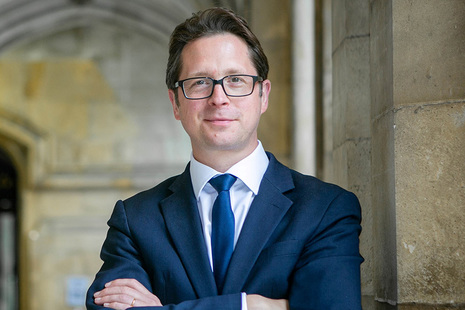
The speech made by Alex Burghart, the Shadow Trade Minister, in the House of Commons on 24 February 2026.
I congratulate the right hon. Member for Kingston and Surbiton (Ed Davey) on securing this debate. I should say at the outset that the Conservatives support the motion.
The truth is that the people who helped Jeffrey Epstein by supplying him with contacts and information were the people who enabled him to become powerful. Those people effectively enabled him to build his net of influence, his net of abuse. That network of power, in turn, enabled him to abuse more and more people, so it is quite right that this House is enabled to scrutinise what went on and how it went on.
I listened to the Minister’s remarks. I appreciate the way that he has approached this debate and the way that the Government will constructively co-operate with the terms of the Humble Address. However, this is the second occasion in only a few weeks when the Government have had to be brought here by Opposition parties under the terms of a Humble Address to disclose information that they quite obviously could have disclosed without the need for such an Address in the first place. I acknowledge the humility with which the Minister has approached the debate, but the Government as a whole could have been much more proactive on this issue right from the start. I also appreciate the humble way in which the Minister came to the House and reminded us that he had been right all along.
Chris Bryant
Very humble.
Alex Burghart
Very humble.
The leader of the Liberal Democrats referred to this as the first global political scandal. Indeed, it is a global political scandal whose tendrils have reached into the operation of many Governments across the west and the east. The fact that our allies in Poland have launched an intelligence investigation into Epstein’s links with Russia and that in the published Epstein papers it is clear that Jeffrey Epstein was supplying people at the very top end of Putin’s regime with sensitive information about the American leadership show that this is an international scandal and one in which our Government and our security services must play their part in uncovering things. However, I know that the right hon. Member for Kingston and Surbiton is a lover of history, so I must gently take issue with his claim that this is the first global political scandal. I think of the Dreyfus affair, the XYZ affair and the Panama scandals—there have been many—but this is, to take his substantive point, a global political scandal.
I associate myself with the remarks made by the hon. Member for Strangford (Jim Shannon) that we can only be, as a general point, supportive of the royal family’s role in promoting our country. The people who have witnessed the best of the royal family using their awesome soft power to support what we do best can only be in awe of the vast commitment they make to public service and the life of the country.
Indeed, if it is the case, as reported in the press, that very senior members of the royal family expressed concerns about the appointment of Mr Mountbatten-Windsor in 2001, one can feel only enormous sympathy with them over what has subsequently come to light.
The revelations surrounding the relationship between Andrew Mountbatten-Windsor and Jeffrey Epstein, like those surrounding the relationship between Peter Mandelson and Jeffrey Epstein, and the arrest of both men on suspicion of misconduct in public office make it right that questions are asked and information is brought before the House. If one looks back to 2001, it is possible to identify the hand of Epstein in Mr Mountbatten-Windsor’s appointment. It is reported that Peter Mandelson first met Epstein in the summer of 2001; Mountbatten-Windsor had, I believe, first met Epstein in 1999. Shortly after Mandelson’s first meeting in October 2001, Mandelson was appointed as trade envoy.
Chris Bryant indicated dissent.
Alex Burghart
The Minister shakes his head, so I will go through the chronology again for him—there is no harm in doing so.
Chris Bryant
You’ve got the names wrong.
Alex Burghart
Well, Hansard will show it—it may be that the numbers were jumbled up in the Minister’s head.
In the summer of 2001, Mandelson met Epstein for the first time; in October 2001, Mountbatten-Windsor was appointed as trade envoy. It is possible that Mandelson influenced that. As I said, Mountbatten-Windsor had met Epstein for the first time in 1999, so he was already an associate of Epstein. I am glad to have sorted that out—I can go through it again, but I am sure the Minister will be able to read about it tomorrow.
Wendy Chamberlain
By sketching out that timeline, the hon. Gentleman brings to light the reason why we are calling in our Humble Address for information about the actual creation of the appointment, which, as the Minister rightly pointed out, was a unique role created for Andrew Mountbatten-Windsor. Does the hon. Gentleman therefore agree that we are right not only to call out the creation of that role, but to ascertain whether Mandelson had any role in it?
Alex Burghart
Very much so. As I say, it would have been better if the Government had been proactive on this and had not had to be brought to the House by Opposition parties in order to release the information. I am very glad, though, that the Liberal Democrats have learned from the Conservatives’ Humble Address a few weeks ago. It is always good that once the Conservatives have designed a bandwagon, got it up and running and shown that it can move at high speed, the Liberal Democrats scramble up and get on board—better late than never.
If we go through the sequencing very carefully, we can see that it is possible that there was influence from Epstein, who, we must acknowledge, had not been arrested or convicted in 2001, although there were already rumours and reports about him, and who was, in any case, a highly influential foreign businessman. If it was under his influence that Mr Mountbatten-Windsor was appointed as trade envoy, it would be useful to see what the Prime Minister knew when that appointment was made.
Layla Moran
I think the hon. Gentleman is trying to get to a point that deeply concerns me, which is that we need to understand the extent to which the then Prince Andrew was leaning on government for things he wanted. There is an example of this in the recent Epstein files, which contain an exchange between Ghislaine Maxwell and Jeffrey Epstein about how Andrew had written to the Ministry of Defence in order to allow their plane to land at an RAF base in Norfolk on 7 December 2000. Andrew’s influence on government predated his appointment. What we want to understand is the extent to which he was already trying to influence government as a prince and what that led to in his role as trade envoy. Does the hon. Gentleman agree that it is incredibly important to get to the bottom of that?
Alex Burghart
Yes. I am afraid I do not know what year that—
Layla Moran
2000.
Alex Burghart
Ah, 2000. Well, I agree with the hon. Lady—that is an interesting point. If one looks at the precise wording of the Liberal Democrats’ Humble Address, however, I am not sure that something like that falls within its context. She may wish to table an amendment to her own party’s motion in order to get at that.
Transparency is essential in all this. That is why the Conservatives very much hope that the Government will give us transparency quickly. I turn to the point made by the Father of the House: there is a danger that the Government will use the police process as a means of not disclosing certain information. I say that not because of what the Minister has said today so much as what the Chief Secretary to the Prime Minister said yesterday, when, in the context of the Conservatives’ Humble Address, he said:
“I can confirm that those documents will be made available, subject, I am afraid, to the exclusion of one particular item, in which No. 10 asked Peter Mandelson a number of questions. The Met police have asked that to be held back, subject to their investigations…That item will therefore have to be published at a later date, but the documents that are not subject to the Met police investigation will be published very shortly.”—[Official Report, 23 February 2026; Vol. 781, c. 44.]
As the hon. and learned Member for North Antrim (Jim Allister) said, I think it would assist the House if the Government could explain why the Met police has asked that that item is held back.
It would also be helpful if the Government could confirm that there is no bar to them handing that document over to the Intelligence and Security Committee—a point on which Mr Speaker has been very clear. On 4 February, Mr Speaker said:
“the Metropolitan police have no jurisdiction over what this House may wish to do. It will be a matter of whether or not the Government provide the information. I want to let Members know that the police cannot dictate to this House.”—[Official Report, 4 February 2026; Vol. 780, c. 375.]
There is a means that was specifically debated during the original Humble Address that enabled Members of this House—that is, the ISC—to be given this information regardless of the police investigation.
Christine Jardine (Edinburgh West) (LD)
The hon. Gentleman is making a very important point. What concerns me deeply in this matter is the fact that my constituents and members of the public are increasingly concerned that what they see is the tendrils—as the hon. Gentleman referred to—reaching into government through this debate. In the handling of these papers and the release of information, we must at all times be aware of the reputational impact not just on Andrew Mountbatten-Windsor or Lord Mandelson but on us in this place, as well as on previous and subsequent Governments and Parliaments. Would he agree?
Alex Burghart
Very much so. I know that certain hon. Members across the House will be aware of just how bad it will look if the Government do not provide information as swiftly as possible.
I will give an example of where that is not happening. When we debated the original Humble Address—nearly two weeks ago now—I raised the fact that the Prime Minister had an unrecorded meeting with Palantir in Washington in February last year. He was accompanied on that visit, which did not appear in his register of meetings, by Peter Mandelson. Palantir was a client of the company in which Peter Mandelson held a commanding share. Later that year, Palantir subsequently received by direct award a very substantial contract from Government worth about £240 million.
When I raised this in the House, there was concern on both sides—it was a cross-party issue. I asked the Paymaster General and Minister for the Cabinet Office to confirm that the Cabinet Secretary, whoever that turned out to be, would investigate what looks like a clear case of conflict of interest, and he agreed to write to me. I still have not received any reply, despite the fact that I brought it up again at the Dispatch Box at the start of this week and was assured that I would receive a response.
I just do not think this is good enough. It is very important that the Opposition can hold the Government to account in a meaningful way. To the point made by the hon. Member for Edinburgh West (Christine Jardine), I think it is extremely important that the Government should be seen to be willingly providing information, rather than having to be pushed every step of the way to do the right thing.
I will make one additional point on this score. While we do very much support the Humble Address being debated today, I ask the Government to be clear that nothing in it—nothing at all—will slow down the process of delivering on the original Humble Address. While there is historic and contemporary interest in what happened in 2001, what this Government did in choosing to appoint Peter Mandelson, despite the information they had at their disposal, is of paramount importance. They must come clean, and come clean quickly. As Buckingham Palace said the other day, no one is above the law.