Tag: Ursula von der Leyen

  • Ursula von der Leyen – 2022 Statement on EU Relations with Azerbaijan

    Ursula von der Leyen – 2022 Statement on EU Relations with Azerbaijan

    The statement made by Ursula von der Leyen, the President of the European Commission, on 18 July 2022.

    Thank you very much Mr President for the warm welcome here in Baku. And thank you for stepping up and for supporting the European Union. Because already before Russia’s brutal invasion of Ukraine, the Russian gas supplies to Europe were no more reliable. The European Union has therefore decided to diversify away from Russia and to turn towards more reliable, trustworthy partners. And I am glad to count Azerbaijan among them. You are indeed a crucial energy partner for us and you have always been reliable. You were a crucial partner not only for our security of supply, but also in our efforts to become climate neutral. The Memorandum of Understanding that we have just signed makes our energy partnership even stronger.

    I want to emphasise three points from our Memorandum of Understanding. The first is that we will double the supply of gas from Azerbaijan to the European Union. Indeed, with this MoU, we commit to the expansion of the Southern Gas Corridor. This is already a very important supply route for the European Union, delivering currently more than 8 billion cubic metres of gas per year. And we will expand its capacity to 20 billion cubic metres in a few years. From next year on, we should already reach 12 billion cubic metres. This will help compensate for cuts in supplies of Russian gas and contribute significantly to Europe’s security of supply.

    The second point that is very prominent in the MoU is the topic of the renewables. Azerbaijan has a tremendous potential in renewable energy – you just described it, Mr President –, and in particular in offshore wind and green hydrogen. We discussed it extensively in our bilateral meeting. Today, with our MoU, we are laying the ground for solid cooperation in that area. So gradually, Azerbaijan will evolve from being a fossil fuel supplier to becoming a very reliable and prominent renewable energy partner to the European Union.

    Finally, our cooperation on gas has to be consistent with our responsibilities on climate. This includes, for example, the emissions of methane. Our MoU sets out commitments to reduce methane emissions throughout the entire gas supply chain. And, as we have discussed, Mr President, I strongly encourage Azerbaijan to join the Global Methane Pledge, which is now supported by 119 countries. Azerbaijan has made enormous progress and has a lot to deliver.

    Beyond energy, President Aliyev and I discussed the full range of our relation and cooperation. The EU-Azerbaijan Cooperation Council will meet tomorrow in Brussels and discuss how to take forward our bilateral cooperation. We are working right now on a new bilateral agreement that we hope to conclude soon. The aim is to further expand the strong economic partnership we do have. Indeed, the European Union is: the first commercial partner of Azerbaijan; its first export destination; and one of its most important sources of investments. And we want to expand this. We are investing EUR 60 million of EU funds in Azerbaijan until 2024. And the Economic and Investment Plan has the potential to mobilise up to EUR 2 billion in additional investments. It is already at work, supporting round about 25,000 Azeri small and medium companies, and making the Port of Baku a sustainable transport hub.

    This is for us very important, because this leads indeed to the topic of connectivity that you have mentioned. We also discussed that. In particular, how to deepen our ties to bring our people and societies closer together. This is the mission of our Global Gateway strategy. And this is also the essence of our Eastern Partnership. The European Union wants to work with Azerbaijan to build connections with Central Asia and beyond. So we follow with great interest the discussions and the ideas about trans-Caspian connections. We will deepen these discussions. Finally, we want to finalise the Common Aviation Area Agreement. Because this would greatly boost opportunities for business, trade and for tourism.

    To reach Azerbaijan’s full potential, it is important to create the right conditions for investor confidence. This includes a greater involvement of civil society, and a free and independent media. The European Union is committed to a secure, stable and prosperous South Caucasus. We are the leading donor in demining in the country, for example. We have also discussed this very important topic. We have now just announced a new EUR-4.25-million package for this purpose. But we are also willing to offer machinery and skills in this very important field. All in all, the European Union is firmly attached to your region, Mr President. We value our partnership. And this partnership will consistently grow and deepen over time.

    Thank you very much again for hosting us here. And thank you very much for the joint signing of the MoU.

  • Ursula von der Leyen – 2022 Statement on Gas Supplies to EU from Russia

    Ursula von der Leyen – 2022 Statement on Gas Supplies to EU from Russia

    The statement made by Ursula von der Leyen, the President of the European Commission, on 26 July 2022.

    Today, the EU has taken a decisive step to face down the threat of a full gas disruption by Putin. I strongly welcome the endorsement by Council of the Council Regulation on coordinated demand reduction measures for gas.

    The political agreement reached by Council in record time, based on the Commission’s proposal “Save gas for a safe winter” tabled last week, will ensure an orderly and coordinated reduction of gas consumption across the EU to prepare for the coming winter. It complements all the other actions taken to date in the context of REPowerEU, notably to diversify sources of gas supply, speed up the development of renewables and become more energy efficient.

    The collective commitment to reduce by 15% is very significant and will help fill our storage ahead of winter.

    Moreover, the possibility to declare a state of EU alert triggering compulsory gas consumption reductions across the Member States provides a strong signal that the EU will do whatever it takes to ensure its security of supply and protect its consumers, be it households or industry.

    By acting together to reduce the demand for gas, taking into account all the relevant national specificities, the EU has secured the strong foundations for the indispensable solidarity between Member States in the face of the Putin’s energy blackmail. The announcement by Gazprom that it is further cutting gas deliveries to Europe through Nord Stream 1, for no justifiable technical reason, further illustrates the unreliable nature of Russia as an energy supplier. Thanks to today’s decision, we are now ready to address our energy security at European scale, as a Union.

  • Ursula von der Leyen – 2022 Comments on Roma Holocaust Memorial Day

    Ursula von der Leyen – 2022 Comments on Roma Holocaust Memorial Day

    The comments made by Ursula von der Leyen, the President of the European Commission, on 1 August 2022.

    On the European Roma Holocaust Memorial Day, we commemorate the hundreds of thousands of Roma victims of the Holocaust who suffered and were murdered under the Nazi regime.

    We may never forget the Roma persecution during the Holocaust. We also cannot turn a blind eye to the challenges and discrimination Roma minority is still facing.

    We work closely with our Member States to fight anti-gypsyism. This year we will present a first assessment of the national Roma strategies. In our Union, we strive for openness, tolerance and respect for human dignity for all people.

    Only with this spirit can we fight racism and discrimination.

  • Ursula von der Leyen – 2022 Speech on Ukraine, Moldova and Georgia Joining the European Union

    Ursula von der Leyen – 2022 Speech on Ukraine, Moldova and Georgia Joining the European Union

    The speech made by Ursula von der Leyen, the President of the European Commission, at the European Parliamentary Plenary in Brussels on 22 June 2022.

    Thank you, Madam President, dear Roberta,

    Cher Charles,

    Honourable Members,

    From the early days of the Maidan on, Ukraine has bravely resisted against Russia’s aggression. It went through repression and uprising. It went through territorial annexation, and now outright war. It is the only country where people got shot because they wrapped themselves in a European flag. Ukraine has gone through hell and high water for one simple reason: Its desire to join the European Union.

    The European Commission answered to this desire explicitly. The opinion we presented last week recognises Ukraine’s aspirations. It acknowledges the immense progress that Ukraine’s democracy has achieved since the Maidan protests of 2014. Our opinion stems from a careful and thorough assessment of the reality on the ground. And this evidence tells us that Ukraine deserves a European perspective, and also the candidate status on the understanding that the country will carry out a number of further, important reforms.

    Ukraine has proven, already before the war, that it is on the right trajectory. In the last few years Ukraine has reformed more than in the last decades. Thanks to the Association Agreement of 2016, Ukraine has already implemented roughly 70% of EU rules, norms and standards. It is already involved in many important EU programmes like Horizon Europe and Erasmus. Ukraine is a robust parliamentary democracy, it has a well-functioning public administration, which every day is passing the ultimate stress test of war. It has free and fair elections and a vibrant civil society, that holds the government to account. Year after year, small businesses and, in particular, young entrepreneurs have conquered new space in the country´s economy – and fought back against the power of oligarchs. Ukraine punches well above its weight when it comes to innovative start-ups and the digital economy. And all of this progress has been achieved because the people of Ukraine have Europe in their hearts and their minds.

    But we also know that there is important work ahead. Take the fight against corruption. Ukraine has already taken important steps in the right direction. It has set up the necessary anti-corruption bodies. But now these institutions have to come to life. They need teeth, and the right people in senior posts.

    Or take the excessive influence of oligarchs on the economy. Ukraine has adopted a bold law to break the oligarchs’ grip on Ukraine’s economic, political and public life. In fact, it is the only country in the Eastern Partnership that has done so. Now it is about turning the law into positive and enduring change. I discussed this and other issues with President Zelenskyy and Prime Minister Shmyhal during my recent visit to Kyiv. And I know that the people of Ukraine want to continue on the path of modernisation, the path of democracy, the path that leads to Europe.

    Honourable Members,

    After the fall of the Berlin wall, Jacques Delors said: ‘History is once again on the march in Europe. But it is for us to give history a meaning.’

    Jacques Delors was referring to the need to open up our Union to all European countries. And his words are still true today. History is on the march. And I am not just talking about Putin’s war of aggression. I am talking about the wind of change that once again blows across our continent. With their applications, Ukraine, Moldova and Georgia are telling us that they want change. They want more democracy, more freedoms and stronger reforms. They are telling us that they want Europe. We have a responsibility towards them, but we also have a responsibility towards ourselves to make the right choice. So let me speak briefly about our assessment for Moldova. Moldova has taken decisive steps towards Europe, too. With a clear mandate from its citizens. It is on a real pro-reform, anti-corruption and European path for the first time since independence. And this is why it deserves the European perspective and candidate status, again on the understanding that the country will carry out a number of further, important reforms. In particular, its economy and public administration require major efforts. But provided that the country’s leaders stay the course, we believe the country has the potential to live up to the requirements.

    Georgia shares the same aspirations and potential as Ukraine and Moldova. Its application has strengths, in particular the market orientation of its economy, with a strong private sector. To succeed however, the country must now come together politically. It must design a clear path towards structural reform and towards the European Union. A path that concretely sets out the necessary reforms, brings civil society on board and benefits from broad political support. This is why we recommend to Council to grant Georgia the European perspective, but to come back and assess how the country meets a number of conditions before granting it candidate status.

    Honourable Members,

    How far Ukraine, Moldova and Georgia will come and how quickly they proceed will depend first and foremost on their actions and their progress. It is a merits-based approach. But how we respond to their passion and their progress is our choice, and ours only. This Parliament has already spoken, loud and clear. I would like to thank you again for that. It is now up to the European Council to decide, and live up to the historic responsibility we are confronted with.

    The history of our Union is one of young democracies getting stronger together. It is the history of Germany’s rebirth after the war. It is Greece, Spain and Portugal moving fast from dictatorship to democracy in the mid-1970s. It is the democratic uprising that brought down the Iron Curtain. It is the long path of reconciliation in the Western Balkans. A path that must lead all the six Western Balkan countries to join our Union. And the next chapter is being written today by the brave people of Ukraine, and by all of us, who must accompany them on their European path. Again, this is Europe’s moment. And we must seize it.

    Long live Europe.

  • Ursula von der Leyen – 2022 Comments at Press Conference with President Michel and President Macron

    Ursula von der Leyen – 2022 Comments at Press Conference with President Michel and President Macron

    The opening remarks made by Ursula von der Leyen, the President of the European Commission, on 24 June 2022.

    Today, we had the opportunity to hold an in-depth discussion on the economy during the Euro Summit. The euro area is forecast to continue growing both in 2022 and 2023 although by less than we anticipated before the war. Obviously, the war in Ukraine is having a heavy impact, both on growth and on inflation. We have seen Russia’s disruptive action on gas. And we are seeing price increases beyond energy, on food and elsewhere in the economy. Therefore, we discussed how to mitigate the economic and social impacts, especially on the most vulnerable of our societies.

    This starts with being adequately prepared to deal with potential further disruptions in deliveries of Russian gas to Europe. We are working hard on this. We have reviewed all the national emergency plans to help make sure everyone is ready for further disruptions. And we are working on a common European emergency demand reduction plan with industry, but also with the 27 Member States. We do this because we have learnt our lesson from COVID-19. There we have seen that, when we act together as 27, when we avoid fragmentation, we are strong and we have an enormous impact. I will present this plan in July to the Leaders. There will not be a return to cheap fossil fuels, I think. And therefore, alongside temporary and targeted support to vulnerable families and businesses, it is essential to help our economies and societies adapt to the new conditions. The root cause of our problem is our dependence on fossil fuels, which we must get rid of.

    This is basically the essence of REPowerEU. We are providing through REPowerEU resources of round about EUR 300 billion to do three things: The first pillar is to diversify our energy supply. The second pillar is to increase the energy efficiency. And the third pillar is the supply of our own green renewable energy. We are already seeing results. If I may give you an example for the first pillar, the diversification away from Russian gas: We see that the US LNG deliveries to the European Union are up by 75% this year compared to last year. We have just signed a Memorandum of Understanding with Israel, Egypt and the European Union to make sure that there is natural gas from Israel, liquefied in Egypt and then brought via LNG to the European Union. The Norwegian pipeline gas is up by 15%; Azerbaijan is up by 90%. So there is a lot on the move to really diversify away from the Russian gas to other trustworthy suppliers. Looking at the renewables, I think that there is one interesting figure: The European Union was and is the second largest market globally in terms of increased capacity of renewables in 2021, and will be in 2022. So you also see the big move forward of heavy investment in renewables. That is the energy of the future. That is the way to go.

    A second topic that we have been discussing is, in parallel, that we are working on the review of the economic governance. We know that debts and deficits have soared in all Member States after COVID-19. And at the same time, investment needs are very large for a successful transition to a green, digital and resilient EU society and economy. Therefore, we need to design rules that in a way reconcile these higher investment needs – they are necessary – and at the same time to safeguard sound fiscal finances. One goes with the other: that is fiscal sustainability and growth.

    And let me also end, dear Emmanuel, by congratulating you on an extremely successful French Presidency. The work you have done was colossal. I witnessed every day how intensive your team – and I really want to thank you and your team – has been working on progress in the European Union. It really made a difference. We should keep in mind that when you started, there was a lot on your plate, but you had no clue that there was a war coming. In record time, we delivered together six packages of heavy sanctions. And I think that it was a hallmark and a very defining moment to see the determination of the European Union and the speed at which we can move forward. We have, in this time, welcomed 7.5 million refugees from Ukraine. 3 million are still here. And you and your team, as Presidency, made it possible that we very quickly granted temporary protection, that is access to the labour market, to the education system, to the social security system. All this thanks to the French Presidency.

    I thank you personally for the enormous progress that we have made on the European Green Deal – and here, specifically the huge package of Fit for 55. Dozens of proposals have now been pushed forward. And this is a real step forward. The same goes, and I know that this is very close to your heart, for the DSA and the DMA, so putting the online world in order as well as we have it in the offline world, to protect our citizens and to keep up the competitiveness of our businesses in the online world. This has been – the DSA and the DMA – negotiated with ambition and adopted in record time. You really delivered. There was the Conference on the Future of Europe.

    But I am personally very proud on one specific file that you have concluded during the French Presidency, and this is Women on Boards. It took ten long years; it was stuck for ten years. The French Presidency made it possible that it reappeared and was negotiated and adopted in record time. So not only did you put an end to an injustice for women, but also to an enormous loss of earnings for companies. It is a real big step forward that we have now this agreement on Women on Boards.

    Last but not least, and I would not miss to mention it, we have made good progress on the Pact on Migration and Asylum, especially on the voluntary solidarity mechanism and on the governance of Schengen. Important files. They were difficult to manage, you really pushed it forward. I stop here, but as you can see, dear Emmanuel, I think that France can be very proud of this Presidency. It was outstanding. Many thanks for that.

  • Ursula von der Leyen – 2022 Speech on Social and Economic Consequences of Russian Invasion

    Ursula von der Leyen – 2022 Speech on Social and Economic Consequences of Russian Invasion

    The speech made by Ursula von der Leyen, the President of the European Commission, on 4 May 2022.

    Madam President, dear Roberta,

    Honourable Members,

    Next week, we will mark Europe Day. The 72nd birthday of our Union. This Europe Day will be all about the Union of the future – how we make it stronger, more resilient, closer to its people. But the answer to all of these questions, we cannot give alone. The answer is also given in Ukraine. It is given in Kharkiv, where Ukrainian first responders venture into the combat zone to help those wounded by Russian attacks. It is given in small towns like Bucha, where survivors are coping with the atrocities committed against civilians by Russian soldiers. And it is given in Mariupol, where Ukrainians are resisting a Russian force, which greatly outnumbers them. They are fighting to reaffirm basic ideas: That they are the master of their own future – and not some foreign leader. That it is the international law that counts and not the right of might. And that Putin must pay a high price for his brutal aggression.

    Thus, the future of the European Union is also written in Ukraine. And therefore, today, I would like to speak about two topics. First about sanctions and second about relief and reconstruction. Today, we are presenting the sixth package of sanctions. First, we are listing high-ranking military officers and other individuals who committed war crimes in Bucha and who are responsible for the inhuman siege of the city of Mariupol. This sends another important signal to all perpetrators of the Kremlin’s war: We know who you are, and you will be held accountable. Second, we de-SWIFT Sberbank – by far Russia’s largest bank, and two other major banks. By that, we hit banks that are systemically critical to the Russian financial system and Putin’s ability to wage destruction. This will solidify the complete isolation of the Russian financial sector from the global system. Third, we are banning three big Russian state-owned broadcasters from our airwaves. They will not be allowed to distribute their content anymore in the EU, in whatever shape or form, be it on cable, via satellite, on the internet or via smartphone apps. We have identified these TV channels as mouthpieces that amplify Putin’s lies and propaganda aggressively. We should not give them a stage anymore to spread these lies. Moreover, the Kremlin relies on accountants, consultants and spin doctors from Europe. And this will now stop. We are banning those services from being provided to Russian companies.

    My final point on sanction: When the Leaders met in Versailles, they agreed to phase out our dependency on Russian energy. In the last sanction package, we started with coal. Now we are addressing our dependency on Russian oil. Let us be clear: it will not be easy. Some Member States are strongly dependent on Russian oil. But we simply have to work on it. We now propose a ban on Russian oil. This will be a complete import ban on all Russian oil, seaborne and pipeline, crude and refined. We will make sure that we phase out Russian oil in an orderly fashion, in a way that allows us and our partners to secure alternative supply routes and minimises the impact on global markets. This is why we will phase out Russian supply of crude oil within six months and refined products by the end of the year. Thus, we maximise pressure on Russia, while at the same time minimising collateral damage to us and our partners around the globe. Because to help Ukraine, our own economy has to remain strong.

    With all these steps, we are depriving the Russian economy from its ability to diversify and modernise. Putin wanted to wipe Ukraine from the map. He will clearly not succeed. On the contrary: Ukraine has risen up in unity. And it is his own country, Russia, he is sinking.

    Honourable Members,

    We want Ukraine to win this war. But we also want to set the conditions for Ukraine’s success in the aftermath of the war. The first step is immediate relief. This is about short-term economic support to help Ukrainians cope with the fallout of the war, like we do with our macro-financial assistance package and with direct support to the Ukrainian budget. In addition, we recently proposed to suspend all import duties on Ukrainian exports to our Union for one year. I am sure the European Parliament will put its weight behind this idea. But this is not enough for the short-term relief. Ukraine’s GDP is expected to fall by 30% to 50% this year alone. And the IMF estimates that, from May on, Ukraine needs EUR 5 billion each month, plain and simply, to keep the country running, paying pensions, salaries and basic services. We have to support them, but we cannot do it alone. I welcome that the United States announced massive budgetary support. And we, as Team Europe, will also do our share.

    But then, in a second phase, there is the wider reconstruction effort. The scale of destruction is staggering. Hospitals and schools, houses, roads, bridges, railroads, theatres and factories – so much has to be rebuilt. In the fog of war, it is difficult to come up with a precise estimate. Economists are talking about several hundred billion euros. And costs are rising with each day of this senseless war.

    Honourable Members,

    Europe has a very special responsibility towards Ukraine. With our support, Ukrainians can rebuild their country for the next generation. That is why today I am proposing to you that we start working on an ambitious recovery package for our Ukrainian friends. This package should bring massive investment to meet the needs and the necessary reforms. It should address the existing weaknesses of the Ukrainian economy and lay the foundations for sustainable long-term growth. It could set a system of milestones and targets to make sure that European money truly delivers for the people of Ukraine, and is spent in accordance with EU rules. It could help fight corruption, align the legal environment with European standards and radically upgrade Ukraine’s productive capacity. This will bring the stability and certainty needed to make Ukraine an attractive destination for foreign direct investment. And eventually, it will pave the way for Ukraine’s future inside the European Union.

    Slava Ukraini and long live Europe.

  • Ursula von der Leyen – 2022 Statement by Ursula von der Leyen with Ukrainian President Zelenskyy

    Ursula von der Leyen – 2022 Statement by Ursula von der Leyen with Ukrainian President Zelenskyy

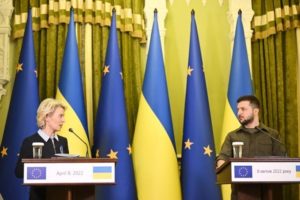
    The statement made by Ursula von der Leyen, the President of the European Commission, in Kyiv on 8 April 2022.

    Thank you, dear Volodymyr,

    Let me start by saying that the missile attack this morning on a train station used for evacuations of civilians is despicable. I am appalled by the loss of life and I offer my deep condolences to the families of the victims and all of those who lost loved ones.

    It was important to start my visit in Bucha today. Because in Bucha our humanity was shattered. And it is right and just that the world voted to suspend Russia from the Human Rights Council. This war is a challenge for the entire international community. And this is a decisive moment. Will heinous devastation win or humanity prevail? Will the right of might dominate or is it the rule of law? Will there be constant conflict and struggle or a future of common prosperity?

    Your fight is our fight. I am here with you in Kyiv today to tell you that Europe is on your side. This is the message, dear Volodymyr, I want to bring to the Ukrainian people today.

    We just discussed how to step it up Europe’s support. Let me be clear: We can never match the sacrifice of the Ukrainian people. But we are mobilising our economic power to make Putin pay a heavy price. We have imposed five waves of unprecedented sanctions against Russia. And we are already preparing the next wave. We are now moving into a system of rolling sanctions. And these sanctions are biting hard. Exports in goods to Russia have fallen almost 71%. Inflation is around 20% – and rising. Businesses confidence in Russia is at its lowest level since 1995. And the best and brightest minds are leaving the country, together with more than 700 private companies. On top of this, Member States have already frozen EUR 225 billion of private Russian assets in the EU since the beginning of the war. Russia will decent in economic, financial and technological decay. While Ukraine is marching towards a European future.

    We stand with you as you defend your country. This is my second point. Ukrainian people are holding up the torch of freedom for all of us. The European Union is sending weapons to your country. We have allocated EUR 1 billion from the European Peace Facility to support the Ukrainian Armed Forces. And more will come. I am grateful the High Representative will now propose another EUR 500 million. In addition, EU Member States are delivering military equipment on an unprecedented scale. Slovakia is a shining example for that. With this we support the brave Ukrainian soldiers, fighting for Ukraine´s freedom. And for everyone’s freedom.

    Third, we are strengthening our financial help for Ukraine. Today, we are delivering on EUR 1 billion of support. This sum consists of three different financial packages. As we speak, we are transferring EUR 120 million in budget support. We will make available the EUR 330 million from our emergency package now. Both are grants. And we are accelerating the second half of the macro-financial assistance package with EUR 600 million.

    Fourth, we are with Ukrainians as they seek refuge within our borders. And I promise you: We will take good care of them until it is safe to return home. Home to a free and prosperous Ukraine. We make sure, that they have access to housing, schools, medical care and work. The brave people of Ukraine deserve nothing less. Together with Prime Minister, Justin Trudeau, of Canada we are convening a pledging event in Warsaw tomorrow. We call our campaign ‘Stand up for Ukraine’. We will mobilise support for people fleeing the war inside and outside Ukraine. This campaign is yet another proof that Ukraine´s cause today is the world´s cause.

    Finally, we are with you as you dream of Europe. Dear Volodymyr, my message today is clear: Ukraine belongs in the European family. We have heard your request, loud and clear. And today, we are here to give you a first, positive answer. In this envelope, dear Volodymyr, there is an important step towards EU membership. This questionnaire is the basis for our discussion in the coming months. This is where your path towards the European Union begins. We will be at your disposal 24 hours a day, 7 days a week to work on this common basis. Ukraine is a friend, we know this very well. Ukraine shares our values. And due to our association agreement, Ukraine is already closely aligned with our Union. So we will accelerate this process as much as we can, while ensuring that all conditions are respected.

    On the first day of your mandate, dear Volodymyr, you said: ‘We have chosen Europe as our direction. But Europe’, you said, ‘Europe is not somewhere else. Europe is here in our mind. And when Europe is in our mind, then Europe will come to our country too.’

    Today, more than ever, Europe is here. Europe is with you.

    Slava Ukraini.

  • Ursula von der Leyen – 2022 Q&A at Stand Up for Ukraine

    Ursula von der Leyen – 2022 Q&A at Stand Up for Ukraine

    The statement made by Ursula von der Leyen, the President of the European Commission, on 9 April 2022.

    It is wonderful to be here with you, Hugh, with you, Mr President, with you, Justin. It is wonderful to have you here. Indeed, I was yesterday in Kyiv and I visited Bucha. And there are no words for the horror I have seen in Bucha, the ugly face of Putin’s army terrorising people. And I have so much admiration for our brave Ukrainian friends fighting against this. They are fighting our war. It is our fight that they are in. Because it is not only Ukraine fighting for its sovereignty and integrity, but they are also fighting for the question whether humanity will prevail or whether heinous devastation will be the result. It is the question whether democracy will be stronger or if it is autocracy that will dominate. It is the question whether there is the right of might dominating or whether it is the rule of law.

    And therefore, this is the reason why, together with Justin Trudeau, with Hugh Evans – and thank you very much Mr President, for hosting it here – we said that they stand up for our freedom, so we stand up for Ukraine. This is the reason why we are here today. And we want to rally the world for refugees, inside and outside Ukraine, to support them. So I hope that many, many people will join.

    I want to thank Global Citizen for really activating and mobilising so many artists, sports people and celebrities. Mr President, I want to thank you for hosting us, because this is the country that is hosting two million refugees from Ukraine. So many people are here, who support. Thank you very much for that and let us have a fantastic result for Ukraine.

    Interventions

    Q1 Europe has come together in an unprecedented way to support those coming from Ukraine to the bloc. You have activated the [EU Civil] Protection Mechanism and offered direct support to Ukraine itself. Can you tell us a little bit more about those efforts to date, as you stand in solidarity with Ukraine?

    President von der Leyen: Yes, indeed, there are four million people, that fled Ukraine, right now in the European Union, and there are six and a half million people within Ukraine who fled the war and they need help. They need urgently help. Here, in the European Union, it means that we have immediately triggered the protection for them that gives them citizens’ rights. So from day one: access to schools, to housing, to healthcare, and of course to the labour market. But of course, they need much, much more. They need support. The Member States are doing an outstanding job. It is phenomenal. The NGOs are working on the ground. The communities, the local communities, are outstanding in receiving the refugees. But as I said, more is needed. And any pledge will help a refugee, here, in the European Union. But also, and this is so important: Any pledge will help a person that is internally displaced, so who has lost their home because of the bombing and shelling of Putin’s army within Ukraine. Yesterday, when I spoke with President Zelenskyy, he urged me again to, first of all, ask for pledges for Ukraine refugees in Ukraine but also to be very clear for those who had to flee Ukraine, that they are welcome here. It is wonderful to have them here and we want to give them shelter and support, and help as much as possible. But President Zelenskyy was also hoping that, pretty soon, you might be able to come back and help rebuild the country. What I want to say is that Europe stands by your side. And I know that Justin Trudeau – I have spoken with him many, many times about it – is fully determined, also with Canada. We stand by your side, be it now in the times of war; be it with the refugees; but most importantly, after this war has been won by Ukraine, for the time for reconstruction and rebuilding the country. So our motto is really: Slava Ukraini.

    Q2 We know that conflict is one of the greatest threats to education. And according to UNICEF, more than 350,000 children in Ukraine have already lost access to education. So Madam President, my question to you is this: How do we ensure that this does not become the last issue that gets funded and that we do not end up with a generation of displaced youth with a lost education and compromised health?

    President von der Leyen: Yes, indeed, this is one of the most pressing questions because many, many of the refugees are young children and they need immediately access to schools. And of course, children need other children, so they need to be with their peer groups. And therefore, the pledging here is also about supporting the Member States who have refugees and children. I was travelling to Kyiv with the Slovak Prime Minister, and he told me that, in the last four weeks, they got 700 children that need immediately access to kindergarten, for example. Also, you need teachers, you need classrooms, very practical things, very down-to-earth. And therefore, it is so necessary that we support them in that but also in health issues. The normal access to healthcare is important, but we have, for example, many that come that are not vaccinated, not only against COVID-19 but also the basic vaccinations that you normally get in your childhood. So this has to be done. Or there are many that come that have other diseases which are normally not so present in the population. So the access to healthcare is eminent and extremely important. All these are topics where the Member States are really doing a great job and doing their utmost to accommodate. But the more support they get the better. And then, there is a last point. I just wanted to refer to Arina’s last comment. Arina, you are so right. Arina wanted to tell us, rightly so, that of course, we are now speaking about the refugees. But we also have to be very clear towards Putin that this cannot be, this aggression. And therefore, we are imposing heavy sanctions on Putin and his war machine to really dry out that – economic sanctions, financial sanctions. And Arina is right, what we have to do is get rid of the fossil fuel dependency from Russia. This is for us so important. So, we got out of coal. We are looking into oil. And Arina, what we have to do is not only diversify away from the Russian fossil fuel but we also need massive investment in renewables. This is not only good for a strategic investment in independence but it is, of course, also good for our climate and for our planet. So, many, many tasks to look at. And I just wanted to support you on that point, Arina, it is a very important one.

    Q3 Many across the globe, are becoming increasingly aware of the wider impacts of this conflict on the global food supply. In fact, their estimates are of up to 500 million people potentially facing food insecurity as a result. So with that in mind, what actions can the EU and the European Community take to prioritise this issue and basically prevent or certainly minimise a global food crisis?

    President von der Leyen: Yes, indeed, besides the incredible human suffering that this war brings along and the unbelievable atrocities that we see, there are knock-on effects, for example on global food security. Ukraine is basically the wheat chamber of the world. And now, it is becoming more and more difficult for the farmers in Ukraine to sow and to have the next harvest. And if you see the figures of how many countries, in the global south for example, are dependent on the export of wheat from Ukraine, it is a very, very serious problem. And it is even more serious because, yesterday, the Prime Minister, Denys Shmyhal, told me in Kyiv that Putin’s army is now systematically bombing warehouses, where grain and wheat is stored. Or for example, Ukraine needs to export the wheat by ships, usually, so he is blocking these ships in the Black Sea, therefore increasing the pressure on the food system. So the first thing that we have offered is: ‘Listen, Ukraine, then take the land route and we will create so-called green corridors, so that these transports for wheat can go along through different borders – it is a longer land route, but at least get the wheat out and get some income in, without any difficulties through these green lanes. We do everything possible to support the Ukrainian farmers who need everything to sow, that they can do their work under very difficult circumstances because of their safety. But they are willing to risk their lives, really, to produce the wheat that the world needs. We are giving now EUR 2.5 billion into the global food security, but I know that more will be needed. Because if I look at the numbers, I mean, Ukraine is a major part of the World Food Programme, for example. So this is one of the ugly knock-on effects of this horrible war and one more reason to do everything to end this war.

    Closing remarks by President von der Leyen at the global pledging event ‘Stand Up For Ukraine’

    Thank you so much, Isha, thank you very much for a splendid moderation, thank you very much. And many, many thanks to you, Hugh, at Global Citizen for, again, standing up for those, who need a strong voice. Those, who we often do not see, do not hear and mobilising, rallying the world, and pushing us politicians hard and the leaders hard. That is your job and it is wonderful to see that.

    And Justin, many, many thanks for being a fantastic co-host. It would not have been possible without you. And thank you for your determination, whenever I meet you in our G7 meetings, for example, your intensity of your beliefs and the strength with which you are fighting for the refugees and their needs – I really want to thank you for that.

    And when I look into this room here, I know that there are many refugees here in the room. And looking into your eyes and thinking about your thoughts and the fears that you might have, I just want to tell you that we stand by you. I want to thank the citizens, the many, many people who just opened their hearts and their minds, and their doors and want to help you and comfort you. Because they know that the question how we act today might one day also be a question where they need help, and then hope to find citizens that open their minds and hearts and doors for them. And therefore, thank you all for stepping up for Ukraine.

    I am very curious what the pledges will bring, and you have seen many, many European Leaders that have pledged for their country. We always speak of Team Europe, these are the 27 Member States and the European Commission. So we will see what the 27 Member States have pledged. But I can only announce today, for the European Commission, that we want to pledge EUR 1 billion, EUR 600 million of those will go to Ukraine, to the Ukrainian authorities, and partially to the United Nations, so that the Ukrainian authorities, who know exactly who is in need, can distribute that. And EUR 400 million will go to the frontline states that are doing such an outstanding job and helping the refugees that are coming.

    And the final tally: The world has finally pledged EUR 9.1 billion through this campaign. And, in addition, the Commission, working with EBRD, adds another EUR 1 billion for the IDPs in Ukraine. This is fantastic, so EUR 10.1 billion. And if you say that in dollars, it is even more.

  • Ursula von der Leyen – 2022 Press Conference with Spanish Prime Minister

    Ursula von der Leyen – 2022 Press Conference with Spanish Prime Minister

    The press conference between Ursula von der Leyen, the President of the European Commission, and Pedro Sánchez, the Prime Minister of Spain, on 5 March 2022.

    Thank you so much Prime Minister, dear Pedro,

    I am very glad to be here in Madrid. Spain, indeed, is a key partner for me and I am here to prepare with you the informal Summit that we are going to have next week.

    Indeed, first of all, we discussed today the extremely difficult situation created by Putin’s war. The number of refugees already exceeds 1.2 million people. And the number is likely to increase multiple times in the days and weeks to come. These are innocent women, men and children, who are fleeing Putin’s ruthless and brutal war. They need our immediate assistance. All Member States are showing a big heart and helping as much as they can. And many thanks, Pedro, for the offer that you just did in our discussions, but also here. We know very well that we can count on you, there is a long tradition, and many thanks for that. I also want to commend the frontline countries, like Poland, Romania, Slovakia and Hungary, but also Moldova, for their outstanding solidarity. They deserve our solidarity and support, as do all European countries that welcome refugees.

    The European Union is providing EUR 500 million in a first tranche to help Ukrainians. And we made sure this week that Ukrainian refugees of this terrible war get residency rights in the European Union immediately for at least a year. So this includes not only the access to the labour market but, for example, also access to schools, access to medical care, many things that are now desperately needed. Let me say how proud I am of the European Union today. Our unity, our determination and the solidarity – that is really Europe at its best.

    We have imposed three packages of hard-hitting sanctions on the Russian leadership. Many thanks, Pedro, here too, for the very close cooperation. By this, we are drastically limiting Putin’s ability to finance this atrocious war. But Putin’s war, as you said, and its consequences will also impact our citizens and our economies here in the European Union. We have also discussed that today.

    One of the most critical topics is, indeed, energy. One thing is very clear: The European Union must get rid of the dependency from Russian oil, gas and coal. For that, we have to diversify the supply, we have to get better at energy efficiency, and we have to massively invest in renewables. Because this is a strategic investment in our security of supply, but also in the health of our planet. And I am glad to say that Spain is a real front-runner. With your impressive share of renewables – and in the national energy mix, the renewable energies play the major role. With the large LNG capacities. But also with the impressive know-how and the industrial players in the field of renewables.

    So Spain can and will play an important role in supplying Europe. For that, we must work, indeed, on the interconnections between the Iberian Peninsula and the rest of the European Union. And we have discussed that we will work hard on that. This is one of the major priorities. A second priority, right now, is, of course, that we need to help the consumers, the households and the businesses that have, indeed, problems with the high energy bills. We discussed that intensively and it will certainly be a topic at the informal Summit in Versailles.

    Dear Pedro,

    This war unleashed by Putin is not only atrocious, it is also a fight of our democracies against autocracies. It is a defining moment in our history, and Spain knows very well that democracy is priceless and that we have to stand up for it.

    I am very much looking forward to seeing you at the Summit. And many thanks for hosting me this afternoon.

    Thank you so much.

  • Ursula von der Leyen – 2022 Press Conference with Italian Prime Minister

    Ursula von der Leyen – 2022 Press Conference with Italian Prime Minister

    The press conference between Ursula von der Leyen, the President of the European Commission, and Mario Draghi, the Prime Minister of Italy, on 7 March 2022.

    A very warm welcome, dear Prime Minister, dear Mario. It is wonderful to have you again here, in the Berlaymont. We are going to discuss, of course, the situation in Ukraine, the atrocious war led by Putin, and we will be discussing the new enforcement package that we are working on right now. As you know, we had three packages of hard-hitting sanctions already, but now we have to make sure that there are no loopholes and that the effect of the sanctions is maximised. The sanctions in place are really biting. We see the downward turbulences in the Russian economy. But in view of the evolution of the situation in Ukraine, the Kremlin’s recklessness towards citizens – women, children, men –, we of course are also working on further sanctions that might be warranted.

    Our second topic will be energy. We have to get rid of the dependency on Russian gas, oil and coal. I know that the two of us agree on this. The Commission will be coming forward with proposals tomorrow. There are three main pillars: One is the diversification of supply away from Russia and towards reliable suppliers. This is mainly LNG and pipeline gas. Both have the advantage that the infrastructure is over time hydrogen-compatible.

    The second main element is to repower the European Union. Repower means massive investment in renewables, like solar, wind and hydrogen. We are looking for a focused acceleration of the European Green Deal. This is not only important and good for our strategic investment in our independence, it is also good for our industry and it is good for our planet. This has to be complemented by a third pillar and that is improved energy efficiency: from renovation of buildings to smart industrial processes, to artificial intelligence, for example, to effectively manage smart energy grids – you name it.

    Finally, a main part of our discussion will focus on the protection of consumers. Today’s energy prices are taking a toll on consumers and businesses. We will discuss how to ensure that our electricity market remains efficient despite the high gas prices that have been amplified by Putin’s war. There are two dimensions to that: The immediate one is to shield the most vulnerable consumers and businesses. And the more structural one is to look at our electricity markets given that our energy mix is transforming. Today, we have a certain share of renewables, but a vast share of gas, oil and coal. This will change. With a massive investment in renewables, we will see a wider share and growing share of renewables. We will massively increase their amount and this of course changes the structure of our market. And therefore, we have to look into the market composition. This will also be part of our discussions.

    Again, a very warm welcome here to the Berlaymont, dear Mario.