Tag: Tom Tugendhat

  • Tom Tugendhat – 2016 Parliamentary Question to the Department for Transport

    Tom Tugendhat – 2016 Parliamentary Question to the Department for Transport

    The below Parliamentary question was asked by Tom Tugendhat on 2016-10-07.

    To ask the Secretary of State for Transport, with reference to the Civil Aviation Authority’s review of impact of environmental landing charges published in 2013, if he will exercise his powers under the Civil Aviation Act 1982, Section 78, to direct airports to review their charges for night flights.

    Mr John Hayes

    The Government has no current plans to use these powers. We have asked the Civil Aviation Authority to update its 2013 review of the impact of environmental landing charges at UK airports to consider the impact of changes since that date.

  • Tom Tugendhat – 2016 Parliamentary Question to the Department for Environment, Food and Rural Affairs

    Tom Tugendhat – 2016 Parliamentary Question to the Department for Environment, Food and Rural Affairs

    The below Parliamentary question was asked by Tom Tugendhat on 2016-03-14.

    To ask the Secretary of State for Environment, Food and Rural Affairs, what the mean time taken was between application for payment and receipt of the (a) Basic Farm Payment and (b) Single Farm Payment to individual farms in the UK in the financial year 2014-15.

    George Eustice

    We do not hold information on mean time taken between the application for payment and a receipt of payment for the Basic Payment Scheme and the Single Payment Scheme in England.

    Like-for-like comparisons cannot be made as the scheme rules and consequent administrative checks are different.

    As of 10 March 90.5% of farmers (1,661 of 1,835) in Kent had been paid their BPS claim.

  • Tom Tugendhat – 2016 Parliamentary Question to the Department for Transport

    Tom Tugendhat – 2016 Parliamentary Question to the Department for Transport

    The below Parliamentary question was asked by Tom Tugendhat on 2016-03-14.

    To ask the Secretary of State for Transport, how many foreign-registered HGVs entered the UK in 2015.

    Andrew Jones

    We estimate that in 2015, 2.0 million foreign registered powered goods vehicles entered Great Britain from mainland Europe.

    Powered goods vehicles include some vehicles weighing under 3.5 tonnes, which would not be classed as heavy goods vehicles.

  • Tom Tugendhat – 2016 Parliamentary Question to the Department for Environment, Food and Rural Affairs

    Tom Tugendhat – 2016 Parliamentary Question to the Department for Environment, Food and Rural Affairs

    The below Parliamentary question was asked by Tom Tugendhat on 2016-03-21.

    To ask the Secretary of State for Environment, Food and Rural Affairs, what proportion of funding from the new measures announced in paragraph 1.205 of Budget 2016 she plans to allocate for flood defences on the River Medway and its tributaries.

    Rory Stewart

    Of the additional £700 million announced at the Budget to be spent on flood defences and resilience, £150m has been allocated to new schemes in Yorkshire and Cumbria. The £40m per year increase in floods maintenance will be spent nationwide according to need. The remaining funding will be allocated following the outcome of the National Flood Resilience Review in the summer.

  • Tom Tugendhat – 2016 Parliamentary Question to the Ministry of Defence

    Tom Tugendhat – 2016 Parliamentary Question to the Ministry of Defence

    The below Parliamentary question was asked by Tom Tugendhat on 2016-05-23.

    To ask the Secretary of State for Defence, whether he has plans for the disposal of his Department’s vacant properties in the UK.

    Penny Mordaunt

    The Ministry of Defence (MOD) is developing an ambitious programme of estate rationalisation which will provide a plan for a smaller, but significantly better Defence estate to meet the needs of the Armed Forces as set out in the Strategic Defence and Security Review 2015. This strategic review of the Defence estate will provide a more efficient and better infrastructure laydown in support of military capability for future generations. The MOD expects to announce the final results of this review in the autumn. When the MOD no longer has a requirement for vacant properties they will be disposed of in accordance with the standard disposal procedure.

    The MOD is also reducing the number of voids by leasing out vacant properties from directly renting to the general public and through other organisations. A number of properties are also vacant awaiting the return of remaining Army personnel and families from Germany over the next three years who will require accommodation.

  • Tom Tugendhat – 2022 Speech to Policy Exchange

    Tom Tugendhat – 2022 Speech to Policy Exchange

    The speech made by Tom Tugendhat, the Security Minister, at Policy Exchange on 13 December 2022.

    I’d like to talk about an evolving threat that we are seeing, an emerging threat, which is of course state threats to our democracy and indeed others.

    I think we should start by recognising what a remarkable achievement the United Kingdom is. It’s not just four nations come together but actually a patchwork of many more nations than that under a single flag.

    It wasn’t that long ago in historical terms, just over a thousand years ago that people owed allegiance to kings in Kent and Fife, in Ulster and Strathclyde. But those kingdoms have intertwined and through a combination of stories and law we’ve made ourselves into one of the most extraordinary countries in the world. We’ve exported stability, we’ve exported principles and the regulations that have constructed a world of free trade and freedom that has made so many prosperous and enabled so much happiness.

    Now this unity was built on shared stories of our past, creating what has become a firm foundation for our future. And it was only possible because the stories that we were able to tell each other, the stories, the myths, the histories turned around to bind the people together. To give us a common foundation. A common root. But those stories that unite can also divide, and today we are seeing that shared understanding fray, we are seeing stories twisted and corrupted deliberately to sow confusion and division.

    We’re seeing threats to our politics and, because of that, to our nation.

    And, I’m not saying this just because I happen to be a very strong unionist, and I believe that our union is one of the pillars of liberty in the world. I don’t need to make that argument – our role in the United Nations, in NATO, in the Commonwealth, in the World Trade Organisation and many, many other organisations besides points to the essential role that our union has had in creating a safer and more prosperous world. I make the argument because we’re not just dealing with just competing narratives today, we’re dealing with false ones.

    Disinformation matters. It can shape debate and it can change outcomes.

    Now this is because democracy isn’t just an event, it’s a process. It’s how we talk to each other, not just how we decide the future in a ballot box. But how we shape that future through discussion. It’s as much about journalists, lawyers, businesses and civic activists as it is about politicians.

    Fundamentally, it’s about citizens. How we participate, what we do, in every community, is just as important as what is done to us.

    That’s why joining political parties, getting together with friends and neighbours, championing ideas and choosing candidates, is the bedrock of our democracy and the heart of our freedom.

    Because democracy can no more be reduced to an election than an economy can be reduced to a market.

    Defending it demands us to understand what matters throughout our society, not just on polling day.

    Now, some have understood this better than many in free countries. They see the source of our strength and have understood the levers that can be used to weaken us.

    Spreading division and lies, challenging the narratives that enable our national conversation and debate, make us less resilient, more brittle and at greater risk.

    And our response must be about more than just protecting politicians or elections.

    I don’t want to confuse however debate for division. It’s entirely right for us to debate our constitution and our laws. It is essential for our freedom that we do.

    We should argue and disagree. A 99% approval rating may sound wonderful if you’re North Korean, but it is truly the sign of a dictatorship not of a democracy.

    What is critical is that we should know where the arguments are coming from. We should know that these debates are triggered by the interests of our nation and our communities. By the peoples who we should rightly be representing.

    We shouldn’t be having them triggered by outside forces and a hidden hand. For too long, foreign interference has been slowly creeping into British democracy.

    And as Security Minister, much of what comes across my desk is acute threats. Quite obviously those are the ones that we respond to immediately.

    But it is the strategic threats to our democracy – because the acts are part of a systematic campaign over a long period of time, to degrade our sovereignty – that concern me most.

    They are threats not just to life; they are threats to our way of life.

    This emerging era of state-based threats isn’t just Le Carré – it’s not the silent battle of shadows – but a challenge to our future and to our society.

    And it’s not a secret that state-based threats are growing and coming from many different sources as competition intensifies, impacting countries across the world including the United Kingdom and our allies.

    Now we’ve seen Russia’s abhorrent and illegal invasion of Ukraine. We’ve seen the attacks around Europe, indeed, the Estonian Ambassador is here and who can talk about the attacks we’ve seen on his great country over the last decade or so. We’ve even seen attacks here in London and in Salisbury, that have sadly cost the life of one British individual and one Russian.

    Now from China we’ve seen increased militarisation, and the growing tension over Taiwan.

    And Iran’s malign behaviour in the Middle East directly threatens our partners and our interests, they are brutally suppressing courageous people in the streets who are calling for an end to the control of a corrupt and corrupted religious and security elite claiming authority from God.

    All of this is clear, much of it has been clear for some time.

    What’s new is that we’re seeing this grow at home.

    During the Covid pandemic, we saw Moscow try to sow disinformation. We saw fake news bots, trying to promote different arguments, false arguments on social media.

    In our universities we’ve seen debate silenced by voices controlled by Beijing, and now, we’re seeing Tehran try to exploit similar routes.

    As the head of MI5 put it recently, the Iranian regime is projecting its campaign to silence dissent directly to the UK, with at least ten such threats since January, as he said. Now, as recently as last month, I – along with other MPs – were sadly given security guidance because of the Iranian threat.

    Since Ken McCallum’s speech just a few weeks ago, we have seen even more out of Iran. This has is not and has not yet finished.

    And we’ve seen states including China and their United Front Work Department try to silence incredibly courageous academics, who are trying to exercise the freedom that every academic in the United Kingdom should enjoy.

    All those are attempts to silence our national debate and to shape our democracies.

    All of those demand responses.

    There is a deeper layer. The activity that hides itself in online platforms and undermines our democratic discourse is like a poison seeping through the body politic. It’s degrading the media environment and attacking our free speech.

    Russian disinformation on Twitter is increasingly obvious. And the bots that we’re seeing attack Ukrainian voices or try to silence those calling out the Kremlin’s human rights abuses in Syria are now often, thank goodness, written about.

    And as the Foreign Affairs Committee, which I was privileged to chair, reported in 2019, Chinese-encouraged smothering of dissent, even beyond its borders, is another.

    That’s why we need to look beyond the sources of disinformation and to its channels.

    As Ofcom reported, only recently, the reach of newspapers and online sources has fallen from roughly a half in 2020, to below 40 percent in just two years. Over that same period, TikTok has gone as a news source, from having 1 percent to 7 percent take up.

    Now that may not sound like a lot, but when you look at the group of younger people, 16-24 year olds, you’ll see that the figure is much higher. Instagram, YouTube and TikTok are all about a third of the news sources young people turn to, outstripping their reliance on the ITV or BBC networks.

    The influence of social media platforms on our younger generations here in the United Kingdom and around the world is pervasive. The content on these platforms will, of course, influence minds. Yet it’s worth noting that foreign states hold considerable sway over the algorithms that are the editor on these sources.

    The challenge for a free country like ours is how we manage this debate. How we keep a society free and open as the last Integrated Review committed us to, quite rightly, while defending ourselves from the dishonesty that could tear us apart.

    The same challenge applies to the platforms themselves. They profit from the liberty that allows the trade in ideas and goods. Ensuring they defend that liberty is not asking them to be altruistic, it’s asking them to invest in their own futures.

    We believe in the liberty of shared views, we believe in the liberty of ideas, we also believe in the liberty of cat videos. But we also need to balance all of this with the reality of the world that we live in.

    To update to the Integrated Review, we are going to have to consider many of these issues in the round and the challenges that they pose to us all.

    And when it comes to tackling foreign influence and malign activity, our National Security Bill, currently in the House of Lords, will modernise our outdated laws and provide the foundations for being better able to protect our people and our institutions from state-based threats.

    Specifically, our Foreign Influence Registration Scheme has been created to tackle covert influence in the United Kingdom.

    The scheme’s aims are twofold, to strengthen the resilience of the United Kingdom political system against covert foreign influence and to provide greater assurance around the activities of specified foreign powers or entities.

    Those who are working on covert political interference will I’m afraid face a simple choice: they will have to register and highlight the activities they seek to hide, or not – and risk prosecution.

    The scheme will not impose restrictions on legitimate activities of people or businesses – it is here to encourage openness and transparency – and it is necessary precisely because we know that those who wish to do us harm are using the shadows to evolve new techniques.

    Together, these threats challenge our democracy. Some are state threats, others are from groups trying to distort us for other reasons.

    This government – is taking them all extremely seriously.

    The Prime Minister has demonstrated he’s serious about it and about tackling state threats, and the specific threat to our democratic resilience, by asking me to lead the Defending Democracy Taskforce.

    Now, this is not just about guarding ministers or protecting technology. Nor even about MPs and those elected across our country to serve our communities in the parliaments and assemblies and councils. Despite the tragedies that all of us have seen in recent years, despite the recognition that is so important, that is not only what this is about. It’s about making sure that all of us, as citizens, are free and able to debate the ideas and choose the future that makes us strong.

    Its primary focus will be to protect the democratic integrity of the United Kingdom from threats of foreign influence.

    We will work across government and with Parliament, the United Kingdom’s intelligence community, the devolved administrations, local authorities, the private sector and civil society on the full range of threats facing our democratic institutions.

    It will be looking at foreign interference in our elections and electoral process; disinformation; physical and cyber threats to the democratic institutions and those who represent them; foreign interference in public office, political parties and universities; and what we call transnational repression. What we mean by that is the activity of those who seek to stifle free expression in diaspora communities in the UK, those who try to silence the debate that they, as anyone else in the United Kingdom, should be able to enjoy. We have seen the most recent example of this in the so-called overseas police stations that China has set up around the country, and indeed around the world.

    I’ve reached out to Five Eyes partners and I am keen to work closely with European and other international friends to tackle state threats together. This is not just a British problem. This is a problem that all democracies face and sadly too many autocracies are trying to use.

    Over the past decade we have seen the evolving threat to our national life and begun to understand the form it is truly taking.

    The challenges we face to our democracy and national security from state-based foreign threats, now and in the years to come, are serious, complex and abundant.

    They will not be solved quickly. They will not be solved by government acting alone.

    All of us, individuals and organisations, have a role in defending our freedoms, and we best start by understanding and debating the threats that we face.

    For all of our achievements as a country – from innovation and scientific discovery, to economic prosperity, cultural wealth and the cohesion that has made this country so extraordinarily rich and strong – it is our freedom that enables it all.

    As we look to the challenges of the future – and yes, there are many – the essential lesson of the past is that dictatorships may look solid in the short term, but they can’t manage change. Real stability, real resilience, comes from debate, from discussion and the democracy that flows from it.

    Protecting democracy is essential to us all.

  • Tom Tugendhat – 2022 Speech on Overseas Chinese Police Stations in UK

    Tom Tugendhat – 2022 Speech on Overseas Chinese Police Stations in UK

    The speech made by Tom Tugendhat, the Minister for Security, in the House of Commons on 1 November 2022.

    Thank you, Mr Speaker. It is a great pleasure to be here on my first outing at the Dispatch Box to speak about something that, as the House will know, I take extremely seriously. Reports of undeclared police stations in the United Kingdom are, of course, extremely concerning and will be taken seriously. Any foreign country operating on United Kingdom soil must abide by UK law. I have discussed this matter with the police and I am assured that they are investigating allegations of unlawful activity. It would be inappropriate for me to comment further on operational matters.

    I will take the opportunity, however, to reassure the House of the Government’s resolve to take the matter seriously. I will also shortly make a statement to the House on safeguarding our democracy. The protection of people in the United Kingdom is of the utmost importance. Any attempt to illegally repatriate any individual will not be tolerated. This egregious activity is part of a wider trend of authoritarian Governments perpetrating transnational repression in an effort to silence their critics overseas and undermine democracy and the rule of law. For example, we have been aware for some time of efforts to interfere in our academic freedoms and university sector, and we have been taking steps to protect our institutions.

    This Government are committed to tackling the challenge of transnational repression wherever it originates. It would be unacceptable for any foreign Government to feel able to operate in that way in the United Kingdom, and it must be stopped. The Home Office works closely with Departments across Whitehall and with devolved Administrations to ensure that our national security is protected and that, in particular, those who have chosen to settle here are free to engage in our democratic society without fear of the regimes that they have tried to leave behind.

    Through our excellent police forces and the agencies that work with them, we take a proactive approach to protecting individuals and communities from all manner of threats. Where we identify individuals who may be at heightened risk, we are front-footed in deploying protective security guidance and other measures where necessary. I pay tribute to my right hon. Friend the Member for Chingford and Woodford Green (Sir Iain Duncan Smith) and particularly my hon. Friend the Member for Rutland and Melton (Alicia Kearns), who has taken over the best job in Parliament as Chair of the Foreign Affairs Committee. They have worked tirelessly on this issue, including with our close international partners.

    The upcoming National Security Bill will strengthen our legal powers to deal with transnational repression. Coercion, harassment or intimidation linked to a foreign power that interfere with the freedoms of individuals will be criminalised under the new foreign interference offence in the Bill. Existing criminal offences against a person, such as assault, may also have sentences increased using the state threats aggravating factor in the Bill where they are undertaken for, on behalf of or with the intention to benefit a foreign power. The Bill will introduce a new foreign influence registration scheme, for which many hon. Members have campaigned, including my hon. Friend the Member for Rutland and Melton. That will provide greater transparency around foreign interference in our society.

    It is clear, however, that we can and must do more. I have therefore asked officials to step up the work to ensure that our approach to transnational repression is robust, and I have asked our Department to review our approach to transnational repression as a matter of urgency. I will provide an update on that work to the House in due course.

    Alicia Kearns

    I thank Mr Speaker for granting this urgent question. I take this opportunity to welcome my right hon. Friend to his place and say how reassured I am to have someone of his expertise leading on this important area for our national security.

    There are troubling reports of a widespread network of Chinese police stations operating worldwide, including three in our country in Croydon, Hendon and Glasgow. Publicly, those stations are harmless administrative centres for Chinese nationals, but reports suggest that they are actually used to hunt down dissidents and alleged Chinese criminals. The Chinese Government have admitted their existence, so I have some questions for the Minister. What is the legal basis for their operations on UK soil? Are Chinese officials involved in their administration? I welcome that the Minister has tasked an investigation, but will he commit to update the House on it in due course?

    Finally, the British national overseas scheme was world leading, but we have a duty to protect those who come here and seek refuge on our soil. Does he agree that, following the Chinese consul general’s attack on a Hongkonger only a couple of weeks ago, we are playing a dangerous game in sacrificing our sovereignty and the safety of not just British nationals, but refugees at the altar of not wanting to upset an authoritarian state?

    Tom Tugendhat

    I again pay tribute to the work that my hon. Friend has done over recent weeks, in particular, and years in alerting this House and the country to the threats that we have faced from authoritarian regimes around the world. I pay particular tribute to her leadership of the China Research Group, on which I was honoured to work with her before.

    The reports that my hon. Friend mentions are not exclusive to this country. Sadly, we have seen authoritarian states exercising repressive tendencies abroad and seeking to extradite, or indeed inveigle, citizens of their own country back to their homeland to extract punishment. That is simply unacceptable. The protections of the UK state need to apply to all those in the United Kingdom and it is absolutely essential that those protections are afforded to all. That is why I am working, and will work further, with the police and agencies to ensure that we are on top of this offence and that, should evidence be shown and proof be given, action will be taken.

    I also thank my hon. Friend enormously for her comments about the British national overseas scheme. She is right that that was not only world leading but essential for protecting British nationals in the face of an authoritarian dictatorship, and that those who come here under the scheme should be afforded the same protections, rights and dignity as all British nationals everywhere.

  • Tom Tugendhat – 2022 Comments on Rishi Sunak Becoming Prime Minister

    Tom Tugendhat – 2022 Comments on Rishi Sunak Becoming Prime Minister

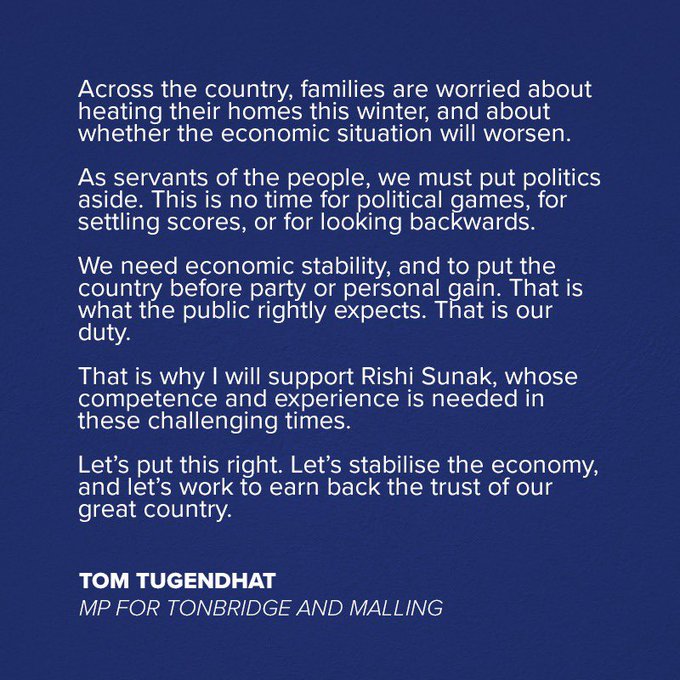
    The comments made by Tom Tugendhat, the Conservative MP for Tonbridge and Malling, on Twitter on 21 October 2022.

    We need economic stability. That’s why I’m backing Rishi Sunak.

    Image

  • Tom Tugendhat – 2015 Maiden Speech in the House of Commons

    Tom Tugendhat – 2015 Maiden Speech in the House of Commons

    The maiden speech made by Tom Tugendhat, the Conservative MP for Tonbridge and Malling, in the House of Commons on 11 June 2015.

    Thank you, Madam Deputy Speaker, for calling me to speak in this important debate. I praise the hon. Member for East Lothian (George Kerevan), whose tour de force demonstrated the strength of speaking skills in the northern part of our nation. I am grateful to be called to speak today, because the financing of Europe is a matter in which I must declare an interest. As the husband of a French wife, I know all about foreign powers deciding on British finances.

    It is an honour to represent the people of Tonbridge, Edenbridge and Malling in this wonderful House. Our beautiful towns and villages prove that England is today enjoying a bountiful summer. The fruits of our fields are enjoyed nationwide and I hope that this summer you, Madam Deputy Speaker, will be among the many who relish the Mereworth strawberries when you go to Wimbledon. I could give you a tour of my wonderful constituency based on the pubs, but for brevity I shall stick to the numerous towns and villages.

    In the west, Edenbridge is a wonderful market town that once made cricket balls—indeed, the balls that Lord Cowdrey of Tonbridge smacked out of the ground to the delight of Kent and England fans. Chiddingstone is home to one of the finest ales in our nation, Larkins, which will, I hope, one day be on tap here. A little further on is Wolf Hall or, as it is known on the maps, Penshurst. Sadly, these wonderful communities are not entirely tranquil. As I reminded my right hon. Friend the Secretary State for Transport this morning, Gatwick’s low flights are blighting our days.

    A little to the east, our largest town, Tonbridge, is home to some of the finest schools in our country. I declare an interest again, as a governor of Hillview School, which is committed to the arts, to drama, to design and to fashion and through that enriches the lives of many young people. West Malling’s High Street shows that commerce and community can combine. The award-winning florists and shoe shops are indeed a delight to all. East Malling is more famous abroad than at home, as its agricultural research has introduced new varieties to farmers around the world, while at Hadlow College those innovations are translated into reality by the teaching of a new generation.

    Our community is not cut off from modernity, but communications too often hamper rather than improve lives. Borough Green, for example, is shaken by heavy traffic while many across our area suffer from poor trains and failing phone signals. The response of my right hon. Friend the Secretary of State for Culture, Media and Sport and of the Rail Minister, the Under-Secretary of State for Transport, my hon. Friend the Member for Devizes (Claire Perry), has been exemplary, and I look forward to seeing both issues improved with their welcome support.

    I am not the first to campaign on these matters. The right hon. Sir John Stanley did so before most people can remember and, indeed, before I was born. In his maiden speech, he tested Hansard with the names of some of our wonderfully yclept villages: Wrotham, pronounced “Routem”; Trottiscliffe, pronounced “Trozlee”; and Ightham, pronounced “Item”. As I say them, I know that I am testing Hansard again 40 years later.

    The House knows Sir John’s formidable legacy. His close links with the councils he served alongside and his dedication to every part of the constituency have left an integrated approach and exemplary work ethic that I am determined to maintain. Furthermore, his dedication to our country saw him serve as Minister for housing, for Northern Ireland and for the armed forces. That connection to the armed forces is very strong in Tonbridge and I am proud to join the line of representatives that our town has sent to this House still holding a commission in her Majesty’s armed forces. Sir John continued that tradition of service and his personal courage was clear both from the ministerial offices he held during the darkest days of the troubles and, perhaps most dramatically, as Parliamentary Private Secretary to Baroness Thatcher. That really took courage. I wish Sir John and Lady Stanley well. They deserve our utmost praise and gratitude.

    My time in this House is, to be honest, unlikely to match the length of Sir John’s, so I shall briefly outline my reasons for seeking a voice in the heart of our democratic Union. The first is the law. As St Thomas More, a former occupant of your seat, Madam Deputy Speaker, once put it:

    “I would uphold the law if for no other reason but to protect myself”.

    Though my learned father invariably displayed the judgment of Solomon, I learnt clearly that the rule of law is not the same as the rule of lawyers. Those are not just words of filial rebellion but a call for the sovereignty of the people—the fundamental principle of British governance reasserted many times since Magna Carta 800 years ago—that finds expression in this House, the court of Parliament, and not through the Queen’s courts nor Strasbourg’s.

    My second reason for seeking a voice is dementia. That silent time bomb is affecting the whole community, both directly and as carers, and that in turn calls for community response. That is why I am working with the whole community to help Tonbridge, Edenbridge and West Malling to become dementia-friendly towns that can offer the support we need across west Kent.

    Finally, I come to the armed forces. Having served in combat in Afghanistan and Iraq and latterly as military assistant to the Chief of the Defence Staff, I know that numerical totems are for accountants, not soldiers. It is capability that matters and that is measured in assets and readiness. As we face an uncertain future in a world in which Russia threatens our allies in the east and Islamic-inspired violent extremism is redrawing the maps of the middle east, we must not only have the ships, the soldiers and the aircraft but must be certain that they are ready. Only by demonstrating our readiness on exercises and operations can we reassure our friends and deter our enemies. Deterrence is about much more than the nuclear boats that are the British people’s ultimate guarantee of sovereignty. It is about the morale and training of our soldiers, sailors, airmen and marines. Like a fiat currency, defence relies on confidence in our ability and only truly works when no one dares test it.

    As we continue our debate on financing the European Union, I pay tribute to my right hon. Friend the Prime Minister—the only Prime Minister to have lowered the budget. I am also grateful and humbled to be the voice of my community in this Chamber. I will speak for the thousands who supported me and for the thousands who did not. I pledge to serve them all and the interests of our United Kingdom to the best of my ability, as long as the people of Tonbridge, Edenbridge and Malling will grant me that privilege.

  • Tom Tugendhat – 2021 Speech on Afghanistan

    Tom Tugendhat – 2021 Speech on Afghanistan

    The speech made by Tom Tugendhat, the Conservative MP for Tonbridge and Malling, in the House of Commons on 18 August 2021.

    Like many veterans, this last week has seen me struggle through anger, grief and rage—through the feeling of abandonment of not just a country, but the sacrifice that my friends made. I have been to funerals from Poole to Dunblane. I have watched good men go into the earth, taking with them a part of me and a part of all of us. This week has torn open some of those wounds, has left them raw and left us all hurting. And I know it is not just soldiers; I know aid workers and diplomats who feel the same. I know journalists who have been witnesses to our country in its heroic effort to save people from the most horrific fates. I know that we have all been struggling. If this recall has done one thing, it has achieved one thing already. I have spoken to the Health Secretary, who has already made a commitment to do more for veterans’ mental health.

    [Hon. Members: “Hear, hear.”]

    This is not just about us. The mission in Afghanistan was not a British mission—it was a NATO mission. It was a recognition that globalisation has changed us all. The phone calls that I am still receiving, the text messages that I have been answering as I have been waiting, putting people in touch with our people in Afghanistan, remind us that we are connected still today, and Afghanistan is not a far country about which we know little. It is part of the main. That connection links us also to our European partners, to our European neighbours and to our international friends, so it is with great sadness that I now criticise one of them, because I was never prouder than when I was decorated by the 82nd Airborne after the capture of Musa Qala. It was a huge privilege to be recognised by such an extraordinary unit in combat. To see their commander-in-chief call into question the courage of men I fought with, to claim that they ran, is shameful. Those who have never fought for the colours they fly should be careful about criticising those who have.

    [Hon. Members: “Hear, hear.”]

    What we have done in these last few days is demonstrate that it is not armies that win wars. Armies can get tactical victories and operational victories that can hold the line; they can just about make room for peace—make room for people like us to talk, to compromise, to listen. It is nations that make war; nations endure; nations mobilise and muster; nations determine and have patience. Here we have demonstrated, sadly, that we—the west, the United Kingdom—do not.

    This is a harsh lesson for all of us, and if we are not careful, it could be a very, very difficult lesson for our allies, but it does not need to be. We can set out a vision, clearly articulated, for reinvigorating our European NATO partners, to make sure that we are not dependent on a single ally, on the decision of a single leader, but that we can work together—with Japan and Australia, with France and Germany, with partners large and small—and make sure that we hold the line together. Because we know that patience wins. We know it because we have achieved it; we know it because we have delivered it. The cold war was won with patience; Cyprus is at peace, with patience; South Korea, with more than 10 times the number of troops that America had in Afghanistan, is prosperous through patience. So let us stop talking about forever wars. Let us recognise that forever peace is bought, not cheaply, but hard, through determination and the will to endure. The tragedy of Afghanistan is that we are swapping that patient achievement for a second fire and a second war.

    Now we need to turn our attention to those who are in desperate need, supporting the United Nations High Commissioner for Refugees, the World Food Programme and so many other organisations that can do so much for people in the region. Yes, of course I support refugees, although I am not going to get into the political auction of numbers. We just need to get people out.

    I leave the House with one image. In the year that I was privileged to be the adviser to the governor of Helmand, we opened girls’ schools. The joy it gave parents to see their little girls going to school was extraordinary. I did not understand it until I took my own daughter to school about a year ago. There was a lot of crying when she first went in—but I got over it—[Laughter]—and it went okay. I would love to see that continue, but there is a second image that I must leave the House with. It is a harder one, but I am afraid it is one that we must all remember.

    Adam Afriyie (Windsor) (Con)

    I wonder whether my hon. Friend could say a bit more about that second image.

    Tom Tugendhat

    I am very grateful to my hon. Friend, who was watching the clock more than me.

    The second image is one that the forever war that has just reignited could lead to. It is the image of a man whose name I never knew, carrying a child who had died hours earlier into our firebase and begging for help. There was nothing we could do. It was over. That is what defeat looks like; it is when you no longer have the choice of how to help. This does not need to be defeat, but at the moment it damn well feels like it.

    [Applause.]

    Mr Speaker

    Order. Please, this is a very serious debate, and that was a very emotive and very important speech. We must recognise that we have to get through.