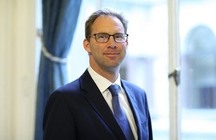
Below is the text of the speech made by Tobias Ellwood, the Parliamentary Under Secretary of State and Minister for Defence People and Veterans, on 15 September 2017.
It’s a real pleasure to be here today at DSEI. I’ve always enjoyed these things, I’ve come to them for many years. And anyone who has been in the Armed Forces and served, and I’m still in the reserves as well, you love wandering round and climbing on the equipment.
And if you’ve left the Armed Forces you’re curious to see what will come around the corner next. It’s interesting to see that some of the many things we are seeing are actually going to be used not by us, who are getting older in this audience, but by a fresher generation that is perhaps yet to even see it – the youngsters that we want to attract into the Armed Forces, and that is the theme I want to play on today.
In going round the stands I also noticed some interesting products. One stand is selling cross bows, for which there is a role I’m sure. It must be some special forces who can justify the need of that particular weapons system!
But it did remind me of how war has changed. The Longbow in Agincourt and the advent of that weapon changed the balance of war. After that everyone had the Longbow. There are many examples in military history where a key invention helped win a battle. The tank in the First Would War, for example. And we see this in the modern context with cyber security coming in.
Perhaps it’s too early to say but we are about to conduct from the SDSR a National Security Capability Review, simply because what has happened over the last couple of years with terrorism, where an individual is content to die to cause violence is forcing us to reconsider how we defend our assets and our people as well.
The scale of this event here reflects the determination and the commitment Britain has to play our role on the international stage. We are living in uncertain times but there are a few nations who want to step forward to change our world as a force for good, and we are one of them.
It doesn’t matter what ID card you have in your back pocket but it’s about whether you want to be part of that coalition of the willing in stepping forward to actually stand up to tyranny. So whether it’s tackling ebola, or coming together to come to a solution on Iran, on the nuclear deal, Britain will continue to step forward and play our role.
This week you’ve heard plenty about the Government investing our £178 billion budget towards our armed forces and equipping them for these very challenges that we know about, and perhaps the ones we don’t know about as well.
From F35 to the carrier, from Ajax to Apache, from Dragonfire lasers to Dreadnought submarines, this is the defence industry, moving together with out Armed Forces to create capability for the future.
We’re also playing our part across the world using that equipment. We shouldn’t forget that we have troops in South Sudan, Nigeria, the Gulf, in Iraq and over the skies of Syria, in Ukraine and doing training with our Allies across the world as well.
We step forward with our Armed Forces when others need our help. When the Blue Light services need support – Operation Temperer is when we provide that that help, flooding is another example.
So I’m displaying the wide variety of skill sets that anyone in uniform today will need to have to provide that versatility. There’s plenty to do to make sure we equip our personnel. But also plenty to do to make sure that what we do make we export as well.
That has been reflected this week, the need to drive up productivity, drive down cost and increase innovation as well. We need to make sure we are making the best kit that we can, attracting the best people to fly, see or use them in any capacity.
The pace of change that is taking place is incredible. I always think that when i have to put on my ipad and create an Imovie with my son that he now knows more about how to use the ipad than I do. I’m sure many of you can appreciate that if you have small children yourselves. And looking at some of this equipment, even though I’m a reservist myself, I wouldn’t know how to use them. And there’s two sides to that concern. one is simply making sure we can attract the people who can use the equipment. But second of all there’s a challenge for those of us who are in uniform to collect all that data and turn it into something that is useful.
Those of you who attended the land warfare conference this year, there was a very interesting study of the scale of date that is now being accumulated from the battlefield. It is enormous. If you have too much data you can’t go through the process of turning it into useful intelligence and plans. And when there is pressure on you to make decisions you can see that we’re getting to the point where we’re overloaded with data as well.
The selection of data is ever so important. But what’s also important is who we are recruiting to make sure they understand how to use that data.
I remember working with some Americans on an exercise and we were firing some rocket launchers. On the rocket launchers themselves the instructions were quite simple. It said on it, ‘aim towards enemy’. And that was the sole instruction on this entire thing. And that simply makes sense. But some of the kit we’re seeing today is far more complicated, required degrees and qualification that we need to look at and attract.
It reminds me of a story a Naval officer told me that equipment must be used in the right way because any ship can be used as a Minesweeper, once.
The vital task of recruiting and retaining is becoming ever more challenging as we adjust to society’s changing expectations and the exponential advance of technology.
So today we’re not just thinking about plugging critical skills gaps but how we can recruit people with a diversity of skills whether welders or cyber warriors at a time when the notion of a career for life has actually disappeared completely.
Today we’re considering how best to retain and develop our nuclear scientists and Apache pilots when faced with face stiffer competition from other industries for their talent. And we have to acknowledge that is very much the case. We need to make sure we attract people in the right ways and there are three approaches I want to share with you.
MOD BROADENING ITS TALENT BASE
First, we’re broadening our talent base. We can’t afford to miss out on the talents of our people no matter their gender, sexuality, religion or social background. A diverse community brings a diversity of talent into our Armed Forces.
That’s why, by 2020, we want 10 per cent of our workforce to hail from ethnic minority communities and 15 per cent to be women. We also want to make sure we extend opportunity to all. We’re lifting the ban on women serving in close combat units in the British military. Opening up the Royal Armoured Corps and the RAF regiment to women. And next year the Royal Marines.
We’re helping our young people get a better start in life, championing the apprenticeship programme. And I’m really proud to say that the Armed Forces are the country’s largest provider with as many as 19,000 people on our books. I think that’s a commendable achievement. But we want to increase that number by 50,000 by 2020.
All the while we’re hoping to appeal to a broader range of people by introducing legislation to make service life far more flexible.
Making it easier for personnel to temporarily change the nature of their service to work part-time or be temporarily protected from deployment to support an individual’s personal circumstances where operational need allows.
INDUSTRY
In wanting to attracting the right people, with the right skills, to the right jobs will mean more than just extra MOD effort, it’s about drawing on our Whole Force. So we’re using our Reserves to draw in the talent and skills that we need, whether in medicine, communications, or cyber skills, often in those areas where we don’t have the necessary standard of support.
The people who possess these high level skills are likely to be more familiar with smart phones than smart bombs. But that shouldn’t mean to say they can’t have a role, even for a short space of time in helping us do our job.
This is just a reflection of our need to change our outlook on how we use people and use civilian life. A broader minded perspective is also shaping our approach to plugging the skills gap which we have to admit is very much there.
Take engineering. We recognise it’s in the mutual interest of industry and government to find individuals who have these critical skills. So we’re looking at creating skills passports, enabling those with the right talents to move seamlessly between government and industry.
At the same, we’ve appointed an engineering champion to work with industry partners across the Defence enterprise to help make better use of the existing talent in the workforce.
Meanwhile, under the Defence Growth Partnership we’re looking at how we can make careers within MOD more rewarding creating a new programme to train our staff to support exports and future trading relationships.
I know Dave Armstrong will set-out more details later on.
But the headlines involve the creation of new qualifications in export and International trade, a common industry and government career pathway and secondments to allow individuals to develop their skills and gain key experience across both industry and government.
I hope those of you who are in industry will lend us your support and encourage that to be done to support the Armed Forces covenant. The commitment that we’ve created between business and the Armed Forces to help recruitment and retention of Reservists, the employment of veterans and service spouses/partners and the Cadets movement with supportive HR policies. This has proved very successful indeed and we’re almost up to our 2000th company signing up to our Armed Forces Covenant and I think that’s a great tribute to the work that’s been done.
PUBLIC PARTNERSHIP
Finally we’ve recognised that building the workforce of the future demands collaboration not just across defence but across Government and across the public sector as well.
So we’re currently working with the departments of Education and Business to reinvigorate young people’s interest in science, maths, engineering, and technology.
At the same time we’re working with academia to make sure to tell our defence story and show it for what it really is, a dynamic place of enterprise, of adventure, a place where you get to see the world, and get to make a difference.
Britain has always been blessed with brilliant talent. From John Harrison to Alan Turing to Sir Tim Berners Lee. In Defence it was Air Commodore Frank Whittle who invented the turbo jet. It was British engineer Robert Whitehead who first designed a torpedo launched from a ship underwater. It was Squadron Commander Edwin Dunning who landed a Sopwith Pup on HMS Furious 100 years ago completing the first successful aircraft landing on a moving ship.
And today our people have built the two mightiest carriers this nation has ever seen, satellites that can land on the back of asteroids, lasers that can strike targets 6 km away.
Our challenge is to fire up the ambition of the average 12-year old with the world beating record breaking kit on display in the room today, kit that can help us dive deeper, fly faster, reach higher.
CONCLUSION
So Britain isn’t just building the technology of the future, we’re building the workforce of the tomorrow. And we’re calling on the next generation of innovative heroes to come forward, for it will be on the back of the next Whittles and the next Berners-Lees that our future security, prosperity and reputation, is founded.
The conduct of war, as I mentioned at the beginning, is changing again, as the fourth phase of the industry revolution takes hold, Britain doesn’t just want to be part of it, we very much want to lead it.
