Tag: Theresa May

  • Theresa May – 2017 Opening Remarks in Japan

    Below is the text of the opening remarks made by Theresa May, the Prime Minister, and Shinzo Abe, the Prime Minister of Japan, in Japan on 31 August 2017.

    Shinzo Abe, Prime Minister of Japan

    I’d like to once again welcome Prime Minister May on her very first visit to Japan. When I visited the United Kingdom in April of this year, she gave me a special welcome by inviting me to the Chequers. As I return a favour, I had the pleasure to invite Prime Minister May to Kyoto and it was a delight that we were able to enjoy tea in a very traditional Omotesenke. And of course, at the Kyoto State Guest House, it’s a very traditionally Japanese architect, unlike here at the Akasaka Guest State House, but we did have a very candid and deep conversation together over dinner.

    And in that sense, I very much was delighted that we were able to have a very candid conversation about the regional issues together. At a time of change and unpredictability, I put great and ever more importance with the United Kingdom as a global strategic partner that shares fundamental values such as freedom, democracy, respect for human rights and the rule of law.

    I also would like to offer my respect to Prime Minister May’s leadership as she steers her country towards the departure from the European Union. Taking the opportunity of, Theresa, your visit to Japan, I hope to make it a huge step forward to elevate our relationship to a new level and would like to work hand in hand with you to robustly develop our bilateral ties between Japan and the United Kingdom.

    Theresa May, UK Prime Minister

    Thank you, thank you very much, and I am delighted to be able to be here in Japan, and I would like to thank you for the welcome that you have given me. And I was particularly pleased on, as you say, my first visit to Japan, to be able to sample some traditional Japanese culture, as well as some very productive meetings.

    As you say, this is an important time for the United Kingdom as we are preparing and negotiating for our exit from the European Union. And as we do so, we are looking to enhance our partnerships, our ties and our links with countries around the world with whom we have had good longstanding relationships, but with whom we can build further cooperation in the future, and Japan is a key country for the United Kingdom. And we already have good cooperation and partnerships in investment between our two countries, with – between businesses, and the Business Forum today was a very good opportunity for further links to be made.

    And there will be further work for us to do on enhancing our trade relationship, but also in security and defence, as we both see the same challenges and threats around the world. And as two nations, island nations, that believe in the rule of law, in the rules-based international order, and have the same values, I believe it is important that we work together. And I look forward to our further discussions.

  • Theresa May – 2017 Message at Eid al-Adha

    Below is the text of the message sent by Theresa May, the Prime Minister, at Eid al-Adha on 31 August 2017.

    I send my warmest wishes to Muslims around the world, and here in the United Kingdom, who are celebrating Eid al-Adha this week. And I congratulate everyone who has performed the Hajj this year.

    At this special time, British Muslims will gather together with family, friends and neighbours to pray, to exchange gifts and to share meals.

    Amidst these celebrations, they will also remember those in need, by extending a hand of friendship and compassion to those less fortunate than themselves.

    That generosity towards others is shown all year round by British Muslims, through charitable giving and service in the community.

    Indeed, British Muslims, and people of Muslim origin, make a huge contribution to all walks of life in the United Kingdom. They help to enrich the successful multi-racial, multi-faith democracy that is twenty-first century Britain.

    As we celebrate this happy occasion here in the United Kingdom, we will also keep in our thoughts and prayers those around the world who will be marking this festival in places of conflict and insecurity.

    This festival’s commemoration of Abraham’s willingness to sacrifice for his faith is a reminder of the shared roots of the world’s great Abrahamic faiths.

    And in their warm spirit of neighbourliness and compassion, the Eid celebrations demonstrate common values in which we can all share.

    So Eid Mubarak. I hope that this will be a wonderful occasion for everyone who is taking part.

  • Theresa May – 2017 Speech on Women in Sport

    Below is the text of the speech made by Theresa May, the Prime Minister, at a reception in 10, Downing Street, London on 29 August 2017.

    I am delighted to welcome you all to Downing Street today – and to have this opportunity to celebrate what I believe has been a watershed for women’s sport in our country this summer.

    In doing so, it is a great honour to welcome two of our teams whose achievements have been such an important part of this breakthrough moment.

    Our England Women’s cricket team whose dramatic nine-run victory over India at a packed out Lords secured the Cricket World Cup.

    And our England women’s rugby team who earlier this Summer beat New Zealand in New Zealand to become the world’s No1 team – and whose breath-taking World Cup final in Belfast on Saturday night had the nation on the edge of its seat.

    And while I know our rugby team will be disappointed with the result on the pitch, your result off the pitch, the legacy of everything you have achieved – together with our cricketers, our footballers, athletes, hockey players and of course Jo Konta’s spectacular run at Wimbledon – will change the way that women’s sport is seen in our country for years to come.

    So I am delighted that you are all here today – and not just the players who have worked so incredibly hard – but also the coaches and backroom teams who have supported you, and some of your families and friends too, whose own sacrifices have been such an important part of everything you have done.

    I am incredibly proud that, with you, our nation can call on such wonderful ambassadors for young women and girls today.

    And I hope that with your support we can seize this opportunity to grow women and girls’ sport in communities across the length and breadth of the land.

    We have got lots to build on.

    Our Sports Strategy is already targeting resources at those less likely to be physically active, with Sport England setting out seven new investment programmes that I hope can really help increase women’s participation in sport.

    While Sport England’s award-winning campaign called This Girl Can has already seen 11,000 organisations register as supporters and 1.6 million women saying they have now started or restarted sporting activity.

    And I am seeing some of this growth in women’s grassroots sport in my own role as Patron of the women’s team at Maidenhead and Bray Cricket Club and as President of the Wargrave Girls Football Club.

    But if we are really going to seize the opportunity of this moment I believe we need to go further in two key areas.

    First, we need to improve the representation of women on the governing bodies of our sports.

    This isn’t just right in terms of creating better governance for any organisation – it is also right in terms of growing women’s sport.

    For too long, in too many sports, there hasn’t been enough attention paid to the women’s side of the sport – and more women on boards can help to change that.

    So our sports governance code now includes a target of at least 30 per cent gender diversity on boards.

    And it is now mandatory and applies to any organisation of any size or scale seeking funding from Sport England or UK Sport.

    As of last year, just under half of NGBs did not yet meet this requirement.

    But they are going to have to set out a plan to do so by October 31st this year.

    Second, we need a radical change in the status and profile of our women’s sports – especially team sports – so that women’s sporting success is routinely held in the same high esteem as that of men’s.

    Developments like the Women’s Premier League in football and the growing professionalisation of team sports are important steps forward.

    And it is welcome too that the gender prize money gap in sport is closing with 83 per cent of sports now rewarding men and women equally.

    But 83 per cent isn’t good enough.

    We need to go further – and broadcast and news coverage has a key role to play.

    And again your achievements this summer can be a major catalyst for progress.

    Channel 4’s hugely successful coverage of the Euros helped to galvanise support for the Lionesses – just as the BBC’s coverage of the World Cup had done in 2015.

    The Cricket World Cup Final at Lords was sold out and had a global television audience of over 100 million.

    While the Rugby World Cup Final saw another packed stadium in Belfast on Saturday night and the largest ever TV audience for women’s rugby in the UK – with the game rightly shown in a prime time slot on ITV1.

    This has generated huge momentum – and I hope we can capitalise on it, so that women’s sport on TV and on the back pages of our newspapers becomes the norm and not the exception.

    Today we celebrate two teams, and two fantastic sets of athletes, but you are much more than that.

    You are trailblazers, ambassadors, pioneers and now a part of British sporting history.

    So together, let’s ensure that your legacy is not just in Britain’s sporting history – but also a fundamental part of shaping Britain’s sporting future – for millions of young women and girls, for generations to come.

  • Theresa May – 2017 Statement on Barcelona Terror Attack

    Below is the text of the statement made by Theresa May, the Prime Minister, on 17 August 2017.

    I am sickened by the senseless loss of life in Barcelona today. The Foreign Office is working to establish if any British nationals were involved in this appalling incident and we are in close contact with the authorities in Spain, who have our full support.

    Following the attacks in Manchester and London, Spain stood alongside the British people. Tonight, Britain stands with Spain against the evil of terrorism.

  • Theresa May – 2017 Speech on HMS Queen Elizabeth in Portsmouth

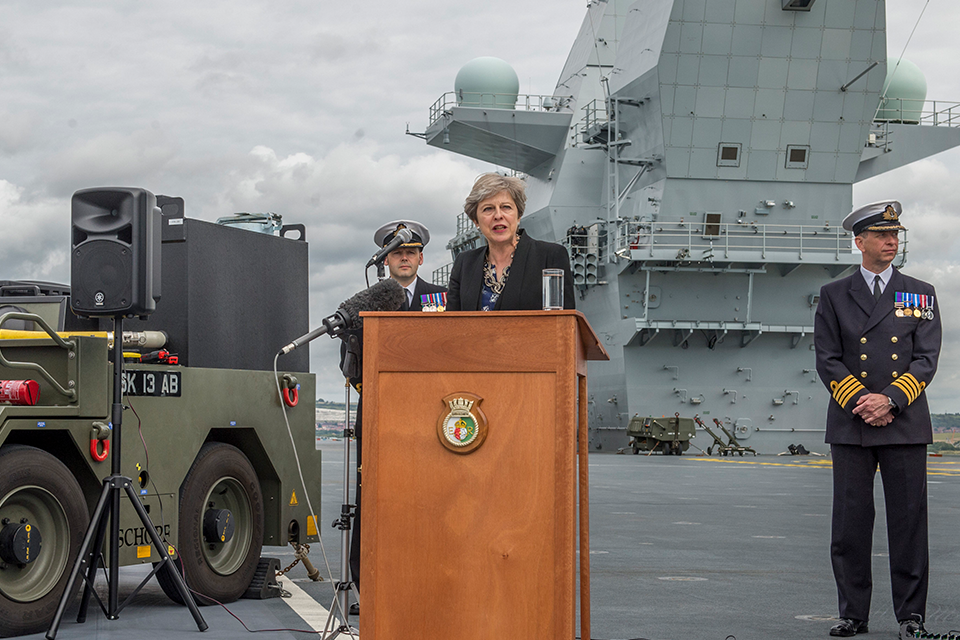
    Below is the text of the speech made by Theresa May, the Prime Minister, on board HMS Queen Elizabeth in Portsmouth on 16 August 2017.

    It is a great pleasure to be here with you aboard HMS Queen Elizabeth today. Let me start by thanking you all, a great partnership of ship’s company and contractors, for your tremendous work putting this great ship through her paces during her sea trials. I know it’s been a major undertaking.

    This is the biggest and most complex warship ever built for the Royal Navy. So to test her capabilities thoroughly, and to make sure that her 17 million components are working as they should, is a very big job. The fact that she was ready to come in to port ahead of schedule is testament to your hard work.

    As the first generation of sailors to form this ship’s company, you have a special privilege and responsibility. You are setting the standard for those who come after you. Decades from now, when this ship is carrying our flag around the world, protecting our interests and ensuring our security, you will be able to look back on this time with pride. And the whole country is proud of you. The skill and professionalism of the Royal Navy are world-renowned. Your service is critical to our country’s security and success in the world. In doing your vital work, you and your families are often called upon to make enormous sacrifices.

    I know that you make them unstintingly and that you always give of your best. Britain truly has the best sailors, marines and officers in the world and I believe that you deserve the very best equipment. That is what we have with HMS Queen Elizabeth. This ship is a symbol of the United Kingdom as a great global, maritime nation.

    Clearly, she is a stunning piece of twenty-first century engineering and a true testament to British shipbuilding and design. Six shipyards from across the United Kingdom contributed sections of this vessel. In Glasgow, Devon, Tyneside, Merseyside, Portsmouth and Fife, the skill of British shipbuilders were on display in her construction. Over 10,000 people, including 800 apprenticeships, 700 businesses helped build the mighty ship we see today. We are determined to build on the success of the Queen Elizabeth class carriers with a National Shipbuilding Strategy to open up new opportunities for our great British shipyards in the future.

    Britain can be proud of this ship, and what it represents. It sends a clear signal that as Britain forges a new, positive, confident role for ourselves on the world stage in the years ahead, we are determined to remain a fully engaged global power, working closely with our friends and allies around the world.

    As a leading member of NATO, the foremost military power in Europe and a permanent member of the UN Security Council, Britain has an enduring responsibility to help sustain the international rules-based order, and to defend the liberal values which underpin it.

    To ensure we can do so effectively, we will increase defence spending every year and continue to meet NATO’s target to spend 2% of GDP on defence. Our carrier programme is an example of what that spending can deliver. As highly versatile and potent assets, they will be able to meet the widest range of challenges around the world. Whether the task be high intensity war fighting, targeted action to fight terrorism or humanitarian relief to save lives overseas, these ships will transform the UK’s ability to project power around the world.

    Alongside her supporting task-group, including state-of-the-art aircraft, helicopters and escorts, HMS Queen Elizabeth and HMS Prince of Wales will in time give the UK a truly world class carrier strike capability for decades to come. Here in Portsmouth, the home of the Royal Navy and the new home of this great ship, we are surrounded by reminders of the Royal Navy’s proud past. It was from this harbour that Nelson embarked aboard HMS Victory before the battle of Trafalgar; from here the allied forces left for the Normandy beaches to defeat fascism on D-day; and from here that the task-force set sail for the South Atlantic to liberate the Falklands.

    Many times in our history we have called upon the Royal Navy to defend our island and protect our interests and those of our citizens around the world. The threats we face may have changed, and naval technology advanced beyond all recognition. But in the fifty years of service to come from this vessel, we can be inspired by those traditions to face the new challenges of the twenty-first century with the same determination and resolve which have always been the Royal Navy’s hallmarks.

    I hope that you can all enjoy some respite before you take the ship out of harbour again for the next phase of her sea trials, and let me once again thank you all for your service to our country.

  • Theresa May – 2017 Speech at London Pride Reception

    Below is the text of the speech made by Theresa May, the Prime Minister, at a Pride Reception on 19 July 2017.

    It is a very great pleasure to welcome you all to this reception today to celebrate the contribution that lesbian, gay, bi and trans people make to our country.

    We meet, of course, during Pride season – a joyful time when communities come together in a spirit of freedom, tolerance and equality.

    Pride in London a couple of weeks ago was a huge success and I’m sure that the first ever UK Pride, to be held in Hull, our Capital of Culture, this weekend will also be a huge success.

    I’m delighted that we have some of the team from both, and other Pride celebrations, here today.

    50th Anniversary

    And of course this year is a special year because fifty years ago this month, the passage of the Sexual Offences Act in England and Wales marked an important step towards legal equality for LGBT people in the UK.

    It was just one step, and it took many more years before it became widely accepted that a person’s sexual orientation and gender identity are things to respect and celebrate. The law in Scotland did not change until 1980 and Northern Ireland in 1982. And only this year did my colleague John Glen’s private member’s bill finally extend this to the merchant navy, closing a sad chapter in our legal history.

    This anniversary reminds us how far we have come, but also how long it has taken to get us here, and also how much more there still is to do. We should take this opportunity to remember the work of those who campaigned so long to deliver the change we have seen over the past fifty years. They braved abuse and ridicule, violence and legal persecution in their tireless quest for justice and human rights.

    They knew that what they stood for was right; they fought for it with courage and determination; and they made our country a better place as a result.

    Changing hearts and minds

    And like millions of other people in this country, I have changed my own mind on a number of the policy issues which I was confronted with when I first became an MP twenty years ago. If those votes were today, yes I would vote differently. And when I was a member of the shadow cabinet before the 2010 general election, I was proud to establish a Contract for Equalities which first committed my Party to taking forward equal marriage. I was proud to give it my full support in government as one of the sponsors of the bill which delivered it. I believe that equal marriage will be one of the proudest legacies of my Party’s time in office.

    Equal marriage in England and Wales was passed with cross-party support and it is a great thing for our country that there is now a broad political consensus in support of equality and human rights. The UK Parliament is now one of the most diverse in the world, with forty-five out gay, lesbian or bi MPs – six more than in the previous Parliament. 17 of those are Conservatives and I am proud to lead a Cabinet with two out members, and to have other gay and lesbian ministers serving in government.

    Now I know that my Party has a mixed record on LGBT issues and, like other parties, we have made mistakes in the past. But there are things we are proud of too. It was a Conservative MP, Humphry Berkeley, who first tried to change the law on homosexuality in the 1960s, before he lost his seat and a Labour MP, Leo Abse, took up the cause. It was a Conservative peer, Lord Arran, who took the Bill through the Lords. A future Conservative leader, Margaret Thatcher, was amongst the MPs who voted for it. A Conservative Health Secretary, Norman Fowler, put in place a world-leading response to the AIDS crisis in the 1980s – and I think that Norman is here with us this afternoon. John Major ended the ban on lesbian and gay people serving as diplomats. And of course David Cameron delivered same sex marriage.

    So I am proud that, just like the country as a whole, my Party has come a long way. Respect for the rights of LGBT people is now an indelible part of modern Conservatism and modern Conservative values – and that is how it will always remain.

    And I want to say something very directly. Because I know that there is concern about the agreement which we have made with the DUP. But this agreement does nothing to weaken the Conservative Party’s absolute commitment to LGBT equality and human rights.

    And let me be even clearer. When it comes to those rights across the United Kingdom, I want all British citizens to enjoy the fullest freedoms and protections. That includes equal marriage. Now with devolution in the UK, that is not a decision for the UK Government to make. But my position is very clear. I think that LGBT people in Northern Ireland should have the same rights as people across the rest of the UK.

    LGBT rights are human rights

    And our ambitions are not just restricted to this country: because LGBT rights are human rights – and as a UK Government, we will always stand up for them.

    In some Commonwealth countries discriminatory laws still exist – often directly based on the very laws which we repealed in this country fifty years ago. So Britain has a special responsibility to help change hearts and minds and we will ensure that these important issues are discussed at next year’s Commonwealth Heads of Government Conference, which we will be hosting here in the UK.

    In countries where human rights are abused and people face violence and persecution, the UK will continue to challenge, at the highest political levels, the governments concerned. That is the case with the sickening treatment which LGBT people are enduring in Chechnya today. It is a mark of shame for the Russian Federation, and we have made that clear to the Russian government.

    As we leave the EU, Britain will forge a new global role and we will use our position to provide even stronger global leadership on this issue in the years ahead.

    At home, we know that the battle has not yet been won. Everyone should be free to enjoy their lives free from harassment and discrimination, happy and proud of who they are. In particular, no child should ever be made to feel afraid or ashamed because of who they are. We need to do all we can to build a country which works for everyone, where people of all backgrounds are free to be themselves and fulfil their full potential.

    So we are supporting schools to tackle homophobic bullying. We have seen encouraging signs that it is in decline, but we must keep up the work to tackle it. Part of that is ensuring that there are strong and positive role models for young people and just earlier this afternoon, before I came down here to this reception, I was delighted to be able to bestow a Point of Light award on someone who has worked to ensure those role models are more visible.

    Rory Smith experienced homophobia in the classroom when he was growing up, and to help other people facing the same challenging experience, he returned to his old school as an adult to help speak out about his experiences as a gay teenager. He helped set up a charity, ‘Just Like Us’, which sends other positive LGBT role models into schools to share their experiences, challenge stereotypes and inspire young people to be themselves.

    But while homophobic bullying may be in decline, we know that transphobic bullying remains a very serious problem. Indeed when it comes to rights and protections for trans people, there is still a long way to go. That is why the government is reviewing the Gender Recognition Act and we hope to make an announcement very soon on the action we will take to reform it by making it less medical and less intrusive.

    Conclusion

    Fifty years on from the 1967 Act, we can look back on a great deal of progress made, but we do so in the sober realisation that there is a long way still to go. I say to the tireless campaigners here today, and to those who are not: your inspirational work has created a better future for LGBT people in Britain and around the world. I hope you all have a fantastic time here at this reception. Thank you to everybody for all that you do.
  • Theresa May – 2017 Statement on June European Council

    Below is the text of the statement made by Theresa May, the Prime Minister, on 23 June 2017.

    At this European Council we dealt with a broad ranging agenda.

    We covered issues that are of critical importance to the UK now – such as counter-terrorism and climate change. These issues will remain important after we leave the EU.

    That is why we will play a full role while we are members of the European Union, and why we want a deep and special partnership with our EU friends and allies after we leave.

    Last night I was also able to update other leaders on the UK’s proposal to give reassurance and certainty to EU citizens who have made their homes and lives in our country.

    Let me deal with a few of the items I and other leaders discussed.

    On security, there was strong commitment around the table to stand firm in the fight against terrorism and the online extremism that incites terrorism.

    I was able to thank our European partners in person for their support and condolence following the appalling attacks in Manchester and London.

    Those attacks have not just affected British citizens, but citizens from across Europe – just as British people suffered in the attacks in Paris and Stockholm.

    And I say this in a city which has itself suffered great loss from terrorist attacks.

    These atrocities have strengthened the need for us to work together to keep our countries safe.

    So I urged other leaders to put pressure on technology companies to do more to rid extremist content from the internet and to ensure that law enforcement agencies can access encrypted data.

    That is what has been agreed at this European Council, and it builds on the recent work I have done with President Macron of France.

    We must continue to work together to combat this evil, to defend our values, and to keep our citizens safe.

    On defence, we have welcomed plans for Europe to step up cooperation on capabilities, and for the EU and NATO to work more closely together. The UK will always be committed to the defence of Europe.

    On climate change, this European Council reaffirmed the commitment of the EU and all Member States to fully implement the Paris Agreement.

    The UK welcomes that joint commitment.

    We discussed the importance of the EU pursuing an ambitious trade policy, delivering jobs and growth. That trade must be fair as well as free. The UK will continue to play a leading role in pushing for openness in global trade.

    On migration, I emphasised the UK would continue to play its part in tackling the ongoing migration crisis – which is a challenge for our entire continent.

    The Council recommitted to a comprehensive approach to the crisis. That means dealing with the drivers of migration while also doing more to stem the flow of migration.

    This summit focussed on the Central Mediterranean route, and I confirmed a new UK bilateral commitment of £75 million to meet urgent humanitarian needs while also facilitating voluntary returns of migrants making these treacherous journeys.

    Finally, after the constructive start to our Brexit negotiations earlier this week, I wanted to briefly set out to my fellow European leaders the UK’s approach to giving reassurance and certainty to EU citizens living in the UK.

    I want all those EU citizens who are in the UK, who’ve made their lives and homes in our country to know that no one will have to leave. We won’t be seeing families split apart. People will be able to go on their living their lives as before.

    This is a fair and serious offer – it gives those three million EU citizens in the UK certainty about the future of their lives, and we want the same certainty for the more than one million UK citizens who are living in the European Union.

    On Monday, I will publish my proposals in full – and look forward to reaching an agreement at the earliest possible date.

  • Theresa May – 2017 Statement on London Bridge Terrorist Attack

    Below is the text of the statement made by Theresa May, the Prime Minister, on Downing Street, London on 4 June 2017.

    Last night, our country fell victim to a brutal terrorist attack once again. As a result I have just chaired a meeting of the government’s emergency committee and I want to update you with the latest information about the attack.

    Shortly before 10:10 yesterday evening, the Metropolitan Police received reports that a white van had struck pedestrians on London Bridge. It continued to drive from London Bridge to Borough Market, where three terrorists left the van and attacked innocent and unarmed civilians with blades and knives.

    All three were wearing what appeared to be explosive vests, but the police have established that this clothing was fake and worn only to spread panic and fear.

    As so often in such serious situations, the police responded with great courage and great speed. Armed officers from the Metropolitan Police and the City of London Police arrived at Borough Market within moments, and shot and killed the three suspects. The terrorists were confronted and shot by armed officers within eight minutes of the police receiving the first emergency call.

    Seven people have died as a result of the attack, in addition to the 3 suspects shot dead by the police. Forty-eight people are being treated in several hospitals across London. Many have life-threatening conditions.

    On behalf of the people of London, and on behalf of the whole country, I want to thank and pay tribute to the professionalism and bravery of the police and the emergency services – and the courage of members of the public who defended themselves and others from the attackers. And our thoughts and prayers are with the victims and with their friends, families and loved ones.

    This is, as we all know, the third terrorist attack Britain has experienced in the last three months. In March, a similar attack took place, just around the corner on Westminster Bridge. Two weeks ago, the Manchester Arena was attacked by a suicide bomber. And now London has been struck once more.

    And at the same time, the security and intelligence agencies and police have disrupted five credible plots since the Westminster attack in March.

    In terms of their planning and execution, the recent attacks are not connected. But we believe we are experiencing a new trend in the threat we face, as terrorism breeds terrorism, and perpetrators are inspired to attack not only on the basis of carefully-constructed plots after years of planning and training – and not even as lone attackers radicalised online – but by copying one another and often using the crudest of means of attack.

    We cannot and must not pretend that things can continue as they are. Things need to change, and they need to change in four important ways.

    First, while the recent attacks are not connected by common networks, they are connected in one important sense. They are bound together by the single, evil ideology of Islamist extremism that preaches hatred, sows division, and promotes sectarianism. It is an ideology that claims our Western values of freedom, democracy and human rights are incompatible with the religion of Islam. It is an ideology that is a perversion of Islam and a perversion of the truth.

    Defeating this ideology is one of the great challenges of our time. But it cannot be defeated through military intervention alone. It will not be defeated through the maintenance of a permanent, defensive counter-terrorism operation, however skilful its leaders and practitioners. It will only be defeated when we turn people’s minds away from this violence – and make them understand that our values – pluralistic, British values – are superior to anything offered by the preachers and supporters of hate.

    Second, we cannot allow this ideology the safe space it needs to breed. Yet that is precisely what the internet – and the big companies that provide internet-based services – provide. We need to work with allied, democratic governments to reach international agreements that regulate cyberspace to prevent the spread of extremism and terrorist planning. And we need to do everything we can at home to reduce the risks of extremism online.

    Third, while we need to deprive the extremists of their safe spaces online, we must not forget about the safe spaces that continue to exist in the real world. Yes, that means taking military action to destroy ISIS in Iraq and Syria. But it also means taking action here at home. While we have made significant progress in recent years, there is – to be frank – far too much tolerance of extremism in our country.

    So we need to become far more robust in identifying it and stamping it out – across the public sector and across society. That will require some difficult and often embarrassing conversations, but the whole of our country needs to come together to take on this extremism – and we need to live our lives not in a series of separated, segregated communities but as one truly United Kingdom.

    Fourth, we have a robust counter-terrorism strategy that has proved successful over many years. But as the nature of the threat we face becomes more complex, more fragmented, more hidden, especially online, the strategy needs to keep up. So in light of what we are learning about the changing threat, we need to review Britain’s counter-terrorism strategy to make sure the police and security services have all the powers they need. And if we need to increase the length of custodial sentences for terrorism-related offences, even apparently less serious offences, that is what we will do.

    Since the emergence of the threat from Islamist-inspired terrorism, our country has made significant progress in disrupting plots and protecting the public. But it is time to say enough is enough. Everybody needs to go about their lives as they normally would. Our society should continue to function in accordance with our values. But when it comes to taking on extremism and terrorism, things need to change.

    As a mark of respect the two political parties have suspended our national campaigns for today. But violence can never be allowed to disrupt the democratic process. So those campaigns will resume in full tomorrow. And the general election will go ahead as planned on Thursday.

    As a country, our response must be as it has always been when we have been confronted by violence. We must come together, we must pull together, and united we will take on and defeat our enemies.

  • Theresa May – 2017 Statement at the G7 Summit in Sicily

    Below is the text of the speech made by Theresa May, the Prime Minister, in Sicily on 26 May 2017.

    Good afternoon.

    This week, the United Kingdom suffered one of the worst terrorist attacks in our history. The murder of innocent citizens and the deliberate targeting of children appalled people at home and around the world.

    Today, G7 leaders have joined Britain in condemning this barbaric act of violence. It is at moments such as this that we are reminded of the fundamental importance of this unique group of nations, and the unity that our membership affords.

    Because the threat of terror is one that all our countries face. And now more than ever we must strengthen our resolve to overcome this threat together and stand firm against those who want to destroy our precious values and our way of life.

    Yesterday I was at the NATO Summit in Brussels, where member countries reaffirmed their commitment to our transatlantic security alliance, and agreed on the importance of NATO expanding its counter-terrorism role.

    And, here in Sicily, the G7 has come together to address the biggest issues we face, from terrorism and conflict, to important foreign policy issues, global trade and climate change.

    I will address each in turn.

    Counter Terrorism

    Today, against the backdrop of Monday’s cowardly attack in Manchester, we have discussed what more we can do together to defeat global terror.

    We agreed the threat from Daesh is evolving rather than disappearing – as they lose ground in Iraq and Syria, foreign fighters are returning and the group’s hateful ideology is spreading online.

    Make no mistake: the fight is moving from the battlefield to the internet.

    In the UK we are already working with social media companies to halt the spread of extremist material and hateful propaganda that is warping young minds.

    But I am clear that corporations can do more. Indeed, they have a social responsibility to now step up their efforts to remove harmful content from their networks.

    Today, I called on leaders to do more.

    We agreed a range of steps the G7 could take to strengthen its work with tech companies on this vital agenda. And ministers will meet soon to take this forward.

    We want companies to develop tools to identify and remove harmful material automatically. And in particular I want to see them report this vile content to the authorities, and block the users who spread it.

    And the G7 will put its weight behind the creation of an international industry-led forum where new technologies and tools can be developed and shared to help us deny terrorists their pernicious voice online.

    It is also vital we do more to cooperate with our partners in the region to step up returns and prosecutions of foreign fighters. This means improving intelligence-sharing, evidence gathering, and bolstering countries’ police and legal processes.

    Foreign Policy

    The investigation into what happened in Manchester is ongoing. But the suicide bomber’s links to Libya undoubtedly shine a spotlight on this largely ungoverned space on the edge of Europe.

    So we must redouble our support for a UN-led effort that brings all the parties to the negotiating table and reduces the threat of terror from that region.

    Similarly in the case of Syria, we agreed that it will be impossible to defeat terrorism without a political settlement that brings a stable transition away from President Assad.

    We welcomed the progress towards de-escalation, but are clear that the regime’s backers, Russia and Iran, must use their influence to deliver a ceasefire and move to a genuine political process.

    Leaders agreed today that we must challenge Iran’s destabilising activity in Syria and the wider region, and that we must continue our efforts to prevent Iran from acquiring a nuclear weapons capability.

    Leaders were united in their condemnation of North Korea’s continued nuclear weapons and ballistic missile tests.

    We agreed to increase pressure on Pyongyang as we work to secure a peaceful resolution in the region.

    Economy and Trade

    This afternoon I led a discussion on trade and the global economy. As we prepare to leave the European Union, I reiterated the UK’s abiding commitment to free trade and open markets.

    But I and my fellow world leaders also recognised that some people feel left behind by globalisation. And that not all countries are playing by the rules.

    We need to show our citizens that the global economy can truly work for everyone.

    This means recognising the importance of the international rules-based system and the World Trade Organisation in creating a level playing field for trade – but accepting that we need to make the system work better.

    And it means taking action to ensure that all our citizens can share in the benefits of globalisation, and support those who feel they have lost out.

    The UK’s industrial strategy of economic and social reform is helping spread growth and opportunity to all parts of our country and society.

    We are ensuring people have the skills to capitalise on the opportunities presented by new technologies and a digital economy at the start of and throughout their careers.

    And as we work to make the UK an even more attractive place for businesses to invest and grow, we want companies to act responsibly and play their part in making ours a country that works for everyone.

    We had a productive discussion today about the importance of global action against climate change, to safeguard the prosperity and security of future generations.

    The UK remains committed to this agenda. We will keep energy affordable and maintain a secure and reliable supply in order to protect the interests of businesses and consumers.

    Clearly, the global challenges we face today are more urgent than ever before. When it comes to the fight against terrorism, we can only defeat this evil together, with determined and coordinated action.

    As the G7 we stand united today in our commitment to uphold the values we share – and to create a safe, secure and prosperous future for all our citizens.

  • Theresa May – 2017 Ramadan Message

    Below is the text of the statement made by Theresa May, the Prime Minister, on 26 May 2017.

    Ramadan is a unique and special time for Muslims in Britain and around the world.

    It is a time for them to renew their faith in God and increase their devotion and spirituality. A time when, despite the long summer days, Muslims across Britain will find strength through devotion to fulfil one of the five pillars of their religion.

    Ramadan fosters a strong sense of community spirit, reflected in the way mosques open their doors and welcome people of all faiths and none to share in the Iftar meal – something I have experienced in my own constituency of Maidenhead. It is an important chance for people from all walks of life to meet together, discuss and share experiences with their neighbours, and to increase familiarity and foster friendships.

    This Ramadan, let us celebrate the way in which this festival of peace, reflection and religious devotion brings people closer together.

    And let us say to Muslims here in Britain and across the world, Ramadan Kareem.