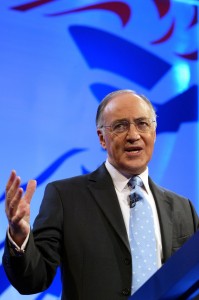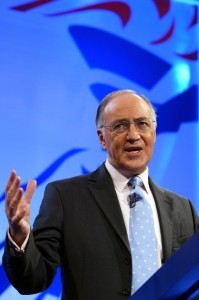
Below is the text of the statement made by Michael Howard, the then Home Secretary, in the House of Commons on 5 February 1996.
When we last debated the policing of London, I placed before the House my vision of what the Metropolitan police can deliver and are delivering for our capital city. My vision was of even more reductions in crime; an even safer city where safer streets improve the quality of life in the capital; and a city where there is a flourishing and active partnership between the police and the public, where individual members of London’s public know that they can make a real difference by volunteering to support their local police in whatever way best suits their local needs.
I said that I wanted that to be delivered by a police service that is visible, approachable and predominantly unarmed, and which provides a reassuring presence right across London. I outlined my plans and those of the Commissioner for bringing that about, and the Government’s commitment to providing the necessary resources.
Today, just over 13 months later, I want to return to my vision and the success that we are having in making it a reality. I want to take stock of the objectives and achievements of the Metropolitan police in the light of that vision, and I want to explain how they fit into the Government’s general strategies for law and order.
I make no apology for beginning with the Met’s crime figures. When–as is the case today–the police make major advances, we should celebrate those achievements and ensure that the public know about them. The Government have never accepted, and will never accept, the depressing view that we are powerless in the face of increasing crime, and neither has the Commissioner.
Let us make no mistake: there has been a major breakthrough in stemming what many had predicted was an inexorable growth in reported crime in the capital. The significant falls are precisely where we most wanted them–in the two volume crimes that make up nearly half the crime in London: breaking into our homes and stealing our cars.
Let us look at the figures for the past two years in the Met, to June 1995. Overall, we see the biggest drop in the number of crimes–118,300–since records began. In the second year alone, there were 60,000 fewer recorded crimes in the Metropolitan police district than in the previous 12 months. That is excellent news.
Ms Glenda Jackson (Hampstead and Highgate): The Secretary of State referred to the figures for recorded crime. Does he agree that a sizeable proportion of the people of London fail to report crimes, because they know that their local police force is overstretched and undermanned, and even if it responds there is very little possibility of a clear-up for that crime?
Mr. Howard: The hon. Lady should know that one of the offences that has fallen sharply in recent years is that of theft of cars. Indeed, if she had listened to what I said, she would have heard me draw particular attention to that a moment ago. Is she suggesting that people do not report the fact that their car has been stolen?
Ms Jackson: Yes.
Mr. Howard: I think that she is in a fantasy land if that is what she thinks, because she knows perfectly well that to make an insurance claim for theft of one’s car, one has to report it to the police. If the hon. Lady thinks that people are not reporting the theft of their cars, I suggest that nothing that she says deserves to be taken seriously. I certainly do not propose to take seriously what she says after that intervention.
The even better news, of course, is that crime is coming down across the country. Whether measured by police recorded figures or the British crime survey, the overall position in the Met is better than outside London. For example, vehicle crime fell by 33 per cent. in the two years to June 1995. That is a drop of 79,200 offences. Theft of vehicles in London has dropped by 39 per cent. in the period from June 1979 to June 1995.
Look at burglary. The Met attacked it vigorously just as we asked it to. The Commissioner’s anti-burglary initiative, Operation Bumblebee, used, for the first time, techniques such as intelligence gathering, surveillance and targeting of suspects, which previously had been used only for the most serious crime. The fact is that there have been 8 per cent. fewer burglaries in the Metropolitan district in the two years following the start of Londonwide Operation Bumblebee in June 1993, and a 30 per cent. leap in the number of crimes being solved.
Mr. Harry Greenway (Ealing, North): I regularly attend neighbourhood watch meetings in my constituency, which falls within the Ealing and Southall police areas, and I know that the fall in the number of burglaries has given tremendous heart to local people. The police tell me that they have been able to pinpoint and target particular culprits and have them dealt with them, and that partly accounts for their great success. Does that mean that my right hon. and learned Friend’s concern for dealing with those people, should they continue in their ways when they are released back into society, is a matter of concern for everyone?
Mr. Howard: My hon. Friend, who takes a close interest in these matters, is right to cite the targeting of persistent offenders as one of the reasons for the Met’s success. Of course, if those offenders are not dealt with properly by the courts, much of the good that the police do will be undone. As my hon. Friend will know, that consideration prompted one of the proposals that I announced in Blackpool last October, which was intended to ensure that persistent burglars were properly dealt with.
Mr. Andrew Mackinlay (Thurrock): In 1994,959 burglars were cautioned by the Metropolitan police, and were not prosecuted. I accept that, in the case of domestic family incidents, the police may have had some discretion, but some of those who were cautioned were not prosecuted because the Crown Prosecution Service did not think it worth while. The Home Secretary must tell us whether those people are included in the clear-up rates, and what is the disparity between the use of cautions for burglars by the Metropolitan police and their use by other forces in England and Wales.
Mr. Howard: I am delighted that the hon. Gentleman has intervened. He made a series of allegations which were reported in the Evening Standard last week, and which disclosed depths of ignorance previously unplumbed even by him.
If the hon. Gentleman had made the slightest attempt to check his facts, he would have discovered, first, that, contrary to what he said, the guidance that I have given is designed not to increase but to decrease the number of cautions given by the police, and that it has had a considerable effect.
Secondly, he would have discovered that the number of cautions given has no effect on the crime figures, because a crime is recorded as a crime, whether a caution, a prosecution or a conviction follows. Thirdly, he would have discovered that whether a caution is given makes no difference to the clear-up figures. Each of the three components of the hon. Gentleman’s allegation was completely incorrect.
Mr. Simon Hughes (Southwark and Bermondsey): Will the Home Secretary give way?
Mr. Howard: I will give way to the hon. Gentleman, but I must then continue my speech.
Mr. Hughes: In his capacity as police authority, will the Home Secretary join me in paying tribute to the success of the Metropolitan police in combating crime in London? Wearing his other hat, will he confirm that that success has been achieved despite the fact that, according to his published figures, the grant to the Met fell this year and is projected to fall again next year? The standard spending assessment has also fallen, as has the capital addition. The Met’s resources are now lower than they have been at any time in the last five years.
Mr. Howard: The hon. Gentleman is quite wrong, as I shall shortly demonstrate, when I deal with resources.I thank him for his tribute to the Metropolitan police, however.
The latest published figures for burglary were affected by a change in the recording criteria, and appear to show a 6 per cent. increase, but the Commissioner has told me that the more recent figures for the last quarter of 1995, compared with those for the last quarter of 1994–again, comparing like with like–show a fall of 15 per cent. in the number of burglaries of people’s homes. That amounts to some 5,000 fewer offences. It seems that Bumblebee is working.
Seven major Londonwide operations to date–two involving massive joint operations with other forces–have made a significant impact. Under Bumblebee, nearly 4,500 premises have been searched and more than 3,000 people arrested. Property recovered has included firearms, high-performance cars, knives, axes, mobile telephones, forged passports, stolen licences and MOT certificates, computer equipment, jewellery, drugs, cash and electrical goods.
Operation Christmas Cracker–the nationwide Bumblebee on 5 December–was mounted by 12,000 officers from 40 forces across the country. It resulted in nearly 3,500 arrests, and the recovery of property worth around £1.8 million. In the Metropolitan police district alone, 744 properties were searched, 560 arrests made, and £119,000-worth of property recovered. The Met has made a real impact on crime levels, and it is putting fear where it should be: with the burglar, not the innocent householder.
Mrs. Barbara Roche (Hornsey and Wood Green): Operation Bumblebee has undoubtedly been a tremendous success, and great credit is due to the Metropolitan police. Does the Home Secretary agree that much of the credit for the operation goes to the successful initiative that was piloted in my north London constituency, where Bumblebee started? What was important about the initiative, however, was that it relied on a partnership approach with local authorities, my own included. That is what made it a tremendous success.
Mr. Howard: I am grateful to the hon. Lady for recognising Operation Bumblebee’s success. As she will know, I have always laid great emphasis on the importance of partnership between the police and the public, and that includes partnership between the police and local authorities. Of course local authorities have a part to play in these matters.
Mr. Michael Stephen (Shoreham): I congratulate my right hon. and learned Friend and the Metropolitan police on the reduced crime figures, which are welcome, but will he accept that, as a whole, crime has risen in the past 30 years? Has the problem perhaps been that some of his predecessors, of both parties, have listened far too much to the half-baked left-wing ideas that still appear to be held by Opposition Members, by people in the criminal justice establishment, and even by some judges?
Mr. Howard: My hon. Friend makes an interesting point. I am far more interested in what is happening now, and in what we want to happen in the next few years, than in what happened in the past.
Bumblebee techniques are now being applied, through Operation Eagle Eye, to mugging–the crime that Londoners fear most after burglary. The Commissioner tells me that the Met’s street crime clear-up rate has accelerated past the 15 per cent. target that I agreed with him. He tells me that, before Operation Eagle Eye, at one stage street robberies in London were running at around 850 a week. The increase has now been capped. The figure has already dropped to 500, and the Commissioner tells me that it is still dropping. Over the same period, arrests for street robbery have almost doubled.
It is all the more remarkable that all that has been achieved when the demands on the Met are greater than ever. The population of the Metropolitan police district has risen from 7,260,000 in 1990 to 7,455,000 in 1994. As the Select Committee on Public Accounts heard last November, every year, more than 1.5 million 999 calls are coming in from the public. The Metropolitan police answered 86 per cent. of them within 15 seconds over the past 12 months, and 90 per cent. of them within that time in the past four months.
That is well over 10 per cent. better than the Metropolitan police charter target that I agreed with the Commissioner for the force’s policing plan. It would be hard to find a better emergency response service in any other capital city in the world.
Mr. Nigel Forman (Carshalton and Wallington): On my right hon. and learned Friend’s points about street robbery and the success that the Met is beginning to have, courtesy of Operation Eagle Eye and such initiatives, will he say a word or two about anything that might be learned of a constructive nature from policing experience in the New York police department? I understand that some interesting experiments have been pursued there, and that a team from the Met is shortly to go there to review the position for itself. Will he say a bit more about that?
Mr. Howard: My hon. Friend is right, and I am about to make an observation about New York. Some techniques there are worth examining, and, just a few months ago, I considered them with Commissioner Bratton. But we are too grudging about celebrating success in our own country. Compared with other major cities here and capitals abroad, London is a safe city. Other world capitals have much higher rates.
Commissioner Bratton has made great progress in New York, but, for all the most serious offences, the crime rate there is far higher than in London. For robbery it is three times as high, and for rape it is twice as high. The homicide rate there is 210 per million–10 times the London rate–and most European capitals have homicide rates much higher than that in London. Amsterdam has 84 per million; Stockholm has 54 per million; and Berlin has 39 per million. The rate in London is 21 per million.
Of course there are problems of violent crime in London, as in all capital cities, but the Met is making good progress here, too. In the 12 months to June 1995, recorded violent crime in the Met area fell to 75,300 offences. Compared with the previous 12 months, that represents a decrease of 1,260 offences. That is probably the biggest ever annual fall, and certainly the biggest since the war. The Met figure for the 12 months to November 1995 shows that the rate of decrease is now 3 per cent.
Of course, there is still far too much crime. Every crime is one too many, and we all want to see even more arrests and more detections. But the Commissioner can be justly proud of the spectacular results that he and his officers have achieved. The success of the police in getting crime down deserves our full support.
The police welcome our comprehensive strategy to turn the tables on the criminal. As the Commissioner told the Home Affairs Select Committee last month:
“The pendulum has swung back towards protecting society. The climate within the criminal justice system is more supportive of law and order.”
Ms Margaret Hodge (Barking): If the record on detection and the prevention of crime is so great in the capital, will the Home Secretary explain why 90 per cent. of Londoners are so concerned about crime in the capital, and why two out of three Londoners believe that crime has got worse over the past few years?
Mr. Howard: It is largely because of the misinformation that is peddled by the hon. Lady and her hon. Friends. They bear a heavy responsibility for the fact that the people of London do not yet understand how much the Metropolitan police are achieving. I hope that the hon. Lady will see the error of her ways, will help us to pay tribute to the Met for its achievements, and will help to reassure Londoners about the extent to which the capital city is becoming a safer place in which to live.
Mr. Richard Tracey (Surbiton): I hope that my right hon. and learned Friend intends to cover the issue that I am about to raise, but in case he does not, could he tell the House what the Metropolitan police are doing to combat the crime that worries every capital city in the world–that of drug trafficking, which crime touches the lives of us all?
Mr. Howard: If my hon. Friend will bear with me for a moment or two, I shall certainly deal with that later.
A key part of our strategy is investing in technology. As the Commissioner says, technology has been responsible for many of his current successes. Good and innovative policing cannot be separated from good and innovative technology.
The national DNA database went live in April 1995. The database is revolutionary. It is the first of its kind in the world, and relies on leading edge technology and the most up-to-date DNA techniques. More than 30,000 profiles have been entered on the database already, and more than 300 matches–matching DNA profiles from individuals to profiles from traces left at scenes of crime, and profiles from traces left at one scene with another–have been made in these early months of operation.
The number of samples being sent in by the police, and the already high number of profile matches, speak well for the continued success of the database. I am pleased to be able to announce that the Metropolitan police forensic science laboratory has now formally been granted authorisation to contribute DNA profiles directly to the database.
Much of the good and exciting new technology will be on display at the second annual Met technology fair that will take place from 12 to 14 March at the conference centre at 1 George street. I urge all hon. and righthon. Members to call in and see the technology behind Operation Eagle Eye, the new body armour, DNA, livescan fingerprints and the new imaging, mapping, and tracking systems of the police. Also on view will be the much-needed new personal radios that I have approved for the Met, which are already installed in the central area and delivering a much higher standard of officer safety.
Visitors will also be able to see CRIS, the Met’s new computerised crime report information system, which starred in a recent episode of “The Bill”. CRIS is already working in two areas of the Met, and will be implemented right across the rest of the Metropolitan police district before the end of the year. The Commissioner tells me that CRIS is already showing that it can make a contribution to the upward trend in detections and the downward trend in crime. We all want that downward trend in crime to continue. It requires the on-going commitment to resourcing the police that the Government have always demonstrated.
For the next financial year, like this year, we have agreed that the Met should have a special grant in addition to the money from the new national funding formula.
We are giving it £130 million in that way in recognition of its unique national and capital city functions. The Met has unique needs, and we are meeting them. Spending on policing in the Metropolitan police district is well above the national average, and so is the number of officers per 1,000 population.
In total, we are making available £1.65 billion to the Metropolitan police in 1996-97–£20.5 million more than last year and an increase of 86.8 per cent. in real terms since 1979. In addition, we have removed altogether the 2 per cent. ceiling on the amount that the Metropolitan police can carry forward from one year to the next. Due to reductions in its rates contributions, that new flexibility is likely to be worth an extra £25 million to the Met on top of the existing maximum of £34 million that can be carried forward. That gives the Commissioner very substantial extra spending power–worth up to3.6 per cent. of this year’s budget–if he needs it.
Mr. Jack Straw (Blackburn): For the year 1994-95, which is the subject of the debate, will the Secretary of State explain why Her Majesty’s inspector of constabulary reported that the strength of the police in the Metropolitan police area fell by 131 officers during that year?
Mr. Howard: I am coming to police numbers in a moment. The hon. Gentleman will know full well that we made substantial extra resources available to the Metropolitan police for 1994-95. As he also knows, the way in which those resources are spent is a matter for the Commissioner. He has the responsibility and discretion to spend that money as he sees fit. We made money available to enable all the needs of the Metropolitan police to be met, including extra officers. It is for the Commissioner to decide on his priorities within that budget.
Mr. Simon Hughes: I understand the Home Secretary’s point about the additional allowance for the Met because of its additional duties. Will he confirm the real-terms increase for normal operational duties–not additional capital duties, for which there is a separate grant–year on year? My understanding is that the real-terms increase this year is less than the rate of inflation.
Mr. Howard: Had the hon. Gentleman been listening to what I said, he would have appreciated that that is completely wrong. What I said–what the truth is–was that, as a result of the various changes, the Commissioner has extra spending power worth up to 3.6 per cent. of this year’s budget if he needs it. The hon. Gentleman knows as well as I do that that is in excess of the rate of inflation. That is therefore a significant increase in the budget. The hon. Gentleman’s question is based on an inaccurate understanding of the facts.
Ms Hodge: Will the Home Secretary give way?
Mr. Howard: No, I have given way to the hon. Lady once.
We should not overlook, either, the Commissioner’s substantial efficiency savings, which have been achieved by reducing management overheads through restructuring the force and by civilianisation. Since 1993–this is one of the reasons why the number of officers has gone down, to return to the question put by the hon. Member for Blackburn (Mr. Straw), whose attention has strayed elsewhere–the number of officers on the Association of Chief Police Officers grade in the Met has fallen from52 to 35, and the number of chief inspectors and superintendents from 840 to 594. That is a total reduction of almost 30 per cent. In addition, about 1,000 posts have been civilianised over the same period. What all that means is more officers out on patrol. That is a key part of my vision for the Met–high public visibility of the police.
As the House knows, my right hon. Friend the Prime Minister’s pledge to provide funding for 5,000 extra police officers is worth an additional £180 million during the next three years, and £20 million in the first year. The Metropolitan police’s share of that is £3.4 million. That would have enabled the Commissioner to recruit 149 extra officers. In fact, I understand that he proposes to recruit 180 more officers, and that they will all be out on duty by the middle of this year.
Contrary to some media reports, there is no problem about recruitment. I understand that the Commissioner’s latest recruitment round was so successful that the force had to wind down the campaign early, and that the applicants are of high quality.
The Met has also made real progress in attracting more recruits from the ethnic minorities. Nearly 9 per cent. of recruits to the regular constabulary are now from an ethnic background, and the figure for the special constabulary is up to around the 15 per cent. mark, precisely mirroring the ethnic composition of London as a whole.
Mr. Neil Gerrard (Walthamstow): We all appreciate the fact that ethnic minority recruitment is improving, but does the Home Secretary acknowledge that there is still a major problem with retention in the Met? Unfortunately, many of the ethnic minority police who are recruited do not remain in the force, so there is still a problem there.
Mr. Howard: I would not for a moment suggest that all is perfect, or that there is no room for improvement–of course there is. The recruitment figures I just gave, however, provide grounds for encouragement, as I hope the hon. Gentleman will agree.
Mr. Peter Bottomley (Eltham): That is an important point, and the House will be encouraged by the information that my right hon. and learned Friend has given. Does he agree that it is important that the colour of someone’s skin should be as important as the colour of their eyes or their hair, and that it should be no more likely a predictor of whether or not they join the police service or become the subject of police attention?
Mr. Howard: I entirely agree and reinforce everything that my hon. Friend said.
So far as the up-to-date position on establishment is concerned, at the end of January this year there were 27,719 officers in the Metropolitan police–around 5,000 more than there were in 1979, and a 22 per cent. increase in police strength–and 16,928 civilian staff, which is over 2,600 more than in 1979. At the end of last December, there were 18,769 uniformed constables, which is almost 600 above the establishment figure. The Met has more police constables than ever before.
Strength has been brought up close to establishment levels. There were 552 vacancies in the Met last month–one tenth of the vacancies in 1979. It is even more encouraging to see that the number of constables increased during that period from 16,500 to 20,833. The proportion of officers allocated to street duty has increased from 26 per cent. in 1984, when such records began, to 35 per cent. in 1995. There are more resources than ever before, and better use is being made of them.
But another and much more precious category of resources is needed for policing. I refer to the personal resources of courage and dedication needed by every police officer, and his or her family, who places the duty to uphold law and order above personal safety.
During the year–for the third time since I became Home Secretary–I had the sad duty of attending the funeral of an officer who paid the ultimate sacrifice that policing can ask from those resources. That officer was PC Phillip Walters, who died tragically last April ina shooting attack, following a call to a disturbance ata private residence in Ilford. More than 3,000 other Met officers suffered criminal violence in the past year. Every one of those attacks disgusts me.
The bald statistics hide a catalogue of valour and personal sacrifice. Let me give an example–one that is not for the squeamish. PC Barry Cawsey, a 28-year-old rugby player serving at Forest Gate, gave evidence–on crutches–last month of how he was treated by two so-called joyriders whom he tried to stop getting away. PC Cawsey was not well placed to make his arrest, but he did his best to get into the vehicle and not be shaken off. “I can’t get rid of him,” said one of the thugs.”He’s holding on too tight”. The fleeing joyriders then manoeuvred the vehicle at top speed and crushedPC Cawsey against parked cars. This young officer saw his flesh tear right down both legs and his muscles pulped. Such sacrifices are made by the Metropolitan police on our behalf day in, day out. We should always be deeply grateful for the work done by Met officers.
Ms Tessa Jowell (Dulwich): Will the Home Secretary join me in paying tribute to PC George Hammond, who died recently? PC Hammond was seriously injured11 years ago in circumstances similar to those that the right hon. and learned Gentleman has described. Despite his incapacity–the officer suffered from kidney failure and other injuries arising directly from the attack–he fought for the retention of the kidney unit at Dulwich hospital. After his retirement from the police,PC Hammond continued to show the spirit that he had shown in devoting himself so selflessly and courageously to serving the residents of Dulwich.
Mr. Howard: I am very glad to join the hon. Lady in that tribute. That was a particularly sad case, and she is right to raise it.
Lady Olga Maitland (Sutton and Cheam): Some 2,500 police officers were stabbed by knives or other sharpened implements in the past year alone. Does my right hon. and learned Friend therefore accept that my private Member’s Bill, the Offensive Weapons Bill, will go some way to deterring such appalling knife crimes?
Mr. Howard: I very much agree with my hon. Friend, who knows that the Government fully support her Bill.
Attacks on the police such as those we have mentioned demonstrate the need for the best available protection.My policy is clear and simple. Anything that helps to protect police officers and others who face violence on behalf of the rest of us–including changes to the law on offensive weapons, such as those proposed by myhon. Friend the Member for Sutton and Cheam (Lady Olga Maitland)–must be looked at seriously.
The Commissioner takes the safety of the public and of his officers equally seriously. By the end of next month, all operational officers in the Met will have been trained in the use of the new long batons and the new handcuffs. They will have seen a video, been given a personal handbook and attended specialised training sessions. Once each officer has successfully completed the force tests, he will have issued to him a protective vest to a standard at least as high as anywhere in the world.
In last year’s debate, I reported to the House my decision to approve replacements for the traditional wooden police truncheon. As a result, the Met is making good defensive use of the long straight acrylic baton and–for plain-clothes officers–an expanding baton. The Commissioner tells me that there has been a decrease in assaults on his officers since the new batons were introduced, and that is welcome news.
I have also explained the measures that the Commissioner was taking, with my full support, to increase his armed response units and to allow certain officers better access to firearms. Again, the Commissioner informs me that this policy has helped him to reduce armed robberies on business premises, and the use of firearms by criminals. Those measures represented, first, an essential improvement in routine self-defence, and, secondly, a balanced response to the firearms threat in London. In my judgment, they have helped to ensure that we can continue to maintain a predominantly unarmed police force on the streets of the capital.
There remains a gap between the use of a truncheon and the lethal use of a firearm by a specialist team. We need a safe means by which an officer can incapacitate a violent criminal short of hand-to-hand combat. That is why I supported the chief police officers’ decision to trial CS sprays, which can be directed at a violent assailant and put him or her out of action. The Metropolitan police is one of the forces piloting the use of sprays. The trials will begin in March, and will last for six months. They will be properly evaluated, and I await the results with interest.
I said earlier that a major part of my vision for the capital, as for the whole of England and Wales, is a flourishing and active partnership between the police and the public. Partnership is not a pie-in-the-sky slogan. It is a central and completely practical part of the Government’s approach to tackling crime. It means people–ordinary members of the public and local businesses–volunteering to support their local police in whatever way best suits their local needs; and especially, it is about local solutions to local problems.
The new Metropolitan police committee, which I put in place last April to advise me as police authority, has also been busy forming links with the various local voluntary bodies. Sir John Quinton and his committee are all volunteers themselves. They give me good advice, and are well placed to promote partnerships and pursue my approach with the Met.
The best of all possible ways in which the individual member of the public can help his local police is by signing up as a special constable. One of the objectives that I set with the Commissioner in this year’s policing plan, following consultation with Sir John Quinton, was a stretching recruitment target of 650 new special constables–384 more than the previous year. The Commissioner and his colleagues have, I know, worked very hard to meet this target, including a local recruitment drive, advertising, improvements in handling applications and a push for specials right across the force. The latest figures show that he has recruited well over 400 so far, and is, I understand, well on the way to hitting the target.
I shall soon be discussing next year’s target for specials with the Commissioner. We recently announced a new fund, started with £4 million of Government grant in 1995-96, to help all police forces to expand their recruitment of specials, and to improve their training and recruitment processes. I understand that the Metropolitan police has made a bid for support from the fund.
I am delighted that local businesses and organisations are also recognising the value of the special constabulary. They have done so not only by encouraging their staff to volunteer but also by practical support. For example, Wandsworth special constables have been provided with a car sponsored by a local firm, TFL Motor Group, and Harrods is providing a car for special constables in central London.
In Lambeth, some £5,000 has been given by Brixton Challenge to help boost recruitment following the public disorder there. A cable network company in east London is running an advertising campaign for specials at no cost. Other local campaigns for specials have also, the Commissioner tells me, been helped by reduced advertising rates generously offered by local companies.
Such co-operation and support in London is by no means confined to specials. A whole new crop of partnership strategies is springing up throughout the Met as local organisations gear up to improve life for their neighbourhoods. The kind of partnership that I want between the Met and the public continues to grow in all areas. There are now over 12,000 neighbourhood watch schemes, and 201 business watch and 51 school watch schemes. The Crimestoppers initiative led directly to266 arrests last year.
Some of Britain’s biggest companies are joining forces in business-led coalitions against crime. Household names like Marks and Spencer, Barclays bank, Dixons, Coca Cola, the BBC, EMI, Polygram, the Novotel hotel chain and drinks companies Seagrams and United Distillers have pledged to underwrite new initiatives that aim to make our streets safer.
Partners Against Crime in Hammersmith and Fulham was launched with grants and donations of £140,000. First results of the united front will be seen in two operations to target street crime in North End road in Fulham and around Shepherds Bush Green. Security staff from one of the companies will be involved in the second scheme to monitor closed circuit television cameras in Hammersmith town centre.
Mr. Clive Soley (Hammersmith): I am grateful for that comment, because one of the things that had so far being missing from the Home Secretary’s speech was greater emphasis on crime prevention. The burglary rate in White City, which is in my area, dropped by 66 per cent. in two years–thanks to no Government funding but to money from the BBC, which was used in conjunction with the police and the local authority. We also got it down in two high-rise blocks in Shepherds Bush, despite getting only a small amount of Government money, using a concierge system, which the Government then refused to extend to the rest of the estate.
Mr. Howard: I am not sure where the hon. Gentleman thinks the BBC gets its money. The truth is that there is scope for local initiatives and partnerships of that kind. Not all successes in the fight against crime are assisted by Government money–although it is clear that Opposition Members have yet to learn that lesson. Partners Against Crime is also planning training programmes that are aimed at directing persistent offenders away from crime.
The royal borough of Kensington and Chelsea also has a partnership board, and it has just received £1.6 million in funding from the single regeneration budget. Some of the money has already been earmarked for a closed circuit television system in Earl’s Court. There is also a safer cities project in the borough, setting up domestic violence units and dealing with drug-related issues on the Worlds End estate. A CCTV system is again planned, this time for the north of the borough.
Wandsworth has the highest number of neighbourhood watch schemes in London, and their work in partnership with the police is rightly imitated all over the capital. The junior citizen scheme–like the one in Westminster, which was visited recently by my right hon. Friend the Minister of State–aims to teach our children the difference between good and bad citizenship. Wandsworth has a neighbourhood special constable scheme, with recruitment part funded by the council. The number of specials on Wandsworth division has increased by50 per cent. to 33.
Later this month, my right hon. Friend the Minister of State hopes to meet Mr. David Streven, a member of Wandsworth council staff, who is about to go out on the beat as the first neighbourhood special constable in London. The borough is also funding the introduction of CCTV in two shopping areas.
Mrs. Roche: I am delighted that Westminster is following the excellent example of my borough of Haringey in introducing a junior citizen scheme. Does the Home Secretary agree that London fared very badly from the introduction of CCTV? According to an analysis that I conducted by means of responses to parliamentary questions, it is most worrying that the lion’s share of the money went to the constituencies of Conservative Members of Parliament. Can the Home Secretary assure us that London will not be discriminated against in the latest challenge? Will he also consider very seriously the excellent bid by my area, particularly Wood Green high road?
Mr. Howard: I do not accept for one moment that London was treated unfairly in the recent competition.It may have escaped the hon. Lady’s notice–I know that she and her right hon. and hon. Friends spend much time in a fantasy world–that Conservative Members of Parliament represent more London constituencies than do Opposition Members. I am very confident that that state of affairs will continue after the next general election.
The use of closed circuit television cameras to detect and prevent crime is also spreading in close co-operation with local authorities and businesses. CCTV is a common theme in many of those initiatives, and it is one of the 1990s’ big success stories in the fight against crime. Our investment in CCTV has increased from nothing two years ago, to £5 million last year and £15 million in the coming year.
Some £317,400 was allocated to schemes in the Metropolitan police force last year. Among the more well known are Newham, Wandsworth, Sutton, Enfield, Mitchum, Woolwich and the extensive City of London surveillance system. Our grants are expected to lever in another £667,300 from sponsorship, making a total of nearly £1 million to be spent in the capital under that initiative alone. That is on top of the sum that has already been invested in closed circuit television in Hammersmith and Wandsworth under safer cities schemes, which was also funded by my Department.
Lady Olga Maitland: I congratulate my right hon. and learned Friend on that investment in CCTV. Is he aware that crime in Sutton has decreased by 15 per cent. as a result of his support for the installation of CCTV cameras?
Mr. Howard: I am very grateful to my hon. Friend. That result is reproduced in many other parts of the capital.
The Metropolitan police are doing their part. They are included in all seven city challenge programmes running in London, and are an active partner in all eight of London’s safer cities teams. They are represented on all 25 of London’s drug action teams.
Mr. Harry Cohen (Leyton): I welcome the Government’s action in installing CCTV in order to increase public safety. Will the Home Secretary take on board the recent incident that occurred in the constituency of my hon. Friend the Member for Walthamstow(Mr. Gerrard)? In that case, there was an awful murder in a tower block which had cameras installed at the entrance, but they were so old that they were unable to identify the murderer. Does the Home Secretary accept that, if cameras are to be installed, there is a case for monitoring and updating them regularly, to ensure that they remain in good working order?
Mr. Howard: I am grateful for the hon. Gentleman’s support, and I take very seriously the point he makes. That is why we have issued guidance about how to make the most of closed circuit television, how to ensure that the reproduction quality is as high as possible, and how to gain maximum benefit from the expenditure to which the Government are making such a significant contribution.
Again this year we have seen tragic deaths arising from the pernicious activities of drug dealers. I have made it a national key objective for all police forces to take action against drugs. In London, I approved the Commissioner’s priority to improve performance against drug-related crime. Each of the Metropolitan police’s five areas now has a dedicated unit to help divisions target street-level drug dealing. They work closely with their colleagues in the south east regional crime squad, many of whom are seconded Metropolitan police officers, to hit at the source of the problems: the dealers and the importers.
Meanwhile, the Metropolitan police force continues to run successful partnership programmes against drug abusers where there are particular local problems. Operation Welwyn, in the King’s Cross area, has set the standard for high profile enforcement activity. Since 1992, Operation Welwyn has led to the conviction of more than 300 drug dealers, trafficking in crack, cocaine and heroin, leading to prison sentences of more than 450 years.
Mr. Frank Dobson (Holborn and St. Pancras): Will the Secretary of State do as the Commissioner does and pay tribute to both the Camden and Islington councils and the local community groups who have made such a big contribution to the success of Operation Welwyn, which was initiated by me and by my hon. Friend the Member for Islington, South and Finsbury (Mr. Smith)?
Mr. Howard: I am happy to pay tribute to everyone who has played a part in Operation Welwyn. It is very important that all concerned play their role, and I accept that the hon. Gentleman certainly played his part in that initiative.
Mr. Nigel Spearing (Newham, South): The Home Secretary has paid tribute to all those who have played their part, and he has outlined a whole range of useful initiatives and issues that require co-operation and consultation in London. Does he agree that the work of the Metropolitan police advisory committee might be enhanced if, in addition to his appointees, some members were appointed from police community consultative committees and other associated groups throughout London? Many of the issues we have mentioned could then be pursued in greater detail to everyone’s benefit as they occur. Would that not be an improvement on the London scene?
Mr. Howard: I know how strongly the hon. Gentleman holds that view, and I understand the force behind his question. The committee has made contact with such groups and it is working very closely with them. I think that that is a particularly effective way of ensuring that I receive the best possible advice.
Finally, I shall refer to the Metropolitan police force’s public order duties during the past year. One of the core functions of any police force is the maintenance of the Queen’s peace. That is especially true of the Metropolitan police force, as the policing of major events and demonstrations in the capital has always placed great demands on it.
Some will remember 1995 as the year when serious public disorder broke out again in Brixton. However, they are taking completely out of perspective an isolated local incident that was contained effectively by the local police.
I visited Brixton immediately following the disturbances, and it seemed to me that, in many ways, the event revealed the underlying strength of the relationships built up by the police and responsible local people since 1981.
Miss Kate Hoey (Vauxhall): I thank the Home Secretary for his remarks. Does he agree that Lambeth has moved forward enormously in terms of the relationship between the local authority and the local police? There is a joint logo for Lambeth council and the Metropolitan police in areas of partnership–which would have been unheard of only a few years ago. Will he pay tribute again to the work that has been done, particularly by the new chief executive, Heather Rabbatts?
Mr. Howard: I thank the hon. Lady for her intervention, and I am grateful for the opportunity to pay tribute to all concerned, and to the extent to which things have improved in Lambeth. I am sure that she agrees–indeed, it was implicit in her question–that there was an awfully long way to go from the events and circumstances of a few years ago, but, yes, progress has been made, and I am happy to pay tribute to all concerned.
I especially deplore the attack that was made during the course of the disturbance in Brixton on PC Tisshaw, whom I visited in St. Thomas’s hospital the day after he was hurt. His injuries might have been much worse, however, if a section of the crowd had not held off his attackers and made a way through for his colleagues to help him. Those members of the public deserve our acknowledgment and thanks.
The community in Brixton returned to normality remarkably quickly after the disturbance. That was partly due to the excellent relationship built up over the years between the local police and local residents in consultative groups. They spoke to one another and continue to do so, and that two-way communication promotes understanding and makes the job of the police much easier.
What is worth remembering, and is too readily forgotten or not fully reported, is the immense amount of work done behind the scenes by the police to ensure that many public order problems are solved peacefully–another successful and peaceful Notting Hill carnival, another round of new year celebrations in Trafalgar square without serious incident, and the immensely painstaking and successful policing of the VE day andVJ day commemorations. The Commissioner tells me that, thanks to better stewarding and planning, there is much less risk of major disorder at football matches than, sadly, was recently the case.
The year 1995 was an excellent one for the Metropolitan police. The people of London can justly be proud of the policing service they receive, and of their and the police’s successes against crime. The Commissioner and I, and the Metropolitan police committee, are committed to improving that service, and to providing even better value for money.
The Government will continue to listen to the people at the sharp end of the fight against crime, and to respond to what they say. We shall continue to ensure that the police and the courts have the powers that they need, we shall continue to invest in cutting crime, and we shall continue to ensure that London and the rest of the country have the best police service that it is possible to provide.