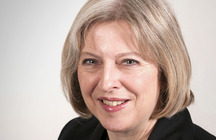
Below is the text of the speech made by Theresa May, the Prime Minister, at the Conservative Party Conference held in Birmingham on 3 October 2018.
Thank you very much for that warm welcome.
You’ll have to excuse me if I cough during this speech; I’ve been up all night supergluing the backdrop.
There are some things about last year’s conference I have tried to forget.
But I will always remember the warmth I felt from everyone in the hall.
You supported me all the way – thank you.
NO LIMIT TO WHAT WE CAN ACHIEVE
This year marks a century since the end of the First World War.
Just a few hundred yards from this conference centre stands a Hall of Memory, built to honour the sacrifice of men and women from this city in that terrible conflict.
Inscribed within it are some familiar words:
‘AT THE GOING DOWN OF THE SUN, AND IN THE MORNING, WE WILL REMEMBER THEM.’
We do remember them.
We remember the young men who left their homes to fight and die in the mud and horror of the trenches.
We remember the sailors who shovelled coal into hellfire furnaces in the bowels of battleships.
We remember the selflessness of a remarkable generation, whose legacy is the freedom we enjoy today.
I think of Hubert Grant – my father’s cousin in whose honour he was named.
Hubert fought and died at Passchendaele at the age of just 19.
Last year, at the service to mark the centenary of that battle, I took a moment to find his name on the Menin Gate, alongside thousands of his comrades.
We will remember them.
But the builders of that Hall of Memory also wanted us to do something else.
Alongside a commitment to remember, they inscribed a command that still calls to us today:
‘SEE TO IT THAT THEY SHALL NOT HAVE SUFFERED AND DIED IN VAIN.’
Those words express a determination that transformed our country.
A determination that the men who returned from the quagmires of Passchendaele to their families, here in Birmingham and across the land, should have homes fit for heroes.
That the women who made munitions, kept the buses and trains running, served as firefighters and police officers, should have a voice in our democracy.
That a country which stood together in solidarity, with people of every class sharing the danger, should become a fairer place.
A generation later, another victory built on shared sacrifice renewed that determination.
Twice in a century, Britain came together to beat the odds and build a better future.
A stronger democracy in the Mother of Parliaments – where every person, no matter their gender, no matter their class, has an equal voice.
A fairer economy in the home of the free market – where enterprise creates wealth to fund great public services.
A more secure future in the post-war world – where former enemies become friends and the trans-Atlantic alliance makes our world a safer place.
We must recapture that spirit of common purpose.
Because the lesson of that remarkable generation is clear: if we come together, there is no limit to what we can achieve.
Our future is in our hands.
SOMETHING WRONG WITH POLITICS
And that is why we are all in this hall today.
It is the reason we chose to get involved in politics in the first place.
We believe that by standing up to be counted, by working together, we can change our communities and our country for the better.
It’s not always glamorous.
I’ve seen the trailers for ‘Bodyguard’ and let me tell you – it wasn’t like that in my day.
Real politics involves a lot of hard graft.
Knocking on doors in all weathers.
Delivering bundles of leaflets.
We do it because we believe in its potential to transform lives.
We understood when we got involved that sometimes it’s adversarial.
But in the last few years something’s changed for the worse.
I feel it. I am sure you do too.
Rigorous debate between political opponents is becoming more like a confrontation between enemies.
People who put themselves forward to serve are becoming targets.
Not just them, their families as well.
We all saw the sickening pictures of a far-left extremist shouting abuse at Jacob Rees-Mogg’s children
And it’s not only Conservatives who are facing abuse.
The first black woman ever to be elected to the House of Commons receives more racist and misogynist messages today than when she first stood over 30 years ago.
You do not have to agree with a word Diane Abbott says to believe passionately in her right to say it, free from threats and abuse.
Some people have lost sight of the fact that political differences are not everything.
I have served in local and national government, in office and in opposition.
I know that no party has a monopoly on good ideas.
That getting things done requires working together – within parties and beyond them.
When our politics becomes polarised, and compromise becomes a dirty word, that becomes harder.
And good people are put off public service.
It doesn’t have to be this way.
Our Party has more elected representatives than any other.
We have in our hands the power to set a standard of decency that will be an example for others to follow.
John McCain, who spoke at this conference 12 years ago, put it like this:
‘We argue and compete and sometimes even vilify each other in our raucous public debates. But we have always had so much more in common with each other than in disagreement.’
That was Jo Cox’s message too.
It is a truth that the British people instinctively understand.
Because they are not ideologues.
They know we all have a common stake in this country and that the only path to a better future is one that we walk down together.
So, let’s rise above the abuse.
Let’s make a positive case for our values that will cut through the bitterness and bile that is poisoning our politics.
Let’s say it loud and clear: Conservatives will always stand up for a politics that unites us rather than divides us.
THE JEREMY CORBYN PARTY
That used to be Labour’s position too.
But when I look at its leadership today, I worry it’s no longer the case.
We all remember what the Labour Party used to be.
We passionately disagreed with many of their policies.
Every Labour Government left unemployment higher than they found it.
Every Labour Government ran out of other people’s money to spend.
Every Labour Government left the economy in a mess.
But at least they had some basic qualities that everyone could respect.
They were proud of our institutions.
They were proud of our armed forces.
They were proud of Britain.
Today, when I look across at the opposition benches, I can still see that Labour Party.
The heirs of Hugh Gaitskell and Barbara Castle, Dennis Healy and John Smith.
But not on the front bench.
Instead their faces stare blankly out from the rows behind, while another party occupies prime position: the Jeremy Corbyn Party.
The Jeremy Corbyn Party rejects the common values that once bridged our political divide.
Compare Jeremy Corbyn’s behaviour to that of his predecessors.
Would Neil Kinnock, who stood-up to the hard-left, have stood by while his own MPs faced deselection, and needed police protection at their Party conference?
Would Jim Callaghan, who served in the Royal Navy, have asked the Russian government to confirm the findings of our own intelligence agencies?
Would Clement Attlee, Churchill’s trusted deputy during the Second World War, have told British Jews they didn’t know the meaning of antisemitism?
What has befallen Labour is a national tragedy.
What has it come to when Jewish families today seriously discuss where they should go if Jeremy Corbyn becomes Prime Minister?
When a leading Labour MP says his party is ‘institutionally racist’?
When the Leader of the Labour Party is happy to appear on Iranian state TV, but attacks our free media here in Britain?
That is what Jeremy Corbyn has done to the Labour Party.
It is our duty, in this Conservative Party, to make sure he can never do it to our country.
PARTY FOR THE WHOLE COUNTRY
To do that we need to be a Party for the whole country.
Because today millions of people, who have never supported our Party in the past, are appalled by what Jeremy Corbyn has done to Labour.
They want to support a party that is decent, moderate, and patriotic.
One that puts the national interest first.
Delivers on the issues they care about.
And is comfortable with modern Britain in all its diversity.
We must show everyone in this country that we are that Party.
A Party that conserves the best of our inheritance, but is not afraid of change.
A party of patriotism, but not nationalism.
A party that believes in business, but is not afraid to hold businesses to account.
A party that believes in the good that government can do, but knows government will never have all the answers.
A party that believes your success in life should not be defined by who you love, your faith, the colour of your skin, who your parents were, or where you were raised – but by your talent and your hard work.
Above all a party of Unionism, not just of four proud nations, but of all our people.
A party not for the few, not even for the many, but for everyone who is willing to work hard and do their best.
SECURITY. FREEDOM. OPPORTUNITY.
And we must be a party that is not in thrall to ideology, but motivated instead by enduring principles.
For me they can be summed-up in three words: Security. Freedom. Opportunity.
Security for the nation with strong defences against threats from abroad, and protection against threats at home.
Security for communities, upheld by the brave men and women of our police forces.
Security for individuals and families, provided by a good job, a home of your own, and dignity in old age.
And security is the bedrock of freedom.
Freedom of thought, freedom of expression, freedom of action.
The freedom to make decisions for yourself, rather than have them made for you by government.
The freedom that our grandparents and great grandparents fought for against tyranny.
The freedom that swept across Eastern Europe when the Soviet Union collapsed, and nations were reborn in sovereignty and independence.
The freedom that is still denied to many in our world today.
But with freedom should always come responsibility.
To obey the law, even when you disagree with it.
To conserve our environment, for the next generation.
And most especially for those in public life – the responsibility to weigh the impact our words and actions have on other people.
And if we are secure and we are free, then opportunity is opened-up.
The opportunity to take your future in your hands. To dream, and strive, and achieve a better life.
To know that if your dad arrived on a plane from Pakistan, you can become Home Secretary.
That if you spent time in care, you can be in the Cabinet.
That if your grandparents came to our shores as part of the Windrush generation you could be the next Mayor of London.
That if you are pregnant with your first child and engaged to your girlfriend, you could be the next First Minister of Scotland.
We, the Conservative Party, are the party of opportunity.
LONG-TERM PLAN FOR THE NHS
No institution embodies our principles as Conservatives more profoundly or more personally than our National Health Service.
It gives every man, woman and child the absolute security of knowing that whenever you are sick, care will be there.
What greater freedom than to live your life never having to worry about whether you can afford the treatment you need?
What greater opportunity for a country to make the most of all its talents?
The NHS is a service that is there for everyone; free at the point of use; with care based always on clinical need, never the ability to pay.
These principles are in our country’s DNA.
And Conservatives will always uphold them.
Indeed, Conservatives have looked after our NHS for most of its life.
And this year we gave the NHS a seventieth birthday present to be proud of: the biggest cash boost in its history.
An extra £394 million every single week.
And in return, the NHS will produce a new long-term plan to make sure every penny makes a difference on the front line.
So, next time you hear someone say that the Tories don’t care about the NHS, tell them about that extra funding.
Tell them about the Conservative MPs who work in the NHS in their spare time.
Tell them about the Tory Prime Minister who can only do her job thanks to the wonderful staff of her local NHS trust, who help her manage diabetes.
Tell them about our Housing Secretary, James Brokenshire.
Last year James officially opened the new Guy’s Cancer Centre at Queen Mary’s Hospital in his constituency.
A few months later he was a patient.
The outstanding NHS care he received helped him recover, and now he is back serving in the Cabinet.
Cancer can strike any of us at any time.
A few years ago, my goddaughter was diagnosed with cancer.
She underwent treatment and it seemed to be working.
But then the cancer came back.
Last summer, she sent me a text to tell me that she was hoping to see another Christmas.
But she didn’t make it.
Half of us will be diagnosed with cancer. All of us know someone who has been.
Survival rates are increasing, but we are lagging behind other countries.
So today I can announce a new Cancer Strategy, funded through our 70th birthday investment, will form a central part of our long-term plan for the NHS.
The key to boosting your chance of surviving cancer is early diagnosis.
Five-year survival rates for bowel cancer are over 90% if caught early, but less than 10% if diagnosed late.
Through our Cancer Strategy, we will increase the early detection rate from one-in-two today, to-three-in four by 2028.
We will do it by lowering the age at which we screen for bowel cancer from 60 to 50.
By investing in the very latest scanners.
And by building more Rapid Diagnostic Centres – one stop-shops that help people get treatment quicker.
This will be a step-change in how we diagnose cancer.
It will mean that by 2028, 55,000 more people will be alive five years after their diagnosis compared to today.
Every life saved means precious extra years with friends and family.
Every life saved means a parent, a partner, a child, a god mother spared the pain of losing a loved one before their time.
PUTTING THE NATIONAL INTEREST FIRST
Our NHS saves countless lives every day.
That is never more true than when our national security is threatened.
Those are the times when I feel most keenly the responsibilities of my office.
When I have to ask our brave servicemen and women to put themselves in harm’s way.
To protect our citizens.
To support our allies, as we would expect them to support us.
To uphold the international rules on which our security depends.
Like when the Syrian regime attacked Douma with chemical weapons, killing innocent men, women and children.
We joined with our friends to send a message that the use of chemical weapons will never be tolerated.
I took the decision to send RAF jets to strike against Assad’s chemical weapons facilities.
As Prime Minister, I had to make the call, and then be held to account for it.
The same was true when Russia launched a chemical attack on the streets of the United Kingdom.
I took the decision to expel 23 Russian diplomats who were undeclared intelligence officers.
Our allies joined with us in degrading Russia’s intelligence network.
In Parliament I received almost universal support – from the SNP to the Liberal Democrats and the Labour backbenches.
There was just one dissenting voice – Jeremy Corbyn.
Dismissing the findings of our security services.
Suggesting that the country responsible for the attack should double-check the findings of our chemical weapons scientists.
Refusing to lay the blame squarely where it belonged.
Just imagine if he were Prime Minister.
He says Britain should disarm herself in the hope others follow suit.
I say no – we must keep our defences strong to keep our country safe.
He says a strong NATO simply provokes Russia.
I say no – it is the guarantor of our freedom and security.
He poses as a humanitarian. But he says that military action to save lives is only justified with the approval of the Security Council – effectively giving Russia a veto.
I say no – we cannot outsource our conscience to the Kremlin.
HONOURING THE REFERENDUM
Leadership is doing what you believe to be right and having the courage and determination to see it through.
That is the approach I have taken on Brexit.
We have had disagreements in this Party about Britain’s membership of the EU for a long time.
So, it is no surprise that we have had a range of different views expressed this week.
But my job as Prime Minister is to do what I believe to be in the national interest.
And that means two things.
First, honouring the result of the referendum.
MPs asked the British people to take this decision.
We put our faith in their judgement.
They have put their faith in us to deliver.
I will not let them down.
And secondly, to seek a good trading and security relationship with our neighbours after we have left.
They are our close friends and allies, and we should ensure it stays that way.
That’s what I said at Lancaster House.
It’s what we promised in our manifesto.
And it’s what I’ve worked day and night for the last two years to achieve.
No-one wants a good deal more than me.
But that has never meant getting a deal at any cost.
Britain isn’t afraid to leave with no deal if we have to.
But we need to be honest about it.
Leaving without a deal – introducing tariffs and costly checks at the border – would be a bad outcome for the UK and the EU.
It would be tough at first, but the resilience and ingenuity of the British people would see us through.
Some people ask me to rule out no deal.
But if I did that I would weaken our negotiating position and have to agree to whatever the EU offers.
And at the moment that would mean accepting one of two things.
Either a deal that keeps us in the EU in all but name, keeps free movement, keeps vast annual payments and stops us signing trade deals with other countries.
Or a deal that carves off Northern Ireland, a part of this country, effectively leaving it in the EU’s Custom’s Union.
So, let us send a clear message from this hall today: we will never accept either of those choices.
We will not betray the result of the referendum.
And we will never break up our country.
I have treated the EU with nothing but respect. The UK expects the same.
OUR PROPOSAL
In a negotiation, if you can’t accept what the other side proposes, you present an alternative.
That is what we have done.
Our proposal is for a free trade deal that provides for frictionless trade in goods.
It would protect hundreds of thousands of jobs in the just-in-time supply chains our manufacturing firms rely on.
Businesses wouldn’t face costly checks when they export to the EU, so they can invest with confidence.
And it would protect our precious Union – the seamless border in Northern Ireland, a bedrock of peace and stability, would see no change whatsoever.
No simple free trade agreement could achieve that, not even one that makes use of the very latest technology.
Our proposal would be good for our rural communities, getting us out of the Common Agricultural Policy.
It would be good for our coastal communities.
We would be out of the Common Fisheries Policy, an independent coastal state once again.
And with the UK’s biggest fishing fleets based in Scotland, let me say this to Nicola Sturgeon.
You claim to stand up for Scotland, but you want to lock Scottish fishermen into the CFP forever.
That’s not ‘Stronger for Scotland’, it’s a betrayal of Scotland.
Our proposal would mean we could renew our role in the world, strike new trade deals with other countries.
With control of our money, we can spend more on our NHS.
With control of our laws, we can bring decision-making closer to the people and returning powers to Westminster, Edinburgh, Cardiff and Belfast.
And with control of our borders, we can do something that no British government has been able to do in decades – restore full and complete control of who comes into this country to the democratically elected representatives of the British people.
And this is what we will do with the immigration powers we take back.
The free movement of people will end, once and for all.
In its place we will introduce a new system.
It will be based on what skills you have to offer, not which country you come from.
Throughout our history, migrants have made a huge contribution to our country – and they will continue to in the future.
Those with the skills we need, who want to come here and work hard, will find a welcome.
But we will be able to reduce the numbers, as we promised.
And by ending free movement we will give British business an incentive to train our own young people and to invest in technology that will improve their productivity.
So this is our proposal. Taking back control of our borders, laws and money.
Good for jobs, good for the Union.
It delivers on the referendum.
It keeps faith with the British people.
It is in the national interest.
TIME TO COME TOGETHER
Even if we do not all agree on every part of this proposal, we need to come together.
Because it’s time we faced up to what is at risk.
We have a Labour Party that, if they were in Government, would accept any deal the EU chose to offer, regardless of how bad it is for the UK.
But who also say they’ll oppose any deal I choose to bring back, regardless of how good it is for the UK.
They are not acting in the national interest, but their own political interest.
And there are plenty of prominent people in British politics – in Parliament and out of it – who want to stop Brexit in its tracks.
Their latest plan is to hold a second referendum.
They call it a ‘People’s Vote’.
But we had the people’s vote. The people voted to leave.
A second referendum would be a “politicians’ vote”: politicians telling people they got it wrong the first time and should try again.
Think for a moment what it would do to faith in our democracy if – having asked the people of this country to take this decision – politicians tried to overturn it.
Those of us who do respect the result – whichever side of the question we stood on two years ago – need to come together now.
If we don’t – if we all go off in different directions in pursuit of our own visions of the perfect Brexit – we risk ending up with no Brexit at all.
And there’s another reason why we need to come together.
We are entering the toughest phase of the negotiations.
You saw in Salzburg that I am standing up for Britain.
What we are proposing is very challenging for the EU.
But if we stick together and hold our nerve I know we can get a deal that delivers for Britain.
A BREXIT THAT WORKS FOR EVERYONE
And ultimately that’s what it’s all about.
The people we serve are not interested in debates about the theory of Brexit – their livelihoods depend on making a success of it in practice.
A Brexit that might make Britain stronger fifty years from now is no good to you if it makes your life harder today.
If you work in a factory in Pendle, you need a Brexit that keeps trade friction-free and supply-chains flowing.
If you are a fisherman in Peterhead, you need a Brexit that delivers full control of our waters.
If you run an exporting business in Penarth, you need a Brexit that will open up new global markets.
If you live in Pettigo on the Irish border, you need a Brexit that keeps it frictionless and communities connected.
These things matter to you – so they matter to me.
You are the people we are all here to serve.
And together we will build a brighter future for the whole United Kingdom.
A MOMENT OF OPPORTUNITY
I passionately believe that our best days lie ahead of us and that our future is full of promise.
We have fundamental strengths as a country.
English is the global language.
We can trade with Shanghai over morning coffee and San Francisco at tea time.
Our courts are incorruptible.
Our universities, world-leading.
Our soft power, unrivalled.
A driving force in the Commonwealth.
A permanent member of the UN Security Council.
And soon we will retake our own seat at the World Trade Organisation.
Britain will be a champion for free trade right across the globe – and I want to thank our fantastic trade envoys for leading that work.
But our greatest strength of all is the talent and diversity of our people.
We have produced more Nobel Prize winners than any country apart from America.
We are home to amazing innovators, creators, and entrepreneurs.
Our wonderful public servants are the best in the world.
The compassion of our NHS staff, the dedication of our teachers, the bravery of our police, and the matchless courage of our armed forces.
Don’t let anyone tell you we don’t have what it takes: we have everything we need to succeed.
And in 2022 we will put the best of British creativity and innovation, culture and heritage on show in a year-long festival of Great Britain and Northern Ireland.
Wherever I travel, I find a renewed interest in Britain.
Let me give you one example.
Last month I became the first British Prime Minister to visit Kenya in 30 years.
This is a Commonwealth partner, a nation of over 50 million people, on a continent that will be an engine-room of economic growth in the years ahead.
Their message to me was clear: our businesses want to trade with you.
Our young people want to study with you.
Our scientists and artists want to collaborate with you.
Yet I was the first Prime Minister to visit since Margaret Thatcher.
There is a whole world out there. Let’s lift our horizons to meet it.
THE POWER OF FREE MARKETS
The UK has always been an outward-looking trading nation.
And as Conservatives, we believe in the power of a well-regulated free market – the greatest agent of collective human progress ever devised.
In the last 30 years, extreme poverty has been cut in half.
Global life expectancy has increased by nearly 20 years.
Child mortality has halved.
But the free market hasn’t just saved lives, it has improved them: the internet, smartphones, cheap air travel, electric cars, even flat-pack furniture.
We should defend free markets, because it is ordinary working people who benefit.
Closed markets and command economies were not overthrown by powerful elites, but by ordinary people.
By the shipyard workers of Gdańsk, who led the resistance in Poland.
By people of all backgrounds who took part in the Velvet Revolution in Czechoslovakia.
By the people of East Berlin, who tore down that wall.
These were the many, not the few.
And when the many have the freedom to choose, they choose freedom.
I saw it last month in South Africa.
I was speaking to some inspiring young people, full of fire and hope for their futures.
Some told me they wanted to be doctors, others lawyers.
I think some might even have been inspired to become professional dancers.
Perhaps not.
But one young woman said something else.
She told me her ambition was to start a business, so she could create jobs in her local community.
The people in this hall who have started their own businesses will know how thrilling it is to take a risk and start something new.
But offering someone a job – creating opportunity for other people – is one of the most socially-responsible things you can do.
It is an act of public service as noble as any other.
To everyone who has done it – we are all in your debt.
So, we in this party, we in this hall, we say thank you.
And to all businesses – large and small – you may have heard that there is a four-letter word to describe what we Conservatives want to do to you.
It has a single syllable. It is of Anglo-Saxon derivation. It ends in the letter ‘K’.
Back business.
Back them to create jobs and build prosperity.
Back them to drive innovation and improve lives.
Back them with the lowest Corporation Tax in the G20.
Britain, under my Conservative Government, is open for business.
TEN YEARS ON
We support free markets because we know their strengths.
But we also know their limits.
The defining event for a new generation of voters was not the fall of the Berlin Wall, but the collapse of the banks.
It was the biggest market failure in our lifetimes.
A recession in which almost three quarters of a million jobs were lost.
Sound businesses forced to close because they could not access credit.
People queuing to withdraw their money from Northern Rock.
Thanks to Labour, the country was not prepared.
The government ended up borrowing £1 for every £4 it spent.
It fell to our party to clear up the mess.
Eight years on, how have we done?
Our economy is growing.
The deficit down by four-fifths.
Unemployment at its lowest since the 1970s.
Youth unemployment at a record low.
Households where nobody works down by almost a million.
We should not forget what’s behind those numbers.
The parent who swaps a benefit cheque for a regular wage.
The youngster leaving school and never having to sign on.
The children growing up with an example of hard work.
Hope and dignity for millions of people in our country.
We should be proud of our record.
But our pride in those achievements should not blind us to the challenges that remain.
The after-effects of the crash are still being felt – in four important ways.
Some markets are still not working in the interests of ordinary people.
Employment is up, but too many people haven’t had a decent pay rise.
The deficit is down, but achieving that has been painful.
And our economy is growing, but some communities have been left behind.
This is why some people still feel that our economy isn’t working for them.
Our mission as Conservatives must be to show them that we can build an economy that does.
LABOUR’S FALSE HOPE
In Liverpool last week, all Labour offered were bogus solutions that would make things worse.
Ideas that might seem attractive at first glance, but which would hurt the very people they claim to help.
Their flagship announcement was a case in point.
It would mean the government effectively confiscating a tenth of every company with more than 250 employees.
Workers wouldn’t become shareholders – and much of the income generated would end up with the government.
They dress it up as employee ownership, but it’s a giant stealth tax on enterprise.
It would slash the share prices of British businesses, hitting anyone with a private pension.
And it would make the UK an unattractive place to invest, driving away business, destroying jobs.
The same is true of their nationalisation policy.
They want our railways and utilities to be owned entirely by the Government.
But when you nationalise something, people pay for it twice – once when they use the service, and again every month through their taxes.
And investment in them goes down, because when governments are setting budgets, they will always choose schools and hospitals over reservoirs and railways, so people get a worse service.
Even some in the Labour Party admit their programme of nationalisation, and their endless expensive promises, would cost £1 trillion.
You heard me right – one thousand billion pounds.
That is not government money but your money.
Because Labour would have to pay for it by raising taxes higher and higher.
Of course, everyone should pay their fair share.
But when you raise taxes too high, businesses cannot afford to invest.
They cannot afford to take on new employees.
Eventually, they cannot afford to operate here at all.
They move abroad, create jobs in other countries, pay taxes somewhere else, and leave us poorer.
They would also have to increase borrowing again.
We already spend more each year on debt interest than we do on our schools.
After all the sacrifices we have made, they would take us back to square one.
These ideas won’t help people who are struggling, they will hurt them.
Hurt workers, whose jobs would go as businesses left Britain.
Hurt pensioners, whose savings would be devalued.
And hurt young people, whose future Labour would mortgage.
FIXING BROKEN MARKETS
However bad the Labour approach is, we must do more than criticise it.
We need to show what this Conservative government is doing to address people’s concerns.
First, we need to make markets work in the interests of ordinary people again.
That’s why we toughened up our corporate governance rules.
We are giving workers a stronger voice in the boardroom.
We have changed the rules on bonuses, so bosses are rewarded for long-term performance, not short-term profit.
It’s why, with the gig economy changing how people work, we are changing our employment rules, so new technology cannot undermine workers’ rights.
It’s why we introduced the energy price cap.
Announced at last year’s conference, and in place for this winter.
It will stop energy firms charging their most loyal customers unfair prices.
Any other companies charging their customers a ‘loyalty penalty’ should know: we will take action.
Because we put the interest of consumers first, we have also announced a fundamental review into our railways.
Since privatisation, investment in the network has gone up, safety has improved, and more people are travelling by rail than ever before.
But on some routes the service has not been good enough. We will fix that.
And while we do so, we will bring in a new system of auto-compensation, so that when your train is late you won’t have to waste more time getting your money back.
Last year I made it my personal mission to fix another broken market: housing.
We cannot make the case for capitalism if ordinary working people have no chance of owning capital.
To put the dream of home ownership back within their reach, we scrapped stamp duty for most first-time buyers – and over 120,000 households have already benefited.
We’ve helped half a million people onto the housing ladder through other schemes like Help to Buy.
And this week we have announced that we will charge a higher rate of stamp duty on those buying homes who do not live and pay taxes in the UK, to help level the playing field for British buyers.
The money raised will go towards tackling the scourge of rough sleeping.
But the truth is that while these measures will help in the short term, we will only fix this broken market by building more homes.
And that is what we are doing.
More new homes were added to our stock last year than in all but one of the last 30 years.
But we need to do better still.
The last time Britain was building enough homes – half a century ago – local councils made a big contribution.
We’ve opened-up the £9 billion Affordable Housing Programme to councils, to get them building again.
And at last year’s conference I announced an additional £2 billion for affordable housing.
But something is still holding many of them back.
There is a government cap on how much they can borrow against their Housing Revenue Account assets to fund new developments.
Solving the housing crisis is the biggest domestic policy challenge of our generation.
It doesn’t make sense to stop councils from playing their part in solving it.
So today I can announce that we are scrapping that cap.
We will help you get on the housing ladder.
And we will build the homes this country needs.
COST OF LIVING
Our next challenge is to help working people with the cost of living.
We know how hard people work to make ends meet and provide for their families.
It isn’t easy. It never has been.
And the difference it makes to have a little bit of money left to put away at the end of each month isn’t measured in pounds and pence.
It’s the look on a daughter’s face when her mum says she can have the bike she wants for her birthday.
It’s the joy and precious memories that a week’s holiday with the family brings.
It’s the peace of mind that comes with having some savings.
Many people, in towns and cities across our country, cannot take these things for granted.
They are the people this party exists for.
They are the people for whom this party must deliver.
It’s for them that we cut income tax.
Introduced a National Living Wage.
Extended free childcare.
And froze fuel duty every year.
Because for millions of people, their car is not a luxury. It’s a necessity.
Some have wondered if there would be a thaw in our policy this year.
Today I can confirm, given the high oil price, the Chancellor will freeze fuel duty once again in his budget later this month.
Money in the pockets of hard-working people.
A Conservative Government that is on their side.
END OF AUSTERITY
Third, after a decade of austerity, people need to know that their hard work has paid off.
Because of that hard work, and the decisions taken by the Chancellor, our national debt is starting to fall for the first time in a generation.
This is a historic achievement.
But getting to this turning point wasn’t easy.
Public sector workers had their wages frozen.
Local services had to do more with less.
And families felt the squeeze.
Fixing our finances was necessary.
There must be no return to the uncontrolled borrowing of the past.
No undoing all the progress of the last eight years.
No taking Britain back to square one.
But the British people need to know that the end is in sight.
And our message to them must be this: we get it.
We are not just a party to clean up a mess, we are the party to steer a course to a better future.
Sound finances are essential, but they are not the limit of our ambition.
Because you made sacrifices, there are better days ahead.
So, when we’ve secured a good Brexit deal for Britain, at the Spending Review next year we will set out our approach for the future.
Debt as a share of the economy will continue to go down, support for public services will go up.
Because, a decade after the financial crash, people need to know that the austerity it led to is over and that their hard work has paid off.
AN ECONOMY OF THE FUTURE
The final challenge is about the future we want for our economy.
We stand on the threshold of technological changes that will transform how we live and work, travel and communicate.
This has the potential to improve the lives of everyone in society, but only if we take the right decisions now.
At times of change in the past, the benefits have not been evenly spread.
Some communities have been left behind. This time it must be different.
Because we are all worse off when any part of us is held back.
That means doing things differently.
Our Modern Industrial Strategy is helping the whole country get ready for the economic change that is coming.
We are investing in infrastructure.
We are doing more than anyone since the Victorians to upgrade our railways.
Our road-building programme is the largest since the 1970s.
We have taken the big decision to build a third runway at Heathrow.
We are driving up research spending– so we can be the ideas factory of the future.
We are investing in our workforce – helping people train and retrain.
In our schools, we are keeping standards high.
And where Labour want to roll-back reform, scrap academies and kill off free schools, we will build more of them, because every child deserves a great start in life.
Every child, in every town and city, across the whole country.
So that is our Conservative answer.
Fixing markets not destroying them.
Helping with the cost of living.
Ending austerity.
An economy of the future with nowhere left behind.
This is how we will build a country that works for everyone.
I made that my mission when I stood for the leadership.
It was what I dedicated my government to on the steps of Downing Street.
And it is the future this Party will deliver.
OUR FUTURE IS IN OUR HANDS
Every person in this hall has the power to shape that future.
This is a moment of opportunity for our party.
To champion decency in our politics.
To be the moderate, patriotic government this country needs.
To be a party not for the few, not even for the many, but for everyone who works hard and plays by the rules.
And it’s a moment of opportunity for our country.
To honour the result of the referendum.
To come together to make a success of the decision we took.
To build the homes we need.
To get the next generation on the housing ladder.
To help people who are struggling to make ends meet.
To invest in our vital public services.
To renew our precious National Health Service.
To lead the world in the technologies of the future.
To ensure every family and every community shares the success.
To tackle the burning injustices that hold people back.
We stand at a pivotal moment in our history.
It falls to our party to lead our country through it.
When we come together there is no limit to what we can achieve.
Ours is a great country.
Our future is in our hands.
Together, let’s seize it.
Together, let’s build a better Britain.