Tag: Sajid Javid

  • Sajid Javid – 2022 Personal Statement in Commons after Resignation

    Sajid Javid – 2022 Personal Statement in Commons after Resignation

    The personal statement made by Sajid Javid, the former Secretary of State for Health and Social Care, in the House of Commons on 6 July 2022.

    I am grateful for your permission to make this personal statement, Mr Speaker. Yesterday we began our day together—you, I, my right hon. Friend the Prime Minister and Members from across this House—when we broke bread together at the parliamentary prayer breakfast, and we all listened to the words of Rev. Les Isaac, who spoke about the responsibility that comes with leadership: the responsibility to serve the interests of others above our own, and to seek common ground in our party, our community and, above all, our country.

    Colleagues will be forgiven for having a sense of déjà vu. Despite how it might seem, I am not one of life’s quitters. I did not quit when I was told that boys like me do not do maths; I did not quit when old-school bankers said I did not have the right school ties; and I did not quit when people in my community said that I should not marry the love of my life.

    I care deeply about public service and giving back to this country that has given me so much. That is why, when I got the call from my right hon. Friend the Prime Minister just over a year ago, I did not hesitate to serve again. It was a critical time for our country: tough decisions needed to be made about when we were going to come out of lockdown, and about supporting the national health service and care sector under unprecedented strain.

    It has been an absolute privilege of my life to have been entrusted with these responsibilities, and I can only hope that my best has been good enough. It has undoubtedly also been one of the toughest roles I have had so far—the gravity of Home Office decisions; the scale of Treasury decisions—but nothing matters more than the health of our people, the British people, especially in the wake of a pandemic.

    Caring for people’s health and wellbeing is truly a noble vocation, so I would like to take this opportunity to pay tribute to all those across the country working in the health and care sectors, as well as those I worked so closely with in my old Department, the Department of Health and Social Care, and in the NHS. There was so much that I planned for the long-term reform of our health and care systems, and it is a wrench to leave that important work behind.

    When I last gave a personal statement from this seat, I spoke about the importance of institutions and conventions. Today, it is about the importance of integrity—and do not worry, there is not going to be a series of these. Institutions and integrity are both central pillars that underpin our great democracy. It does not matter what your political perspective is in this House; I believe that we are all motivated by the national interest and that the public expect all of us to maintain honesty and to maintain integrity in whatever we do. This is not an abstract matter; we have seen what happens in great democracies when divisions are entrenched, and not bridged. We cannot allow that to happen here; we must bring the country together as one nation.

    Effective governance inevitably requires loyalty and collective responsibility—of course it does—and I am instinctively a team player and have completely focused on governing effectively over the last year. But treading the tightrope between loyalty and integrity has become impossible in recent months, and I will never risk losing my integrity.

    I also believe that a team is as good as its team captain, and that a captain is as good as his or her team, so loyalty must go both ways. The events of recent months have made it increasingly difficult to be in that team. It is not fair on ministerial colleagues to have to go out every morning defending lines that do not stand up and do not hold up; it is not fair on my parliamentary colleagues, who bear the brunt of constituents’ dismay in their inboxes and on the doorsteps in recent elections; and it is not fair on Conservative members and voters who rightly expect better standards from the party they supported.

    When the first stories of parties in Downing Street emerged late last year, I was personally assured at the most senior level, by my right hon. Friend’s then team, that

    “there had been no parties in Downing Street and no rules were broken.”

    I gave the benefit of the doubt and I went on those media rounds to say that I had had those assurances from the most senior level of the Prime Minister’s team. Then we had more stories. We had the Sue Gray report and a new Downing Street team. I continued to give the benefit of the doubt. This week, again, we have reason to question the truth and integrity of what we have all been told. At some point, we have to conclude that enough is enough. I believe that that point is now.

    I welcomed the Prime Minister’s public acknowledgement last night that matters could have been handled better in who he appointed, what was said about what he knew and when. I appreciated his kind and humble words, and his humble spirit, when I went to see him yesterday, and also the kind letter that he has sent to me. But I do fear that the reset button can work only so many times. There are only so many times that we can turn that machine on and off before we realise that something is fundamentally wrong.

    Last month, I gave the benefit of the doubt one last time, but I have concluded that the problem starts at the top, and I believe that that is not going to change. That means it is for those of us in a position of responsibility to make that change. I wish my Cabinet colleagues well. I can see that they have decided to remain in the Cabinet. They will have their own reasons, but it is a choice. I know just how difficult that choice is, but let us be clear: not doing something is an active decision.

    I am deeply concerned about how the next generation will see the Conservative party on our current course. Our reputation after 12 years in government depends on regaining the public’s trust. This is not just a personal matter: the philosophy and perception of Conservatives depend on it. It is central to the Conservative ideal that we believe in decency, in personal responsibility and in social justice, enabled by conventions and the rule of law. The Conservative mission to extend freedom and prosperity and opportunity is all at risk if we cannot uphold that ideal.

    The Conservative party is not the only great institution in need of urgent repair. Like everyone in this House, I have been dismayed by the drip, drip of stories of harassment and worse by Members of this House. I am also concerned about how the next generation will see this House and the health of our democracy. In recent years, trust in our roles has been undermined by a series of scandals, but the one thing that we can control is our own values and behaviours. It is incumbent on all of us to set high standards for ourselves and to take action when they are not met by others.

    I am grateful for the messages of support that I have had from many Members of this House and beyond. I got into politics to do something, not to be somebody, so it is hard in one way, but not in another—being a good father, a husband, a son and a citizen is good enough for me. If I can continue to contribute to public life and to my party from the Back Benches, it will be a privilege to do so.

  • Sajid Javid – 2022 Letter of Resignation as Health Secretary

    Sajid Javid – 2022 Letter of Resignation as Health Secretary

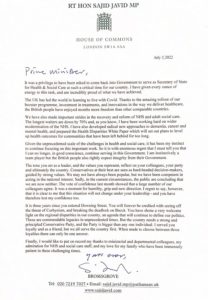
    The letter written by Sajid Javid, the Secretary of Health and Social Care, to the Prime Minister, Boris Johnson, on 5 July 2022.

  • Sajid Javid – 2022 Statement on Gender Recognition Disclosure of Information

    Sajid Javid – 2022 Statement on Gender Recognition Disclosure of Information

    The statement made by Sajid Javid, the Secretary of State for Health and Social Care, in the House of Commons on 30 June 2022.

    Today, I have laid the Gender Recognition (Disclosure of Information) (England) Order 2022 in Parliament. This statutory instrument will make a minor change under the Gender Recognition Act (GRA) 2004 in order to facilitate the invaluable research being undertaken as part of Dr Hilary Cass independent review of gender identity services for children and young people (the Cass review).

    Under the Gender Recognition Act 2004, it is an offence for a person acting in an official capacity to disclose information about the gender history of a person with a gender recognition certificate (GRC). The Act calls this “protected information”, with some existing exemptions, such as where disclosure is to prevent or investigate crime, or the subject of the information agrees to the disclosure.

    The order I have laid today will add a further exemption to the GRA so that a closely defined class of people who facilitate, assist and carry out the research for the Cass review will be able to disclose protected information to each other during the course of their work. Without access to information currently protected under the Act, a significant portion of the available data on health outcomes would have to be removed from the study. This would subsequently prevent Dr Cass review from being able to provide robust recommendations rooted in the best available clinical evidence about how this care can best be provided.

    This data will allow us to plan the provision of these services from a world-leading clinical evidence base, to promote better health outcomes for those who use these important services. I firmly believe that this will help enable further debate on these issues to be informed by the best available clinical evidence which will better serve everyone, not least children.

    I remain committed to upholding the rights and privacy of transgender people, so this data will be carefully controlled. Only those working for a small number of organisations listed in the order and who are involved in the research will be able to access protected information and share it with each other. Furthermore, those within this closed circle will only be able to access and share the data if doing so is genuinely necessary in order to facilitate, assist or carry out research as part of the Cass review.

    As an additional safeguard, the order will expire after a period of five years which is the maximum amount of time that we believe the project will take. The order does not allow patient identifiable information to be made public through the course of this research, and any research outputs subsequently published will be fully anonymised.

  • Sajid Javid – 2022 Statement on a Plan for Digital Health and Social Care

    Sajid Javid – 2022 Statement on a Plan for Digital Health and Social Care

    The statement made by Sajid Javid, the Secretary of State for Health and Social Care, in the House of Commons on 29 June 2022.

    I would like to inform the House that “A Plan for Digital Health and Social Care” has been published today. This document sets out how we will build a more digitised, more efficient and more personalised health and care system.

    Earlier this year, I made a speech setting out my four priorities for reform in health: prevention, personalisation, people and performance. We cannot deliver the change We need to see, unless we embrace the opportunities from digital technologies.

    We are now embarking on a transformative programme of reforms that will make sure the NHS is set up to meet the challenges of 2048, not of 1948, when it was first established, and also to make the vital changes that are so urgently required in social care.

    On 13 June we published a strategy for a data-enabled health and social care sector, “Data Saves Lives”, which draws on lessons learned about the power of data from the response to the covid-19 pandemic. Data Saves Lives includes a range of commitments that will help connect systems and details how we will use data flowing through the digitised health and social care system to continually improve services while maintaining the highest standards of privacy and ethics.

    The long-term sustainability of health and social care is dependent on having the right digital foundations in place, and so digital transformation is crucial in achieving and delivering these reforms.

    This plan sets how the delivery of health and social care will change, taking forward what we have learnt from the pandemic, and from tech pioneers across the world. The aim is something that we can all get behind: a health and social care system that will be much faster and more effective, and delivers more personalised care.

    Digital is not, and will not, be the only means of access to health and social care services, but through it we can ensure that the needs and preferences of individuals are reflected in the services we provide.

    Health and social care organisations and partners from industry can use the plan to help shape their strategies to digitally transform services for their populations.

    The NHS app will be at the heart of these plans. We saw during the pandemic how people grasped the opportunity to have healthcare at their fingertips.

    I am determined to make this app the front door to NHS services, and this plan shows how we will add an array of new features over the coming months and years, with new functionality and more value for patients every single month. My vision is one in which the app is an assistant in your pocket and a permanent feature of how we do healthcare in this country.

    With digitised services and a connected system that supports integration and harnesses the power of data, technology can create a transformed health and social care system that is more responsive to the needs and preferences of all people, identifies and reduces health disparities and delivers improved outcomes for everyone.

    We have already made huge progress. Over 28 million people now have the NHS app in their pocket, over 40 million people have an NHS login, and most NHS trusts have an electronic patient record system in place. This is on top of unprecedented investment in the digitisation of adult social care, including £150 million of funding for digital adoption that we announced in our recent White Paper.

    This plan sets out the next chapter of this story of digital transformation. It sets out a vision of how we will build a more connected and much more efficient system.

    The opportunities offered by digital transformation are huge, with benefits over the next decade running to billions of pounds in efficiencies, economic growth and private investment.

    That plan includes a raft of other initiatives, £2 billion of funding to support electronic patient records to be in all NHS trusts, and help over 500,000 people to use digital tools to manage their long-term health conditions in their own homes.

    Just as we are putting the right technology in place, we also need to make sure that people are confident and supported in using it. The plan also shows how we will relentlessly focus on digital skills, leadership and culture as well as building patient trust, at all levels, so we can make transformation durable right across the board.

    This agenda matters more than it did when this pandemic began. I am determined to use the power of technology and the skills, leadership and culture that underpins it, to drive a new era of digital transformation. So that our health and care system, and our country, will thrive long into the future, delivering vast benefits for patients.

    I will deposit a copy of the plan in the Libraries of both Houses.

  • Sajid Javid – 2022 Statement on the Draft Mental Health Bill

    Sajid Javid – 2022 Statement on the Draft Mental Health Bill

    The statement made by Sajid Javid, the Secretary of State for Health and Social Care, in the House of Commons on 27 June 2022.

    With permission, Mr Speaker, I would like to make a statement on our plans to bring the Mental Health Act 1983 into the 21st century. Today, just as we pledged in the Queen’s Speech, we have published a draft Mental Health Bill to modernise legislation that was passed by the House almost 40 years ago and make sure that it is fit for the future.

    Last year, we invested £500 million to support those with mental health needs who were most affected by the pandemic and, as we set out in the NHS long-term plan, we are investing record amounts into expanding and transforming mental health services. That will reach an extra £2.3 billion each year by 2023-24. Later this year, we will also publish a new 10-year mental health plan followed by a 10-year suicide prevention plan, which, as I set out in a speech on Friday, will place a determined focus on this major source of grief and heartbreak so that fewer people will one day get the news that turns their lives upside down. But we cannot make the critical reforms that we need and that are so essential to the country’s mental health system without making sure that the law that underpins our country’s mental health system is up to date, too.

    Since the 1983 Act, our understanding of and attitude towards mental health has transformed beyond recognition, and it is right that we act now to bring the Act up to date. The Mental Health Act was created so that people who have severe mental illnesses and present a risk to themselves or others can be safely detained and treated for their own protection and that of those around them, but there are a number of alarming issues with how the Act is currently used. Too many people are being detained. They are also being detained for too long, and there are inequalities among those who are detained. The previous Prime Minister, my right hon. Friend the Member for Maidenhead (Mrs May), asked Professor Sir Simon Wessely to lead a review into the Act. I pay tribute to my right hon. Friend for her tireless commitment to this most important of issues and to Sir Simon for his illuminating report, which made a powerful case for reform and was rightly welcomed on both sides of the House. It made for uncomfortable but essential reading, vividly showing how currently the Act fails patients and their loved ones and deprives people of autonomy and control over their care.

    The draft legislation that we have published today builds on Sir Simon’s recommendations as well as those in our White Paper, which was published in partnership with the Ministry of Justice last year. Just like Sir Simon’s report, the White Paper was welcomed by both sides of the House. It was also welcomed by leading charities including Mind, the National Autistic Society and Rethink, countless mental health professionals and, critically, the people who use mental health services and their loved ones. Today, we are showing how we will put the vision into action. The Bill is a once-in-a-generation reform, and I would like to set out briefly to the House the important themes that sit behind it.

    First, the Bill rebalances the criteria for detention so that it will take place only as a last resort when all other options have been explored and considered. Under the new criteria, people will be detained only when they pose a significant risk of harm to themselves and others, and patients should be detained only if they will benefit from the treatment that is made possible by their detention.

    Secondly, the Bill shows how we will give patients more control over their care and treatment. It will ensure that, in most cases, clinicians can administer compulsory treatment only if there is a strong reason to do so. In future, all patients formally detained under the Act will have a statutory right to a care and treatment plan, drawn up between the patient and their clinician, and personalised based on the patient’s needs. It will give them a clear road map to their discharge from hospital.

    There are some cases when patients are not able to make decisions about their own care or feel that they could benefit from greater support. Currently, patients are not always able to choose who can represent them, as their nearest relative automatically qualifies to act on their behalf. The Bill will change that, allowing patients to choose a nominated person who they believe is best placed to look after their interests. The Bill will also increase the powers of that nominated person, so that they can be consulted about the patient’s future care.

    Thirdly, the Bill will tackle the disparities in how the 1983 Act is used. Black people are four times more likely to be detained under the Act than white people, and 10 times more likely to be placed on a community treatment order. The Bill provides for greater scrutiny of decision making, including through greater use of second opinions on important decisions, and through expanded access to independent tribunals; that will help us to address the disparities in the use of the Act.

    Fourthly, the Bill will enhance support for patients with severe mental health needs who come into contact with the criminal justice system. Under the 1983 Act, too often, people in prison experience delays in getting treatment in hospital. Courts are sometimes forced to divert defendants who require care and treatment, some of whom have not been convicted, to prison as a so-called place of safety. The Bill will make crucial improvements so that vulnerable offenders and those awaiting trial can access the treatment that they need. It will tackle delays and speed up access to specialist care by introducing a new statutory 28-day time limit for transfers from prison to hospital, and it will end the use of prison as a so-called place of safety, so that patients can get the care that they need in the appropriate hospital setting.

    The Bill will also amend the Bail Act 1976 so that courts are no longer forced to deny a defendant bail if the judge’s sole concern about granting bail has to do with the defendant’s mental health. The Bill will allow the judge to send them to hospital instead, so that they can be in the best environment for their mental health and can receive any treatment that they need.

    Finally, the Bill will improve the way that people with a learning disability and autistic people are treated under the 1983 Act. One of my priorities in my role is personalised care. The current blanket approach cannot be allowed to continue; it means that too many autistic people and people with a learning disability are admitted into institutional settings when they would be better served by being in the community. The Bill will change this. It limits the scope for detaining people with learning disabilities and autistic people for treatment unless they have a mental illness that justifies a longer stay or they are admitted through the criminal justice system. It also gives commissioners of local authorities and integrated care boards new duties to make sure that the right community support is available instead.

    I look forward to working with hon. Members in all parts of the House as we take these plans forward. This momentous Bill deals with one of the most serious and sombre responsibilities of any Government: their responsibility for the power to deprive people of their liberty. Mental ill health can impact any of us at any time. It is essential that we all have confidence that the system will treat us and our loved ones with dignity and compassion. That is what the Bill will deliver. I commend the statement to the House.

  • Sajid Javid – 2022 Update on Covid-19 (June 2022)

    Sajid Javid – 2022 Update on Covid-19 (June 2022)

    The statement made by Sajid Javid, the Secretary of State for Health and Social Care, in the House of Commons on 27 June 2022.

    As part of our continued commitment to open up travel, on 23 June, the Government extended the International NHS covid pass letter service to allow children aged five to 11 years to get an International NHS covid pass following a positive NHS PCR test or equivalent within the past 180 days—recovery status. Prior to 23 June, children aged five to 11 could only access an international NHS covid pass if they had received a full primary course of covid-19 vaccination.

    Extending access to the International NHS covid pass to children aged five to 11 with recovery status will save families the cost of testing in countries where this is required for foreign travel and ensures that young children are able to provide proof of their covid-19 status on a par with the rest of the population. The UK has no covid certification requirements and this is to support outbound travel to a variety of countries that still have requirements.

    A person with parental responsibility for the child—such as the parent or guardian—will be able to request the letter online via the NHS website or by calling 119. The letter will only be sent to the address on the child’s GP record.

    This service is now available for children aged five to 11 resident in England and Wales. A letter based on recovery status is not available in the Isle of Man. In Northern Ireland, parents or guardians of children aged five to 11 have been able to request a digital or printed covid certificate on behalf of a dependant since January 2022. The COVIDCert NI app was updated in March 2022, to allow all those under 16 to upload the certificate—requested on their behalf—to display on the app. Anyone under 16 who tested positive for covid through an NHS PCR test prior to 1 May is able to request a recovery certificate in Scotland by phoning the covid status helpline on: 0808 196 8565.

  • Sajid Javid – 2022 Speech on Suicide Prevention

    Sajid Javid – 2022 Speech on Suicide Prevention

    The speech made by Sajid Javid, the Secretary of State for Health and Social Care, on 24 June 2022.

    Last Monday would have been my brother Tariq’s birthday. I say it would have been because Tariq is no longer with us. He took his own life.

    And on that Monday it was the first thing I thought about when I opened my eyes and the last thing I thought about when I closed my eyes. Nothing can prepare for you for the loss of a loved one.

    But I want to use this privileged role that I have as Secretary of State to do right by his memory, but also the memories of thousands of others each year who have left us before their time, by preventing more people from going down the same devastating path.

    Almost everyone in this country has been touched by suicide in some way.

    The Samaritans – doing amazing work – answer a call for help every 10 seconds and tragically, around every 90 minutes someone dies from suicide in the UK. When we look across the last decade and look at Government initiatives like the previous Suicide Prevention Strategy no matter how well intentioned, the trends have broadly been going in the wrong direction.

    We must treat suicides with the same urgency that we treat any other major killer and take determined action that reflects the changes and progress that we all want to see in society.

    So we will be publishing a new 10-year mental health plan. At the moment we have a call for evidence asking for people’s views and shortly afterwards we will be publishing a new 10-year suicide prevention plan.

    I want to hear views from far and wide to help shape this work and the roundtable that I chaired here earlier this morning was so illuminating to help us do just that.

    I heard heart-breaking tales of love and loss but also inspirational stories of the work being done to divert people from this painful path including of course the work of Papyrus here.

    I am determined to make a difference on this issue and I wanted to take this opportunity to come and speak to you all, and talk about some of the principles that will drive this future work.

    The first is encouraging those people who are at the greatest risk to come forward and to get the help they need. Talking about our innermost feelings can be uncomfortable and upsetting of course. But it is so important.

    I am 52 years old, the same age as Tariq was when he left us.

    Men in their 40s and 50s they make up a disproportionately high proportion of male suicides, around 40%. We can achieve so much if we encourage people to talk about how they feel and they come forward and ask for help.

    Thanks to the trailblazing courage of campaigners in the public eye and thousands of quiet conversations in homes, schools and workplaces more and more people across the country are being open about their mental health.

    We must keep these conversations going as we live with Covid and look at how we can bring in groups of people together traditionally more reluctant to come forward.

    Last week I heard about a survey published showing that 75% of construction workers said that they regularly discussed emotions with colleagues. Yet there were some people who derided this, some newspapers who said this was evidence of a stereotypically male-dominated industry that had supposedly lost its way. I found the data shocking too.

    I want it to be 100%. Not 75%. Because too many people suffer in silence, based on outdated ideas of what it means to be a man.

    Mental health must not be only talked about in whispers. We must shout about it. Because keeping quiet can kill.

    Traditionally, the construction trade has a suicide rate that is three times higher than the national male average rate and so the fact that people who work there are talking more is a cause for celebration, not castigation.

    To build on this progress, I want to see more local areas doing outreach activities in places that men are likely to attend.

    I’ve heard wonderful stories of a Tyne and Wear gym that gives men a safe space to share their feelings, a group of barbers who are trained to recognise symptoms of mental ill health, and there is a Talk Club, where a talking and listening club has been established and hosted at football clubs for their supporters.

    We know, from all the research that’s already out there, that it’s easier to talk about your feelings when you’re pursuing your passion.

    When we recently awarded over £5 million of funding to the voluntary sector as part of our Suicide Prevention Grant we backed a number of organisations that work specifically with men.

    As we take forward our plans for suicide prevention we will also keep focusing on those communities where suicide is the greatest risk so for instance, the LGBT community which makes up a third of people who access an organisation called SHOUT, a suicide prevention hotline.

    This work goes hand-in-hand with our mission to tackle disparities across the country and transform local communities.

    Men in the lowest socioeconomic groups, who live in some of the most deprived areas are up to ten times more at risk of suicide than those in the highest socioeconomic groups, in other words those living in the most affluent areas.

    There are regional disparities too.

    For instance, you are twice as likely to die in the North East by suicide, than you are in London. It’s fantastic that we have charities from across the UK here today many I met in the roundtable we just had and my Department is working with many of you here today to get to the bottom of these disparities and work out how we can put them right.

    One of the golden threads running through all my work in this role has been a commitment to tackling disparities of all kinds that have been overlooked and ignored for far too long.

    A relentless focus on suicide prevention will help us to break the cycle of devastation and deprivation in some of our most deprived communities and so too, focusing on transforming communities can lift so many of the strains on our health and happiness what the economist and Nobel Prize winner Sir Angus Deaton recently called the ‘deaths of despair’ that sit behind so many of the tragic stories in this country.

    As well as looking at those communities at greatest risk we must also look at the risk factors that lead to suicides across all communities and this is the second area of what I wanted to talk about today.

    We know that the causes of suicide are complex and intertwined but the data does show that there are some areas where we can have a big impact.

    For example, there is a project in Kent that found that 30% of all suspected suicides in a two year period were linked to domestic abuse.

    Our new Plan will look at risks like domestic abuse and gambling these weren’t looked at in the previous strategy.
    It will also place a greater focus on the online world which has created new challenges when it comes to suicide prevention.

    Now we have made real progress in some areas like working with manufacturers and online platforms to limit access to methods of suicide online. But there are also areas where we’ve found it harder to keep up with the proliferation of digital content for example when it comes to pro-suicide related content.

    Research has found that suicide-related internet use was relevant to a a quarter of suicide deaths in those aged under 20 and Google searches for suicide methods from UK browsers have risen by over 50% in two years.

    Just think about that. When we use the internet we use google and search for suicide rates has gone up by 50% in two years.

    When I was Home Secretary I spoke at the launch of the Online Harms White Paper. I talked about how we cannot allow leaders of some of the tech companies to simply look the other way and deny their share of responsibility for content on their platforms. Because if you run a business, of any kind, you have a duty to protect your customers.

    I believe this strongly then as Home Secretary when I was thinking about sexual abuse but is just as important now.

    Although the Internet contains a wealth of helpful content for those who are struggling too many people, especially those who are young or vulnerable they are also exposed to abhorrent and unacceptable content that promotes suicide and self-harm.

    I will be convening a roundtable with social media platforms and search engines to encourage them to take more action and the Online Safety Bill that we have already brought before Parliament which will give us a once in a generation opportunity to tackle this issue.

    I will also work jointly across Government to look at both upcoming and current legislation to make sure it meets the rapidly evolving challenges that we face.

    Because when it comes to the encouragement of suicide and related harmful behavior we are currently relying on legislation that was primarily created long before the digital age and there is currently no specific offence that covers those who encourage or assist others to self-harm, or in my view of course a grave and heinous offence.

    We have already announced that we will be creating a new offence of encouraging or assisting self-harm and I will work with my colleagues to see what else we can do where we might be falling short.

    Our Suicide Prevention Plan will set out more about how we will do this.

    We know that debt and economic uncertainty can be a factor too. We saw from the recession in 2008 which tragically led to a rise in suicide rates over the following years especially among men.

    I know that people are facing real strains over the cost of living. There is a huge cost of living challenge now for so many people.

    We protected millions of jobs during the pandemic through man incentives and we are now providing economic security at a time of great uncertainty.

    During Covid-19 the suicide rate mercifully remained stable, despite the monumental impact on people’s lives.

    But the next few months are critical and we must do everything in our power to make sure that we support the most vulnerable as they deal with these financial pressures.

    Our public servants of course have a hugely important role to play here. They interact with people when they are at their most vulnerable and they deal with issues like debt and gambling that can be major risk factors.

    I want to ensure that all front line Government employees and workers who interact with people in these situations have suicide prevention training and I’m also going to be working with the Speaker of the House of Commons to encourage access to suicide prevention training for all MPs and their staff.

    I’ve been hosting surgeries in my own constituency for over 12 years, and often people come to see me when they feel they have nowhere else to turn.

    As a result, I think it is really important MPs and their staff who have a unique window into the lives of many people in distress in their local area that they get this training. To recognise the signs of suicidal behaviour, and signpost options for support we can help them to intervene before it’s too late.

    I am determined to focus not just on those who are at risk of suicide, but of course also their loved ones too. The sudden and unexpected circumstances of death from suicide can bring huge trauma. And I know the toll of losing a loved one and we need to be better at supporting those who are left behind. Not only because it is the right thing to do but because those who are bereaved from suicide are themselves at greater risk of suicide.

    The evidence suggests that for every suicide, 135 people are directly affected and so we need to do everything we can to break this cycle of grief and suffering. Through putting in place for example the NHS Long Term Plan, every local area now has services for suicide bereavement support. By the end of this year, those services will proactively communicate with bereaved families within days of a death to offer their support. Removing the onus from the bereaved at their time of grief.

    Third, we must keep improving services to help people who are struggling with their mental health.

    The NHS is offering care and support to more people with mental health conditions than ever before with record levels of investment and more comprehensive round-the-clock support.

    After all, your suicidal thoughts don’t keep office hours.

    They are more likely to emerge when people are alone or perhaps late at night and we hear from our charity partners that their helplines are often busiest between the hours of 9pm and midnight.

    All mental health providers now have 24/7 urgent mental health helplines in place that, together, are managing over 200,000 calls each month. My aim is that by 2023/24, anyone in the country can dial NHS 111 to reach their local mental health team at any time of day, 24/7 which would make England one of the first countries in the world to offer this service.

    We are also making greater use of talking therapies which were pioneered in England and have now been emulated across the world.

    Over a million people have accessed talking therapy in the past year and we’re expanding this access even further. The vast majority of these people who have accessed these therapies have done so through self-referral meaning they can get the help they need more quickly and so the median waiting time to start treatment is now only two weeks.

    But despite this progress we must keep working to drive up service levels and address any unevenness in provision across the board. As part of this, I want to see an improvement in the quality of safety plans.

    These are practical tools to help someone to navigate suicidal feelings and urges for example, removing objects that could be used for suicide or self-harm.

    At the moment, there’s a stark variation in the standard and quality of these plans. I’m pleased to announce today that we will be working with experts in the sector to publish some standalone, best practice guidance on safety plans showing what good looks like, and how we can save lives.

    These urgent services work extraordinarily hard to help people at the greatest risk. But sadly, some two thirds of people who take their own life are not in contact with mental health services at all.

    I was just reminded of this a couple of hours ago when I spoke to a bereaved parent.

    Of course, we want to get this number down but it reinforces the importance of the communities we need around.

    A report for the Adolescent Mental Health programme finds that, and I quote, “in cohesive neighbourhoods defined as a place where people know their neighbours adolescent wellbeing and mental health are stronger”.

    We all know the power to make a positive impact on the mental health of people around us and the answers can often lie within the communities where we live.

    There are two central pillars of my overall NHS reform programme that I think are crucial here, prevention and personalisation. One wonderful initiative that intersects both of these areas is social prescribing where we draw on all parts of the local community that shape our health and happiness.

    This work will benefit the whole community but especially those at risk of suicide reconnecting those who feel lonely or isolated with the world around them.

    I talked earlier about how we need to do more to reach middle aged men, who are at greatest risk. Men of that age typically find it harder to build social connections than women and I’ve been really inspired by groups like Men in Shedswhich give men a place to meet like-minded people and share their concerns.

    Through tailored opportunities for social prescribing and personalised support we can help those who are traditionally reluctant to come forward and give them the help and support that they need.

    There have now been almost a million referrals to social prescribing services in this country with now some record 2,500 social prescribing workers in place who have all been encouraged to do e-learning on suicide awareness.

    I’ve set a target of four million people to benefit from personalised care, like this, by March 2024 and I want to get more people into community-led schemes to tackle the social and economic drivers of their distress.

    Finally, we will make the most of the kind of new technologies that helped this country through the pandemic.
    This was a time when our mental health system just like others across the world, was put under huge strain.

    But it was also a time when we saw new ways of accessing care that we can take forward now as we enter this next chapter.

    We must make greater use of the apps and online services that can provide new pathways for care and help us to give more people the kind of access they need more quickly.

    We must apply this approach to data too. During the Covid crisis, our decisions, my decisions were underpinned by real-time data that gave us an up-to-date picture of the situation on the ground.

    But there are currently too many gaps when it comes to data around suicide prevention that means we don’t currently have a clear picture in certain areas for example, any link between suicide and ethnicity.

    By bringing data together, we can identify concerning trends and respond at a much faster pace. We’ve been working with OHID – the division in my department- to trial a national suspected suicide surveillance system.

    This allows us to look at patterns of risk like data on new and emerging methods of suicide and on suicide rates across different population groups to provide more sophisticated real time information that will allow us to make better decisions.

    These trials have already shown to be a great success and I’m pleased to confirm today that we will now be rolling this initiative out nationally and it’ll be operational from early next year.

    Last week, during London Tech Week I also launched our Data Strategy which shows how we will use the intrinsic value within data to tackle the twin challenges of recovery and reform.

    I called the strategy, I named it Data Saves Lives and there are few greater opportunities to save lives than this vital work on suicide prevention.

    This issue is deeply personal to me, and I feel a heavy sense of duty to use my time in this role to make a difference.

    The dark cloud of suicide means that too much potential has gone unfilled and that there are too many families that have been left incomplete.

    I’m determined to work with you to tackle this source of grief and heartbreak so that fewer people get the news that will one day perhaps turn their lives upside down.

    Thank you all very much.

  • Sajid Javid – 2022 Comments on Men’s Mental Health Problems

    Sajid Javid – 2022 Comments on Men’s Mental Health Problems

    The comments made by Sajid Javid, the Secretary of State for Health and Social Care, on 24 June 2022.

    We must treat suicides with the same urgency that we treat any other major killer.

    I’m determined to make a difference on this issue and one of the ways we’ll do this is by publishing a new 10-year suicide prevention plan.

    This is something that is deeply personal to me – there are too many families that are left incomplete, and too much potential has gone unfulfilled.

    The Online Safety Bill gives us a once in a generation opportunity to tackle this issue. I will also work jointly across government to look at both upcoming and current legislation to make sure it meets the rapidly evolving challenges that we face.

    Because when it comes to the encouragement of suicide we are currently relying on legislation that was primarily created long before the digital age.

    I want to hear views from far and wide about how to shape this work and the roundtable that I chaired here earlier this morning was so illuminating.

    I heard heart-breaking tales of love and loss but also inspirational stories of the work being done to divert people from this painful path, including of course here at Papyrus.

    I am determined to make a difference on this issue.

  • Sajid Javid – 2022 Statement on UK Life Sciences

    Sajid Javid – 2022 Statement on UK Life Sciences

    The statement made by Sajid Javid, the Secretary of State for Health and Social Care, in the House of Commons on 22 June 2022.

    The life sciences have played an essential role in helping us to learn to live with covid-19. The UK’s natural strengths, and our world-beating vaccine programme, have allowed us to lead the way in this. As we learn the lessons of covid-19, it is essential that we take steps to further strengthen UK life sciences and our resilience against both future threats and a possible future resurgence in covid-19.

    To date over £380 million has been invested to secure and scale up the UK’s vaccine manufacturing capabilities and we have ambitious plans to invest more alongside industry to further our domestic vaccine resilience. As announced in the spending review in October 2021, the Government have now made available £9.6 billion for key covid-19 programmes and related health spending and continues to work closely with industry to ensure our life sciences sector thrives.

    Looking to the future, we are determined to take action to secure further investment into the UK’s thriving life science industry and cement our position as a science superpower. To that end, the Government have agreed a detailed heads of terms with Moderna to create a strategic partnership over the next decade. A binding contract will be negotiated with Moderna over the coming weeks and, subject to approval of a full business case, will be in place by early Autumn. The proposed partnership, led by the vaccine taskforce, will strengthen domestic mRNA capability and better equip the UK to respond to covid-19 and future health emergencies.

    Moderna would establish their global research & development centre in the UK as part of an R&D strategic partnership, siting R&D capability onshore, with academic and wider vaccine ecosystem engagement, including extensive use of the clinical trials network in the UK. Their facilities would support vaccines not just against covid-19 but other diseases such as flu and RSV. The industry-leading, future-proof design of the plant will permit the addition of capability to manufacture a wide range of medicines and will be a massive boost to the UK’s R&D capability. The site will also allow the UK to be better prepared in the event of future health emergencies. The project, which will provide an important boost to the local economy and to the country’s life sciences sector, was developed with the support and collaboration of the vaccine taskforce and will be a key investment to bring novel technologies and pandemic resilience onshore in the UK.

    A consistent and resilient supply of covid-19 vaccines will be critical in protecting against a possible future resurgence in covid-19, ensuring jabs are provided in time to protect those who are most vulnerable to serious covid-19. That is why one of the objectives given to the vaccine taskforce was to strengthen the UK’s onshoring capacity and capability in vaccine development, manufacturing and the supply chain to provide resilience for future pandemics.

    Moderna has demonstrated expertise in mRNA development and has offered a strategic partnership with Her Majesty’s Government under which it would invest in a new state of the art manufacturing facility in the UK for the production of respiratory vaccines. This would be capable of accelerating production, with UK priority access, in the event of a future health emergency.

  • Sajid Javid – 2022 Statement on Monkeypox

    Sajid Javid – 2022 Statement on Monkeypox

    The statement made by Sajid Javid, the Secretary of State for Health and Social Care, in the House of Commons on 22 June 2022.

    The United Kingdom Health Security Agency (UKHSA) yesterday published its updated vaccination strategy in response to the current monkeypox outbreak.

    Based on the currently available vaccine supply, UKHSA recommends that the available doses of the vaccine should be used for a selective vaccine strategy with the aim of interrupting transmission in the subset of individuals at increased risk. This approach is supported by the Joint Committee on Vaccination and Immunisation (JCVI).

    Although anyone can contract monkeypox, data from the latest outbreak shows higher levels of transmission within, but not exclusive to, the social networks of gay, bisexual, and other men who have sex with men (GBMSM). Therefore, the updated strategy recommends that vaccination should be offered as soon as feasible to GBMSM at highest risk. Targeted pre-exposure vaccination is also recommended for others, including healthcare workers who are at high risk of exposure.

    In view of the current epidemiology and vaccine supply available, wider vaccination in low-risk GBMSM individuals or the general population is not advised at this time.

    NHS England is due to set out details on how eligible people can get vaccinated shortly.

    To see the full updated strategy, which includes details of the recommendations for both pre and post-exposure vaccination, please visit: https://www.gov.uk/guidance/monkeypox-outbreak-vaccination-