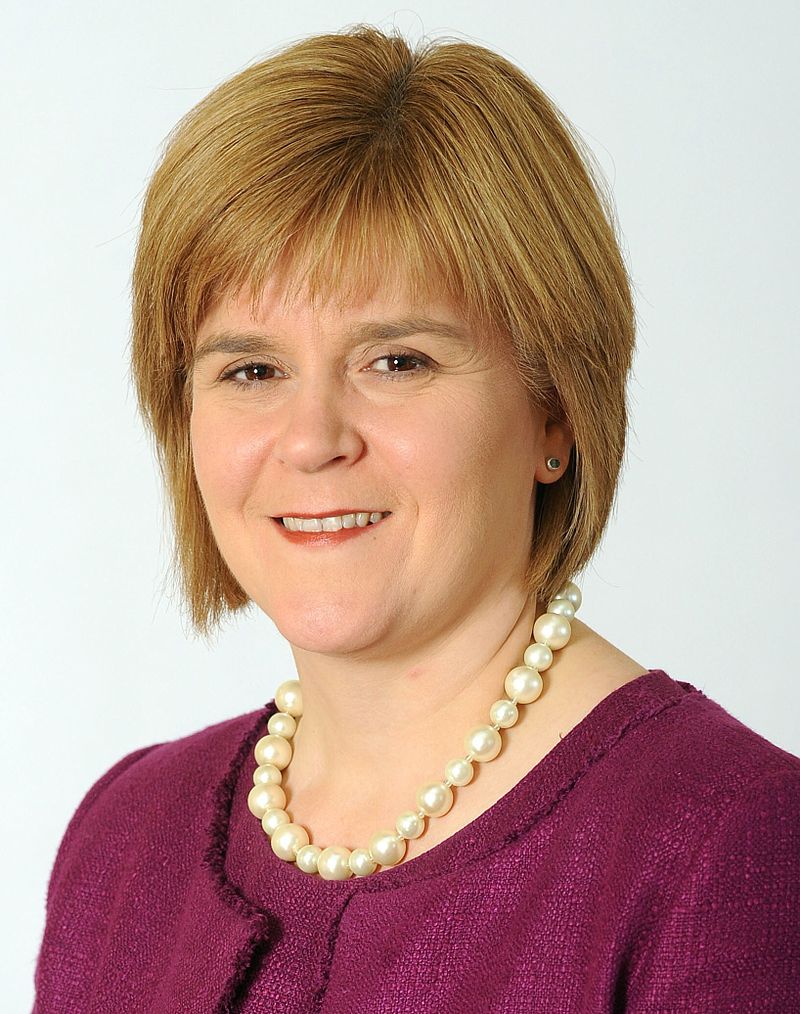
Tag: Nicola Sturgeon

  • Nicola Sturgeon – 2020 Statement on the Coronavirus (21/04/2020)

    Nicola Sturgeon – 2020 Statement on the Coronavirus (21/04/2020)

    Below is the text of the statement made by Nicola Sturgeon, the Scottish First Minister, at St Andrew’s House in Edinburgh on 21 April 2020.

    Good afternoon everyone. Thank you yet again for joining us for this daily update.

    As usual I will start with an update on some of the key statistics about the spread and impact of COVID-19 in Scotland.

    As at nine o’clock this morning, I can report that there have been 8,672 positive cases confirmed – which is an increase of 222 since yesterday.

    A total of 1,866 patients are currently in hospital with either confirmed or suspected COVID-19 – that is an increase of 57 from yesterday.

    A total of 166 people last night were in intensive care with confirmed or suspected COVID-19. That is a decrease of 3 since the figure I reported to you yesterday.

    Now while I would still urge caution in interpreting these figures, I do remain cautiously optimistic that firstly, while the numbers being admitted to hospital are still fluctuating on a daily basis, they do appear to be broadly stable – and secondly that the numbers being admitted to intensive care are, at this stage reducing.

    And we shouldn’t forget how important that is. It’s not too long ago that we were seriously worried about the potential for our hospital capacity to be overwhelmed by now.

    The fact that it is not, is down to the planning that’s been done in the national health service, of course, but more than that it is down to the high compliance with the lockdown restrictions.

    So my thanks to all of you for helping us to ensure the NHS has been able to cope, although the work that they do is very difficult and very challenging.

    It is of course in the nature of the virus that there will be a lag between numbers being admitted to hospital and intensive care reducing and the numbers sadly dying from this virus reducing. But I hope we will see the latter number also start to reduce in the next couple of weeks.

    However, in the last 24 hours, I am afraid that 70 deaths have been registered of patients who have been confirmed as having COVID-19 – that takes the total number of deaths in Scotland, under that measurement, to 985.

    I would remind you however, that registration over weekends, and this is a point you have heard me make often before, registrations over weekends still tend to be lower than during the week, so today’s higher figure will, at least in part, be a reflection of that.

    I would also remind you that these daily figures are of people who have sadly died after testing positive for this virus.

    Tomorrow, National Records of Scotland will again publish its weekly report, which will show the number of people who have died with either presumed or suspected COVID-19 as well, as well as those who have had a positive test confirmed.

    And again, as I always do because it is really important always to do this, I want to stress that each of these deaths represents much, much more than a statistic.

    They each represent an individual who was loved by family and friends, and whose loss is a source of intense grief. And so again I want to extend my sincere and deepest condolences to everyone who has lost a loved one.

    I also want once again to thank all of our health and care workers. The entire country continues to be grateful to you, for the extraordinary work you are doing.

    And it’s worth also making the point that there are not just health and care workers, although we understand the importance of the work they are doing, there are essential workers across a range of areas, who are going to work every day right now to keep the country moving, to keep the country going, to keep food on the table, to keep the lights on, and to each and every one of them, let me say thank you as well.

    I’ve got three issues I want to speak briefly about today.

    The first is that the Government’s Chief Economist, Gary Gillespie published the latest ‘State of the Economy’ report this morning. Gary is here with us today and will say a bit more about that in a few minutes.

    This report confirms the fact that dealing with this public health emergency has in itself created an economic emergency.

    It estimates that Scotland’s economic output could fall by a third during the current period of social distancing – an analysis which is broadly in line with last week’s projections for the UK as a whole from the Office for Budget Responsibility.

    The Labour Market Statistics on employment and unemployment, which have also been published today don’t fully reflect that impact yet, since they relate to the period up until the end of February, so a period before these restrictions took effect.

    It is however likely that there has been a significant increase in unemployment since then. For example, since March 15 we know there have been 130,000 new claimants for Universal Credit in Scotland. To give some context to that, in the comparable period last year, that number was 15,500.

    The Scottish Government’s immediate focus, working with the UK Government, has been on trying to mitigate the impact of the economic shock on people’s wellbeing, and on protecting the economy’s productive capacity for the future.

    Our overall package of support for businesses in Scotland now totals more than £2.3 billion – that includes business rates relief for many sectors, and grants for small businesses.

    The Economy Secretary will set out later today in Parliament today how £100 million of funding that we announced last week will be used to support people – for example, people who have become recently self-employed, who might not currently be eligible for other forms of support.

    Fundamentally, and this is a point I have made previously, we recognise that in order to protect public health, the Government is making extraordinary demands on businesses and workers.

    We are asking you to do unprecedented things, so we recognize that the responsibility and onus is on the Government, to equally do extraordinary things and provide extraordinary levels of support for businesses and workers, and we will continue to do everything we can to meet that challenge.

    It’s also worth adding that the health of the economy is, of course, one of the things we must consider as we think about how to emerge from this period of lockdown.

    The plans we will publish this week will set out some of the factors we will have to weigh up, as we work towards a point when we can allow some businesses to reopen, albeit with appropriate social distancing measures in place.

    But the economic harm being caused by this virus is not in itself a reason to come out of lockdown early. Indeed, dealing with this public health emergency and continuing to suppress the virus is an absolute prerequisite for a sustainable economic recovery.

    If we were to move out of lockdown too early, and then have to impose the same level of restrictions again, due to a further rapid rise in cases, that would in itself cause further, and possibly much longer lasting, economic damage.

    So these are decisions that we have to strike the right balance on, for the good of the country overall, and that is what we will seek to do.

    The work that I’ve mentioned we will publish towards the end of this week will set out in some more detail the principles that will guide us, as we seek to restore as much normality as we can to everyday life, without risking a resurgence of this virus that we know can, and is, doing so much harm.

    That point is actually related to the second issue I want to briefly speak on. We have today amended regulations introduced three weeks ago, to restrict public gatherings and non-essential business activities.

    Some of these amendments strengthen those regulations, to formalise what is already our established guidance – for example all businesses must take all reasonable measures to enforce the rule that workers are at least two metres apart from each other.

    Police, as a result of these amended regulations, will now be able to enforce that power within workplaces – though as with the regulations already in place, we envisage that this will be done initially through dialogue and encouragement. We do not expect police to be routinely patrolling office blocks.

    The legislation will also make clear that livestock markets and money advice services, such as foreign exchange services, can continue to operate – and that holiday accommodation businesses can manage online and telephone services for bookings. Not for this period but related to future dates.

    However, let me be clear it is not yet possible to say when such establishments will be able to re-open.

    I am very grateful, just as I am to every individual across the country who is complying with these restrictions, I am very grateful to all businesses who have acted responsibly by closing their businesses, or by ensuring safe social distancing.

    I know how tough these restrictions are for business. However, I would reiterate that they are absolutely essential to public health.

    The final issue I want to briefly cover is related to mental health. When I spoke to you last Tuesday, I said then that the Scottish Government would launch a new mental health campaign.

    That campaign – the “Clear Your Head” campaign – starts today.

    It highlights practical steps that all of us can take to look after our mental health better. For example sticking to a routine, staying active within the current guidelines, keeping in touch with people, and taking a break from news or social media from time to time.

    It also points people to places where you can get help and advice. For example, NHS Inform and helplines including NHS24, Breathing Space, the Samaritans, and the Scottish Association for Mental Health.

    What the campaign recognises is that the current lockdown is really tough for everyone. Everyone will be experiencing it differently but it is tough for everyone without exception. It is okay not to be feeling okay, at times right now.

    So all of us need to look out for each other – to show kindness, compassion and solidarity even as we stay physically separate.

    We should all also do what we can to look after our own mental health, and the campaign provides good advice on that.

    But if you need help, please reach out for it. Support is available, and the campaign that will launch today will show you where and how you can access that support.

    I’m about to hand over briefly to the Chief Medical Officer and then to the Chief Economist, who will say more about the State of the Economy Report.

    Before I do that, however, just let me again emphasise our key public health messages.

    Because it is really important if we’re to see that continued downward trend in people in intensive care, leading to that downward trend in the number of people dying, we must all comply with these restrictions.

    Stay at home, unless you are going out for essential purposes, such as food or medicine, or exercising.

    If you do go out, stay two metres away from other people, and don’t meet up with people from other households.

    Wash your hands regularly and thoroughly.

    By doing all of that you are helping us make sure that we suppress this virus and bring forward that time where we can restore some normality.

    Now as I keep saying, and I will keep saying, these restrictions are tough, and they will get tougher, not easier. I know everybody is feeling that increasingly. But they are essential, and as some, if not all of the statistics that I’ve given you today show, they are making a difference.

    By staying home, we are helping to slow the spread of the virus, we are as I have talked about already, protecting the NHS, and we are saving lives. So thank you once again to all of you for cooperation and compliance.

  • Nicola Sturgeon – 2020 Statement on the Coronavirus (22/04/2020)

    Nicola Sturgeon – 2020 Statement on the Coronavirus (22/04/2020)

    Below is the text of the statement made by Nicola Sturgeon, the Scottish First Minister, at St Andrew’s House in Edinburgh on 22 April 2020.

    Good afternoon everyone. Thanks for joining us for today’s update.

    I’ll start as usual with an update on some of the key statistics in relation to Covid 19.

    As on the last two Wednesdays, this will have two parts – an update of the usual daily figures, but also a summary of the key points from today’s weekly publication from National Records of Scotland.

    Now this inevitably means a bit more complexity, so please bear with me as I go through these statistics.

    Let me turn firstly, to the daily figures.

    As at 9 o’clock this morning, there have been 9,038 positive cases confirmed – an increase of 366 from yesterday’s figures.

    A total of 1776 patients are currently in hospital with confirmed or suspected Covid-19 – that is a decrease of 90 from yesterday.

    And a total of 155 people last night were in intensive care with confirmed or suspected cases of the virus. That is a decrease of 11 on yesterday.

    Let me again say that these figures for hospital admissions and admissions to intensive care are really encouraging and there are a cause for optimism, still cautious optimism, but optimism nevertheless.

    In addition, as part of a package of new information we are providing on our website from today I am able, for the first time, to give a figure for the number of COVID-19 patients who have been discharged from hospital – indeed, that is information some of you have contacted me to ask that we provide.

    So I am able to confirm today that since 5 March, a total of 1,813 patients who had tested positive for the virus have been able to leave hospital, and I wish all of them well.

    On a much sadder note though, I also have to report today that in the last 24 hours, 77 deaths have been registered of patients who had been confirmed positive through a test as having Covid-19 – that takes the total number of deaths in Scotland as of this morning under that measurement, to 1062.

    Now I have spoken before about the different ways in which we record figures, but it might be helpful to very briefly recap on that.

    For our daily update figure – the one you have just heard me give – we report on deaths which have been registered where the individual who has died has been tested and confirmed as having Covid-19.

    Those figures are the most accurate ones that we’re able to provide on a daily basis. But obviously they don’t capture all deaths from the virus.

    So National Records of Scotland now produces a report each Wednesday which captures all deaths registered within a 7 day period, ending on the preceding Sunday. It includes – not just those with a confirmed laboratory diagnosis of the virus – but also deaths which are presumed to be linked to Covid-19 and mentioned on a death certificate.

    The number of deaths covered under this reporting system is therefore larger than under the daily system, when you compare the two figures according to the same date. But it is the comprehensive one.

    NRS published the third of its weekly reports today, just around half an hour ago. It covers the period up to Sunday 19th April – three days ago. At that point, according to our daily figures, if I can remind you, 915 deaths had been registered of people who had tested positive for Covid-19.

    However, today’s report shows that by Sunday, the total number of registered deaths linked to the virus – confirmed and presumed – was 1,616.

    651 of those were registered in the 7 days up until Sunday the 19th of April. That is an increase of 41 from the week before, when 610 Covid-19 deaths were registered.

    These figures are extremely difficult to report on, and I know they will be difficult for you all to listen to. They are higher than any of us would ever want to think about. But this information is really important because it gives us as full a picture as possible of the toll the virus is having and how and where it is progressing.

    There are two further points I want to highlight about today’s report. The first is that it again provides a breakdown of deaths by age, sex, location and health board area.

    It shows that almost three quarters of those who have died were aged over 75 – however it also shows that much younger people do sometimes die as a result of this virus. That is an important reminder that all of us are potentially at risk so it’s therefore important for all of us to follow the guidance.

    The report also provides information about the location in which people died. So far, 56% of those who have died died in hospital, 33% – 537 in total – have died in care homes, and 10% have died at home or in some other setting.

    We know older people and care homes are particularly vulnerable to this virus.

    But we must match that increased vulnerability with enhanced protection.

    So I want to say a bit more today about the measures we have put in place to protect residents and staff in care homes.

    Clear guidance on isolation in care homes has been in place now for some time and it is of course the duty of providers of care homes to make sure that guidance is followed.

    The Health Secretary set out yesterday additional steps that we are taking.

    NHS Directors of Public Health are taking enhanced clinical leadership for care homes.

    A national rapid action group has been established, which will receive daily updates and ensure quick local action is taken to deal with emerging issues.

    Testing for staff and residents is being expanded – as I set out here last week, all symptomatic residents of care homes will be tested.

    Covid-19 patients discharged from hospital, should only be admitted or readmitted to a care home once they have had 2 negative tests.

    In addition, other new admissions to care homes should be tested and isolated for 14 days – let me stress that this is in addition to and not a substitute for the clear isolation and social distancing measures the guidance sets out.

    We are also helping to recruit students, and people who previously worked in social care, to work in the care sector as soon as possible. Nursing staff are also supporting care homes, where that is needed.

    And we are increasing access to NHS personal protective equipment to care homes.

    For example this week, and let me stress this is in addition to our other supply routes, we are delivering supplies of aprons, gloves and fluid-resistant surgical masks direct to care homes. In doing that, of course, we are giving priority to those with known outbreaks of the virus.

    Finally, the Scottish Government, from today, is making more information publicly available about how the virus is affecting care homes.

    The statistics that we publish at 2pm today will include

    the total number of adult care homes that have reported a suspected COVID-19 case at any time;
    The total number of suspected cases in care homes so far; and

    the number of care homes that have current suspected cases. On this last point, I can tell you the figure today will show

    that 384 care homes have a current outbreak, but let be me clear what that means. It means that these are care homes

    that have at least one resident who has exhibited symptoms of the virus in the last 14 days.

    We must remember, difficult though this is, that it is not unusual for people to become sick in care homes. Residents are often frail and nearing the end of their lives.

    But that does not mean we consider any of these cases to be inevitable or that we don’t do everything we can to prevent them. Older people in care homes require as much – if not more – support and protection as anyone else in our society. We are working with care homes and other partners to provide that.

    In doing that, we are helped hugely by the expertise and dedication of those who work in the sector, who are doing a remarkable job in incredibly testing circumstances. We are grateful to all of them.

    The second point I want to briefly cover about the statistics is that the overall number of deaths registered last week is again much higher than the average for the same week in previous years – something that seems to be reflected in other countries at this time.

    And while around three quarters of that difference this week can be attributed directly to Covid-19, more than 200 deaths cannot be explained in this way.

    The data the NRS published today provides some explanation of that and indicated that some of the difference appear to be a result of more people dying of cancer, and dementia and Alzheimer’s. However clearly, this is an issue that we need to do further work on to make sure we understand it fully.

    Now, I focus on the statistics in these updates because they are important.

    And I set the reasons why they are important to us in understanding the spread of this virus and informing decisions about the way forward, and I’ll say more about the principles that will underpin our decision making tomorrow.

    But I want to emphasise again that these death are not just statistics.

    They were all people who were loved and cherished and who, for their family and friends, are irreplaceable. We should never forget that.

    Just as we shouldn’t forget those left behind, grieving for their lost loved ones. My condolences are with all of them.

    The final point I want to acknowledge is that listening to numbers like this is really horrible – reporting these numbers is really horrible, certainly the most difficult experience I’ve had as First Minister.

    And I know listening to this might leave you with a feeling of powerlessness as well as an acute and deep feeling of sadness.

    But I want to stress again that none of us are powerless, we all have some power against this virus. By following the rules, by staying home and by self-isolating when we have symptoms, we are all making a difference.

    I know it’s hard to see progress when numbers of deaths that we are reporting are so grim.

    But the other statistics I’m reporting on daily right now, particularly on hospital and intensive care admissions, do show that we are making progress – they are a source of optimism – and soon I hope a fall in the numbers of people dying will show that progress too.

    By complying with the lockdown, we are protecting ourselves and others, and we are saving lives.

    But even a very small easing up in that right now could send all of that progress very quickly into reverse.

    So please, keep sticking with it.

    Stay at home except for essential purposes. When you do go out, stay 2 metres away from other people, and do not meet up with people from other households. And wash your hands thoroughly and regularly.

    By doing this, we are all helping – and we are helping – to slow the spread of the virus, we are protecting the NHS – which has not been so far overwhelmed in the way we feared just a few weeks ago and despite these figures I am reporting to you today – and we undoubtedly all of us saving lives. So thank you once again to all of you for doing that.

    So thank you once again for all that you are doing. This is hugely appreciated not just by me, and by the government, but the collective community. It is appreciated by everyone. Thank you very much for bearing with me though what I know was a complicated update today with lots of different statistics.

  • Nicola Sturgeon – 2020 Statement on the Coronavirus (23/04/2020)

    Nicola Sturgeon – 2020 Statement on the Coronavirus (23/04/2020)

    Below is the text of the statement made by Nicola Sturgeon, the Scottish First Minister, at St Andrew’s House in Edinburgh on 23 April 2020.

    Good afternoon everyone. Thank you for joining us for today’s briefing as usual.

    Today I’m going to focus quite a lot on the paper we’ve just published about how we might, at the right time and in the right way, begin to restore some normality to our lives, while still containing the COVID-19 virus.

    But before I do that, I will start as usual with an update on some of the key statistics in relation to the virus in Scotland.

    As at 9 o’clock this morning, there have been 9,409 positive cases confirmed – which is an increase of 371 from yesterday.

    A total of 1,748 confirmed or suspected COVID-19 patients are in hospital – and that is a decrease of 28 from yesterday.

    And a total of 148 people last night were in intensive care with confirmed or suspected cases of the virus. And that is a decrease of seven since yesterday. Let me say again as I did yesterday, these figures on hospital admissions and admissions in to intensive care are very encouraging and do give us real optimism at this stage.

    However in the last 24 hours, I am very sorry to have to report that 58 deaths have been registered of patients who had been confirmed through a test as having the virus – and that takes the total number of deaths in Scotland, under that measurement, to 1,120.

    Once again, it’s really important for all of us to remember that each of these deaths represents a unique, loved and irreplaceable individual. And I want to again extend my deepest condolences to everyone who has lost a loved one.

    I also want again to thank all of our health and care workers right across the country. This evening many thousands of us will, yet again applaud your efforts – we are all so deeply grateful to you for the extraordinary work you are doing.

    So let me turn now to the paper we have published just a few moments ago about the decisions we will need to take as we seek to contain this virus while also restoring a semblance of normality to our lives.

    And I want to be very clear with you at the outset – what we are publishing at this stage today is, by necessity, a first cut.

    I am seeking today really, to start a grown up conversation with you, the public.

    The decisions that lie ahead of us, of all of us, are really complex.

    We will – as we have done all along – seek to inform those decisions with the best scientific advice possible.

    But the science will never be exact, so we will also require to make very careful judgments.

    And we are in uncharted territory – it’s impossible to know with absolute certainty what the impact of our decisions will be in advance.

    That means we must also be prepared to adapt and change course as we go. We want to ease restrictions, of course we do, but we cannot absolutely rule out having to reapply some of them in future should we have evidence that the virus is again running out of control.

    And I want to be frank with you every single step of the way about all of these complexities and uncertainties.

    So while today’s paper is still quite high level, it is the start of a process.

    It sets out the objectives and the principles that will guide us, the different factors that we will need to take into account, the framework in which we will take decisions, and the preparations we need to make now.

    In the days and the weeks ahead, evidence, data and modelling will allow us to take firmer decisions.

    As that happens, this paper will evolve into a detailed plan with metrics, actions, milestones and measurements attached to it.

    And I give an assurance today that as we go through this process, we will share our thinking on an ongoing, iterative basis.

    But let me briefly set out some of the key points today.

    Firstly, and this is an obvious point, this virus causes real harm. And we see that every day in the statistics that we report, especially in the numbers of people who have died.

    But the lockdown measures we are taking to contain the virus are also doing damage.

    They’re doing harm to the economy and to living standards, to children’s education, to other aspects of our physical health, and to mental health and wellbeing. And the toll of all of that may also, in time, be measured in poorer health outcomes and lives lost.

    So we must try to find a better balance than the one we have right now.

    But my second point is that, as we do so, we cannot and we must not take our eye off the need to suppress the virus and minimise the damage that it does.

    And let me be very clear about this, continuing to suppress COVID-19 is the central objective that we set out in this paper today.

    Obviously, we cannot guarantee that no one will get this virus in the future – far from it – but an assumption that it is somehow safe to allow a certain proportion or a certain section of the population to get the virus is not part of the approach we will be taking.

    Third, we are increasingly confident that measures we are taking now are suppressing the virus.

    The key factor – and you may have heard this before – is what is known as the reproduction rate – the R number. And that needs be as far below one as possible.

    Now before lockdown that R number was very likely above three. And that means everyone with the virus was infecting three more people, each of them was infecting three more people and so on and on. That is what is exponential growth.

    Our best estimate now is that the R number is somewhere between 0.6 and one – though I should say that it is probably still higher in certain settings, such as care homes.

    But we can’t yet be absolutely sure about any of that. That’s why we need more time to monitor the statistics we report every day – like case numbers, hospital and ICU admissions, and numbers of deaths. And we need to develop further our data through ongoing surveillance.

    It’s only when we are sure that the virus is under control that we can even start to ease any of the restrictions.

    And it’s my next point really that takes us to the hard part.

    When we do reach that stage, the virus will be under control only because of the severity of the restrictions we are all living with just now. But the virus will not have gone away.

    So as we start to lift the restrictions, the real risk – and it is a very real risk – is that COVID-19 runs rampant again.

    So a return to normal as we knew it is not on the cards in the near future. And it’s really important that I am upfront with you right now about that.

    What we will be seeking to do is find a new normal – a way of living alongside this virus, but in a form that keeps it under control and stops it taking the toll that we know it can do.

    Social distancing and limiting our contacts with others will be a fact of life for a long time to come – certainly until treatments and ultimately a vaccine offer different solutions. So that means possibly for the rest of this year and maybe even beyond.

    And that’s why talk of lifting the lockdown – as if it’s a flick of a switch moment – is misguided.

    Our steps – when we take them – will need to be careful, gradual, incremental and probably quite small to start with.

    We will need to assess them in advance and monitor them in action. Sometimes, as I said a moment ago, we may even need to reverse things.

    As we go, we will apply our judgment to the best scientific advice possible, we will continue to collaborate closely with the other governments across the UK, and we will learn from international experience. The fact is that different countries are at different stages of this pandemic – but none of us are anywhere near through it yet and we all face the same challenges.

    So as we make these decisions here, careful balances will have to be struck.

    For example, it may be that be that certain business in certain sectors can re-open – but only if they can change how they work to keep employees and customers two metres distant from each other.

    Similarly with schools – classrooms may have to be redesigned to allow social distancing, so maybe not all children can go back to or be at school at the same times.

    Some limited outdoor activity might be able to restart earlier than indoor activity. But let me be clear, big gatherings and events are likely to be off for some months to come.

    We will also consider whether different approaches would make sense for different areas – though our preference, not least for ease of understanding, will be for as much consistency as possible.

    And of course given how severely this virus is affecting older people and those with other health vulnerabilities, some form of shielding will almost certainly be required for the foreseeable future.

    Now let me stress that what I have just set out there are not firm decisions – but they do illustrate the kind of options we will be assessing.

    And as we do so, we will consider not just the health imperatives, but also issues of practicality, sustainability, fairness and equity, ethics and human rights.

    And lastly, as well as changes to how we live, we will use public health interventions and technology to the maximum possible to help us control this virus.

    In the next phase, extensive testing, tracing of those who test positive and the isolation of symptomatic people to break the chain of transmission will be a central part of the approach that we will take. And the preparations to make that possible are already under way.

    We will also discuss with the UK government – for this is a reserved responsibility – the need for stronger surveillance measures for those coming into the country from elsewhere.

    So in short, this paper sets out the difficult decisions we face and the way in which we will go about preparing for them, making them and also assessing their impact.

    I want to stress again because it’s important that I am frank. The path ahead is not an easy one – it is paved with complexity and uncertainty. But with openness, transparency and frankness along the way, I believe that together we will be able to navigate it. It is for me and for government to work through and lead that process. But this is about all of us – hence this discussion that we are opening up with all of you today.

    The paper we have published is available on the Scottish Government website. I will post a link to it on Twitter, later this afternoon.

    So, please, even if – like I suspect most of the population – you are not in the habit of reading government documents, have a look at it. And if you have views on it please let us know. These views are important and will be helpful.

    As I said earlier, I will continue to share our thinking with you as it develops.

    But let me now end now on a vital point and one that you have become used to hearing me make each day. Moving on from where we are now as all of us want to do as quickly as it is safe to do will only be possible if and when we do get this virus properly under control.

    And that means sticking with the current rules that are in place just now.

    Stay at home except for essential purposes.

    Stay two metres apart from others when you have to be out.

    Do not meet up with people from other households.

    And isolate completely if you or anyone in your household has symptoms.

    This is tough, this is the toughest set of circumstances that the vast majority of us have ever lived through – and I can’t stand here and promise you it is going to get a whole lot easier soon.

    But as I hope we have started to set out today, if we keep doing the right things, and if we consider all of the options carefully and with the right objectives in mind, I do believe there will be a way through.

    And we will find that way through. So thank you for all you are doing to help. And please if you can, engage with this discussion as we go through the days and weeks to come.

    Thank you very much for your patience right now in allowing me to go through that in detail.

  • Nicola Sturgeon – 2020 Statement on the Coronavirus (27/04/2020)

    Nicola Sturgeon – 2020 Statement on the Coronavirus (27/04/2020)

    Below is the text of the statement made by Nicola Sturgeon, the Scottish First Minister, at St Andrew’s House in Edinburgh on 27 April 2020.

    Good afternoon everyone. Thank you for joining us for today’s briefing.

    I want to start as I always do with an update on some of the key statistics, in relation to COVID-19 in Scotland.

    As at 9 o’clock this morning, I can confirm that there have been 10,521 positive cases confirmed, which is an increase of 197 from yesterday.

    A total of 1,762 patients are currently in hospital with either confirmed or suspected COVID-19, that is an increase of 27 from yesterday.

    A total of 134 people last night were in intensive care with confirmed or suspected COVID-19. That is an increase of one since yesterday.

    I should say at this point that despite these occasional fluctuations, overall these statistics for hospital and intensive care admissions still give us cause for cautious optimism.

    I am also able to confirm today that since 5 March, a total of 2,380 patients who had tested positive for the virus have been now able to leave hospital, and I wish them well.

    On a much sadder note, I have to report that in the last 24 hours, 13 deaths have been registered of patients who had been confirmed through a test as having the virus, and that takes the total number of deaths in Scotland, under that measurement to 1,262.

    It is worth highlighting again, indeed it’s important that I do so, that although people can now register deaths on Sundays, we do know that from recent weeks that the figures that we report on Mondays, of deaths which were registered on a Sunday, tend to be relatively low. That means the figure I report tomorrow maybe significantly larger than today’s.

    And of course, once again, I want to stress and indeed reflect on the fact that the numbers I read out here every day are not just statistics.

    They are individuals whose loss is a source of grief and distress to family and friends. So once again, I want to send my deepest condolences to everyone who has lost a loved one to this virus.

    I also want to thank as I always do, our health and care workers, who continue to do extraordinary work in the most difficult of circumstances.

    And again, place on record my thanks to essential workers the length and breadth of the country, whose dedication each and every day is helping to keep vital services running.

    Tomorrow, on international workers’ memorial day, the Scottish Government will join a minute’s silence at 11am to honour those frontline workers.

    Particularly, though of course not exclusively, health and care workers, who have sadly lost their lives while working to tackle this pandemic.

    I invite all of you at home, and those taking part in essential work across the country, to join us at that time tomorrow.

    The silence will provide an opportunity to pay tribute to those who have died as a result of their work to serve, care for and save others.

    It will be a further reminder that, of all the duties government bears during a situation like this, the most vital is our obligation to help to keep care and health workers safe.

    I want to stress again today that I and the Scottish Government are acutely aware of that responsibility, and will work each and every day to do everything we can to fulfil that obligation.

    I have two things I want to comment on this morning. The first is to reflect a little bit more on some of the statistics I have just reported.

    I know that it might not feel this way, since the numbers that I am reporting each day, particularly those on the number of people who are dying, are always far higher than we want them to be – but it is nevertheless the case that we are now seeing some real signs of progress.

    The number of people in intensive care has fallen by around a third in the last fortnight, from the figure I would have reported to you two weeks ago today.

    The number of people in hospital, which was rising sharply in the first 10 days of this month, has also now broadly stabilised and the trend there may also now be a downward one.

    Our NHS, while working incredibly hard and in the most difficult of circumstances, has not been overwhelmed, which just a few weeks ago we really feared that it might be.

    Of course, we are not yet seeing a definite fall in the number of people who are dying each day from the virus.

    However, as we have always said, because of the way the illness progresses, that will be the last daily number that we do start to see declining, and we hope to see that in the next couple of weeks.

    But we do have evidence that the actions that all of us, all of you watching at home are taking, are making a real and a positive difference.

    Your efforts are working, so again today I want to thank you for that.

    However, and I realise that this is a less welcome and much more difficult point for me to make, this progress remains very fragile and now is a time for all of us to exercise careful caution. It is certainly not a time to throw caution to the wind.

    The margins we think we are working within, in respect to the reproduction number – that crucial R number that I spoke about last week, are very narrow.

    At this stage, even a slight easing up in the restrictions in place now, could send the reproduction rate back towards or above one, and the virus would then start to spread very quickly again.

    Within days of that, all the indicators that are suggesting progress now, would start to go in the wrong direction again.

    That would mean more cases, more hospital and intensive care admissions and sadly, more deaths.

    So for all our sakes, and to protect the progress that together we’ve made, all of the restrictions currently in place need to remain in place, for now.

    The job is not done yet – we need you to stay the course for a bit longer.

    Of course, we are now thinking about the ways in which we can begin to ease the lockdown a bit when it is safer to do so, although we can’t yet put dates on any of that.

    And as I said last week, lifting lockdown will not be a flick of a switch moment. We will instead be considering gradual and careful variations.

    It important and necessary to do that work now, and we are doing that work now, and as I said last week, I think it is really important to engage you in that work in an open and transparent way.

    So I can confirm that in the coming days, I will say more about the different options under consideration, and how we are going about assessing those.

    But let me stress again that the current restrictions are still in place. We have to stick with them for now, in order to be able to relax things in future.

    As well as the impact on all of us as individuals, I absolutely understand the anxieties of business, and I am acutely aware of the social and health impacts of economic damage.

    But let me make this point – a premature easing up on restrictions, if it led to the virus running out of control again, would not help your business or the economy. In fact, it would make the economic damage even worse.

    That’s why I am asking businesses as well as individuals to continue to do the right things, as indeed the vast majority of you have been doing already, for which you have my deep gratitude.

    So if you are a business on the list of those required by law to close, then obviously you should remain closed.

    But if you are not in that category but chose to close voluntarily at the start of the lockdown, and are now thinking of reopening – our view is that you should not contemplate doing so, unless you can comply fully with existing guidance, and are able to change your working practices to ensure safe social distancing at all times.

    The precautionary principle that I have spoken about before still applies, for the protection of your workers and for your customers.

    And for all of us, not just businesses. If you are now going out and about a little bit more than you were at the start of the lockdown, then you really shouldn’t be.

    Because you might be putting yourselves, and your loved ones at risk.

    Fundamentally, the basic restrictions of lockdown continue to apply.

    You should only leave home for essential purposes like buying food or medicine, or exercising.

    If you do leave the house, you should stay two metres apart from other people, and not meet up with people from other households.

    And you should wash your hands thoroughly and regularly.

    As I say every day, I know that all of this is difficult, and I know that it gets more difficult with every day that passes but it remains essential.

    As I’ve said many times, and again today, any easing up right now would risk us seeing the virus surge upwards again.

    So please, please stick with it, so we can continue to make progress together, and accelerate hopefully, the stage at which we can begin a process of restoring some normality to our lives.

    The other issue I want to very briefly update on relates to skills.

    Skills Development Scotland have updated their ‘My World of Work’ website to help people find free courses.

    This new service has been developed with the support of the Open University in Scotland, and it highlights free courses run by 12 providers in areas like digital technology, business studies, and languages.

    In the coming weeks and months, we will expand the range of courses available, by working with colleges and universities.

    We are also working with the UK Government and the other devolved administrations, who are all developing similar initiatives, in order to highlight the courses they offer.

    I‘m aware that doing courses like this may not be an option for everyone. If you have caring responsibilities, or if you have volunteered to help others, time to study might be pretty limited.

    But for some people, maybe especially, though not exclusively, people who are currently furloughed, or have been made unemployed, it could make sense to develop new skills during this period.

    We hope that this initiative will help people to do that, safely and free of charge.

    It’s a good example of the importance of digital public services, and I’m grateful to Skills Development Scotland for establishing this site so quickly.

    The courses are open to anyone. So if you are interested then go to myworkofwork.co.uk where you will find the free courses under the ‘Learn and train’ section of the main menu.

    That concludes my update for today. Before I pass on to the Chief Medical Officer, and then the Health Secretary, I simply want to end by thanking again each and every one of you for doing the right thing, and staying at home.

    I know it’s difficult, but it is as I hope I’ve demonstrated today, also making a difference.

    The steps we are all taking are helping to slow the spread of the virus, as we wanted to do.

    They are helping to protect the NHS as we wanted to do, and they are, notwithstanding the figures I have to report to you every day, helping to save lives.

    So please stick with them, and thank you for doing so.

  • Nicola Sturgeon – 2020 Statement on the Coronavirus (24/04/2020)

    Nicola Sturgeon – 2020 Statement on the Coronavirus (24/04/2020)

    Below is the text of the statement made by Nicola Sturgeon, the Scottish First Minister, at St Andrew’s House in Edinburgh on 24 April 2020.

    Good afternoon. Thanks for joining us for today’s briefing.

    I want to start – as I always do – by updating you on some of the key statistics in relation to Covid-19 in Scotland.

    As at 9 o’clock this morning, there have been 9,697 positive cases confirmed – an increase of 288 from yesterday.

    A total of 1710 patients are in hospital with Covid-19 – that is a decrease of 38 from yesterday.

    A total of 141 people last night were in intensive care with confirmed or suspected Covid 19. That is also a decrease of 7 since yesterday.

    These figures for hospital admissions and intensive care are giving us real and growing cause for optimism that the current lockdown is working to suppress the virus. That’s the good news, perhaps the less good news is that also tells us why we must stick with these lockdown restrictions, because as I’ve said many times before standing here, any easing up on that at all right now would risk us putting all that progress into reverse and the virus quickly running out of control again. So please stick with the restrictions because as you can see they are working

    I am also, in some other good news, able to confirm today that since 5 March, a total of 2,271 patients who had tested positive for the virus and been admitted to hospital have been able to leave hospital, and I wish all of them well.

    However on a much sadder note, I also have to report that in the last 24 hours, 64 deaths have been registered of patients who have been confirmed through a test as having Covid-19 – that takes the total number of deaths in Scotland, under that measurement, to 1,184.

    As I’ve said before, we provide these statistics for a very important reason, it helps tell us and tell you what is happening with the virus and how it is progressing across the country and what impact it is having. But the people behind these statistics could be the loved ones of any of us and that’s what I always bear in mind when I report the numbers to you every day. Each and every one of these statistics was a real person and across the country right now their deaths are being mourned by family members whose lives will never be the same again without them. So once again today I want to convey my deepest condolences to everyone who is grieving for a loved one as a result of this virus.

    I also want to thank again – as I always do and always will – our health and care workers. Last night, I – along with thousands of people across the country – once again took part in the applause at 8 o’clock. It has become a regular – and very special – feature of our week and our Thursday evenings in particular. And it’s just one small way in which we show our appreciation, for the extraordinary work that all of you do and I again today I give my sincere thanks to all of you.

    That Thursday night applause has also become a way for all of us in streets and communities up and down the land to briefly come together to share some kindness and show some solidarity. At a very grim and difficult time these really are special moments indeed.

    Now, there a two issues I want to cover today before handing on to my colleagues and opening up to questions.

    The first issues is just to recap the paper the Scottish Government published yesterday, on how we might begin to go through a process over the weeks to comes of restoring some level of normality to our everyday lives, while we also continue to contain and suppress the virus and minimise the harms that it does.

    I can tell you today that since it was published – this time yesterday – more than 250,000 people have viewed the paper on the Scottish Government’s website. So thank you to those of you who have taken the time to engage with this and I would encourage those who haven’t had the opportunity to do so yet to take some time to read the document. I noted yesterday that most people will never read a government document but if you are ever going to do it at all this is the time. So please take some time to read what we set out, the principles that are going to guide us, some of the factors we have to take into account. And if you’ve got views that you would like us to consider in this next phase of our work then please don’t hesitate to tell us what they are.

    As I said yesterday, this publication is an attempt to have grown up conversation with the wider public in Scotland. We want to be really frank with you every step of the way about the complexities and uncertainties of the decision that lie ahead. We need to be clear now that lockdown remains essential for the reasons I mentioned a moment ago, and that even as we are able to start to ease some of these restrictions, we’re going to have to do so very carefully, very cautiously – probably very slowly and gradually. We’re going to have to take what I described this morning as baby steps in doing this. We’ve got to try to seek a new normal, because how we are living our lives right now has consequences and can’t go on forever, but we have to recognised the virus has not gone away, so there will be changes in how we live our lives that will be necessary for some time to come, until science in the form of treatments and a vaccine offer new solutions to us.

    So this really is about all of us and its impact on the lives of each and every one of us and that’s why it’s important everyone feels part of this process.

    What’s important to me as First Minister, in contrast to the uncertainties that politicians usually like to express, is that I can also be frank with you about the uncertainties and the complexities of the decisions that lie ahead. Those decisions will make demands on all of us and the lives that we lead so I want that process to be as open as possible. And the paper that we published yesterday, which so many of you have already taken the opportunity to read, is the start of that process.

    As I said yesterday, in the days and few weeks ahead, we will set out more detail on the different options we will consider, as well as the modelling and scientific advice that underpins and informs our decisions. And of course, as we develop and assess those options, we will continue to engage as widely as possible, across the different sectors and groups of society.

    Lastly, I want to reemphasise an important point. It’s one that I made yesterday it and it’s one I’ve made already in my remarks to you today.

    Moving on from where we are now will only be possible only if and when we get the virus under control and we have more confidence that is the case. And so it remains absolutely vital that all of us continue to comply with the public health guidance and rules that are in place.

    To reiterate, that means staying at home, unless you are going out for essential purposes – such as exercising once a day, or buying food and medicines.

    It means that if you do go out, do not meet up with people from other households, and please stay two metres apart from other people.

    And it means wash your hands thoroughly and regularly.

    By following these rules, we can continue, as we are doing right now, to slow the spread of this virus. And we can hasten the day, when we return if not to complete, but to some semblance of normality in our everyday lives.

    The second item I want to update you on, is our work to ensure that Scotland’s NHS has the supplies that it needs to care for people in this time.

    Over the past month, the Minister for Trade Ivan McKee has been leading work to ensure that any shortages are overcome – and that supply chains can continue to meet demand.

    That has involved at times sourcing equipment from alternative supply chains. And where necessary, we have looked overseas to source the equipment we need.

    For example, last weekend, a major consignment of PPE arrived at Prestwick Airport, from China. It included 10 million fluid-resistant face masks, as well as equipment for use in intensive care units and laboratories.

    I can confirm that, just an hour ago, another of those consignments arrived at Prestwick. It includes 100,000 testing kits, as well as another 10 million face masks.

    Of course, alongside international procurement, we’re also working to boost Scotland’s domestic supply lines.

    About a month ago, we put out a call to action, to Scotland’s businesses. We asked them to support the flow of supplies and equipment, to our health and social care sector.

    To date, more than 1,600 businesses and individuals have answered that call. And I want to thank each and every one of them.

    We are working hard to assess and coordinate each of those offers, as quickly as possible. And in doing that, we are prioritising the support that is needed most.

    Our work with Calachem – a company based in Grangemouth – is a good example. Calachem have now produced 20,000 litres of hand sanitiser. The sanitiser was manufactured using denatured alcohol from Whyte & Mackay. It was bottled by the Stonehaven-based company, McPhie. And deliveries of the product – to our front line services – will begin from next week.

    The Scottish Government has formed this supply chain, in an incredibly short space of time. It will produce 560,000 litres of hand sanitiser, over the next four weeks. And that will be enough meet the needs of Scotland’s entire health and social care sector.

    Another example is the work we’re doing with the firm Alpha Solway. They are currently manufacturing 20,000 face visors per day, at their factory in Annan. And in total, they are supplying an order of over one million visors, to our NHS.

    These businesses – and many more like them – are doing hugely important work. Rightly and properly we will continue to talk about getting supplies of this kind of equipment to the front line, but I thought it was useful today to give you an insight into the work that’s being done to ensure these supplies keep flowing and the we have sufficient of them to get through this crisis. So these companies and many more in addition to the ones I’ve mentioned today are playing a critical part in our overall collective national endeavour in Scotland to tackle this crisis and I want to put on record today my heartfelt thanks to each and every one.

    Let me close today by saying something about this weekend. I’m conscious that it will be the fifth weekend, since Scotland went into lockdown. And I know that they only get harder, as time goes on.

    I also know that this weekend will be particularly difficult for Scotland’s Muslim communities – who are now observing the holy month of Ramadan. It will be tough not to be able to host people in your home, or visit friends and family, or attend your local mosque. And the Justice Secretary, who is himself observing Ramadan, will say a bit more about that, shortly.

    However, I want to end by emphasising the sacrifices we’re all making, are having a positive impact. We have a long way to go, I shared some of that with you yesterday, but it is equally true to say that we are seeing hopeful signs and so it’s vital that we stick with it – and build on the work we’ve done, so far.

    By doing that, we are slowing the spread of this virus, we are protecting our NHS, and despite the horrible statistics I report to you on a daily basis, we are saving lives. So I want to thank all of you, once again, for playing your part and doing that.

  • Nicola Sturgeon – 2020 Statement on Catherine Calderwood

    Nicola Sturgeon – 2020 Statement on Catherine Calderwood

    Below is the text of the statement made by Nicola Sturgeon, the Scottish First Minister, on 5 April 2020.

    Dr Calderwood’s advice to me, to the government and to people across Scotland over the past few weeks has been the right advice. People should continue to stay at home to protect the NHS and to save lives.

    It is however clear that the mistake she made – even though she has apologised sincerely and honourably for it – risks distracting from and undermining confidence in the government’s public health message at this crucial time. That is not a risk either of us is willing to take.

    Catherine has been a transformational CMO, bringing changes to the way medicine is delivered in Scotland and in particular using her experience to bring an overdue focus to women’s health. Also, as I said earlier, her advice to me on Coronavirus will be missed – which is why she will work to ensure a smooth transition in the days ahead.

    While she has made a very serious mistake in her actions, that should not detract from the fact that as CMO she has made a highly valuable contribution to the medical profession and to health in Scotland, and I have no doubt she will continue to do so in future. She leaves office with my thanks and admiration.

  • Nicola Sturgeon – 2019 Speech at SNP Conference

    Below is the text of the speech made by Nicola Sturgeon, the First Minister in Scotland, at the SNP Conference held in Edinburgh on 28 April 2019.

    Conference, we gather here in Edinburgh, our beautiful capital city.

    Soon to be, we hope – and how good does this sound – the capital city of an independent Scotland.

    And as we meet today, our party has plenty of reasons to be cheerful.

    Yesterday, an opinion poll showed levels of support for the SNP that would make any party leader smile.

    A 23 point lead in Westminster voting intentions, a 24 point lead for the Scottish Parliament and a 26 point lead for the Euro elections.

    That is truly extraordinary.

    But enough of polls. What about elections?

    Two weeks ago people here in Edinburgh got to vote – the result of the council by-election in Leith was stunning.

    With all due apologies to The Proclaimers – and don’t worry, I’m not about to sing – the result went something like this:

    My heart was broken for the Tories. Sorrow, sorrow for Labour.

    And for the SNP and independence – it was Sunshine on Leith all the way.

    That win came hard on the heels of another success, with the Labour vote down and SNP support up.

    So let us congratulate our two newest councillors – Jane McTaggart in Clackmannanshire and Rob Munn, our new councillor for Leith Walk.

    Friends, here in Edinburgh we are surrounded by history.

    History that offers inspiration for the future.

    This is the birthplace of the enlightenment.

    It was in this city, in our small country on the edge of Europe, that an intellectual flowering transformed the way humanity thinks about the world.

    Thomas Jefferson, the author of America’s Declaration of Independence, wrote this:

    “So far as science is concerned, no place in the world can pretend to competition with Edinburgh”.

    The contribution Scotland has made to the modern world is unparalleled.

    That should make us proud, but it should also be determined.

    Proud that the Scottish independence movement is defined by progressive, inclusive internationalism.

    And determined that we will never allow our nation’s place in the world to be sacrificed by the likes of Nigel Farage, Jacob Rees-Mogg or Boris Johnson.

    Scotland’s enlightenment legacy is not just about our history.

    The search for knowledge, invention and innovation is the foundation on which we will build our future too.

    Few countries are better placed than Scotland to help lead the world into a new age.

    We are one of the best educated nations anywhere.

    Today, we have more top universities per head of population than any other country in the world, bar one.

    Our universities are part of a golden thread.

    That thread runs from the Scotland of David Hume and Adam Smith, to the country of John Logie Baird, Alexander Graham Bell and Marion Ross, and onto our modern day nation of Peter Higgs and his Nobel Prize winning discovery.

    Our nation values education – that’s why I will always make this commitment to Scottish students.

    As long as the SNP is in government, there will be no tuition fees.

    Education will always be based on your ability to learn, not your ability to pay.

    Our universities today face a grave Brexit threat.

    European Research Grants at risk, collaboration damaged, European academics leaving.

    The end of free movement – and Theresa May’s deplorable hostile environment – will make it harder to attract the world’s best minds to Scotland.

    So I make no apology for taking the opportunity again today to send a message to all our fellow EU citizens.

    Whether you are studying or working in our universities, saving lives in our health service, creating wealth in our business community, catering for our tourists or harvesting our food – wherever you are in Scotland and whatever you do – you are part of us.

    And with all our hearts, we want you to stay.

    We stand up for Scotland in Europe as well.

    When the history of the SNP is written, there will be a special place for Winnie Ewing, and the late Allan Macartney and Neil MacCormick.

    Not just giants of our movement, but formidable figures who advanced Scotland’s interests on the international stage.

    In recent years, Alyn Smith and Ian Hudghton have continued that tradition.

    Ian has championed Scotland’s cause in the European Parliament for more than 20 years – he has been a passionate advocate for Scotland’s interests.

    As he steps down, we thank him for all he has done for our party, for independence and for Scotland.

    Alyn, we hope, will be going back to Brussels.

    Our job is to make sure he is taking others from our fantastic group of candidates with him.

    Number 2 on our list is Christian Allard, a native Frenchman.

    What a wonderful statement of Scotland’s intent to stay part of the European family of nations.

    Conference, as voters go to the polls for the European elections on May 23 our message will be clear and direct.

    And unlike Labour’s, it will be unambiguous.

    Scotland’s not for Brexit, Scotland’s for Europe.

    If you want to keep Scotland in Europe, vote SNP.

    Conference, Brexit is an unforgivable act of Tory sabotage on our country.

    Having failed to force her disastrous plan through Parliament, the Prime Minister is now looking for help from Labour

    Let me be blunt – I don’t trust Theresa May.

    But on Brexit, I don’t trust Jeremy Corbyn either.

    So today, I make this clear.

    The SNP will not vote for a Tory Brexit and we will not vote for a Labour Brexit. Our policy is no Brexit.

    That is what the people of Scotland voted for, and that is what should happen.

    At Westminster, Ian Blackford has led our MPs in fighting Scotland’s corner.

    And they have been simply magnificent.

    It’s not just on Brexit that they do sterling work.

    Our MPs represent the interests of their constituents day in and day out.

    Recently they forced a vote on Trident renewal.

    Lifelong CND member, Jeremy Corbyn, and most of his MPs refused to oppose Trident. What an utter disgrace.

    Labour’s defence spokesman derided the very idea that Scotland should have any say.

    He said that it was “blindingly obvious” that the decision should be taken at Westminster.

    Well, let me tell you what I think is blindingly obvious – a Labour Party that supports Trident missiles on the Clyde has lost its moral compass.

    A country with one in four children growing up in poverty should not be spending £200 billion on nuclear weapons.

    Conference, the UK Government is paralysed by Brexit and broken by infighting. It is no longer a functioning administration.

    There are no policies to tackle the big issues the UK faces – inequality, access to housing, climate change.

    An end to austerity turned out to be just another promise Theresa May didn’t keep.

    Where there should be action to address the underlying reasons for Brexit, there is a just a vacuum – a vacuum filled by incompetence.

    Incompetence that can be summed up in two words: Chris Grayling, or Failing Grayling as he’s better known.

    A buccaneering hard Brexiteer, he signed a ferry contract with a company that had no ferries.

    Though that’s probably just as well – because they didn’t have access to a port to dock them in either.

    In the not-too-distant past, any Minister would have been sacked for such shocking ineptitude.

    But with these Tories, there’s more chance he’ll be running for Prime Minister by next week.

    There is now no level of incompetence that is a disqualification for a place in this Tory government.

    They lack vision, policies and ability. They can’t even be trusted not to leak sensitive information from the National Security Council.

    This Tory government is a disgrace. It needs to go, and it needs to go now.

    Conference, every government faces challenges.

    But unlike the UK government, our Scottish Government is getting on with the job.

    A recent editorial in an Irish newspaper put it rather well.

    Scotland, it said, ‘is a beacon of sense in a sea of madness’. How true that is.

    Let me share with you just a taste of what our Scottish Government has been doing in the last few weeks.

    While Westminster has been turning the UK into an international laughing stock, we have extended free personal care to everyone who needs it, regardless of age.

    We’ve introduced the world leading Domestic Abuse Act.

    Invested millions of pounds in low carbon projects.

    And millions more to tackle fuel poverty.

    We’ve announced new funding to make sure children don’t go hungry during school holidays.

    And we have achieved the lowest Scottish unemployment rate on record.

    Conference, we’ve done something else too.

    To show the strength of our commitment to those who choose to make our country their home, we have extended free university tuition for EU citizens studying here in Scotland.

    On the NHS, investment and staffing are at record high levels with the SNP.

    When the UK Government short-changed our health service, we used our tax powers to protect it.

    When it comes to a choice between a tax cut for high earners or investing in our precious NHS – we will always put patients first.

    The Scottish Tory tax plans would mean a cut of £650 million to public services – that’s the equivalent of 16,000 nurses.

    And it shows that this cast-iron rule of politics is as strong as ever – you cannot trust the Tories with Scotland’s NHS – not now, not ever.

    Conference, as Westminster sinks deeper into the Brexit mire, let me also give you an insight into what your Scottish government will be doing in the days and weeks to come.

    Action we will be taking on those very issues the UK government is ignoring – housing, inequality, climate change.

    Technology is one of the key drivers of Scotland’s economy, and this city is now the best location anywhere in the UK to start up a tech company.

    We must embrace the potential of technology, but we shouldn’t shy away from the challenges.

    Let me give an example – for many people, accommodation provider Airbnb has enabled cheaper, more flexible travel.

    It’s one of the reasons Scotland’s tourism industry is booming.

    But for others – particularly in tourist hot spots, like the centre of this city – it is making it harder to find homes to live in.

    So today, we are setting out new plans to help cities like Edinburgh and islands like Arran get the balance right.

    We are asking for views on a new system of regulation to make short term lets subject to the same controls as other accommodation.

    And give councils the power to control the number of lets and ensure they make a contribution to the services they use.

    Conference, the SNP will always back Scotland’s tourism industry.

    But we will also help people find places to live in the communities they want to call home.

    We will also take fresh steps to help people own their own home.

    We already provide Help To Buy for new-build houses and support shared equity for lower income home owners.

    But there is a wider issue. An issue of generational fairness.

    Some first time buyers trying to get onto the property ladder can call on the financial help of relatives or friends – the famous bank of mum and dad.

    But for those who can’t, the average age of a first-time buyer is now 35.

    The simple truth is that for many young people, even those on decent incomes, saving for a deposit takes so long it has become a distant dream.

    Many are paying more in rent than they would pay for a mortgage, so they don’t have the money left at the end of the month to save for a deposit.

    In a fair and equitable country that cannot stand.

    And so we will act – we will help young people with the deposits they need.

    I am announcing today a new £150 million scheme.

    If buyers can find just 5% of the value of their new house from their own funds, we will do the rest.

    Starting later this year and running until the end of this parliament, we will offer first-time buyers loans of up to £25,000 to fund or top up their deposit.

    Conference, that is your SNP government – building a fairer Scotland for the next generation.

    Scotland’s new social security system is now a year old.

    In that time, nearly £200 million has been paid to carers and families across the country.

    One of the new benefits we introduced is the Best Start Grant.

    Since December, low income families have been eligible for a payment of £600 on the birth of a first child, and £300 on the birth of any siblings.

    And do you know this – in just the first two months of the Best Start Grant, the Scottish Government got more money into people’s pockets than the DWP had managed under the old system in an entire year.

    Now, we will go further. I can announce today that low income families will get a further £250 when their child starts nursery. Applications open tomorrow.

    And from June they will get the same again when their child starts school.

    And let me be crystal clear: there is no two child cap or rape clause in the Scottish welfare system – and with the SNP, there never will be.

    Conference, our obligations to the next generation are the most important we carry.

    A few weeks ago, I met some of the young climate change campaigners who’ve gone on strike from school to raise awareness of their cause.

    They want governments around the world to declare a climate emergency.

    They say that’s what the science tells us.

    And they are right.

    So today, as First Minister of Scotland, I am declaring that there is a climate emergency.

    And Scotland will live up to our responsibility to tackle it.

    We are already a world leader and our new legislation commits us to being carbon neutral by 2050. It contains some of the toughest targets in the world.

    But many are urging us to do more and go further.

    I am listening.

    So I am making this public promise to the young people I met, and to their entire generation.

    If that advice says we can go further or go faster, we will do so.

    Scotland will lead by example.

    Friends, that commitment to future generations has been the hallmark of your SNP government.

    It’s why I made education our number one priority.

    It’s why we’re taking action to reduce the attainment gap in schools – action that is now delivering results.

    It’s why we are doubling childcare.

    And, friends, it is why 80,000 children have now benefited from Scotland’s wonderful baby box.

    The rights of children and young people must be embedded in everything we do.

    This year is the 30th anniversary of the United Nations Convention on the Rights of the Child.

    The UN is campaigning for all nations to commit to it.

    Conference, I want Scotland, one day very soon, to take our place as an independent member of the United Nations.

    And when we take that place, we must make sure we are meeting the UN’s gold standard on children’s rights.

    So I can confirm today that next month, we will launch our consultation on exactly how to achieve it.

    Our plan is this: by the end of this Parliament we will have incorporated the UN Convention on the Rights of the Child into Scots law.

    Children’s rights will be enshrined in statute in time for Scotland to re-join the family of independent nations.

    Friends, it is time.

    It is time for Scotland to become independent.

    The last three years have shown, beyond any doubt, that for Scotland the Westminster system is broken.

    And do you know what else has been broken?

    The promises Westminster made to the people of Scotland.

    They have been broken too.

    They promised us in 2014 that if we voted No we would stay in Europe.

    They promised 13 new frigates would be built on the Clyde.

    They promised to protect the vulnerable.

    They promised “strength and stability”.

    They promised us an equal partnership.

    Each and every single one of these promises has been broken.

    And the people of Scotland will never, ever trust their promises again.

    Remember what the No campaign called themselves back then? Project Fear.

    Well today, I can reveal their new slogan.

    A Tory minister – anonymous of course – told the BBC why they believed the UK Government should not agree to an independence referendum.

    “Once you’ve hit the iceberg” they declared, “you’re all on it together”.

    So there you have it – we’ve gone from Project Fear to Project Iceberg.

    Never has there been a more dismal offer from Westminster to the people of Scotland.

    Friends, I have a different suggestion.

    We should do everything we can to stop the UK hitting that iceberg.

    I do not want to see that fate for any part of these islands.

    But if the UK can’t be persuaded to change course, Scotland must – we must have the choice of a better future.

    Scotland must have the choice of an independent future.

    Next month, we will introduce legislation for a referendum.

    And we plan to pass it by the end of this year.

    The UK government says it will block Scotland’s right to choose.

    A right to choose mandated in not just one but two elections and endorsed by the Scottish Parliament.

    The Tories – they want to veto Scottish democracy.

    Their only friends in Westminster are the Democratic Unionist Party.

    Well, if they’re not careful, this generation of Tories will go down in history as the Undemocratic Unionist Party.

    On Thursday, they tried to justify their position by saying there was no upsurge in support for independence.

    Two days later the latest opinion polls have proved them wrong.

    Support for independence is already up – our job now is to get support for independence surging.

    And make sure that no Westminster government can ever stand in the way of Scotland’s right to choose.

    Conference, I am setting out today our strategy to win our country’s independence.

    We must recognise that these are different times and new circumstances – this isn’t a re-running of 2014.

    The UK that existed then does not exist any more, so our approach must be different.

    We should not enter this campaign thinking of people as No voters or Yes voters, Remainers or Leavers, but as fellow citizens who all want the best for ourselves, our families and for Scotland’s future.

    We must acknowledge the ties of family and friendship across the UK, and step up to the challenge of answering people’s questions.

    And conference, we must always make our case with the decency, respect and dignity that we want to be the hallmark of our independent country.

    I am acutely aware of the responsibility of all politicians, especially leaders, to bring people together not drive them apart.

    To work as hard as we can to find agreement – that’s why earlier this week I reached out to other parties at Holyrood.

    They are as much a part of Scotland as we are.

    And to those parties, let me say this: I know you haven’t said yes yet, but my door is open.

    You may not share the SNP’s view of Scotland’s destination as an independent country.

    But in Scotland’s journey of change, we can still travel a fair way together.

    If you want to be part of that journey, we will welcome you with open arms.

    But be in no doubt – if your only offer is a failed and broken Westminster system, Scotland’s journey will completely pass you by.

    Conference, we will also reach beyond parliament and political tribes.

    We are establishing a non-party Citizens’ Assembly, so that people from across Scotland can guide the conversation.

    Independence, after all, is about the future of everyone who lives here.

    It was once said: “Don’t think about what you want to be, but what you want to do.”

    Friends, that should be our guiding principle.

    Independence is about the children we can lift out of poverty.

    And the fairer, more equal society we can create.

    That starts with building confidence in the economic case.

    Answering people’s questions, addressing their concerns, and inspiring them about the future.

    The conversation we have had within our party is one we must now have with the country.

    Yesterday, in endorsing our new economic plan, we took a big step – the right step.

    And in the process, we demonstrated what a vibrant, engaged and democratic party we are.

    Over ten years ago, we won the right to govern by demonstrating credibility with the financial powers of devolution.

    And make no mistake about this: if we can now show what is possible with the economic powers of independence, we will win a referendum.

    We have set out an ambitious, optimistic and realistic way forward for these new times.

    And so I can announce today that we will now launch the biggest campaign on the economics of independence in our party’s history.

    From this summer, we aim to get information on Scotland’s potential into the hands of every voter.

    Our plan is to distribute “An independent Scotland – a household guide” to every home across the country – all 2.4m of them.

    So friends, you know what that means… it is time to get your jackets on.

    We will set out an alternative to the inevitable economic decline of Brexit.

    We will tell people about Scotland’s strengths.

    The extraordinary success of our food and drink industry.

    Our renewable energy, our advanced manufacturing, technology, life sciences, creative industries, tourism.

    Above all, we will show that Scotland has a talented and educated people.

    As an independent nation we will face challenges, as all independent countries do. We must be responsible with our finances.

    But few countries on earth can match our resources and our potential.

    So never let anyone tell you that Scotland doesn’t have what it takes to be a prosperous, independent nation.

    Because our country most certainly does – our new economic plan demonstrates the potential of an independent Scotland.

    It stresses the importance of social justice and equality.

    The point is this: a strong economy is the bedrock of a fair society.

    And a fair, inclusive society leads to a strong economy – that is the case we must make.

    That is why I am announcing today the next step for the SNP in setting out our vision of a fairer, independent Scotland.

    Building on the foundation of Andrew Wilson’s work on the economy, I am now setting up a Social Justice and Fairness Commission.

    It will set out how the proceeds of economic growth in an independent Scotland can be shared much more fairly.

    It will demonstrate how we can use the powers of independence to end poverty, achieve full employment, and drive equality for all.

    It will look at how we can deliver fairness for pensioners, be a nation that sets a gold standard for equal pay, and create opportunity for all of our young people.

    All of that is what independence is for.

    The fact is this – independence will mean little if it does not ensure a safe, warm home for everyone to live in. A fair chance for everyone to get on in life.

    And bring an end to the shameful Westminster system which in 21st century Scotland leaves people without enough money to feed their families at the end of the week.

    We are one of the wealthiest countries in the world.

    But we will only be a truly rich society when we ensure that not a single man, woman or child has to rely on a food bank to eat.

    That is the prize of independence.

    Conference, our economic and social ambitions can best be realised if Scotland is a member of the European Union.

    I do not, for a single second, dismiss those who voted to Leave – I understand the desire for change and the sense that political institutions can feel remote.

    The EU is far from perfect, but membership is not just about economic and social benefits – substantial though those are.

    It is also about the values we cherish – freedom, democracy, the rule of law, equality, respect for human dignity and human rights.

    In our world today, these values are under attack from the forces of intolerance and extremism.

    But they are values that we must fight for and stand up for – and our party will always do so.

    Conference, for independent countries of our size, the EU does not curtail sovereignty – it enhances and amplifies it.

    If ever we needed proof of the power of small nations in Europe, think about this.

    At the last summit, the leaders of 27 other countries decided the UK – and Scotland’s – fate.

    12 of those countries have populations similar to or smaller than Scotland’s.

    Very small nations such as Luxembourg and Cyprus.

    Countries that have long enjoyed independence: Denmark, Finland and Ireland.

    And others who have regained their independence much more recently.

    All of these nations have come together to share sovereignty for mutual benefit, and on the basis of equality and common values.

    Conference, the respect, support and solidarity they receive in return stands in stark contrast to the contemptuous treatment of Scotland by Westminster.

    That is why it is now time for Scotland to become a truly equal partner in the British Isles.

    It is time to take our place among the family of independent European nations.

    Conference, the SNP is not an ordinary political party.

    We do not represent just one section of society or one group of people.

    We are the national party.

    Our aim is to represent everyone who lives here.

    That comes with a big responsibility.

    Because we are building a nation.

    And what is that nation?

    It is our extraordinary landscape. Our villages, towns and cities – like this one with the castle on the hill.

    It is our history – of independence, of union, of social advancement, of industrial and high-tech revolutions.

    It is what our former Makar, Edwin Morgan, called a “thread of pride and self-esteem” that can never be “broken or forgotten”.

    It is our innovators and our wealth creators.

    Our writers, our poets and our artists – it is all of our people.

    Those who have been here for generations. And those who have just arrived.

    Scotland is everyone who chooses to make this country their home.

    So when we speak of building a nation, what we mean is that we are building a better future for all those who live here and for the generations yet to come.

    A society founded on compassion, on kindness and love.

    A nation that people will come from all over the world to see, to experience, and to be part of.

    So let’s always take the time to dream a little.

    To dream of that better country.

    For those of us privileged to carry the SNP flame today, our task is to turn the dream – that message of hope – into reality.

    So let’s get on with our task.

    Let us win our independence.

    Let us build that fairer nation.

    And let Scotland – an independent Scotland – play our part in building the better world that we know is possible.

  • Nicola Sturgeon – 2017 Speech at SNP Conference

    Below is the text of the speech made by Nicola Sturgeon, the Scottish First Minister and Leader of the SNP, at the party’s conference in Glasgow on 10 October 2017.

    Friends,

    Leading this Party is a great privilege – one enjoyed by just a few people in our history.

    Earlier this year we lost one of our past leaders – a true giant of our movement.

    Gordon Wilson had the good fortune to be born in Govan in this city.

    And to represent Dundee in the House of Commons.

    Two great cities.

    When Gordon became leader of our party in 1979, he was one of just two SNP MPs at Westminster.

    Hopes of a new Scottish Parliament had just been scuppered.

    It was a tough time.

    But Gordon’s commitment and political skill laid the groundwork for the SNP’s future success.

    New members and younger voters may not know of Gordon’s contribution, but it can’t be overstated.

    He kept the flame alive.

    He devoted his life to serving Scotland.

    And all of us owe him a deep debt of gratitude.

    Friends,

    The three years I have been your leader can be described in many ways.

    Dull isn’t one of them.

    We’ve had an EU referendum.

    A Scottish Parliament election.

    And not one, but two, Westminster campaigns.

    Different election contests, for different Parliaments.

    But with one common thread.

    Victory for the SNP in all of them.

    Of course, we’ve had tough days along the way – and we learn from them.

    In June we lost good colleagues from the House of Commons.

    Let us thank them for their service.

    But let me offer a gentle reality check to our opponents.

    The SNP is polling at a higher level today than we were at this point in the honeymoon days after our 2007 win or our landslide in 2011.

    Our lead over the second placed party now is twice what it was in October 2008 – and it is five times that of 2012.

    Ten years into government, the verdict of the Scottish people is clearer than ever.

    They trust the SNP to deliver for Scotland.

    And we will work each and every day to retain that confidence.

    That applies here in this great city too.

    For decades, Glasgow has been run by Labour.

    In May, that came to an end.

    The cronies and time-servers are out.

    Fresh ideas, Susan Aitken and the SNP are in.

    The difference is already clear.

    Under Labour, a bitter school janitor dispute rumbled on for months.

    Within weeks, it was resolved by the SNP.

    For years, under Labour, women were denied the equal pay they are entitled to.

    Conference

    It may take us a bit of time to fix Labour’s mess, but I make this promise today.

    Fix it we will.

    The injustice suffered by low paid women in this city will be put right.

    Equal pay for equal work, denied for too long, will be delivered by the SNP.

    As we fight for Scotland, our opponents fight each other.

    Scottish Labour is currently having its annual leadership election.

    Hypocrites, plotters, betrayers, barrel scrapers.

    No, that’s not what we’ve been calling the candidates.

    That’s what they’ve been calling each other.

    These days, ferrets in a sack distance themselves from Scottish Labour.

    And as for the Tories – well, they’re now back in third place in Scottish politics.

    And no wonder.

    They are a policy vacuum.

    And the racism, misogyny and sectarianism within their ranks has been on full, ugly display.

    The disgusting views that have been expressed by too many Tory politicians have no place in public life.

    It’s time Ruth Davidson found some backbone and kicked the racists and bigots out of her party.

    Conference

    The opposition in Scotland are all over the place.

    That’s why more than ever the responsibility is on us, the SNP, to provide the good government that the people of our country expect and deserve.

    It is up to us to inspire the optimism that will drive Scotland forward.

    Just as we have over the past decade.

    Our record is a strong one.

    More than £3 billion extra for the NHS.

    Almost 12,000 more health service staff.

    And the best performing emergency departments anywhere in the UK.

    Prescription charges abolished.

    And no privatisation of healthcare.

    Conference

    As long as the SNP is in office, the NHS will always be in public hands.

    Now we are focussed on vital reforms to shift more care and more resources into communities. Tough decisions, yes – but necessary to make our NHS fit for the future.

    As in health, so too in education.

    In our schools, higher passes are up by almost a third.

    Ten years ago, just 12% of young people in this city left school with 3 Highers.

    Today, it is 30% and rising.

    Now we are reforming school education – empowering headteachers and delivering more money direct to the classroom.

    Friends

    I said we would close the attainment gap in our schools – and, mark my words, that is exactly what we are going to do.

    We have rebuilt the country’s infrastructure too.

    From Lerwick harbour in the north.

    To the Border Railway in the south.

    From the Queen Elizabeth Hospital in the west.

    To the magnificent new Queensferry Crossing in the east.

    And what an amazing feat of Scottish engineering that is.

    Look and travel across our wonderful country – the evidence is all around us.

    Improved rail connections the length and breadth of Scotland…

    The new Aberdeen bypass, upgrading the M8…

    Dualling the A9 and making it our first electric-enabled highway…

    Superfast broadband being extended to 100% of premises.

    Conference

    We are connecting Scotland for the 21st century and beyond.

    The SNP is Scotland’s Party and we are delivering for all of Scotland.

    This progress is good for Scotland.

    And it has another benefit.

    It shows the way for the rest of the UK.

    Last week, Theresa May said she would freeze tuition fees in England.

    She said they won’t rise above £9,250.

    Well, I can announce today that we will match that commitment.

    We will also freeze tuition fees.

    But we will freeze them at zero.

    Politicians elsewhere in the UK argue about whether fees should be frozen, reduced or abolished altogether.

    We’ve settled that issue.

    We abolished tuition fees. We restored education as a right.

    And we now have record numbers of young people going to University.

    While others debate fees, we are focused on the next challenges.

    Reforming student support. Widening access.

    Our mission is this.

    To give young people from poorer backgrounds – not just a better chance of going to university – but an equal chance of going to university.

    On housing too – one of the biggest issues of our time – while Westminster dithers and delays, Scotland is leading the way.

    When we came into office, council house building in Scotland had ground to a halt.

    The last Labour government built 6 council houses.

    Not 6000 or 600 or even 60.

    Just 6.

    So 8 years ago, we started a new generation of council house building.

    And since then, we’ve built 8,500 council houses.

    Overall, we are building new social housing at a faster rate than any other part of the UK.

    And now we are going further.

    Over this Parliament, we will deliver 50,000 more affordable homes.

    We are backing our commitment with record investment.

    £3 billion in this Parliament – almost 80% more than in the last five years.

    We’ve already set out how much money councils will be allocated each year.

    And we will not allow any of it to be diverted to other priorities.

    Let me make this clear to every council today.

    If you don’t use all of your allocation to deliver new housing, we will take back the balance and give it to one that can.

    On money for housing – if you don’t use it, you will lose it.

    Every last penny of our investment will go to delivering the new houses that people across this country need.

    That is our guarantee.

    Friends

    Over the past ten years, we have led the way.

    We should be proud of what we achieved.

    Our focus now is on the next ten years and beyond.

    The world we live in today is changing at a faster pace than we have ever known.

    The challenges we face are generational.

    Our responses must be transformational.

    Last month we unveiled our programme for government.

    A new programme for a new Scotland.

    It offers practical solutions to the daily concerns people have.

    And it aims to equip our country to prosper in a fast changing world.

    As we look ahead we face a choice.

    We can trail in the wake of the change that is coming.

    Or we can choose to shape our own future.

    Let’s resolve this today:

    We will not wait for others to decide for us.

    Let’s resolve to put Scotland in the driving seat.

    A country which values education and cares for future generations will always be in the driving seat.

    At the heart of all we do is a determination to make Scotland the best place in the world to grow up.

    I’ve referred already to our school reforms.

    But it is what we do in the early years that matters most to the life chances of children.

    The baby box really is a beautiful thing.

    Not just for all the practical help it provides Or even the contact it promotes between pregnant mothers and midwives.

    It is beautiful because of what it says.

    All children are born equal. All children are valued. All children deserve the same start in life.

    But much as I love it, the baby box is not the most significant of our early years policies.

    Our expansion of nursery education is.

    It is truly transformational.

    Currently, we deliver around 16 hours of early education and childcare a week – that’s already an expansion.

    But it means some parents still face a struggle to find and fund the childcare they need to allow them to work.

    We are going to change that.

    By 2020, we will deliver 30 hours a week for every three and four year old and eligible two year old.

    It will give children the best start in life.

    It will free parents to find work.

    And each month it will save families around £350 on the costs of childcare.

    That is the kind of real, practical help that young parents need.

    Often when I talk about this policy, I’m asked – sometimes sceptically – if we will really be able to fund it properly.

    Well, today, we put our money where our mouth is. Over the past few months, we have undertaken detailed work to assess the investment needed.

    Right now, we invest around £420 million a year.

    I can announce today that by the end of this Parliament, that will double to £840 million a year.

    Friends

    That is a commitment unmatched anywhere else in the UK.

    And it is the best investment we can make in Scotland’s future.

    Every child matters.

    That includes those who grow up in care.

    Last year, I set out plans for a fundamental review of the care system.

    We want it to have love at its heart.

    We are also delivering practical help to level the playing field for care leavers – like full grants and guaranteed places for those with the grades to go to university.

    We want to make life a little bit easier for those leaving care.

    So I can announce today a further step.

    We will change the law so that all young care leavers are exempt from paying council tax.

    Friends

    We can do all these things because we are in government.

    We can make a difference every day – with decisions that benefit this and future generations.

    The greatest responsibility of all that we owe to the next generation is to protect the planet.

    In 2009, we passed world leading climate change targets and we met them.

    Next year, we will go further.

    A new climate change bill will set even more ambitious targets.

    We will meet our obligations under the Paris Accord.

    Conference

    Every industrialised country, large or small, must play its part to meet our collective duty to safeguard the environment.

    And let me be blunt about this.

    That applies just as much to the White House as it does to Bute House.

    Environmental campaigners recently described our programme for government as the greenest in the entire lifetime of the Scottish Parliament.

    We should be proud of that.

    In that programme, we committed to setting up Low Emissions Zones in our four biggest cities by 2020, to improve the quality of the air that we breathe.

    The first of these will be in place by the end of next year and I am very pleased to announce today that it will be located here in the city of Glasgow.

    Conference

    We should also be proud of how we handle the difficult decisions involved in tackling climate change.

    We don’t rush to judgment.

    We weigh up the evidence.

    We listen to the people.

    And we come to clear conclusions.

    Clear conclusions like this one –

    Fracking is now banned in Scotland.

    Tackling climate change is a moral obligation.

    It is often seen as a challenge.

    But it is also a massive opportunity.

    Scotland can be a world leader in the technologies that will drive forward the low carbon economy of the future.

    Jobs and investment are there to be won.

    So we are leading by example.

    We will end the need for new petrol and diesel vehicles by 2032 – 8 years ahead of the rest of the UK.

    An ambitious target, but one we know can be met.

    In 2007, we pledged that by 2020, 50% of the electricity we consume would come from renewable sources.

    Last year, ahead of schedule, we achieved 54%.

    That’s great for our environment.

    And the lesson for our economy is this – by leading the way in using new technology, we send a message to the world that Scotland is the best place to develop it.

    Already, we are home to the largest tidal power array in the world.

    And next week, we will celebrate a new global first.

    I will officially open the world’s largest floating windfarm, situated right here in Scotland, off the coast at Peterhead.

    Conference

    Our ambition is simple –

    To put ourselves in the driving seat of change.

    That is why we are establishing a new National Manufacturing Institute and increasing our investment in business research and development.

    And it is why we have made this decision too.

    At our conference in March, you asked us to set up a Scottish National Investment Bank.

    And in our Programme for Government we committed to doing just that.

    Conference

    The Investment Bank is about doing things differently for the new age.

    In our manifesto last year, we also pledged to explore the option of a new publicly owned energy company.

    The idea, at its heart, is simple.

    Energy would be bought wholesale or generated here in Scotland – renewable, of course – and sold to customers as close to cost price as possible.

    No shareholders to worry about.

    No corporate bonuses to consider.

    It would give people – particularly those on low incomes – more choice and the option of a supplier whose only job is to secure the lowest price for consumers.

    Conference

    We will set out more detail when we publish our new Energy Strategy.

    But I am delighted to announce today that – by the end of this Parliament – we will set up a publicly owned, not for profit energy company.

    Conference

    We are taking real action in government now to meet the challenges of tomorrow.

    Responsible intervention to advance the collective good.

    We are also taking steps to empower communities.

    Local ownership. More autonomy for our islands.

    And of course land reform.

    Exactly 20 years ago, the people of Eigg bought their island from its owner.

    And so started Scotland’s modern journey of land reform.

    That journey continues today.

    In recent months Ulva, an island off the west coast of Mull, has sought permission to follow in Eigg’s footsteps.

    If permission is granted, the residents can get on with raising the money needed.

    Conference

    The Scottish Government has carefully considered the application.

    And I am delighted to announce that we have today granted permission to the people of Ulva to bring their island into community ownership.

    Scotland’s islands and rural communities attract visitors from across the globe.

    The tourist boom that our country is enjoying is great news.

    It means more jobs and investment.

    But it can also mean pressure on transport, services and facilities – especially in rural areas.

    The Scottish Government is determined to help.

    So I am pleased to announce today that we will establish a new £6 million Rural Tourism Infrastructure Fund.

    It will take bids from communities and work with local councils.

    And it will allow even more people to enjoy this, the most beautiful country in the world.

    Friends,

    Giving every child the best start, with the opportunity to live a healthy life, with a great education, and in a clean environment is at the heart of our programme for a new Scotland.

    But today’s generation faces another defining challenge.

    It is one that is rocking the foundations of political establishments across the democratic world.

    It is the challenge of our age – tackling the unfairness and inequality felt so sharply by so many.

    Here in the UK inequality is among the worst in the developed world.

    We intend to drive change here too.

    The fact that real wages have stagnated or fallen heightens the sense of unfairness.

    So to our nurses, teachers, police officers, firefighters – to all of our dedicated public sector workers – let me reiterate this commitment today.

    Next year, we will seek pay deals that are affordable but also fair.

    The 1% pay cap will be lifted.

    We are the only government in the UK to make this unequivocal commitment.

    It is now time for others to do so too.

    Making decisions that tackle the big challenges is the responsibility of our government.

    Last year, this conference asked us to investigate the feasibility of a citizens’ basic income.

    So we’ve announced the funding to do just that.

    You asked us to tackle period poverty.

    So we set up a pilot scheme to help low income women.

    And last month we announced free sanitary products for all in our schools, colleges and universities.

    Conference

    I can announce today that this groundbreaking commitment to tackle the gender injustice of period poverty will be delivered from the start of the new academic year next August.

    Scotland and the SNP – once again – leading the way in building a better, fairer country for all.

    Of course, a fair society must be paid for.

    Decisions taken at Westminster still determine our overall spending power.

    Revenue from income tax makes up just one third of our budget.

    But the prospect of more Tory austerity and the impact of Brexit pose growing threats to our public services and the most vulnerable in our society.

    That means it is right to consider how our limited tax powers might help us protect what we value most.

    As we do so, this question will be centre stage.

    What kind of country do we want to be?

    Too often, the debate on tax is framed as the economy versus public services.

    That’s wrong.

    Our taxes pay for the support that our businesses need to thrive just as they do for our health service and our schools.

    And our competitiveness as a country is about more than just our tax rates.

    It depends on the strength of our public services, the skills of our people and the quality of our infrastructure.

    It is a fact that a good society needs a strong economy.

    But let’s never forget this.

    No economy will reach its full potential without a strong, fair, inclusive society.

    And that’s what our government will always work to protect.

    Friends

    The Tories often accuse the last Labour government of bankrupting the UK.

    I’ll leave Labour to answer for itself.

    But there is no doubt about this.

    There is a bankruptcy at the heart of this Tory Government.

    It is a moral one.

    The rape clause.

    The misery being caused to so many by the shambles that is Universal Credit.

    Treatment of disabled people so appalling that the UN brands it a human catastrophe.

    And all the while tax cuts handed to those who earn the most.

    That is Tory austerity.

    Heartless, shameful, self-defeating.

    For the sake of decency, austerity must end – and it must end now.

    Conference

    We stand for a Scotland that is fair at home.

    And we want our country to play its part in building a better, fairer world.

    There is now a battle of ideas underway across the globe.

    A battle between those who want to turn inwards and those determined to look outwards.

    We know what side we are on.

    Our party is internationalist to its core and it will always be so.

    We’ve opened our doors and our hearts to refugees from Syria.

    We are working with the United Nations to support women in conflict resolution.

    In Africa and Pakistan we’re helping fight poverty and give girls the chance to be educated.

    We’re sending aid to Rohingya muslims fleeing violence in Burma.

    And our ground-breaking Climate Justice Fund is helping provide clean water in Malawi and irrigation in Zambia.

    Conference

    We will never accept that a limit should be placed on the contribution Scotland can make to building a better world.

    Strong voices for peace and justice are needed now more than ever.

    Last week, ICAN, the global campaign against nuclear weapons won the Nobel Peace Prize.

    Our party stands proudly as part of the global movement for peace.

    So let us restate this today.

    No ifs, no buts from the SNP.

    We say no to weapons of mass destruction.

    We say no to nuclear weapons on the River Clyde, or anywhere else.

    Friends,

    Sometimes we underestimate the goodwill the rest of the world has towards Scotland.

    Last week, I visited Dublin to promote Scottish business.

    The warmth of feeling in Ireland towards Scotland is tangible – as is their frustration and utter bewilderment at the direction of the UK.

    While I was there, I met with the new Taoiseach and I am delighted that he accepted my invitation to visit Scotland next year.

    We look forward to welcoming him as we strengthen the ties between our two countries.

    The UK Government may want to retreat from Europe.

    We intend to stay at its heart.

    Conference

    15 months on from the Brexit vote, the Tories’ failure to guarantee the rights of EU citizens to stay here shames them.

    We don’t have the power to guarantee these rights ourselves. I wish that we did.

    But we will act where we can.

    The Tories want to make EU citizens apply for the right to stay and pay for the privilege.

    They should think again.

    But if a fee is imposed, I can confirm today that – as a minimum – the Scottish Government will meet the cost for EU nationals working in our public services.

    It is a move that will give practical assistance to individuals.

    It will help us keep the doctors, nurses and other public sector workers that we rely on.

    And it will send a clear message to our fellow EU citizens, in actions not just words, that we welcome you, we value you and we want you to stay.

    Friends

    Immigration is not an easy subject for politicians.

    But we have a duty to be straight with people.

    If we accept the Tories’ arbitrary target the number of people working and paying taxes here will fall.

    That means fewer people to generate the tax revenues we need to pay for our public services and support our older citizens.

    An immigration policy designed to appease UKIP must go.

    A Scottish policy that meets Scotland’s needs and lives up to Scotland’s values must take its place.

    It is time to give control of immigration policy to our own Scottish Parliament.

    And put ourselves in the driving seat of decisions that really matter.

    In so many ways, the chaos unfolding at Westminster threatens Scotland’s best interests.

    Labour’s position is as clear as mud.

    For the Tories, the Prime Minister has lost control.

    The hard-liners are running amok.

    They loathe the European Union.

    And they don’t much like devolution either.

    The EU Withdrawal Bill gives Westminster control over Scottish agriculture, fishing, the environment, GM crops, fracking licensing and a whole host of other devolved powers.

    It is a blatant power grab.

    Conference

    We will not allow a Tory government to undermine devolution.

    Our message to the Westminster Tories is clear.

    Hands off Scotland’s Parliament.

    We do want Scotland to stay at the heart of Europe.

    But that does not mean we think the EU is perfect.

    Sometimes it fails to live up to its founding values of human dignity, freedom, democracy and equality.

    When the people of Catalonia – EU citizens – were violently attacked by police just for trying to vote, the EU should have spoken up, loudly, to condemn it.

    Friends,

    In Catalonia, I hope dialogue will replace confrontation.

    It is time for the Spanish government to sit down with the government of Catalonia.

    It is time for them to talk and to find a way forward.

    A way forward that respects the rule of law, yes.

    But a way forward that also respects democracy and the right of the people of Catalonia to determine their own future.

    Friends,

    Choosing your own future. Being in charge of the decisions that shape your destiny.

    Being in the driving seat and not simply at the mercy of events.

    That is the essence of independence.

    And we are the party of independence.

    The case for independence doesn’t depend on Brexit.

    But Brexit does show us what can happen when we don’t control our own future.

    Over the years, there have been many decisions taken at Westminster that I disagree with.

    But in the course of my lifetime, there have been three defining moments when a decision taken there has changed fundamentally our country’s path.

    In all three, Scotland’s interests have been cast aside.

    In the 1970s, when oil was discovered in the North Sea Westminster had a decision to make – set up an oil fund or not. They chose not to.

    Independent Norway took a different decision.

    Last month, their oil fund topped one trillion dollars.

    One trillion reminders that taking your own decisions is better than letting others take them for you.

    After the financial crash, Westminster was faced with another choice.

    Stimulate the economy or impose austerity.

    They chose austerity.

    The result has been a £3 billion cut to Scotland’s budget, the dismantling of the welfare state and thousands more children growing up in poverty.

    It is shameful.

    And now, Westminster is pursuing the hardest possible Brexit, knowing that it will make us all poorer.

    Just think if those decisions had been taken in Scotland.

    The difference could be dramatic.

    The security of a multi-billion pound oil fund.

    Investment, not Tory-imposed austerity

    And a country at the heart of Europe.

    When we think about those wasted opportunities, it should make us all the more determined that, in future, we will do things differently.

    It should make us determined to put Scotland’s future in Scotland’s hands.

    Friends,

    As I have always said, Scotland should have the right to choose our future when the terms of Brexit are clear.

    We have a mandate to give the people that choice.

    That mandate was won fairly and squarely.

    But exercising it must be done with the interests of all of Scotland at heart.

    People want clarity about Brexit first.

    We respect that.

    But to all of you here in this hall and across our country who are impatient for change, let me say this.

    We may not yet know exactly when the choice will be made.

    But we can, we must, and we will always make the case for independence.

    With the UK government so engulfed in chaos and taking the country down a path of self imposed decline, the need to do so has never been greater.

    So let us make our case with conviction.

    Let us address concerns head on.

    And above all, let us inspire confidence in our fellow citizens that the way things are now is not the way they must always be.

    There is a better future to be had for all of us, if we chose to build it, together.

    Friends,

    The gap between Scotland’s interests and Westminster’s priorities has never been wider.

    The House of Commons is polarised.

    There are deep divides not just between parties but within them.

    Politicians tipped to be future Prime Ministers hark back to Agincourt and Waterloo.

    They look to the past and the days of empire.

    We must look to the future.

    If the last year has taught us anything it is this –

    In an age of rapid global change we cannot afford to be bystanders.

    That means speaking up for universal democratic rights.

    And, yes, it means campaigning for independence.

    But it also means acting and governing today.

    Taking action now so that everyone has a stake in Scotland’s success.

    Providing opportunity and security for our young people.

    Caring for the elderly and those in need.

    Building a sustainable, green economy to create jobs and place Scotland at the cutting edge of technology.

    Our focus must be on what really matters – building a better Scotland and contributing to a better world.

    That has never been so vital.

    The late Canon Kenyon Wright once said this:

    “There is another way. It is marked ‘The Road of Hope’. Hope for a new nation at ease with its past, confident in its present and hopeful for its future.”

    This is the time to believe in and work for that better future.

    To put ourselves firmly in the driving seat of our own destiny.

    That is what the people of Scotland deserve.

    That is what we will deliver.
  • Nicola Sturgeon – 2017 Speech on Programme for Government

    Below is the text of the speech made by Nicola Sturgeon, the Scottish First Minister, in the Scottish Parliament on 5 September 2017.

    Over the past 10 years, this Government has expanded free childcare, removed university tuition fees for students and abolished business rates for 100,000 small businesses. We have invested in the national health service, scrapped prescription charges and protected free personal care. We have built social housing at a faster rate than any other part of the United Kingdom and we have placed Scotland firmly at the forefront of the global fight against climate change. Today, our unemployment rate is close to a record low, youth unemployment is half what it was 10 years ago, our hospital accident and emergency departments are the best performing anywhere in the UK and crime is now at a 42-year low. In addition, as was illustrated by yesterday’s official opening of the new Queensferry crossing, the nation’s infrastructure has been transformed.

    That is good progress, but it is time to take stock of our achievements, refocus our efforts and refresh our agenda. We live in a time of unprecedented global challenge and change, with rapid advances in technology, a moral obligation to tackle climate change, an ageing population, the impact of continued austerity and deep-seated challenges of poverty and inequality, and an apparent rise in the forces of intolerance and protectionism. Those challenges are considerable, but in each of them we must find opportunity. This programme for government is our plan to seize those opportunities and to build the kind of Scotland that we all seek—an inclusive, fair, prosperous, innovative country that is ready and willing to embrace the future. It is a programme to invest in our future and shape Scotland’s destiny.

    Ensuring that we have a highly educated and skilled population that is able to adapt to the needs of a rapidly changing economy is vital to our future prosperity and our wellbeing. That is why improving education—including by closing the attainment gap—is our number 1 priority.

    As of this summer, parents of all newborn children now receive a baby box. The box encapsulates an important principle, which is that all children, regardless of their parents’ circumstances, deserve the best possible start in life. That principle is one that will follow the baby box generation as they grow up. They will be the first to benefit from our next transformation in childcare. We have already expanded early years education and childcare, but by the time the baby box generation reach nursery, we will have almost doubled the amount of free nursery education that children receive.

    Over the next year, to lock in that expansion, we will guarantee a multiyear package of funding for local authorities to support the recruitment and training of staff and the delivery of new premises, and to support private and third sector providers of childcare, we will introduce rates relief for day nurseries.

    The massive expansion of nursery education is the first strand of our transformation of Scotland’s education system. The second is school reform. A new education bill will deliver the biggest and most radical change to how our schools are run that we have seen in the lifetime of devolution. It will give headteachers significant new powers, influence and responsibilities, formally establishing them as leaders of learning and teaching. Our premise is simple but very powerful: the best people to make decisions about a child’s education are the people who know them best—their teachers and their parents.

    Our reforms will be matched by resources. We will build on the early success of the new pupil equity funding so that, over time, more of the money that funds our schools will go directly to those in our classrooms.

    Of course, we know that the whole education system must work together if we are to see the kind of improvement in schools that we all want to see, so new regional improvement collaboratives will be established to provide support to teachers, including access to teams of attainment experts and subject specialists. We will also reform the way in which teachers are recruited and educated throughout their professional careers. We will introduce new routes into teaching to attract the highest quality graduates into priority areas and subjects, and to broaden the pool of talent that is available to our schools.

    Those changes will be underpinned by the new standardised assessments that will be taken by pupils in primaries 1, 4 and 7 and secondary 3 from this autumn. Those assessments will not raise standards in and of themselves, but they will help to ensure that parents, teachers, policy makers and the wider public have access to high-quality and reliable information about the performance of our schools.

    The third strand of the transformation in education comes beyond the school years. We are determined to open up university to all who have the talent to attend. We will therefore take forward the recommendations of the commission on widening access to ensure that young people, regardless of their background, have an equal chance of going to university. To make sure that they get the help that they need, we will set out plans to reform student support based on the findings of the independent review that is due to report in the autumn.

    We will also ensure that those who take vocational qualifications have the opportunities that they need. In particular, we will continue to increase the number of modern apprenticeships to meet our objective of 30,000 a year by 2020.

    Across all three strands of reform—in our nurseries, in our schools and in our colleges and universities—we are driving change. Our clear purpose is to ensure a first-class education for all young people, no matter the disadvantages that they might face. That is my top priority, and I recommit to it today.

    A good education is important for its own sake—it contributes to the health, the happiness and the fulfilment of all of us as individuals—but it is also vital to building a modern, successful, dynamic economy. Last week, I set out our vision for the economy that we want to build. To succeed, Scotland must lead change, not trail in its wake. We must aspire to be the inventor and the manufacturer of the digital, high-tech and low-carbon innovations that will shape the future, not just a consumer of those innovations.

    To support innovation, we will increase Government investment in business research and development by 70 per cent, which it is estimated will generate £300 million of additional R and D spending overall over the next three years.

    To help businesses to increase their exports, we will appoint, this autumn, a network of trade envoys to champion our businesses’ interests in key markets overseas. Our network of investment hubs, currently confirmed in London, Dublin, Brussels and Berlin, will be expanded to include Paris, maximising opportunities in France, our third biggest export market.

    The support that we provide for innovation and internationalisation will be backed up by help for key growth sectors. Scotland has the potential to be a world leader in advanced manufacturing. Right now, we are investing £9 million in a new lightweight manufacturing centre in Renfrewshire to help companies develop a global competitive advantage in the manufacture of lightweight, environmentally friendlier materials such as titanium and carbon fibre. That centre is just the first step. Later this year, we will take the next step by confirming the location and key partners for the new national manufacturing institute for Scotland, with work starting on site in 2018. That is a clear demonstration of our conviction that advanced manufacturing will be central to our modern economy.

    We will also support financial technology—or fintech—as a key growth sector. Our ambition is for this city of Edinburgh to become one of the top 10 global fintech centres, so we will invest in the establishment of fintech Scotland, an industry-led body that will champion, nurture and grow our fintech community.

    We will continue to champion clean energy. The North Sea is potentially the largest carbon storage resource anywhere in Europe, but the UK Government’s withdrawal of support for key carbon capture and storage initiatives risks that potential. As Westminster holds the key levers, we will continue to press for the right policy and financial framework to be put in place, but we will do more than that. I can announce today that we will provide direct Scottish Government funding for the feasibility stage of the proposed acorn project at St Fergus in Aberdeenshire.

    Today’s programme sets out the range of actions that we will take to support other highly successful growth sectors from food and drink to tourism and life sciences that through their determination and innovation are securing jobs now and for the future. However, I want to make specific mention of creative industries, which is a sector that is important both for our economy and our cultural wellbeing. We live today in a golden age of film and television production, and over the next decade, the opportunities for attracting investment to Scotland will be considerable. We have already increased support for the screen sector, and last month I was delighted to announce that the National Film and Television School is setting up a base in Glasgow, the first of its kind outside London. I can announce today that we will go further and do what those working in the sector have asked of us: in next year’s budget, we will provide an additional £10 million to bring screen development, production and growth funding to £20 million a year.

    As well as supporting key sectors, we must support those whose ideas and ingenuity create new products, services, jobs and wealth. The entrepreneurial spirit that forged Scotland’s reputation in the past must drive our success in the future. That means not just helping young innovators start their businesses, but helping those businesses scale up, and organisations such as Entrepreneurial Scotland, Elevator and CodeBase are building the innovative culture and leadership ambitions of our people and entrepreneurs. To complement that work, we will establish and fund a new unlocking ambition challenge. Each year, we will offer intensive support for up to 40 of the most talented and ambitious entrepreneurs to help them bring their ideas to market and create jobs. Candidates will be chosen and supported by established entrepreneurs who will give their time and commitment.

    Across the economy, we are determined to have a supportive business environment. To promote that, we have reformed our enterprise and skills agencies. Next month, we will establish the new strategic board; it will be led by Nora Senior, former chair of the Scottish Chambers of Commerce, and its task will be to ensure that the £2 billion each year that we invest in enterprise and skills delivers exactly what our economy needs to grow and succeed. Highlands and Islands Enterprise has been successful in taking account of the needs of the north of Scotland, and we will establish a new South of Scotland enterprise agency to champion the needs of that area, too.

    To ensure competitive taxes for business, we will quickly take forward the Barclay review of business rates. Initial steps are included in this programme and an implementation plan will be published by the end of this year. We will also introduce a new planning bill to support the efficient delivery of the development our communities need, including vital infrastructure.

    Of course, a significant—often very significant—constraint faced by many businesses with growth potential is access to long-term, patient capital. The Council of Economic Advisers has made clear the importance to our future economic success of continued infrastructure development, adequate finance for high-growth businesses and strategic investments in innovation. We have already taken steps to improve access to finance through, for example, the establishment of the Scottish growth scheme.

    However, if we are to succeed in raising our ambition even further, this is a challenge that we must do more to address. We believe that the time is now right to take a new approach on capital investment. I can therefore announce today that we will begin work to establish a Scottish national investment bank. Benny Higgins, the chief executive officer of Tesco Bank, has agreed to lead work on developing the bank’s precise remit, governance, operating model and approach to managing financial risk—vital steps that will see the new bank up and running and providing the patient capital investment that the Scottish economy needs for the future.

    Alongside that commitment, we will provide the infrastructure that is needed for Scotland to be a world-leading economy. We will complete the Aberdeen western peripheral route, deliver the electrification of the railway between Edinburgh and Glasgow, bring on stream new and refurbished trains and continue to push ScotRail to meet the highest standards of performance. We will also do what Conservative and Labour Governments have failed to do over so many years: we will identify a public body that will be able to make a robust, public sector bid for the next ScotRail franchise. Those and many more transport plans across the country will benefit our people and our economy.

    They will be matched by infrastructure investment for the digital age. Later this year, we will procure the latest phase of our project to deliver, by 2021, next-generation broadband to 100 per cent of residential and business premises—an investment that will be transformational for our economy in general, and for rural Scotland in particular. That is a significant step, but we are determined to do even more.

    To encourage others to see Scotland as the place to research, design and manufacture their innovations—for us to become a laboratory for the rest of the world in the digital and low-carbon technologies that we want to champion—we must also become early adopters of them. We must be bold in our ambitions, just as we have been in renewable energy. Let me set out today one area in which we intend to do just that.

    The transition from petrol and diesel cars and vans to electric and other ultra-low-emission vehicles is under way and gathering pace. We intend to put Scotland at the forefront of that transition. I am announcing today an ambitious new target. Our aim is for new petrol and diesel cars and vans to be phased out in Scotland by 2032—the end of the period that is covered by our new climate change plan and eight years ahead of the target that was set by the UK Government.

    As members are aware, we do not currently hold powers over vehicle standards and taxation. However, we can and will take action. Over the next few months, we will set out detailed plans to massively expand the number of electric charging points in rural, urban and domestic settings; plans to extend the green bus fund and accelerate the procurement of electric or ultra-low-emission vehicles in both the public and the private sectors; plans for pilot demonstrator projects that encourage uptake of electric vehicles among private motorists; and plans for a new innovation fund to encourage business and academia to develop solutions to some of our particular challenges, for example charging vehicles in areas with a high proportion of tenements. We will also make the A9—already a major infrastructure project—Scotland’s first fully electric-enabled highway.

    That is an exciting challenge, which I hope that all members and the whole country will get behind. It sends a message to the world: we look to the future with excitement, we welcome innovation and we want to lead that innovation. That ambition will help stimulate economic activity, but it is also part of our plans to improve our environment and the quality of the air that we breathe. In the coming year, we will introduce a new climate change bill that will set even more ambitious targets for the reduction of greenhouse gas emissions and ensure that we meet our obligations under the Paris accord.

    Air pollution is a significant risk to public health. It is particularly harmful to vulnerable groups, such as the very young and the very old. We have already committed to the introduction of a low emissions zone in one of our cities by the end of next year and we will confirm its location shortly. However, I can announce today that we will go further. We will work with local authorities to introduce low emission zones in each of our four biggest cities by 2020 and in all other air quality management areas where necessary by 2023.

    We will also do more to support the circular economy and reduce waste. I can confirm today that we will design and introduce a deposit return scheme for drinks containers as an important part of our determination to tackle litter and clean up our streets.

    For the sake of our environment and our health, we will also take further steps to support walking and cycling—active travel—by doubling the amount spent on it in Transport Scotland’s budget from £40 million to £80 million a year. We will also introduce a new transport bill, which will include measures to improve public transport, from provisions on smart ticketing to giving local authorities a range of options to improve local bus services.

    I have spoken a lot today about measures to support the economy. A successful economy also needs strong public services. The quality of our schools and hospitals, the safety of our streets and communities, the supply of skills, and good housing and infrastructure are just as important as rates of tax in growing our economy and attracting investment to Scotland.

    Our most cherished public service is the national health service. In the past 10 years, the budget of our NHS has increased by £3 billion and its workforce by about 12,000. To equip the NHS for the challenges that are ahead, we will ensure that its budget continues to grow. We will deliver at least a real-terms increase in the revenue budget next year as part of our commitment to increase funding by a further £2 billion by the end of this parliamentary session. We will continue to develop the NHS workforce plan and we will introduce a safe staffing bill to make sure that we have the right staff in the right places.

    Increasing funding for the NHS is vital, but it is not enough on its own; we must also reform how the NHS delivers care. We have integrated health and social care and, during the next year, we will take forward our health and social care delivery plan and continue to support a shift in the balance of care and resources towards primary, community and social services. That will not always be easy, but it is right and necessary.

    We will expand our focus on the prevention of ill health. During the next year, we will deliver a refreshed framework that sets out the next steps in our work to tackle alcohol misuse. We must also match our actions on smoking and alcohol with bold initiatives in other areas. In addition to our plans to tackle air pollution and boost active travel, we will take forward a new strategy to tackle obesity, including measures to restrict the marketing of foods that are high in fat, sugar or salt.

    In the year ahead, we will progress the implementation of our new mental health strategy, with its focus on prevention, early intervention and access to services.

    Part of the challenge for health services the world over is to reduce unnecessary admissions to hospital. Providing more of the care that people need in their own homes or in a homely setting is key to meeting that challenge. One of the Parliament’s flagship policies—free personal care for over-65s—was designed with precisely that purpose in mind. However, some people under the age of 65 also need personal care, such as those who have early-onset dementia or conditions such as motor neurone disease.

    The campaign for what has become known as Frank’s law—named after Frank Kopel—advocates the extension of free personal care to under-65s. The Scottish Government undertook to carry out a study into the feasibility of making that change. That study was published today and I am pleased to announce that we will now begin work to fully implement Frank’s law.

    We will introduce one further piece of health legislation in the next year. The organ and tissue donation bill will establish—with appropriate safeguards—a soft opt-out system for the authorisation of organ and tissue donation, to allow even more lives to be saved by the precious gift of organ donation.

    Keeping people and communities safe is one of the most important responsibilities of any Government. In Scotland today, crime is at a 42-year low, but the nature of crime and people’s expectations of the police are changing. We will continue to ensure that our police and fire services are equipped for the challenges of the future. In particular, we will protect the front-line police budget and support the police as they modernise the way in which they work. During the next year, we will also create a new criminal offence of drug driving, which will come into force in 2019.

    For some people, a period in prison—sometimes a lengthy period—is the only appropriate sentence. However, we also know that community sentences, where appropriate, are much more effective in reducing reoffending. As a result of decisions that we took 10 years ago to reform our justice system and as a result of more community-based alternatives to prison being available, the reconviction rate is now at an 18-year low.

    However, we must be even bolder in our efforts to keep people out of prison and reduce reoffending further. Although sentencing is always a matter for the judiciary, I can announce today that we will extend the presumption against short-term sentences from sentences of under three months to sentences of under 12 months. We will commence that change once the relevant provisions of the Domestic Abuse (Scotland) Bill are in force, to ensure proper protection for those who are victims of domestic abuse.

    We will introduce a new management of offenders bill to extend the use of electronic monitoring in the community and to enable the use of new technology where appropriate. In the coming year, the vulnerable witnesses and pre-recorded evidence bill will be introduced to reduce further the need for children and other vulnerable witnesses to give evidence live in a courtroom.

    A further piece of justice legislation that we will introduce this year is the sexual offences (pardons and disregards) bill. I confirm that it will ensure that people who were convicted of offences that related to same-sex sexual activity that is now legal will receive an automatic pardon. The bill will also enable those who have been pardoned to apply to have such convictions removed from criminal records. Above all, the bill will right a historic wrong and give justice to those who found themselves unjustly criminalised simply because of who they loved.

    Ensuring justice for the victims of crime is an essential element of a fair society, and so too is delivering social justice for everyone. Our aim is to make Scotland fairer and more equal. Over the next year, we will continue our work to build a Scottish social security system that is based on dignity and respect. The Social Security (Scotland) Bill will complete its passage this parliamentary year; in the next few weeks, we will confirm where the new social security agency will be based. Next summer, we will deliver the first of the new devolved benefits—an increased carers allowance, with the increase backdated to April 2018. We will also prepare for the delivery of the new funeral expense allowance and the new best start grant by summer 2019. The best start grant is particularly important, as it will provide additional help for low-income families at key transitions in their children’s lives and help to tackle child poverty.

    Our Child Poverty (Scotland) Bill, which sets statutory targets to tackle child poverty, will complete its parliamentary passage later this year. We recently established the Poverty and Inequality Commission to advise and challenge the Government on further actions to reduce poverty. We will now consider options to place the commission on a statutory footing.

    Among other things, we will seek the commission’s advice as we establish a new tackling child poverty fund. The fund will be worth £50 million over the next five years and will enable new approaches to be piloted or scaled up in the short term. Over the next year, we will also introduce a financial health check for low-income families and bring forward a new package of support for young carers.

    Tackling poverty involves many different approaches. I am extremely proud that Scotland is one of the first countries in the world to tackle so-called period poverty through the current pilot scheme in Aberdeen and I welcome the cross-party support for that approach. We will consider further action to help women on low incomes across Scotland in the light of our learning from the pilot, but I confirm today that we will provide free access to sanitary products for students in schools, colleges and universities. Some local authorities have already made that commitment for schools, so we will work through the Convention of Scottish Local Authorities and with other partners to consider the options for delivery. The Parliament is providing global leadership on the issue and we should all be proud of that.

    Although we must take a range of actions now to tackle poverty, we should also consider options for more fundamental reform in the longer term. One idea that is attracting interest, not just here but internationally, is that of a citizens basic income. Contemplating such a scheme inevitably raises a number of practical issues and questions, not least around the Parliament’s current powers, and undoubtedly there are arguments for and against. However, as we look ahead to the next decade and beyond, it is an idea that merits deeper consideration. I therefore confirm that the Scottish Government will work with interested local authorities to fund research into the concept and the feasibility of a citizens basic income, to help to inform Parliament’s thinking for the future.

    One of the most important contributors to a good quality of life is housing. Good-quality, warm and affordable housing is vital to ensuring a Scotland that is fair for this and future generations. Over the next year, we will make further progress towards our target of delivering 50,000 affordable homes by the end of this parliamentary session. Our new planning bill will also help to secure the housing development that the country needs.

    We will continue work to improve the quality of our housing stock. A new warm homes bill will set a statutory target for reducing fuel poverty, and we will introduce new energy efficiency standards for the private rented sector to improve the quality of accommodation and help to lower fuel bills for those who rely on privately rented accommodation, many of whom are young people.

    Scotland has a good record on housing. We are building social housing at a faster rate than any other part of the UK and we have protected social housing by removing the right to buy. However, as Westminster austerity and welfare cuts take their toll, we are seeing worrying signs of an increase in homelessness and rough sleeping. We are not prepared to tolerate that. I restate today a conviction that I hope will unite us all: it is not acceptable for anyone to have to sleep rough on our streets. We must eradicate rough sleeping.

    However, in setting that national objective, we must recognise that it requires more than just housing. Every individual has unique needs and challenges. We will therefore establish a short-life expert group to make urgent recommendations on the actions, services and legislative changes that are required to end rough sleeping and transform the use of temporary accommodation. To support the group’s recommendations, we will establish a new £10 million a year ending homelessness together fund, and we will invest an additional £20 million a year in alcohol and drug services to help to tackle some of the underlying problems that so often drive homelessness.

    In tackling the challenges of building a fairer Scotland, national Government can do a great deal, but often the best solutions are found by communities. That is why we will continue work to empower communities across the country. Next year, we will launch a comprehensive review of local governance ahead of a local democracy bill later in this session of Parliament. We will continue to work with local authorities to ensure that at least 1 per cent of council budgets is controlled by communities. We will introduce a Crown estate bill to establish a framework for the management of assets and ensure that local communities benefit from the devolution of the powers.

    We will continue to implement the Land Reform (Scotland) Act 2016 and will shortly approve the first strategic plan of the new Scottish Land Commission, which will outline a programme of research to inform options for future change, such as possible measures to tackle constraints on the supply and cost of land for housing and possible tax and fiscal reforms, including the potential for some form of land-value-based tax.

    Scotland has a well-earned reputation as a leader in human rights, including economic, social and environmental rights. We will therefore oppose any attempt by the UK Government to repeal the Human Rights Act 1998 or to withdraw from the European convention on human rights. I intend to seek independent advice to help us to ensure that all existing and, where appropriate, future rights that are guaranteed by European Union law are protected in Scotland after Brexit.

    We will take forward the actions in our strategy “A Fairer Scotland for Disabled People”; publish a new race equality action plan; progress the Gender Representation on Public Boards (Scotland) Bill; work with the time for inclusive education campaign to tackle lesbian, gay, bisexual, transgender and queer bullying in schools; and consult on reforming the gender recognition laws.

    Next year is our year of young people. Scotland has always taken a progressive approach to the welfare of children and young people in the criminal justice system. The children’s hearings system remains a jewel in the crown. However, in the year of young people, we will go further. We will introduce a minimum age of criminal responsibility bill to increase the minimum age of responsibility from eight to 12, in line with international norms.

    I also confirm today that, although it is not our proposal and parties might give their members a free vote on the issue, the Scottish Government will not oppose John Finnie’s proposal to prohibit the physical punishment of children. It is worth noting that approximately 50 countries around the world—including France, Germany, Sweden, Norway, Denmark and the Republic of Ireland, to name a few—have already successfully made that change.

    Over the next year, we will consider how to further embed the principles of the United Nations Convention on the Rights of the Child into policy and legislation, including the option of full incorporation into domestic law.

    Brexit will provide the backdrop to much of what we do over the next year. We are determined not to allow it to stand in the way of the ambitious programme that I am outlining today. However, we are equally determined to protect Scotland’s interests.

    The UK Government’s European Union (Withdrawal) Bill represents a power grab. It seeks to replace EU law in devolved areas with unilateral Westminster decision making. That is simply unacceptable. The Scottish Government will not recommend to this Parliament that we approve the bill as it stands. We will continue to seek the UK Government’s agreement to amendments that will address our concerns. However, in case that proves impossible, we are also considering the option of legislation in this Parliament to secure the necessary continuity of laws in Scotland.

    We will continue to argue the case for continued UK membership of the single market and customs union. Leaving either will have deeply damaging consequences for our economy and wider society.

    As I said in June, we will consider again the issue of a referendum on independence when the terms of Brexit are clear. In the coming months, we will publish a series of evidence-based papers that set out how enhanced powers for this Parliament in some key policy areas will allow us to better protect our interests and fulfil our ambitions for the country. Those papers will cover immigration and its importance to our economy; welfare; employment and employability; and trade. We will seek to work with other parties and with civic Scotland to build a consensus on the powers that the Parliament needs.

    Later this year, we will publish our draft budget bill. The detail of our spending plans for next year will be set out then. However, I will address two issues today.

    First, I confirm that we will lift the 1 per cent public sector pay cap. The pay cap, although never desirable, was necessary to protect jobs and services. However, with inflation on the rise, it is not sustainable. Our nurses, teachers, police officers and firefighters deserve a fairer deal for the future. The need to recruit the staff on whom our public services depend also demands a new approach. We will therefore aim to secure from next year pay rises that are affordable but which reflect the real-life circumstances that our public servants face and the contribution that our public services make to our country’s overall prosperity.

    The budget bill process will set income tax rates for next year. We will always exercise the utmost responsibility in setting tax rates and will not simply transfer the burden of austerity to the shoulders of those who can least afford it. However, I am mindful that, as a minority Government, we must build alliances across Parliament in support of our budget. For all of us, the interests of our public services, households and economy must drive our decisions. We know that continued Westminster austerity, the consequences of Brexit and the impact of demographic change will put increasing pressure on our public services and our ability to provide the infrastructure and support that our businesses need to thrive. The time is therefore right to open a discussion about how responsible and progressive use of our tax powers could help to build the kind of country that we want to be—one with the highest-quality public services, well-rewarded public servants, good support for business, a strong social contract and effective policies to tackle poverty and inequality.

    Ahead of the budget, we will publish a paper that sets out the current distribution of income tax liabilities in Scotland; analyse a variety of options, including the proposals of the other parties across Parliament; explain the interaction between tax policy and the fiscal framework; and provide international comparisons. The purpose of that paper will be to inform the discussions that we have with other parties ahead of the budget. I give an assurance that the Scottish Government will go into those discussions with an open mind and with the best interests of the country as a whole as our guiding principle, and I invite other parties to do likewise.

    Three bills of a more technical nature—the damages bill, the land and buildings transaction tax bill and the prescription bill—will complete the 16 bills that make up our legislative programme for the year ahead.

    The programme that I have set out today—the policies and the legislation—is fresh, bold and ambitious. Because of that, aspects of it undoubtedly will be controversial. That is inevitable—indeed, it is necessary. No one has ever built a better country by always taking the easy option.

    As we debate the programme in the days, weeks and months ahead, members will focus on and scrutinise individual aspects of it. That is right and proper, but I invite Parliament—and the public—also to see the programme in the round. It is about equipping Scotland not just for the next year but for the next decade and beyond. At its heart is the ambition to make our country the best place in the world in which to grow up and be educated; the best place to live in, work in, visit and do business in; the best place in which to be cared for in times of sickness, need or vulnerability; and the best place in which to grow old.

    I commend the programme for government to Parliament.

  • Nicola Sturgeon – 2017 Speech on Scottish Independence and Brexit

    Below is the text of the speech made by Nicola Sturgeon, the Scottish First Minister, to the Scottish Parliament in Edinburgh on 27 June 2017.

    Presiding Officer,

    Like other countries, Scotland faces big challenges.

    Some, like Brexit, are not of our choosing.

    But we must always remember that Scotland is one of the richest countries in the world, with resources and talent in abundance.

    Our task is to make the most of our great potential and build the kind of country we want to be – a fair, prosperous, open and tolerant country.

    In working towards that goal, it is my responsibility as First Minister to build as much unity and consensus as possible.

    That is why, after the election – which was, of course, won by the SNP in Scotland – I said I would reflect on the outcome and, in particular, on the issue of an independence referendum.

    I have done so carefully, taking time to listen to a broad spectrum of voices, both within and out with my own party.

    I want to set out today where those reflections have taken me.

    Before I do so, let me underline two enduring points.

    Firstly, it remains my view that at the end of the Brexit process, the people of Scotland should have a choice about our future direction as a country.

    Indeed, the implications of Brexit are so potentially far reaching that, as they become clearer, I think people may well demand that choice.

    We face a Brexit we did not vote for, and in a form more extreme than most would have imagined just a year ago.

    And now, the terms of that Brexit are being negotiated by a UK government with no clear mandate, precious little authority or credibility and no real idea, even within its own ranks, of what it is seeking to achieve.

    While we must hope for the best, the reality is that with the UK government’s current approach, even a so-called good deal will be on terms substantially inferior to our current EU membership.

    And, of course, there is a real risk that the UK will crash out of the EU with no deal or a very bad deal – with deep and long lasting consequences for jobs, trade, investment, living standards and the opportunities open to future generations.

    On top of all of that – as we saw so clearly in the deal struck with the DUP yesterday – we now have a UK government that talks about wanting to strengthen the bonds of the UK, but in reality is so desperate to cling on to power at any cost, that it is prepared to ride roughshod over the very principles of the entire devolution settlement.

    So if Scotland is not simply to be at the mercy of events, but instead in control of our own future, then the ability to choose a different direction must be available.

    Secondly, there is simply no doubt that the Scottish Government has a mandate within this term of parliament to offer the people of Scotland that choice.

    We have now won two elections with that explicit commitment in our manifesto – and the Scottish Parliament has also endorsed the position.

    By any normal standard of democracy that mandate is beyond question.

    Opposition parties – no matter how strongly they disagree with us on independence, as is their right – should stop trying to turn the basic rules of democracy on their head.

    Presiding Officer,

    The mandate we have is beyond doubt.

    But deciding exactly how to exercise it is a matter of judgment – and it is a judgment that must be made in the interests of the country as a whole.

    That is what I have been thinking carefully about.

    Before, during and since the election campaign, I have had hundreds of conversations with people in every part of Scotland about the issues of Brexit and a second independence referendum.

    There are, of course, some people who don’t want another referendum, ever, because they oppose independence in all circumstances.

    I respect that position. It is just as legitimate as the position of those who support independence in all circumstances and want another referendum tomorrow.

    But many people – probably the majority – fall into neither of these categories.

    Indeed, having spoken to many people who voted Yes in 2014 and to many others who did not but who would be open minded in future, what has struck me is the commonality of their views.

    They worry about the uncertainty of Brexit and the lack of any clarity about what it means.

    Some just want a break from the pressure of big political decisions.

    They agree that our future should not be imposed on us, but feel that it is too soon right now to make a firm decision about the precise timing of a referendum.

    They want greater clarity about Brexit to emerge first – and they want to be able to measure that up against clarity about the options Scotland would have for securing a different relationship with Europe.

    And, in the meantime, whatever their scepticism about the likely outcome of the negotiations, they want the Scottish Government to try as hard as we possibly can to secure Scotland’s position.

    Indeed, that view has even more force now that the General Election and the weakness of the UK government has re-opened the possibility, however narrow, of retaining membership of the single market.

    I intend to listen to those views.

    We remain committed – strongly – to the principle of giving Scotland a choice at the end of this process.

    But to reassure people that they will not be asked to make this choice now – or in the immediate future – but only at the end of the process when greater clarity has emerged, I am confirming today that the Scottish Government will reset the plan I set out on March 13th.

    We will not seek to introduce legislation for an independence referendum immediately.

    Instead, we will – in good faith – redouble our efforts and put our shoulder to the wheel in seeking to influence the Brexit talks in a way that protects Scotland’s interests.

    We will seek to build maximum support around the proposals set out in the paper that we published in December – Scotland’s Place in Europe – to keep us in the single market, with substantial new powers for this parliament, and do everything we can to influence the UK in that direction.

    And at the end of this period of negotiation with the EU – likely to be around next autumn – when the terms of Brexit will be clearer, we will come back to Parliament to set out our judgment on the way forward, including our view on the precise timescale of offering people a choice over the country’s future.

    In setting out this position today, I am also issuing a challenge to the other parties.

    The Scottish Government will stand the best chance of positively influencing the Brexit outcome if we are at the table – with the full backing of our national Parliament – arguing for the sensible option of staying in the single market.

    So join us now, with no equivocation – back the demands for the democratically elected Scottish Government to be at the table, able to influence the UK’s negotiating strategy, and for Scotland and the UK to stay in the single market.

    The second conclusion I have reached is this.

    Over the past few months, the focus on the when and how of a referendum has, perhaps inevitably, been at the expense of setting out the many reasons why Scotland should be independent.

    The fact is we are only talking of another referendum so soon after the last one because of Brexit. And it is certainly the case that independence may well be the only way to protect Scotland from the impact of Brexit.

    But the case for an independent Scotland is not just about Brexit – it goes far beyond that.

    Many of us believe that independence is the right and best answer to the many, complex challenges we face as a country – and also the best way to seize and fully realise our many opportunities as a country.

    So the challenge for all of us who do believe that Scotland should be independent is to get on with the hard work of making and winning that case – on all of its merits – and in a way that is relevant to the changes, challenges and opportunities we face now and in the years ahead,

    That is what my party will do.

    We won’t do it on our own – because the independence case is bigger than us too.

    My party will engage openly and inclusively with, and work as part of, the wider independence movement.

    And, together, we will build and win the case that governing ourselves is the best way to tackle the challenges we face as country – from building a better balanced and more sustainable economy, to growing our population, strengthening our democracy, and tackling deep seated problems of poverty and inequality.

    Presiding Officer,

    My last point, today, is this.

    The SNP government has been in office now for ten years.

    I am incredibly proud of our achievements – delivered in the face of unprecedented Westminster cuts.

    I am also clear about our priorities as we move forward – not just fighting Scotland’s corner in the Brexit talks, but also growing our economy and making sure that the public services we all rely on are there when we need them, from cradle to grave.

    That means improving education, equipping our NHS for the challenges of the future, lifting people out of poverty and building a social security system with dignity at its heart.

    But any government, after ten years, needs to take stock and refresh.

    So over this summer, as we prepare our next Programme for Government and our budget for the year ahead, that is exactly what we will do.

    We will set out afresh our vision for the country we lead, together with the creative, imaginative, bold and radical policies that, as far as possible within the current powers available to us, will help us realise that vision.

    We look forward to getting on with the job in the best interests of all the people of Scotland.