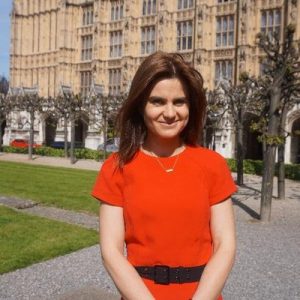
Below is the text of the maiden speech made by Jo Cox in the House of Commons on 3 June 2016.
Thank you, Mr Speaker; it is a great privilege to be called to make my maiden speech in this most important of debates, and I congratulate many others who have made outstanding maiden speeches today.
I am sure that many right hon. and hon. Members will claim that their constituencies consist of two halves or numerous parochial parts; I am another in that respect, and Batley and Spen is very much that kind of constituency. It is a joy to represent such a diverse community.
Batley and Spen is a gathering of typically independent, no-nonsense and proud Yorkshire towns and villages. Our communities have been deeply enhanced by immigration, be it of Irish Catholics across the constituency or of Muslims from Gujarat in India or from Pakistan, principally from Kashmir. While we celebrate our diversity, what surprises me time and time again as I travel around the constituency is that we are far more united and have far more in common with each other than things that divide us.
My constituency is also home to Fox’s Biscuits and Lion Confectionery, so I am sure you will not think it an indulgence, Mr Speaker, if I describe Batley and Spen as a constituency with an industrial heart wrapped in a very rich and pleasant Yorkshire landscape—geographical, historical and cultural.
The spirit of non-conformity is as prevalent now in my part of west Yorkshire as it was in the time of my two immediate predecessors, Mike Wood and Elizabeth Peacock. They were both known for offering their own brand of independent, non-conformist service, albeit in very different ways. I intend to maintain that established tradition in my own unique style.
Of course, Batley is a town that has sent Labour MPs to this place for the best part of a hundred years. One of them, Dr Broughton, is of course famously credited with bringing down a Government, so I respectfully put the right hon. Members on the Front Bench opposite on notice. The Spen valley has a far more chequered political history, alternately sending Labour and Conservative MPs here to Westminster for much of the 20th century. Nothing made me prouder on 8 May than to be sent to this place with an increased Labour majority, proving again that in my neck of the woods non-conformity is what we do best.
As I have already alluded to, we make things in Batley and Spen; we do so now, just as we did historically. Batley and Spen has a high proportion of people working in manufacturing, and we can boast the full range of industries, including high-skilled, precision engineering. We manufacture all sorts, from beds to biscuits, and from carpets to lathes. We also have some of the best fish and chips in the country, and some of the best curries in the world.
However, what many of our businesses are lacking is confidence: confidence to expand; confidence to borrow; confidence to grow; and the confidence to fuel a real economic recovery that benefits everybody, offering decent jobs, paying decent wages and bridging the skills gap. Key to changing that situation is a fundamental shift in attitude towards regional economic regeneration. It is time to give city and county regions the powers and resources they need to promote growth, and I will happily work with all of those who are genuinely committed to building an economic powerhouse in the north. This agenda has to have at its centre a commitment to connect towns and villages in constituencies like mine to thriving city hubs, and to deliver a financial offer in the forthcoming July Budget that gives this worthy goal a real chance of success. Yorkshire folk are not fools: talk about devolving power to cities and regions, while simultaneously stripping them of the resources to deliver and subjecting northern councils such as Kirklees to the harshest of cuts, is not compatible with a worthy commitment to building a northern powerhouse to drive growth and prosperity.
Businesses in my constituency want help to address the skills mismatch at local level which leaves employers with staff shortages and young people without jobs. They want access to reliable sources of finance, including a network of local banks. They want to connect to a regional infrastructure that works for them, not rail price hikes of more than 126% and endless delays to key transport projects such as the electrification of the line from Manchester to Leeds. Many businesses in Yorkshire want the security and stability of Britain’s continued membership of the European Union, a cause I look forward to championing passionately in this place and elsewhere.
The key question is: will the Government’s actions match their northern powerhouse rhetoric? HS2 is not the only acid test. There are two bigger challenges. First, will the Government really devolve all the powers and decisions that could and should be taken locally and regionally? My test will be this: if there is a compelling reason for this to be a national decision then so be it; if not, it should be devolved. Secondly, will the Government really take the whole range of their decisions—on transport, research and development, planning, education and skills—in the interests of rebalancing the economy and growing the north?
I am Batley and Spen born and bred, and I could not be prouder of that. I am proud that I was made in Yorkshire and I am proud of the things we make in Yorkshire. Britain should be proud of that, too. I look forward to representing the great people of Batley and Spen here over the next five years.
Below is the text of the maiden speech made by John Morris, the Labour MP for Aberavon, in the House of Commons on 3 November 1959.
It is with considerable trepidation that I rise to intervene in such an important debate. I stand in the same place as other young men have done in the past, and I can only hope that they did not do so with as much trepidation as I do. I hope that the House, in putting me in the balance and weighing me, will not find me unduly wanting.
Like my hon. Friend the Member for Gower (Mr. I. Davies), I should like to mention my predecessor, Mr. W. G. Cove, who, while the political tides ebbed and flowed, for 30 years represented Aberavon in this House, and before that he represented Wellingborough. While the tides ebbed and flowed Aberavon stood firm, even in 1931, when Mr. Cove’s predecessor, Mr. Ramsay Macdonald, stood in another light and, of course, for another constituency.
I should like in the few minutes at my disposal to deal with that part of the Gracious Speech which concerns the development of a sound system of communications throughout the country and the Government’s intention to press forward with their policy of building new highways and improving existing roads. It would be presumptuous of me, as a new, young and inexperienced Member, to try to paint a broad picture of the country’s system of road communications. I shall try to devote myself to a part of the problem with which I have tried to the best of my ability to familiarise myself in the last few years, and that is the transport system of South Wales, and, in particular, of Port Talbot.
In recent years the problem of who will do something for the Port Talbot by-pass and for the inner relief road scheme for the town has been a burning question in South Wales. This is not a mere constituency matter. It affects the prosperity of the whole of South Wales. Indeed, whenever there is an international match in Cardiff, every sportsman in Wales has his own epithets for describing the Government of the day when he is held up at the Port Talbot bottleneck.
The Minister of Transport said yesterday that he was appalled at the standard of driving on the new M.1 road from London to Birmingham. My sincere hope is that he is equally appalled at the hourly chaos which exists at the Port Talbot bottleneck. Here is one of the greatest bottlenecks in the country. Hour after hour private vehicles and the great vehicles of industry are held up there, causing a tremendous waste of fuel, time and money. I shudder to think of the annual amount of wastage caused by that single bottleneck. The worst period is between five o’clock and six o’clock in the evening. It has been reported that on a recorded occasion 1,278 vehicles crawled through that bottleneck between those hours.
The significance of the bottleneck is that while there is traffic from east and west, there is also traffic from north and south, and a railway crossing across that great highway. In the period between five o’clock and six-thirty it has been estimated that on recorded occasions the railway crossing gates have been shut for no less than thirty-five minutes. In any system of road communications I think that is a considerable time for the road between east and west to be closed.
No doubt the Minister is aware of the controversy which has existed regarding which of two proposed improvement schemes should be carried out, an outer scheme of relief, involving the demolition of 260 to 270 houses, or an inner scheme. It has been stated that the schemes concerning Port Talbot have had a “chequered career,” but it has appeared to me to be more like a game of snakes and ladders, with no one winning. Even though the Minister decided as far back as November, 1957, that the outer scheme should be carried out first, not a single brick has been laid up to now and not a single inch of tarmacadam has been put down.
Local authorities have done their best to assist the Minister in this matter. I wish to stress that at the inquiry in November, 1957, the Minister did not decide against the local authority’s scheme for inner relief; he merely said that he would not alter his order of priorities and that he intended to carry out the outer scheme first. But the problem of inner relief for the town still remains. On 10th March this year the local authority and the Glamorgan County Council resubmitted a scheme for the inner relief of the town. Even on the most optimistic prophecy the outer scheme will not be completed before 1965, and, even so, it will deal only with 30 per cent. of the traffic which now comes through the bottleneck at Port Talbot.
Traffic is increasing year by year by 10 per cent. I shudder to think what a tremendous bottleneck will exist in 1965 even with the construction of the outer scheme. It is absolutely vital that the Minister should decide to do something at the earliest possible moment regarding the inner road. In May of this year the local authorities requested a joint meeting with the Minister, but he regretted that the future of the inner relief scheme must remain in abeyance until after the election, as he did not consider that he should take a decision which would commit a future Administration. Now that the joustings at the hustings have been completed, I hope that the Minister of Transport will see his way clear to meet the local authorities in this matter at the earliest possible moment.
There is also the question of re-housing the people whose homes are involved in the carrying out of the scheme. I said earlier that 260 to 270 houses will be demolished. I am informed that the Ministry has not encountered a demolition problem of this magnitude before, but the problem is one which eventually will affect the whole of the country. There are no houses for sale in this area.
The majority of my constituents are steel workers and at the moment they are members of the most prosperous community in Britain. Many of these people are old and their houses are worth only £700 or £1,000. Where are they to find equivalent accommodation with which to replace their present homes? Those who are tenants will be re-housed by the council which will get a subsidy in order to do that. But the problem of where owner-occupiers will go still remains. Will the council have to re-house these people? Will it get a subsidy to enable it to rehouse owner-occupiers who cannot find other accommodation?
This is a basic problem involving people who have worked all their lives and saved up to buy their house. Are they to be compensated with sums of money which will not be sufficient to provide them with another house? There are no such houses available in modern housing developments. The cost of a new house would far exceed any amount of compensation which they might receive. Even were they re-housed in council houses, the £700 or £1,000 compensation which they might receive would soon be whittled away if they had to pay the economic rent of a council house, which amounts to £2 17s. a week. If they came within the differential rent scheme for council houses and the council received a subsidy for re-housing them, they would still have to pay a weekly rent of £1 6s.
It is no consolation to speak of National Assistance for such cases; indeed it would be tragic, because these people would have to use up the compensation they had received before getting any aid at all. There is a basic principle involved here because the life of a whole community is at stake and if we continue with great plans of road development, in a few years other people will be put in jeopardy in the same way. It will need the wisdom of Solomon to dispense justice in such circumstances.
How can we compensate people who have spent all their lives in a house of a certain type which cannot be replaced under modern housing conditions? Local authorities are anxious to obtain some indication of the attitude of the Government to these problems. Some of these houses are to be demolished as early as next March. The occupants are under notice, but the local authority has not yet been informed whether it is supposed to re-house those people.
There is a tremendous backlog of road work to be done in the country. In Great Britain there are 29 motor vehicles for every mile of road. We have the most congested roads in the world, and if the number of vehicles continues to increase at the present rate it is estimated that by 1962 there will be no fewer than 10 million vehicles on our roads. This means that there will be a motor vehicle for every 35 yards of public road or street.
Compared with twenty-five years ago the yield from motor taxation has gone up nine times, but the expenditure on roads today, even taking into account the present plans, is running at only three-and-a-half times more. The fact that we have three times more traffic on our roads today than we had in 1939 is, in my opinion, convincing evidence of the growing dependence of our social and economic life upon road transport, and it has been estimated that road congestion already costs the country no less than £500 million a year. That amount accrues from delays, wastages, wear and tear and accidents.
South Wales, and South-West Wales in particular, has suffered some hard knocks regarding unemployment in recent years. Industrialists—and who can blame them?—shy away when faced with the tremendous transport problems which exist in South Wales.
After years of talk, of inquiries, of consultations and of conferences, the people of South Wales will hardly believe their eyes when the first part of any scheme for Port Talbot is completed. Good roads are the arteries of our economic existence. The developments at Milford Haven and Swansea and the bringing of new industries to Pontardawe and Llanelly are dependent on the development of a new life link to South Wales. The prosperity of the whole community of South and South-West Wales depends on a good system of communications.
Below is the text of the speech made by Christine Hardman, the Lord Bishop of Newcastle, in the House of Lords on 25 May 2016.
My Lords, the theological understanding of grace is of the love and mercy given to us by God because God desires us to have it, not because of anything we have done to deserve it. In these early days in your Lordships’ House, it is grace that I have experienced—wonderful kindness and a warmth of welcome from your Lordships, the staff and all who work in this place. It has been entirely undeserved but a truly heart-warming experience. It will be no surprise to your Lordships that one of the loveliest and warmest welcomes came from the late Lord Walton—a fine and godly man, and a distinguished son of the north-east.
I grew up in the 1950s on a large London overspill council estate. In those large sprawling estates there were precious few community facilities and the school I attended had two classes of 45 children in each year group. The life chances of many growing up on that estate were very limited. Out of the 90 children in my year group, only 10 went to grammar school.
Two things were key in supporting me through those childhood years. The first was to be fortunate enough to be born into a loving family and the second was to be blessed by some truly inspirational, vocational teachers, who gave so generously of their free time to expand our horizons above and beyond the ordinary. One of those teachers was Mrs. Boyd, who started a debating society at our school. She had a passion for the art of debating and wanted us to catch that passion. Her sister, the late Lady Birk, had just been introduced to the Lords as one of those pioneering early women life Peers. Through Lady Birk’s good offices, Mrs Boyd brought our little debating team to this place to inspire us by witnessing debating at its best. How could I have imagined, as a 16 year-old girl up in that Gallery, that one day I would find myself making a maiden speech in your Lordships’ House?
I have the privilege of being the 12th Bishop of Newcastle. I would like to pay tribute to my predecessor, Bishop Martin—a fine Bishop and one of the longest-serving Bishops in your Lordships’ House. I will do my best to be a worthy successor, with the important exception that I will probably spend slightly less time in the smoking shed.
My diocese stretches from the River Tyne in the south to the River Tweed in the north and encompasses the city of Newcastle, North Tyneside and the county of Northumberland, together with a very small area of eastern Cumbria and four parishes in northern County Durham. Newcastle diocese is wonderful, with extraordinary contrasts: from the vibrant regional capital of Newcastle upon Tyne, with two world-class universities and 50,000 students, to the remote hill farms, some still without mains electricity and water; from the Northumberland Church of England Academy with 2,500 students in Ashington, to our smallest Church of England school on Holy Island with just four children. We have the stunning Dark Skies at Kielder and the bright lights of the big city, alongside places of pilgrimage such as Holy Island—or St James’ Park. The beauty of my diocese takes my breath away.
The gracious Speech emphasised the importance of increasing life chances for the most disadvantaged, supporting economic recovery, creating jobs and apprenticeships, and creating the kind of infrastructure that businesses need to grow. All these issues are absolutely key to economic and human flourishing in the north-east. The issues around the development of the northern powerhouse are also of great significance. I therefore warmly welcome the commitment from the noble Lord, Lord O’Neill, earlier in this debate to regional growth in the north and the Midlands.
The people of the north-east are warm, hospitable, proud and resilient. Our workforce is famed for its loyalty, with a very low staff turnover. The north-east is not a problem to be solved by the rest of the country but an asset to be valued. We are one of the very few parts of the UK with a surplus of both water and energy. Rather than transporting these vital resources to other parts of the country, we should be looking to relocate water-and energy-intensive businesses to the north-east. We are the only region in the UK with a consistent positive balance of trade and we export nearly a third of everything we make and do.
As I have journeyed around the diocese in my first five months, I have seen more signs of hope than I have time to talk about. Let me give just one example— Port of Blyth. Blyth, on the coast in the south-east corner of Northumberland, is one of the most deprived areas in the whole of England. With the closure of the Alcan Lynemouth aluminium smelter in 2012, the future of the port looked bleak. But with great leadership, a determination to find new trade and a policy of recruiting local young people who stay, Port of Blyth is now facing an increasingly optimistic future. It has just announced record results for 2015, with a doubling of pre-tax profits to £1.2 million.
Human flourishing in all its forms, including economic flourishing, depends above all on our most precious resource: our people. If these signs of flourishing are to be sustained and grow, we need the commitments in the gracious Speech to be made real in everyday lives. The most important of these commitments is to our children. There are many areas of poverty in the north-east, Blyth among them, where children’s life chances will continue to be curtailed without the determination and ambition to give such children the start in life that they deserve.
As I experienced so powerfully in my own early life, education can be absolutely transformative. Northumberland is the most sparsely populated county in England, so it is not surprising that our schools are inevitably among the smallest in the country. I therefore warmly welcome the commitment in the education White Paper to provide sparsity funding for every single small rural school, but I hope that this will not be at the expense of schools in urban areas. We need to support schools in all disadvantaged areas if the commitment to life chances is to be realised. That is made very clear in the report on northern schools issued this week by the IPPR North and Teach First, where the gap in secondary education for disadvantaged children is particularly highlighted.
The northern powerhouse will be anything but unless there is a 100% commitment to adequate funding—funding for education, apprenticeships and the infrastructure that the north-east needs. It would be this kind of vision and commitment that would make a real difference.
Below is the text of the maiden speech made by Tessa Jowell (Baroness Jowell) in the House of Lords on 23 May 2016.
My Lords, I am delighted to have the opportunity to speak in this debate on the Loyal Address and to be doing so for the first time in your Lordships’ House. I thank the noble Lord for his kind introduction. This place throngs with noble Lords who have for years been my heroes and my heroines, as well as my very dear friends, so it is an honour to be able to listen to their speeches and to learn. What a pleasure to have been able to listen to the valedictory speech of the noble Baroness, Lady Perry, who I think is a woman with more than one more adventure inside her.
I extend particular thanks to my two sponsors, my long-standing and dear noble and learned friend Lord Falconer of Thoroton and my noble friend Lady Lawrence of Clarendon, who has been a heroine of mine for many years and has deserved all the acclaim she has received as a campaigner against racism and for social justice. If only it had not been as a result of such a terrible personal loss. I also thank my mentor and dear noble friend Lady Jay of Paddington. There are so many more to whom I would like to pay tribute, but for the sake of your Lordships’ time and their blushes I will stop there. Of course, I would particularly like to thank all the staff of the House who have been so kind, welcoming and helpful since I arrived here. The doorkeepers, those in the Dining Room and those who welcome guests at the Peers’ Entrance have made me feel so welcome and have been so helpful.
As I was preparing my contribution to the debate today, I consulted my noble friend Lord Hennessy of Nympsfield—who, in turn, recalled asking the late and much-loved Lord Peston in advance of his own maiden speech what happened here. “Gossip and the discussion of ailments”, came the reply. These topics no doubt do get their occasional airing, but I have been so impressed in the short time I have been a Member by the important contribution made by this House in confronting with uncompromising humanity some of the most difficult issues of this time. The campaign led by my noble friend Lord Dubs showed that a confident, optimistic country can indeed distinguish between the fear of a free-for-all in immigration and the chance to give back to a small number of unaccompanied refugee children who have suffered unimaginable trauma their childhood.
Tax credits, support for disabled people and social housing are all causes that will change the lives of hundreds of thousands of people. They were all taken up by your Lordships in the short time that I have been a Member. So I would say to the Prime Minister, in the light of the proposals in the Loyal Address, that, however thwarted he may feel by this House, bad and unfair laws are not improved by curtailing the power of scrutiny in this place.
I sat for 23 years in the other place, both as a Back-Bencher and in government. I do not think there was a single day in my 23 years as a Member of Parliament when I did not feel awe at the responsibility of representing 80,000 people and trying to meet their expectations of me. My former constituency of Dulwich and West Norwood, now so ably represented by my successor, Helen Hayes, represents all I most admire about our country—its diversity, the endless ingenuity of its people, their optimism and their belief in the possibility of change. All my constituents, rich and poor, benefited equally from the dedicated staff at King’s College Hospital. Over all those years we campaigned together with community organisations such as the Brixton Soup Kitchen, Centre 70 and 4ALL, along with many others, and with local parents, for secondary schools which are transforming the ambition of young people so often written off.
My own first job was as a social worker in Brixton, tramping the same streets that I was later lucky enough to represent in Parliament and supporting families who had so much stacked against them. I hope that I will never become inured to what poverty smells like, nor forget the look of disappointment in a young person’s face when they realise that the great opportunity of London seems to be for others and not for them. Our new mayor, Sadiq Khan, carries on his shoulders such high expectations from those dispossessed. I congratulate him so warmly on his victory and pledge to help and support him in every possible way to be, as he wishes, the mayor for all Londoners.
The great issue before this country today is, of course, our membership of the European Union—the focus of so much of today’s debate. I devoutly hope that we will remain in it as fully engaged partners, but with the self-confidence to continue to negotiate change. So a vote to remain is not a vote for the status quo. Amid the daily salvos from warring economists and the claims and counterclaims of the partisans, it is too easy to forget that the European Union is a union of 28 nations, in a continent that saw the deaths of 70 million from wars in the last century, that have bound themselves together by common commitments to standards of human rights, rights at work, democracy, the rule of law and peaceful coexistence. We should never take that for granted.
Of course the EU institutions need to be improved. In many ways, this forthcoming referendum is a reproach to their slow response to public concern about this. Of course the EU faces enormous challenges, but we are not alone in wanting to shake up its inadequate institutions. But the founding optimism, its vision and its purpose are noble ones. We should stand up for them. Of course I respect the sincerely held views of those who want to leave, but behind the go-it-alone rhetoric I detect a deep pessimism. Those who wish to make this leap in the dark discount our importance to the rest of the European Union and the fact that our active engagement is a force for stability and good sense. It is a matter of vital national interest and it is a view which betrays a lack of confidence in our own country, in our ability to lead and win the argument for reform.
Personally, I feel I have been here before. When I proposed that we bid for the 2012 Olympic Games in London, I was told by all sides, “I wouldn’t bother if I were you. Even if we try, we won’t win. The French have it all sewn up—and, if we do win, we won’t be able to host it properly”. “Best not get involved” was the general advice. Here I pay particular tribute to my dear friends, the noble Lords, Lord Coe and Lord Deighton, who always believed that we could do it and did so much to make sure that we did.
And indeed we did. We did make a world-class venue out of a wasteland. We did inspire our young people not just in this country but around the world through International Inspiration. We did lead the world in sport after sport, and in that summer we found a renewed sense of our national identity, of who we are: self-confident and diverse. I think it took us a little by surprise. In those summer weeks four years ago, to recall Abraham Lincoln, we found,
“the better angels of our nature”.
I hope that in that same spirit the people of this country will renew their commitment to the European Union as an optimistic community of nations in which proud and distinct national identities are also the foundation of collective solidarity and open trade.
What I wish for my country, I wish for my own beloved Labour Party. I hope it can embrace the energy of its new and growing membership, who all share a belief that we should help people achieve more together than they can alone. But my party can do that only when it governs. It fails when it becomes a sect of the elect, turning its back on those who are not true believers, and becoming obsessed with rooting out heresy.
My Lords, I am truly honoured to join you. I hope to be useful and constructive, to learn from you and to offer help where I can. The great Seamus Heaney’s last injunction to his wife was, “Noli timere”—“Do not be afraid”. In holding the Executive to account, in defending a just cause even when it is unfashionable, in defending the weak against the strong and in forging our future proudly and confidently in a prosperous, peaceful Europe—in all these endeavours, we need not be afraid.
Below is the text of the maiden speech made by John Gummer in the House of Commons on 30 November 1970.
I should like to thank you, Mr. Deputy Speaker, for calling me to make my maiden speech. I wish to ask the House for its customary indulgence, even though on this occasion it will be particularly difficult to speak in an uncontroversial way.
I represent a constituency that is particularly affected by the matters raised by the hon. Member for Manchester, Wythenshawe (Mr. Alfred Morris). West Lewisham is largely a residential area with a higher than average population of older people and, therefore, the concerns of the cost of living hit them perhaps more directly than they hit other kinds of communities.
This Motion begs a major question, a question to which the hon. Gentleman did not fully address himself, namely how a Government should protect the consumer. This is a basic question, the kind of question to which my predecessor as Member for Lewisham, West, Mr. James Dickens, would have addressed himself with a sturdy independence irrespective of the views of this side of the House or, indeed, of his own Front Bench. I hope that sturdy independence which he represented in West Lewisham will not disappear with the change of regime.
There is implicit in the Motion not only the question, but the answer that the hon. Gentleman would like us to give. Unfortunately, it seems to me that that answer is precisely that which was attempted for over six years by the Labour Government and which was attended by a conspicuous lack of success. Therefore, in addressing ourselves to this Motion it would seem more reasonable not to make apologies for past history, but to try to find a new way of solving the problems which, quite rightly, were highlighted by the hon. Gentleman.
The hon. Gentleman’s reference to the National Board for Prices and Incomes reinforces what I have said about his remarks. If we become mesmerised by the easy answer which is very popular with the country on the lines of, “Let us have some kind of automatic panacea; let us have a prices and incomes policy”, we know that, after six years, such a policy very soon becomes only an incomes policy; there is no real effect except to raise prices, and the incomes policy very soon can be proved to increase rather than decrease the way in which incomes rise with the consequent effect on the price spiral.
I notice that there has been a great deal of quoting from the Grocer, a magazine not often quoted by the Labour Party before 18th June. I believe the hon. Gentleman now quotes it to suggest that if only we were to use the same methods as had been used then we will have a great deal of success, though this has not been the case over the past six years. I agree that if the present Government were to use the same methods as were used by the previous Government in the last six years, the present Government containing the sort of people it does, would achieve greater success. But what we need is a different method from that set out in the Motion.
Is it reasonable to suggest that we can protect the consumer unless we are prepared to do something about the reasons why prices rise unnecessarily? One of those reasons is the way in which our industrial situation has caused overmanning in industry so as to make us uncompetitive. I must declare an interest since I am connected with the printing industry, and it is surely unreasonable to have a situation in which every printing press in Britain has more men working on it than is the case on the Continent. Until we solve that sort of problem we will be able to do nothing for the old-age pensioners of West Lewisham, or of anywhere else.
On the matter of social welfare the attitude behind the Motion is that all is well and that we should merely stay in the same place. That is what worries me. The situation is not solved merely by saying, “How appalling it is to change the social welfare system.” That is the burden of what is proposed in the Motion. When I go round my constituency I see hundreds of people in private tenancies who need help, and I do not believe that they will regard a change in the system of housing subsidies as being to their disadvantage.
When we find references made to Professor Townsend and the Child Poverty Action Group, we must remember that, even in every one of six years of Labour Government, child poverty got worse and worse year by year. Nor do I believe it necessary to talk of school milk in the terms used by the hon. Gentleman in moving this Motion when one remembers that school milk was introduced at a time when the major health problem for children in Britain was rickets. Indeed, the major problem today is that of obesity. We have only to look at the evidence to see that that is the case. It has recently been said that nearly one-third of the children of London are overfed. We might well look at that situation in the light of what is said in this Motion.
To go back to housing policy, it would be wrong to face a situation in which we are not prepared to say that, in order to solve the problems which face the nation, in order to do something about the rising cost of living, we should not ask those who are able to do so to stand on their own feet, simply because there are some—and there are certainly some people in this category—who cannot do so.
On the matter of consumer choice, it is curious that we should not allow people to make choices in housing and education, which are important, and then complain when people make trivial choices. This takes away the right of a person to make a meaningful choice.
This Motion not only contains a major question, which it begs, but it gives the wrong answer. Our only choice in solving the problems which face us today is to change the whole nature of our competitiveness. I do not see how the system will work without changing the taxation system to make it possible for companies to improve their liquidity, or to alter the system in such a way as to encourage people by changes in their personal tax situation. Without changing those sorts of things, I do not see how we will avoid the hand-to-mouth system which exists at the moment merely by putting a new subsidy in place of the old. Subsidy is merely a redistribution of present wealth. We want to see an increase in our wealth. This Government have put that matter first and I believe that is the successful answer to our situation.
The hon. Gentleman spent a good deal of his time sniping at the possibility of Britain entering the Common Market. This was all of a piece with the same argument. He was saying, “Let us stay in the same place. Let us make no major changes. Let us go on like we have always done. Let us not solve the basic problems first.” I feel that unless we enter the Common Market on suitable terms, we will be unable to bring about a change in the continuing costs and wages spiral and that this will go on until we find ourselves unable to operate in the world in which we live. The whole proposition in the Motion seems to demand a return to a world of what one might call Socialist myth, a world which may have existed but does not today—a world which can exist only if Governments are not prepared to make fundamental changes in our society.
I believe that the Conservative Party was elected to make these fundamental changes in our society. That means changes, and not just tinkering about with and replacing old ideas that have failed over six years of Labour Government. This can be done only by restoring national competitiveness, by changing the taxation system and by being prepared to provide aid for those who need it—and there are many who do—and, above all, by seeking a new place for Britain in the world by finding an accommodation with Europe so that we can play our full role.
Below is the text of the speech made by David Rendel in the House of Commons on 19 May 1993.
Thank you, Mr. Deputy Speaker, for giving me this early opportunity to do what the Prime Minister would no doubt describe as “breaking my duck”.
As is traditional, I should like to begin by recalling the sad circumstances of my election to the House. In February of this year, my predecessor, Judith Chaplin, tragically and very suddenly died after what had appeared to be a routine and successful minor operation. Her death was a great loss not only to the House, and particularly to her many close friends here, but also to all of us in west Berkshire. I do not think that anyone doubted that she was a woman of immense ability. Indeed, she was believed on all sides to be destined for high office. For her parliamentary career to be cut short after only 10 months was indeed a tragedy.
Sadly, just one week after he had given the oration at Judith’s memorial service, her predecessor, Sir Michael McNair-Wilson, also died. He too will be long remembered with great affection by many in this House, as well as by all of us who knew him in west Berkshire. He had many friends and, so far as I know, not a single enemy, even among those who, like myself, were his political opponents. But, above all, we shall remember him for his immense courage after his health failed him. He not only remained a Member of the House while on kidney dialysis, but fought and won in a further general election. It is a great sadness that he enjoyed less than a year of retirement before he too died.
Both my predecessors were admired greatly as first-class, hard-working constituency MPs. As I said in my acceptance speech, they will be a very hard double act to follow. The constituency that they have passed on to me covers almost half of the area of Berkshire. Although it is dominated by the two largest towns—Newbury and Thatcham—nearly half the population live in the town of Hungerford, in the larger villages such as Lambourn, Compton, Mortimer and Burghfield Common, or in the smaller villages and outlying settlements spread across the rural area. With the M4 cutting across the constituency from west to east, we lie in the now somewhat tarnished silicon valley, with high-tech industries providing a large share of local employment. We are also, of course, famous for our racing stables, particularly in Lambourn and West Ilsley.
Many hon. Members will, for one reason or another, have had cause to visit our beautiful constituency during the past few weeks. Indeed, there was a time when we saw so much of the hon. Member for Winchester (Mr. Malone) that I began to wonder whether he was looking for a home in the area. It is, of course, no surprise to me that people should wish to visit west Berkshire, a very large proportion of which is designated as an area of outstanding natural beauty, but I suppose that it is only fair to say that, of the two principal tourists who visited us from Somerset recently, one—the right hon. Member for Yeovil (Mr. Ashdown), who often sits in the seat that I have temporarily occupied today—got a rather better reception than the other.
It is because so large a proportion of our population live in the rural area that I particularly wished to speak in this debate. Over the past few weeks, hon. Members on both sides of the House have found their mail bags full —as I have done—of letters pleading for the retention of rural sub-post offices. Indeed, if the Secretary of State has done anything for post offices recently, it is perhaps that many extra stamps have been sold to pensioners who have written to their Members of Parliament on this subject.
But it is not just a matter of letters. As I went round my constituency during the recent by-election, I was struck by how often this issue was raised on the doorstep. As we all know, rural sub-post offices are often housed in the village shop, and thousands upon thousands of our village shops are dependent on their post office income for survival.
Let me illustrate briefly how important these village shops are for life in rural areas by telling the House about what one village postmistress said to me only a week or two ago. She told me about the lady who comes into her shop almost every day, takes just one or two items off the shelves, and then waits to pay. After a while, the attendant at the till motions to the lady, to indicate that it is her turn to pay, but, in reply, the lady stands back and motions others to go ahead of her.
At first the postmistress could not understand why the lady should act in this way, but eventually it dawned on her that the lady comes into the shop not merely to buy her daily rations but also because the shop is her sole meeting point for contact with her fellow human beings. She lives on her own—a lonely existence, without relatives around her—and her contact with humanity consists of her daily visit to her village shop-cum-post office, where she always waits at the end, of the queue, listening to the village gossip.
For all too many people, the village shop is now the only escape from their well of loneliness. If we lose such shops, we shall lose a vital ingredient of the quality of life in rural areas.
Let there be no doubt that the sub-post office system is vital to the survival of village shops. I have long since lost count of the number of letters that I have received, mainly from elderly people, but also from those in receipt of various other benefits as well. They have all stated that their local post office is now the only remaining place in the village where they can obtain cash. The banks have mostly long since closed their village branches.
If the post offices close as well, the only option will be a trip into town. It may sound easy, but it is not when people have to rely on public transport because they are too old or too disabled to have a car of their own. Public transport has more or less disappeared from most rural villages. Even when a bus is available, many people have written of how a trip into town to draw their pension will cost them more in bus fares than the total increase in their pensions this year.
Of course I understand that the Secretary of State intends to leave it to the individual to choose between payment through a bank and payment through a post office, but that is not the choice that people want—a real choice for them means choosing between paying through a bank in the town or paying through the post office in their local village. That choice is under threat today.
I understand that the Secretary of State wishes to reduce the taxpayers’ subsidy to rural post offices, but surely hon. Members should take a wider view. Yes, we can save the taxpayer money by reducing the subsidy to rural post offices, but what about the far greater cost to the taxpayer of the extra traffic on the roads as more and more people have to drive their cars into towns? What about the cost of car parks, petrol and environmental pollution?
The overall cost to the community caused by the loss of the sub-post office system will be far greater than any possible savings. Let all hon. Members join to save village sub-post offices, not by merely giving a vague pledge—such as the Secretary of State gave about some national network—but by giving a specific pledge that the number of sub-post offices will not be further reduced. A small, but important, aspect of our country is in danger. It is our duty to save it before it is gone for ever. I therefore urge hon. Members to vote for the motion, not for the Government’s amendment.
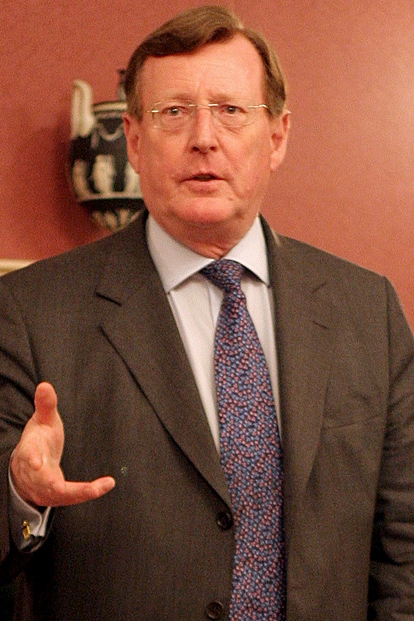
By https://www.flickr.com/photos/altogetherfool/ – https://www.flickr.com/photos/altogetherfool/3674015778, CC BY-SA 2.0, https://commons.wikimedia.org/w/index.php?curid=39319835
Below is the text of the maiden speech made by David Trimble in the House of Commons on 23 May 1990.
I understand that it is customary for me to begin by paying tribute to the previous Member for Upper Bann, which I do gladly. Mr. Harold McCusker can be aptly summed up as a man of the people. He worked extremely hard for the people of Upper Bann and cared deeply for their welfare. I know from canvassing in the recent by-election that he was held in high regard and with deep affection by the people of Upper Bann. Harold, characteristically, was a fighter. He fought for those people and he fought in personal terms. His illness would not have been so prolonged if he had not fought so strongly against it. As many hon. Members know, Harold’s surname literally means “a son of Ulster”, and he was a son of Ulster. He was conscious of the soil from which he sprang and the traditions of the area and its people.
The Upper Bann area is proud of its Unionist heritage, and many elements within the area express that heritage. I had some pleasure in reading a recent publication by the Public Record Office, edited by David Miller. Hon. Members will be familiar with his earlier work, which was extremely enlightening, on Unionism and loyalism. That publication included a copy of the account by Colonel Blacker of the formation of the Orange Order, of which I am proud to be a member. We find within it not only the Armagh area—sometimes the Armagh people, it being the County of the Diamond, forget that other counties contributed—but particularly in the west Down area. I am thinking particularly of the Bleary boys who contributed to that and to the successful defeat of the 1938 rebellion shortly afterwards.
The Unionist heritage of the north Armagh area is in some ways epitomised by the statute of Colonel Saunderson, which stands in the centre of Armagh. I shall refer again to Colonel Saunderson in a way that is particularly apposite to other matters.
Upper Bann is significant not only for its Orange heritage but for the way in which its character was formed largely through the plantation processes of the 17th and early 18th centuries. The major towns in the area are plantation towns. We see that from the contribution of the Brownlows to the creation of Lurgan and of the Warings to Waringstown and other towns in the area.
That plantation had a significant heritage in other repects, because directly from it sprang the Ulster custom, which after the Ulster land war of the 1770s provided a basis from which the industrial revolution was able to occur. The industrial revolution in Ulster, which was centred on the Lagan valley, was an indigenous growth. Ministers may be interested in this, because it owed nothing to Government contribution or significant landlord patronage. It was indigenous and arose out of the customary rights that the tenants had won for themselves. We find the traces of one of the first major industrial developments in the area—the textile industry—through the middle Bann valley, running from Gilford down to the town of Banbridge, which lies in the centre of the constituency.
During the recent by-election in Upper Bann, attention focused on the intervention of what are called national parties. I want to reflect on that for a moment. I mentioned Colonel Saunderson, whose statue stands in the centre of Portadown. The inscription refers to him as the leader of Ulster’s Unionists in the House for more than 20 years. As hon. Members will know, he first sat in the House as a Liberal, representing the constituency of County Cavan, and in the 1880s was returned for North Armagh, including Portadown, as a Conservative. Of course, he is noted as the leader of the Ulster Unionists.
The term “national parties” which has been bandied about in recent times is misleading. It was misleading for some people who call themselves Conservatives to intervene in that election and call themselves the national parties. They claimed that their arrival was something new. Of course it was not new. Nor are they right to refer to themselves as solely national parties as distinct from provincial parties. We in the Ulster Unionist party are the British national party in Ulster. We were formed historically by an alliance between Ulster Liberals and Ulster Conservatives, with Ulster Labour representatives too, to combat Irish nationalists. We are the national British parties in Ulster. In that context, one must put a large question mark against the aims and motives of a group calling itself Conservative which contested the election with, it seemed to us, the object of dividing and diminishing the Unionist voice and, by so doing, diminishing the voice of the British people of Ulster.
Since my arrival in the House, several hon. Members have expressed to me their regret at the decision of the Conservative party to contest the Upper Bann election. I did not regret it during the election. While canvassing, I repeatedly told the electors that the election was an opportunity for them to vote against the policies of the Government. The results show that the electorate of Upper Bann seized that opportunity with both hands. Hon. Members will not need to be reminded that the candidate representing the policies of the Government scored a total of 2.9 per cent.—less than 3 per cent.—of the valid votes cast in the election. That is a clear rejection of the policies of the present Administration. That demonstrates—indeed, it confirms, because we had demonstrated it on many previous occasions—that the policies pursued by the Northern Ireland Office have no mandate from the people of Ulster. That is significant.
People cannot say that a majority elsewhere in the United Kingdom in favour of the Government’s policies legitimises those policies. A clear distinction can be drawn between Northern Ireland and, say, Scotland. In Scotland, where again the Government have no mandate for their policies, they can say that their policies are applied on a Great Britain basis and that they have a majority in Great Britain. However, the policies pursued in Northern Ireland are applied, not on a United Kingdom basis but specifically to Northern Ireland. Northern Ireland is treated differently from the rest of the United Kingdom and its constitutional status in the kingdom is diminished.
A mandate for the Government’s policies can be obtained only from the people of Ulster. Clearly that mandate does not exist. In the light of that, the only honourable course for the Government is to reconsider their policies and accept the offers made by my colleague to extricate them from the position in which they have put themselves. They should adopt policies that reinforce the position of the kingdom of Ulster within the kingdom.
At least the Conservative party came to seek a mandate in Upper Bann, even though that mandate was refused. If listened with interest to the speech of the hon. Member for Leicester, South (Mr. Marshall). I find his detailed interest in matters relating to Northern Ireland interesting. I agreed with several of the points that he made. Surely he must find it a little strange to take such a detailed interest in Northern Ireland matters and discuss them at length in the House when he belongs to a party that not only does not contest elections in Northern Ireland but refuses people in Northern Ireland the right or opportunity to join it. A member of a party which deliberately boycotts the people of Northern Ireland must surely find it inconsistent to take such a detailed interest in Northern Ireland.
Tonight we are discussing the Appropriation (No. 2) (Northern Ireland) Order 1990. The measure is dealt with in the form of an Order in Council. Order in Council procedures are less than satisfactory. Indeed, that is an understatement. The hon. Member for Belfast, East (Mr. Robinson) referred a few moments ago to defects in the planning legislation on article 22 inquiries. As hon. Members will know, a planning and building regulations order has been tabled and is shortly to be debated. If that was legislation dealt with in the normal way, the hon. Member for Belfast, East could table an amendment to provide a remedy for the defects to which he referred. Of course, he cannot do so. That is not right. The procedures should not operate in the way that they do. Significant changes are needed.
I support the comments made by the hon. Member for Antrim, South (Mr. Forsythe) on the Payments for Debt (Miscellaneous Provisions) Act (Northern Ireland) 1971. Order in Council procedure is objectionable partly because it is described as temporary. It is a temporary procedure stemming currently from the Prevention of Terrorism Act 1974 and originally from the Northern Ireland (Temporary Provisions) Act 1972. One wonders what the meaning of the word “temporary” is in that context.
That is even more appropriate in the context of the point raised by the hon. Member for Antrim, South. He dealt with a temporary measure introduced in 1971, which is still operating. Not only is the measure objectionable because it was a temporary measure which lasted 19 years, but the provisions made for deduction of benefits under the Act were made as the result of administrative action.
I should have thought that hon. Members who are interested in the rights of persons subject to the law of the United Kingdom would want people’s property rights determined in the courts or through some form of judicial procedure, rather than civil service actions. Civil servants may decide to withhold benefits in order to pay debts owed to other persons. That is particularly strange when, through the Enforcement of Judgments Office and its provisions for attachment of earnings and other assets, procedures have to be followed and some independent judgment is placed between the debtor and the creditor by the operations of the enforcement officers.
Surely, at least on those grounds, something should be done. Even if it is still felt necessary to make deductions from people entitled to claim benefit, surely something should be done to enable people to make representations before a third party. It would be appropriate to provide something analogous to the procedure for enforcement judgments.
My first point about the order concerns planning policy in the Craigavon district. That area is unique in Northern Ireland as the only area that does not have in force a development plan or area plan. The original, non-statutory plan, which is now some 20 years old, is not relevant, because the position has changed drastically in the past 20 years, with the failure of the new city project contained within it. In that area, we are operating with the detritus of the new city project.
While canvassing during the election campaign, I was struck by the desolation of the estates in the central Craigavon or Brownlow area. I hope that some thought has been given to planning policies that could help to regenerate that area. I was also struck by the way in which many areas of the town of Lurgan have been badly blighted because of road proposals which, I am told, have since been abandoned. Again, I hope that some serious planning policies will be evolved to regenerate those areas.
I was also struck by one of the consequences of the 1960s housing policies which I hope will not be repeated. I refer to the not very well built medium and high-rise flat developments. Nearly all the developments that I saw were semi-derelict and unoccupied. They were eyesores and worse—especially in the Portadown district, where properties that were originally constructed by the local Housing Executive have been bought by the tenants under the right-to-buy procedures, which the Government encouraged.
The owners have found that, to some extent, their properties have been devalued by the derelict medium-rise flat developments just across the road. I hope that some urgent action will be taken on that. I was told by the occupiers—the purchasers—that they had been told by the executive that they would have to wait two or three years simply for a decision on the flat developments, let alone for any action to be taken.
My second point about the appropriation order relates to the community relations cultural traditions programmes. As the Minister said, the programmes are being expanded considerably. That is a good thing, and I very much welcome the existence of those programmes. However, I should like an assurance that they will be genuinely representative and even-handed. I must confess to being uncertain about the Northern Ireland Community Relations Council. Technically, it is not a Government body, although in the first instance all its members have been appointed by the Government. It has been given a budget of £300,000. We must ask, how was the body formed? How representative of the community are the people who serve on it and how balanced is that representation? It seems that that representation does not rise above the level of tokenism as far as the majority tradition in Ulster is concerned. Many of the people who serve on it cannot be regarded as truly representative.
Finally, I refer to an item of expenditure relating to the Northern Ireland Assembly. I note that there is a provision for £274,000 to be spent—over £200,000 of which will be spent on maintaining a cadre to provide the basis for an Assembly, should one be called in the future. I welcome that expenditure because there is a great need for representative institutions in Ulster. Hon. Members will know that there is a virtual absence of representative institutions and that what are called “local authorities” are not really what are normally understood by that term. They rarely get above the level of English parish councils. There is a huge gap between them and this House. We need representative institutions.
Although I welcome that expenditure on the Northern Ireland Assembly, I do not want my comments to be taken as implying my approval of the proposals in the Prior Act—the Northern Ireland Act 1982. I am not sure that those proposals ever were workable. If we ever have an Assembly—or devolution on any significant scale in the future—I hope that it will be much more substantial than that of the Northern Ireland Assembly, if it is to be regarded as worthwhile devolution as distinct from what is essentially local government restructuring, which is another matter.
Devolution is said to be the Government’s policy. I find it curious that a Government with that policy have not made any proposals that would advance that policy. That is to be contrasted with the experience or the actions of the Ulster Unionist party because it is now almost two and a half years since the Ulster Unionist party made detailed proposals for developments in Northern Ireland to the previous Secretary of State, to which there has not yet been any response. The Government do not make any proposals of their own. Their attitude is passive. If we were to have discussions on the proposals, I suspect that the Government would not advance any proposals of their own, but would simply adopt the role of picking holes in the proposals of ourselves and others.
I wonder why that should be the case. I suspect that, despite its protestations to the contrary, the Northern Ireland Office actually prefers the present position. I suspect that it does not really want devolution, but prefers to sustain the present direct rule. Under that system, it is effectively insulated from any form of democratic control. Ministers can speak for themselves, but civil servants in the Northern Ireland Office give the impression that they are not really interested in devolution, and that they enjoy the freedom from accountability that direct rule gives them. That is another reason for ending direct rule at the earliest opportunity.
Below is the text of the maiden speech made in the House of Commons by Ed Balls in the House of Commons on 25 May 2005.
It is a great honour to make my maiden speech in this House on this, the final day of debate on the Queen’s Speech, to follow the thoughtful speeches of my right hon. Friends the Members for Torfaen (Mr. Murphy) and for West Dunbartonshire (Mr. McFall) and to follow a series of excellent maiden speeches, not least that of the hon. Member for Preseli Pembrokeshire (Mr. Crabb), which together show that we can look forward to a number of thoughtful and constructive contributions in the debates of this House in the years to come.
This is the first maiden speech by a Member of Parliament for Normanton for 22 years. Bill O’Brien, my predecessor, was a hugely respected MP, whose commitment to improving the lives of hard-working families in our area is beyond question. Almost everyone I have met in our constituency has a personal story to tell of how Bill has helped them, a friend or a family member. I know, too, that he is widely respected in the House for his parliamentary experience, for his detailed knowledge of mining and local government matters and for his wisdom. I have been told by many hon. Members how they have turned to Bill for advice and support during their parliamentary careers.
I also want to mention Bill’s family and in particular his wife, Jean, who has also served for 22 years, as an MP’s spouse. It is my considered view, speaking from some personal experience, that the role of the MP’s spouse is not always fully appreciated at a political level. I want today to set the record straight: Jean O’Brien has consistently been by Bill’s side, a tower of quiet strength and dignity. I am sure that all hon. Members will want to wish them a long and happy retirement from the Commons and to thank Bill for his commitment to public service.
I have had the privilege of speaking to many hundreds of voters in the past year about issues that directly affect their daily lives—pensions, skilled jobs, plans for a new hospital at Pinderfields, out-of-school child care and the need for more police and community support officers on the beat. All those issues I will be actively pursuing in the coming months. As we have talked, time and again I have heard and felt first hand the powerful traditions that run deep through Normanton.
My constituency forms an arc around the north of the city of Wakefield, running from Sharlston and the town of Normanton in the east, through Altofts, Stanley, Outwood and Wrenthorpe to the north, and then round to Ossett and Horbury in the west, all linked together by the M62 and M1 motorways, which intersect in the constituency. It is a constituency united by a strong industrial tradition in manufacturing, railways and coal mining, and by a long-standing civic, trade union and co-operative tradition. In our district, the Co-operative party is our conscience, and I look forward to participating actively as a member of the Co-operative group of Labour MPs.
Most important, Normanton boasts a historic Labour tradition, with the longest continuous Labour representation of any seat in England—a continuous representation, that is, since 1885, when the Liberals stood aside for 12 working-class Lib-Lab candidates. We are proud of Normanton’s Labour tradition, matched only by the Rhondda valley in south Wales, and if I may be so bold, long may it continue.
We are now in a time of great change, as the revolution of globalisation transforms communities such as ours, but these challenges of technological change, foreign visitors and new investors are, for us, nothing new. Few constituencies can boast visitors as distinguished as Queen Victoria, Prime Ministers Gladstone and Disraeli and US President Ulysses Grant, all of whom visited our area in the mid-19th century, Normanton being, for passengers travelling north to south in the pre-buffet era, the restaurant stop of choice.
One visitor above all left his mark: the Emperor of Brazil, Dom Pedro II, who stopped for lunch in August 1871, heard about the local colliery at Hopetown, arranged a visit and caused such a stir that the pit shaft was renamed Dom Pedro and became known as the Don. The emperor also visited the Normanton iron works, was shown a special rail and immediately ordered a batch to be sent back and used in the expansion of the Brazilian railway.
To us, globalisation is nothing new, and well over a century later the same strengths that made my constituency an industrial leader—our strategic location, our manufacturing expertise and our skilled work force—are now the key to our future prosperity. It is the task of the Wakefield Way steering group, on which I serve, to ensure that we exploit those advantages to the full. We want to see the Wakefield district established as a key logistics cluster, and a centre of industrial and manufacturing expertise.
We also have to be honest about the weaknesses that we must address. We still have too many people trapped on incapacity benefit, who want to work but need extra help and support to return to work. Compared with other parts of Yorkshire, we have skills shortages alongside low levels of qualifications in the adult work force. It is both an affront to social justice and a real economic threat that so many 16-year-olds in my constituency still leave school without a proper qualification. I therefore welcome the measures set out today by the Chancellor of the Exchequer in this Queen’s Speech debate on science, skills, employment, housing and regional policy, which will really help us in that task.
We are able to debate today how our wider economic policy can build on stability—rather than, as used to happen, how we can avoid stop-go—because the Labour Government have put in place a new British model of monetary and fiscal policy for our country and taken the tough decisions to establish and entrench economic stability. Twenty years ago, the Wakefield district was labelled a “high unemployment area”, with one young person in every four unemployed for more than six months as a result of the devastating loss of manufacturing jobs and the closures of the pits. It was not a price worth paying. Today, because of our economic stability, our district has an unemployment rate, not above, but below the national average. The new deal has cut youth unemployment from a peak of 3,300 young people out of work in 1984 to just 130 today—20 in my constituency. It is because of the proactive and forward-looking approach that Labour has taken to economic policy—Bank of England independence, the symmetric inflation target and the two fiscal rules—that, for the first time in a generation, my constituents are benefiting from what is close to a full employment economy.
That stability—that prudence—has been for a purpose. We have shown that a Government committed to progressive goals—increasing investment in our public services, introducing a national minimum wage, lifting 1 million children out of poverty—can also deliver the lowest inflation for 30 years, the lowest mortgage rates for 40 years and record levels of employment. Some said that a Labour Government could not run a stable economy and pursue progressive goals. The present Government have proved them wrong.
At this point, I must confess that, yes, as a young economist working in opposition back in 1994, I wrote that truly immemorable phrase, “post-neoclassical endogenous growth theory”—but there was a penultimate draft from which that infamous phrase had been excised, and it was not I but a rather more distinguished Member of this House who wrote in the margin, “Put back the theory.” From 1997, I was proud to serve the Labour Chancellor and the Labour Government for seven years as economic adviser and then chief economic adviser to the Treasury. I was privileged to chair the International Monetary and Financial Committee Deputies during a period in which Britain, under the leadership of the Prime Minister and the Chancellor, have led international efforts to reform the international financial architecture and meet the millennium development goals.
I know that those opportunities—all the opportunities that my family and I have had—were made possible only by the achievements of the Labour party in government. My grandfather, a lorry driver, died from cancer soon after the war, when my father, the youngest of three boys, was only 10. My father—from a widowed family in a working-class community in Norwich—was able to stay on at school at 16 and get a scholarship to university. All the opportunities that he and we have been able to enjoy were made possible only because of the welfare state that the Labour Government created in 1945, reflecting our core belief that opportunity should be available for all, not just for the privileged few.
I am now able to be in public service once more, as a Member of this House and as Labour’s ninth MP for Normanton. My Labour predecessors—Benjamin Pickard, William Parrott, Fred Hall, Tom Smith, George Sylvester, Thomas Brooks, Albert Roberts and Bill O’Brien—were all coal miners, every one of them. They were Labour because the adversity they suffered taught them not selfishness, but solidarity. However insurmountable the obstacles seemed to be, they never settled for second best for themselves or anyone else in their struggle for full employment and social justice. I hope that, in the coming years, I shall be able to demonstrate the humility, hard work and commitment to public service for which previous Normanton MPs are known, remembered and honoured, and thus enable my constituency’s historical traditions to live on renewed in this century. We owe it to our predecessors, as we owe it to our families and to future generations, to complete their work and, on the platform of stability that we have built, secure an economically strong and socially just society of which we can be proud.
I thank you, Mr. Deputy Speaker, for giving me the opportunity to make my maiden speech today.
Below is the text of the maiden speech made by Stephen Crabb in the House of Commons on 25 May 2005.
I am grateful for the opportunity to make my maiden speech on the final day of debate on the Queen’s Speech. It was a pleasure to listen to the maiden speeches by my hon. Friends the Members for Northampton, South (Mr. Binley) and for Mid-Bedfordshire (Mrs. Dorries), and by the hon. Members for Plymouth, Devonport (Alison Seabeck), for Worsley (Ms Keeley), for Blaydon (Mr. Anderson) and for Westmorland and Lonsdale (Tim Farron). I wish them all the best in their parliamentary careers. I would like to add my own tribute to those that have already been made to the right hon. Member for Torfaen (Mr. Murphy) for his excellent work, both in Northern Ireland and in the Principality.
I count it a huge honour to be elected as the new Member for Preseli Pembrokeshire. I am only the second Member to represent the constituency, which was created before the 1997 election, when it was won by Jackie Lawrence, and again in 2001, for the Labour party. Jackie retired at the end of the last Parliament. She and I were opponents in the election held four years ago, and we both fought robust campaigns. The more that I saw of her during that election, however, the more that I was struck by the sincerity and humanity with which she carried out her duties as a Member of Parliament. She entered Parliament for exactly the right reasons—to improve the lives of Pembrokeshire people—and served her constituents well during her eight years as an MP. Her parting remark to me on election night in 2001 was, “Best of luck with your parliamentary career, Stephen, just not here in Pembrokeshire.” I am afraid that I have disappointed her, but it was typical of her integrity and grace that not only did she send her congratulations after my win on 5 May but, last weekend, she welcomed my family and me to her home, where she passed on some excellent advice on being a Member of Parliament and treated us all to excellent home-made scones. I am sure that Members on both sides of the House will join me in wishing her all the very best in retirement.
Preseli Pembrokeshire, with much justification, can be described as one of the most beautiful parliamentary constituencies, containing as it does much of the Pembrokeshire coastal park with its 185 miles of footpath running alongside scenes of spectacular beauty. The coastline is important to Pembrokeshire. We are surrounded by the sea on three sides, and that has been the source of our comparative economic advantage throughout our history. Even today, after whaling, fishing, oil refining and defence-related industries have all flourished and then declined, the sea is still important to our local economy.
We have two ports: Fishguard, with its ferry service to Rosslare in Ireland; and the port of Milford Haven, which is the UK’s fifth largest port, with major oil interests, a remnant of the fishing industry, and an Irish ferry from Pembroke dock. As I speak, construction is under way on two major liquefied natural gas terminals near Milford Haven. When completed, those could provide 30 per cent. of the UK’s natural gas needs, which will be shipped into the nearby port of Milford Haven. Not surprisingly in an area of such outstanding natural beauty, the liquefied natural gas development is not without controversy, and some specific issues need to be addressed. The LNG investment, however, will bring a vital injection of economic activity to west Wales, which could provide a substantial long-term pay-off for many years to come.
As well as our coastal heritage, Pembrokeshire is also home to Britain’s smallest city, St. David’s, with its picturesque streets and beautiful ancient cathedral. St. David’s was a site of huge importance in early Christendom. It lay on the intercontinental route that took Irish pilgrims through Britain on the way to Rome and sometimes Jerusalem. Still today, the A40 trunk road, which leads from Fishguard through Pembrokeshire towards the M4 corridor is recognised by the EU strategic trans-European network, which links western Ireland with mainland continental Europe.
Travelling along the single-lane A40 through Pembrokeshire can be a slow and frustrating journey, however. Upgrading the A40 to a dual carriageway is certainly overdue. Local business needs it, local people want it, and while I am a Member of this House I want to do whatever I can to make the case for it, and, I hope, to persuade the rather Cardiff-centric Welsh Assembly of the need for investment in critical infrastructure in other parts of Wales.
In the heart of Pembrokeshire is the old town of Haverfordwest—the county town of Pembrokeshire—which I am blessed to be able to say is my home town. I grew up there, in a street of council housing, which backed on to my old secondary school. Many of the houses in that street have now been bought and had small porches, kitchen extensions and other improvements added to them. I want to add my voice to that of my hon. Friend the Member for Mid-Bedfordshire (Mrs. Dorries), who said that no one should lose sight of what the Conservative right-to-buy scheme did for hard-working, working-class families in constituencies such as mine. Of course we need to provide an adequate rented sector for individuals and families who might, through different circumstances in their life, have to fall back on social housing, but the aspiration of the vast majority of people in this country is towards home ownership, which should be recognised as a key goal of housing policy.
There have been Crabbs in Pembrokeshire for many generations, and not just on our wonderful beaches. My grandfather was a baker in Haverfordwest at a time when, like other small market towns, it was full of independent traders, grocers, shopkeepers and tradesmen. In those days, there was no such thing as a small business sector; there were only small businesses. Times change, and today Haverfordwest has a Tesco, a Morrisons, a Kwiksave and an Aldi, and I am told that we will soon have a Lidl store as well. I am not a betting man, but I am willing to wager that not many of our long-suffering local farmers who still constitute a significant part of the local economy will see much of their produce on the shelves of that supermarket when it comes to Haverfordwest.
A principal reason why Pembrokeshire is such an attractive place for the food discounters is that our per capita GDP is so much lower than the UK national average. GDP in Pembrokeshire is less than 70 per cent. of the EU’s 15-member average, which qualifies us for objective 1 status. We are currently in receipt of structural funds through that programme. I do not want to be too controversial today, but I am more than a little sceptical of the long-term success of EU structural funds in closing the wealth gap between regions. The targets for the EU cohesion and structural funds have consistently not been met.
Objective 1 did, however, provide an important opportunity for many stakeholders in west Wales to focus like never before on what needs to be done to improve the region’s economy. My fear is that that was a missed opportunity. Many business people in Pembrokeshire tell me that they do not feel that the business community was actively involved in the objective 1 programme, and that the process was dominated by public sector bodies. I believe that small business is the backbone of the Pembrokeshire economy and I want to do whatever I can while I am a Member of the House to provide a voice for the hard-working men and women who comprise that sector.
I greatly value the commitment in the Queen’s Speech to reducing burdens on business—business regulations. The small business community in my constituency is looking for action, not more words, from this Parliament.
I am grateful for the courtesy of the House this afternoon, and to the people of Preseli Pembrokeshire for giving me the opportunity to be their representative during this Parliament.
Below is the text of the maiden speech made in the House of Commons by Candy Atherton on 11 June 1997.
I am grateful for the opportunity to bring to the attention of the House a problem that affects hundreds of people in my constituency and throughout Cornwall.
Before dealing with the problems of long-term care for the elderly in Cornwall, I should like, in my maiden speech, to describe my constituency. It is the penultimate seat before the Atlantic and America, a place of almost indescribable beauty, stretching from Gwithian to Portreath on the north coast, while the Carrick roads and Helford river form its southerly boundaries.
The north coast is wild and the south coast is bathed in warm air that gives us some of the world’s most famous and breathtaking gardens—Trebah being one which readily comes to mind. We have creeks and coves, windswept cliffs and sun-soaked and glorious beaches, but that beauty, like so much in life, cannot mask the underlying problems that scar the area.
Unemployment is at 10 per cent. officially, yet, on estates in Redruth and Camborne, it is nearer 90 per cent. among men of working age. The old industries, such as mining, quarrying, fishing and farming, are in decline and what work there is, is often low paid and seasonal, in the tourist industry.
The last working tin mine in Europe provides a mainstay of employment in the north of the constituency, as do the Falmouth docks in the south, but where thousands were employed years ago, only handfuls of hundreds are today. Many more jobs used to be found in the tin and quarrying industries and still more depended on the mines.
Today, we have the internationally famous Camborne school of mines that has trained hundreds of people from throughout the world in its many arts. There is widespread dismay in the area because the welcome plan for a university for Cornwall in Penzance includes the proposal to relocate that famous school out of our area.
Before making this speech, I read my predecessors’ maiden speeches. The last four all referred to problems of unemployment. Sebastian Coe, the former Olympic runner, spoke of the endemic unemployment, as did his predecessors, the broadcaster David Mudd, Dr. Dunwoody and Frank Harold Hayman. Senior Members may remember Harold Hayman, a Labour Member of Parliament who is still spoken of with love and affection by my constituents. “If you do half as well as our Harold,” they tell me, “you won’t be doing half bad.”
My priority as a Member of Parliament will be to bring new work and opportunities to my constituents. I look forward with relish to the introduction of a national minimum wage which, alongside reform of our benefits system, will enable my constituents to enjoy employment and a living wage.
I shall be keen to ensure that we have a development agency to tackle the problems facing the fishing and farming communities, improve the quality of our housing and provide new opportunities for our young people through jobs and training. In Cornwall, we are concerned to ensure that the seasonal nature of much of our employment does not result in fewer opportunities for our young people and the long-term unemployed. The number of people enduring long-term unemployment is greater in reality than the figures imply.
I could entertain the House with the follies of South West Water. We pay the highest water bills in the country for a service that leaves many of our beaches polluted and fails to provide the long-term investment for which Falmouth, in particular, is crying out. However, this debate is about Cornwall Care.
I believe that all Members from Cornwall must work and speak together on issues of concern to the county. There is much that the new Government must do to remedy the ills of the past 18 years of Conservative rule. I am certain that there will be times when the Liberal Democrats are critical of the new Government; equally, there will be times when I am critical of the actions of Liberal Democrats. That is the nature of all good relationships: we all fall out occasionally. This is one of those times.
The tragedy that has prompted this debate has led some to dub the charity, “Cornwall Doesn’t Care”, but I leave it to right hon. and hon. Members to decide for themselves. The problem is one that all too many local authorities have had to face. The Conservative Government slanted the figures so that it was financially better for many authorities to transfer their residential homes for the elderly to housing association or charity status.
Several years ago, Cornwall county council recognised that it was facing a problem with its 18 residential homes for the elderly. Two and a half years ago, a report was produced that suggested that four homes should be closed. Understandably, there was uproar when it was published. People, including the then chair of policy and resources, in whose ward one of the homes was located, do not want their local homes to close.
The controlling group proposed that a new charity, Cornwall Care, should be created. The county council would retain ownership of the homes but the services would be delivered by Cornwall Care. Last April, the new charity took control of the services and announced that existing staff would have to sign new contracts of employment considerably worsening their terms and conditions.
Many of us recognised that the figures did not add up and that the new charity would be forced to take action when the staff were transferred into their employment. I met many of the staff, some of whom faced losing more than £300 a month. That was their mortgage, and many told me that they would not be able to survive financially under the new terms.
For weeks, pressure was put on those caring members of staff to sign the new contracts. They were told that if they failed to sign, they would lose their jobs. I have some knowledge of transfer of undertakings law and I joined many others in publicly warning the charity that it would face industrial tribunals.
Eventually, 249 staff decided to take their cases to an industrial tribunal. All were dismissed. That was not an easy decision for them to make. Many had worked for the county council for more than 20 years, and I know that their decision caused them great anguish and misery. To a man and a woman—they were mostly women—they said that they loved working with the residents and wanted to continue doing so, but that they could not and would not sign the contracts.
The case was heard in Truro in the middle of the general election campaign. The former staff won and the result was widely publicised in the national media. Since then, the situation has deteriorated. The charity has announced that it will be forced into liquidation if an appeal is unsuccessful, and I understand that it has recently said that it faced severe financial problems whatever the result of the appeal. That has meant that existing staff are concerned for their futures and that residents—and their families—are worried about where they will live. The staff who won the industrial tribunal feel pressure not to take up their legal entitlement and a general miasma of worry is hanging in the air.
During the election campaign, I met folk in tears about the situation. I met one woman, who was clutching a letter from Cornwall Care and who was in tears on her doorstep. She implored me to act as soon as I won the election, because she was so worried about her mother, who was a resident in one of the homes in my constituency. That was one reason why I, with many other hon. Members, signed an early-day motion about Cornwall Care last month.
Meanwhile, the county council, which was embroiled in elections itself during the general election campaign, said that the problem was for Cornwall Care to resolve. My intention in requesting this Adjournment debate was to knock a few heads together at Cornwall Care and the council. The county council, as the owner and purchaser of the service, has a responsibility to resolve the problem. Occasionally, local government gets its priorities wrong and sometimes councillors make the wrong decisions. When Labour local authorities err, as a party and a Government, we have rightly condemned them. It is time for the Liberal Democrats to do the same.
I have consulted the Liberal Democrats’ general election manifesto, which was entitled “Make the Difference”. It states: Older people in Britain should be able to look forward to a retirement of security, opportunity and dignity. Older people feel that they are fast becoming Britain’s forgotten generation. Many of the residents of Cornwall Care feel that they have been forgotten, that they have no security and that the whole sorry mess is very undignified.
Many of us believe that the county council knew that Cornwall Care would lose at an industrial tribunal. It is not right for local authorities to transfer a problem to another body rather than face the political flak. The residents and their families and the former and current staff need to be reassured about their futures. The whole sorry mess could, and should, have been avoided. The elderly in Cornwall deserve better and I call on the Liberal Democrats in Parliament, from whom I would like to hear on the issue some day, to demand that their colleagues on Cornwall county council to resolve the problem.