Tag: Maiden Speech

  • Colum Eastwood – 2019 Maiden Speech in the House of Commons

    Below is the text of the maiden speech made by Colum Eastwood, the SDLP MP for Foyle, in the House of Commons on 19 December 2019.

    Mr Deputy Speaker (Sir Roger Gale)

    Order. Just before we proceed, may I remind the House that the convention is that maiden speeches are heard uninterrupted? I am saying that now because it gives me great pleasure to call the first maiden speaker of the 2019 Parliament, the hon. Member for Foyle (Colum Eastwood).

    Colum Eastwood (Foyle) (SDLP)

    Thank you, Mr Deputy Speaker. No pressure then!

    As the leader of the Social Democratic and Labour party, may I thank the people of Foyle and Belfast South for the resounding mandates that they have given my hon. Friend the Member for Belfast South (Claire Hanna) and me? We will not you down and we will not take your support for granted. I also want to thank my predecessor for the work that she did in the constituency.

    I stand here, Mr Deputy Speaker, as an Irish nationalist. In fact, I stand here because I am an Irish nationalist, not in spite of it, because I believe that every single person in all our constituencies needs to be properly ​and fully represented. I am glad to be here, but we are not narrow nationalists. We come from the tradition of Parnell and Hume. Our vision is big and it is broad. Our mission is to unite all of our people, not divide them any further. We intend to represent nationalists, unionists and everybody else, and we will do that to the best of our ability.

    This Prime Minister wants to drag us out of the European Union against our will. I know that he has a huge majority, but the only majority that I am concerned about is the pro-remain majority in Northern Ireland that has thankfully now got its voice back in this place. We may be few in number, but we intend to be very, very loud in voice.

    The Prime Minister’s approach to Brexit is totally reckless. It drives a coach and horses through the Good Friday agreement and the relationships that we have built up over many years, right across our community and right across our islands. I am glad to see now that the Democratic Unionists are very concerned about the checks between this island and our island. It is a pity that they did not think about that when they drove the Brexit agenda, and when they rejected Theresa May’s deal. Now we are in a situation that none of us is happy with. We are in a situation that every one of us should be trying to reverse and to reject.

    Equally damaging to our progress and our peace process is the current proposal that basically gives an amnesty to British soldiers for whatever they carried out in Northern Ireland during our very, very difficult troubles. I come from a place called Derry. In 1972, 14 innocent civil rights marchers were gunned down by the British Army on the streets of Derry. They were demanding their rights and they were marching against internment. An international tribunal has stood by the fact that they were innocent and were unlawfully killed. Is prosecuting those veterans vexatious? No, it is not. We will resist this attempt to undermine our peace process and our political progress, and this insult to all the victims of our terrible, terrible past, who have been denied the opportunity to find full truth and full justice since 1998. We stand by every single one of those victims, no matter who the perpetrator was. Government Members need to understand that if they begin with an amnesty for the British Army, they will end up with an amnesty for everybody; that is the door they are opening with this proposal. It would better suit the Prime Minister and the Government to stand by all the innocent victims who have been searching for truth and justice for far too long.

    I will end with one other comment. A proposal has been mentioned today by a number of people, including by the Prime Minister, who said, “Watch this space.” The Government want to build a bridge from Scotland to Northern Ireland. Well, they would be much better suited building a decent road from Belfast to Derry.

  • Dennis Skinner – 1970 Maiden Speech in the House of Commons

    Below is the text of the maiden speech made by Dennis Skinner, the then Labour MP for Bolsover, in the House of Commons on 29 October 1970.

    I am grateful for an opportunity to speak in this very important debate. My constituency has within it upwards of 10,000 miners who work in the Notts and Derbyshire coalfield. It is important to place on record, too, that the previous hon. Member for Bolsover was Mr. Harold Neal, who served the constituency diligently for about 25 years. Like me, he became an official of the Derbyshire miners. During the post-war Government, he was made Parliamentary Secretary to the Ministry of Fuel and Power. Perhaps at that point I should cease to make comparisons.

    Having worked underground for 21 years and accumulated a little knowledge on the way, I want if possible to impart a little of it to the House. I wish to refer especially to one matter raised by the hon. Member for Worcestershire, South (Sir G. Nabarro) concerning pithead prices of coal.

    The price of coal at the pithead in Derbyshire when I left it on 18th June was less than £5 a ton. It is true that the national position is somewhat higher. The reason is that the North Derbyshire output per man shift is higher than the national figure. The result is that the national pit head price is something like £5 15s. a ton.

    The reason why the hon. Member for Worcestershire, South has to pay about £23 a ton for his smokeless fuel is that there are many people involved in trying to sell it. It could be argued that they are rigging the market in no way less than the people shown on television a few nights ago who are rigging the market in the construction industry.

    Three problems face our miners today. From my point of view, it is a pity that they have been referred to already by my hon. Friend the Member for Ebbw Vale (Mr. Michael Foot) in his excellent speech. Obviously it would be difficult for me to improve upon his rhetoric.

    I want to attempt to say a few words first about the basic wages and conditions in the mining industry. For some reason, they never seem to get across to the people really concerned. When miners talk about wanting a £20 minimum wage, they are really discussing a £20 maximum wage. There are no bonus payments in the mining industry today. There are no piece rates, no annual increments and no service payments. A man who has been in the pit for 50 years from the age of 13 or 14 finds towards the end of his career that he is likely to be shuffled to the bottom of the pack. Far from getting service payments, he gets less than he did 20 or 30 years before.

    My hon. Friends well know the conditions that I have outlined, but the Government should realise that wages and conditions of these kinds have to be accepted. When we discuss a £20 minimum wage for miners, it is no good right hon. and hon. Gentlemen opposite arguing that we are talking about something in excess of that when other marginal additions are made at the pithead.

    For working unsocial hours—the afternoon shift, the night shift, the continental shift and the twilight shift—unlike many other workers, the miner receives the monumental amount of 6d. an hour extra for working between 8 p.m. and 6 a.m. Indeed, it can and must be said that many miners do not receive that. Unlike hon. Members, miners are not sent home for a 95 days’ cooling off period. Miners receive two weeks annual holiday entitlement. It ill becomes anybody outside or any hon. Member in this House to talk about the miner having an occasional day off when the allowances that he gets for holidays are so abysmally low.

    Because of this situation—the wages and conditions that the miners have suffered all these years—we have seen, during the past few months and weeks, an upsurge of militancy in the miners’ ranks. It was an upsurge of militancy that recorded a 55 per cent. vote. Let no one imagine that the 55 per cent. vote was regarded by people like myself, who have just left the industry, or those who are now officials within it, as a disaster. It is generally accepted that if this vote had been taken 10, or even five, years ago the chances are that it would have been more like 20 per cent., not 55 per cent., because for the last 15 years the miners’ leaders have been confronted by a Chairman of the Coal Board who has been able to hide behind a 40 million ton mountain of coal. During the past two years—particularly the last 18 months—it became apparent not only to the miners, but also to people outside the industry, that this mountain was gradually being removed and that, therefore, the miners’ bargaining power had improved with it.

    When the miners were asking for their £5 a week wage claim, it was not a question of £5 today. The exercise in which they were taking part involved £5 in retrospection—a £5 wage claim that they failed to get 15 years previously because they were not then able to use any bargaining power. So it was not £5 for this particular year; it was £5 that they failed to get previously. It was indeed retrospection.

    They also recognised that they were confronted by a Chairman of the Coal Board, behind his 40 million ton mountain of coal, who previously exuded a great deal of self-confidence, now transferring that self-confidence into nothing less than arrogance—arrogance in the form of certain letters, before the strike ballot was declared, to the homes of the miners in order, it appears, to try to influence the miners’ families in the strike ballet. But, most important, he was really saying to the miners’ executive that he had met the previous Tuesday, “I cannot really trust you to tell the miners what the offer is. I must tell them myself.”

    The miners, realising the contempt with which they were faced, decided to put in for the full claim. I put it to the Chairman of the National Coal Board that if he really wants to display any tendencies of arrogance on behalf of the miners, the best possible way he can do it is to say to the miners’ leaders, “I will accede to the full £5 claim; I will also refuse to raise coal prices”, and, instead of alienating the miners and their leaders, walk arm in arm with them and confront the Tory Government with the demand that he is prepared to meet. That would be the kind of arrogance that I and the miners feel would remove the alienation which has taken place.

    The second major problem facing the industry, to which reference has already been made, concerns financial reconstruction. During the past two years the National Union of Mineworkers has argued—indeed, I raised the matter at the Swansea conference in 1968—that the Coal Board and the nationalised industries were failing to get investment grants comparable with those that private industry had been getting inside and outside the regions, but particularly in the regions, because, strangely enough, most of the coalfields are in the development areas. It can be usefully argued that if we had got development grants on the same basis as private industry it would have meant upwards of £15 million. We cannot argue about that today, because on Tuesday the Chancellor pulled the rug from under our feet. If we are to have a viable coal industry, as suggested by the Secretary of State for Trade and Industry, there must be a substantial write-off of the capital debts—a write-off that takes account of the £74 million paid in the 12-year period between 1947 and 1959 for importing foreign coal; a write-off that takes account of the £334 million paid to the former coal owners; and a write-off that takes account—most important of all—of the £1,000 million lost to the industry between 1947 and 1959 because the Coal Board and the miners were subsidising the rest of British industry to that amount by selling cheap coal. Without a write-off it seems to me and to my hon. Friends that we are not likely to remove one of the main problems within the industry. Indeed, it is hanging like an albatross not around the neck of the Chairman of the Coal Board but around the necks of the miners themselves.

    The third problem is the social question that arises from redundancy, pit closures, etc.

    First, I want to touch on social costs. In the Bill that was presented to this House in March this year by the Labour Administration there was reference to a sliding scale of two-thirds’ social costs being borne by the Government, one-half in the second year and one-third in the third year. I would argue that the Bill should go further. It should indeed be talking about social costs being borne in full by the Government of the day. The reason is obvious. It seems to me that the banker in Bournemouth should rightly pay as much in contribution to the consequences of the nation shutting pits as the back-ripper in Bolsover. Unless it is fully borne by the Government, the back-ripper in Bolsover will pay more than his fair share in the social costs of the industry.

    The second point in this social question concerns redundancy pay. The wage-related benefits introduced by the Coal Industry Act, 1967 have now expired so far as some miners are concerned. There are miners aged 58 and over throughout the coalfields who are beginning to become excluded from the wage-related benefits and are falling back on unemployment pay. I do not think that there has been any suggestion for cutting that. However, it will mean £8 2s. Therefore, I am arguing, as some of my hon. Friends argued with the previous Labour Administration, that there is a real necessity to see that the social benefits are continued over and above the three years until the men get jobs, which is unlikely, or until they reach the age of 65. It can usefully be argued that one of the reasons why the Bill was to some extent delayed was that these representations were being made by some of my hon. Friends. I suggest, therefore, that this is taken into account when the Bill is introduced.

    The third point which comes within the social question as a result of pit closures concerns the provision of alternative industries. My opinion is that, as a result of the Chancellor’s statement on Tuesday, far from seeing more alternative industries being directed or, shall we say, finding themselves within the development regions, which are generally consistent with the coalfields, we shall see fewer. Nevertheless, I suppose that it is my job as the representative of my constituents in Bolsover, who have seen a few pit closures, to put it to the Government that they should do something about the situation.

    The worst blow of all to the miners—and this, too, was referred to by my hon. Friend the Member for Ebbw Vale—occurred on Tuesday when the Chancellor of the Exchequer struck what I considered to be a savage blow against the miners in particular. I refer to the three waiting days provision. The statistics in the National Coal Board’s Report for the financial year ended 31st March 1970 show that there were 110,000 accidents in the industry during the previous 12 months. Of those, several hundred were reportable accidents, which meant that they represented broken limbs, broken arms, and, indeed, legs being removed. Despite all that, on Tuesday we heard of the appalling announcement that a miner disabled in an accident, or a miner with dust-filled lungs, will find that when he goes off sick or injured he will lose half the benefits that he now receives, and that is more than equal to the £5 wage claim which the miners have put in.

    If there is industrial peace in the coalfields this winter it will not be due to the efforts of the Chairman of the Coal Board, or because of the manipulations of the Tory Government. They will not have earned it, and in my view they do not deserve it.
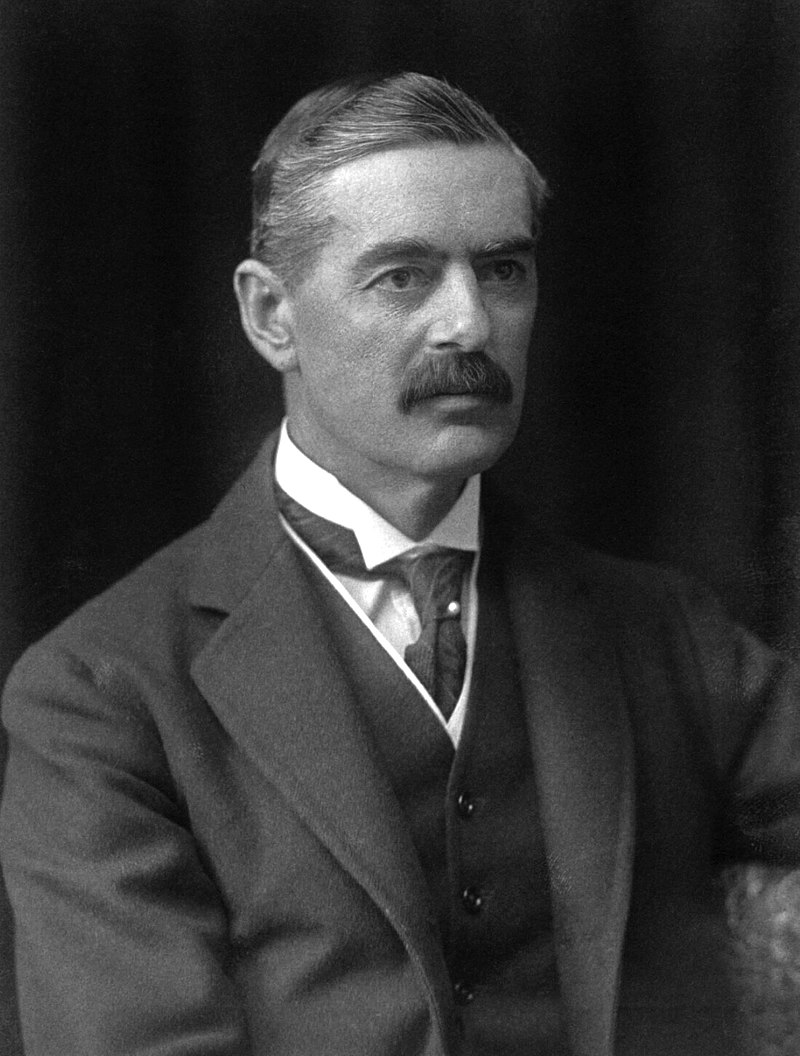

  • Neville Chamberlain – 1919 Maiden Speech in the House of Commons

    Below is the text of the maiden speech made in the House of Commons by Neville Chamberlain, the then MP for Birmingham Ladywood on 18 March 1919.

    I have listened to the Debate with very great interest and attention, but I have noticed with some regret that although controversy has ranged round railways, roads, docks, and harbours, there has been very little said about what is an important part of our transport system, and that is our inland canals and waterways. I was not altogether surprised at that. There have been recommendations passed by county councils praying that canals might be excluded from the Bill. Hon. Members have not been overwhelmed with showers of telegrams on the subject. As far as I know even the anglers’ clubs have hardly yet realised the danger of the right hon. Gentleman’s activities to their favourite amusement. But the canals and waterways have long been the cinderella of our transport system, and I hope the right hon. Gentleman, who in his time has played many parts, will on this occasion impersonate the fairy godmother and with his wand turn Cinderella into a princess and revivify our inland water system. But I found the right hon. Gentleman’s remarks somewhat vague and somewhat slighting. He spoke, indeed, of taking the canals into his system, but he suggested that to spend £38,000,000 upon improving a property which was only valued at £6,000,000 was rather a tall order. I must agree that that is a tall order, but it is not necessary to spend £38,000,000 in order to test whether it is or is not worth while to improve our canals. I have never advocated, and do not advocate now, that the whole of the system known as the Cross should be improved at once. I have always thought the proper and the profitable course was to take that part which appeared to have the greatest return for the smallest expenditure of money, and having improved that, to profit by the experience gained in working it before proceeding to larger and more costly schemes. But why is it that our canal system is only valued at £6,000,000?

    The canals as we see them to-day were all constructed about the end of the eighteenth and the beginning of the nineteenth century. At that time goods were carried mostly in packs upon horseback, and when the canals were first introduced the economy and the comparative rapidity of the transport at once brought them into popularity, and they entered upon a period of great prosperity. Then came the railways, and immediately from their superior speed and through the better opportunities that they offered both to passengers and goods, the canals went under, and from about the year 1840 until now, with the single exception of the Manchester Ship Canal, there has been no extension of our canal system, and the actual useful mileage is less to-day than it was then.

    It may be said this was a necessary result of the introduction of a superior system of transport. It has been said that canals areas obsolete as the stage coach, and that it is no use trying to revive them. But before you can answer the question as to whether this is a necessary result of the competition of the railways, you must see what has been done in other countries. Precisely the same experience was gone through on the Continent as was gone through here. There, again, the canals, when they were first constructed, went through a period of great prosperity, and there, also, they were practically killed by the railways, but at that point the similarity between the two practices ceases. Instead of starving and neglecting their canals, Continental countries formed a canal policy. They deliberately spent large sums of money upon the improvement of their waterways, so that between 1870 and 1890 France alone spent upwards of £28,000,000, Belgium spent also large sums, and Germany entirely reorganised her waterway system. Again, at the beginning of the present century, all these countries returned to their old situation once more. They had then behind them the experience of what they had done, and they were so well satisfied with the result that in every single case they started new programmes; they voted again large sums of money, all of which practically had been spent at the beginning of the present War, and then once more they had started on new programmes of improvement and construction. Is it likely that all these great industrial nations went on deliberately throwing millions of pounds into a quagmire? Does it not stand to sense that if they continually renewed this policy and developed it, they did so because they found that it paid them? It was that consideration which was responsible for the appointment of the Royal Commission on Canals and Waterways in 1906. It reported in 1909 in favour of nationalisation. They regarded nationalisation in precisely the same way as the right hon. Gentleman, not as an end desirable in itself, but as a means to an end, because their investigations showed them that what had held back canals in this country was the multiplicity of ownership. If you want to send a barge to-day from the Thames to Birmingham, it has to pass through navigations belonging to no fewer than seven different authorities. From Birmingham to Liverpool, again, there are seven different authorities; and from Birmingham to Hull, on another route, the canal would have to pass seven or ten different authorities in going from one end of its journey to the other. That has resulted in absolute disconformity of dimensions of locks and bridges, so that to-day the barges upon the northern canals are too wide to enter the locks upon the southern canals, and the barges upon the southern canals are too long to pass through the locks on the northern canals. It is perfectly hopeless to get any kind of improvement in canals without unifying the control, and the Commission felt that it was impossible to get unity of control unless you nationalised the waterways. One principal reason for that was that in almost every through route you found somewhere or other along its length a piece of canal which was either under or controlled by a railway.

    When you suggest that the railways have strangled traffic upon the canals they are always indignant. They always deny it stoutly. They always say that the canals are a great loss to them, and that therefore it must be to their interest to put as much traffic upon them as they possibly can. An illuminating remark fell from the right hon Gentleman yesterday. He said the railways love a long haul. Yes; they do love a long haul, and they love to shove a short haul on to the poor old canals. The Birmingham Canal is a great complicated system which coils round and round in the Midlands, through the Black Country, and forms the connection between all four main routes from the Midlands to the sea.

    It is, therefore, an enormous collecting ground for traffic which would, if it could, pass out to the ports. What happens? The Birmingham Canal is controlled by the London and North-Western Railway, and six-sevenths of the traffic upon the canal is loaded and discharged upon the canal itself, although it is only about 150 miles long. That speaks for itself. I am not particularly blaming the railway for what they have done. They have looked after their own interests. Their interests have been to develop traffic upon their own rails, and to take away traffic from the canals. Although the Royal Commission reported in 1909 nothing has been done to carry its recommendations into effect. In 1911 there was formed the Waterways Association, consisting of traders and local authorities in different parts of the country, which had for its object the pressing upon the Government to carry out the recommendations of the Royal Commission, and to educate public opinion to press for the carrying out of those recommendations. They saw the President of the Board of Trade from time to time. There is one important achievement of the Waterways Association which I should like to mention. On the Continent the practice has been for the Governments which have constructed new canals to go to the local authorities upon the routes, and to ask for their financial co-operation. There has been a sort of system of bargaining between the central and the local authority whenever it has been proposed to construct a new canal or to improve an old one. The Waterways Association of this country has gone round to the different authorities and have endeavoured to induce them to accept a principle of that kind, and they have been signally successful. They got no less than forty-one local authorities to pass resolutions to the effect that they would view with favour a proposal which asked them to contribute to the improvement of their canals. Anyone who knows local authorities will, I think, agree that that is a very considerable achievement to get them to pledge themselves favourably upon a proposal of that kind.

    The House will see that, in so far as the Bill indicates an intention on the part of the Government to unify the canals and then to improve them, it is entirely in accordance with the policy which was advocated by the Royal Commission and which has since been adopted by the Waterways Association. But a new factor has arisen since the War, and that is the control of the railways by the Government. Therefore the question arises whether we should support the handing over of the canals and waterways to the railways which have been so inimical to them in the past. I put aside at once any suggestion that the right hon. Gentleman is not impartial in this matter. We have to legislate for a system, and in my view there can be no possible doubt that the right system is one which puts both the railways and the canals under the same central authority. I must confess that if the poacher is going to turn gamekeeper, I am very much less afraid of him in that capacity than if he retained separate control of the railways. I frankly admit that I am not a Free Trader in this matter. I want Protection for the canals. They are not in a position to-day to stand upon their own legs, and if the right hon. Gentleman had the railways and someone else had the canals I should feel that the canals had not a dog’s chance. But if he is going to take them over and if, as I am sure he means to, he is going to give a fair chance to the canals to show what they can do, then I feel that a new era will have dawned for inland waterway navigation and I shall give my hearty support to the Bill.

  • Fiona Onasanya – 2017 Maiden Speech in the House of Commons

    Below is the text of the maiden speech made in the House of Commons by Fiona Onasanya, the then Labour MP for Peterborough, on 5 July 2017.

    It is with both a humble heart and abiding pride that I stand to make my first speech in the House of Commons. As is customary, I would like to pay tribute to my predecessor. There is nothing that highlights a person’s character more than when they are faced with adversity, and I will never forget the grace, kindness and authentic good wishes that Mr Jackson expressed to me on the night of the election. I hope that his life beyond Parliament is as fulfilling as he intends.​

    Also, I would like to speak briefly about my home constituency of Peterborough. It is rich in history. Its cathedral is a true gem: it was a temporary resting place for Mary Queen of Scots, and it is also where Catherine of Aragon, Henry VIII’s first wife, is buried. One could say that Peterborough attracts its share of powerful women!

    But when I look at Peterborough, my home, I see so much more than the legacies and treasures of its past; I see a city that cherishes its diversity. People have come to Peterborough from every corner of the globe, and many nations are represented. My presence here may be a symbol of this increasing diversity: I am the first black female MP ever elected by my constituency. In Peterborough, I see a place that has much to be proud of. Our major employers, like Perkins Engines and Peter Brotherhood, are world class. We also have entrepreneurs that are cutting edge, and our local newspaper, the Peterborough Telegraph, is dynamic and well read. Peterborough is also notable for its beauty, and there are rural parts of the constituency that serve as our own Gardens of Eden.

    Peterborough has a bright future and so much going for it, but my constituency and our country also have their share of challenges, which I intend to address as a Member of Parliament. When I began my campaign, one of the very first issues I said I wanted to tackle was housing. We all need a decent place to live. Never in my darkest nightmares did I expect to see this proposition so starkly illustrated as it was by the Grenfell Tower fire. It still seems incredible that such a disaster could happen in one of the richest parts of one of the richest cities in one of the richest countries in the world. It is incumbent upon the Government and Members of this House to do their utmost to ensure that such a tragedy can never happen again. With this in mind, the Government must ensure that adequate funding is provided to those councils that require it. Fine words and opaque promises of support are insufficient.

    We must also help those who do not have a home. According to Shelter, in December 2016 some 600 people in Peterborough were without a place to live. Homelessness is an increasing problem for the country as a whole. Shelter estimates that 150 British families become homeless every day. Far from any stereotype, these are often people who work or are willing to work. Some are veterans who have served our country with distinction. Some have physical and mental health problems. All deserve decent treatment.

    I am also very concerned about education. Peterborough had amongst the lowest SATs results in the country. Our schools are trying very hard to make do with ever-shrinking resources that have been tied up in experiments such as free schools. Beyond improvements in primary and secondary education, Peterborough needs a university. So many bright and talented young people in my city feel they have to leave home to achieve their dreams, which is why I am pleased to note that some progress has been made in that area.

    The NHS is also one of my key concerns. Cuts to the health service have left my constituents facing long waiting times for appointments. The healthcare “reforms” as implemented by this Government led to the fiasco of the UnitingCare Partnership, which collapsed in 2015 after only eight months. Attempts to marry up public service ​and private profit have tended to favour the latter over the former, which leads me to a final observation: we need balance in our policies, placing people at the centre. We need to acknowledge that there is a role for Government and regulation, as the markets we create are not necessarily compassionate, understanding or even humane.

    We need not only to hear but to listen to the voices of those we were elected to serve and we need to look around us. Those at the top continue to get wealthier, while those at the bottom are seeing their living standards eroded. Contrary to what some may think, austerity is expensive. Cutting budgets does not always save money, let alone lives. We cannot make a rich country out of one that makes the majority of its people poorer.

    I am motivated in all that I do by my abiding faith in God. As we look at the issues facing Palestine and Israel, there is the temptation to see religion as something that divides rather than unites people, but I believe that it is mankind’s frailties that cause conflict and strife, not one’s faith. I sincerely hope for a future in which the peoples of the middle east live in the harmony that God intends for them.

    It is on this note of faith that I would like to conclude my speech. Hon. Members who have encountered my acronyms will know that I refer to myself as MP FI because I endeavour to “Make People Feel Inspired” and my acronym for faith is “For All In This House”. As stated on the floor in Central Lobby:

    “Except the Lord build the House, they labour in vain that build it”.

    With His help, Mr Deputy Speaker, I intend to do right.

  • Michael Havers – 1970 Maiden Speech in the House of Commons

    Below is the text of the maiden speech made in the House of Commons by Michael Havers, the then Conservative MP for Wimbledon, on 16 July 1970.

    I observe with pleasure the conventions of a maiden speech. I should like to speak briefly of my constituency, famous as the home of one of the greatest sports enjoyed by so many and host to so many of the finest tennis players in the world. It is also one of the most beautiful boroughs in London, where even the smallest garden is attractively kept. It is a friendly and hospitable constituency which has made available some of its loveliest land to neighbouring councils for old people’s homes. I am proud to be its representative here.

    The second convention which I observe with pleasure is to refer to my predecessor, Sir Cyril Black. Sir Cyril will always be remembered in the House for his qualities of courage and total integrity. He was always prepared fearlessly to support minority views, and the yardstick of his reputation and character may be demonstrated by the fact that he numbered among his many friends those who opposed many of his campaigns. I feel a sense of inadequacy as his successor, but I shall always be grateful for the kindness and support which he has given to me since I was chosen to replace him. He was, I am told, a good House of Commons man, and his retirement will be a great loss to the House, and we wish him well for the future.

    In a maiden speech, I should not spend a great deal of time on the Bill, but there are two Clauses which as a matter of principle I do not like in their present form. Clause 28 shifts the burden of proof in certain cases. There seems to be no reason why the rule which has existed for so many centuries should be changed. It is a good rule. It is a rule of which every jury is reminded—”He who brings the charge must prove it”. I hope that my right hon. Friend will be able to reconsider whether this change should be maintained.

    My principal objection to the Bill concerns Clause 25 where one finds yet again the provision that no prosecution shall be taken before quarter sessions or assizes except at the election of the defendant, or if the consent of the Director of Public Prosecutions has been obtained. I do not know why that provision is included. With practically every ordinary criminal offence carrying sufficient sentence if necessary to justify the matter going to a higher court, the prosecution has the right to elect to ask for the case to be tried by a higher court. As the Bill stands, a case may go to a higher court only at the election of the defendant.

    That means that a man may be charged with a number of serious criminal offences under the Bill carrying as much as 14 years apiece and yet only by his choice can he be put at risk for them. Otherwise, he remains in the magistrates’ court where the total maximum sentence which may be imposed is 12 months. Even if in the course of the hearing, as may happen in a number of cases, the magistrates take the view that it is more serious than they had originally understood it to be and ought to go to assizes or quarter sessions, they will have no power to order it to do so.

    The ordinary rule should apply. Over the past few years too much of the discretion of magistrates has been taken from them as to the way in which they conduct their courts and the sentences they give. This begins to be yet another example of that and I very much hope that my right hon. Friend will reconsider this matter when the Bill goes into Committee.

    I thank the House for its indulgence.

  • Alan Haselhurst – 1970 Maiden Speech in the House of Commons

    Below is the text of the maiden speech made in the House of Commons by Alan Haselhurst, the then Conservative MP for Middleton and Prestwich, on 22 July 1970.

    I am grateful for this opportunity to make my maiden speech, and I recognise that there are many conventions surrounding maiden speeches in this House. The first is to seek the indulgence of the House, which I do most earnestly—the more so since I realise the subject matter which the House is debating. I assure the House that I am not deliberately trying to find shelter behind the courtesies normally shown a maiden speaker in order to make speaking on a controversial subject more easy. I speak from a genuine and close interest in these matters, which goes back many years and to which many of my hon. Friends and at least one right hon. Member on the Opposition Front Bench can testify.

    Another convention of the House is to pay some words of respect and tribute to one’s predecessor, and for me this is no formalistic ritual. Denis Coe was, I believe, a valued Member of the House and a great respecter of it. He took considerable interest in the workings of the House and was tireless in his efforts to improve the conditions of hon. Members—a subject in which his successor also takes an interest. He was also highly regarded in his constituency. On all sides he was found to be friendly, helpful and hard-working, and he was a very active and conscientious constituency Member, with an enviable reputation. I have before me a formidable standard, I frankly own, by which to judge my own efforts and to be judged.

    The third convention is to say something of one’s constituency. Its name is not an adequate description, because, apart from the boroughs of Middleton and Prestwich, it also contains the urban district of Whitefield. Although all three towns lie in Lancashire, I can speak of them with pride and affection, even though I am a Yorkshireman—although it is not unkown in this House for a Yorkshireman to represent a Lancashire seat. I should like to say more about these towns, but, following the last speaker, it would be improper of me, in view of the time allowed for this debate, to go into detail. I would just add that I am stimulated by the thought of representing their needs in this Parliament. If I am found wanting, there are at least four of my constituents in the House to see that I come up to standard, which is unusual for a constituency so far from London.

    The convention that I have difficulty in following is to link the subject matter of the debate with my constituency, but all I can say is that my constituents’ interest in overseas matters is very much alive, and I have had a great deal of correspondence on this question. Much as I have reservations on the general question of arms sales to South Africa, I cannot agree with the terms or spirit of the Opposition Motion.

    The yardstick commonly used in discussion of arms sales is how far British actions are propping up a Government whose policies, based on race, are universally detested, and how far we are thought to be doing that. Just as a distinction can be made between trade in general and trade in arms, so I believe a distinction—I admit that it is more difficult—can be made between arms for internal purposes and those for external defence. It is not reasonable to make that distinction on what a weapon is theortically capable of: one should question the true purpose of the weapon, for which it is intended and for which it is reasonably certain to be used.

    I do not believe, but it is only a judgment, that South Africa, whatever her faults, intends to wage an aggressive war or is likely to be involved in the foreseeable future in a defensive intra-continental struggle for which marine armaments would be a factor. If one is prepared to stretch the theories to the opposite judgment that I have made, then of course ordinary trade can be seen to bolster the South African Government—and right hon. Members opposite do not call for a cessation of all trade.

    The policies which are being operated by the whole world in arms and other things towards South Africa are aimed at isolating that country. Their effects should be considered carefully. I cannot see one respect in which the system of apartheid has been eased in the time that these pressures have been applied. Rather, it has become more rigidly enforced. The traditional rift between the Dutch- and the English-descended South Africans, which used to carry over into party divisions, has been overcome significantly, and, as the pressure on South Africa mounted, the English-speaking people, for patriotic motives which seemed honourable to them, rallied to the Nationalist Government. The task for liberal or progressive critics such as Mrs. Suzmann has been made more difficult, because talk against the system has become, instead of just unfashionable, unpatriotic.

    I must question what this policy of less contact and no arms for external defence has achieved. What is to be the consequence of this policy of isolation of South Africa if carried to its ultimate conclusion? The people who support its maintenance or intensification should consider what conclusion it will lead to.

    I fear, knowing on the one hand the laager-type mentality of the Afrikaaner and on the other the relentlessness of many anti-racialists, that the conclusion will be violent. It may be that apartheid can only be overcome by a wave of bloodshed. That would be a dreadful conclusion to which to reconcile oneself.

    South Africa is not a country of a few thousand whites or with a primitive industrial economy. A violent upheaval in South Africa would have appalling consequences. However senseless and immoral I might consider apartheid to be—and I so regard it—I would like to think that there is another way of its coming to an end.

    I believe that there is another way through economic pressures. They are remorselessly and inevitably building up, and I suggest that they are no more slow in achieving a result than might be the processes leading towards violent revolution. They are more likely to take effect if some countries will deal with South Africa on a less restrictive basis.

    Sensing that they are under attack, South African leaders feel more nervous and act more repressively. The natural economic forces and progressive political thought would stand more chance of doing their work if South Africa had a wider political relationship with the outside world. I know that it may not be in vogue to say this, but I believe it to be true, and I would wish at all costs to avoid the violent alternative which seems to be the other likely course.

    I believe that we must say to our Commonwealth friends—because it is true—that we are resolutely against racialism and that the Government’s intention in no way implies support of racialism. We have a right to be believed in this respect. Our desire to see the passing of the apartheid system is as sincere as that of other members of the Commonwealth. It is because I do not think that the statement by my right hon. Friend the Foreign Secretary was founded in either racialism or hypocrisy that I shall vote against the Opposition Motion.

  • Brian Harrison – 1955 Maiden Speech in the House of Commons

    Below is the text of the maiden speech made in the House of Commons by Brian Harrison, the then Conservative MP for Maldon, on 9 June 1955.

    I beg to second the Motion.

    I am conscious of the privilege of being allowed to second the Motion of thanks in reply to the Gracious Speech, but I realise that it is an honour which I accept not for myself but for my constituents. I must also admit to great personal diffidence in seconding the Motion, as this is my maiden speech. I therefore doubly crave the indulgence which the House customarily extends on both these occasions.

    Already today my constituents have made one contribution to the ceremonies we have witnessed, for in the division is the market town of Braintree, where surprisingly enough in such a rural area there is a flourishing textile industry, and it was the Braintree craftsmen and women who were chosen to supply the velvet for Her Majesty’s State robes which were worn at the opening of Parliament this morning.

    It is not from Braintree that the ancient borough of Maldon takes its name. It is from a famous old borough which stood out against the Danes for some 70 years and which at one time even sent two Members to this House. Around these two places lie some of the most fertile and best farm land in the Kingdom, and, therefore, I welcome the intention to maintain the maximum economic agricultural production. No farmer wishes to see his prices guaranteed by real or artificial shortages, causing, as they often do, suffering and rationing.

    The Government have already shown how it is possible to carry out the guarantees of the 1947 Agriculture Act in conditions of comparative plenty. We welcome the reference to the efficient marketing of food and to producer marketing schemes which should prove of benefit to producer, consumer, and my right hon. Friend the Chancellor of the Exchequer.

    It is, however, no use guaranteeing prices and insuring markets unless there is labour to produce the food. Here I must say that the standard that the unions require from their worker members is extremely high. Within the last 18 months I have taken a correspondence course with the agricultural section of my union, the Transport and General Workers’ Union. Everything possible must be done to look after those who work on the land. Too often the workers’ loyalty to the land and their diligence in long hours and foul weather go unrecognised. We must raise the status of the agricultural worker and recognise that he is no longer the poor relation among manual workers.

    Britain has now the most highly mechanised agricultural industry in the world, but the accident rate has gone up considerably. It is right, therefore, that legislation should be introduced to guard the health, the safety and the welfare of those employed in this great and important industry.

    We welcome the intimation that rural areas are to receive special attention in connection with education. Distances and sparsity of population add to the present difficulties, but they have been overcome elsewhere and they can be overcome here. It is on the teaching profession itself that the country largely depends. Since the war it has had a particularly difficult time with large classes and makeshift classrooms. I am glad that the teachers’ superannuation scheme is to be looked into. This consideration will, I hope, remove one of the feelings of injustice under which teachers are at present labouring.

    As one who was born and spent most of his life in one of the other great realms of the British Commonwealth, I welcome especially the mention in the Gracious Speech of the continuance of consultation within the Commonwealth. The closeness of the home country and the overseas Dominions means all the more to me when I recall that not many years ago my father was a Member of the Australian House of Representatives. Now I have “come home,” which is as we refer to these islands, and I stand here still an Australian citizen but a British subject and a Member of the greatest of Parliaments.

    I hope the increased consultation which is referred to in the Gracious Speech may lead to a sharing of the burden and the responsibility for mutual defence and aid more equitably throughout the Commonwealth. It is a healthy sign that this already has begun, but it should go further. Whilst on the subject of the Commonwealth, and because of the reference in the Gracious Speech to clean air, I ask whether we should not take note of the achievements in Australia, where there is no smog, no fog, and—at present—no Ashes?

    We further welcome the reference to the Colombo Plan, initiated as it was by an Australian Minister for External Affairs, Sir Percy Spender. We in the United Kingdom refer to that area as the Far East, but we must not forget that to Australia it is the near north. This Plan is one of the foundations on which stability can be built in South-East Asia. It is a fine concept and one which must be made to expand and prosper in order to bring a higher standard of living to the people there.

    The world is too small a place today for the peoples of Asia and Europe to try to live their lives separately. We can all help the nations in these areas in their struggle against famine and disease, and there are many ways in which we can do it. This help need not be in the form of charity because, as their standard of living increases, so will their markets, to our future benefit. But we cannot help each other unless there is an easing of tension and a development of mutual trust in these areas. I hope we may continue to play a leading part in bringing that about.

    Throughout the world the thoughts of all peace-loving people will be on the talks which we hope are to take place between the leaders of the great Powers, and we join with the people all over the world in wishing our representatives well in these talks, for without peace, which we so earnestly desire, the programme laid before us in the Gracious Speech will in itself not be worth even the paper on which it is printed.

  • James Harden – 1948 Maiden Speech in the House of Commons

    Below is the text of the maiden speech made in the House of Commons by James (Richard) Harden, the then Ulster Unionist MP for Armagh, on 20 April 1948.

    Although I have not addressed the House before, and I would ask hon. Members for their indulgence on this my first intervention, I could not let such remarks pass as have been made regarding my election, which took place only a short time ago. I would draw the attention of hon. Members to the remarks of my opponent when he seconded my vote of thanks to the returning officer. He said he was completely satisfied with the election and he had no fault to find with it. He went further. He said that, so far as he could see, it had been a perfectly clean and straight fight. After the closing of the polling booths there were one or two small incidents. This election was fought on a very vital question that made the people’s blood rise to a pretty good height. There were incidents on both sides; the incidents were not confined to one side only. If the official opposition candidate says that the election was fair and that he is satisfied, I think that hon. Members of this House must accept that before they accept the remarks of hon. Members for English constituencies.

    The reason why I state that so strongly is that on the day of the election, both my opponent and I spent the day touring all the polling booths, and neither he nor I found any fault at all with the way that the election was being run. I am quite convinced, and I think he was too, that each person had a right to go and vote as he thought fit, and as freely as he wished. I thank the House for the indulgence which they have shown me on this my first speech here.

  • Jeremy Hanley – 1983 Maiden Speech in the House of Commons

    Below is the text of the maiden speech made in the House of Commons by Jeremy Hanley, the then Conservative MP for Richmond and Barnes, on 1 July 1983.

    I thank you sincerely, Mr. Speaker, for calling me to make my maiden speech in this historic place, and I thank the Minister for his kind remarks.
    Richmond and Barnes is a new, enlarged constituency, containing the well-known communities of Barnes in the north-east, Mortlake, Palewell, East Sheen, Kew, Richmond, Petersham, Ham in the south and St. Margaret’s and east Twickenham, north of the Thames. It is now the only London constituency which spans that great river, and a greater utilisation of it, coupled with the preservation of its beauty, will be one of my regular pleas in this House.

    I pay tribute to my predecessor as the hon. Member for Richmond, Surrey, Sir Anthony Royle. He served his constituency for nearly 25 years and was also Under-Secretary of State for Foreign and Commonwealth Affairs from 1970 to 1974. His wisdom and guidance over the last two years were instrumental in my being here. Many things are said by many people—perhaps occasionally with a political axe to grind—but I must set the record straight concerning that gentleman.

    During the last two years I have met literally hundreds of people to whom Sir Anthony had given help and they would willingly walk to the end of the earth for him. If people called on him and he believed they were genuinely in need, he would unstintingly seek a satisfactory solution, but, unlike certain cynical politicians, Sir Anthony would never parade his constituents’ problems through the press. That, for him, would have been a breach of privacy and honour.

    There were, of course, thousands of people who never needed to seek out Sir Anthony for help and therefore had no evidence of his care and concern, but there are nearly 100 new Conservative Members of this House who would vouch for his labours, because for the last four years he has been the vice-chairman of the Conservative party, with responsibility for candidates. During that time he has radically changed the selection and training system.

    Perhaps only time will tell whether the new intake will be of particularly good vintage, but I believe that it will be, and that, far from some of the more spectacular and lurid speculations made by less well-researched journalists—and, indeed, the Opposition—the new Members, in my experience, are almost exclusively men and women of compassion, loyalty and dedication, possessing simple common sense and energy. That is Sir Anthony’s doing.

    I must also pay tribute, on behalf of those in east Twickenham and St. Margaret’s, to their previous Member of Parliament, my hon. Friend the Member for Twickenham (Mr. Jessel). That he should lose, through redistribution, his east Twickenham ward, and the constituents for whom he cared for 13 years, was a great distress to him. His record as one of the very best constituency Members for exposing and fighting those matters that affect the peace and environment of those who are his responsibility is, quite literally, an inspiration to me. I hope that we may, as brother Members for the same borough, work together for the mutual benefit of the nearly 200,000 people whom we represent. I have much to learn from him, and I offer him my deep gratitude for his willingness to help me.

    Tributes are deemed to be traditional, but I hope that I shall be permitted to pay a less conventional compliment. My opponents in the general election were men of the highest integrity and a credit to their respective parties. Their attitude throughout the last few months and years, their co-operation on matters of community interest, and their willingness to work with me rather than against, have constructively caused local wrongs to be put right wherever possible. Co-operation between political rivals — unfortunately by no means commonplace — can produce a combined weight against which it is hard to resist.

    On the Richmond Royal hospital, on London Transport’s bus policy, on Windham road nursery school, on aircraft noise and on Richmond’s traffic blight, we have fought our battles together. That has meant that the campaign in Richmond was, if anything, more healing than divisive. It also helps that whoever won the battle could feel that he had the support of the whole community, not merely the party of his preference.

    We candidates had many differences in political and social policies, some of them diametrically opposed, but it is pointless in politics to strike a pose, purely to propose some separate dogma, when co-operation can achieve so much. I hope that all my constituents will know that I am open and willing to hear their problems, as I intend to serve their constituency in the way that I believe it deserves.

    We are fortunate in Richmond and Barnes that, in addition to being one of the most historic parts of London and Surrey, we have 21 miles of river frontage, 743 acres of urban parks and open spaces and, indeed, the highest number of conservation areas in London. That is in addition to the Royal parks and Kew gardens. The greatest pleasure to be derived from those enormous benefits is in quiet enjoyment of the facilities offered, but quiet enjoyment is what we sadly lack.

    While it is a beautiful area in many ways, the immediate impression of Richmond and Barnes is scarred by the inordinate and constant noise from road traffic and from the air. The blight to the area caused by the south circular road, the constant landing of aircraft at Heathrow, flying directly down the line of the upper Richmond road west, and the ever-increasing helicopter noise, causes conversation in the street to be rendered impossible for more than a few moments at a time. A casual meeting of neighbours in Sheen or Palewell is more often accompanied by nods and waves than by words.

    In my 10 years of political experience, I have met my various opponents on many platforms and experienced a wide range of opinions and views, often vociferously put, but since coming to Richmond I have never known an issue to unite people of different political persuasions so closely as that of aircraft and traffic noise. On Saturday 5 March 1983, the threat of a possible fifth terminal at Heathrow caused all three political parties to unite in a march to show our strength of feeling. I am not one to take to the streets with banners raised at every opportunity—and, indeed, believe that little good usually comes from such protest—but I was moved in that instance to give my active support, and that of my wife and family, to demonstrate that political barriers had been dropped and that the community as a whole was moved to join together. The support of those along the route was indeed heartening, and those who listened to our speeches later in the centre of Richmond gave us evidence that our complaint was shared by people who would not normally have been moved to protest. Incidentally, during our march of three miles, my younger son counted 32 aeroplanes of varying sizes flying directly overhead. That made the decision to take to the streets that much more rational. Hardly any of the Conservatives in our contingent had ever joined such an event before.

    Quite apart from the countless letters that my predecessor Sir Anthony Royle received over the years on the subject, already in nearly two years I have had over 200 letters complaining about aircraft noise, and that must be the tip of the iceberg. Wherever I go in my constituency, whenever I speak to constituents, aircraft noise is second only to traffic noise and volume as a reason for complaint. That we are used to it, as British Airways seems to believe, I refute. We might accept our experience as being unavoidable, but we shall never become used to it and will always pray for its reduction. With summer here, during a hot and airless night it is impossible for almost half my constituents to open their windows, because 15 to 25 aeroplanes destroy the peace which we believe to be ours by right when trying to sleep.

  • David Trippier – 1979 Maiden Speech in the House of Commons

    Below is the text of the maiden speech made in the House of Commons by David Trippier, the then Conservative MP for Rossendale, on 21 May 1979.

    My first task is the very pleasant one of congratulating the hon. Member for Kilmarnock (Mr. McKelvey) on a speech which was both fluent and articulate—indeed, amusing—and I thought that it was quite profound. I have with him, on this occasion, a fellow feeling, as this is the first occasion on which we have both spoken in this House, and I think that it may well be the last occasion on which we shall have this in common. None the less, I congratulate him on a very successful speech.

    As many hon. Members are aware, my constituency of Rossendale has for some time been regarded as a barometer of political opinion, as it has been represented by no fewer than four different Members of Parliament over the last nine years. That is not only an indication of the importance of the seat to the two major political parties, but it is also an indication that my constituents are well aware of the importance which is attached to their opinions. In short, the seat is not only marginal or critical, but “intensive care”.

    The Rossendale valley is important for two other reasons. First, it is an attractive valley, and, although the area would be classed as primarily industrial, its industry does not detract from many of its aesthetic features, most notable of which are the hills and moorlands common to north-east Lancashire.

    Secondly, the industrial welfare of my constituents depends to a large extent on the success of two major industries—textiles and footwear. In the past, these industries have been responsible for the employment of a significant majority. Even today, they are responsible for the employment of 45 per cent. of the work force.

    All the Members of Parliament for Rossendale have represented the interests and concern of those industries in this House to the best of their ability. But I wish to pay a warm tribute to my immediate predecessor, Mr. Mike Noble, who made a significant contribution in this respect. His concern for the welfare of those industries could not have been more clearly demonstrated. I should like to assure the House that I intend to carry on the campaign which he and his predecessors so ably fought.

    Whereas these two industries experience quite different problems in certain areas, they have common difficulties in others. Both are subjected to unfair import competition and both are recipients of Government largesse through the medium of subsidies. 1 April this year was the final date for applications for temporary employment subsidy. That was replaced by the compensation for short-time working. This latter subsidy is by no means as effective as TES and has been claimed by comparatively few firms because it is so inappropriate to the present needs of industry in the valley. Only 16 per cent. of those who benefited from TES are in receipt of the compensation for short-time working.

    I am convinced, however, especially after my experiences over the last few weeks, and particularly during the election campaign, that until the economic climate improves and until these industries can enjoy stricter control of unfair import competition, existing or alternative subsidies must be maintained to preserve these essential British industries.

    I compliment the trade unions which represent the workers in these industries, which have acted in a very responsible way during a period of great transition for these industries since the last war.

    Whilst emphasising the need for employment subsidies, it is equally important for me to draw the attention of the House to the system of Government grants which have been made available to industry to encourage expansion. The vast majority of the money made available for this purpose is offered to those companies which wish to expand their existing premises, whereas little or no money is available for new plant and equipment.

    Although the idea is sound in principle, it rarely works in practice. In order to increase efficiency and thereby increase production in a very competitive world, it is vital that modern methods and modern machinery are used if we are not to fall further behind in the industrial league.

    To replace old and outdated machinery does not necessarily require more space, just as extensions to existing premises do not guarantee increased productivity. That is why I believe that in this complex chicken-and-egg situation it is much more important to ensure that what Government moneys are available for grants are used in the replacement of plant and machinery rather than in the expansion of premises. Nowhere is this so true as in Rossendale, where one frequently finds comparatively small textile and footwear firms operating in very large Victorian mills whose size was more appropriate to the labour-intensive firms of that era than to the more modern firms of today.

    On the other hand, modern machinery and methods improve output and productivity, and increased productivity means an increase in jobs. Only with a higher demand for a company’s products and a resultant increase in jobs does the company begin to think of extending existing premises.

    I spoke earlier of the unfair import competition which faces the textile and footwear industries. To a certain extent, the multi-fibre arrangement protects the textile industry, but, even so, I believe that the current restrictions imposed should be tightened when the MFA is renegotiated in 1981 and the bilaterals are renegotiated the following year.

    Already we have seen that certain countries have broken their quota levels, and I ask that the present Government give a firm undertaking that quota levels will not be exceeded in the future. At the same time, the present anti-dumping procedures are cumbersome and time-consuming, and they should be made much more effective.

    In the footwear industry, there is no binding international agreement to protect the industry. As a consequence, footwear manufacturers have to face increasing competition from South Korea, the Philippines, Brazil, India and the COMECON countries. I believe that it is essential that a new form of international agreement is introduced for the footwear industry—a multi-footwear arrangement, very much on the same lines as the MFA. It is essential to establish this agreement through the European Parliament as soon as possible, and certainly before Greece, Portugal and Spain are eventually admitted to the Community.

    I refer, finally, to a major problem which came to a head in my constituency during the recent election campaign. This concerns the sad plight of the working widows who are employed mainly in textiles and footwear in Rossendale but also in other industries. My right hon. Friends the Secretaries of State for Industry and for Employment are aware that the widow’s pension is grossly inadequate, and that many widows find it essential to supplement their pensions by going out to work. Their contribution to productivity is greatly appreciated by the industries which employ them, but the State chooses to penalise them by taxing them on every penny they earn. As the widow’s pension is £974 a year and is classed as earned income and as they are entitled to only a single person’s tax allowance of £985 a year, it naturally follows that all money earned by the widow in employment is subject to tax, which I think is unfair.

    I therefore appeal to my right hon. Friends seriously to consider the introduction of a widow’s tax allowance set at a higher level than the single person’s allowance although lower than the married man’s. The introduction of such an allowance would take account of the fact that a working widow has practically the same overheads as a married man, especially if she has a family at home, but is without the benefit of two incomes coming into that home. It would also be a clear indication on the part of this Government that our objective of restoring the incentive to work applies to widows as it does to everyone else in the land.