Tag: Kwasi Kwarteng

  • Kwasi Kwarteng – 2014 Parliamentary Question to the Ministry of Justice

    Kwasi Kwarteng – 2014 Parliamentary Question to the Ministry of Justice

    The below Parliamentary question was asked by Kwasi Kwarteng on 2014-06-04.

    To ask the Secretary of State for Justice, what rights prisoners in HM Prison High Down Sutton have to association and exercise; and whether he has received representations that prisoners at that prison are being permitted less than half an hour to exercise per day.

    Jeremy Wright

    Prisoners at High Down have the same access to exercise and association as in all prisons in England and Wales. The details are set out in Prison Service Instruction (PSI) 58/2011 Physical Education for Prisoners. In addition, prisoners are entitled to association time outside of their cells that may include forms of exercise.

    We have no record of any formal representations made by prisoners at HMP Highdown on the lack of opportunity to exercise

  • Kwasi Kwarteng – 2010 Maiden Speech in the House of Commons

    Kwasi Kwarteng – 2010 Maiden Speech in the House of Commons

    The maiden speech made by Kwasi Kwarteng, the Conservative MP for Spelthorne, on 8 June 2010.

    It is a great honour to be called to deliver my maiden speech. First of all, I want to give a hearty thanks to David Wilshire who, amidst difficulties and press distortions, managed to keep up his work as a fine constituency MP. Very often, people would open the door to me and say, “Ah, so you’re the new David Wilshire,” and I would reply, “Well, sort of, but I want to continue his traditions of service and commitment to the constituency.”

    People always ask me, “Where is Spelthorne?” A friend of mine said he did not realise it was a constituency; instead he thought someone called David Spelthorne was the MP for Wilshire. It is, however, a well-known constituency, and Spelthorne is a very old name, too. It comes from an old English word of which we have a remnant in the word “spelling”. It means speaking, and the “thorne” part of the word “Spelthorne’” referred to a thorn tree on Ashford common where people used to gather and speak. That is where the name comes from, and it also appears in the Domesday Book as the southern hundred of the old county of Middlesex.

    Middlesex had a long and illustrious history, which my predecessor was very keen to stress-much to the annoyance of my Surrey colleagues. Middlesex did have an existence, however, and it had a reputation in this House, because in the old days it had proper elections. Charles James Fox was elected, and thousands of people were involved, whereas in nearby rotten boroughs there might be only half a dozen people. Famously, John Wilkes was elected in Middlesex, and was a distinguished Member of this House. He was described as the “ugliest man in England” but, like many politicians, he was not afraid of boasting and celebrating his own talents and he said that he had such charm that he could “talk away his face” in “half an hour”. Hon. Members can imagine my surprise at the fact that we were given only seven minutes to speak in the House today.

    In the limited time available to me, I wish to make some points about the subject of today’s debate. Spelthorne is a seat in the south-east that relies almost exclusively on infrastructure and economic expansion, and in that context self-starting business men are very important. A gentleman from Shepperton, in my constituency, who has been in the breakage business for 30 years said to me, “Kwasi, it is very difficult. I am getting strangled by red tape and bureaucracy.” A Government quango, whose name I shall not mention, had been bombarding him with forms that he had to fill in, so he had been spending all his time filling in forms and none of his time attending to the business. My thought was that it was precisely those small business people who will drive us out of recession and into recovery.

    I have to say-even though this is a maiden speech, I will be controversial-that to hear Labour Members in many of these debates is to be in never-never land; they have not once accepted any blame for what happened and they seem to think that we can just sail on as before. In many of their eloquent speeches it appears that they have forgotten that wealth creation is the most important element in getting us out of this recession. I heard the right hon. Member for Oldham West and Royton (Mr Meacher), who I believe has been in the House for 40 years, say that he was going to tax those in The Sunday Times rich list. Of course, one of the results of their being rich is that they can leave the country in about half an hour, so if he were to go down that route, a lot of them would leave and he would not bring in any more money to the Exchequer.

    One of the right hon. Gentleman’s remarks reminded me of the story of the man who, when leaving a gentlemen’s club-it might have been the Carlton Club-in 1970 gave the footman sixpence. The footman looked at him and said, “That is only sixpence”, to which he replied, “Ah, it is sixpence to you, but it is a pound to me.” That was because income tax was at 95 or 97%. We cannot go down the road that the right hon. Gentleman suggests, and the Conservatives have stressed again and again that the only way to get out of this difficulty is to try to let business grow.

    I was surprised to hear the hon. Member for Edinburgh South (Ian Murray) refer to the Scottish enlightenment. He will recall that one of its most prominent figures was Adam Smith, rather than the previous Prime Minister, who did not take an enlightened Scottish approach. Adam Smith made it very clear in “The Wealth of Nations”, a book that many hon. Members will know, how societies grow rich and how they can become very poor. I am sorry to say that the past 13 years have been an exercise that Adam Smith and the university of Edinburgh would probably have awarded a flat D grade for performance-perhaps he would have awarded a B grade for effort, who knows?

    I am pleased at this juncture to refer to the compelling speech made by the hon. Member for Newcastle upon Tyne Central (Chi Onwurah), in which she mentioned George Stephenson. There was some controversy as to whether he came from Newcastle upon Tyne Central or from Chesterfield, but I shall not comment on that as that is a matter for Labour Members. What she did say was that he made a fortune through industry, enterprise and innovation, and those are exactly the kind of things that this coalition Government will look to promote in the months and years ahead.

    To sum up, I should say that the truest words said in this debate were uttered by someone making a maiden speech, my hon. Friend the Member for Loughborough (Nicky Morgan), who said that the private sector is the “backbone of our economy”. In my few weeks in the House, I have not heard any truer words uttered in it. That is something that we have to be absolutely focused on, in terms of getting out of the recession. I hate to say this, but I find it staggering that Labour Members have not had the good grace to come to the House to apologise and to show some recognition of the very real problems that we face and the solutions that we need to get out of this situation. I thank the House for giving me such a good and warm reception to my maiden speech.

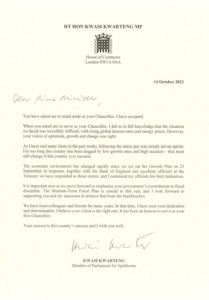
  • Kwasi Kwarteng – 2022 Letter to Liz Truss Confirming His Dismissal

    Kwasi Kwarteng – 2022 Letter to Liz Truss Confirming His Dismissal

    The letter sent by Kwasi Kwarteng, the Chancellor of the Exchequer, to Liz Truss, the Prime Minister, on 14 October 2022.

  • Kwasi Kwarteng – 2022 Statement on Recent Bank of England Asset Purchases

    Kwasi Kwarteng – 2022 Statement on Recent Bank of England Asset Purchases

    The statement made by Kwasi Kwarteng, the Chancellor of the Exchequer, in the House of Commons on 12 October 2022.

    The Bank of England decided to carry out temporary purchases of long-dated UK Government bonds (gilts) from 28 September through the asset purchase facility (APF) on whatever scale is necessary to restore orderly conditions. These interventions will be strictly time limited, with auctions taking place until 14 October.

    I have therefore authorised an increase in the total size of the APF by £100 billion. This will bring the maximum total size of the APF from £866 to £966 billion.

    On 11 October, the Bank decided that that it will widen the scope of its daily gilt purchase operations to also include purchases of index-linked gilts. This was designed to act as a further backstop to restore orderly market conditions by temporarily absorbing selling of index-linked gilts in excess of market intermediation capacity, the purchasing of index-linked gilts was already covered by the existing indemnity for the APF.

    The amendments to the APF that could affect the allocation of credit and pose risks to the Exchequer have been discussed with Treasury officials. The risk control framework for the APF previously agreed with the Treasury will remain in place, and HM Treasury will keep monitoring risks to public funds from the facility through regular risk oversight meetings and enhanced information sharing with the Bank.

    The Government will continue to indemnify the Bank and the APF from any losses arising out of, or in connection with, the facility. If the liability is realised, provision for any payment will be sought through the normal supply procedure.

    A full departmental minute has been laid in the House of Commons providing more detail on this contingent liability.

  • Kwasi Kwarteng – 2022 Statement on the Timing of Medium-Term Fiscal Plan

    Kwasi Kwarteng – 2022 Statement on the Timing of Medium-Term Fiscal Plan

    The statement made by Kwasi Kwarteng, the Chancellor of the Exchequer, in the House of Commons on 11 October 2022.

    Today I can inform the House that I have asked the Office for Budget Responsibility to bring forward the date of its next forecast to 31 October.

    Strong growth and sustainable public finances go hand in hand. Alongside the publication of the economic and fiscal outlook, I will set out the Government’s medium-term fiscal plan. This will set out further details on the Government’s fiscal rules, including ensuring that debt falls as a share of GDP in the medium term.

    This forecast, in addition to the forecast that will be commissioned in spring, will fulfil the obligation for the OBR to produce at least two forecasts in a financial year, as is required by legislation.

  • Kwasi Kwarteng – 2022 Statement on Appointment of James Bowler as Permanent Secretary

    Kwasi Kwarteng – 2022 Statement on Appointment of James Bowler as Permanent Secretary

    The statement made by Kwasi Kwarteng, the Chancellor of the Exchequer, on 10 October 2022.

    I’m delighted to welcome James [Bowler] back to the Treasury and Beth [Russell] and Cat [Little] into their new roles as Second Permanent Secretaries. James joined the Civil Service over 20 years ago and has enormous experience delivering across a range of Government departments. Beth and Cat bring experience and continuity and it’s fantastic to have them as part of the Treasury’s top team.

    James has a proven track record of delivery and strong leadership, both of which will be vital as we drive towards our mission of igniting growth and raising living standards for everyone across the UK.

  • Kwasi Kwarteng – 2022 Speech to the Conservative Party Conference

    Kwasi Kwarteng – 2022 Speech to the Conservative Party Conference

    The speech made by Kwasi Kwarteng, the Chancellor of the Exchequer, in Birmingham on 3 October 2022.

    Thank you, conference.

    What a day!

    It has been tough, but we need to focus on the job in hand.

    We need to move forward.

    No more distractions. We have a plan, and we need to get on and deliver it.

    That’s what the public expect from their government.

    But first conference, welcome back to Birmingham.

    This is a remarkable city.

    It has a history of great brilliance

    Joseph Chamberlain in the nineteenth century was an extraordinary civic leader who led Birmingham and the world through the industrial revolution.

    And today Andy Street is following in that great tradition.

    Grafts and grit turned this small town first into a thriving industrial market.

    Then into one of the centres of the industrial revolution…

    Which powered and grew not just the British economy,

    But provided the new technologies that changed the world forever.

    The Industrial Revolution was one of the most monumental transformations in human history.

    And it began here.

    With determination and application

    Those Britons built a thriving economy.

    They inspire me today.

    They remind us that in Britain, with the British people, absolutely anything is possible.

    Our Plan today focuses on the same, bold sentiment.

    The same inspiration

    To deal with the challenges of today by giving people the tools they need to thrive tomorrow.

    To get Britain moving.

    We have great ideas

    We have the same inspirational people

    And I know we have the same determination.

    Our Growth Plan set out ten days ago will ensure we focus relentlessly on economic growth.

    Because we must face up to the fact that for too long our economy has not grown enough.

    The path ahead of us was one of slow, managed decline.

    But I refuse to accept that it is somehow Britain’s destiny to fall back into middle league status…

    …or that the tax burden reaching a 70-year-high is somehow inevitable.

    It isn’t, and it shouldn’t be.

    Conference we needed a new approach, focused on raising economic growth.

    Because that is the only real way to deliver opportunities, to deliver higher wages, to deliver more jobs, and crucially, to deliver that revenue to fund our precious public services…

    …and it is the best and only way of achieving long-term fiscal sustainability.

    Because it is only by raising economic growth that we will spread opportunity and prosperity to every corner of our country.

    With economic growth, everybody benefits.

    And I mean everybody.

    Whilst we all believe in growth

    We as Conservatives also believe, it is an important principle that people should keep more of the money they earn.

    I don’t need to tell you that. That isn’t radical. That isn’t irresponsible.

    It is a deeply held belief that we all share as Conservatives.

    We were faced with a 70-year high tax burden,

    … we were confronted with low growth

    … and the path we were on was clearly unsustainable.

    So that’s why we are cutting taxes for working people.

    That’s why we will reverse the National Insurance hike on the 6th November.

    And that’s why we will bring forward the 1p cut to the basic rate of Income Tax by one year.

    And that’s why we will take 200,000 people out of paying Stamp Duty altogether.

    Taken together … this is what our support will do for all our people.

    Thanks to our energy intervention, a typical person in a semi-detached property will save £1,150 on their energy bills this winter.

    On top of the £400 discount.

    And if they are earning an average salary, they will benefit from an additional tax cut of around £400.

    That is almost a TWO-THOUSAND-POUNDS saving this year alone.

    But I can be frank, I know the plan put forward only ten days ago has caused a little turbulence.

    I get it. We are listening and have listened.

    And now want to focus on delivering the major parts of our growth package because with…

    Energy bills skyrocketing

    A painful Covid aftermath

    War on our continent

    A 70-year high tax burden

    Slowing global growth rates

    And glacially slow infrastructure delivery:

    We couldn’t simply do nothing.

    We can’t sit idly by.

    What Britain needs more than ever is economic growth…

    And a government wholly committed to economic growth.

    That is why we will forge a new economic deal for Britain…

    …backed by an ironclad commitment to fiscal discipline.

    More businesses. More jobs. Higher pay. More money for public services.

    Because we cannot have a strong NHS without a strong economy.

    We can’t have good schools without a strong economy.

    We cannot fund our Armed Forces without a strong economy.

    So growing our economy should be our central and guiding mission.

    With this plan, we are aiming for two and a half percent annual trend growth.

    We have done it before, and we can do it again.

    And even in the face of extreme volatility in global markets…

    …with major currencies wrestling an incredibly strong US dollar…

    …and longer-term trends from demographic change to climate change…

    …we will show that our plan is sound, that it is credible and that it will increase growth.

    That is our pledge to the people of this country.

    However, there is an immediate challenge facing not just our country, not just our people, but the whole of Europe…

    The high cost of energy driven by Putin’s barbaric invasion of Ukraine.

    Cast your mind back just four weeks ago.

    We had dire warnings of extreme energy prices to come.

    Corner shops to heavy industry predicted unprecedented disruption.

    Business groups feared mass unemployment.

    Entire livelihoods were on the line.

    Make no mistake, this was a very real prospect for our country.

    So, within 48 hours of taking office, we announced one of the most significant interventions ever conceived by the British state…

    Annual energy bills of up to £6,500 from next year were staring us in the face.

    Everybody was worried.

    Now, we are holding down the price at an average of £2,500.

    Not just this winter like the Labour Party promised… but next winter too.

    Two years of significant taxpayer support to protect our people.

    Because THIS government will always be on the side of those who need help the most.

    For our businesses too, Conference, help is on its way.

    A local pub could save £3,100 a month, cutting their bills by 40 per cent.

    And we have also frozen Alcohol Duty!

    Make no mistake, this is a monumental support package to protect millions of families and businesses from devastating price hikes unleashed by Vladimir Putin.

    There is no doubt that this is a substantial intervention, but we had no choice.

    Doing nothing was simply not an option.

    We couldn’t just cross our fingers and hope for the best.

    The price of inaction would have been far greater than the cost of the scheme.

    We will deal with the short-term shocks caused by Putin…

    But we must also go for growth to ensure we are much more self-sufficient.

    We will tackle the mistakes of the past to ensure the UK can NEVER again be blackmailed by people such as Putin and his like.

    When Covid hit our shores, we were right to intervene to protect lives and livelihoods.

    And I can say – in all sincerity – that we went into that crisis in a much better position because of the action we have taken over the last decade.

    Because of successive Conservative governments, the UK now has the second lowest debt to GDP ratio in the G7.

    And throughout this urgent endeavour of ours to protect Britain from high energy costs… and in response to…

    … the urgent need to grow our economy… we have taken the appropriate action.

    Our entire approach will be underpinned by a strong institutional framework, which enhances growth in our country…

    …including our independent Bank of England and Office for Budget Responsibility.

    We will have a strong fiscal anchor with debt falling as a proportion of GDP over the medium term.

    That is the Conservative way.

    But today, we face new challenges.

    And in addressing those challenges, we will act in a fiscally sustainable and responsible way.

    That is why, shortly, we will publish our Medium-Term Fiscal Plan setting out our approach more fully.

    It will set out how we plan to get debt falling as a percentage of GDP over the medium term.

    And I have asked the OBR to publish a full economic and fiscal forecast alongside our Medium Term Fiscal Plan.

    There is no path to higher sustainable economic growth without fiscal responsibility.

    Conservatives have always known this and we know it still.

    And it is because we are Conservatives, that we must remain absolutely committed to being serious custodians of the public purse.

    This is what defines us – and separates us from the Labour Party

    But conference, to grow the economy we really do need to do things differently.

    We know that it is our towns and cities which drive much of our economic growth today.

    Business investment, skills, science and technology, infrastructure, housing, energy supply, strong financial services…

    …these are the key ingredients for higher economic growth and well-funded public services.

    I had the great privilege of being Business Secretary for nearly 2 years.

    I visited every corner of this country.

    I saw the creativity, the drive, the entrepreneurial spirit.

    We have to celebrate our entrepreneurs, our business people, our job creators, people who are taking risks…

    But I also saw where government got in the way of progress.

    My job now is to free that potential.

    This starts with Investment Zones.

    We will empower local areas to do things differently, just as here in Birmingham.

    We will liberalise planning rules, releasing land and accelerating development.

    We will cut taxes for business in these zones.

    We will accelerate tax reliefs for new structures and buildings.

    We will provide relief on investments on plant and machinery.

    We will lower taxes which stop businesses hiring and skilling up their workforce.

    That is an unprecedented set of incentives for business to invest, to build, and to create jobs right across the country.

    And it will start right now.

    Conference, we will…get… Britain… moving.

    But too often regulation holds business and Britain back.

    Stifling red tape puts up too many barriers for entrepreneurs looking to scale up…

    …there are too many rules for the small business owner who wants to take on an apprentice

    … there are too many burdens on our finance sector stopping it from investing in key projects

    And when Britain’s innovators, job creators, entrepreneurs and risk takers are held back…

    …so is Britain.

    That is why we will review, replace or repeal retained EU law holding our country back.

    We will also speed up the delivery of infrastructure and promote house building to create a true home owning, shareholding democracy.

    Unapologetically, and emphatically we will get out the way to get Britain building and on its feet.

    Over the coming days and weeks, we will forge ahead and break down the barriers that have held our country back for too long.

    On childcare, agriculture, immigration, planning, energy, broadband, business, financial services…

    Sensible, economic reforms to produce more of the products and services we need to drive down costs.

    To create jobs

    And generate higher pay and productivity.

    And when it comes to those who would hold us back, we will act.

    Pernicious strike action disrupts the lives of the British people and it slows down our economy.

    It stops children going to school.

    It stops parents from going to work.

    And it stops people from getting the vital care they need.

    Action which slows down our economy cannot be the policy of any serious party serious about growth.

    And a party which is not serious about growth, can never be considered fit for office.

    So, we will introduce important reforms to stop strike action from derailing our daily lives.

    Reform to get Britain moving.

    Conference, I am unashamedly a pro-business Conservative.

    I know that the interests of businesses and hardworking families are not in conflict. They are aligned.

    When businesses thrive, they create more jobs, they raise wages, and they contribute more for our public services.

    Rather than bashing business, we’re backing it.

    That is why we need to make our tax system simpler, more competitive and pro-growth.

    So, we will reverse the planned increase in Corporation Tax, ensuring we have the lowest rate in the G20.

    This will plough almost £19bn a year back into the economy.

    That’s £19bn for businesses to reinvest, to create jobs and raise wages.

    We will reverse the reforms to IR35 that have added unnecessary complexity and cost for so many businesses.

    We will maintain the £1 million Annual Investment Allowance, giving 100% tax relief on investments in plant and machinery.

    For over a decade, the Conservative Party has stood up for working people in this country.

    Since 2010, we have delivered:

    ● The lowest unemployment since the 1970s

    ● A million new businesses

    ● More than doubling the tax-free personal allowance

    ● We have taken 2 million of the lowest paid OUT of paying tax altogether.

    ● The National Living Wage, boosting the pay packets of the lowest paid

    ● Fuel duty, frozen for 12 years.

    ● The £1,000 uplift in Universal Credit, making sure work always pays.

    These are great achievements. Conservative achievements.

    And let us not forget…

    When this Party came into Government – we were met with the full force of Labour’s economic incompetence.

    ● ‘No money left’

    ● Taxes raised

    ● Record unemployment.

    We reversed that story of national decline.

    But even after three election defeats, they still haven’t learned their lesson.

    The Labour Party would have you believe that every penny you earn should go straight into the Government’s coffers.

    The Labour Party believe that they know how to spend your money better than you do.

    The Labour Party believe that you can tax your way to growth.

    We don’t believe that.

    We believe in low tax, high growth and fiscal discipline. We are Conservatives.

    And that’s what our growth plan delivers.

    Last week we saw a Labour Party with the same old ideas

    Renationalisation

    … empty slogans

    … and no plan for growth.

    But we as Conservatives believe in Britain.

    We love this country, our patriotism, isn’t something that we turn on and off and negotiate like the Labour Party

    It goes to the core of what it is to be a Conservative… it is an unyielding quality.

    Yes we have challenges to face.

    But our plan will take this country forward.

    We will get Britain moving.

    We will deliver lower taxes for you and your family.

    And we will grow our economy.

    I know we can achieve that goal.

    With grit, with drive and with determination

    We can meet the challenges of this new era.

    Thank you.

  • Kwasi Kwarteng – 2022 Statement Scrapping Tax Cut for High Earners

    Kwasi Kwarteng – 2022 Statement Scrapping Tax Cut for High Earners

    The statement made by Kwasi Kwarteng, the Chancellor of the Exchequer, on 3 October 2022.

    From supporting British business to lowering the tax burden for the lowest paid, our Growth Plan sets out a new approach to build a more prosperous economy.

    However, it is clear that the abolition of the 45p tax rate has become a distraction from our overriding mission to tackle the challenges facing our country.

    As a result, I’m announcing we are not proceeding with the abolition of the 45p tax rate. We get it, and we have listened.

    This will allow us to focus on delivering the major parts of our growth package.

    First, our Energy Price Guarantee, which will support households and businesses with their energy bills.

    Second, cutting taxes to put money back in the pockets of 30 million hard-working people and grow our economy.

    Third, driving supply side reforms – including accelerating major infrastructure projects – to get Britain moving.

  • Kwasi Kwarteng – 2022 Letter to the Governor of the Bank of England on Inflation

    Kwasi Kwarteng – 2022 Letter to the Governor of the Bank of England on Inflation

    The letter sent by Kwasi Kwarteng, the Chancellor of the Exchequer, to Andrew Bailey, the Governor of the Bank of England, on 22 September 2022.

    [in .pdf format]

  • Kwasi Kwarteng – 2022 Mini Budget Statement in the House of Commons

    Kwasi Kwarteng – 2022 Mini Budget Statement in the House of Commons

    The statement made by Kwasi Kwarteng, the Chancellor of the Exchequer, in the House of Commons on 23 September 2022.

    Mr Speaker,

    Let me start directly with the issue most worrying the British people – the cost of energy.

    People will have seen the horrors of Putin’s illegal invasion of Ukraine.

    They will have heard reports that their already-expensive energy bills could reach as high as £6,500 next year.

    Mr Speaker, we were never going to let this happen.

    The Prime Minister has acted with great speed to announce one of the most significant interventions the British state has ever made.

    People need to know that help is coming.

    And help is indeed coming.

    We are taking three steps to support families and businesses with the cost of energy.

    Firstly, to help households, the Energy Price Guarantee will limit the unit price that consumers pay for electricity and gas.

    This means that for the next two years, the typical annual household bill will be £2,500.

    For a typical household, that is a saving of at least £1,000 a year, based on current prices.

    We are continuing our existing plans to give all households £400 off bills this winter.

    So taken together, Mr Speaker, we are cutting everyone’s energy bills by an expected £1,400 this year.

    And millions of the most vulnerable households will receive additional payments, taking their total savings this year to £2,200.

    Secondly, as well as helping people, we need to support the businesses who employ them.

    The Energy Bill Relief Scheme will reduce wholesale gas and electricity prices for all UK businesses, charities, and the public sector like schools and hospitals.

    This will provide a price guarantee equivalent to the one provided for households, for all businesses across the country.

    Thirdly, energy prices are extremely volatile, erratically rising and falling every hour.

    This creates real risks to energy firms who are otherwise viable businesses.

    Those firms help supply the essential energy needed by households and businesses.

    So to support the market, we are announcing the Energy Markets Financing Scheme.

    Delivered with the Bank of England, this scheme will provide a 100% guarantee for commercial banks to offer emergency liquidity to energy traders.

    Mr Speaker,

    The consensus amongst independent forecasters is that the Government’s energy plan will reduce peak inflation by around 5 percentage points.

    It will reduce the cost of servicing index-linked government debt and lower wider cost of living pressures.

    And it will help millions of people and businesses right across the country with the cost of energy.

    Let no one doubt: during the worst energy crisis in generations, this Government is on the side of the British people.

    The Bank of England are taking further steps to control inflation, acting again only yesterday.

    I can assure the House, this Government considers the Bank of England’s independence to be sacrosanct.

    And we remain closely coordinated, with the Governor and myself speaking twice a week.

    But Mr Speaker,

    High energy costs are not the only challenge confronting this country.

    Growth is not as high as it should be.

    This has made it harder to pay for public services, requiring taxes to rise.

    In turn, higher taxes on capital and labour have lowered returns on investment and work, reducing economic incentives and hampering growth still further.

    This cycle has led to the tax burden being forecast to reach the highest levels since the late 1940s – before even Her Late Majesty acceded to the throne.

    We are determined to break that cycle.

    We need a new approach for a new era, focused on growth.

    Our aim, over the medium term, is to reach a trend rate of growth of 2.5%.

    And our plan is to expand the supply side of the economy through tax incentives and reform.

    That is how we will deliver higher wages, greater opportunities, and crucially, fund public services, now and into the future.

    That is how we will compete successfully with dynamic economies around the world.

    That is how we will turn the vicious cycle of stagnation into a virtuous cycle of growth.

    So as a Government, we will focus on growth – even where that means taking difficult decisions.

    None of this is going to happen overnight. But today we are publishing our Growth Plan that sets out a new approach for this new era, built around three central priorities:

    Reforming the supply-side of the economy.
    Maintaining responsible approach to public finances
    And cutting taxes to boost growth.
    Mr Speaker,

    The UK has the second-lowest debt to GDP ratio of any G7 country.

    In due course, we will publish a Medium-Term Fiscal Plan, setting out our responsible fiscal approach more fully.

    Including how we plan to reduce debt as a percentage of GDP over the medium term.

    And the OBR will publish a full economic and fiscal forecast before the end of the year, with a second to follow in the new year.

    Fiscal responsibility remains essential for economic confidence, and it is a path we remain committed to.

    Today we are publishing costings of all the measures the Government has taken.

    And those costings will be incorporated into the OBR’s forecast in the usual way.

    The House should note that the estimated costs of our energy plans are particularly uncertain, given volatile energy prices.

    But based on recent prices, the total cost of the energy package, for the six months from October, is expected to be around £60bn.

    We expect the cost to come down as we negotiate new, long term energy contracts with suppliers.

    And, in the context of a global energy crisis, it is entirely appropriate for the government to use our borrowing powers to fund temporary measures in order to support families and businesses.

    That’s what we did during the Covid-19 pandemic.

    A sizeable intervention was right then…and it is right now.

    The heavy price of inaction would have been far greater than the cost of these schemes.

    Mr Speaker,

    We are at the beginning of a new era.

    As we contemplate this new era, we recognise that there is huge potential in our country.

    We have unbounded entrepreneurial drive.

    We have highly skilled people.

    We have immense global presence in sectors like finance, life sciences, technology, and clean energy.

    But Mr Speaker, there are too many barriers for enterprise. We need a new approach to break them down. That means reforming the supply side of our economy.

    Over the coming weeks, my Cabinet colleagues will update the House on every aspect of our ambitious agenda.

    Those updates will cover: the planning system, business regulations, childcare, immigration, agricultural productivity, and digital infrastructure.

    And Mr Speaker, we start this work today.

    An essential foundation of growth is infrastructure.

    The roads, railways, and networks that carry people, goods, and information all over our country.

    Today, our planning system for major infrastructure is too slow and fragmented.

    The time it takes to get consent for nationally significant projects is getting slower, not quicker, while our international competitors forge ahead.

    We have to end this.

    We can announce that in the coming months, we will bring forward a new Bill to unpick the complex patchwork of planning restrictions and EU-derived laws that constrain our growth.

    We will streamline a whole host of assessments, appraisals, consultations, endless duplications, and regulations.

    We will also review the government’s business case process to speed up decision making.

    And today, we are publishing a list of infrastructure projects that will be prioritised for acceleration, in sectors like transport, energy, and telecoms.

    And, to increase housing supply and enable forthcoming planning reforms, we will also increase the disposal of surplus government land to build new homes.

    Mr Speaker, we are getting out of the way to get Britain building.

    Mr Speaker,

    One of the proudest achievements of our government is that unemployment is at the lowest level for nearly fifty years.

    But with more vacancies than unemployed people to fill them, we need to encourage people to join the labour market.

    We will make work pay by reducing people’s benefits if they don’t fulfil their job search commitments.

    We’ll provide extra support for unemployed over-50s.

    And we’ll ask around 120,000 more people on Universal Credit to take active steps to seek more and better paid work, or face having their benefits reduced.

    And, Mr Speaker,

    At such a critical time for our economy, it is simply unacceptable that strike action is disrupting so many lives.

    Other European countries have Minimum Service Levels to stop militant trade unions closing down transport networks during strikes.

    So we will do the same.

    And we will go further.

    We will legislate to require unions to put pay offers to a member vote, to ensure strikes can only be called once negotiations have genuinely broken down.

    Of course, Mr Speaker, to drive growth, we need new sources of capital investment.

    To this end, I can announce that we will accelerate reforms to the pension charge cap so that it will no longer apply to well-designed performance fees.

    This will unlock pension fund investment into UK assets and innovative, high growth businesses.

    It will benefit savers and increase growth.

    And, we will provide up to £500 million to support new innovative funds and attract billions of additional pounds into UK science and technology scale-ups.

    And Mr Speaker, this brings me to the cap on bankers’ bonuses.

    A strong UK economy has always depended on a strong financial services sector.

    We need global banks to create jobs here, invest here, and pay taxes here in London, not Paris, not Frankfurt, not New York.

    All the bonus cap did was to push up the basic salaries of bankers, or drive activity outside Europe.

    It never capped total remuneration, so let’s not sit here and pretend otherwise.

    So we’re going to get rid of it.

    And to reaffirm the UK’s status as the world’s financial services centre, I will set out an ambitious package of regulatory reforms later in the Autumn.

    But Mr Speaker,

    To support growth right across the country, we need to go further, with targeted action in local areas.

    So today, I can announce the creation of new investment zones.

    We will liberalise planning rules in specified agreed sites, releasing land and accelerating development.

    And we will cut taxes.

    For businesses in designated tax sites, for ten years, there will be:

    Accelerated tax reliefs for structures and buildings.

    And 100% tax relief on qualifying investments in plant and machinery.

    On purchases of land and buildings for commercial or new residential development, there will be no stamp duty to pay whatsoever.

    On newly occupied business premises, there will be no business rates to pay whatsoever.

    And if a business hires a new employee in the tax site, then on the first £50,000 they earn…

    …the employer will pay no National Insurance whatsoever.

    That is an unprecedented set of tax incentives for business to invest, to build, and to create jobs right across the country.

    I can confirm for the House that we’re in early discussions with nearly 40 places like Tees Valley, the West Midlands, Norfolk and the West of England to establish Investment Zones.

    And we’ll work with the devolved administrations and local partners to make sure Scotland, Wales and Northern Ireland will also benefit, if they are willing to do so.

    If we really want to level up, Mr Speaker – we have to unleash the power of the private sector.

    And now, Mr Speaker, we come to tax – central to solving the riddle of growth.

    The tax system is not simply about raising revenue for public services, vitally important though that is. Tax determines the incentives across our whole economy.

    And we believe that high taxes reduce incentives to work, they deter investment and they hinder enterprise.

    As the Prime Minister has said, we will review the tax system to make it simpler, more dynamic, and fairer for families.

    And we are taking that first step today.

    Mr Speaker,

    The interests of businesses are not separate from the interest of individuals and families.

    In fact, it is businesses that employ most people in this country.

    It is businesses that invest in the products and services we rely on.

    Every additional tax on business is ultimately passed through to families through higher prices, lower pay, or lower returns on savings.

    So I can therefore confirm that next year’s planned increase in Corporation Tax will be cancelled.

    The UK’s corporate tax rate will not rise to 25% – it will remain at 19%.

    We will have the lowest rate of Corporation Tax in the G20.

    This will plough almost £19bn a year back into the economy.

    That’s £19bn for businesses to reinvest, create jobs, raise wages, or pay the dividends that support our pensions.

    I’ve already taken steps elsewhere in this statement to support financial services, so the Bank Surcharge will remain at 8%.

    But, Mr Speaker, we will do more to encourage private investment.

    The Annual Investment Allowance, which gives 100% tax relief on investments in plant and machinery, will not fall to £200,000 as planned…

    It will remain at £1m.

    And it will do so permanently.

    Our duty is to make the UK one of the most competitive economies in the world – and we are delivering.

    And Mr Speaker,

    We want this country to be an entrepreneurial, share-owning democracy.

    The Enterprise Investment Scheme. The Venture Capital Trusts. We will extend them beyond 2025.

    The Seed Enterprise Investment Scheme. Company Share Option Plans. We will increase the limits to make them more generous.

    Crucial steps on the road to making this a nation of entrepreneurs.

    Mr Speaker,

    For the tax system to favour growth, it needs to be much simpler.

    I’m hugely grateful to the Office of Tax Simplification for everything they have achieved since 2010.

    But instead of a single arms-length body which is separate from the Treasury and HMRC, we need to embed tax simplification into the heart of Government.

    That is why I have decided to wind down the Office of Tax Simplification, and mandated every one of my tax officials to focus on simplifying our tax code.

    To achieve a simpler system, I will start by removing unnecessary costs for business.

    Firstly, we will automatically sunset EU regulations by December 2023, requiring departments to review, replace or repeal retained EU law.

    This will reduce burdens on business, improve growth, and restore the primacy of UK legislation.

    Mr Speaker, we can also simplify the IR35 rules – and we will.

    In practice, reforms to off-payroll working have added unnecessary complexity and cost for many businesses.

    So, as promised by My RHF the Prime Minister, we will repeal the 2017 and 2021 reforms.

    Of course, we will continue to keep compliance closely under review.

    Mr Speaker,

    Britain welcomes millions of tourists every year, and I want our high streets and airports, our ports and our shopping centres, to feel the economic benefit.

    So we have decided to introduce VAT-free shopping for overseas visitors.

    We will replace the old paper-based system with a modern, digital one.

    And this will be in place as soon as possible.

    This is a priority for our great British retailers – so it is our priority, too.

    Our drive to modernise also extends to alcohol duties.

    I have listened to industry concerns about the ongoing reforms.

    I will therefore introduce an 18-month transitional measure for wine duty.

    I will also extend draught relief to cover smaller kegs of 20 litres and above, to help smaller breweries.

    And, at this difficult time, we are not going to let alcohol duty rates rise in line with RPI.

    So I can announce that the planned increases in the duty rates for beer, for cider, for wine, and for spirits will all be cancelled.

    Now, Mr Speaker, we come to the question of personal taxation.

    It is an important principle that people should keep more of the money they earn. And it is good policy to boost the incentives for work and enterprise.

    Yesterday, we introduced a Bill that means the Health and Social Care Levy will not begin next year… it will be cancelled.

    The increase in Employer National Insurance Contributions and dividends tax… will be cancelled.

    And the interim increase in the National Insurance rate, brought in for this tax year…will be cancelled.

    And this cut will take effect from the earliest possible moment, November 6th.

    Reversing the Levy delivers a tax cut for 28 million people, worth, on average, £330 every year;

    A tax cut for nearly a million businesses;

    And I can confirm: the additional funding for the NHS and social care services will be maintained at the same level.

    Mr Speaker,

    I have another measure.

    Today’s statement is about growth.

    Home ownership is the most common route for people to own an asset, giving them a stake in the success of our economy and society.

    So to support growth, increase confidence, and help families aspiring to own their own home, I can announce that we are cutting stamp duty.

    In the current system, there is no stamp duty to pay on the first £125,000 of a property’s value.

    We are doubling that – to £250,000.

    First time buyers currently pay no stamp duty on the first £300,000.

    We’re increasing that threshold as well, to £425,000.

    And we’re going to increase the value of the property on which first time buyers can claim relief, from £500,000 to £625,000.

    The steps we’ve taken today mean 200,000 more people will be taken out of paying stamp duty altogether.

    This is a permanent cut to stamp duty, effective from today.

    And Mr Speaker,

    I have another measure.

    High tax rates damage Britain’s competitiveness.

    They reduce the incentive to work, invest, and start a business.

    And the higher the tax, the more ways people seek to avoid them, or work elsewhere or simply work less…

    …rather than putting their time and effort to more creative and productive ends.

    Take the additional rate of income tax.

    At 45%, it is currently higher than the headline top rate in G7 countries like the US and Italy.

    And it is higher even than social democracies like Norway.

    But I’m not going to cut the additional rate of tax today, Mr Speaker.

    I’m going to abolish it altogether.

    From April 2023, we will have a single higher rate of income tax of 40 per cent.

    This will simplify the tax system and make Britain more competitive.

    It will reward enterprise and work.

    It will incentivise growth.

    It will benefit the whole economy and whole country.

    And, Mr Speaker, after all, this only returns us to the same top rate we had for 20 years.

    And that’s not all.

    I can announce today that we will cut the basic rate of income tax to 19p in April 2023 – one year early.

    That means a tax cut for over 31 million people in just a few months’ time.

    This means we will have one of the most competitive and pro-growth income tax systems in the world.

    Mr Speaker,

    For too long in this country, we have indulged in a fight over redistribution.

    Now, we need to focus on growth, not just how we tax and spend.

    We won’t apologise for managing the economy in a way that increases prosperity and living standards.

    Our entire focus is on making Britain more globally competitive – not losing out to our competitors abroad.

    The Prime Minister promised that this would be a tax-cutting government.

    Today, we have cut stamp duty.

    We have allowed businesses to keep more of their own money to invest, to innovate, and to grow.

    We have cut income tax and national insurance for millions of workers.

    And we are securing our place in a fiercely competitive global economy…

    …with lower rates of corporation tax…

    …and lower rates of personal tax.

    We promised to prioritise growth.

    We promised a new approach for a new era.

    We promised, Mr Speaker, to release the enormous potential of this country.

    Our Growth Plan has delivered all those promises and more.

    And I commend it to the House.