The resignation statement by Jeremy Miles, issued on 16 July 2024.
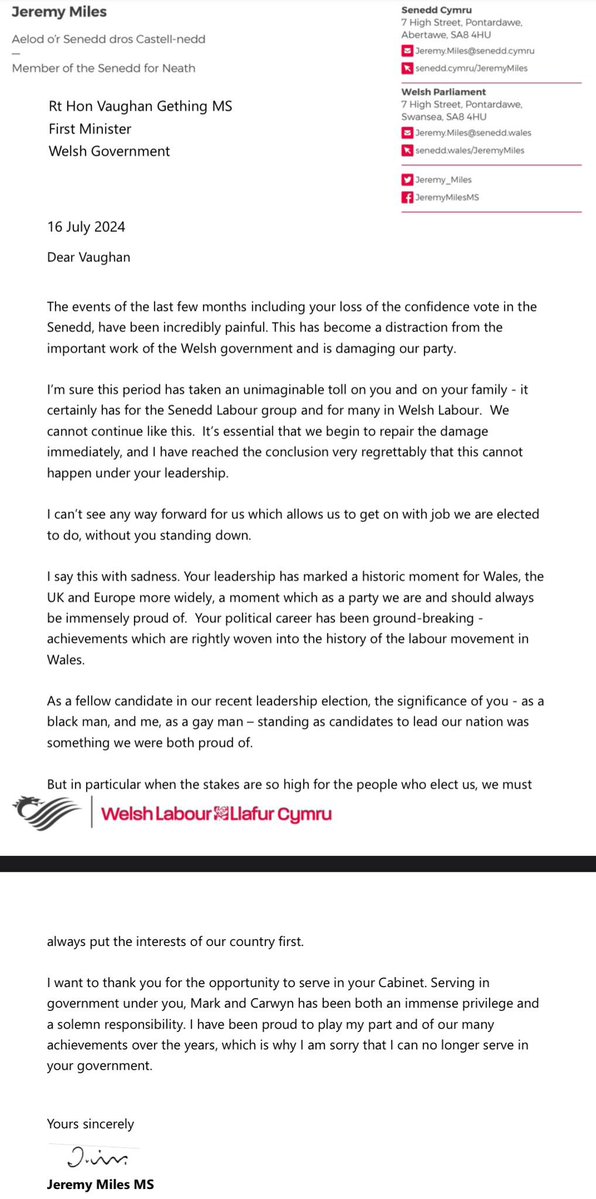

The resignation statement by Jeremy Miles, issued on 16 July 2024.
The statement made by Jeremy Miles, the Welsh Minister for Education and Welsh Language, on 19 January 2023.
Over recent years, Wales has been moving towards a new way of teaching and learning which is focused on helping children and young people achieve the four purposes: to be ready to learn, to play a full part in life and work, to be citizens of Wales and the world, and be valued members of our society. The teaching profession has worked hard and creatively to build new curricula for their learners, and schools across Wales are now introducing the Curriculum for Wales. We have always been clear that we need to ensure that all aspects of the education system are aligned with and fully support the realisation of the new curriculum, and we have taken clear steps forward on both professional learning and implementation of the new qualifications from 2025.
Next steps – developing a new data and information ecosystem/landscape
In June 2022, I published school improvement guidance to introduce a new way for the education system to work together to support schools in their improvement, build confidence in the system and retain a clear focus on supporting all learners to progress through their education. In July, the Welsh Government published the curriculum evaluation scoping report which made recommendations for how we will know that our new curriculum is improving learning in Wales. Today we see the publication of the Developing a new data and information ecosystem that supports the reformed school system in Wales report, which sets out recommendations for approaches to using data and information, in a way that will allow partners across the system to work together to support all our learners, irrespective of background, to fulfil their potential.
The report outlines the different information needs within the system: the needs of learners and their parents, of schools, of local authorities, as well as the importance of information at a national level to form the basis for improvement across the system. I welcome this helpful evidence that will inform our thinking. The report proposes developing a broader suite of information on areas such as wellbeing (both learner and staff) and the development of learners’ skills integral to the four purposes. It makes clear that when analysing information, we consider the context of our schools and the challenges they face. This includes a more sophisticated understanding of relative economic disadvantage and learners’ additional learning needs, as well as the voice of learners.
It is crucial to have the right breadth of information to support evaluation and improvement, whether at a national level or a school level, but I wish to emphasise that the Welsh Government’s expectation is that information is used to support schools and local authorities to understand their own contexts and improve their own offer. It should not be used in isolation to judge performance or compare schools and information should be created for a clear purpose.
Outcomes from qualifications will continue to form a key part of a school’s evaluation and improvement considerations. In 2019, we introduced new transitional interim measures for secondary schools that ensured more focus on raising our aspirations for all learners. They removed the narrowed focus on borderline C/D grade pupils to instead recognise the achievement of all our learners at Key Stage 4. These measures were paused during the pandemic. I can confirm today that for an interim period, whilst we progress the development of a neutral approach to the information system, we will restart reporting of Key Stage 4 outcomes at school level using the approach adopted in 2019 (including the policy of counting only first entries of exams). We will report outcomes in the points score format, including the ‘Capped 9’, broken down by gender and eligibility for free school meals. There are clear benefits in retaining a recognised approach which reflects attainment in both general and vocational qualifications as well as the importance of every learner and their outcomes, and in minimising changes to the approach to reporting on an interim basis. We will develop further thinking to align with the introduction of new qualifications from 2025 as we develop our new information landscape.
Rolling programme of national sample assessments
It is very important to emphasise that this return to 2019 arrangements is only temporary as we move towards a more holistic system that promotes learning and puts learners, teachers and parents at the centre. It is important that we have transparency on what we are achieving at a national level too. The Welsh Government is commencing work on an ambitious programme of national monitoring of education. As outlined in the curriculum evaluation scoping report, this will include a rolling programme of assessments of samples of learners across the breadth of the Curriculum for Wales. This is not about testing every learner but understanding and monitoring the national picture of learners’ attainment and progress over time on a system-wide basis. This approach will minimise burdens on schools and the education system as a whole and help provide the information we need to understand our progress in tackling the impact of poverty on learners’ achievement and inform our approaches to addressing these issues. Development work for this programme is underway, and we expect to begin rolling out these sample assessments on a pilot basis in the academic year 2025/26, alongside the wider ecosystem development.
Practitioner engagement and co-construction
Building on the findings of today’s report, we will now work with practitioners across Wales to develop a shared set of information which can help to support learning by understanding learner progress, attainment and the components which drive them. This will be informed by the eight factors which support curriculum realisation set out in the school improvement guidance. We will have a particular focus on improving understanding of progress of disadvantaged learners. I will be keen to gain the views of parents in this work, to understand what information they will find useful. We will work with local authorities, regional consortia and partnerships alongside this to seek to build a coherent and consistent approach across Wales which supports learning and minimises workload for teachers and schools. The Welsh Government will be writing to schools in the coming weeks to provide further details, and I will provide further updates as this work progresses.
The statement made by Jeremy Miles, the Welsh Minister for Education and Welsh Language, on 19 January 2023.
During a cost of living crisis, it is more important than ever that every measure is taken to ensure that everyone, no matter their background, can access higher education.
In 2018, the Welsh Government introduced a progressive and equitable student support system that is unique in Europe for financing full and part time undergraduates and postgraduates. This system is based on supporting students with the cost of living while they study.
We have taken the decision that the rate of support for students is linked to the value of the National Living Wage – this will increase substantially in the 2023-24 financial year. Despite continuing budget pressures, I can confirm today that we have ensured that the value of support is increased accordingly at this time of exceptional cost-of-living pressures.
This means that the rate of maintenance support paid to full and part-time higher education students from Wales will increase by 9.4% for the 2023/24 academic year, subject to regulations being made early in February. In contrast, the UK Government has announced a 2.8% increase for students ordinarily resident in England.
Our financial support for students has increased steadily in recent years. This increase will apply to full and part-time students who began a course on or after 1 August 2018.
The Welsh Government continues to provide the most progressive student finance system in the UK. Welsh undergraduate students have less to repay on average than their English peers as they can access our generous living costs package of grants and loans. The highest level of grant support is given to those students most in need. A substantial part-time student support package is available, enabling students of all backgrounds to undertake part-time study.
Living costs should never be a barrier to studying at university. The increase in support I am announcing today will ensure that students from all backgrounds are able to access higher education.
The statement made by Jeremy Miles, the Welsh Minister for Education and Welsh Language, on 23 December 2022.
In accordance with the inter-institutional relations agreement, I can report I chaired the third meeting of the UK Education Ministers Council (UKEMC) on Friday 9 December at the Welsh Government Buildings in Cathays Park, Cardiff.
Shirley-Anne Somerville MSP, Cabinet Secretary for Education and Skills attended for the Scottish Government. The Rt. Hon. Gillian Keegan MP, Secretary of State for Education attended for the UK Government and Mark Browne, Permanent Secretary to the Department for Education and Mark Lee, Director Tertiary Education represented Northern Ireland via video link.
The group discussed challenges and recent developments in the areas of: the rising cost of living; general and vocational qualifications; and lifelong learning.
Mike James, Chief Executive of Cardiff and Vale College, gave a presentation on the broad offer from the post-16 sector.
Amongst other things I highlighted the work the Welsh Government has been doing on Universal Primary Free School Meals, the significant changes taking place in the qualifications landscape in Wales and my vision for Wales to be a second chance nation.
It was agreed the UK Government will host the next meeting of the UKEMC.
This statement is being issued during recess in order to keep members informed. Should members wish me to make a further statement or to answer questions on this when the Senedd returns I would be happy to do so.
The statement made by Jeremy Miles, the Welsh Minister for Education and Welsh Language, on 22 December 2022.
I would like to update Senedd Members on the decision of the High Court today.
I welcome the Court’s decision which found in favour of the Welsh Ministers on all grounds.
The Court rejected the characterisation of the RSE (Relationships and Sexuality Education) curriculum by the claimants. The Court found that “…the content of the Code and the Guidance is consistent with the requirement to take care to ensure that RSE teaching is conveyed in an objective critical and pluralistic manner, and does not breach the prohibition on indoctrination.
“There is nothing in the Code or the Guidance that authorises or positively approves teaching that advocates or promotes any particular identity or sexual lifestyle over another, or that encourages children to self-identify in a particular way.
“…In my judgment, both the Code and the Guidance reflect the general spirit of the Convention as an instrument designed to maintain and promote the ideals and values of a modern liberal democracy, including the values of tolerance, respect and equality.”
We have been clear that RSE is intended to keep children safe and to promote respect and healthy relationships.
Now more than ever, our children need our help in protecting them from harmful content and people online. RSE should provide young people with confidence to say no to bullies, to call out harassment, and to understand that families come in all shapes and sizes.
Parents can expect the teaching their children receive to be appropriate for their children’s age and maturity: this is a legal requirement.
I want parents to understand what is being taught and what resources are being used, and for schools to take the time to have those discussions with parents. This will require time, patience and confidence-building.
Parents can expect schools to engage with them about their plans for teaching RSE and to be able to raise any constructive questions or anxieties they have about those plans. We will work closely with schools and communities to ensure that they are heard and they are clear about what their children will and will not be taught.
I would like to put on record that I am appalled by the misinformation that has been purposefully spread by some campaigners, and the additional pressure this has brought upon some schools and workforce. I want to say to our education workforce that we will support you and we thank you for the contribution you make to the lives of the children you teach.
We will continue to work with local authorities and schools to support them in rolling out the new curriculum, help them engage with parents, carers and communities, including with resources to support teaching and learning.
This statement is being issued during recess in order to keep members informed. Should members wish me to make a further statement or to answer questions on this when the Senedd returns I would be happy to do so.
The statement made by Jeremy Miles, the Welsh Minister for Education and Welsh Language, on 15 November 2022.
We believe that everyone should learn about and be able to critically engage with the history of our country in all its diversity. Our vision is for all of our citizens, including young people, to understand how history, language, diversity and culture have shaped Wales to become the proud and unique nation we are today. We want all our learners to understand the history of Wales including the history of the Welsh language. Moreover, we want all of our learners to feel inspired to use the Cymraeg they have, wherever they are on their Welsh language journey.
Through the statements of ‘What Matters’ Code and the Humanities Area of Learning and Experience, Welsh history is a mandatory part of the new curriculum.
The Welsh Government strengthened the statements of ‘What Matters’ for Humanities following consultation in spring 2021 to ensure the study of Welsh history is both explicit and compulsory for schools and settings. They now state:
“Through consistent exposure to the story of their locality and the story of Wales, as well as to the story of the wider world, learners can develop an understanding of the complex, pluralistic and diverse nature of societies, past and present. These stories are diverse, spanning different communities as well as in particular the stories of Black, Asian and Minority Ethnic people. This also enables learners to develop a common understanding of the diverse history, cultural heritage, ethnic diversity, identities, experiences and perspectives of their local area, Wales and the wider world.”
The Co-operation Agreement between Plaid Cymru and the Welsh Government emphasises the importance of Welsh history – in all of its diversity and complexity – being mandatory in the new Curriculum for Wales and commits us to reviewing the mandatory statements of What Matters Code and other supporting guidance to further strengthen this shared commitment. This will happen, following consultation, over the course of the coming academic year to provide explicit reference to the ‘history of Wales and the world’. The guidance underpinning this will also be updated to reflect and provide full support for this change. In line with Co-Operation Agreement, we will also commission the development of an overarching timeline of Welsh history and further updates will be provided in due course.
The Welsh Government held a National Network conversation on Welsh history, in all its diversity, in April 2022. This conversation gathered perspectives from schools and stakeholders to develop common approaches around the teaching of local and Welsh history and how the Welsh language and diverse communities can play a vital role in identity and belonging. We are now looking at how we can further support teachers. This will include holding further National Network conversations focused on Welsh history and culture, including Black, Asian and Minority Ethnic histories and culture in Wales, and the history and current situation of the Welsh language in terms of national and local contexts.
We are also commissioning supporting materials to enable teachers designing their curriculum to reflect Wales’ diverse history and communities. This includes a specific timeline to support the teaching and learning of Black, Asian and Minority Ethnic histories and contributions, plus an interactive map of Wales.
We will continue to work with stakeholders, including historians and academics, over the coming months to look at further ways of supporting teachers as we move towards the full implementation of the Curriculum for Wales. Delivering the recommendations made by the ‘Black, Asian and Minority Ethnic Communities, Contributions and Cynefin in the New Curriculum Working Group’ will be integral to the teaching of Welsh history. In June, I published an Annual Report on the progress made to date on implementation of the recommendations.
Today, I am also publishing our formal response to the Estyn thematic report on The teaching of Welsh history including Black, Asian and Minority Ethnic history, identity and culture. We are addressing these recommendations as part of the implementation of the actions above. I am delighted to confirm that Professor Charlotte Williams OBE has agreed to extend her advisory role with the Welsh Government to support the embedding of the recommendations.
It is vital that we continue to promote and support the delivery of Welsh history in the new curriculum and enable our learners to become ethical and informed citizens of Wales and the wider world. It is important that young people are able to explore the diverse history of Wales, discover their heritage and understand the importance of the Welsh language, and develop their understanding of their cynefin.
The statement made by Jeremy Miles, the Welsh Minister for Education and the Welsh Language, on 14 November 2022.
I can announce today there will be an uplift of pay for our highly skilled and hardworking teachers in Wales.
On 21 July, subject to consultation with key stakeholders, I agreed in principle to accept all of the Independent Welsh Pay Review Body’s recommendations for 2022/23 including an uplift of 5% to all statutory salary points on all pay scales and for all allowances from September 2022. I can confirm today that we will be accepting the Review Body’s recommendations.
The new starting salary for teachers will therefore be £28,866 and the salaries of more experienced classroom teachers will increase by £2,117 to £44,450. Additionally, all allowances will also be uprated by 5%.
I accept that some may be disappointed that a higher award could not be provided and recognise the legitimate right of all workers to seek a fair and decent pay rise during this challenging time of inflation and cost of living rises.
However, as additional funding has not been made available by the UK Government, we are not in a position to further address these issues over and above what has previously been considered. The Welsh Government’s budget will be worth £4bn less over the three years of the current settlement – £1.5bn lower next year. This is before the much touted further budgetary cuts the UK Government claims it will make imminently. Within this context, it is simply unaffordable, and would be irresponsible, to propose higher pay rises. We repeat our calls for the UK Government to finally do the right thing and act urgently to restore Wales’s budget so that we can support our public services.
Members will recognise that there is a huge amount of ongoing financial uncertainty.
In relation to future pay awards from September 2023, no compelling evidence was provided to alter my earlier proposal for the IWPRB recommendations to be kept under review and be used as a planning assumption, subject to such a review.
I also welcomed the IWPRBs recommendations on improvements to some key terms and conditions of teachers, notably in relation to remuneration of part-time teachers for TLR allowances; and the need to review the remuneration of ALNCos. I thank both employers and teacher unions for working alongside us on these matters to further improve terms and conditions for teachers in Wales. In particular, I welcome the agreed revisions to the required methodology for calculating TLR allowances for part time teachers which will improve the transparency and fairness for those part time teachers carrying out these roles from now on.
Consequently, I will today make the School Teachers’ Pay and Conditions (Wales) Order 2022 which gives effect to the School Teachers’ Pay and Conditions (Wales) Document 2022.
The pay award will be backdated to 1 September 2022. Timing of the implementation of the award will be a matter for employers. Initial discussions with local authorities have been positive, with the aim to arrange for back pay to be passed on as soon as possible, hopefully before the end of December.
Moving forward, I welcome the opportunity to continue to work together with stakeholders on a comprehensive review of the structure of teachers’ and leaders’ pay and conditions. This will provide us with further opportunities to improve and enhance the system and, where we can, make it fairer and more transparent for all teachers. Such partnership working will also help to promote teaching as a profession of choice for graduates and career changers.
The statement made by Jeremy Miles, the Minister for Education and the Welsh Language, in the Welsh Assembly on 9 November 2022.
I made a statement on 5 September 2022 to confirm the intention to cap the interest rate charged to Welsh students on certain loans from September 2022 at 6.3% for a period of three months. This cap was also announced by the UK Government for English students.
I can now announce that the interest rate will be capped from 1 December 2022 for a further three months. The rate for these three months will be 6.5%.
The rate of inflation, which determines the interest charged on certain student loans, has risen significantly. Interest rates on these loans would have risen to up to 12% without the September cap. The Welsh Government must ensure that rates do not exceed the prevailing market rate and took action three times in 2021 to cap the rate on loans and protect students.
As prevailing market rates remain high, the rate on loans taken out by undergraduate students since 2012, and by postgraduate students, will be capped at 6.5% between 1 December 2022 and 28 February 2023. Further rate caps may be applied if the prevailing market rate continues to be below student loan interest rates after that date.
Changes to interest rates do not affect monthly student loan repayments, which are charged as a fixed proportion of income. Loan repayments are income contingent. Students repay their loan only if they earn above a threshold, and remaining debts are written off after thirty years.
Living costs should never be a barrier to studying at university, which is why the Welsh Government provides the most generous living costs grants in the UK. Welsh students have less to repay on average than their English peers. The Welsh Government also provides a debt write-off of up to £1,500 for each borrower entering repayment, a scheme unique in the UK.
Below is the text of the statement made by Jeremy Miles, the Counsel General for Wales, on 7 May 2020.
This statement provides members with an update on issues related to the UK’s exit from the EU, focusing on the latest position in the negotiations on the UK / EU future relationship and the implications of this for the huge and complex programme of work required by the end of the transition period given that governments in the UK and EU are rightly focused on responding to Covid-19.
Responding to the Covid-19 pandemic continues to be the immediate priority of the Welsh Government, and we maintain that the negotiations on the future UK / EU relationship should be paused and an extension to the transition period sought. Despite the realities of the current crisis, the UK Government continues to argue that successful negotiations, and the necessary work to implement an agreement, can be concluded alongside dealing with the current national emergency. We have seen no evidence to support that position.
EU / UK Negotiations
Following an understandable pause in formal talks between the UK and EU as all parties rightly focused their efforts on responding to Covid-19 and keeping all of our citizens safe, the negotiations resumed in the week commencing 20 April, albeit with reduced numbers and via videoconference.
At the end of the second full round of talks, there were clearly major differences remaining between the two sides as outlined by Michel Barnier in recent comments. The largest areas of difference include: the UK Government’s unwillingness to sign up to a ‘level playing field’ of economic, social and environmental standards which the EU insists should underpin the envisaged zero-tariff, zero-quota trade deal; the UK Government’s rejections of any role for the Court of Justice of the European Union in relation to aspects of the future relationship; the UK Government’s position that there should be multiple separate agreements as opposed to the EU’s preference for one overarching agreement; and fishing rights. There seems to have been little, if any, progress in resolving these fundamental differences despite the fact we are now half way between the publication of negotiating mandates and the critical end of June date (which under the terms of the Withdrawal Agreement is the last point at which an extension to the transition period can be agreed).
The negotiations have to date focused on the presentation and clarification of negotiating positions. If the UK Government persists in seeking to work to the original timetable, then the negotiations need to reach agreement swiftly, which will require compromise and pragmatism. Despite best efforts there will inevitably be limitations about what can be achieved by video conference rather than face to face negotiations, especially when there are clear fundamental differences between the two sides.
The UK Government continues to refuse to contemplate extending the end date of the transition period. This is despite requests from us and many others to pause the negotiations and extend the transition period, recognising the fundamentally changed circumstances facing the economy and society due to the Covid-19 pandemic. It is of great concern in the current circumstances that we will exit transition on 31 December 2020. The focus must be for us to work together to combat Covid-19 and the economic consequences thereafter, rather than unnecessarily compounding these issues by adding the economic shock a change in our economic relationship with the EU will inevitably entail. The UK Government must also recognise that conducting complex negotiations under these constrained circumstances is unlikely to lead to an outcome which protects our interests.
UK Government engagement with the Devolved Governments on the negotiations remains deficient: despite the promises of improved engagement as the future relationship negotiations got underway, Ministerial engagement became even more inadequate. The UK Government has failed despite their formal commitment in the terms of reference of the Joint Ministerial Committee (EU Negotiations) to seek agreement with the Devolved Governments on the negotiations to provide us with meaningful opportunities to influence. Whilst we have made clear that the UK Government position is not one we can support since it does not represent Wales’ interests, as a responsible government, we continue to take any opportunities that we can to press our case on specific points. We will, of course, continue to speak up for what we believe is in Wales’ interests in these negotiations, both in our dealings with the UK Government and in public.
A meeting of the Joint Ministerial Committee (EU Negotiations) is being arranged for the middle of May. This is the first meeting since January. I have also spoken bilaterally this week and last week with the UK Government’s Paymaster General, Penny Mordaunt MP. These short calls are welcome but necessarily limited in their effectiveness and therefore I continue to press for structured, collective and detailed discussions involving all three Devolved Governments and the UK Government on the negotiations, and in particular on changes to the UK Government’s negotiating position.
EU Exit Implementation
The uncertain and deeply concerning situation on the negotiations exacerbates the pressures and risks we face in preparing for the end of the transition period – in particular on preparedness, legislation, frameworks, policy and finance.
In relation to preparedness overall, at the end of transition we need to be able to implement any deal reached on the future UK / EU relationship, or manage the implications if no such deal is agreed. We may not know until well into the autumn, or even later, which scenario we face.
Covid-19 has already affected the current capacity of both the UK Government and the Welsh Government to prepare for the end of transition. More fundamentally, the scale of the immediate crisis has hugely reduced the capacity of people, businesses and other organisations to consider, let alone take action to prepare for, the end of transition. The risks of this will multiply if significant changes to trade and supply chains hit already fragile businesses which are not prepared and still suffering from the impact of the pandemic – with potentially serious implications across Wales.
We have repeatedly pressed the UK Government to work with the Devolved Governments on the preparations for the end of the transition period, as happened – eventually – in respect of preparations for a ‘no deal’ scenario in 2019. However, at a central level the UK Government is choosing not to share information or work with the Devolved Governments on the wide range of preparedness work which we know it is seeking to carry out, including on the functioning of the Northern Ireland Protocol. As we made clear during the work on a ‘no deal’ scenario previously, it is not possible for the Welsh Government to prepare Wales for whatever situation we face at the end of transition period in isolation from the UK Government’s work in England or at a UK level. Moreover, the UK as a whole cannot be properly prepared if the UK Government does not work effectively with the Devolved Governments. As such, the UK Government’s continued reluctance to share information and to work with the Devolved Governments – and the months of time lost for joint preparedness work as a result is profoundly concerning.
In relation to legislation, there remains a high degree of uncertainty with relatively limited information available from the UK Government on the scope and nature of the legislation needed, in particular on the implementation of the Withdrawal Agreement and related agreements, and with even less certainty regarding a possible treaty on the future relationship with the EU. We have asked the UK Government to share a credible plan for how all the necessary legislation can be passed by the end of December, but no such plan has been shared. The successful implementation of the Withdrawal Agreement requires a cross-UK approach, or at least understanding, and this cannot be achieved without input from the UK Government. We are very aware that there is likely to be a significant programme of SIs required and we will continue to press the UK Government to work with us on such legislation and to ensure that the devolution settlement is properly respected.
Moreover, there is extensive work required in relation to ‘common frameworks’ by the end of 2020. Officials from all four administrations have been working together to consider how to deliver the most important framework areas. However, even achieving this by the end of this year will be difficult. More broadly, work in relation to common frameworks and the internal market serves to illustrate powerfully how inter-governmental relations and devolution / constitutional issues could well grow significantly in breadth and complexity in the future. There is much work to do in a short period of time to resolve potential challenges and maintain a positive economic and constitutional landscape within the UK.
In addition to frameworks, there is a wide-ranging policy agenda which relates to EU exit, encompassing policy making in Wales (for example, in respect of future agriculture policy) and our need to seek to influence policy making at a UK level (for example, on how the UK internal market will function, and on migration policy) to ensure they meet the needs of Wales. All this will also need to be calibrated according to the progress of recovery from the Covid-19 crisis.
Furthermore, there is an important set of issues relating to finance. Around £700m a year comes to Wales now from the EU and whereas there are short-term reassurances from the UK Government on aspects of this, we need to protect our interests in longer-term funding decisions, particularly in respect of the possible Shared Prosperity Fund (SPF) and future agricultural and rural development funding. We will hold the UK Government to promises made that Wales will not be a penny worse off as a result of leaving the EU, and that the Welsh Government will continue to be responsible for deploying these funds in Wales.
This statement demonstrates the scale and the complexity of the work on EU exit issues facing us in the remainder of 2020 and illustrates how it links to the new realities and work arising from the Covid-19 pandemic. The Welsh Government will continue to do all we can to seek to influence the negotiations and to work on the necessary preparations for the end of the transition period. This is constrained however, by the current approach of the UK Government. I will continue to keep members up to date on developments, in particular following the anticipated JMC(EN) meeting later this month.