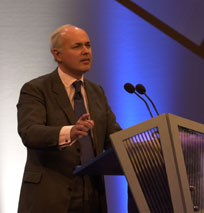
Tag: Iain Duncan Smith

  • Iain Duncan Smith – 1992 Maiden Speech in the House of Commons

    ids2000

    Below is the text of the maiden speech made by Iain Duncan Smith in the House of Commons on 20 May 1992.

    I take this opportunity to congratulate you, Madam Speaker, on your election. As this is my maiden speech, I ask the House to bear with me if I make a series of mistakes.
    Earlier, the right hon. Member for Chesterfield (Mr. Benn) reminded the House of the great honour that our electorate bestow upon us in permitting us to represent their views and interests in a sovereign Parliament. I may point out that Chingford is officially part of Greater London, not Essex. Having heard the recent results in Basildon, I am sad that it is not part of Essex.

    The majority of the people who live in Chingford have striven for a long time to buy their own properties, take care of their own lives, and make the most that they can—to hand on to future generations—from hard work and the sweat of their own brows. Many of my right hon. and hon. Friends will immediately recognise those as key principles that have supported conservatism, and which my party promoted during the whole of the 1980s. Chingford represents those interests, and we represent Chingford’s interests.

    My hon. Friend the Member for Eastleigh (Mr. Milligan) mentioned that there is a factory producing Mr. Kipling cakes in his constituency. I cannot boast of such a place, but we do have the London Rubber Company in the middle of my constituency. That company is heavily linked to today’s debate. The House may recall the little problem that existed with the Italian regulations, on the size or width of certain items that London Rubber produces—so it has a keen interest in what goes on here.

    Few constituencies are so associated with a particular individual as Chingford. I refer of course to my predecessor, Norman Tebbit. Some may remember only the “Spitting Image” vision of a leather jacket, studs, and chains—but I am sure that all right hon. and hon. Members will keep in mind the image of a man of incisive wit, telling rebukes, and most of all, reforming zeal.

    If it were only for his political achievements, Norman would be remembered as one of the most important figures in British political history—but he is remembered for much more than that. The House owes him a great debt. On that terrible night in Brighton, the lives of Norman, Margaret, and their family were devastatingly and treacherously changed for the worst—yet at no time has Norman or Margaret complained, and they consistently serve as a great inspiration to me and many others.

    It is not overstating the case to say that Norman brought great honour to the House. I know that all right hon. and hon. Members will join me in wishing him great happiness in the future, in all that he does.

    So often in the past when Europe has been debated, there has been a knee-jerk level to the debates. It is said that there are those who are pro-Europe—the Europhiles—and those who are anti-Europe—the Euro-sceptics. If the issue is always polarised in that way, it will be impossible to have a rational debate. The question is rather, whether we want to interrogate certain aspects and regulations or not, the public have a right to know the detail, and it is important that we examine the detail of the treaty and put it before them. I will attempt to do that this evening.

    Let me begin by congratulating my right hon. Friends the Prime Minister, the Foreign Secretary and the Chancellor on their great negotiating skills, which have produced the treaty that is now before us. Their achievements in securing our exclusion from the social chapter protocol, and in reserving Parliament’s right to decide whether to enter currency union, are greatly appreciated by hon. Members on both sides of the House.

    As I read the treaty, however, I must confess to a growing disquiet. My chief worry is that, despite the Government’s considerable successes, we remain locked into what I see as a continuing progression towards a European super-state. I consider that neither necessary nor desirable.

    Maastricht—following, as it does, from the Single European Act and the treaty of Rome—embodies that movement; perhaps it is proceeding at a slower rate in this context, but it is a movement none the less. Let me explain—echoing what was said earlier by the right hon. Member for Llanelli (Mr. Davies)—that my reasons for believing that are based fundamentally on the ethos that exists in the institutions that the Community now contains. I refer chiefly to the European Commission and the European Court.

    In my view, successive Governments have failed fully to understand the way in which the Commission seeks constantly to advance its competence. In so doing, it will be supported by the European Court. The Commission is not just a bureaucratic body, as so many people seem to think; it has substantial law-making powers—very excutive powers. Beyond those powers, it exists as much to propose legislation to the Council of Ministers. Through its performance of both those roles, constant pressure will continue to extend the process of European integration.

    All too often, press and politicians talk about Delors as though he were an expletive. His role is quite clear to him; I believe that it is our understanding of that role that is unclear. Obviously, the European institutions hold the key to the concern that I feel over Maastricht—the Single European Act and, originally, the treaty of Rome.

    The European Court of Justice has the role of interpreting and applying Community law. Through the interpretation that it gives the treaties within the Community, it can and does fundamentally affect the balance between nation states and the Community. The Court, through its judgments, cannot be considered neutral by any means: it is part of those key institutions that consider it their duty constantly to push forward the concept of the Community, ultimately at the expense of the nation state.

    An example of that is provided by a judgment in a case brought by the Netherlands against the high authority. The power of the Court was defined by the Court as the ultima ratio enabling the Community interest enshrined in the Treaty to prevail over inertia and resistance of member states. Many other judgments also illustrate the point.

    The history of the European Court clearly shows, time and again, that it will be far from impartial, invariably finding in favour of what it perceives as the interest of the Community. Furthermore, the difference between the tradition of common law that exists in this country and the tradition of Continental law—based, as it is, so fundamentally on the code Napoleon—means, essentially, that the European Court will regularly fall back on the preambles to treaties, and will use them to interpret points, as it sees them, within the spirit of the agreement—the members. Every treaty that we have ever signed has given the Court greater scope to interpret.

    The preamble to the treaty of Rome raises general provisions urging member states to attain ever closer union with general objectives. To most common law lawyers, that might appear fairly general on the surface. However, it is a major signpost in continental law. The preamble to the Single European Act is full of references to the states implementing a union. Article I clearly refers to progress towards European unity—a major signpost for the European Court.

    Here we seem constantly to have disregarded the general wording of the preambles to the treaties. Under common law, they are not part of any agreement, but in the code Napoleon and continental law, they form a major part of any agreement. The treaty on European union sets out no less clearly in its preamble that defence, foreign policy, economic and social policies and the free movement of people are all set to converge in ways which on the surface may appear rather general but which will be critical to the functioning of the treaty. Therefore, across a full range of matters the Maastricht treaty extends further the areas to which Community law applies.

    Given the natural desire to the Community institutions constantly to push forward with closer ties and greater compliance, it is natural that they will seek to find areas that are open to extensive secondary legislation affecting our national life that have not yet been affected.

    That can be clearly seen in the proposals for a 48-hour working week. We never perceived under the Single European Act that that would necessarily be the case, but the Community—in the shape of the Commission, ultimately supported by the European court—pushes for that extra bit to be brought to the Commission, under majority voting. I know that my right hon. Friend the Secretary of State for Employment is doing all she can to sort this out, and I wish her the very best of luck. However, I remain a touch pessimistic about the outcome.

    Both sides of the House have made much of subsidiarity, probably because most people do not have a clue what the heck it means. I suspect that some hon. Members on both sides of the House also fall into that category. It is the devolving of power to a lower level, as perceived by the treaty—that of nation states. As a means of trying to retain control over our national identity, it should be given some approval, but if we look back we see that it is a two-edged sword. It very much cuts both ways.

    Originally it was a papal concept. That concept was about power that could flow downwards to the constituent parts of the papal dominion. The key factor was that that power had to be given, as judged by the central authority. In line with that, if we come forward to Maastricht again, we see that it could imply that anything that cannot be justified at national level should, therefore, be taken to the European level. That is the other edge of the cutting sword: that the Community could easily turn round and say, “Justify the fact that you have the right to retain control over that area; otherwise, we shall take it under our powers and competence.” It therefore follows that the European Court would ultimately find in favour of the Community. That is part of its ethos.

    Therefore, I propose some measure of reform which I believe we must undertake if we are to make sure that the sort of Europe that we want to see is the one that goes through and that we can control. First, I propose that we should repeal sections 1 and 2 of the European Community Act 1972 and replace them with clear statements about this Parliament’s supremacy over all European Community activities that affect the relationship between this House and the courts—and, in fact, all other constitutional matters.

    Secondly, we should set about reforming the Commission, starting with the European Court. We should position a constitutional court over the Community, I stress, to take an impartial position on questions which affect the competence of nation states.

    Thirdly, the Commission should be slimmed down, losing many of its existing portfolios. We should get rid of the position of the President and make the Commission more of a non-executive body. Those moderate suggestions are offered, Mr. Deputy Speaker, with some deference to your position.

    Most of all, we must therefore seek to refocus the Community as one of a group of nation states determined to seek co-operation on a defined but limited number of areas. That would greatly assist the inclusion of other states, which is proposed and with which I thoroughly agree, while keeping the flow of trade as free as possible through co-operation not coercion.

    From successive treaties, we have seen a growing erosion of the powers of the House to legislate, not to be overruled by the European Court. Much has been made about the exclusion of the word “federalism”. Having read the treaty time and again, I have to say that, even if we exclude it, the obvious signs are there for all to see—that is, that that is the inevitable march. After all, a bite from a rottweiler hurts just as much even if we insist on calling it a pekinese.

    We are asked to support the Government. There is no doubt in my mind of the Government’s intentions, and those I support. However, the problem is that far too much trust is expected of us in this House to be vested in the institutions in the Community. I do not believe that, if we notice how the general tendency is to move towards greater integration, that trust will be well placed.

    It has been ably pointed out several times that we have seen the Government and previous Governments fight rearguard actions to prevent the growing power of the Commission from encroaching. Those rearguard actions have been fought in the knowledge that we have signed up to something which has given the Commission powers to get in and take control of certain aspects of our lives.

    The treaty is therefore somewhat out of date. It reflects, sadly, concerns from the past which are no longer relevant. I hope that, if we consider the problems and changes that are going on in the Community, hon. Members will agree with me. The treaty keeps the door open to a federalist, centralist and uncompetitive Europe which is clearly moving us in the wrong direction from the rest of the world.

    I am not by any means anti-European. After all, Europe is a geographical expression. Therefore, being in the centre of Europe or supporting Europe is neither here nor there. The key is a European Community of nations trading and co-operating through sovereign Parliaments. There is no other time but now. I have talked to many hon. Members who have said, “Don’t worry, this matter will ultimately collapse; things will change and we will not have the problems.”

    If now is not the time to put the line in the sand and say, “Thus far and no further,” when are we to say that? This matter has caused me great concern and problems early in the Parliament, but I hope in the next 24 hours to show where my true attitudes lie.


  • Iain Duncan Smith – 2000 Speech to Conservative Party Conference

    ids2000

    Below is the text of the speech made by Iain Duncan Smith, the then Shadow Secretary of Defence, on 3 October 2000.

    Last week the Prime Minister said he had reached his irreducible core. We may not know what his irreducible core is – only his focus groups can tell him that – but we do know that he has reached it. The question is what does he do now he has reached it. I always thought that once you had finished eating an apple you threw away the core.

    Today’s debate is not about the Prime Minister’s core, but about what his Government has done to the Armed Forces and how we will rectify that.

    We are proud of our Armed Forces. We only need to look at the rescue of the British Army hostages in Sierra Leone to see how good they are. We are proud of their outstanding success. Yet it was not without loss. I would like to pay tribute today to all those who took part, particularly Bombardier Brad Tinnion who gave his life fighting for his comrades and his country.

    Yet behind the headlines, in the Gulf our RAF pilots are fired upon nearly every day by the Iraqis. And in Kosovo and Bosnia our forces patrol an uneasy peace with calm assurance. And last week the Navy came to the rescue of the victims of the Greek ferry disaster.

    Still in Northern Ireland our troops stand in support of the brave men and women of the Royal Ulster Constabulary. Let me say that again, Royal Ulster Constabulary.

    Peter Mandelson says that the name conjures up the wrong image. This should come as no surprise from someone who has called our own troops ‘chinless wonders’ But for me RUC stands for dedication, service and sacrifice.

    In many other areas around the globe they are the unsung heroes. But the armed forces are leaving in droves. Do you blame them?

    Exercises are cancelled, soldiers are being sent into action with guns that don’t work, whilst having to use mobile phones on the battlefield, upgraded bombers that can’t drop bombs and short of enough pilots to fly them anyway.

    Fighter jets that won’t have guns, ships without missiles, sailors shouting ‘bang’ in gunnery training instead of firing live ammunition. And service families living in sub-standard accommodation for too long.

    Conference, a few weeks ago, people couldn’t get fuel for their cars. Well at the end of last year Navy ships were unable to leave port because they couldn’t even afford the fuel.

    The result is that the Armed Forces have 5,000 fewer servicemen and women than they did when we left office. That’s the equivalent of 10 Army battalions. Or 20 destroyer crews.

    Last week the Prime Minister pompously talked about difficult choices. What he didn’t say was that because of cuts, the RAF has to choose either to scrap its Tornadoes or Jaguars.

    This, ladies and gentlemen, is defence of the realm – Labour style.

    Yet today Robin Cook struts his stuff on the world stage, only too happy to commit our overstretched forces everywhere and anywhere. The Armed Forces are the best in the world. But the truth is that behind the gloss, they are being really hurt – yet despite that they show dedication and professionalism in marked contrast to this Government. But whilst they squabble, new threats around the world are emerging.

    We are seeing a dangerous and widespread proliferation of long-range missiles, biological, chemical and even nuclear weapons taking place amongst the rogue states of the world. Missiles are now capable of reaching from the Middle East right to the heart of Europe. It won’t be long before they are able to strike here.

    The Americans are responding to this new threat, developing anti-missile systems to defeat this new danger. But instead of supporting our American allies, Mr Blair has run away from the problem and instead is playing games with his plans for a Euro Army.

    The Blair Government has led the creation of a Euro Army to rival NATO, and the EU is busy creating what Mr Prodi has confirmed is a European Army of some 200,000 men. Blair’s short-sighted short-term use of Defence as a bargaining chip in the corridors of power in Brussels has risked all our security.

    A Conservative Government will support the Americans in their development of defences against weapons of mass destruction. And we will put paid to any divisive and political notion of a Euro Army. We want to improve European defence capabilities – but within NATO, never outside it.

    But even worse, Labour believes that the Armed Forces are a social experiment in human rights. But what they don’t understand is that being a member of the armed forces isn’t about rights. They give up many of their rights to defend ours. They are expected if necessary to kill or be killed – events just a few weeks ago in Sierra Leone are a stark reminder of this fact.

    Yet by applying the European Convention on Human Rights to our forces this Government is putting their effectiveness into the hands of campaign junkies, jobbing lawyers and even judges. Theirs is a creeping tide of political correctness threatening to overwhelm our forces’ military effectiveness.

    So when we return to Government we will take the Armed Forces out of this politically correct morass, safeguard their unique ethos, and uphold the primacy of military effectiveness.

    Labour’s policy of asking the forces to do more with less has damaged all three services. Labour’s cut of 18,000 men from the Territorial Army was vindictive. Less than a year after the cut was made they were getting ready to call them up for service in Kosovo.

    In Government, I promise we will return the Territorial Army to its full effectiveness and restore their important place in support of our regulars. The Army is overstretched and 8,000 men understrength. Full manning will be a priority for a Conservative Government.

    We also appreciate and value the dedication and loyalty of service families. And they will be at the centre of our thinking and our policy making.

    For us defence of the realm is the first consideration of any Government. Some people say defence doesn’t matter but sixty years ago what Churchill referred to as that brilliant youth risked all in the skies above in the defence of their country and the people they loved.

    My father was one of those few. And he never ceased to tell me the reason so many of his friends died was because politicians had failed to heed the warnings and left us without strong defence. But then this Government doesn’t like history ……

    It’s a Government which seems to hate the country it was elected to govern, which sets one part of the country against the other. That pours hundreds of millions of pounds into a shapeless piece of foreign plastic, which no one wanted, whilst insulting pensioners and service families.

    But what we understand is that no country ever created a future by making war on its past.

    At the election there will be a choice between spin and substance, between being embarrassed about our nation and being ambitious for our nation.

    Confident and united at last behind William Hague, ours will not be a battle just for Government but for the heart and soul of the country that we love.

  • Iain Duncan Smith – 2011 Speech to Age UK

    Ian  Duncan Smith
    Iain Duncan Smith

    Below is the text of the speech made by Iain Duncan Smith, the Secretary of State for Work and Pensions, to Age UK on 8 March 2011.

    Introduction

    I’d like to thank Age UK for the invitation to speak to you today.

    I want to use this opportunity to be absolutely clear about my priorities for the pension system.

    When we came into office we were faced with the challenge of securing the incomes of today’s pensioners.

    We acted immediately to introduce the triple guarantee, meaning that someone retiring today on a full basic state pension will receive £15,000 more over their retirement by way of basic State Pension than they would have done under the old prices link.

    We also committed to a permanent increase in Cold Weather Payments.

    And we protected other key areas of support for pensioners, including free eye tests, free prescription charges and free TV licenses for the over 75s.

    Having put incomes on a firmer footing, we moved to secure older people’s rights to work.

    We are phasing out the Default Retirement Age from April of this year, despite concerns from some in the business community.

    I believe this sends out a message that age discrimination has no place in modern British society.

    I’m proud to say that we fought for these reforms against the backdrop of the worst fiscal position in living memory.

    Our public debt alone is the equivalent of over £14,000 for every man, woman and child.

    We’ve had to take tough decisions, but I believe that we have managed to protect the areas that matter most to today’s pensioners.

    And I should use this opportunity to pay tribute to my colleague Steve Webb, Minister of State for Pensions, whose work since we entered office has been nothing short of remarkable.

    It is a real privilege to work closely with someone who is so passionate about pensions and the issues facing older people in this country.

    Next generation

    Of course we cannot be complacent.

    There is always more to be done to help the poorest in retirement.

    However, having worked to put incomes and rights for today’s pensioners on a firmer footing, we must also turn our focus to the next generation.

    The challenge is immense.

    A diminishing group of younger workers will have to work longer just to help fund the pension promises made to their parents, even before they invest in their own future.

    The comparison with previous generations is stark.

    When the State Pension Age was set back in 1926 there were around nine people of working age for every pensioner.

    Today, there are only three people working for every pensioner, and by the second half of the century it will be down to nearly two.

    For the first time in more than 30 years our children are expected to have retirement incomes which will fail to keep up with average earnings in the rest of the economy – despite our decision to restore the earnings link in the State Pension.

    This is our children’s legacy – unfunded obligations and insecurity in private pensions.

    Few will be able to look forward to a guaranteed income in retirement.

    The numbers saving in Defined Benefit pensions in the private sector have more than halved in the last 20 years and have been on an inexorable downward trend.

    There are currently only one million active members in open private sector Defined Benefit schemes, down from five million members in the mid 1990s.

    But, because the numbers in Defined Contribution schemes have so far failed to take up the slack, fewer people than ever are saving in any form of scheme at all.

    Indeed, less than half of the entire working age population is currently saving in a pension.

    Even those who are saving face an uncertain retirement.

    This is because contribution rates are weak, and annuity rates have fallen significantly since the late 1990s.

    They can only be expected to fall further as life expectancy increases.

    And the next generation will not be able to rely on bricks and mortar in the way their parents have been able to.

    While 70% of today’s pensioners own their homes outright, their grandchildren are struggling to even get a foot on the housing ladder.

    The average cost of property for a first-time buyer has increased by 40% in real terms in the last decade.

    It’s no wonder our children are increasingly cynical about saving.

    And they won’t be able to afford a stable and secure retirement unless we do something radically different.

    Acting in the long term

    So it is absolutely imperative that we take steps to secure the position of the next generation.

    It would be easy to shirk our responsibilities.

    But what will we say to the next generation if we don’t act now?

    That it was too difficult?

    That there were no votes in securing our childrens’ pensions?

    That attitude must be consigned to history.

    Otherwise we will bear responsibility for the burdens on our children.

    Surely we have to act now to secure their future?

    Parallels to welfare reform

    But this challenge isn’t unique.

    After all, this is, in many ways, the challenge that confronted us when we looked at welfare reform.

    We could have continued with the short term option – increasing child welfare payments at budget after budget and triumphantly announcing the number of children we had pushed just over the poverty line.

    But we knew that if we were going to make a real difference to people’s lives – transforming them rather than just maintaining them – we had to tackle the problem at its roots.

    In welfare this meant simplification of the system.

    And it meant getting rid of the perverse incentives which rewarded the wrong choices and meant that work didn’t pay.

    The challenge in pensions is exactly the same.

    We have to fundamentally simplify the system.

    And we have to make it crystal clear to young savers that it pays to save.

    Private Pensions

    We have made a start by pushing ahead with plans for auto-enrolment, building on the groundwork laid by Lord Turner back in 2005.

    By providing a low-cost and dependable pension scheme for those who wouldn’t otherwise put money aside, we can start to push up savings rates and move away from a culture of debt.

    This should ensure that between five and eight million people start saving or save more, and it will enable us to start the process of rebuilding confidence in private pensions.

    It will also challenge other providers to look hard at their service charges, at the way they communicate information to their customers, and at the quality of the product they are providing.

    Auto-enrolment is as much about cultural change as improving saving rates.

    All of those who have played such an important role in the development of the existing UK pension system have to recognise that the world is changing, and they need to start working in the interests of the next generation.

    They need to get their shoulders to the wheel and help make this new retirement system work.

    State Pension

    But this alone will not be enough.

    Auto-enrolment cannot solve the savings challenge on its own, and we have to be prepared to look at the other side of the equation.

    We now have to look at the State Pension.

    For the two go together, and what we do in one affects the other.

    Just like the chaos in the benefit system, piecemeal changes to state pensions have turned what started as a relatively simple contributory system into a complex mess.

    S2P, Serps, graduated retirement pension, the additional state pension – these are names designed to strike fear into the heart of a young saver and confusion in almost everyone else.

    The system is so complex that most people have no idea what any of this will mean for them now and in their retirement.

    And for those on the lowest incomes, the complex rules governing Pension Credit have been a barrier to claiming the money they so dearly need.

    That is not to mention the demeaning nature of the means-test, which we know puts people off from making a claim, as well as acting as a disincentive to save.

    Means-testing

    Too many people on low incomes who do the right thing in saving for their retirement find those savings clawed back through means-testing.

    When they reach pension age they discover that while they have foregone spending opportunities and made plans to be self-sufficient, others, who haven’t saved a penny, are able to get exactly the same income as them by claiming Pension Credit.

    Think about how this could affect auto-enrolment – low income savers will rightly be frustrated if they reach retirement and find they have paid in for nothing.

    Confused and uncertain, they may never even get that far, choosing instead to opt-out of saving altogether.

    We have to change this.

    We have to send out a clear message across both the welfare and pension systems – you will be better off in work than on benefits, and you will be better off in retirement if you save.

    Conclusion

    I seek a debate on the next generation of pension reform.

    Having acted immediately to protect the incomes of today’s pensioners, we have to turn our focus towards the next generation – tomorrow’s pensioners – and start working hard to secure their future.

    I want a State Pensions system fit for a 21st Century welfare system, which is easy to understand and rewards those who do the right thing and save.

    My Department has been working closely with colleagues at the Treasury on options for reform.

    As the Chancellor made clear late last year, he is keen to look at options for simplifying the pension system, and that is precisely what we are doing.

    We have worked together on this and he has been seized of the importance of this project from the start.

    The Chancellor is determined to lift the burden of debt from the shoulders of our children and our children’s children, and to enable them to pursue, at the very least, the opportunities we have been fortunate enough to avail ourselves of.

    Surely we cannot let this opportunity to put right the mistakes of the past pass us by?

    That is why we seek your support to get this right.

    Too often we forget that this isn’t just a system for those who are currently retired, but also for those who will need it in the years ahead.

    That is why, together, we must make it work not just now but down through the generations, and make sure we leave hope and stability for those generations to come.

  • Iain Duncan Smith – 2003 Statement on Iraq

    ids

    Below is the text of the statement made by Iain Duncan Smith, the then Leader of the Opposition, in the House of Commons on 18 March 2003.

    The House and the whole country rightly recognise that we are soon likely to be at war. It is a solemn moment in the life of our nation, and our first thoughts and prayers today must be with our troops and their families as they prepare for action. The Opposition recognise the heavy responsibility that the Prime Minister and the Government have to bear. I remind the House that the Prime Minister’s decision comes at the end of 12 years of what was too often indecision by the international community.

    I make it clear from the outset that the official Opposition will vote tonight in the same Lobby as the Government. In saying that, I recognise that there are honestly felt and genuinely carried differences of view on both sides of the House about further military action in Iraq. I respect those unreservedly, wherever they are held, and I recognise that they reflect strong differences of view that are felt throughout the country. However, given the differences and the difficulties that they have posed for the Government in general and for the Prime Minister in particular, I say frankly to the House that the official Opposition could somehow have sought to manoeuvre themselves into the No Lobby tonight. After all, we have argued consistently that Ministers have failed to convince the public of their case, and we have sought to hold the Government to account in the House for their mistakes. In particular, we have also pointed out the failures with regard to the humanitarian consequences of war. However, I believe that when the Government do the right thing by the British people, they deserve the support of the House, and particularly of the main Opposition.

    Certain issues need to be taken head-on today. The idea that this action would become a recruiting sergeant for others to come to the colours of those who are “anti” any nation in the west is, I am afraid, nonsense. The biggest recruiting sergeant of all has been indecision, and the failure to take action to show that such resolve matters.

    There are well-held views that I have respect for, but as I said, we could have sought a way to do something that would have damaged the Government. I understand that the Liberal Democrats will do just that tonight. They are, of course, entitled to their view, but I simply say this to them. One can argue that further military action by our armed forces would be illegal, or that it should be supported. But a political party surely cannot simultaneously argue that military action is illegal but should none the less be supported somehow. Yet that, we gather, is what the Liberal Democrats plan to put as their main case tonight. What is clear is that one cannot have it both ways; one has to make a decision and lead.

    We are voting tonight in support of the motion not because we endorse every detail of the Prime Minister’s handling of the matter, certainly not because we are eager for conflict—as the House knows, I served in the armed forces, and I have some knowledge of the horror of the aftermath of conflict—and not just because we want to show our support for our troops. That said, I believe firmly that, as the Prime Minister says, they are entitled to our full support today.

    Saddam Hussein is a tyrant who tortures and murders his own people. He poses a threat to the safety and stability of the middle east, and he is in complete breach of his obligations to the United Nations and to the international community. However, the main reason why we will be voting for the motion is that it is in the British national interest. Saddam Hussein has the means, the mentality and the motive to pose a direct threat to our national security. That is why we will be voting tonight to do the right thing by our troops and the British people.

  • Iain Duncan Smith – 2014 Speech on Welfare Reform

    Ian  Duncan Smith
    Iain Duncan Smith

    Below is the text of the speech made by Iain Duncan Smith, the Secretary of State for Work and Pensions, at Business for Britain on 7th April 2014.

    Introduction

    Thank you for coming to Pimlico today, and my thanks both to Pimlico Plumbers and Business for Britain for their efforts in making this event happen.

    It is a pleasure to be here…at the site of a real British success story.

    What better setting to discuss the turnaround in our country’s fortunes, as the Chancellor set out last week.

    The recession slashed 7.2% off our economy and cost 750,000 people their jobs.

    Following the crash we heard gloomy forecasts of a million jobs disappearing from the private sector, mass unemployment, lost generations…

    …yet they could not have proved more wrong.

    Britain’s economic recovery is established and taking hold faster than forecast – and nowhere are the signs of this recovery clearer than in our labour market.

    Logical process

    Whilst others have questioned and puzzled over the record employment Britain is now seeing…

    … as the Work and Pensions Secretary, I have long believed that the strength of our labour market would both drive Britain’s economic recovery, and increase as a result.

    Let me explain.

    The logic behind that belief is twofold – you will know most about the first step, and the second is my area of responsibility – but the two are linked.

    First, this government created the conditions for growth, and gave businesses the freedom and confidence to create jobs… which is precisely what you have done.

    Second, we drove a programme of welfare reform where every change was designed to get Britain back to work…

    … giving people previously left to languish out of work, the skills and the incentive to take those jobs.

    In doing so, welfare reform is, at its heart, about breaking the chains of dependency and supporting people to achieve their potential…

    … giving them the freedom to secure a better future for themselves and their families.

    Getting Britain working

    In reforming a broken welfare system, I have had one overriding intention – to get Britain working again.

    Now, the results are clear to see:

    we have more people working in the private sector than ever before, up over 1.7 million since the election

    we have record employment – more than half a million higher than its pre-recession peak

    and – less known – we have falling numbers of people absent from the labour market… falling long-term unemployment… and, perhaps most importantly of all, falling numbers of workless households

    It is easy to get lost in what feel like abstract numbers – so let me make clear what this means.

    The increase in employment is equivalent to the cities of Manchester, Liverpool and Bolton now all in work.

    It means individuals in jobs, really feeling the impact of the recovery.

    Families able to feel secure about their futures…

    …. breadwinners able to feel proud that they can support them…

    … and children with that all-important role model to look up to, offering hope and self-worth, with aspirations for their own future transformed.

    Human capital

    At last year’s Budget, and so too this year, the Office for Budget Responsibility has revised its estimates for employment up and unemployment down.

    Yet even still, the labour market has continued to outperform the forecasts.

    In looking to explain this trend, there is much to be said of the labour market reforms that took place in the UK many decades ago – freeing up the labour market and ensuring flexibility, even to this day…

    … and particularly in contrast to rigid and uncompetitive markets that continue to plague some of our neighbours in Europe.

    Yet, I believe there is even more to this recovery than economics alone – which is why, to my mind, the latest labour market statistics are not a source of confusion – but make logical sense.

    On entering office in 2010, I was not only determined to get Britain working, but more than that: I was determined that economic reform should be matched by social reform…

    … taking action, not only to rebuild our finances, but also to restore our nation’s greatest asset – that is, the British people.

    Legacy

    Too often in the past, when Britain recovered from an economic crash, the poorest were left behind.

    I was determined that would not happen here.

    When I arrived in office, too many people had been left to languish in dependency…

    … not only an unsustainable drain on productivity… but a tragic waste of human potential.

    Under the last government, millions of people were stuck on out of work benefits – a million for a decade or more.

    Unemployment had risen by half a million, and youth unemployment by nearly half.

    1 in 5 households was workless, and the number where no one had ever worked doubled – from 184,000 to over 350,000 – rising even during the boom years.

    Essentially, I found a persistent and sizeable group of people who were inactive – having dropped out of the labour force altogether – neither in work nor looking for work, even when jobs were available.

    Migrant workers

    With so many trapped on the sidelines, British business looked to migrant workers to fill the jobs which British people didn’t want or couldn’t get.

    In just 5 years between 2005 and 2010, the number of British people in jobs fell by over 300,000, while the number of foreigners in British jobs soared by more than 650,000.

    Clearly there is a powerful argument to be made here about immigration – but actually, this an issue of supply and demand, as much as it is about borders.

    That is why when British business found British people were unwilling or unable to work in the UK, they quickly looked elsewhere.

    Taxpayers paid a financial cost for rising welfare payments, and society paid the cost as well – with too many of our own fellow citizens falling into dependency, hopelessness, and despair.

    No one knows this better than employers – like yourselves – those wanting to expand but struggling to find workers to fill their vacancies… or whose staff turn down extra hours for fear of losing their benefits.

    But even apart from being bad business, it was also damaging people’s lives…

    … destroying the ethos of a whole section of our society, left behind in workless households where no one knew what it was to hold down a job.

    In too many cases, it was a combination of the welfare system trapping people in dependency and removing the drive to go to work… and the open door immigration policy which meant they were so easily replaced by foreign workers coming in.

    Social recovery

    Surely common sense should tell us that Britain cannot run a modern flexible economy, if at the same time, so many of the people who service that economy are trapped in dependency on the state, unwilling or unable to play a productive part.

    That is why I knew that welfare reform needed to play a vital part in Britain’s recovery: a stable economy matched by a strong society where people are ready and capable of work.

    Unlike in the past, when economic recovery meant all too little for those furthest from the labour force…

    … now, the evidence of a linked social and economic recovery is clear to see – in an improving jobs market where no one is being left behind.

    This is the greatest marker of how successful our welfare reforms have been:

    inactivity is at its lowest on record excluding those in education, down by nearly half a million since 2010… driven by falling numbers claiming inactive benefits – down by 350,000, and falling in every single local area of Britain

    there are a lower proportion of workless households than at any time on record, down 450,000 since 2010

    and we are now seeing promising signs that the trend of more migrant than British workers gaining jobs is being reversed…

    … with the latest data showing that of the rise in employment over the past year, nearly 90% went to UK nationals

    As the economy improves, this is where the real effect of our reforms is felt: British people reengaging with the workforce and regaining the opportunity to access the jobs being created…

    … ensuring everyone who is able can play a part and realise their potential.

    Life change

    But for me, the drive and the energy has been about ensuring that behind each of these statistics, the recovery reaches those previously at the very bottom of the career ladder.

    For, in every case, these statistics represent massive life change for individuals and families.

    For the young person: once with bleak prospects, but now one of a growing proportion in employment or education… who has their foot on the first rung of the ladder, able to move onwards and upwards.

    For the lone parent – more of whom are now in work than ever before – which we know is the best route to lift their family out of poverty… with children in workless families 3 times more likely to be poor.

    For the long-term unemployed, and those for whom worklessness had become a way of life – too often written off in the past, but now receiving meaningful help to overcome the problems that hold them back.

    Already, the number of people stuck on Jobseeker’s Allowance for a year or more is down by almost a fifth…

    … and the Work Programme is succeeding, helping those further from the labour market into work.

    Half a million people have started a job so far – including 22,000 people who might once have been left unseen on sickness benefits, cut off from any real support – and outcomes are ever improving.

    Just think of the transformation for someone whose life was one of dependency on the state, but who now has hope for a life they are able to shape for themselves and their family.

    Instead of being trapped in that vicious circle – be it crime, addiction, debt – now we are seeing individuals on a journey from dependency to independence…

    … regaining control over their own lives and security for their futures.

    Welfare reform

    Britain will only be great again if all in our society – every disadvantaged group, every deprived community – are part of our nation’s prosperity.

    Since coming into office, it has been this belief that has underpinned my programme of welfare reform, arguably the most significant in a generation.

    Across all these changes… every day, every policy decision, every visit, every instruction… my purpose has been to get Britain working…

    …. restoring the incentive for British people to get back to work and removing the barriers in their way…

    … in doing so, transforming the lives of those locked out of the labour market for too long, so that we all benefit as one nation from Britain’s recovery.

    Early intervention

    Yet powerful as that may be, alone it will not be enough. We also need to go further back and intervene before families fall into dependency and disadvantage in the first place.

    For that process of life change to be as effective as possible, it must start at the first opportunity – which is why I am getting involved earlier than ever before…

    … working alongside my colleague Michael Gove, who is leading the vital changes in the education system… to prevent the next generation of young people from facing entrenched problems.

    I set up the Innovation Fund – a £30 million investment – which catalyses cutting-edge programmes to improve the employment prospects of our most disadvantaged young people… intervening as early as 14 to avoid wasted life chances.

    Such has been our success in testing new schemes, that now we’re taking a pioneering approach into the jobcentres too…

    … ending a situation where, for too long, jobcentres have been unable to support young people who fall out of school at too young an age.

    For 16 and 17 year olds – locked out of both the classroom and the jobcentre – the wage scar caused by being out of work can damage their prospects for years to come.

    Now, by opening the jobcentre door to these teenagers, and trialling what works best in helping them, we can do a huge amount to secure their futures.

    Support into work

    When it comes to my department’s employment programmes, I am using every tool at my disposal to get people into work.

    But – equally deliberate – from start to finish, that is the purpose of welfare reform as well.

    That is why:

    I have fought so hard to create and introduce Universal Credit, now running in England, Scotland and Wales, and set to roll out further across the north west.

    The old benefit system too often rewarded the decision to turn down work and for too many, the decision to move into work left them worse off. For too many, to take a job was not seen as the logical choice.

    Universal Credit is the great reform that changes this: ensuring that at each and every hour, work always pays.

    Already, as we roll it out, the behavioural effect of this reform is striking, with those on Universal Credit spending twice as long looking for work, better understanding their requirements, and working harder to meet them.

    That is why:

    We took the decision to invest in childcare in Universal Credit, so that families could take that job and earn their way out of poverty.

    That is why:

    We have capped benefits at average earnings and restricted housing benefit, so that families on benefits face the same choices about where they live and what they can afford as everyone else.

    This is putting an end to the something for nothing culture that too often meant work wasn’t worthwhile – meaning welfare became a lifestyle choice.

    And if these are the reforms which restore strong work incentives, together with raising the threshold so people now pay no tax on their first £10,000 of income…

    … our conditionality system is designed to send a clear message that we expect every effort to be made to find and take work.

    We have set clear requirements in return for state support, and are making sure that if someone fails to meet their responsibilities, they face the consequences…

    … getting the balance right again in the welfare system, just as for those in work…

    … and ensuring fairness for the taxpayers who fund it.

    Conditionality and sanctions

    Our reforms make this deal unequivocal.

    We are requiring everyone to sign up to a Claimant Commitment as a condition of entitlement to benefit – it is deliberately set to mimic a contract of employment… setting out what individuals must do in return for state support.

    From this month, we are going further still – the final nail in the coffin for the old ‘something for nothing’ culture.

    A more stringent regime will require claimants to do all they can to get work-ready even before they sign on – taking the initiative and showing they are serious about finding work…

    … as well as attending the jobcentre weekly, rather than fortnightly, if they need more intensive supervision.

    This will be backed up by increased support – no one will be overlooked or left without help… but we are saying to everyone that there is no longer any opt-out from a tough jobseeking regime.

    If individuals fail to meet their requirements without good reason, they must face the consequences… with a robust set of sanctions that mean for the most serious offences, they lose their benefit for 3 months for the first time, 6 months for the second and 3 years for the third.

    Yes, it is challenging and there is still much more to do if we are to finish the job… but already, it is working… which is why I am baffled when commentators cannot understand the jobs figures.

    In response to those who were puzzled by such a strong fall in unemployment, it was the Bank of England which said:

    “a tightening in the eligibility requirements for some state benefits might also have led to an intensification of job search.”

    In other words, it is this process – everything we have been doing, every reform we have implemented – which has been about getting Britain working.

    Access to benefits

    Yet in striking the right balance between give and take in Britain’s welfare system, there is still one final issue we must confront.

    We have ended the something-for-nothing culture for those already living in Britain…

    … and, equally, I believe it is only fair and reasonable to say to those coming into our country: if you haven’t made a contribution, you shouldn’t be able to claim benefits.

    So we have also had to reform the way our benefits system works for those, arriving on our shores.

    Here too the same principle of fairness must apply.

    That is why for those migrants who do come here, we’re ensuing our benefit system is no longer an easy target for abuse…

    … limiting access, to prevent migrants from taking unfair advantage of our system by accessing benefits as soon as they arrive.

    We have introduced a tougher test that stops individuals from getting jobseeking benefits until they have been living in the UK for at least 3 months…

    … ending that entitlement after 6 months unless the person has genuine prospects of finding work.

    Those prospects are severely hampered if someone can’t speak English – so, from this month, jobseekers who struggle to speak English will now be mandated to English language courses, and their benefits stopped if they don’t attend.

    Banning new migrants from claiming Housing Benefit altogether, we have also clamped down on those trying to manipulate the tax credits system…

    … for too long a source of income for those in bogus jobs or falsely declaring themselves self-employed.

    Now, until those who come here start paying National Insurance contributions, individuals must prove to us that they are working in a real job.

    And we want to go further still – the right to say to migrants that we require a much longer record of commitment before you get benefits…

    … restoring the principle that nation states run their own national welfare arrangements…

    … something the UK is not prepared to change.

    Together, these new immigration and benefit checks will clamp down on those trying to exploit the system…

    … ensuring that Britain’s growing economy and dynamic jobs market deliver for those who work hard and play by the rules.

    As we reshape our economy, and revitalise the entrepreneurial spirit that our great nation has always shown, we cannot shut the door on the rest of the world.

    But those who come here should know that we will not compromise when it comes to protecting the principles on which our welfare state is based.

    We must do right by those born here, living here and working here, whose contributions fund the system. That is only fair.

    Chancellor’s commitment

    It was just last week that the Chancellor talked about a commitment to fight for full employment in Britain – as he put it, to have the highest employment rate in the G7.

    And he is right.

    We must no longer limit our ambition, nor avoid facing up to a challenge that would improve so many lives.

    Indeed, it is my belief that this should be, perhaps, the most vital aim: with help and support, everyone contributing as far as they possibly can.

    We’ve done a lot already, and will continue to make progress…

    … our long-term economic plan ensuring we help businesses like yours to create new jobs and generate opportunities.

    Yet we must go further still, following the recession, to seize a real opportunity: ensuring that our social settlement offers all in our society a fair chance of securing those jobs.

    Progression in work

    For too long, the prevailing attitude was that a bit more money paid out to those on the sidelines would make their lives a bit better.

    Yet the reality is that whilst this approach might have pacified the problem in the short-term…

    … the long-term consequence has been a state of even more entrenched dependency.

    Given the chance, I believe people will want to make the most of their talents – but instead, what this did was trap them, with little opportunity to take control of their own lives.

    Locked into dependency on the state, people’s talents were too often wasted…

    … either in trying to get more money from the state…

    … or in dodging the state, as individuals were pushed into the shadow economy or a dark world of petty crime.

    Still now, some commentators fail to recognise the damage that worklessness and dependency can inflict on people’s life chances and aspirations…

    … persisting with the same misguided thinking, through an argument that denigrates those who are taking the first steps into the labour market

    The way our opponents would seem to have it, people are better off in dependency than taking a part time or entry level job.

    It is hardly an argument many of those on Jobseeker’s Allowance would recognise, desperate to get a job and start earning their way in the world.

    Nor does it reflect the dynamic nature of our labour market.

    The way I see it, securing a job is the first step – the beginning of a process in which people are able to take control of their futures.

    Make the first step too difficult or too high, and a person may never get there.

    But help them to take that step, make that positive move, and the rest is in their hands.

    Conclusion

    Our purpose must be to release people from the trap and so that they can break free from dependency, participating equally as our economy improves.

    That is the aim of the reforms we are pushing through.

    It is hardly a small undertaking – for it requires a huge cultural change, both within government and for those caught in the system for so long.

    And it is not easy, as attacks from all quarters seek to misrepresent what we are doing…

    …. angling for a return to failed and expensive policies, when welfare was about how much money was paid out to people, rather than how their lives were improved.

    Yet I believe this task is vital – and without it, we risk Britain slipping behind, as growing levels of dependency hinder our progress.

    Whilst our critics persist in arguing that a minimum wage job is stepping into a hole…

    … I believe, quite the contrary, that it can be the first step on the ladder to an independent life.

    Our nation is only as great as the people in it.

    That is why our ambition must be pitched so high:

    All those who are able, adding to our prosperity…

    … and playing a part in their communities.

    People supporting their families…

    … inspiring the next generation…

    … being the best that they can be.

  • Iain Duncan Smith – 2013 Speech to Capita Welfare Reform Conference

    Ian  Duncan Smith
    Iain Duncan Smith

    Below is the text of the speech made by the Work and Pensions Secretary, Iain Duncan Smith, to the Capita Welfare Reform Conference in Edinburgh on 27th March 2013.

    Introduction

    It is a pleasure to be here today.

    All across the UK, few issues provoke as much debate as welfare reform.

    But then few issues matter as much to our society.

    Our welfare state is not simply a question of institutions and systems.

    It is, and always has been, about people…

    … providing effective support to the most vulnerable, and helping those who have fallen on hard times to get back on their feet.

    Social costs

    This Government is on the side of the welfare system – we believe in the values that created it and recognise that these are common values across the UK.

    We all benefit from having the welfare safety net to fall back on.

    But equally, when welfare doesn’t work, we all feel it.

    We feel the social costs:

    The four and a half million people of working age, trapped on out of work benefits – 450,000 of them in Scotland.

    The 1 million people on sickness benefits, unseen for a decade or more.

    The 3.7 million workless households, 367,000 in Scotland…

    … and the 1.8 million children living in households where no one works – 145,000 in Scotland alone.

    Across the UK, in communities blighted by disadvantage, as a whole section of people are cut adrift from the rest of society…

    … what we are left with is a tragic waste of human potential and lost opportunity.

    Welfare spending

    As well as the social cost, we must also acknowledge that this entrenched dependency weighs heavily on the public purse.

    Welfare is vitally important, but the reality is that it comes at a cost.

    Across the UK, we spend over £200 billion annually on benefits, tax credits and pensions…

    … an amount that increased by 60% under the last Government, from £122 billion to £197 billion, some £3,000 a year for every household in Britain by 2010.

    The rising cost of paying benefits was one significant reason for the increase in the UK’s deficit – a hole in the government finances worth 11.2% of GDP in 2009/10, unprecedented in peace-time.

    Hard decisions

    This Government has taken hard decisions on tax and spending in order to piece our economy back together.

    If there were ever to be an independent Scotland, that new Scottish state would not be immune from similarly hard and difficult choices.

    The Scottish Government’s own independent Fiscal Commission talks of the challenge of “ensuring long-term fiscal sustainability”…

    … indeed, the UK Government’s commitment to restoring a strong economy is not separate from our commitment to a resilient welfare state.

    We need only look to Ireland to see how far the two are linked.

    Back in 2008, Scotland’s First Minister spoke about Scotland drawing a lesson from Ireland, “the Celtic Tiger economy”.

    So too now… only the lesson we learn is of the vital measures Ireland has had to take as an independent nation, in order to stabilise their banks and maintain competitiveness.

    In the face of the global financial crisis and the country’s plummeting GDP, Ireland’s leaders have had to implement difficult public expenditure cuts.

    Doing so has hit benefit recipients hard…

    … with social welfare cuts of around £680 million for the year 2010, and £780 million for the year 2011.

    For a workless couple with two children, this equates to an actual cut in income of around £900 a year.

    For a childless couple, where one person is caring for a spouse in receipt of Disability Allowance, it is a cut of £840 a year.

    And it is not only Ireland having to make these cuts. Other countries – Spain, Portugal – have found themselves having to do the same.

    In contrast… with a broader and more diverse economy, the UK has been better able to cope with shocks such as the Eurozone crisis and volatile oil revenues… whilst keeping our welfare safety net in place.

    Across the UK – contrary to the headlines – all those on benefits will still see cash increases in every year of this Parliament.

    Life change

    A sound economy and a properly structured social settlement go side by side.

    And when it comes to welfare, the point is not just how much we spend…

    ….but how we spend it.

    Instead of big spending to grab media headlines and placate interest groups in the short term, I believe that for every pound we spend, we should be asking – how does it promote lasting and positive life change?

    We need to look at the results that welfare spending is having in terms of transforming people’s lives…

    … investing in a dynamic system that promotes work as the best route out of poverty, setting people on course to an independent life beyond the state.

    Benefit cap

    That is what our welfare changes are all about.

    First, the benefit cap – removing perhaps the greatest catch in the current system… the fact that for too many people, it pays more to languish on benefits than to enter work.

    We are exempting the most vulnerable, including war widows and those with severe disabilities.

    But by capping the total amount others can receive in benefits, we restore the incentive for them to move back to work…

    … restoring fairness to those who work hard and pay into the system in the process.

    As we are move towards implementing this change, we are already seeing signs of this positive behavioural change.

    Housing reform

    Much has also been said about the impact of our Housing reforms in Scotland, with claims that we are cutting the Housing Benefit bill.

    But here are the facts:

    Housing Benefit spending doubled in the last decade from £11 billion to £23 billion, our reforms are starting arrest that rate of growth.

    House building under the last Government had fallen to its lowest peacetime level since the 1920s, down by almost a third, with the fall in Scotland even worse than that in England.

    There are 188,000 households on waiting lists in Scotland, and overcrowding stands at 60,000…

    … meanwhile 80,000 homes in the social rented sector are under-occupied, with taxpayers having to subsidise those spare bedrooms.

    So the real story here is not the impact of our reforms, but the failure of past housing policy both North and South of the border.

    I am not saying that ending the spare room subsidy will not present some difficult cases, which is why we have allocated an additional £370 million in Discretionary Housing Payments to help manage the transition… £10 million to Scottish local authorities in the first year.

    But let me remind you that tenants on Housing Benefit in the private sector do not receive payments for spare bedrooms – it is only fair to taxpayers to bring the social sector back into line.

    Work

    As well as ending the snags that have too often trapped people in dependency, we are also investing in dynamic reforms to get people into work.

    From the Work Programme – paying providers by the results they achieve in supporting those further from the labour market into work and keeping them there…

    … to Universal Jobmatch – an online jobsearching and matching service which is already revolutionising how claimants find work, with over 2 million already registered…

    … and the introduction of the Personal Independence Payment, focusing support on those who need it most and helping those on DLA and PIP to gain the independence they need through entering work…

    … our purpose is to target support where it will make the greatest difference, giving people the tools they need to regain control of their own lives.

    Universal Credit

    Perhaps the most important single change will be the introduction of Universal Credit – starting with the Pathfinder in April, followed by a progressive national roll-out from October…

    … making work pay, at each and every hour.

    In Scotland, around 300,000 households will have higher entitlements, gaining £162 more per month on average…

    … with around 80% of gainers are in the bottom 40% of the income distribution, meaning support is better targeted at those most in need.

    Together with significant increases in the Personal Tax Allowance, now rising to £10,000 by 2014…

    … benefiting 2.2 million people in Scotland and lifting 224,000 out of tax altogether…

    … this is what dynamic investment is all about – making sure that those who take positive steps towards financial independence see the rewards.

    Single Tier

    But the changes we are putting in place are not just about improving the prospects of workers today.

    They are also about securing their position in future, as they enter retirement.

    We are already successfully rolling out auto enrolment – helping up to 9 million people into a workplace pension scheme to make saving the norm.

    But auto-enrolment won’t work unless it pays to save – which is what the Single Tier pension is all about.

    For too long, the UK has spent rather than saved, one of the main reasons we see our economy in so much debt.

    Whilst restoring our economy today, it is even more important that we put the UK on a sound financial footing going forward.

    As the Chancellor announced in last week’s Budget, the Single Tier will be introduced from April 2016 – meaning after 60 years of tinkering with a more and more complicated pensions system which penalised savers…

    … we can finally deliver the vital reforms that the UK needs.

    You see, Universal Credit and the single tier are two sides of the same coin – ensuring that it pays, first to work and then it pays to save…

    … delivering a fairer social settlement, underpinned by sound public finances.

    An independent Scotland

    It is my belief that we are better placed to achieve this, doing so together.

    All across the UK, our ability to support those in retirement is something we should be proud of.

    By shouldering the responsibility on broad shoulders, even in difficult times the Coalition has been able to pledge its support to UK pensioners now…

    … introducing the Triple Lock to protect their incomes against inflation, and guaranteeing universal pensioner benefits for all…

    … and to improve pension provision for the future – through reforms such as auto-enrolment and the Single Tier.

    Were Scotland to leave the UK for good, an independent’s Scotland’s pension provision would no longer be a shared obligation.

    Let me quote Finance Minister John Swinney, on the issue of future pensions:

    “at present HM Treasury and DWP absorb the risk…in future we will assume responsibility for managing such pressure. This will imply more volatility in overall spending than at present”.

    Not my words – the words of John Swinney, who has apparently already warned his Cabinet colleagues in a private note about the risks of underwriting Scottish state pensions.

    So John Swinney and the SNP already admit that it is the broad shoulders of the United Kingdom that underpin the fundamental solidarity of our pensions system.

    “Volatility” and “responsibility” – two simple words but what lies behind them is of enormous importance.

    Pensions challenge

    People in Scotland thinking of their grandparents and parents, or indeed looking ahead to their own retirement, have no doubt been wondering what such casual references mean.

    As a UK Secretary of State who knows only too well the cost of paying pensions… let me tell you what it means.

    Ultimately, all of the UK faces a challenge to pay for future pensions.

    But Scotland has an older demographic than the rest of the UK AND an old age support ratio predicted to deteriorate faster over the next 50 years.

    Currently, there are 32 working age people supporting every 10 pensioners both in Scotland and the UK overall.

    By 2060 this is expected to fall to 26 working age people in the UK.

    Scotland, however, sees a bigger fall, to just 23 working age people per 10 pensioners… which in turn comes at a much greater cost.

    Overall, the proportion of UK GDP spent on pensioner benefits is projected to rise by 1.8 percentage points over the next 50 years – from 6.9% to 8.7%.

    But in Scotland the increase is much worse – a 2.8 percentage point rise from 7.2% to 10.0% – costing an extra £3.6bn in today’s terms… and roughly an enormous 20% increase in Scotland’s overall welfare spending.

    For the benefit of the Scottish people worried about “more volatility”, let me put that another way:

    In today’s terms, in 50 years time, it will cost each working age person in the UK £700 more per year to pay for state pensions and other pensioner benefits than it does now.

    In Scotland, the position is much worse – it will cost another £1,100 per working age person to pay for pensioner benefits.

    So the SNP have some serious questions to answer.

    First and foremost, how would they pay for this?

    Extra money would be required to meet Scotland’s demographic pressures.

    Whilst both oil and gas revenues are projected to decrease significantly over the next decade, and remain minimal thereafter.

    So having laid out the facts, the question mark remains:

    Higher taxes? More borrowing?

    Or in the minds of Scottish people: “if Scotland goes it alone, will I pay more… or will the state pay more?”

    The question of future pensions provision is a legitimate one… and in the context of welfare, I believe the biggest single question that those seeking independence must answer.

    Conclusion

    United… we are in a stronger position to respond these challenges…

    … sharing both the resources and risks…

    … able to sustain welfare spending on the back of broader shoulders.

    The great strength of the UK’s welfare system is that help goes to the parts of the country where the need is greatest.

    Today, for some benefits, that may be in parts of Scotland.

    Tomorrow, as circumstances change, it may be somewhere else.

    Wherever, the commitment is the same – a strength of the UK that is widely recognised in Scotland.

    So when people here come to cast their vote in the referendum, I hope they will vote for a Scotland that continues to play a central role in our United Kingdom….

    … and one that would not allow a disproportionate burden to fall on people working in Scotland to pay for the increasing cost of pensions.

    Pulling together when times are tough.

    Working together, so that everyone has the chance to play a full part in our shared future.

    Together, united in a common purpose for the common good…

    … we can be sure that there is a secure welfare safety net in place now…

    … and one which will endure in future.

  • Iain Duncan Smith – 2013 Speech to Social Justice Conference

    Ian  Duncan Smith
    Iain Duncan Smith

    Below is the text of the speech made by Iain Duncan Smith, the Secretary of State for Work and Pensions, to the Social Justice Conference on 30th October 2013.

    Introduction

    Let start by saying thanks to our chair for today, Naomi Eisenstadt.

    And thanks also to the other speakers, whose contributions will no doubt be the starting point for much debate and discussion.

    It is a pleasure to be here, to mark the second annual social justice conference. Thank you all for coming.

    I was struck, in the run-up to today, by the significance of these 2 years.

    From nought to 2 – so often a formative period in an individual’s lifecycle, as the many advocates of early intervention in this room will tell you…

    …they have also, I believe, proved decisive for us.

    On entering government, we published the Social Justice Strategy.

    That was about posing a landmark challenge to the status quo…

    … even in the face of scepticism and uncertainty… establishing a radical new vision for how we support Britain’s most disadvantaged individuals and families.

    We recognised that a new approach was needed – one founded on early intervention to prevent problems from arising in the first place, alongside tackling the root causes of disadvantage to make a meaningful difference to people’s lives.

    Since then, making that vision a reality has required an enormous cultural shift.

    From top-down, to bottom-up. From national to local. Reactive to preventative. Dependence to independence.

    It has not always been easy, and there is still a great deal to do, but the last 2 years have shown that this far-reaching cultural change can be achieved.

    Progress

    As you all well know, when it comes to tackling social problems, the media focus is often overwhelmingly on welfare reform.

    Rightly so, for welfare reform is vitally important.

    But that focus too often obscures the inspiring and crucial work that people like you are leading, to improve the lives of the worst off.

    Since publishing the strategy, we have made substantial progress against over 100 social justice commitments.

    Even in tough times, we are seeing striking positive signs:

    – 429,000 fewer people out of work than a year ago, and the lowest proportion of children living in workless households since records began

    – in schools, the unacceptable attainment gap between disadvantaged youngsters and the rest is at last narrowing – for teenagers taking GCSEs last year, a far greater improvement in equality than any we’ve seen for a decade

    – on our streets, we are seeing continued overall falls in police-recorded violence in England and Wales

    – and there is an increasing proportion of people successfully completing treatment for addiction in England – the latest stats showing 13,000 more people leaving rehab entirely drug-free compared to 3 years earlier

    – crucially, in terms of new ways of delivering this social change, we now have 14 social impact bonds up and running, making the UK a world leader… and a social investment market which by some estimates, stands to be worth £1 billion by 2016

    Local solutions

    All of this marks a strong beginning, which gives us every chance of success in years to come.

    And today, it is right that we mark this progress by bringing together representatives from across the public, private, voluntary, and social enterprise sectors…

    … those of you who have set to work in delivering social justice, putting our strategy into action.

    In facing up to our most challenging social problems – be it worklessness, family breakdown, educational failure, addiction, or debt – I have long believed that the answers were not to be found in Whitehall.

    That mistake was made too often in the past. And as a result, the government approach to tackling social breakdown too often overlooked complexities at a local level…

    … allowing vested interests to obstruct change, and preventing dynamic new approaches from moving forward.

    Despite good intentions, it is my belief that we achieve far less from sitting in ivory towers drawing scientific conclusions on social policy…

    …and far more from listening to people on the ground, freeing up grassroots organisations to apply their insights, and working together with experts to deliver practical solutions.

    Social justice awards

    Local initiatives and local leadership hold the key to unlocking social justice.

    We know, from the many projects already underway, that new local approaches to funding and delivering services are producing better outcomes for those most in need.

    Nothing illustrates this better than the work of the individuals and organisations nominated for today’s inaugural social justice awards.

    The finalists that have been chosen are people committed to helping those on the margins to rejoin society…

    … people who are offering addicts and offenders a chance to change…

    … people who are committed to ensuring individuals get the help they need to get a job and realise their potential.

    This is inspirational work, and I would like to congratulate all of you on your success, especially the winners who will be announced later today.

    It is to your credit – you, and others championing social justice – that we have achieved such progress against a difficult economic backdrop.

    St George’s House

    Yet there is, I believe, still more we can do.

    Just today (30 October 2013), St George’s House published their independent report on delivering social justice, having brought together leaders from across the social justice world, away from the media spotlight, to have a frank and realistic discussion…

    … the aim being to break the trait all too often seen in government, of papering over recurring problems.

    Some of the more innovative challenges highlighted in their report we need to explore further – for example, looking at the role head teachers might play in delivering social justice even beyond the school gate.

    Others we already know about – such as the need for better links between local and central government.

    The report’s welcome recommendations remind us that we cannot lose momentum now.

    Local authorities have a crucial role – using their commissioning power to take advantage of the best local service providers.

    But central government too must play its part, when it comes to information sharing, for example, or opening up procurement to smaller organisations.

    Social justice toolkit

    Our purpose is to put in place the mechanisms that aid and enable your vital work.

    So when you tell us that data remains a problem – too often patchy, inaccessible or unavailable…

    … well, we must push harder than ever to put the right structures in place, and remove the obstacles that hinder your work.

    To this end, following joint development with the Centre for Social and Economic Inclusion, we are pleased to announce the launch of the social justice toolkit…

    … aimed precisely at helping anyone – whether a civil servant, a provider, or the man on the street – to understand and get involved in tackling the social problems in their area.

    For local areas in particular, the toolkit will enable a better identification of their immediate priorities…

    … sharing best practice and learning from communities with a similar demography.

    What’s more, by measuring local progress against our key social justice indicators, the toolkit will help to align local work with national objectives, allowing central and local government to work in tandem.

    Families

    Change measured against these indicators will not happen overnight.

    But already, we can be sure that we are delivering real, tangible improvements in the daily life and future prospects of the most vulnerable in our society.

    Take the young family, who might once have struggled to cope with a new baby, and risked falling apart…

    … but are now one of 48,000 parents having received couple counselling, able to get specialist help from one of 1,000 additional health visitors in post since 2011.

    With extended free early education from age 2 for the most disadvantaged children… and a Pupil Premium worth £900 per child this year…

    … the life chances for that newborn now look very different – set on an upward trajectory, rather than a downward spiral.

    So too when it comes to this country’s most troubled families, once at the hands of a whole host of piecemeal and inefficient services…

    … now being offered intensive tailored support through a designated support worker.

    Already, the lives of over 14,000 troubled families have been changed for the better – meaning children back in school where they were previously playing truant or committing crime; adults off benefits and into work.

    These are some of the hardest families to work with, the ones known to all local services – police, children’s services, housing associations and so on – but who have never before received this intensive, tailored support that can bring lasting change.

    So too for those sadly lacking a functional family structure – young people leaving care, who have, for too long, seen persistently poor social outcomes.

    This week, we have launched our ‘Care Leavers’ Strategy, brokered through the Social Justice Cabinet Committee…

    … which will ensure, for the first time, that government’s pooled resources – from education and employment, to health, housing and justice – are tailored to the challenges facing these young people.

    These may be simple strategic steps, but they stand to make a significant impact on a group too often left to struggle alone.

    Individuals

    Through interventions such as this, and many more, we are making a real difference…

    … giving to individuals who might once have been left on the sidelines, the tools to turn their own lives around.

    Just a few examples of what that means in practice.

    For the ex-offender – it is early processing of benefits claims so they have money in their pocket and support through the Work Programme from the moment they leave the prison gates.

    For the seriously indebted – it means being able to escape the spiral of problem debt through money advice, budgeting support and credit unions, whilst government finally clamps down on the predatory practices of payday lenders.

    For the drug or alcohol addict – it is help to get clean and back on track, through pioneering new approaches across the prison, employment and rehabilitation services, that focus on freedom from addiction and lasting life change.

    This is social justice in action – not just government putting an extra pound in someone’s pocket to try and lift them over an arbitrary poverty line…

    … but meaningful support to tackle the problem at its source…

    … and from there, enabling people to sustain that improvement in their lives, moving from dependence to independence.

    Social investment

    This is a historic break from a system that for too long, fostered dependency rather than transforming lives…

    … and one which will not happen using the same old methods.

    As I said at the beginning, the Social Justice Strategy was always about challenging the status quo.

    Encouragingly, I believe one final measure of our progress over the past 18 months has been emergence of radical and creative ways of achieving social change.

    We now have over 30 schemes and pilots up and running, where providers are paid at least in part for the outcomes they achieve in improving in people’s lives.

    Because the focus is on results, instead of inputs, providers are freed from rigid processes and given scope to innovate.

    Spurred on by a growing social investment market, new models are coming to the fore, such as social enterprises and social impact bonds…

    … in turn bringing in new investors – private sector companies, high-net individuals, and venture capitalists… groups who might never before have seen themselves as part of the solution for change.

    The introduction of a social investment tax relief will open up that market even further.

    Just as Gift Aid has encouraged charitable donations, so my hope is that the tax relief will incentivise anyone with savings to put their money into social investment.

    Alongside new infrastructure – a Social Stock Exchange and the Early Intervention Foundation, which is already starting to assess and advise on programmes’ social return on investment…

    … this is opening up exciting new prospects.

    Conclusion

    Now is the time to seize those emerging opportunities.

    Some are doing so already: scouting out local talents in the voluntary sector and encouraging social entrepreneurship…

    … opening up the commissioning of services to allow newcomers to the market…

    … or harnessing new funding models, where the discipline and rigour of the business world is built in.

    But in straightened times, and faced with tight budgets, all of us need to find new ways of tackling social problems…

    … building momentum in the years to come.

    Delivering social justice offers a way forward.

    By intervening early and efficiently, we prevent costs from building up further down the line.

    By tackling problems at their source, we save money otherwise spent on ineffective remedial policies.

    And by focussing on meaningful outcomes, we ensure that each pound we spend has a demonstrable purpose.

    Restoring our finances, as we are compelled to do…

    … but most of all, restoring hope and aspiration to those on the furthest reaches of society…

    … at the same time, restoring lives.

  • Iain Duncan Smith – 2013 Speech to the Recovery Festival

    Ian  Duncan Smith
    Iain Duncan Smith

    Below is the text of the speech made by the Work and Pensions Secretary, Iain Duncan Smith, to the Recovery Festival on 12th March 2013.

    Introduction

    It is a pleasure to be here today.

    I’d like to start by thanking the Recovery Partnership for organising today’s festival…

    … and also to express my gratitude to Noreen Oliver.

    Noreen is a remarkable woman who has single-handedly changed the debate – focusing it on setting people free from their drug and alcohol addiction and on the path to a better life…

    … rather than just maintaining individuals in dependency.

    It is a real inspiration to see today’s Recovery Festival championing the same approach…

    … uniting politicians of all hues, alongside charity workers, top employers, and even celebrities… in support for giving recovering addicts a second chance.

    A waste of potential

    For too long, I think, where people are suffering from addiction, we as a society have focused on containing the problem…  managing the symptoms rather than treating it at its source.

    In my area of interest – the welfare system – there is clear evidence of this.

    There are around 100,000 people claiming sickness benefits whose illness is primarily down to their drug or alcohol addiction.

    Of these, a staggering 23,000 have been claiming incapacity benefits for a decade or more…

    …. many unseen for that entire duration… no one checking whether their health has changed, or might improve if they were to engage with treatment.

    It cannot be right that people suffering from addiction are simply written off on benefits, all too often, without any belief that their life could change.

    Turning things around

    The work of Bac O’Connor, and other organisations like it, shows that nothing could be further from the reality.

    Visiting a rehab centre some years ago, I met an ex-prisoner who had been a serious drug user – whose story was a source of real inspiration.

    He told me:

    “I was, until I recovered, a one-man crime wave in my area. Every day was spent figuring out what house to burgle… how I could get money to feed my drug habit… essentially, how I could survive, just kicking along.”

    “I did it”, he told me,”for 20 years. God knows he said how many places I robbed, how many people I hurt, trying to steal their property or their money… how degraded I became. I was arrested endlessly, I was charged, I was let lose again, I was in prisons, I was out of prisons.”

    “Until finally I went through this programme to get off my drug addiction altogether – and that was what turned things around.”

    By addressing the root cause of the problem – tackling the addiction itself – he had finally broken free from a life of crime.

    When I met him he was seeing his children for the first time in years, putting what mattered to him into perspective.

    The help and support offered whilst in rehab was playing a vital part – but I was also struck by the man’s strength of character and conviction…

    … his determination to take control of his own life and do something positive with it.

    Ending stigma

    Strength, conviction, determination.

    Not necessarily three words you would use to describe someone with a history of substance abuse and crime.

    Yet for an individual in recovery, these characteristics are precisely what is required of them if they are to maintain their motivation… make positive choices… and overcome adversity.

    In taking steps to address their addiction, individuals gain valuable knowledge… both about themselves, and about how to deal with and understand their impact on others…

    … which can readily be applied in other aspects of their life.

    In fact, there is much to suggest that recovered addicts can make for extremely motivated, loyal and committed employees…

    … all the more grateful for the opportunity to work because it offers a highly valuable opportunity to stay on track…

    … whilst bringing tenacity, drive and dedication to the job – a set of skills that employers might otherwise struggle to find.

    Managing the risk

    Sadly, too often, this talent has been left untapped.

    Potential employers have been put off by the misconception that employing people who have been through rehab is overly risky.

    Ironically, research suggests that this stigma itself can negatively affect people’s chances of recovery.

    The reality is that, yes, there is a risk involved for employers.

    But that is true of taking on any new employee.

    What’s more, with the help of the treatment sector, the Government is taking important measures to minimise any uncertainty around employing a recovered addict.

    Just a few words to explain how.

    Focusing on recovery

    We have already started changing how the state supports people with an addiction…

    … with promising signs that the right interventions can have a positive effect.

    Since 2005, the proportion of drug and alcohol users successfully going through treatment AND not returning, has increased by around a quarter.

    This is real progress, but we must do more to improve these outcomes further still.

    The Government’s Drug and Alcohol Strategy sets out our commitment to prioritise full recovery, meaning freedom from dependence on drugs and alcohol.

    This is crucial.

    For if the outcomes are to be sustainable, recovery must be about getting clean – rather than just bringing someone’s addiction under control…

    … abstinence instead of maintenance.

    No one knows this better than Noreen, and others here today.

    Bac O’Connor have advocated this approach for years…

    … but we are now starting to see it put into practice across the treatment sector.

    Holistic approach

    We are also promoting a broader, more holistic approach to recovery…

    … recognising that the problems faced by drug and alcohol users are often interlinked and overlapping.

    Alongside someone’s addiction, we must address the other issues that hold individuals back, limiting their capacity to improve their own life.

    That is why we are taking steps to join up different support services and treat problems together.

    Take the 8 pilot programmes launched last year, where we are incentivising treatment providers to identify and address a whole range of social problems.

    Paying them not just for helping someone break free from drugs and alcohol…

    … but also for the outcomes they achieve in terms of preventing re-offending, getting people off the streets, and improving their overall quality of life.

    For someone going through rehab, the value of these positive changes cannot be underestimated.

    Having a stable family life… a safe place to live… good overall health… and feelings of self-worth…

    … all these are vital in supporting a full and lasting recovery.

    Importance of work

    Yet there is one final step in the recovery journey – perhaps the most important of all.

    If we are serious about making a sustainable difference to people’s lives… moving from dependency to independence… then work is the best stepping stone to doing so.

    Earning a wage can help in itself – helping get on top of problem debt, for example, or in terms of the opportunities it brings.

    Even something as simple as earning a holiday can make a big difference to normal family life, where insecurity had previously prevailed.

    The money earned through work is a big step towards individuals regaining control over their own lives, making a contribution and having a sense of achievement.

    But more than that, work itself is a vital component in our daily lives – it shapes us, develops us, and helps us create friends and sense of belonging.

    The money we earn gives us choices, and the work we do helps us to develop, so we can make the most of those choices.

    Put simply, having a job is one of the best ways for individuals to find a foothold in society again – and stay there.

    Given the transformative effect it can have, we must do all we can to help those who are able, to move into work.

    Work Programme

    For people who are a long way from the workplace, who lack skills or the work habit… who have been through rehab or recently released from prison…

    … that means addressing the barriers that hold them back, giving them the best prospects of securing a job.

    That is what the Work Programme is all about.

    I know you have already heard today from Stuart Vere, Chairman of Avanta – one of our Work Programme providers – but I just want to reiterate why this is so important.

    Through the Work Programme, we have tasked the best organisations in the voluntary and private sectors with delivering personalised employment support for the hardest to help individuals.

    As part of this, we have launched two pilots programmes specifically targeted at supporting drug and alcohol addicted claimants into work.

    The ‘Recovery Works’ pilot will test the impact of higher job outcome payments for individuals engaged in drugs treatment – offering a financial incentive to support addicts into rehab AND into work.

    The other – ‘Recovery and Employment’ – is about promoting cooperation between providers and the treatment experts, with better sharing of existing knowledge and resources.

    Work readiness

    But in both cases, because we are focused on long-term outcomes, paying for the results achieved in sustaining people in work for two years…

    … providers must make sure that individuals are ready to move into work and stay there.

    Whether through getting clean… engaging in training or education… gaining work experience… or building confidence…

    … in the process, individuals are given a real opportunity to rebuild their own lives.

    Just last month I visited the Brink restaurant in Liverpool, an excellent social enterprise putting all this into action – and which I believe is represented here today.

    As well as providing a space where people can meet and socialise, the Brink also acts as a recovery hub, bringing together a wide range of different services.

    It is a venue for fellowship groups to run sessions… it has onsite counselling and referrals… and importantly, it offers employment advice and support – delivered by both Action on Addiction and a local employment agency.

    The majority of the staff are recovered addicts themselves, with work experience opportunities for others like them…

    … giving individuals in recovery a sense of self-respect… helping them to understand and cope with the pressures of a job… ultimately, getting them ready for the world of work.

    What’s more, all the profits go directly back into the community, in turn funding rehab programmes for those still battling with addiction.

    Supply and demand

    Nothing illustrates better our vision for change – restoring hope and stability to those previously left on the margins, giving them a chance to turn their lives around.

    As I have said, within Government and the treatment sector, we are already making progress.

    Yet I believe there are two sides to the process.

    In a scenario very familiar to the businessmen and women here today, it is a question of supply and demand.

    By getting and keeping addicts clean, equipping them with the skills and experience they need, and helping them to establish a stable life…

    … we are ensuring that individuals are prepared, willing and able to move into work.

    So there is a highly motivated, highly determined supply of labour.

    What now remains is the demand side.

    We need employers – of all sizes and from across different industries – who are willing to take on recovered addicts…

    … able to look beyond someone’s past and see their skills and aptitude now…

    …. and their loyalty and potential for the future.

    That is what today’s Recovery Festival is all about.

    Challenging the preconceptions around employing people who have been through rehab…

    … opening employers’ eyes to the possibilities…

    … encouraging demand.

    Through offering work placements and opening up job vacancies to recovered addicts, you stand to gain from the knowledge and talent that they can bring to the workplace…

    … confronting widespread prejudice, and giving individuals a real chance to get on in life.

    Conclusion

    At a time when consumers have never been more demanding…

    … looking at the quality and value, not just of the goods and services they’re buying, but also the quality and value of the companies themselves….

    … I believe this offers a real opportunity to set yourselves apart.

    To prove that you’re different…

    … that you care about your community, just as your care about your business…

    … building your workforce, and rebuilding lives at the same time.

  • Iain Duncan Smith – 2013 Speech to the Kid’s Company

    Ian  Duncan Smith
    Iain Duncan Smith

    Below is the text of the speech made by the Work and Pensions Secretary, Iain Duncan Smith, to the Kid’s Company in London on 31st January 2013.

    I would like start by thanking Camila for generously hosting today.

    Camila is a remarkable woman, and it is a real pleasure to be back at Kids Company – an organisation that I know very well, and of which I am a great supporter.

    The work you do here is a real inspiration – offering a lifeline to children who need it most, and working tirelessly to help them reach their potential.

    It is far from an easy task.

    Listening to your stories, it is clear that the children who come here – like too many others across the country – face profound disadvantages.

    Growing up in very dysfunctional or violent families… often with emotional and mental health difficulties… or facing problems around substance misuse…

    … their need for Kids Company could not be more pressing.

    Relative income

    This Government will always stand by its commitment to tackle child poverty…

    … supporting those frontline organisations, such as Kids Company and others represented here today, who are best placed to turn children’s lives around.

    You understand the reality of these children’s lives, and what it means to grow up suffering severe disadvantage.

    Yet for too long, I believe, the common political discourse has been lagging behind – fixated on a notion of relative income and moving people over an arbitrary poverty line…

    … at the expense of a meaningful understanding of the problem we are trying to solve.

    Visiting today has only reaffirmed that belief.

    Life change

    If we are to make real headway in ending child poverty, we must learn the lessons of the last decade…

    …. where for too long, Government chased income based poverty targets without focusing on what happened to the families they moved above the income line.

    Despite an unprecedented amount of spending, some £170 billion paid out in tax credits between 2003/04 and 2010, 70% of it on child tax credits…

    … sadly the 2010 target to halve child poverty was missed.

    Good intentions failed to translate into effective policies…

    … for whilst moving a family from one pound below the poverty line to one pound above it might be enough on paper, it does not do enough to transform their lives.

    There must be a sustainable difference in the family’s life, or they simply risk slipping back into the poverty cycle… leaving the underlying causes unchecked.

    I believe that we need to focus on life change so that families are able to sustain the improvement in their lives beyond government money.

    Poll findings

    Income matters – and surely must remain a key indicator in defining what it means to be in poverty.

    But how we measure child poverty must do more to expose the real challenge we face…

    … drawing on how it is experienced by children themselves, and how poverty is perceived by the wider public.

    The Government is currently consulting on a new multidimensional measure of child poverty – with the aim of doing just that.

    A recent poll conducted as part of the consultation process shows that whilst not having enough income is thought to be one important factor…

    … other criteria are considered equally or even more crucial.

    Interestingly, having a parent addicted to drugs or alcohol was thought to be the most important factor of all…

    … above and beyond other dimensions such as going to a failing school, living in a cold damp home, or having to care for a parent.

    Three quarters of people said having an addicted parent was very important, almost 20% more than the next most significant factor….

    … and only 2% of people saying it was not important – lower than any other single factor.

    Of course, not every child in poverty will have drug or alcohol addicted parents.

    Nor have we made a decision on which on which factors should be included in the new measure.

    But it is striking that so many people pick out as central to a child’s experience of poverty, a factor that so rarely features in the poverty debate.

    It seems obvious that having a parent with addiction problems will have a huge negative impact on a child’s life and prospects…

    … but the debate has pushed us away from the kind of direct thinking that is intuitive for most people.

    Nothing illustrates more clearly how far off course the current measure has taken us AND why we need a new measure…

    … one which both identifies those most in need and entrenched in disadvantage and is widely accepted by as being meaningful and accurate.

    Breaking the cycle

    Let me explain why.

    For a poor family where the parents are suffering from addiction, giving them an extra pound in benefits might officially move them over the poverty line.

    But increased income from welfare transfers will not address the reason they find themselves in difficulty in the first place.

    Worse still, if it does little more than feed the parents’ addiction, it may leave the family more dependent not less…

    … resulting in poor social outcomes and still deeper entrenchment.

    What such a family needs is that we treat the cause of their hardship – the drug addiction itself.

    Rather than simply tracking income levels, this surely is what a measure of child poverty should capture…

    …  measuring whether the family has an opportunity to break the cycle of disadvantage…

    … so that parents can take responsibility for their own lives and improve the life chances of their children.

    Routes out

    This Government is committed to addressing the pathways that lead families into poverty in the first place, and offer meaningful routes out.

    For those who are able, we know that work is the best way for families to lift themselves out of poverty.

    It is not just about more money.

    Work and the income it brings can change lives – providing a structure to people’s lives, giving them a stake in their community…

    … in turn, having a transformative effect on children’s lives and aspirations, equipping them to fulfil their potential.

    This belief underpins the whole package of reforms that I am delivering in the Department for Work and Pensions.

    We are introducing the Universal Credit, a single payment withdrawn at a single rate, so it is always clear to people that work pays more than benefits.

    And we are delivering the Work Programme – offering personalised support to get people back into employment and keep them there.

    Universal Credit and the Work Programme are two sides of the same coin.

    Either without the other would not have the same impact.

    Together, they will become formidable tools for taking people on a journey from dependency to independence.

    Drug pilots

    Where someone is paralysed by an addiction, they cannot make progress on this journey.

    Their addiction keeps them from getting into work, but being unemployed in turn traps them in dependency, limiting the control they have over their own life.

    There are around 100,000 people claiming sickness benefits whose illness is primarily down to their drug or alcohol addiction.

    Of these, a staggering 23,000 have been claiming incapacity benefits for a decade or more.

    And whilst addicts may face real barriers to work, if we are to break the cycle, it is vital that we help individuals break their addiction and secure a job.

    Today, I am pleased to announce two Work Programme pilot programmes, which will be specifically targeted at supporting drug and alcohol addicted claimants into work.

    The first of these – the ‘Recovery Works’ pilot will test the impact of higher job outcome payments for individuals engaged in drugs treatment…

    … giving providers a financial incentive not only to support addicts into work rehab but also into work.

    Launching in the East of England and West Yorkshire, the focus will be on helping those battling drug and alcohol dependency to break free from their addiction…

    … using work as a stepping stone to recovery.

    The second ‘Recovery and Employment’ pilot works on a slightly different principle – harnessing the existing knowledge of treatment experts, in tandem with that of Work Programme providers.

    Here we will be testing how far better sharing of skills and resources can deliver better outcomes for addicts.

    Our aim is that two further pilot sites within the West Midlands will provide a flagship example of cooperation between providers…

    … working together to support people through recovery and into employment.

    Sustainable outcomes

    In both cases, the pilots are about sustainable outcomes…

    … which means full recovery, supporting people to live a life free from drugs and alcohol…

    … and into meaningful employment, getting them into work and keeping them there for up to 2 years.

    By focusing on long-term outcomes, we can support individuals to rebuild their future – make a real and lasting difference to their own lives.

    Importantly, because we are paying by results, we will only pay for what works…

    … at once reducing the risk on the taxpayer, and ensuring that every pound of Government money is targeted where it will have a lasting impact.

    Solve that problem – get someone clean…

    … get them into work…

    …and you help them find a foothold in society again – and stay there.

    A new measure

    Whether it be addiction, poor housing, educational failure, unemployment, or debt…

    … across Government we are tackling the barriers that hold people back, through dynamic interventions which will make real difference to individuals’ wellbeing and their children’s future life chances.

    Our commitment to developing a new multidimensional measure of child poverty means that, finally, we will be able to measure the effect of interventions like these.

    By segmenting the central drivers of poverty, identifying those children most entrenched in disadvantage and who are on poor trajectories…

    … we can both target policies that have the most impact, and hold ourselves accountable for the results.

    Consultation

    As I have said, we are consulting now on what this measure should look like.

    Addiction is one important form of poverty, but it is not the only form.

    The process provides an opportunity and a forum to consider our options.

    There are many we could pursue – as part of the consultation we need to consider how different dimensions interrelate, which overlap, and which can be easily quantified.

    In developing what a future measure might look like, we accept that expertise lies far beyond Whitehall.

    In fact, the success of our future measure relies on listening to what you have to say.

    The consultation closes in two weeks’ time, on Friday 15 February.

    Before then, I urge you to offer your views and bring your knowledge to bear on what the future measure could look like.

    This is a unique opportunity to shape how child poverty is understood…

    … now and for generations to come.

    Conclusion

    In truth, no statistic will ever perfectly reflect what it means for a child to live in poverty.

    But through a better representation of the reality of children’s lives I hope we can get much closer to doing so…

    … in turn, putting us all in a better position to measure, address and ultimately end child poverty…

    … a commitment which, as I said at the start, we will always stand by.

  • Iain Duncan Smith – 2013 Speech to the Wave Trust

    Ian  Duncan Smith
    Iain Duncan Smith

    Below is the text of the speech made Iain Duncan Smith, the Secretary of State for Work and Penions, to the Wave Trust in London on 25th April 2013.

    Introduction

    It is a pleasure to be here today, in support for the Wave Trust’s 70/30 campaign, and I’d like to thank George for inviting me.

    I have long been a supporter of Wave’s work and philosophy…

    … and this latest aim – to drive a 70% reduction in child abuse, neglect and domestic violence in the UK by 2030 – exemplifies your dedication, ambition, and drive to make a real difference.

    The difference that could be achieved in terms of improving children’s chances and transforming lives is enormous.

    For thanks to your research, and that of other pioneers in the field, we now understand how strongly a person’s earliest experiences shape their later life.

    Compelling evidence shows that what happens inside the family, when a child is very young indeed, strongly determines how they will interact with people… how ready they will be to learn… ultimately, where they will end up in life…

    … for better, or indeed, for worse.

    Early years

    In a country as wealthy as ours, it is an injustice that so many children are trapped in disadvantage from an early age.

    Whilst some children thrive despite growing up in difficult circumstances, all too often, the mark left by this experience lasts a lifetime… confining individuals to the margins of society because of where they have started out in life.

    By as young as 4 years old, there is already an attainment gap of a fifth between disadvantaged children and their more affluent peers.

    From the back of the classroom, it is a slippery slope to truancy, to school exclusion, from there to a life of benefits, and in extreme cases, gangs and crime.

    More than half of young offenders were permanently excluded from school…

    … and two in every five prisoners report having witnessed violence in the home as a child.

    Early intervention

    This is a bleak future, and we must end it.

    Yet for too long, our social policy has been based on maintaining social problems rather than preventing them… allowing disadvantage to become entrenched.

    As a result, we have paid out ever increasing amounts in welfare, social programmes and care… whilst feeling the social costs at the same time.

    Take the fact that 120,000 of Britain’s most troubled families cost the state £75,000 in special interventions each year… £9 billion annually overall, of which £8 billion is estimated to be spent reactively – on visits to A&E, police call outs, prison services, and more.

    £8 billion spent picking up the pieces of social breakdown, but doing little to transform the families’ dysfunctional lives.

    Social Justice

    That’s a policy of late intervention and it has to change – for it’s not only a drain on public funds, but also a tragic waste of human potential.

    Across the UK, despite the number of workless households having fallen by 240,000 since 2010, there are still 3.7 million households – around 1 in 6 – where no-one works…

    … meaning over 1.8 million children living in a workless household.

    Especially in tough economic times, every pound we spend must bring about the positive, sustainable outcomes that people so badly need.

    Instead of a maintenance approach, this government is determined that early intervention should be a defining principle in how we tackle social problems…

    … central to our strategy delivering social justice…

    …breaking the cycle of disadvantage…

    … and transforming the lives of those most in need.

    Just today, we published our Social Justice Progress Report, which shows how far we’ve come over the last year in putting this principle into practice.

    Early years

    As the Wave Trust has long advocated, we are starting with the family…

    … taking action in the earliest stages of a child’s development, and helping parents in order to give their infants a better start in life.

    Whether it be in terms of health, where we are training an additional 4,200 health visitors and doubling the number of Family Nurse Partnerships to 13,000 by 2015…

    … education, where we are extending free early education to the most disadvantaged two-year-olds…

    … or families, where we are investing £30 million in support to build strong, resilient relationships …

    …through all this, the government are steering the focus and the spending towards areas which we know can make a real difference to improving children’s life chances.

    Cross-party consensus

    What’s more, even across party lines, there is a growing consensus around the vital importance of children’s formative years.

    This was one of our priorities on coming into government, and led to the commissioning of a series of reports, including Frank Field’s report on poverty and life chances, and two reports from Graham Allen that focused on early intervention…

    … aimed at developing cross-party agreement on what needed to be done in this space.

    But there us someone else in the House of Commons who has done a huge amount over the years to advance this cause, and that is Andrea Leadsom.

    Andrea was chairman of OXPIP – the Oxford Parent Infant Project – and a founding trustee of NORPIP in Northampton…

    … and is now championing the roll-out of a national network of PIPs, offering therapeutic support across the country to help mothers and babies develop a strong and loving attachment.

    She has also played a vital role in establishing the first All Party Parliamentary Group on Early Intervention, which had its inaugural meeting just last week.

    With a cross-party manifesto to follow, focussing on the importance of conception to two…

    … all this will help to establish a resolute commitment to children’s early years, now and under governments to come.

    Government spending

    This is a historic shift in how we deliver services for the most vulnerable…

    … replacing reactive policies, and a short-term focus on politicians’ pet projects, with a meaningful, sustained approach that will pay dividends further down the line.

    Yet alongside this shift from a maintenance approach to a transformational one… we must also achieve a shift in how government funds its interventions.

    We have to reject the old tendency to lavish money on programmes in the hope that more money alone will solve the problem…

    … and instead, we must open up a whole new dimension – one focussed solely on the return that money is achieving.

    Every pound for life change.

    Social investment

    I believe that here too, we are starting to make real progress.

    In particular, we are opening up new funding streams based on payment by results…

    … where we pay for what works, reducing the risk on the taxpayer…

    … and the money follows the outcome, meaning providers are only rewarded for the positive life change we want to see.

    You may have heard of the Peterborough social investment bond, the first of its kind – where investors are funding charities to run rehabilitation programmes with prisoners.

    If reoffending falls by 7.5%, the investors receive a financial return, paid for out of the reduced costs of social breakdown… whilst making a real difference to society at the same time.

    Such is the success of Peterborough that we have now seen 13 social impact bonds spring up across the country, from Perth to the Midlands, Merseyside to London… making the UK a global leader in social investment.

    In all cases, it is about saying to investors: ‘You can use your money to have a positive impact on society, and you can make a return.’

    Huge potential

    Our aim is to strengthen the UK’s position further still, by making it as easy as possible for the social investment market to develop.

    One vital step has been the establishment of the Early Intervention Foundation, which launched on 15 April, with both huge cross-party support and the backing of leaders in the local and community sectors.

    Let me say here this evening that we owe a debt to Graham Allen – a colleague and a friend, whose drive and dedication made this happen.

    The Early Intervention Foundation will play a crucial role:

    advocating early intervention over late reaction in tackling social problems amongst children and young people…

    … rigorously assessing what works, to determine both the best early interventions available and their relative value for money…

    … and independently advising local commissioners, providers and potential investors on the best evidence-based programmes, enabling them to make the best choices in how they support children and families.

    The work of the Foundation will be aided by a government investment of £20 million in a new Social Outcomes Fund, with the aim of catalysing new social impact bonds and topping up their returns…

    … specifically in complex areas such as children’s early years, where the yield is spread across different services – health, welfare, education, and so on.

    A more cohesive society

    Yet there is still more to do, capitalising on a predicted rise in demand for social investment to as much as £1 billion by 2016.

    If we can get it right, I believe social investment has huge potential.

    Clearly, it has the potential to greatly increase the amount of funding available for social programmes by bringing in private investment money on top of that provided by government or pure philanthropy alone.

    But more than that – perhaps most importantly – I believe social investment could be a powerful tool for building a more cohesive society.

    The gap between the top and bottom of society is in many cases larger than it has ever been.

    We have a group of skilled professionals and wealth creators at the top of society who have little or no connection to those at the bottom.

    Yet as George and others at Wave will tell you – in so many cases, what divides the two is little more than a different start in life.

    I believe social investment gives us an opportunity to lock not just the wealth but also the skills of those at the top of society back into our most disadvantaged areas.

    Imagine you create a social bond in a particular deprived neighbourhood. Investors buy into it and as with any investment, will want to see it flourish – taking an interest in that community where they would otherwise be totally detached.

    At the same time, these wealth creators can have a dramatic effect on the communities themselves – taking the city to the inner city…

    … and showing those at the bottom that they have an opportunity to turn their own lives around and move up the social ladder.

    Conclusion

    For too long, our failure to make each pound count has cost us.

    Not only in terms of a financial cost – higher taxes, inflated welfare bills and lower productivity, as people are trapped in dependency long-term.

    But also the social cost of a fundamentally divided Britain – one in which children born just streets away from each other, are left miles apart in terms their life chances and outcomes.

    We can no longer afford to spend ever greater amounts on ineffective remedial policies.

    Instead, by investing in the early years – harnessing the expertise of our early intervention community and the power of social investment – we can make a transformative difference.

    Setting children on the path to a productive and independent life beyond the state…

    … restoring hope, aspiration and belief to communities who have been left behind…

    … laying the future foundations for a cohesive and successful society.