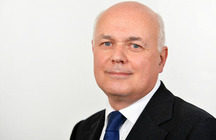
Tag: Iain Duncan Smith

  • Iain Duncan Smith – 2021 Comments After Being Hit by Traffic Cone

    Iain Duncan Smith – 2021 Comments After Being Hit by Traffic Cone

    The comments made by Iain Duncan Smith, the former Leader of the Conservative Party, in October 2021 at the Conservative Party Conference.

    Well, interestingly, there were a bunch of what I would literally describe as morons outside the hall, banging drums and screaming obscenities, just about every obscenity you can imagine. We were on our way, my wife and a friend of hers, two women, on our way to, I was speaking at another engagement outside the secure zone, and they followed us banging drums and hurling abuse and I was quite concerned about the two women with me you know, given all that’s happened and everything else and three quarters of the way there I stopped for a second to cross the road and some bloke had picked up a great big heavy traffic cone, one of the ones that were there, and tried to smash it into my head.

    It knocked me forward and I held onto it, turned, lost my temper because I’ve stepped forward and I pointed at them like this and then they all backed away. I then dropped the cone and I said you’re just pathetic I said and walked off into the thing and then the police apparently arrested them and are doing them for assault. But you know, it was when you think about all that’s been going on, and particularly I had two women with me for goodness sake, the language and the abusive nature of it. There’s no place in politics for it.

  • Iain Duncan Smith – 2021 Speech in the House of Commons on David Amess

    Iain Duncan Smith – 2021 Speech in the House of Commons on David Amess

    The speech made by Iain Duncan Smith, the Conservative MP for Chingford and Wood Green, in the House of Commons on 18 October 2021.

    I am going to be, or at least intend to be, brief; after all, pretty much everything about David has been said, but that does not mean I cannot repeat it.

    I knew David for 29 years. When I first came into this place in 1992, he was outstandingly and unfailingly kind, conscientious and generous, even to new Members who had arrived here eight years after him. I remember that very clearly. Later on, when I got to know him better, I recalled that a constituent of mine had referred to David, when he represented Basildon, as somebody who would go to the opening of an envelope. I put this to him, saying, “You are accused of going to the opening of an envelope,” and he said, “I damned well hope so, because I wrote it to them so I could go there in the first place.”

    When the Conservatives won Basildon Council—for the first time, I think—David was there. It was not enough for him just to be with the councillors when they went in; he formed a conga that took the whole of the newly elected council through the council buildings and into the chamber. His sense of humour was always there, preceded by that megawatt smile that he could turn on. For most of us in this Chamber, it is hard work sometimes being able to smile enough, but for David it was hard work not to smile, and he would smile even in some of the most difficult circumstances.

    After I ceased being Leader of the Opposition—I have to say, with respect, to the right hon. and learned Gentleman the current Leader of the Opposition that no matter how much he is enjoying it now, it really is not what it is cracked up to be—[Laughter.] I have to tell him that. [Interruption.] That is what I thought, too. I had to go and speak at an event for David, and he patted me on the shoulder and said, “Are you going all right?” I said, “Yes, fine,” and he got up and introduced me by saying, “I’m so pleased to have Iain Duncan Smith here; he has just slid down the greasy pole”—and then he carried on. [Laughter.] He did tell me directly afterwards that he had retired finally from a long time in government and thought that he would have more influence elsewhere; actually he spent a very short time in government, but that did not bother him in the slightest.

    On a more serious note, I want to say that David has shown us the way—the way of co-operation. Most Members in this place know that we get things done by co-operating across the Floor. Little is talked about that, Mr Speaker, as you know, but it is the embodiment of who we are in this place. We cannot get stuff done by ourselves, so we form alliances. Whether it is on modern-day slavery or, in my case, gambling harms, we go on, we form alliances and we eventually move things and get them done. David was the architect of that. There was not an alliance that he could not form; even if there was not an issue on which he could form it, he would form it. [Laughter.]

    My point is that this is who we are. We are often, as Jo Cox said, more united by the things we believe in than necessarily divided. The fact is that we are in this place because we argue with each other about our ideas. The important feature of this place is that we may disagree with arguments, but we do not disrespect the motives of those who hold them.

    This is a lesson to us that we need to be careful here what we legitimise in what we say about our colleagues. They are not evil people. Nobody in this Chamber is an evil individual. They have strong beliefs. I was struck when the media had finished talking about David and then said, “And he was a man with very strongly held beliefs,” as though that was an aside that they wanted to bury. We come here because we have strong beliefs, and we should be proud of that. We argue with each other because we are the point where people can see us debate these things, have power of emotion and be angry about them—this place is a cockpit of that—so that they do not have to do it outside, violently, elsewhere. I believe the point that David was making was that we need publicly to show each other the respect that those ideas are greatly held. We respect each other, but we do not dislike or hate each other. That is not for us, and it is not for that that he lost his life.

    I have been told that today, a document came through the door of my constituency office. The front page was all about David, and on it was written, “Like you. You bastard.” In fact, I did think he might have done it, because it was spelled “Barsted”. Even in that threat, I think there is a sense of irony.

    In conclusion, let me say that for David’s family, this is a tragedy, which this deranged, hateful and violent individual has brought to them, unwarranted and without cause. David taught us something very important that they can remember. He believed not in the power of position, but in the power of purpose. Mr Speaker,

    “They told me, Heraclitus, they told me you were dead,

    They brought me bitter news to hear and bitter tears to shed.

    I wept as I remember’d how often you and I

    Had tired the sun with talking and sent him down the sky.

    And now that thou art lying, my dear old Carian guest,

    A handful of grey ashes, long, long ago at rest,

    Still are thy pleasant voices, thy nightingales, awake”—

    that is the important thing, Mr Speaker: he will be with us forever.

  • Iain Duncan Smith – 2002 Speech on Mental Health

    Iain Duncan Smith – 2002 Speech on Mental Health

    The speech made by Iain Duncan Smith, the then Leader of the Conservative Party, on 25 June 2002.

    Much has happened since I spoke to you nearly a year ago at last year’s annual lunch.

    The Two Cities have been at the forefront of the national outpouring of affection and respect for the Queen during her Golden Jubilee celebrations.

    In May’s Elections Westminster City Council once again showed how successful Conservatives can be when we deliver high quality, good value local services. Simon Milton and his team have certainly played their part in our local government revival in London.

    And in the House of Commons your new MP, Mark Field, has marked himself out as a leading member of that new generation of Conservative MPs that I will make it my business to lead into Government.

    Twelve months that would have sounded fanciful. We had just suffered our second devastating defeat in four years.

    Yet today, our Party is more disciplined and more united than it has been for a decade.

    And Labour, seemingly impregnable back then, have been caught in their own web of intrigue and spin which has seen them lose the trust of the British people.

    This is all a very long away from the new dawn in British politics that Tony Blair promised on taking office in 1997 or from the promises he made at the last Election.

    How has a Prime Minister who said he would follow the People’s Priorities come to view those he claims to represent with such contempt?

    Integrity and politics

    The relationship between government and the governed is the cornerstone of democratic politics. It is usually vigorous and sometimes harsh, but when it reaches the point where the Government considers the people it leads as its enemy the very idea of democracy becomes debased.

    Whether it is smearing Rose Addis as racist or investigating Pam Warren and the survivors of the Paddington Rail crash for their political affiliations, one thing is clear. This Government believes that anyone who is prepared to speak out and contradict its message that things are in fact getting better, must have a political motive for doing so.

    Just last month, a newly-appointed Labour minister – the former Head of the Prime Minister’s Policy Unit summed up Labour’s governing philosophy. He said ‘Third Way triangulation is much better suited to insurgency than incumbency’.

    This is a polite way of saying that defining yourself by the people and things you are against instead of what you are for may win elections but isn’t much use when it comes to running the country.

    It is because Labour have failed to learn that lesson after more than five years in power, that they go after the likes of Rose Addis and Pam Warren with the venom that they do.

    Tony Blair said he would be ‘tough on crime, tough on the causes of crime’, but overall crime has started to rise again and violent crime and street crime are rocketing.

    The best David Blunkett can claim of nearly sixty headline-grabbing initiatives on law and order over the past year is that they are not Jack Straw’s.

    Tony Blair said ‘education, education, education’ would be their priority, but one in ten students in some inner city areas leave school without a single GCSE and indiscipline has become the standard in too many classrooms.

    And the best Estelle Morris can say is that the days of the one-size-fits-all comprehensive are over after David Blunkett abolished Grant Maintained schools.

    Tony Blair said Britain had ’24 hours to save the NHS’, but five years later a quarter of a million people are having to pay for operations out of their own pockets because they cannot afford to wait any longer.

    And the best Alan Milburn can say about health is that there is now room for partnership with the private sector after boasting that the NHS would remain a state monopoly little more than a year ago.

    And where is the Chancellor in all this? He said National Insurance was ‘a tax on ordinary families’ and dismissed claims during the Election that he would increase it as ‘smears’. Ten months later he increased National Insurance by £8 billion while the state of our public services have declined still further.

    And the best Gordon Brown can do is to adopt a sphinx-like silence. But New Labour is his project too.

    Political discontent and cynicism have been accelerated by five years of a Prime Minister and a Chancellor who neither mean what they say nor say what they mean.

    Five years of seeking to be all things to all people.

    Five years when Labour’s only tangible achievement is to be neither the Party they once were nor the Government they replaced.

    They have poisoned the well for all politicians.

    So we cannot sit back and wait for the public disillusionment with Labour to grow. We have to show that the Conservative Party is changing, that we can deliver action not words.

    We do not have to stop being Conservative to win the next Election, but we do have to start showing how our principles will deliver solutions to the problems people face.

    Some people say it is not the job of the Conservative Party to talk about the vulnerable. I say it is part of our very purpose. It is what brought me into politics. That is why I will never be apologetic about putting the vulnerable at the centre of our strategy.

    Today Liam Fox is talking about giving mental illness a much higher priority within the Health Service. One in four people in this country suffer from mental illness of one form or another. It is our nation’s hidden epidemic and yet it is one our society’s last remaining taboos.

    There is nothing fashionable about championing the mentally ill, but they are the victims of an old consensus that has let them down.

    Too many people with mental illness now languish in prison and the Government plans to detain indefinitely people with personality disorders who have done no harm to others. The mentally ill have a right to be heard and we will give them a voice.

    Because it is vulnerable people – the elderly, the sick and the disadvantaged – who suffer most when public policy and public services fail.

    We have allowed issues like these to be colonised by Labour for far too long. The paucity of their methods and the poverty of their results can no longer go unchallenged.

    But it isn’t good enough for us just to talk the talk, we are going to have to walk the walk. People have to trust our motives, but they have to believe we will deliver.

    It is going to fall to us to tackle the problems of crime, failing schools, family breakdown and poor healthcare. Now, as in the past, we will work to give people back control over of their own lives, to direct power away from government to the places and the people who can use it more effectively. That is why I have set up a Unit to head the most wide-ranging review of our policies and our priorities for a generation.

    Better schools and hospitals, more responsive local government, means giving teachers, doctors, nurses and councillors the power to do their jobs and making them accountable for what they do.

    That is what happens in every other walk of life, it is also what happens in every other country whose standards of public services exceed our own.

    If we do these things people will see the difference. It is about putting people before systems, results before theory, and substance before spin. That is the right way to do things, but it is not Labour’s way.

    Taxation

    Instead of opening their minds to new ideas all they have done is open our wallets.

    The higher taxes announced in the Budget are intended to give us European levels of health spending.

    But European spending won’t give us European standards without reform. I was struck by recent figures which showed that the productivity improvements in the NHS before 1997 have been reversed over the last five years.

    And Tony Blair and Gordon Brown have shut the door on any serious debate reforming the NHS. Instead, they are simply going to give us higher taxes. That is an expensive recipe for disaster.

    In all, taxes will increase by around £8 billion pounds next year, and over half that sum will come from business, the very people who generate the country’s wealth in the first place.

    But this is not the first time Gordon Brown has raised taxes.

    Pensioners were his first target. In 1997, the Chancellor’s withdrawal of the ACT Dividend Tax Credit landed pension funds and pensioners with a £5 billion a year stealth tax from which they are still reeling.

    In 1998, the utility companies had to pay the second half of the £5.2bn windfall tax.

    In 1999, the very smallest businesses, personal service companies, first became aware that their vital contribution to the economy was to be attacked with the IR35 tax.

    In 2000, hauliers, taxi drivers and every single business reliant on road transport felt the anger of ordinary motorists at the highest taxes on petrol in Europe, culminating in the fuel crisis.

    In 2001, right in the middle of a painful manufacturing recession, Labour introduced the Climate Change Levy, a tax on energy which hit manufacturing the hardest.

    Finally, in Budget 2002, Gordon Brown announced half a billion pounds of higher National Insurance Contributions for the self-employed and £4bn more for all other businesses, not to mention £3.5bn extra that will now have to be paid by employees.

    Regulation and competitiveness

    But it’s not just the higher taxes that Labour have levied on business every single year.

    There’s the red tape, the Government’s favourite mechanism for getting business and the public services to do what it wants.

    Just this morning we hear that GPs are wasting two and half million appointments every year filling in repeat prescriptions and filling out sick notes to satisfy the thirst for bureaucracy.

    Businesses will recognise the pattern, as they cope with regulation upon regulation, from new payroll burdens that have turned businesses into unpaid benefits offices, to administrative juggernauts like the Working Time Directive.

    In monetary terms, the Institute of Directors calculates that these burdens have cost business a further £6bn every year, but no-one could ever really know the true cost of time which comes from having to fill in forms instead of creating wealth.

    And yet, despite all these taxes and all this red tape, Peter Mandelson, the architect of New Labour says, “we’re all Thatcherites now”.

    Well I’m a tolerant man and I believe in broad church politics, but I draw the line at heresy.

    Mr Mandelson says we all have to accept that globalisation “punishes hard any country that tries to run its economy by ignoring the realities of the market or prudent public finances”.

    Quite. So why is Labour ignoring one of the most fundamental realities of the free market: that to be competitive, to win orders and create wealth, you have to keep burdens on business to a minimum.

    We have become the fourth richest country in the world because Conservative Governments spent eighteen years freeing labour and capital markets, deregulating key sectors of industry, and slashing red tape and taxes.

    Every new regulation and every increase in business taxation introduced by Labour since then has undermined our long-term ability to compete in the global marketplace.

    Monetary stability and the Euro

    Another feature of the economic legacy that Conservatives passed to this Government was that we won the war against inflation. By 1997, inflation had already been running near to the 2.5% target for four years.

    The independence of the Bank of England has helped to reinforce this anti-inflationary environment and credit should be given to Gordon Brown for that measure at least.

    The real question now is this: do we want to give up those arrangements in favour of interest rates set by the European Central Bank?

    Joining the euro would mean no longer setting interest rates on the basis of what is best for Britain but submitting to a single rate that would benefit the whole of the Eurozone – an impossible task.

    The Prime Minister continues to drop hints about a referendum on the single currency next year.

    At a time when everyone is concerned about the state of their schools and hospitals, when we feel threatened by the rise in violent crime, he should focus on these issues and stop playing games over the Euro.

    Lately there are signs that the Prime Minister is getting cold feet, not because of the five economic tests but because of the only test that really matters to him, the opinion of the public.

    He grasps that a referendum on the single currency would also be a referendum on the breakdown of public trust in his Government.

    He is caught between the rock of the Pound’s popularity and the hard place of his own desire to scrap the Pound. His lack of conviction about everything else is getting in the way of the only conviction he truly holds. Such are the wages of spin.

    If the Prime Minister wants Britain to adopt the Euro, he should have the courage to say so, name a date and let the people of this country decide. If a referendum comes the Conservative Party with me at its head will campaign vigorously to keep the Pound.

    We will join with trade unions and businesses, and supporters of all parties and none who believe that replacing the Pound means away giving control over British interest rates, taxes, and public spending. It ultimately means British people giving away control over our politicians too.

    So not only will we campaign vigorously for a ‘no’ vote. We will not be alone. The Pound is more popular than any political party, because it doesn’t belong to any one political party. And we will fight to keep it that way.

    When Tony Blair entered Downing Street five years ago he had more going for him than any other incoming Prime Minister.

    A landslide election victory.

    The foundations of economic stability and success laid by his Conservative predecessors.

    The goodwill of the overwhelming majority of the British people.

    Never has a Government had so much, but achieved so little.

    With no fixed idea of who they are, they have chosen to define themselves by how they look. And the truth is after five years of lies and spin they are beginning to look pretty shoddy.

    They are no more capable of effective leadership to tackle the issues that undermine our society today than they were of grasping the economic reforms that were necessary in the 1980s.

    Whether it is raising standards in our schools and returning civility to our classrooms; restoring the rule of law to our streets; or dealing with the insecurities of infirmity and old age, it falls the Conservative Party to lead the way once more.

    That means fresh thinking and new ideas on education and health, on crime and policing, on finding new ways for people to share in economic growth.

    It means taking every opportunity to show ourselves as we really are: decent, tolerant and generous people who want the country we live in to be a better place for everyone.

    Above all it means showing that the difference between the Third Way and the right way is the difference between promises and delivery.

    We all know this in our hearts. Our job is to earn the right to prove it.
  • Iain Duncan Smith – 2021 Speech on HRH The Duke of Edinburgh

    Iain Duncan Smith – 2021 Speech on HRH The Duke of Edinburgh

    The speech made by Iain Duncan Smith, the Conservative MP for Chingford and Wood Green, in the House of Commons on 12 April 2021.

    I rise to extend my condolences to Her Majesty the Queen on the death of her liegeman of life and limb, who was her husband, a father, grandfather and great-grandfather, and a remarkable man.

    He was talented in his own right, as we have heard and read so much in the last few days, at many things that I suspect many of us had no idea he did. I try to paint, and I understand what it is to be described as adequate, but I have to tell anyone who does not paint yet that they have something to discover—that even getting the right colours in the right place at the right time is, as far I am concerned, brilliant. We have discovered that he had all these elements and talents, and did so many things, and was not just innovative, designing his own machinery, but just had that intelligence, drive and leadership. From the armed forces, through hundreds of charities and so many thousands of public events, the Duke of Edinburgh added much distinction throughout. He brought distinction to all that he did, even if it was telling business leaders to pull their fingers out, saying it was quite clear the UK needed business leaders who actually led and actually produced something people wanted to buy. He was quick to spot that was missing—it was not about the people working in the businesses, but about the people not leading them properly—and that was considered quite outrageous.

    The thing that has struck me has been the huge fondness—the outpourings of fondness––that have come in the last few days. I did not expect quite that level of fondness, because I thought by now many of the new generations would not recognise or even understand some of the things the Duke of Edinburgh had done, but their fondness and their sense of who he was is quite interesting.

    I would like to reflect on the fact that in a way there is something else the Duke of Edinburgh represents: he represents the passing, finally, of the greatest generation. That generation was prepared to sacrifice everything—everything—so that the rest of us could live in peace and prosperity. They did not ask any questions and what defined them so much, and I think defined him in a way, was this sense of duty and an obliging sense of service no matter what the request or command. They were uncomplaining or, as the Duke of Edinburgh would say, they never bellyached. They were always understated and never complained. With those of my father’s generation, we could hardly ever hear them say a word about what they went through; they just shrugged. They never complained about their illnesses or their war wounds, but just got on with life. He was very much a representative of that remarkable—remarkable—generation, as is of course Her Majesty the Queen.

    The one area I wanted to remark on is that that generation had this incredible sense of humour in the most difficult and appalling times. I hope my right hon. Friend the Secretary of State for Health does not mind if I relate one particular story so typical of His Royal Highness. We were in the receiving line for civil service awards, and I was standing but one or two away from my right hon. Friend when the Duke of Edinburgh arrived. Her Majesty the Queen went through very calmly and quietly: she shook everyone’s hand, said a few words to them and moved on. He came through just behind her, and as he was getting to my right hon. Friend asking people what they did, he asked him, “What do you do?” He boldly announced—this was some years ago—that he had just been put in charge of nuclear submarines. “But,” he said, smiling, “I don’t know anything at all about them, Your Royal Highness”, whereupon he guffawed immediately and said, “How typical! Typical of politicians—in charge of something, and not a single clue about it.” He roared with laughter and walked on, with everybody else in complete and utter silence. He asked me what I did, and I said, “Sir, nothing that important”, which had the merit of being true, and he moved on.

    I have to say that the Duke of Edinburgh was straight and very funny, and that is a key element of this. In this generation, I wonder what he thought about social media, where everybody complains or bellyaches the whole time about everything and about each other, often rudely and arrogantly—something that he and that generation would I think have considered appalling. “If you have nothing good to say about someone,” the old rule was, “then don’t say it.” Of course, this will fly over our heads here, I suspect, quite happily.

    I end by simply saying that the one thing we must all remember is that here was a man with a glittering potential career who chose, because of love, to walk a pace behind the woman he loved and to serve her, and by serving her he served his country with distinction. Nothing else needed to be said. His departure is a loss for us all, but in relation to the fact that we have such a great monarch, the reality is that it is because we had a great man beside her, and for that I give thanks.

  • Iain Duncan Smith – 2020 Speech on the National Security and Investment Bill

    Iain Duncan Smith – 2020 Speech on the National Security and Investment Bill

    The speech made by Iain Duncan Smith, the Conservative MP for Chingford and Wood Green, in the House of Commons on 17 November 2020.

    It is always a pleasure to follow the right hon. Member for Doncaster North (Edward Miliband), not only because he followed me into leadership and discovered just exactly how pointless that really was. On that we can immediately agree, and he may well have stumbled into another point of agreement; he should know, now that he is a Cummings-ite, that I once employed him and then let him go, so maybe it is time for the right hon. Gentleman to do the same. Anyway, beyond that, I want to congratulate him, because there were things on which I did agree with him, as well as, obviously, things that would need further discussion.

    I thank my right hon. Friend the Secretary of State for his deliberations on the Bill, which I will support tonight. It is long overdue. The debates around the Huawei stuff at the beginning of the year really exposed the fact that the UK had lost its way in this area in terms of threats and so on. We were behind the others—Australia, the United States; some of our big Five Eyes compatriots—but at least my right hon. Friend has grasped the nettle and brought this Bill forward, which is laudable. I also thank him for his courtesy in the ​course of this, in the sense that he spoke to me and, I know, to others. I particularly commend the courtesy of his Minister, the Under-Secretary of State for Business, Energy and Industrial Strategy, my hon. Friend the Member for Stratford-on-Avon (Nadhim Zahawi), who is a very good friend. He went out of his way to talk this through with colleagues on both sides of the House.

    This debate is in that context. This is right. I particularly like clauses 32 to 39 and onwards, which deal with penalties, fines and incarcerations, the scope of which is up to five years. These are strong recommendations—slightly stronger than I expected, to be quite frank, but they are well worth it. There are many other good things about the Bill. I will not run through them all, because the Secretary of State did that, and I want to tease out a few points that I think are relevant and need inquiry.

    The Bill gives the Secretary of State great powers for industrial strategy—powers to screen these investments that we have been discussing and to address the national security risk that they involve. It also gives him the power to call in investments. We have been through those already. However, I want to pick up on the things that I think are missing from the Bill and that I hope the Secretary of State will look at again in the course of its passage.

    First, we have to accept that parked across this space are two very big threats: Russia and, of course, China. In fact, I think China is now the single biggest threat and problem posed to the United Kingdom and the free world. The way it is going—its problems, its difficulties, and the way it is focusing on internal suppression, external expansion and trashing both World Trade Organisation rules and laws—means that we will have to deal with that, and I suspect that this Bill will progressively be right in the middle of that. In dealing with that, I want to raise a couple of issues. In dealing with that, I want to raise a couple of issues.

    Without this definition of national security, the Government are giving a stick to beat themselves with at the moment. Having such a definition is important for two reasons. First, it helps to improve clarity—a couple of my hon. Friends wanted clarity. I have looked at some of the definitions out there, including the American definition, which may not be perfect but it does cover some of the wider areas that I will talk about soon under transnational crimes and goes into things such as threats from drug trafficking. It is important for the Government to think carefully about this because it will help to define the Bill.

    Bob Seely

    On what the shadow Secretary of State said, there is obviously a genuine and good debate to be had on the elements of the Bill. This is not necessarily about industrial policy—I say with great respect to those on the Benches opposite—which is part and parcel of another debate. It is about the modern definition of national security and whether we see it as narrow or broad, and there is a strong argument today for having a broader definition of national security.

    Sir Iain Duncan Smith

    I agree with my hon. Friend and I agree that this is not the Bill to discuss industrial strategy. The right hon. Member for Doncaster North made wider points which I think are worthy of discussion, but I am not sure that that discussion should take place in relation to this Bill and I want to keep this narrow.​

    First, in China something very special is taking place: the idea of civil-military fusion, which is now infecting every single enterprise and company in China. The Chinese military, as we have already heard, uses this concept and strategy to acquire intellectual property, technologies and research for civilian use and for military use. An external investment screening body, therefore, should be set up under this legislation, to establish and investigate cases where this may now affect UK investments. This is very important, because the rules are very strictly applied in China: you co-operate with the intelligence services or you are out of business. You may be out of not just your livelihood but your freedoms.

    Ms Ghani

    Is it not even more dangerous in that, under the national security law in China, not only do people have to hand over data, but if asked by a foreign state they have to deny they are handing over data? If that is the case, should we not have a bigger debate about social media companies based in this country harvesting our data and our children’s data and where that data might end up down the line?

    Sir Iain Duncan Smith

    I of course completely agree with my hon. Friend and I was just going to come on to the data harvesting point, because it is caught in this. She is right that China’s national intelligence law requires all Chinese firms to assist with state intelligence work and to deny that if they are asked. Let us say the Secretary of State wants to investigate and says he has strong penalties for non-compliance. By law in China they are not allowed to comply with that process at all, so there is already a national conflict in this. TikTok is owned by ByteDance, which is a very dodgy company set up in China that has huge links with the Chinese Communist Government. So we need to be very careful about where we go with this because UK nationals might get caught up and get punished for what is essentially a refusal by the Chinese Government to allow others to do this.

    I am also slightly concerned about some of the things that happened in the past not being caught by the Bill. The Henry Jackson Society has today announced that, having looked through the Bill, only 23 of the 117 Chinese acquisitions over the last decade would have actually been caught. The areas that are outside of this include pharmaceuticals. The Chinese takeover of Bio Products Laboratory, which has a very significant technology with regard to blood products, would not have been caught. In education, 10 universities have many thousands of obligations to Chinese investors, where they get a trade-off on technology, some linked to defence firms. That would not have been caught. Interestingly, Thames Water and Veolia Water have significant share ownership from Chinese firms, but that certainly would not have been called into question.

    Richard Fuller

    My right hon. Friend is referring a lot to China, and I am sure he will not be alone in that this afternoon. Is his perspective that we should be looking in the Bill to restrict all Chinese investments in the UK, or investment in particular sectors, and what is the differentiation if the origins of that is the Chinese state, in this fusion of the state with business?

    Sir Iain Duncan Smith

    My view is that the Bill should help us to identify exactly which of these are genuinely private and not located in China under Chinese law. ​That will be a big issue. I have to tell my hon. Friend that, on that question he is right, because I believe we are now facing a very significant threat from China. So we now need to use the Bill to figure out how we deal with that threat on a wider basis, not just on individual takeovers. The Government need to look at that. Huawei was a very good example of Government policy having to be reversed on that basis. It is a growing problem and he is right to raise it.

    Richard Graham (Gloucester) (Con)

    Does my right hon. Friend agree that it is incredibly important that we recognise that the Bill is not aimed at one particular country or any particular identified sovereign threat? It is a more general Bill about the importance and value of national security assets in this country. Does he also agree that referring to China as communist—although, of course, it is ruled by the Communist party—is a misnomer in the context of a successful model of authoritarian state capitalism with which we will have to deal and the world will have to deal? We will have to separate those companies that offer attractive investment opportunities from those that are genuine threats.

    Sir Iain Duncan Smith

    I thank my hon. Friend for that intervention. I know he has been a big champion of that relationship. We do not agree with each other on this matter because I think that China, with its dictatorial Government, poses a very significant threat. But I did speak about other countries—I did say that Russia also poses a threat—so I recognise his defence.

    I want to move on to the national interest test. This year, the Australian Government invoked the national interest in looking at tests and they used it in similar legislation to block the acquisition of a minor stake—this might deal with the issue that my hon. Friend was talking about—in AVZ Minerals by a Chinese firm. They needed to intervene because the asset, given what has happened with covid and so on, had lowered in value unusually and unnecessarily, and that had opened it up to a takeover which they felt would have been very unhelpful. The other point I want to raise in passing is that we need to look at things like the Confucius Institute, which is here investing in universities with offers but is actually acting on behalf of the Chinese Government to follow lots of Chinese students around.

    Other Members wish to speak, so I will finish my remarks. My main point is that without that national security test the Bill will lack clarity and definition, and fail to understand sometimes where it is actually looking. It could be open to pressures to turn this more into an industrial policy statement, rather than a national security issue.

    The Bill also falls short of similar legislation by Five Eyes partners. My right hon. Friend the Secretary of State is absolutely right to say that they have looked across the scope of what others have done, but other Five Eyes partners have gone further on this. They are competitor countries to us, so it is not as though they have any kind of dictatorial regimes. The Committee on Foreign Investment in the United States and the Australian Foreign Investment Review Board are external bodies.

    This is the point that I wanted to make to my right hon. Friend. I just wonder whether he might want to reflect on the nature of the pressure on somebody such as him, who, under the Bill, will have to sum up and make final decisions on the advice peculiarly to him. ​The other two organisations, in Australia and in the United States, have the ability to say that everybody on the panel makes a group decision on the evidence. I know he will argue that that process takes longer—yes, he may be right about that—but I feel that the pressure is on him.

    I was in government for six years and I know what Downing Street does. It gives you a call and says, “I don’t think you have to go very far with this sort of stuff, do you? After all, this is worth a lot of money to us. Come on.” Others will say that and the Secretary of State will be sitting there thinking, “This is a balanced judgment. Where do I go on this?” I just wonder whether that pressure is fair on the Secretary of State. He would be questioned later on why certain decisions were made. If I was the Secretary of State, I would want to release myself from that situation. I would not want to be dragged to the courts to be accused of being biased in that decision and making a decision that was not agreeable. So I would look for more external bodies to be able to make that judgment.

    I also say to the Government that human rights are vital nowadays. We cannot walk away from it; it is part of what makes us. The reality for us is that far too many companies have allowed themselves to quietly get sucked into the use of slave labour and other labour. We know about that, in Xinjiang province and in other areas too. My right hon. Friend does need to think about that very carefully. I do not want to make the Bill a Christmas tree, but elements of that are involved.

    I congratulate the Government on bringing forward the Bill. It is the right legislation to bring forward. It is overdue, no question. However, the balance still needs to be widened somewhat. I hope that in the course of the Committee and Report stages the Secretary of State will accept that good amendments may come forward from brilliant people—not just me—who may well be able to help him in his adventures.

  • Iain Duncan Smith – 2020 Speech on Covid-19

    Iain Duncan Smith – 2020 Speech on Covid-19

    Below is the text of the speech made by Iain Duncan Smith, the Conservative MP for Chingford and Wood Green, in the House of Commons on 12 May 2020.

    I wish to make a few quick points. First, I wish to welcome the Chancellor’s statement today, because this is an area where a lot of us have been pushing him to give some security to businesses as they go forward. The idea of the furloughing scheme going on and, we hope, reducing as it does, as businesses go back to work, is an important one. However, we must bear in mind that there is a huge cost to it, at some £13 billion every month. He is right to say that he is prepared to extend the scheme, but we must be careful that we do not end up spending so much money that it makes it difficult for the economy to thrive.

    I also wish to raise with the Government a few areas where I have concerns. The work they have done so far has been remarkable, and they have rightly received the ​full support of people in this House and, I believe, in the country at large, but I wish briefly to raise some issues with them. They say they have been guided by the science, but a number of people have concerns that this is not just about the science alone; there needs to be a much broader sense of where we are—the balance between the economy and covid. Some of the language has been loose on that, with the idea that it has been a choice—this is a false choice—between saving lives and saving the economy. Both are about saving lives; the point is when one becomes so big that we need to deal with it. I think we are at that moment now, and have been for a little while, in terms of the economy.

    My concern is that we seem to have been wedded in the early days to the Imperial College model, which has had some quite significant criticisms and a poor record in the past of forecasting in these areas. I am glad that the Government have now widened this out. I note that Sweden ran the figures on the Imperial model and found that it was wrong by about 15 times, overestimating the number of deaths as against what they had witnessed—the same applies in respect of what Edinburgh University and others had managed to do. I am therefore concerned that there is a deal of pressure on that, but I am also glad the Government have moved on from there.

    Another point to make is about testing, where the Government have had to shoulder a lot of difficulty and blame, but quite a lot of that should also be targeted, in due course, at Public Health England. The big mistake they made early on was the decision not just on having more testing, which they should have done from day one, but the decision not to include all the private laboratories. They should have done that straightaway; even though they were building their own and getting their own, we should have maximised and gone out to the private laboratories, which would have helped enormously.

    The other thing I do not understand at the moment is that at the beginning of lockdown we did not close the airports but now we are looking to make coming into the airports more difficult as we come out of lockdown. It is a puzzle why it was not right at the beginning but it is now right as we try to open the economy. I am particularly concerned about that.

    I just want to say to the Government that for four weeks I have been arguing that they need to open the economy and be talking to the public to bring them with them and give them a sense of what is coming. The paper produced yesterday and the statements that have been made at last are the right indication. I am with the Government: people should use their common sense. There are going to be areas and times when we cannot always meet that argument and that deal about social distancing. I want to ask one question: why does every other country have a lesser distance than we do? That makes a big difference on things such as public transport. Ours is the only country that has a 2-metre rule—Germany’s rule is 1.5 metres, some countries use 1 metre and the World Health Organisation says that 1 metre is enough. Such an approach would help enormously with public transport—on the tube and so on—where there is a great problem. I urge the Government to get on with opening the economy and with giving people the opportunity to get back to their livelihoods. We should trust them, with their common sense, to be able to implement these sets of guidance and to make sure they do the right thing as they go back to work.

  • Iain Duncan Smith – 2019 Speech on Brexit

    Below is the text of the speech made by Iain Duncan Smith, the Conservative MP for Chingford and Woodford Green, in the House of Commons on 29 January 2019.

    I will accept your guidance, Mr Speaker.​

    It is a pleasure to follow the right hon. Member for Ross, Skye and Lochaber (Ian Blackford) for plenty of reasons, but specifically because he happens to have what I think is possibly the most beautiful constituency in the country—and my heart is there because both my parents are buried there, as are many of my ancestors. There are some links between us, beyond a wee drop now and then.

    In the limited time available to me, I want to respond to what was said by my right hon. Friend the Prime Minister. She gave us a challenge—quite rightly, I think—at the beginning of what was, I must say, an excellent speech. She said that we had spent a lot of time telling everyone what we were against, and that now we must say what we were in favour of. In accepting that challenge, I shall say what I am against, and then come on to what I am in favour of. I shall do that quickly, I hope.

    I shall oppose the amendment tabled by my right hon. and learned Friend the Member for Beaconsfield (Mr Grieve). He remains a friend, an honourable friend, and he is much admired: he was, I thought, an excellent Attorney General. However, I disagree with him on this specific issue. I do not think—this is my view, and we will have different feelings about it—that the House needs another process, or mechanism, to allow it to decide what it is in favour of or against. I think that all multiple motions of this kind end up with a place like this going nine ways from Sunday, and we do not end up with any kind of agreement. I think that the amendment process is a way of deciding what we are in favour of. My right hon. and learned Friend will push his amendment tonight, and I think we will then get an idea of whether the House really does think that.

    Let me comment in the same light, but for a different reason, on the amendment tabled by the right hon. Member for Normanton, Pontefract and Castleford (Yvette Cooper) proposing a delay. Like my right hon. Friend the Prime Minister, I do not think that, of all the things we need right now, we need to book a delay regardless of what we are actually delaying for. I am conscious of the way in which the Commission has responded to the idea of a delay in recent days. Its response has been, “We do not want you to delay, because we do not want you to crash into all our procedures that we have now allowed. For instance, you are not taking part in the European elections—we do not want those to be disrupted—and we do not know what it is that you want to delay for. ”

    The amendment contains no appendage, as it were, telling us what the delay might actually be about. I can understand someone saying, “We are near the end of an agreement, but we have run out of time a bit”, but that is different from simply crying out for a delay. I think that, ultimately, it comes down to the fact that, as many on the right hon. Lady’s own side have said, it will then become a reality that we are opposing the delivery of Brexit. Those who vote for the amendment tonight will have to face that challenge: perhaps the delay is really all about stopping Brexit. However, I will leave the right hon. Lady to deal with that herself. I admire her enormously, as I would, but on this issue, I disagree with her completely.

    As for the amendment tabled by my right hon. Friend the Member for Meriden (Dame Caroline Spelman), again, I just do not think that this one works. The issue ​of a delay—even expressed as it is in the terms of a motion—brings me back to where I was earlier. I hope that my right hon. Friend will forgive me, but I will not support her tonight. I shall go with the Prime Minister on this.

    I want to make two further points and then a comment about what I think I must support tonight. I voted against the agreement; I did so because I felt it was too full of problems and issues that would not be settled and would give a lack of clarity, and so I expressed my view. I have not voted against the Government for well over 20 years, and I did not particularly enjoy doing it, but I did so because I felt that we needed to rethink this and go back and make some changes. So I am pleased tonight that the Prime Minister has come back.

    I challenge those who say that the only thing available is the backstop as it is. That is not altogether true; it depends what question is being asked. An open border, which is the key question that Ireland wanted, can be settled by a much simpler backstop. I am in favour of a backstop; I think it is fair for Ireland and Northern Ireland to want guarantees that there will be an open border, so I am in favour of an open border and of that guarantee. I am just not in favour of the complexity and nature of the demands that left Northern Ireland separated in terms from this Union that we are in favour of keeping Northern Ireland in. That led to serious and significant problems. I believe that the protocol that we have, and that I have been to see the negotiating team in Brussels over, is the key to the way we go forward, and I believe its response to us was positive. I therefore think it would be good to take that process back to Brussels.

    This brings me to what has emerged overnight, which I have been involved with myself, although not absolutely in the frontline. It is an agreement between those of us who take different views about Brexit in my party. I am thinking in particular of my hon. Friend the Member for North West Hampshire (Kit Malthouse) and my right hon. Friend the Member for Loughborough (Nicky Morgan). I say absolutely genuinely to my colleagues that we might be divided about these issues, but we must now strive to find some kind of compromise. I say that as if it is somehow a discovery, but it is not really; I do genuinely think we have the prospect of moving towards that. So however we vote tonight, I hope we will, bit by bit, get behind the process that my colleagues have put forward with those of other colleagues who have taken a very different view about Brexit. I think this is wholly feasible, and I am in full support of this, given the nature of it. I therefore recommend that all of us, despite how we end up voting tonight, recognise that in delivering leaving the European Union in line with the vote that took place in the referendum, this offers a real opportunity not just for Members on my side of the House but for Members opposite who believe that it is right to deliver Brexit to get behind it.

    So now I come to what I am in favour of, which started with the issue of this internal agreement here. We need what the Prime Minister described today: we need to express that view. The Prime Minister was clear on a number of points that I particularly wanted to hear. I wanted to hear whether she was determined to ensure that, where necessary, we looked for legally binding change and that change therefore would change the complexion of the agreement that she had, and she said that today. I also thought she was very clear to the ​whole House that she is not going to assume that were a particular amendment to be passed it would mean we would all agree with whatever she came back with, and she has absolutely guaranteed that we will return with a chance to vote on that; I think that is clear.

    I am also pleased that the Prime Minister answered my hon. Friend the Member for Stone (Sir William Cash) on the question about the extent of the legal powers and the adjudication of the Court of Justice in the Bill to follow; I thought it was strong of her to do that. Many would have avoided that question, as it is complex. Most of my hon. Friend’s questions are quite complex, but she dealt with this one and dealt with it well.

    Trying to keep to the time limit for speeches, I shall now simply say that on that basis, having voted against the agreement, I am now going to support the amendment of my hon. Friend the Member for Altrincham and Sale West (Sir Graham Brady). I shall support it tonight, not because I give a blank cheque and not because I think that therefore we will have solved the problem; I give this support to him, and therefore to what the Prime Minister has said is the Government’s position, because I believe it is necessary for us now to send the Prime Minister back with a fair wind and a sense that this House has agreed that it wants her to go and renegotiate, and to take that change and that desire to deliver Brexit on time on 29 March with her over there to Brussels and achieve what I hope and believe, with strength and determination, she will be able to achieve in those negotiations. I wish her well, and I therefore will be voting tonight to support that amendment because I think it will be, for me, the greatest expression of my good will for a Prime Minister for whom, notwithstanding our disagreements sometimes, I have the greatest respect.

  • Iain Duncan Smith – 2002 Speech to the Jewish Welfare Board

    Below is the text of the speech made by Iain Duncan Smith, the then Leader of the Conservative Party, on 26 April 2002.

    As Leader of the Conservative Party, I have had the privilege of meeting with and addressing a number of Jewish organisations.

    Almost every time I have done so, it has been against a backdrop of great sadness.

    I have spoken to Jewish audiences just days after yet another suicide terrorist attack on Israel, just days after anti-Semitic incidents across Europe and just days after an article in the press written by a Jewish author urging more understanding of Israel’s plight.

    Unfortunately, as I stand here today, the backdrop is no different.

    But this time, there is an added factor. In my conversations with British Jews, I get a sense that there is deep anxiety and unease amongst the British Jewish community about the fate of Israel and public opinion.

    Israel

    Last week on Radio 4, Chief Rabbi Jonathan Sacks spoke passionately and eloquently about this unease. He reminded listeners that Israel had suffered 12,500 terrorist attacks – almost one hour of every day of every week.

    He urged that the media to be more balanced in its criticism of Israel.

    I agree. When watching our TV news bulletins I am often struck by the lack of sense of proportion and tendency to succumb to moral relativism.

    Of course the crisis in Israel and the West Bank is a tragedy: a tragedy for Palestinians and Israelis. When innocents die wherever they come from we must all grieve.

    Yet to insinuate that this is the fault of Israel is to wilfully misrepresent the facts. After all, the peace process – when Mr Barak’s proposals at both Camp David and Taba were turned down by Yassar Arafat.

    Criticism should therefore be.

    We will disagree with Israel sometimes about tactics. We urge that Mr Sharon withdraws speedily from the West Bank Towns.

    It is the duty of any Government to protect their citizens from terror.

    Just as the United States and the free world were right to pursue Al Qaeda and the Taliban after the outrage of September 11, so the Israelis have a right to react against the terrorists who are trying to destroy her very existence.

    All the peace plans currently on offer will not work unless the Palestinian leadership grasp the nettle and no longer give succour to terrorists.

    Neither is the cause of peace helped by those who should know better seeking to fan the flames of hatred by encouraging suicide bombers.

    It is no good Chairman Arafat on the one hand writing in the New York Times an article condemning terror and recognising Israel’s right to exist and on the other covertly giving impetus to terrorist organisations like Hamas.

    There must be no doubt that if the Palestinians are really committed to peace, the Palestinian Authority can call off the terrorists – just as they did for 24 days last Christmas.

    We support the Tenet peace plan and Mitchell proposals and welcome the dialogue begun by Prince Abdullah of Saudi Arabia. However, one vital key to the whole peace process must be the short and long term guarantee of Israel’s security, within secure and internationally recognised boundaries.

    For its part, my party will work hard with the Government and President Bush to achieve these goals.

    Moreover whilst we may differ with Israel over specific actions we must do all we can to support the values she stands for because these are the values that distinguish democracies from dictatorships and will underpin a real and lasting peace.

    The British Jewish Community and Anti-Semitism

    One of the alarming consequences of the problems facing Israel has been the resurgence of anti Semitism and the increased anxiety amongst Jewish communities in Europe.

    Le Pen on the rampage in France, Jorg Haider in Austria and the rise of extremist parties elsewhere in Europe will heighten these forebodings.

    I heard of marchers in Bournemouth shouting death to the Jews.

    I am increasingly concerned when I hear reports of attacks on British Jews. 310 individuals alone last year.

    But I am saddened when I hear members of the ‘chattering classes’ indulge in thinly veiled ‘salon anti-Semitism’.

    The apparent remarks by poet Tom Paulin, that American Jewish settlers were ‘Nazis’ and should be shot are – if accurate – unforgivable.

    When I think of these things, I am reminded of a recent meeting I had with a European Conference of Jewish community leaders. I told them of a powerful statement by Martin Luther King:

    You declare my friend that you do not hate the Jews, you are merely anti-Zionist…when people criticise Zionism, they mean Jews. This is God’s own truth. Anti-Semitism, the hatred of the Jewish people has been and remains a blot on the soul of mankind. In this we are in full agreement. So know also this: anti-Zionism is inherently anti-Semitic and ever will be so”.

    Of course this does not mean that we can never criticise Israel or question her activities. I have some misgivings about the long-term course which Mr Sharon is engaged in but I understand the need for defence against the suicide bombers. But I think that the Israeli people will be quick to distinguish between those who are her real, but candid friends and those who want to use attacks on Israeli actions as an excuse for justifying their prejudices.

    The Jewish Contribution

    I think it was Peter Ustinov who once said:

    I believe that the Jews have made a contribution to the human condition out of all proportion to their numbers: I believe them to be an immense people. Not only have they supplied the world with two leaders of the stature of Jesus Christ or Karl Marx, but they have even indulged in the luxury of following neither one nor the other!”

    Jewish communities embody principles of family, neighbourliness and responsibility towards those in need.

    Nowhere has this been truer than in Britain, where you have offered beacons of hope to the vulnerable amongst your community.

    I understand that you have a Hebrew statement for this; Tzedekah (the act of giving).

    Today’s society faces a paradox perhaps never faced before.

    We have more choice than ever but more insecurity.

    We have more mobility, yet our communities and neighbourhoods are breaking down.

    We have more generous welfare benefits yet so many are still impoverished.

    We are spending billions on our public services yet not getting the services we require.

    In short we have entered an age of deep insecurity and anxiety not just in the global village but the moment we open our front door to our own neighbourhoods.

    Of one thing I am certain. If we are to ease that insecurity. If we are to fill the vacuum that exists at the heart of our neighbourhoods and communities, then we must make every effort to pin together what we have termed “the neighbourly society”.

    This will not be achieved by state intervention alone.

    To build a strong infrastructure in our neighbourhoods, and therefore help those most in need, we must have a thriving network of strong families, community groups, voluntary associations, faith inspired organisations and others – all dedicated to public service and responsibility to others.

    It is only this network that can buttress the foundations of the neighbourly society.

    I agree with the historian of the Leeds Jewish Welfare Board, Mr Heinz Skyte when he writes:

    “the ethos of voluntarily contributing to the society, which nurtures us is deeply ingrained”.

    This is the essence of Conservatism and what I mean when I say that my party will stop at nothing to help the most vulnerable people in our country – whether it be in the Easterhouse Estate in Glasgow, which I visited recently, London or in Leeds.

    To achieve these things, we need not always start from scratch.

    We need to look at organisations and individuals that are working hard to transform their communities. We need to visit them to learn best practice and see what more can be done to help them flourish.

    We need to understand how it is that politicians so often create the problem of dependency which has blighted our society.

    Since you were first established as the Jewish Board of Guardians in 1878, your whole purpose has been to provide relief to the poor, children, the old, the mentally ill and disabled, all through initiative, hard work and voluntary action.

    What better demonstration is there of support for the family, community and those in need?

    It seems to me that your commitment to family is deeply rooted at the heart of your organisation. I am told that Mr Robert Manning, your President who has done so much to make the Leeds Jewish Welfare Board the success that it has become, is the son of a previous President.

    Moreover, I think I am right in saying that Mr Edward Ziff who has worked so hard to raise funds is part of a third generation dynasty of the Ziff family that has been on the Board since the 1940s.

    There can’t be many better examples of the importance of family ties.

    Your initiative has enabled you to raise £1.5 million on provision of vital services for the Jewish community in Leeds.

    I am told that you have even found an ingenious use for the Euro in persuading people to part with approximately £2000 pounds in obsolete foreign currency.

    That is one currency I hope helps you more, as it becomes more obsolete.

    Through all your work, you have shown that the neighbourly society is something that really can be achieved.

    That working within one’s community from the grassroots upwards to help the needy can have astonishing results – far better than any top-heavy, top-down, bureaucratised ‘anti-poverty’ scheme emanating from Whitehall.

    When I look at this achievement, alongside the many others of the Jewish community; in education, in charity, in philanthropy and the professions I have no doubt that the Jewish sense of identity and tradition will continue be as vibrant as ever through our future generations.

    When I think of the contribution made by the Chief Rabbi and other senior Jewish leaders to our national life and to civil society I am confident that this difficult period for the Jewish community will pass and that you will go from strength to strength.

    That is why I believe it is incumbent on those of us in positions of influence to ensure that this is so. Britain’s proud status as an open and tolerant society depends upon it. It is the right and proper thing to fight for such tolerance and remind ourselves that friendship is for bad times as well as good.

  • Iain Duncan Smith – 2002 Speech at the London Chamber of Commerce

    Below is the text of the speech made by Iain Duncan Smith, the then Leader of the Conservative Party, at the London Chamber of Commerce on 18 April 2002.

    It is a great pleasure to be with you at your President’s lunch today and I am extremely grateful to you for your kind invitation.

    I’m looking forward to what is usually described as a full and frank discussion about the Budget in a few moments, but first I would like to set out where I think things stand.

    Today’s newspapers are full of headlines about Gordon Brown punishing small businesses and their workers to pump more money into public services.

    But none of this is new.

    The Chancellor spent his first five Budgets raising taxes by stealth. He piled on £6 billion a year in extra taxes and another £5 billion a year in regulation.

    What we saw yesterday was simply the final stripping away of the veneer of New Labour and a return to old-style tax and spend in spades.

    With his increase in National Insurance contributions he broke cover.

    The CBI estimates that the cost of doing business has gone up by £2.5 billion after yesterday.

    The Federation of Small Business said that small firms will face a £2 billion bill to cover his National Insurance hike, and called the Chancellor’s Budget ‘a sickener’.

    The British Chambers of Commerce said that Business Competitiveness had taken a step backwards.

    The fact is the increase in Employers’ National Insurance contributions is purely and simply a tax on jobs.

    And with people on average earnings having to pay an extra £214 pounds a year in tax from their income, it will also influence pay negotiations going forwards.

    These things dwarf the eye-catching measures made by the Chancellor such as the reduction in the small companies corporation tax rate, the simplification of VAT and his research and development credit.

    Overall his measures amount to an effective increase in Corporation Tax of 3%, except that they will bite on all firms no matter how profitable they are, no matter how small they are.

    They will hit labour-intensive industries such as those in the service sector particularly hard.

    And that includes those public services like health, education and the police that he says he is seeking to improve with his tax increases.

    The NHS is Europe’s largest employer. Well over half its total costs are staff costs.

    How much of yesterday’s NHS funding increases announced by the Chancellor yesterday will be eaten up by NICs increases for employers?

    And what of the employees? A senior nurse will now be more than £300 a year worse off as a result of yesterday’s tax changes.

    Will senior nurses not want a pay increase to compensate for the extra tax they are having to pay?

    The total cost could be a billion pounds.

    No wonder Tony Blair and Gordon Brown got a warmer reception than they were hoping for from an irate nurse when they went to the Chelsea & Westminster Hospital this morning.

    She was right to say the Chancellor he had scored ‘an own goal’ by raising National Insurance on poorly-paid NHS staff.

    And that is not the only own goal he has scored.

    The Chancellor’s budget speaks volumes about his attitude to small businesses, many of them already struggling to survive under the burden of regulations he has imposed.

    None more so than care homes – a crucial part of how we care for the vulnerable in our society.

    Care homes have been closing all over the country as a result of the costs the Government has imposed on them.

    They are labour-intensive businesses: around 80 per cent of their costs are labour costs.

    The smallest care homes now operate on profit margins of less than 5 per cent.

    Raising employers’ NICs by 1 per cent will reduce their profits by almost a fifth.

    More and more care home owners will find that they can earn a better living by investing their money in a building society rather than by providing care for the elderly.

    As the Chief Executive of the Registered Nursing Home Association said today:

    ‘For those care home owners who are already teetering on the brink, this tax increase on wages could be the final straw. Many care home owners could say “I’ve had enough”‘.

    What kind of message is that to send to small businesses?

    What kind of message is that for the Chancellor to send to the elderly?

    But all of this is merely a down payment on future tax rises.

    Now the Chancellor has turned on the tap, he will find it very hard to turn it off again.

    His current increases in public spending only take us up to the next Election. Whatever he says at that Election he would ultimately need to raise taxes again, perhaps by as much as £6 billion a year during the next Parliament.

    And not all of this would even go on schools and hospitals. Over the past five years welfare bills have increased faster than the money into health and education.

    But at least the British people will know next time that he will tax, tax and tax again.

    At the last Election, just ten months ago, Gordon Brown who once called National Insurance ‘a tax on ordinary families’ rejected claims he would jack up NICs as ‘smears that I utterly repudiate’.

    After yesterday, no-one will ever believe a word they say again.

    The tough medicine he dispensed yesterday is only part of a repeat prescription.

    But will it work? The Chancellor has firmly closed his mind to any meaningful reform of the Health Service and has decided instead to try and spend his way to decent healthcare in this country.

    In that sense it is a real gamble. We should never forget that in his first five years he had already increased real resources going into the NHS by one-third.

    Consider the results of that approach.

    Waiting lists are rising again.

    Accident and Emergency waits have got longer.

    The odds of surviving cancer in this country are among the worst in Europe.

    Hospital beds are blocked and care home beds are being closed.

    The NHS has to send patients abroad to be treated.

    And last year a quarter of a million people paid for their own operations out of their own pockets, a record.

    I heard Gordon Brown this morning on television and radio saying the NHS was the best health insurance scheme in the world.

    To be honest I don’t think French patients, German patients or Swedish patients lie in their beds wishing they were British. Quite the reverse in fact.

    Under the Chancellor’s plan, by 2007/8 the NHS as a whole will be spending roughly what a country like France spends today. But Wales and Northern Ireland already spend that now and their treatment of patients is worse.

    At the end of the day it isn’t simply about money, it is about changing the way that money is spent.

    Yes, we need to spend more money on health, but we also need to learn lessons from those countries who deliver healthcare to their people than we do.

    I challenged Tony Blair on this point at Prime Minister’s Question Time before Christmas.

    I asked him whether once we matched the European average on health spending we could look forward to European standards of health care. He said yes.

    So today I issue this challenge to the Chancellor, if he matches European spending on health will he get rid of waiting lists as they have in Germany?

    Will he give patients a legal right to treatment within four weeks of seeing their GP as they have in Denmark?

    Will patients be able to go to the doctor and the hospital of their choice as they do in Stockholm?

    Will Gordon Brown come with me as I visit Italy and Spain in the weeks to come to see what Britain can learn from the way they run health care there?

    For in the end that is how yesterday’s Budget will ultimately be judged.

    On whether it deliver things to people in Britain – especially our elderly and our vulnerable – that the citizens of other countries take for granted.

    I think the Chancellor’s past record is a guide to his future performance.

    He has closed his mind to genuine reform.

    He is about to spend a lot of money on a system which is outdated, overly-centralised and incapable of using that money properly.

    1970s methods used on a 1940s institution will not deliver 21st century standards.

    In the process he will damage our competitiveness and make things more difficult for hardworking families.

  • Iain Duncan Smith – 2016 Speech on the EU

    Ian  Duncan Smith
    Iain Duncan Smith

    Below is the text of the speech made by Iain Duncan Smith, the Conservative MP for Chingford and Woodford Green, on 10 May 2016.

    Today I want to briefly explain why the EU, particularly for the UK has become a force for social injustice and why leaving provides a vital opportunity for us to be able to develop policies that will protect the people who often find themselves at the sharp end of global economic forces and technological change. My plea to better off Britons who have done well in recent years is to consider using their vote in the referendum to vote for a better deal for people who haven’t enjoyed the same benefits as them. Because the EU, despite its grand early intentions, has become a friend of the haves rather than the have-nots.

    Take the euro, for example. It has greatly favoured already wealthy Germany and its export industries at the expense of southern Europe. The euro has meant serious unemployment for millions of young Greeks, Portuguese, Spaniards and Italians and has produced political extremism. The EU is also working well for big banks. The bailouts being financed by extreme levels of austerity in countries like Greece have largely benefited financial institutions that lent irresponsibly before the crash. The EU is also working for big corporates that benefit from mass immigration. Businesses that have under-invested for decades in the productivity and training of their own and local workforces have no reason to mend their ways so long as cheap labour can be imported from abroad.

    But if the EU is working for Germany, for banks, for big corporates and for the public affairs companies with large lobbying operations in Brussels, the EU isn’t working for over regulated small businesses and lower-paid and lower-skilled Britons. They now have to compete with millions of people from abroad for jobs and a wage rise. The Government’s own Migration Advisory Committee reported that for every 100 migrants employed twenty three UK born workers would have been displaced.

    The construction of the Olympic Park was a powerful illustration of the way in which immigrants undercut UK workers through their willingness to endure family-unfriendly living conditions. Visiting job centres in East London at the time I met both skilled and unskilled workers who struggled to get work on the site. When I asked why they said that people from Eastern Europe, often living in bedsits, without UK housing and family costs, hugely underbid them for their work. Since then those stories have been borne out by the facts. Despite the all the statements about the Olympic Park helping British workers, we now know that nearly half of all the jobs on the site went to foreign nationals.

    Given this evidence, I find the Labour party’s current position ironic. As Frank Field has pointed out, in saying they are now in favour of staying in the EU they are acting against the interests of the communities they purport to serve. Even Stuart Rose of the Stronger In campaign has admitted that immigration cuts the pay of the poor in a rare moment of candour – and acknowledged that wages will go up for many Britons if immigration is restricted.

    The downward pressure on wages is a trend will only get worse if we continue to have open borders with the EU – and would get most difficult in a recession. A Bank of England study in December 2015 concluded: ‘the biggest effect is in the semi/unskilled services sector, where a 10 percentage point rise in the proportion of immigrants is associated with a 2 percent reduction in pay’.

    This significantly affects British workers – especially those on low wages.

    We know that EU migration has increased by 50% since 2010. If the number of EU jobseekers entering the UK over the next decade remains at current levels, some 690,000 people would be added to the UK population as a direct result. And with 5 more countries due to join, that number looks conservative. This would be the equivalent of a city the size of Glasgow.

    Another big negative economic effect of the level of immigration that the British people have never voted for – and do not want- is on house prices. Young people are the biggest losers from this. They are being forced to pay an ever larger share of their incomes on accommodation, are suffering longer commutes and often have to move far away from their families. We need to build around 240 houses every day for the next 20 years just to be able to cope with increased demand from future migration. Of course there are a number of issues in the difficulty to get housing in the UK but the impact of uncontrolled immigration make it a major factor in the demand for housing. Official data shows that over the last fifteen years, over two thirds (66%) of the additional households created in the UK were headed by a person born abroad.
    The struggle to get on the housing ladder is one that affects families up and down the UK. Such is the pressure that the average age for a first time buyer is now 31.

    Everyone should have the opportunity to own their own home, but as the EU continues to expand to other countries such as Macedonia, Albania, and Turkey, the population pressures that remaining in the EU would bring can only make that prospect less likely.

    And as the Government’s own recent figures show, to cope with the kind of pressure that immigration is placing on the schools system the taxpayer is having to find extra school places equivalent to building 27 new average-sized secondary schools or 100 new primary schools. So my Vote Leave and Conservative colleague Priti Patel was correct when she highlighted the fact that as always, when public services are under pressure, those without the resources to afford alternatives are most vulnerable. In short, getting a place in your local school gets more and more difficult.

    The heavy burden of EU regulation is particularly hard on the smaller businesses that, all evidence shows, are the best route back into the workforce for the unemployed. Even though the vast majority of these businesses never trade with the EU they are subject to EU red tape at the cost of tens of billions of pounds. Those regulations don’t just mean lower profits for small entrepreneurs, they also mean fewer new businesses starting up and fewer jobs created.

    Then there are the higher grocery prices that the EU’s Common Agricultural Policy has produced. The independent House of Commons Library has concluded that EU membership actually increases the cost of living, stating that the EU’s Common Agricultural Policy ‘artificially inflates food prices’ and that ‘consumer prices across a range of other goods imported from outside the EU are raised as a result of the common external tariff and non-tariff barriers to trade imposed by the EU. These include footwear (a 17% tariff), bicycles (15% tariff) and a range of clothing (12% tariff)’.

    This may not sound a lot for better off British families – but for many it might be the difference between paying the rent or not paying the rent.

    And this takes me back to my central appeal to what I think are the best, compassionate instincts of the British people. When you vote on 23rd June – even if you believe what you are being told by those who want to remain in the EU; that you may have done ok from the EU – think about the people who haven’t and, just as importantly, think about the economic changes that are coming fast down the track and ask, very seriously, whether a Britain in charge of all policy levers will be better equipped to cope with those changes than a Britain that is still part of what, all evidence suggests, is the dysfunctional, declining, high unemployment EU.

    Because this EU vote is happening at a time of enormous global economic upheaval. We are at a point in the development of the world economy where, if we are not careful, we are going to see an explosion of have-nots. We are going to see increasing divides between people who have a home of their own and those who are, to coin a phrase, at the back of a queue – a lengthening queue – to ever get on the housing ladder. People who have jobs that aren’t threatened by automation and people who live in the shadow of the impact of technological innovation. People who benefit from the immigration of cheap nannies and baristas and labourers – and people who can’t find work because of uncontrolled immigration.

    I have always wanted people to be able to own their own home but that gets more difficult particularly for young people through our inability to control the scale of migration.

    We are entering a long period of much slower growth than we’ve been used to. We are entering a period when white collar jobs are going to be replaced by technology on the same scale that innovation has already replaced many manual, industrial and other blue collar jobs. In the coming decades the populations of China and India and other developing countries will be increasingly educated and will compete more directly with us. In this world we need to be nimble and we need to do everything we can to ensure that those likely to be most affected by these changes are, ideally, equipped to meet them or, if necessary, are cushioned from their worst effects.

    Britain avoided the high unemployment and savage austerity that many Eurozone nations suffered because we wisely ignored the advice of groups like the CBI and retained sterling. The principle that it is better to be in control of our own destiny can and should apply to all areas of national life, starting with our borders. It should cover the design of agricultural and environmental policies and the implication of those policies for grocery and energy bills. To the design of trade agreements. To fisheries policies – another regressive EU policy that has devastated some of our coastal communities. And, of course, to budget and tax policies.

    If we want to cut VAT on fuel to help families afford to heat their homes, we should be free to do so. We should be able to choose how we spend the £350 million that we currently send to Brussels every week. It would in any normal world be a strange choice to make for a British government that whilst bearing down on welfare spending and other budgets since the election we continue to send to this wealthy EU hundreds of millions of taxpayers money. This is money that could help fund the NHS. It could fund extra training and infrastructure to help every Briton to thrive in the coming economic age.

    The EU is fast sliding to economic irrelevance. Just look how it’s losing its share of world trade at twice the rate of the US. There are many reasons for this but one key reason is that its institutions have become irredeemably unwieldly. EU leaders and the Brussels army of bureaucrats can’t agree on how to fix the euro. They can’t agree on what to do about refugees. They cannot agree on what kind of transatlantic trade partnership they want with the USA – such that it is very unlikely that it will ever happen. They cannot agree on the kind of steel and industrial policies that will ensure that Europe doesn’t lose even more of its manufacturing base. The EU can only move as quickly as its slowest member states and that means it can only move very slowly indeed. And in today’s global economy it’s not speed that kills but indecision. EU leaders and ministers spend so much time in Brussels, not agreeing decisions, that they aren’t focused on the challenges back in their home nations.

    This is the key point. No matter what those who want to remain say about the EU as a market place, the reality is that it is first and foremost a political project; the aim of which is the creation of an overarching federal power, above the nation states. It is the reason why economic common sense cannot prevail and why many Greeks are now living in third world conditions, Italian banks are becoming insolvent and terrible levels of youth unemployment have become, for the EU a terrible price worth paying.

    Yet outside of the EU an independent Britain can design migration, agricultural, environmental, budgetary and trade policies that the rest of Europe seems sadly incapable of agreeing upon.

    I hope I’ve persuaded you that leaving the EU is in the clear interests of social justice within Britain. Let me end by saying I I also think it could also advance social justice across the whole continent. A vote to Leave by the British people might be the shock to the EU system that is so desperately needed. Perhaps I’m being unrealistic. The EU does not have a good track record of changing course after member states have voted against the EU project in referenda. But Brexit – coming after the Greek crisis, after so much impossibly high youth unemployment, after the election of so many extremist parties –should be the moment when Brussels finally decides to give member states more freedom to design economic, social and migration policies that reflect the democratic will and particular needs of each individual state. Given we are so uninfluential inside the EU, our maximum moment of influence might be in leaving. Confronting the rest of the EU with the need and opportunity to radically change its structures is the most socially just and, indeed, European-friendly service that Britain can provide to our neighbours across the Channel.

    Surely like me you believe the UK can do better. Why should we set such a low vision about our future by tying it to this failing project.

    Inside the EU our politicians can only talk of what we would like to do to change things knowing they will achieve very little. Outside the EU we can change our destiny and dare to believe in the greatness of all our citizens.

    Britain deserves better than this which is why on 23rd June we should take back control and vote for our own British independence day.