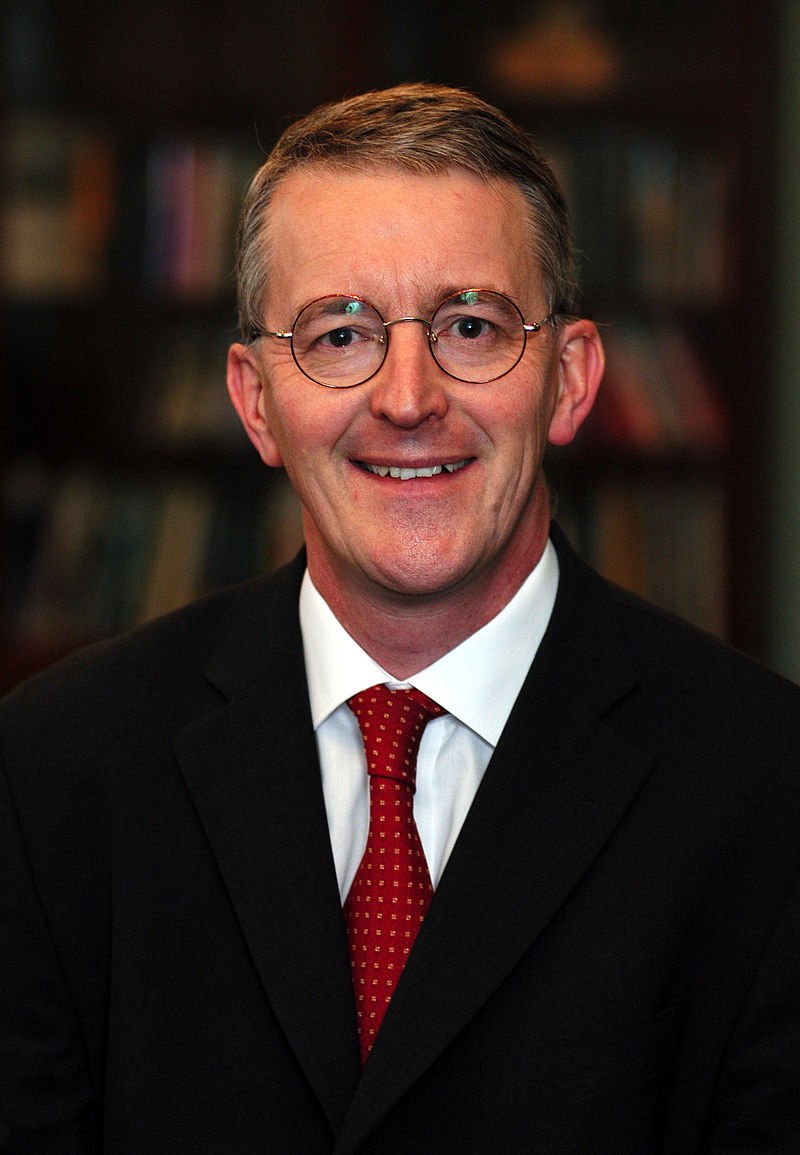
Tag: Hilary Benn

  • Hilary Benn – 2012 Speech to Labour Party Conference

    tonybenn

    Below is the text of a speech made by Hilary Benn to the 2012 Labour Party Conference on 4th October 2012.

    Good morning Conference.

    I want to begin by thanking Dave Sparks for his leadership of our LGA Group.

    Our great CLG team in Parliament – Jack Dromey, Helen Jones, Roberta Blackman-Woods, Chris Williamson, Paul Blomfield, Nic Dakin, Bill McKenzie and Jeremy Beecham for everything that they do.

    And I want especially to thank – as I am sure you will too – our 6,000 Labour councillors, including the 824 elected in our great victories this year, who do such an outstanding job in cities, towns and villages up and down the country flying the Labour flag.

    As we come to the end of our Conference, the message we take home with us has to be one of hope.

    Why? Because at a time when people are really worried about what all this economic uncertainty means for them and their family’s future, the biggest threat we face is not the scale of the challenge.

    No. It is that too many people feel that too many decisions are being taken too far away from them.

    It is that people may lose faith in the capacity of politics to do something. To change things. To transform lives.

    Now we know that it does. And we know that when you transform one life, you start to transform a community.

    And why do we know it. Because our history teaches us so.

    Just think what we have achieved as a country, as one nation. Look back 200 years to when poverty, disease and slums scarred our land. What changed that here in Manchester? Social conscience, civic pride, collective endeavour – people who did something extraordinary.

    They brought gas and electricity, and schools and hospitals.

    They opened the first public parks.

    They built homes.

    They provided the clean water and the sewers that did more than anything else to defeat disease and increase life expectancy.

    And a century ago in David Cameron’s constituency – and I bet he wouldn’t know the answer to this question about British history – the Workers’ Union set up a new branch in Witney, not to campaign for a cut tax for millionaires, but for a fair deal, a living wage: the Just Reward of Our Labour.

    And none of these peoples waited to be told what to do by Whitehall. They looked around them, saw the problems, decided what needed doing and they got on with it.

    And that’s exactly the spirit of Labour in local government today – a spirit we should celebrate.

    Now let’s face it, these could not be tougher times for councils.

    They have been singled out for cuts in funding that are unjust and unfair, and in true Tory style the poorer the area, the bigger the cuts.

    All in this together, Mr Cameron? You’ve no idea what that means, do you?

    Now while Labour councils are fighting for a fair deal for their communities, they are also facing impossible, agonising choices.

    But with a quiet and steely determination, they are making those choices not because they don’t care, but because they do.

    To choose is to express our Labour values and to show that we can make a difference to people’s lives.

    And so, while Labour may not be in government nationally, we are in government locally and we’re gaining more councils.

    By winning the public’s trust.

    By showing the Labour difference.

    By proving, however tough it gets, that we don’t write people off. We stretch out a hand and pull each other up.

    One thing we did in Government to pull young people up was our Educational Maintenance Allowance . The Tories and the Lib Dems scrapped it.

    I’d like to welcome Cllr Nick Forbes, Labour Leader of Newcastle, to tell us what they are doing to help the young people affected in their city.

    Nick.

    [Cllr Nick Forbes, Labour Leader of Newcastle City Council:

    Educational Maintenance Allowance was just one of the many socially progressive measures introduced by Labour. It helped thousands of young people to stay longer in education, meaning they could improve their skills and increase their job prospects. And, because it was targeted to people from disadvantaged backgrounds, it helped with social mobility.

    I know how important it was to young people in Newcastle, because they marched through our city centre in their thousands when it was scrapped.

    We were determined to do something to help. So we worked with our local schools – this one, Benfield, is just one of the many schools rebuilt by the last Labour Government – and introduced our own version of EMA, which we called the Newcastle Bursary. Let me tell you about some of the people it has helped.

    Lucy was knocked down in Year 9 and has suffered extensive and on-going surgery ever since. She did quite well at GCSE and is determined to go to university, and would be the first to do so in her family. She is progressing well academically with good AS grades and the bursary has helped her with travel and study costs.

    Jamie lives with his granddad in Byker. They really struggle financially. He did not do well at GCSE with a few E and F grades but in Sixth form he has not missed a single lesson! The bursary has allowed him to carry on with his education; without it he would not have been able to stay on. He passed his BTEC last year and is now studying ICT at A level, as well as progressing with English and Maths qualifications.

    Our bursary has meant that these young people, and hundreds like them, can afford to stay in education. I am proud to say that this is a real difference that we have been able to make.

    Because we believe no one should be overlooked, no one should be left behind. And no one should be denied opportunities simply through the circumstances of their birth and upbringing. That’s the difference a Labour council makes, and how we are doing our part in rebuilding Britain.]

    Thanks Nick.

    There you are.

    Practical help to bring out the future talent of our country – the next generation. That’s the Labour difference.

    Now once those young people have completed their studies, what awaits them? Youth unemployment over a million. No experience, no job. No job, no experience.

    So in my city Leeds, council leader Keith Wakefield has brought together the City College, Jobcentre Plus and local employers to help 600 young people get their careers started. By offering them what they really want – advice, training and, most of all, work experience.

    And in November they’ll be launching the Leeds Apprenticeship Agency. Why? Because the council listened to small businesses who said: we want to take on apprentices, but we’re worried about employment liabilities and all the administration.

    So the council said, ok, we’ll create a company to take on those responsibilities, so your company can take on those apprentices. A Labour council working with small businesses to make a big difference.

    Now, one area where jobs have been badly hit is construction.

    House building is falling. Because of the Government’s failed economic policy, people can’t get mortgages. They can’t raise deposits. And so developers aren’t building.

    And it’s all very well Nick Clegg talking last week about wanting to build lots of new homes but where was he when his Government slashed the affordable housing budget by 60% and the number of affordable housing starts collapsed by more than two-thirds.

    Now you’ve started saying sorry – how about apologising for that Nick ?

    But while the Government is cutting, Labour is building. Let’s hear now what Labour Islington is doing about it from Cllr James Murray, Executive Member for Housing and Development.

    [Cllr James Murray, Islington Council:

    Conference, if you’ve been to any fringe meetings about housing this week you will have heard lots of speakers saying our country needs more homes.

    That is certainly true in Islington. But, for us, it is vital that if we’re building more homes, they need to be the right kind of homes. They need to be decent, secure, and affordable homes.

    And in Islington, a desperate need we have is for more social housing.

    We have 3,000 families living in overcrowded council housing.

    Take the example of Leslie Hynes, who lives and works near the Arsenal tube. He was living with his wife and four-year-old daughter in a one-bed council flat above some disused garages that were just a brick wall onto the street.

    But after Labour won control of Islington Council in 2010, we got on with converting the ground floor garages under his flat, and the space at the ends of his block, into 23 new council homes.

    And so this summer, through our local lettings policy for new council homes, Leslie and his family moved the short distance from their overcrowded flat upstairs, to a new 2-bed flat downstairs with a garden.

    Their daughter now has her own room, and the family is now living in a new high-quality home with a secure tenancy at a social rent.

    This is just one of the projects we’ve been working on. We are building new council housing now, and have plans for hundreds more homes over the coming years.

    And we are working with housing associations to bring the number of new affordable homes well into the thousands. We have a plan where we give them land and then they build homes for social rent.

    The Tories and Liberals in government want to raise social rents to near-market levels – that would triple the cost of the average council 2-bed in my borough. We’ve said no to this. That would be no use to Leslie and his family. That would destroy the mix of housing that Islington needs to work socially and economically, and that makes the borough fairer.

    So, we are stepping in where we can: we know what Islington needs, we are confident how we’re going to get there, and we know we are making a difference.]

    Thanks James for helping the Hynes family. They now have a place they can really call home this Christmas.

    That’s one Labour difference in housing. Here’s another. Many older people wouldn’t mind moving into a smaller home, but they don’t want a one bedroom flat. Why? Because they might need a carer to come and stay with them or they want their son or daughter to come and visit.

    So Labour Sandwell listened. ‘Fair point’ they said, and so now they are building 2 bedroom bungalows on the same estates – this one is in West Willows, Great Barr – so that residents can move there and still have someone to come to stay over. And because of that they are releasing 2, 3 and 4 bedroom properties to let to families on the waiting list. Good idea eh?

    And what are the Tories doing? Taking away people’s housing benefit if they have a spare bedroom. A shameful attack on families, carers and people with disabilities, whose homes have been adapted.

    Now Conference you’ve been telling us “Build more homes”. We hear you.

    When you’re in recession the best way is to build yourself out of it.

    And that’s why this week we’ve said: use the money from the 4G auction to build 100,000 new affordable homes to take people off the waiting lists and thousands of unemployed building workers off the dole queue.

    Makes sense, doesn’t it?

    But we also need an economy that is fair.

    When households are feeling the squeeze, it’s hardest for those on low pay.

    I’d now like to invite a guest to speak to us Conference.

    Not a Labour councillor, but someone who is benefiting because of a choice made by Labour councillors.

    Will you please give Elaine Hook a warm welcome.

    [Elaine Hook:

    My name is Elaine Hook. I am a cleaner employed by Birmingham City Council. I take pride in my work. And I work hard. I love my job.

    Labour took control of Birmingham City Council in May. The very first thing they did was to introduce the living wage. No council worker now earns less than £7.20 per hour. That’s a big difference from the minimum wage of £6.08 per hour.

    It’s made a real difference to me. It’s made it easier to pay the bills. It’s really helped improve my quality of life. And there are over two thousand five hundred lower paid workers like me. My colleagues who benefited are dinner ladies, catering staff and street cleaners.

    So, I’d like to thank the council and the Labour Party for helping me and other workers like me – who now get a decent wage, a living wage. Thank you.]

    Thank you very much Elaine and thanks to Albert Bore and his team in Birmingham for making that difference.

    And you know what Conference?

    People like Elaine are benefiting up and down the country because it’s not just Labour Birmingham that’s paying the Living Wage; it’s also Labour Preston, Oxford, Lewisham, Islington, Camden, Lambeth, Hackney and Glasgow.

    And more Labour councils are on the way. So let’s applaud all of them for making that Labour difference too.

    So that is the difference.

    The Tories got rid of EMAs. Labour Newcastle steps in to help.

    The Tories put youth unemployment up. Labour Leeds provides apprenticeships.

    The Tories slashed the affordable housing budget. Labour Councils are building new homes.

    The Tories punish people for having a spare bedroom. Labour Sandwell provides one for its pensioners.

    Rail fares and heating bills are up while the Tories want to drive wages down by paying council cleaners in one part of the country less than someone doing the same job elsewhere.

    Shameful. What are Labour Councils doing ? They’re trying hard to pay a living wage.

    Who said politics doesn’t make a difference. Who said we are all the same. Not true.

    And when people ask us ‘what would you do?’, look them in the eye, and reply ‘Look at what we are doing’.

    So let’s be proud, let’s celebrate the difference that Labour is making in local government.

    That’s the message we’ve got to take into next May’s County Council elections.

    Now one of the places we are fighting hard to win is here in Lancashire.

    Please welcome our last contributor Jenny Mein, the Leader of the Labour Group, who is going to tell us about the difference she wants to make.

    [Cllr Jenny Mein, Lancashire County Council:

    It is a privilege to speak to Conference about our campaign in Lancashire to regain control of the County Council.

    I want to talk about the difference that a Labour Lancashire will make and just how important our County Council campaign is.

    The Tories in Lancashire are letting people down.

    Our young people have seen cuts to the youth service, our disabled have seen the cost of their day care services increase by 700 per cent and our older people are being priced out of community centres.

    Lancashire is being let down by a Tory government in Westminster and the Tory county council is hurting our residents.

    Lancashire was once a place where everybody mattered and Lancashire Labour want to make it that way again.

    A Labour controlled Lancashire will work with local businesses, the third sector, trade unions, schools and colleges to stop a generation of our young people from being thrown on the scrap heap.

    A Labour Lancashire will give every young person a chance in our County and our priority will be to tackle youth unemployment.

    As one of the largest employers in the County, Lancashire Labour needs to take the lead in ensuring a living wage economy, and a Labour controlled Lancashire will deliver a living wage for its employees.

    We believe in the power of the living wage and will use our influence across the County to improve the living standards of thousands of Lancashire residents. We congratulate colleagues in Birmingham and as Elaine shows, we can make a real difference.

    To achieve this, we know that we must work hard and campaign harder than ever before.

    We have made over 100,000 contacts already this year and have delivered over 1/2 million pieces of literature for our Operation Red Rose campaign.

    But we still need to do more.

    So, if you’ve got any spare time over the coming months we would love to extend a warm Lancashire welcome to you all!]

    Thanks Jenny. I’ll come. Conference will you?

    So, as we leave here today we’ve got counties to win next year and a mayoral election in Bristol this November so that Marvin Rees can introduce a living wage there too.

    But Conference, while we do so, remember this.

    Everything we’ve just heard about is a testament to local ideas. Local commitment. Local action.

    We need more of it, and yet too much power in England is still wielded in Westminster, and if we are honest we have been too wedded to that way of doing things in the past. That needs to change. We really need to change.

    And do you know what? There’s nothing to fear and there’s everything to gain.

    Because our job is to give people locally the tools they need to do their job.

    Decisions taken closer to the people, by the people.

    And there’s so much that needs doing. Just look around us.

    Improving people’s health so that life expectancy doesn’t fall with income.

    Making sure that broadband – the artery of economic development in our century – is available everywhere.

    Generating renewable energy on our roofs to help reduce people’s bills and look after the planet.

    Caring for a growing elderly population, so that we can remain independent and be looked after in our own homes, as Sandwell is doing.

    Building decent affordable homes for families like Leslie Hynes’, as Islington is doing.

    Helping more people like Elaine by paying a Living Wage, as Birmingham is doing.

    And as we do all these things, as we give people hope, so confidence will build in us and in Labour politics.

    200 years ago the circumstances may have been different, but our mission – what we are about – has not changed.

    And we will stand shoulder to shoulder with you as – together – we get to work.

  • Hilary Benn – 2011 Speech to Labour Party Conference

    tonybenn

    Below is the text of the speech made by Hilary Benn to the 2011 Labour Party conference on 29th September 2011.

    Good morning Conference. Can I begin by thanking my team Helen Jones and Paul Blomfield – Paul it’s great to see you back fit and well – and all our MPs for the work they do taking the fight to the Government in the House of Commons.

    Ed’s great speech on Tuesday reminded us that politics – like life – is about the choices we make. It’s about the values we uphold. And nothing matters more right now than the economy.

    Where we got it wrong – like on bank regulation – we’ve held our hands up. But everyone else got it wrong too. George Osborne used to complain not that we weren’t doing enough on the banks but that we were being too tough on them. He was wrong then and we’ll take no lectures from him.

    And he was wrong again when those frightened people were queuing up outside the branches of Northern Rock to ask for all their money back. Now when that happens – your banking system is on the point of collapse.

    And the real test of politics is not what you do when times are easy but the choices you make when times are tough. And we made the right choice. I rang my father up that day and said “Dad, you know you always told me that we should nationalise the banks. Well I’ve got some news for you”

    And why did we do it ? Because we made a choice to protect people’s savings, to protect people’s jobs and to protect people’s homes, and for that we should never apologise.

    And it’s exactly the same choice we face today when a new crisis threatens. Do you act or do you stand on one side. And whose side on you on?

    Every day in the House of Commons we face a Tory Government kept in office by the votes of the Liberal Democrats and Nick Clegg.

    They’re not a happy bunch.

    Tim Farron wants out, and Chris Huhne is after his boss’s job. He thinks Nick Clegg should go off to be an EU Commissioner – indeed he’s so keen on the idea that he’s offered to drive him to Brussels himself.

    And why are they unhappy? Well we know why.

    Cancelling the loan to Forgemasters, not backing Bombardier in Derby where British skill and British engineering has been building trains for 170 years, and tuition fees. Nick Clegg made a promise. He broke it. And that’s why people will never trust the Lib Dems again.

    Now, beating the Lib Dems is pleasure – and we should thank them for the help they’re giving us – but Conference beating the Tories is business.

    Look at what they’re doing to the economy. Growth is flatlining. Unemployment is rising. And that’s going to make it harder to pay off the deficit.

    Look at their broken promises.

    David Cameron promised to protect Sure Start. But Sure Start centres are closing.

    He promised that ministers who came up with cuts to the front line would be sent packing, but instead it’s 16,000 police officers who are going.

    He promised no top down reorganisation of the NHS, but now he’s wasting billions on doing just that.

    And he actually wants to be able to fine your local NHS hospital up to 10% of its turnover for something called anti-competitive behaviour even though he can’t explain what that means.

    That’s the Tories for you. They actually do think that our hospitals are no different from banks or phone companies. Well we know they are different and that’s why the British people will never trust the Tories on the NHS again.

    This is a government that’s got rid of EMAs and the Future Jobs Fund at a time when one in five young people can’t find a job.

    We have a No 10 adviser who wants to get rid of maternity leave.

    A schools Secretary who seems only to be interested in the education of some of our children, when he should be interested in the education of all of our children.

    A government department that’s sending out letters to people who are terminally ill warning them that their benefits could be cut in April even though Parliament hasn’t yet approved these changes.

    And a Prime Minister who at the same time as taking away childcare tax credits from working mums, wants to abolish the 50p tax rate.

    All in in together? No, they’re just interested in a few.

    And that’s why people will be looking to us to help them. And so as we head back home let’s be proud of who we are and of how our politics can change things. Just look around this great city of Liverpool to see what we can do.

    It’s quite easy to have a go at politicians – and sometimes we deserve it. And yet being an MP or a councillor is an honourable job. It is a privilege to serve the public.

    And that’s why all these boundary changes are so wrong and so damaging. For the Tories it’s all about trying to gain party advantage, but for the rest of us they will destroy the relationship between places and communities and their MPs, and we will fight them as hard as we can.

    And we won’t allow millions of people to be thrown off the electoral register because of individual registration. Aung San Suu Kyi reminded us this week just how precious the right to vote is. And that right must be protected for all our citizens.

    And if anyone says to you – ah, you’re all the same, what’s the point, nothing ever changes – remind them of Labour’s NHS, forged in the aftermath of a world war. Remind them of Labour’s minimum wage and the winter fuel payment. Remind them of the schools and hospitals we built. Remind them of Tom Watson and Chris Bryant’s courage in standing up against Murdoch. Remind them of Ed Miliband’s belief in a something for something society.

    And then ask yourself: what would things be like without them ? Do we make a difference? Of course, we do.

    And then go out there – ignore the cynics – and look people firmly in the eye and say: we are here to stand shoulder to shoulder with you in your community, and in your workplace, and in our Parliament as together we face the future.

    And do you know what matters more than anything else? Confidence. Having confidence in ourselves as a nation. Yes, the challenges are great, but if you look around you can see that we have all the skill, passion, innovation, inventiveness, creativity and determination we need.

    And when we put the power of our politics at the service of the people, then together we can transform lives and build something better.

    Conference, we are now going to hear from someone for whom what we did in Government to support families really made a difference, but also about how her life and her family have been affected by this Government’s dismantling of the help we put in place.

    It is a moving story about why politics matters.

    She comes from Stone in Staffordshire. It is her first time at Conference.

    Will you please welcome Catherine Gregory.

  • Hilary Benn – 2011 Speech to the Local Government Information Unit

    tonybenn

    Below is the text of a speech made by Hilary Benn to the Local Government Information Unit on 28th October 2011.

    Thank you for your kind invitation.

    It is good to be back in local government, so to speak, after all these years. Quite a few things have changed, and some things haven’t; in particular I find myself once again in opposition with a Conservative Government in Westminster.

    My time as a councillor in Ealing – and my experience in Leeds – has made me a passionate believer in local government and what it can do to help people to solve their problems and to realise their hopes and aspirations for a better world.

    I say that because – as you know better than anyone – communities are at the heart of society. They are shaped by the places we live in and the relationships we have one with another. And what councils do makes such a difference to people’s lives. Localism is much talked about these days but what I find missing from the Secretary of State for Local Government is any apparent enthusiasm for local government. I don’t think what you do is appreciated enough, and one of the things that I want to do in this job is to stand up for local government.

    Now these are very difficult times for councils and for the country. People are worried about their jobs, the rising cost of living and the affordability of housing. You are worried about implementing the huge reductions in funding – unprecedented in my political lifetime – that have been forced upon you, and unfairly and unevenly distributed.

    This localism is about devolving responsibility for cuts that are hard and difficult – as you try to protect statutory services and decide where the axe will fall.

    Yes, the deficit has to be dealt with, and no I am not here today to say that if you hang on for another three and a half years – and if there is a change of government – normal service will be resumed.

    But the Chancellor does face a choice about economic policy, and the one he is pursuing clearly isn’t working. Confidence is plummeting. Unemployment is rising. Growth is grinding to a halt.

    Nothing like enough private sector jobs are being created to replace those being lost in the public sector, including by councils – although we were promised that this would happen.

    And, worst of all, in the face of this failure the Government has no plan to put it right.

    The nation needs a plan, and local government needs a plan too. We have to get the economy going again. And that’s why a temporary reduction in VAT, a 5% VAT rate on home improvements, a NI tax break for SMEs taking on workers, a repeat of our bankers’ bonus tax to help 100,000 young people to find work and build 25,000 affordable homes and bringing forward long-term capital investment would all help to do that.

    And councils should be at the heart of a plan for growth, doing what so many of you have done so successfully over the years – promoting the economic development of your area. Thinking ahead. Responding to profound changes rather than become prisoners of that change.  Making sure the right infrastructure and the right skills are in place.

    Supporting economic growth of the right kind is really important, but the current mess that is planning isn’t going to help.

    Some policies are very hard to understand.  I cannot fathom why the Government has scrapped the brownfield first policy – and very successful it was too – and I cannot understand why it has created so much uncertainty about the transition to the new Framework and where this will leave councils and communities in relations to developers.

    The truth is that ministers have a long way to go to reassure people who fear that green England is under threat, and a long way to go to persuade us that we won’t see more appeals and more arguments about what the words of the new National Planning Policy Framework mean.

    Some policies are contradictory. The localisation of council tax benefit, with a 10% cut and protection for certain groups, is likely to end up hitting people who work but are on low incomes; the very opposite of what the DWP says it is trying to do to make work pay.

    Others haven’t been thought through. The localisation of business rates is fine in principle as long as there is real incentive, that councils don’t lose out financially and there is a fair mechanism for redistribution that recognises disadvantage. But so far even those who favour the idea don’t think much of the proposals.

    Some are plain incoherent. When money is tight, and CLG has faced huge cuts, to suddenly find £250m to try to bribe councils into changing decisions they themselves have made  – in the spirit of localism  – about how to collect  people’s rubbish is bizarre and smacks of Whitehall knows best.

    We have a housing crisis; a crisis of supply and a crisis of affordability. The housing budget has been slashed, the number of new homes built in England last year was the lowest for decades, and plans for 200,000 new homes have been abandoned since the election, in part because of the chaos over planning.

    And some are plain unfair. As any of you who have seen the map that Newcastle City Council has produced will know, this show that the most deprived communities are being hardest hit. The most deprived 10% of single tier authorities will see their total spending power reduce by nearly four times as much as the least deprived 10%. So much for not balancing the books on the backs of the poorest.

    So we have:

    An Economic crisis

    Less money

    Significant changes with the Localism Bill, in health, education and policing, with police commissioners, coming, that local government is going to have to work with, and through, in future.

    And a continuing debate about the balance between the local and the national.

    The charge that all oppositions are localisers and all governments are centralisers has more than a grain of truth in it. The Whitehall machine is naturally centralising, and we have to recognise that when things go wrong locally – the failure to protect a child, for example – there is very powerful pressure on ministers to do something. And we accept that there is a case for central oversight and the inspection regime that goes with it.

    So, first it would help if we were clearer about where responsibility should lie for what nationally, locally and in neighbourhoods and communities.

    Some national responsibilities are obvious. Defence, benefits, health, and the framework for entitlement to social care, for example.

    Education is currently a mixture of all three, although I find the continued use by some of the phrase local authority control of schools rather mystifying as there hasn’t been much of that since local management of schools came in. But even with all the changes that have taken place, there is still a role for local authorities in ensuring a sufficient supply of school places, in providing support services, and of course in working with schools as they contribute so much to the wider community.

    At the local end, we have, for example, the number of libraries, or traffic calming, or parks and recreation.

    It seems to me that reaching a measure of agreement – finding the right balance – would help us in the relationship between the community, the local and the national, and will be especially important in the new financial circumstances that local authorities find themselves in.

    Secondly, we need to encourage the process now underway in which councils are looking at different way of doing things. There is a case for doing this because of the cuts and there is case for doing this anyway in the interests of providing a better service.

    Earlier this week I met the co-operative councils network and learned about the interesting things they are doing. Rochdale mutualising its housing stock. Lambeth’s work on devolving youth service spending and decision-making. And co-op trust schools in Oldham. Or look at the bringing together of back office functions and some front-line services by Kensington and Chelsea, and Westminster.

    As Sophia Parker puts it: “an increasing number of councils are recognising that slicing existing budgets ever more thinly is not enough in today’s world, and that competition and outsourcing alone will not do the trick. An altogether bolder approach is needed.”

    Thirdly, I think there is a very strong case for taking the principle of coming together and sharing things and applying it much more widely outside of local government. I am talking about the Total Place approach. The argument for this way of looking at things is overwhelming.

    You only have to reflect on what we have now and ask yourself – if we had been starting from scratch – would the duplication and overlap between local authorities, and health, and police, and probation and other services have seemed a sensible thing to do.

    It also means for local government that it can have a bigger say in how other public services are provided in their communities.

    What the Worcestershire pilot showed was that of all the public spending in the county, only around 20% was attributable to the 6 district councils and the county – and what was directly controlled was about half that once you took out schools. In other words most of it was elsewhere, but when you bring people together round a table to discuss how to spend the pot all sorts of new ways of doing things emerge and become possible if there is the will.

    I think we should be naturally wary of turning the whole system upside down for the sake of it – we have all seen a lot of that – but I favour a radical approach in this area allied to the right kind of incremental change [Fabians]. Pooling budgets to look at all the needs of an area and sharing data on, and working together with, the same people or families that lots of different agencies are dealing with makes a lot of sense. Making the best use of the public estate – school buildings, housing offices, job centres – makes a lot of sense.

    And from a resident’s perspective, if several different local and national agencies are undertaking the same financial assessment of you and your circumstances, then doing it just the once seems pretty sensible too.

    The argument for a total place way of doing things is even stronger in the context of the cuts, not least because it enables us to see the cumulative impact of what would otherwise be different decisions taken by different bodies and to ask the obvious question – is it fair and are we all working in the same direction?

    Fourthly, I am a very strong supporter of neighbourhood management and neighbourhood budgets; what we might call ‘local place’. Before the boundaries changed, I represented the Halton Moor estate. It had its troubles and the Halton Moor Residents Group came together to say “we don’t want to put up with this any more”.

    So we set up a neighbourhood management group, the ALMO provided support, and we got all the different services round the table, including the police, and set to work trying to sort things out. It didn’t cost a penny more – apart from the ALMO’s contribution – but it made much better use of the pounds that were being spent, and gradually the local residents told us that things had got better. And one sign of that was that some new houses for sale built where only a few years before perfectly good semi-detached houses had been knocked down were all sold before the last one was completed.

    That experience taught me what was possible in doing things differently and what communities can do for themselves if they are given the chance.

    Doing a better job for those we represent is what we are all interested in; it is outcomes for citizens that really matter. And citizens are really interested in the services they receive from local authorities; for them whether their needs are met is what matters.

    When our children are of school age, what we want is a good local school and we don’t think much about structure or arguments about accountability.

    When your 85 year old Dad needs support to stay in his own home, it is the help the council can give him that we rely on.

    So we all need to assess how we are doing, and I do worry that with the abolition of the audit commission, we may lose some of the comparative data which would allow people locally and society nationally to see how councils fare in comparison to each other.

    Finally, I know you’ve discussed lots of different approaches today about how councils can do the best in the tough circumstances you face. But you remain the defenders of your local communities. You are their voice in speaking to other public services. But the most important resource you have is the essential vitality of local government.

    What history teaches us and what we can see around us is that with political will, and good leadership, and determination and confidence you can achieve an enormous amount.

    Local government has always been an ocean of innovation. Victorian Britain saw people of civic mind and civic virtue lead the way. They brought gas and electricity to communities. They created the first public parks. They built homes. And they provided the clean water and the sewers that did more than anything else to beat disease and increase the life expectancy of our forebears and our ancestors.

    They didn’t wait to be told what to do. They looked around, they saw the problems, and they got on with it.

    And it is just as true today. Look at Leeds’s success in building a diverse economy and a thriving city centre.

    Look at the regeneration of the former coalfields.

    Or Camden’s work on services provided to and with people who have mental health problems.

    Or Kent’s social innovation lab.

    Or York’s plan to provide free wi-fi in the city centre; the 21st century equivalent of gas and electricity, powering the new economy.

    And then think of the new challenges of our age.  Climate change. A population that is growing and ageing.  Obesity – the 21st century epidemic. Finding a way to live sustainably.

    And then ask yourself this. If we can do extraordinary and visionary things in one place – and you have shown that you can – then we can do them anywhere.

    And that’s why – despite the difficulties and despite the really tough choices that councils are confronted with – we have to hang on to that sense of optimism about what we can do to shape our future together.

    And I really look forward to working with you as we do.

  • Hilary Benn – 2009 Speech to Labour Party Conference

    tonybenn

    Below is the text of the speech made by Hilary Benn, the then Secretary of State for Environment, Food and Rural Affairs, to the 2009 Labour Party conference on 28th September 2009.

    I would like to thank Michael Cashman and the policy commission for everything you do, and also our great ministerial team at Defra – Jim, Huw, Dan and Bryan. Thanks very much.

    Many of us who came down to Brighton by train would have caught a wonderful glimpse of the South Downs.

    Formed over millions of years by nature’s hand, the glorious western weald and the chalk hills are one reason why Clem Attlee’s Labour government did something unique in our history.

    From the ashes of World War Two, they founded the National Health Service, created the Welfare State, and built new homes and towns amid the rubble of the old. But they also had the vision to legislate to preserve beauty.

    Drawing inspiration from William Blake, the Kinder Trespassers and many others, they passed the National Parks Act into law 60 years ago this year.

    And as we commemorate what that Labour government did two generations ago, so this spring were many able to celebrate – after a long, hard campaign – our decision that the South Downs will now become our fifteenth and newest National Park.

    We made a political choice to preserve and protect this landscape for future generations.

    For everyone. For ever.

    And why?  Because we know that the quality of our lives, our health, our happiness are shaped not just by our families and the work we do, but also by the places in which we live and by how we treat each other.

    It was this Labour Government that has opened up the countryside for everyone to enjoy with the right to roam.  We’ve passed the first all-embracing animal welfare act for a century, and in just over two years’ time battery cages for chickens will be no more.

    And we will now preserve and protect our seas and coastlines with the Marine and Coastal Access Bill. The first stretch of the new Coastal Path around England will open at Weymouth Bay  – site of the 2012 sailing competition – in time for the lighting of the Olympic flame.

    But now that we’ve fulfilled the original dream of the National Parks’ creators, our next task is to enrich and link together more wonderful places where wildlife, bees, flowers and trees can flourish, and we can enjoy them as they do.

    So I will now ask a group of people passionate about our countryside to come up with a plan to do just that so that we can realise another long-held dream of all those who care about our wild places.

    We also need our countryside to produce more food.

    Our farmers and farmers around the world will have another 2 to 3 billion mouths to feed in two generation’s time.

    That’s why I want British agriculture to produce as much food as possible today as we protect the soil and water on which our ability to grow more food tomorrow depends.

    We’re working together to protect the environment, beat animal diseases, and tackle climate change.

    Our farmers – at the heart of our rural communities – are ready for the challenge. And we should support them in the great job they do.

    But conference, in our hearts, we know that we are living in a time of change that will affect all our lives.

    How best can we deal with it ?

    Well, Charles Darwin – that genius of science who transformed the way we think about ourselves and our place in the world – gave us this advice.

    He said:

    “It is not the strongest of the species that survives, nor the most intelligent. Rather, it is the one that is most adaptable to change.”

    And that’s why we must adapt to the changes we can see all around us.

    We need banks that value the next generation rather than the next bonus. An economy that creates the low carbon jobs of the future.

    We need to make sure our air is clean, including in London which needs to get on with improving air quality.

    We need to value and use everything around us.

    We’re now recycling more than four times as much household waste than we did a decade ago. But we can do more. It doesn’t make sense to dump thousands of tonnes of aluminium in landfill every year when someone will buy it and recycle it into new cans, using 90% less energy.

    It doesn’t make sense that we throw way a third of the food we buy – costing us money and most of it ending up rotting in a tip, producing greenhouse gases – when instead we can turn it into clean renewable electricity to power our homes.

    So we need to stop thinking of these things as rubbish, stop sending them to landfill, and start making the most of everything.

    Our changing climate is already affecting those least able to cope from the deltas of Bangladesh to the parched lands of Kenya, and the remotest places on earth like Antarctica. Our natural world  – as well as giving us inspiration beyond price – also helps give us clean air and water, soil, plants, food, and medicines on which human existence depends.

    We have a moral responsibility to look after both.

    We need especially to value water, and protect ourselves from too much of it by investing in flood defences.

    Now, some churches, sports clubs and youth groups have been hit by huge increases in their water bills for surface drainage. It isn’t right. So I can tell you today that we will legislate to allow water companies to run concessionary schemes for these organisations so they can get on with the great job they are doing instead of worrying about unaffordable bills.

    When you look at things this way, you can see the choice we have. Whether to leave people and landscapes to fend for themselves or to act together to seize this moment in human history and build the green society in which the low carbon will inherit.

    Life is about the choices we make, and that’s why the choice at the general election will matter so much.

    The Tory choice is a return to fox hunting, cutting inheritance tax while cutting Sure Start which has done so much for my constituents in Leeds.

    The Labour choice is to build more homes, help people into work, make sure we come out of the recession stronger, get that deal in Copenhagen that Gordon and Ed and all of us are working so hard to achieve and together create a more sustainable way of life.

    But we have to be honest. In this generation, some wonder whether we can do all these things. Whether the future will be as good as the past. Whether our children be able to afford a home, get a job and a decent pension. What kind of climate will we bequeath to them by the middle of the century.

    And they ask – will our damaged politics be capable of dealing with all this?

    We have to show that it can.

    By sorting out what’s gone wrong.

    By standing up against the cynics who decry politics, because every time they do so they undermine our ability to change things for the better.

    By standing by our beliefs – fairness, justice, equality, opportunity, the helping hand, the window on the world that education gives us,  a sustainable environment – beliefs that have changed our lives for the better.

    And by having confidence.

    In ourselves. In what we’ve done. And what we have still to do.

    That’s why Roosevelt – a great leader who charted a way through the depths of the Great Depression – looked people in the eye and said: “The only thing we have to fear, is fear itself”

    He was right.

    So let’s take the fight to the Tories. Let’s stand up for what we believe in.

    And let’s remember that the greatest thing we can do is to give people hope.

    Because – as our history has taught us – it is with hope that we can – and we will – change the world for the better.

  • Hilary Benn – Why Natural Environment Matters

    tonybenn

    The speech below was given at the Barnes Wetland Centre, 21st July 2008.

    Thank you all for coming, although I must admit that today is a subtle ruse on my part to enable me to visit the Barnes Wetland Centre.

    And what a wonderful setting. I used to come to Barn Elms every week when I was at secondary school to play sport. Little did I think then what this place would become. Or that I’d be back here one day to make this speech.

    My wife and I were discussing yesterday what I should say about my interest in the natural world. She said. “Tell them about our oak trees”.

    We’ve been planting oaks from seed, and ash, and silver birch on a nature reserve – 8 acres of former farmland in Essex – for some 20 years now. The tallest oak is 15 feet or so, and the trees we have planted and those that nature has brought share the land with adders, foxes, and lots of lots of brambles that I go and do battle with whenever I can. It is my idea of relaxation. It’s a lot easier than doing this job! And every time I walk down the path, and wend my way through the narrow opening into the reserve, I feel the same sense of anticipation.

    And why do we feel like this? Because nature is part of our soul.

    I use the word ‘soul’ because this is a fundamental part of all of us. Of our identity. Of where we come from.

    There are few things that can lift the spirit, or inspire a sense of freedom, as time spent – however fleetingly – with nature.

    A glance out of the window of a train. The first crocus of spring. Even if you have spent your entire life in a city and have never before seen the mountains or the downs – looking out for the first time across the still waters of the Blackwater Estuary as dawn breaks, or gazing up at Scafell Pike from Great Moss, or catching a glimpse of the Seven Sisters from Birling Gap, or hearing the buzz of a bumblebee jumping from flower to flower, who would not feel a sense of awe and wonder at the astonishing biodiversity of landscape that this small island reveals unto us?

    To be disconnected from nature is to be disconnected from the earth itself. It is not simply self-preservation that urges us to confront the threat of climate change. It is also our love for the soil from which we came and to which we will – one day – all return, in my case under one of my oak trees.

    Of course, the natural environment provides us with the essentials of life which we take for granted. But the truth is that we cannot take it for granted any longer, and so our task is to rebalance our relationship with the natural world.

    And that is what I really want to talk about today – where we are now, how we got here, and what we must aim for in future.

    We have a long history in these islands. For better or worse, the natural environment we see around us today is a product of the relationship between humankind and nature. And it is constantly changing.

    We have been managing the land for some 6,000 years since Neolithic farmers began keeping cattle and sheep and started cultivating cereals.

    Over time we became more sophisticated. We dug ditch boundaries, we grew hedges, and we found ways to store food and manage woodland. We created fields and improved drainage.

    The enclosures, the industrial revolution and the consequent growth of our towns and cities transformed everything, as the relationship changed. And we began to feel the consequences of failing properly to take account of the environment.

    In 1848, 14,000 people died from Cholera in London because of contaminated water. The epidemic forced the government to pass the Public Health Act.

    A decade later, following the ‘Great Stink’, which was killing the river Thames, making life in the capital intolerable and shut down Parliament, the government gave the go-ahead to Bazalgette’s plan for a new sewerage system.

    A century after that, as a result of the ‘Great Smog’ of 1952 in London – which asphyxiated the cattle at Smithfield market and is thought to have killed around 4,000 people in just 4 days – the Clean Air Act was passed.

    A little earlier – in 1949 – the National Parks and Access to the Countryside Act became law. The minister who took the Bill through the House of Commons, Lewis Silkin, said during the Second Reading:

    ‘Now at last we shall be able to see that the mountains… moors… dales… and tors belong to the people as a right and not as a concession. This is not just a Bill. It is a people’s charter… With it the countryside is theirs to preserve, to cherish, to enjoy and to make their own.’

    It was by this Act that we have conserved some of the most important and iconic of our landscapes. The National Parks now cover 8% of England, and over 90% of people say that the Parks are important to them.

    Why? Because we like green places – and we want them to be near to where we live as well. It was pressure from communities that lead to public parks being created in our major cities.

    Today we are a more urbanised country, and there are more of us. 50 million more than when the first census was carried out at the height of the industrial revolution, and 10 million more than when Parliament passed the National Parks Act.

    And so, inevitably, our natural environment has changed. Its story is the story of human development. And the question for us now is how we can have both and keep both in balance.

    We shouldn’t, by the way, over-romanticise life as it was. There are some things we have left behind that should stay in the past.

    In 1800 life expectancy was just 37 years of age. It is now pushing 80, and we have been adding around three months a year for the past few decades.

    Of course, we don’t want to turn back the clock on advances in education, medicine, technology, transport, science, or in overcoming poverty, but we do want to maintain the natural world around us. And to do so we must recognise its true value.

    The natural environment does more than just nourish the soul. It provides us with the very essentials of life: clean air and water; food and fuel; it regulates our climate; it stems flood waters; and it filters pollution. It is the very foundation of our economic and social well-being.

    And at a time when – as a nation as well as a world – we are increasingly thinking about the security of our food and of our energy, we should also be asking: how secure is our environment ?

    Climate change is showing us what happens when we gets things out of balance. And if we do not manage what nature has given us sustainably, our children will be faced with consequences the scale of which we do not yet fully understand

    Of course climate change and the natural environment are inextricably linked.

    Many of the impacts of climate change will be felt by nature – from sea level rise and flooding to drought and desertification. So we need to manage the natural environment in a way that enables it to adapt to the effects of climate change and contribute to our efforts to halt it.

    So how are we doing ?

    The Millennium Ecosystem Assessment – led by our very own Bob Watson – looked at the global picture on the natural environment. Its findings were bleak; two thirds of ecosystems are in decline. It also concluded that environmental degradation is a real barrier to defeating global poverty and so to achieving the Millennium Development Goals. Time to shout not just ‘more aid, and drop the debt’ – but also ‘save the ecosystem’.

    Natural England’s latest ‘State of the Natural Environment’ report says that the natural environment in England is “much less rich than 50 years ago.”

    Pavan Sukhdev’s groundbreaking work is showing us that the economic consequences of the loss of biodiversity are potentially severe. He talks of there being three types of capital; human, financial and environmental.

    The first is rising because of education; the second is rising too, although it can go down as well as up; but the third is in decline. And yet he estimates that the benefits of global investment to protect ecosystems could outweigh the costs by 100 to 1.

    So can we do anything or is everything lost ? I am a great believer in looking at what can be done, and in celebrating our successes.

    And there is much to encourage us, because raising awareness, campaigning, institutional change, and politics have achieved a great deal for the natural environment in recent years.

    Pavan Sukhdev gives the example of the Panama Canal, where insurance firms and shipping companies are financing a 25 year project to restore forest ecosystems along the canal.

    This will result in less erosion and a more controlled flow of freshwater into the canal, reducing insurance risks and resulting in lower premiums for shipping companies.

    Our own analysis shows that Sites of Special Scientific Interest in England are doing well, with 80% now in a favourable or recovering condition.

    In the tradition that led Clem Attlee to create the National Parks, the Countryside and Rights of Way Act of 2000 finally gave legal expression to the ‘right to roam’.

    The Marine Bill will open up our coasts and improve the conservation of our seas, creating a network of Marine Protected Areas by 2012.

    In Lyme Bay, off the South West coast, we have recently banned the most damaging types of fishing to protect the area’s rich marine life and habitats.

    We’ve created the first new National Park for over forty years in the New Forest. And we are looking at the creation of another one in the South Downs. The public inquiry has recently finished and I am awaiting the Inspector’s report. I look forward to taking a decision.

    And although the EU target to halt the loss of biodiversity by 2010 may never have been achievable in its entirety, it has served as a call to arms. We as a nation have made some progress:

    • by substantially reducing upland overgrazing and inappropriate moorland burning
    • by stemming the overall decline in birds compared with 40 years ago, and significantly increasing the number of wintering wetland birds
    • by improving sewage treatment to reduce the pollution of sensitive water bodies
    • by launching a plan to tackle invasive non-native species in England, Scotland and Wales, and
    • by introducing a new biodiversity indicator to measure the performance of local authorities

    Farmers, who manage three quarters of England’s land and mould its distinctive character, have now signed up to 35,000 Environmental Stewardship agreements covering more than 5 million hectares.

    Agri-environment schemes have helped more than 18,000 miles of hedgerow to be restored or newly planted – that’s about the distance from the north pole to the south pole and halfway back again.

    And I see Graham that, partly with the help of Environmental Stewardship, Martin Smith, from Burnham Wick Farm, has won your Eastern England Nature of Farming Award for what he has done to attract corn buntings to his land.

    To build on this success, I am pleased to confirm today that Natural England will introduce an uplands strand to the Entry Level Stewardship scheme from 2010, replacing the Hill Farm Allowance so that we can help maintain and improve the biodiversity and historic landscape of England’s uplands.

    And as we reform the Common Agricultural Policy in the years ahead, we need to make sure that we secure the public funding needed to pay for these environmental benefits which the market does not reward.

    We have also made progress on water quality in recent years. Today the Government is publishing its response to the consultation on proposals to revise the Regulations implementing the Nitrates Directive.

    Nitrate pollution is expensive to remove from drinking water sources and it harms biodiversity.

    So we will put a number of new measures in place to tackle it, including creating further ‘nitrate vulnerable zones’ and putting tighter limitations on when manure and fertiliser can be spread.

    There’s some of the progress, but there’s still much more that we need to do especially in our towns and cities. The more disadvantaged a neighbourhood is, the worse the environmental conditions are for the people who live there. In deprived areas there’s more air pollution, less green space, fewer trees, more derelict land and less bio-diversity. And a poor environment can lead to poor physical and mental health.

    By contrast, research from across Europe shows that people living in greener environments are three times more likely to be physically active and 40 per cent less likely to be overweight or obese. So nature is good for our health.

    A recent study for the RSPB investigated the evidence that not only do green spaces promote more physical activity, but they also have an economic impact. So nature is good for the economy too.

    Both reasons why I want to see more people visiting our National Parks, the countryside and farms. There are about 75 million visits to National Parks every year, and nearly 17 million to National Nature Reserves. Through environmental stewardship, approximately 800 farms provide educational access visits, free of charge, for over 100,000 schoolchildren.

    I visited one in Kent a couple of months ago, and the commitment of the couple who run the farm to passing on their accumulated knowledge and love for the land was simply inspiring.

    That’s about bringing the countryside within reach of the many, but what about bringing green spaces within reach of our many towns and cities?

    In London, with the 2012 Olympics, we will be creating the biggest new public park for a century.

    We also need to use the green spaces that we have better. ‘Walking the way to Health’ – a joint initiative by Natural England and the British Heart Foundation – aims to get more people walking where they live. Hundreds of walks now take place across the country every month.

    Green roofs can provide a haven for wildlife especially in urban areas. In winter they can provide insulation, and in the summer they help to cool the building below.

    Gardens accounts for up to a quarter of the land surface in our towns and cities. Paving over them contributes to global warming, reduces biodiversity, and causes flash flooding.

    We’re taking steps to tackle the latter by changing the planning rules so that we’ll need permission to pave over our front gardens in future, unless we use permeable paving. So why not let the soil breathe again and plant something while you’re at it?

    This is just one example of the pressures that human development has created. And we need to be honest with each other about what’s happening.

    Pressures from a rising population, unsustainable development, increasing urbanisation, the need to produce more renewable energy, demand for water, our desire to drive and to fly, and from deforestation.

    None of them new, some of them made worse by climate change, and many of them intensifying in pace and scale.

    In the face of these, protecting the natural environment will require us to make it central to our decisions and not an afterthought. That’s why, for the first time, we have a natural environment Public Service Agreement.

    We understand now that the environment has a value that we must account for – as individuals, in businesses, and in government. It’s not a choice between the economy or the environment; as Bill Clinton might have said, it’s both, stupid.

    Take homes. We need a lot of them to meet the rising demands of a population that is both increasing and ageing. Where is everyone going to live and how will they afford to do so? We have a target to provide three million more homes in England by 2020. But we have to work together to make sure we build them in a way that is sustainable and in communities where people will actually want to live.

    That’s what the Sub-National review – which we have debated a bit – will have to do. It’s a chance to show how the regions will ensure sustainable development – both through helping us meet our carbon targets and through protecting and enhancing the natural environment.

    It’s a chance to make sure that our plans are based on the best evidence of the environmental threats and opportunities; which is why Natural England and the Environment Agency have agreed to work to identify the environmental pressures in each region.

    To do this we will need to develop a better understanding of our natural environment – so that we can be more clear and consistent in how we value its benefits and pay for public environmental goods in the long-term.

    So I have decided that Defra will commit half a million pounds over 2 years to funding an ecosystem assessment for England.

    This will pull together what we know about the state of our natural environment so as to improve our awareness and understanding, and think about what might happen in the future.

    We will be consulting on the nature and scope of the project in due course and I look forward to hearing your views.

    There is one other thing we must value too. And that is the means by which we can do all this – and more. The things which cannot be achieved by Government alone.

    Whether it is a thriving, environmentally sustainable farming industry, or more parks, and woodlands and forests, or creating marine conservation zones, or more children having the chance to visit farms or national parks to learn about the natural world, or every family having a pleasant green space to exercise in and enjoy, or planning decisions taken with sustainability in mind, or planting more trees in our streets – and celebrating them as the green lungs they are rather than inspecting them as health and safety hazards – we depend on one another.

    We would not have got as far as we have without you.

    The thousands of volunteers in wildlife organisations. The farmers who are proud stewards of the land. The people locally fighting to create a bit of green space or protect a vast wilderness. The campaigning might of the natural environment movement. The professional expertise of Natural England, of the Forestry Commission, the Environment Agency, the JNCC and many others. The ability of our politics to listen and to act and to lead – and to change things.

    I want to thank all of you for the work that you do, and ask – not that you need asking – that you continue to play your part.

    The great truth is simply this.

    We have always known that the natural environment sustains our souls, but we have now come to understand that it also sustains our very existence.

    That’s why it matters.

    And that’s why, in the words of William Blake, we should seek each of us to “hold infinity” in the palm of our hands.

    Thank you.

  • Hilary Benn – 1999 Maiden Speech in the House of Commons

    tonybenn

    Below is the text of the maiden speech made by Hilary Benn in the House of Commons on 23rd June 1999.

    I rise with some trepidation, as I am sure is customary among Members making maiden speeches. There is, however, nothing customary in what I wish to say about my predecessor, Derek Fatchett. His tragic death just six weeks ago left us all the poorer. His family lost a much-loved husband and father; the House lost a fine parliamentarian; the Government lost a first-class Foreign Office Minister; the trade union movement lost a committed advocate of the rights of working people; and, above all, the people of Leeds, Central lost a friend as well as a Member of Parliament.

    Derek served his constituents with passion and with distinction. People liked him as well as respected him. That is why his passing is still deeply felt by many, and why he is and will be greatly missed by all who knew him. As the new Member, I am proud to serve the constituency that he served.

    Over the years, the strength of the city of Leeds and the source of its prosperity have been both its diversity and its capacity to change with the times. That diversity is reflected in the constituency. Starting from the north, it covers two universities and two hospitals, “Jimmy’s” and the Leeds general infirmary. It takes in the West Yorkshire playhouse. It then runs down across a thriving city centre, and on to a large area of manufacturing—to Holbeck, Hunslet and Beeston, which welcomed the first Kosovar refugees to this country. From Cottingley in the west to Richmond Hill in the east along the York road, each part is a unique community with its own characteristics and traditions. Let me add that the warmth of its people is matched only by their plain speaking.

    The constituency contains two other great institutions: the Hunslet Hawks rugby league club, in its splendid stadium in south Leeds, and, of course, Leeds United football club at Elland Road. I shall always have a special affection for Elland Road, because that is where my selection conference took place. As my hon. Friend the Member for Rother Valley (Mr. Barron) can readily testify, as he was present, it was a colourful scene that night as the votes were counted. The ballot box was pitch black. The voting slips piled on the table were a very pale shade of pink—no political significance whatever should be read into that! The faces of the candidates were, to put it mildly, a little grey. But, resplendent in their traditional white, gazing down at us from their picture frames on the wall, were those two great heroes of Leeds United teams gone by, Gordon Strachan and Johnny Giles. I knew at that moment that there was something special about the constituency, and so it has proved.

    There is, however, something else about Leeds, Central, which is why I wanted to contribute briefly to this debate. It contains some of the poorest parts of Leeds, and some of the most deprived communities. It has the highest unemployment in the city. For many of the people who live there, social exclusion is not a theory, but their life experience. These are people whose faith in the capacity of the democratic system to produce real and lasting improvement is tested daily by crime, poor housing and social decay.

    Perhaps not surprisingly in view of that, Leeds, Central had one of the lowest turnouts in the country at the last general election: only 55 per cent. Just a fortnight ago, only 20 per cent. of the electorate voted in the by-election, under the first-past-the-post system, and in the European elections, under proportional representation. Such a low turnout must be a matter of concern to all of us; but perhaps there is a deeper message than one just about electoral systems. I hope that the House will forgive me if I do not comment today on the relative merits of those systems, let alone the complexities of the d’Hondt system. I do not even understand the Lewis-Duckworth rule when it comes to rain delay in one-day cricket. However, I believe that the link between a Member of Parliament and his or her constituency is very important.

    While there are steps that can and should be taken to make voting easier, I believe that the deeper message is this. The true test of our democratic system—and of the House, in the eyes of those who put us here—is whether we can demonstrate in practice to people in a constituency such as Leeds, Central that they can use this place to make a difference to their own lives.

    As the community police officer for Lincoln Green said to me last Friday, when I was talking to him about the area which he knows very well and cares about so passionately: People are looking for a sign that things will get better. That statement summarises why the ballot box has to be an instrument of hope as well as of democracy, a means of economic and political progress, and a way out of poverty and despair.

    It was that instrument of hope that, at the end of the second world war, created the national health service, and, under the current Government, created the minimum wage and the new deal, of which we are justly proud. I believe that it is that instrument of hope that remains our best chance of meeting the challenges of the new century that will shortly dawn.

    Leeds, Central is special, if not unique, in one other respect: the potential of the people who live there to find a voice for themselves. As I travelled round the constituency during the by-election, time and again, I was impressed by the people I met who were not waiting for us to do something, but were trying to do something for themselves.

    At the Holbeck community forum, for example, which I visited, 40 people turned out on a Wednesday evening simply to talk about how they could improve the community in which they live. My right hon. Friend the Home Secretary and I visited a supported housing scheme on a tenant-managed housing estate that was providing supported living—and advice, help and a shoulder to cry on—to young people who could not, for whatever reason, continue to live with their own families. The elderly care project based in the Woodhouse Road community centre, which has raised 80 per cent. of its own funds, is now providing a hot breakfast every day for those in the community who might not otherwise get a square meal.

    All those people have very high expectations of us, and rightly so: there is much more that we need to do. But those examples—and there are many others—give me hope, because they are a living demonstration that, where a community finds a voice for itself, it is in a much stronger position to tackle the problems about which it knows most. I also believe that, when that happens, our job as Members of Parliament is made that much easier, because we can then add our voice to theirs. If, by doing that, we can together make a difference, we shall be able to demonstrate not only that the House is the servant of those who elect us but that it is something worth voting for.