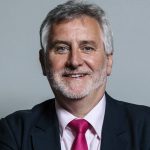
Tag: Clive Efford

  • Clive Efford – 2016 Parliamentary Question to the Department of Health

    Clive Efford – 2016 Parliamentary Question to the Department of Health

    The below Parliamentary question was asked by Clive Efford on 2016-10-14.

    To ask the Secretary of State for Health, whether he has made an assessment of the procedures that Greenwich Clinical Commissioning Group followed when it took its decision to award the contract for musculoskeletal services to Circle Holdings PLC; and if he will make a statement.

    Mr Philip Dunne

    The procurement of local health services by means of competitive tendering is a matter for the local National Health Service.

    We are informed by NHS England that Greenwich Clinical Commissioning Group follows standard NHS procurement procedures and these procedures were followed for this procurement.

  • Clive Efford – 2015 Parliamentary Question to the Department for Culture, Media and Sport

    Clive Efford – 2015 Parliamentary Question to the Department for Culture, Media and Sport

    The below Parliamentary question was asked by Clive Efford on 2015-11-09.

    To ask the Secretary of State for Culture, Media and Sport, what assessment he has made of the effect of a Sport Betting Right on betting operators; and if he will make a statement.

    Tracey Crouch

    The government has no plans to introduce a sport betting right.

  • Clive Efford – 2016 Parliamentary Question to the Department for Culture, Media and Sport

    Clive Efford – 2016 Parliamentary Question to the Department for Culture, Media and Sport

    The below Parliamentary question was asked by Clive Efford on 2016-03-03.

    To ask the Secretary of State for Culture, Media and Sport, whether he has had discussions with (a) Cabinet colleagues and (b) sporting stakeholders on setting up an independent body to fund research into anti-doping in sport; and if he will make a statement.

    David Evennett

    The World Anti-Doping Agency, to which the UK pays an annual fee, conducts research into anti-doping in sport that is utilised by national anti-doping organisations including UK Anti-Doping.

  • Clive Efford – 2016 Parliamentary Question to the Department of Health

    Clive Efford – 2016 Parliamentary Question to the Department of Health

    The below Parliamentary question was asked by Clive Efford on 2016-09-02.

    To ask the Secretary of State for Health, what the average cost is to the NHS of each patient visit to a (a) GP, (b) GP surgery-based practice nurse and (c) practitioner led service at The Source, Greenwich; and if he will make a statement.

    David Mowat

    The information requested is not centrally held.

  • Clive Efford – 2016 Parliamentary Question to the Department for Transport

    Clive Efford – 2016 Parliamentary Question to the Department for Transport

    The below Parliamentary question was asked by Clive Efford on 2016-10-14.

    To ask the Secretary of State for Transport, what steps he is taking to monitor the environmental effect of flights going to and from London City Airport; and if he will make a statement.

    Mr John Hayes

    Under the Environmental Noise (England) Regulations 2006 (SI. 2006 No. 2238), airports such as London City are required to produce noise action plans at least every five years. This requires an assessment of noise impacts around airports and for the airport to identify suitable measures to address noise problems. The Secretary of State is responsible for approving noise action plans.

    London City Airport also funds the employment of an Airport Monitoring Officer at the London Borough of Newham. This role includes ensuring that the airport complies with requirements placed upon them, including those related to the environment – such as not operating flights at night.

  • Clive Efford – 2015 Parliamentary Question to the Department for Communities and Local Government

    Clive Efford – 2015 Parliamentary Question to the Department for Communities and Local Government

    The below Parliamentary question was asked by Clive Efford on 2015-12-08.

    To ask the Secretary of State for Communities and Local Government, what assessment he has made of trends in the number of homes built for social rent since 2010.

    Brandon Lewis

    Since 2010 we have delivered 270,000 affordable homes, including nearly 200,000 homes for rent.

    The majority of rented homes delivered through the Affordable Homes Programme are for Affordable Rent, delivering more homes for every pound of Government investment.

    The Spending Review committed £1.7 billion to deliver 100,000 affordable rented homes.

  • Clive Efford – 2016 Parliamentary Question to the Department for Culture, Media and Sport

    Clive Efford – 2016 Parliamentary Question to the Department for Culture, Media and Sport

    The below Parliamentary question was asked by Clive Efford on 2016-03-03.

    To ask the Secretary of State for Culture, Media and Sport, what information his Department holds into anti-doping in UK sport; and if he will make a statement.

    David Evennett

    UK Anti-Doping is an Arms Length Body of DCMS and regularly advises my Department on all anti-doping matters.

  • Clive Efford – 2016 Parliamentary Question to the Department of Health

    Clive Efford – 2016 Parliamentary Question to the Department of Health

    The below Parliamentary question was asked by Clive Efford on 2016-09-02.

    To ask the Secretary of State for Health, what assurances he has received from Greenwich Clinical Commissioning Group that the £12 million saving promised by Circle Holdings plc as part of its successful bid for the contract to provide musculoskeletal services will not affect the quality of services to patients; and if he will make a statement.

    Mr Philip Dunne

    The procurement of local health services by means of competitive tendering is a matter for the local National Health Service.

    We are advised that NHS Greenwich Clinical Commissioning Group (CCG) undertook a review of the provision of musculoskeletal (MSK) services in the area in 2014, involving local general practitioners (GPs), secondary care clinicians, other MSK clinicians and patient groups. The CCG took account of this exercise in confirming its commissioning intentions for an integrated MSK service pathway. The CCG subsequently held a GP clinical commissioner-led provider engagement event on 2 March 2016 to seek feedback on the clinical service specification and the proposed contractual model.

    We understand that, as part of the procurement process, the MSK Programme Board was fully apprised of the Our Healthier South East London initiative, the predecessor to the Sustainability and Transformation Plan (STP) in respect of elective orthopaedic centres.

    We are advised that the Invitation to Tender (ITT) developed as part of the procurement exercise explicitly stated the aspirations of these two initiatives, in addition to the proposed implementation timeline. When submitting their bids, all prospective providers were required to confirm their understanding and acceptance of the planned new model of in-patient care. Patient choice continues to apply with regard to both this local procurement and the South East London STP proposals on elective care centres.

    We understand that the ITT issued to potential service providers, was divided into sections, with each section allocated a weighting. The financial weighting was designed to ensure that the selection of the preferred provider was driven by clinical quality scores whilst remaining within the CCG’s published financial envelope. The detailed clinical service specification will be used to hold the provider to account within the format of the NHS national standard contract.

    Health Ministers have not received any representations from local health practitioners in Greenwich with regard to the provision of MSK services in the area.

  • Clive Efford – 2016 Parliamentary Question to the Department for Transport

    Clive Efford – 2016 Parliamentary Question to the Department for Transport

    The below Parliamentary question was asked by Clive Efford on 2016-10-14.

    To ask the Secretary of State for Transport, what restrictions are in place controlling flights going to and from London City Airport; and if he will make a statement.

    Mr John Hayes

    London City Airport’s operational hours are limited to minimise the impact on local residents. The airport is permitted to operate flights between the following hours:

    • 06.30 and 22.30 hours on weekdays
    • 06.30 and 13.00 hours on Saturdays
    • 12.30 and 22.30 on Sundays
    • 09.00 and 22.30 hours on Public or Bank Holidays
    • Full closure on 25 December

    The final 30 minutes of operation is solely for flights scheduled earlier which have been unavoidably delayed.

    The total number of aircraft movements (take off and landings) is limited to 120,000 per annum.

  • Clive Efford – 2022 Speech on Southeastern Railway Timetable Changes

    Clive Efford – 2022 Speech on Southeastern Railway Timetable Changes

    The speech made by Clive Efford, the Labour MP for Eltham, in Westminster Hall, the House of Commons, on 6 December 2022.

    I beg to move,

    That this House has considered Southeastern railway timetable changes.

    It is genuinely a pleasure to serve under your chairmanship, Ms Harris, for the first time, I think. We are here because on 4 August Southeastern sought and got the Government’s permission to cut rail services without consultation. It is cutting two trains from the morning peak in my constituency on the New Eltham and Mottingham line, and three from the Eltham and Kidbrooke line. On the Bexleyheath line, which services Eltham and Kidbrooke, it is cutting three trains out of 15—a 20% cut in the morning peak capacity of trains that go via London Bridge. It is a similar cut in New Eltham and Mottingham, where the number of trains will go from 18 down to 16, but there is the welcome addition of one single train that goes to New Eltham via Blackfriars. Given an average of 10-car trains, the cuts on the Bexleyheath line amount to 3,000 passengers at peak time who have to find spaces on the remaining trains. It is a similar situation on the New Eltham line.

    Before the pandemic, we had PiXC—passengers in excess of capacity—on our lines. We campaigned previously for additional trains, particularly off peak, and were successful in getting them. Transport planners do not recognise that our part of south-east London is not served by the London underground and we rely very heavily on train services. The cuts take no account of that fact, nor of the fact that my constituency has a huge new development at Kidbrooke, which has had a considerable effect on the numbers of passengers getting on and off trains at Kidbrooke station.

    According to the Office of Rail and Road, there were 890,000 passenger exits and entrances at Kidbrooke station in 2010. That had risen by more than 42% to 1.5 million by 2018. During the pandemic, as we would expect, the number of exits and entrances went down to 429,000 in 2020, but it is already back over 1 million at Kidbrooke station and it is continuing to rise. There were also increases at Eltham station, but on nowhere near the scale of the increases at Kidbrooke station because of that development.

    The Kidbrooke development is approaching 7,000 homes, about half of which have been completed. Passenger entrances and exits had already increased by 640,000, as I said, but that was prior to the pandemic. Taking that as a guide, that means we will see a further 1.5 million entrances and exits at that station by the time all the properties are built. The proximity to the train station was used as justification by the developer Berkeley Homes, as well as by the Mayor of London and Transport for London, in respect of the development of 619 homes at Kidbrooke. Was that taken into consideration when the Government approved the cuts to train services?

    Back in September 2017 we all thought we had cracked the problem of overcrowding. We all campaigned to get extra trains and longer trains on the line and the Government allowed Southeastern to do that—we were told that we got 68 extra carriages. The then managing director, David Statham, said:

    “Longer trains will mean more seats, more space and more comfortable journeys…Southeastern has worked very closely with the Department for Transport and Govia Thameslink Railway to deliver this extra capacity for passengers.”

    The press release went on to say that trains to Hayes, Bexleyheath, Woolwich, Sidcup, Bromley South and Grove Park would be lengthened. We were told we were going to get extra capacity, not less. Now we are told there is a need to rationalise services post covid.

    A report on Southeastern published in July by the Office of Rail and Road shows that 2018-19 was its busiest year—but then, of course, the pandemic hit us. There were 183.2 million passenger journeys in 2018-19, but the number dropped to 40.2 million in 2019-20. In 2021-22, passenger journeys went up to 97.8 million, which is more than a 50% increase, and they are continuing to rise, so this is hardly the climate in which we should undertake cuts.

    Sir David Evennett (Bexleyheath and Crayford) (Con)

    The hon. Gentleman is doing a really good job of explaining the figures. In the London Borough of Bexley, a lot of new apartments and houses are being built and there will be increased demand.

    Clive Efford

    Absolutely. I do not think any account has been taken of the increased demand from the additional development in our part of London—certainly not the demand from the very big development at Kidbrooke. We are seeing considerable growth and no one can know where it will end.

    We see a similar pattern in passenger kilometres. Again, the highest number was in 2018-19. That dropped massively in 2020-21, but more than doubled in 2021-22. For planned trains—the trains agreed with Southeastern and Network Rail the night before they run—2018-19 was the busiest year, with 654,389 trains. The number dropped to 527,855 in 2020-21, then still further in 2021-22 to 523,965—that is a 20% drop in planned trains. If we look at the performance figures—bear in mind that the Government’s rationale is that running fewer trains makes the trains more efficient—we do not see the huge improvement in performance that we would expect from running considerably fewer trains, so the Government’s argument that fewer is better is not borne out by the facts.

    The rationale is the old chestnut that the all the trains crossing over west of Lewisham create too much congestion, which leads to knock-on effects and delays. That argument was rolled out several years ago when Southeastern wanted to take away the Victoria service from the Bexleyheath line. It was the same story: “It’s all those trains crossing over west of Lewisham.” Back then, I spoke to some rail experts about the problem and they told me that what Network Rail and Southeastern were saying was complete nonsense. There is not a problem with trains crossing over at that point unless there is bad maintenance and a lack of investment in the infrastructure.

    We need to be clear about what is happening. In Transport questions recently, the Minister said to me:

    “It is not just about taking down some costs; it is also about simplifying the line structure, so that at Lewisham, for example, there will not be as many trains crossing.”—[Official Report, 24 November 2022; Vol. 723, c. 436.]

    First, this is about cost cutting—the Minister has made that clear. There is then this issue of too many trains crossing. It might be fine to say that to people who still have trains, but we are having trains cut. Obviously, our trains cannot cross if they do not exist, so actually what the Minister says is true: the service will improve because the trains are not there. If we follow that logic, we should perhaps just get rid of all the trains; that would solve the problems on our railway.

    When I first asked questions about these cuts, I was told that cutting peak-time trains would reduce cancellations and delays. When I pressed further, I was told:

    “The number of train services in the new timetable is broadly very similar to the current timetable on both of these routes.”

    I pushed a bit further, because that answer denied that there are cuts on the Bexleyheath and Sidcup lines. The idea that the trains will run better becomes a self-fulfilling prophecy, because nobody can be criticised for a delayed train that does not exist. Given the logic of the solution that running a future railway should be based on cuts to services, I suspect we will be back here again listening to the Minister explain why we need to cut trains further because we still have a problem of poor maintenance and lack of investment in the infrastructure west of Lewisham.

    First, the Government tried to avoid admitting they had approved the cuts without consultation; I was told that they would reduce cancellations, which is not what I had asked. Then, the Government said there would be a similar number of trains, when I had asked how many cuts there would be. It has been a shameful attempt by the Government to avoid their responsibility for approving cuts to our services. Admitting now that there are cuts is a welcome step, but that will make everyone else’s trains run on time while we have to endure cuts.

    The new timetable has been imposed without listening to our constituents. It is too late to change that and the Government are determined to press ahead. What is the Minister going to do to monitor the situation so we do not go back to overcrowded trains and a poor service after the new timetable is introduced? That is what we endured before and I see nothing in the decision to cut our train services that is going to change it.