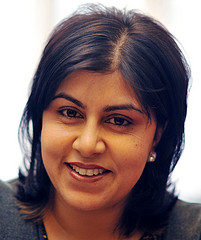
Tag: Baroness Warsi

  • Baroness Warsi – 2016 Parliamentary Question to the Home Office

    Baroness Warsi – 2016 Parliamentary Question to the Home Office

    The below Parliamentary question was asked by Baroness Warsi on 2016-09-15.

    To ask Her Majesty’s Government whether they will place in the Library of the House copies of all the end of year evaluation reports of projects and civil society organisations funded by the Home Office under the Prevent strategy for the years 2011 to 2016.

    Baroness Williams of Trafford

    For security reasons we do not publish detailed evaluation reports. Headline statistics on Prevent delivery are reported annually through the CONTEST Annual Report.

    The most recent CONTEST Annual Report was published on 21 July 2016.

  • Baroness Warsi – 2016 Parliamentary Question to the Home Office

    Baroness Warsi – 2016 Parliamentary Question to the Home Office

    The below Parliamentary question was asked by Baroness Warsi on 2016-10-13.

    To ask Her Majesty’s Government, further to the Written Answer by Baroness Williams of Trafford on 29 September (HL1969), whether they will place in the Library of the House a list of civil society organisations funded by the Home Office under the Prevent strategy for the years 2011 to 2016.

    Baroness Williams of Trafford

    The Home Office works with a broad range of community groups and civil society organisations who deliver community based projects and counter narrative campaigns to safeguard against radicalisation.

    Headline statistics are reported annually through the CONTEST Annual Report. In 2015, 130 community based projects were delivered reaching over 25,300 participants and counter narrative products developed in partnership with groups generated over 15 million online viewings.

  • Baroness Warsi – 2014 Speech Honouring Overseas World War One Heroes

    baronesswarsi

    Below is the text of the speech made by Baroness Warsi, the Foreign and Commonwealth Office Minister, in London on 26th June 2014.

    Your Royal Highness, Ladies and Gentlemen. It is a great privilege to welcome you here this afternoon, to commemorate the Victoria Cross recipients of the Great War.

    I am delighted to welcome His Royal Highness The Duke of Kent, as our Guest of Honour. As President of The Commonwealth War Graves Commission, and through his military roles as Colonel-in-Chief of the Royal Regiment of Fusiliers, Royal Colonel of 1st Battalion The Rifles, and Honorary Air Chief Marshall of the Royal Air Force, His Royal Highness has connections to several of the VCs we are commemorating today and it is an issue that is as dear to his heart as it is to mine.

    The bugle call to arms that sounded across Britain in August 1914 carried to the farthest corners of the world.

    It was heard in Australia, Canada, and New Zealand; in the countries we know today as India, Pakistan, Bangladesh and Burma; and across Africa and the Caribbean – where men travelled at their own expense to enlist.

    And around three million men responded, coming to Britain’s aid and joining the Allied cause. Tariqs and Tajinders fought shoulder to shoulder with Tommies in Flanders, Ypres, Gallipoli and Passchendaele.

    And, it is very clear, that without all of them Britain, the Allies, could not have prevailed. Without them, we would not have the rights and freedoms that we all enjoy today.

    A little over a year ago I visited the battlefields of France and Belgium. My own personal pilgrimage.

    I saw the Neuve Chapelle Indian Memorial which honours almost 5000 soldiers from the Indian sub-continent who have no known grave;

    I laid a wreath to Sikh soliders at Hollebeke in Belgium. And also then thought of Khudadad Khan, a Punjabi Muslim, who single-handedly held back the enemy long enough for reinforcements to arrive, making him the Great War’s first overseas recipient of the Victoria Cross;

    And I paid my respects at Menin Gate in Ypres – which lists the names of the 54,000 British and overseas soldiers whose resting places are unknown.

    Seeing names like Khan and Singh, Ali and Atwal listed alongside Smith, Jones and Williams and Taylor reminded me of a line by Rudyard Kipling, inscribed on the Tomb of an unknown Seypoy who fell in France, which reads: “This man in his own country prayed we know not to what powers; We pray to them to reward him for his bravery in ours.”

    All deserve our enduring gratitude and respect for the hardships and horrors they endured, and for the selfless sacrifice they made.

    To me, they are all heroes.

    But, as we are here today to commemorate, the courage and fortitude of many of Britain’s overseas soldiers brought them particular distinction. 175 were judged to have acted “with most conspicuous bravery, or some daring or pre-eminent act of valour or self-sacrifice, or extreme devotion to duty in the presence of the enemy” to warrant the award of Britain’s highest military honour – the Victoria Cross.

    Men like:

    – Private John Kerr from Canada – awarded his Victoria Cross for “most conspicuous bravery” on 16 September 1916, towards the end of the Battle of the Somme. Knowing that bombs were running short, Private Kerr ran under heavy fire until he was in close contact with the enemy. He opened fire on them at point-blank range, and inflicted heavy loss. The enemy, thinking they were surrounded, surrendered. Sixty-two prisoners were taken and 250 yards of enemy trench captured.

    – Or Captain Alfred Shout from New Zealand who fought with the Australian Imperial Force. Captain Shout won his VC for most conspicuous bravery at Lone Pine trenches, in the Gallipoli Peninsula.

    – And Gobind Singh from India. He won his VC during the Battle of Cambrai in 1917 when, on three occasions, he saved his fellow men by volunteering to deliver urgent messages over 1.5 miles of open fire – despite having his horse shot from under him on each occasion and having to finish each journey on foot.

    Today, there are just nine Victoria Cross recipients alive. And I am honoured that we have two of them here with us this afternoon: Sergeant Johnson Beharry VC and Corporal Mark Donaldson VC.

    Sergeant Beharry’s story will be familiar to many of you gathered here today. He became the first living soldier in more than 30 years to be awarded the Victoria Cross. Twice, in direct face of the enemy, under intense fire, and at great personal risk, he showed heroism in saving the lives of his comrades.

    Corporal Donaldson, who has travelled from Australia to be with us today, became the first recipient of the Victoria Cross for Australia in January 2009. While deployed in Afghanistan, his patrol was ambushed. He deliberately made himself the target of enemy fire in order to draw Taliban fighters’ attention away from the casualties and allow wounded soldiers to be moved to safety.

    These acts go beyond bravery.

    The word “hero” is bandied around too often these days. And I’m sure you will agree with me, all of these men are the true heroes.

    Over the next four years, the centenary commemorations give us an opportunity to mark the important contributions of Victoria Cross winners, past and present, so that they become known and understood by a whole new generation. And 5 years since the last veterans of the Great War passed away, it is more important than ever to ensure future generations never forget.

    That is why:

    – we are providing funding support towards the restoration of the burial places of all VC winners;

    – we will honour 400 British Victoria Cross recipients from the First World War with commemorative paving-stones in their place of birth;

    – we will dispatch these beautifully handcrafted bronze plaque to the 11 other countries that the VC winners of the conflict came from;

    And finally, why I’m pleased to announce we will be launching a digital archive later this year to memorialise all overseas VC recipients. Ensuring that people of all backgrounds, from all over the world can remember and learn from their stories of heroism.

    To conclude, as I said at the beginning, it would not have been possible for Britain to prevail in the First World War without the massive contribution and sacrifice of countries from the Commonwealth and beyond.

    I am proud that that both my grandfathers fought in the Bombay Royal Sappers and Miners Regiment in the Second World War. It is incredible that, like them, men were inspired to fight for a country they had never seen; pledge loyalty to a far away King…for the value of freedom. Something they themselves had yet to fully experience.

    It shows the rich diversity of our shared history and that, whether you can trace your families heritage back to the Norman Conquest, or to a relative who gave his life for Britain a century ago; whether your grandparents came from Nigeria or your parents from Jamaica – this commemoration is relevant to us all.

    And it puts paid to the idea that you cannot be a Muslim and British; serve your country; support the military – our ancestors were doing these things 100 years ago.

    Today, we must ensure that the things they embodied and fought for: freedom, liberty, duty, courage, loyalty, sacrifice and caring for others are as alive today as they were in 1914 – regardless of race, creed or nationality.

    But the centenary also gives us the opportunity to commemorate and honour those who truly went above and beyond the call of duty- the VC recipients from overseas, and I hope you will find that these plaques are a fitting tribute – a reminder that Britain will never forget their courage and a powerful message that people of all backgrounds and faiths can unite in the name of a common cause.

  • Baroness Warsi – 2014 Speech in Oman

    baronesswarsi

    Below is the text of the speech made by Baroness Warsi, the Minister for Faith, in Muscat, Oman on 18th February 2014.

    Your excellencies, ladies and gentlemen.

    It is a true honour to be here. I have had the privilege of speaking from the pulpits of Britain’s oldest cathedrals and from the lecterns of the world’s greatest universities…

    But there is nothing quite like standing here at Muscat’s spectacular Grand Mosque, a place of deep spirituality and immense beauty.

    For me, this is something of a home from home – not only because it is a symbol of the faith I hold so dearly, Islam, but because its construction was partly down to a British company!

    And it is therefore the perfect backdrop for me to talk about religious tolerance. For Oman under His Majesty’s wise leadership is a symbol of that very co-existence we are all striving for. Proof that sectarianism is not inevitable – even when a religion is blighted by splits in a region that is constantly the focus of such tensions. Now I look forward to saying more about the lessons I think we can learn from your example later on in this speech.

    Ladies and gentlemen, I serve in the British government, in which I am the first ever Minister for Faith. In 2010, I became the first Muslim to serve as British Cabinet Minister. Alongside my responsibility for South Asia, Central Asia, and the United Nations ….my remit covers faith at home and religious freedom abroad.

    In both cases, I have made religious freedom my personal priority: promoting and protecting people’s right to hold a faith, to manifest their faith, or indeed to change their faith.

    This is something which I believe is not only integral to personal identity but also leads to fairer, more secure and more progressive communities.

    My own faith – Islam – has been shaped by my upbringing, coloured by the country I was born in, shaped by my experiences as a lawyer, a campaigner and a politician and my personal experience as a daughter, a wife and a mother.

    In my country, for a politician to talk honestly and openly about faith, especially one’s own faith, is not particularly fashionable. As Tony Blair’s advisor famously said “ we don’t do God.”. But back in 2010, when we came to government, the first major speech that I made was to state that we would “do God”.

    What I meant when I said that was that the way in which faith was being sidelined and marginalised was wrong, and that it had to change.

    That faith should be an important informer of public debate and that the role of faith charities, voluntary organisations and individuals motivated by faith to serve their societies would be supported.

    I said that we would tackle head on, the tough issues like the rising tide of anti-Muslim sentiment in Europe. In the UK I felt the bigotry of Islamophobia had increased, so much so that sentiment against Muslims had become acceptable even in the most civilised of settings.

    I felt that it was time for government to respond. I’m delighted that this government has done so, including through working with partners such as the OIC.

    I said that we would reach out to new faith communities as well as revive and restore some of our oldest relationships.

    In 2012 I had the privilege to lead the largest ever British ministerial delegation to the Vatican, where I argued that Europe should be stronger in its Christian identity.

    Why?

    Because minorities are most welcomed and accepted in places where they are sure of their own identity, and that militant secularism creeping across our continent was alienating minorities rather than welcoming them.

    I said that we would not shirk from our responsibility as a staunch defender of religious freedom. And it was right that last year, when I spoke at Georgetown University in Washington, I warned about religious persecution, especially against Christian minorities in parts of the Middle East. That is a tragic global crisis and it demands an international response.

    These are difficult and complex subjects, which have the potential to arouse passionate and emotional responses. But I hope my approach is from a position of hopefulness and optimism for the future.

    I also feel it is a responsibility – a responsibility to use my privileged position in politics to highlight injustice and encourage tolerance.

    I am a proud Muslim. I am patriotically British – indeed, one who is at her proudest when standing here in a part British-built mosque. Despite the oft asked unanswerable question as to which I am first – whether I am Muslim first or British first – I see no conflict in these parts of my identity.

    My patriotism and my faithfulness are both strong, positive forces which drive me.

    But today ladies and gentlemen I want to focus on an aspect of my identity that I have rarely mentioned publicly: my Sunni-Shia upbringing.

    The diversity of my religious teaching and the inquisitive approach to religion that was encouraged in our home. As a child Ashura was as much as part of my life as regular attendance at a Deobandi mosque.

    In the past I have argued that faith forms the fault lines of modern conflict, something which has come into stark relief in recent years. But these cracks are as present – and often deeper – within faiths as they are between them. This infighting is rarely confronted; but it is something which, I feel, poses a great danger to faith and to our world.

    Today I want to speak from a very personal perspective, in relation to my personal faith, Islam, and argue that hostile and violent sectarianism is not just un-Islamic: it is anti-Islamic.

    It has no roots in the practice of our faith – indeed, I believe it is condemned in the founding tenets. It is tragically the cause of tension, turmoil and terrorism.

    It should have no place in our world today, and is something we all have a duty to condemn and tackle. Now of course, sects, denominations, factions – in religions as in life – are nothing new. Cliques and rivalries are part of human nature. I should know that – I work in politics!

    But whilst people have always defined themselves by a whole series of characteristics – I describe myself as British, as working class, as Muslim, as a mum – today, sadly, one’s sect is becoming the dominant identifier. With the faithful not only increasingly identifying themselves by sect, but also defining themselves in comparison and in superiority to others.

    The hatred that can exist between sects – between people who follow the same God and share the same holy book – disturbs and saddens me.

    And even in Britain we are not immune from this. With division being preached by some, and belittling another’s faith or denomination being used as a way of reaffirming one’s own faith. Often the strongest condemnation seems to be reserved for your brother or sister in faith.

    The fact that their version of their faith does not replicate yours is no longer seen as an inevitable, healthy difference of opinion, but is seen as an insurmountable difference – to the point where sectarian difference is used as a way of justifying acts of religious extremism.

    Around the world such violence is reaching an all-time high. In Iraq, according to the UN, at the height of the sectarian conflict, more than 50,000 Iraqis were killed as a result of terrorist violence. More than 8,000 Iraqis died in such violence last year alone.

    In Pakistan, in the past two years, more than 1000 people have died in sectarian violence. Sectarian violence continues to blight in Lebanon. It takes place in Somalia, between al Shabaab and its opponents, and in Yemen, with the targeting of Shia Houthi Muslims. Now I accept that not all of these deaths were necessarily motivated by sectarianism alone. Some attacks were simply an attempt by terrorists to destabilise a community or a country.

    But the fact that terrorists use sectarianism as a basis for their actions shows how deep and dangerous this problem has become.

    It reflects an attitude that underpins a worldview that states you are only acceptable if you follow my version of my faith.

    This Takfiri worldview, which rejects the longstanding Islamic tradition of ikhtilaf – of difference – is deeply worrying to me, where the faithful appear far more concerned with others’ faithfulness than with their own.

    I’ve been a victim of this judgementalism myself; a few years ago attacked on the streets of Britain by a gang who accused me of not being a ‘proper Muslim’.

    They didn’t approve of my involvement in politics and they didn’t approve of me appearing in public with my face uncovered.

    They reduced my faith to a list of ‘don’ts’, defined only in the negative, defining their faith in terms of what they are against, rather than what they stand for. Stripping out the soulfulness and kindness of spirit that sits at the heart of Islam.

    I believe that this approach is at odds with the teachings of Islam, and leaves the faithful vulnerable to extremists who justify violence in the name of Allah.

    For I have always been taught that faith is at its strongest when people find their own way to the Almighty. And as Oman’s Religious Tolerance website so wisely states: “everyone must answer for himself before God”.

    But there’s a deeply disturbing political element to sectarianism when negative political forces exploit these differences. And this approach takes on an even more sinister tone when sect is equated with nationality or loyalty to a particular country.

    Where Shia Muslims in Sunni majority countries are seen as loyal to another country, and vice versa.

    I’ve spoken about this previously, in relation to the tensions between different faiths, such as when Christians are persecuted in Muslim-majority countries because they are seen as agents of the west, and where Muslims in the west are held responsible for the actions of their co-religionists in the east.

    Of course violent sectarianism isn’t peculiar to Islam. The United Kingdom knows all too well what happens when religious differences and divisions are used as a proxy for political problems.

    Over decades the divisions in the historic struggle in Northern Ireland were aligned with religious difference – that of Protestants and Catholics.

    Many lives were lost. The Troubles, and the scars remain.

    Indeed, the course of our history – in the UK but more so elsewhere in Europe – has been shaped by the bitter and historic clashes within Christianity. One only has to recall during the Crusades the cry of Christians against fellow Christians “kill them all, God will know his own.”

    Now Ladies and gentlemen, this is an incredibly complex problem. There are no easy solutions. But let me lay out an approach which I think we could start to tackle it.

    Let me go back to basics. The universal Islamic definition of what constitutes a believer in Islam is extremely simple: la ilaha illallah Muhammadur rasulullah: a belief in God and Muhammad as his Prophet (peace be upon him). There are no other stipulations or conditions at all for belief. Even at the time of the Prophet, there were differences of opinion between his Companions over his religious instructions that were interpreted in different ways, even over sacred duties such as prayers. The Prophet viewed those differences of opinions as healthy, as an inevitable diversity, and even as a blessing of, the faith.

    Therefore any notion of rejectionist sectarianism goes against the very foundation of the Muslim faith. Political and religious leaders must repeat this message, loudly and clearly, far and wide.

    We need to point to history to show violent sectarianism is not inevitable.

    We must look to times when different sects within Islam worked together and worshipped together.

    They must look to the fact that Imam Jafar, a key figure in Shia Islam, was actually a teacher of Imam Malik and Imam Abu Hanifa, founders of two of the most widely followed Sunni Schools of Thought throughout the world today.

    All of us, believers and leaders alike, must reclaim the true meaning of Islam, and focus on the things that unite us, rather than those that divide us.

    And in reclaiming the true meaning of Islam we must also reclaim the language of Islam, much of which has been distorted and usurped for political ends So let me start by restoring the concept of ‘ummah’.

    Ummah is, by its very nature, a definition of community, one that includes difference, not excludes it. The Prophet’s ‘Ummah’ in Medina was multi-faith and multi-ethnic. It was an Ummah of Conscience.

    And let’s not forget: the Prophet Muhammad (peace be upon him) is constantly referred to as “Rahmat lil Alameen” – mercy for the world. There could not be a more clear statement than that of the inclusive concept of ummah in Islam.

    So, we must reclaim the faith, and the language of the faith. But we must go beyond that.

    We must highlight great living examples that show how violent sectarianism is not inevitable.

    Oman is one such example.

    It is an oasis of tolerance in a desert of division – proving that, right in the geographical centre of a troubled region, different sects can and do live side by side.

    This is testament to His Majesty the Sultan’s wise leadership and the character of the Omani people.

    The warm encounters between Ibadhi and Shia Muslims at the Al Lawati Wall; the praying side-by-side of Sunni and Ibadhi Muslims in mosques like this one.

    The humility and openness seamlessly extended to other faiths; the welcome given to the new Christian church in Ruwi by the Omani authorities.

    These are principles on which Oman thrives and I couldn’t put it better than the Omani Ministry for Religious Affairs, when it states: “Bloodshed due to theological differences is shameful.

    Prayers in the mosques throughout the country are conducted with Sunnis and Shiites at the sides of the Ibadhis. The communal prayer to God knows no theological disputes. Everyone must answer for himself before God.”

    And I couldn’t think of greater symbolism of this than His Eminence, the Grand Mufti of Oman, an Ibadhi, conducting a wedding between a Shia bride and Sunni groom.

    So in conclusion ladies and gentlemen, those of us who have had the privilege of experiencing this social harmony must make the case for it, over and over again. To share, to provide, to demonstrate the benefits of such co-existence. To highlight the benefits of pluralism, and warn of the stifling impact of sectarianism.

    In previous speeches I have made the case that Islam – by its very nature – is moderate. Today, I hope I have made the case that violent sectarianism isn’t just unIslamic, it is anti-Islamic. It is at odds with Islam’s principles and perspective and it jeopardises the future of the faith.

    I want to thank my hosts for giving me the great privilege of allowing me to make this personal plea from yet another pulpit in the most soulful of surroundings. Thank you.

  • Baroness Warsi – 2013 Speech on the First World War

    baronesswarsi

    Below is the text of the speech made by Baroness Warsi on the First World War and the contribution from the Commonwealth. The speech was made at the Royal United Services Institute on 8th November 2013.

    Introduction

    In his speech ‘A Time of Triumph’, Winston Churchill praised those who came “from the uttermost ends of the earth” to fight alongside Britain in the Second World War. “From the poorest colony to the most powerful dominion”, he said, “the great maxim held: when the King declares war, the Empire is at war”.

    Both of my grandfathers were among those brave men. And for that reason I have always known something of British India’s role in that conflict. But for many years I was unaware of the role their fellow countrymen played 30 years earlier. The 1,500,000 from modern day India, Pakistan and Bangladesh who served, fought and fell for Britain in the Great War.

    So many others from what is now the Commonwealth served too. Nearly half a million from Canada. The same number from Australia, Tasmania, New Zealand and Newfoundland. 74,000 from South Africa. 16,000 from the West Indies. 30,000 from other dominions. And many more from beyond the British Empire.

    As I’ve said on many occasions, our boys were not just Tommies – they were Tariqs and Tajinders too. And for far too long this has been overlooked, like a chapter torn from the book of our history. This project, the lectures, the multi-media presentations, are a way of using the forthcoming centenary to make us all better informed.

    Real stories

    It’s important that the focus is on the individuals. Using letters and photographs; war diaries and anecdotes. To reveal the stories behind the statistics. As the Prime Minister said: some will make you cry, some will make you laugh. Let me tell you one which inspired me.

    Mir Dast, from Tirah, Pakistan, found himself in a poisonous gas attack on the Ypres Salient. There were no gas masks. His comrades resorted to makeshift measures to survive. Dipping their turban ends in chloride of lime and holding them over their mouths. Meanwhile, Mir Dast rallied all the men he could. He brought in 8 wounded officers, despite being wounded and gassed himself. For this, he won the highest military honour.

    And this is how he described it to his family:

    The men who came from our regiment have done very well and will do so again.

    I want your congratulations. I have got the Victoria Cross.

    What astonishing humility – putting his comrades first in his letter, just as he had done on the battlefield.

    Interfaith co-operation

    Earlier this year I visited the battlefields of Belgium and northern France. And those long, even lines of headstones give some insight into the scale of sacrifice. Each one representing a life extinguished and a family bereft. The inscriptions and symbols on the stones…Christian crosses. But also Stars of David. Urdu and Hindi script. Even Chinese lettering.

    For me that diversity is the starkest reminder: that comradeship, companionship and co-existence cut cross all faiths.

    Of course, this doesn’t sit particularly well with extremists’ views. And it doesn’t fit the extremists’ narrative that other faiths have no place in Britain. It dispels the myth that you cannot be both devoted to a faith and loyal to a country. Our shared history scuppers their argument. It says to the far-right: this wasn’t the all-white war you believe it was.

    Now, ladies and gentlemen, we may have wrestled the Union Flag back from the extremists.

    And I believe highlighting these multi-ethnic, multi-faith stories will reclaim our proud, patriotic history too. There will be many who don’t want these stories to come to light.

    Whether it’s the extremists on the far-right. Or ignorant people like Anjem Choudary and his followers. Because this is about commemorating, honouring and, above all, learning – and it is good for Britain.

    Conclusion

    So I’m delighted to stand here and see this project come to fruition.

    Can I thank the Curzon Institute, whose blood, toil, sweat and tears have especially helped to make this happen.

    I know how important the support of the former chief of the defence staff has been.

  • Baroness Warsi – 2013 Speech to the UN Security Council

    baronesswarsi

    Below is the text of the speech made by Baroness Warsi to members of the the UN Security Council at Lancaster House in London on 11th February 2013.

    I am delighted to welcome you here tonight.

    We are honoured to be joined by both our current partners on the Council and by those who left at the end of last year.

    And I would like to extend a particular welcome to my fellow parliamentarians and our guests from the United Nations Association-UK.

    In January we said farewell to Germany, South Africa, India, Portugal and Colombia, who stepped down from the UN Security Council.

    I want to thank their representatives here tonight for the excellent collaboration we have enjoyed over the past two years – without which the Council would have been unable to respond effectively to international crises, not least the huge changes we have seen across the Middle East and North Africa.

    I now have the pleasure to welcome five new members onto the Council – Argentina, Australia, Luxembourg, the Republic of Korea and Rwanda.

    Each of you will bring new perspectives and priorities to the Council’s agenda. I’m sure you will also bring with you a sense of pragmatism, and a commitment to working together to bring about peaceful resolutions to the myriad challenges to global peace and security.

    Colleagues in the Foreign and Commonwealth Office – whether in London, New York or elsewhere in our overseas network – are ready to work closely with you on all UN issues…

    …not just the issues we agree on, but those we may approach from different perspectives.

    This is, after all, the purpose of the Security Council.

    The Council is the fundamental UN instrument for maintaining international peace and security. It is what the world looks to when there are threats to international peace and security or humanitarian disasters.

    It brings together different ideas and a range of perspectives. It is the forum for negotiation and debate, and for seeking international consensus on matters that affect all of us.

    This is not an easy process, and it can at times test Council unity. But it is a process to which we must all remain committed and it is vital that we work closely together.

    The issues at stake are too important for us not to.

    I have been Minister for the United Nations for only a few months, but have already had the privilege to visit New York twice to see the UN and the Security Council in action.

    My first was in September to attend the UN General Assembly Ministerial week where Heads of State, Government and Ministers from around the globe convened in New York to mark the start of an intense period of debate and negotiation on the full spectrum of international issues.

    And last month I attended a debate in New York on Counter Terrorism chaired by Pakistani Foreign Minister Khar. In that debate I stressed the importance of a comprehensive global approach to countering terrorism in all its forms.

    This shared commitment to tackling threats to our collective peace and security is the driving force behind Council business. And while 2012 was not without its challenges, we can still be proud of our achievements.

    In Somalia we have ensured that the transition roadmap obligations are delivered and that there is adequate support for the peacekeeping mission, AMISOM…

    In Yemen, which hosted a Security Council visit last month, we have supported the political process to help keep transition on track…

    And in Sudan and South Sudan it was the Council’s action that gave the African Union’s roadmap the strength and resources it needed to successfully bring both parties to the negotiating table and prevent all-out conflict.

    These achievements are all too often overlooked, amid questions of Council effectiveness.

    It is of course right that we continue to set a high bar for the important work the Council does. But the examples I mention show just a fraction of what can be achieved when we come together and take decisive action.

    And it is in this spirit that we should look ahead.

    There’s little doubt that we will face new challenges in 2013.

    In Mali, the Security Council and its members will be instrumental in supporting the pushing back of the armed militia, and in doing so protecting millions of civilians…

    In Somalia, which remains a personal priority for my Prime Minister, the Council will need to set the long-term response and ensure stability…

    In the Democratic Republic of Congo, the Council will need to support a unified process to ensure stability and prosperity in the eastern part of the country…

    And, of course, the Council will need to put aside differences and commit to reaching resolutions in Syria and between Israel and Palestine. I cannot stress this point enough. The Council must united and act decisively to encourage all parties to come to the negotiating table.

    It is clear that we have a lot to do. But if we work together, I believe we can achieve a great deal.

    Before I wrap things up, I would like to thank again those member states who left at the end of 2012 for their contribution to the Council over the past two years.

    We have greatly valued your tireless work and commitment in what has been an immensely busy period.

    We look forward to continuing our work with you bilaterally and multilaterally in the years ahead, as we do with the new Council members.

  • Baroness Warsi – 2013 Speech at the Islamic Cooperation Summit

    baronesswarsi

    Below is the text of a speech made by the Foreign Office Minister, Baroness Warsi, at the Organisation of Islamic Cooperation Summit in Cairo on 7th February 2013.

    Your Majesties, your excellencies, it is a pleasure to speak at this OIC Heads of State meeting – and a privilege that I’m the first British Government Minister to do so.

    I am delighted to be here in Egypt, which among many other things is the home of Al Azhar, the ‘Manaratul ‘Ilm’ for many Muslims across the world. I was deeply honoured to have met his Eminence the Shaykh Al Azhar yesterday and His Holiness Pope Tawadros II today.

    The invitation to speak here is a clear demonstration of the strengthening bonds between the OIC and the UK. I am grateful to our hosts, Egypt, who have of course taken over the OIC’s presidency this year.

    I said at the meeting of OIC Foreign Ministers in Kazakhstan in 2011 that we in Britain are deeply committed to building our relationships with the Muslim world.

    I am particularly pleased that we were able to sign a Memorandum of Understanding with the OIC at the UN General Assembly in September.

    This would not have been possible without the tireless efforts of His Excellency Secretary-General Ihsanoglu – whom I am sure you will agree has steered the OIC towards being a relevant and important player on international issues, and whom I personally consider to be a friend.

    Freedom of Religion or Belief

    We have heard today about many important issues. But I want to focus on one. One which threads into so much of what we have discussed. One which is in itself a challenge, but that if we get right, will unlock solutions to so many other challenges we face.

    That issue is Freedom of Religion or Belief.

    Islamophobia

    Now, I know that the OIC has for many years been concerned about the scourge of Islamophobia, or anti-Muslim hatred, and other hate speech.

    As a practising British Muslim, as a proud member of a minority faith in a majority Christian nation, and as a Government Minister, I am also deeply concerned about this issue. But concern alone will not bridge divides.

    The question is, how do we address this scourge? How do we defeat it?

    I believe that the answer is to tackle religious intolerance head-on where and when it occurs, and to protect the rights of all in society.

    UK experience

    In the UK we have sought to do exactly that. We legislate against incitement to hatred on the basis of religion or belief, be it behaviour that is anti-Muslim or intolerant of any other religion or belief. But legislation is not the only answer. While incitement to religious hatred remains an offence in Britain, a blasphemy law once on our statute book was abolished in 2008 – in part because we felt it was incompatible with the freedom of speech.

    To truly achieve societies that are founded on tolerance and acceptance, on love and understanding, we need more than just legislation. We need to nurture these values, to engrain them into the way we look at the world.

    There are no short-cuts here. It requires patience and time, sometimes a generation or two.

    So in the UK we are seeking to combat negative media stereotypes…

    To develop resources for teachers…To support victims……and to improve hate crime reporting.

    Building a pluralistic society

    But it’s not just about dealing with incidents when they arise. If we want to truly defeat this scourge we must put in place the building blocks that support a pluralistic society based on tolerance and inclusion.

    A society where respect for the right to Freedom of Religion or Belief is universal.

    One in which people are free to make the basic choices of how they decide to live their daily lives.

    Those choices might include whether to be guided by one faith or another, or no faith at all…Whether to go to a church, a mosque or a temple…Whether to wear a cross around their neck, or to cover their head with a hijab or a kippah…Whether to read the Bible, the Torah or the Quran……or to send their child to a religious school or keep a religiously-proscribed diet.

    In short, this is all about real life. It is about the choices that people across the world, myself included, make every day.

    Over the past two years, people across this region have taken to the streets calling for dignity, for freedom, for jobs…demand for basic rights.

    And of these, the Freedom of Religion or Belief is absolutely fundamental; a universal right for all.

    And yet people across the world are still denied this basic freedom. They can be victimised or unfairly imprisoned simply for having a religion or belief, and some pay with their lives. For me, being a Muslim is about humanity.

    I believe that human rights underpin Islamic values, and that those rights are not limited to a specific religious belief or ethnic grouping.

    This is what motivates me to speak as passionately as I do about the rights of Christians, Jews and others of faith, or indeed of no faith – as I do about the rights of fellow Muslims. The basic duty of governments is to provide security for their people. That responsibility can have no exceptions.

    So if there is just one message that I hope you will take back from my contribution, it is the universality of Freedom of Religion or Belief.

    Your Excellencies, some peddle the notion that people of different faiths and beliefs cannot co-exist peacefully, with respect for each other’s views.

    This misguided notion is held in the West, as it is in the East. Some use political ideology to justify this viewpoint…others use extremist religious views.

    But I reject that notion. I reject it because history tells us otherwise, and I reject it because of my own experience.

    The UK’s culture of tolerance

    The UK is by no means perfect. But I am proud of its culture of religious tolerance; of its position as a multi-ethnic, multi-cultural and multi-religious state.

    It is a country in which people have traditionally been confident of their nation’s Christian heritage and cultural identity. That confidence, together with a history of freedom of speech, has I believe made Britons open to the identities and religions of others.

    So yes, I accept that there are challenges in tackling this problem, and that overcoming them is not easy. But I have seen through my own experience that in Britain we are rising to them.

    Consider this simple question: in how many other countries could someone like me, the daughter of a poor Muslim immigrant, rise to a seat at the Government Cabinet table?

    I believe that we can build consensus and lead efforts to influence cultural norms in our countries in support of religious tolerance. Tolerance between religions, but also tolerance within religions.

    UNHRC Resolution 16/18 and the January Ministerial

    And the foundation has already been laid.

    UN Human Rights Council Resolution 16/18 on combating religious intolerance, now under the umbrella of the Istanbul process, provides a strong basis from which to work. UN member states have all jointly signed up to a call to action to implement the resolution.

    But what we need is greater political will.

    Since the meeting in Istanbul in 2011, the discussions and debates on this agenda had only taken place within UN fora or among experts. I felt that we needed to go further.

    Two weeks ago I hosted a high-level meeting in London on this very issue. I was delighted that His Excellency Secretary-General Ihsanoglu was able to join us, along with Ministers from Canada, Pakistan, the United States and representatives from a wide spread of other countries.

    I hope that the discussions we had in London will be the beginning of this dialogue. A dialogue in which we speak with confidence and openness, learning from one another and sharing best practice about how we have tackled these issues in our own countries.

    I am grateful that His Excellency the Secretary-General has agreed to host the next meeting as part of the Istanbul process.

    This is important, because an honest, open and frank dialogue on Freedom of Religion or Belief and tackling religious intolerance is something we must sustain.

    Conclusion

    Your Excellencies, we live in an interconnected world; one in which we can communicate more quickly and over greater distances than we have ever been able to in our history.

    I believe that it is outdated to view this world through the prism of Christians in the West and Muslims in the East. This is simplistic and historically untrue.

    Solutions that accept the reality of the pluralistic nature of our nations – long-term solutions – may well be led by Christians in the East and Muslims in the West. By people of faith across the world. Because, like the OIC, I don’t accept that religion is constrained by national boundaries.

    We need to continue to span these boundaries, to build a better future for our people.

    It is why as a Muslim from the West, representing the United Kingdom, it is a pleasure and a privilege to be invited to speak and be allowed to play a small part in reaching out to better understanding.

  • Baroness Warsi – 2012 Speech on World Day Against the Death Penalty

    baronesswarsi

    Below is the text of the speech made by Baroness Warsi on 10th October 2012 to mark the World Day Against the Death Penalty.

    I would like to thank the APPG for hosting this event, members of the expert group who have taken time out to attend this event, the other speakers on the panel, all of you who are here to support and most of all to Baroness Stern, for her tireless work and continued outspokenness on this issue over many years. It is clear there are issues which need to be spoken about and she should continue to be outspoken on this issue.

    One of the important things that Baroness Stern said in her remarks was that this is not a European initiative. Being British, of Asian origin, Muslim by faith and Conservative in politics, and seeing the other speakers on the panel today, it is clear that those who oppose the death penalty come in many shapes and sizes.

    In the early nineteenth century there were about 230 different offences carrying the death penalty in the UK. If you were caught stealing a sheep, cutting down the wrong tree or were judged to have “damaged Westminster Bridge”, you risked death.

    Things have, quite rightly, changed. The UK’s journey towards abolition of the death penalty has taken us from the first Parliament-imposed restrictions in 1957, to abolition for all ordinary crimes in 1969 and for all crimes apart from in times of war in 1998, up to Britain’s commitment to abolish the death penalty in all circumstances in 2004. We have been on a journey.

    Today as much as ever before, the death penalty remains a subject of the utmost importance. Over the next few minutes I want to make clear one, why we oppose the death penalty; two, talk about the global landscape on this issue; and three, set out what we are doing to encourage its abolition globally.

    Why we oppose the death penalty

    There was a question about reintroducing the death penalty in Britain on Radio 4’s Any Questions a couple of weeks ago following the murders of two women police officers – and you could tell from the audience reaction quite how strongly people felt against it.

    That isn’t surprising: the question of a state’s right to take life set against a legitimate wish to punish and deter serious crimes is among the most difficult of moral dilemmas.

    In Britain our view is clear: our long standing policy is to oppose the death penalty in all circumstances as a matter of principle. And by extension, to work towards its worldwide abolition.

    Fundamentally, we believe that its use undermines human dignity; that there is no conclusive evidence of its value as a deterrent; and that any miscarriage of justice leading to its imposition is irreversible and irreparable.

    The UK perspective

    When talking about this, it’s easy to slip into abstractions. But we shouldn’t, because it’s about people.

    When Timothy Evans and Derek Bentley were executed in 1950 and ’53, after flawed trials that led to posthumous pardons, it catalysed steps towards abolition in Britain.  It reminded us of the inhumanity of capital punishment.  And the risk – and tragedy – of getting it wrong.

    In a world with countries that retain the death penalty, that risk still exists.  Right now, there are twelve British nationals facing the death penalty overseas. One of the first things I did when I started my role was to ask my officials to print photos of them and give me information on their families. It is important to see them as people, not statistics.

    Foreign Office staff are in constant touch with them. We do our best to give support to them and their families, and we forcefully make the case to the governments concerned that these people, no matter what they are believed to have done, should not die at the hands of state authorities.

    Over the past year we have made representations on behalf of British citizens in the Democratic Republic of the Congo, China, the Central African Republic, the United Arab Emirates, Indonesia, Pakistan, Thailand, and the US, to name a few.

    It makes a difference: we judge that our interventions have helped to prevent death sentences, or to delay execution dates, giving time for further representations.

    International trends

    There has been growing international momentum towards abolition, particularly over the past two decades. Last year only 21 countries carried out executions, a figure which has fallen by more than a third over the last decade.

    Steps taken towards abolition in recent years by Benin, Gabon, Kyrgyzstan, Mongolia and the US States of Illinois and Connecticut are very encouraging; as is last year’s decision by the State of Oregon to introduce a moratorium on executions.

    This progress is welcome – because no legal system is error-proof, and the death penalty leaves no room for error.

    But despite this trend, some disturbing exceptions remain. We are deeply concerned by the increasing use of the death penalty: in Iran and Saudi Arabia, where public executions still take place; in Iraq, where 26 executions were recently recorded in a single week; and in the Gambia, which in August carried out nine executions after a moratorium of 27 years.

    UK action

    So, what does the British Government do?

    We work relentlessly with our EU partners and others to gain support for abolition of the death penalty, or at least a moratorium on its use.

    We seek dialogue with governments of countries which use the death penalty – to urge them to impose a moratorium, and to take steps towards abolition.

    And the FCO continues to fund projects throughout the world to support those campaigning against it.

    And whist doing this at the macro-level, we have an ever-watchful eye on the individuals.

    UN resolution

    In a few weeks’ time, the UN General Assembly will vote on the biennial resolution on the death penalty. It will again call for a moratorium rather than full abolition, allowing states that have suspended but not abolished capital punishment to give it their support.

    There has been good progress since the last resolution in 2010. Several countries have either abolished the death penalty, or taken steps such as ratifying the Second Optional Protocol to the International Covenant on Civil and Political Rights, which addresses the death penalty. In addition, there are many states which keep the death penalty in their legislation but do not use it.

    Our appeal, and my personal appeal at the UN General Assembly just a few weeks ago, is for countries to register an affirmative vote – or at least an abstention, if they have previously opposed the resolution.  Doing so would send a clear signal of their desire to join the growing worldwide movement towards abolition.

    Of the specific countries I have Ministerial responsibility for, five supported the resolution.  These were from the Central Asian states and I am pleased to see some of their representatives here today.

    Conclusion

    Amnesty International has called the death penalty the “ultimate, irreversible denial of human rights”.

    If we continue to work together and spread our message, I believe we can win the argument. And it’s important that we do, because capital punishment should have no place in the world today we live in today.