Tag: Aaron Bell

  • Aaron Bell – 2023 Parliamentary Question on Prosecutions for Fraud and Bribery

    Aaron Bell – 2023 Parliamentary Question on Prosecutions for Fraud and Bribery

    The parliamentary question asked by Aaron Bell, the Conservative MP for Newcastle-under-Lyme, in the House of Commons on 1 February 2023.

    Aaron Bell (Newcastle-under-Lyme) (Con)

    What steps she is taking to help the Serious Fraud Office investigate and prosecute fraud and bribery.

    The Solicitor General (Michael Tomlinson)

    Mr Speaker, you may remember that the SFO successfully prosecuted Glencore Energy UK Ltd and that the total amount the company will pay—£280 million—is the highest ever ordered in a corporate criminal conviction in the United Kingdom. We continue to work closely with the SFO to identify any policy changes that could support its ambitions.

    Aaron Bell

    My constituents want to see the Government crack down on corporate criminality. What measures are the Government considering in the Economic Crime and Corporate Transparency Bill to address corporate crime?

    The Solicitor General

    I am grateful to my hon. Friend for his interest. The Government recognise that the current law does not go far enough. That is why we have committed to addressing the need for a new “failure to prevent” offence in the Economic Crime and Corporate Transparency Bill. In addition, we are introducing a provision to extend the SFO’s pre-investigation powers.

  • Aaron Bell – 2022 Comments on Rishi Sunak Becoming Prime Minister

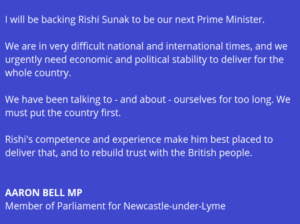
    Aaron Bell – 2022 Comments on Rishi Sunak Becoming Prime Minister

    The comments made by Aaron Bell, the Conservative MP for Newcastle under Lyme, on Twitter on 22 October 2022.

    I’m backing Rishi Sunak.

  • Aaron Bell – 2022 Comments on the Resignation of Liz Truss

    Aaron Bell – 2022 Comments on the Resignation of Liz Truss

    The comments made by Aaron Bell, the Conservative MP for Newcastle-under-Lyme, on Twitter on 20 October 2022.

    I am currently in a debate about levelling up, but have just seen that the PM has resigned. A successor will be elected within a week.

    These are very difficult times nationally and internationally. Those of us in Westminster must work together and put the national interest first.

  • Aaron Bell – 2022 Comments on the Prime Minister’s Conference Speech

    Aaron Bell – 2022 Comments on the Prime Minister’s Conference Speech

    The comments made by Aaron Bell, the Conservative MP for Newcastle-under-Lyme, on Twitter on 5 October 2022.

    Great speech from the PM!

    A global economic crisis is completely the wrong time to be raising taxes on businesses that create wealth. Liz’s growth focused approach will mean British businesses have the freedom to grow and invest – creating jobs and boosting prosperity for all.

  • Aaron Bell – 2022 Tribute to HM Queen Elizabeth II

    Aaron Bell – 2022 Tribute to HM Queen Elizabeth II

    The tribute made by Aaron Bell, the Conservative MP for Newcastle-under-Lyme, in the House of Commons on 10 September 2022.

    It is a sad privilege to rise to speak on behalf of my constituents in Newcastle-under-Lyme, to offer our condolences to His Majesty and the whole royal family, and to give thanks for the life and service of Her Majesty.

    As Britons, we are lucky to live in a constitutional monarchy, but to have had the Queen as our constitutional monarch we were more than lucky; we were blessed. I believe that she is the greatest public servant this nation has ever seen. Through 70 years, she has led this nation through profound challenges and seen profound change, not just in this nation but throughout the world and across the Commonwealth. She has led and guided us throughout with her grace, her wisdom and her example. She visited us in Newcastle-under-Lyme in 1973 for our octocentenary. Constituents of mine of a certain age will remember that, and as we prepare to celebrate 850 years next year, those memories will now be all the more poignant.

    As we remember Her Majesty, I would like to pay tribute to the way that she has led this nation. Only earlier this week we had the transfer of power. She continued to take her constitutional responsibilities with the utmost seriousness to the end, and I am sure the Prime Minister was extremely grateful for her advice only on Tuesday.

    I have sat in the Chamber and listened to much of the debate, both yesterday and today. There have been some very fine and moving speeches, and some very funny ones, on all sides. I think the finest speech I have heard was not from the Dispatch Box or from these Benches, and it was not even from the Opposition Benches. It was from the monitor screens in here yesterday, when we listened to His Majesty address the nation. It was a profoundly fine and moving speech, and it confirmed to me what I already knew from his many years of service as the Prince of Wales: that the Crown is in very safe hands and that we can look forward with confidence as we go through yet another trying time for our nation. He will follow his mother’s example, leading us into a new era. God save the King.

  • Aaron Bell – 2022 Speech at the Sir David Amess Summer Adjournment Debate

    Aaron Bell – 2022 Speech at the Sir David Amess Summer Adjournment Debate

    The speech made by Aaron Bell, the Conservative MP for Newcastle-under-Lyme, in the House of Commons on 21 July 2022.

    It is a pleasure to follow my hon. Friend the Member for Dudley South (Mike Wood), and an honour to be participating in the first Sir David Amess Adjournment debate. This is a very fitting tribute indeed for a great champion and an enthusiast for the format. He was someone to whom service of his constituents, his party and his country was of the utmost importance. There is so much inspiration for us newer Members in his example. I welcome his successor, my hon. Friend the Member for Southend West (Anna Firth), to her place today. I also welcome five other Members who have joined us since last summer. A few of them came in on the back of by-elections that were quite painful for my party, but it is important that we remember the people who sent us here, and by-elections are a way to do that, and perhaps they have given this party a wake-up call over the past year as well.

    I have spent the past few weeks trying to argue for a clean start in Government, but I think we also need a clean start in Parliament when we come back. When we come back, we will have a new Prime Minister, and that is an opportunity for us all to reflect on the way that we conduct ourselves in this Chamber and in the estate more widely. I have come to feel that Parliament is perhaps suffering from a bout of long covid of its own—some bad habits that are antithetical to the good working of this place as well as contrary to some long-standing culture and practice. Some of these things have taken hold and are not serving ourselves, our constituents or the reputation of this House well.

    If I have the time, I want to cover four particular points: the debate itself; the tone in which we speak to each other; standards; and the culture around the estate. Some of it is a hangover literally from covid. The new intake of 2019 participated in debates where there was no back and forth. We were basically recording clips from the comfort of our own living rooms. The May 2020 report of the Procedure Committee, on which I now sit but did not at the time of the report, said that

    “debates have become recitals of prepared texts rather than lively exchanges of view.”

    I wholeheartedly concur, and I fear that this tendency has been slower to depart than some of the other arrangements that we had during covid.

    Although it is of course vital that our constituents can see what we do here, I do not think that it is necessarily wise that what we do here is simply for our constituents to see—whether it is on our Facebook pages or on Twitter, the echo chamber for the retweets and likes. I will, of course, concede that today’s debate is a noble exception and that we should all go for it in the way that Sir David used to do. But that is not really what we are here for. We are legislators. We are here to scrutinise legislation. We are here to hold the Government to account, whether we are supporters of the Government or members of the Opposition. We are not here to make viral clips only tangentially related to the legislation that we are supposed to be considering. I think that all of us, including me, probably need to do a little bit better. What we need is genuine debate. We should refer to previous speakers in the debate. We should take interventions—I am willing to take one now—and we should take on and win arguments with other people.

    We also need a clean start on tone in September. During the confidence debate, there were flashpoints. I do realise that the past few months have been tough and fraught, and that is just on the Conservative side of the Chamber. The temperature has literally risen over these past few days, but what we say in this place really matters. We should all remain moderate and collegiate. We should argue and disagree with each other, but in good faith and with good humour and respect. We should set an example. We heard only the other day in points of order from my hon. Friends the Members for Rother Valley (Alexander Stafford), for Wolverhampton North East (Jane Stevenson) and for Hyndburn (Sara Britcliffe) that if that tone gets out into the country, it could be really, really damaging. It could threaten our security and it could threaten our families, so we must set an example in this place.

    I will touch on standards briefly, because I made my views known on this in the debate that we had after the Owen Paterson affair. We cannot have one rule for us and another for everybody else. We must do better.

    We need a clean start on estate culture. There have been exposés in the papers about staffers getting drunk and sleeping in offices, to say nothing of the behaviour of some MPs that has been well documented recently. We really must address that when we come back in September. We must have a clean start.

    On the Speaker’s Commission, which is part of the solution, I am not at all convinced that the right solution is for MPs not to employ their own staff. Some may have noticed that, over the past few months, my support for the Prime Minister has been open to question. If, for example, my staff had been employed by the Conservative party, they would have faced a huge conflict of interest; they owe their job to the Conservative party, but they owe their judgment to me. Who would they be beholden to? There would be an unacceptable conflict. I have discussed this with my staff, and I know that they would have found it extremely difficult to navigate these past few months had their loyalty been split. It is not a small concern to them. They need to know who they are working for and whose interests they are employed to pursue—obviously our constituents, but ourselves as Members as well.

    Moreover, that would not fundamentally solve the issue of the worst behaviour of MPs towards their staff, other Members’ staff, Clerks, House staff and so on. What we need to do is grapple with bad behaviour and stamp it out. No human resources policy in the world can mitigate some of the terrible behaviours that we have seen reported about former Members of this House.

    Finally, because it is Sir David’s debate, we need a clean start in Newcastle as well. We need levelling up. We need the money coming through from the towns fund. We need to clean up the antisocial behaviour. Most of all, as I have said in this debate previously, we need to clean up that landfill at Walleys quarry. [Interruption.] We need to stop the stink—thank you very much. We need a clean start in Parliament, in Newcastle and in the country.

  • Aaron Bell – 2022 Speech on the Northern Ireland Protocol Bill

    Aaron Bell – 2022 Speech on the Northern Ireland Protocol Bill

    The speech made by Aaron Bell, the Conservative MP for Newcastle-under-Lyme, in the House of Commons on 27 June 2022.

    May I begin, just as the Foreign Secretary did, with the Good Friday agreement? There is common cause across the House that that is the sacrosanct treaty that we in this place really must uphold. Obviously, where there are competing treaties, there have to be mechanisms to decide between them, as DUP Members have said.

    As the Foreign Secretary said in her piece in yesterday’s Financial Times:

    “The protocol was not set in stone forevermore on signing. It explicitly acknowledges the need for possible new arrangements in accordance with the…(Good Friday) Agreement.”

    As she has said, our first preference is to renegotiate the text with the EU. We have been working at that for a year and a half, but we have not been able to do it. The EU has not been engaging, as recently as this weekend, she said. To quote another piece, written by my hon. Friend the Member for Bromley and Chislehurst (Sir Robert Neill):

    “A good deal of the blame lies with the needlessly rigid and inflexible approach adopted on the EU side.”

    I could not agree more. We really need to get negotiation going, and I will speak about negotiation for most of the rest of my speech.

    This is a Second Reading debate—nobody expects the Bill to be rammed through the Commons, let alone Parliament, in short order. I understand the arguments that have been put forward throughout the House, including by many learned and senior colleagues on the Conservative Benches, but I will not stand here and undermine and circumscribe the Government’s negotiating position with the EU.

    My hon. Friend the Member for North Dorset (Simon Hoare) questioned whether the Bill is a bargaining chip; if we are to have a negotiation, I would rather have as many bargaining chips as possible. I tried to intervene on him during his speech but he would not take my intervention. The fatal mistake that the previous Parliament made between 2017 and 2019 was that too many Members tried to circumscribe the Government’s negotiating position, to undermine our position and to take the EU’s side. The current Leader of the Opposition and the former Leader of the Opposition, the right hon. Member for Islington North (Jeremy Corbyn), posed with the EU negotiating team, undermining what the Government were trying to do.

    Martin Docherty-Hughes (West Dunbartonshire) (SNP)

    The hon. Gentleman makes a point about Members of this House. Does he believe in parliamentary sovereignty? If he does, he will understand that Members had every electoral right to do as they did.

    Aaron Bell

    I completely agree with parliamentary sovereignty. I also believe that no Parliament can bind its successor and am pleased that, following the results of the 2019 general election, we have a much more reasonable Parliament on these matters than we had previously. I might add that we now have a Speaker who is much more reasonable on these matters. The previous Speaker completely undermined what the Government were trying to do in that Parliament. Negotiation is about achieving a win-win. We do not do that by undermining our own position.

    Jonathan Gullis (Stoke-on-Trent North) (Con)

    Give him a job!

    Aaron Bell

    I am not going to take a job, thank you very much.

    I agree with my right hon. Friend the Member for North Thanet (Sir Roger Gale) that the Northern Ireland protocol was flawed, but that was because of the antics of the previous Parliament. As my hon. Friend the Member for South Thanet (Craig Mackinlay) said in his speech a few moments ago, the antics of that Parliament created the unsatisfactory need for the protocol in the first place.

    In reality, we need to go right back to the start of the negotiations. I have a huge amount of time for the former Prime Minister, my right hon. Friend the Member for Maidenhead (Mrs May), but the reality is that the sequencing decision in that first summer of 2017 was where it all started to go wrong. We should never have allowed Northern Ireland to be split apart from the negotiation in the way we did. We should have found a way and we would not have had the problems with the protocol that we now see. That is what led us to this position.

    The EU has been using the negotiations, or the lack thereof, in bad faith. They have resisted co-operation with the Government even in areas where we ought to have simple mutual advantage. I speak in particular of the Horizon programme, which we on the Science and Technology Committee have considered at great length. I would like to see that programme reinstated and it is a shame that the EU is using the Northern Ireland protocol issues to resist that.

    To conclude—[Hon. Members: “More!”] Members can have more. The Bill contains solutions to the four principal issues with the protocol—customs, regulation, tax and spend and governance—but I fervently hope that in the end we will not need to pass it. I hope the Bill unlocks the negotiations with the EU, thereby leading to a result that is mutually satisfactory for not only the Government and the EU but, most importantly, for the people of Northern Ireland: nationalists and Unionists alike. It should be a device that brings people together and kick-starts negotiations.

    I stand in the same position as my right hon. and learned Friend the Member for South Swindon (Sir Robert Buckland), who made exactly this point in summing up: the Bill is perhaps a negotiating device and it is also a backstop in case the negotiations fail. I support it on both bases and I will support the Government in the vote tonight.

  • Aaron Bell – 2022 Speech on the Cost of Living Crisis

    Aaron Bell – 2022 Speech on the Cost of Living Crisis

    The speech made by Aaron Bell, the Conservative MP for Newcastle-under-Lyme, in the House of Commons on 17 May 2022.

    It is a pleasure to follow the hon. Member for Jarrow (Kate Osborne).

    There is much to welcome in Her Majesty’s Gracious Speech, but since I have only four minutes, I will be brief about the Bills in it. The Schools Bill will raise standards and help every child fulfil their potential in this country, and the energy security Bill will tackle the long-term cost of living increases. We have seen the disruption that oil prices can cause, but we can expand on our leadership in offshore wind, build new nuclear and kick-start Britain’s hydrogen economy. The Brexit freedoms Bill will make it easier to amend and repeal outdated EU laws.

    The Levelling-up and Regeneration Bill will give communities new powers to drive local growth and regeneration. That will build on the success we have already had in Newcastle-under-Lyme from the future high streets fund and the town deal, with more than £50 million of investment brought into our borough by a very well-run council. As I said earlier, it has already paid out to 34,000 residents their £150, whereas so many Labour councils—I mentioned some of them earlier, and I forgot Kirklees, with apologies to my hon. Friends from there—have not paid out their £150. All the words from those on the Opposition Benches about the cost of living squeeze ring very hollow when their councils are not getting that money into people’s bank accounts. No doubt that is why Newcastle-under-Lyme Borough Council was returned earlier this month with the first Conservative majority in our history. We won seats from Labour in historic Labour places, such as Crackley and Silverdale. I am very proud of the achievements of that council and the leader Simon Tagg.

    Turning to support with the cost of living, many colleagues have said that we are right to target growth and investment in the long term. That is the solution to raising standards in the long term, but we need support right now because of the high inflation that has been stoked principally by the oil price and by Putin’s war in Ukraine. I welcome the threshold rise in national insurance, which means that 30 million people will be better off and 70% will be paying less even after the new levy. I noticed that in the Opposition’s literature, they said they would scrap the levy, but now they are rowing back on that. Can we have a spending commitment for the next election that they want to scrap it? That levy is going to support the NHS and social care, so if Labour wants to remove it, it should say so.

    We are increasing the warm home discount to £100, and extending eligibility to 3 million people. We are doubling the household support fund to £1 billion and investing £200 million per annum in continuing the holiday activities and food programme. I am also very glad that the Chancellor of the Exchequer listened to me and my right hon. Friend the Member for Harlow (Robert Halfon) on fuel duty. That 5p cut is very helpful in a constituency such as Newcastle-under-Lyme, where so many are reliant on cars.

    We may yet need to do more on energy, but that depends on where the oil price goes. If the oil price stays high, I am sure the Chancellor will do more when we come to the next round of the energy price cap. I welcome what he said on the windfall tax. The Opposition amendment is unnecessary. I am clear that windfall taxes are unwelcome, although in certain circumstances they may be the right answer, and I am glad to see the Chancellor not ruling anything out. We need to see proper action from the oil and gas companies in investing. If they do not do that, I will be happy to support him, if that is the direction we take. I realise it is a cyclical industry, but there is a case to be made.

    Finally, I press the Chancellor to do more about levelling up through the tax system. I urge him to look again at council tax. That £150 for bands A to D was very well targeted at people. It was not just levelling up for constituencies such as mine, where 92% of people are in those bands, but levelling up for anyone in a house in bands A to D across the country. Council tax rates are based on valuations that are now very out of date. No Government have ever had the appetite for a valuation, but there must be some scope to lower the burden on people in lower bands and to increase or add extra bands I and J on top. I put that to the Chancellor.

    Jonathan Ashworth (Leicester South) (Lab/Co-op)

    That is brave.

    Aaron Bell

    It is brave—I thank the right hon. Gentleman—but we need to do it to level up the tax system.

    More than anything, I am glad to have the Chancellor of the Exchequer leading us through these difficult times. Hon. Members should remember that if Opposition Members had had their way, we would be led by the right hon. Members for Islington North (Jeremy Corbyn) and for Hayes and Harlington (John McDonnell), and we would not be standing up to Putin; we would be excusing him.

  • Aaron Bell – 2022 Speech on the Sue Gray Report

    Aaron Bell – 2022 Speech on the Sue Gray Report

    The speech made by Aaron Bell, the Conservative MP for Newcastle-under-Lyme, in the House of Commons on 31 January 2022.

    It seems that a lot of people attended events in May 2020. The one I recall attending was my grandmother’s funeral. She was a wonderful woman. As well as her love for her family, she served her community as a councillor and she served Dartford Conservative Association loyally for many years. I drove for three hours from Staffordshire to Kent. There were only 10 people at the funeral; many people who loved her had to watch online. I did not hug my siblings. I did not hug my parents. I gave a eulogy and afterwards I did not even go into her house for a cup of tea; I drove back, for three hours, from Kent to Staffordshire. Does the Prime Minister think I am a fool?

  • Aaron Bell – 2021 Speech on Covid-19 Restrictions

    Aaron Bell – 2021 Speech on Covid-19 Restrictions

    The speech made by Aaron Bell, the Conservative MP for Newcastle-under-Lyme, in the House of Commons on 14 December 2021.

    It is a pleasure to follow my hon. Friend the Member for Rutland and Melton (Alicia Kearns). This has been a good debate and a necessary debate. Strong views have been expressed on all sides, and I think those reflect the views that a lot of us have heard from the country and in our inboxes. I believe in a proportionate response to the potential threat of a public health emergency, and that the precautionary principle applies, so I will support the Government today. Given what I have heard about the transmissibility of omicron, I think these measures will be for only a limited period of time, one way or the other, because it is very transmissible and we do not yet know quite how severe it is.

    The response that the Government take has to be balanced with the needs of the economy, as many others have said, and we must be particularly mindful of the effect on the hospitality industry, particularly at this time of year. But it is not these measures that are affecting the hospitality industry. In fact, some of these measures will support the hospitality industry by giving people confidence. It is the virus that is affecting the hospitality industry. Sometimes I get the sense that some colleagues, and certainly some people who write to me, are arguing with the virus, not with the Government. I think it is common cause across the House that we all do not like the virus, but unfortunately the virus does not care about that and it will keep on doubling.

    That brings us to the data. I am grateful to all the witnesses we heard this morning in the Science and Technology Committee, ably chaired by my right hon. Friend the Member for Tunbridge Wells (Greg Clark), but clearly we do not have enough data yet, particularly UK data, as my right hon. Friend the Member for Forest of Dean (Mr Harper) said. On case fatality rates, we heard that omicron is perhaps 29% milder than the original strain—that is from the South African data—and that in terms of length of stay in hospital, omicron stays are perhaps half the length of regular stays. Unfortunately, those are both linear variables. The R0 rate, on which omicron is truly outcompeting the other variants, is an exponential variable. That means that until it runs out of targets, it is going to keep doubling. We heard that there were 200,000 infections yesterday; that will be 400,000 in two or three days, and possibly 800,000 in a week’s time. We must not fool ourselves that we know how we can balance that exponential growth with the two linear measures we have found out about. We have to take a precautionary but balanced approach in the meantime.

    I have sympathy—I really do—with the slippery slope argument made by my hon. Friend the Member for Bosworth (Dr Evans) and those who say this is the thin end of the wedge. I share the view of many colleagues that the House must have its say over the next two weeks if we are to take further steps along that slope or to a thicker part of the wedge. I would not vote for the thickest part of the wedge—I would never vote for mandatory vaccination of the general public, and I welcome the assurances we have heard from the Dispatch Box today—but that is not the question before us. We should all vote for or against these measures based on their content and our own personal belief in them.

    On the so-called vaccine passports, I do not believe that they are anything of the sort. With lateral flow tests and recent experience of covid as alternatives, I do not think they should be described as vaccine passports; they should be described as covid passes. I welcome the assurance from the Dispatch Box that lateral flow tests will remain part of that in the future, and I will hold the Government to that.

    Finally, on the point about rights and responsibilities of citizens that my hon. Friend the Member for Bexhill and Battle (Huw Merriman) made so eloquently, there are 4 million people who have chosen not to be vaccinated so far. Some of them may be disorganised, but there are undoubtedly many out there who have chosen not to be vaccinated. I say to all of them: “I will stand up for your freedom and for your right not to be vaccinated, but you cannot imagine that there can be no consequences to that choice once that starts impacting the freedoms and rights of others.” I therefore think that some of the measures that my right hon. Friend the Member for Elmet and Rothwell (Alec Shelbrooke) mentioned may have to be considered in the future if we get severe exponential growth of omicron.

    In my last 10 seconds, I commend the Government for what they have done on boosters, and I urge everyone to go out and get their booster as soon as possible. That is the way out of this.