The letter written by Sajid Javid, the Secretary of Health and Social Care, to the Prime Minister, Boris Johnson, on 5 July 2022.
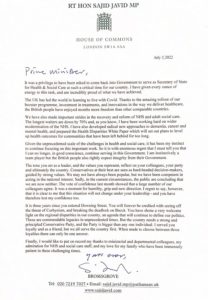
The letter written by Sajid Javid, the Secretary of Health and Social Care, to the Prime Minister, Boris Johnson, on 5 July 2022.

The speech made by Keir Starmer, the Leader of the Opposition, on 4 July 2022.
Thank you.
It’s a real privilege to be here tonight.
We are here to mark the 26th birthday of the CER.
In that time, the world has changed beyond recognition and so has your work.
For many 1996 was a time of optimism. From the Baltic shipyards of Poland to the villages of southern Bulgaria, tens of millions of people who had laboured under the yoke of tyranny were looking forward to a European future.
Barriers were coming down; economies were beginning to thrive.
Mobile phones were becoming commonplace, personal computers were switched on to the internet – that concept we were beginning to understand in 1996. And those new technologies were connecting the world at a stroke.
The totemic battles of the previous generation were being wrapped up.
The Cold War was over. Apartheid had been ended. Peace was coming to Northern Ireland.
Here in Britain, a deeply unpopular Conservative Prime Minister found himself mired in sleaze, weakened by his failures and a slave to the right wing of his party.
So whilst much has change, not everything has changed…
Then, just as now the Labour Party had put itself in position to be the next government staking out the centre ground, and building plans to take the country forward to a new era.
The big difference, I think, with 1996, is that we have lost that sense of optimism.
After a decade of low growth under the Tories. Taxes are rising and inflation is rampant and doing huge damage to households and businesses.
In 2022, Britain is stuck.
Stuck with an economy where wages have flatlined and household bills are going through the roof.
Stuck with broken public services that no longer work for those that they serve.
Stuck in queues for passports or driving licences.
Stuck waiting for delayed trains and buses.
Stuck on hold as we try to get a doctor’s appointment.
Britain is also stuck with a government that has no plan.
One that was elected on a promise to get Brexit done but has now decided to re-open those old divisions, in order to ensure Britain remains stuck with this failed Prime Minister.
While the Conservatives are flailing around, Labour has been claiming the centre ground of British politics once again.
Not a mushy place of compromise but a place driven by purpose, a place driven by optimism.
Our driving mission is to get Britain’s economy growing again so we can ensure the people and the places who for too long have lost out are once again revitalised and re-energised.
I am going to be saying a lot about that in the coming weeks and months.
But the first step in doing so, is to ensure Britain thrives in its new role in the world by ensuring we Make Brexit Work.
There are some who say “we don’t need to make Brexit work – we need to reverse it.”
I couldn’t disagree more.
Because you cannot move forward or grow the country or deliver change or win back the trust of those who have lost faith in politics, if you’re constantly focused on the arguments of the past.
We cannot afford to look back over our shoulder because all the time we are doing that we are missing what is ahead of us.
So let me be very clear.
Under Labour, Britain will not go back into the EU.
We will not be joining the single market or the customs union.
Now, I know some people don’t want to hear that, but it is my job to be frank and to be honest – and you will always get that with me.
The reason I say this is simple.
Nothing about revisiting those rows will help stimulate growth or bring down food prices or help British business thrive in the modern world.
It would simply be a recipe for more division, it would distract us from taking on the challenges facing people and it would ensure Britain remained stuck for another decade.
Under Labour, that simply will not happen.
What you will get under Labour is a plan.
One that will deliver on the opportunities Britain has, to sort out the poor deal Boris Johnson signed, and end the Brexit divisions once and for all.
It is a proper plan to Make Brexit Work.
Now, I know I’d never be allowed to take this stage without telling you what that plan looks like, so let me set out for you how it works.
The first step is clear and obvious.
We have to sort out the Northern Ireland Protocol.
If you’re going to Make Brexit Work, that has to be the starting point.
Just a few weeks ago, I had the great pleasure of being in Dublin and in Belfast, where I worked for many years.
I was struck by the fact that businesses there are clear – they can make the Protocol work.
The solutions are there, the desire is there. What is lacking is trust.
That crucial ingredient that has always characterised progress in relations between our islands. That has been eroded by this government.
Labour will change that.
We will be the honest broker our countries need; we will get the protocol working and we will make it the springboard to securing a better deal for the British people.
As well as building trust, Labour would eliminate most border checks created by the Tory Brexit deal with a new veterinary agreement for agri-products between the UK and EU.
And we will work with business to put in place a better scheme to allow low-risk goods to enter Northern Ireland without unnecessary checks.
The second step we would take is to tear down unnecessary barriers.
Of course we recognise, outside of the Single Market and a Customs Union we will not be able to deliver complete frictionless trade with the EU.
But there are things we can do to make trade easier.
Labour would extend that new veterinary agreement to cover all the UK, seeking to build on agreements and mechanisms already in place between the EU and other countries – benefiting our exporters at a stroke.
There was a story on the news the other day about a ‘wet wipe island’ that has formed in the Thames. Made of fat and oil and household rubbish one metre deep and the size of two tennis courts. It is blocking the flow of the river and changing the shape of the riverbed.
You couldn’t imagine a better metaphor for the Tory Brexit deal.
They have created a hulking ‘fatberg’ of red tape and bureaucracy.
One that is hampering the flow of British business.
We will break that barrier down, remove that fatberg – unclog the arteries of our economy and allow trade to flourish once more.
The third step will be to support Britain’s world-leading industries.
That means mutual recognition of professional qualifications ensuring our services can compete and restoring access to funding and vital research programmes.
Step four would be to ensure we keep Britain safe.
For too long, the Government has been blasé about European security.
The actions of (Vladimir) Putin must jolt us back into reality.
Because in the modern world if one of us is not safe then none of us are safe.
Strengthening security cooperation with our friends and allies is vital.
I know from first-hand experience during my time as Director of Public Prosecutions that we cannot take risks with terrorism, organised crime and people trafficking.
That’s why Labour will seek new security arrangements to defend our borders, and why we will share data, intelligence, and best practice. And it’s why we will set up joint intelligence working here and in Europe.
The final part of our plan will be to invest in Britain.
The lesson of the last decade is that if we are to achieve economic growth and see the benefits flowing to every part of our country, we cannot be bystanders.
The Tory plan as set out by Jacob Rees-Mogg is about cutting standards, regulations, and protections before stepping back and gawping at the power of the market.
This will not work.
It is a sure-fire way for Britain to lose the global race for jobs and for trade.
It will exacerbate the problems we already face; it will not deliver on the promise of Brexit.
Labour’s plan is very different.
We will work hand-in-hand with business to bring the good, clean jobs of the future to our shores, harnessing the power of government, alongside the ingenuity of our brilliant private sector.
Together, we will open up new markets and create new opportunities.
The government have missed Brexit opportunities time and time again.
It beggars belief that during a cost-of-living crisis they haven’t cut VAT on energy bills.
Labour will be sharper than this.
We will use our flexibility outside of the EU to ensure British regulation is adapted to suit British needs.
That is Labour’s plan to Make Brexit Work.
It is a plan that puts the divisions of the past behind us and seizes on the challenges and opportunities of the future.
It is a plan that that helps everyone from exporters to musicians – to thrive.
It’s a plan to reverse the Tory spiral of low-growth and high-tax.
A plan that puts Britain in the best place to compete on the global stage.
A plan that will help us achieve our central mission of delivering economic growth to Britain and spreading it throughout the country.
But there is something even more crucial than that.
In 2016, the British people voted for change.
The very narrow question that was on the ballot paper – leaving or remaining in the EU – is now in the past.
But the hope that underpinned that vote – the desire for a better, fairer future for our country is no closer to being delivered.
We will not return to freedom of movement to create short term fixes, instead we will invest in our people and our places, and deliver on the promise our country has.
If we are to restore faith in politics as a force for good, we must now get on with delivering on that promise.
The Tories have no idea how to do it.
Labour does. Labour has a plan.
And this plan, a plan to Make Brexit Work is the first stage of delivering on that change and delivering a better future for our country.

The comments made by Priti Patel, the Home Secretary, on 4 July 2022.
It is an important development that the UK and Nigeria have signed an agreement to co-operate on migration issues, to tackle illegal migration and the significant threat it poses to both nations.
The deal will mean that operational teams in both countries will share their expertise to take the fight to criminal people smugglers who are responsible for a wider range of criminality and put profit before people while undermining the security of our two countries. This landmark agreement will increase the deportation of dangerous foreign criminals to make our streets and country safer.
This is our New Plan for Immigration being put into action.

The comments made by Nigel Huddleston, the Sports Minister, on 4 July 2022.
Based upon what I have experienced and we have learnt through the pilot programme, safe standing is set to deliver an electric atmosphere at our football stadiums.
Fans have long campaigned for its introduction and we have worked carefully with supporters groups, including the families affected by the tragic Hillsborough football disaster.
I am proud of the work that has gone into this rigorous process and that we have delivered on our manifesto commitment to get fans back on their feet in stadiums.

The comments made by Nadine Dorries, the Secretary of State for Digital, Culture, Media and Sport, on 4 July 2022.
We want to make the experience of watching football as magical as the play on the pitch. Fans will now be able to cheer on their team from a seat or join others in a safe standing section to really get behind the players and roar on their heroes to victory.
We are not reintroducing terraces and only clubs which meet strict safety criteria will be permitted. Thanks to a robust trial, thorough evidence and modern engineering, we are now ready to allow standing once again in our grounds.

The speech made by Liz Truss, the Foreign Secretary, in Lugano, Switzerland, on 4 July 2022.
Thank you very much Prime Minister, thank you very much to President Cassis for hosting the conference today. Ukraine’s recovery from Russia’s war of aggression will be a symbol of the power of freedom and democracy over autocracy.
It will show Putin that his attempts to destroy Ukraine have only produced a stronger, more prosperous and more united nation.
The United Kingdom is resolute in its support of Ukraine’s territorial integrity and we will remain at Ukraine’s side as it emerges as a strong and thriving democracy.
We have led on support for Ukraine during the war and will continue to lead in supporting the Ukrainian Government’s Reconstruction and Development Plan.
This needs to be a new Marshall Plan for Ukraine and it needs to be driven by Ukraine itself.
We will push for immediate investment and to drive economic growth because it’s absolutely imperative we get the Ukrainian economy going, we need to need able to support returning Ukrainians returning to Ukraine, we need to give people hope about the future, and we need to give them the means to be able to support themselves.
Reconstruction should embed reform, modernisation, technology and transparency.
The United Kingdom is very pleased to join the Joint Reconstruction Coordination Group.
It’s our view that it’s vital that that is open to partners right around the world, we need all of the free world supporting this effort. It must be open and comprehensive, and it must involve international organisations as are represented on stage at the moment.
It must involve all of those who have been active in helping Ukraine defend itself and who back Ukraine for the long term through thick and thin, whatever it takes.
The United Kingdom has committed to host next year’s 2023 Ukraine Reconstruction Conference.
President Cassis, we have a lot to learn from you, it’s been a fantastic conference so far.
We are also exploring how we engage British business, tech companies and universities in that reconstruction effort, we’re looking at how we can use English and Scots law to ensure investors have the confidence to participate in the reconstruction effort, and we will use the might of the City of London and the European Bank of Reconstruction and Development which is based in London to make Ukraine one of the world’s top destinations for investment in 2023.
We think there is a real opportunity for Ukraine to near-shore manufacturing, agribusiness, technology, to be an extremely vibrant economy going forward. As the Prime Minister mentioned the United Kingdom is actively looking at how we legislate to seize assets from those who have contributed to this appalling war, it’s vitally important that we acquire those funds for the reconstruction of Ukraine.
The UK will be championing the recovery of the Kyiv region, in response to President Zelenskyy’s specific request from our Prime Minister for UK leadership. We believe that despite the appalling suffering, despite the terrible war crimes that have taken place, the devastation, and the human cost, that Ukraine will emerge stronger and more successful after this war.
President Zelenskyy you have demonstrated that Ukraine is a bastion of freedom and democracy, and it’s our duty as your friends and allies, as the free world, to do whatever it takes to support you.
Thank you.

The comments made by Mims Davies, the Minister for Employment, on 4 July 2022.
Older workers are a huge asset to this country, and there are currently more than 400,000 over 50s in roles than before the pandemic.
We’re increasing funding and support at every step of their journey up the career ladder, to ensure everyone gets the support they need to get into work, progress and use their experience to boost their earnings and plan for a better future. Helping people find the security of a stable income, through a job they can take pride in, is also one of the best ways for people to support their families during these challenging times.

The speech made by Vicky Ford, the Parliamentary Under-Secretary of State for Foreign, Commonwealth and Development Affairs, in the House of Commons on 30 June 2022.
I am extremely grateful to my right hon. Friend the Member for Newark (Robert Jenrick) and the hon. Member for Birmingham, Selly Oak (Steve McCabe) for securing this important debate. I share their grave concerns, and those of many Members, about the potential for a nuclear armed Iran.
In his opening remarks, my right hon. Friend the Member for Newark said that it was important for the Government to listen to what Members say about this subject. We are listening, and it is my pleasure to respond on behalf of the Government. I am also grateful for the contributions of the other Members who have spoken, and I will try to respond to many of the points that have been raised.
Time after time, we have seen Iran take actions that directly undermine global security, freedom and democracy, and challenge the international order. The UK is taking a tough stance: Iran must end its threatening behaviour and destabilising regional activity, and must also return to its JCPOA commitments.
Iran’s nuclear programme has never been more advanced than it is today, and our objective remains to ensure that the country never acquires a nuclear weapon. The escalation of its nuclear activities is threatening regional and international peace and security, and undermining the global non-proliferation system. Along with our partners, the United Kingdom has worked intensively to find a diplomatic solution. Over the last year we have worked alongside Germany, France, the United States and others to find a solution that would return Iran to compliance with its nuclear commitments under the JCPOA.
In March 2022, we left Vienna after reaching the end of talks. At that point there was a viable deal on the table that would return Iran to compliance with its commitments and return the US to the deal, reversing Iran’s nuclear escalation and lifting US sanctions related to the JCPOA. Iran has not accepted the deal, and time is running out. Iran should urgently take the offer on the table; there will not be a better one.
I agree that the JCPOA is not perfect, but it does represent a pathway for constraining Iran’s nuclear programme. A restored JCPOA would provide a foundation for international diplomatic efforts to ensure that Iran’s nuclear programme remained peaceful in the long-term. As my hon. Friend the Member for Hendon (Dr Offord), my right hon. Friend the Member for Newark and the hon. Member for Strangford (Jim Shannon) pointed out, there are some issues regarding sunset provisions. The hon. Member for Birmingham, Selly Oak also mentioned the switching off of the cameras, as did my hon. Friend the Member for Bracknell (James Sunderland).
I want to make it clear that if Iran returns to the JCPOA, our priority is the extension of the sunset clauses and enabling a stricter monitoring regime. Should the JCPOA collapse, however, we will consider all options in partnership with our allies. Let me repeat that: if a deal is not struck soon the JCPOA will collapse, and in that scenario we will carefully consider all our options in partnership with our allies. Those options may include new sanctions. I accept that the JCPOA does not address wider regional security issues, but a return to the deal would contribute positively to regional prosperity and security in the middle east and could pave the way for further discussions on regional and security concerns.
Iran must stop its destabilising behaviour. We believe it is important to encourage Iran to take a more constructive approach to its relationship with its neighbours. The UK has long made clear our concern about Iran’s reckless destabilising activity in the region, including the political, financial and military support that it gives to militants and proscribed terrorist groups, including Hezbollah in Lebanon and Syria, to militias in Iraq and to the Houthis in Yemen.
Iran’s support for these groups and activities risks the security and prosperity in the region. They pose a direct threat to the UK and to our interests as well as to the safety of our allies. Regional security and that of our allies remains one of our top concerns, and we are working with allies to constrain Iran’s ability to conduct destabilising activities in the region. We will continue to do so, whether or not a deal is signed.
We will continue our work with allies and partners to hold Iran to account for breaches of UN security resolutions. That includes supporting enforcement of UN prohibitions on the proliferation of weapons to non-state actors in the region, including to Hezbollah and to the Houthis in Yemen. We continue to build on the existing co-operation between the UK and our partners to counter the activities of Iran and its proxies in the region, including in our work to support stability in Iraq and to end the conflicts in Yemen and Syria.
My hon. Friend the Member for Hendon mentioned the Paris bomb plot and his experiences at that time. The UK Government always strongly condemn the targeting of civilians and we welcome the fact that those responsible for that plot in Paris in 2018 have been held to account. We also welcome the work by the Belgian courts in convicting four individuals last year, including Asadollah Asadi, who received a 20-year sentence.
The integrated review outlines our contribution to maritime security, upholding the principle of freedom of navigation. The UK is working to ensure the safety of shipping in the middle east, including in the Strait of Hormuz. We deter Iran from disrupting maritime security through our contributions to the international maritime security construct and the combined maritime forces.
A number of Members mentioned sanctions. The UK continues to maintain a range of sanctions aimed at addressing Iran’s destabilising behaviour. We have over 200 sanctions designations in place. Those include the Islamic Revolutionary Guard Corps, and sanctions related to human rights, proliferation and terrorism.
My hon. Friend the Member for Harrow East (Bob Blackman) and others spoke in detail about the IRGC. We have made clear our concerns about its continuing destabilising activity throughout the region, and we maintain a range of sanctions that are working to constrain that activity. The list of proscribed organisations is kept under constant review, but we do not routinely comment on whether an organisation is under consideration for proscription so I cannot comment on that; I know that my hon. Friend understands the reasons why.
A number of Members spoke about those who have been detained, and in particular about Morad Tahbaz. The Iranian Government committed to releasing Morad from prison on indefinite furlough but they failed to honour that commitment. His continuing horrendous ordeal sends a clear message to the international community that Iran does not honour its commitments. We continue to urge the Iranian authorities at every opportunity to release him immediately. He must be allowed to return to his family’s home in Tehran without further delay. Morad is a tri-national, and we are working closely with the United States to release him.
Let me conclude by saying that it is in no one’s interest to see a nuclear-armed Iran. The UK is firm in its commitment to the security and prosperity of our allies in the region, and to working with the international community to hold Iran to account for its destabilising activity. We urge, and will continue to urge, Iran to cease its nuclear escalation and to conclude the deal currently on the table to restore the JCPOA while that is still possible. If that does not happen, we will work with our international partners to consider all options.
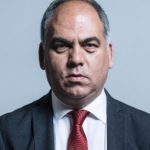
The speech made by Bambos Charalambous, the Labour MP for Enfield Southgate, in the House of Commons on 30 June 2022.
I thank the right hon. Member for Newark (Robert Jenrick) and my hon. Friend the Member for Birmingham, Selly Oak (Steve McCabe) for securing this excellent and important debate, and hon. Members across the House who have contributed to it.
The JCPOA was a landmark agreement. Labour fully supported the Vienna negotiations aimed at restoring it. We remain hopeful that a way forward can be found, including in the latest rounds of talks in Doha, co-ordinated by the European Union. It is absolutely right that the UK Government engage with those negotiations. We continue to believe that the JCPOA framework remains the best option to limit Iran’s nuclear programme, based on restoring Iranian compliance in exchange for sanctions relief. A pragmatic approach should be pursued, as the hon. Member for Bracknell (James Sunderland) said, and it is important that the US engages with Iran as part of the diplomatic process to restore the JCPOA.
In the short term, pressure must be applied on Tehran to reverse its enrichment programme so that it is within the limits of the initial agreement. Iran must also refrain from further steps that would reduce the possibility of a return to that agreement. In the longer term, however, the UK Government must show leadership. Our aims should be not just to restore the JCPOA, but to address the long-standing issues and other aspects of the Iranian Government’s actions that cause serious concern. These include much more than restricting and monitoring the country’s nuclear capability, important though that is. I note that the right hon. Member for South West Wiltshire (Dr Murrison) has called for a “stronger, longer deal”. Indeed, we are greatly worried about the destabilising influence of Iran, which poses a serious threat to security in the region. That is why I believe we must do more to hold the Iranian regime to account.
In 2018, as we know, the Trump Administration withdrew the US from the JCPOA. It was completely wrong for the US to walk away from the agreement and reimpose sanctions. That decision was taken without support from the other signatories to the deal, including the UK, and the reckless action of the US Government at the time has been deeply damaging. Since the American withdrawal from the JCPOA, Iran has flagrantly violated the agreement’s terms. It has pursued a dangerous path of non-compliance. It has increased the quality and quantity of its enriched uranium production far beyond the JCPOA limits.
As the hon. Member for Strangford (Jim Shannon) and the right hon. Member for Clwyd West (Mr Jones) have pointed out today, Tehran’s persistent refusal to co-operate with the International Atomic Energy Agency, the global nuclear watchdog, in matters including its inquiry into prior nuclear activities, signals Iran’s lack of transparency while it continues to increase its nuclear capability. For example, the IAEA has reported that Iran is enriching uranium up to 60% to produce highly enriched uranium, and in August 2021 the IAEA verified that it had begun producing uranium metal, which has little civilian purpose and is applicable to nuclear weapons development. As we heard from the hon. Member for Grantham and Stamford (Gareth Davies), nuclear weapons in the wrong hands are the gravest of all threats.
Earlier this month, the IAEA announced that Iran was removing 27 surveillance cameras from nuclear sites in what has been described as a “fatal blow” to the JCPOA and the monitoring of Iran’s nuclear programme. As Iran continues to escalate its nuclear activities, we believe that the IAEA’s inspection ability must be strengthened, and I would be keen to hear more from the Minister about the steps that the UK Government are taking to support the strengthening of the IAEA as a matter of urgency.
More widely, we know that the Vienna talks have stalled since March, not least owing to Russia’s invasion of Ukraine. I would like to hear the Minister’s view on the consequences of the invasion for the future viability of the E3+3 format, which has been the basis for negotiations with Iran for more than 15 years. We also know that Iran is currently holding up conclusion of the agreement, which would return it to its JCPOA commitments and restore US involvement in the deal. As has been noted, a new round of talks is under way in Qatar, and we welcome that, but we cannot underestimate the challenges and the importance of securing an agreement.
There has been increasing frustration with the Iranian intransigence that has been seen in these negotiations, and concerns remain that the regime is attempting to gain leverage for future negotiations while advancing its nuclear knowledge as talks are stalled. As was pointed out by the hon. Member for Harrow East (Bob Blackman), this may mean that at some point on its current trajectory, Iran will soon make irreversible nuclear progress, rendering the benefits of returning it to its JCPOA commitments meaningless. That is incredibly concerning. It remains our steadfast hope that a compromise can be found that will allow for the restoration of the nuclear agreement, which could then serve as a basis for addressing many other concerns.
We cannot talk about Iran without discussing wider issues, many of which have been rightly raised by other Members today. Although the JCPOA is a critical agreement to limit Iran’s nuclear capability, it does not address Tehran’s ballistic missiles programme, which is designed to deliver nuclear weapons, or its support for terrorist groups and militias throughout the middle east, including Hezbollah and the Houthis in Yemen. That was mentioned by the hon. Member for Hendon (Dr Offord).
These issues need to be addressed, and the Labour Party believes it is imperative to move them up the international agenda. We are seriously concerned about the threats that Iran has made against Israel. My hon. Friend the Member for Birmingham, Selly Oak referred to Iran’s stated desire to see Israel’s destruction. Moreover, the JCPOA does not hold Iran to account for its human rights violations against its own people, or for its continued engagement in state hostage-taking—an issue of which we in the House are acutely aware.
As was pointed out by the right hon. Member for Islington North (Jeremy Corbyn), Mehran Raoof and Morad Tahbaz remain in Iran despite the release of Nazanin Zaghari-Ratcliffe and Anoosheh Ashoori earlier this year. It is shameful that the Iranian regime continues to use the two remaining hostages as political pawns, and the UK Government must do everything possible to ensure their safe return home to the UK, as their families were promised.
As for the wider nuclear issues, we believe there is an opportunity for the UK to take a leadership role at the upcoming nuclear non-proliferation treaty review conference. The outlook at present is not good. Russia’s invasion of Ukraine has closed the space for dialogue on critical issues involving arms control, transparency and confidence-building. The flagrant violations of the Budapest memorandum send a dangerous message. Proliferation risks are very significant. There are also many crucial new issues that need to be addressed, including threats of emerging technology, especially in the domains of cyber and space. I urge the Minister to update the House on the UK’s priorities for the conference in August, and on how the UK can lead from the front on these matters internationally.
If diplomacy and efforts to restore the JCPOA fail, the consequences may be severe. The return of sanctions, a rapid expansion of Iranian nuclear activity, and a heightened risk of military tension in the region are likely outcomes. As we have heard from right hon. and hon. Members on both sides of the House today, there is broad agreement that the restoration of the JCPOA would be an important step, and I therefore ask the Government to continue to pursue every possible avenue diplomatically to help to promote and restore the nuclear deal with Iran. However, it is not the only step, and it should not be the only aim. We must continue to support our international partners, including Israel, by holding the regime to account, and we must ensure that the wider issues that I, and many others, have mentioned today are not left unaddressed by the UK and our international allies.

The speech made by Kirsty Blackman, the SNP MP for Aberdeen North, in the House of Commons on 30 June 2022.
I congratulate the right hon. Member for Newark (Robert Jenrick) on bringing this debate to the House, and I thank the Backbench Business Committee for ensuring that it could happen. There has been an awful lot of accord across the House today; it seems that we are all raising similar concerns and we are all keen to find a way forward. It is not quite a matter of semantics, but perhaps there is just a slight disagreement about the way forward and the best way to tackle the issue.
The joint comprehensive plan of action was never ideal, but it was better than no deal and we need to recognise that it was a major diplomatic achievement. The SNP joins Members across the House who have called for Iran to halt its activities that are in violation of the JCPOA. We hope to see detailed, precise and deep talks this week. There is an urgent need for a diplomatic solution and an urgent need to end Iran’s nuclear escalation.
We agree with the concerns that have been raised about Iran’s stated intention to end all JCPOA-related transparency measures and about the action that it has already taken in that regard. Transparency is incredibly important, and any future deal needs to put that at the heart of the agreements made.
There are other risks that have not been mentioned in the Chamber today. Bilateral work on tackling climate change and on tackling the Afghan refugee crisis is currently on ice because of the present situation. Regardless of escalation and nuclear uranium enrichment, the climate crisis and the Afghan refugee crisis are not going away. We must work to tackle them. As several hon. Members have said, we must ensure that we put people at the heart of our approach and that we work to improve human rights in the region, as well as ensuring that the people of Iran are decoupled from the action of their Government and given the opportunity to flourish.
We agree with the calls for the UK to use our place to press the regime—and to press all regimes that have issues with human rights or are committing human rights abuses, whether that is Iran, Saudi, Russia or any of the countries committing human rights abuses against their citizens or citizens of other countries.
I criticise the unilateral actions that Donald Trump took, on the basis that taking unilateral action on this is not the way forward. The way forward is for everybody to work together as international partners to get a settlement. The reality is that the situation is potentially worse than it could have been if those unilateral actions had not been taken. It is better to act in concert.
We welcome President Biden’s commitment not just to returning to the deal, but to strengthen the areas in which it is defective and extend the JCPOA. I have not much mentioned wider regional security, but we need to ensure that action is taken and that there is international co-operation with respect to Iran’s issues, its causing of regional instability and the actions that it is taking to destabilise countries around the world, as several contributors to the debate have mentioned. That needs to be a matter of priority.
As somebody who believes that we should not have nuclear weapons anywhere in the world, I am massively concerned to see the upscaling of Iran’s potential nuclear capabilities. We need to ensure that talks happen, whether that is around the table this week or in some future round of talks. We need to ensure that the UK’s international power is used to put pressure on, and to de-escalate the situation as quickly and as properly as we possibly can.