Tag: 2013

  • Owen Paterson – 2013 Speech to the LGA Rural Conference

    owenpaterson

    Below is the text of the speech made by Owen Paterson, the Secretary of State for Environment, Food and Rural Affairs, on 4 September 2013.

    Thank you for the invitation to join you this morning.

    Last year, this event was my first opportunity as Defra Secretary to talk about my four key priorities. These are to boost the rural economy, improve the environment and safeguard both plant and animal health.

    It’s great to have a conference dedicated to talking about rural communities and businesses. I’m pleased that this year you have decided to focus on rural growth.

    The rural economy is worth £211 billion a year. Rural areas are home to one fifth of the English population, yet they support nearly a third of England’s businesses.

    That’s around half a million businesses. Small and micro-enterprises employ around 70 per cent of employees in rural areas. We need to get the conditions right for all these businesses to thrive.

    In rural England, tourism accounts for 14 per cent of employment and 10 per cent of businesses. It contributes £33 billion a year to the economy. It creates employment and growth opportunities for business where opportunities are sometimes limited.

    Businesses are diversifying. For example, they are offering accommodation like boutique campsites. They are using historic properties as wedding or corporate venues. A great local example is Ragley Hall, which as well as catering for big events, also hosted this year’s CLA Game Fair. Tourism allows rural businesses to maximise their potential.

    One of the most important sectors of the rural economy is food and drink. This sector supports 3.7 million jobs and contributes nearly £90 billion a year to the UK economy.

    We’re working hard to make sure that food and drink businesses have a wide range of opportunities to expand. This summer I’ve been to agricultural shows across the country – from the Royal Cornwall to the Royal Highland. I spoke to dozens of small businesses about the barriers to growth. The more we know about what’s holding businesses back, the better we’ll be able to target our actions.

    UK food and drink exports were worth £18.2 billion in 2012. This is an enormous opportunity for a huge number of rural businesses.

    That’s why I’ve been going abroad banging the drum for British products. In the last year I’ve been to China and the United States. In ten days’ time, I’m off to Russia. Later in the autumn I’m going to Anuga in Germany, the world’s largest food and drink fair.

    The aim of all these trade missions is to help businesses make the most of all the available opportunities and to capitalise on the growing demand for high-quality British food.

    As well as promoting exports, we need to make a significant dent in the 22 per cent of food that’s imported but could be produced here. I recently hosted a meeting with farmers, manufactures and retailers to discuss this. We’re now looking at how we can work with the industry to make it easier for businesses to grow in the UK market.

    Businesses alone won’t make a big enough impact, we in Government need to play our part. The Government has set public procurement standards for food through the Government Buying Standard. I believe that local government has a huge part to play in supporting, and benefitting from, this agenda.

    The Cornwall Food Programme, which supplies the Royal Cornwall Hospital as well as St Michaels and the West of Cornwall Hospital, is a great example. They have increased the amount of fresh, local food they use. This has boosted the local economy, reduced environmental impacts and improved the quality. These improvements have been made with no additional cost. As we seek to spread best practice across the country, I’d love to hear from you of any similar examples.

    Imagine the impact if every school, care home and leisure centre were buying from their local area.

    There are some amazing opportunities available to businesses in all sectors of the rural economy. It’s our job in Government to make sure that businesses can take advantage of them.

    That’s why we set up the £60 million Rural Economy Grant. This money is supporting a range of businesses and activities. For example, some of the funding has gone to a fruit producer, D.C. Williams in Essex, enabling them to use their own fruit to produce juices and purees. This creates a new product using their poorer quality fruit. It has also created 3 new full-time jobs and reduced waste. This is exactly the kind of innovative business I’d like to encourage.

    Most rural businesses are small. So, we’ve established five Rural Growth Network pilots, which focus on small businesses. These pilots expect to create up to 3,000 new jobs and support up to 700 new businesses, offering a local approach to local problems.

    These pilots are progressing well. They are tackling local barriers such as a shortage of work premises, slow internet connectivity and fragmented business networks.

    This morning I opened the Stoneleigh Rural Innovation Centre, which will provide business development advice to local businesses. This has been made possible by funding from the Warwickshire Rural Growth Network and LaSalle.

    The Rural Development Programme to date has invested over £400 million in projects to grow the rural economy. Completed projects have created over 8500 new jobs and safeguarded a further 9700.

    Valefresco Ltd in Warwickshire is a local beneficiary of RDPE. It grows leafy salads and specialist vegetables. It has got a grant of around £38,000 to support a wider investment of nearly £1.5 million. This investment will create 11 jobs.

    Over a third of the jobs that the Rural Development Programme has helped to create are as a result of the 64 Leader Local Action Groups. This is something I know many Local Authorities here today work hard to support. I am extremely grateful to you for this.

    The next seven year Rural Development Programme is a major opportunity to continue to invest in rural growth and the environment. We are working together with interested groups to design this. We will be consulting formally next month and look forward to hearing your views.

    To ensure that businesses can take advantage of all these opportunities, they need to be able to communicate quickly and reliably. I share your frustration that many rural communities and businesses do not yet have access to reliable and fast broadband.

    This is essential for homes throughout the country to benefit from online services, and for UK businesses to access global markets. In fact, I believe that nothing will have a more spectacular impact on the rural economy than the roll out of superfast broadband. For the first time, we have a technology that can truly bridge the gap between urban and rural.

    In my first week in the job, I visited an old barn at the top of a Cumbrian fell. I was amazed to find an architects’ business designing golfing villas for Nasiriyah in Iraq. That’s the transformative power of broadband.

    The current public investment of £1.2 billion means that 90 per cent of the UK should have superfast coverage by early 2016. This programme will benefit over 4 million rural homes and businesses. We are currently connecting 100,000 properties a week.

    An extra £250 million of investment from the TV licence fee has been committed to reach 95 per cent of premises by 2017. We are now exploring with industry the use of more innovative fixed, wireless and mobile broadband solutions, so that we can reach at least 99 per cent of premises by 2018.

    Our £20 million Rural Community Broadband Fund is providing opportunities for some communities in the most hard to reach locations to get superfast broadband sooner.

    We also need to address poor mobile phone coverage. The current situation is beyond dire.

    Through the Mobile Infrastructure Project we are investing £150 million to deliver a sustainable solution for people living and working in rural areas with no mobile coverage. We estimate that this will have an economic benefit in excess of £375 million. The first new sites are due to go live this year.

    Improving broadband and mobile access isn’t just about supporting businesses. It’s key for rural communities and improving resident access. It will enable central and local government to deliver services, such as healthcare, education and community care, more efficiently and directly.

    I have often said that I see my role as getting out of people’s hair. We are making steady reductions to the amount of regulation that all businesses face as part of the Red Tape Challenge.

    Over the next 5 years we will reduce costs to businesses by at least £1 billion. We have introduced a three-year moratorium on new regulation for micro-businesses. We’re providing certainty by only introducing new regulations on two specific dates a year. And, of course, we’re reducing the overall regulatory burden by removing two regulations for every new one introduced.

    The Better Regulation Framework Manual has also been updated to provide a specific rural proofing test. This is the guide for government officials on making and changing regulations. Rural considerations will now be a key part of our work on improving regulation.

    A key part of what Defra does is to ensure that rural communities’ interests are recognised by helping to rural proof other department’s policies. It will be no surprise to you that in recent years money has been channelled towards inner cities. This is despite the cost of delivering services in rural areas often being much higher. We are working to address this so that rural areas do get a better deal.

    Education will be a key priority for many of you. I represent a rural constituency and I am committed to ensuring that the best education is available in rural areas. That’s why I fully support the Department for Education’s announcement in June that it would allow local authorities to use a new sparsity factor when allocating funding, in recognition of the needs of remote rural schools.

    Defra has also worked with the Department of Health to produce the Rural Proofing for Health Toolkit, launched in November 2012. This is an on-line reference point for those commissioning health services in rural areas.

    Affordable and reliable transport is essential to people living in rural areas. It provides access to local services, enables people to be economically active and avoid social isolation.

    That is why my department is working closely with the Department for Transport (DfT) who share our ambition to understand the specific impacts of their policies on rural transport provision. For example, we are supporting programmes like Wheels to Work which help young people in rural areas to get access to education, employment and training.

    Flooding is another area where local government’s role is crucial.

    In June the Government announced the first ever six year commitment for investment in new and improved flood defences up to 2021. This, together with Defra’s new approach to funding, has improved the situation for rural areas by creating opportunities for joint funded projects where previously access to central funding was not available.

    Early indications suggest that Defra’s Partnership Funding approach will enable up to 25 per cent more schemes to go ahead in the coming years. £148 million of additional funding has already been attracted. Many schemes, which would never have seen the light of day, are now being delivered more cost-effectively through joint decision making with local councils.

    Local Authorities are central to these partnerships. You can identify the needs and long term aspirations of communities and assist in funding, both directly and through your influence with local partners.

    Turning to surface water flooding, we aim to implement sustainable drainage systems – SuDs – for new-build and re-developments. We hope to start with major developments in April 2014. Of course, local authorities can continue to encourage SuDS today through the existing planning regime.

    No speech to the LGA would be complete if I didn’t touch on housing and planning.

    The National Planning Policy Framework lets communities decide where homes, businesses and facilities should go, alongside reinforcing environmental safeguards.

    The new Growth and Infrastructure Act has measures designed to stimulate growth and reduce planning burdens. Since the 30th May, existing redundant agricultural buildings can be converted to a variety of alternatives uses such as offices or shops without the need for planning consent.

    We are currently consulting on allowing existing agricultural building to be changed to residential use without planning permission. The consultation closes on 15 October and I would urge you to contribute your views.

    As well as this, DCLG launched a consultation on 6 August looking at greater flexibilities around permitted development rights. These proposals would support high streets by allowing shops which are no longer commercially viable to be converted for residential use.

    I know that many of you in this room will have firsthand experience of the concerns of local communities about inappropriately-sited wind farms. Only last week, on visits to Shropshire, Northumbria and Yorkshire, I saw for myself the passions that such developments can arouse. That is why the Government has recently amended the planning guidance to give greater weight to issues such as landscape and heritage. It now makes clear that the need for renewable energy should not automatically override local environmental protections or the concerns of local people.

    We have committed to ensuring that there will be early community engagement on significant onshore wind projects. This will be before the planning application is made. We have also ensured that those communities which welcome such projects are able to enjoy a greater share of the benefits.

    Looking to the future, my Department is working with DECC to look at the impacts of wind farms and other energy infrastructure on the environment and rural economy. This will form the basis of a report which will be published to help inform our understanding of the scale of impacts and future energy choices.

    This does raise a broader issue. For too long we have allowed the lazy assumption that the environment and growth are incompatible objectives within the planning system. Whereas I believe that in many cases it is possible to have both.

    This is why I am particularly interested in Biodiversity Offsetting. The purpose of offsetting is to ensure that where the planning system requires compensation for biodiversity loss, it is delivered in a fair and effective way.

    Offsetting gives us a chance to improve the way our planning system works. It gets round the long-running conundrum of how to grow the economy at the same time as improving the environment.

    The concept has been around for some time now. I’ve seen it working well in Australia. And we can learn from other countries such as the United States and Germany.

    In the UK pilots are underway in 6 areas. I am very grateful to all those have worked on these pilots that range from Devon to Doncaster and, of course, here in Warwickshire. I’ve visited the Ryton Pool Country Park where they are offsetting for a nearby development. I was impressed to see the benefits that offsetting is bringing.

    The time has now come to broaden the discussion. I am launching a consultation very shortly to seek a wide range of views on what offsetting has to contribute. We shall be running a number of workshops alongside this consultation. I do hope that the LGA, and those of you with specific responsibility for planning, will join this important debate.

    There are amazing opportunities available to rural businesses and communities. My role as Secretary of State is to make sure that the conditions exist for people to take advantage of them.

    You play an invaluable role in ensuring that businesses and communities get the support they need. Thank you for your tireless work.

    We want to see successful businesses and thriving communities in a living, working countryside. The countryside is not preserved in aspic, nor would we wish it to be. It is shaped by the communities who live and work there. And by those, like you, who represent it.

    I look forward to working with you to achieve this.

  • Norman Baker – 2013 Speech on Low Carbon Vehicles

    normanbaker

    Below is the text of the speech made by Norman Baker, the then Parliamentary Under Secretary of State for Transport, on 4 September 2013.

    Introduction

    Thank you Brendan and good morning ladies and gentlemen.

    Today is one of the days when I really enjoy being a minister. I am out of the office talking to the people who are actively involved in helping to deliver the department’s twin key objectives – to create growth for the British economy and to help reduce our environmental footprint.

    Looking around the exhibition I see the very best of what the UK automotive industry has to offer, the result of technical and engineering brilliance, business acumen and foresight.

    I would like to take this opportunity to spell out the value the government places on your industry and to tell you about the world leading package of support the government has put in place to ensure a thriving future of UK’s automotive sector.

    Automotive strategy

    The automotive strategy that we recently published shows that we – industry and government – have set a clear path for what our low and ultra-low emission R&D goals are – supported by the creation of the £1 billion Advanced Propulsion Centre, which will be jointly funded by the government and industry.

    We have also laid out our plans on long term support for automotive manufacturing. This includes the government working with industry to ensure that we have the right work force with the right skills, and by the industry making public its recruitment intentions for more apprenticeships and more graduates.

    And we have said how we will support further investment into the supply chain through the new Automotive Investment Organisation.

    ULEV strategy – scene setting

    Today I want to talk to you about another significant milestone…our ultra low emission vehicle strategy – Driving the future today.

    Before I get into the detail I would like to thank those of you who provided advice, evidence and insight to the Office for Low Emission Vehicles as our strategy was shaped and developed.

    We know that successful strategies take full account of the views of the experts – in this case those that take on the engineering and design challenges, those that squeeze every last efficiency out of the production line and those who know the amount of effort necessary to close a sale in the showroom.

    The recent spending review announcement confirmed the coalition government’s strong support for the ultra low emission vehicle sector. Five hundred million pounds to support the market to 2020. But behind this figure lies a political consensus, across departments, between the coalition partners and right to the highest level of government.

    Our approach is based on solid foundations. The partnership between the automotive industry, the recharging equipment suppliers, the energy companies, the vehicle users, and government.

    We have a common understanding of the direction of travel. We have robust discussions and dialogue about the many issues. And most importantly we have a collective will to deliver a clear vision.

    First let me recognise the huge strides made by industry in reducing carbon emissions from petrol and diesel cars. Progress has been very impressive and continues. There is clearly a lot of life left in the internal combustion engine.

    But our strategy is about preparing for the long term. We are driving the future, today. By 2050 effectively every car and van in the UK will be an ultra low emission vehicle.

    The cars that were rolling off the production line in the mid-1970’s were a very different beast to the cars of today – the Ford Cortina was king of the road.

    Your innovation, supported by government policy will continue to transform the cars we drive. And in another 3 decades, zero emissions will be the norm.

    ULEV strategy – the detail

    We have collected evidence from more than 5000 recharging posts installed through the PIP schemes, from over 5000 vehicles that have benefited from our plug-in car and van grants, from the 340 vehicle low carbon vehicle trial and from numerous government funded R&D projects.

    And of course UKH2Mobility is also examining the role that fuel cell electric vehicles can have in an ultra low carbon future.

    So we have the expert opinion and the robust evidence – now what does the strategy say?

    We have identified 5 work streams which we believe will support the UK’s ambition to become one of the global leaders in the design, production and use of ultra low emission vehicles – driving growth, delivering jobs, cutting carbon. These 5 workstreams are:

    – supporting the early market for ULEVs

    – shaping the required infrastructure

    – securing the right regulatory and fiscal measures

    – investing in UK automotive capability

    – preparing the energy sector

    I would like to outline our thinking for each of them.

    Supporting the early market for ULEVs

    Coming from a retail background myself I understand the importance of the sales and marketing effort involved in shifting new products – I was in music retail as the compact disc was released – a complete paradigm shift in music formats, higher spec and higher price than both cassette and vinyl.

    In the strategy we have set out our thinking on market issues relating to the price premium that ultra low emission vehicles attract. In addressing these barriers the government’s track record is good – we have grants towards purchase, we have put in place a tax and duty regime that encourages their purchase by both private and business motorists and we recognise the importance of local measures such as the congestion charge discounts, parking benefits and in some cases low or zero cost charging.

    And we also recognise that automotive manufacturers are playing their part. Currently there are 14 cars and 7 vans eligible for the grant – and there are many more in the pipeline. More cars and vans, covering more market segments, with a range of price points and imaginative ownership options. These are making the decision to switch easier for consumers whilst reducing their risk.

    But we recognise that we need to make the case to a wider section of the motoring public – part of this will be through the word of mouth of ULEV drivers, but we are also aiming to reinforce this with other communications. Industry partners and government are currently working together to explore how best to do that.

    Together we need to address the situation where the opinions of some ill informed keyboard warriors are given more credence than those of the engineers and business brains who have invested billions to help secure sustainable personal mobility for this and future generations.

    Our second strand concerns infrastructure

    Our plugged-in places programme has resulted in the installation of well over 5,500 recharging points with over 65% of them publically accessible. Through our £37 million infrastructure package, we have provided funding to deliver 1000 domestic points. And Michael Fallon – the BIS Minister – and I recently announced the winning bids for the first round call for proposals for rapid chargers, and chargers at train stations and wider public estate which will see £12 million allocated to support over 75 projects. We are also now open for second round bids. The closing date is 31 October – and I fully expect to see a large number of high quality and innovative bids.

    Of course infrastructure is not only about the absolute numbers, it’s also about the type of charger, their location, and meeting the requirements of drivers.

    Here I would like to mention the recent successful TEN-T project supported by Nissan BMW, VW and Renault, Charge Your Car North and the UK and Irish governments. This scheme will see rapid chargers installed in up to 70 sites on the UK and Ireland’s strategic road network – and these chargers will be multi-standard systems having 3 connector types.

    I would also like to mention the newly formed UK EVSE –the trade body for those organisations involved in the manufacture and installation of charging infrastructure. I look forward to working with them closely on a wide range of issues, including technical standards where their expertise will be invaluable in ongoing EU negotiations, interoperability and improving the customer experience – for example through better signing and information.

    Our third area of focus is securing the right regulatory and fiscal framework. In my 3 and a half years as a transport minister, I have been able to meet a large number of businesses of varying shapes and sizes. And all of them, without exception, have a common refrain. Let us get on with our work in a stable and long term regulatory and fiscal environment – don’t keep moving the goal posts. We have heard and got this message.

    So the strategy says we will give you the stability you require, to make your long term design, investment and production plans and the associated financial commitments. We will consult early and fully with you in the event that any changes are really necessary and we will apply this approach fully in engaging with Europe on emerging regulations.

    Our message to industry is clear. We are in this for the long-term. We welcome those who share our vision of the future and we are backing this with serious money and a commitment to work shoulder to shoulder with you to ensure that the UK reaps the dividends that this exciting opportunity offers.

    So, and this is our fourth strand, we have identified supporting the UK ultra low emission supply chain as one of the key elements of the strategy. This is essential to support the UK’s economic recovery, creating jobs and encouraging growth.

    For every new job on the assembly line multiple jobs are supported in the associated supply chain.

    We have already seen our policies bear fruit, attracting the Euro LEAF and battery production by Nissan at Gateshead, The Auris production by Toyota at Burnaston, and BMW producing their i8 powertrain at Hams Hall.

    All testament to the high quality of the UK’s workforce and, I like to think, the coalition government’s business friendly environment.

    We also recognise the importance and excellence of the UK’s automotive R&D sector with more than £1.5 billion annual investment driving technologies forward.

    On R&D, £80 million of OLEV funding, combined with Technology Strategy Board funding, has generated over £350 million total investment in well over 170 projects with very tangible results – some of which I saw a few moments ago. And I understand that there will be an announcement of the winners of the latest 2 integrated delivery programme competitions during the conference.

    The fifth priority highlighted in the strategy is preparing the energy sector. We need to ensure that the grid is able to cope with the load created by a large number of vehicles plugging in to it.

    We need to ensure that it decarbonises so that environmental benefits are maximised and we need to look to technologies such as smart grids and smart meters to ensure that the each and every ULEV owner can help us achieve our ambitious carbon reduction targets. We are working closely with DECC on this vital strand.

    Principles

    The strategy also sets some key overarching principles about how we are intending to take this agenda forward: a technology neutral approach, a focus on intervening to address market failure, and a commitment to always work in Europe on the basis that regulations should be ambitious but realistic. These principles are important. They reflect what industry has been telling us over the last few years and they will continue to underpin our activities from now on.

    Conclusion

    Finally I would like to engage your active help, We will shortly be putting out a call for evidence. We have a clear investment commitment out to 2020. And so we want to hear from all sectors, car, vans, freight, buses as well as powered 2 wheelers.

    We want to talk to the charging manufacturers and installers, hydrogen gas producers, the wider energy sector, the fleet industry –everyone who will have a role to play in ensuring that our ambitious growth and environmental goals are met.

    These discussions will inform how we will achieve the best value for our £500 million investment and ensure that we are working with those whose knowledge, drive and technical excellence will deliver ultra low carbon transport.

    The strategy is available online, there are a few printed copies available here as well as summary versions. Please read them and then talk to us.

    Officials from the Office for Low Emission Vehicles are here in force and would much rather talk to you about the strategy than test drive the fantastic array of vehicles on display here. At least they would now.

    Ladies and gentlemen, thank you for listening. Ministers and officials across government are prepared for the hard work ahead and I know that you are all up for the challenges and opportunities that delivering low carbon road transport offers.

    Thank you and please enjoy the rest of your conference.

  • William Hague – 2013 Speech on Business and Human Rights

    williamhague

    Below is the text of the speech made by William Hague, the then Foreign Secretary, on 4 September 2013.

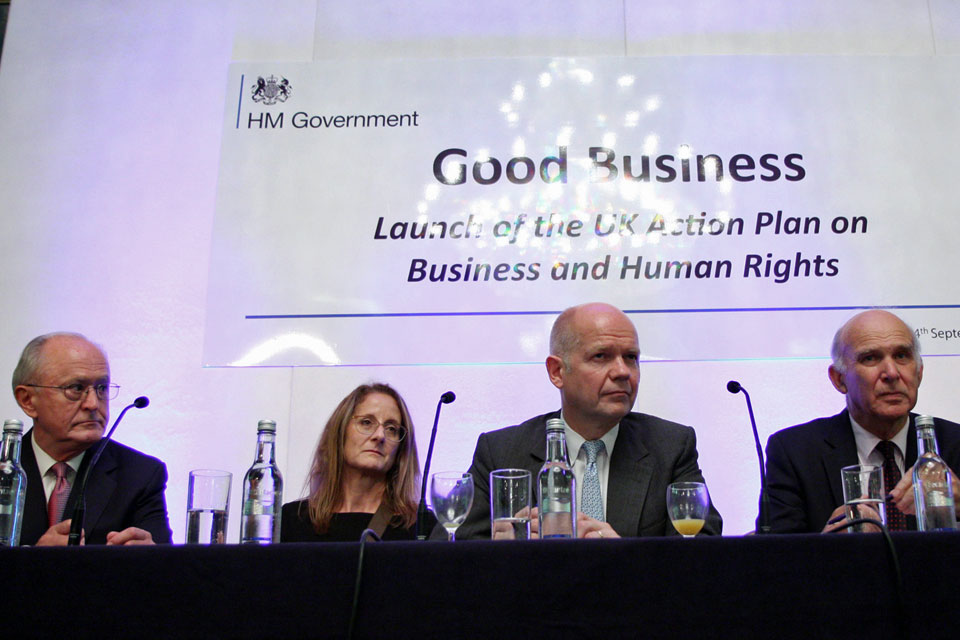
    Good evening ladies and gentlemen. It gives me great pleasure to join the Business Secretary and our distinguished guests to launch the UK’s Action Plan on Business and Human Rights, and I can think of no better place to do it than here at the Institute of Directors – an organisation which does a great deal to promote the corporate integrity which is at the heart of this Plan.

    You are here because we all share the same goal, which is to ensure that British companies succeed and that they do so in a manner that is consistent with this country’s deeply held values of human rights and individual dignity.

    In 1948 the UN General Assembly called on “every individual” and “every organ of society” to respect the rights and freedoms enshrined in the Universal Declaration of Human Rights.

    Today, the duty to uphold those rights cannot be the responsibility of governments alone. We live in a world where open markets and more equitable trading rules mean that British companies – large or small, public or private – are increasingly transnational; where it’s not unusual for our companies to purchase materials from Bangkok manufacture products in Bangalore, sell them in Bogota; and we live in a world where legal standards and practices for working conditions and the treatment of staff may differ from country to country.

    hmgb

    Today, business and government have to work together. The vast majority of companies, I believe, understand the moral imperative of respecting human rights, and they are active in ensuring that they do exactly that. This isn’t about imposing burdensome bureaucracy on them; it’s about Britain leading the way and the British Government helping our businesses to enhance their international reputations even further.

    The truth is that incorporating human rights properly into business operations across the world matters:

    It matters to companies, as weaving human rights deeply into corporate cultures not only protects and enhances reputations, but it also reassures shareholders, attracts investors, and increases the attractiveness of their brands.

    It matters to the reputation of this country and the prosperity of its people.

    And, perhaps most of all, it matters to the health, safety and livelihoods of employees, and the communities to whom they belong.

    That is why I believe that promoting business and respecting human rights are two sides of the same coin, and which determined that the UK will show leadership on this issue, and which all the ambassadors here will be telling their countries we did so, I am sure.

    So I am proud that we are the first country to present a National Action Plan for implementing the UN Guiding Principles developed by former Special Representative of the Secretary General, John Ruggie, who I am delighted to have with us this evening.

    This Action Plan responds to calls from business for greater clarity by setting out explicitly what the Government’s position is on business and human rights.

    It details this Government’s plans to implement our obligations to protect against human rights abuse by business enterprises within UK jurisdiction; to support our companies in meeting their responsibility to respect human rights throughout their operations at home and abroad; to provide access to effective remedy for victims of human rights abuse; to promote understanding of how addressing human rights risks can help build business success; and to ensure policy consistency across the British Government and all its departments But the plan also outlines the Governments expectations of business, such as complying with all applicable laws; honouring the principles of internationally recognised human rights when faced with conflicting requirements; adopting appropriate due diligence policies; consulting those who may be affected at all stages of project design and implementation; emphasising to supply chains in the UK and overseas the importance of behaving in line with the UN Guiding Principles; and participating in effective grievance mechanisms that are transparent, equitable and predictable.

    Launching the Plan today is just the beginning. We now need to take on the more challenging task of ensuring that it’s implemented with consistency.

    To do this, we need business leaders to work with us and to highlight challenges, and I urge companies to use the expertise that we have in our Embassies, High Commissions, and Consulates, who are standing ready to help you enact the Plan.

    We need those civil society groups who have contributed so much to developing this Action Plan to continue holding us to account and to lend your expertise to the companies that need it.

    We need our partners overseas to follow the UK’s lead and to develop their own Plans, so that we can generate real international momentum behind improving the rights of all people affected by business activity in all countries.

    And, for our part, we are determined to continue showing leadership by lobbying and influencing other states to follow this example, and by working together with British businesses to ensure that we achieve nothing short of comprehensive implementation of the UN Guiding Principles.

    That’s our objective, and the Foreign and Commonwealth Office, its Ministers, and its overseas network will do everything to ensure that this Action Plan lays a strong foundation for the long-term success and sustainability of British business.

  • Eric Pickles – 2013 Speech on United in Britishness

    ericpickles

    Below is the text of the speech made by Eric Pickles, the then Secretary of State for Communities and Local Government, at the Queen Elizabeth II Conference Centre in London on 5 September 2013.

    I want to start by thanking you for work most conscientiously done.

    This is a unique group to be addressing – as senior officers and senior councillors many of you have direct experience of walking the streets of your city or town, not knowing if you would be there the next day. Or whether it would have gone up in flames. Whether just one careless incident would undermine years of painstaking work.

    If you’ve experienced that I don’t think it ever leaves you.

    As councillors you instinctively understand the importance of the clean up operation: sweeping up the glass and cleaning up the graffiti to minimise the impact.

    But you also understand the effect such incidents have on individuals and the community.

    These are attacks on our very way of life.

    We are fighting something entirely un-British – something utterly alien – and for me there is a fundamental test. If a woman cannot pop down to the shops for a pint of milk or a bag of rice because she’s worried about getting lewd threats; because she’s afraid she might be jostled and jeered; because she’s scared she might be spat on – no matter how many committees we set up or programmes we run or reports we write, if there are people in our communities too frightened to venture beyond the doorstep, hesitating simply because they are wearing a headscarf, then we have failed.

    Before the election I had great pleasure in going to Paris with Caroline Flint, Vince Cable and Rita Chakrabati to address a conference of European students.It was around the time the French were debating banning face veils in public. I said to the students that this was an absurd thing to do.

    I can see circumstances in which covering the face might be unsuitable to the situation, but people going about their private business should be left to do so.

    I have to say that many of these young people including the French were rather shocked by my view and wanted me to justify it.

    I can be a little blunt sometimes and I simply said, look, we’re not far from the Champs-Elysees and it’s not so long ago that the Gestapo strode through the streets of Paris seeking out Jewish people.

    How can the nation of liberty, equality and fraternity have forgotten where intolerance leads and be prepared to contemplate such a restrictive view?

    Here in Britain tolerance, decency and respect for others are embedded deep within our psyche.

    Our warmth and hospitality, our willingness to welcome other views and embrace other ways of life are what has made Britain a beacon of hope around the world.

    Now a few voices from the fringes try and challenge those values:

    – whether Islamist preachers of hate peddling a twisted and distorted version of a peaceful faith

    – or whether malicious trouble makers on the far left – a rent-a-mob only interested in stirring up trouble

    – or those on the far-right who try and claim that being a Muslim and being British are incompatible

    Each in their own way attempting to corrode and destroy from within with lies, aggression and violence.

    These purveyors of hatred are anti-British.

    We try in various ways to counteract their efforts and I think the work of this group has been very helpful in trying out new ideas:

    – going online to challenge the myths being spread on social media

    – using the legal powers you’ve got to stop marches disrupting people’s lawful business

    – and on a couple of occasions rightly sending the EDL a bill to clean up the mess they make

    We also undermine them by encouraging communities to come together around solemn occasions such as Remembrance Sunday or what we’re about to do to commemorate next year, and honour those from around what was then the Empire who fought and died for our country.

    Or to work together to tackle local social problems as in the near neighbours programme or Together in Service.

    Because when people work collectively together the emphasis is on what we have in common – shared values and shared goals – not on difference or division. And we also undermine the extremists by encouraging our fellow Muslim citizens to engage in the wider community, ensuring that everyone has the English they need to play a full part in their community. And through initiatives like the Big Iftar where mosques threw open their doors.

    After the horrific murder of Drummer Lee Rigby in Woolwich – a young man in the prime of life wearing a ‘Help for Heroes’ t-shirt – Muslim communities were united in revulsion and shouted the loudest of all of us to say not in my name.

    In the wake of this senseless death there were a number of attacks on mosques, but still the community was resilient. Still they refused to be cowed or put in the corner – instead they said firmly: we will open our doors, we will welcome in our neighbours and we will work with our community to build a better nation.

    We saw that in York where the Muslim community responded to EDL provocation as any Yorkshireman would do – with a cup of tea.

    Showing compassion and courage and generosity – a very English gesture and an act of pure genius.

    Meeting hatred and anger with friendship – completely defusing the situation.

    What a gesture of sincerity, which did so much more good than the self indulgent and pompous posturing of groups like the UAF who are more interested in stirring up further trouble than in actually solving problems.

    In Muswell Hill you will recall that their community centre had been burned down, but when I went to take part in the Big Iftar with the local Somali community, there they were inviting in their neighbours to show what Ramadan is all about and showing true British grit.

    Not just integrated but an integral part of the community.

    And I also saw it in Gillingham when after another grotesque attack on a mosque other community leaders including councillors all came out not only to condemn those actions entirely, but also to support the Muslim community.

    I went to share in their Eid celebrations. It was a true privilege to see people of different faiths standing shoulder to shoulder together.

    That is where we gain strength – by working together to solve common problems and including everyone so that the faces of our neighbours become familiar and their customs become understood.

    It’s especially important for young people – so they grow up open-minded with a strong sense of personal accountability and social responsibility. This is why we are backing the work of Youth United – giving young people a positive place to belong and creating more places in our great British institutions whether the scouts, the sea cadets or the St John Ambulance.

    The work we are doing together – the work that each of you do, every day, wherever you live will lead us on the path to a stronger society. But the alternative route – the route offered by the extremists – ultimately ends in the villages of Srebrenicia.

    The old century was riven by discord – scarred and despoiled by the Holocaust – but we have a chance in this century. We can be determined to learn the lessons, to set aside hatred and ensure all people of goodwill work together.

    That instead of those who preach hate, or those who shout slogans, we will listen to the voices of peace and hope.

    Of a people comfortable with differences – accepting of others and united in Britishness.

    Thank you very much.

  • Matthew Hancock – 2013 Speech to OFSTED Conference

    Matt Hancock
    Matt Hancock

    Below is the text of the speech made by Matt Hancock, the then Minister of State for Skills and Enterprise, at the Novotel in Hammersmith, London on 5 September 2013.

    Thank you very much for the invitation to speak to you today. I’m particularly keen to come here because I have a simple message: you matter. The job you are doing matters, and it’s vital you do it right. You are a vital part of our ambitious reforms across academic and vocational courses. You matter to me, to pupils, to the future of our nation no less – and I want to take a few minutes to explain why.

    Half of 16 year olds enter the vocational education system but in the past the need for vocational education to be inclusive has removed the focus on the need for quality.

    We need a vocational education system that is rigorously high quality, motivating people with any level of prior attainment to get the skills they need to reach their potential and prepare them for working life, so that it becomes the norm for school leavers to go to university or into an apprenticeship.

    This drive for quality is an enormous challenge for the skills system.

    While the top students in colleges are as well served as the top in academy sixth forms, the average is lower and the tail of poor performance much longer.

    90% of young people who leave school without a C or higher in both English and maths have still not reached this level by the age of 19.

    Businesses cannot find young people with the right skills. Just today James Dyson set out how he could employ more young people if they had the right skills. Our reforms will and must rise to that challenge.

    We are doing this through a relentless focus on improving rigour and responsiveness to employers needs.

    We need rigour to improve the quality of vocational education, which has been ignored for too long. The academic reforms that this government has implemented are essential to ensuring GCSE and A levels give young people the right skills and knowledge. We now need to bring that same resolve and ambition to vocational education, driving up quality and with it the esteem in which technical qualifications are held.

    And we need providers to be responsive to employers needs, not to central command and control. We have given colleges the freedoms and flexibilities they need but this is not enough. Autonomy for providers must be matched with accountability.

    So our vision is rigour and responsiveness, delivered by autonomy and accountability.

    And that’s where you come in.

    There are three ways to hold providers to account:

    First, we are giving learners the information they need to make the right choices. By providing high quality and timely information to learners about schools, colleges and training providers, students can make an informed choice about which providers suit their needs and aspirations. We are focusing more on progression and value added – on where a course gets you – instead of completion rates so that providers put their time and energy into helping learners progress onto the next stage of their career.

    Second, we are implementing new and tough minimum standards. These minimum standards will force providers to drive up the quality of their classroom provision, workplace provision and apprenticeships. Alongside these minimum standards, we are taking a much closer interest in the financial performance of colleges to ensure that learners are protected.

    Third, we are using a tougher intervention regime across the sector. I am delighted to see Sir Michael Wilshaw and yourselves taking an ever-increasing interest in the quality of skills providers. Within skills there is some outstanding provision, as your inspections have already shown, but there is still too much provision that is falling short of what is required. So I am increasingly using Ofsted grading to determine access to funding. You cannot access funding for our new traineeships unless you are rated ‘good’ or ‘outstanding’ by Ofsted. I believe that this puts the right incentives in place for providers. The new Further Education (FE) Commissioner, who reports to Ministers, will challenge failing FE colleges and institutions over their capacity and capability to improve, and in cases where the college or institution cannot deliver, we will take tough action. Your role in providing evidence to support action, whether from inspections or monitoring visits, will be crucial.

    So our three core accountability tools – high-quality information, minimum standards, and tougher inspections – rely on the ability accurately measure quality. This becomes even more critical as we begin to base our funding decisions on the judgements of Ofsted.

    So it falls to you to deliver tough but fair judgement on vocational courses.

    Tough in that you don’t let up on need for high quality and high expectations in vocational provision.

    Fair, recognising that excellent vocational learning can be different in nature from academic.

    We know that government itself must also deliver on its promises if we are to promote successful and aspirational vocational education.

    We have removed poor value qualifications at 14 to 16, and are now removing them at 16 to 19. Our new qualifications, including Tech Levels, will be more rigorous, developed according to standards set by employers and have widespread recognition and transferability. The new Tech Bacc will be a central feature of our future accountability system.

    Excellent vocational education and training must keep pace with, and actively develop, new learning technologies. We look to you to support the skills system to embrace these technologies, and to understand the value they bring to learning and the learner experience.

    We are redesigning our apprenticeship system following Doug Richard’s review earlier this year. Our upcoming reforms to apprenticeships will lead to higher quality employer-led provision in the workplace, while Nigel Whitehead’s review will ensure adult vocational qualifications are fit for purpose.

    Alongside our major reforms to apprenticeships, we have recently launched traineeships for those who cannot yet hold down a job, but are within six months of being able to. We expect traineeships to play a major role in tackling NEETs and supporting Raising the Participation Age (RPA).

    I believe that these reforms together with the work of Ofsted can genuinely transform FE into a rigorous and responsive sector.

    I would like to thank all of you for the dedication and commitment that you put into your work in FE and beyond. I know that the role of Her Majesty’s Inspectors (HMIs) is demanding and requires a special range of qualities, so thank you for the professionalism and commitment that you bring to this role and I look forward to seeing the impact of your work in the coming months and years.

  • James Brokenshire – 2013 Speech for the Far Right Special Interest Group conference

    jamesbrokenshire

    Below is the text of the speech made by James Brokenshire, the then Minister for Security, on 5 September 2013.

    Thank you for the opportunity to address this conference.

    It’s a privilege to speak to the people at the front line in reducing extremism in our communities.

    Clearly we are here today to discuss our response to the threat posed by far right extremism – and I think that we have assembled in this room some of the best, most experienced people in the field.

    Before I begin, I would like to echo the sentiments of the previous speakers and utterly condemn the actions of the so-called defence leagues, their off-shoots and the offensive, anti-Muslim messages they promote.

    They are divisive and run contrary to the values of respect and tolerance of different faiths and beliefs.

    Those values are the essence of our democratic system, and any attack on them is an attack on the basis of our society.

    The terrorist threat posed by the far right

    However, as you might expect from the Security Minister, I will focus my comments today on the terrorist threat posed by the far right.

    As you know, the most significant terrorist threat we face comes from Al Qa’ida, its affiliates and like-minded terrorists.

    That’s the ideology most likely to inspire a terrorist attack in Britain today.

    But we know from recent events that although the far-right threat may not be on the same scale as Al Qa’ida, their divisive and racist ideology can still have deadly consequences.

    This summer we have been shocked and appalled by the murder of Mohammed Saleem and the attacks on Aisha Mosque in Walsall, Wolverhampton Central Mosque and Kanz Ul Iman Masjid in Tipton.

    I met with Mr Saleem’s family and representatives of the mosques affected and was deeply moved by their resilience, unity and dignity in the face of terrorism.

    I also met with officers from the West Midlands Counter Terrorism Unit and as you know, following their thorough investigation, an individual has now been charged with the attacks.

    Alongside the investigation, West Midlands security advisors also visited over two hundred mosques and Islamic centres to provide reassurance and advice on how best ensure that mosques are safe places.

    Building on this and existing work, they have developed national guidance on protective security measures for mosques and other places of worship.

    This guidance has been sent to all forces so that the advice can be provided across the country.

    Even more recently the police have been investigating a fire at a mosque in Harlow, which has now led to a man being questioned about the incident.

    But, of course, this summer wasn’t the first time the far right has posed a threat in the UK – in 2010 Ian and Nicky Davison – co-founders of the Aryan Strike Force – were convicted for possessing the poison ricin and for making pipe bombs.

    They claimed they had 350 members and their website had tens of thousands of postings, all of them messages of hate.

    And this is not just an issue for Britain – in 2011, Anders Breivik conducted the callous murder of 77 people in Oslo and on the island of Utoya.

    Most of his victims were children and teenagers.

    In Breivik’s manifesto, which he published online before the attack, he identified Islam as the enemy and called for the deportation of all Muslims from Europe.

    Al Qa’ida and the far right

    Although the threat they pose is very different, Al Qa’ida inspired terrorism and domestic terrorism share a number of similarities.

    In both cases there is no single pathway to radicalisation, but the vulnerable people that domestic extremists prey upon can share many of the same characteristics exploited by Al Qa’ida radicalisers.

    They both look for the same sense of alienation; the same questions of identity; and the same feelings of anger and injustice.

    And once they’ve found these psychological hooks, Al Qa’ida and domestic extremists use ideologies with similar features to justify their perverse violence.

    Both groups simplistically divide the world into ‘them’ and ‘us’ – an evil group that is responsible for all of the world’s ills and a persecuted group that includes the person they are targeting for radicalisation.

    They ignore complexity and nuance in favour of stereotypes and conspiracy thinking to allow individuals to blame others for their own failures and absolve themselves of responsibility.

    They also operate in similar ways.

    For example, both make increasing use of the internet to spread hate-filled propaganda which can have a brutalising and dehumanising effect.

    We also know that domestic extremism and Al Qa’ida-inspired terrorism can have a “reciprocal radicalisation” effect.

    Incidents instigated by one group can ratchet up tensions within the other, and so on back and forth.

    Prevent and the Extremism Task Force

    Let me be clear everyone has the right to go about their lives freely and without fear and we will not tolerate any form of terrorism and extremism.

    That is why we updated our Prevent strategy in 2011 to emphasise that Prevent is about stopping people becoming or supporting all kinds of terrorism.

    And that is why the Prime Minister has set up the Extremism Task Force earlier this year.

    This group includes all of the cabinet members whose departments have a role to play in challenging extremism and terrorism.

    The taskforce has met three times so far, and has re-examined the evidence and government policy in a number of areas.

    One of the key conclusions has been that Prevent work must be led at the local level, but with strong enabling support from central government.

    The central government response

    At the centre we have important levers.

    For example, the Home Secretary has the power to ban individuals from entering the country to stir up hatred and provoke violence.

    This can be effective, such as when we prevented Pamela Geller and Robert Spencer – the co-founders of the anti-Muslim hate campaign “Stop The Islamization of America” – from speaking at an EDL rally in Woolwich in June.

    This country also has one of the strongest legal frameworks in the world to protect communities from hostility, violence and bigotry.

    We keep that framework under review to make sure that it remains effective in the face of new and emerging threats.

    In March last year we published a cross-government action plan to tackle hate crime, bringing together the work of a wide range of departments and agencies.

    The action plan will work to prevent hate crime happening in the first place; increase reporting and victims’ access to support; and improve the operational response to hate crimes.

    I think it is important to underline that we need to explore every option to encourage the victims of hate crime to report these crimes to the police so that they can be investigated and the perpetrators brought to justice.

    To counter the use of the internet by extremists we are funding the Counter Terrorism Internet Referral Unit, a specialist team in the police, who assess online content and seek to remove it when it breaches terrorism legislation and is linked to the UK.

    To date over 6,500 items of terrorist material have been taken down.

    The local response

    But the real difference is being made by local action in local communities.

    I know it is coming from the people in this room.

    You know your communities.

    You live and work in them, and for them, every day.

    And it is clear that a huge amount of work is going on to tackle the threat from the far right.

    Take Channel, for instance.

    About 15% of all the referrals you have made to Channel have been due to concerns that someone may be vulnerable to radicalisation by the far right – that is hundreds of people being protected from being drawn into hate and extremism.

    And concerns about the far right are becoming an ever larger part of Channel’s workload.

    You are also making great progress in raising awareness of the signs of domestic extremism through the roll out of WRAP and similar products.

    Through WRAP alone, you have trained over 44,000 local staff in schools, prisons, social services and the health service to recognise the signs of vulnerability and make referrals to Channel.

    Of course Channel is only effective if there are supportive measures in place, and that means everything from mainstream health and social services interventions to mentoring by those specialising in challenging ideologies.

    And it is having an impact.

    I have also been very impressed by the breadth and variety of the domestic extremist-oriented projects that you are taking forward as part of our Local Delivery programme.

    Through the local Prevent coordinators we are funding 18 projects focussed on preventing domestic extremism across England and Wales.

    Together, these projects represent a substantial challenge to the extremists and whilst time prevents me from telling you about all of them, I do want to highlight a few of them that I think are doing particularly innovative work.

    One project called “One Extreme to the Other” taking place in a number of areas across the country tackles the phenomenon of reciprocal radicalisation through a theatre performance in schools followed by a discussion session.

    Thousands of children will have seen these performances and participated in discussions when the project is completed.

    Another project seeks to “rewind” racism by deconstructing the very concept of race in schools and colleges that have experienced friction between Muslim and non-Muslim students.

    The project aims to reduce extremist support, provide a more stable learning environment in schools and colleges and increase the resilience of our young people.

    A third project focuses on frontline staff who have already received basic WRAP training, and provides a deeper understanding of far right extremism, its history, ideology and symbols.

    Innovation like this is positive, welcome and necessary.

    The Special Interest Group

    Indeed, the Special Interest Group itself is an excellent innovation, enabling people to share lessons learned and to take forward joint activity.

    Therefore, today is an important opportunity to take this innovation a step further and we should seize it with both hands.

    We need to use all the tools available to us – from dialogue and engagement through to stronger powers such as licensing laws and even littering laws.

    This might mean working with venues to share our guidance on how to avoid being used for extremist events, using local media to spread positive messages; or bringing prominent local people on board.

    How we can make better use of social media and harness the power of the internet to counter those who use it to spread hate.

    The key challenge for all of us is to be creative – the extremists take every opportunity to advance their agenda of hate and we need to be just as imaginative in our response.

    Thank you again for giving me this opportunity to speak.

  • Nick Clegg – 2013 Speech to CBI Scotland

    nickclegg

    Below is the text of the speech made by Nick Clegg, the Deputy Prime Minister, to CBI Scotland in Glasgow, Scotland on 5 September 2013.

    After the toughest global economic conditions in living memory, the UK economy is starting to turn a corner. And the signs of recovery are encouraging.

    Growth has doubled in the last quarter. Across the UK, more people are in work than ever before. And at a time when unemployment is rising across the EU, private sector employment in Scotland has grown by 146,000 in the last three years.

    Our focus on fiscal discipline is also helping to keep interest rates low for UK businesses and families. We’ve reduced the deficit by a third as a percentage of GDP over the last three years. And we’re borrowing £49 billion less this year than the previous government.

    Of course, none of this is easy. There are still major economic challenges to be overcome. Many families are feeling the squeeze. Some businesses still struggle to get the credit they need. And, as a country, we are working hard to repair and rebuild our economy.

    That means doing what we can to unwind the toxic legacy of the last government’s economic model. Broken from the start, it didn’t do enough to support balanced growth across the UK. It was lop-sided: over-reliant on one specific part of the financial services industry to drive an unsustainable boom that left us vulnerable when the crisis hit.

    None of that can be fixed overnight. But bit by bit, we are clearing up the mess we inherited. Our critics said it couldn’t be done. That the two parties of the coalition wouldn’t be able to set politics aside and put our economy and nation first. But we are proving them wrong.

    And so are you. Because ultimately it is your enterprise and your hard work, as UK and Scottish businesses, that is making the difference. And tonight I want to focus on our work together, government and business.

    And the essential role that Scotland – as one of the UK’s biggest economic success stories – plays in realising our vision for a stronger economy and fairer society across the UK.

    Because I believe that the best route we have to achieving a sustainable recovery lies in strengthening that partnership between us.

    For me, it’s a partnership that strikes that old-fashioned liberal balance between a government that gets out of the way of businesses to enable and empower them to do what they do best: create jobs and drive growth.

    And a government that steps in, when needed, to set the rules of the game essential to ensure a sustainable and competitive economy; backed up with access to finance, modern infrastructure and a skilled workforce.

    That’s why we’re making the UK’s business environment one of the most competitive in the world: cutting corporation tax to one of the lowest rates in the G20; reducing the National Insurance bill for companies; protecting the flexibility of our jobs market and getting rid of unnecessary red tape.

    And that combination of measures has helped make the UK the most attractive location for overseas investment in Europe, with over 10% of the UK’s 2012 FDI, foreign direct investment, projects coming to Scotland.

    At every step of the way, in the coalition, we’re fighting hard to create jobs, boost growth and make a genuine difference to people’s lives across the UK.

    That’s why we’ve committed to raise the personal allowance on income tax. So that basic rate tax payers will get to keep all of the first £10, 000 they earn. We’ve already taken over 2 million people out of paying income tax altogether. And by the time these changes are complete, they will be worth around £700 a year for over 20 million basic rate taxpayers.

    We’ve also extended our Funding for Lending Scheme to provide more help to SMEs. And the latest figures show that under this scheme lending to businesses and homebuyers has increased. And ahead of the official launch of our new £1 billion UK Business Bank, we are already accepting proposals for the project’s first investment round.

    We’re also protecting and boosting investments essential to our long-term growth. Setting out, for the first time, a long-term Infrastructure Strategy for 21st century Britain, with a major boost to capital spend here in Scotland.

    This is supporting a £100 million roll-out of superfast broadband to communities across Scotland; a £50 million contribution to safeguard and improve the cross-border sleeper service for Scotland; and an investment in faster, more modern electric trains on the East Coast Main Line. That’s in addition to our committed investment in a national High Speed Rail Network.

    HS2 is central to our 21st century ambition to build a stronger economy in the UK. We know that our competitors have been investing in better roads and railways for decades. But the last time we built a new main rail line north of London was more than 100 years ago.

    Rail travel has doubled in the last 20 years. With important routes like the West Coast Main Line hit by serious capacity issues. HS2 will help us catch up and compete, more than doubling the number of seats between London and Birmingham and helping to slash journey times to Scotland. This is an economic growth story.

    Completing HS2 will help us to tackle the north-south divide that’s scarred our country for too long. Giving 8 of our biggest cities, across the North and Midlands, the modern rail links they deserve, as well as generating over £60 billion of benefits for the UK.

    The Core Cities Group estimates this investment will create around 400,000 new jobs, 70% of which will be based outside of London. And in Scotland, we calculate it will boost the economy by around £3 billion.

    And here I just want to respond to those who have criticised this project in recent weeks. That includes the ex-ministers who green-lighted this idea in the first place.

    It’s a pattern, we see happening time and time again in this country. When a deal has been signed, the temptation to undermine it from the comfort of opposition can be too much for some politicians to resist. This clouds the debate and chips away at the consensus.

    But the alternatives they suggest – such as upgrading existing lines – aren’t viable answers. For example, the extra capacity created through the £9 billion upgrade of the West Coast Mainline has already been filled.

    We’ve tested our business case rigorously. And we’re clear on what needs to be done to deliver this project on time and to budget. That is how Britain builds the infrastructure it needs. And that’s how we compete, as a 21st century economy, with a modern transport system that works to make us stronger.

    In energy, our £3.8 billion UK Green Investment Bank, headquartered here in Scotland, is helping to boost private sector investment in green energy projects.

    And I’m pleased to say that we can raise a glass to the bank’s first project here in Scotland: with over half a million pounds committed to a new bio mass boiler at Tomatin Distillery, near Inverness.

    But that’s just the start. And with our strengthened support for renewables through the single British energy market, we are helping to create thousands of new jobs in Scotland.

    And here in Glasgow, at Strathclyde University, we’re funding 2 new catapult centres to drive research, innovation and business development in our Offshore Renewables and High-Value Manufacturing sectors.

    These are investments that will help rebuild the UK’s economy because the UK succeeds when Scotland succeeds. And a stronger UK economy ensures a stronger Scotland.

    And it’s precisely because of that shared prosperity that I don’t want to see a barrier thrown up between Scotland and the rest of the UK.

    Right now, membership of the UK’s Single Market gives UK businesses unrestricted access to over 60 million consumers. As set out in our business and microeconomic analysis paper, in 2011, that was worth around £45.5 billion in trade for Scotland (excluding oil and gas), that’s double the amount Scottish businesses sell to the rest of the world. And the demand for Scottish goods and services from England, Wales and Northern Ireland contributes almost 30% of Scottish GDP. In turn the rest of the UK exports almost £50 billion worth of goods and services to Scotland.

    Now I’m not saying that all of this trade will be lost, if Scotland votes Yes in 2014. I’m not here to create an artificial argument. But our latest research shows that the long-term effect of a new border between our two countries – with all of the new rules, regulations and systems it will require – will reduce Scotland’s GDP by 4%, equivalent to £5 billion in 2012, over the next 30 years.

    The UK’s strong monetary and fiscal framework also provides investors and businesses in Scotland with the confidence, certainty and support they need to grow. This includes strong national institutions like the Bank of England. And as a strong part of the UK, Scotland also makes its global voice heard with a seat at the table at the G8, the G20, NATO and UN Security Council.

    This also means that Scotland through the UK’s membership can play a powerful part within the wider union of EU, shaping legislation, negotiating budgets and driving the future of EU single market.

    This time next year, the people of Scotland will be gearing up for one of the most important collective decisions you will ever take together.

    Those, who say Scotland could not be an independent state are wrong. Scotland could be an independent state, but my view is that Scotland’s future is best served in the UK, as part of our family of nations. And just because you can do something does not mean you should do something.

    In the 21st century when countries around the world, within the European Union, in Latin America, South East Asia and beyond are reaching out to cooperate, I believe that it would serve no-one well if the nations of the UK family were to loosen the ties that bind us together.

    But separating our family of nations – through the creation of a new international border – would inevitably, mean a drifting apart. So that the strength that we draw from 300 years of economic integration; the solidarity of our common values that built the welfare state and the NHS; and the security we share from standing together past and present – all of that will be lost.

    I will campaign proudly for Scotland to remain in the UK. Not out of some nostalgia-driven attachment to the past. But out of a clear-sighted look to our future.

    Just two days ago the Chancellor was in Aberdeen to publish the latest in our series of Scotland Analysis papers, which set out objective expert analysis on the realities of Scotland becoming an independent state. Everything points the same way: our nations are better together than we are apart.

    We have a great deal of confidence in our argument and that the facts speak for themselves. Already the answers put forward so far by the nationalists about what an independent future for Scotland might look like keep changing. In particular, what the economic realities of separation will mean for your business.

    You drive the Scottish economy. You create the jobs and the wealth that makes Scotland a great place to live and work. And I urge businesses across Scotland to remain a voice of reason in this debate, relentless in securing honest answers about the choice Scotland has to make.

    But if Scotland votes No next year, this won’t be the end of the story. A vote against leaving the UK family is a positive vote to remain within it – and to be part of Scotland’s evolving position within it.

    We can’t let this debate be set up as a false choice between separation, on the one hand, and a status quo set in tablets of stone, on the other. Because the more pragmatic reality is – and which business accepts – is that nations must adapt and evolve.

    Gladstone, Grimond, Steel, Kennedy and Campbell – these are just some of the giants of my party who, down the years, have set the Scottish debate alight. And made a genuine, lasting difference.

    And within the coalition government, we have a strong track record on this. Through last year’s Scotland Act 2012, we took substantial steps to improve Scotland’s devolution settlement.

    And I want to thank Michael Moore and his team, for their work with business to ensure this new settlement will be one that serves the interests of Scottish business and Scotland’s communities.

    The Act amounts to the biggest transfer of financial powers – including major tax and borrowing powers – from London to Edinburgh in 300 years. That work has been a priority for me in government, because, as a Liberal, I will always argue that our country is at its strongest and has its best shot at success when we share the power within it more fairly between our government and our people.

    And the Campbell Home Rule Commission defined a truly modern settlement for a modern Scotland to be achieved through a major transfer of financial and constitutional power from Westminster to Holyrood: with Holyrood raising the majority of the money it spends. So Scotland can determine its own destiny on the domestic agenda.

    Fiscal responsibility is critical to a modern, mature parliament; one that has to balance the budget not just spend the money. This also means much more autonomy and power for local councils and communities across Scotland, and across the UK.

    This is a proposition that the Scottish government seems reluctant to accept. For example, it says it will consider powers for the Isles of Scotland to become independent in the future – yet they seem to be centralising power more and more.

    My proposition protects the United Kingdom single market, one of the most important things for business. A single currency; a single regulatory system; a single, open, free market.

    With Home Rule we truly get the best of both worlds. Local power and authority right alongside global clout, social equity and economic strength.

    Many others are joining the debate. I welcome this. It is in the best Scottish political tradition to have a broad, inclusive conversation about the best form of government for Scotland. It worked to deliver devolution and it can work to improve devolution. And I urge you to join it too.

    I believe that the structures of government, and the policies of government, should serve all of the people – that they should serve the people of Scotland.

    A thriving business sector creates opportunity and diversity as well, of course, as the revenue on which our public services depend. So the future of devolution in Scotland must evolve in a way that enables your success too.

    This train is leaving the station – debate is under way. So now is the time for you to express your views, to shape that debate, to influence and shape a modern and successful Scotland within a strong United Kingdom.

    In conclusion, the responsibility that rests on the shoulders of the people who live in Scotland today is considerable. One year from now, you will decide whether Scotland remains part of the UK or not.

    You won’t just be making that decision for now, for yourselves. But for ever – that’s because there is no turning back. The future of the 300 year union is your call on 18 September next year.

    What I believe, and what the evidence shows is that, the best future for Scotland is to be part of a strong United Kingdom.

    That is how we build a stronger economy and secure a fairer society in a UK where every corner of our country prospers, and where every individual – English, Scottish, Welsh and Northern Irish – can succeed.

  • Theresa Villiers – 2013 Speech on Keeping Northern Ireland on a Steady Footing

    Theresa Villiers
    Theresa Villiers

    Below is the text of the speech made by Theresa Villiers, the Secretary of State for Northern Ireland, Saint Catherine’s College Cambridge on 6 September 2013.

    I am delighted to be able to attend my first British-Irish Association Conference. Ever since its formation in 1972 the BIA has played a valuable role in bringing together key politicians, academics, journalists and others to debate relationships across the UK and the Republic of Ireland.

    You have made a significant contribution to the progress made in Northern Ireland over the past two decades. And today you continue to set the agenda on how we can build on those achievements and move Northern Ireland forward. So I would like to warmly congratulate your outgoing chairman, Paul Bew on his outstanding work and wish his successor, Hugh MacNeill well in his new role.

    It is also great that Tánaiste, Eamon Gilmore will be attending the conference. The UK Government very much values the excellent working relationship between London and Dublin and the Tánaiste has played a key role in delivering that.

    The Agreements

    One of the key themes of your conference this weekend is how, 15 years on from the Belfast Agreement, Northern Ireland can keep a steady footing. And it’s on that issue that I’d like to reflect in my comments this evening.

    I was born around the same time as the so-called ‘troubles’ erupted in the late 60s. So for the first 30 or so years of my life, like most people I mainly associated Northern Ireland with instability, sectarian strife and terrorist bombs.

    The issues of identity and belonging that gave rise to those troubles seemed completely intractable. So I pay tribute to all those here who played a part in delivering the settlement agreed on Good Friday 1998.

    Along with its successors at St Andrews in 2006 and Hillsborough in 2010, the Belfast Agreement has helped to bring about a degree of peace and political stability not seen for nearly half a century.

    Of course the Agreements are not perfect. They contained elements that many people found difficult to swallow. But there can be no doubt that they have changed life in Northern Ireland for the better in a fundamental way. 15 years on, that is something we should neither undervalue nor take for granted.

    For our part, the coalition government at Westminster will continue to stand faithfully by the agreements and the institutions they have established. We believe that this is a settlement that must work and deliver across the whole community.

    Public disorder

    Yet for all the hard-won stability, there is no doubt that there are key issues that are far from settled in Northern Ireland.

    The controversy over flying the union flag and around parades demonstrates the deep divisions which remain in some parts of society. That said, nothing can excuse lawless behaviour of the kind we saw on the streets of Belfast in July. Rioting is not a recreational activity; it’s a serious crime that can lead to substantial prison sentences.

    Street violence is not a cost free option. It damages Northern Ireland as we seek to compete in the global race for investment and jobs. It places an intolerable burden on the police who demonstrate incredible bravery in upholding the rule of law. And it ruins the life prospects of those who engage in it by landing them with a criminal record.

    And of course rioting is completely counter-productive to any cause that its participants claim to espouse. We stand four-square for the rule of law, whether it is under attack from so-called loyalists or dissident republicans. So I pay tribute once again to the work of the PSNI and An Garda Síochána whose unprecedented level of co-operation is saving lives in Northern Ireland.

    Yet at the same time it is right that both the government and the Executive seek to address the issues that can feed this kind of disorder. That’s why both administrations are determined to make progress on tackling the causes of sectarian division and building a stronger economy. Both are vitally important if we are to keep Northern Ireland on a steady footing.

    Economic recovery

    Taking the economy first, in recent weeks there have been some tentative signs that the Northern Ireland economy is beginning to mend. Unemployment has fallen for 6 months in a row and is now back below the UK average.

    Data published last month by Ulster Bank showed business activity returning to growth for the first time since the financial crash of 2007. There are also indications that the housing market is beginning to stabilise.

    The Government recognises that things are still very tough, and there is a long way to go before we fix the broken economy.

    The economy is still far too dependent on public spending. The property crash has left many businesses with a heavy burden of debt. And the recovery is still slower in Northern Ireland than in any other part of the UK.

    So in June, the Prime Minister and I, along with the First and deputy First Minister launched a substantial package aimed at boosting the private sector and rebalancing the economy.

    The truth is we don’t have as many resources as might have been available in times past, but we rifled through every locker in Whitehall to see what more could be done to help Northern Ireland grow its private sector.

    So we’ve secured an additional £42 million in UK funding for the PEACE IV and a £154 million top-up for EU structural funds.

    The package also includes £100m in additional borrowing powers for the Executive and measures to boost lending to businesses.

    The government’s highly successful start-up loans scheme is now open for business in Northern Ireland as one of the first elements of the economic package to get off the ground.

    A joint £20 million investment plan for research and development projects in Northern Ireland is proposed, with a particular focus on aerospace.

    We’re working on a visa waiver pilot to encourage visitors to the Republic of Ireland to visit Northern Ireland.

    And an agreement has been reached on a mechanism for taking forward the devolution of corporation tax before the 2015 general election, if the government decides to devolve these powers.

    Crucially we have also managed to retain Northern Ireland’s assisted areas status coverage that’s helped the Executive to create over 3,000 jobs in NI in recent months.

    All of this represents a substantial body of work and it will see the Executive and the government cooperating more closely together than ever before on our shared goal of equipping Northern Ireland to compete successfully in the global race for investment and jobs.

    Shared Future

    Moving on to the second means of moving Northern Ireland forward, building a more cohesive society, virtually all the relevant policy responsibilities fall within the remit of the Northern Ireland Executive

    But making progress on this is still a key priority for the government which is why it’s featured in nearly every conversation I’ve had with the First and deputy First Ministers since taking office.

    The publication the Executive’s document Together: Building a United Community met a mixed reaction. Certainly, the real test will come with efforts to see its proposals actually delivered. But the publication of an ambitious programme to tackle division and build a stronger society in itself represents a genuine and welcome step after long months of deadlock, and I congratulate the First and deputy First Minister for finding a way to move things forward.

    I have also warmly welcomed the establishment of the cross party working group on parading, flags and the past that will begin its work later this month under the chairmanship of Richard Haass. While the government is not directly represented on this group we are very supportive of it and are keen to engage constructively with its work. For a number of reasons, we have a direct interest in the outcome of this process.

    The most obvious reason is that we want these talks to be successful because that would improve life for people in Northern Ireland, strengthen the economy and make it easier to combat the threat from dissident republicans. But it’s also worth remembering that parading and some elements of the rules on flags are currently matters for Westminster. So if changes are proposed by the Haass group, they would need the support of the government if they are to be implemented.

    Likewise, while not necessarily requiring legislation, it is likely that any proposals to deal with the past would, at least in part, fall to the government for implementation.

    So it’s the subject of the past that I would like to spend the remainder of my speech this evening.

    The Past

    I am sure that no one here would doubt that the legacy of the troubles has a continuing impact in modern Northern Ireland. I see that when I meet victims of terrorism or those who believe that the security forces operated outside the law. It’s impossible not to be moved by harrowing stories from families who lost loved ones, often in the most brutal of circumstances.

    A range of initiatives are underway regarding the past, a number of which I have had the honour to visit. In addition to a host of local and oral history projects across Northern Ireland, there are outstanding initiatives like the CAIN archive at the University of Ulster, the renowned collection at the Linen Hall Library and the wealth of historical material held by the BBC and UTV. Other projects such as the Warrington Peace Centre and the Wave Trauma Centre also do invaluable work. As a consequence, Northern Ireland’s troubles are one of the most comprehensively recorded and documented periods in history.

    For its part the government is moving from the 30 year rule to a 20 year rule for the release of state papers, though the release of any information into the public domain will always have to be done in a way that is sensitive to the Article 2 rights of all parties.

    We’re also working with the Irish government on the decade of centenaries beginning last year with the Ulster Covenant and continuing next August with the outbreak of the Great War. We believe that these centenaries can provide an opportunity to reflect on events in our shared history which have profoundly different meaning for those from different traditions.

    We also continue to support the valuable work being done in the devolved sphere, for example by the Police Ombudsman, the Historical Enquiries Team and the Victims’ Commissioner.

    And of course the government has been fully prepared to apologise where the state has failed to uphold the highest standards of conduct, as we did in the cases of Bloody Sunday, Claudy and the murder of Patrick Finucane.

    So the allegation that “nothing’s happening on the past” isn’t true. But of course there is no so-called over-arching ‘process’ on the past and little consensus on what that should be. I’ve found that in the range of discussions I’ve had on this subject, as did my predecessor Owen Paterson, as did the last government in the 12 year period during which they grappled with this issue.

    So we should all welcome the opportunity for the Haass working group to bring a fresh perspective. I’ve no intention of pre-empting the Group’s discussions, but I’m mindful of the following. Any mechanisms for dealing with the past needs to be fully consistent with maintaining the integrity of the rule of law. They must have regard to the fiscal position in which the UK government finds itself as a result of the deficit. And as our manifesto set out and the Prime Minister re-iterated in his statement on Bloody Sunday, we will never put those who uphold the law on the same footing as those who seek to destroy it. For us, politically motivated violence from whatever side was never justified and we will not be party to attempts to re-write history by legitimising terrorism.

    I’d also like to mention public inquiries.

    Any request to establish a new inquiry has to be carefully considered on its own merits. But this government has always been very clear on its reservations about the use of public inquiries to deal with the past. It isn’t just about the length and cost of inquiries, though the final sums can be quite staggering. Public inquiries are by no means a guaranteed route in all cases to establishing the truth.

    For example, the Billy Wright Inquiry was unable to establish how the weapons that killed him entered Europe’s most high security prison, the question right at the heart of what the inquiry was all about.

    And of course it would be impossible for every victim of the troubles that claimed over 3,500 lives to have a public inquiry. So they are by their nature selective, and can provoke very divided views in Northern Ireland.

    Conclusion

    But in conclusion, whatever the outcome of the Haass process I hope there will be a thread running through all work on the past which ensures that its underlying purpose is always to play a constructive part in wider efforts to heal social division, build mutual respect and understanding and move Northern Ireland forward towards a better future.

    And it is vital that the Haass work takes place alongside real progress on other crucial issues on reconciliation and social cohesion and on the economy. Richard Haass and his group have an immensely difficult task ahead of them. Whether they will succeed is something we can’t yet know for certain.

    So over the coming weeks and months it is critical that we see progress both on the economic package and the shared society proposals from the First and deputy First Minister. There is much that we can work on even while issues like the past and parading remain to be resolved.

    As ever, the ability of the political leadership of Northern Ireland to work together collaboratively across political boundaries will play a key part in determining whether the changes needed to rebalance the economy and heal social divisions are delivered.

    This summer we have seen some depressing scenes in Northern Ireland. And the government takes them very seriously, as do our partners in the Republic of Ireland and the United States.

    But this summer has also witnessed the best of Northern Ireland. That was evident when the Prime Minister brought the G8 Summit to Lough Erne. Sunny Fermanagh played host to the most peaceful G8 ever and even the protesters commented on the warmth of the welcome they received.

    In addition, Derry-Londonderry’s UK City of Culture programme has been an outstanding success with the all-Ireland Fleadh the biggest event yet.

    And the World Police and Fire Games saw spectators from all community backgrounds cheering on PSNI teams with enthusiasm. Given the history of policing in Northern Ireland, that support is something that would have been very hard to imagine only a few years ago.

    All of these represent the new Northern Ireland – one that’s confident, forward looking, that’s a great place to live, work, visit and do business. That’s the kind of Northern Ireland we’re determined to build. And that’s what will keep Northern Ireland on the right footing.

  • Dominic Grieve – 2013 Speech on the Rule of Law

    dominicgrieve

    Below is the text of the speech made by Dominic Grieve, the Attorney General, at the 18th Annual Conference and General Meeting of the International Association of Prosecutors in Moscow on 9 September 2013.

    It gives me great pleasure to speak today at the 18th Annual Conference and General Meeting of the International Association of Prosecutors (IAP).

    The aims of the IAP – to promote the rule of law, fairness, impartiality and respect for human rights and to improve international cooperation to combat crime – demonstrate the powerful and influential role which the prosecutor can play within society.

    A prosecution service which is fearless and protective of its independence and impartiality, which is free of political control and direction, will be a bulwark for freedom and liberty.

    As Attorney General of England and Wales I superintend prosecutions and am answerable to Parliament for their conduct. The primary prosecution services in England and Wales – the Crown Prosecution Service and Serious Fraud Office – are, however, wholly free of political control and direction. They bring prosecutions only when a two stage test has been met:

    Is there is sufficient evidence to provide a realistic prospect of conviction?

    And if there is; is a prosecution required in the public interest?

    It matters not if a government minister, politician or even the Prime Minister demands a prosecution be started – if those two stages have not been met, then no prosecution will follow.

    Political aims, petty vindictiveness or vendettas have no role to play. This process helps uphold the rule of law.

    Although prosecutions are the responsibility of independent prosecuting authorities, I do not feel a fraud or interloper appearing here before so many distinguished prosecutors. I am proud to call myself a prosecutor.

    As Attorney General I do in fact have a number of prosecutorial functions, for example, in certain criminal cases – terrorism, possession of explosives, offences with an international angle – my consent to prosecution is required.

    I also appear regularly in the Court of Appeal to seek the review of sentences imposed in criminal cases which I believe to be too low.

    When I perform these prosecutorial functions, I act wholly independent of Government. Indeed, one of my predecessors, Lord Simon, said:

    The Attorney General should absolutely decline to receive orders from the Prime Minister or cabinet or anybody else.

    While that may not do much for my political career, that is an important protection for the rule of law in the United Kingdom and one that I will uphold and staunchly defend.

    The UK recognises the importance of developing the rule of law, legal institutions and the capacity of countries to deal with legal matters, as crucial to our mutual national interests. The ‘Golden Thread’ of the rule of law runs through not only the ability to prosecute serious crime and terrorism but increasingly wider agendas such as prosperity, development and growth.

    In 2010, one of the United Kingdom’s most distinguished jurists in the last hundred years, Lord ‘Tom’ Bingham, published the seminal work ‘The Rule of Law’ (I suspect we will hear more about the thoughts of Lord Bingham as the conference progresses!).

    Lord Bingham’s book built upon an academic paper which he had delivered four years earlier in 2006 and in which he had looked at what exactly is meant by the rule of law.

    In his 2010 book Lord Bingham identified the core principle of the rule of law as being:

    “That all persons and authorities within the state, whether public or private, should be bound by and entitled to the benefit of laws publicly and prospectively promulgated and publicly administered in the courts”.

    He went on to outline 8 principles which he saw as being the key ingredients necessary to support that aim. In brief these were:

    The law must be accessible, intelligible, clear and predictable.

    Questions of legal right and liability should ordinarily be resolved by the exercise of the law and not the exercise of discretion.

    Laws should apply equally to all.

    Ministers and public officials must exercise the powers conferred in good faith, fairly, for the purposes for which they were conferred – reasonably and without exceeding the limits of such powers.

    The law must afford adequate protection of fundamental Human Rights.

    The state must provide a way of resolving disputes which the parties cannot themselves resolve.

    The adjudicative procedures provided by the state should be fair.
    The rule of law requires compliance by the state with its obligations in international as well as national laws.

    By observing these 8 principles, and in particular the fifth, affording adequate protection of fundamental human rights, we avoid the dilemma identified by Professor Joseph Raz in his 1979 work ‘The Authority of Law’.

    Professor Raz argued that, seemingly, within the framework of the rule of law, there can exist societies which oppress minorities, condone slavery, and support sexual inequalities – all of which would be abhorrent to liberal democracies. And yet, by adhering to strict legal structures and procedures such societies could still legitimately claim to excel in their conformity to the rule of law.

    Such a legal system will allow discrimination and prejudice but all the time within the legal construct of decrees and legislation. Absent protection for human rights, courts and legal system may deprive fellow citizens of their freedom, property and ultimately their very existence. In such circumstances, the claim that the rule of law is observed is but a mockery of the truth.

    It is troubling to see some countries publicly proclaim adherence to the Rule of Law and Human Rights, whilst at the same time eroding those very same standards behind the cover of legislative processes – providing a thin veneer of respectability and apparent conformity with legal norms.

    It is all too easy for countries to develop a system of oppression and tyranny camouflaged by what purports to be a legal framework. Lord Bingham’s principles and the call for respect for fundamental human rights, expose the lie of such systems and their flawed claim to act in compliance with the rule of law.

    As prosecutors and lawyers, we should therefore seek to observe and uphold each of Lord Bingham’s principles; but for the purposes of today’s plenary session, I wish to examine in a little more detail one specific principle, the seventh: the adjudicative procedures provided by the state should be fair.

    It is this principle which I believe is of particular relevance to the prosecutor and one whereby the prosecutor who observes it correctly will make a significant difference.

    Absent a fair adjudicator (which includes the prosecutor) the rule of law will be banished, replaced by arbitrary and flawed justice. Without fairness there can be no confidence in the courts and decision makers.

    A trial where the conclusion is pre-determined, dictated by politics, or directed by the government, does not uphold the rule of law. It is vital, therefore, that the prosecutor be a fearless defender of independence, impartiality and fairness – ensuring not just that the guilty are convicted but also the innocent remain free.

    Prosecutors need to be scrupulous in ensuring the fairness of the proceedings with which they are involved. Not just when presenting a prosecution in court but also in the period before, when the prosecutor should carefully assess and analyse the evidence and public interest – that process or adjudication must adhere to the principle of fairness.

    At times, the prosecutor’s compliance with this principle will undoubtedly prove to be challenging but the prosecutor, should always act independently and impartially.

    Independent, in the sense that a prosecutor should determine the merits of a prosecution solely on the basis of the law and available evidence.

    No prosecution should be brought so as to satisfy the political aims of a party or individual. Absent properly acquired, admissible and genuine evidence, no prosecution should ever be started. The law courts are not the forum for settling political rivalries nor should they be used as a convenient means of neutralising an opposition opponent. The selective application of justice can never be justified or appropriate.

    The prosecutor must be impartial and free of political taint. Reviewing a case, the prosecutor must be open minded and unbiased. Prosecutors should never allow their personal prejudices or partisan allegiances to influence their decision.

    The prospect of a promotion; the fear of demotion; the chance of an increased salary; the possibility of a reward for a decision convenient to a political master – the prosecutor should guard against any of these considerations influencing his decision.

    And a state, which truly respects the rule of law, will seek always to shield and protect the prosecutor from ever being subject to such improper pressures or blandishments. Establishing constitutional and legal protections for the prosecutor.

    When prosecuting a case the prosecutor should also consider the necessity to disclose material to a defendant which may be helpful to the defence or which potentially undermines the prosecution case. Save in exceptional circumstances, it can never be fair for the prosecutor in a criminal trial to withhold material which may exonerate or support a defendant. Nor, when deciding whether to bring a prosecution, should the prosecutor ignore such material. Impartiality demands that the prosecutor retains an open mind from start to finish.

    Fairness means fairness to all. Just as the prosecutor should have ample opportunity to present his case before an impartial tribunal, so too should the defendant be able to effectively rebut the prosecution case. To quote a phrase, there must be ‘equality of arms’.

    It simply cannot be right that the prosecution alone be allowed to present evidence. Nor can it ever be right that disputed evidence go unchallenged. Or that the tribunal of fact reaches a conclusion in advance or without having heard the evidence for both sides.

    A defendant must be given sufficient opportunity to prepare his case and to have it heard. Any system that convicts a defendant without allowing him these opportunities will be flawed and outside the rule of law.

    The prosecutor has a vital role in ensuring that from beginning to end the process is fair. No prosecutor should be party to a state orchestrated charade which shames and abuses the rule of law.

    That is the challenge presented by the rule of law.

    In saying these things, I am very mindful that it is easy to sound sanctimonious and critical of the systems of others and the challenges which they face. That is not my purpose in speaking so openly. Unless we as prosecutors are frank and honest with each other, speaking out against errors which we perceive and sharing best practice, what is the purpose of this conference?

    Indeed, it is because the UK has made many mistakes, and doubtless will continue to do so, that I feel confident in speaking frankly to you – and at all times as friends.

    The British system of law and government lays no special claim to infallibility or perfection. Our history is scattered with abuses of executive power and failures within the justice system.

    In the 1960s, Northern Ireland was a part of the United Kingdom where the political and legal systems were perceived as being skewed against the minority catholic population. The vital quality of fairness was missing and this fuelled resentment, anger and hatred.

    Where did this lead? To almost four decades of bloody conflict, instability and violence.

    The government reacted, usually from the best of motives, but all too frequently oppressively and in reality beyond the rule of law. There was, for example, imposed a system of internment – imprisonment without trial. This was a system perceived as biased, unfair and unjust. It further fuelled the anger and hatred and proved to a fertile breeding ground for terrorism and discontent.

    If you undermine or subvert the rule of law in the belief that by so doing you will protect your regime or system of government; you will ultimately prove to be the destroyer of all that you seek to preserve.

    Fortunately, British democracy has the ability to learn, adapt and amend. Condemned in the European courts, the subject of parliamentary and press criticism, slowly, often far too slowly, the inequalities and unfairness in Northern Ireland society were reduced or removed – lawfully and within the rule of law.

    As prosecutors, as lawyers, we need to be vigilant in guarding against the danger of providing a fig leaf of legal respectability to what in reality are oppressive, unfair and unjust systems of law and government. Devoid of the rule of law.

    I said at the start, the prosecutor can play a vital role in safeguarding the liberties and freedoms of his fellow citizen. When the echoes of discussion and analysis of this conference have faded, and you tread your weary way home, remember the real value and contribution which you can make to ensuring the rule of law is upheld.

    As prosecutors we must never lose sight of that truth – that is the challenge which we face.

  • Ed Davey – 2013 Speech on Myths and Realities of Shale Gas Exploration

    eddavey

    Below is the text of the speech made by Ed Davey, the then Secretary of State for Energy and Climate Change, at the Royal Society in London on 9 September 2013.

    Introduction

    It’s an honour to be here at the Royal Society today.

    For over 350 years, the Society has served the common good.

    Your Charter, updated and approved by the Queen just last year, tasks the Royal Society to ensure that the light of science and learning “shines conspicuously”.

    Not just amongst our own people – but the “length of the whole world”;

    To be a “patron of every kind of truth”.

    It is because of your rich history, your reputation for independence, your dedication to the scientific method, that people turn to the Royal Society for understanding when confronted with new and complex challenges.

    That is why last year, the Government’s former Chief Scientific Adviser, Sir John Beddington, asked the Royal Society and the Royal Academy of Engineering, to review the scientific and engineering evidence on the advances being made in shale gas extraction.

    Specifically the technology of hydraulic fracturing – popularly known as fracking.

    And he asked you to make recommendations to ensure exploration in the UK could proceed safely and extraction be managed effectively;

    Recommendations based on the scientific evidence to ensure that the way forward is informed by fact and not by myth.

    On behalf of the Government, I accepted the recommendations of your report in full.

    And today I want to talk about the progress we’re making in implementing them.

    But I also want to take this opportunity to address other concerns that have been raised.

    And to set shale gas in the context of Britain’s overall energy strategy.

    The debate on shale gas

    There has been quite a debate on the future of shale gas this summer.

    And if you took at face value some of the claims made about fracking, such has been the exaggeration and misunderstanding, you would be forgiven for thinking that it represents a great evil;

    One of the gravest threats that has ever existed to the environment, to the health of our children and to the future of the planet.

    On the other side of the coin, you could have been led to believe that shale gas is the sole answer to all our energy problems;

    That we can turn our backs on developing renewables and nuclear, safe in the knowledge that shale gas will meet all our energy needs.

    Both of these positions are just plain wrong.

    I understand the concerns people have that shale gas extraction could be taken forward irresponsibly and without proper protections.

    And I stand shoulder to shoulder with those who want to tackle climate change;

    Just as I stand shoulder to shoulder with those who want to keep our homes warm and our businesses powered at a price people can afford.

    But our society is ill served when we allow myths to proliferate or when we allow debates to be hijacked by zealots or vested interests.

    So, today, I want to make the calm, rational, objective case for shale gas exploration in the UK in the light of the three equal and overarching objectives I have as Secretary of State for Energy and Climate Change.

    First, powering the country – keeping the lights on – planning properly to meet our future energy needs.

    Second, protecting the planet – cutting carbon emissions and preserving our environment – being responsible guardians of our children’s inheritance.

    And third – making sure the whole of society benefits from the exploitation of energy resources – revenues, growth and jobs – and, of course, affordable bills.

    My message to you today is this:

    UK shale gas can be developed sensibly and safely, protecting the local environment, with the right regulation.

    And we can meet our wider climate change targets at the same time, with the right policies in place.

    Gas, as the cleanest fossil fuel, is part of the answer to climate change, as a bridge in our transition to a green future, especially in our move away from coal.

    Gas will buy us the time we need over the coming decades to get enough low carbon technology up and running so we can power the country and keep cutting emissions.

    We have to face it: North Sea gas production is falling and we are become increasingly reliant on gas imports.

    So UK shale gas could increase our energy security by cutting those imports.

    Home-grown gas, just like home-grown renewables and new nuclear, also provides jobs for our people and tax revenues for our society.

    Taking all this together shale gas could have significant benefits.

    But – let me be equally clear – shale gas is no quick fix and no silver bullet.

    First, we must make sure that the rigorous regulation we are putting in place is followed to the letter, to protect the local environment.

    Second, we must pursue vigorously the development and deployment of mitigation and abatement technologies like carbon capture and storage, to protect the planet.

    And, third, frankly, we are at the very early stages of onshore shale gas exploration in the UK.

    We may have been fracking in Britain’s offshore waters for years.

    The US may have been fracking onshore for years.

    But in Britain, fracking for onshore gas in shale, at any significant scale, is something new.

    Nobody can say, for sure, how much onshore UK shale gas resource exists.

    Or how much of it can be commercially extracted.

    So let’s be cautious about hyperbole on shale.

    For it would likely be the 2020s before we might feel any benefits in full.

    So we can’t bank on shale gas to solve all our energy challenges, today or this decade.

    And in the next decade, shale, by itself, will not come close to solving even our basic energy resource security challenge.

    But the promising news is that UK shale gas could be a key and valuable resource as part of a more diverse energy mix – especially as the production of North Sea gas declines in the future.

    And it will do so alongside conventional gas, wind, wave, biomass, nuclear, carbon capture and storage – and all the other low carbon technologies that must contribute.

    We won’t know any of this for sure until proper exploration takes place.

    So it’s in the national interest to move on from the arguments of zealots and vested interests, and start a debate about how best to proceed safely with shale gas exploration, where we maximise the real positive benefits and minimise the inevitable negative impacts.

    And today I want to start that debate beginning with that first objective I set out, powering the country.

    And to do that, I have to tell the story of gas in Britain.

    We need gas

    Over the last 45 years, the extraction of both oil and gas from the North Sea has contributed around £300 billion in production taxes to the Treasury, with hundreds of thousands of jobs across the country.

    Today, our society annually consumes around 70 billion cubic metres of gas.

    Roughly a quarter of that is used to produce electricity.

    And nearly all of the rest is used for cooking our food and heating our buildings.

    And gas has advantages for those tasks: it is flexible and readily available.

    Gas is much better for the environment than coal when generating electricity, with half the carbon footprint.

    As our comprehensive 40 year Carbon Plan sets out – a plan that meets our ambitious climate change objectives – gas will continue to play a role right through to 2050.

    And over the next two decades or more, gas in the power sector will support our ability to reduce carbon emissions while we develop low carbon alternatives for electricity.

    For by 2030, none of Britain’s electricity must come from unabated coal – a dramatic shift.

    Instead, it must come from some mixture of renewable generation, nuclear and gas.

    In proportions decided in the world’s first low carbon electricity market this Coalition Government is establishing.

    But with gas-fuelled electricity predicted to have a significant market share.

    And if carbon capture and storage technology can be successfully deployed, gas will continue to play a major role in power generation into the 2030s and beyond.

    So Britain will continue to need gas.

    For power.

    For heating.

    And for cooking.

    But North Sea gas reserves are diminishing.

    We expect net North Sea gas production to fall from a peak of 108 billion cubic metres at the turn of the century to perhaps 19 billion cubic metres by 2030.

    We will miss that gas – and the tax revenues it brings.

    And the jobs – given the levels of employment supported today by offshore gas production.

    And less North Sea gas means greater reliance on imports.

    In 2003, we were a net exporter of gas.

    But by 2025 we expect to be importing close to 70% of the gas we consume.

    How we get gas matters.

    Energy security

    There is a big debate at the moment about Britain’s energy security.

    And like the shale gas debate it is characterised by myth and misinformation.

    Over the next 6 months, I intend to make a series of speeches that I hope will counter that – and reassure people that the problems the Coalition inherited on all aspects of energy security are being fully addressed.

    But for today, it’s important to realise that energy security has several aspects – from having sufficient electricity generation capacity to having the networks for delivering gas, electricity and transport fuel reliably across the country.

    The role of gas in the UK’s energy security story is in the energy resource piece.

    Can Britain be sure of our raw fuel supplies?

    And the good news is, our energy resource security is actually very robust.

    There have been no major interruptions to gas supplies in recent history.

    Partly, of course, because we have our own direct supplies currently – from the North Sea.

    But also because we have reliable conventional piped gas supplies from our friends in Norway and the Netherlands.

    And because the Liquefied Natural Gas (LNG) we import from Qatar and other suppliers has been dependable.

    Indeed, our capacity to import gas has increased five-fold in the past decade.

    So the UK has one of the largest and most liquid gas markets in Europe – giving us confidence about the short and medium term security of gas supply.

    But we cannot afford to be complacent.

    Global energy demand is already twice as high as it was 30 years ago.

    And the International Energy Agency estimates that it is set to grow by a third again by 2035.

    If we see rapid increases in global gas demand to which supply cannot react quickly. Or if we see disruptions in supply to which demand cannot react quickly, we will see price spikes and wider market instability.

    In 2005/6 for instance, the spike in UK gas prices can be partly attributed to a reduction in Russian supplies to Europe.

    Fears that a conflict in the Middle East would close the straits of Hormuz can also set the markets jittering.

    You only have to look at the effect of recent crises in Libya or Syria to understand how global events can impact on the markets.

    So our solutions to energy resource security have to be robust and lasting – looking out to 2050 and beyond – alongside our decarbonisation timescales in fact.

    For key to delivering energy security in the long-term is making sure we have a diverse energy mix, not over-reliant on any one source or fuel.

    And much, much less reliant on fossil fuels and imported fuels.

    That’s one of the many reasons I put such a great emphasis on renewable energy and energy efficiency investments as central to my energy strategy.

    By increasing indigenous, home-grown, energy production through renewables, new nuclear and lower carbon fossil fuels, and by using energy more wisely, we are seeking to cushion the country as far as possible from volatile global fuel prices.

    And onshore UK shale gas could play an important part in that strategy of planning, long term, for more home grown diversity.

    By advancing shale gas production in the UK we will achieve three things:

    First – we will displace a proportion of gas imports – increasing resilience and energy security.

    Second – there will be a benefit in terms of jobs, tax revenues and growth mitigating some of the falling revenues from the North Sea.

    Better those jobs and tax revenues are in the UK, rather than in the countries from which we import.

    And third – we control the production, so we control the carbon emissions created by production.

    Better those emissions are controlled within our rigorous carbon budgets system than in other countries where controls may be more lax.

    So let me turn to those environmental issues.

    Safe for the local environment

    Your Royal Society report published last year with the Royal Academy of Engineering demonstrated, that if regulated properly and with investment in safeguards, hydraulic fracturing can take place quite safely, without hurting the local environment.

    It will not contaminate water supplies.

    It will not cause dangerous earth quakes.

    We have a long, strong tradition of civil engineering and mineral and energy extraction.

    From coal in the 18th and 19th century.

    Oil and gas in the 20th.

    And renewables in the 21st.

    We are skilled, practised, and vastly experienced – with some of the tightest safety and environmental regulations in the world.

    But onshore shale gas exploration and production could genuinely become a significant new industry for the UK.

    So the same scientific rigour, methodical engineering, and stringent safeguards that have been applied elsewhere must be applied to shale.

    We must make sure that the recommendations the Royal Society made in your report are in place and the regulations we have imposed are followed to the letter.

    As you proposed, we have now set up the Office of Unconventional Gas and Oil to co-ordinate the cross-government work on shale gas:

    Planning regulations under the Department of Communities and Local Government;

    Environmental safeguarding carried out by the Environment Agency under DEFRA;

    And of course the licencing and consents procedure carried out by my Department.

    We have introduced the traffic light system you proposed to reduce the risk of seismic tremors.

    Environmental Risk Assessment Guidance will be published this autumn.

    And the Research Councils have agreed in principle to fund a joint responsible innovation study to consider further work.

    These may be early days for onshore shale gas exploration – but I’m determined we have tough regulations in place, from the start.

    The public rightly expect that.

    And then we will still need to continue to develop our systems as the industry evolves.

    The Environment Agency for example is considering the best way to ensure groundwater monitoring for when exploration takes off.

    We are looking at ways to pilot methane emissions monitoring with industry.

    And we are working to ensure there is a formal mechanism for operators to share information about any problems they are encountering and how they can be overcome.

    My Department met with the Royal Society recently to look at progress and we will continue to seek your advice.

    Meeting UK emissions targets

    But there has remained a gap in our knowledge in relation to the impact of UK shale gas extraction on greenhouse gas emissions.

    Today, I have published the report I commissioned in December last year from DECC’s Chief Scientist Professor David MacKay and Dr Timothy Stone into the carbon footprint of UK produced shale gas.

    I want to thank them publicly for that report.

    Their report concludes that with the right safeguards in place the net effect on national emission from UK shale gas production will be relatively small when compared to the use of other sources of gas.

    Indeed emissions from the production and transport of UK shale gas would likely be lower than the imported Liquefied Natural Gas that it would replace.

    The continued use of gas is perfectly consistent with our carbon budgets over the next couple of decades.

    If shale gas production does reach significant levels we will need to make extra efforts in other areas.

    Because by on-shoring production we will be on-shoring the emissions as well.

    And, as this report recommends, we will still need to put in place a range of mitigation and abatement techniques.

    I strongly welcome these very sensible recommendations and we will be responding positively and in detail shortly.

    But the report from Professor MacKay and Dr Stone puts another piece of the puzzle in place.

    It should help reassure environmentalists like myself, that we can safely pursue UK shale gas production and meet our national emissions reductions targets designed to help tackle climate change.

    Global emissions

    Of course, in terms of global emissions, the only way we are going to address the very real danger that rising global energy demand results in ever rising global carbon emissions is through a binding international agreement on how to tackle climate change.

    This has to stand at the centre of any climate change strategy.

    Climate change is the greatest long-term threat that humankind currently faces.

    A threat that is proven, growing and already impacting on the way we live.

    So it is right that we consider how the exploitation of new fossil fuel reserves will impact on this process.

    Would the imported LNG that UK shale gas is likely to replace just create extra emissions elsewhere?

    Or will it displace more damaging coal generation elsewhere?

    One of the unfortunate side effects of US shale gas production has been the dumping of US coal on international markets.

    But I believe that if we can encourage a global move from coal to gas, we will be doing the planet a favour.

    China has overtaken the US as the world’s biggest polluter, mainly because of the massive amounts of coal they burn.

    A Chinese switch from coal to gas – as is happening in the US – will make it easier to cut global emissions in the short and medium term, as the low-carbon revolution picks up pace.

    If shale gas can contribute to weaning the world off more damaging coal; then we should not fear it; from an environmental point of view we should welcome it.

    Let me be clear – here at home we must not and will not allow shale gas production to compromise our focus on boosting renewables, nuclear and other low carbon technologies.

    UK shale gas production must not be at the expense of our wider environmental aims – indeed, if done properly, it will support them.

    I am determined to make that happen.

    With the market reforms enacted by the Energy Bill currently going through Parliament, we can attract the investment we require to develop technologies across the mix we need – from wind to nuclear, shale gas to carbon capture and storage.

    As I have said, the future of gas in the long-term will rely on technology like carbon capture and storage.

    The UK Government is committed to CCS head, heart and wallet.

    We have selected the Peterhead project and the White Rose project chosen as preferred bidders under our £1bn commercialisation competition.

    And the £125m research and development programme is supporting 100 different projects testing knowledge in all areas of the CCS pipeline from technology to transportation to the supply chain.

    So I am excited by the prospect of Britain leading the world on carbon capture and storage, because cracking this technology and making it cost effective will open up a host of new options in tackling climate change.

    That is why we need to plan properly for our future.

    And that includes thinking about how we use the potential proceeds from shale gas.

    When North Sea oil and gas production was at its height, tax revenues were used for current spending and not reinvested.

    In contrast countries like Norway and countries in the Middle East have used oil and gas tax revenues to create sovereign wealth funds which invest for the future.

    If onshore shale gas production takes off; If our country gets another major fossil fuel tax revenue boost; I want us to be a country that invests for the future.

    A low carbon future.

    Using shale gas revenues.

    My party at its conference next Sunday will be discussing how we can best transition to a zero carbon Britain by 2050.

    One policy proposal before our party conference is that a Low Carbon Transition Fund is established from some of the tax revenues from any future shale gas production.

    I think that is absolutely the right thing to do.

    Shale gas production can and must be used to transition to a low carbon future.

    In this way the benefits of future shale gas production can be felt not just by this generation, but by future generations to.

    So let me now turn to the third of my objectives as Secretary of State – making sure the whole of our society benefits from the exploitation of energy resources.

    The future of UK Shale

    Here in the UK we are at the very early stages of shale gas exploration.

    The British Geological Survey is methodically investigating the geology.

    This is beginning to give us some idea of the size of the resource.

    The Bowland shale study suggests a large rock volume, potentially filled with some 37 trillion cubic metres of gas.

    But the geology also makes for challenging extraction.

    In some areas the shale is 10,000 feet thick.

    There is just no way of knowing how much gas can be physically extracted and how it will flow.

    And, crucially, there is no way of knowing how much can be extracted at a commercially viable rate.

    That is why we have put in place the right incentives for exploration to take place and for a domestic industry to develop so that we can make those judgements more clearly.

    But, let’s just look one possible scenario.

    In May, the Institute of Directors produced a report based on available evidence.

    They conclude that on a central estimate Britain’s shale gas production could potentially peak at around 32 billion cubic metres per year.

    The industry could support around 70,000 jobs directly, in the supply chain, and in the wider economy.

    Significant production could have a benign effect on wholesale prices.

    And that production would of course provide a net benefit to the Treasury in terms of revenues.

    It is plain common sense that we pursue the shale possibility if we can realise such benefits, without jeopardising our environment.

    So – is onshore shale gas Britain’s new North Sea?

    Well the 32 billion cubic metres a year of shale gas production estimated by the IOD would be less than a third of peak North Sea gas output.

    In reality it could be much more, I hope so.

    But it could also be much less.

    Regardless it would still be valuable – especially if we can keep the North Sea running longer – perhaps with more offshore fracking.

    Any shale gas tax revenues could offset some of the revenue reduction we are already seeing from our North Sea asset.

    Shale gas could displace some gas imports.

    But even with shale gas in full production, Britain is likely to remain significantly import dependent.

    So there will be a very real and tangible benefit from shale gas – but let us not get carried away.

    The basic fact is we just don’t know exactly what amounts of gas are under our feet and how much of that gas we can commercially and safely extract.

    And this is why we can’t quantify precisely the effect that UK shale gas production will have on UK prices.

    Prices

    It’s far from clear that UK shale gas production could ever replicate the price effects seen in the US.

    The situation is different here.

    We don’t have the wide open landscapes of Texas or Dakota.

    Just one of the areas producing shale gas in the United States – the so-called Marcellus Play – has a productive use of roughly 95,000 square miles.

    That is the same size as the whole of the United Kingdom.

    The Bowland Shale, the largest potential shale gas area in the UK, is just 500 square miles – almost 200 times smaller.

    Of course this is just a two dimensional example, but it gives you a sense of scale.

    And it’s not just the geology, or the population density, or the environmental regulations or the planning laws that are different.

    The US has a closed gas market – massive increases in supply naturally affect prices.

    We are part of the European market.

    We source energy from far and wide.

    And we compete against others for the supply.

    And gas produced in the UK is sold into this market.

    When UK gas production in the North Sea was at its highest earlier this decade, UK and continental gas prices were still closely linked and fairly similar.

    North Sea Gas didn’t significantly move UK prices – so we can’t expect UK shale production alone to have any effect.

    But given there are plenty of demand side upward pressures on gas prices, as we’ve seen so painfully in recent years, shale gas is well worth pursuing simply to have more supplyside downward pressures on prices.

    For if Britain can lead in Europe and can show a lead on how shale can be done safely, and as part of a complete shift away from coal, shale gas production might take off not just in the UK but across Europe.

    This would reduce the dependency of Europe as a whole on gas imports.

    And with huge Europe-wide shale gas production boosting supply, markets might really be impressed.

    Then we might see downward pressures on gas prices strong enough to offset fast rising demand.

    And frankly after wholesale gas price rises of 50% in the last 5 years – the key and overriding reason behind today’s high energy bills in Britain – any downward pressure that can be exerted on prices will be welcomed by consumers and industry alike.

    Conclusion

    So, ladies and gentlemen,

    The reality is shale gas has a role to play in meeting all the objectives I have set out – keeping the lights on, tackling climate change, and helping keep energy affordable and the economy moving.

    On all these fronts – especially energy security – shale represents an exciting prospect.

    Even if the potential benefits are some way off.

    Even if shale gas is not the new North Sea.

    It is a national opportunity.

    An opportunity it would be foolish to turn away from.

    An opportunity for a home-grown energy resource that boosts security.

    An opportunity for investment, jobs and tax revenues.

    The bottom line is we are going to need gas supplies for many decades to come as we move to the zero carbon Britain I’d like to see.

    As a bridge to that future, shale gas can help the UK, and other countries, transition to the low carbon energy system that we need if we are to limit climate change.

    On this crowded island, our communities matter, our environment matters.

    Energy production of all types has to be safe and an accepted part of the landscape.

    Exploration, development and production all need to be handled correctly.

    And that is what we are doing.

    Shale gas will be developed responsibly.

    Britain can lead the way.

    We have the skills and expertise to lead in Europe – showing others how it can be done – protecting the environment not wrecking it.

    And you at the Royal Society have helped to show us the way.

    Here at the Royal Society, in 1988, a seminal speech was made by a seminal British Prime Minister.

    Even though action to tackle carbon emissions may involve up-front costs, she argued:

    “I believe it to be money well and necessarily spent because the health of the economy and the health of our environment are totally dependent upon each other.”

    By embracing the concept of green growth, Margaret Thatcher showed a lead not just to her party, not just to the country, but to the world.

    This Coalition Government agrees.

    And our approach to shale gas will meet these twin responsibilities – to the economy and to the environment.