The text of the Honours System by Sir Hayden Phillips which was published in 1994.
Tag: 2004
-
Denis MacShane – 2004 Comments on the Political Situation in Belarus
The comments made by Denis MacShane, the then Minister of State for Europe, in the House of Commons on 20 July 2004.
The failure of the Belarussian Government to adhere to European standards in respect of human rights, freedom of expression and democracy in Belarus remains a matter of concern to the Government. It is too early to assess the likely conduct of the elections. We have made clear to the Belarussian Government that we expect the authorities in Minsk to ensure that the elections are free and fair and that international observers will be invited.
-

Tim Yeo – 2004 Speech at Conservative Party Spring Conference
Below is the text of the speech made by Tim Yeo on 6 March 2004.
Welcome to this session – delighted to have David Davis and Shailesh Vara with me. You’ll be hearing from them soon and later from four of our outstanding PPCs.
“Young and hopeful” – I think that includes us on the platform.
It certainly includes most of you in the audience.
But it’s really the millions of young people who are the future of our country.
Who are being let down by this Labour Government.
We can all remember Tony Blair’s promise that education, education, education would be their priority.
Seven years later what has Labour delivered?
Take class sizes. An important issue for parents.
Labour promised to reduce them.
But the number of secondary school classes with 30 pupils or more has gone up by more than half since 1997.
That’s 130,000 more young people in classes with over 30 pupils than when Tony Blair gave that pledge.
What about exam results?
Ministers try to persuade us standards have risen.
But the truth is that one in three 11 year-olds leave school unable to read, write or count properly.
That’s a fact that ought to shame even Tony Blair.
And here’s another one. Last year more than 33,000 young people left school without a single GCSE.
Maybe that’s partly because the number of pupils bunking off from school has risen more than a fifth since 1997, despite more than £600 million of spending on various Ministerial initiatives and gimmicks.
For those who are at school the situation inside the classroom isn’t always good. According to the teaching union NASUWT there’s an attack on a teacher every seven minutes.
A year ago a poll showed that one in three teachers are considering leaving the profession within five years, because of the target-driven culture and lack of discipline.
And for youngsters going to university, Labour’s broken promises on top-up fees means they’ll start their working lives burdened with huge debts.
As for bureaucracy, under Labour non-teaching staff are recruited faster than teachers.
So Tony Blair’s school report is not good.
Meddling Ministers.
Money wasted.
Frustrated teachers.
Stagnating standards.
So much for Labour.
What will we do to put this right?
Our plan is radical. It has three elements.
First, we believe it’s time to give pupils and parents much greater control over how the Government spends their money on their children’s education. I’ll come back to this in a moment.
Second, we will give schools more freedom. We know it’s the commitment of teachers that determines the quality of education.
It’s time to get the target-obsessed bureaucrats off their backs.
To set teachers free.
To be accountable first and foremost to parents.
Free to restore discipline in schools and stop the small minority of disruptive pupils from wrecking the chances of their classmates.
Free to do what they do best – teach.
Which brings me to the third element.
Restoring confidence in standards.
Whatever the spin about better exam results, we know Labour has downgraded the system with its culture of prizes for all which undermines students’ real achievements.
Universities and employers tell the same story of falling confidence in the qualifications young people acquire at school.
We will make the Qualifications and Curriculum Authority institutionally independent like the Bank of England, to prevent political manipulation.
We will address other problems too. Wearing my health hat for a moment, I know that physically active young people are healthy too.
Because of that we will bring sport back into the schools, something Labour has been too busy flogging off school playing fields to attend to.
As a parent myself I know what benefits sport can bring.
Labour’s failures are not confined to schools.
Our universities are under-funded.
Labour’s solution will saddle students with huge debts.
By contrast, we will keep our promises on top-up fees and tuition fees, while giving universities the cash they need.
That’s good news for students and universities. Bad news for Labour MPs who have to explain why they broke their manifesto promises.
And under the Conservatives universities won’t be told by yet another bureaucrat, appointed by the Minister, who they can admit and who they can’t.
But fixing the funding of our universities is not enough.
We need vocational training that stimulates and skills up those young people who don’t go to university.
Labour’s system of vocational training is an expensive mess – respected by neither students nor employers.
Later this year I will set out our Conservative framework for skills training which will address this fundamental failing, a failing that becomes more and more critical as international competition for jobs and investment intensifies.
Let me close by returning to my first element – the core of our strategy to improve standards in schools.
The Pupil Passport.
The right for every parent to choose the school their child goes to.
Take the example of a child in an inner city borough, with two secondary schools in the vicinity, one good and one bad.
Currently if the good school is full and the bad one has empty seats then parents may be compelled by the surplus places rule to send their child to the bad school, regardless of their wishes.
The only way parents can avoid this is to appeal against the decision.
But although appeals have risen 50 per cent since 1997, only a third are decided in the parents’ favour.
The Pupil Passport means that child would be able to attend the good school, which itself could expand.
I can announce today, following Oliver Letwin’s speech setting out the spending plans of the next Conservative Government, and confirming that extra cash will be available for schools, that the Pupil Passport will not be confined to inner city areas as we originally envisaged.
Instead it will be rolled out progressively across the whole country.
Because we want every family to be empowered.
To have the choices which in the past have been available only to the better-off.
People who could afford to move to the catchment area of their favoured school.
Under the Conservatives you’ll be able to go to the right school even if your family lives in the wrong street.
Good schools will attract more pupils.
And since every girl or boy who is accepted by a school will have funding that goes automatically with her or him, that school will be able to expand in response to demand.
A popular faith school, for example, within the maintained sector, will be able to grow. So would a successful comprehensive.
In some areas, completely new schools will spring up. The other side of this coin is that schools which few parents choose for their children will find their numbers decline.
That will put pressure on budgets.
It will provide a spur to encourage those schools to improve.
No longer will they be able to rely on the LEA to ensure that their classrooms are filled with youngsters whose parents have been ordered to send them there.
Unlike Labour a Conservative Government will not reward failure.
Because we will abolish the surplus places rule.
The rule which enables the council to decide the school your child goes to, even if you know it’s the wrong one.
We are talking to local government colleagues and others about what this means for the future role of LEAs.
And about how money will be allocated.
About how the value of the Passport will be set.
Our aim is to give every family the power now enjoyed by a few.
Because we know the power of choice is the power to force improvement.
At the next General Election we will offer the country a clear choice.
Either continue down this Labour path of stagnating standards where Ministers know best, where you take what you are offered. Don’t you dare ask for anything different.
An education system in which the State looms too large and people are too small.
Or follow the new Conservative path.
Bigger citizens who have more control. Where you choose what you want.
A path which leads to higher standards.
Transforming the way public services are delivered.
That’s the choice we’ll offer the next generation of young and hopeful Britons to help fulfil their aspirations.
Together our task is to help them choose the right option.
-

Michael Howard – 2004 Speech on Housing
Below is the text of the speech made by Michael Howard, the then Leader of the Opposition, on 27 October 2004.
There are few things more important to us than the home we live in.
People in this country want to own their home. Owning your own home gives you security, stability and a base. It gives you a real stake in society. It gives you freedom and security.
A lot of people do already own their own home. But for more and more people – particularly first time buyers – it’s becoming very difficult.
Everyone knows someone who is desperate to buy their own home – someone just starting out on a career, or a young couple that have just got married and want to start a family.
Twenty or thirty years ago, their parents would have found it difficult, but they would have managed. But for today’s young people, the difficult dream has become the impossible dream.
But it’s not just young people who have a problem. It’s easy to forget that many older people want to move home – to a home that is more suitable or to one that is nearer their family.
So we need practical policies that that will help put a home within their reach.
Some people think the answer is to build more houses. We certainly do need more homes – the level of homebuilding in this country is at its lowest for more than eighty years – and we will be publishing our detailed proposals on this shortly.
But what we emphatically do not want is to concrete over the south east with millions of homes, which are simply dumped on communities and which are unsustainable.
Labour have been all talk. They have promised action, but they have not delivered. In many ways, through stealth taxes such as stamp duty and council tax, they have made owning your own home even more difficult.
I won’t promise to solve the housing problem overnight. But we are putting forward today a series of practical policies that will make a difference, policies that will address different housing needs and tackle the problem of affordable housing.
As Caroline said, we’ve been working on our policies for many months now. We’ve talked to a huge range of people and held wide-ranging discussions. Today’s document is the fruit of a lot of hard work.
The policies in this document will help increase home ownership in this country. They will help give young people the start they need and support older people who want to move house.
At the heart of our approach is people, not buildings.
We haven’t simply asked – how can we build more homes?
We’ve asked some different questions – how we can we make homes more affordable? How can we open up the existing supply of homes? How can we give more people a greater stake in the home they live in?
In short, how can the Party that gave people the Right to Buy today give people the Right to Own?
This is what we are going to do:
First, we will extend the Right to Buy to over a million housing association tenants who don’t have that right at the moment.
Second, we will allow social housing tenants to buy the home of their choice, not just the house in which they currently live. We’re going to do that by giving tenants transferable discounts that can be used towards the cost of any suitable property on the market.
Third, we will enable tenants to steadily build-up a stake in their home through a Right to Shared Ownership.
Fourth, we will bring the property ladder back within reach of ordinary home buyers – young and old – by extending shared equity schemes.
These proposals will help bring more homes within reach of more people.
They will increase home ownership.
They will make homes more affordable.
They will help people live in the homes that are right for them.
And they will help us invest in building more social housing.
-
Tim Yeo – 2004 Speech on the Loyal Address
Below is the text of the speech made by Tim Yeo, the then Shadow Secretary of State for Transport, in the House of Commons on 25 November 2004.
On Tuesday we heard the last Queen’s Speech before the general election. It was given after seven and a half years of a Labour Government. So it is fair to say that this is a time to pass judgment first on the Government’s record and secondly on their intentions. I am genuinely sorry—because it matters very much to this country—to say that the Government’s record is a bad one.
Our transport system increasingly resembles that of a third-world country. The Government’s failure to bring roads and railways into the 21st century is damaging business. The Confederation of British Industry has estimated that the cost of congestion is £15 billion per year. It damages the competitive position of British firms and makes Britain a less attractive country for new investment.
Congestion does not hurt just business; it hurts families. Although Ministers like to talk about the work/life balance, they seem to have their heads firmly in the sand when it comes to transport policy. One simply cannot put a price on the time that mums and dads lose because the train has let them down again or the road is too congested and they are not home in time to say good night to their children.
Let us look at the facts. We will start with roads. In Britain, the proportion of road links that are congested for more than an hour a day is three times greater than in Germany and five times greater than in France. Our motorway provision per head of population is less than half the European average. We have a lower motorway density than any of our European competitors. That is despite the fact that motorists pay £8 billion more in vehicle excise duty and fuel duty than in 1997. Indeed, the Treasury now takes more than £40 billion a year in tax from road users, but the Government spend only £1.6 billion on new trunk roads and motorways and only £10 billion a year on all road infrastructure. Some of the extra tax goes to subsidise bus services. Although subsidies to buses have doubled to more than £1.4 billion a year, outside London bus use is falling.
The picture on railways is similarly depressing. Twice as many trains run late now as in 1997.
New rail schemes have been kicked into the long grass, even though rail subsidies have soared from more than £1 billion a year in 1997 to more than £3.5 billion now. Fares have risen faster than inflation, despite the Government’s promises to the contrary. Nothing that we have heard in the Queen’s Speech addresses those failings. The Crossrail Bill will have our support, but as everyone knows, and the Secretary of State acknowledged, it does not advance the starting date for that important project by a single day, because the Government are still dithering over the funding.
I will deal with the Railways Bill in detail in a moment, but let me say initially that it is hard to see what the Bill contains that will improve the lot of passengers. Its central feature and the reason why it is being introduced is the abolition of the Strategic Rail Authority. The House will remember that two years ago the Department of Transport’s own review of the 10-year transport plan said that the SRA would provide the
“firm leadership envisaged for it: that of providing strategic direction and funding for the rail industry.”
The Labour general election manifesto said that the body would provide
“a clear, coherent and strategic programme for the development of the railways so that passenger expectations are met.”
Now, having consumed £237 million of taxpayers’ money, that very body is being abolished. The Secretary of State’s only strategy for the railways is one of utter incoherence.
To be fair to the Secretary of State and the Government, we should judge them according to the performance criteria that they set out. The 10-year plan launched with such fanfare four years ago by the Deputy Prime Minister—and I am sorry that he is not here to enjoy the debate—contained a number of commitments.
According to the plan, congestion on Britain’s roads was to be reduced by 2010. In practice, it has got worse. According to the plan, trains were to be made more punctual. In practice, they have become less punctual. According to the plan, rail passengers were to increase in number by 50 per cent. In practice, the increase has been 5 per cent. According to the plan, bus travel throughout England was to grow by 10 per cent. In practice, outside London, it is falling. According to the plan, the maintenance backlog on local roads was to be eliminated. In practice, that target has been dropped.
According to the plan, Thameslink and the East London line were to be built by 2010. In practice, those targets cannot be met. According to the plan, rail freight was to increase by four fifths. In practice, the amount of freight carried by rail in the past two years has fallen. According to the plan, passengers were to travel by train more quickly and comfortably. In practice, as those of us who use the railways regularly will know, overcrowding has reached chronic proportions and is likely to get worse, while reliability is worse than in 1997. According to the plan, the east coast main line was to be modernised and capacity increased. In practice, that scheme has been put on ice. According to the plan, local roads were to be improved. In practice, the Freight Transport Association reports that their condition is worse than a decade ago.
Not one of those 10 failures was mentioned by the Secretary of State today, but they are what concern road and rail users every day. Their consequence is an economy whose competitive position is being steadily worsened by this Government’s refusal to address them. Absolutely nothing in the Queen’s Speech suggests that the Government have any idea about how to tackle those problems, or even any intention of trying to do so. Let us look at what the Secretary of State is proposing.
When it comes to new roads, the most decisive step that he can muster is more talk about road pricing, along with yet another consultation exercise about a possible extension northwards of the M6 toll road. Yet the Secretary of State told the House on 20 July that
“Doing nothing would be the worst possible option.”
Yet that is the very option that he is pursuing.
A carefully argued study by the CBI, the British Chambers of Commerce, the Automobile Association, the FTA and other organisations identified the need for improvements to key motorways and trunk roads, but it is simply being ignored. The only certain consequence of this Queen’s Speech and of the actions of this Secretary of State is that road congestion will get worse.
When it comes to the railways, now that the SRA has been condemned to death, power is shifting decisively back to civil servants in the Department of Transport and Network Rail. None of that bodes well for passengers, but I suppose that we should not be surprised that this Government should want to give more power to a body such as Network Rail, which is not directly answerable to anyone—least of all to its customers or the paying public.
There will be anxiety too among train operators about how decisions over the allocation of franchises will be taken under the new regime. Most alarming of all, however, is the Government’s proposal to hand more power over the railways to Ken Livingstone.
Two out of three train journeys begin or end in London, so that proposal is worrying indeed, especially for passengers travelling to or from stations outside the area for which Ken Livingstone is responsible. Passengers may now find that it suits Ken to stop their fast trains on the edge of London to pick up a few of his voters. They may also find that their fares go up because Ken says so.
Just this week, Ken Livingstone’s officials at Transport for London caved in to trade union demands for tube workers to be given longer holidays than anyone else in the country. That is a warning of what lies ahead. I wonder whether it was Ken’s attitude to cost control that tipped the balance when Ministers in the Department of Transport were deciding about handing over to him a bit more say about how our railways are run. Giving Ken Livingstone power over how trains are run is a sure-fire way to discourage the extra private investment that railways need to attract.
Where will it all end? Will the local councils in Birmingham, Rugby, Milton Keynes and Watford all be given a say over the trains that run from the constituency of my hon. Friend the Member for Meriden to London? Will all those councils be involved, too?
The Railways Bill has exposed the Government’s complete disarray over the strategic direction of the rail industry. It will increase the extent to which politicians and bureaucrats interfere in the running of the railways. For that reason, the Conservative party will oppose it.
We look forward to the imminent publication of the road safety Bill. I welcome the Government’s acceptance of many of the measures for which the Conservative party has been calling for some time. They include measures such as a crackdown on uninsured drivers—long overdue—and action to tackle the disappointing upturn in drink driving. Other measures include the introduction of variable penalty points to reflect the relative seriousness of different traffic offences.
I was not entirely surprised that the Secretary of State got on to the subject of money in his speech, but he did not mention the cuts that he has made in transport spending. They must be something of an embarrassment to him. The spending plans that he inherited were set out in the 2002 spending review. That document said that, in the current year, 2004-05, the Government would spend £11.2 billion on transport. In the 2003 public expenditure statistical analysis, that figure was cut to £10.75 billion, and in the 2004 spending review, there is a further cut in transport spending for this year. The figure is now down to £10.4 billion—a reduction of 7 per cent. from the planned total for spending in 2004-05 that was announced before the Secretary of State took over.
Breaking a pledge so spectacularly is not unusual for this Government, of course, but it is a reason why we cannot rely on any promise about future spending increases from this Secretary of State. It makes a total mockery of the right hon. Gentleman’s attempt to attack the Conservative party’s transport plans when he has personally overseen a cut of nearly £1 billion in transport spending for the current year.
In any event, almost everyone—and I suspect that that includes the Secretary of State—recognises that taxpayers alone cannot fund the improvements needed in Britain’s transport infrastructure. The key to a modern transport system is more private investment. Unfortunately, even if he realises that, the Secretary of State is not taking the necessary action to encourage it. Instead of getting on with extending the M6 toll road northwards, he is conducting yet another consultation process. That is another example of how this Government are all talk.
The M6 toll road was first approved when my hon. Friend the Member for Christchurch (Mr. Chope) was a Transport Minister, and it took more than a decade to complete. The need for immediate action is therefore obvious.
On railways, the Government’s insistence on short-term contracts for train operators is an obstacle to increased investment. The bungled renationalisation of Railtrack is another deterrent to private investors. At the same time, the potential to bring vastly more private capital into the railways by unlocking the huge development potential in and around our stations, which are adjacent to some of the most valuable brownfield sites in the country, remains shamefully unexploited.
Unlike the present Government, the next Conservative Government will have a timetable for action. That will include longer contracts for the best train operators and a major programme. The Under-Secretary of State for Transport (Mr. Jamieson) appears to think that that is amusing, but he did not hear the earlier part of the debate. We will also have a major programme of investment in stations which will bring benefits to passengers without any contribution from the taxpayer or any increase in fares.
I turn now to the other subject for today’s debate. It would have been too much to hope that the Queen’s Speech would include a reference to farming. After all, the Secretary of State for Environment, Food and Rural Affairs could not bring herself to mention farming in her speech to this year’s Labour party conference. Nevertheless, everyone involved in agriculture has plenty about which to be concerned.
We are at a potential turning point in the industry. The effect of the mid-term review is to break the mould of 40 years of supporting farming by linking payment to production. Now that link is broken. I am not against that change in principle, but the potential consequences for the industry are far reaching. We may not see the changes take effect until 2006, because the Government’s incompetence in sorting out the rules under which the new arrangements will work mean that, for the time being, farmers have to operate in a climate of uncertainty.
The difficulty that the Minister for Rural Affairs and Local Environmental Quality had last week in answering my question about whether the Government have assessed the likely impact of the changes in the method of farming support on British agricultural production was revealing. Clearly, the Government have not assessed that. I ask again today: does the Minister agree that it is now possible that over the next five years farm output will fall dramatically? Are the Government happy to see Britain become more and more dependent on imports for more and more of its food needs? Does the Government regard farming as a strategically important industry. What assessment have Ministers made of what all that will do for jobs in the countryside, the effect on the rural economy and how our rural landscape will look?
If we are to import more and more of our food, it is even more urgent that we require honesty in food labelling by law. British consumers are entitled to know where the food they buy comes from and how it was produced. British farmers are entitled to know that when food grown abroad—often to lower environmental and animal welfare standards—is sold in British shops, consumers will be informed of the differences between British methods of production and those overseas. Why are the Government so afraid of what Brussels might say that they continue to shirk their duty to consumers and producers alike on the vital question of labelling?
Will the Minister confirm that, because of the Government’s failure in yet another computer project, farmers are likely to suffer severe cashflow problems? The Rural Payments Agency will be unable to make payments due to farmers when the single farm payment comes in, because of the Government’s failure to complete the necessary preparations.
Why on earth have the Government not abolished the over-30-month scheme? Even the European authorities now accept without qualification that British beef is safe, but Ministers are unwilling to take the action that is needed to relieve our beef producers of a burden that could and should have been lifted a considerable time ago.
Will the Minister confirm the report in The Daily Telegraph today about the European Commission’s refusal to allow two thirds of Britain’s claim for help with the costs of foot and mouth disease? It appears that British taxpayers must pay an extra £600 million towards the £8 billion cost of foot and mouth disease because the Government refused to respond to the outbreak in a timely and prompt manner. The House will recall that in the last few days of February 2001 and the first three weeks of March 2001, my colleagues and I constantly urged the Government to take the steps, such as bringing in the Army, that were needed to bring foot and mouth disease under control. Because the Prime Minister did not want to admit the scale of the crisis in the run-up to the general election, he refused to act until forced to do so in the face of overwhelming evidence. That failure—those lost weeks during which I and others set out day after day exactly what needed to be done—cost our farmers, the countryside, the tourism industry and the country very dear. Today we learn that it will cost the taxpayer another £600 million on top of the billions of pounds already wasted. If the Minister says just one thing when he winds up, will he say sorry to all those people who suffered because of the way in which the Government bungled the handling of foot and mouth disease?
The Government now propose an integrated rural agency. That proposal will weaken both the important statutory functions carried out by English Nature and the rural advocacy role performed by the Countryside Agency. I do not believe that making greater use of regional development agencies to deliver rural services will help the countryside or the people who live and work there.
We support the principles behind the animal welfare Bill, although we have some concerns about the extent to which it will give Ministers powers to act through secondary legislation. My hon. Friend the Member for Meriden will refer in more detail to the clean neighbourhoods and environment Bill when she winds up later. Those measures are certainly necessary. Fly-tipping has increased by two fifths since 2001, littering increased by 12 per cent. last year, and the number of abandoned vehicles increased by 39 per cent. in two years. Unlike the present Government, we will take environmental crime seriously and we will start by making fly-tipping an arrestable offence.
I now turn to what was not in the Queen’s Speech. There was a serious omission from the programme, which I hope the Minister will address: the absence of a marine conservation Bill. Will he explain the reason for that extraordinary omission? Is it, as many people fear, that his Department has simply been outgunned by the Treasury and the Department of Trade and Industry? If so, it is another worrying sign that on environmental matters the Government are all talk and lack real commitment. The Bill is urgently needed and, if introduced, would have our support.
I pay tribute to my hon. Friend the Member for Uxbridge (Mr. Randall), who has worked tirelessly on that subject. His early-day motion 171 in the last Session attracted the support of about half the Members of the House. Both that early-day motion and his private Member’s Bill in 2001 enjoyed all-party backing, as well as the endorsement of many outside organisations, including the Royal Society for the Protection of Birds, the World Wildlife Fund, the wildlife trusts and the Marine Conservation Society. It also enjoyed endorsement from the Select Committee on Environment, Transport and Regional Affairs. The absence of any marine equivalent to the sites of special scientific interest, despite the fact that more than half our biodiversity is in the marine environment, is scandalous. Furthermore, a marine spatial planning framework would enable rational decisions to be made about the priorities to be attached in different places to development, nature conservation, fisheries and so on. The Government’s attitude to that Bill is a litmus test of whether they take environmental issues seriously. What the Minister for Rural Affairs and Local Environmental Quality says this afternoon will show whether the Government have passed or failed that test.
I turn to a subject that did get a mention in the Queen’s Speech: climate change. I am pleased that the Prime Minister intends that to be a theme of both Britain’s chairmanship of the G8 and our presidency of the EU, but I should be much more pleased if he backed his fine words with a bit of action. On climate change, so far the Government have been all talk. Let us consider carbon dioxide emissions, on which Britain is committed to a reduction of 20 per cent. by 2010. Up to 1997, under the last Conservative Government, carbon dioxide emissions were falling; over the first six years of the Labour Government, they have risen. Unless there is an urgent policy change, Britain has no chance of meeting its targets for cutting carbon dioxide emissions.
To make matters worse, the Prime Minister has failed to show the international leadership that Baroness Thatcher provided. When my noble Friend Baroness Thatcher was Prime Minister, she was the first Head of Government of any substantial country to take the issue of climate change seriously. The Prime Minister has failed, too, to use his unique relationship with President Bush to persuade the United States Administration to address the issue of climate change constructively. As Stephen Tindale of Greenpeace said recently:
“The Prime Minister can no longer be given the benefit of the doubt. So far his record on climate change is almost entirely a record of fine words and no action. His repeated failure on this issue is undermining his diplomatic efforts . . . Fancy speeches are not enough.”
Tony Juniper of Friends of the Earth was equally forthright:
“The leadership position of the country is jeopardised by the position at home.”
He went on to say that
“Britain’s credibility is essentially derived from the policy choices taken by the Conservatives in the 1980s.”
His predecessor at Friends of the Earth, Charles Secrett, summed it up when he said:
“Blair thinks he can get away with boosting his green credentials by making a big speech every year on climate change. When it comes to putting his own house in order it’s always business as usual.”
In the transport sector, the Government’s efforts to encourage greener practices are pitiful. The Conservative party is looking at how we can encourage a much faster switch to more environmentally friendly vehicles. We have already advocated colour-coded licence disks so that the public can instantly recognise which vehicles are environmentally friendly and which are not. We are now examining how the tax system can be used much more extensively to encourage the purchase and the use of greener cars. We want Britain to be in the forefront of the trend, which is already under way, for hybrid vehicles that do not run at all times on fossil fuels.
Aviation is the fastest growing single source of carbon-dioxide emissions in the transport sector. It is an area where international leadership is desperately required to move the world towards recognition of the need for an agreement on an aviation fuel tax—leadership which Britain could provide if we had a Government who took climate change seriously.
Progress in curbing emissions from aircraft depends on international agreement, and sadly the Government have neglected this subject entirely. One step forward would be the inclusion of aviation within the EU emissions trading scheme. Why on earth are the Government giving the go-ahead for further expansion of runway capacity in south-east England before agreement has even been reached on a robust European emissions trading regime for aviation? The Department for Transport’s own survey in 2002 shows that only one person in eight is aware of the link between aviation and climate change. The Royal Commission on Environmental Pollution has commented that
“rapid growth in air transport is in fundamental contradiction to the Government’s . . . goal of sustainable development.”
On this issue, the Government are not even all talk; they are no talk. Surely it would be a start if air travel documents contained information similar to that which now appears in car advertisements, disclosing the emissions that the relevant flights caused.
Home energy efficiency is another crucial aspect of the solution to climate change, and it is another area where the Government’s approach has been lacklustre. The domestic sector accounts for a quarter of all UK carbon dioxide emissions, largely from heating homes and generating electricity for appliances. Households could cut their bills by one third through energy efficiency measures.
Under pressure from the Conservative party and others, amendments to the recent Housing Bill, now the Housing Act 2004, have finally forced the present Government to accept a target for improving domestic energy efficiency equivalent to that set under the last Conservative Government. The next Conservative Government will make it easier for homes to be powered by clean, green, renewable energy and to save on energy consumption. Fiscal instruments can promote those aims, whether in the form of lower stamp duty for energy-efficient homes—an option that we are now examining—or through council tax concessions for tenants and owners who have invested to make their homes more energy efficient. The scheme pioneered by Centrica with Conservative-led Braintree district council, under which householders who install cavity wall insulation can claim a £100 council tax rebate, is a good model that could be replicated elsewhere. More could be done in the social housing sector too, where faster progress is needed to bring all social housing up to an energy-efficient rating of 65, to reduce fuel poverty and to comply with the law.
Another area of Government neglect is micro-generation. To realise the enormous potential that that could make, changes to the distribution network would be needed, and discussions with the industry and with Ofgem about how to promote those changes should be underway now. The role that combined heat and power schemes can play has been well demonstrated in Woking, and it is disappointing that that model has not been more widely followed.
That leads directly to the topic of renewable energy. The Government’s fixation, which I mentioned, with covering our countryside with onshore wind farms at the expense of encouraging other renewable energy technologies is undermining both our ability to raise the proportion of Britain’s energy derived from renewable sources and our chances of gaining a commercial advantage by leading the world in the development of offshore wind, wave and tidal power. Our island status gives us a big natural advantage, which Ministers are busy throwing away.
Biofuels and biomass could also make a bigger contribution than they currently do, and at a time when farm output is likely to fall, biofuels could take up some of the slack. If that is to happen, more encouragement, whether in the form of a further duty cut or through a renewables transport fuel obligation, is needed. As usual from a Government who are all talk, nothing is happening.
In conclusion, let me just say that the issues for which the Department for Transport and the Department for Environment, Food and Rural Affairs are responsible affect every family and every business in the country. They affect Britain’s reputation abroad and the influence we can exercise, as well as our ability to attract new investment and to compete internationally. Sadly, the failure of Ministers, from the Prime Minister downwards, to tackle these challenges with the urgency needed is damaging our economy, our environment and the quality of life of every man, woman and child in the country.
Instead of action, we have consultation. Instead of decisions, we have delay. Instead of leadership, we have posturing. This is a Government who are all talk, and they must be replaced at the earliest opportunity.
-

Michael Howard – 2004 Speech on the Voluntary Sector and Public Services
Below is the text of the speech made by Michael Howard, the then Leader of the Opposition, at Toynbee Hall on 30 November 2004.
Since becoming Leader of the Opposition, I’ve spent a lot of time travelling round Britain. And wherever I go, I meet remarkable people who give up their time to help those who are less fortunate.
I meet people that have pulled together to tackle the problems they face. I visit communities who have been emancipated by the realisation that they can help themselves. And I see society working to meet the needs of its most vulnerable people, often more successfully than the State.
As Beveridge wrote in 1948:
“The making of a good society depends not on the State but on the citizens, acting individually or in free association with one another, acting on motives of various kinds, some selfish, some unselfish, some narrow and material, others inspired by love of man and love of God. The happiness or unhappiness of the society in which we live depends upon ourselves as citizens, not on the instrument of political power which we call the State.”
Central to my approach is a belief that voluntary organisations are often better at delivering services than government.
Just because the State pays for services, it doesn’t always have to provide them. Involving the voluntary or private sectors helps to drive up standards – benefiting everyone.
Voluntary organisations are often more flexible and more responsive than the State. They tailor their services to the communities they work in. They do not simply hand out money – they know how it’s going to be used. They rarely suffer widespread fraud – because they know their clients personally. Some of the most successful organisations in the country – the schools, care homes and child care centres catering to the poorest people in society – are independent charities.
Institutions like Toynbee Hall do not simply offer a contract with their customers. They offer a covenant: a relationship, an understanding of the emotional aspects of life, a recognition that we are not economic units or faceless statistics, but human beings.
That’s why I would like to involve the voluntary sector much more in the delivery of public services. In education, we want charitable schools to be able to compete for the money which the taxpayer spends on each child – so that parents have a greater choice of school. In health care, we want charitable hospitals and clinics to qualify for NHS funding, if they can deliver care at NHS standards and NHS prices.
But voluntary activity is more than about providing services to people in need. It’s part of a mindset, it’s a set of values, it’s a sense of humanity by which people can show responsibility for others. It’s practical. But it can also be wonderfully inspirational.
A thriving voluntary sector, by virtue of the fact that it is voluntary, is a sign of a society in which people recognise that freedom brings responsibility – responsibility not just to our communities but to those less fortunate than ourselves. It offers the decisive and positive answer to that age-old biblical question: am I my brother’s keeper?
What drives me forward is my trust in people.
I believe that if people are given a choice they will make the right decisions for themselves and their families.
I believe that if professionals – doctors, nurses and teachers – are trusted to exercise their judgment, they will take the right decisions: decisions that are in the best interests of patients and pupils.
And I believe that if the voluntary sector is trusted to help run our schools and hospitals, we can improve the services on offer.
My ambition is simple – to give everyone the choice in health and education that today only people with money can buy.
As Winston Churchill said in 1940:
“When this war is won, as it surely will be, it must be one of our aims to establish a state of society where the advantages and privileges which have hitherto been enjoyed by the few shall be far more widely shared by the many”.
It’s a dream worth turning into reality.
-
Damian Green – 2004 Speech on British Hauliers

Below is the text of the speech made by Damian Green to the Road Haulage Association’s Spring Conference in Portugal on 21 May 2004.
“I was struck in my early weeks in this job that, for politicians, too often transport consists entirely of the railways, when rail provides only 6% of the journeys taken, and for most people road transport is much more important in their lives. All politicians are obsessed by polls, and it is instructive that MORI, in their regular polls about public attitudes to the parties in relation to the big permanent political issues, only ask about the parties’ policies towards public transport—no mention of roads and motoring. So I want to take a balanced and unemotional approach to transport planning.
Having said which, of course rail and bus policies are vital. If we don’t get the railways right, for freight as well as passengers, then increasing numbers of people will take to their cars, or their trucks, in despair, adding to the congestion we all suffer from. John Prescott notoriously said “I will have failed if in five years time there are not fewer journeys by car.” Well traffic is up 7%, and motorway congestion is up 250%. So you can’t make our roads more effective without making the railways more effective as well.
So with that as the background I want to set out three principles which will act the basis for our policies.
First, Governments should give people genuine choice about the mode of transport they choose.
Secondly, Long-term transport success will come from steady and predictable investment policies, sheltered from incessant political interference.
Thirdly, The necessary investment levels will require private sector money, and this is as important for roads as it is for railways.
Those are our guiding principles. What do they mean in policy terms? Indeed, what do they mean for your industry and its reliance on the road network. My basic pitch is that the Government should call off its war on the motorist—not least because making driving miserable for private motorists also inevitably means making it miserable for commercial motorists—including all of your drivers.
We have already made some proposals, including an audit of the positioning of speed cameras to make it clear that every one is contributing to road safety and not just acting as a silent tax collector for the Chancellor. We believe speed limits should be revisited, with higher maximum speeds possible on motorways and lower speeds necessary on some other roads.
All of these ideas are designed to make our roads flow more freely, so that no one is holding up your trucks unnecessarily, and that your trucks are not holding up other drivers unnecessarily.
Our second principle, recommending steady investment, is designed to avoid the stop-start nature of big transport investment in Britain. You will all have seen the full page adverts in papers this week arguing for more and better transport investment—the RHA was one of the bodies placing them. They laid particular emphasis on the most serious pinch points: the M1, the M4 near London, the M6 north of Birmingham, the M62 and the M25. And it is very often schemes to relieve these bottlenecks that take an age to come to fruition. There will always be planning issues, and genuine environmental issues, which cause delays. But what is most frustrating is that such schemes are often delayed further after we have gone through all the planning delays, because the Government finances of the day don’t permit large-scale blocks of extra expenditure. It applies on the roads, it’s applying to the Crossrail Scheme in London at the moment.
This is where our third principle comes in; that if we are to have a steady, well-planned flow of big transport projects, we will need to use private money more than in the past. The details of this are being worked on at the moment, and we will be coming out with announcements later this year, but I am absolutely convinced that unless we change our attitude towards the use of the private sector in building, operating and maintaining roads, we will keep suffering the same problems.
For more than 50 years, under every type of Government and through good economic times and bad, our road system has been inadequate. There is no sign that this is changing. The last progress report on the Government’s Ten Year Plan said that although we were promised less congestion when it was launched in 2000, supply chains will have to cope with growing congestion and unreliability. So even under a government that is committed to taxing and spending, the current system shows no sign of improvement. The figures are depressing. The Ten-Year Plan promised a 5% reduction in inter urban congestion, and an 8% reduction in large urban areas. The result has been a predicted increase in journey times of 30% by 2010.
The solution won’t be a single magic bullet. We will need to use our roads, especially in urban areas, more intelligently—using some of the methods I spoke about earlier. We will need more by-passes. We will need more dualling, and possibly more motorway routes. To fund these new roads, we will need more private finance.
So we need a complete change in the way we deal with transport policy. It is obvious that the life-cycle of any particular big transport project is very likely to be longer than one particular Parliament, or of one particular Party’s period in power. We need to be grown up about this. In particular we need to set up funding systems so that the temptation for new Governments or new Ministers to drop existing ideas in favour of their own pet projects is minimised.
So those are the principles. Let me turn now to the specific issue of fuel prices. No one expects the British Government to be in complete control of the oil price. But what the British Government can control is the level of fuel taxes. The Conservative Party voted against Gordon Brown’s increase of 1.9p a litre which he is due to bring in this September. At Prime Minister’s questions this week, shortly before we were all interrupted by noises off and powder on, Michael Howard asked the Prime Minister whether he would reverse this increase. There was a good deal of bluster but no answer. So we have to wait and see what the Government will do. But let me put on the record once and for all that we think this extra imposition should not happen.
On over-regulation Europe, and specifically the Working Time Directive, I am conscious that later this morning you will be hearing from Philip Bushill-Matthews, my colleague from the European Parliament, and I don’t want to tread too hard on his territory. Apart from anything else, it is bad enough to have to cope with European Directives without having to listen to two different speeches about them in the course of one morning.
So I will simply set out the main lines of our proposals. We want to get rid of at least a quarter of all existing EU regulations and directives and introduce sunset clauses for new ones. And by this we mean 25% of the total number of regulations and directives, not just a quarter of the pages in the current Acquis, which is the limit of the Commission’s ambition.
Now you will have heard politicians talk about the desirability of deregulation before. And it’s just possible you may be a little cynical. It’s even possible that I would not blame you for being cynical. You need to know how we would do it. So here goes. There are five points.
· We want a designated Commissioner with explicit responsibility for meeting deregulation targets.
· We will use the confirmation hearings for new Commissioners this autumn to test their individual commitments to the deregulation agenda
· We will use the European Parliament better for the deregulation agenda by initiating pre-legislative scrutiny of legislation, and the impact on competitiveness made explicit in every proposal.
· We would introduce the right of repeal of legislation to the European Parliament, which would mean the Commission would lose its exclusive right to delete existing laws.
· We would allow national parliaments to block proposed legislation if the thought it infringed the principles of subsidiarity and proportionality.
So these are practical measures which my colleagues in the European Parliament will pursue, and the more of them we elect on June 10th the more likely they are to be effective.
Moving on to one of the worst accusations against British Governments, Are they guilty of gold plating European Regulations? Yes they are. Gold plating is a very difficult concept to pin down, but it often means simply making a regulation more detailed and prescriptive in English law than it was when it left Brussels. One way of measuring this is the simple number of words used to transpose a directive into the country’s own legal document. On this basis, the UK adds a staggering two and third times as many words to the average regulation as it had in the original. This is much more than France, and overwhelmingly more than Portugal and Germany, the three countries where these comparisons have been made.
Changing this requires a change in the culture of Whitehall, which will only come about from a Government committed to deregulation as a central part of its economic thinking. The next Conservative Government will do that.
Moving briefly onto the Working Time Directive, our desired outcome when we were considering it was the minimum amount of regulation compatible with safety and reasonable comfort. I urged the Government to lobby for extending the reference period over which average working time is calculated. I agreed that a 17-week reference period would be too short, and would damage businesses that have a seasonal focus.
There has been much progress in the past few weeks. The six-month reference period for calculating the average week is an improvement. So is the definition of night time working. But I still think the omission of a definition of periods of availability is worrying. I hope it simply means that the Department is trying its best to find a definition that will be most helpful to those trying to run a business in difficult circumstances. I know there is a strong case for saying that driving time should be the key measure, and I would be interested to hear your views on this.
As a final specific point I should address the vexed subject of Road User Charging for lorries. It is good to know, looking at the Austrian example, that this kind of system can be made to work technically, especially when you look over the border at Germany and their problems. And certainly the current situation when British hauliers are put at a competitive disadvantage to other European companies by our own Government because of our fuel duties is neither sensible nor sustainable.
But the Chancellor’s latest delay in implementation means that the original idea, that UK hauliers deserved a more level playing field, has been forgotten until 2008 at the earliest. I know that many of you believe that the level playing field argument was always a convenient front for introducing technology that would lead to all-out road pricing. That may be true.
What is beyond argument is that we should be looking for other ways of levelling the playing field between now and 2008, if it can be done in a revenue-neutral way. I have been investigating thoughts of charging lorries that come into Britain on the basis of the mileage used when they are using our roads. So far, all the schemes I have looked at would be effective, but would also be illegal under competition law. So I am still searching. I am sure that many of you will be able to help me in this quest, and I am very receptive. UK hauliers deserve a better deal than the one they currently get from the Government, and I want to work with you all to make sure they receive it.
One last observation on the Ten Year Plan as a whole. It was, frankly, over-hyped as a solution to our transport problems. The slow progress of the Multi-Modal studies has meant that the implementation of specific road improvements has remained a weak area in the plan. Congestion charging seems to create at least as many problems as it solves. Rail planning is back in the melting pot. Tax incentives for cleaner vehicles are offered with one hand and taken away with the other.
So the degree of certainty that many people in your industry hoped for when the Plan was unveiled has not happened. There is an alternative vision, where politicians step back from the detail of industrial planning and set the framework for companies and individuals to make their own decisions. That is the vision that I and my colleagues are developing, and I am sure that it can contribute to the long-term health of our the road haulage industry—an industry which itself is absolutely essential to the long-term health of our economy.
-
Theresa May – 2004 Press Release on Family Needs
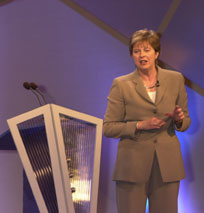
Below is the text of a press release issued by Theresa May, the then Shadow Secretary of State for the Family, on 24 August 2004.
Labour’s plans to improve access arrangements for children whose parents split up will prove to be a big disappointment, Theresa May has warned.
The Shadow Secretary for the Family accused Government ministers of “papering over the cracks” rather than addressing the real problems at the heart of Britain’s family justice system.
In a Green Paper being published by the Department for Constitutional Affairs, Labour is seeking to encourage separated parents to embark on a mediation process to find agreement on access and control over their children, rather than going to court. However, the Government has rejected the idea that parents should be guaranteed 50-50 access to their children, claiming that offspring cannot be divided up “like property” after a marriage founders.
Commenting on the proposals, Mrs May described the package as “a huge disappointment for families up and down the country”, and declared: “Rather than address the real problems at the heart of our family justice system, this Government would rather attempt to paper over the cracks. This is just another false dawn for all those many heartbroken parents and grandparents trapped for years in the courts and denied contact with their children.”
Highlighting the absence of a presumption in favour of equal rights for parents to have an influence on the upbringing of their children, Mrs May said: “This has meant that parents with residence have found it far easier to obstruct the other parent’s access to their children and their ability to have a say in how those children are brought up. Government must redress that imbalance.”
She added: “The Government has failed to grasp the real problem at the heart of the current system. What parents want is proper quality parenting time with their children, not the availability of more contact centres and warm words about ‘parenting plans’. Children need to have contact with their mothers and fathers if at all possible. The best parent is both parents. We need to ensure that children grow up with mother and father, and where ever possible Grandparents playing a full and active role in their upbringing.”
-
Ken Livingstone – 2004 Speech on Housing

Below is the text of the speech made by Ken Livingstone, the then Mayor of London, on 25 May 2004.
I am delighted to have this opportunity to speak at the second conference the Guardian has organised about housing for key workers. So much is now not just being written and said, but actually done about this important issue that it is easy to forget that just four years ago it was hardly on the agenda as a priority for policy makers.
I would like to pay tribute to the work of Chris Holmes, the former Director of Shelter, who chaired the London Housing Commission I established immediately after the first Mayoral election. It was Chris’s Commission and their report which identified just how critical this issue was for London.
The Commission rightly said: “The economic importance of London to the whole country means that the capital’s housing problems are not just a parochial matter. If London begins to fail economically there will be serious implications for the national economy…..The evidence in the Commission’s report demonstrates that there is not just a housing justification for a major increase in the rate of provision of affordable homes but also an economic justification and a public service justification.”
Another central conclusion of the Commission was that “the definition of affordability must work both for people in traditional housing need and for people on moderate incomes who cannot afford market housing.”
Over the last four years since the publication of that report we have carried that analysis through into the statutory London Plan. This now sets a requirement for new developments to contain not just traditional affordable housing, but also what has become known in the jargon as “intermediate housing”, catering precisely for the needs of those on moderate incomes up to £40,000 who are priced out of London’s housing market.
And we have secured new backing from Government for this policy approach. Government has endorsed and agreed the London plan and its housing targets; they have accepted my view that we need to support homes for rent as well as for sale for the intermediate market; and most importantly of all they have backed the policy with the funding that it – needs especially the new £700 million programme announced in March. This programme will give new affordable homes to more than 8,000 key workers in London in the next two years alone. And we have secured 62% of the national pot of resources for London.
A vital element in the approach has been to set new, higher targets for affordable housing. When I gave my backing to the Housing Commission proposal for an overall 50% target for London there was a predictable outcry from some in the housebuilding and development industry. It was claimed that setting higher targets would hold back housing production and supply.
Well now we are getting the evidence which shows that the Jeremiahs were simply wrong. The latest ODPM figures for housebuilding completions released this month show that overall housebuilding in London is up 52% since 1999/2000 and private sector housebuilding up by 55%. These welcome increases have coincided precisely with the period in which tougher affordable housing policies have been put in place because of my London Plan. And we have achieved this with the support of greatly increased public resources secured for London from government – the Housing Corporation programme up from £260 million in 199/2000 to £886 million. At the same time the housebuilders have been earning more than reasonable profits.
And we are on course to deliver 10,000 new affordable homes this year up from 6,000 in 1999/2000. More to do, of course, but we have built a really solid track record of progress. Now there is much more widespread acceptance of the policy approach from the private sector.
Given this record it is remarkable that during the current election Steve Norris should now be suggesting cutting back on the 50% target. The only consequences of this would be fewer affordable homes for Londoners and higher windfall profits for developers.
Steve is also completely wrong to claim the target is inflexible. I am inflexible about getting the maximum possible number of affordable homes for London But I promised that site by site the new policy would be implemented flexibly to ensure development was not held back. And that is what I have done on the major developments that come to me, such as on Greenwich Peninsula where we agreed 41% as part of an overall package of transport and other social infrastructure.
Had our policy starting point at Greenwich been Steve Norris’s 35% rather than 50% we would have lost at least 600 affordable homes on that one site alone. And over the next four years we would lose 20,000 affordable homes right across London.
One other important lesson from the Housing Commission is that key workers are not just nurses, teachers and police, vital though they are. The people who clean and porter at London’s hospitals are just as essential as the doctors; the people working in hotels who keep London’s tourism industry going are key workers; and so are the lower paid office workers who support London’s back office finance sector.
I agree with the Commission that our longer term objective must be to create an intermediate housing market in London that caters for the needs of all these people on moderate incomes, not just for narrowly defined occupational groups. And, of course, many of London’s key workers on the lowest incomes need more social housing. The idea that you help key workers by cutting social housing is an illusion.
But it is good news that we are now creating more low cost home ownership opportunities in London than ever before. And I am delighted that many of these schemes are also at the cutting edge of high quality design and the best environmental and energy efficiency standards.
There are fantastic examples of this built or being built in London by the private sector and by housing associations. One of the earliest housing schemes to come to me for a planning decision was the Grand Union Village scheme on the canal on the borders of Ealing and Hillingdon. When I first saw the scheme I asked my planning officers couldn’t we get more homes on the site while still having a really well designed and attractive development. If that could be done, the scheme should be more profitable which would allow the developer to provide more than the 25% affordable housing on offer.
The GLA planners were able to negotiate successfully for more homes and an increase in the amount of affordable housing to 35% with a big key worker component. I was delighted to go and open the scheme and see how not only were we housing local teachers and newly recruited police community support officers. But the scheme also met the highest standards of energy efficiency and recycling provision and had created new high quality open space and restored the canal basins.
As so often the quality of the scheme which is low rise – and the experience for people living there – was so much better at the higher density.
This month has also seen two London shared ownership schemes built by housing associations winning awards. in Haringey Circle 33 have worked with the Council and Primary Care Trust to turn an unpopular local eyesore into another award winning scheme of 71 shared ownership and rented homes, a healthy living centre and a CAB.
And in Barking Tower Homes won the national Affordable Home Ownership award for its top quality scheme of 69 shared ownership and rented homes which again meets my aspirations for more sustainable housing – photovoltaic cells in roof panels, low energy fittings, all meeting the lifetime homes standards now required by the London Plan and all with private rear gardens. This was also a scheme which tackled affordability in the right way – the average share bought was 41 per cent and the average income of the main owner £18,850.
Right across London there are more and more schemes like this underway – showing it is possible to produce genuinely mixed tenure developments – market and discounted sale, shared ownership and housing for rent – and with all the tenures pepper-potted, indistinguishable and built to the same standard. This is the right and only way forward for London’s new homes programme.
So for the future we need to keep up the pressure to hit the targets for supply and affordable supply – this year a minimum of 10,000 new affordable homes; next year closer to 15,000 and keeping at least at that level. Maintaining the overall 50% target is absolutely vital; and delivering the target will mean that we need to achieve more than 50% on some sites. Obviously housing association developments will help with that – and so will the exciting new initiative by English Partnerships to assemble land for affordable homes, especially for key workers. This should produce at least another 4,000 affordable homes over the next two to three years.
Another approach I want to encourage is securing more key worker housing without the need for public subsidy. More developers and builders are now coming forward with schemes of this sort and these should be encouraged through planning policy. On suitable sites particularly in areas where there are already high levels of social housing we should encourage developments of 100% key worker housing for rent and shared ownership. Increasingly there are signs that big financial institutions are interested in investing in this type of development opening up a minor new sources of finance for more key worker homes in London.
And we must continue to be imaginative in the way we use land – encouraging high quality mixed use development and looking for new capacity to build more homes. We have worked with the major supermarket firms to encourage them to build more housing above and around their new stores. Again this month we have seen another big scheme coming forward with Tescos planning to build 104 new homes above a new store in Clapham.
I believe there is further major potential to build new homes – and especially affordable homes – on and around rail and Underground stations and I will be asking London Underground to work with partners such as English Partnerships, housing associations and house-builders to develop a strategy to maximise these opportunities.
I will continue to work with and support other new initiatives to provide more key worker homes. Later at the Conference you will be hearing about the ‘More than Halfway There’ scheme which brings together big employers and trade unions in London to support building more key worker homes in London. I was delighted that the GLA was able to work with Britannia Building Society and other partners to support this scheme with feasilbility money, and look forward to these and other similar initiatives bearing fruit and housing London workers.
The other major challenge we face is to make sure that we deliver the new infrastructure that is essential for building London’s new homes and communities. New public transport schemes are vital to connect new homes to jobs and allow better quality and more intensive development. Cutting back on proposed transport schemes would seriously damage the drive for new homes for Londoners.
Just as important as transport is delivering more high quality schools, health care and other community facilities. These are needed for London’s growing population but will also improve services and facilities for existing residents. I have been working closely with the NHS and the Department for Education to plan together how to make these extra investments in London’s public services.
We now have much better co-ordinated policy to support the new homes Londoners need – and we have started to make real, demonstrable progress on delivering more homes and serving a much wider range of people in housing need, especially key workers. The new office of Mayor has made a decisive difference in bringing planning, housing and transport policies together, securing extra resources, supporting new initiatives and setting the right targets for new affordable homes.
The Barker Review – on the heels of the Sustainable Communities Action Plan – was the latest and perhaps most significant sign of the greater political priority the government is now giving to building new homes. Particularly significant because it comes with the backing of the Treasury.
The Treasury have accepted Kate Barker’s important recommendation about the need to bring together responsibility for strategic housing and planning policy at the regional level. We have already made big strides in that direction in London and shown the approach delivers real results, more homes. I will work with government to implement the Barker proposals in London which should mean giving the Mayor important new responsibilities for strategic housing policy and investment.. Given the right powers, more public and private investment, working in partnership, but not relaxing our targets we can deliver more and more of the high quality affordable homes London’s public and private sector workers aspire to.
-
Liam Fox – 2004 Speech to Conservative Party Conference
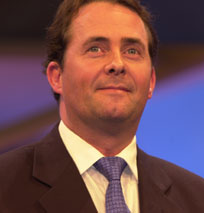
Below is the text of the speech made by Liam Fox at the Conservative Party Conference in Bournemouth on 4 October 2004.
Welcome to Bournemouth to this, our last conference in Opposition.
At this conference, a renewed and reinvigorated party will set out a clear and hopeful alternative for our country – one that promises freedom and security.
And we begin by reclaiming as our party colours the red white and blue that reflects our pride in our country. We will never surrender the colours of our flag to those on the dangerous fringe of British politics. We are the party of all Britain and all Britons.
Under the leadership of Michael Howard, we have become by far the biggest party in local government. On June 10th when millions of voters went to the polls, we pushed Labour into a humiliating third place. We triumphed in the London Assembly with our best performance since the early 90s. We have more women in local government. office than any other political party. And recently we showed that we can win again in the cities, for example, in Millwall in London, our first seat in Tower Hamlets for 40 years.
All talk and no action
Over the past year our membership has grown so that we now have more members than the Labour Party and the LibDems combined.
Remember what he said? 24 hours to save the NHS. Yet despite spending billions of pounds of your money look what’s happened. There are too many managers, too many filthy hospitals, too many people waiting for treatment – and you can’t even find an NHS dentist.
Remember he said education, education, education? But Labour have wasted billions on bureaucracy. There is too much paperwork for teachers and too little discipline for pupils.
He said tough on crime tough on the causes of crime but guess what he forgot. He forgot to be tough on the criminals, so crime, especially violent crime, is out of control. And to make matters worse, too many sentences are far too lenient.
Too many people live in fear in Blair’s Britain, a Britain crying out for more respect, more discipline and decent values.
And what about our security? At a time of greater threats from abroad what do we get from Labour? Cuts to the Army. Cuts to the Navy. Cuts to the AirForce. We will soon have a smaller navy than France for the first time since the seven years war ended in 1763.
And isn’t it shameful that this Government sent our servicemen and women to Iraq to fight without the proper equipment to protect them and keep them safe?
Then there’s asylum. Labour have lost control of asylum. Under Labour, Britain has become a soft touch. People look to us, the Conservatives, to get a grip on the system.
Of course, if you are Prime Minister, if you get five summer holiday freebies and spend more time out of Britain, these things might not matter to you .
But all these things do matter. They matter to all the people who have seen Tony Blair break his promises. Pensioners, patients, parents, pupils, taxpayers, students, our servicemen and women. Each and every one betrayed by Tony Blair.
No wonder people no longer believe a word he says. He is all talk and no action. No matter what he promises at the next election, nobody in this country will be able to trust him.
The LibDems
Of course, if you can’t trust Labour you could always try the Lib Dems.
They want to ban smoking but legalise soft drugs.
They want to license prostitution, but ban the sale of goldfish.
They want the age of criminal responsibility to go up but the age at which you can buy pornography to come down.
And they want prisoners all to have the vote – presumably because every inmate would support them.
They want a tax on zoos and a tax for regional assemblies. One MP wants cocaine to be sold from licensed premises.
They haven’t changed. They’re still a Party that likes to get high – high on taxes but low on integrity.
But a LibDem vote is not just a wasted vote, it is a dangerous vote.
Their crazy law and order policies would be even softer on crime than Labour. And their European policy would sell Britain out with a single currency, a single constitution and a single European defence policy.
They know they can never win office in Britain. But what they can never achieve in this country they would conspire to impose upon the British people from Brussels.
Michael Howard
It will fall to Michael Howard and the Conservative Party and everyone here in this hall to restore trust in British politics.
Let me tell you about Michael Howard. He gave me my first political job. Come to think of it, he may have given me my last one.
Michael is not always the easiest person to work with. He knows what he thinks and what he believes in. He likes a good argument – a very good argument.
He wants evidence and fact, not supposition and prejudice – and when he makes up his mind, he can be one of the most stubborn people I’ve ever met.
But not only is he one of the most fair and decent people I’ve worked with, but his case will always be based on reason and he will always put his country before his party.
What a contrast to our current Prime Minister, whose moral vanity means that he believes he is always right. Even his own Party can now see through the lame excuses from the lame duck Prime Minister.
The scale of our task
This Conservative Party last threw out a failed Labour Government under the brave and historic leadership of Margaret Thatcher. We owe her so much.
We were faced with a broken economy crippled by socialism. Our task this time will be just as great.
Not only will we have to restore trust in politics itself, We will have to restore the balance of power between the government and the British people.
Over the last seven years Labour have eroded more and more of our freedoms. They have created a pocket money society where the government takes more and more of our money to make more and more decisions on our behalf and they leave us with less and less income and less and less control over our own lives.
New Labour have hit us with new taxes. New taxes on pensions. New taxes on homeowners. New taxes on business.
And it is not just more taxes. They now intrude into every nook and cranny of our lives. They tell you how to do your job and how many hours you are allowed to do it for. How to bring up your child – even what to feed them. They extended means testing, so that pensioners who have spent their lives trying to be independent of the state now have to declare their savings to the ever more intrusive taxman.
This is not the nanny state – that makes it sound too cuddly – this is the intruder state, which is eroding our historic liberties, strangling our self- reliance and suffocating our freedoms.
Is this the sort of Britain we want ?
Where professionals are told how to do their jobs?
Where there is a speed camera round every corner not to make us safer but to lighten our pockets?
Where the rights of the countryside are decided by the bigotry of urban class warriors? Is this what we want?
New Labour have created a society where people increasingly feel that there is a growing gap between the law and justice. People feel that their burglars will never be caught, but they will be if they drive at 35 in a 30 zone.
And they wonder what is the point of the law if, when you fail the tests for asylum, you are still allowed to stay in this country.
Worst of all, New Labour have created a tyranny of political correctness. A tyranny where decent, ordinary people feel intimidated. They know there are things that need to be said, but they are afraid to say them.
Well, we are not afraid.
I thought it was outrageous for the Commissioner of the Metropolitan Police to tell us that “gang rape” is a politically incorrect term . Apparently it should be called group rape. Well, frankly, I couldn’t care less about the sensitivities of rapists – what about the sensitivities of the victims of rape?
If a husband kills his wife in their home it’s not ” a case of domestic violence”- it’s murder. Let’s call it that.
And drunk youngsters on street corners who threaten old people are not guilty of “social disorder”, they are yobs, they are thugs and they are hooligans.
Its time to start saying things as they are.
A Conservative alternative
Britain is crying out for a new direction and this week we will give it. People are tired of Labour’s words. Tired of soundbites and empty promises. They are tired of being preached at.
They want action. And this week we’ll tell them what the next Conservative Government will do – and how we will make a difference.
Andrew Lansley will show how we will get our hospitals clean, get money through to doctors and nurses and give patients the opportunity to choose where and when they get their treatment.
David Davis will show how we will cut police paperwork, put more police on the beat and stop the early release scheme that puts the public at risk by letting dangerous criminals out too soon.
Tim Collins will show how we will restore discipline in schools and give parents the opportunity to choose the best school for their child.
We will show how we will stop Labour’s reckless defence cuts and make sure we have the armed forces to do the job.
And we will set a firm timetable for a referendum on the European constitution. If we win an election in May we will hold a referendum before we meet at next year’s Party Conference- a pledge that only the Conservative Party can deliver. We will campaign for a No vote. And we will get a No vote.
We will show that you can get a grip on asylum and stop Britain being a soft touch. It is not ” a lurch to the right” but an overdue response to the real anxieties expressed by the British people. If we do not deal fairly and clearly with these issues then there are those on the shadowy extremes of British politics who would love to exploit them.
We need a fair but firm system that helps genuine refugees. We will introduce a points system like they have in Australia. It will give priority to those who want to come to Britain to work hard and make a positive contribution to our country.
And, for the first time, we will set a ceiling on the number of people who can come into the United Kingdom each year.
Cleaner hospitals, discipline in schools, an end to political correctness, police on the beat, support for our armed forces, control of our borders and the British people controlling their own future in Europe.
A Conservative Government delivering freedom from fear and the security to enjoy our liberties.
A timetable for action
People are fed up with talk. They want action. They don’t want vague promises. They want to know exactly what a Conservative Government would do – and when.
That is why, that at this Conference, will do something that has never been done before. We will set a timetable for action. We will set out what we will actually do in our first day, our first week, our first month in office. So that people will know how to judge our performance, so that we can be held to account – so that we can restore trust between the government and the people of our country.
Natural Conservatives
We will show that there are huge differences in the way we see our future. Political parties are not all the same.
I don’t know about you, but one thing that makes me mad is when people say Tony Blair’s really a Conservative. He’s even had the nerve to compare himself to Margaret Thatcher. To paraphrase Lloyd Bentsen, we know Margaret Thatcher, we worked with Margaret Thatcher – Mr. Blair, you’re no Margaret Thatcher.
Tony Blair has raised tax and wasted our money. He has presided over an explosion in crime. He has lost control over the asylum system. He has failed to deliver his promises on health and education and he will sell us out on the European constitution. He’s no Conservative.
There is a fundamental difference between us and Tony Blair. On tax, we’re right and he’s wrong. On crime and asylum we’re right and he’s wrong. And on health, education and especially on our future in Europe, we’re right and he’s wrong.
All across this country, there are natural conservatives looking for leadership, for a place to go. They have forgotten what we stand for because we have stopped telling them. So, for those who wonder if they are natural conservatives, let me say this with all due respect to the Governor of California.
If you believe that the first duty of the government is defence of this country, then you are a conservative.
If you believe that you should keep more of your own hard-earned income, then you are a conservative.
If you believe that those who save for themselves and their families should be rewarded not penalized, then you are a conservative.
If you believe that government should give us the tools, get off our backs and let us get on with our lives, then you are a conservative.
If you believe the law is for the security of the law abiding and to punish not to excuse criminals, then you are a conservative.
If you believe that we are a nation of individuals whose talents and diversity should be encouraged, you are a conservative
And if you believe that the British people should have control of their own destiny, then you are a conservative.
We must tell these things to the British people with clarity and courage. We can restore trust in politics.
There is an alternative.
You can make a difference.
Less talk, more action.
For the sake of this country the fight starts today.